Text Comprehension
Instruction
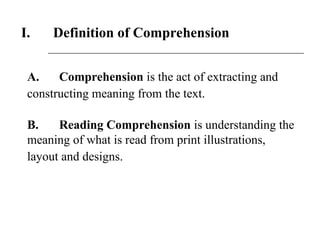
I. Definition of Comprehension
B. Reading Comprehension is understanding the
meaning of what is read from print illustrations,
layout and designs.
A. Comprehension is the act of extracting and
constructing meaning from the text.
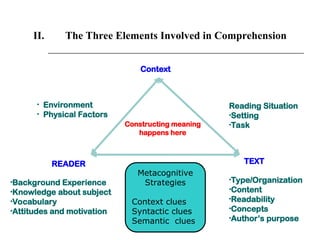
II. The Three Elements Involved in Comprehension
Context
READER TEXT
Constructing meaning
happens here
•Background Experience
•Knowledge about subject
•Vocabulary
•Attitudes and motivation
•Type/Organization
•Content
•Readability
•Concepts
•Author’s purpose
Reading Situation
•Setting
•Task
• Environment
• Physical Factors
Metacognitive
Strategies
Context clues
Syntactic clues
Semantic clues
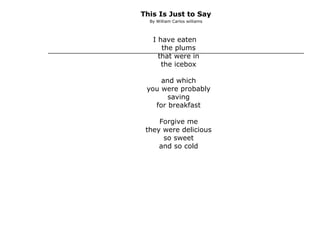
This Is Just to Say
By William Carlos williams
I have eaten
the plums
that were in
the icebox
and which
you were probably
saving
for breakfast
Forgive me
they were delicious
so sweet
and so cold
III. Strategies in Teaching Reading Comprehension
A. Informative/Expository Text
BEFORE READING
III. Strategies in Teaching Reading Comprehension
BEFORE READING: Informative Text
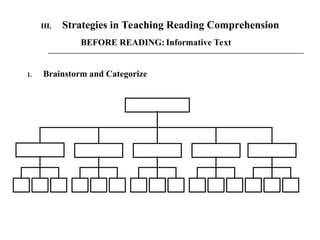
1. Brainstorm and Categorize
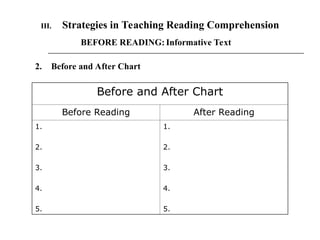
Before and After Chart
Before Reading After Reading
1.
2.
3.
4.
5.
1.
2.
3.
4.
5.
III. Strategies in Teaching Reading Comprehension
BEFORE READING: Informative Text
2. Before and After Chart
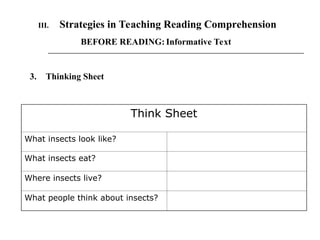
Think Sheet
What insects look like?
What insects eat?
Where insects live?
What people think about insects?
III. Strategies in Teaching Reading Comprehension
BEFORE READING: Informative Text
3. Thinking Sheet
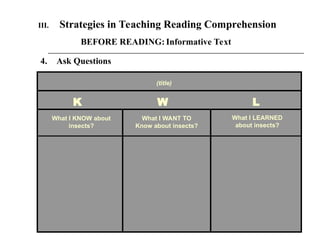
What I KNOW about
insects?
K W L
(title)
What I WANT TO
Know about insects?
What I LEARNED
about insects?
III. Strategies in Teaching Reading Comprehension
BEFORE READING: Informative Text
4. Ask Questions
III. Strategies in Teaching Reading Comprehension
A. Informative Text
DURING READING
III. Strategies in Teaching Reading Comprehension
1. Check the text Strategy
This strategy is useful for individuals or mixed ability groups
working collaboratively. This encourages readers to interpret
illustrations and diagrams when reading.
Procedure:
a. Cover text so that children can examine diagram or picture.
b. Allow time for children to discuss the picture.
c. Children then write text to match the pictures.
d. Uncover the text and compare children’s version with the text.
DURING READING: Informative Text
III. Strategies in Teaching Reading Comprehension
2. Directed Teacher Reading (DTR)
This gives students practice in identifying important information and raises
their awareness of the processes involved in reading for meaning. They are
also encourage to monitor their understanding by sharing responses with the
other group members.
Procedure:
a. Each student needs a copy of the text.
b. Set a focus question to give purpose to the reading.
c. Read the text to the students.
d. Early finishes can be asked to set the group another questions.
e. Discuss the passage by first answering the focus question.
f. Allow students to ask some of their questions.
g. Probe student’s understanding by asking questions that require
different levels of comprehension.
DURING READING: Informative Text
III. Strategies in Teaching Reading Comprehension
3. Ask the Teacher
This strategy improves student’s comprehension by teaching
them how to formulate questions independently and monitor their
comprehension.
Procedure:
a. Teacher reads the first sentence, paragraph, chapter of the text.
b. Close the book.
c. Request students to ask questions as many as they can about the text
that was just read.
d. Ask questions to add students’ understanding of the text.
e. Model different types of questions:
e.1. What do you think…?
e.2. Would the author agree…?
f. Continue this procedure with the next part of the text.
DURING READING: Informative Text
III. Strategies in Teaching Reading Comprehension
5. Find the Main Idea
Students may be asked to read a piece of text if they can. If not,
have the teacher read the text to them and find the main idea/s. Main ideas
may be stated in topic sentence that require literal translation. It may be
implied and require the reader to connect information and make inferences.
Procedure:
a. Write words from topic into cards and work with students to classify
them according to common features.
b. Give each category a heading
c. Have students work in group to practice classifying.
d. Vary activities by specifying categories and sometimes allow
students to study the words to see relationships and devise appropriate
categories.
DURING READING: Informative Text
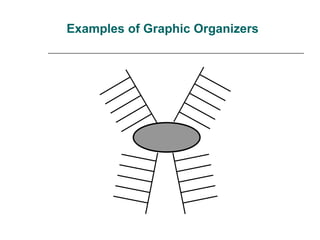
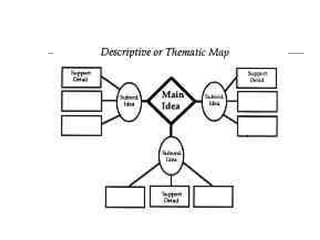
Examples of Graphic Organizers
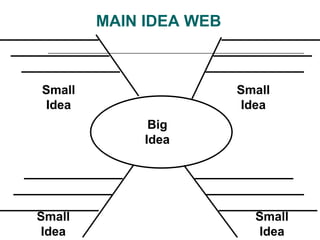
MAIN IDEA WEB
Big
Idea
Small
Idea
Small
Idea
Small
Idea
Small
Idea
III. Strategies in Teaching Reading Comprehension
A. Informative Text
AFTER READING
III. Strategies in Teaching Reading Comprehension
1. Cloze
Cloze procedure encourages students to use syntactic cues when
reading.
Procedure:
a. Produce text in which some words are deleted
b. Ask students to read the passage and insert suitable words. Words
should be chosen after student as:
* Does it make sense?
* Does it sound right?
c. Give 2-3 words to choose for each deletion when starting to use
written cloze.
d. Allow students to work in groups and debate on their choice of
words.
AFTER READING: Informative Text
III. Strategies in Teaching Reading Comprehension
Read the passage once without first answering it. Read it again and start
completing the gaps.
Ang mga hulmigas mga gagmayng binuhat sa Ginoo. Nagapuyo sila sa
balay, sa kaumahan, sa kasagingan, sa kakahuyan ug uban pang nagkalain laing
dapit. Sila mga ________nga binuhat.
Nagkalain lain ang klase sa mga ______ dunay dagko, aduna poy
gagmay. Adunay pula, adunay itom ug adunay puti nga mga hulmigas.
Cloze Passage
AFTER READING: Informative Text
kugihan
hulmigas.
III. Strategies in Teaching Reading Comprehension
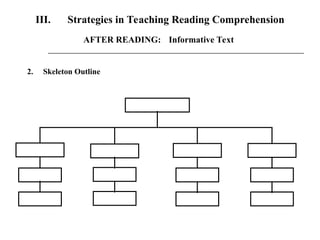
2. Skeleton Outline
AFTER READING: Informative Text
Read the selection, then classify the items in the text using the
diagram below.
The Ants
Title
I. Major Topic
A. Sub-topic: Food
1. worm
2. flour
3. sweets
B. Sub-topic: Habits
1. carry food
2. makes nests
C. Sub-topic; Classes
1. big
2. small
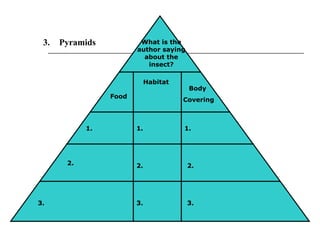
What is the
author saying
about the
insect?
Habitat
Food
Body
Covering
1.
2.
3.
1. 1.
2. 2.
3. 3.
3. Pyramids
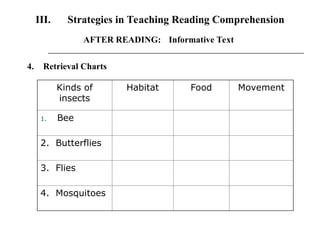
Kinds of
insects
Habitat Food Movement
1. Bee
2. Butterflies
3. Flies
4. Mosquitoes
4. Retrieval Charts
III. Strategies in Teaching Reading Comprehension
AFTER READING: Informative Text
III. Strategies in Teaching Reading Comprehension
B. Narrative Text
BEFORE READING
Five Little Monkeys.mp4
 Micro Demo
III. Strategies in Teaching Reading Comprehension
BEFORE READING: Narrative Text
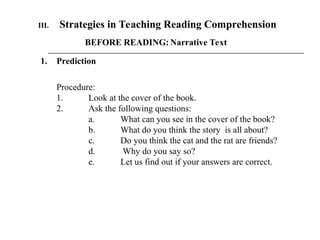
1. Prediction
Procedure:
1. Look at the cover of the book.
2. Ask the following questions:
a. What can you see in the cover of the book?
b. What do you think the story is all about?
c. Do you think the cat and the rat are friends?
d. Why do you say so?
e. Let us find out if your answers are correct.
BEFORE READING: Narrative Text
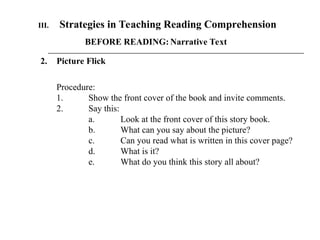
2. Picture Flick
III. Strategies in Teaching Reading Comprehension
Procedure:
1. Show the front cover of the book and invite comments.
2. Say this:
a. Look at the front cover of this story book.
b. What can you say about the picture?
c. Can you read what is written in this cover page?
d. What is it?
e. What do you think this story all about?
III. Strategies in Teaching Reading Comprehension
BEFORE READING: Narrative Text
3. Book Features
Procedure:
1. Show the book.
2. Discuss the following:
a. title
b. author
c. illustrator
d. overview
First Lines
First Lines is a pre-reading comprehension strategy
in which students read the beginning sentences from
a book and then make predictions about that book.
This technique helps students focus their attention on
what they can tell from the first lines of a story,
play, poem, or other text. As students read the text
in its entirety they discuss, revisit and/or revise
their original predictions.
III. Strategies in Teaching Reading Comprehension
BEFORE READING: Narrative Text
4. Set the Scene
Procedure:
1. Discuss the title, the illustrator, and the author.
2. Help children recall story/ies that have the same author or
illustrator.
3. Discuss the type of the story:
a. myths
b. legends
c. fables
d. fairytales
e. folktales
III. Strategies in Teaching Reading Comprehension
BEFORE READING: Narrative Text
5. Brainstorming
Procedure:
1. Talk about the story structure.
2. Ask students questions like;
a. What do you know about fables?
b. What words in the story that is new to you?
3. Unfold these difficult words identified by the pupils for
better understanding.
4. Talk about the theme.
5. Relate pupils’ experiences to the theme/topic. Say these;
a. Sometimes people are very excited when they
see a lot of food. Can you tell us about the time when
you get excited of many foods offered?
b. What do you think happens when you are
hungry and you eat a lot?
III. Strategies in Teaching Reading Comprehension
DURING READING
B. Narrative Text
III. Strategies in Teaching Reading Comprehension
1. Reader’s Circle
Procedure:
a. Pupils should sit in circle with the teacher.
b. Read aloud the story.
c. Read the title and ask for predictions .
d. Return to the text to confirm answers.
e. Ask children to make further predictions and then
continue with another section of the text.
f. Interrupt reading by asking questions about the
author’s purpose of writing the story.
DURING READING: Narrative Text
2. Oral Summaries
Procedure:
a. Read the story lines.
b. Ask each one to summarize what has
happened so far in the story.
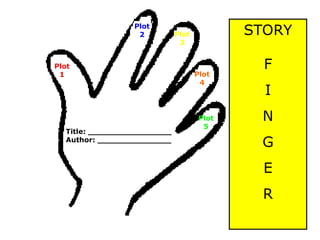
c. Use the story finger to sequence events.
III. Strategies in Teaching Reading Comprehension
DURING READING: Narrative Text
Plot
1
Plot
2 Plot
3
Plot
4
Plot
5
Title: _________________
Author: _______________
STORY
F
I
N
G
E
R
III. Strategies in Teaching Reading Comprehension
3.
Procedure:
a. Read a section of the story.
b. Request students to imagine the following:
1. character
2. setting
3. action
c. Sharing thoughts with partner.
d. Return to the next section.
e. Request students to skim and scan to
substantiate what they are thinking.
DURING READING: Narrative Text
III. Strategies in Teaching Reading Comprehension
4. Read and Think
Procedure:
a. Give copies of the reading material.
b. Read the first paragraph to the students.
c. Ask questions
c.1. While are you thinking while listening
to the story
c.2. What do you think will happen next?
c.3. What other questions do you have
d. Continue reading the text.
e. Stop at intervals to repeat the procedure outlined.
DURING READING: Narrative Text
III. Strategies in Teaching Reading Comprehension
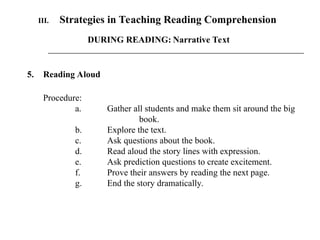
5. Reading Aloud
Procedure:
a. Gather all students and make them sit around the big
book.
b. Explore the text.
c. Ask questions about the book.
d. Read aloud the story lines with expression.
e. Ask prediction questions to create excitement.
f. Prove their answers by reading the next page.
g. End the story dramatically.
DURING READING: Narrative Text
III. Strategies in Teaching Reading Comprehension
AFTER READING
B. Narrative Text
III. Strategies in Teaching Reading Comprehension
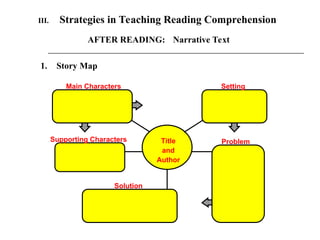
Main Characters Setting
Supporting Characters
Solution
Problem
Title
and
Author
1. Story Map
AFTER READING: Narrative Text
III. Strategies in Teaching Reading Comprehension
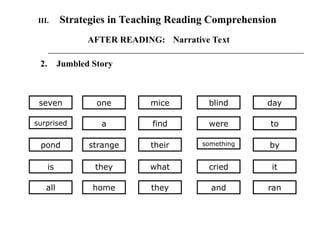
2. Jumbled Story
seven one mice blind
surprised a find were
pond strange their something
is they what cried
all home they and
day
to
by
it
ran
AFTER READING: Narrative Text
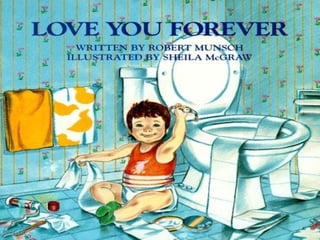
MICRO TEACH
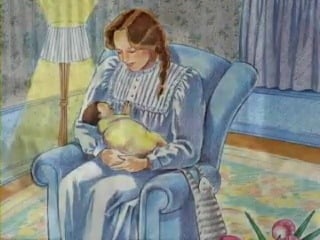
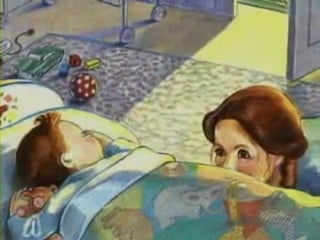
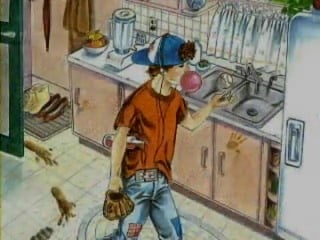
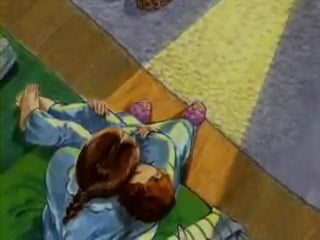
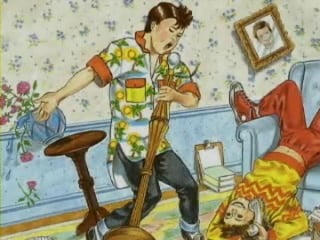
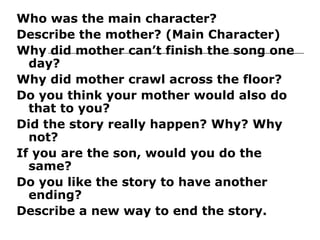
Who was the main character?
Describe the mother? (Main Character)
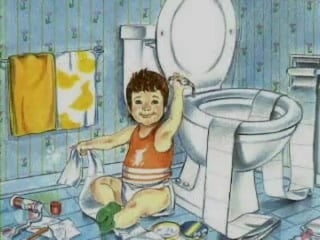
Why did mother can’t finish the song one
day?
Why did mother crawl across the floor?
Do you think your mother would also do
that to you?
Did the story really happen? Why? Why
not?
If you are the son, would you do the
same?
Do you like the story to have another
ending?
Describe a new way to end the story.
TEACHING READING COMPREHENSION in instruction

TEACHING READING COMPREHENSION in instruction

  • 1.
  • 2.
    I. Definition ofComprehension B. Reading Comprehension is understanding the meaning of what is read from print illustrations, layout and designs. A. Comprehension is the act of extracting and constructing meaning from the text.
  • 3.
    II. The ThreeElements Involved in Comprehension Context READER TEXT Constructing meaning happens here •Background Experience •Knowledge about subject •Vocabulary •Attitudes and motivation •Type/Organization •Content •Readability •Concepts •Author’s purpose Reading Situation •Setting •Task • Environment • Physical Factors Metacognitive Strategies Context clues Syntactic clues Semantic clues
  • 4.
    This Is Justto Say By William Carlos williams I have eaten the plums that were in the icebox and which you were probably saving for breakfast Forgive me they were delicious so sweet and so cold
  • 5.
    III. Strategies inTeaching Reading Comprehension A. Informative/Expository Text BEFORE READING
  • 6.
    III. Strategies inTeaching Reading Comprehension BEFORE READING: Informative Text 1. Brainstorm and Categorize
  • 7.
    Before and AfterChart Before Reading After Reading 1. 2. 3. 4. 5. 1. 2. 3. 4. 5. III. Strategies in Teaching Reading Comprehension BEFORE READING: Informative Text 2. Before and After Chart
  • 8.
    Think Sheet What insectslook like? What insects eat? Where insects live? What people think about insects? III. Strategies in Teaching Reading Comprehension BEFORE READING: Informative Text 3. Thinking Sheet
  • 9.
    What I KNOWabout insects? K W L (title) What I WANT TO Know about insects? What I LEARNED about insects? III. Strategies in Teaching Reading Comprehension BEFORE READING: Informative Text 4. Ask Questions
  • 10.
    III. Strategies inTeaching Reading Comprehension A. Informative Text DURING READING
  • 11.
    III. Strategies inTeaching Reading Comprehension 1. Check the text Strategy This strategy is useful for individuals or mixed ability groups working collaboratively. This encourages readers to interpret illustrations and diagrams when reading. Procedure: a. Cover text so that children can examine diagram or picture. b. Allow time for children to discuss the picture. c. Children then write text to match the pictures. d. Uncover the text and compare children’s version with the text. DURING READING: Informative Text
  • 12.
    III. Strategies inTeaching Reading Comprehension 2. Directed Teacher Reading (DTR) This gives students practice in identifying important information and raises their awareness of the processes involved in reading for meaning. They are also encourage to monitor their understanding by sharing responses with the other group members. Procedure: a. Each student needs a copy of the text. b. Set a focus question to give purpose to the reading. c. Read the text to the students. d. Early finishes can be asked to set the group another questions. e. Discuss the passage by first answering the focus question. f. Allow students to ask some of their questions. g. Probe student’s understanding by asking questions that require different levels of comprehension. DURING READING: Informative Text

  • 13.
    III. Strategies inTeaching Reading Comprehension 3. Ask the Teacher This strategy improves student’s comprehension by teaching them how to formulate questions independently and monitor their comprehension. Procedure: a. Teacher reads the first sentence, paragraph, chapter of the text. b. Close the book. c. Request students to ask questions as many as they can about the text that was just read. d. Ask questions to add students’ understanding of the text. e. Model different types of questions: e.1. What do you think…? e.2. Would the author agree…? f. Continue this procedure with the next part of the text. DURING READING: Informative Text
  • 14.
    III. Strategies inTeaching Reading Comprehension 5. Find the Main Idea Students may be asked to read a piece of text if they can. If not, have the teacher read the text to them and find the main idea/s. Main ideas may be stated in topic sentence that require literal translation. It may be implied and require the reader to connect information and make inferences. Procedure: a. Write words from topic into cards and work with students to classify them according to common features. b. Give each category a heading c. Have students work in group to practice classifying. d. Vary activities by specifying categories and sometimes allow students to study the words to see relationships and devise appropriate categories. DURING READING: Informative Text
  • 15.
  • 16.
  • 18.
    III. Strategies inTeaching Reading Comprehension A. Informative Text AFTER READING
  • 19.
    III. Strategies inTeaching Reading Comprehension 1. Cloze Cloze procedure encourages students to use syntactic cues when reading. Procedure: a. Produce text in which some words are deleted b. Ask students to read the passage and insert suitable words. Words should be chosen after student as: * Does it make sense? * Does it sound right? c. Give 2-3 words to choose for each deletion when starting to use written cloze. d. Allow students to work in groups and debate on their choice of words. AFTER READING: Informative Text
  • 20.
    III. Strategies inTeaching Reading Comprehension Read the passage once without first answering it. Read it again and start completing the gaps. Ang mga hulmigas mga gagmayng binuhat sa Ginoo. Nagapuyo sila sa balay, sa kaumahan, sa kasagingan, sa kakahuyan ug uban pang nagkalain laing dapit. Sila mga ________nga binuhat. Nagkalain lain ang klase sa mga ______ dunay dagko, aduna poy gagmay. Adunay pula, adunay itom ug adunay puti nga mga hulmigas. Cloze Passage AFTER READING: Informative Text kugihan hulmigas.
  • 21.
    III. Strategies inTeaching Reading Comprehension 2. Skeleton Outline AFTER READING: Informative Text
  • 22.
    Read the selection,then classify the items in the text using the diagram below. The Ants Title I. Major Topic A. Sub-topic: Food 1. worm 2. flour 3. sweets B. Sub-topic: Habits 1. carry food 2. makes nests C. Sub-topic; Classes 1. big 2. small
  • 23.
    What is the authorsaying about the insect? Habitat Food Body Covering 1. 2. 3. 1. 1. 2. 2. 3. 3. 3. Pyramids
  • 24.
    Kinds of insects Habitat FoodMovement 1. Bee 2. Butterflies 3. Flies 4. Mosquitoes 4. Retrieval Charts III. Strategies in Teaching Reading Comprehension AFTER READING: Informative Text
  • 26.
    III. Strategies inTeaching Reading Comprehension B. Narrative Text BEFORE READING
  • 27.
  • 28.
  • 29.
    III. Strategies inTeaching Reading Comprehension BEFORE READING: Narrative Text 1. Prediction Procedure: 1. Look at the cover of the book. 2. Ask the following questions: a. What can you see in the cover of the book? b. What do you think the story is all about? c. Do you think the cat and the rat are friends? d. Why do you say so? e. Let us find out if your answers are correct.
  • 30.
    BEFORE READING: NarrativeText 2. Picture Flick III. Strategies in Teaching Reading Comprehension Procedure: 1. Show the front cover of the book and invite comments. 2. Say this: a. Look at the front cover of this story book. b. What can you say about the picture? c. Can you read what is written in this cover page? d. What is it? e. What do you think this story all about?
  • 31.
    III. Strategies inTeaching Reading Comprehension BEFORE READING: Narrative Text 3. Book Features Procedure: 1. Show the book. 2. Discuss the following: a. title b. author c. illustrator d. overview
  • 32.
    First Lines First Linesis a pre-reading comprehension strategy in which students read the beginning sentences from a book and then make predictions about that book. This technique helps students focus their attention on what they can tell from the first lines of a story, play, poem, or other text. As students read the text in its entirety they discuss, revisit and/or revise their original predictions.
  • 33.
    III. Strategies inTeaching Reading Comprehension BEFORE READING: Narrative Text 4. Set the Scene Procedure: 1. Discuss the title, the illustrator, and the author. 2. Help children recall story/ies that have the same author or illustrator. 3. Discuss the type of the story: a. myths b. legends c. fables d. fairytales e. folktales
  • 34.
    III. Strategies inTeaching Reading Comprehension BEFORE READING: Narrative Text 5. Brainstorming Procedure: 1. Talk about the story structure. 2. Ask students questions like; a. What do you know about fables? b. What words in the story that is new to you? 3. Unfold these difficult words identified by the pupils for better understanding. 4. Talk about the theme. 5. Relate pupils’ experiences to the theme/topic. Say these; a. Sometimes people are very excited when they see a lot of food. Can you tell us about the time when you get excited of many foods offered? b. What do you think happens when you are hungry and you eat a lot?
  • 35.
    III. Strategies inTeaching Reading Comprehension DURING READING B. Narrative Text
  • 36.
    III. Strategies inTeaching Reading Comprehension 1. Reader’s Circle Procedure: a. Pupils should sit in circle with the teacher. b. Read aloud the story. c. Read the title and ask for predictions . d. Return to the text to confirm answers. e. Ask children to make further predictions and then continue with another section of the text. f. Interrupt reading by asking questions about the author’s purpose of writing the story. DURING READING: Narrative Text
  • 37.
    2. Oral Summaries Procedure: a.Read the story lines. b. Ask each one to summarize what has happened so far in the story. c. Use the story finger to sequence events. III. Strategies in Teaching Reading Comprehension DURING READING: Narrative Text
  • 38.
  • 39.
    III. Strategies inTeaching Reading Comprehension 3. Procedure: a. Read a section of the story. b. Request students to imagine the following: 1. character 2. setting 3. action c. Sharing thoughts with partner. d. Return to the next section. e. Request students to skim and scan to substantiate what they are thinking. DURING READING: Narrative Text
  • 40.
    III. Strategies inTeaching Reading Comprehension 4. Read and Think Procedure: a. Give copies of the reading material. b. Read the first paragraph to the students. c. Ask questions c.1. While are you thinking while listening to the story c.2. What do you think will happen next? c.3. What other questions do you have d. Continue reading the text. e. Stop at intervals to repeat the procedure outlined. DURING READING: Narrative Text
  • 41.
    III. Strategies inTeaching Reading Comprehension 5. Reading Aloud Procedure: a. Gather all students and make them sit around the big book. b. Explore the text. c. Ask questions about the book. d. Read aloud the story lines with expression. e. Ask prediction questions to create excitement. f. Prove their answers by reading the next page. g. End the story dramatically. DURING READING: Narrative Text
  • 42.
    III. Strategies inTeaching Reading Comprehension AFTER READING B. Narrative Text
  • 43.
    III. Strategies inTeaching Reading Comprehension Main Characters Setting Supporting Characters Solution Problem Title and Author 1. Story Map AFTER READING: Narrative Text
  • 44.
    III. Strategies inTeaching Reading Comprehension 2. Jumbled Story seven one mice blind surprised a find were pond strange their something is they what cried all home they and day to by it ran AFTER READING: Narrative Text
  • 45.
  • 62.
    Who was themain character? Describe the mother? (Main Character) Why did mother can’t finish the song one day? Why did mother crawl across the floor? Do you think your mother would also do that to you? Did the story really happen? Why? Why not? If you are the son, would you do the same? Do you like the story to have another ending? Describe a new way to end the story.