BEFORE, DURING AND
AFTER READING
STRATEGIES
MIRANDA MIJARES RED4348
Before, During and After Reading Strategies
◦ It is important to keep the students engaged and involved in the reading process.
◦ Using the before, during and after reading strategies improve students comprehension and
ensure that students retain the information that they have read in their long term memory.
◦ “The most productive comprehension instruction occurs when a teacher asks a high percentage
of questions requiring thought before, during and after reading” (Pg. 298).
Before Reading Strategies
◦ Connect to Prior Knowledge
◦ Picture Walk
◦ Pre Teach Key Vocabulary
◦ Create a Purpose for Reading
◦ Graphic Organizer
Connect to Prior Knowledge
◦ “Good readers make predictions based on background knowledge, focus on looking forward
and backward in the text to find important information, paraphrase, explain, summarize and
construct conclusions about what they read” (Pg. 284).
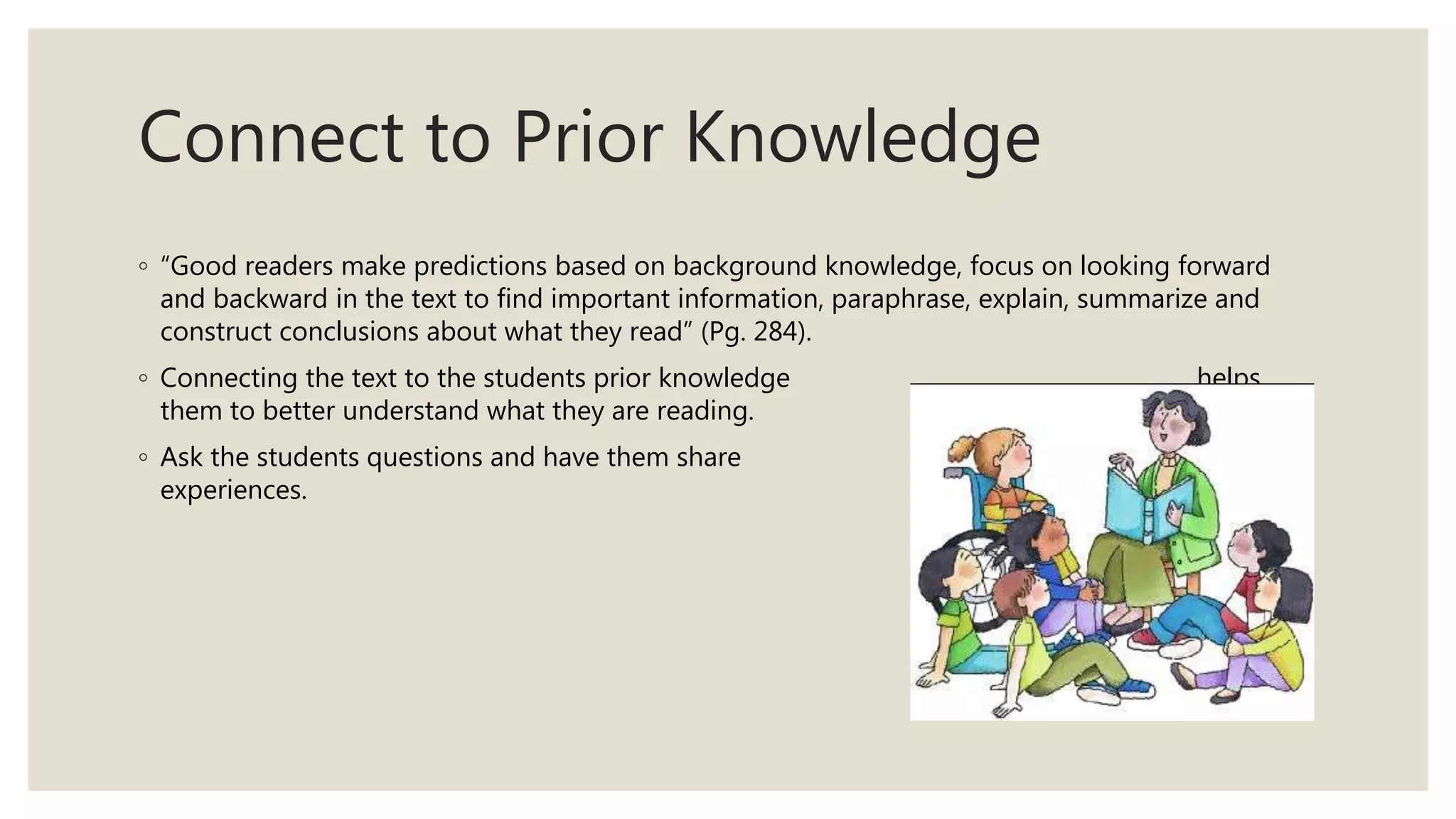
◦ Connecting the text to the students prior knowledge helps
them to better understand what they are reading.
◦ Ask the students questions and have them share personal
experiences.
Picture Walk
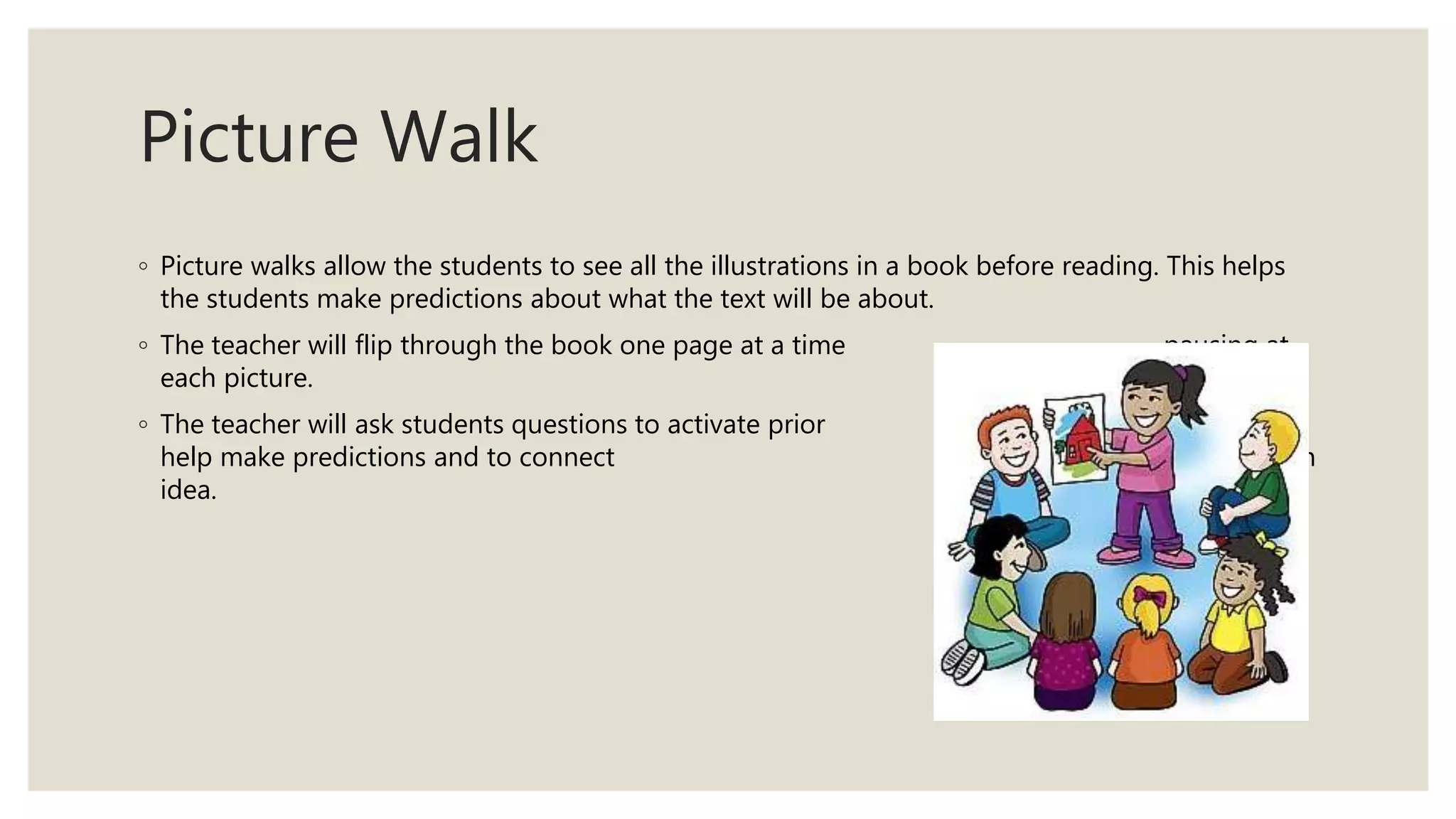
◦ Picture walks allow the students to see all the illustrations in a book before reading. This helps
the students make predictions about what the text will be about.
◦ The teacher will flip through the book one page at a time pausing at
each picture.
◦ The teacher will ask students questions to activate prior knowledge, to
help make predictions and to connect the pictures to the main
idea.
Pre Teach Key Vocabulary
◦ The teacher will select vocabulary words from the text that the students might not know.
◦ The teacher will have the students skim the text to find unknown words.
◦ The teacher will define the words for the students or have the students define them and share
with the rest of the class.
◦ The teacher can ask the students to use the vocabulary words in a sentence to make sure that
they comprehend them.
Create a Purpose for Reading
◦ The teacher will create a purpose for reading by giving students different things to look for
while reading such as introducing the after reading activity. This gives students a purpose for
listening and understanding the reading.
◦ The teacher can allow the students to choose their own text.
Graphic Organizer
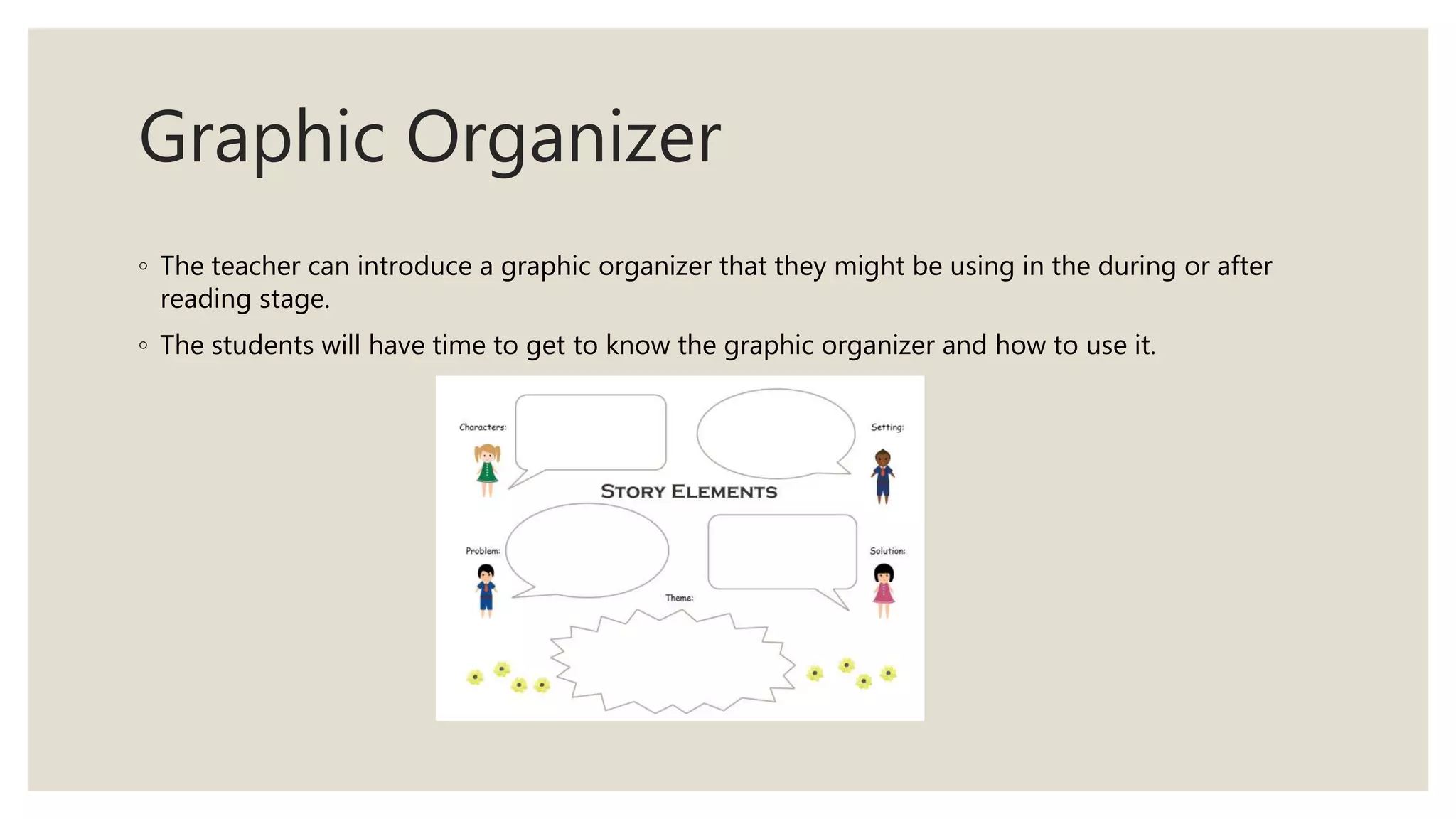
◦ The teacher can introduce a graphic organizer that they might be using in the during or after
reading stage.
◦ The students will have time to get to know the graphic organizer and how to use it.
During Reading Strategies
◦ Reciprocal Teaching
◦ Think-A-Louds
◦ Fact Charts
◦ Close Reading
◦ Story Map
Reciprocal Teaching
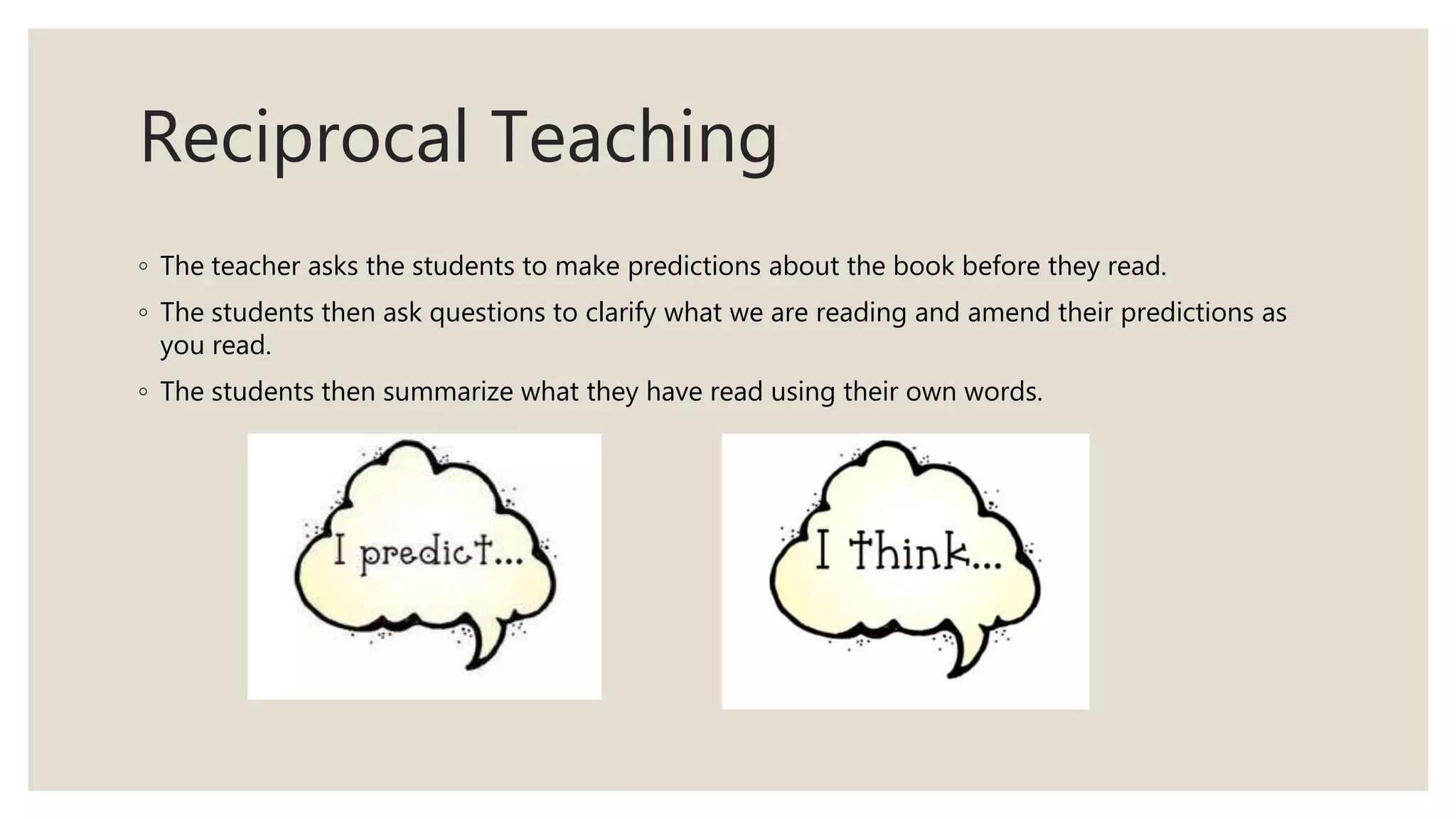
◦ The teacher asks the students to make predictions about the book before they read.
◦ The students then ask questions to clarify what we are reading and amend their predictions as
you read.
◦ The students then summarize what they have read using their own words.
Think-Alouds
◦ The teacher reads the story out loud to the
students. While the teacher is reading she
says what she is thinking.
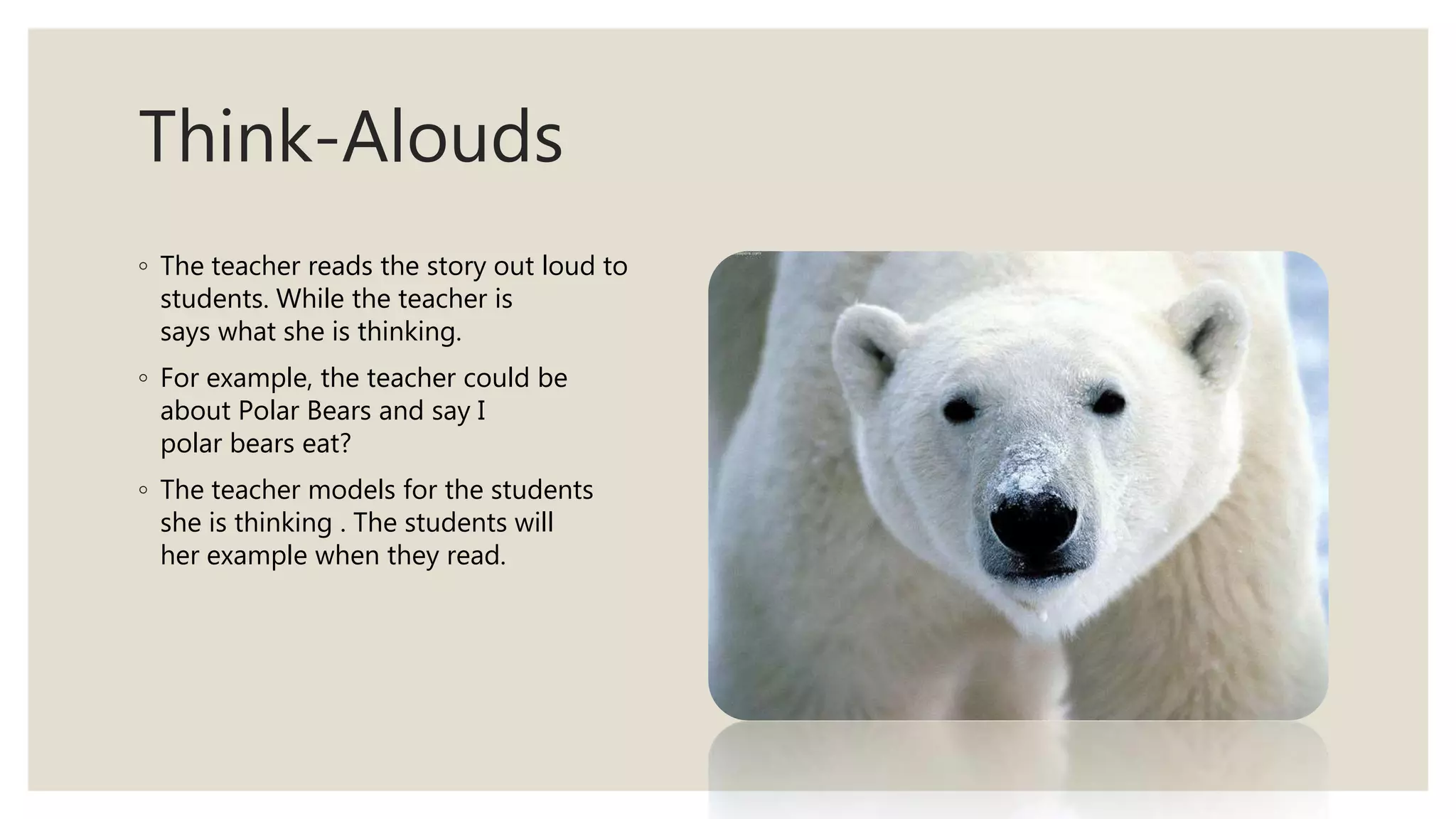
◦ For example, the teacher could be reading
about Polar Bears and say I wonder what
polar bears eat?
◦ The teacher models for the students what
she is thinking . The students will then follow
her example when they read.
Fact Charts
◦ The teacher will create a chart for all the students to see that contain facts that they learned
while reading the book.
◦ This chart helps students pay attention to important details as they read and display them neatly
on a chart for them to refer back to.
Close Reading
◦ “A method in which students read and reread text in order to focus on its increasingly deeper
meanings” (Pg. 292).
◦ This technique is used for more complex text.
◦ Questions should increase in difficulty with each rereading of the text.
Story Map
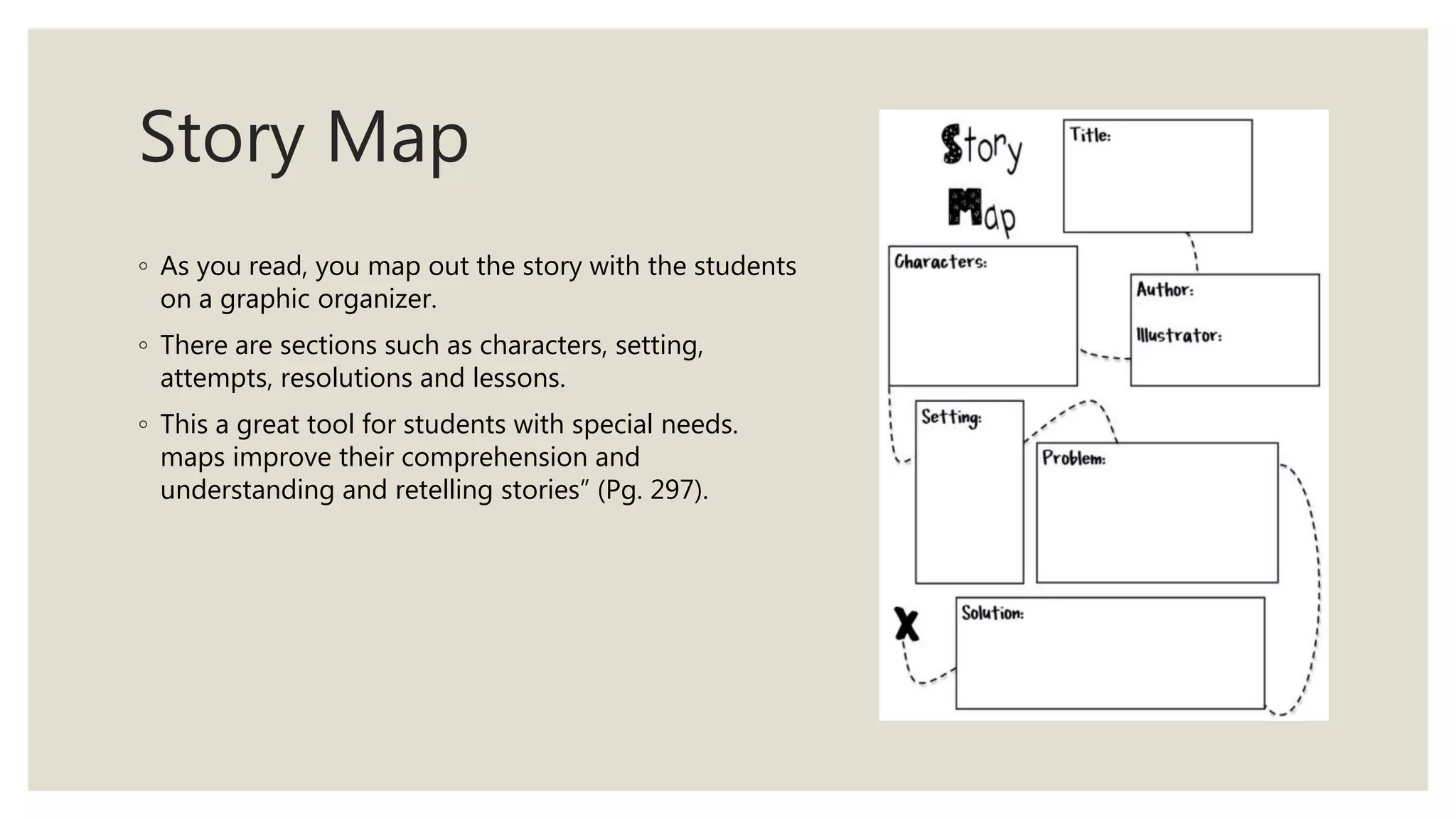
◦ As you read, you map out the story with the students
on a graphic organizer.
◦ There are sections such as characters, setting, problems,
attempts, resolutions and lessons.
◦ This a great tool for students with special needs. “Story
maps improve their comprehension and provide a visual guide to
understanding and retelling stories” (Pg. 297).
After Reading Strategies
◦ Discussions
◦ Summarize
◦ Create a Timeline
◦ Reflect
◦ Retelling
Discussions
◦ Ask the students questions about the book. The whole class listens to the answers.
◦ What is one things that you learned?
◦ What interested you?
◦ What surprised you?
◦ What was your favorite part?
Summarize
◦ Ask the students to help you summarize the book.
◦ Make sure that the students recall the important details.
◦ For students with special needs you can let them use the story map when making their
summary.
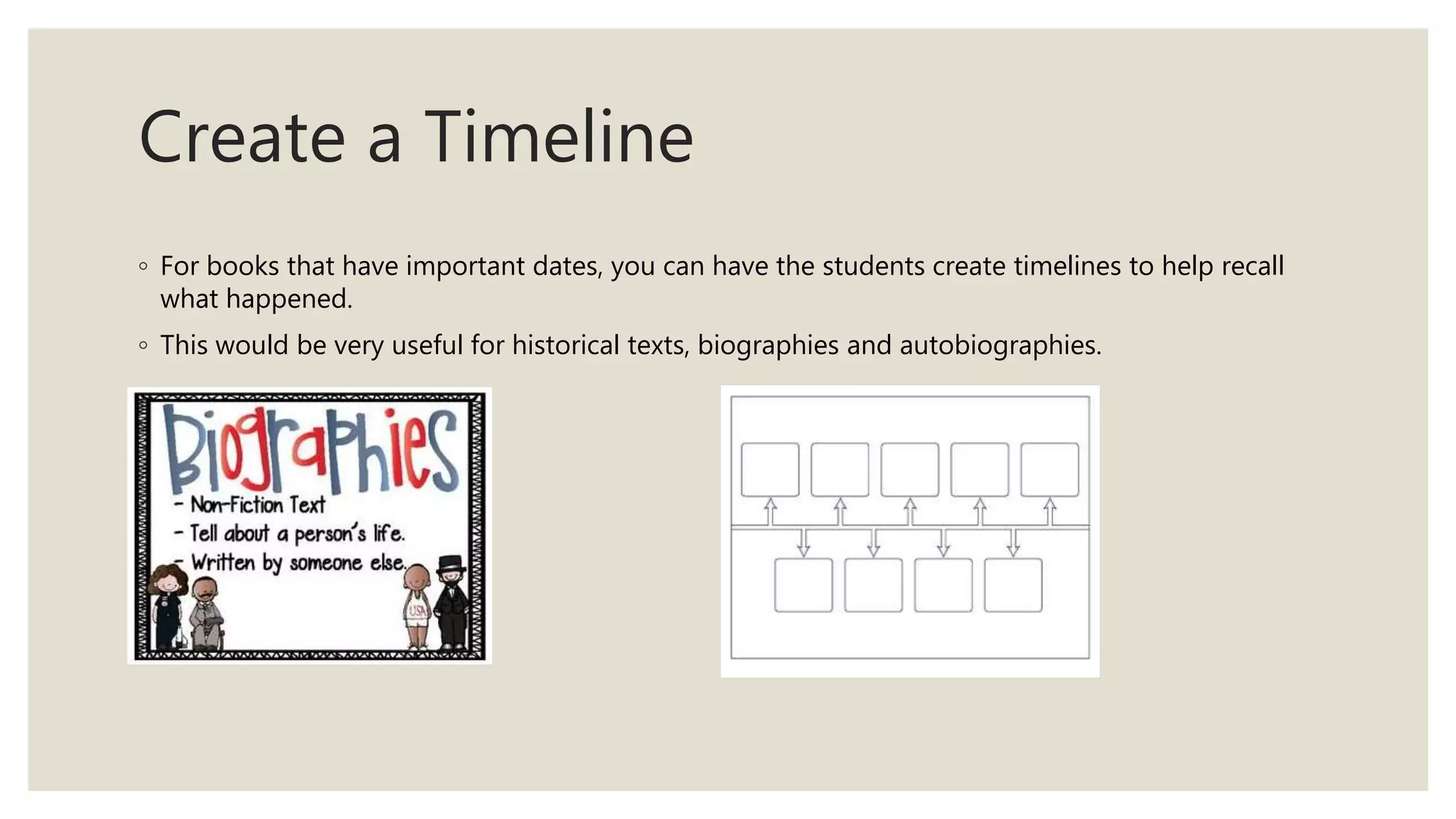
Create a Timeline
◦ For books that have important dates, you can have the students create timelines to help recall
what happened.
◦ This would be very useful for historical texts, biographies and autobiographies.
Reflect
◦ After reading the text it is important to have the students reflect on the book and their thoughts
while reading it.
◦ These reflections will help the students better understand what they have read and improve
their comprehension.
◦ The reflection can be written or shared orally.
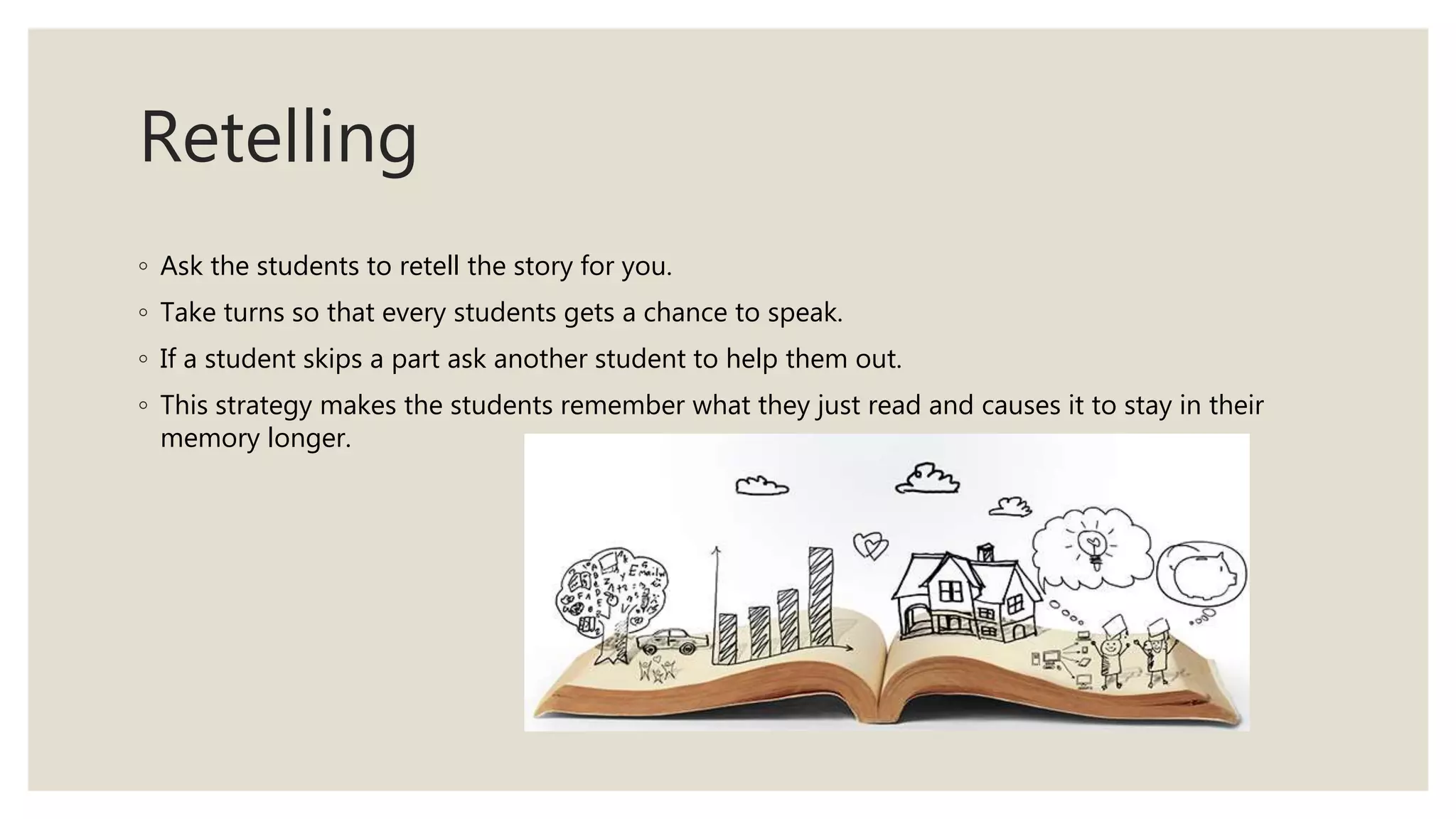
Retelling
◦ Ask the students to retell the story for you.
◦ Take turns so that every students gets a chance to speak.
◦ If a student skips a part ask another student to help them out.
◦ This strategy makes the students remember what they just read and causes it to stay in their
memory longer.
Resources
◦ Bursuck, W. D., & Damer, M. (2015). Teaching Reading to Students Who Are At Risk or Have
Disabilities . Boston: Pearson Education, Inc.

Before, During and After Reading Strategies

  • 1.
    BEFORE, DURING AND AFTERREADING STRATEGIES MIRANDA MIJARES RED4348
  • 2.
    Before, During andAfter Reading Strategies ◦ It is important to keep the students engaged and involved in the reading process. ◦ Using the before, during and after reading strategies improve students comprehension and ensure that students retain the information that they have read in their long term memory. ◦ “The most productive comprehension instruction occurs when a teacher asks a high percentage of questions requiring thought before, during and after reading” (Pg. 298).
  • 3.
    Before Reading Strategies ◦Connect to Prior Knowledge ◦ Picture Walk ◦ Pre Teach Key Vocabulary ◦ Create a Purpose for Reading ◦ Graphic Organizer
  • 4.
    Connect to PriorKnowledge ◦ “Good readers make predictions based on background knowledge, focus on looking forward and backward in the text to find important information, paraphrase, explain, summarize and construct conclusions about what they read” (Pg. 284). ◦ Connecting the text to the students prior knowledge helps them to better understand what they are reading. ◦ Ask the students questions and have them share personal experiences.
  • 5.
    Picture Walk ◦ Picturewalks allow the students to see all the illustrations in a book before reading. This helps the students make predictions about what the text will be about. ◦ The teacher will flip through the book one page at a time pausing at each picture. ◦ The teacher will ask students questions to activate prior knowledge, to help make predictions and to connect the pictures to the main idea.
  • 6.
    Pre Teach KeyVocabulary ◦ The teacher will select vocabulary words from the text that the students might not know. ◦ The teacher will have the students skim the text to find unknown words. ◦ The teacher will define the words for the students or have the students define them and share with the rest of the class. ◦ The teacher can ask the students to use the vocabulary words in a sentence to make sure that they comprehend them.
  • 7.
    Create a Purposefor Reading ◦ The teacher will create a purpose for reading by giving students different things to look for while reading such as introducing the after reading activity. This gives students a purpose for listening and understanding the reading. ◦ The teacher can allow the students to choose their own text.
  • 8.
    Graphic Organizer ◦ Theteacher can introduce a graphic organizer that they might be using in the during or after reading stage. ◦ The students will have time to get to know the graphic organizer and how to use it.
  • 9.
    During Reading Strategies ◦Reciprocal Teaching ◦ Think-A-Louds ◦ Fact Charts ◦ Close Reading ◦ Story Map
  • 10.
    Reciprocal Teaching ◦ Theteacher asks the students to make predictions about the book before they read. ◦ The students then ask questions to clarify what we are reading and amend their predictions as you read. ◦ The students then summarize what they have read using their own words.
  • 11.
    Think-Alouds ◦ The teacherreads the story out loud to the students. While the teacher is reading she says what she is thinking. ◦ For example, the teacher could be reading about Polar Bears and say I wonder what polar bears eat? ◦ The teacher models for the students what she is thinking . The students will then follow her example when they read.
  • 12.
    Fact Charts ◦ Theteacher will create a chart for all the students to see that contain facts that they learned while reading the book. ◦ This chart helps students pay attention to important details as they read and display them neatly on a chart for them to refer back to.
  • 13.
    Close Reading ◦ “Amethod in which students read and reread text in order to focus on its increasingly deeper meanings” (Pg. 292). ◦ This technique is used for more complex text. ◦ Questions should increase in difficulty with each rereading of the text.
  • 14.
    Story Map ◦ Asyou read, you map out the story with the students on a graphic organizer. ◦ There are sections such as characters, setting, problems, attempts, resolutions and lessons. ◦ This a great tool for students with special needs. “Story maps improve their comprehension and provide a visual guide to understanding and retelling stories” (Pg. 297).
  • 15.
    After Reading Strategies ◦Discussions ◦ Summarize ◦ Create a Timeline ◦ Reflect ◦ Retelling
  • 16.
    Discussions ◦ Ask thestudents questions about the book. The whole class listens to the answers. ◦ What is one things that you learned? ◦ What interested you? ◦ What surprised you? ◦ What was your favorite part?
  • 17.
    Summarize ◦ Ask thestudents to help you summarize the book. ◦ Make sure that the students recall the important details. ◦ For students with special needs you can let them use the story map when making their summary.
  • 18.
    Create a Timeline ◦For books that have important dates, you can have the students create timelines to help recall what happened. ◦ This would be very useful for historical texts, biographies and autobiographies.
  • 19.
    Reflect ◦ After readingthe text it is important to have the students reflect on the book and their thoughts while reading it. ◦ These reflections will help the students better understand what they have read and improve their comprehension. ◦ The reflection can be written or shared orally.
  • 20.
    Retelling ◦ Ask thestudents to retell the story for you. ◦ Take turns so that every students gets a chance to speak. ◦ If a student skips a part ask another student to help them out. ◦ This strategy makes the students remember what they just read and causes it to stay in their memory longer.
  • 21.
    Resources ◦ Bursuck, W.D., & Damer, M. (2015). Teaching Reading to Students Who Are At Risk or Have Disabilities . Boston: Pearson Education, Inc.