Art of
Questioning
9012
Republic of the Philippines
Department of Education
Cordillera Administrative Region
Division of Baguio
Bakakeng National High School
Bakakeng North, Baguio City
Telefax 422 9012
https://www.facebook.com/BakakengNatHS/
2
Learning Objectives
At the end of the session, the participants should be
able to:
• classify questions according to the levels of
comprehension
• ask questions for all levels of comprehension
• recognize and articulate the characteristics of
developmentally appropriate questioning techniques
• realize the importance of enhancing skills in
questioning .
3
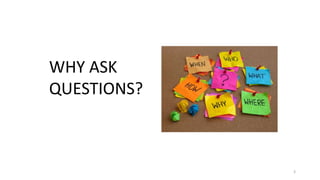
WHY ASK
QUESTIONS?
•We ask questions to make connections.
(self,to other people,world…)
•We ask questions to make predictions.
( look for clues to help decide on what might
come next. Help students set expectations for
reading/learning and compare their thinking with
what is written.)
• We are using questions to make sure we understand what we have
read or listened to
• Questions strengthen reasoning abilities of children as well as help
them clarify/define their initial response to the text.
• “Books not discussed lose their value.” (Mortime Adler)
--More than the information, concepts, characters presented in books.
Discussion could give the learners an emotional experience, a cultural
experience. And more than anything, books presents themes and ,
lessons about life
• Questioning help students to become better readers by making them
THINK!
-Humans continue to develop their critical thnking skills in analogy, inference and
reasoning. CLASSROOM has a big part
-Comprehension abilities
-Independent thinkers
-Recognize fallacies, rhetoric and propaganda
-Asking questions would help learners to be more open-minded about other
people’s opinions and make better decisions in life
•Questions allow us to make sense of the
world. They are the most powerful tools we
have for making decisions and solving
problems, for inventing, changing and
improving our lives as well as the lives of
others. (Jamie McKenzie)
- SENSE OF WONDER
What KIND OF questions should we ask?
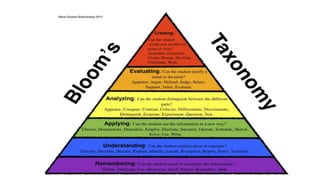
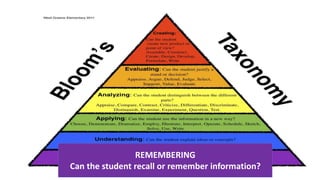
• Bloom’s Taxonomy was developed in 1956 by Benjamin
Bloom and a group of educational psychologists. This has a
recent revision developed by Anderson in 2006.
This taxonomy consists of six criteria:
1) knowledge, or the recall of information
2) comprehension, or the understanding of concepts
3) application, or problem solving
4) analysis, in which students separate the material into its
various components
5) evaluation, or judging the material; and
6) create in which students combine elements to form a new
structure.
REMEMBERING
Can the student recall or remember information?
Level 1
Remembering (Knowledge)
The learner is able to
recall, restate or
remember learned
information.
• Recognizing
• Listing
• Describing
• Identifying
• Retrieving
• Naming
• Locating
• Finding
CAN YOU RECALL INFORMATION?
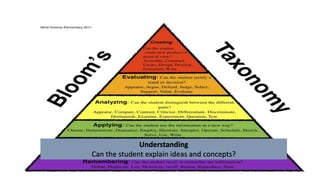
Understanding
Can the student explain ideas and concepts?
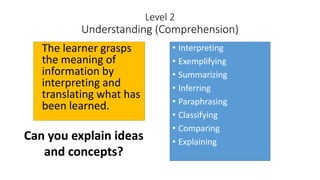
Level 2
Understanding (Comprehension)
The learner grasps
the meaning of
information by
interpreting and
translating what has
been learned.
• Interpreting
• Exemplifying
• Summarizing
• Inferring
• Paraphrasing
• Classifying
• Comparing
• Explaining
Can you explain ideas
and concepts?
Questions:
• Can you explain why…?
• Can you write in your own words?
• How would you explain…?
• Can you write a brief outline...?
• What do you think could have happened next...?
• Who do you think...?
• What was the main idea...?
• Can you clarify…?
• Can you illustrate…?
• Does everyone act in the way that …….. does?
(Pohl, Learning to Think, Thinking to Learn, p. 12)
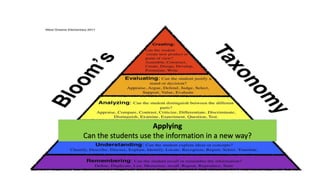
Applying
Can the students use the information in a new way?
Level 3
Applying (Application)
• The learner makes
use of information
in a context
different from the
one that it was
learned.
•Implementing
•Carrying out
•Using
•Executing
• Put yourself in the place of one of the characters and tell what
you would have done….. ?
• What would result if….. ?
• Compare and contrast….. ?
• What questions would you to find out … ?
• How would the character solve the similar situation of….. ?
• Put the main character in another story setting, how would he
act?
• If you had to plan a vacation for the main character, where
would they go?
Questions:
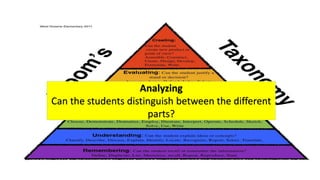
Analyzing
Can the students distinguish between the different
parts?
• What motive does ____ have…..?
• What conclusions can you draw about…..?
• What is the relationship between…..?
• How is ______ related to …..?
• What ideas support the fact that…..?
• What evidence can you find…..?
• What inferences can you make about…..?
• What generalizations can be made about …..?
• What assumptions do you make about …..?
• What is the theme of…..?
Questions:
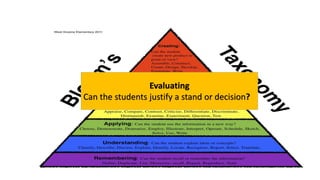
Evaluating
Can the students justify a stand or decision?
• It involves the making of personal judgment on the
text by the reader, usually based on his/her
experience:
 Evaluation of accuracy
 Discrimination of fact and opinion
 Recognition of emotionally charged words
 Identification of author's purpose, mood, tone,
intent
 Evaluation of values presented
Questions:
• Compare two characters in the selection….which was a better
person…why?
• Which character would you most like to spend the day with?
• Do you agree with the actions of…..?
• How could you determine…..?
• Why was it better that…..?
• What choice would you have made about…..?
• How would you explain…..?
• What data was used to make the conclusion…..?
• Would it be better if…..?
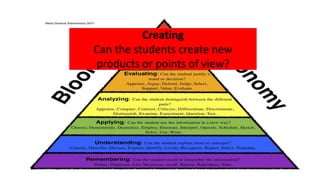
Creating
Can the students create new
products or points of view?
•involves coming up with new ideas
or reproducing the text information
in other forms: dramatizing, writing
another ending, writing a letter,
musical interpretation
QUESTIONS:
• Can you design a...to...?
• Can you see a possible solution to...?
• If you had access to all resources, how would you deal
with...?
• Why don't you devise your own way to...?
• What would happen if ...?
• How many ways can you...?
• Can you create new and unusual uses for...?
• Can you develop a proposal which would...?
(Pohl, Learning to Think, Thinking to Learn, p. 14)
ACTIVITIES AND PRODUCTS
• Invent a machine to do a specific task.
• Design a robot to do your homework.
• Create a new product. Give it a name and plan a marketing campaign.
• Write about your feelings in relation to...
• Write a TV show play, puppet show, role play, song or pantomime about..
• Design a new monetary system
• Develop a menu for a new restaurant using a variety of healthy foods
• Design a record, book or magazine cover for...
• Sell an idea
• Devise a way to...
• Make up a new language and use it in an example.
• Write a jingle to advertise a new product.
•Moving beyond the who, what,
where, when and why
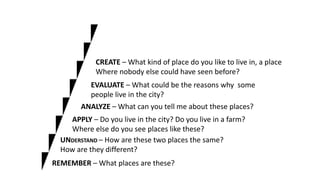
CREATE – What kind of place do you like to live in, a place
Where nobody else could have seen before?
EVALUATE – What could be the reasons why some
people live in the city?
ANALYZE – What can you tell me about these places?
APPLY – Do you live in the city? Do you live in a farm?
Where else do you see places like these?
UNDERSTAND – How are these two places the same?
How are they different?
REMEMBER – What places are these?
•How
should
questions
be asked?
Effective Questioning should:
•Reinforce and promote the learning objectives
•Include “staging” questions to draw pupils
towards key understanding or to increase the
level of challenge in a lesson as it proceeds.
•Involve all pupils
•Promote justification and reasoning
•Create an atmosphere of trust where pupils’
opinions and ideas are valued
•Show connections between previous and
new learning
•Encourage pupils to speculate and
hypothesize
•Encourage pupils to ask as well as to
“receive” questions
•Create an atmosphere of trust where pupils’
opinions and ideas are valued
•Show connections between previous and new
learning
•Encourage pupils to speculate and hypothesize
•Encourage pupils to ask as well as to “receive”
questions
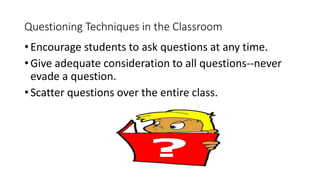
• Encourage students to ask questions at any time.
• Give adequate consideration to all questions--never
evade a question.
• Scatter questions over the entire class.
Questioning Techniques in the Classroom
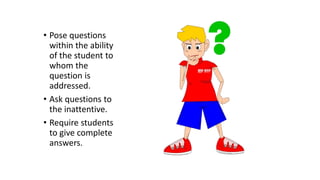
• Pose questions
within the ability
of the student to
whom the
question is
addressed.
• Ask questions to
the inattentive.
• Require students
to give complete
answers.
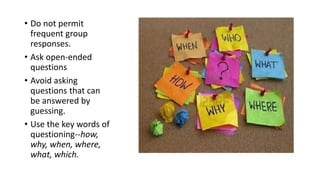
• Do not permit
frequent group
responses.
• Ask open-ended
questions
• Avoid asking
questions that can
be answered by
guessing.
• Use the key words of
questioning--how,
why, when, where,
what, which.
•Have students speak
loudly so that all may
hear.
•Use correct grammar
and terminology.
•Write questions in
your lesson plan.
41
Presented by:
Marilyn S. Apiit
Education Program Supervisor for Filipino

Art of Questioning

  • 1.
    Art of Questioning 9012 Republic ofthe Philippines Department of Education Cordillera Administrative Region Division of Baguio Bakakeng National High School Bakakeng North, Baguio City Telefax 422 9012 https://www.facebook.com/BakakengNatHS/
  • 2.
    2 Learning Objectives At theend of the session, the participants should be able to: • classify questions according to the levels of comprehension • ask questions for all levels of comprehension • recognize and articulate the characteristics of developmentally appropriate questioning techniques • realize the importance of enhancing skills in questioning .
  • 3.
  • 4.
    •We ask questionsto make connections. (self,to other people,world…) •We ask questions to make predictions. ( look for clues to help decide on what might come next. Help students set expectations for reading/learning and compare their thinking with what is written.)
  • 5.
    • We areusing questions to make sure we understand what we have read or listened to • Questions strengthen reasoning abilities of children as well as help them clarify/define their initial response to the text. • “Books not discussed lose their value.” (Mortime Adler) --More than the information, concepts, characters presented in books. Discussion could give the learners an emotional experience, a cultural experience. And more than anything, books presents themes and , lessons about life
  • 6.
    • Questioning helpstudents to become better readers by making them THINK! -Humans continue to develop their critical thnking skills in analogy, inference and reasoning. CLASSROOM has a big part -Comprehension abilities -Independent thinkers -Recognize fallacies, rhetoric and propaganda -Asking questions would help learners to be more open-minded about other people’s opinions and make better decisions in life
  • 7.
    •Questions allow usto make sense of the world. They are the most powerful tools we have for making decisions and solving problems, for inventing, changing and improving our lives as well as the lives of others. (Jamie McKenzie) - SENSE OF WONDER
  • 8.
    What KIND OFquestions should we ask?
  • 10.
    • Bloom’s Taxonomywas developed in 1956 by Benjamin Bloom and a group of educational psychologists. This has a recent revision developed by Anderson in 2006. This taxonomy consists of six criteria: 1) knowledge, or the recall of information 2) comprehension, or the understanding of concepts 3) application, or problem solving 4) analysis, in which students separate the material into its various components 5) evaluation, or judging the material; and 6) create in which students combine elements to form a new structure.
  • 11.
    REMEMBERING Can the studentrecall or remember information?
  • 12.
    Level 1 Remembering (Knowledge) Thelearner is able to recall, restate or remember learned information. • Recognizing • Listing • Describing • Identifying • Retrieving • Naming • Locating • Finding CAN YOU RECALL INFORMATION?
  • 14.
    Understanding Can the studentexplain ideas and concepts?
  • 15.
    Level 2 Understanding (Comprehension) Thelearner grasps the meaning of information by interpreting and translating what has been learned. • Interpreting • Exemplifying • Summarizing • Inferring • Paraphrasing • Classifying • Comparing • Explaining Can you explain ideas and concepts?
  • 16.
    Questions: • Can youexplain why…? • Can you write in your own words? • How would you explain…? • Can you write a brief outline...? • What do you think could have happened next...? • Who do you think...? • What was the main idea...? • Can you clarify…? • Can you illustrate…? • Does everyone act in the way that …….. does? (Pohl, Learning to Think, Thinking to Learn, p. 12)
  • 17.
    Applying Can the studentsuse the information in a new way?
  • 18.
    Level 3 Applying (Application) •The learner makes use of information in a context different from the one that it was learned. •Implementing •Carrying out •Using •Executing
  • 19.
    • Put yourselfin the place of one of the characters and tell what you would have done….. ? • What would result if….. ? • Compare and contrast….. ? • What questions would you to find out … ? • How would the character solve the similar situation of….. ? • Put the main character in another story setting, how would he act? • If you had to plan a vacation for the main character, where would they go? Questions:
  • 20.
    Analyzing Can the studentsdistinguish between the different parts?
  • 22.
    • What motivedoes ____ have…..? • What conclusions can you draw about…..? • What is the relationship between…..? • How is ______ related to …..? • What ideas support the fact that…..? • What evidence can you find…..? • What inferences can you make about…..? • What generalizations can be made about …..? • What assumptions do you make about …..? • What is the theme of…..? Questions:
  • 23.
    Evaluating Can the studentsjustify a stand or decision?
  • 24.
    • It involvesthe making of personal judgment on the text by the reader, usually based on his/her experience:  Evaluation of accuracy  Discrimination of fact and opinion  Recognition of emotionally charged words  Identification of author's purpose, mood, tone, intent  Evaluation of values presented
  • 25.
    Questions: • Compare twocharacters in the selection….which was a better person…why? • Which character would you most like to spend the day with? • Do you agree with the actions of…..? • How could you determine…..? • Why was it better that…..? • What choice would you have made about…..? • How would you explain…..? • What data was used to make the conclusion…..? • Would it be better if…..?
  • 26.
    Creating Can the studentscreate new products or points of view?
  • 27.
    •involves coming upwith new ideas or reproducing the text information in other forms: dramatizing, writing another ending, writing a letter, musical interpretation
  • 28.
    QUESTIONS: • Can youdesign a...to...? • Can you see a possible solution to...? • If you had access to all resources, how would you deal with...? • Why don't you devise your own way to...? • What would happen if ...? • How many ways can you...? • Can you create new and unusual uses for...? • Can you develop a proposal which would...? (Pohl, Learning to Think, Thinking to Learn, p. 14)
  • 29.
    ACTIVITIES AND PRODUCTS •Invent a machine to do a specific task. • Design a robot to do your homework. • Create a new product. Give it a name and plan a marketing campaign. • Write about your feelings in relation to... • Write a TV show play, puppet show, role play, song or pantomime about.. • Design a new monetary system • Develop a menu for a new restaurant using a variety of healthy foods • Design a record, book or magazine cover for... • Sell an idea • Devise a way to... • Make up a new language and use it in an example. • Write a jingle to advertise a new product.
  • 30.
    •Moving beyond thewho, what, where, when and why
  • 32.
    CREATE – Whatkind of place do you like to live in, a place Where nobody else could have seen before? EVALUATE – What could be the reasons why some people live in the city? ANALYZE – What can you tell me about these places? APPLY – Do you live in the city? Do you live in a farm? Where else do you see places like these? UNDERSTAND – How are these two places the same? How are they different? REMEMBER – What places are these?
  • 33.
  • 34.
    Effective Questioning should: •Reinforceand promote the learning objectives •Include “staging” questions to draw pupils towards key understanding or to increase the level of challenge in a lesson as it proceeds. •Involve all pupils •Promote justification and reasoning
  • 35.
    •Create an atmosphereof trust where pupils’ opinions and ideas are valued •Show connections between previous and new learning •Encourage pupils to speculate and hypothesize •Encourage pupils to ask as well as to “receive” questions
  • 36.
    •Create an atmosphereof trust where pupils’ opinions and ideas are valued •Show connections between previous and new learning •Encourage pupils to speculate and hypothesize •Encourage pupils to ask as well as to “receive” questions
  • 37.
    • Encourage studentsto ask questions at any time. • Give adequate consideration to all questions--never evade a question. • Scatter questions over the entire class. Questioning Techniques in the Classroom
  • 38.
    • Pose questions withinthe ability of the student to whom the question is addressed. • Ask questions to the inattentive. • Require students to give complete answers.
  • 39.
    • Do notpermit frequent group responses. • Ask open-ended questions • Avoid asking questions that can be answered by guessing. • Use the key words of questioning--how, why, when, where, what, which.
  • 40.
    •Have students speak loudlyso that all may hear. •Use correct grammar and terminology. •Write questions in your lesson plan.
  • 41.
  • 42.
    Presented by: Marilyn S.Apiit Education Program Supervisor for Filipino

Editor's Notes

  • #3 ”Skill in the art of questioning lies at the basis of all good teaching ” (Betts, 1910, p. 55). Asking the right questions is key to getting the right information. Asking appropriate questions lead to more learning. The quality of teachers questions affects the quality of thinking in the classroom
  • #4 ”Skill in the art of questioning lies at the basis of all good teaching ” (Betts, 1910, p. 55). Asking the right questions is key to getting the right information. Asking appropriate questions lead to more learning. The quality of teachers questions affects the quality of thinking in the classroom