Questioning
Techniques To
Produce
Quality
Answers
Children’s responses
to a question tells
weather they are
understanding the
content they are
being taught, Builds
social skills, and is
very important for
building critical
thinking skills.
Questioning
Techniques
By: Teresa Puga
Fresno Pacific
University
References:
Blake, S. & Shaw, J. (1998).
Mathematics for Young Children
Upper Saddle River, NJ: Prentice
Hall.
Helping your children
become better
communicators in
mathematics
Here are some helpful
tips to implement in
activities at home.
• Use higher-level, open-
ended questions
• Model the thinking
process
• Encourage children to
listen to others
Use High-level. Open-
ended Questions to
Assess and Stimulate
Children’s Thinking
Some questions that should
be asked to encourage a
higher-level of thinking are:
1. Can you tell me about
your shape?
2. Why do you think the
two groups have
different amounts?
3. What are some other
items that measure
the same?
4.How do you know?
Model the
Thinking Process
for Children
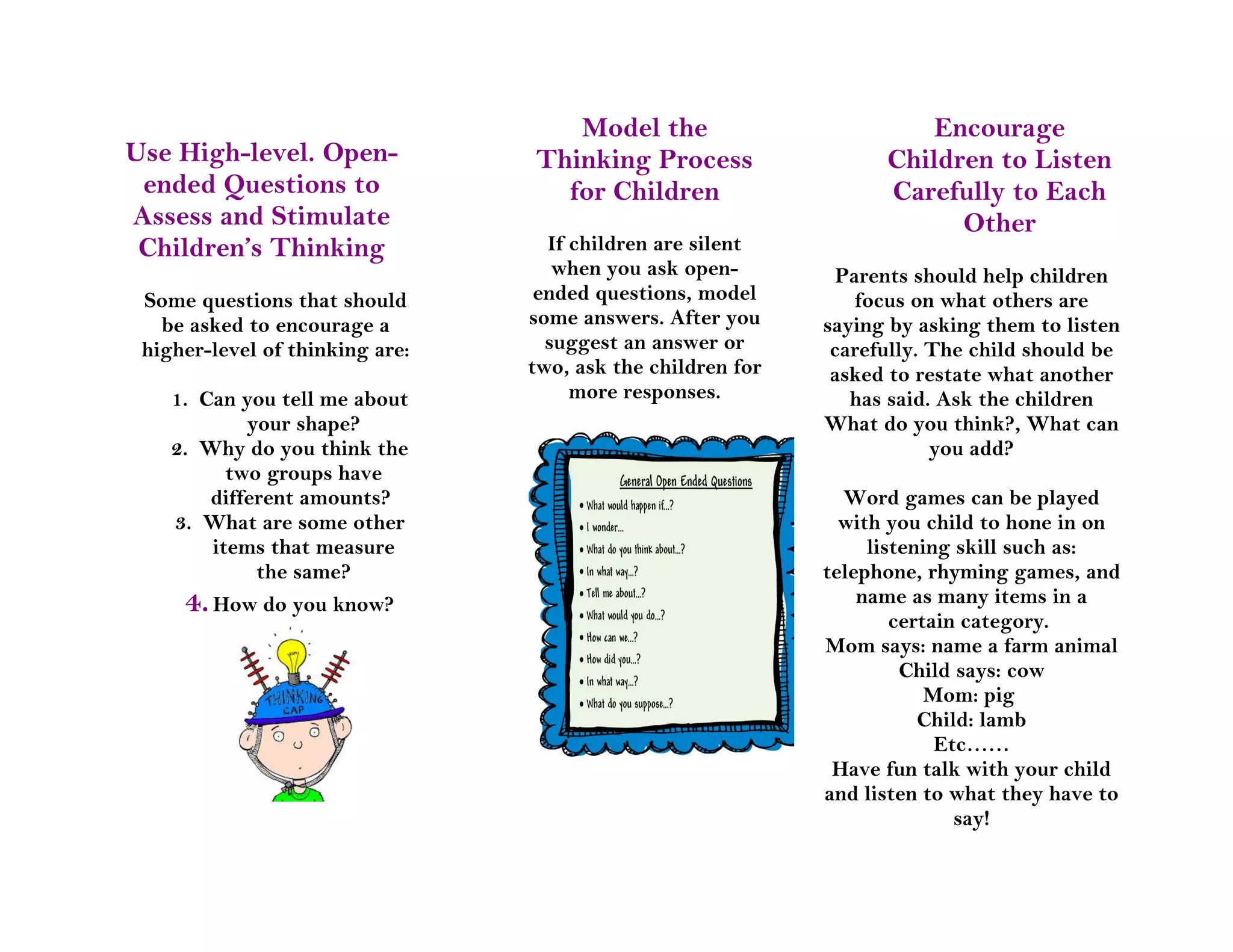
If children are silent
when you ask open-
ended questions, model
some answers. After you
suggest an answer or
two, ask the children for
more responses.
Encourage
Children to Listen
Carefully to Each
Other
Parents should help children
focus on what others are
saying by asking them to listen
carefully. The child should be
asked to restate what another
has said. Ask the children
What do you think?, What can
you add?
Word games can be played
with you child to hone in on
listening skill such as:
telephone, rhyming games, and
name as many items in a
certain category.
Mom says: name a farm animal
Child says: cow
Mom: pig
Child: lamb
Etc……
Have fun talk with your child
and listen to what they have to
say!

Questioning Techniques.

  • 1.
    Questioning Techniques To Produce Quality Answers Children’s responses toa question tells weather they are understanding the content they are being taught, Builds social skills, and is very important for building critical thinking skills. Questioning Techniques By: Teresa Puga Fresno Pacific University References: Blake, S. & Shaw, J. (1998). Mathematics for Young Children Upper Saddle River, NJ: Prentice Hall. Helping your children become better communicators in mathematics Here are some helpful tips to implement in activities at home. • Use higher-level, open- ended questions • Model the thinking process • Encourage children to listen to others
  • 2.
    Use High-level. Open- endedQuestions to Assess and Stimulate Children’s Thinking Some questions that should be asked to encourage a higher-level of thinking are: 1. Can you tell me about your shape? 2. Why do you think the two groups have different amounts? 3. What are some other items that measure the same? 4.How do you know? Model the Thinking Process for Children If children are silent when you ask open- ended questions, model some answers. After you suggest an answer or two, ask the children for more responses. Encourage Children to Listen Carefully to Each Other Parents should help children focus on what others are saying by asking them to listen carefully. The child should be asked to restate what another has said. Ask the children What do you think?, What can you add? Word games can be played with you child to hone in on listening skill such as: telephone, rhyming games, and name as many items in a certain category. Mom says: name a farm animal Child says: cow Mom: pig Child: lamb Etc…… Have fun talk with your child and listen to what they have to say!