QUESTION 2
How does your media
product represent
particular social
groups?
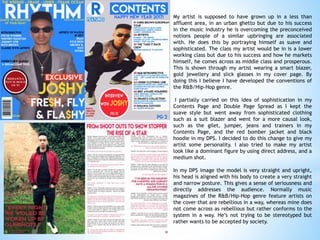
My artist is supposed to have grown up in a less than
affluent area, in an urban ghetto but due to his success
in the music industry he is overcoming the preconceived
notions people of a similar upbringing are associated
with. He does this by portraying himself as suave and
sophisticated. The class my artist would be in is a lower
working class but due to his success and how he markets
himself, he comes across as middle class and prosperous.
This is shown through my artist wearing a smart blazer,
gold jewellery and slick glasses in my cover page. By
doing this I believe I have developed the conventions of
the R&B/Hip-Hop genre.
I partially carried on this idea of sophistication in my
Contents Page and Double Page Spread as I kept the
suave style but went away from sophisticated clothing
such as a suit blazer and went for a more causal look,
such as the gilet, jumper, jeans and trainers in my
Contents Page, and the red bomber jacket and black
hoodie in my DPS. I decided to do this change to give my
artist some personality. I also tried to make my artist
look like a dominant figure by using direct address, and a
medium shot.
In my DPS image the model is very straight and upright,
his head is aligned with his body to create a very straight
and narrow posture. This gives a sense of seriousness and
directly addresses the audience. Normally music
magazines of the R&B/Hip-Hop genre feature artists on
the cover that are rebellious in a way, whereas mine does
not come across as rebellious but rather conforms to the
system in a way. He’s not trying to be stereotyped but
rather wants to be accepted by society.
My artist is mixed race with African origins which is conventional of the R&B/Hip-Hop genre as the genre
originated from 1940s and 1950s blues, an African-American style of music. The artist is a male, young adult.
This does not challenge conventions as artists on music magazine covers are commonly male however, they vary
in the way they portray themselves. An artist like Lil’ Wayne for example markets himself with a gangster vibe
i.e. tattoos, guns, caps, etc. The Weeknd on the other hand comes across as more casual and slick with leather
jackets and other stylish clothing. My artist falls along The Weeknd’s style, reaching conventions.
The artist being a young male shows how he represents men aged 20-24 who are of a similar lower working
class background. The artists’ use of materialistic items i.e. Jordan trainers, Levi’s jeans, jewellery, etc.
attract the social group of people who fit with the ‘ASPIRERS’ psychographic as they seek status and the desire
to be wealthy, like how many music artists of the R&B/Hip-Hop magazine portray themselves.
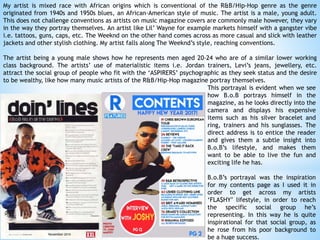
This portrayal is evident when we see
how B.o.B portrays himself in the
magazine, as he looks directly into the
camera and displays his expensive
items such as his silver bracelet and
ring, trainers and his sunglasses. The
direct address is to entice the reader
and gives them a subtle insight into
B.o.B’s lifestyle, and makes them
want to be able to live the fun and
exciting life he has.
B.o.B’s portrayal was the inspiration
for my contents page as I used it in
order to get across my artists
‘FLA$HY’ lifestyle, in order to reach
the specific social group he’s
representing. In this way he is quite
inspirational for that social group, as
he rose from his poor background to
be a huge success.

Question two

  • 1.
    QUESTION 2 How doesyour media product represent particular social groups?
  • 2.
    My artist issupposed to have grown up in a less than affluent area, in an urban ghetto but due to his success in the music industry he is overcoming the preconceived notions people of a similar upbringing are associated with. He does this by portraying himself as suave and sophisticated. The class my artist would be in is a lower working class but due to his success and how he markets himself, he comes across as middle class and prosperous. This is shown through my artist wearing a smart blazer, gold jewellery and slick glasses in my cover page. By doing this I believe I have developed the conventions of the R&B/Hip-Hop genre. I partially carried on this idea of sophistication in my Contents Page and Double Page Spread as I kept the suave style but went away from sophisticated clothing such as a suit blazer and went for a more causal look, such as the gilet, jumper, jeans and trainers in my Contents Page, and the red bomber jacket and black hoodie in my DPS. I decided to do this change to give my artist some personality. I also tried to make my artist look like a dominant figure by using direct address, and a medium shot. In my DPS image the model is very straight and upright, his head is aligned with his body to create a very straight and narrow posture. This gives a sense of seriousness and directly addresses the audience. Normally music magazines of the R&B/Hip-Hop genre feature artists on the cover that are rebellious in a way, whereas mine does not come across as rebellious but rather conforms to the system in a way. He’s not trying to be stereotyped but rather wants to be accepted by society.
  • 3.
    My artist ismixed race with African origins which is conventional of the R&B/Hip-Hop genre as the genre originated from 1940s and 1950s blues, an African-American style of music. The artist is a male, young adult. This does not challenge conventions as artists on music magazine covers are commonly male however, they vary in the way they portray themselves. An artist like Lil’ Wayne for example markets himself with a gangster vibe i.e. tattoos, guns, caps, etc. The Weeknd on the other hand comes across as more casual and slick with leather jackets and other stylish clothing. My artist falls along The Weeknd’s style, reaching conventions. The artist being a young male shows how he represents men aged 20-24 who are of a similar lower working class background. The artists’ use of materialistic items i.e. Jordan trainers, Levi’s jeans, jewellery, etc. attract the social group of people who fit with the ‘ASPIRERS’ psychographic as they seek status and the desire to be wealthy, like how many music artists of the R&B/Hip-Hop magazine portray themselves. This portrayal is evident when we see how B.o.B portrays himself in the magazine, as he looks directly into the camera and displays his expensive items such as his silver bracelet and ring, trainers and his sunglasses. The direct address is to entice the reader and gives them a subtle insight into B.o.B’s lifestyle, and makes them want to be able to live the fun and exciting life he has. B.o.B’s portrayal was the inspiration for my contents page as I used it in order to get across my artists ‘FLA$HY’ lifestyle, in order to reach the specific social group he’s representing. In this way he is quite inspirational for that social group, as he rose from his poor background to be a huge success.