Evaluation Q2
HOW DOES YOUR MEDIA
PRODUCT REPRESENT
PARTICULAR SOCIAL
GROUPS?
 I wanted my music magazine to be targeted at a youthful
audience of both genders between 18 to 21 as this is the age
that people have most disposable income and would purchase
a product such as the one I created. As Kerrang! is aimed at
younger teenagers, and Q at people who are slightly older, I
wanted to find a balance between the sophistication of Q with
the edgy aspects from Kerrang! so that my magazine could
appeal to a range of ages.
 From my target feedback questionnaire I was able to see that
the genre that most people wanted to read about was
pop/rock so I wanted to focus on this in my magazine. This
questionnaire also told me that the majority of my audience
would be females. With this in mind I analysed similar
magazines to get an idea of how they represent social groups.
REPRESENTING SOCIAL GROUPS
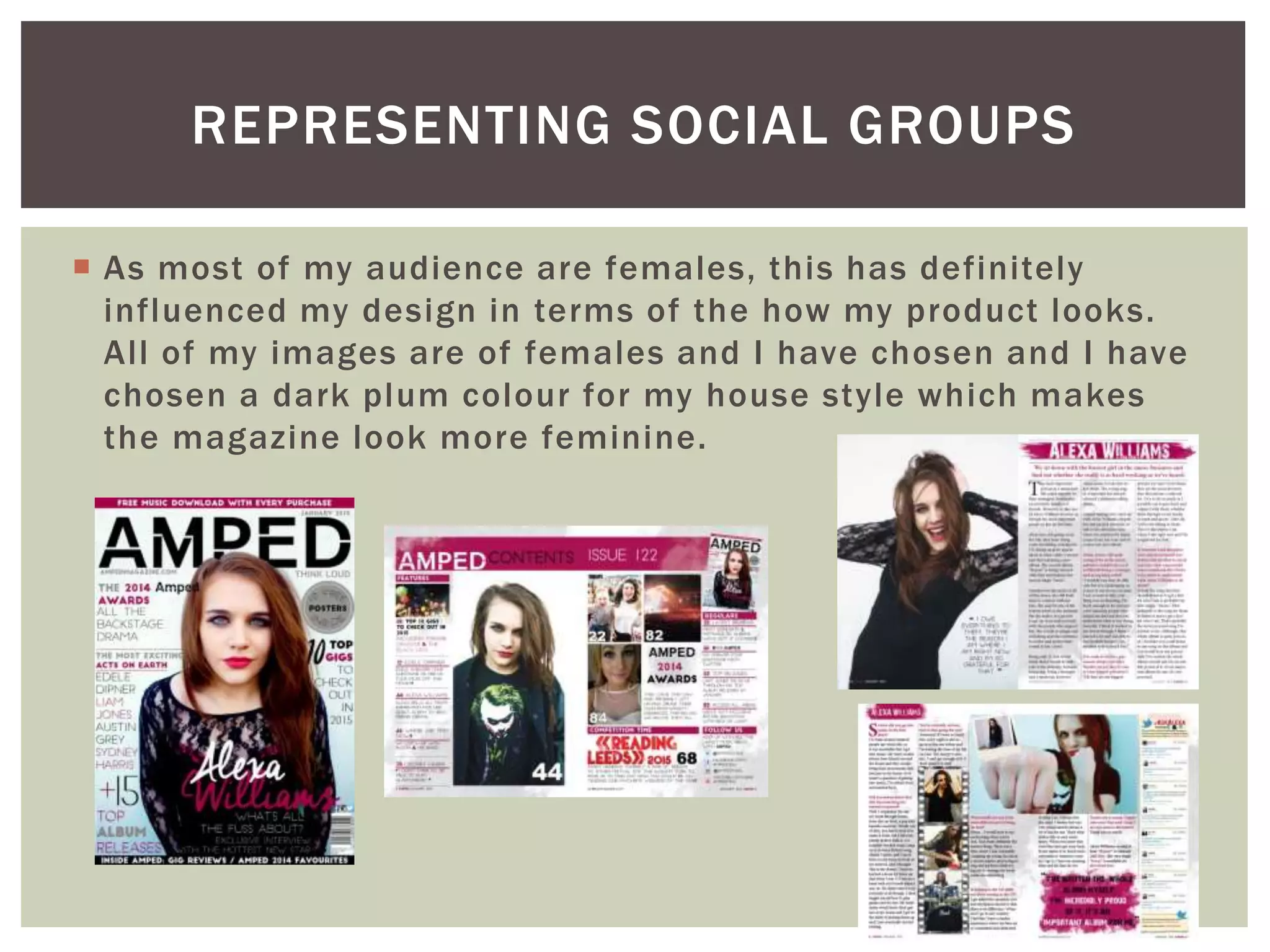
 As most of my audience are females, this has definitely
influenced my design in terms of the how my product looks.
All of my images are of females and I have chosen and I have
chosen a dark plum colour for my house style which makes
the magazine look more feminine.
REPRESENTING SOCIAL GROUPS
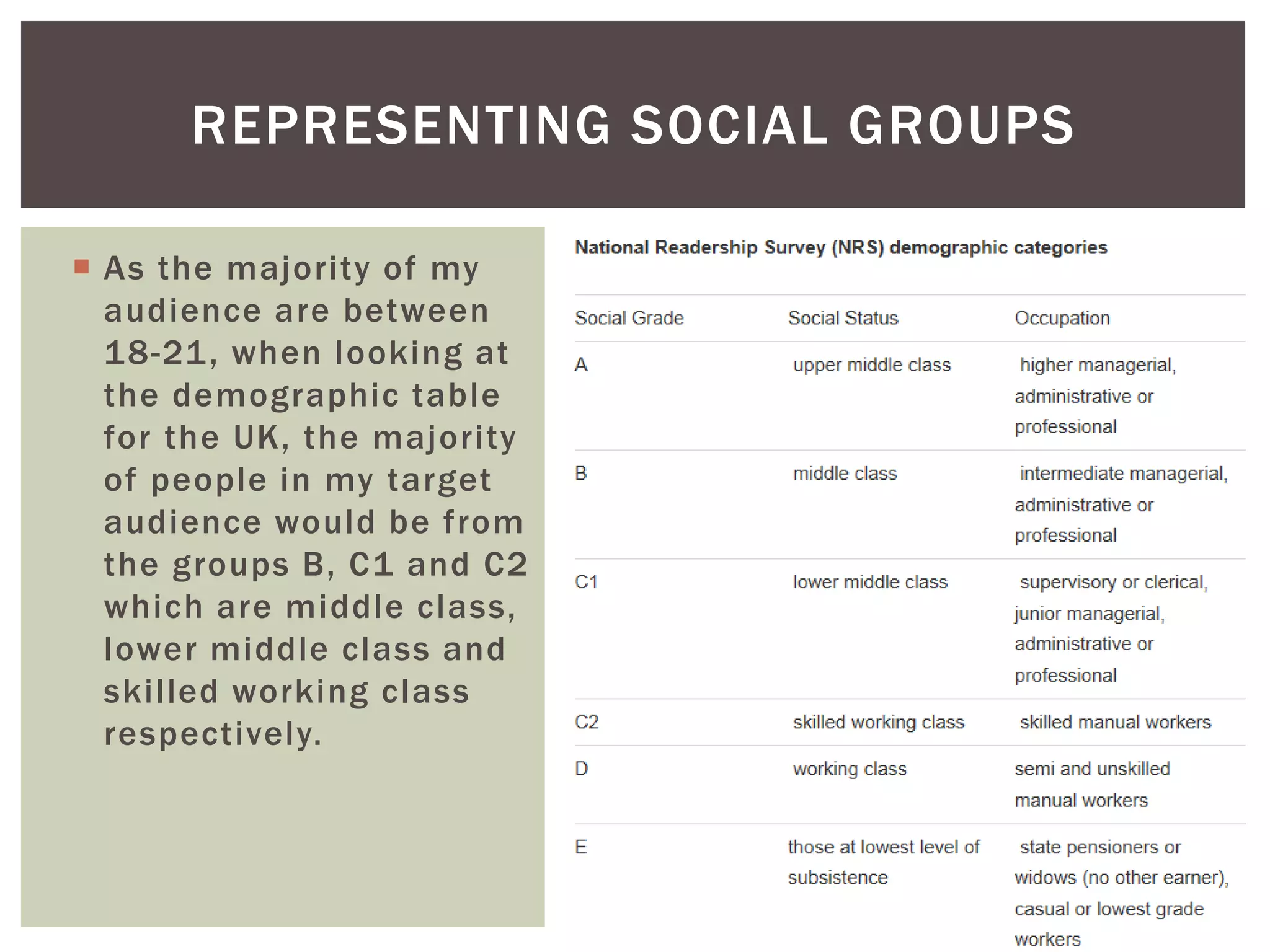
 As the majority of my
audience are between
18-21, when looking at
the demographic table
for the UK, the majority
of people in my target
audience would be from
the groups B, C1 and C2
which are middle class,
lower middle class and
skilled working class
respectively.
REPRESENTING SOCIAL GROUPS
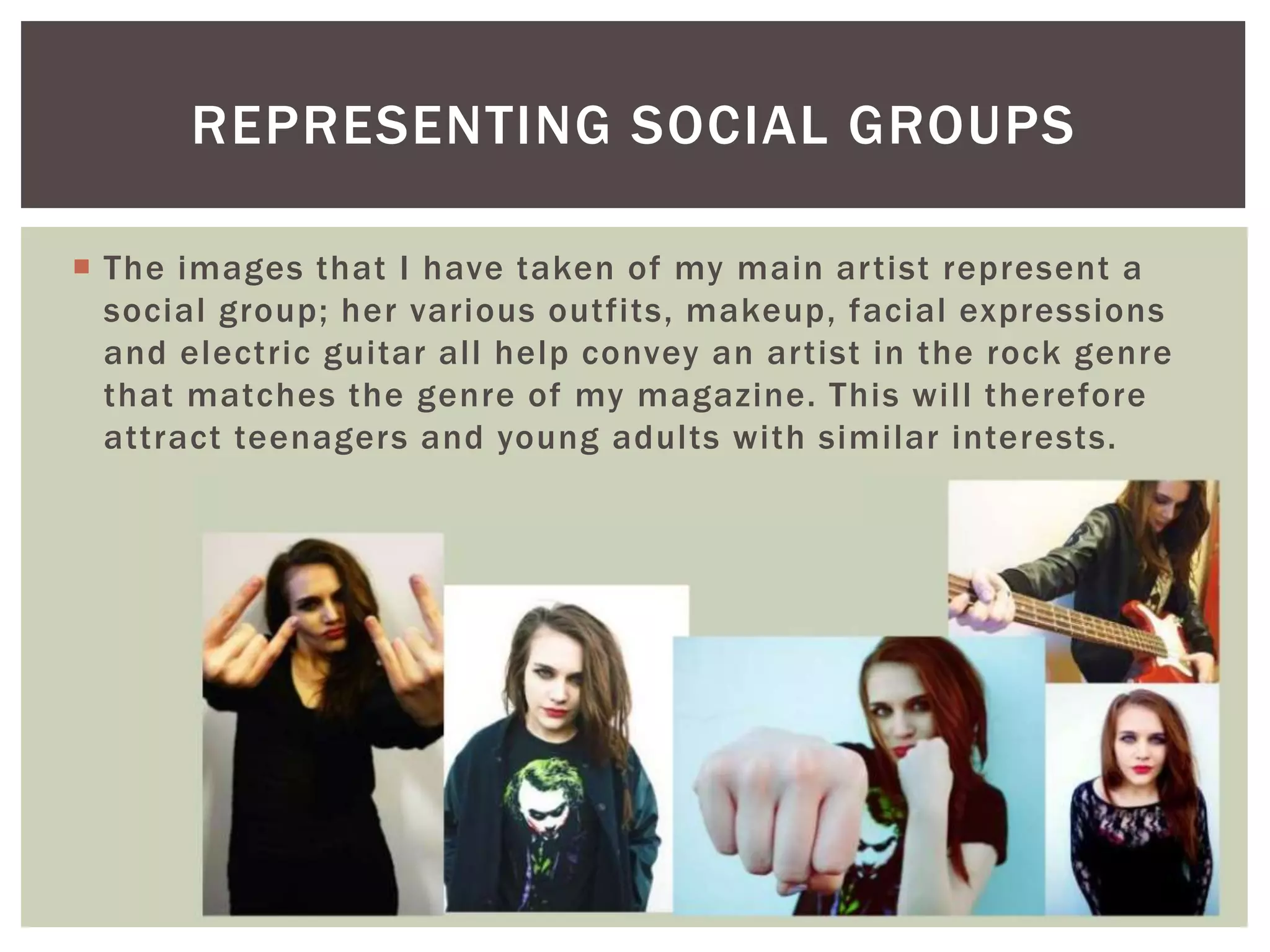
 The images that I have taken of my main artist represent a
social group; her various outfits, makeup, facial expressions
and electric guitar all help convey an artist in the rock genre
that matches the genre of my magazine. This will therefore
attract teenagers and young adults with similar interests.
REPRESENTING SOCIAL GROUPS
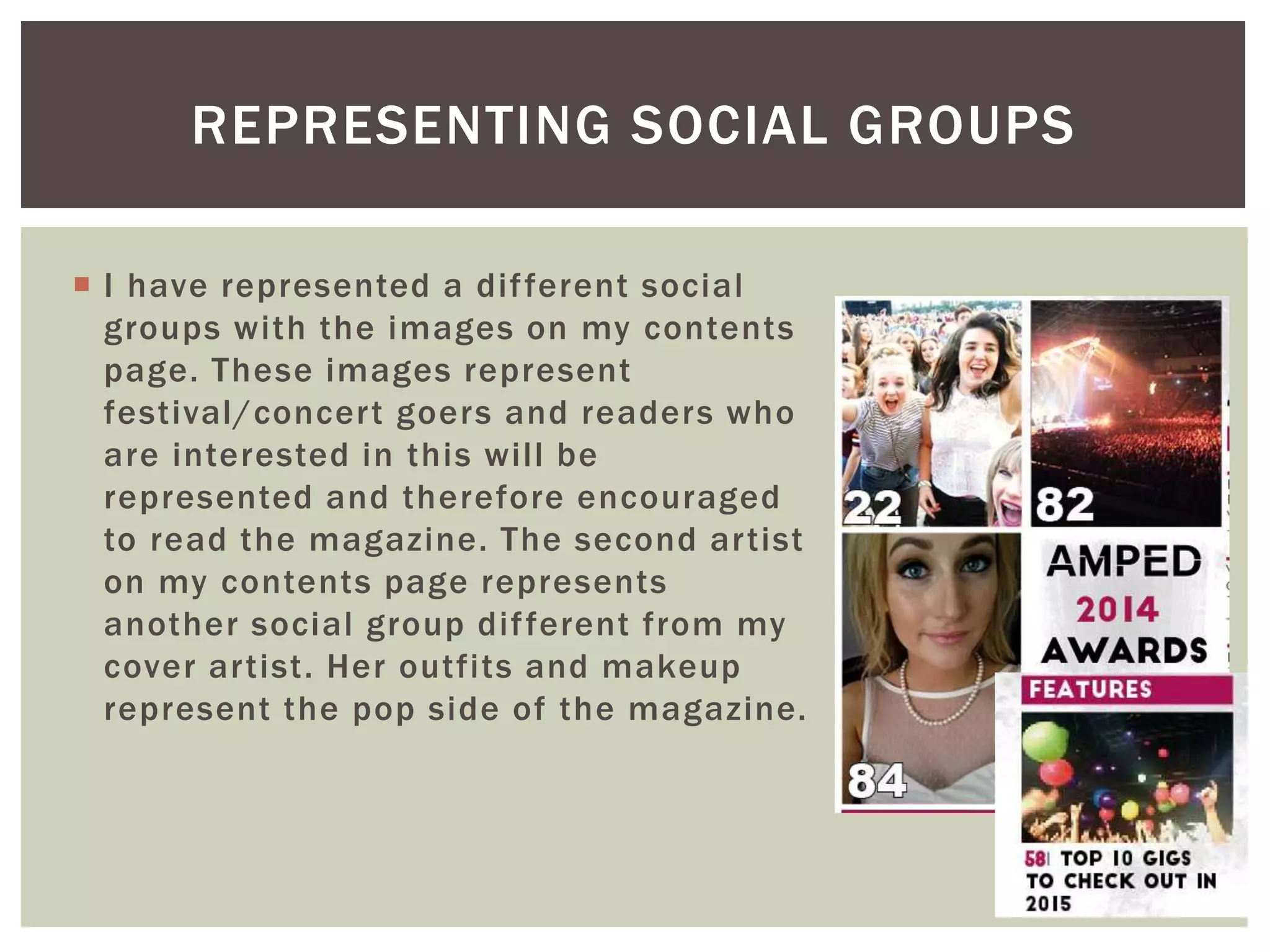
 I have represented a different social
groups with the images on my contents
page. These images represent
festival/concert goers and readers who
are interested in this will be
represented and therefore encouraged
to read the magazine. The second artist
on my contents page represents
another social group different from my
cover artist. Her outfits and makeup
represent the pop side of the magazine.
REPRESENTING SOCIAL GROUPS
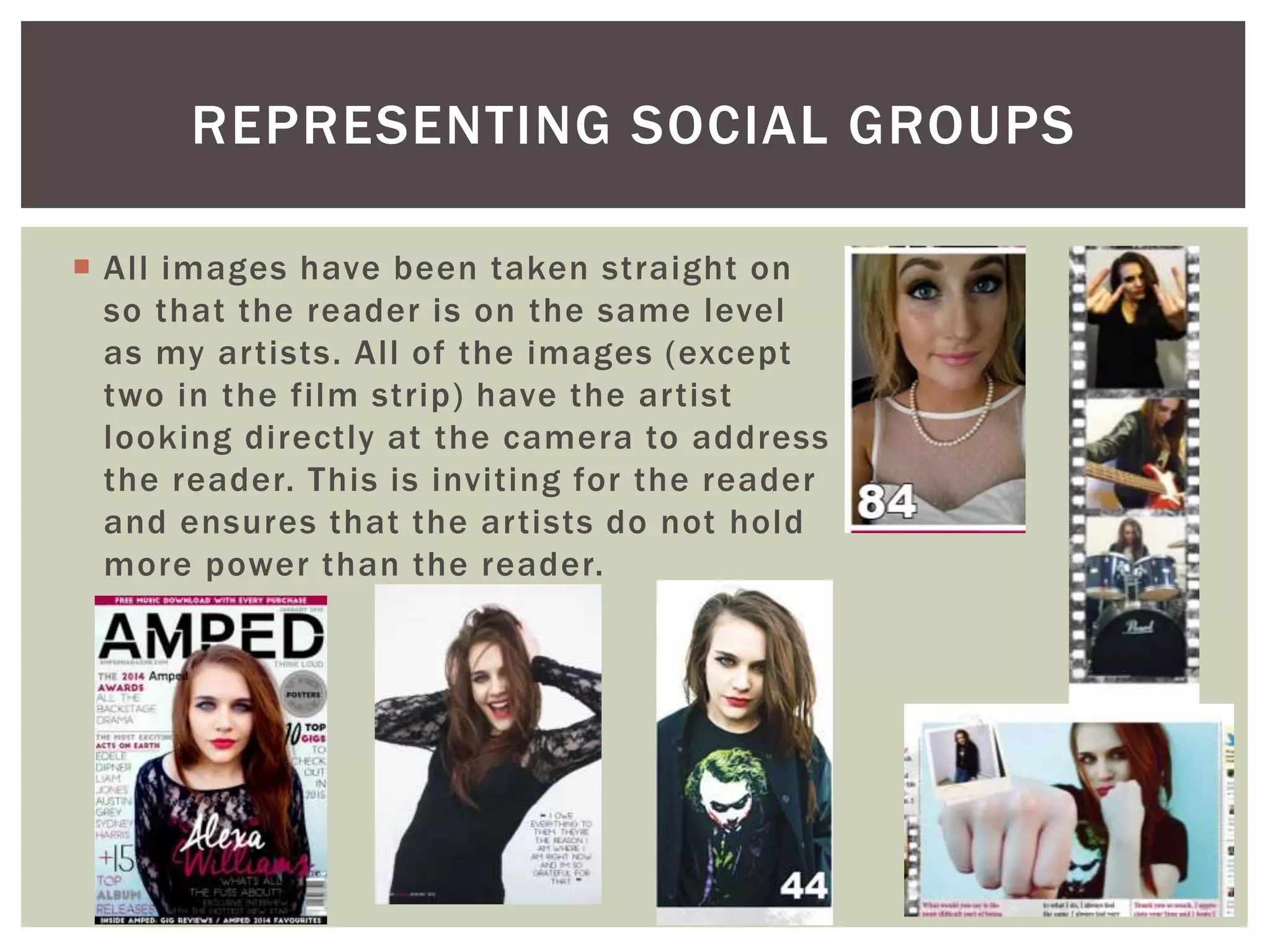
 All images have been taken straight on
so that the reader is on the same level
as my artists. All of the images (except
two in the film strip) have the artist
looking directly at the camera to address
the reader. This is inviting for the reader
and ensures that the artists do not hold
more power than the reader.

Q2

  • 1.
    Evaluation Q2 HOW DOESYOUR MEDIA PRODUCT REPRESENT PARTICULAR SOCIAL GROUPS?
  • 2.
     I wantedmy music magazine to be targeted at a youthful audience of both genders between 18 to 21 as this is the age that people have most disposable income and would purchase a product such as the one I created. As Kerrang! is aimed at younger teenagers, and Q at people who are slightly older, I wanted to find a balance between the sophistication of Q with the edgy aspects from Kerrang! so that my magazine could appeal to a range of ages.  From my target feedback questionnaire I was able to see that the genre that most people wanted to read about was pop/rock so I wanted to focus on this in my magazine. This questionnaire also told me that the majority of my audience would be females. With this in mind I analysed similar magazines to get an idea of how they represent social groups. REPRESENTING SOCIAL GROUPS
  • 3.
     As mostof my audience are females, this has definitely influenced my design in terms of the how my product looks. All of my images are of females and I have chosen and I have chosen a dark plum colour for my house style which makes the magazine look more feminine. REPRESENTING SOCIAL GROUPS
  • 4.
     As themajority of my audience are between 18-21, when looking at the demographic table for the UK, the majority of people in my target audience would be from the groups B, C1 and C2 which are middle class, lower middle class and skilled working class respectively. REPRESENTING SOCIAL GROUPS
  • 5.
     The imagesthat I have taken of my main artist represent a social group; her various outfits, makeup, facial expressions and electric guitar all help convey an artist in the rock genre that matches the genre of my magazine. This will therefore attract teenagers and young adults with similar interests. REPRESENTING SOCIAL GROUPS
  • 6.
     I haverepresented a different social groups with the images on my contents page. These images represent festival/concert goers and readers who are interested in this will be represented and therefore encouraged to read the magazine. The second artist on my contents page represents another social group different from my cover artist. Her outfits and makeup represent the pop side of the magazine. REPRESENTING SOCIAL GROUPS
  • 7.
    REPRESENTING SOCIAL GROUPS All images have been taken straight on so that the reader is on the same level as my artists. All of the images (except two in the film strip) have the artist looking directly at the camera to address the reader. This is inviting for the reader and ensures that the artists do not hold more power than the reader.