 Query Optimization
 Why Query Optimization?
 Join Size Estimation?
 Estimation of Number of Distinct Values.
 Query optimization is the process of selecting
the most efficient query-evaluation plan from
among the many strategies usually possible
for processing a given query, especially if the
query is complex.
 In simple scenes the query optimizer come
up with query-evaluation plan that computes
the same result as a given expression, but it
is a least costly way of generating result.
 Faster processing of a query.
 Lesser cost per query.
 High performance of the system.
 Lesser stress on the database.
 Efficient use of database engine.
 Lesser memory is consumed.
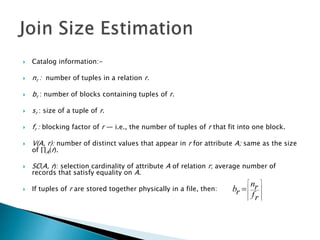
 Catalog information:-
 nr : number of tuples in a relation r.
 br : number of blocks containing tuples of r.
 sr : size of a tuple of r.
 fr : blocking factor of r — i.e., the number of tuples of r that fit into one block.
 V(A, r): number of distinct values that appear in r for attribute A; same as the size
of A(r).
 SC(A, r): selection cardinality of attribute A of relation r; average number of
records that satisfy equality on A.
 If tuples of r are stored together physically in a file, then:











rf
rn
rb
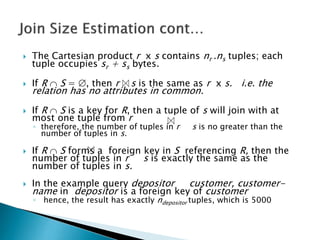
 The Cartesian product r x s contains nr .ns tuples; each
tuple occupies sr + ss bytes.
 If R  S = , then r s is the same as r x s. i.e. the
relation has no attributes in common.
 If R  S is a key for R, then a tuple of s will join with at
most one tuple from r
◦ therefore, the number of tuples in r s is no greater than the
number of tuples in s.
 If R  S forms a foreign key in S referencing R, then the
number of tuples in r s is exactly the same as the
number of tuples in s.
 In the example query depositor customer, customer-
name in depositor is a foreign key of customer
◦ hence, the result has exactly ndepositor tuples, which is 5000
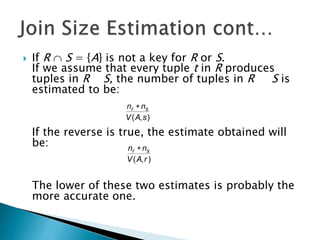
 If R  S = {A} is not a key for R or S.
If we assume that every tuple t in R produces
tuples in R S, the number of tuples in R S is
estimated to be:
If the reverse is true, the estimate obtained will
be:
The lower of these two estimates is probably the
more accurate one.
),( sAV
nn sr 
),( rAV
nn sr 
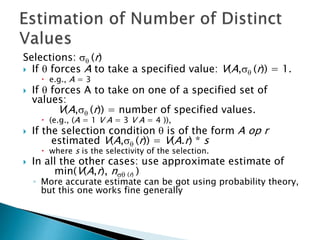
Selections:  (r)
 If  forces A to take a specified value: V(A, (r)) = 1.
 e.g., A = 3
 If  forces A to take on one of a specified set of
values:
V(A, (r)) = number of specified values.
 (e.g., (A = 1 V A = 3 V A = 4 )),
 If the selection condition  is of the form A op r
estimated V(A, (r)) = V(A.r) * s
 where s is the selectivity of the selection.
 In all the other cases: use approximate estimate of
min(V(A,r), n (r) )
◦ More accurate estimate can be got using probability theory,
but this one works fine generally
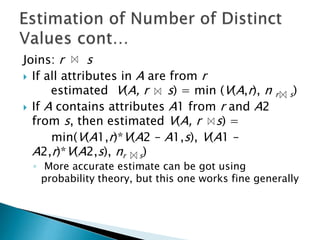
Joins: r s
 If all attributes in A are from r
estimated V(A, r s) = min (V(A,r), n r s)
 If A contains attributes A1 from r and A2
from s, then estimated V(A, r s) =
min(V(A1,r)*V(A2 – A1,s), V(A1 –
A2,r)*V(A2,s), nr s)
◦ More accurate estimate can be got using
probability theory, but this one works fine generally
THANKYOU…!!!

Query Optimization

  • 2.
     Query Optimization Why Query Optimization?  Join Size Estimation?  Estimation of Number of Distinct Values.
  • 3.
     Query optimizationis the process of selecting the most efficient query-evaluation plan from among the many strategies usually possible for processing a given query, especially if the query is complex.  In simple scenes the query optimizer come up with query-evaluation plan that computes the same result as a given expression, but it is a least costly way of generating result.
  • 4.
     Faster processingof a query.  Lesser cost per query.  High performance of the system.  Lesser stress on the database.  Efficient use of database engine.  Lesser memory is consumed.
  • 5.
     Catalog information:- nr : number of tuples in a relation r.  br : number of blocks containing tuples of r.  sr : size of a tuple of r.  fr : blocking factor of r — i.e., the number of tuples of r that fit into one block.  V(A, r): number of distinct values that appear in r for attribute A; same as the size of A(r).  SC(A, r): selection cardinality of attribute A of relation r; average number of records that satisfy equality on A.  If tuples of r are stored together physically in a file, then:            rf rn rb
  • 6.
     The Cartesianproduct r x s contains nr .ns tuples; each tuple occupies sr + ss bytes.  If R  S = , then r s is the same as r x s. i.e. the relation has no attributes in common.  If R  S is a key for R, then a tuple of s will join with at most one tuple from r ◦ therefore, the number of tuples in r s is no greater than the number of tuples in s.  If R  S forms a foreign key in S referencing R, then the number of tuples in r s is exactly the same as the number of tuples in s.  In the example query depositor customer, customer- name in depositor is a foreign key of customer ◦ hence, the result has exactly ndepositor tuples, which is 5000
  • 7.
     If R S = {A} is not a key for R or S. If we assume that every tuple t in R produces tuples in R S, the number of tuples in R S is estimated to be: If the reverse is true, the estimate obtained will be: The lower of these two estimates is probably the more accurate one. ),( sAV nn sr  ),( rAV nn sr 
  • 8.
    Selections:  (r) If  forces A to take a specified value: V(A, (r)) = 1.  e.g., A = 3  If  forces A to take on one of a specified set of values: V(A, (r)) = number of specified values.  (e.g., (A = 1 V A = 3 V A = 4 )),  If the selection condition  is of the form A op r estimated V(A, (r)) = V(A.r) * s  where s is the selectivity of the selection.  In all the other cases: use approximate estimate of min(V(A,r), n (r) ) ◦ More accurate estimate can be got using probability theory, but this one works fine generally
  • 9.
    Joins: r s If all attributes in A are from r estimated V(A, r s) = min (V(A,r), n r s)  If A contains attributes A1 from r and A2 from s, then estimated V(A, r s) = min(V(A1,r)*V(A2 – A1,s), V(A1 – A2,r)*V(A2,s), nr s) ◦ More accurate estimate can be got using probability theory, but this one works fine generally
  • 10.