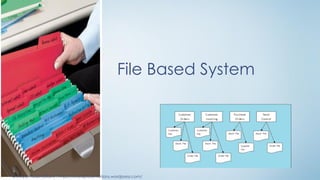
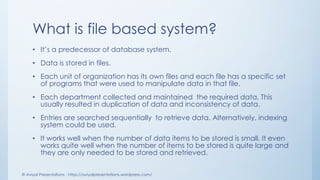
File Based System
© Aviyal Presentations : https://aviyalpresentations.wordpress.com/
What is file based system?
• It’s a predecessor of database system.
• Data is stored in files.
• Each unit of organization has its own files and each file has a specific set
of programs that were used to manipulate data in that file.
• Each department collected and maintained the required data. This
usually resulted in duplication of data and inconsistency of data.
• Entries are searched sequentially to retrieve data. Alternatively, indexing
system could be used.
• It works well when the number of data items to be stored is small. It even
works quite well when the number of items to be stored is quite large and
they are only needed to be stored and retrieved.
© Aviyal Presentations : https://aviyalpresentations.wordpress.com/
• File system crashes when cross-referencing and processing of information in the files is
performed.
• Its almost obsolete, cumbersome and time consuming.
EXAMPLE:
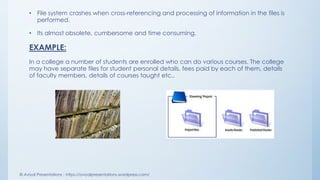
In a college a number of students are enrolled who can do various courses. The college
may have separate files for student personal details, fees paid by each of them, details
of faculty members, details of courses taught etc..
© Aviyal Presentations : https://aviyalpresentations.wordpress.com/
Disadvantages of File based System
• File-based system has the following disadvantages:
 Data Redundancy: Due to decentralized approach, the same information may be
duplicated in different files. This leads to : i) wastage of storage space ii) costs time and
money to enter the data more than once. For example, consider a person has both savings
and current account. In this case, customers personal details(name, address…) will be
stored in both files. This results in wastage of memory.
 Data Inconsistency: Two reasons for inconsistency: i) more than one person modifies the
data simultaneously. ii) wrong data is entered. For example, consider a person has both
savings and current account. Consider that the address of a person is changed only in one
file. This creates data inconsistency.
 Difficulty in Accessing Data: It becomes difficult to access data when data is stored in
different files. When data is stored in more than one file it becomes extremely difficult to
access data as large amount of data has to be searched.
 Limited Data Sharing: Data are stored in different files. Different files may have different
formats and these files may be stored in different folders. So, due to this data isolation, it is
difficult to share data among different applications.
© Aviyal Presentations : https://aviyalpresentations.wordpress.com/
 Integrity Problems: Data integrity means that the data contained in the database in
both correct and consistent. For this purpose the data stored in database must satisfy
correct and consistent. For example, balance for any account should not be less than
0, this should be specified in the system by adding appropriate code .
 Data dependence: File structure is stored in program code. Its very difficult to change
the existing structure. The programmer will have to find all the affected programs,
modify and change them. This characteristic is known as program data
independence.
 Incompatible file formats: File structure is stored in program code, therefore the
structure is dependent on programming language. This makes it difficult to process
jointly.
 Fixed Queries: File based systems are dependent on application program. Programs
are written to satisfy particular functions. Any new requirement needs a new program.
 Maintenance: Maintenance of file based system is difficult.
 Security: There is no provision for security. Paper files can be lost leading to permanent
data loss.
 Recovery: Recovery is non-existent or inadequate.
© Aviyal Presentations : https://aviyalpresentations.wordpress.com/

File based approach

  • 1.
    File Based System ©Aviyal Presentations : https://aviyalpresentations.wordpress.com/
  • 2.
    What is filebased system? • It’s a predecessor of database system. • Data is stored in files. • Each unit of organization has its own files and each file has a specific set of programs that were used to manipulate data in that file. • Each department collected and maintained the required data. This usually resulted in duplication of data and inconsistency of data. • Entries are searched sequentially to retrieve data. Alternatively, indexing system could be used. • It works well when the number of data items to be stored is small. It even works quite well when the number of items to be stored is quite large and they are only needed to be stored and retrieved. © Aviyal Presentations : https://aviyalpresentations.wordpress.com/
  • 3.
    • File systemcrashes when cross-referencing and processing of information in the files is performed. • Its almost obsolete, cumbersome and time consuming. EXAMPLE: In a college a number of students are enrolled who can do various courses. The college may have separate files for student personal details, fees paid by each of them, details of faculty members, details of courses taught etc.. © Aviyal Presentations : https://aviyalpresentations.wordpress.com/
  • 4.
    Disadvantages of Filebased System • File-based system has the following disadvantages:  Data Redundancy: Due to decentralized approach, the same information may be duplicated in different files. This leads to : i) wastage of storage space ii) costs time and money to enter the data more than once. For example, consider a person has both savings and current account. In this case, customers personal details(name, address…) will be stored in both files. This results in wastage of memory.  Data Inconsistency: Two reasons for inconsistency: i) more than one person modifies the data simultaneously. ii) wrong data is entered. For example, consider a person has both savings and current account. Consider that the address of a person is changed only in one file. This creates data inconsistency.  Difficulty in Accessing Data: It becomes difficult to access data when data is stored in different files. When data is stored in more than one file it becomes extremely difficult to access data as large amount of data has to be searched.  Limited Data Sharing: Data are stored in different files. Different files may have different formats and these files may be stored in different folders. So, due to this data isolation, it is difficult to share data among different applications. © Aviyal Presentations : https://aviyalpresentations.wordpress.com/
  • 5.
     Integrity Problems:Data integrity means that the data contained in the database in both correct and consistent. For this purpose the data stored in database must satisfy correct and consistent. For example, balance for any account should not be less than 0, this should be specified in the system by adding appropriate code .  Data dependence: File structure is stored in program code. Its very difficult to change the existing structure. The programmer will have to find all the affected programs, modify and change them. This characteristic is known as program data independence.  Incompatible file formats: File structure is stored in program code, therefore the structure is dependent on programming language. This makes it difficult to process jointly.  Fixed Queries: File based systems are dependent on application program. Programs are written to satisfy particular functions. Any new requirement needs a new program.  Maintenance: Maintenance of file based system is difficult.  Security: There is no provision for security. Paper files can be lost leading to permanent data loss.  Recovery: Recovery is non-existent or inadequate. © Aviyal Presentations : https://aviyalpresentations.wordpress.com/
  • 6.
    © Aviyal Presentations: https://aviyalpresentations.wordpress.com/