Approximate Continuous Query Answering
Over Streams and Dynamic Linked Data Sets
Soheila Dehghanzadeh, Daniele Dell’Aglio, Shen Gao,
Emanuele Della Valle, Alessandra Mileo, Abraham Bernstein
3 March 2015
Outline
• Introduction
• Motivating example
• Problem definition
• Proposed solution
• Experimental results
• Conclusion
Insight Centre for Data Analytics Slide 2
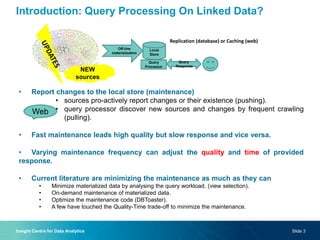
Introduction: Query Processing On Linked Data?
• Report changes to the local store (maintenance)
• sources pro-actively report changes or their existence (pushing).
• query processor discover new sources and changes by frequent crawling
(pulling).
• Fast maintenance leads high quality but slow response and vice versa.
• Varying maintenance frequency can adjust the quality and time of provided
response.
• Current literature are minimizing the maintenance as much as they can
• Minimize materialized data by analysing the query workload. (view selection).
• On-demand maintenance of materialized data.
• Optimize the maintenance code (DBToaster).
• A few have touched the Quality-Time trade-off to minimize the maintenance.
Replication (database) or Caching (web)
Off-line
materialization
Local
Store
Query
Processor
Query
Response
NEW
sources
Slide 3Insight Centre for Data Analytics
Web
My suggestion to minimize the
maintenance
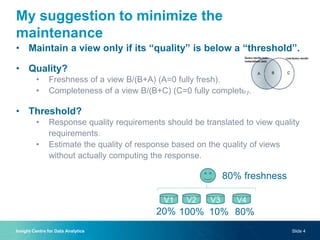
• Maintain a view only if its “quality” is below a “threshold”.
• Quality?
• Freshness of a view B/(B+A) (A=0 fully fresh).
• Completeness of a view B/(B+C) (C=0 fully complete).
• Threshold?
• Response quality requirements should be translated to view quality
requirements.
• Estimate the quality of response based on the quality of views
without actually computing the response.
Insight Centre for Data Analytics Slide 4
V1 V2 V3 V4
80% freshness
20% 100% 10% 80%
My Experiment
• I simplified the problem.
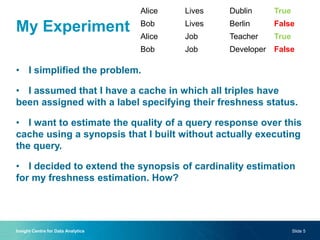
• I assumed that I have a cache in which all triples have
been assigned with a label specifying their freshness status.
• I want to estimate the quality of a query response over this
cache using a synopsis that I built without actually executing
the query.
• I decided to extend the synopsis of cardinality estimation
for my freshness estimation. How?
Insight Centre for Data Analytics Slide 5
Alice Lives Dublin True
Bob Lives Berlin False
Alice Job Teacher True
Bob Job Developer False
Cardinality Estimation
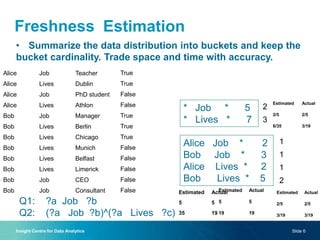
• Summarize the data distribution into buckets and keep the
bucket cardinality. Trade space and time with accuracy.
Insight Centre for Data Analytics Slide 6
Alice Job Teacher
Alice Lives Dublin
Alice Job PhD student
Alice Lives Athlon
Bob Job Manager
Bob Lives Berlin
Bob Lives Chicago
Bob Lives Munich
Bob Lives Belfast
Bob Lives Limerick
Bob Job CEO
Bob Job Consultant
Alice Job * 2
Bob Job * 3
Alice Lives * 2
Bob Lives * 5
* Job * 5
* Lives * 7
Freshness
True
True
False
False
True
True
True
False
False
False
False
False
2
3
1
1
1
2
Q1: ?a Job ?b
Q2: (?a Job ?b)^(?a Lives ?c)
Estimated Actual
5 5
35 19
Estimated Actual
5 5
19 19
Estimated Actual
2/5 2/5
6/35 3/19
Estimated Actual
2/5 2/5
3/19 3/19
Cardinality Estimation Approaches
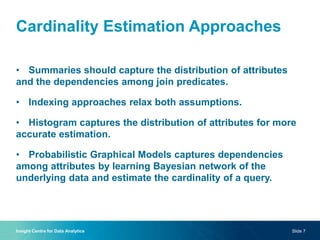
• Summaries should capture the distribution of attributes
and the dependencies among join predicates.
• Indexing approaches relax both assumptions.
• Histogram captures the distribution of attributes for more
accurate estimation.
• Probabilistic Graphical Models captures dependencies
among attributes by learning Bayesian network of the
underlying data and estimate the cardinality of a query.
Insight Centre for Data Analytics Slide 7
Measure Performance of The Estimation
Approach
Insight Centre for Data Analytics Slide 8
n is the number of queries
Measure the difference between the actual and estimated
freshness of queries in a query set.
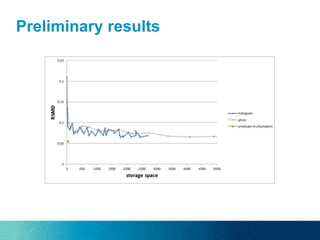
Preliminary results
Conclusion
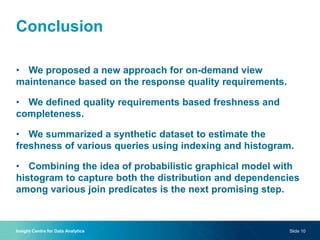
• We proposed a new approach for on-demand view
maintenance based on the response quality requirements.
• We defined quality requirements based freshness and
completeness.
• We summarized a synthetic dataset to estimate the
freshness of various queries using indexing and histogram.
• Combining the idea of probabilistic graphical model with
histogram to capture both the distribution and dependencies
among various join predicates is the next promising step.
Insight Centre for Data Analytics Slide 10
• Thanks a lot for your attention !
• Any comment is welcomed!
Insight Centre for Data Analytics Slide 11
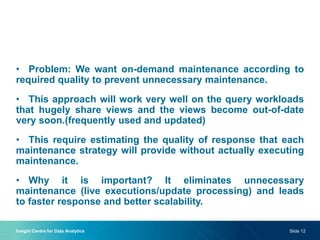
• Problem: We want on-demand maintenance according to
required quality to prevent unnecessary maintenance.
• This approach will work very well on the query workloads
that hugely share views and the views become out-of-date
very soon.(frequently used and updated)
• This require estimating the quality of response that each
maintenance strategy will provide without actually executing
maintenance.
• Why it is important? It eliminates unnecessary
maintenance (live executions/update processing) and leads
to faster response and better scalability.
Insight Centre for Data Analytics Slide 12
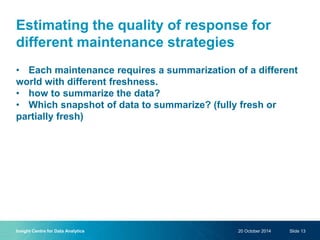
Estimating the quality of response for
different maintenance strategies
• Each maintenance requires a summarization of a different
world with different freshness.
• how to summarize the data?
• Which snapshot of data to summarize? (fully fresh or
partially fresh)
20 October 2014Insight Centre for Data Analytics Slide 13
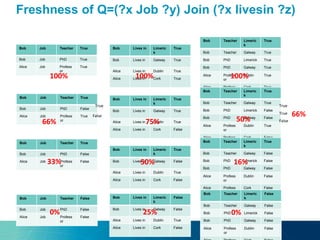
Freshness of Q=(?x Job ?y) Join (?x livesin ?z)
Bob Job Teacher True
Bob Job PhD True
Alice Job Profess
or
True
Bob Job Teacher True
Bob Job PhD False
Alice Job Profess
or
True
Bob Job Teacher True
Bob Job PhD False
Alice Job Profess
or
False
Bob Job Teacher False
Bob Job PhD False
Alice Job Profess
or
False
Bob Lives in Limeric
k
True
Bob Lives in Galway True
Alice Lives in Dublin True
Alice Lives in Cork True
Bob Lives in Limeric
k
True
Bob Lives in Galway True
Alice Lives in Dublin True
Alice Lives in Cork False
Bob Lives in Limeric
k
True
Bob Lives in Galway False
Alice Lives in Dublin True
Alice Lives in Cork False
Bob Lives in Limeric
k
False
Bob Lives in Galway False
Alice Lives in Dublin True
Alice Lives in Cork False
Bob Teacher Limeric
k
True
Bob Teacher Galway True
Bob PhD Limerick True
Bob PhD Galway True
Alice Profess
or
Dublin True
Alice Profess
or
Cork True
Bob Teacher Limeric
k
True
Bob Teacher Galway True
Bob PhD Limerick False
Bob PhD Galway False
Alice Profess
or
Dublin True
Alice Profess
or
Cork False
Bob Teacher Limeric
k
True
Bob Teacher Galway False
Bob PhD Limerick False
Bob PhD Galway False
Alice Profess
or
Dublin False
Alice Profess
or
Cork False
Bob Teacher Limeric
k
False
Bob Teacher Galway False
Bob PhD Limerick False
Bob PhD Galway False
Alice Profess
or
Dublin False
100% 100% 100%
66% 75% 50%
33% 50% 16%
0% 25% 0%
True
False
True
True
False
66%
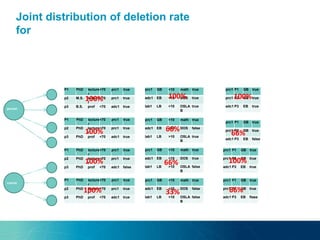
Joint distribution of deletion rate
for
person
income
position
Teacher of
education
course difficulty
location
name
P1 PhD lecture
r
<70 prc1 true
p2 M.S. lecture
r
<70 prc1 true
p3 B.S. prof <70 adc1 true
P1 PhD lecture
r
<70 prc1 true
p2 PhD lecture
r
<70 prc1 true
p3 PhD prof <70 adc1 true
P1 PhD lecture
r
<70 prc1 true
p2 PhD lecture
r
<70 prc1 true
p3 PhD prof <70 adc1 false
P1 PhD lecture
r
<70 prc1 true
p2 PhD lecture
r
<70 prc1 true
p3 PhD prof <70 adc1 true
prc1 GB <10 math true
adc1 EB <10 DOS true
lab1 LB >10 OSLA
B
true
Select ?x,?y,?a4
WHERE
?x income ?a1
?x position ?a2
?x teacherof ?y
?x education ?a3
?y location ?a4
?y difficulty ?a5
?y name ?a6
100% 100%
prc1 P1 GB true
prc1 P2 GB true
adc1 P3 EB true
100%
prc1 GB <10 math true
adc1 EB <10 DOS false
lab1 LB >10 OSLA
B
true
prc1 GB <10 math true
adc1 EB <10 DOS true
lab1 LB >10 OSLA
B
false
prc1 GB <10 math true
adc1 EB <10 DOS false
lab1 LB >10 OSLA
B
false
prc1 P1 GB true
prc1 P2 GB true
adc1 P3 EB false
prc1 P1 GB true
prc1 P2 GB true
adc1 P3 EB true
prc1 P1 GB true
prc1 P2 GB true
adc1 P3 EB flase
100%
100%
66%
66%
66% 100%
100% 33% 66%
Research questions and hypothesis
• How to adjust the maintenance according to response
quality requirements.
• What is the quality of response provided without maintenance
(current materialized data)?
• Which maintenance strategy can boost the response quality up-to
the required level with lowest maintenance cost ( live
execution/update processing).
• Hypothesis:
• Having quality of join counterparts, we “CAN” estimate the quality of
(maintained) join results and choose the best maintenance which
can fulfil the required quality in shortest time.
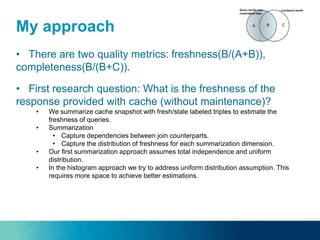
My approach
• There are two quality metrics: freshness(B/(A+B)),
completeness(B/(B+C)).
• First research question: What is the freshness of the
response provided with cache (without maintenance)?
• We summarize cache snapshot with fresh/stale labeled triples to estimate the
freshness of queries.
• Summarization
• Capture dependencies between join counterparts.
• Capture the distribution of freshness for each summarization dimension.
• Our first summarization approach assumes total independence and uniform
distribution.
• In the histogram approach we try to address uniform distribution assumption. This
requires more space to achieve better estimations.
State of the art
• Difficulty? Capturing all the dependencies among various sub-queries and
learn distribution of fresh entries in a summary to estimate the freshness of join
results is a very complicated task. Most summarizations assumes
independence and uniform distribution.
• In RDBMS
• Join has been modelled as a selection over the Cartesian product. (selection condition
over the Cartesian product is the join condition)
• Estimation of query response quality boils down to quality estimation of selection
conditions.
• Heavily influenced by the role of identity key per tuple which doesn’t exist in RDF data
model.
• Goal is to estimate the quality of different selection conditions using different formula
and probabilities based on if the selection condition (partially) contains the identity key.
Evaluation plan
• I’ll test the hypothesis by measuring the difference
between actual freshness and estimated freshness.
• Baseline is freshness estimation with independent
assumption and uniform freshness distribution between join
counterparts.
• Capturing more dependencies and accurate distribution of
freshness leads to more accurate freshness estimation.
• Probabilistic graphical models can capture more
dependencies which leads to more accurate freshness
estimation and response quality and optimization in
maintenance.
Reflections
• The ideal case is to run query on the actual cache
without summarization which leads to 100% accuracy in
freshness estimation which is not feasible due to huge
space requirements and long response time.
• Summarization will provide faster but approximate
results with lower space requirements.
• Summarization techniques require capturing the
distribution and the dependencies. The more accurate
distribution and capturing more dependency leads to
more accurate estimations.

Approximate Continuous Query Answering Over Streams and Dynamic Linked Data Sets

  • 1.
    Approximate Continuous QueryAnswering Over Streams and Dynamic Linked Data Sets Soheila Dehghanzadeh, Daniele Dell’Aglio, Shen Gao, Emanuele Della Valle, Alessandra Mileo, Abraham Bernstein 3 March 2015
  • 2.
    Outline • Introduction • Motivatingexample • Problem definition • Proposed solution • Experimental results • Conclusion Insight Centre for Data Analytics Slide 2
  • 3.
    Introduction: Query ProcessingOn Linked Data? • Report changes to the local store (maintenance) • sources pro-actively report changes or their existence (pushing). • query processor discover new sources and changes by frequent crawling (pulling). • Fast maintenance leads high quality but slow response and vice versa. • Varying maintenance frequency can adjust the quality and time of provided response. • Current literature are minimizing the maintenance as much as they can • Minimize materialized data by analysing the query workload. (view selection). • On-demand maintenance of materialized data. • Optimize the maintenance code (DBToaster). • A few have touched the Quality-Time trade-off to minimize the maintenance. Replication (database) or Caching (web) Off-line materialization Local Store Query Processor Query Response NEW sources Slide 3Insight Centre for Data Analytics Web
  • 4.
    My suggestion tominimize the maintenance • Maintain a view only if its “quality” is below a “threshold”. • Quality? • Freshness of a view B/(B+A) (A=0 fully fresh). • Completeness of a view B/(B+C) (C=0 fully complete). • Threshold? • Response quality requirements should be translated to view quality requirements. • Estimate the quality of response based on the quality of views without actually computing the response. Insight Centre for Data Analytics Slide 4 V1 V2 V3 V4 80% freshness 20% 100% 10% 80%
  • 5.
    My Experiment • Isimplified the problem. • I assumed that I have a cache in which all triples have been assigned with a label specifying their freshness status. • I want to estimate the quality of a query response over this cache using a synopsis that I built without actually executing the query. • I decided to extend the synopsis of cardinality estimation for my freshness estimation. How? Insight Centre for Data Analytics Slide 5 Alice Lives Dublin True Bob Lives Berlin False Alice Job Teacher True Bob Job Developer False
  • 6.
    Cardinality Estimation • Summarizethe data distribution into buckets and keep the bucket cardinality. Trade space and time with accuracy. Insight Centre for Data Analytics Slide 6 Alice Job Teacher Alice Lives Dublin Alice Job PhD student Alice Lives Athlon Bob Job Manager Bob Lives Berlin Bob Lives Chicago Bob Lives Munich Bob Lives Belfast Bob Lives Limerick Bob Job CEO Bob Job Consultant Alice Job * 2 Bob Job * 3 Alice Lives * 2 Bob Lives * 5 * Job * 5 * Lives * 7 Freshness True True False False True True True False False False False False 2 3 1 1 1 2 Q1: ?a Job ?b Q2: (?a Job ?b)^(?a Lives ?c) Estimated Actual 5 5 35 19 Estimated Actual 5 5 19 19 Estimated Actual 2/5 2/5 6/35 3/19 Estimated Actual 2/5 2/5 3/19 3/19
  • 7.
    Cardinality Estimation Approaches •Summaries should capture the distribution of attributes and the dependencies among join predicates. • Indexing approaches relax both assumptions. • Histogram captures the distribution of attributes for more accurate estimation. • Probabilistic Graphical Models captures dependencies among attributes by learning Bayesian network of the underlying data and estimate the cardinality of a query. Insight Centre for Data Analytics Slide 7
  • 8.
    Measure Performance ofThe Estimation Approach Insight Centre for Data Analytics Slide 8 n is the number of queries Measure the difference between the actual and estimated freshness of queries in a query set.
  • 9.
  • 10.
    Conclusion • We proposeda new approach for on-demand view maintenance based on the response quality requirements. • We defined quality requirements based freshness and completeness. • We summarized a synthetic dataset to estimate the freshness of various queries using indexing and histogram. • Combining the idea of probabilistic graphical model with histogram to capture both the distribution and dependencies among various join predicates is the next promising step. Insight Centre for Data Analytics Slide 10
  • 11.
    • Thanks alot for your attention ! • Any comment is welcomed! Insight Centre for Data Analytics Slide 11
  • 12.
    • Problem: Wewant on-demand maintenance according to required quality to prevent unnecessary maintenance. • This approach will work very well on the query workloads that hugely share views and the views become out-of-date very soon.(frequently used and updated) • This require estimating the quality of response that each maintenance strategy will provide without actually executing maintenance. • Why it is important? It eliminates unnecessary maintenance (live executions/update processing) and leads to faster response and better scalability. Insight Centre for Data Analytics Slide 12
  • 13.
    Estimating the qualityof response for different maintenance strategies • Each maintenance requires a summarization of a different world with different freshness. • how to summarize the data? • Which snapshot of data to summarize? (fully fresh or partially fresh) 20 October 2014Insight Centre for Data Analytics Slide 13
  • 14.
    Freshness of Q=(?xJob ?y) Join (?x livesin ?z) Bob Job Teacher True Bob Job PhD True Alice Job Profess or True Bob Job Teacher True Bob Job PhD False Alice Job Profess or True Bob Job Teacher True Bob Job PhD False Alice Job Profess or False Bob Job Teacher False Bob Job PhD False Alice Job Profess or False Bob Lives in Limeric k True Bob Lives in Galway True Alice Lives in Dublin True Alice Lives in Cork True Bob Lives in Limeric k True Bob Lives in Galway True Alice Lives in Dublin True Alice Lives in Cork False Bob Lives in Limeric k True Bob Lives in Galway False Alice Lives in Dublin True Alice Lives in Cork False Bob Lives in Limeric k False Bob Lives in Galway False Alice Lives in Dublin True Alice Lives in Cork False Bob Teacher Limeric k True Bob Teacher Galway True Bob PhD Limerick True Bob PhD Galway True Alice Profess or Dublin True Alice Profess or Cork True Bob Teacher Limeric k True Bob Teacher Galway True Bob PhD Limerick False Bob PhD Galway False Alice Profess or Dublin True Alice Profess or Cork False Bob Teacher Limeric k True Bob Teacher Galway False Bob PhD Limerick False Bob PhD Galway False Alice Profess or Dublin False Alice Profess or Cork False Bob Teacher Limeric k False Bob Teacher Galway False Bob PhD Limerick False Bob PhD Galway False Alice Profess or Dublin False 100% 100% 100% 66% 75% 50% 33% 50% 16% 0% 25% 0% True False True True False 66%
  • 15.
    Joint distribution ofdeletion rate for person income position Teacher of education course difficulty location name P1 PhD lecture r <70 prc1 true p2 M.S. lecture r <70 prc1 true p3 B.S. prof <70 adc1 true P1 PhD lecture r <70 prc1 true p2 PhD lecture r <70 prc1 true p3 PhD prof <70 adc1 true P1 PhD lecture r <70 prc1 true p2 PhD lecture r <70 prc1 true p3 PhD prof <70 adc1 false P1 PhD lecture r <70 prc1 true p2 PhD lecture r <70 prc1 true p3 PhD prof <70 adc1 true prc1 GB <10 math true adc1 EB <10 DOS true lab1 LB >10 OSLA B true Select ?x,?y,?a4 WHERE ?x income ?a1 ?x position ?a2 ?x teacherof ?y ?x education ?a3 ?y location ?a4 ?y difficulty ?a5 ?y name ?a6 100% 100% prc1 P1 GB true prc1 P2 GB true adc1 P3 EB true 100% prc1 GB <10 math true adc1 EB <10 DOS false lab1 LB >10 OSLA B true prc1 GB <10 math true adc1 EB <10 DOS true lab1 LB >10 OSLA B false prc1 GB <10 math true adc1 EB <10 DOS false lab1 LB >10 OSLA B false prc1 P1 GB true prc1 P2 GB true adc1 P3 EB false prc1 P1 GB true prc1 P2 GB true adc1 P3 EB true prc1 P1 GB true prc1 P2 GB true adc1 P3 EB flase 100% 100% 66% 66% 66% 100% 100% 33% 66%
  • 16.
    Research questions andhypothesis • How to adjust the maintenance according to response quality requirements. • What is the quality of response provided without maintenance (current materialized data)? • Which maintenance strategy can boost the response quality up-to the required level with lowest maintenance cost ( live execution/update processing). • Hypothesis: • Having quality of join counterparts, we “CAN” estimate the quality of (maintained) join results and choose the best maintenance which can fulfil the required quality in shortest time.
  • 17.
    My approach • Thereare two quality metrics: freshness(B/(A+B)), completeness(B/(B+C)). • First research question: What is the freshness of the response provided with cache (without maintenance)? • We summarize cache snapshot with fresh/stale labeled triples to estimate the freshness of queries. • Summarization • Capture dependencies between join counterparts. • Capture the distribution of freshness for each summarization dimension. • Our first summarization approach assumes total independence and uniform distribution. • In the histogram approach we try to address uniform distribution assumption. This requires more space to achieve better estimations.
  • 18.
    State of theart • Difficulty? Capturing all the dependencies among various sub-queries and learn distribution of fresh entries in a summary to estimate the freshness of join results is a very complicated task. Most summarizations assumes independence and uniform distribution. • In RDBMS • Join has been modelled as a selection over the Cartesian product. (selection condition over the Cartesian product is the join condition) • Estimation of query response quality boils down to quality estimation of selection conditions. • Heavily influenced by the role of identity key per tuple which doesn’t exist in RDF data model. • Goal is to estimate the quality of different selection conditions using different formula and probabilities based on if the selection condition (partially) contains the identity key.
  • 19.
    Evaluation plan • I’lltest the hypothesis by measuring the difference between actual freshness and estimated freshness. • Baseline is freshness estimation with independent assumption and uniform freshness distribution between join counterparts. • Capturing more dependencies and accurate distribution of freshness leads to more accurate freshness estimation. • Probabilistic graphical models can capture more dependencies which leads to more accurate freshness estimation and response quality and optimization in maintenance.
  • 20.
    Reflections • The idealcase is to run query on the actual cache without summarization which leads to 100% accuracy in freshness estimation which is not feasible due to huge space requirements and long response time. • Summarization will provide faster but approximate results with lower space requirements. • Summarization techniques require capturing the distribution and the dependencies. The more accurate distribution and capturing more dependency leads to more accurate estimations.

Editor's Notes

  • #4 The estimation will create a lot of problem: Each maintenance requires a summarization of a different world with different freshness. how to summarize the data? Which snapshot of data to summarize? (fully fresh or partially fresh) If qp frequently maintain their local strore, less resources will be available for the qp and the reponse time becomes longer. On the other hand if qp dedicate more resources for qp then the maintenance procedure will be less frequent and data becomes stale. We determine the best maintenance plan and execute “only” that maintenance “lively”. If I want to estimate the quality of a specific maintenance strategy, I should have the summarization which have that particular maintenance. Estimating the quality of each maintenance strategy requires summarizing the data that was in a similar situation or trying to design a dynamic summarization. For example if I want to estimate the quality of response of a query with live executing sub-query1 and sub-query2 I should have a summarization of a situation that those 2 have been fresh and These summarization becomes out-of-date according to the real situation. For example, if I summarize a situation where 2 views are fresh would that be always valid for evaluating scenarios where these 2 are fresh? And does that make sense to have a summary for each combination of fresh views? 2^number of fresh views. What would happen if I update Even if I have the summarization of that situation, it stil The main problem in query processing is to ------------ To process queries over web one naïve approach is to process queries over individual data sources which is not realistic because it takes an infinite amount of time. The solution to this problem was to replicate or cache data in a local store and process queries over it. however, this solution arises another problem which is changes to original data is not reflected on local store. The maintenance procedure is responsible to keep the local copy up-to-date. Depending on the change reporting mechanism, maintenance should be done with different strategies. In the second maintenance type I should mention that “here maintenance translates to live execution”. We get the query, we estimate the quality of each underlying view (this view has been update 10 mins ago and it decreases freshness 10% a minutes. The only problem is the actual updates are happening in burst) , we choose the corresponding summarization for each maintenance and use that to estimate the quality of join.
  • #5 For that I need to define the quality and a way to specify threshold. We discovered that quality requirements of a user response can be summarized based on 2 factors freshness and completeness and we define them as follows: imagine user could run the query on the real data and get the transparent circle and I provide him with the response on my materialized data the shaded circle. If A turns out empty, you will say, see my responses are fresh even though they are not complete. If C turns out empty then you will say my responses are complete even though some of them are out of data. We didn’t include C in detention of freshness because in our intuition changing C doesn’t affect freshness and changing A doesn’t affect completeness either. Now a way to specify threshold. And having the user specified quality dimensions for their response, we should translate it to quality dimensions for underlying views. Problem: We want on-demand maintenance according to required quality to prevent unnecessary maintenance. This approach will work very well on the query workloads that hugely share views and the views become out-of-date very soon.(frequently used and updated) This require estimating the quality of response that each maintenance strategy will provide without actually executing maintenance. Why it is important? It eliminates unnecessary maintenance (live executions/update processing) and leads to faster response and better scalability.
  • #6 This is for one snapshot but since quality is changing rapidly we have to design several synopsis for various snapshots or design a dynamic histogram.
  • #7 Less accurate but save required space and response time. More granularity in bucket  more space, longer response time but higher accuracy.
  • #10 (Do you have any preliminary results that demonstrate that your approach is promising) It is obvious that to capture freshness distribution per entry using histogram, our summary requires more space.
  • #17 (What is the object of your study? What is the hypothesis that you will test? ) We want to minimize maintenance Maintained join is a join with updated join counterparts
  • #18 (What is the main idea behind your approach? The key innovation?) We use summarization to estimate join freshness based on freshness of join counterparts. Can we expect the summary (build from one snapshot) to respond properly for other snapshots? If it captures the joint distribution properly then we can… We just want to summarize cache
  • #19 (Why is the problem difficult? What have others tried to do? ) Estimating the freshness of selection condition still requires join distribution. Thus we need to capture join distribution anyways.
  • #20 How do you plan to test your hypothesis? What will you measure? What will you compare to?
  • #21 Provide an argument, based either on common knowledge or on evidence that you have accumulated, the your approach is likely to succeed.