08/11/2019 1Jonathan Eemans JE Consulting
Queries in SAP
08/11/2019 2
Queries in SAP
Introduction
How does the InfoSet query functionality work?
How to create an InfoSet query?
Attention points
08/11/2019 3
Introduction
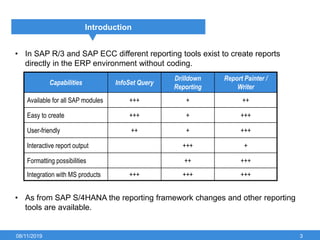
• In SAP R/3 and SAP ECC different reporting tools exist to create reports
directly in the ERP environment without coding.
• As from SAP S/4HANA the reporting framework changes and other reporting
tools are available.
Capabilities InfoSet Query
Drilldown
Reporting
Report Painter /
Writer
Available for all SAP modules +++ + ++
Easy to create +++ + +++
User-friendly ++ + +++
Interactive report output +++ +
Formatting possibilities ++ +++
Integration with MS products +++ +++ +++
08/11/2019 4
Introduction
• 6 reasons to use the query functionality in SAP R/3 or SAP:
It is delivered with SAP
It is available across all modules
It is easy to teach users to write their own reports
It requires minimal configuration
Security is built-in — no hard-coding
No ABAP programming skills required
08/11/2019 5
Introduction
• Useful transactions:
 SQ03: SAP Query - Maintain user groups
 SQ02: SAP Query - Maintain InfoSet
 SQ01: SAP Query - Maintain queries
 SE93: Transaction codes
 SE11: Dictionary - Tables
 SE16(N): General Table Display
08/11/2019 6
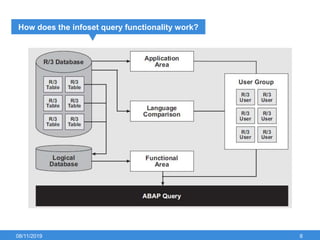
How does the infoset query functionality work?
08/11/2019 7
How to create an InfoSet query?
Proper configuration of these components consists of the following six steps:
1. Determine your administration strategy
2. Decide which application area to use for developing reports
3. Create user groups to organize reports
4. Create InfoSet
5. Create query
6. Create transaction code (if required)
08/11/2019 8
Step 1: Determine your administration strategy
• The first step in configuring the query functionality is to determine where
users can develop and create queries.
1. Configure and enable its use in the live production environment
2. Configure and enable its use only in a development client
3. A little bit of both
• Best practice: queries are always created in the development environment
and transported. All queries need to be tested in staging with special
attention to performance issues!
08/11/2019 9
Step 2: Decide which application area to use for
developing reports
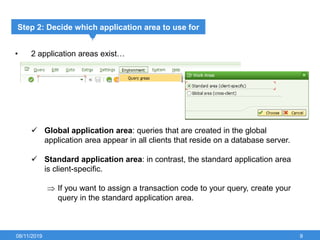
• 2 application areas exist…
 Global application area: queries that are created in the global
application area appear in all clients that reside on a database server.
 Standard application area: in contrast, the standard application area
is client-specific.
 If you want to assign a transaction code to your query, create your
query in the standard application area.
08/11/2019 10
Step 3: Create user groups to organise reports
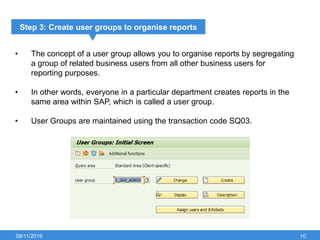
• The concept of a user group allows you to organise reports by segregating
a group of related business users from all other business users for
reporting purposes.
• In other words, everyone in a particular department creates reports in the
same area within SAP, which is called a user group.
• User Groups are maintained using the transaction code SQ03.
08/11/2019 11
Step 4: Create InfoSet
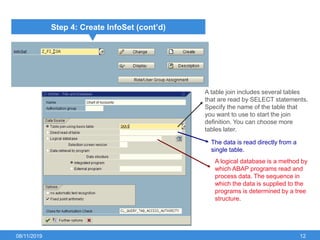
• InfoSets are data sources used in getting the data for SAP reports. Such
data sources are evaluated in queries.
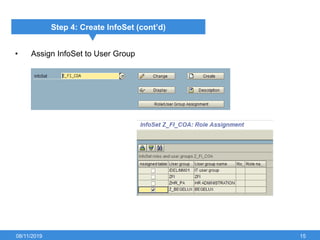
• InfoSets are allocated to a user group; the members of a group can access
the InfoSet to which the group is allocated.
• InfoSets are maintained using the transaction code SQ02.
08/11/2019 12
Step 4: Create InfoSet (cont’d)
A table join includes several tables
that are read by SELECT statements.
Specify the name of the table that
you want to use to start the join
definition. You can choose more
tables later.
The data is read directly from a
single table.
A logical database is a method by
which ABAP programs read and
process data. The sequence in
which the data is supplied to the
programs is determined by a tree
structure.
08/11/2019 13
Step 4: Create InfoSet (cont’d)
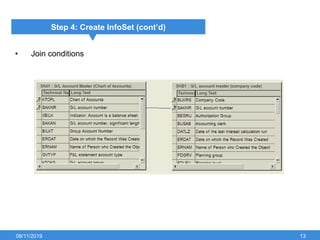
• Join conditions
08/11/2019 14
Step 4: Create InfoSet (cont’d)
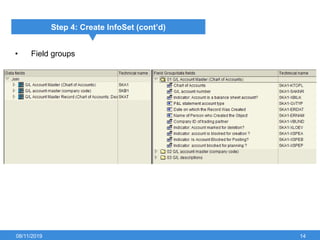
• Field groups
08/11/2019 15
Step 4: Create InfoSet (cont’d)
• Assign InfoSet to User Group
08/11/2019 16
Step 5: Create Query
• A query is a tool used to create lists using data available for analysis
purposes in InfoSet.
• Queries are assigned to InfoSet and user group(s).
• A query is created and maintained using the transaction code SQ01.
08/11/2019 17
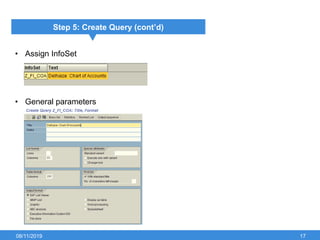
Step 5: Create Query (cont’d)
• Assign InfoSet
• General parameters
08/11/2019 18
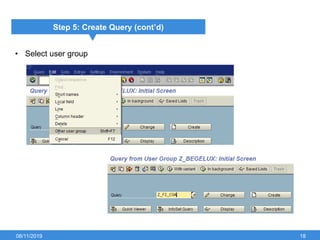
Step 5: Create Query (cont’d)
• Select user group
08/11/2019 19
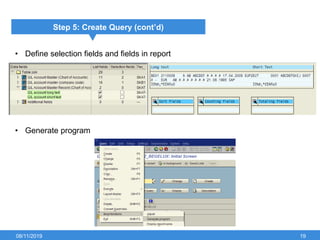
Step 5: Create Query (cont’d)
• Define selection fields and fields in report
• Generate program
08/11/2019 20
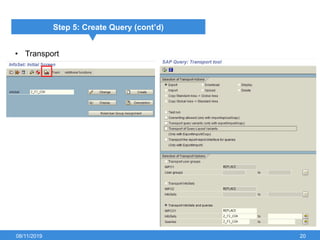
Step 5: Create Query (cont’d)
• Transport
08/11/2019 21
Step 6: Create transaction code
• There are two options for executing queries…
1. Execute query from transaction SQ01
Not really user-friendly
2. Create custom transaction code to query
Authorisations need to be updated
08/11/2019 22
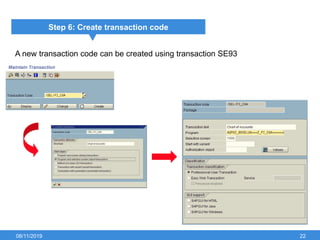
Step 6: Create transaction code
A new transaction code can be created using transaction SE93
08/11/2019 23
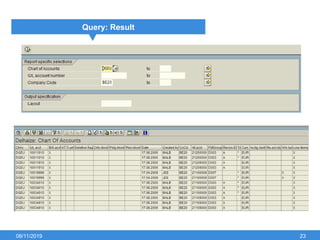
Query: Result
08/11/2019 24
Attention points
Performance of queries needs to be checked before transporting new reports
to production !
Simple lists with limited or no formatting !
Be careful with reports on transactional data !

Queries in SAP: Introduction

  • 1.
    08/11/2019 1Jonathan EemansJE Consulting Queries in SAP
  • 2.
    08/11/2019 2 Queries inSAP Introduction How does the InfoSet query functionality work? How to create an InfoSet query? Attention points
  • 3.
    08/11/2019 3 Introduction • InSAP R/3 and SAP ECC different reporting tools exist to create reports directly in the ERP environment without coding. • As from SAP S/4HANA the reporting framework changes and other reporting tools are available. Capabilities InfoSet Query Drilldown Reporting Report Painter / Writer Available for all SAP modules +++ + ++ Easy to create +++ + +++ User-friendly ++ + +++ Interactive report output +++ + Formatting possibilities ++ +++ Integration with MS products +++ +++ +++
  • 4.
    08/11/2019 4 Introduction • 6reasons to use the query functionality in SAP R/3 or SAP: It is delivered with SAP It is available across all modules It is easy to teach users to write their own reports It requires minimal configuration Security is built-in — no hard-coding No ABAP programming skills required
  • 5.
    08/11/2019 5 Introduction • Usefultransactions:  SQ03: SAP Query - Maintain user groups  SQ02: SAP Query - Maintain InfoSet  SQ01: SAP Query - Maintain queries  SE93: Transaction codes  SE11: Dictionary - Tables  SE16(N): General Table Display
  • 6.
    08/11/2019 6 How doesthe infoset query functionality work?
  • 7.
    08/11/2019 7 How tocreate an InfoSet query? Proper configuration of these components consists of the following six steps: 1. Determine your administration strategy 2. Decide which application area to use for developing reports 3. Create user groups to organize reports 4. Create InfoSet 5. Create query 6. Create transaction code (if required)
  • 8.
    08/11/2019 8 Step 1:Determine your administration strategy • The first step in configuring the query functionality is to determine where users can develop and create queries. 1. Configure and enable its use in the live production environment 2. Configure and enable its use only in a development client 3. A little bit of both • Best practice: queries are always created in the development environment and transported. All queries need to be tested in staging with special attention to performance issues!
  • 9.
    08/11/2019 9 Step 2:Decide which application area to use for developing reports • 2 application areas exist…  Global application area: queries that are created in the global application area appear in all clients that reside on a database server.  Standard application area: in contrast, the standard application area is client-specific.  If you want to assign a transaction code to your query, create your query in the standard application area.
  • 10.
    08/11/2019 10 Step 3:Create user groups to organise reports • The concept of a user group allows you to organise reports by segregating a group of related business users from all other business users for reporting purposes. • In other words, everyone in a particular department creates reports in the same area within SAP, which is called a user group. • User Groups are maintained using the transaction code SQ03.
  • 11.
    08/11/2019 11 Step 4:Create InfoSet • InfoSets are data sources used in getting the data for SAP reports. Such data sources are evaluated in queries. • InfoSets are allocated to a user group; the members of a group can access the InfoSet to which the group is allocated. • InfoSets are maintained using the transaction code SQ02.
  • 12.
    08/11/2019 12 Step 4:Create InfoSet (cont’d) A table join includes several tables that are read by SELECT statements. Specify the name of the table that you want to use to start the join definition. You can choose more tables later. The data is read directly from a single table. A logical database is a method by which ABAP programs read and process data. The sequence in which the data is supplied to the programs is determined by a tree structure.
  • 13.
    08/11/2019 13 Step 4:Create InfoSet (cont’d) • Join conditions
  • 14.
    08/11/2019 14 Step 4:Create InfoSet (cont’d) • Field groups
  • 15.
    08/11/2019 15 Step 4:Create InfoSet (cont’d) • Assign InfoSet to User Group
  • 16.
    08/11/2019 16 Step 5:Create Query • A query is a tool used to create lists using data available for analysis purposes in InfoSet. • Queries are assigned to InfoSet and user group(s). • A query is created and maintained using the transaction code SQ01.
  • 17.
    08/11/2019 17 Step 5:Create Query (cont’d) • Assign InfoSet • General parameters
  • 18.
    08/11/2019 18 Step 5:Create Query (cont’d) • Select user group
  • 19.
    08/11/2019 19 Step 5:Create Query (cont’d) • Define selection fields and fields in report • Generate program
  • 20.
    08/11/2019 20 Step 5:Create Query (cont’d) • Transport
  • 21.
    08/11/2019 21 Step 6:Create transaction code • There are two options for executing queries… 1. Execute query from transaction SQ01 Not really user-friendly 2. Create custom transaction code to query Authorisations need to be updated
  • 22.
    08/11/2019 22 Step 6:Create transaction code A new transaction code can be created using transaction SE93
  • 23.
  • 24.
    08/11/2019 24 Attention points Performanceof queries needs to be checked before transporting new reports to production ! Simple lists with limited or no formatting ! Be careful with reports on transactional data !