Variant Configuration
What is the Purpose of variant Configuration

  Variant configuration is for manufacturing complex products in
   which customer determines the features of the product. Objective
   of variant configuration is to react quickly to customers’
   requirements.
   Here it needs not to create separate material for each variant of a
   product. When companies introduce variant configuration this
   often goes beyond a business process re-engineering project.
   Variant configuration offers an opportunity to restructure product
   structures for which then processes are defined. This has a direct
   impact to the core areas such as marketing and product data
   management


                                                                    Slide Number 2
                                                                  ©2008 Capgemini
What is the Use of variant Configuration
  It is tool which helps to simplify the complex manufacturing of final
   product more varieties and variation of the input material

  To ensure right choice is delivered

  Easy for the sales person to select & Communication is fast and clear

  Ensures production of right item

  New products can be configured immediately by the system itself and all
   changes in the costs of production, pricing for the new product are taken
   into account by the system automatically.

  This session will walk you through the steps of building a simple VC
   model.

                                                                             Slide Number 3
                                                                           ©2008 Capgemini
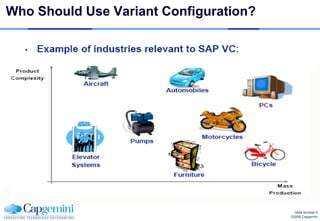
Who Should Use Variant Configuration?


                                          Slide Number 4
                                        ©2008 Capgemini
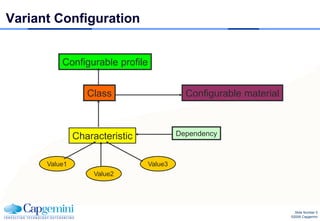
Variant Configuration


          Configurable profile


                  Class                     Configurable material


               Characteristic             Dependency


      Value1                     Value3
                    Value2


                                                                      Slide Number 5
                                                                    ©2008 Capgemini
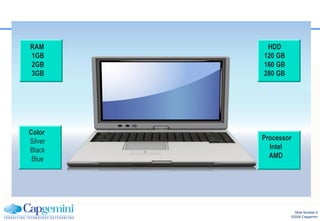
RAM       HDD
1GB      120 GB
2GB      160 GB
3GB      280 GB


Color
Silver   Processor
Black      Intel
 Blue      AMD


                    Slide Number 6
                  ©2008 Capgemini
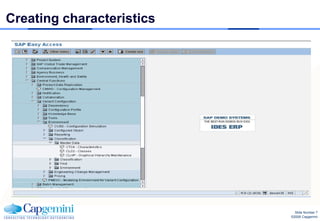
Creating characteristics


                             Slide Number 7
                           ©2008 Capgemini
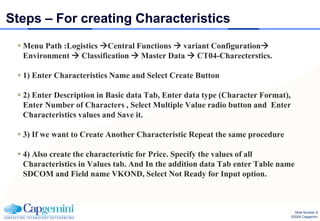
Steps – For creating Characteristics
  Menu Path :Logistics Central Functions  variant Configuration
   Environment  Classification  Master Data  CT04-Charecterstics.

  1) Enter Characteristics Name and Select Create Button

  2) Enter Description in Basic data Tab, Enter data type (Character Format),
   Enter Number of Characters , Select Multiple Value radio button and Enter
   Characteristics values and Save it.

  3) If we want to Create Another Characteristic Repeat the same procedure

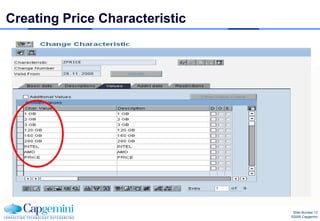
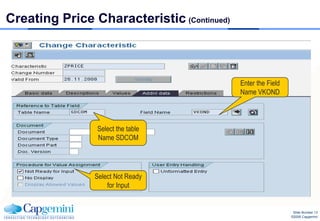
  4) Also create the characteristic for Price. Specify the values of all
   Characteristics in Values tab. And In the addition data Tab enter Table name
   SDCOM and Field name VKOND, Select Not Ready for Input option.


                                                                                   Slide Number 8
                                                                                 ©2008 Capgemini
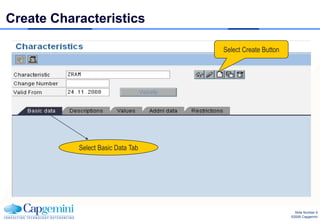
Create Characteristics

                                   Select Create Button


           Select Basic Data Tab


                                                            Slide Number 9
                                                          ©2008 Capgemini
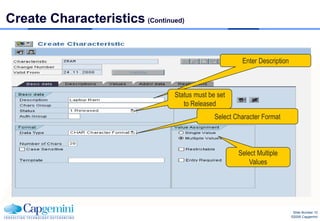
Create Characteristics (Continued)


                                                       Enter Description


                                Status must be set
                                   to Released
                                              Select Character Format


                                                      Select Multiple
                                                          Values


                                                                            Slide Number 10
                                                                           ©2008 Capgemini
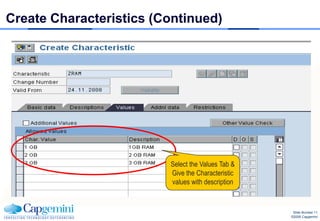
Create Characteristics (Continued)


                         Select the Values Tab &
                         Give the Characteristic
                         values with description


                                                    Slide Number 11
                                                   ©2008 Capgemini
Creating Price Characteristic


                                 Slide Number 12
                                ©2008 Capgemini
Creating Price Characteristic (Continued)


                                            Enter the Field
                                            Name VKOND


                Select the table
                Name SDCOM


                Select Not Ready
                    for Input


                                                               Slide Number 13
                                                              ©2008 Capgemini
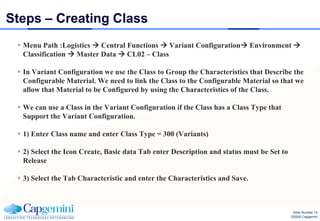
Steps – Creating Class
  Menu Path :Logistics  Central Functions  Variant Configuration Environment 
   Classification  Master Data  CL02 – Class

  In Variant Configuration we use the Class to Group the Characteristics that Describe the
   Configurable Material. We need to link the Class to the Configurable Material so that we
   allow that Material to be Configured by using the Characteristics of the Class.

  We can use a Class in the Variant Configuration if the Class has a Class Type that
   Support the Variant Configuration.

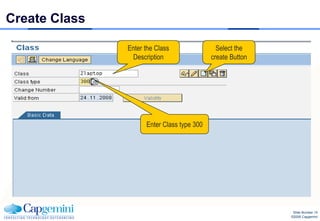
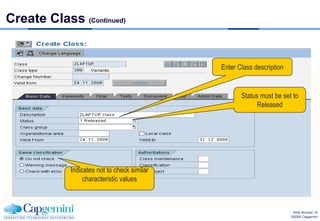
  1) Enter Class name and enter Class Type = 300 (Variants)

  2) Select the Icon Create, Basic data Tab enter Description and status must be Set to
   Release

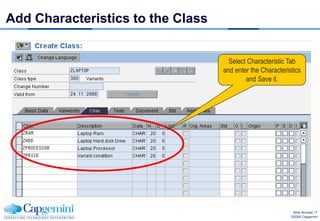
  3) Select the Tab Characteristic and enter the Characteristics and Save.


                                                                                            Slide Number 14
                                                                                           ©2008 Capgemini
Create Class

               Enter the Class                Select the
                Description                 create Button


                     Enter Class type 300


                                                             Slide Number 15
                                                            ©2008 Capgemini
Create Class (Continued)


                                             Enter Class description


                                                    Status must be set to
                                                          Released


            Indicates not to check similar
                 characteristic values


                                                                        Slide Number 16
                                                                       ©2008 Capgemini
Add Characteristics to the Class


                                     Select Characteristic Tab
                                   and enter the Characteristics
                                           and Save it.


                                                             Slide Number 17
                                                            ©2008 Capgemini
Creating a Configurable Material
  A material with different features or characteristics and options is known as
   configurable material. Example: PC, Car.

  Configurable materials are either created in a material type that allows the
   configuration (n the standard system, the material type KMAT) or they are
   given the indicator Configurable in the material master record.

  Specify the Industry sector is Mechanical Engineering & Material type is
   Configurable Material

  Item category group is 0002

  In basic data 2 tab we need to select the check box configurable material

  Class type is 300


                                                                                    Slide Number 18
                                                                                   ©2008 Capgemini
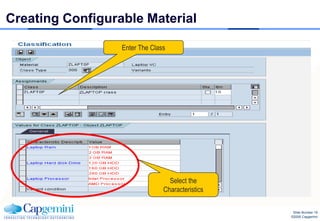
Creating Configurable Material

                  Enter The Class


                                  Select the
                                Characteristics

                                                   Slide Number 19
                                                  ©2008 Capgemini
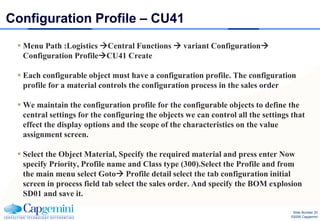
Configuration Profile – CU41
  Menu Path :Logistics Central Functions  variant Configuration
   Configuration ProfileCU41 Create

  Each configurable object must have a configuration profile. The configuration
   profile for a material controls the configuration process in the sales order

  We maintain the configuration profile for the configurable objects to define the
   central settings for the configuring the objects we can control all the settings that
   effect the display options and the scope of the characteristics on the value
   assignment screen.

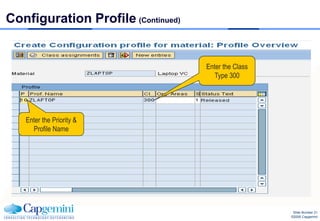
  Select the Object Material, Specify the required material and press enter Now
   specify Priority, Profile name and Class type (300).Select the Profile and from
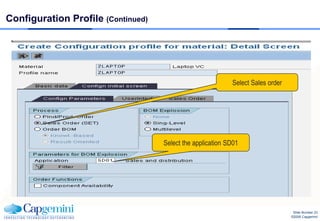
   the main menu select Goto Profile detail select the tab configuration initial
   screen in process field tab select the sales order. And specify the BOM explosion
   SD01 and save it.

                                                                                    Slide Number 20
                                                                                   ©2008 Capgemini
Configuration Profile (Continued)


                                    Enter the Class
                                       Type 300


   Enter the Priority &
     Profile Name


                                                       Slide Number 21
                                                      ©2008 Capgemini
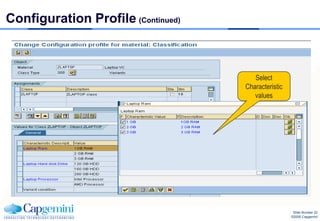
Configuration Profile (Continued)


                                       Select
                                    Characteristic
                                       values


                                                      Slide Number 22
                                                     ©2008 Capgemini
Configuration Profile (Continued)


                                                            Select Sales order


                                    Select the application SD01


                                                                                  Slide Number 23
                                                                                 ©2008 Capgemini
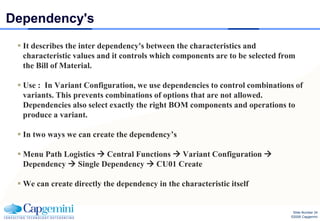
Dependency's
  It describes the inter dependency's between the characteristics and
   characteristic values and it controls which components are to be selected from
   the Bill of Material.

  Use : In Variant Configuration, we use dependencies to control combinations of
   variants. This prevents combinations of options that are not allowed.
   Dependencies also select exactly the right BOM components and operations to
   produce a variant.

  In two ways we can create the dependency’s

  Menu Path Logistics  Central Functions  Variant Configuration 
   Dependency  Single Dependency  CU01 Create

  We can create directly the dependency in the characteristic itself


                                                                                Slide Number 24
                                                                               ©2008 Capgemini
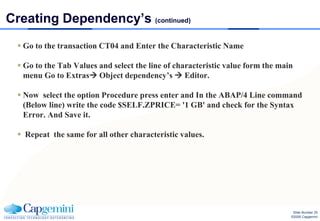
Creating Dependency’s (continued)
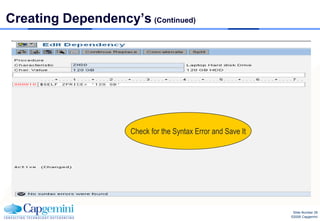
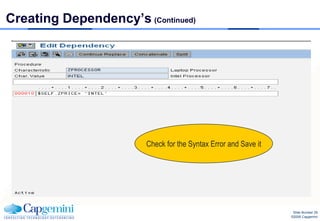
   Go to the transaction CT04 and Enter the Characteristic Name

   Go to the Tab Values and select the line of characteristic value form the main
    menu Go to Extras Object dependency’s  Editor.

   Now select the option Procedure press enter and In the ABAP/4 Line command
    (Below line) write the code $SELF.ZPRICE= '1 GB' and check for the Syntax
    Error. And Save it.

   Repeat the same for all other characteristic values.


                                                                                  Slide Number 25
                                                                                 ©2008 Capgemini
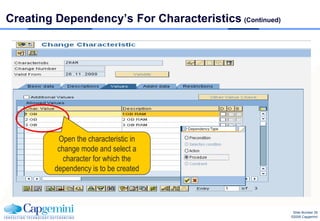
Creating Dependency’s For Characteristics (Continued)


          Open the characteristic in
          change mode and select a
            character for which the
         dependency is to be created


                                                         Slide Number 26
                                                        ©2008 Capgemini
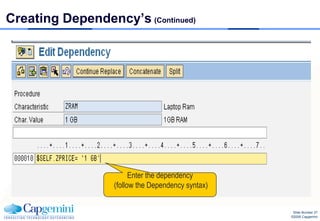
Creating Dependency’s (Continued)


                        Enter the dependency
                  (follow the Dependency syntax)


                                                    Slide Number 27
                                                   ©2008 Capgemini
Creating Dependency’s (Continued)


                     Check for the Syntax Error and Save It


                                                               Slide Number 28
                                                              ©2008 Capgemini
Creating Dependency’s (Continued)


                        Check for the Syntax Error and Save it


                                                                  Slide Number 29
                                                                 ©2008 Capgemini
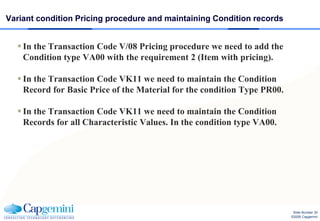
Variant condition Pricing procedure and maintaining Condition records


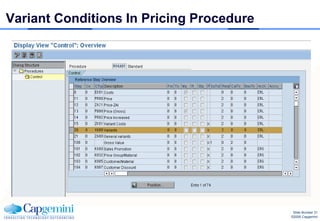
   In the Transaction Code V/08 Pricing procedure we need to add the
    Condition type VA00 with the requirement 2 (Item with pricing).

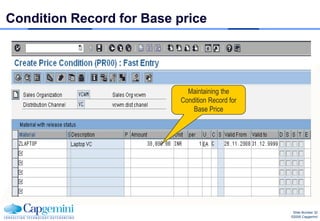
   In the Transaction Code VK11 we need to maintain the Condition
    Record for Basic Price of the Material for the condition Type PR00.

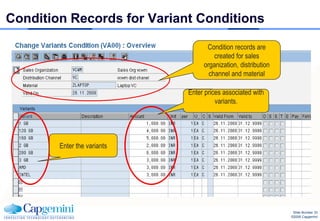
   In the Transaction Code VK11 we need to maintain the Condition
    Records for all Characteristic Values. In the condition type VA00.


                                                                           Slide Number 30
                                                                          ©2008 Capgemini
Variant Conditions In Pricing Procedure


                                           Slide Number 31
                                          ©2008 Capgemini
Condition Record for Base price


                            Maintaining the
                          Condition Record for
                              Base Price


                                                  Slide Number 32
                                                 ©2008 Capgemini
Condition Records for Variant Conditions

                                   Condition records are
                                      created for sales
                                  organization, distribution
                                    channel and material

                             Enter prices associated with
                                       variants.


        Enter the variants


                                                                Slide Number 33
                                                               ©2008 Capgemini
Creating the Sales Order BOM

  Create the Material masters for All the Components

  Go to the Transaction Code CS01.And Enter the Material “ZLAPTOP ”,
   Enter the Plant and Enter the BOM Usage is 5.

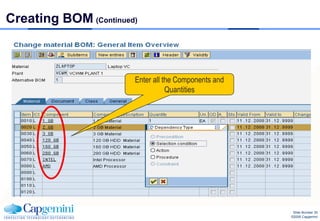
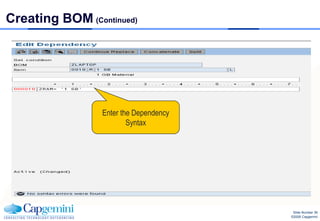
  In the Initial Screen of the BOM enter all the Components and Quantity

  Select the Line and Go to the Main menu select Extras  Object
   Dependencies  Editor there write the dependencies Syntax.

  Repeat the Procedure for all BOM Components and Save.


                                                                       Slide Number 34
                                                                      ©2008 Capgemini
Creating BOM (Continued)


                       Enter all the Components and
                                  Quantities


                                                       Slide Number 35
                                                      ©2008 Capgemini
Creating BOM (Continued)


                 Enter the Dependency
                         Syntax


                                         Slide Number 36
                                        ©2008 Capgemini
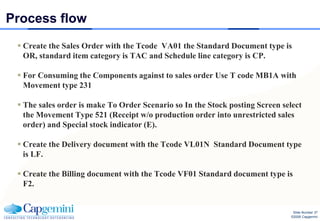
Process flow
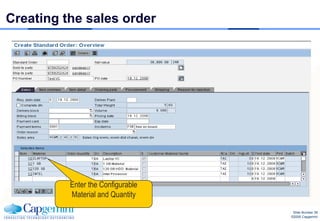
  Create the Sales Order with the Tcode VA01 the Standard Document type is
   OR, standard item category is TAC and Schedule line category is CP.

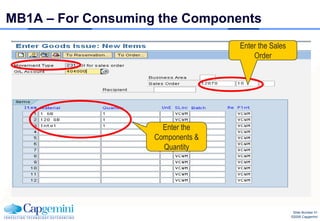
  For Consuming the Components against to sales order Use T code MB1A with
   Movement type 231

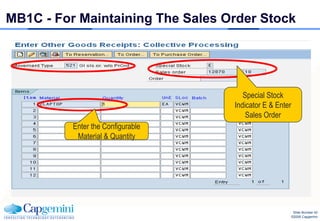
  The sales order is make To Order Scenario so In the Stock posting Screen select
   the Movement Type 521 (Receipt w/o production order into unrestricted sales
   order) and Special stock indicator (E).

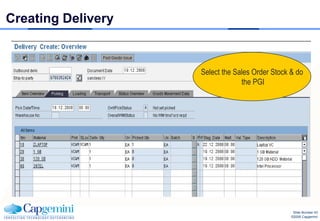
  Create the Delivery document with the Tcode VL01N Standard Document type
   is LF.

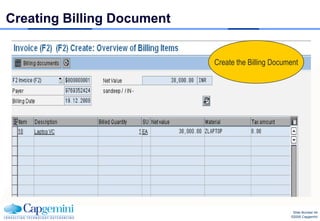
  Create the Billing document with the Tcode VF01 Standard document type is
   F2.


                                                                                Slide Number 37
                                                                               ©2008 Capgemini
Creating the sales order


          Enter the Configurable
          Material and Quantity
                                    Slide Number 38
                                   ©2008 Capgemini
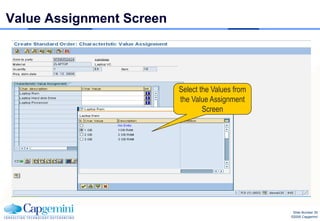
Value Assignment Screen


                          Select the Values from
                          the Value Assignment
                                  Screen


                                                    Slide Number 39
                                                   ©2008 Capgemini
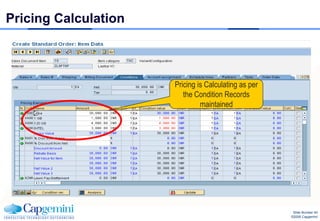
Pricing Calculation


                      Pricing is Calculating as per
                         the Condition Records
                               maintained


                                                       Slide Number 40
                                                      ©2008 Capgemini
MB1A – For Consuming the Components
                                   Enter the Sales
                                       Order


                      Enter the
                    Components &
                      Quantity


                                                      Slide Number 41
                                                     ©2008 Capgemini
MB1C - For Maintaining The Sales Order Stock


                                      Special Stock
                                   Indicator E & Enter
                                       Sales Order
          Enter the Configurable
           Material & Quantity


                                                      Slide Number 42
                                                     ©2008 Capgemini
Creating Delivery


                    Select the Sales Order Stock & do
                                 the PGI


                                                  Slide Number 43
                                                 ©2008 Capgemini
Creating Billing Document


                            Create the Billing Document


                                                     Slide Number 44
                                                    ©2008 Capgemini
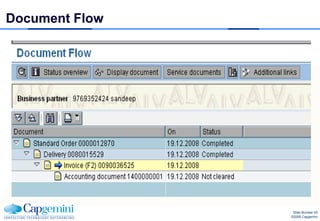
Document Flow


                 Slide Number 45
                ©2008 Capgemini
Thank You
Variant Configuration with Production Planning
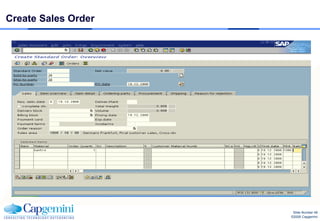
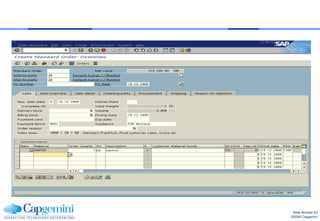
Create Sales Order


                      Slide Number 48
                     ©2008 Capgemini
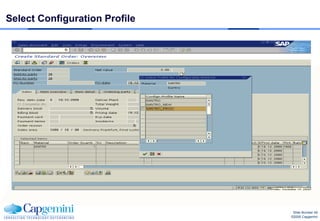
Select Configuration Profile


                                Slide Number 49
                               ©2008 Capgemini
Slide Number 50
©2008 Capgemini
Slide Number 51
©2008 Capgemini
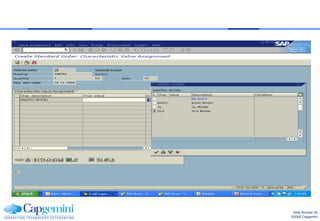
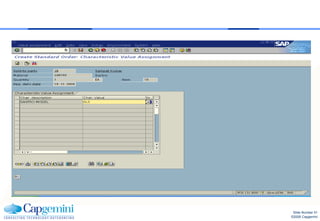
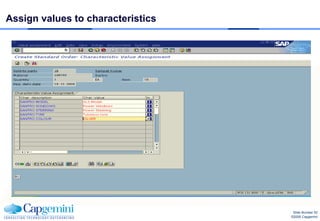
Assign values to characteristics


                                    Slide Number 52
                                   ©2008 Capgemini
Slide Number 53
©2008 Capgemini
Slide Number 54
©2008 Capgemini
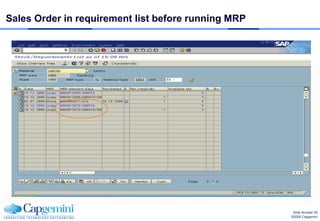
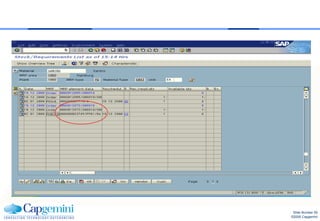
Sales Order in requirement list before running MRP


                                                      Slide Number 55
                                                     ©2008 Capgemini
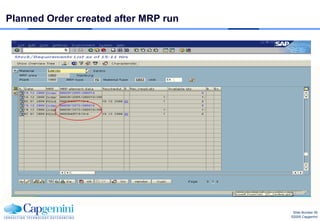
Planned Order created after MRP run


                                       Slide Number 56
                                      ©2008 Capgemini
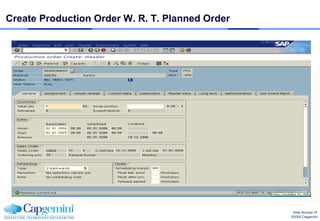
Create Production Order W. R. T. Planned Order


                                                  Slide Number 57
                                                 ©2008 Capgemini
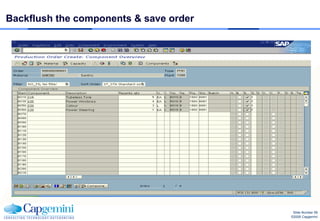
Backflush the components & save order


                                         Slide Number 58
                                        ©2008 Capgemini
Slide Number 59
©2008 Capgemini
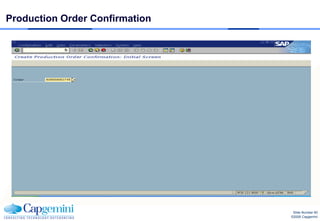
Production Order Confirmation


                                 Slide Number 60
                                ©2008 Capgemini
Slide Number 61
©2008 Capgemini
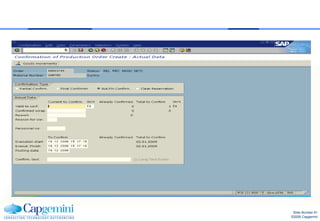
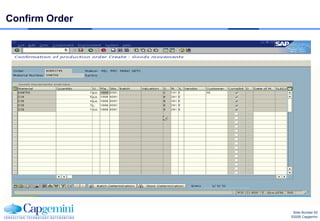
Confirm Order


                 Slide Number 62
                ©2008 Capgemini
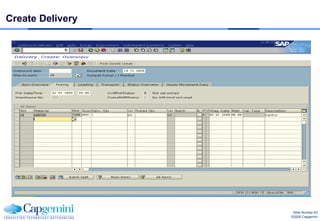
Create Delivery


                   Slide Number 63
                  ©2008 Capgemini
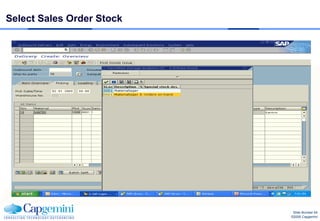
Select Sales Order Stock


                            Slide Number 64
                           ©2008 Capgemini
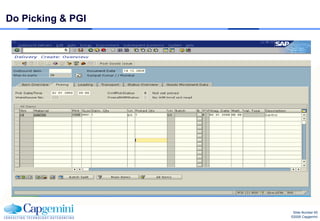
Do Picking & PGI


                    Slide Number 65
                   ©2008 Capgemini
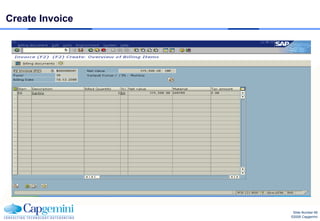
Create Invoice


                  Slide Number 66
                 ©2008 Capgemini
Thank You

SAP SD Variant configuration-training-document 2

  • 1.
  • 2.
    What is thePurpose of variant Configuration  Variant configuration is for manufacturing complex products in which customer determines the features of the product. Objective of variant configuration is to react quickly to customers’ requirements. Here it needs not to create separate material for each variant of a product. When companies introduce variant configuration this often goes beyond a business process re-engineering project. Variant configuration offers an opportunity to restructure product structures for which then processes are defined. This has a direct impact to the core areas such as marketing and product data management Slide Number 2 ©2008 Capgemini
  • 3.
    What is theUse of variant Configuration  It is tool which helps to simplify the complex manufacturing of final product more varieties and variation of the input material  To ensure right choice is delivered  Easy for the sales person to select & Communication is fast and clear  Ensures production of right item  New products can be configured immediately by the system itself and all changes in the costs of production, pricing for the new product are taken into account by the system automatically.  This session will walk you through the steps of building a simple VC model. Slide Number 3 ©2008 Capgemini
  • 4.
    Who Should UseVariant Configuration? Slide Number 4 ©2008 Capgemini
  • 5.
    Variant Configuration Configurable profile Class Configurable material Characteristic Dependency Value1 Value3 Value2 Slide Number 5 ©2008 Capgemini
  • 6.
    RAM HDD 1GB 120 GB 2GB 160 GB 3GB 280 GB Color Silver Processor Black Intel Blue AMD Slide Number 6 ©2008 Capgemini
  • 7.
    Creating characteristics Slide Number 7 ©2008 Capgemini
  • 8.
    Steps – Forcreating Characteristics  Menu Path :Logistics Central Functions  variant Configuration Environment  Classification  Master Data  CT04-Charecterstics.  1) Enter Characteristics Name and Select Create Button  2) Enter Description in Basic data Tab, Enter data type (Character Format), Enter Number of Characters , Select Multiple Value radio button and Enter Characteristics values and Save it.  3) If we want to Create Another Characteristic Repeat the same procedure  4) Also create the characteristic for Price. Specify the values of all Characteristics in Values tab. And In the addition data Tab enter Table name SDCOM and Field name VKOND, Select Not Ready for Input option. Slide Number 8 ©2008 Capgemini
  • 9.
    Create Characteristics Select Create Button Select Basic Data Tab Slide Number 9 ©2008 Capgemini
  • 10.
    Create Characteristics (Continued) Enter Description Status must be set to Released Select Character Format Select Multiple Values Slide Number 10 ©2008 Capgemini
  • 11.
    Create Characteristics (Continued) Select the Values Tab & Give the Characteristic values with description Slide Number 11 ©2008 Capgemini
  • 12.
    Creating Price Characteristic Slide Number 12 ©2008 Capgemini
  • 13.
    Creating Price Characteristic(Continued) Enter the Field Name VKOND Select the table Name SDCOM Select Not Ready for Input Slide Number 13 ©2008 Capgemini
  • 14.
    Steps – CreatingClass  Menu Path :Logistics  Central Functions  Variant Configuration Environment  Classification  Master Data  CL02 – Class  In Variant Configuration we use the Class to Group the Characteristics that Describe the Configurable Material. We need to link the Class to the Configurable Material so that we allow that Material to be Configured by using the Characteristics of the Class.  We can use a Class in the Variant Configuration if the Class has a Class Type that Support the Variant Configuration.  1) Enter Class name and enter Class Type = 300 (Variants)  2) Select the Icon Create, Basic data Tab enter Description and status must be Set to Release  3) Select the Tab Characteristic and enter the Characteristics and Save. Slide Number 14 ©2008 Capgemini
  • 15.
    Create Class Enter the Class Select the Description create Button Enter Class type 300 Slide Number 15 ©2008 Capgemini
  • 16.
    Create Class (Continued) Enter Class description Status must be set to Released Indicates not to check similar characteristic values Slide Number 16 ©2008 Capgemini
  • 17.
    Add Characteristics tothe Class Select Characteristic Tab and enter the Characteristics and Save it. Slide Number 17 ©2008 Capgemini
  • 18.
    Creating a ConfigurableMaterial  A material with different features or characteristics and options is known as configurable material. Example: PC, Car.  Configurable materials are either created in a material type that allows the configuration (n the standard system, the material type KMAT) or they are given the indicator Configurable in the material master record.  Specify the Industry sector is Mechanical Engineering & Material type is Configurable Material  Item category group is 0002  In basic data 2 tab we need to select the check box configurable material  Class type is 300 Slide Number 18 ©2008 Capgemini
  • 19.
    Creating Configurable Material Enter The Class Select the Characteristics Slide Number 19 ©2008 Capgemini
  • 20.
    Configuration Profile –CU41  Menu Path :Logistics Central Functions  variant Configuration Configuration ProfileCU41 Create  Each configurable object must have a configuration profile. The configuration profile for a material controls the configuration process in the sales order  We maintain the configuration profile for the configurable objects to define the central settings for the configuring the objects we can control all the settings that effect the display options and the scope of the characteristics on the value assignment screen.  Select the Object Material, Specify the required material and press enter Now specify Priority, Profile name and Class type (300).Select the Profile and from the main menu select Goto Profile detail select the tab configuration initial screen in process field tab select the sales order. And specify the BOM explosion SD01 and save it. Slide Number 20 ©2008 Capgemini
  • 21.
    Configuration Profile (Continued) Enter the Class Type 300 Enter the Priority & Profile Name Slide Number 21 ©2008 Capgemini
  • 22.
    Configuration Profile (Continued) Select Characteristic values Slide Number 22 ©2008 Capgemini
  • 23.
    Configuration Profile (Continued) Select Sales order Select the application SD01 Slide Number 23 ©2008 Capgemini
  • 24.
    Dependency's  Itdescribes the inter dependency's between the characteristics and characteristic values and it controls which components are to be selected from the Bill of Material.  Use : In Variant Configuration, we use dependencies to control combinations of variants. This prevents combinations of options that are not allowed. Dependencies also select exactly the right BOM components and operations to produce a variant.  In two ways we can create the dependency’s  Menu Path Logistics  Central Functions  Variant Configuration  Dependency  Single Dependency  CU01 Create  We can create directly the dependency in the characteristic itself Slide Number 24 ©2008 Capgemini
  • 25.
    Creating Dependency’s (continued)  Go to the transaction CT04 and Enter the Characteristic Name  Go to the Tab Values and select the line of characteristic value form the main menu Go to Extras Object dependency’s  Editor.  Now select the option Procedure press enter and In the ABAP/4 Line command (Below line) write the code $SELF.ZPRICE= '1 GB' and check for the Syntax Error. And Save it.  Repeat the same for all other characteristic values. Slide Number 25 ©2008 Capgemini
  • 26.
    Creating Dependency’s ForCharacteristics (Continued) Open the characteristic in change mode and select a character for which the dependency is to be created Slide Number 26 ©2008 Capgemini
  • 27.
    Creating Dependency’s (Continued) Enter the dependency (follow the Dependency syntax) Slide Number 27 ©2008 Capgemini
  • 28.
    Creating Dependency’s (Continued) Check for the Syntax Error and Save It Slide Number 28 ©2008 Capgemini
  • 29.
    Creating Dependency’s (Continued) Check for the Syntax Error and Save it Slide Number 29 ©2008 Capgemini
  • 30.
    Variant condition Pricingprocedure and maintaining Condition records  In the Transaction Code V/08 Pricing procedure we need to add the Condition type VA00 with the requirement 2 (Item with pricing).  In the Transaction Code VK11 we need to maintain the Condition Record for Basic Price of the Material for the condition Type PR00.  In the Transaction Code VK11 we need to maintain the Condition Records for all Characteristic Values. In the condition type VA00. Slide Number 30 ©2008 Capgemini
  • 31.
    Variant Conditions InPricing Procedure Slide Number 31 ©2008 Capgemini
  • 32.
    Condition Record forBase price Maintaining the Condition Record for Base Price Slide Number 32 ©2008 Capgemini
  • 33.
    Condition Records forVariant Conditions Condition records are created for sales organization, distribution channel and material Enter prices associated with variants. Enter the variants Slide Number 33 ©2008 Capgemini
  • 34.
    Creating the SalesOrder BOM  Create the Material masters for All the Components  Go to the Transaction Code CS01.And Enter the Material “ZLAPTOP ”, Enter the Plant and Enter the BOM Usage is 5.  In the Initial Screen of the BOM enter all the Components and Quantity  Select the Line and Go to the Main menu select Extras  Object Dependencies  Editor there write the dependencies Syntax.  Repeat the Procedure for all BOM Components and Save. Slide Number 34 ©2008 Capgemini
  • 35.
    Creating BOM (Continued) Enter all the Components and Quantities Slide Number 35 ©2008 Capgemini
  • 36.
    Creating BOM (Continued) Enter the Dependency Syntax Slide Number 36 ©2008 Capgemini
  • 37.
    Process flow Create the Sales Order with the Tcode VA01 the Standard Document type is OR, standard item category is TAC and Schedule line category is CP.  For Consuming the Components against to sales order Use T code MB1A with Movement type 231  The sales order is make To Order Scenario so In the Stock posting Screen select the Movement Type 521 (Receipt w/o production order into unrestricted sales order) and Special stock indicator (E).  Create the Delivery document with the Tcode VL01N Standard Document type is LF.  Create the Billing document with the Tcode VF01 Standard document type is F2. Slide Number 37 ©2008 Capgemini
  • 38.
    Creating the salesorder Enter the Configurable Material and Quantity Slide Number 38 ©2008 Capgemini
  • 39.
    Value Assignment Screen Select the Values from the Value Assignment Screen Slide Number 39 ©2008 Capgemini
  • 40.
    Pricing Calculation Pricing is Calculating as per the Condition Records maintained Slide Number 40 ©2008 Capgemini
  • 41.
    MB1A – ForConsuming the Components Enter the Sales Order Enter the Components & Quantity Slide Number 41 ©2008 Capgemini
  • 42.
    MB1C - ForMaintaining The Sales Order Stock Special Stock Indicator E & Enter Sales Order Enter the Configurable Material & Quantity Slide Number 42 ©2008 Capgemini
  • 43.
    Creating Delivery Select the Sales Order Stock & do the PGI Slide Number 43 ©2008 Capgemini
  • 44.
    Creating Billing Document Create the Billing Document Slide Number 44 ©2008 Capgemini
  • 45.
    Document Flow Slide Number 45 ©2008 Capgemini
  • 46.
  • 47.
    Variant Configuration withProduction Planning
  • 48.
    Create Sales Order Slide Number 48 ©2008 Capgemini
  • 49.
    Select Configuration Profile Slide Number 49 ©2008 Capgemini
  • 50.
  • 51.
  • 52.
    Assign values tocharacteristics Slide Number 52 ©2008 Capgemini
  • 53.
  • 54.
  • 55.
    Sales Order inrequirement list before running MRP Slide Number 55 ©2008 Capgemini
  • 56.
    Planned Order createdafter MRP run Slide Number 56 ©2008 Capgemini
  • 57.
    Create Production OrderW. R. T. Planned Order Slide Number 57 ©2008 Capgemini
  • 58.
    Backflush the components& save order Slide Number 58 ©2008 Capgemini
  • 59.
  • 60.
    Production Order Confirmation Slide Number 60 ©2008 Capgemini
  • 61.
  • 62.
    Confirm Order Slide Number 62 ©2008 Capgemini
  • 63.
    Create Delivery Slide Number 63 ©2008 Capgemini
  • 64.
    Select Sales OrderStock Slide Number 64 ©2008 Capgemini
  • 65.
    Do Picking &PGI Slide Number 65 ©2008 Capgemini
  • 66.
    Create Invoice Slide Number 66 ©2008 Capgemini
  • 67.