Quantum Computing
INTRODUCTION
By Muhammad Miqdad Khan
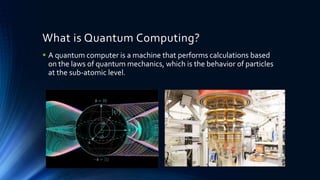
What is Quantum Computing?
 A quantum computer is a machine that performs calculations based
on the laws of quantum mechanics, which is the behavior of particles
at the sub-atomic level.
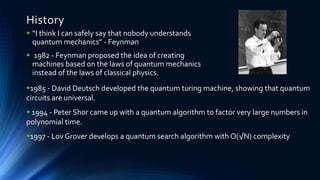
 “I think I can safely say that nobody understands
quantum mechanics” - Feynman
 1982 - Feynman proposed the idea of creating
machines based on the laws of quantum mechanics
instead of the laws of classical physics.
History
1985 - David Deutsch developed the quantum turing machine, showing that quantum
circuits are universal.
 1994 - Peter Shor came up with a quantum algorithm to factor very large numbers in
polynomial time.
1997 - Lov Grover develops a quantum search algorithm with O(√N) complexity
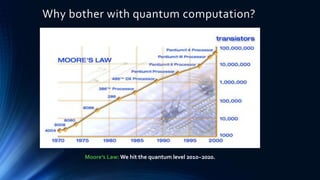
Why bother with quantum computation?
Moore’s Law:We hit the quantum level 2010~2020.
The design of devices on such a small scale will require engineers to control
quantum mechanical effects.
Allowing computers to take advantage of quantum mechanical
behaviour allows us to do more than cram increasingly many
microscopic components onto a silicon chip…
… it gives us a whole new framework in which information can be
processed in fundamentally new ways.
The nineteenth century was known as the machine age, the twentieth century will go down in history as the
information age. I believe the twenty-first century will be the quantum age. Paul Davies, Professor Natural
Philosophy – Australian Centre for Astrobiology
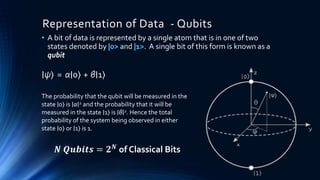
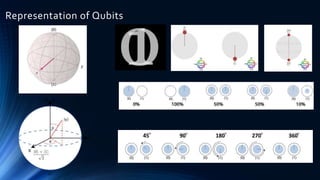
Representation of Data - Qubits
• A bit of data is represented by a single atom that is in one of two
states denoted by |0> and |1>. A single bit of this form is known as a
qubit
∣ψ⟩ = α∣0⟩ + β∣1⟩
The probability that the qubit will be measured in the
state ∣0⟩ is ∣α∣2 and the probability that it will be
measured in the state ∣1⟩ is ∣β∣2. Hence the total
probability of the system being observed in either
state ∣0⟩ or ∣1⟩ is 1.
𝑵 𝑸𝒖𝒃𝒊𝒕𝒔 = 𝟐 𝑵
of Classical Bits
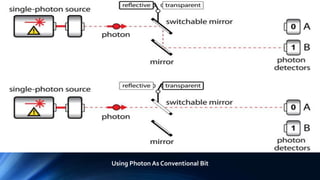
Using Photon As Conventional Bit
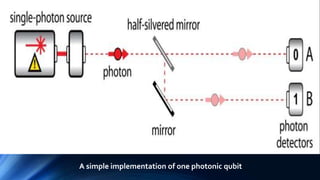
A simple implementation of one photonic qubit
Representation of Qubits
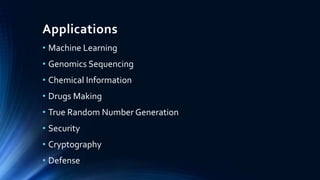
Applications
• Machine Learning
• Genomics Sequencing
• Chemical Information
• Drugs Making
• True Random Number Generation
• Security
• Cryptography
• Defense

Introduction to quantum computing

  • 1.
  • 2.
    What is QuantumComputing?  A quantum computer is a machine that performs calculations based on the laws of quantum mechanics, which is the behavior of particles at the sub-atomic level.
  • 3.
     “I thinkI can safely say that nobody understands quantum mechanics” - Feynman  1982 - Feynman proposed the idea of creating machines based on the laws of quantum mechanics instead of the laws of classical physics. History 1985 - David Deutsch developed the quantum turing machine, showing that quantum circuits are universal.  1994 - Peter Shor came up with a quantum algorithm to factor very large numbers in polynomial time. 1997 - Lov Grover develops a quantum search algorithm with O(√N) complexity
  • 4.
    Why bother withquantum computation? Moore’s Law:We hit the quantum level 2010~2020.
  • 5.
    The design ofdevices on such a small scale will require engineers to control quantum mechanical effects. Allowing computers to take advantage of quantum mechanical behaviour allows us to do more than cram increasingly many microscopic components onto a silicon chip… … it gives us a whole new framework in which information can be processed in fundamentally new ways. The nineteenth century was known as the machine age, the twentieth century will go down in history as the information age. I believe the twenty-first century will be the quantum age. Paul Davies, Professor Natural Philosophy – Australian Centre for Astrobiology
  • 6.
    Representation of Data- Qubits • A bit of data is represented by a single atom that is in one of two states denoted by |0> and |1>. A single bit of this form is known as a qubit ∣ψ⟩ = α∣0⟩ + β∣1⟩ The probability that the qubit will be measured in the state ∣0⟩ is ∣α∣2 and the probability that it will be measured in the state ∣1⟩ is ∣β∣2. Hence the total probability of the system being observed in either state ∣0⟩ or ∣1⟩ is 1. 𝑵 𝑸𝒖𝒃𝒊𝒕𝒔 = 𝟐 𝑵 of Classical Bits
  • 7.
    Using Photon AsConventional Bit
  • 8.
    A simple implementationof one photonic qubit
  • 9.
  • 10.
    Applications • Machine Learning •Genomics Sequencing • Chemical Information • Drugs Making • True Random Number Generation • Security • Cryptography • Defense