Quantum Computing
&
Quantum Communications
by
Srinivasarao Bukkuru
Dept. of Nuclear Physics
Andhra University
Quantum Computing:
• Quantum Mechanics: A branch of physics which is the fundamental
theory of nature at small scales and low energy levels of atoms and
subatomic particles
• At this level, particles behave in strange ways, taking on more than one
state at the same time, and interacting with other particles that are very
far away - Superposition & Quantum entanglement - will be discussed
later on.
• Quantum computing uses these quantum phenomena to process
information in a novel and promising way.
Classical Computers: "Today's comupters"
• make use of the flow of electrons in electrical and electronic circuits
• Process the information in the form of bits or binary digits ( 0 or 1)
• Served for decades in the development of almost everything from health
care to online shopping..
But..
But..
• there are many problems that classical computers will simply never be able to
solve.
• Examples:
• Simulation of quantum systems - Idea behind the quantum computing by Feynman
• Trillions of connections in the human brain
• Optimization problems - cancer Radiotherapy - involves thousands of variables and constraints - requires
many simulations until an optimal solution is determined
• AI - Machine Learning: Machines learn to recognize objects by detecting recurring patterns
• Medicine & Materials: To untangle the complexity of molecular and chemical interactions leading to the
discovery of new medicines and materials.
• Cloud Security: Making cloud computing more secure by using the laws of quantum physics to keep private
data safe no matter where it is stored or processed.
• Financial Services: Finding new ways to model financial data and isolating key global risk factors to make
better investments.
For the ever growing need of powerful computation and smaller devices..
Why Quantum Computers?
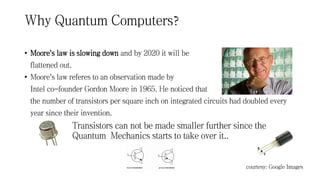
• Moore's law is slowing down and by 2020 it will be
flattened out.
• Moore's law referes to an observation made by
Intel co-founder Gordon Moore in 1965. He noticed that
the number of transistors per square inch on integrated circuits had doubled every
year since their invention.
Transistors can not be made smaller further since the
Quantum Mechanics starts to take over it..
courtesy: Google Images
History of Quantum Computers
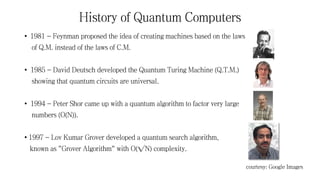
• 1981 - Feynman proposed the idea of creating machines based on the laws
of Q.M. instead of the laws of C.M.
• 1985 - David Deutsch developed the Quantum Turing Machine (Q.T.M.)
showing that quantum circuits are universal.
• 1994 - Peter Shor came up with a quantum algorithm to factor very large
numbers (O(N)).
• 1997 - Lov Kumar Grover developed a quantum search algorithm,
known as "Grover Algorithm" with O(√N) complexity.
courtesy: Google Images
History of Quantum Computers cont..
• 1998 - The first working NMR quantum computers demonstrated.
• 2001 - Researchers demonstrated Shor's algorithm to factor 15
• 2006 - Scientists at MIT develop the first working 12 - qubit platform.
• 2009 - First universal programmable quantum processor is unveiled.
• 2011 - D-Wave systems announced the 1st commercial quantum computer.
History of Quantum Computers cont..
• 2012 - D-Wave Systems reveals a 512-qubit processor (D-Wave Two)
• 2012 October - Nobel Prizes were
presented to David Wineland and Serge Haroche
for measuring and manipulating quantum systems.
• 2012 December - The 1st Quantum Computing
Software company 1QBit was established.
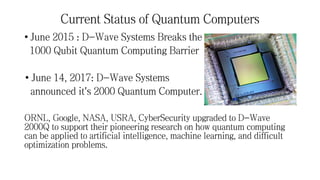
Current Status of Quantum Computers
• June 2015 : D-Wave Systems Breaks the
1000 Qubit Quantum Computing Barrier
• June 14, 2017: D-Wave Systems
announced it's 2000 Quantum Computer.
ORNL, Google, NASA, USRA, CyberSecurity upgraded to D-Wave
2000Q to support their pioneering research on how quantum computing
can be applied to artificial intelligence, machine learning, and difficult
optimization problems.
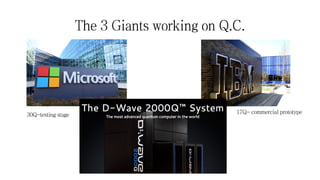
The 3 Giants working on Q.C.
17Q- commercial prototype30Q-testing stage
Processes/ Technologies involved
• Nuclear Magnetic Resonance (NMR) - nuclear spin
• Ion Trap - Qubits are stored in stable electronic states
of each ion
• Quantum Dot - very small semiconductor particles, only
several nanometres in size with different optical and
electronic properties from their macro sized bodies.
• Optical Method
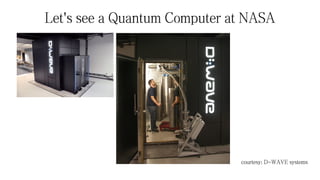
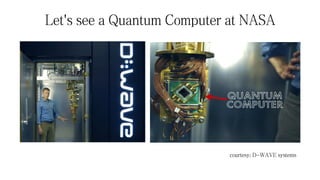
Let's see a Quantum Computer at NASA
courtesy: D-WAVE systems
Let's see a Quantum Computer at NASA
courtesy: D-WAVE systems
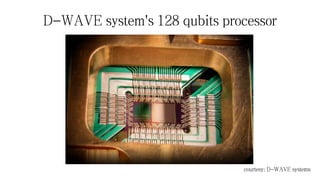
D-WAVE system's 128 qubits processor
courtesy: D-WAVE systems
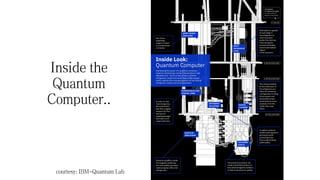
Inside the
Quantum
Computer..
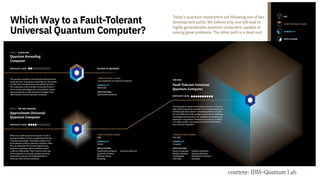
courtesy: IBM-Quantum Lab
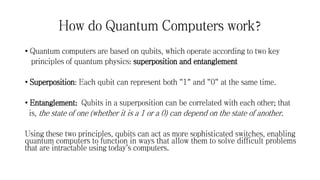
How do Quantum Computers work?
• Quantum computers are based on qubits, which operate according to two key
principles of quantum physics: superposition and entanglement
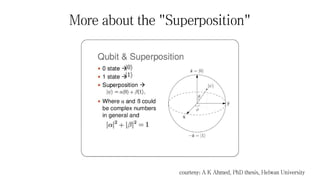
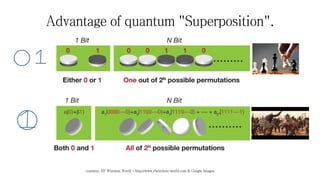
• Superposition: Each qubit can represent both "1" and "0" at the same time.
• Entanglement: Qubits in a superposition can be correlated with each other; that
is, the state of one (whether it is a 1 or a 0) can depend on the state of another.
Using these two principles, qubits can act as more sophisticated switches, enabling
quantum computers to function in ways that allow them to solve difficult problems
that are intractable using today’s computers.
More about the "Superposition"
courtesy: A K Ahmed, PhD thesis, Helwan University
Advantage of quantum "Superposition".
courtesy: RF Wireless World - http://www.rfwireless-world.com & Google Images
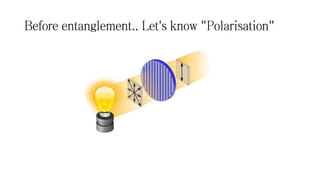
Before entanglement.. Let's know "Polarisation"
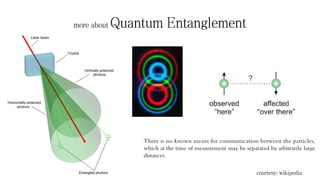
more about Quantum Entanglement
There is no known means for communication between the particles,
which at the time of measurement may be separated by arbitrarily large
distances.
courtesy: wikipedia
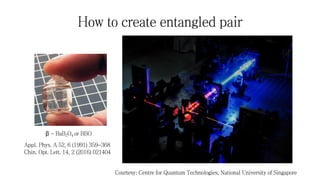
How to create entangled pair
Courtesy: Centre for Quantum Technologies, National University of Singapore
β - BaB2O4 or BBO
Appl. Phys. A 52, 6 (1991) 359-368
Chin. Opt. Lett. 14, 2 (2016) 021404
More about "Entanglement"
• Entangled pair can be created by many ways
Few ways to obtain entangled pair:
• a subatomic particle decays into an entangled pair of other
particles.
• Particles produced in "Pair production".
• By using radioactive Na22 (entangled γ-photons)
• Hg atoms - Ordinary light, etc.
Present status of Dragon's Quantum Computer
Quantum internet is expected
to be up for commercial use by
the end of August in the City of
Jinan, which is a ‘node’ in
the 2000-km quantum link
built between Beijing and
Shanghai.
China’s quantum satellite achieves ‘spooky action’ at record distance of 1200 Km.
Saying a different approach.. not releaving much details.. seems to be 5 qubit
courtesy: Chinese Academy of Sciences, Shanghai & Google images, [Photo: Xinhua, press release: May 25th 2016]
Quantum Communication
• Quantum communication science is an area of study based on the idea
that information science depends on quantum effects in physics.
• Sub-fields:
• Quantum computing
• Quantum correction
• Quantum teleportation
• Quantum cryptography
Quantum Network
• Optical networks using existing telecommunication fiber can be
implemented using hardware similar to existing telecommunication
equipment.
• At the sender, a single photon source can be created by heavily
attenuating a standard telecommunication laser such that the mean
number of photons per pulse is less than 1
• For receiving, an avalanche photodetector (analog to photomultipliers)
can be used.
• Free space quantum networks operate similar to fiber optic networks but
rely on line of sight between the communicating parties instead of using
a fiber optic connection. Free space networks can typically support
higher transmission rates than fiber optic networks
Quantum Network cont..
• Entanglement purification: Quantum decoherence can occur during the
transmission. Entanglement purification allows for the creation of nearly
maximally entangled qubits from a large number of arbitrary weakly
entangled qubits.
• Many existing quantum networks are designed to support quantum key
distribution (QKD) between classical computing environments. In this
application, the quantum network facilitates the sharing of a secret
encryption key between two parties, unlike classical key distribution
algorithms.
• QKD is the "unhackable" quantum communications technology.
Principle behind the unhackable QKD technology
Heisenberg's uncertainty principle: one cannot simply
observe a quantum particle (in this case a photon)
without changing that particle's quantum state.
Conclusions
• Pioneering Stage
• NEW hardware - Quantum HARDware
• Exploring the new methods of creating better "qubits"
• WHEN?? - will we get a Quantum Computer??
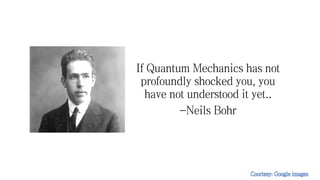
If Quantum Mechanics has not
profoundly shocked you, you
have not understood it yet..
-Neils Bohr
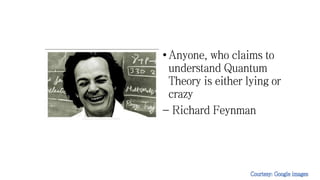
•Anyone, who claims to
understand Quantum
Theory is either lying or
crazy
- Richard Feynman
quantum computing and Quantum Communications

quantum computing and Quantum Communications

  • 1.
    Quantum Computing & Quantum Communications by SrinivasaraoBukkuru Dept. of Nuclear Physics Andhra University
  • 2.
    Quantum Computing: • QuantumMechanics: A branch of physics which is the fundamental theory of nature at small scales and low energy levels of atoms and subatomic particles • At this level, particles behave in strange ways, taking on more than one state at the same time, and interacting with other particles that are very far away - Superposition & Quantum entanglement - will be discussed later on. • Quantum computing uses these quantum phenomena to process information in a novel and promising way.
  • 3.
    Classical Computers: "Today'scomupters" • make use of the flow of electrons in electrical and electronic circuits • Process the information in the form of bits or binary digits ( 0 or 1) • Served for decades in the development of almost everything from health care to online shopping.. But..
  • 4.
    But.. • there aremany problems that classical computers will simply never be able to solve. • Examples: • Simulation of quantum systems - Idea behind the quantum computing by Feynman • Trillions of connections in the human brain • Optimization problems - cancer Radiotherapy - involves thousands of variables and constraints - requires many simulations until an optimal solution is determined • AI - Machine Learning: Machines learn to recognize objects by detecting recurring patterns • Medicine & Materials: To untangle the complexity of molecular and chemical interactions leading to the discovery of new medicines and materials. • Cloud Security: Making cloud computing more secure by using the laws of quantum physics to keep private data safe no matter where it is stored or processed. • Financial Services: Finding new ways to model financial data and isolating key global risk factors to make better investments. For the ever growing need of powerful computation and smaller devices..
  • 5.
    Why Quantum Computers? •Moore's law is slowing down and by 2020 it will be flattened out. • Moore's law referes to an observation made by Intel co-founder Gordon Moore in 1965. He noticed that the number of transistors per square inch on integrated circuits had doubled every year since their invention. Transistors can not be made smaller further since the Quantum Mechanics starts to take over it.. courtesy: Google Images
  • 6.
    History of QuantumComputers • 1981 - Feynman proposed the idea of creating machines based on the laws of Q.M. instead of the laws of C.M. • 1985 - David Deutsch developed the Quantum Turing Machine (Q.T.M.) showing that quantum circuits are universal. • 1994 - Peter Shor came up with a quantum algorithm to factor very large numbers (O(N)). • 1997 - Lov Kumar Grover developed a quantum search algorithm, known as "Grover Algorithm" with O(√N) complexity. courtesy: Google Images
  • 7.
    History of QuantumComputers cont.. • 1998 - The first working NMR quantum computers demonstrated. • 2001 - Researchers demonstrated Shor's algorithm to factor 15 • 2006 - Scientists at MIT develop the first working 12 - qubit platform. • 2009 - First universal programmable quantum processor is unveiled. • 2011 - D-Wave systems announced the 1st commercial quantum computer.
  • 8.
    History of QuantumComputers cont.. • 2012 - D-Wave Systems reveals a 512-qubit processor (D-Wave Two) • 2012 October - Nobel Prizes were presented to David Wineland and Serge Haroche for measuring and manipulating quantum systems. • 2012 December - The 1st Quantum Computing Software company 1QBit was established.
  • 9.
    Current Status ofQuantum Computers • June 2015 : D-Wave Systems Breaks the 1000 Qubit Quantum Computing Barrier • June 14, 2017: D-Wave Systems announced it's 2000 Quantum Computer. ORNL, Google, NASA, USRA, CyberSecurity upgraded to D-Wave 2000Q to support their pioneering research on how quantum computing can be applied to artificial intelligence, machine learning, and difficult optimization problems.
  • 10.
    The 3 Giantsworking on Q.C. 17Q- commercial prototype30Q-testing stage
  • 11.
    Processes/ Technologies involved •Nuclear Magnetic Resonance (NMR) - nuclear spin • Ion Trap - Qubits are stored in stable electronic states of each ion • Quantum Dot - very small semiconductor particles, only several nanometres in size with different optical and electronic properties from their macro sized bodies. • Optical Method
  • 12.
    Let's see aQuantum Computer at NASA courtesy: D-WAVE systems
  • 13.
    Let's see aQuantum Computer at NASA courtesy: D-WAVE systems
  • 14.
    D-WAVE system's 128qubits processor courtesy: D-WAVE systems
  • 15.
  • 16.
  • 17.
    How do QuantumComputers work? • Quantum computers are based on qubits, which operate according to two key principles of quantum physics: superposition and entanglement • Superposition: Each qubit can represent both "1" and "0" at the same time. • Entanglement: Qubits in a superposition can be correlated with each other; that is, the state of one (whether it is a 1 or a 0) can depend on the state of another. Using these two principles, qubits can act as more sophisticated switches, enabling quantum computers to function in ways that allow them to solve difficult problems that are intractable using today’s computers.
  • 18.
    More about the"Superposition" courtesy: A K Ahmed, PhD thesis, Helwan University
  • 19.
    Advantage of quantum"Superposition". courtesy: RF Wireless World - http://www.rfwireless-world.com & Google Images
  • 20.
    Before entanglement.. Let'sknow "Polarisation"
  • 21.
    more about QuantumEntanglement There is no known means for communication between the particles, which at the time of measurement may be separated by arbitrarily large distances. courtesy: wikipedia
  • 22.
    How to createentangled pair Courtesy: Centre for Quantum Technologies, National University of Singapore β - BaB2O4 or BBO Appl. Phys. A 52, 6 (1991) 359-368 Chin. Opt. Lett. 14, 2 (2016) 021404
  • 23.
    More about "Entanglement" •Entangled pair can be created by many ways Few ways to obtain entangled pair: • a subatomic particle decays into an entangled pair of other particles. • Particles produced in "Pair production". • By using radioactive Na22 (entangled γ-photons) • Hg atoms - Ordinary light, etc.
  • 24.
    Present status ofDragon's Quantum Computer Quantum internet is expected to be up for commercial use by the end of August in the City of Jinan, which is a ‘node’ in the 2000-km quantum link built between Beijing and Shanghai. China’s quantum satellite achieves ‘spooky action’ at record distance of 1200 Km. Saying a different approach.. not releaving much details.. seems to be 5 qubit courtesy: Chinese Academy of Sciences, Shanghai & Google images, [Photo: Xinhua, press release: May 25th 2016]
  • 25.
    Quantum Communication • Quantumcommunication science is an area of study based on the idea that information science depends on quantum effects in physics. • Sub-fields: • Quantum computing • Quantum correction • Quantum teleportation • Quantum cryptography
  • 26.
    Quantum Network • Opticalnetworks using existing telecommunication fiber can be implemented using hardware similar to existing telecommunication equipment. • At the sender, a single photon source can be created by heavily attenuating a standard telecommunication laser such that the mean number of photons per pulse is less than 1 • For receiving, an avalanche photodetector (analog to photomultipliers) can be used. • Free space quantum networks operate similar to fiber optic networks but rely on line of sight between the communicating parties instead of using a fiber optic connection. Free space networks can typically support higher transmission rates than fiber optic networks
  • 27.
    Quantum Network cont.. •Entanglement purification: Quantum decoherence can occur during the transmission. Entanglement purification allows for the creation of nearly maximally entangled qubits from a large number of arbitrary weakly entangled qubits. • Many existing quantum networks are designed to support quantum key distribution (QKD) between classical computing environments. In this application, the quantum network facilitates the sharing of a secret encryption key between two parties, unlike classical key distribution algorithms. • QKD is the "unhackable" quantum communications technology.
  • 28.
    Principle behind theunhackable QKD technology Heisenberg's uncertainty principle: one cannot simply observe a quantum particle (in this case a photon) without changing that particle's quantum state.
  • 29.
    Conclusions • Pioneering Stage •NEW hardware - Quantum HARDware • Exploring the new methods of creating better "qubits" • WHEN?? - will we get a Quantum Computer??
  • 30.
    If Quantum Mechanicshas not profoundly shocked you, you have not understood it yet.. -Neils Bohr
  • 31.
    •Anyone, who claimsto understand Quantum Theory is either lying or crazy - Richard Feynman