Quantitative
Research
•The systematic
investigation of
phenomena by gathering
quantifiable data and
performing statistical,
mathematical or
computational techniques.
Broadcasting
Audience
Research Board
Basic
Education
Information
System
QUANTITATIVE
RESEARCH
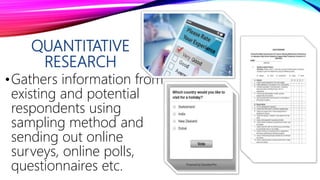
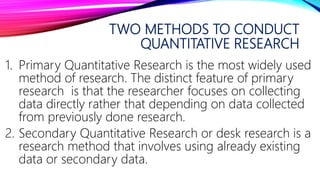
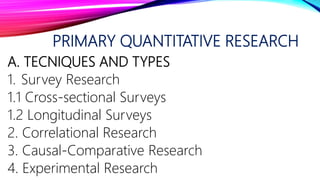
•Gathers information from
existing and potential
respondents using
sampling method and
sending out online
surveys, online polls,
questionnaires etc.
QUANTITATIVE
RESEARCH
•Objective,
elaborate and
investigational in
nature.
TWO METHODS TO
CONDUCT QUANTITATIVE
RESEARCH
1.Primary Quantitative Research
2.Secondary Quantitative Research
TWO METHODS TO CONDUCT
QUANTITATIVE RESEARCH
1. Primary Quantitative Research is the most widely used
method of research. The distinct feature of primary
research is that the researcher focuses on collecting
data directly rather that depending on data collected
from previously done research.
2. Secondary Quantitative Research or desk research is a
research method that involves using already existing
data or secondary data.
PRIMARY QUANTITATIVE RESEARCH
A. TECNIQUES AND TYPES
1. Survey Research
1.1 Cross-sectional Surveys
1.2 Longitudinal Surveys
2. Correlational Research
3. Causal-Comparative Research
4. Experimental Research
PRIMARY QUANTITATIVE RESEARCH
B. DATA COLLECTION METHODOLOGIES
Step 1: Sampling Methods
•Probability Sampling
1. Simple random sampling
2. Stratified random sampling
3. Cluster sampling
4. Systematic sampling
PRIMARY QUANTITATIVE RESEARCH
B. DATA COLLECTION METHODOLOGIES
Step 1: Sampling Methods
• Non-probability sampling
1. Convenience Sampling
2. Consecutive Sampling
3. Quota Sampling
4. Snowball Sampling
5. Judgmental Sampling
Step 2: Using Surveys and Polls
USE OF DIFFERENT QUESTION TYPE
• Email
• Buy Respondents
• Embed survey in website
• QR code
• SMS survey
• QuestionPro app
PRIMARY QUANTITATIVE RESEARCH
C. DATA ANALYSIS TECHNIQUES
1. SWOT Analysis
2. Conjoint Analysis
3. Cross-tabulation
4. TURF Analysis
SECONDARY QUANTITATIVE RESEARCH
•Popular secondary quantitative research methods
1. Data available on the internet
2. Government and non-government sources
3. Public libraries
4. Educational institutions
5. Commercial information sources
QUANTITATIVE RESEARCH CHARACTERISTICS
• Structured Tools
• Sample size
• Close-ended questions
• Quantitative data
• Generalization of results
GOAL
• Quantitative Research focuses on more in counting and
classifying features and constructing statistical models
and figures to explain what is observed.
Qualitative Quantitative
HYPOTHESIS Broad Narrow
DESCRIPTION Whole Picture Focused
TYPES OF
RESEARCH
Exploratory Conclusive
USAGE
•Quantitative Research provides the researcher a
clearer picture of what to expect in his research
compared to qualitative research.
Qualitative Quantitative
PHASE Early Late
DATA GATHERING INSTRUMENT
•Quantitative Research makes use tools
such as questionnaires, surveys,
measurements and other equipment to
collect numerical data.
TYPES OF DATA
•Quantitative Research
will most likely appear
in your discussion are
tables containing data
in form of numbers
and statistics.
APPROACH
•Quantitative
Research tend to
remain objectively
separated from
the subject matter.
ADVANTAGES
•Reliable and accurate data
•Quick Data Collection
•Wider scope of analysis
•Eliminate bias
• The research is anonymous
•You can perform the research
remotely
DISADVANTAGES
•Expensive and
time consuming
•Difficulty in data
analysis
•Limited outcomes
in a qualitative
research
THANK YOU!

Quantitative research

  • 2.
    Quantitative Research •The systematic investigation of phenomenaby gathering quantifiable data and performing statistical, mathematical or computational techniques.
  • 3.
  • 4.
  • 10.
    QUANTITATIVE RESEARCH •Gathers information from existingand potential respondents using sampling method and sending out online surveys, online polls, questionnaires etc.
  • 15.
  • 16.
    TWO METHODS TO CONDUCTQUANTITATIVE RESEARCH 1.Primary Quantitative Research 2.Secondary Quantitative Research
  • 17.
    TWO METHODS TOCONDUCT QUANTITATIVE RESEARCH 1. Primary Quantitative Research is the most widely used method of research. The distinct feature of primary research is that the researcher focuses on collecting data directly rather that depending on data collected from previously done research. 2. Secondary Quantitative Research or desk research is a research method that involves using already existing data or secondary data.
  • 18.
    PRIMARY QUANTITATIVE RESEARCH A.TECNIQUES AND TYPES 1. Survey Research 1.1 Cross-sectional Surveys 1.2 Longitudinal Surveys 2. Correlational Research 3. Causal-Comparative Research 4. Experimental Research
  • 19.
    PRIMARY QUANTITATIVE RESEARCH B.DATA COLLECTION METHODOLOGIES Step 1: Sampling Methods •Probability Sampling 1. Simple random sampling 2. Stratified random sampling 3. Cluster sampling 4. Systematic sampling
  • 20.
    PRIMARY QUANTITATIVE RESEARCH B.DATA COLLECTION METHODOLOGIES Step 1: Sampling Methods • Non-probability sampling 1. Convenience Sampling 2. Consecutive Sampling 3. Quota Sampling 4. Snowball Sampling 5. Judgmental Sampling Step 2: Using Surveys and Polls
  • 21.
    USE OF DIFFERENTQUESTION TYPE • Email • Buy Respondents • Embed survey in website • QR code • SMS survey • QuestionPro app
  • 25.
    PRIMARY QUANTITATIVE RESEARCH C.DATA ANALYSIS TECHNIQUES 1. SWOT Analysis 2. Conjoint Analysis 3. Cross-tabulation 4. TURF Analysis
  • 26.
    SECONDARY QUANTITATIVE RESEARCH •Popularsecondary quantitative research methods 1. Data available on the internet 2. Government and non-government sources 3. Public libraries 4. Educational institutions 5. Commercial information sources
  • 27.
    QUANTITATIVE RESEARCH CHARACTERISTICS •Structured Tools • Sample size • Close-ended questions • Quantitative data • Generalization of results
  • 28.
    GOAL • Quantitative Researchfocuses on more in counting and classifying features and constructing statistical models and figures to explain what is observed. Qualitative Quantitative HYPOTHESIS Broad Narrow DESCRIPTION Whole Picture Focused TYPES OF RESEARCH Exploratory Conclusive
  • 29.
    USAGE •Quantitative Research providesthe researcher a clearer picture of what to expect in his research compared to qualitative research. Qualitative Quantitative PHASE Early Late
  • 30.
    DATA GATHERING INSTRUMENT •QuantitativeResearch makes use tools such as questionnaires, surveys, measurements and other equipment to collect numerical data.
  • 31.
    TYPES OF DATA •QuantitativeResearch will most likely appear in your discussion are tables containing data in form of numbers and statistics. APPROACH •Quantitative Research tend to remain objectively separated from the subject matter.
  • 32.
    ADVANTAGES •Reliable and accuratedata •Quick Data Collection •Wider scope of analysis •Eliminate bias • The research is anonymous •You can perform the research remotely DISADVANTAGES •Expensive and time consuming •Difficulty in data analysis •Limited outcomes in a qualitative research
  • 34.