Understanding
Quantitative Research
Mr. Giovanni A. Desuyo
Practical Research 2 Teacher
Bantayan National High School- Senior High School
Welcome to Quantitative Research
● Discover the world of structured data and analysis.
● Learn how quantitative research helps in making informed
decisions.
● Get ready to explore different methods and tools used in
quantitative studies.
What is Quantitative Research?
● Quantitative research involves collecting and analyzing
numerical data.
● It aims to quantify the problem and understand how prevalent it
is by looking for projectable results to a larger population.
● Why do you think numbers are important in research?
Characteristics of Quantitative Research
● Structured research instruments
● Larger sample sizes
● Statistical analysis
● Objective and unbiased approach
● Can you think of a situation where these characteristics would be
particularly important?
Quantitative vs. Qualitative Research
● Quantitative: Focuses on numbers and statistical analysis.
● Qualitative: Focuses on descriptions and themes.
● Both have their place in research, but they serve different
purposes.
● When might you prefer qualitative research over quantitative?
Types of Quantitative Research
● Descriptive Research: What is happening?
● Correlational Research: What relationships exist?
● Causal-Comparative Research: What causes what?
● Experimental Research: How does one thing affect another?
● Which type seems most interesting to you, and why?
Common Quantitative Research Methods
● Surveys and Questionnaires
● Experiments
● Observational Studies
● Secondary Data Analysis
● What method would you use to study the popularity of a new
smartphone app?
Surveys and Questionnaires
● Used to collect data from a large number of respondents.
● Can be administered in person, by phone, online, or through
mail.
● Standardized questions ensure comparability of responses.
● How would you design a survey to be both effective and
efficient?
Experiments
● Controlled tests to determine cause and effect.
● Involves manipulation of one or more variables.
● Often conducted in laboratories or controlled environments.
● Can you think of an experiment you could conduct at school?
Observational Studies
● Researcher observes subjects in their natural environment.
● Does not involve manipulation of variables.
● Useful for collecting data on naturally occurring behaviors.
● What are some challenges you might face in an observational
study?
Secondary Data Analysis
● Analysis of existing data collected for another purpose.
● Includes sources like government statistics, previous research,
and historical records.
● Saves time and resources but may have limitations regarding
relevance and accuracy.
● What are the pros and cons of using secondary data?
Sampling Techniques
● Random Sampling: Every individual has an equal chance of
being selected.
● Stratified Sampling: Population divided into subgroups, then
sampled from each group.
● Convenience Sampling: Samples taken from a group that is
readily available.
● Which sampling technique would yield the most reliable results,
and why?
Data Collection Tools
● Questionnaires
● Interviews
● Observational checklists
● Sensors and counters
● Think about a tool that could help collect data for a traffic study.
Ensuring Validity and Reliability
● Validity: Does the research measure what it is supposed to
measure?
● Reliability: Are the results consistent when the research is
repeated?
● How can a researcher increase the validity and reliability of a
study?
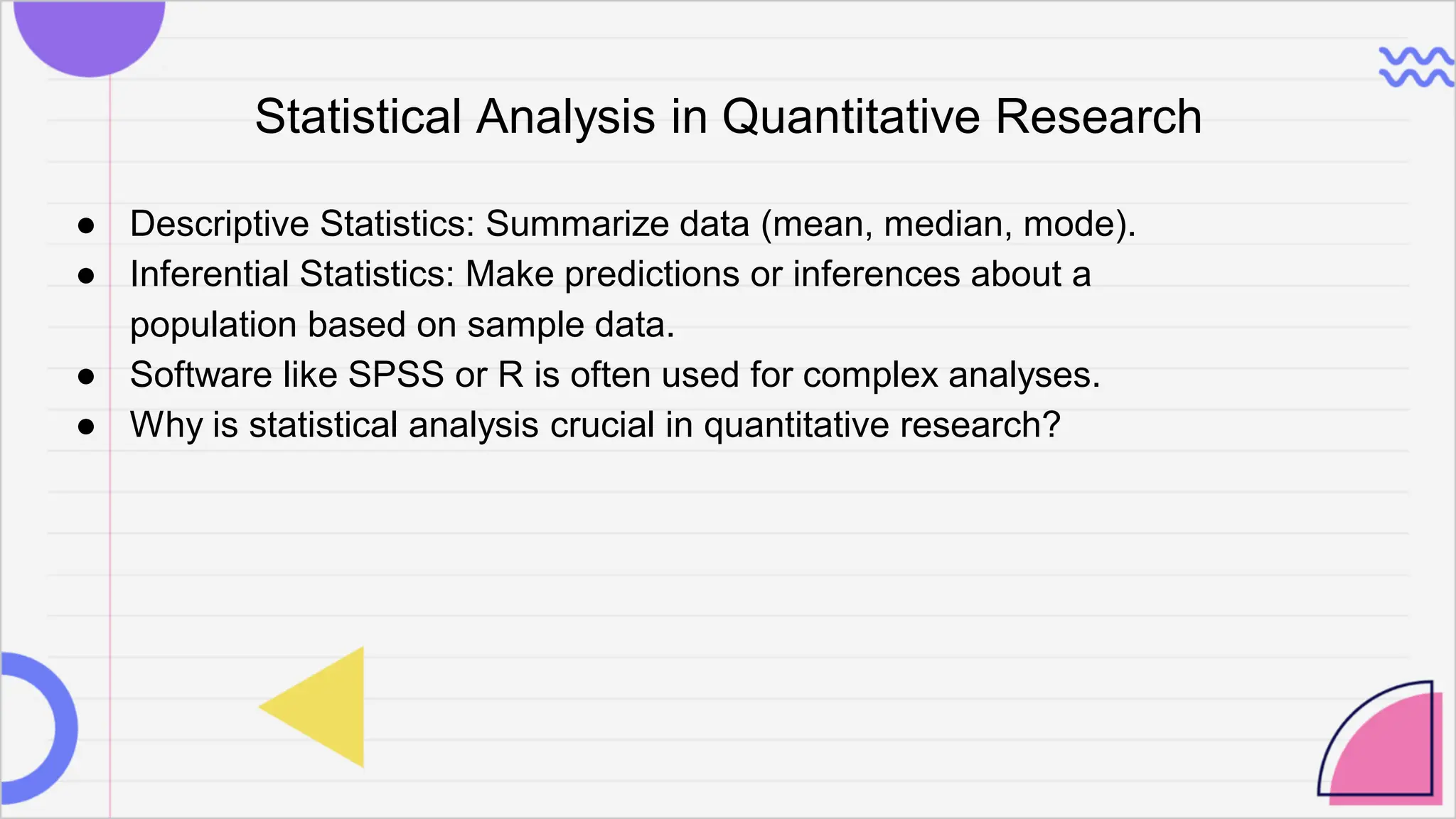
Statistical Analysis in Quantitative Research
● Descriptive Statistics: Summarize data (mean, median, mode).
● Inferential Statistics: Make predictions or inferences about a
population based on sample data.
● Software like SPSS or R is often used for complex analyses.
● Why is statistical analysis crucial in quantitative research?
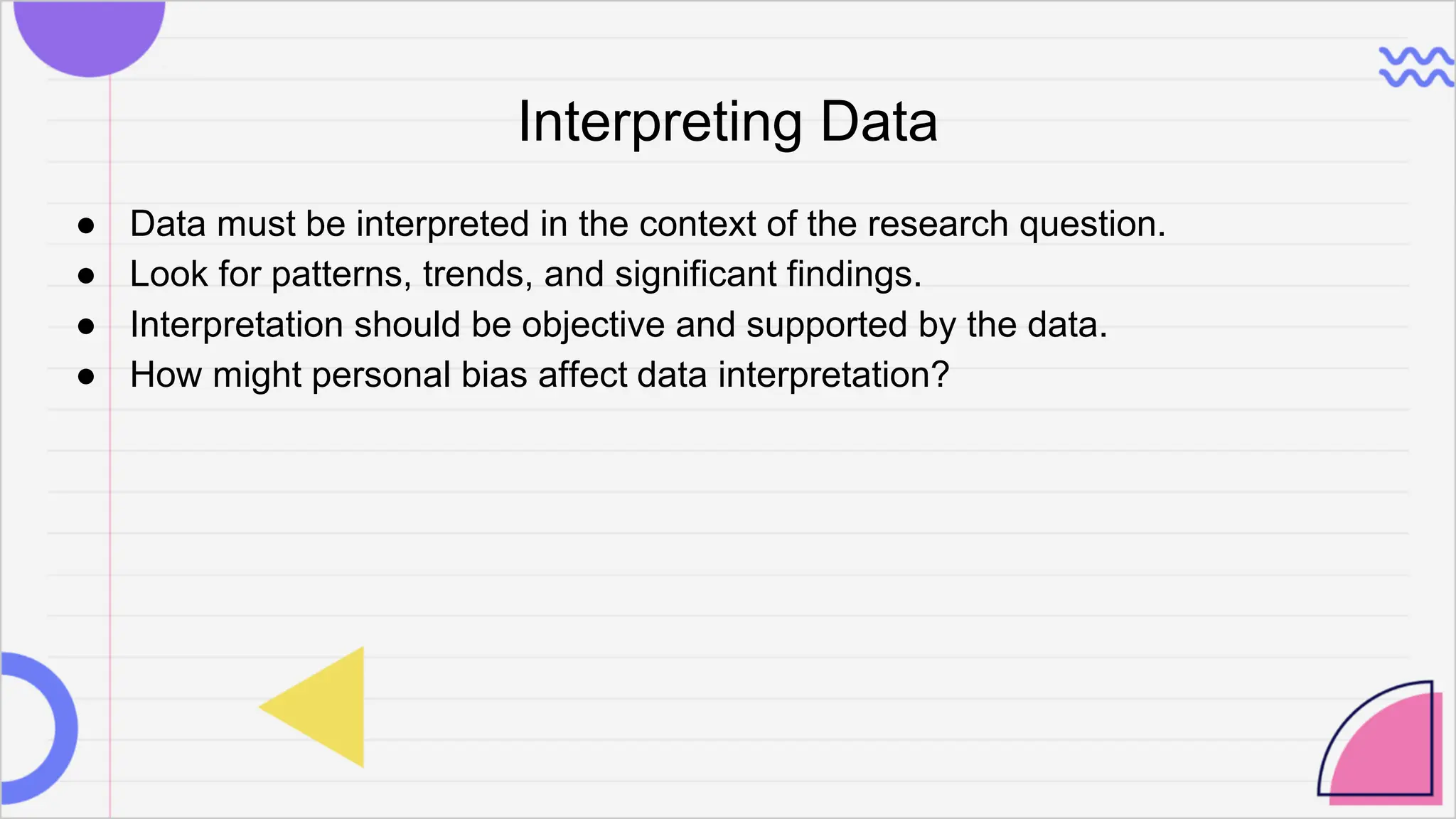
Interpreting Data
● Data must be interpreted in the context of the research question.
● Look for patterns, trends, and significant findings.
● Interpretation should be objective and supported by the data.
● How might personal bias affect data interpretation?
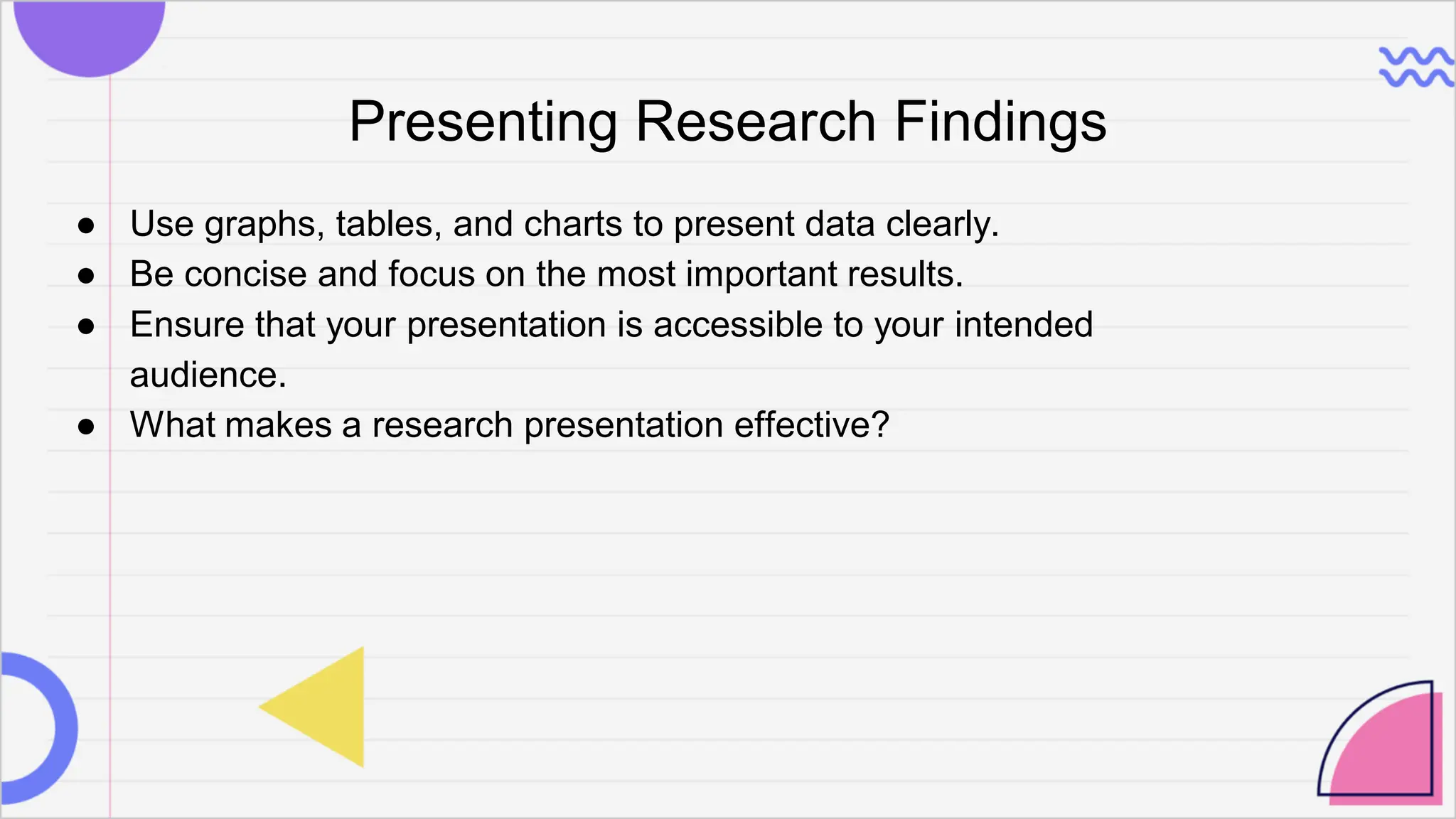
Presenting Research Findings
● Use graphs, tables, and charts to present data clearly.
● Be concise and focus on the most important results.
● Ensure that your presentation is accessible to your intended
audience.
● What makes a research presentation effective?
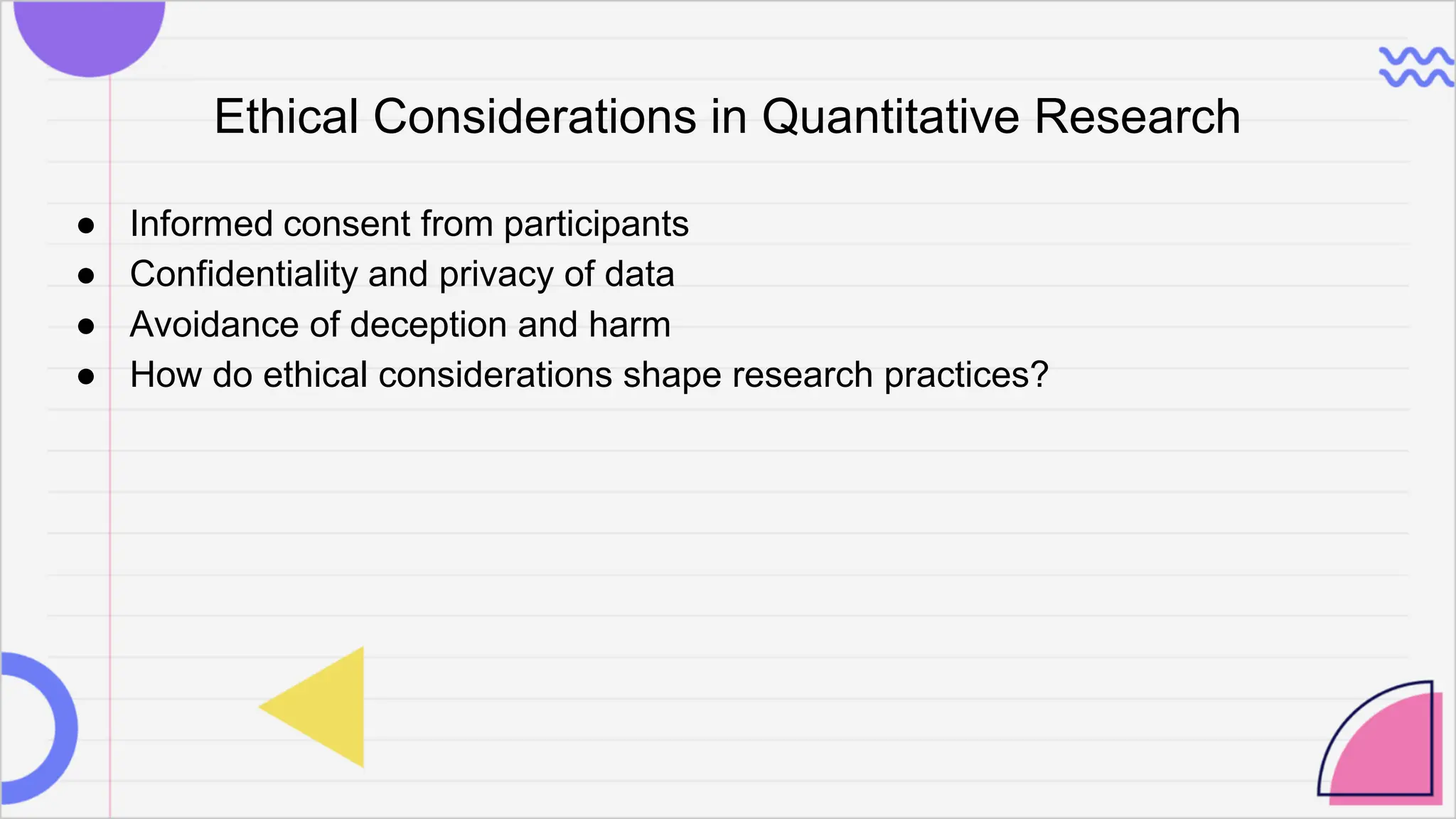
Ethical Considerations in Quantitative Research
● Informed consent from participants
● Confidentiality and privacy of data
● Avoidance of deception and harm
● How do ethical considerations shape research practices?
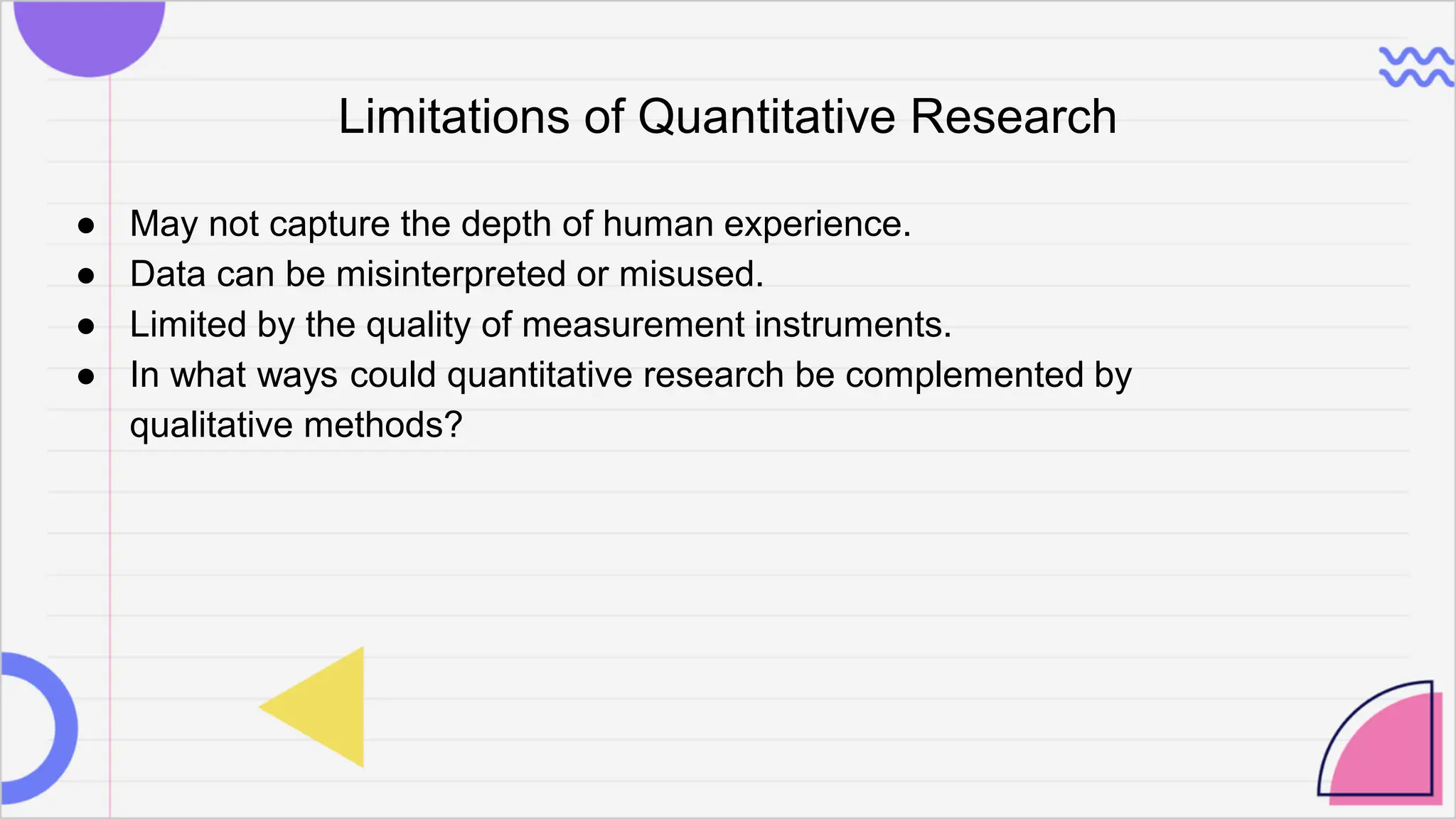
Limitations of Quantitative Research
● May not capture the depth of human experience.
● Data can be misinterpreted or misused.
● Limited by the quality of measurement instruments.
● In what ways could quantitative research be complemented by
qualitative methods?
Quantitative Research in the Real World
● Used in market research, health studies, education, and more.
● Helps in making evidence-based decisions.
● Can lead to advancements in various fields.
● Can you think of a recent decision that might have been
influenced by quantitative research?
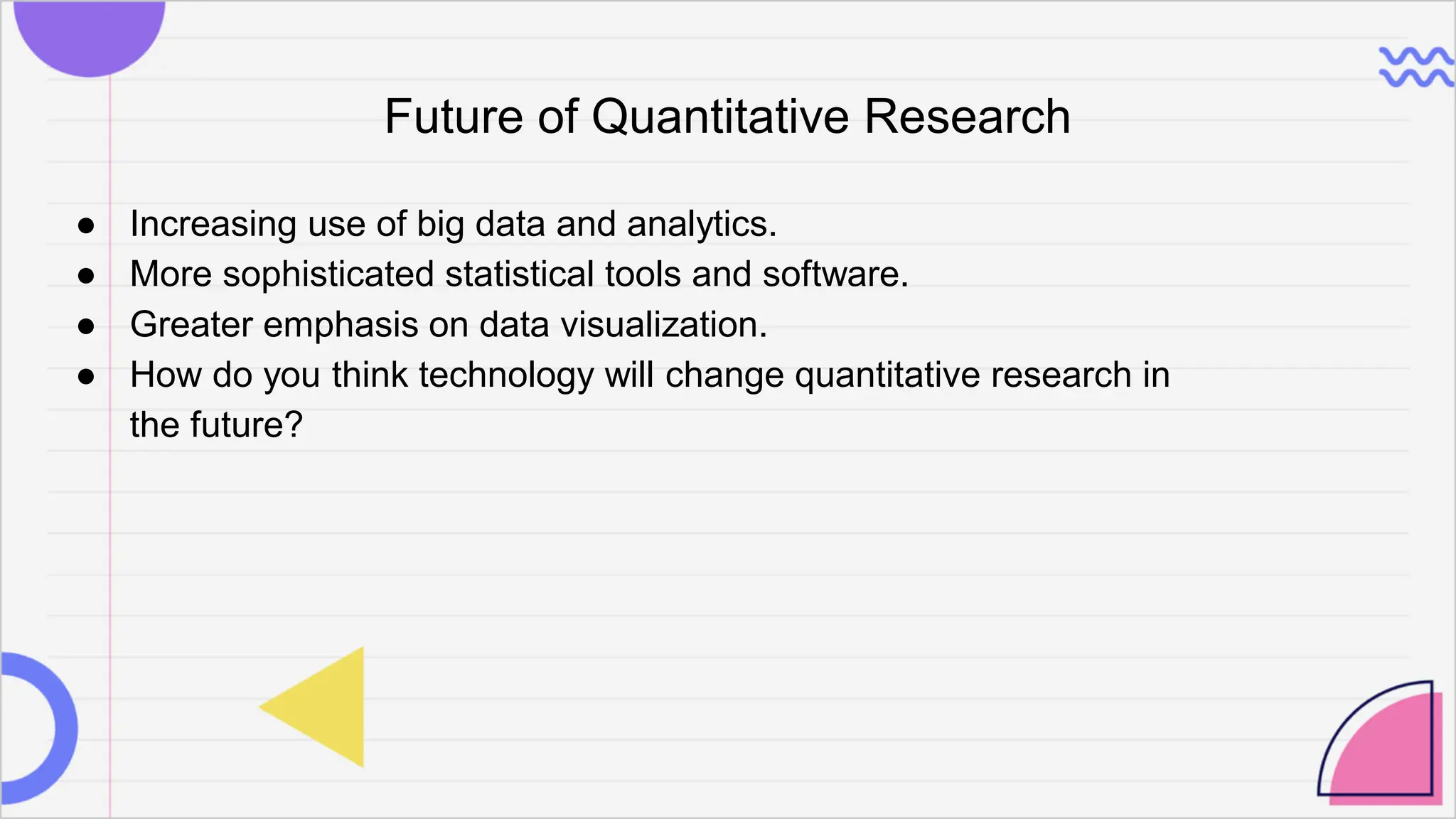
Future of Quantitative Research
● Increasing use of big data and analytics.
● More sophisticated statistical tools and software.
● Greater emphasis on data visualization.
● How do you think technology will change quantitative research in
the future?
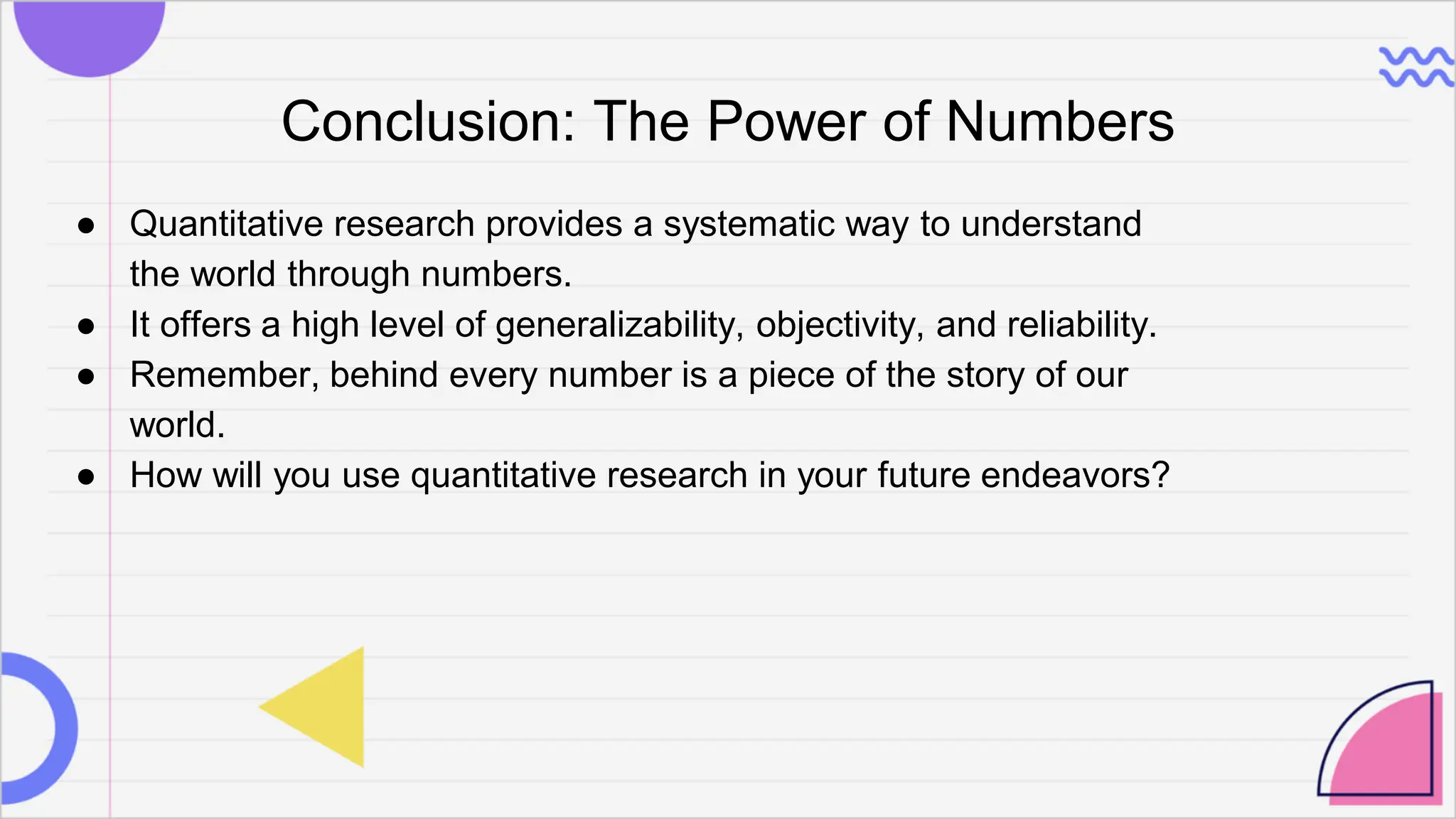
Conclusion: The Power of Numbers
● Quantitative research provides a systematic way to understand
the world through numbers.
● It offers a high level of generalizability, objectivity, and reliability.
● Remember, behind every number is a piece of the story of our
world.
● How will you use quantitative research in your future endeavors?
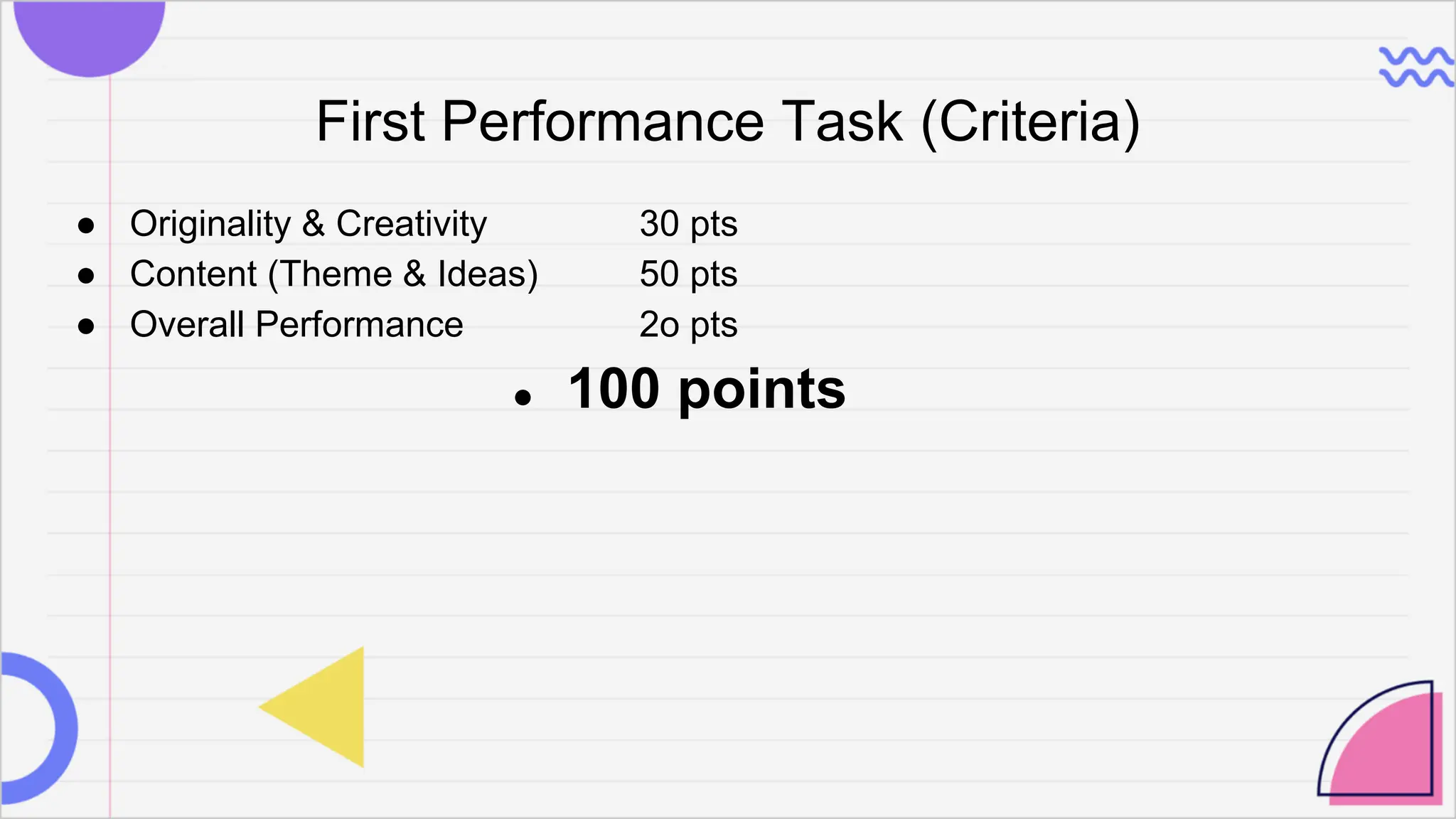
First Performance Task (Criteria)
● Originality & Creativity 30 pts
● Content (Theme & Ideas) 50 pts
● Overall Performance 2o pts
● 100 points

1.-Quantitative-Research-Introduction.pdf

  • 1.
    Understanding Quantitative Research Mr. GiovanniA. Desuyo Practical Research 2 Teacher Bantayan National High School- Senior High School
  • 2.
    Welcome to QuantitativeResearch ● Discover the world of structured data and analysis. ● Learn how quantitative research helps in making informed decisions. ● Get ready to explore different methods and tools used in quantitative studies.
  • 3.
    What is QuantitativeResearch? ● Quantitative research involves collecting and analyzing numerical data. ● It aims to quantify the problem and understand how prevalent it is by looking for projectable results to a larger population. ● Why do you think numbers are important in research?
  • 4.
    Characteristics of QuantitativeResearch ● Structured research instruments ● Larger sample sizes ● Statistical analysis ● Objective and unbiased approach ● Can you think of a situation where these characteristics would be particularly important?
  • 5.
    Quantitative vs. QualitativeResearch ● Quantitative: Focuses on numbers and statistical analysis. ● Qualitative: Focuses on descriptions and themes. ● Both have their place in research, but they serve different purposes. ● When might you prefer qualitative research over quantitative?
  • 6.
    Types of QuantitativeResearch ● Descriptive Research: What is happening? ● Correlational Research: What relationships exist? ● Causal-Comparative Research: What causes what? ● Experimental Research: How does one thing affect another? ● Which type seems most interesting to you, and why?
  • 7.
    Common Quantitative ResearchMethods ● Surveys and Questionnaires ● Experiments ● Observational Studies ● Secondary Data Analysis ● What method would you use to study the popularity of a new smartphone app?
  • 8.
    Surveys and Questionnaires ●Used to collect data from a large number of respondents. ● Can be administered in person, by phone, online, or through mail. ● Standardized questions ensure comparability of responses. ● How would you design a survey to be both effective and efficient?
  • 9.
    Experiments ● Controlled teststo determine cause and effect. ● Involves manipulation of one or more variables. ● Often conducted in laboratories or controlled environments. ● Can you think of an experiment you could conduct at school?
  • 10.
    Observational Studies ● Researcherobserves subjects in their natural environment. ● Does not involve manipulation of variables. ● Useful for collecting data on naturally occurring behaviors. ● What are some challenges you might face in an observational study?
  • 11.
    Secondary Data Analysis ●Analysis of existing data collected for another purpose. ● Includes sources like government statistics, previous research, and historical records. ● Saves time and resources but may have limitations regarding relevance and accuracy. ● What are the pros and cons of using secondary data?
  • 12.
    Sampling Techniques ● RandomSampling: Every individual has an equal chance of being selected. ● Stratified Sampling: Population divided into subgroups, then sampled from each group. ● Convenience Sampling: Samples taken from a group that is readily available. ● Which sampling technique would yield the most reliable results, and why?
  • 13.
    Data Collection Tools ●Questionnaires ● Interviews ● Observational checklists ● Sensors and counters ● Think about a tool that could help collect data for a traffic study.
  • 14.
    Ensuring Validity andReliability ● Validity: Does the research measure what it is supposed to measure? ● Reliability: Are the results consistent when the research is repeated? ● How can a researcher increase the validity and reliability of a study?
  • 15.
    Statistical Analysis inQuantitative Research ● Descriptive Statistics: Summarize data (mean, median, mode). ● Inferential Statistics: Make predictions or inferences about a population based on sample data. ● Software like SPSS or R is often used for complex analyses. ● Why is statistical analysis crucial in quantitative research?
  • 16.
    Interpreting Data ● Datamust be interpreted in the context of the research question. ● Look for patterns, trends, and significant findings. ● Interpretation should be objective and supported by the data. ● How might personal bias affect data interpretation?
  • 17.
    Presenting Research Findings ●Use graphs, tables, and charts to present data clearly. ● Be concise and focus on the most important results. ● Ensure that your presentation is accessible to your intended audience. ● What makes a research presentation effective?
  • 18.
    Ethical Considerations inQuantitative Research ● Informed consent from participants ● Confidentiality and privacy of data ● Avoidance of deception and harm ● How do ethical considerations shape research practices?
  • 19.
    Limitations of QuantitativeResearch ● May not capture the depth of human experience. ● Data can be misinterpreted or misused. ● Limited by the quality of measurement instruments. ● In what ways could quantitative research be complemented by qualitative methods?
  • 20.
    Quantitative Research inthe Real World ● Used in market research, health studies, education, and more. ● Helps in making evidence-based decisions. ● Can lead to advancements in various fields. ● Can you think of a recent decision that might have been influenced by quantitative research?
  • 21.
    Future of QuantitativeResearch ● Increasing use of big data and analytics. ● More sophisticated statistical tools and software. ● Greater emphasis on data visualization. ● How do you think technology will change quantitative research in the future?
  • 22.
    Conclusion: The Powerof Numbers ● Quantitative research provides a systematic way to understand the world through numbers. ● It offers a high level of generalizability, objectivity, and reliability. ● Remember, behind every number is a piece of the story of our world. ● How will you use quantitative research in your future endeavors?
  • 23.
    First Performance Task(Criteria) ● Originality & Creativity 30 pts ● Content (Theme & Ideas) 50 pts ● Overall Performance 2o pts ● 100 points