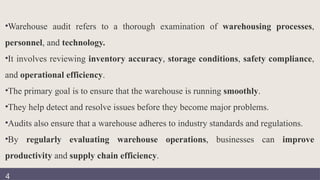
•Warehouse audit refersto a thorough examination of warehousing processes,
personnel, and technology.
•It involves reviewing inventory accuracy, storage conditions, safety compliance,
and operational efficiency.
•The primary goal is to ensure that the warehouse is running smoothly.
•They help detect and resolve issues before they become major problems.
•Audits also ensure that a warehouse adheres to industry standards and regulations.
•By regularly evaluating warehouse operations, businesses can improve
productivity and supply chain efficiency.
4
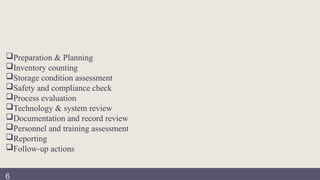
Preparation & Planning
Inventorycounting
Storage condition assessment
Safety and compliance check
Process evaluation
Technology & system review
Documentation and record review
Personnel and training assessment
Reporting
Follow-up actions
Planning the audit
6
7.
• Before startinga warehouse audit process,
the first step is to prepare and plan. This
involves defining the audit’s goals and
objectives.
• Decide what aspects of the warehouse will be
examined, such as inventory accuracy,
material handling, and safety compliance.
• Assign team members to various tasks and
gather all necessary documentation.
• Proper planning will ensure the audit runs
smoothly while covering all important areas.
Preparation & Planning
7
8.
• Inventory countingis a key part of the audit
process.
• It includes counting the stock in the
warehouse and comparing it to the recorded
numbers.
• This step helps identify discrepancies and
ensures that inventory records are accurate.
• Regular inventory counting helps maintain
proper stock levels and prevents issues like
stockouts or overstocks.
Inventory counting
8
9.
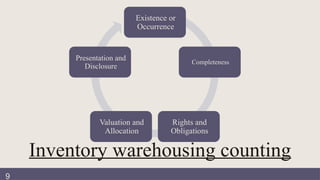
Inventory warehousing counting
Reportingfindings
Existence or
Occurrence
Completeness
Rights and
Obligations
Valuation and
Allocation
Presentation and
Disclosure
9
10.
A. Existence orOccurrence: Recorded inventory warehousing transactions occurred
Tests of Controls :
Observe separation of duties and examine approval signature on receiving report
Substantive Test :
For selected transactions, recorded in the inventory control account, examine signed
receiving report.
10
11.
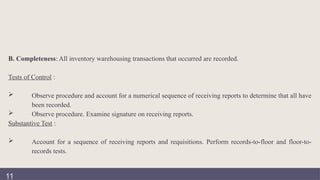
B. Completeness: Allinventory warehousing transactions that occurred are recorded.
Tests of Control :
Observe procedure and account for a numerical sequence of receiving reports to determine that all have
been recorded.
Observe procedure. Examine signature on receiving reports.
Substantive Test :
Account for a sequence of receiving reports and requisitions. Perform records-to-floor and floor-to-
records tests.
11
12.
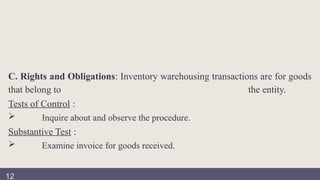
C. Rights andObligations: Inventory warehousing transactions are for goods
that belong to the entity.
Tests of Control :
Inquire about and observe the procedure.
Substantive Test :
Examine invoice for goods received.
12
13.
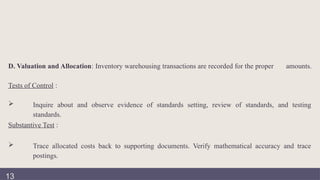
D. Valuation andAllocation: Inventory warehousing transactions are recorded for the proper amounts.
Tests of Control :
Inquire about and observe evidence of standards setting, review of standards, and testing
standards.
Substantive Test :
Trace allocated costs back to supporting documents. Verify mathematical accuracy and trace
postings.
13
14.
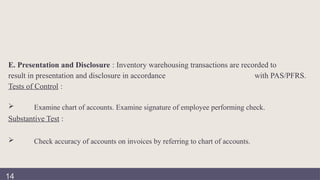
E. Presentation andDisclosure : Inventory warehousing transactions are recorded to
result in presentation and disclosure in accordance with PAS/PFRS.
Tests of Control :
Examine chart of accounts. Examine signature of employee performing check.
Substantive Test :
Check accuracy of accounts on invoices by referring to chart of accounts.
14
15.
• Assessing storageconditions is crucial for
a successful audit.
• This includes checking if goods are
stored properly and if the storage
environment meets required standards.
• Evaluate factors like temperature,
humidity, and organization of items.
• Proper storage conditions are necessary
for maintaining the quality and safety of
products.
Storage condition
assessment
15
16.
• A compliancecheck ensures the
warehouse meets all safety regulations
and industry standards.
• Inspect for potential hazards and ensure
that safety equipment is in place and
functioning.
• Verify that the warehouse follows all
regulatory requirements to prevent
accidents and promote a safe working
environment.
Safety & compliance
check
16
17.
• Evaluating warehousingprocesses helps
identify inefficiencies and areas for
improvement.
• Review workflows, material handling
procedures, and operational practices.
• This step aims to streamline operations,
reduce bottlenecks, and improve overall
efficiency.
• Efficient warehouse processes lead to
better productivity and cost savings.
Process evaluation
17
18.
• This stepfocuses on reviewing the
technology systems and tools within a
warehouse.
• Check if the technology in use supports
accurate inventory tracking, reporting,
and security.
• Evaluating technology helps ensure that
systems are always up-to-date and well-
functioning.
Technology & system
review
18
19.
• Another importantstep is to review
certificates, documents, and records in
the warehouse.
• Verify that all records, such as inventory
logs and safety reports, are complete and
updated.
• Proper documentation supports
transparency and helps in tracking the
warehouse’s performance over time.
Documentation &
record review
19
20.
• Assessing personneland training
involves evaluating staff knowledge and
skills.
• Check if warehouse workers are
properly trained and understand their
roles and responsibilities.
• Investing in training further improves
staff performance and ensures that
employees are equipped to handle their
tasks effectively.
Personnel & training
assessment
20
21.
• Once theaudit is complete, compile the
result-findings and observations into a
comprehensive report.
• Document any issues discovered, along
with recommendations for improvement.
• A clear and detailed report helps in
making informed decisions and tracking
progress over time.
Reporting
21
22.
• Follow-up actionsare necessary to
address any issues identified during the
warehouse audit.
• Implement corrective measures and
monitor their effectiveness.
• Schedule follow-up audits to ensure that
improvements are sustained and to
continue improving warehouse
operations.
Follow-up actions
22
• Conducting awarehouse audit is crucial in today's times.
• It promotes a productive workforce, satisfied customers, and profitable business
outcomes.
• Here's why performing warehouse auditing is important:
Ensures accurate and efficient inventory management, preventing stockouts and
overstocks.
Identifies inefficiencies in warehousing operations.
Guarantees compliance with safety regulations.
Reduces operational costs.
Enhances customer satisfaction with accurate and timely order fulfillment.
24
25.
Detects andaddresses potential risks and hazards within the warehouse.
Enhances employee safety, security, and engagement.
Provides insights for process improvement and strategic decision-making.
Supports accurate financial management.
Increases supply chain efficiency.
25
Documentation
review
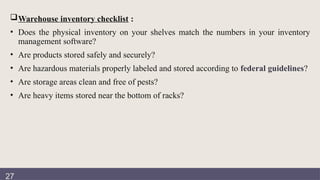
Warehouse inventory checklist:
• Does the physical inventory on your shelves match the numbers in your inventory
management software?
• Are products stored safely and securely?
• Are hazardous materials properly labeled and stored according to federal guidelines?
• Are storage areas clean and free of pests?
• Are heavy items stored near the bottom of racks?
27
28.
Documentation
review
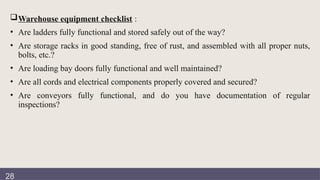
Warehouse equipment checklist:
• Are ladders fully functional and stored safely out of the way?
• Are storage racks in good standing, free of rust, and assembled with all proper nuts,
bolts, etc.?
• Are loading bay doors fully functional and well maintained?
• Are all cords and electrical components properly covered and secured?
• Are conveyors fully functional, and do you have documentation of regular
inspections?
28
29.
Documentation
review
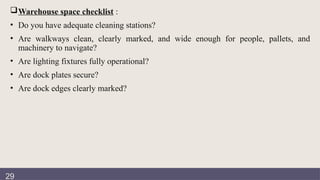
Warehouse space checklist:
• Do you have adequate cleaning stations?
• Are walkways clean, clearly marked, and wide enough for people, pallets, and
machinery to navigate?
• Are lighting fixtures fully operational?
• Are dock plates secure?
• Are dock edges clearly marked?
29
30.
Documentation
review
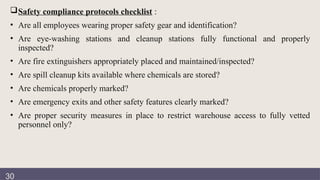
Safety compliance protocolschecklist :
• Are all employees wearing proper safety gear and identification?
• Are eye-washing stations and cleanup stations fully functional and properly
inspected?
• Are fire extinguishers appropriately placed and maintained/inspected?
• Are spill cleanup kits available where chemicals are stored?
• Are chemicals properly marked?
• Are emergency exits and other safety features clearly marked?
• Are proper security measures in place to restrict warehouse access to fully vetted
personnel only?
30
31.
Documentation
review
Employee performance checklist:
• Do they work well with their teammates?
• Do they follow proper safety protocols?
• Do they document maintenance work and inspections as needed?
• Do they consistently clock in and out on time?
31