Informed Consent Form
Presented by,
Rasika.R.Walunj
M.Pharm(QAT)
Content…
1. Introduction
2. Purpose of consent
3. What is informed consent form
4. History
5. Basic principles
6. Elements of informed consent
7. Documentation
8. Top ten consent audit finding
9. Summary
2
Introduction
• Millions of volunteers participate in government
and industry sponsored clinical trial each year.
• Prior to agreeing to participate, every volunteers
has right to know and understand what happen
during clinical trial .
• This is called as informed consent and this process
that can help to decide whether or not
participating in a trial is right for you .
3
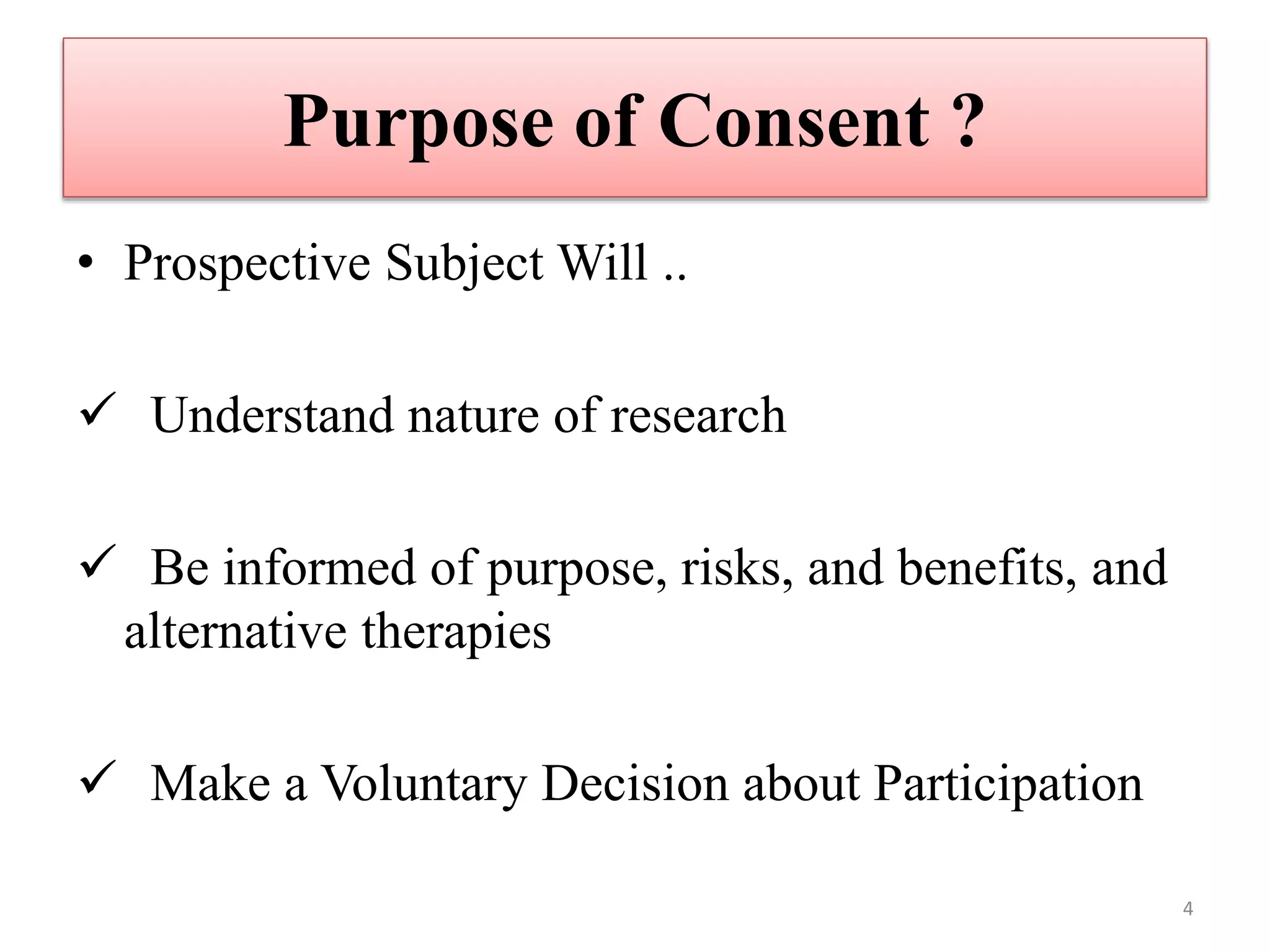
Purpose of Consent ?
• Prospective Subject Will ..
 Understand nature of research
 Be informed of purpose, risks, and benefits, and
alternative therapies
 Make a Voluntary Decision about Participation
4
Defining Informed Consent
Informed consent is defined by the ICH for GCP
“ A process by which a subject voluntarily
confirms his or her willingness to participate in
a particular trial, after having been informed of
all aspects of the trial that are revelent to the
subject’s decision to participate”.
Informed consent is documented by means of a
written, signed and dated informed consent
form.
5
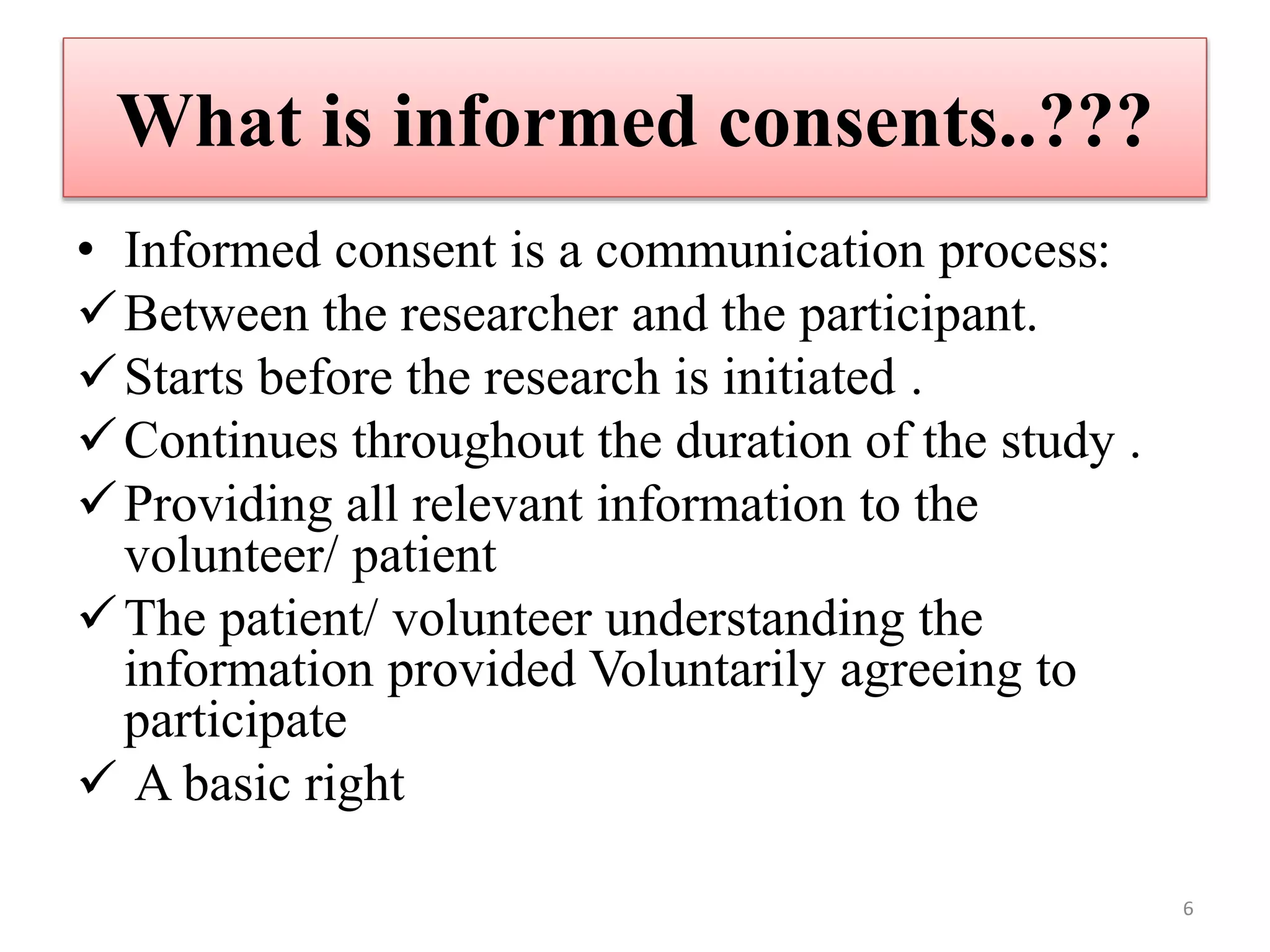
What is informed consents..???
• Informed consent is a communication process:
Between the researcher and the participant.
Starts before the research is initiated .
Continues throughout the duration of the study .
Providing all relevant information to the
volunteer/ patient
The patient/ volunteer understanding the
information provided Voluntarily agreeing to
participate
 A basic right
6
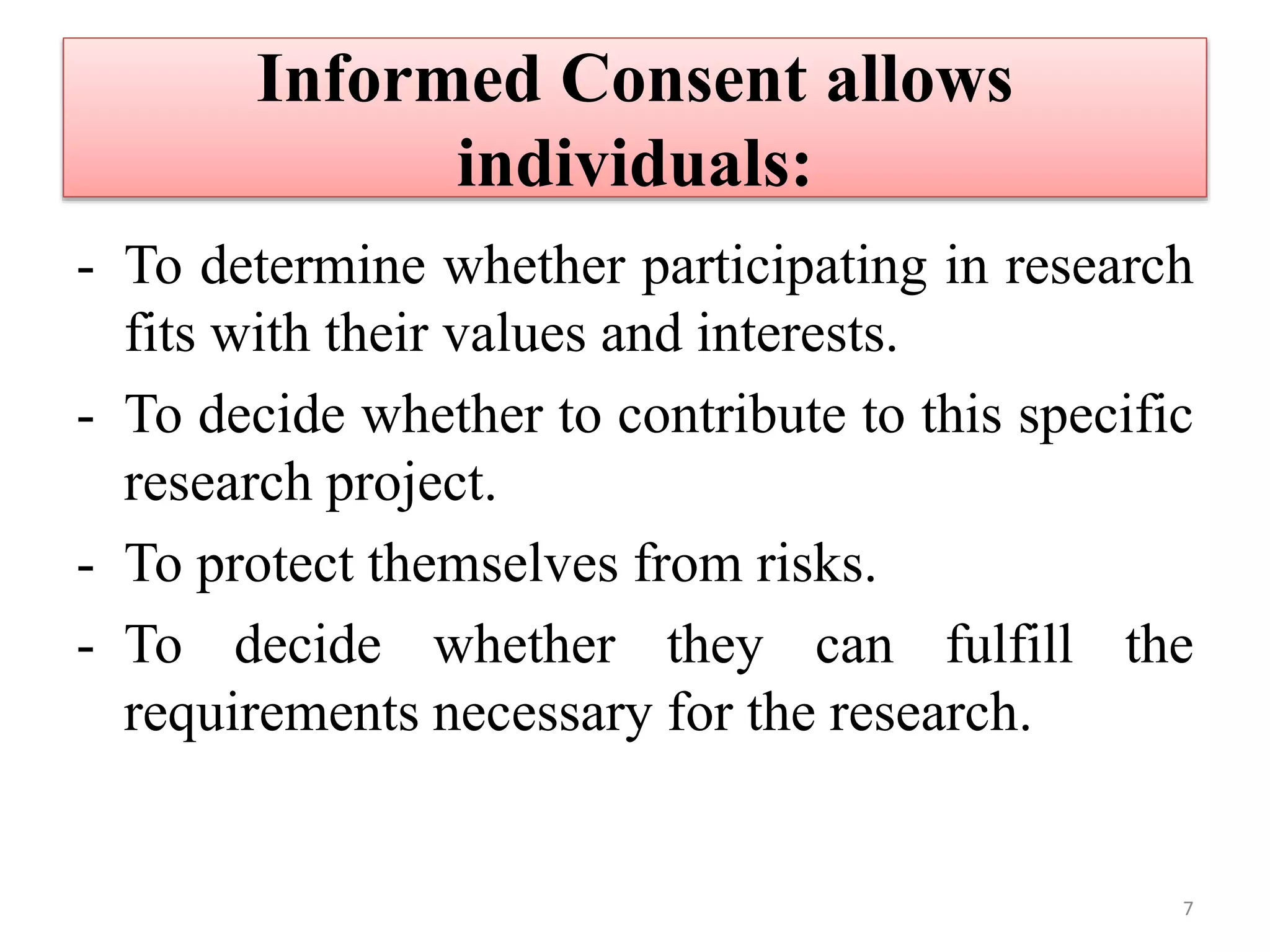
Informed Consent allows
individuals:
- To determine whether participating in research
fits with their values and interests.
- To decide whether to contribute to this specific
research project.
- To protect themselves from risks.
- To decide whether they can fulfill the
requirements necessary for the research.
7
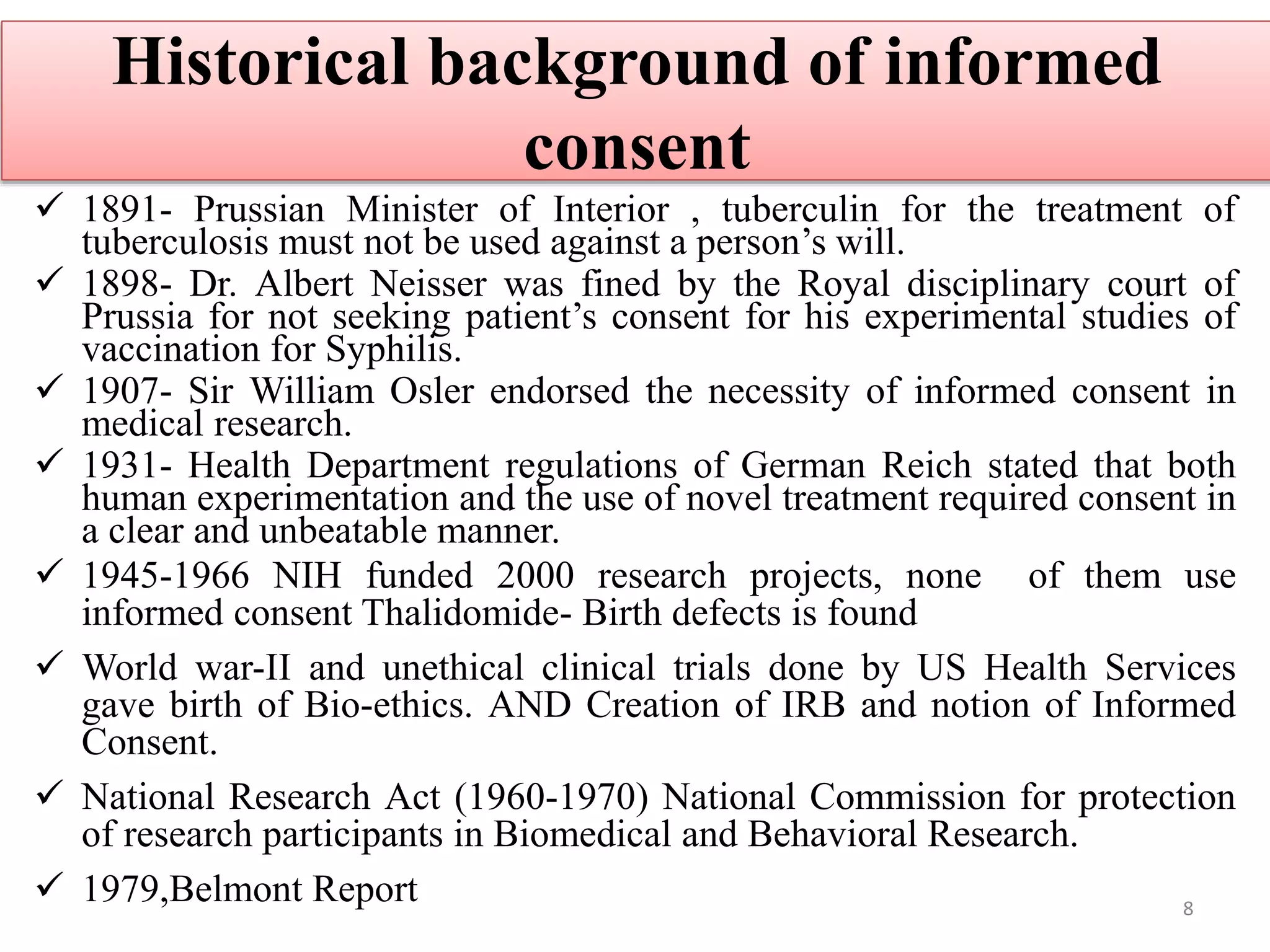
Historical background of informed
consent
 1891- Prussian Minister of Interior , tuberculin for the treatment of
tuberculosis must not be used against a person’s will.
 1898- Dr. Albert Neisser was fined by the Royal disciplinary court of
Prussia for not seeking patient’s consent for his experimental studies of
vaccination for Syphilis.
 1907- Sir William Osler endorsed the necessity of informed consent in
medical research.
 1931- Health Department regulations of German Reich stated that both
human experimentation and the use of novel treatment required consent in
a clear and unbeatable manner.
 1945-1966 NIH funded 2000 research projects, none of them use
informed consent Thalidomide- Birth defects is found
 World war-II and unethical clinical trials done by US Health Services
gave birth of Bio-ethics. AND Creation of IRB and notion of Informed
Consent.
 National Research Act (1960-1970) National Commission for protection
of research participants in Biomedical and Behavioral Research.
 1979,Belmont Report 8
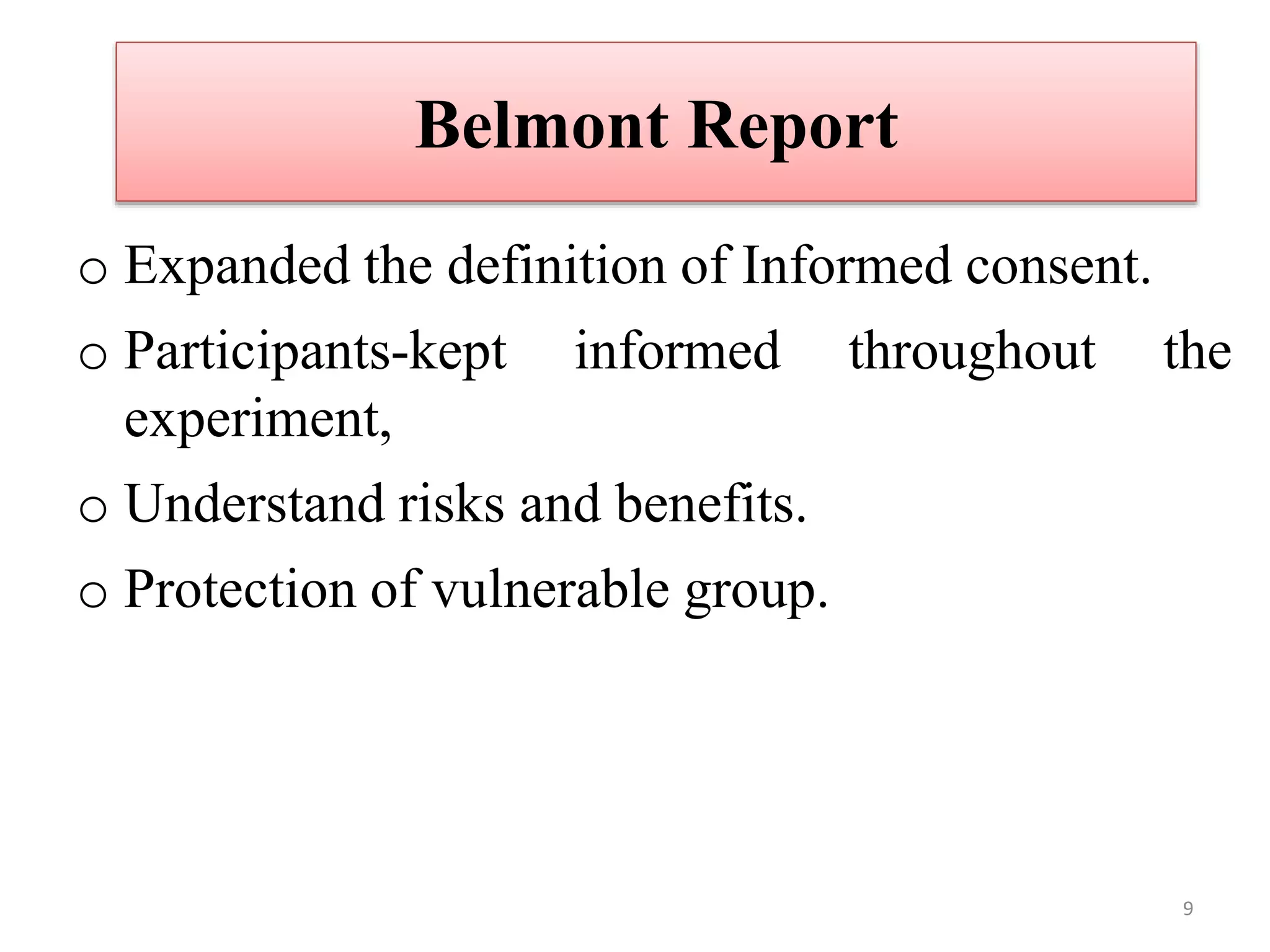
Belmont Report
o Expanded the definition of Informed consent.
o Participants-kept informed throughout the
experiment,
o Understand risks and benefits.
o Protection of vulnerable group.
9
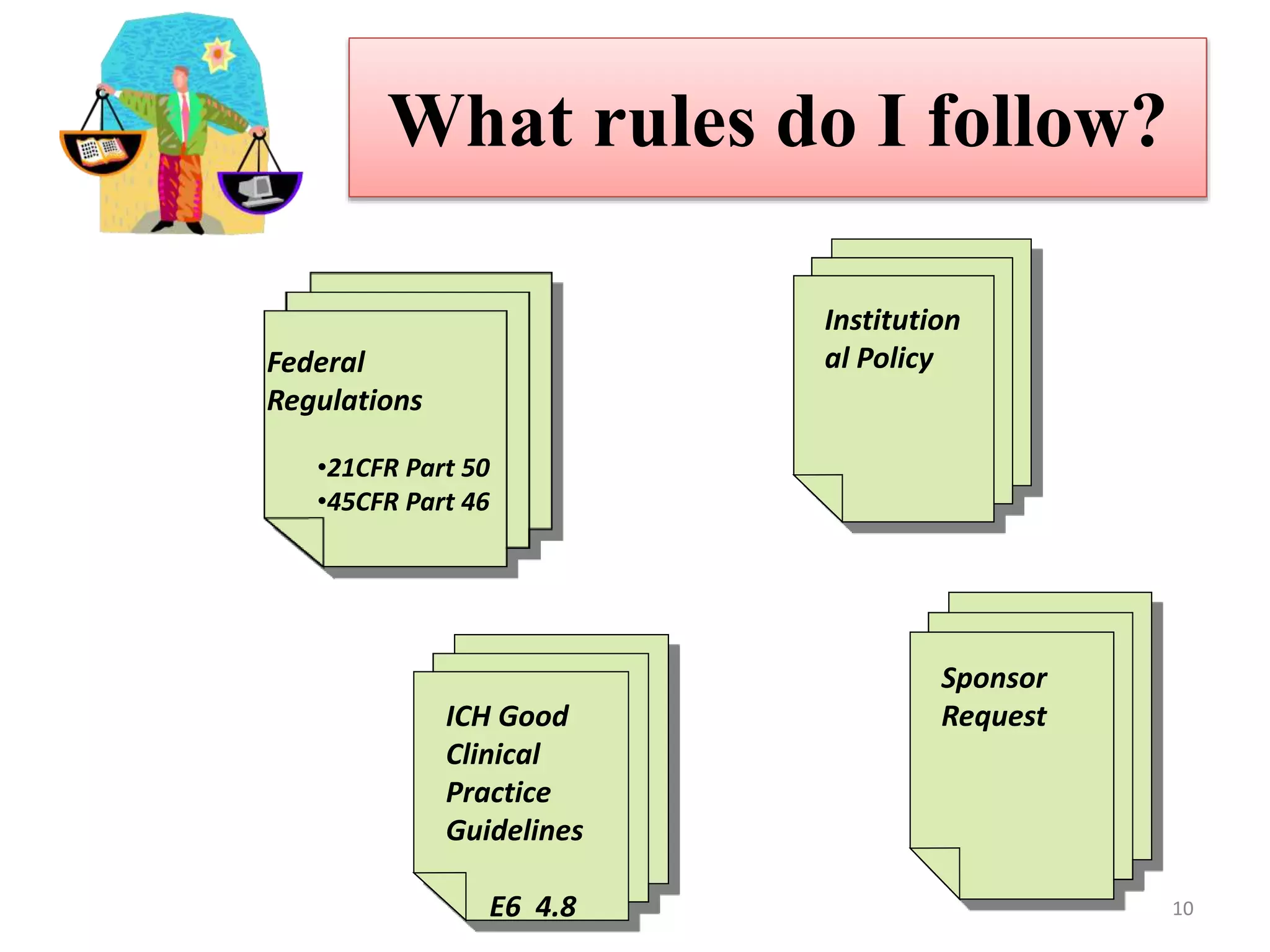
What rules do I follow?
Institution
al Policy
ICH Good
Clinical
Practice
Guidelines
E6 4.8
Sponsor
Request
Federal
Regulations
•21CFR Part 50
•45CFR Part 46
10
Basic Principles
AUTONOMY
BENEFICENCE
JUSTICE
11
Elements In Informed Consent
Form
1. Protocol number or name of study
2. Purpose of the study.
3. Duration of study and subject involvement
4. A statement that the protocol, and the informed consent were reviewed with the
participant, including the risks and benefits of the study.
5. Alternative treatment options discussed.
6. Confidentiality record
7. No of subjects
8. Compensation for injury
9. Time for questions to be asked and answered.
10. Description of the participant’s decision
11. Contact details
12. Travel reabusment
13. Subject responsibilities
14. Subject satisfaction
15. Use understandable language
16. Copy of consent was given to the participant
17. Sign copy of ICF
12
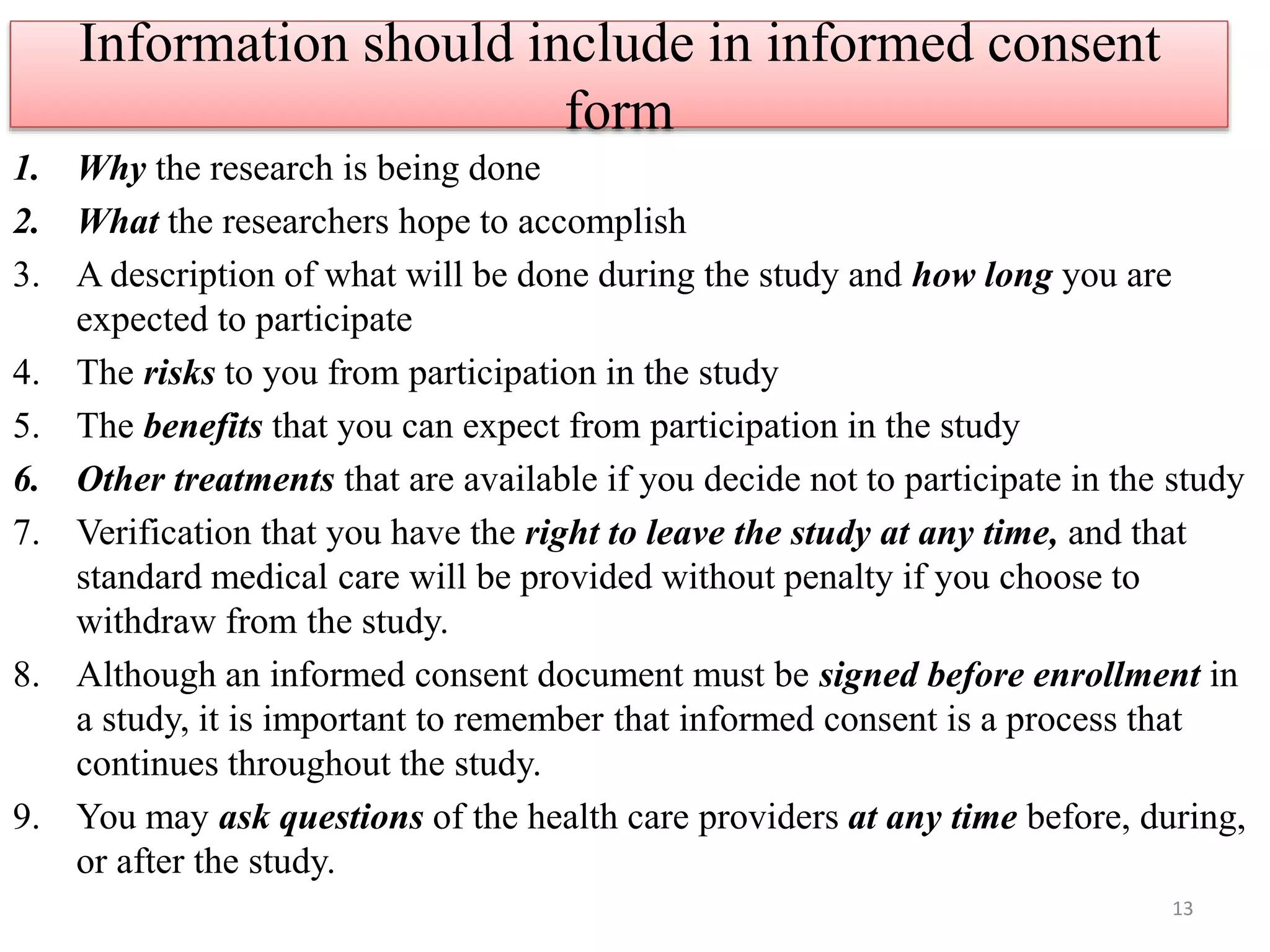
Information should include in informed consent
form
1. Why the research is being done
2. What the researchers hope to accomplish
3. A description of what will be done during the study and how long you are
expected to participate
4. The risks to you from participation in the study
5. The benefits that you can expect from participation in the study
6. Other treatments that are available if you decide not to participate in the study
7. Verification that you have the right to leave the study at any time, and that
standard medical care will be provided without penalty if you choose to
withdraw from the study.
8. Although an informed consent document must be signed before enrollment in
a study, it is important to remember that informed consent is a process that
continues throughout the study.
9. You may ask questions of the health care providers at any time before, during,
or after the study.
13
Informed Consent form
Readability
• Language that is easily understood
• Language must be appropriate to the population being
studied
• Language translators should be qualified and IRB
authorized
– Consider comprehension as well as readability
– Limit medical terminology
– Avoid informal speech
14
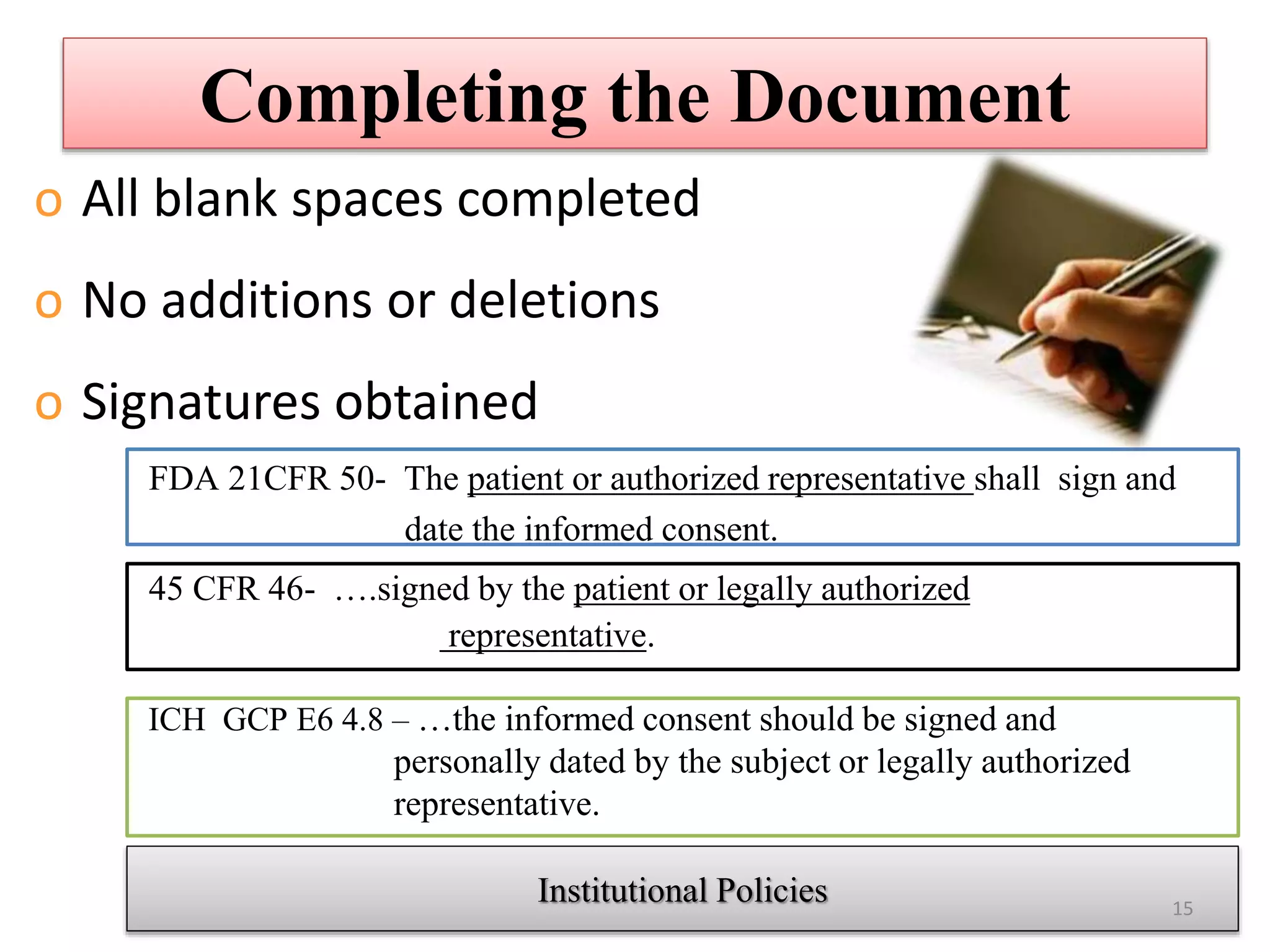
Completing the Document
o All blank spaces completed
o No additions or deletions
o Signatures obtained
FDA 21CFR 50- The patient or authorized representative shall sign and
date the informed consent.
45 CFR 46- ….signed by the patient or legally authorized
representative.
ICH GCP E6 4.8 – …the informed consent should be signed and
personally dated by the subject or legally authorized
representative.
Institutional Policies 15
Completing the Document
o Document distribution
FDA 21CFR 50- A copy of Informed Consent shall be given to the patient
or representative.
45 CFR 46- A copy shall be given to the person signing the form.
ICH GCP E6 4.8 – The subject should receive a copy of the signed and
dated written informed consent form…
Institutional Policies
16
Completing the Document
•When do you need a witness?
• When presenting the informed consent document orally
• Use of a short form
• If required by the IRB
• Who can be the witness?
ICH GCP – Impartial witness – a person who is independent of
the trial, who cannot be unfairly influenced by
people involved in the trial, who attends the
informed consent process…
17
Decision-Making Capacity
• Decision-making capacity is often referred to by the legal term competency.
Decision-making capacity is not black and white.
1. The components of decision-making capacity are as follows:
2. The ability to understand the options
3. The ability to understand the consequences of choosing each of the options
4. The ability to evaluate the personal cost and benefit of each of the consequences
and relate them to your own set of values and priorities
5. If you are not able to do all of the components, family members, court-appointed
guardians, or others (as determined by state law) may act as "surrogate decision-
makers" and make decisions for you.
6. To have decision-making capacity does not mean that you, as the patient, will
always make "good" decisions, or decisions that your doctor agrees with. Likewise,
making a "bad" decision does not mean that you, as patient, are "incompetent" or
do not have decision-making capacity.
7. Decision-making capacity, or competency, simply means that you can understand
and explain the options, their implications, and give a rational reason why you
would decide on a particular option instead of the others.
18
Revisions to Informed
Consent
1. Informed consent documents must be revised every
time new safety information becomes available or
there is a change in trial procedures, participant
compensation or personnel noted on the consent form.
2. Revisions to the informed consent document must be
approved by an IRB/IEC prior to its use, and the
informed consent process with the new information
and documentation needs to be repeated with every
clinical trial participant.
3. The participant is then required to sign the revised
form.
19
How does informed consent apply to
children?
1. Children do not have the decision-making capacity to provide
informed consent.
2. Since Therefore, parents or other surrogate decision-makers may
give informed permission for diagnosis and treatment of a child,
preferably with the assent of the child whenever possible.
3. Other disagreements in care may result in court orders that specify
what treatment should occur (for example, blood transfusions), or
in the court-ordered appointment of a guardian to make medical
decisions for the child.
4. Depending on the type of research, the IRB may make provisions
for “assent” of children
Assent
“A child’s affirmative agreement to be a participant in research.
Mere failure to object should not, absent affirmative agreement,
be construed as assent.” 20
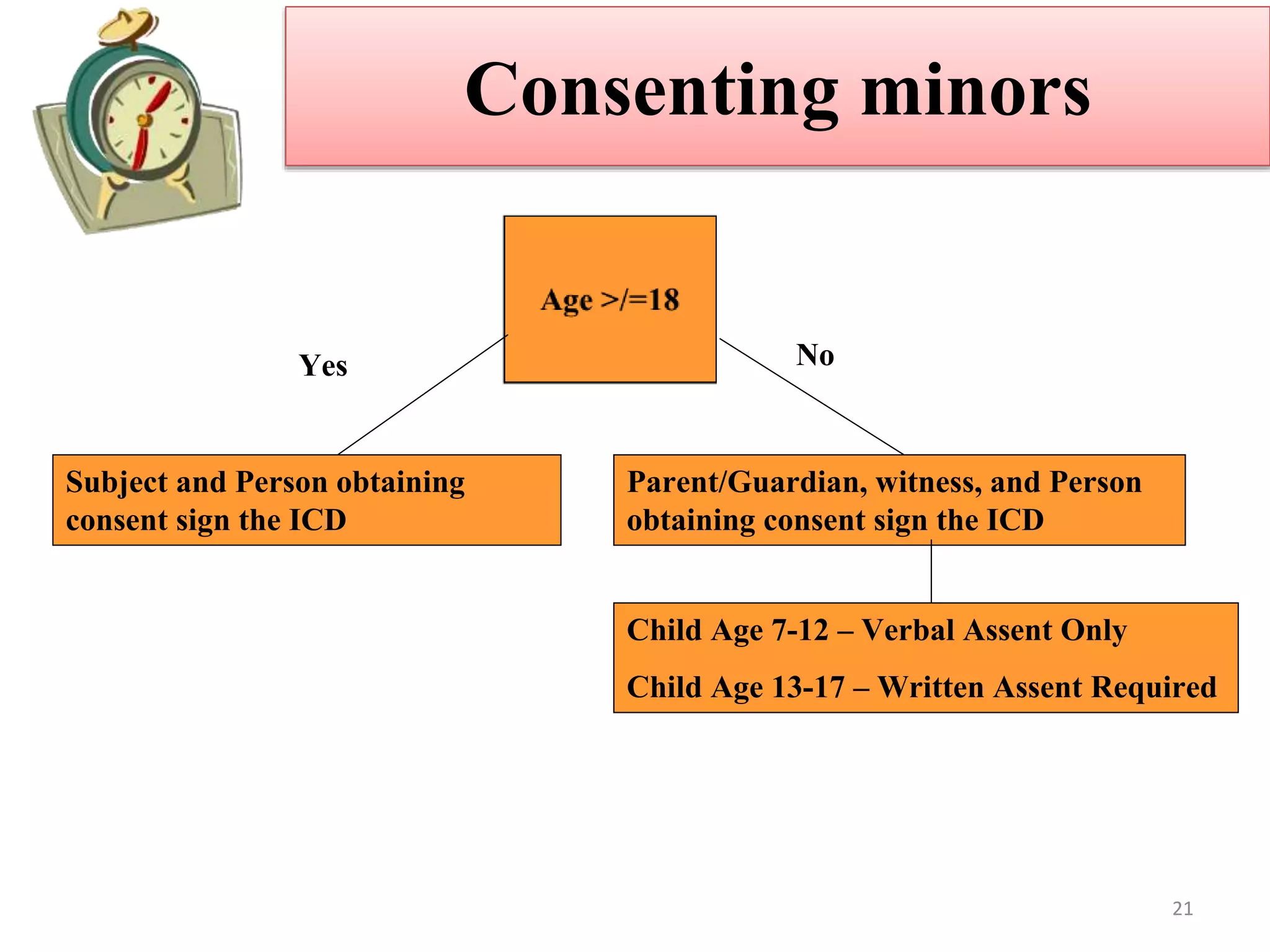
Consenting minors
Subject and Person obtaining
consent sign the ICD
Yes No
Parent/Guardian, witness, and Person
obtaining consent sign the ICD
Child Age 7-12 – Verbal Assent Only
Child Age 13-17 – Written Assent Required
21
Inform consent in pregnant women
Researchers should obtain informed consent
from both the pregnant woman and the father
Consent of the father is not necessary if
1. The purpose of the study is to meet the health
needs of the mother.
2. The identity or where about of the father can
not be reasonably as certained.
22
Informed consent form in Non English
speaking person
1. Ideal is to use consent translated to
participant’s native language
2. A copy of the consent document must be
given to each subject. While a translator may
be helpful in facilitating conversation with a
non-English speaking subject, verbal
translation of the consent.
3. Document must not be substituted for a
written translation.
23
Informed consent in illiterate person
 An investigator may enroll individuals, who can speak
and understand English,
 The potential subject must be able to place a written
mark on the consent form.
 After that the subject must also be able to:
1. Comprehend the concepts of the study and understand
the risks and benefits of the study as it is explained
verbally, and
2. Be able to indicate approval or disapproval for study
enrollment.
24
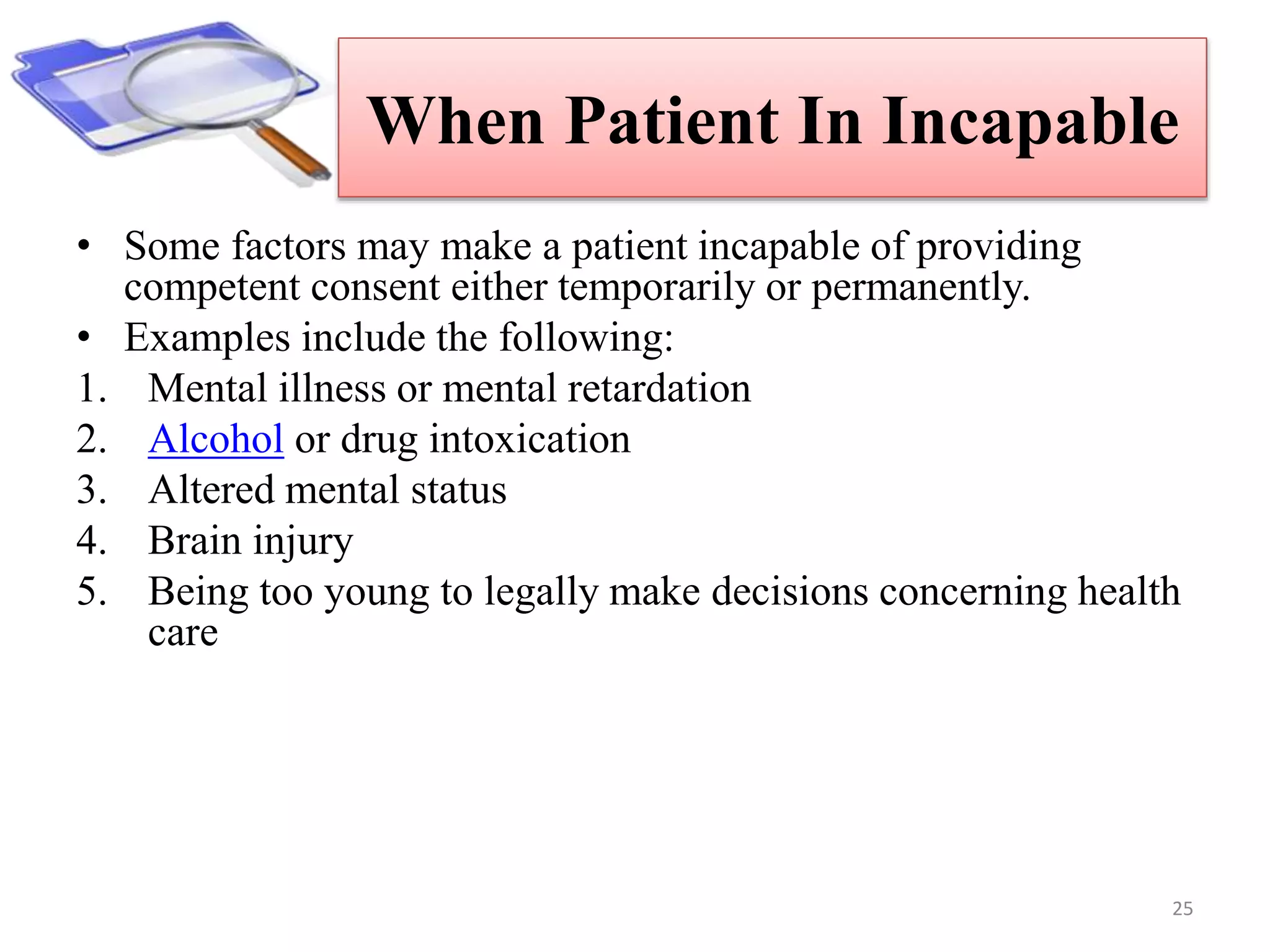
When Patient In Incapable
• Some factors may make a patient incapable of providing
competent consent either temporarily or permanently.
• Examples include the following:
1. Mental illness or mental retardation
2. Alcohol or drug intoxication
3. Altered mental status
4. Brain injury
5. Being too young to legally make decisions concerning health
care
25
Top 10 Consent Audit Findings
10. Subject signature and person obtaining consent on different dates
9. Subject consented with wrong version of consent/expired consent
8. Subject consented by individual not named on the IRB protocol
7. Check boxes within consent incomplete (future use of samples)
6. Crossed out or white out anywhere on the consent document
5. Unable to locate consent(s) for subject(s) on study
4. Subjects not re-consented with revised consent
3. Ineligible subjects enrolled
2. Wrong contact telephone number listed in consent
1. Copy of the consent document NOT provided to the subject
26
Audio-video visualing
 High resolved camera.
 Audible, clear, no other person involved
 Order to maintain confidentiality
 Disturbance free room
 CD can store at least 5 years after clinical trials
• Merits
1. Save investigators from future litigation's
2. Increase a transparency rate
• Demerits :
1. Long term storage
2. On additional step increases
3. Time consuming
27
Summary
 Informed consent is a key document in protecting the right of
study subject
 Procurement of consent ensures human dignity of the
participants and also shows respect for them.
 Informed consent assures that prospective research subjects will
understand the nature of the research and can knowledgeably
and voluntarily decide whether or not to participate
 The Investigator is primarily responsible for the ethics and
practice of informing persons about their participation in
research .
 The Investigator should communicate the importance of the
Informed Consent Process to the research staff and expect them
to maintain high ethical standards.
28
29

Inform consents form

  • 1.
    Informed Consent Form Presentedby, Rasika.R.Walunj M.Pharm(QAT)
  • 2.
    Content… 1. Introduction 2. Purposeof consent 3. What is informed consent form 4. History 5. Basic principles 6. Elements of informed consent 7. Documentation 8. Top ten consent audit finding 9. Summary 2
  • 3.
    Introduction • Millions ofvolunteers participate in government and industry sponsored clinical trial each year. • Prior to agreeing to participate, every volunteers has right to know and understand what happen during clinical trial . • This is called as informed consent and this process that can help to decide whether or not participating in a trial is right for you . 3
  • 4.
    Purpose of Consent? • Prospective Subject Will ..  Understand nature of research  Be informed of purpose, risks, and benefits, and alternative therapies  Make a Voluntary Decision about Participation 4
  • 5.
    Defining Informed Consent Informedconsent is defined by the ICH for GCP “ A process by which a subject voluntarily confirms his or her willingness to participate in a particular trial, after having been informed of all aspects of the trial that are revelent to the subject’s decision to participate”. Informed consent is documented by means of a written, signed and dated informed consent form. 5
  • 6.
    What is informedconsents..??? • Informed consent is a communication process: Between the researcher and the participant. Starts before the research is initiated . Continues throughout the duration of the study . Providing all relevant information to the volunteer/ patient The patient/ volunteer understanding the information provided Voluntarily agreeing to participate  A basic right 6
  • 7.
    Informed Consent allows individuals: -To determine whether participating in research fits with their values and interests. - To decide whether to contribute to this specific research project. - To protect themselves from risks. - To decide whether they can fulfill the requirements necessary for the research. 7
  • 8.
    Historical background ofinformed consent  1891- Prussian Minister of Interior , tuberculin for the treatment of tuberculosis must not be used against a person’s will.  1898- Dr. Albert Neisser was fined by the Royal disciplinary court of Prussia for not seeking patient’s consent for his experimental studies of vaccination for Syphilis.  1907- Sir William Osler endorsed the necessity of informed consent in medical research.  1931- Health Department regulations of German Reich stated that both human experimentation and the use of novel treatment required consent in a clear and unbeatable manner.  1945-1966 NIH funded 2000 research projects, none of them use informed consent Thalidomide- Birth defects is found  World war-II and unethical clinical trials done by US Health Services gave birth of Bio-ethics. AND Creation of IRB and notion of Informed Consent.  National Research Act (1960-1970) National Commission for protection of research participants in Biomedical and Behavioral Research.  1979,Belmont Report 8
  • 9.
    Belmont Report o Expandedthe definition of Informed consent. o Participants-kept informed throughout the experiment, o Understand risks and benefits. o Protection of vulnerable group. 9
  • 10.
    What rules doI follow? Institution al Policy ICH Good Clinical Practice Guidelines E6 4.8 Sponsor Request Federal Regulations •21CFR Part 50 •45CFR Part 46 10
  • 11.
  • 12.
    Elements In InformedConsent Form 1. Protocol number or name of study 2. Purpose of the study. 3. Duration of study and subject involvement 4. A statement that the protocol, and the informed consent were reviewed with the participant, including the risks and benefits of the study. 5. Alternative treatment options discussed. 6. Confidentiality record 7. No of subjects 8. Compensation for injury 9. Time for questions to be asked and answered. 10. Description of the participant’s decision 11. Contact details 12. Travel reabusment 13. Subject responsibilities 14. Subject satisfaction 15. Use understandable language 16. Copy of consent was given to the participant 17. Sign copy of ICF 12
  • 13.
    Information should includein informed consent form 1. Why the research is being done 2. What the researchers hope to accomplish 3. A description of what will be done during the study and how long you are expected to participate 4. The risks to you from participation in the study 5. The benefits that you can expect from participation in the study 6. Other treatments that are available if you decide not to participate in the study 7. Verification that you have the right to leave the study at any time, and that standard medical care will be provided without penalty if you choose to withdraw from the study. 8. Although an informed consent document must be signed before enrollment in a study, it is important to remember that informed consent is a process that continues throughout the study. 9. You may ask questions of the health care providers at any time before, during, or after the study. 13
  • 14.
    Informed Consent form Readability •Language that is easily understood • Language must be appropriate to the population being studied • Language translators should be qualified and IRB authorized – Consider comprehension as well as readability – Limit medical terminology – Avoid informal speech 14
  • 15.
    Completing the Document oAll blank spaces completed o No additions or deletions o Signatures obtained FDA 21CFR 50- The patient or authorized representative shall sign and date the informed consent. 45 CFR 46- ….signed by the patient or legally authorized representative. ICH GCP E6 4.8 – …the informed consent should be signed and personally dated by the subject or legally authorized representative. Institutional Policies 15
  • 16.
    Completing the Document oDocument distribution FDA 21CFR 50- A copy of Informed Consent shall be given to the patient or representative. 45 CFR 46- A copy shall be given to the person signing the form. ICH GCP E6 4.8 – The subject should receive a copy of the signed and dated written informed consent form… Institutional Policies 16
  • 17.
    Completing the Document •Whendo you need a witness? • When presenting the informed consent document orally • Use of a short form • If required by the IRB • Who can be the witness? ICH GCP – Impartial witness – a person who is independent of the trial, who cannot be unfairly influenced by people involved in the trial, who attends the informed consent process… 17
  • 18.
    Decision-Making Capacity • Decision-makingcapacity is often referred to by the legal term competency. Decision-making capacity is not black and white. 1. The components of decision-making capacity are as follows: 2. The ability to understand the options 3. The ability to understand the consequences of choosing each of the options 4. The ability to evaluate the personal cost and benefit of each of the consequences and relate them to your own set of values and priorities 5. If you are not able to do all of the components, family members, court-appointed guardians, or others (as determined by state law) may act as "surrogate decision- makers" and make decisions for you. 6. To have decision-making capacity does not mean that you, as the patient, will always make "good" decisions, or decisions that your doctor agrees with. Likewise, making a "bad" decision does not mean that you, as patient, are "incompetent" or do not have decision-making capacity. 7. Decision-making capacity, or competency, simply means that you can understand and explain the options, their implications, and give a rational reason why you would decide on a particular option instead of the others. 18
  • 19.
    Revisions to Informed Consent 1.Informed consent documents must be revised every time new safety information becomes available or there is a change in trial procedures, participant compensation or personnel noted on the consent form. 2. Revisions to the informed consent document must be approved by an IRB/IEC prior to its use, and the informed consent process with the new information and documentation needs to be repeated with every clinical trial participant. 3. The participant is then required to sign the revised form. 19
  • 20.
    How does informedconsent apply to children? 1. Children do not have the decision-making capacity to provide informed consent. 2. Since Therefore, parents or other surrogate decision-makers may give informed permission for diagnosis and treatment of a child, preferably with the assent of the child whenever possible. 3. Other disagreements in care may result in court orders that specify what treatment should occur (for example, blood transfusions), or in the court-ordered appointment of a guardian to make medical decisions for the child. 4. Depending on the type of research, the IRB may make provisions for “assent” of children Assent “A child’s affirmative agreement to be a participant in research. Mere failure to object should not, absent affirmative agreement, be construed as assent.” 20
  • 21.
    Consenting minors Subject andPerson obtaining consent sign the ICD Yes No Parent/Guardian, witness, and Person obtaining consent sign the ICD Child Age 7-12 – Verbal Assent Only Child Age 13-17 – Written Assent Required 21
  • 22.
    Inform consent inpregnant women Researchers should obtain informed consent from both the pregnant woman and the father Consent of the father is not necessary if 1. The purpose of the study is to meet the health needs of the mother. 2. The identity or where about of the father can not be reasonably as certained. 22
  • 23.
    Informed consent formin Non English speaking person 1. Ideal is to use consent translated to participant’s native language 2. A copy of the consent document must be given to each subject. While a translator may be helpful in facilitating conversation with a non-English speaking subject, verbal translation of the consent. 3. Document must not be substituted for a written translation. 23
  • 24.
    Informed consent inilliterate person  An investigator may enroll individuals, who can speak and understand English,  The potential subject must be able to place a written mark on the consent form.  After that the subject must also be able to: 1. Comprehend the concepts of the study and understand the risks and benefits of the study as it is explained verbally, and 2. Be able to indicate approval or disapproval for study enrollment. 24
  • 25.
    When Patient InIncapable • Some factors may make a patient incapable of providing competent consent either temporarily or permanently. • Examples include the following: 1. Mental illness or mental retardation 2. Alcohol or drug intoxication 3. Altered mental status 4. Brain injury 5. Being too young to legally make decisions concerning health care 25
  • 26.
    Top 10 ConsentAudit Findings 10. Subject signature and person obtaining consent on different dates 9. Subject consented with wrong version of consent/expired consent 8. Subject consented by individual not named on the IRB protocol 7. Check boxes within consent incomplete (future use of samples) 6. Crossed out or white out anywhere on the consent document 5. Unable to locate consent(s) for subject(s) on study 4. Subjects not re-consented with revised consent 3. Ineligible subjects enrolled 2. Wrong contact telephone number listed in consent 1. Copy of the consent document NOT provided to the subject 26
  • 27.
    Audio-video visualing  Highresolved camera.  Audible, clear, no other person involved  Order to maintain confidentiality  Disturbance free room  CD can store at least 5 years after clinical trials • Merits 1. Save investigators from future litigation's 2. Increase a transparency rate • Demerits : 1. Long term storage 2. On additional step increases 3. Time consuming 27
  • 28.
    Summary  Informed consentis a key document in protecting the right of study subject  Procurement of consent ensures human dignity of the participants and also shows respect for them.  Informed consent assures that prospective research subjects will understand the nature of the research and can knowledgeably and voluntarily decide whether or not to participate  The Investigator is primarily responsible for the ethics and practice of informing persons about their participation in research .  The Investigator should communicate the importance of the Informed Consent Process to the research staff and expect them to maintain high ethical standards. 28
  • 29.