Click to edit Master title style
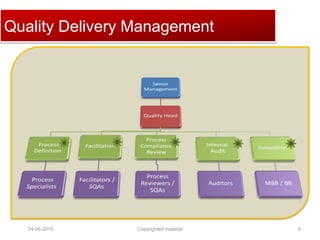
Quality Delivery Management
The ideal model for Effective Quality Implementation
By
Ramkumar Ramachandran
GM – Quality & Testing
Renault Nissan Technology & Business Centre India Pvt. Ltd
(IS&IT Division)
Chennai.
ramkumarramachandran@yahoo.co.in
Click to edit Master title styleContents
• Objective
• The Quality Team Structure
• Teams & Responsibilities
• Quality Team – Ideal Composition
• Selling Quality – Best Practices
• Risks & Mitigations
• Summary
04-06-2015 2Copyrighted material
Click to edit Master title styleObjective
• How do you setup a Quality Team?
• How do you effectively create Quality Culture?
• How do you justify investments in quality?
• What is war-time and peace-time activities?
• Mix of Practitioners in Quality Team
• Determine Facilitation Productivity
• Monitoring mechanisms
• Awarding Quality in deliveries
04-06-2015 3Copyrighted material
Click to edit Master title styleDisclaimer
04-06-2015 4Copyrighted material
Click to edit Master title style
Quality Organization
The typical ‘Quality Structure’ for well-oiled operations
Click to edit Master title styleQuality Delivery Management
04-06-2015 6Copyrighted material
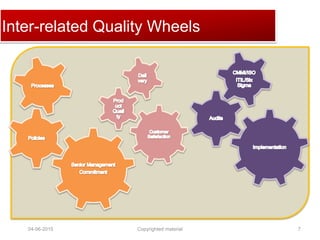
Click to edit Master title styleInter-related Quality Wheels
04-06-2015 7Copyrighted material
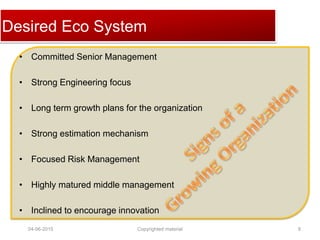
Click to edit Master title styleDesired Eco System
• Committed Senior Management
• Strong Engineering focus
• Long term growth plans for the organization
• Strong estimation mechanism
• Focused Risk Management
• Highly matured middle management
• Inclined to encourage innovation
04-06-2015 8Copyrighted material
Click to edit Master title style
Justifying Investment
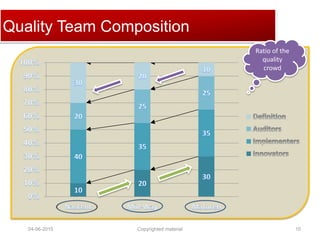
Creating a quality team with the right crowd and right composition
Click to edit Master title styleQuality Team Composition
Ratio of the
quality
crowd
04-06-2015 10Copyrighted material
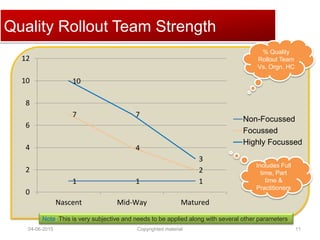
Click to edit Master title styleQuality Rollout Team Strength
1 1 1
7
4
2
10
7
3
0
2
4
6
8
10
12
Nascent Mid-Way Matured
Non-Focussed
Focussed
Highly Focussed
Note: This is very subjective and needs to be applied along with several other parameters
% Quality
Rollout Team
Vs. Orgn. HC
Includes Full
time, Part
time &
Practitioners
04-06-2015 11Copyrighted material
Click to edit Master title stylePractitioners Composition
• Practitioners can contribute for: -
– Process Championing
– Process Definition – through EPG
– Process Implementation
– Process Audits
• In the nascent levels it can be as much as 30%
• In matured state it can be at 15%
• Higher composition of Practitioners leads to better quality culture
and sustainability of initiatives
04-06-2015 12Copyrighted material
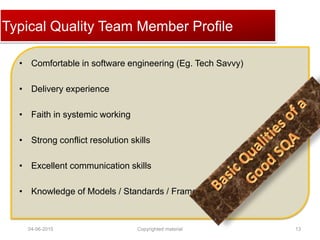
Click to edit Master title styleTypical Quality Team Member Profile
• Comfortable in software engineering (Eg. Tech Savvy)
• Delivery experience
• Faith in systemic working
• Strong conflict resolution skills
• Excellent communication skills
• Knowledge of Models / Standards / Frameworks
04-06-2015 13Copyrighted material
Click to edit Master title style
Process Definition
Create rules for delivery that meet the business objectives
Click to edit Master title styleFit the Model into Business
M
a
p
s
T
o
B
u
s
i
n
e
s
s
04-06-2015 15Copyrighted material
Click to edit Master title styleRules for Defining Process
• Choose Model / Standard / Framework that suits the business
• Map the Model into the business – never the other way
• Create a process architecture to understand various process
interactions
• Make the process architecture scalable
• Call the QMS as BMS – Business Management System – melting
pot of all Best Practices
• BMS should be able to accommodate QMS, SMS, ISMS etc.
04-06-2015 16Copyrighted material
Click to edit Master title style
CUSTOMER 1 CUSTOMER 2
Maintenance Support
Java .NET OTHERSM/F SAP
ABC Corporation
Business Service Catalogue
Technical Service Catalogue
Service Level Management
Business Relationship Management
Service Continuity Management
Strategic Service Management
Information Security Management Supplier Management
Service Management Objectives, Policy , Scope and Plan
IT Financial Management
Requirements Management
Service System Development
Change Management
Release and Deployment Management
Incident Management
Problem Management
Service Request Management
Configuration Management
Availability Management
Capacity Management Risk Management Work Planning
Work Monitoring & Control
Measurement & Analysis
Quality Assurance
Organizational Training
Integrated Work Management
Organizational Process Definition
ContinualServiceImprovement
Continual Service Improvement
04-06-2015 17Copyrighted material
Click to edit Master title styleBMS Release Mechanism
• After initial baseline, plan quarterly releases of BMS
• Encourage Practitioners to come out with process change requests
• Process changes needs to be approved by EPG and queued for the
forthcoming release
• Have provision for ‘Hotfix’ releases
• Provide a version number for each BMS release
• Communicate to all stakeholders on each BMS release
04-06-2015 18Copyrighted material
Click to edit Master title style
04-06-2015 Copyrighted material 19
• Design a very effective training mechanism to all stakeholders
• Split the training into two parts: -
– Generic BMS training
– Role based BMS training
• Everyone should undergo a training of these two components
• Role based training should be with case studies / scenarios that is
applicable to the given roles
• Have a very strong mechanism for evaluating training effectiveness
Effective Training on BMS
Click to edit Master title style
04-06-2015 Copyrighted material 20
• Evaluation mechanism can be through online quiz / interviews / tests
• Arrive at a threshold score that everyone should get in these
evaluations
• Plan for Refresher Training for all roles
• Bring in the training completion as a pre-requisite for deployment
into Projects
Effective Training on BMS
Click to edit Master title style
Engineering Process Group
How to make Practitioners own the process?
Click to edit Master title styleHaving an Active Engineering Process Group
• Engaging Practitioners to define processes is key to effective buy-in
• EPG should be headed by Practitioner
• Identify ‘Process Owners’
• Co-ordination of EPG Meetings by QA rep
• High visibility of Process ‘Tailorings’ & ‘Deviations’ to EPG
• Cross unit representation in EPG
• Incentives for Practitioners to be part of EPG
04-06-2015 22Copyrighted material
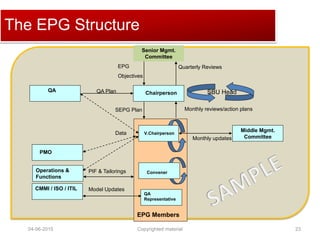
Click to edit Master title styleThe EPG Structure
EPG Members
Senior Mgmt.
Committee
Chairperson
EPG
Objectives
SEPG Plan
QA
Representative
Quarterly Reviews
Monthly reviews/action plans
PMO
Middle Mgmt.
Committee
CMMI / ISO / ITIL
Operations &
Functions
Monthly updates
QA QA Plan
Model Updates
PIF & Tailorings
Data
SBU Head
V.Chairperson
Convener
04-06-2015 23Copyrighted material
Click to edit Master title styleEPG Responsibilities
• Process should be owned by EPG
• EPG should be predominantly comprised of Practitioners
• QA should vet the processes for compliance with CMMI / ISO / ITIL as
applicable
• EPG should analyze various parameters to sense patterns and act on the
same
• Sample parameters for analysis: -
– Tailoring / Deviation Requests
– Non-Conformances
– Risks
– PPB
• An annual plan for analysis should be drawn and monitored
04-06-2015 24Copyrighted material
Click to edit Master title style
04-06-2015 Copyrighted material 25
Jan Feb Mar Apr May Jun Jul Aug
Defects Analysis
PCR Analysis
Risks Analysis
Best Practices Analysis
Tailoring / Deviations Analysis
Annual EPG Analysis Calendar
Click to edit Master title style
Process Rollout
Effective facilitation of process adherence in delivery
Click to edit Master title styleEffective Facilitation Planning
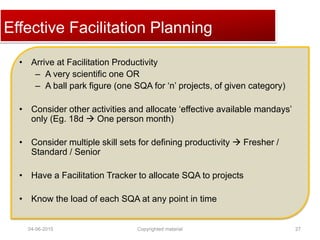
• Arrive at Facilitation Productivity
– A very scientific one OR
– A ball park figure (one SQA for ‘n’ projects, of given category)
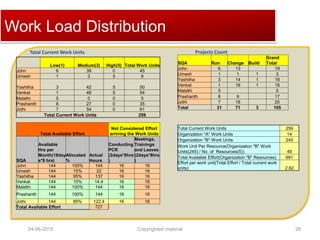
• Consider other activities and allocate ‘effective available mandays’
only (Eg. 18d  One person month)
• Consider multiple skill sets for defining productivity  Fresher /
Standard / Senior
• Have a Facilitation Tracker to allocate SQA to projects
• Know the load of each SQA at any point in time
04-06-2015 27Copyrighted material
Click to edit Master title style
04-06-2015 Copyrighted material 28
Work Load Distribution
Total Current Work Units Projects Count
Total Available Effort
Not Considered Effort
arriving the Work Units
SQA
Available
Hrs per
Month(18day
s*8 hrs)
Allocated
%
Actual
Hours
Conducting
PCR
(2days*8hrs
)
Meetings,
Trainings
and Leaves
(2days*8hrs
)
John 144 100% 144 16 16
Umesh 144 15% 22 16 16
Yashitha 144 95% 137 16 16
Venkat 144 10% 14.4 16 16
Malathi 144 100% 144 16 16
Prashanth 144 100% 144 16 16
Jothi 144 85% 122.4 16 16
Total Available Effort 727
SQA Run Change Build
Grand
Total
John 6 13 19
Umesh 1 1 1 3
Yashitha 3 14 1 18
Venkat 1 16 1 18
Malathi 5 5
Prashanth 8 9 17
Jothi 7 18 25
Total 31 71 3 105
Low(1) Medium(3) High(5) Total Work Units
John 6 39 0 45
Umesh 1 3 5 9
Yashitha 3 42 5 50
Venkat 1 48 5 54
Malathi 5 0 0 5
Prashanth 8 27 0 35
Jothi 7 54 0 61
Total Current Work Units 259
Organization "A" Work Units 14
Organization "B" Work Units 245
Work Unit Per Resource(Organization "B" Work
Units(245) / No. of Resources(5)) 49
Total Available Effort(Organization "B" Resources) 691
Effort per work unit(Total Effort / Total current work
units) 2.82
Click to edit Master title styleDoing Effective Facilitation
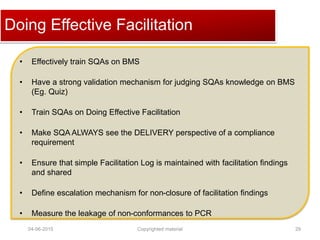
• Effectively train SQAs on BMS
• Have a strong validation mechanism for judging SQAs knowledge on BMS
(Eg. Quiz)
• Train SQAs on Doing Effective Facilitation
• Make SQA ALWAYS see the DELIVERY perspective of a compliance
requirement
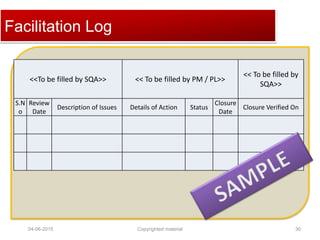
• Ensure that simple Facilitation Log is maintained with facilitation findings
and shared
• Define escalation mechanism for non-closure of facilitation findings
• Measure the leakage of non-conformances to PCR
04-06-2015 29Copyrighted material
Click to edit Master title style
04-06-2015 Copyrighted material 30
Facilitation Log
<<To be filled by SQA>> << To be filled by PM / PL>>
<< To be filled by
SQA>>
S.N
o
Review
Date
Description of Issues Details of Action Status
Closure
Date
Closure Verified On
Click to edit Master title styleKnow the Practitioners Pulse
• Conduct CSAT on Facilitation team’s performance with Delivery Team
• Frame questions to know how much the SQA is delivery focused / BMS
knowledge etc
• Take this CSAT as an indicator of Delivery Team’s perception on
Facilitation
• Answers should NEVER be mapped to SQAs
• Answers should ONLY be mapped to projects
• NEVER use this CSAT to appraise SQA
• Do systemic changes based on this CSAT
04-06-2015 31Copyrighted material
Click to edit Master title stylePlan localized Facilitation Services
• Meet delivery units at define frequency with special facilitation
services. For eg: -
– Analyze certain delivery patterns and provide a solution
– Study certain challenges (Requirements / Testing etc) of delivery
and offer solutions
– Identify opportunity for improvements and advice the same
– Discuss beyond ‘audit’, ‘compliance’, ’PCR’ etc.
04-06-2015 32Copyrighted material
Click to edit Master title style
04-06-2015 Copyrighted material 33
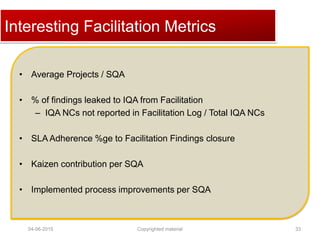
• Average Projects / SQA
• % of findings leaked to IQA from Facilitation
– IQA NCs not reported in Facilitation Log / Total IQA NCs
• SLA Adherence %ge to Facilitation Findings closure
• Kaizen contribution per SQA
• Implemented process improvements per SQA
Interesting Facilitation Metrics
Click to edit Master title style
Process Compliance Reviews
The in-between of Facilitation and Internal Audits
Click to edit Master title styleFindings Leakage
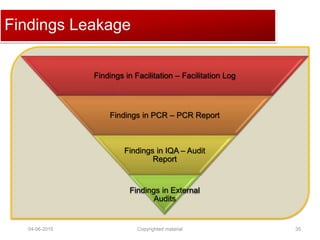
Findings in Facilitation – Facilitation Log
Findings in PCR – PCR Report
Findings in IQA – Audit
Report
Findings in External
Audits
04-06-2015 35Copyrighted material
Click to edit Master title styleEffective PCR Framework
• Cross allocate SQA for PCR
• Ensure independence of PCR activity
• Maintain an elaborate PCR template with
– Process-wise questions
– Graded scores for each question (0 to 5)
• All scores <= 2 should be treated as NCs and tracked for closure
• Define ‘hygiene factors’ as pre-requisite to start a PCR
• PCR template should have provision to capture details of compliance
04-06-2015 36Copyrighted material
Click to edit Master title styleCrosslink PCRs
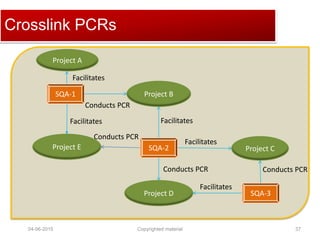
SQA-1
SQA-2
SQA-3
Project A
Project B
Project C
Project D
Facilitates
Facilitates
Facilitates
Conducts PCR
Conducts PCR
Facilitates
Conducts PCR
Project E
Facilitates
Conducts PCR
04-06-2015 37Copyrighted material
Click to edit Master title stylePCR Planning
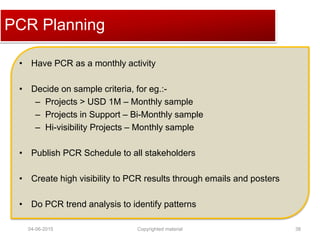
• Have PCR as a monthly activity
• Decide on sample criteria, for eg.:-
– Projects > USD 1M – Monthly sample
– Projects in Support – Bi-Monthly sample
– Hi-visibility Projects – Monthly sample
• Publish PCR Schedule to all stakeholders
• Create high visibility to PCR results through emails and posters
• Do PCR trend analysis to identify patterns
04-06-2015 38Copyrighted material
Click to edit Master title styleFiner aspects of PCR
• Ensure min 80% of PCR activity is offline and only max 20%
engages the delivery team
• Define SLAs to close PCR findings along with escalation
mechanisms
• Capture findings leakage from Facilitation
• Make Leads to randomly validate the PCRs
• Minimum 80% of PCR score should be made as KPI at all levels
• Provide high visibility for PCRs that are cancelled
04-06-2015 39Copyrighted material
Click to edit Master title style
04-06-2015 Copyrighted material 40
• Arrive at the Corroborative Compliance Score
– Compliance score only when activities are done in the
chronological order
– Nil compliance for artifacts created in ‘one-go’
• Identify ‘Sustainability Index’
– This score tells how much is the PCR compliance sustainable
– Purely refers to artifacts in relevant location
– CM Plan becomes the base for Sustainability Index
Going Beyond PCR
Click to edit Master title style
Internal Audit
How to design the best internal business control
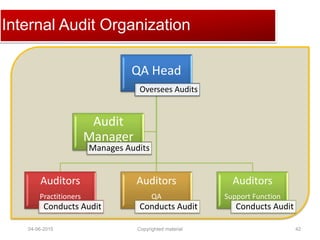
Click to edit Master title styleInternal Audit Organization
QA Head
Oversees Audits
Auditors
Practitioners
Conducts Audit
Auditors
QA
Conducts Audit
Auditors
Support Function
Conducts Audit
Audit
Manager
Manages Audits
04-06-2015 42Copyrighted material
Click to edit Master title styleInternal Audit Framework
• Audit team should be trained on auditing skills
• The Audit Manager should oversee the audits
• Audit frequency should be defined – ideally quarterly
• Support functions also should be audited
• Strive for common approach across auditors
• Normalization of findings should be done
04-06-2015 43Copyrighted material
Click to edit Master title styleInternal Audit Framework……(Cntd)
• Audit analysis leading to effective CAPA should be done
• Pareto analysis should be done to know ‘Key Contributors’ of Non-
conformances
04-06-2015 44Copyrighted material
Click to edit Master title styleInternal Audit – Activities
• Maintain an annual audit calendar, with named audit cycles
• Have a well defined project sampling criteria
• Have 70% to 80% of Auditors from delivery
• Rest 20% to 30% of Auditors from support
• Clearly define SLA at every level
• Ensure formal Opening & Closing meetings
• Provide high visibility to findings closure status
04-06-2015 45Copyrighted material
Click to edit Master title styleInternal Audit SLAs
Audit
Announcement
Audit Report
Submission
Audit Report
Queries Raising
Audit Queries
Resolution
Findings
Closure
Audit
Team
Auditor Auditee Auditor Auditee
SLA for Findings closure depends upon finding category. Eg. 2 weeks for
Major and 1 week for Minor. SLA for Findings Closure is followed by
Escalation Mechanism.
04-06-2015 46Copyrighted material
Two weeks
lead time to
announce
audit
schedule
Audit report
to be
provided
within 2
Business Days
Queries to be
raised within
2 business
days
Queries
should be
responded
within 4
business days
Findings
should be
closed as per
NC
classification
Click to edit Master title style
04-06-2015 Copyrighted material 47
NC Closure Specific SLA Escalation
Becomes a
Organization
RISK beyond 5
weeks of non-
closure
Click to edit Master title style
04-06-2015 Copyrighted material 48
NC Closure Specific SLA Escalation
NC
Details
Open
within
SLA
Open beyond SLA
Escalated Level
PM
Unit
Head
QA Head VP
NC 1
NC 2
NC 2
NC
Details
Closed Closed beyond SLA Closed
with
Propose
d Action
within
SLA
Escalated Level
PM
Unit
Head
QA Head VP
NC 1
NC 2
NC 2
Open beyond SLA
Closed beyond SLA
Click to edit Master title styleStandard Audit Analysis
• NC score across delivery units
• Audits Planned Vs. Conducted
• Pareto analysis of Process Areas of NCs
• Process Area-wise / Clause-wise NC analysis
• NC Open / Close Status
04-06-2015 49Copyrighted material
Click to edit Master title styleInteresting Audit Metrics
• NC Density / Delivery Unit
• Auditors Effectiveness Score
• SLA Adherence – Delivery Unit-wise
• NCs leakage percentage – from PCR
• Average TAT to close NC – Delivery Unit-wise
04-06-2015 50Copyrighted material
Click to edit Master title styleInternal Audit – Key Success Factors
• Clear sampling criteria
• Comprehensive coverage of all operations & support functions
• Auditors Training
• Auditees Awareness Session
• Findings normalization
• Strict adherence to SLA & related escalations
• Providing high visibility to audit outcome to all Stakeholders
04-06-2015 51Copyrighted material
Click to edit Master title style
04-06-2015 Copyrighted material 52
• Mechanism to track NCs that are closed with ‘Proposed Corrective
Action’ in future releases
• All NCs should be tracked as following: -
– Open – Within SLA / Beyond SLA
– Closed – With Correction / With Proposed Corrective Action
– Closed – Within SLA / Beyond SLA
• Each audit cycle should track last cycle’s NC closed with ‘Proposed
Corrective Action’
• Closure verification can be done by SQAs and later concurred with
concerned Auditors
Internal Audit – Finer Aspects
Click to edit Master title style
Innovation
Building a strong Innovation Culture is key for sustained growth
Click to edit Master title styleInnovation Framework
04-06-2015 54Copyrighted material
Click to edit Master title styleInnovation Framework
• Build a culture of innovation in the organization slowly &
methodically
• Innovation is disruptive thinking – needs a planned growth
• Expect enough resistance in the initial period
• Create a three to five year plan
• Start with high visibility – posters, mailers, roadshows etc.
• Form a strong Innovation Team with Master Blackbelt and Blackbelts
04-06-2015 55Copyrighted material
Click to edit Master title styleRolling out Innovation Culture
• Start with Kaizens
• Conduct multiple Kaizen waves every year
• Define Kaizen as ‘small, implemented improvement’
• Never harp on hard savings
• Stress on benefits, soft savings achieved through Kaizen
• Create a common body to evaluate Kaizens
• Have defined criteria to ‘qualify’ a Kaizen
04-06-2015 56Copyrighted material
Click to edit Master title styleAwarding Kaizens
• Kaizens can scored based on ‘Originality’, ‘Re-usability’, ‘Cost
Savings’, ‘Effort Spent’
• Provide Wave-wise awards for Kaizens Eg. Top ‘n’ Kaizens
• Have an Annual Best-of-Best Award across Kaizen Waves
• Make Kaizen Contribution as part of KPI for Managers
• Provide awards in public forums to convey its importance
04-06-2015 57Copyrighted material
Click to edit Master title styleGraduate into Six Sigma
• Kickoff Six Sigma projects on strong Kaizen base
• A very conducive Innovation Culture is key for successful Six Sigma
rollout
• Kickoff Annual Six Sigma Cycle with identification of key business
pain points
• Business pain points should be decided by the Senior Management
• Evaluate and rank business pain points
• Choose the Top ‘n’ pain points as candidates of Six Sigma Projects
04-06-2015 58Copyrighted material
Click to edit Master title styleEvaluating Pain Points
• Pain points can be evaluated on: -
– Cost savings that will be achieved on fixing it
– Time that would be taken for fixing it
– Availability of data on the said pain points
• This will justify the time & effort spent on addressing the pain points
• Engage the Finance Department to closely track and confirm the
savings on completion
04-06-2015 59Copyrighted material
Click to edit Master title styleSix Sigma Rollout
• Get nominations for Green Belt training
• Nominated persons will be trained and allocated to GB Six Sigma
projects
• It is a good practice to localize the GB training content, with local
examples
• GB Training should be exhaustive and on workshop mode
• Ensure that the Trainer is an MBB with relevant industry experience
04-06-2015 60Copyrighted material
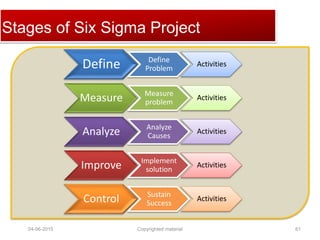
Click to edit Master title styleStages of Six Sigma Project
Define Define
Problem
Activities
Measure Measure
problem
Activities
Analyze Analyze
Causes
Activities
Improve Implement
solution
Activities
Control Sustain
Success
Activities
04-06-2015 61Copyrighted material
Click to edit Master title styleMonitoring Six Sigma Projects
• Draw a schedule for each Six Sigma Projects
• Schedule should never go beyond 3 to 4 months – under normal
circumstances
• A long running Six Sigma project may lose Organization’s focus
• Plan review with MBB, Sponsor, QA Head and Senior Management at
end of each phase
• Take a conscious call on progressing to subsequent phase
• Collectively, have the courage to call off a project if a strong un-
resolvable problem is evidenced
04-06-2015 62Copyrighted material
Click to edit Master title styleKey Success Factors for Six Sigma Projects
• Focus on proper and pragmatic cause attribution
• Ensure good data quality for analysis
• Active participation of Finance person in all phase end reviews is mandatory
• Proposed solutions should be on causes identified and should not be
superfluous
• Sponsor should be fully support effective implementation of proposed
solution
• Focus should be on sustaining the benefits achieved
• Award Green Belt Certificate ONLY on successfully completing the project
04-06-2015 63Copyrighted material
Click to edit Master title styleHonoring Green Belts
• Conduct a high visibility Certification Ceremony for successful
Green Belts
• Share the success details viz. Hard Savings in Dollars, Person Days
etc.
• Use GB Certification as a Differentiator during appraisals for
promotions
• Publish GB Success Stories in organization newsletters to spread
Best Practices
• Set KPIs for Seniors on number of GB projects to be sponsored in a
year
04-06-2015 64Copyrighted material
Click to edit Master title style
The Other Practices
Few standard and non-standard practices
Click to edit Master title styleQuality Award
• Institute a Quality Award based on defined parameters
• These should NOT be on compliance score alone
• Few parameters: -
– SLA honoring in IQA
– SEPG Attendance
– Count of Process changes proposed to SEPG
• Make the award a quarterly affair
• Announce the Winner with high visibility
04-06-2015 66Copyrighted material
Click to edit Master title styleTrain on Art of Facilitation
• Train the SQA on mastering the art of facilitation
• Facilitation is the ‘art of making a point without making an enemy’
• SQA needs to be soft but stubborn
• All Facilitation inputs should be formal in Facilitation Log
• Change projects allocated at defined frequency to avoid bias and
monotony
04-06-2015 67Copyrighted material
Click to edit Master title stylePlan the Activities
• Make Leads provide a broad Activity Report on weekly basis
• Activity Report shall contain: -
– Activities completed last week
– Activities planned for current week
– Activities that spans weeks
– All the above with dates and status as applicable
• This needs to be a simple report conveying the snapshot of activities
of the week
04-06-2015 68Copyrighted material
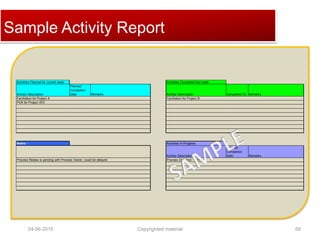
Click to edit Master title styleSample Activity Report
Activities Planned for current week Activities Completed last week
Activity Description
Planned
Completion
Date Remarks Activity Description Completed On Remarks
Facilitation for Project A Facilitation for Project B
PCR for Project XYZ
Notes: - Activities In-Progress
Activity Description
Planned
Completion
Date Remarks
Process Definition - DARProcess Review is pending with Process Owner, could be delayed
04-06-2015 69Copyrighted material
Click to edit Master title styleReport Comprehensively
• Quality Team many a times fails in reporting developments
• Design a comprehensive monthly report to Senior Management
• Broad contents would be: -
– Key accomplishments last month
– Key activities planned for current month
– Key Indicators – PCR Score, SLA adherence, Team Load, Project Risks
etc
04-06-2015 70Copyrighted material
Click to edit Master title styleCreate High Team Morale
• Keep the team morale high
• Provide independence to report factual findings without fear
• Make it clear – Compliance is Delivery Responsibility, enabling is SQA
responsibility
• Measure facilitation effectiveness through NC leakage, Facilitation  PCR
 IQA
• Organize informal group activities for better team bonding
• Remember that your subordinate’s career growth is your responsibility as
well
04-06-2015 71Copyrighted material
Click to edit Master title style
04-06-2015 Copyrighted material 72
• High Compliance Score Vs. High Product Defects
• Delivery Accountability – QA Vs. Project Team
• Snapshot Compliance Vs. Sustainable Compliance
• Is Facilitation a policing activity?
• To CSAT or not to CSAT for SQA services
• War Time and Peace Time activities of QA Function
Case Studies
Click to edit Master title style
04-06-2015 Copyrighted material 73
• What, When and How to escalate Project Risks to Senior
Management
• Facilitation Productivity – Myth or Reality
• Compliance Vs. Defects Vs. CSAT – Can they be correlated?
• Best job rotation models for SQAs
Case Studies
Click to edit Master title styleQuick Recap
• Quality Organization – Sub-divisions
• Defining process
• Implementing process
• Effective NC defect leakage
• Strong Audit Controls
• Planning & Monitoring QA activities
• Team Morale
04-06-2015 74Copyrighted material
Click to edit Master title styleThank You…!
04-06-2015 75Copyrighted material
Click to edit Master title style
04-06-2015 Copyrighted material 76
Join today!
Click to edit Master title style
04-06-2015 Copyrighted material 77
• No part of this presentation may be reproduced, stored in a retrieval
system, or transmitted in any form or by any means, electronic,
mechanical, photocopying, recording, scanning, or otherwise, except as
permitted.
• Requests to the publisher for permission should be addressed to
ramkumarramachandran@yahoo.co.in
Copyright

Quality Delivery Management

  • 1.
    Click to editMaster title style Quality Delivery Management The ideal model for Effective Quality Implementation By Ramkumar Ramachandran GM – Quality & Testing Renault Nissan Technology & Business Centre India Pvt. Ltd (IS&IT Division) Chennai. ramkumarramachandran@yahoo.co.in
  • 2.
    Click to editMaster title styleContents • Objective • The Quality Team Structure • Teams & Responsibilities • Quality Team – Ideal Composition • Selling Quality – Best Practices • Risks & Mitigations • Summary 04-06-2015 2Copyrighted material
  • 3.
    Click to editMaster title styleObjective • How do you setup a Quality Team? • How do you effectively create Quality Culture? • How do you justify investments in quality? • What is war-time and peace-time activities? • Mix of Practitioners in Quality Team • Determine Facilitation Productivity • Monitoring mechanisms • Awarding Quality in deliveries 04-06-2015 3Copyrighted material
  • 4.
    Click to editMaster title styleDisclaimer 04-06-2015 4Copyrighted material
  • 5.
    Click to editMaster title style Quality Organization The typical ‘Quality Structure’ for well-oiled operations
  • 6.
    Click to editMaster title styleQuality Delivery Management 04-06-2015 6Copyrighted material
  • 7.
    Click to editMaster title styleInter-related Quality Wheels 04-06-2015 7Copyrighted material
  • 8.
    Click to editMaster title styleDesired Eco System • Committed Senior Management • Strong Engineering focus • Long term growth plans for the organization • Strong estimation mechanism • Focused Risk Management • Highly matured middle management • Inclined to encourage innovation 04-06-2015 8Copyrighted material
  • 9.
    Click to editMaster title style Justifying Investment Creating a quality team with the right crowd and right composition
  • 10.
    Click to editMaster title styleQuality Team Composition Ratio of the quality crowd 04-06-2015 10Copyrighted material
  • 11.
    Click to editMaster title styleQuality Rollout Team Strength 1 1 1 7 4 2 10 7 3 0 2 4 6 8 10 12 Nascent Mid-Way Matured Non-Focussed Focussed Highly Focussed Note: This is very subjective and needs to be applied along with several other parameters % Quality Rollout Team Vs. Orgn. HC Includes Full time, Part time & Practitioners 04-06-2015 11Copyrighted material
  • 12.
    Click to editMaster title stylePractitioners Composition • Practitioners can contribute for: - – Process Championing – Process Definition – through EPG – Process Implementation – Process Audits • In the nascent levels it can be as much as 30% • In matured state it can be at 15% • Higher composition of Practitioners leads to better quality culture and sustainability of initiatives 04-06-2015 12Copyrighted material
  • 13.
    Click to editMaster title styleTypical Quality Team Member Profile • Comfortable in software engineering (Eg. Tech Savvy) • Delivery experience • Faith in systemic working • Strong conflict resolution skills • Excellent communication skills • Knowledge of Models / Standards / Frameworks 04-06-2015 13Copyrighted material
  • 14.
    Click to editMaster title style Process Definition Create rules for delivery that meet the business objectives
  • 15.
    Click to editMaster title styleFit the Model into Business M a p s T o B u s i n e s s 04-06-2015 15Copyrighted material
  • 16.
    Click to editMaster title styleRules for Defining Process • Choose Model / Standard / Framework that suits the business • Map the Model into the business – never the other way • Create a process architecture to understand various process interactions • Make the process architecture scalable • Call the QMS as BMS – Business Management System – melting pot of all Best Practices • BMS should be able to accommodate QMS, SMS, ISMS etc. 04-06-2015 16Copyrighted material
  • 17.
    Click to editMaster title style CUSTOMER 1 CUSTOMER 2 Maintenance Support Java .NET OTHERSM/F SAP ABC Corporation Business Service Catalogue Technical Service Catalogue Service Level Management Business Relationship Management Service Continuity Management Strategic Service Management Information Security Management Supplier Management Service Management Objectives, Policy , Scope and Plan IT Financial Management Requirements Management Service System Development Change Management Release and Deployment Management Incident Management Problem Management Service Request Management Configuration Management Availability Management Capacity Management Risk Management Work Planning Work Monitoring & Control Measurement & Analysis Quality Assurance Organizational Training Integrated Work Management Organizational Process Definition ContinualServiceImprovement ContinualServiceImprovement Continual Service Improvement 04-06-2015 17Copyrighted material
  • 18.
    Click to editMaster title styleBMS Release Mechanism • After initial baseline, plan quarterly releases of BMS • Encourage Practitioners to come out with process change requests • Process changes needs to be approved by EPG and queued for the forthcoming release • Have provision for ‘Hotfix’ releases • Provide a version number for each BMS release • Communicate to all stakeholders on each BMS release 04-06-2015 18Copyrighted material
  • 19.
    Click to editMaster title style 04-06-2015 Copyrighted material 19 • Design a very effective training mechanism to all stakeholders • Split the training into two parts: - – Generic BMS training – Role based BMS training • Everyone should undergo a training of these two components • Role based training should be with case studies / scenarios that is applicable to the given roles • Have a very strong mechanism for evaluating training effectiveness Effective Training on BMS
  • 20.
    Click to editMaster title style 04-06-2015 Copyrighted material 20 • Evaluation mechanism can be through online quiz / interviews / tests • Arrive at a threshold score that everyone should get in these evaluations • Plan for Refresher Training for all roles • Bring in the training completion as a pre-requisite for deployment into Projects Effective Training on BMS
  • 21.
    Click to editMaster title style Engineering Process Group How to make Practitioners own the process?
  • 22.
    Click to editMaster title styleHaving an Active Engineering Process Group • Engaging Practitioners to define processes is key to effective buy-in • EPG should be headed by Practitioner • Identify ‘Process Owners’ • Co-ordination of EPG Meetings by QA rep • High visibility of Process ‘Tailorings’ & ‘Deviations’ to EPG • Cross unit representation in EPG • Incentives for Practitioners to be part of EPG 04-06-2015 22Copyrighted material
  • 23.
    Click to editMaster title styleThe EPG Structure EPG Members Senior Mgmt. Committee Chairperson EPG Objectives SEPG Plan QA Representative Quarterly Reviews Monthly reviews/action plans PMO Middle Mgmt. Committee CMMI / ISO / ITIL Operations & Functions Monthly updates QA QA Plan Model Updates PIF & Tailorings Data SBU Head V.Chairperson Convener 04-06-2015 23Copyrighted material
  • 24.
    Click to editMaster title styleEPG Responsibilities • Process should be owned by EPG • EPG should be predominantly comprised of Practitioners • QA should vet the processes for compliance with CMMI / ISO / ITIL as applicable • EPG should analyze various parameters to sense patterns and act on the same • Sample parameters for analysis: - – Tailoring / Deviation Requests – Non-Conformances – Risks – PPB • An annual plan for analysis should be drawn and monitored 04-06-2015 24Copyrighted material
  • 25.
    Click to editMaster title style 04-06-2015 Copyrighted material 25 Jan Feb Mar Apr May Jun Jul Aug Defects Analysis PCR Analysis Risks Analysis Best Practices Analysis Tailoring / Deviations Analysis Annual EPG Analysis Calendar
  • 26.
    Click to editMaster title style Process Rollout Effective facilitation of process adherence in delivery
  • 27.
    Click to editMaster title styleEffective Facilitation Planning • Arrive at Facilitation Productivity – A very scientific one OR – A ball park figure (one SQA for ‘n’ projects, of given category) • Consider other activities and allocate ‘effective available mandays’ only (Eg. 18d  One person month) • Consider multiple skill sets for defining productivity  Fresher / Standard / Senior • Have a Facilitation Tracker to allocate SQA to projects • Know the load of each SQA at any point in time 04-06-2015 27Copyrighted material
  • 28.
    Click to editMaster title style 04-06-2015 Copyrighted material 28 Work Load Distribution Total Current Work Units Projects Count Total Available Effort Not Considered Effort arriving the Work Units SQA Available Hrs per Month(18day s*8 hrs) Allocated % Actual Hours Conducting PCR (2days*8hrs ) Meetings, Trainings and Leaves (2days*8hrs ) John 144 100% 144 16 16 Umesh 144 15% 22 16 16 Yashitha 144 95% 137 16 16 Venkat 144 10% 14.4 16 16 Malathi 144 100% 144 16 16 Prashanth 144 100% 144 16 16 Jothi 144 85% 122.4 16 16 Total Available Effort 727 SQA Run Change Build Grand Total John 6 13 19 Umesh 1 1 1 3 Yashitha 3 14 1 18 Venkat 1 16 1 18 Malathi 5 5 Prashanth 8 9 17 Jothi 7 18 25 Total 31 71 3 105 Low(1) Medium(3) High(5) Total Work Units John 6 39 0 45 Umesh 1 3 5 9 Yashitha 3 42 5 50 Venkat 1 48 5 54 Malathi 5 0 0 5 Prashanth 8 27 0 35 Jothi 7 54 0 61 Total Current Work Units 259 Total Current Work Units 259 Organization "A" Work Units 14 Organization "B" Work Units 245 Work Unit Per Resource(Organization "B" Work Units(245) / No. of Resources(5)) 49 Total Available Effort(Organization "B" Resources) 691 Effort per work unit(Total Effort / Total current work units) 2.82
  • 29.
    Click to editMaster title styleDoing Effective Facilitation • Effectively train SQAs on BMS • Have a strong validation mechanism for judging SQAs knowledge on BMS (Eg. Quiz) • Train SQAs on Doing Effective Facilitation • Make SQA ALWAYS see the DELIVERY perspective of a compliance requirement • Ensure that simple Facilitation Log is maintained with facilitation findings and shared • Define escalation mechanism for non-closure of facilitation findings • Measure the leakage of non-conformances to PCR 04-06-2015 29Copyrighted material
  • 30.
    Click to editMaster title style 04-06-2015 Copyrighted material 30 Facilitation Log <<To be filled by SQA>> << To be filled by PM / PL>> << To be filled by SQA>> S.N o Review Date Description of Issues Details of Action Status Closure Date Closure Verified On
  • 31.
    Click to editMaster title styleKnow the Practitioners Pulse • Conduct CSAT on Facilitation team’s performance with Delivery Team • Frame questions to know how much the SQA is delivery focused / BMS knowledge etc • Take this CSAT as an indicator of Delivery Team’s perception on Facilitation • Answers should NEVER be mapped to SQAs • Answers should ONLY be mapped to projects • NEVER use this CSAT to appraise SQA • Do systemic changes based on this CSAT 04-06-2015 31Copyrighted material
  • 32.
    Click to editMaster title stylePlan localized Facilitation Services • Meet delivery units at define frequency with special facilitation services. For eg: - – Analyze certain delivery patterns and provide a solution – Study certain challenges (Requirements / Testing etc) of delivery and offer solutions – Identify opportunity for improvements and advice the same – Discuss beyond ‘audit’, ‘compliance’, ’PCR’ etc. 04-06-2015 32Copyrighted material
  • 33.
    Click to editMaster title style 04-06-2015 Copyrighted material 33 • Average Projects / SQA • % of findings leaked to IQA from Facilitation – IQA NCs not reported in Facilitation Log / Total IQA NCs • SLA Adherence %ge to Facilitation Findings closure • Kaizen contribution per SQA • Implemented process improvements per SQA Interesting Facilitation Metrics
  • 34.
    Click to editMaster title style Process Compliance Reviews The in-between of Facilitation and Internal Audits
  • 35.
    Click to editMaster title styleFindings Leakage Findings in Facilitation – Facilitation Log Findings in PCR – PCR Report Findings in IQA – Audit Report Findings in External Audits 04-06-2015 35Copyrighted material
  • 36.
    Click to editMaster title styleEffective PCR Framework • Cross allocate SQA for PCR • Ensure independence of PCR activity • Maintain an elaborate PCR template with – Process-wise questions – Graded scores for each question (0 to 5) • All scores <= 2 should be treated as NCs and tracked for closure • Define ‘hygiene factors’ as pre-requisite to start a PCR • PCR template should have provision to capture details of compliance 04-06-2015 36Copyrighted material
  • 37.
    Click to editMaster title styleCrosslink PCRs SQA-1 SQA-2 SQA-3 Project A Project B Project C Project D Facilitates Facilitates Facilitates Conducts PCR Conducts PCR Facilitates Conducts PCR Project E Facilitates Conducts PCR 04-06-2015 37Copyrighted material
  • 38.
    Click to editMaster title stylePCR Planning • Have PCR as a monthly activity • Decide on sample criteria, for eg.:- – Projects > USD 1M – Monthly sample – Projects in Support – Bi-Monthly sample – Hi-visibility Projects – Monthly sample • Publish PCR Schedule to all stakeholders • Create high visibility to PCR results through emails and posters • Do PCR trend analysis to identify patterns 04-06-2015 38Copyrighted material
  • 39.
    Click to editMaster title styleFiner aspects of PCR • Ensure min 80% of PCR activity is offline and only max 20% engages the delivery team • Define SLAs to close PCR findings along with escalation mechanisms • Capture findings leakage from Facilitation • Make Leads to randomly validate the PCRs • Minimum 80% of PCR score should be made as KPI at all levels • Provide high visibility for PCRs that are cancelled 04-06-2015 39Copyrighted material
  • 40.
    Click to editMaster title style 04-06-2015 Copyrighted material 40 • Arrive at the Corroborative Compliance Score – Compliance score only when activities are done in the chronological order – Nil compliance for artifacts created in ‘one-go’ • Identify ‘Sustainability Index’ – This score tells how much is the PCR compliance sustainable – Purely refers to artifacts in relevant location – CM Plan becomes the base for Sustainability Index Going Beyond PCR
  • 41.
    Click to editMaster title style Internal Audit How to design the best internal business control
  • 42.
    Click to editMaster title styleInternal Audit Organization QA Head Oversees Audits Auditors Practitioners Conducts Audit Auditors QA Conducts Audit Auditors Support Function Conducts Audit Audit Manager Manages Audits 04-06-2015 42Copyrighted material
  • 43.
    Click to editMaster title styleInternal Audit Framework • Audit team should be trained on auditing skills • The Audit Manager should oversee the audits • Audit frequency should be defined – ideally quarterly • Support functions also should be audited • Strive for common approach across auditors • Normalization of findings should be done 04-06-2015 43Copyrighted material
  • 44.
    Click to editMaster title styleInternal Audit Framework……(Cntd) • Audit analysis leading to effective CAPA should be done • Pareto analysis should be done to know ‘Key Contributors’ of Non- conformances 04-06-2015 44Copyrighted material
  • 45.
    Click to editMaster title styleInternal Audit – Activities • Maintain an annual audit calendar, with named audit cycles • Have a well defined project sampling criteria • Have 70% to 80% of Auditors from delivery • Rest 20% to 30% of Auditors from support • Clearly define SLA at every level • Ensure formal Opening & Closing meetings • Provide high visibility to findings closure status 04-06-2015 45Copyrighted material
  • 46.
    Click to editMaster title styleInternal Audit SLAs Audit Announcement Audit Report Submission Audit Report Queries Raising Audit Queries Resolution Findings Closure Audit Team Auditor Auditee Auditor Auditee SLA for Findings closure depends upon finding category. Eg. 2 weeks for Major and 1 week for Minor. SLA for Findings Closure is followed by Escalation Mechanism. 04-06-2015 46Copyrighted material Two weeks lead time to announce audit schedule Audit report to be provided within 2 Business Days Queries to be raised within 2 business days Queries should be responded within 4 business days Findings should be closed as per NC classification
  • 47.
    Click to editMaster title style 04-06-2015 Copyrighted material 47 NC Closure Specific SLA Escalation Becomes a Organization RISK beyond 5 weeks of non- closure
  • 48.
    Click to editMaster title style 04-06-2015 Copyrighted material 48 NC Closure Specific SLA Escalation NC Details Open within SLA Open beyond SLA Escalated Level PM Unit Head QA Head VP NC 1 NC 2 NC 2 NC Details Closed Closed beyond SLA Closed with Propose d Action within SLA Escalated Level PM Unit Head QA Head VP NC 1 NC 2 NC 2 Open beyond SLA Closed beyond SLA
  • 49.
    Click to editMaster title styleStandard Audit Analysis • NC score across delivery units • Audits Planned Vs. Conducted • Pareto analysis of Process Areas of NCs • Process Area-wise / Clause-wise NC analysis • NC Open / Close Status 04-06-2015 49Copyrighted material
  • 50.
    Click to editMaster title styleInteresting Audit Metrics • NC Density / Delivery Unit • Auditors Effectiveness Score • SLA Adherence – Delivery Unit-wise • NCs leakage percentage – from PCR • Average TAT to close NC – Delivery Unit-wise 04-06-2015 50Copyrighted material
  • 51.
    Click to editMaster title styleInternal Audit – Key Success Factors • Clear sampling criteria • Comprehensive coverage of all operations & support functions • Auditors Training • Auditees Awareness Session • Findings normalization • Strict adherence to SLA & related escalations • Providing high visibility to audit outcome to all Stakeholders 04-06-2015 51Copyrighted material
  • 52.
    Click to editMaster title style 04-06-2015 Copyrighted material 52 • Mechanism to track NCs that are closed with ‘Proposed Corrective Action’ in future releases • All NCs should be tracked as following: - – Open – Within SLA / Beyond SLA – Closed – With Correction / With Proposed Corrective Action – Closed – Within SLA / Beyond SLA • Each audit cycle should track last cycle’s NC closed with ‘Proposed Corrective Action’ • Closure verification can be done by SQAs and later concurred with concerned Auditors Internal Audit – Finer Aspects
  • 53.
    Click to editMaster title style Innovation Building a strong Innovation Culture is key for sustained growth
  • 54.
    Click to editMaster title styleInnovation Framework 04-06-2015 54Copyrighted material
  • 55.
    Click to editMaster title styleInnovation Framework • Build a culture of innovation in the organization slowly & methodically • Innovation is disruptive thinking – needs a planned growth • Expect enough resistance in the initial period • Create a three to five year plan • Start with high visibility – posters, mailers, roadshows etc. • Form a strong Innovation Team with Master Blackbelt and Blackbelts 04-06-2015 55Copyrighted material
  • 56.
    Click to editMaster title styleRolling out Innovation Culture • Start with Kaizens • Conduct multiple Kaizen waves every year • Define Kaizen as ‘small, implemented improvement’ • Never harp on hard savings • Stress on benefits, soft savings achieved through Kaizen • Create a common body to evaluate Kaizens • Have defined criteria to ‘qualify’ a Kaizen 04-06-2015 56Copyrighted material
  • 57.
    Click to editMaster title styleAwarding Kaizens • Kaizens can scored based on ‘Originality’, ‘Re-usability’, ‘Cost Savings’, ‘Effort Spent’ • Provide Wave-wise awards for Kaizens Eg. Top ‘n’ Kaizens • Have an Annual Best-of-Best Award across Kaizen Waves • Make Kaizen Contribution as part of KPI for Managers • Provide awards in public forums to convey its importance 04-06-2015 57Copyrighted material
  • 58.
    Click to editMaster title styleGraduate into Six Sigma • Kickoff Six Sigma projects on strong Kaizen base • A very conducive Innovation Culture is key for successful Six Sigma rollout • Kickoff Annual Six Sigma Cycle with identification of key business pain points • Business pain points should be decided by the Senior Management • Evaluate and rank business pain points • Choose the Top ‘n’ pain points as candidates of Six Sigma Projects 04-06-2015 58Copyrighted material
  • 59.
    Click to editMaster title styleEvaluating Pain Points • Pain points can be evaluated on: - – Cost savings that will be achieved on fixing it – Time that would be taken for fixing it – Availability of data on the said pain points • This will justify the time & effort spent on addressing the pain points • Engage the Finance Department to closely track and confirm the savings on completion 04-06-2015 59Copyrighted material
  • 60.
    Click to editMaster title styleSix Sigma Rollout • Get nominations for Green Belt training • Nominated persons will be trained and allocated to GB Six Sigma projects • It is a good practice to localize the GB training content, with local examples • GB Training should be exhaustive and on workshop mode • Ensure that the Trainer is an MBB with relevant industry experience 04-06-2015 60Copyrighted material
  • 61.
    Click to editMaster title styleStages of Six Sigma Project Define Define Problem Activities Measure Measure problem Activities Analyze Analyze Causes Activities Improve Implement solution Activities Control Sustain Success Activities 04-06-2015 61Copyrighted material
  • 62.
    Click to editMaster title styleMonitoring Six Sigma Projects • Draw a schedule for each Six Sigma Projects • Schedule should never go beyond 3 to 4 months – under normal circumstances • A long running Six Sigma project may lose Organization’s focus • Plan review with MBB, Sponsor, QA Head and Senior Management at end of each phase • Take a conscious call on progressing to subsequent phase • Collectively, have the courage to call off a project if a strong un- resolvable problem is evidenced 04-06-2015 62Copyrighted material
  • 63.
    Click to editMaster title styleKey Success Factors for Six Sigma Projects • Focus on proper and pragmatic cause attribution • Ensure good data quality for analysis • Active participation of Finance person in all phase end reviews is mandatory • Proposed solutions should be on causes identified and should not be superfluous • Sponsor should be fully support effective implementation of proposed solution • Focus should be on sustaining the benefits achieved • Award Green Belt Certificate ONLY on successfully completing the project 04-06-2015 63Copyrighted material
  • 64.
    Click to editMaster title styleHonoring Green Belts • Conduct a high visibility Certification Ceremony for successful Green Belts • Share the success details viz. Hard Savings in Dollars, Person Days etc. • Use GB Certification as a Differentiator during appraisals for promotions • Publish GB Success Stories in organization newsletters to spread Best Practices • Set KPIs for Seniors on number of GB projects to be sponsored in a year 04-06-2015 64Copyrighted material
  • 65.
    Click to editMaster title style The Other Practices Few standard and non-standard practices
  • 66.
    Click to editMaster title styleQuality Award • Institute a Quality Award based on defined parameters • These should NOT be on compliance score alone • Few parameters: - – SLA honoring in IQA – SEPG Attendance – Count of Process changes proposed to SEPG • Make the award a quarterly affair • Announce the Winner with high visibility 04-06-2015 66Copyrighted material
  • 67.
    Click to editMaster title styleTrain on Art of Facilitation • Train the SQA on mastering the art of facilitation • Facilitation is the ‘art of making a point without making an enemy’ • SQA needs to be soft but stubborn • All Facilitation inputs should be formal in Facilitation Log • Change projects allocated at defined frequency to avoid bias and monotony 04-06-2015 67Copyrighted material
  • 68.
    Click to editMaster title stylePlan the Activities • Make Leads provide a broad Activity Report on weekly basis • Activity Report shall contain: - – Activities completed last week – Activities planned for current week – Activities that spans weeks – All the above with dates and status as applicable • This needs to be a simple report conveying the snapshot of activities of the week 04-06-2015 68Copyrighted material
  • 69.
    Click to editMaster title styleSample Activity Report Activities Planned for current week Activities Completed last week Activity Description Planned Completion Date Remarks Activity Description Completed On Remarks Facilitation for Project A Facilitation for Project B PCR for Project XYZ Notes: - Activities In-Progress Activity Description Planned Completion Date Remarks Process Definition - DARProcess Review is pending with Process Owner, could be delayed 04-06-2015 69Copyrighted material
  • 70.
    Click to editMaster title styleReport Comprehensively • Quality Team many a times fails in reporting developments • Design a comprehensive monthly report to Senior Management • Broad contents would be: - – Key accomplishments last month – Key activities planned for current month – Key Indicators – PCR Score, SLA adherence, Team Load, Project Risks etc 04-06-2015 70Copyrighted material
  • 71.
    Click to editMaster title styleCreate High Team Morale • Keep the team morale high • Provide independence to report factual findings without fear • Make it clear – Compliance is Delivery Responsibility, enabling is SQA responsibility • Measure facilitation effectiveness through NC leakage, Facilitation  PCR  IQA • Organize informal group activities for better team bonding • Remember that your subordinate’s career growth is your responsibility as well 04-06-2015 71Copyrighted material
  • 72.
    Click to editMaster title style 04-06-2015 Copyrighted material 72 • High Compliance Score Vs. High Product Defects • Delivery Accountability – QA Vs. Project Team • Snapshot Compliance Vs. Sustainable Compliance • Is Facilitation a policing activity? • To CSAT or not to CSAT for SQA services • War Time and Peace Time activities of QA Function Case Studies
  • 73.
    Click to editMaster title style 04-06-2015 Copyrighted material 73 • What, When and How to escalate Project Risks to Senior Management • Facilitation Productivity – Myth or Reality • Compliance Vs. Defects Vs. CSAT – Can they be correlated? • Best job rotation models for SQAs Case Studies
  • 74.
    Click to editMaster title styleQuick Recap • Quality Organization – Sub-divisions • Defining process • Implementing process • Effective NC defect leakage • Strong Audit Controls • Planning & Monitoring QA activities • Team Morale 04-06-2015 74Copyrighted material
  • 75.
    Click to editMaster title styleThank You…! 04-06-2015 75Copyrighted material
  • 76.
    Click to editMaster title style 04-06-2015 Copyrighted material 76 Join today!
  • 77.
    Click to editMaster title style 04-06-2015 Copyrighted material 77 • No part of this presentation may be reproduced, stored in a retrieval system, or transmitted in any form or by any means, electronic, mechanical, photocopying, recording, scanning, or otherwise, except as permitted. • Requests to the publisher for permission should be addressed to ramkumarramachandran@yahoo.co.in Copyright

Editor's Notes

  • #28 Other activities like PCR, Team Meetings, QA Meetings, RAP etc