Leading and Managing QA Testing Teams  - A Panoramic View Presented to VanQ   June 25, 2009 Jackson Lee  MBA, MASc, BASc
Abstract As a QA testing engineer demonstrates his/her technical excellence, gains recognition from supervisors and progresses through the ranks of QA testing management, he/she will face  new challenges that need to be addressed in the new roles.   How does one handle the  competing demands  from different department? How can one  maximize test coverage  to meet a well-compressed schedule? One may also wonder how best to  allocate lab equipment / human resources , to  hire  new members, or to manage multiple  concurrent test projects . What is the optimal way to  organize and motivate  an often-understaffed team to cope with the ever-changing feature modifications that need to be tested? These are some of the questions that frequently plague the newly promoted test manager.  This seminar aims at  providing insights , through the presenter’s training and experience earned from working in the trenches, to help the new manager gain some proven  tools  (and hopefully more confidence) in his/her  transition to an enriching journey of QA testing leadership in a dynamic high-tech environment.
About the Presenter Jackson Lee  has been involved in high-tech industries for almost two decades. He has broad experience with startups and large companies (Alcatel, Hewlett-Packard, MPR Teltech). He has played different roles in the entire product development and operations lifecycle ( software designer, technical support specialist, project manager, process improvement specialist, QA testing engineer, manager, director ).  Jackson’s diverse career also included  12+ years’ experience leading global QA testing teams  to successfully verify integration of networks and applications. He was Director of Testing and Quality Control at SmarTire Systems and held numerous QA Testing Manager positions in various organizations. Jackson has strong expertise in QA testing, project management and process implementation. He is a certified ISO9001:2000 / TS16949 Quality Auditor.  As an enthusiastic quality practitioner, Jackson is  passionate  about developing test team members and ensuring timely releases of high-quality products to customers. He holds  Bachelors and Masters degrees in Electrical Engineering , an  MBA  from UBC, and is currently preparing to obtain his PMP designation. Jackson speaks 5 languages and is an avid badminton player.
Agenda Carry out the  Mandate  of a QA Testing Manager Establish Cooperative  Working Relationships  with Colleagues  Develop Efficient and Effective  Processes   Plan and Conduct Product  Testing Conclusion
1.  Carry out the Mandate of a QA Testing Manager Lead and manage teams to deliver high-quality products via: providing and implementing  quality   initiatives planning and managing  testing  activities Definition of   Quality :  Philip Crosby (1979 )   - conformance to requirements:  meeting customer expectations, both  stated  and  unstated .  Joseph Juran (1974)   -  fitness for use   PMI   Project Management Body of Knowledge (2008)  - the degree to which a set of inherent characteristics fulfill requirements
… Mandate As guardian of the quality gate of the company,  your  every decision  should be made, and  your  every action  should be taken,  with the mindset of  ensuring that the product meets the needs of the intended user
2.  Establish Cooperative Relationships with Colleagues Interaction with Team Members Set up structure and then  manage by exception Establish  protocol of communications  and  interactions within team  –  sincere ,  assertive ,  integrity ,  dignity Share departmental vision Foster  cooperative  environment: Be fair, open – lead to mutual trust and respect Team organization -  Functional Specialty  (Product, QA domains e.g. management of lab, defects, CM) Set clear  priorities  on projects / tasks Task, Ownership, Deliverable, Deadlines Delegate:  Responsibility – Authority – Accountability
… Relationships with Colleagues Interaction with Team Members (cont’d) Create a  proactive ,  learning  culture  Encourage exchange of lessons learned Arrange technical and leadership training Mentor staff on proper mindset and attitude (QA Testing Staff =  Technical Expert  +  Politician ) Relationship building – build rapport with team A note on hiring:  Hire enthusiastic people who love their work
… Relationships with Colleagues Interaction with Management Provide honest opinion  on feasibility, estimates and progress Report problems early  (but make recommendations) to allow management time for remedial actions as necessary Interaction with other Department Members Win/Win mindset Set up appropriate QA team structure, clarify communication protocols and be  sincere , but  assertive , when interacting with colleagues
3.  Develop Efficient and Effective Processes Establish Quality Framework in the company Goals of QA programs –  end-to-end integrity ; minimize post-installation costs Focus more on  defect prevention , than detection Implementation of Quality Process Initiatives (through collaboration with Management)   Get certified to related industry standard(s)   e.g. Automotive: ISO9001:2000/TS16949,Telecom: TL9000 Product Development Lifecycle Methodology   e.g. Waterfall Model, Agile Development Best practices e.g. design checklists, code logic reviews, inspections
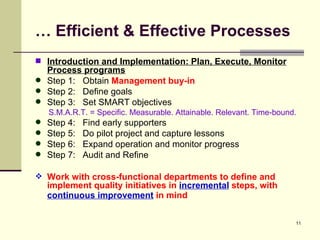
…  Efficient & Effective Processes Introduction and Implementation: Plan, Execute, Monitor Process programs   Step 1:  Obtain  Management buy-in Step 2:  Define goals  Step 3:  Set SMART objectives S.M.A.R.T. = Specific. Measurable. Attainable. Relevant. Time-bound. Step 4:  Find early supporters Step 5:  Do pilot project and capture lessons Step 6:  Expand operation and monitor progress Step 7:  Audit and Refine Work with cross-functional departments to define and implement quality initiatives in  incremental  steps, with  continuous improvement  in mind
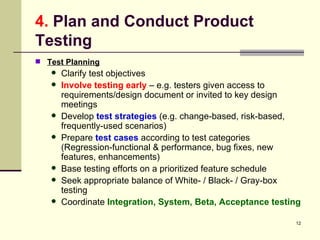
4.  Plan and Conduct Product Testing Test Planning Clarify test objectives Involve testing early  – e.g. testers given access to requirements/design document or invited to key design meetings Develop  test strategies  (e.g. change-based, risk-based, frequently-used scenarios) Prepare  test cases  according to test categories (Regression-functional & performance, bug fixes, new features, enhancements) Base testing efforts on a prioritized feature schedule Seek appropriate balance of White- / Black- / Gray-box testing Coordinate  Integration, System, Beta, Acceptance testing
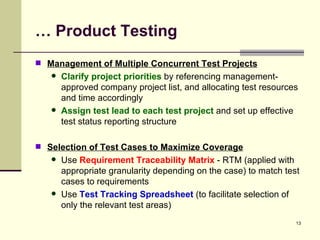
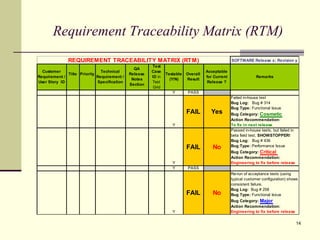
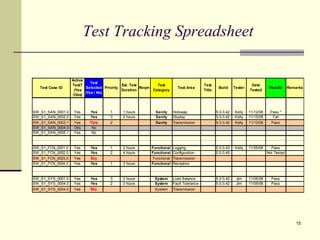
…  Product Testing Management of Multiple Concurrent Test Projects Clarify project priorities  by referencing management-approved company project list, and allocating test resources and time accordingly Assign test lead to each test project  and set up effective test status reporting structure  Selection of Test Cases to Maximize Coverage Use  Requirement Traceability Matrix  - RTM (applied with appropriate granularity depending on the case) to match test cases to requirements Use  Test Tracking Spreadsheet  (to facilitate selection of only the relevant test areas)
Requirement Traceability Matrix (RTM)
Test Tracking Spreadsheet
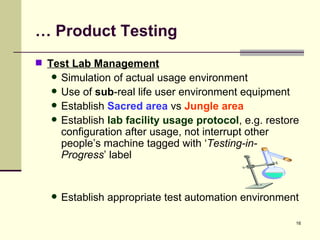
…  Product Testing Test Lab Management Simulation of actual usage environment Use of  sub -real life user environment equipment Establish  Sacred area  vs  Jungle area Establish  lab facility usage protocol , e.g. restore configuration after usage, not interrupt other people’s machine tagged with ‘ Testing-in-Progress ’ label Establish appropriate test automation environment
…  Product Testing Test Execution, Monitoring, Results-Reporting   Accurate logging of test defects (through usage of a  defect tracking tool  e.g. TestTrack Pro) which a  Change Control Board  (CCB) will  triage  on a regular basis – with focus on  critical / high severity  issues Test documentation – test reports, lessons learned,  release record  with metrics, such as: Amount of testable requirements actually tested Efficiency of problem detection  #Found / (#Field + #Found) Punctuality of product release Develop appropriate  testing strategies , select relevant  test cases , prepare  reports  (after test execution) and  release record  (with metrics after  product release)
5.  Conclusion Carry out the Mandate of a QA Testing Manager As guardian of the quality gate, your  every decision  should be made, and  every action  should be taken, with the mindset of ensuring that the product  meets the needs of the intended user Establish Cooperative Working Relationships with Colleagues   Set up appropriate QA team structure, clarify communication protocols and be  sincere , but  assertive , when interacting with colleagues Develop Efficient and Effective Processes   Work with cross-functional departments to define and implement quality initiatives in incremental steps, with  continuous improvement  in mind Plan and Conduct Product Testing Develop appropriate  testing strategies , select relevant test cases, prepare reports (after test execution) and  release record  (with metrics after product release)
The journey of a thousand miles starts with a single step… I hope you enjoy the journey of QA Testing Management as much as I do! Please feel free to contact me: [email_address] www. linkedin .com/in/jacksonyklee www. visualcv.com /jacksonyklee      

My presentation to VanQ at BCIT

  • 1.
    Leading and ManagingQA Testing Teams - A Panoramic View Presented to VanQ June 25, 2009 Jackson Lee MBA, MASc, BASc
  • 2.
    Abstract As aQA testing engineer demonstrates his/her technical excellence, gains recognition from supervisors and progresses through the ranks of QA testing management, he/she will face new challenges that need to be addressed in the new roles. How does one handle the competing demands from different department? How can one maximize test coverage to meet a well-compressed schedule? One may also wonder how best to allocate lab equipment / human resources , to hire new members, or to manage multiple concurrent test projects . What is the optimal way to organize and motivate an often-understaffed team to cope with the ever-changing feature modifications that need to be tested? These are some of the questions that frequently plague the newly promoted test manager. This seminar aims at providing insights , through the presenter’s training and experience earned from working in the trenches, to help the new manager gain some proven tools (and hopefully more confidence) in his/her transition to an enriching journey of QA testing leadership in a dynamic high-tech environment.
  • 3.
    About the PresenterJackson Lee has been involved in high-tech industries for almost two decades. He has broad experience with startups and large companies (Alcatel, Hewlett-Packard, MPR Teltech). He has played different roles in the entire product development and operations lifecycle ( software designer, technical support specialist, project manager, process improvement specialist, QA testing engineer, manager, director ). Jackson’s diverse career also included 12+ years’ experience leading global QA testing teams to successfully verify integration of networks and applications. He was Director of Testing and Quality Control at SmarTire Systems and held numerous QA Testing Manager positions in various organizations. Jackson has strong expertise in QA testing, project management and process implementation. He is a certified ISO9001:2000 / TS16949 Quality Auditor. As an enthusiastic quality practitioner, Jackson is passionate about developing test team members and ensuring timely releases of high-quality products to customers. He holds Bachelors and Masters degrees in Electrical Engineering , an MBA from UBC, and is currently preparing to obtain his PMP designation. Jackson speaks 5 languages and is an avid badminton player.
  • 4.
    Agenda Carry outthe Mandate of a QA Testing Manager Establish Cooperative Working Relationships with Colleagues Develop Efficient and Effective Processes Plan and Conduct Product Testing Conclusion
  • 5.
    1. Carryout the Mandate of a QA Testing Manager Lead and manage teams to deliver high-quality products via: providing and implementing quality initiatives planning and managing testing activities Definition of Quality : Philip Crosby (1979 ) - conformance to requirements: meeting customer expectations, both stated and unstated . Joseph Juran (1974) - fitness for use PMI Project Management Body of Knowledge (2008) - the degree to which a set of inherent characteristics fulfill requirements
  • 6.
    … Mandate Asguardian of the quality gate of the company, your every decision should be made, and your every action should be taken, with the mindset of ensuring that the product meets the needs of the intended user
  • 7.
    2. EstablishCooperative Relationships with Colleagues Interaction with Team Members Set up structure and then manage by exception Establish protocol of communications and interactions within team – sincere , assertive , integrity , dignity Share departmental vision Foster cooperative environment: Be fair, open – lead to mutual trust and respect Team organization - Functional Specialty (Product, QA domains e.g. management of lab, defects, CM) Set clear priorities on projects / tasks Task, Ownership, Deliverable, Deadlines Delegate: Responsibility – Authority – Accountability
  • 8.
    … Relationships withColleagues Interaction with Team Members (cont’d) Create a proactive , learning culture Encourage exchange of lessons learned Arrange technical and leadership training Mentor staff on proper mindset and attitude (QA Testing Staff = Technical Expert + Politician ) Relationship building – build rapport with team A note on hiring: Hire enthusiastic people who love their work
  • 9.
    … Relationships withColleagues Interaction with Management Provide honest opinion on feasibility, estimates and progress Report problems early (but make recommendations) to allow management time for remedial actions as necessary Interaction with other Department Members Win/Win mindset Set up appropriate QA team structure, clarify communication protocols and be sincere , but assertive , when interacting with colleagues
  • 10.
    3. DevelopEfficient and Effective Processes Establish Quality Framework in the company Goals of QA programs – end-to-end integrity ; minimize post-installation costs Focus more on defect prevention , than detection Implementation of Quality Process Initiatives (through collaboration with Management) Get certified to related industry standard(s) e.g. Automotive: ISO9001:2000/TS16949,Telecom: TL9000 Product Development Lifecycle Methodology e.g. Waterfall Model, Agile Development Best practices e.g. design checklists, code logic reviews, inspections
  • 11.
    … Efficient& Effective Processes Introduction and Implementation: Plan, Execute, Monitor Process programs Step 1: Obtain Management buy-in Step 2: Define goals Step 3: Set SMART objectives S.M.A.R.T. = Specific. Measurable. Attainable. Relevant. Time-bound. Step 4: Find early supporters Step 5: Do pilot project and capture lessons Step 6: Expand operation and monitor progress Step 7: Audit and Refine Work with cross-functional departments to define and implement quality initiatives in incremental steps, with continuous improvement in mind
  • 12.
    4. Planand Conduct Product Testing Test Planning Clarify test objectives Involve testing early – e.g. testers given access to requirements/design document or invited to key design meetings Develop test strategies (e.g. change-based, risk-based, frequently-used scenarios) Prepare test cases according to test categories (Regression-functional & performance, bug fixes, new features, enhancements) Base testing efforts on a prioritized feature schedule Seek appropriate balance of White- / Black- / Gray-box testing Coordinate Integration, System, Beta, Acceptance testing
  • 13.
    … ProductTesting Management of Multiple Concurrent Test Projects Clarify project priorities by referencing management-approved company project list, and allocating test resources and time accordingly Assign test lead to each test project and set up effective test status reporting structure Selection of Test Cases to Maximize Coverage Use Requirement Traceability Matrix - RTM (applied with appropriate granularity depending on the case) to match test cases to requirements Use Test Tracking Spreadsheet (to facilitate selection of only the relevant test areas)
  • 14.
  • 15.
  • 16.
    … ProductTesting Test Lab Management Simulation of actual usage environment Use of sub -real life user environment equipment Establish Sacred area vs Jungle area Establish lab facility usage protocol , e.g. restore configuration after usage, not interrupt other people’s machine tagged with ‘ Testing-in-Progress ’ label Establish appropriate test automation environment
  • 17.
    … ProductTesting Test Execution, Monitoring, Results-Reporting Accurate logging of test defects (through usage of a defect tracking tool e.g. TestTrack Pro) which a Change Control Board (CCB) will triage on a regular basis – with focus on critical / high severity issues Test documentation – test reports, lessons learned, release record with metrics, such as: Amount of testable requirements actually tested Efficiency of problem detection #Found / (#Field + #Found) Punctuality of product release Develop appropriate testing strategies , select relevant test cases , prepare reports (after test execution) and release record (with metrics after product release)
  • 18.
    5. ConclusionCarry out the Mandate of a QA Testing Manager As guardian of the quality gate, your every decision should be made, and every action should be taken, with the mindset of ensuring that the product meets the needs of the intended user Establish Cooperative Working Relationships with Colleagues Set up appropriate QA team structure, clarify communication protocols and be sincere , but assertive , when interacting with colleagues Develop Efficient and Effective Processes Work with cross-functional departments to define and implement quality initiatives in incremental steps, with continuous improvement in mind Plan and Conduct Product Testing Develop appropriate testing strategies , select relevant test cases, prepare reports (after test execution) and release record (with metrics after product release)
  • 19.
    The journey ofa thousand miles starts with a single step… I hope you enjoy the journey of QA Testing Management as much as I do! Please feel free to contact me: [email_address] www. linkedin .com/in/jacksonyklee www. visualcv.com /jacksonyklee