IT: Past, Present and the
Promised Land
Saji K Mathew, PhD
Associate Professor
Department of Management Studies
IINDIAN INSTITUTE OF TECHNOLOGY MADRAS
SPICON 2016
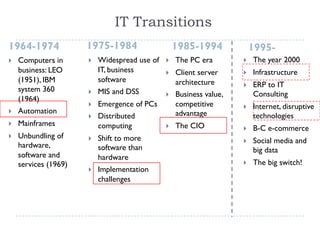
IT Transitions
1985-19941975-1984
} Computers in
business: LEO
(1951), IBM
system 360
(1964)
} Automation
} Mainframes
} Unbundling of
hardware,
software and
services (1969)
} Widespread use of
IT, business
software
} MIS and DSS
} Emergence of PCs
} Distributed
computing
} Shift to more
software than
hardware
} Implementation
challenges
} The PC era
} Client server
architecture
} Business value,
competitive
advantage
} The CIO
1964-1974
} The year 2000
} Infrastructure
} ERP to IT
Consulting
} Internet, disruptive
technologies
} B-C e-commerce
} Social media and
big data
} The big switch!
1995-
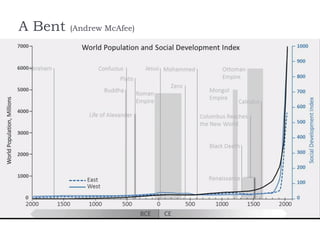
A Bent (Andrew McAfee)
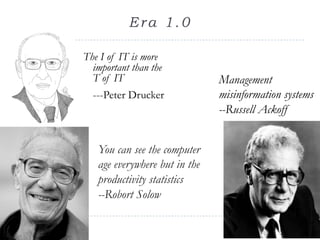
Era 1.0
The I of IT is more
important than the
T of IT
---Peter Drucker
Management
misinformation systems
--Russell Ackoff
You can see the computer
age everywhere but in the
productivity statistics
--Robort Solow
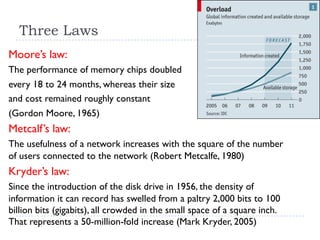
Three Laws
Moore’s law:
The performance of memory chips doubled
every 18 to 24 months, whereas their size
and cost remained roughly constant
(Gordon Moore, 1965)
Metcalf’s law:
The usefulness of a network increases with the square of the number
of users connected to the network (Robert Metcalfe, 1980)
Kryder’s law:
Since the introduction of the disk drive in 1956, the density of
information it can record has swelled from a paltry 2,000 bits to 100
billion bits (gigabits), all crowded in the small space of a square inch.
That represents a 50-million-fold increase (Mark Kryder, 2005)
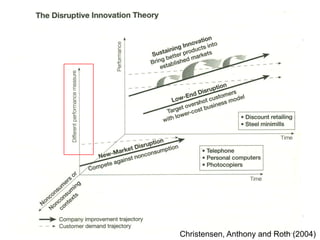
Christensen, Anthony and Roth (2004)
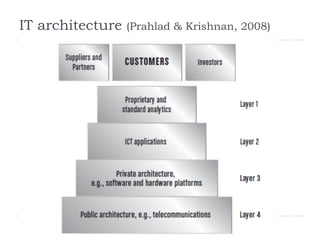
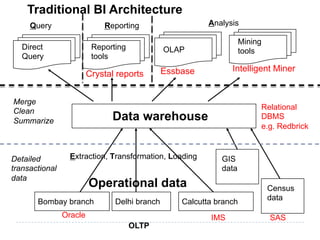
IT architecture (Prahlad & Krishnan, 2008)
Bombay branch Delhi branch Calcutta branch
Census
data
Operational data
Detailed
transactional
data
Data warehouse
Merge
Clean
Summarize
Direct
Query
Reporting
tools
Mining
toolsOLAP
Traditional BI Architecture
Oracle SAS
Relational
DBMS
e.g. Redbrick
IMS
Crystal reports Essbase Intelligent Miner
GIS
data
Query Reporting Analysis
Extraction, Transformation, Loading
OLTP
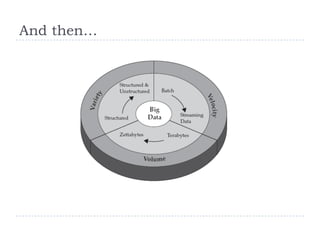
And then…
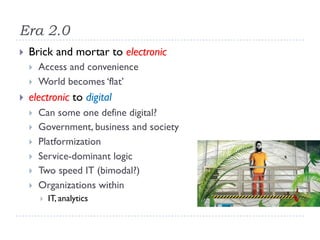
Era 2.0
} Brick and mortar to electronic
} Access and convenience
} World becomes ‘flat’
} electronic to digital
} Can some one define digital?
} Government, business and society
} Platformization
} Service-dominant logic
} Two speed IT (bimodal?)
} Organizations within
} IT, analytics
ePDS: High Level Architecture
NIC-AP
Digital touching the bottom of the pyramid
Thank you!

IT past present and promosed land

  • 1.
    IT: Past, Presentand the Promised Land Saji K Mathew, PhD Associate Professor Department of Management Studies IINDIAN INSTITUTE OF TECHNOLOGY MADRAS SPICON 2016
  • 2.
    IT Transitions 1985-19941975-1984 } Computersin business: LEO (1951), IBM system 360 (1964) } Automation } Mainframes } Unbundling of hardware, software and services (1969) } Widespread use of IT, business software } MIS and DSS } Emergence of PCs } Distributed computing } Shift to more software than hardware } Implementation challenges } The PC era } Client server architecture } Business value, competitive advantage } The CIO 1964-1974 } The year 2000 } Infrastructure } ERP to IT Consulting } Internet, disruptive technologies } B-C e-commerce } Social media and big data } The big switch! 1995-
  • 3.
  • 4.
    Era 1.0 The Iof IT is more important than the T of IT ---Peter Drucker Management misinformation systems --Russell Ackoff You can see the computer age everywhere but in the productivity statistics --Robort Solow
  • 5.
    Three Laws Moore’s law: Theperformance of memory chips doubled every 18 to 24 months, whereas their size and cost remained roughly constant (Gordon Moore, 1965) Metcalf’s law: The usefulness of a network increases with the square of the number of users connected to the network (Robert Metcalfe, 1980) Kryder’s law: Since the introduction of the disk drive in 1956, the density of information it can record has swelled from a paltry 2,000 bits to 100 billion bits (gigabits), all crowded in the small space of a square inch. That represents a 50-million-fold increase (Mark Kryder, 2005)
  • 6.
  • 7.
    IT architecture (Prahlad& Krishnan, 2008)
  • 8.
    Bombay branch Delhibranch Calcutta branch Census data Operational data Detailed transactional data Data warehouse Merge Clean Summarize Direct Query Reporting tools Mining toolsOLAP Traditional BI Architecture Oracle SAS Relational DBMS e.g. Redbrick IMS Crystal reports Essbase Intelligent Miner GIS data Query Reporting Analysis Extraction, Transformation, Loading OLTP
  • 9.
  • 11.
    Era 2.0 } Brickand mortar to electronic } Access and convenience } World becomes ‘flat’ } electronic to digital } Can some one define digital? } Government, business and society } Platformization } Service-dominant logic } Two speed IT (bimodal?) } Organizations within } IT, analytics
  • 12.
    ePDS: High LevelArchitecture NIC-AP Digital touching the bottom of the pyramid
  • 13.