
The human-machine interchange
How intelligent automation is changing the way businesses operate
©2019 IBM Corporation2
Early benefits of intelligent machines include efficiency,
innovation and insights
Source: Intelligent Automation Study. Question: To what extent has your organization realized value from robots and other intelligent machines? “Some positive impact” and
“substantial positive impact” responses.
©2019 IBM Corporation3
37% 33% 28% 27% 25%
19% 19%
11%
65%
77%
56% 54% 49%
34%
49%
26%
0%
20%
40%
60%
80%
100%
Product and
service
optimization
Customer service Quality control Financial
performance
Supply-chain
management
Manufacturing Finance
operations
HR/Talent
management
Today Next two to three years
Biggest gains are expected in front office
 Automotive firms are more likely to say they have experienced a positive impact in manufacturing, quality control, product
optimization and supply-chain management.
 Electronics companies also are more likely to report value in manufacturing, quality control, and supply-chain management.
 Larger companies are more likely to say adaptive robotics has had a positive impact on their organization’s performance across a
wide range of functional areas.
Source: Intelligent Automation Study. Question: To what extent has intelligent machines affected your organization’s performance in the following areas? What impact do you
expect intelligent machines to have on your organization’s performance in the following areas over the next 2 – 3 years?
©2019 IBM Corporation4
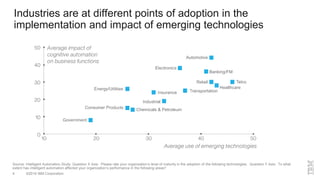
Industries are at different points of adoption in the
implementation and impact of emerging technologies
Source: Intelligent Automation Study. Question X Axis: Please rate your organization’s level of maturity in the adoption of the following technologies. Question Y Axis: To what
extent has intelligent automation affected your organization’s performance in the following areas?
©2019 IBM Corporation5
People are the biggest hurdle to cognitive adoption
Source: Intelligent Automation Study. Question: Which of the following present the greatest challenges to your organization’s use of artificial intelligence/machine learning/adaptive
robotics and automation? Select up to three.
©2019 IBM Corporation6
Teaching humans to work with machines begins with “feeling”
comfortable
Source: Intelligent Automation Study. Question: To what extent do you agree with the following statements about human-machine interactions? “Agree” and “Strongly agree”
responses.
©2019 IBM Corporation7
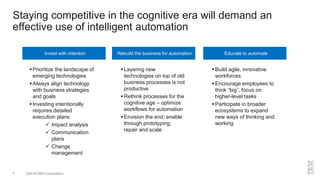
Staying competitive in the cognitive era will demand an
effective use of intelligent automation
Layering new
technologies on top of old
business processes is not
productive
Rethink processes for the
cognitive age – optimize
workflows for automation
Envision the end; enable
through prototyping;
repair and scale
Invest with intention Educate to automate
Build agile, innovative
workforces
Encourage employees to
think “big”, focus on
higher-level tasks
Participate in broader
ecosystems to expand
new ways of thinking and
working
Prioritize the landscape of
emerging technologies
Always align technology
with business strategies
and goals
Investing intentionally
requires detailed
execution plans
 Impact analysis
 Communication
plans
 Change
management
Rebuild the business for automation
Swami ibm deck

Swami ibm deck

  • 1.
    The human-machine interchange Howintelligent automation is changing the way businesses operate
  • 2.
    ©2019 IBM Corporation2 Earlybenefits of intelligent machines include efficiency, innovation and insights Source: Intelligent Automation Study. Question: To what extent has your organization realized value from robots and other intelligent machines? “Some positive impact” and “substantial positive impact” responses.
  • 3.
    ©2019 IBM Corporation3 37%33% 28% 27% 25% 19% 19% 11% 65% 77% 56% 54% 49% 34% 49% 26% 0% 20% 40% 60% 80% 100% Product and service optimization Customer service Quality control Financial performance Supply-chain management Manufacturing Finance operations HR/Talent management Today Next two to three years Biggest gains are expected in front office  Automotive firms are more likely to say they have experienced a positive impact in manufacturing, quality control, product optimization and supply-chain management.  Electronics companies also are more likely to report value in manufacturing, quality control, and supply-chain management.  Larger companies are more likely to say adaptive robotics has had a positive impact on their organization’s performance across a wide range of functional areas. Source: Intelligent Automation Study. Question: To what extent has intelligent machines affected your organization’s performance in the following areas? What impact do you expect intelligent machines to have on your organization’s performance in the following areas over the next 2 – 3 years?
  • 4.
    ©2019 IBM Corporation4 Industriesare at different points of adoption in the implementation and impact of emerging technologies Source: Intelligent Automation Study. Question X Axis: Please rate your organization’s level of maturity in the adoption of the following technologies. Question Y Axis: To what extent has intelligent automation affected your organization’s performance in the following areas?
  • 5.
    ©2019 IBM Corporation5 Peopleare the biggest hurdle to cognitive adoption Source: Intelligent Automation Study. Question: Which of the following present the greatest challenges to your organization’s use of artificial intelligence/machine learning/adaptive robotics and automation? Select up to three.
  • 6.
    ©2019 IBM Corporation6 Teachinghumans to work with machines begins with “feeling” comfortable Source: Intelligent Automation Study. Question: To what extent do you agree with the following statements about human-machine interactions? “Agree” and “Strongly agree” responses.
  • 7.
    ©2019 IBM Corporation7 Stayingcompetitive in the cognitive era will demand an effective use of intelligent automation Layering new technologies on top of old business processes is not productive Rethink processes for the cognitive age – optimize workflows for automation Envision the end; enable through prototyping; repair and scale Invest with intention Educate to automate Build agile, innovative workforces Encourage employees to think “big”, focus on higher-level tasks Participate in broader ecosystems to expand new ways of thinking and working Prioritize the landscape of emerging technologies Always align technology with business strategies and goals Investing intentionally requires detailed execution plans  Impact analysis  Communication plans  Change management Rebuild the business for automation