 sum-total of all the characteristics of a
product/service that has a bearing upon the
utilization of the product/service to the
entire satisfaction of the consumer
 Conformance to the requirements of users or
customers and the satisfaction of their needs
and expectations
1) Acceptable
2) Accessible
3) Affordable
4) Appropriate
 Total Quality Management (TQM)→ an
activity to improve pt. care by having the lab
monitor, its work to detect deficiencies &
subsequently correct them.
 Continuous Quality Improvement (CQI) or
Performance Improvement (PI)→ to improve
the pt. care by placing the emphasis on not
to make mistakes in the first place
 Quality Assurance (QA)→ external activities
that ensure positive pt. outcomes. It
measures what a lab can do to improve
reliability
 TQM also referred to as : total quality control
(QC), total quality leadership, continuous quality
improvement, quality management science or
industrial quality management
 Quality systems in healthcare organization is
evolving
• Public & Private pressure to contain costs are
now accompanied by pressure for quality
improvement (QI)
• TQM provides – management philosophy for
organizational development & a management
process for improvement of quality in all aspects
of work
The Universal principles of TQM are
 Customer focus
 Management commitment
 Training
 Process capability & control
 Measurement using quality-improvement
tools
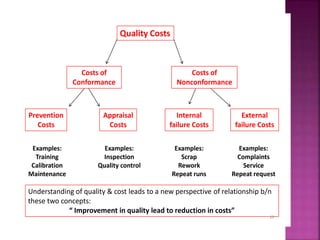
 Costs must be understood in the context of
quality
• Quality = conformance to requirements
• “Quality costs” =“Costs of conformance” +
“Costs of non conformance
Quality Costs
Costs of
Conformance
Costs of
Nonconformance
Prevention
Costs
Appraisal
Costs
External
failure Costs
Internal
failure Costs
Examples:
Training
Calibration
Maintenance
Examples:
Inspection
Quality control
Examples:
Scrap
Rework
Repeat runs
Examples:
Complaints
Service
Repeat request
Understanding of quality & cost leads to a new perspective of relationship b/n
these two concepts:
“ Improvement in quality lead to reduction in costs”
10
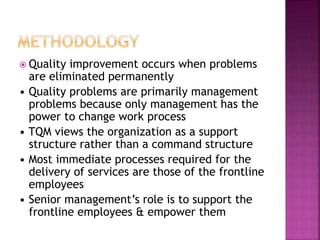
 Quality improvement occurs when problems
are eliminated permanently
• Quality problems are primarily management
problems because only management has the
power to change work process
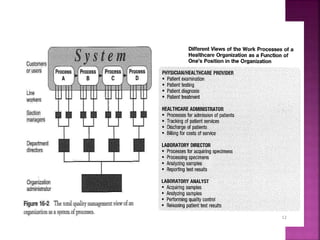
• TQM views the organization as a support
structure rather than a command structure
• Most immediate processes required for the
delivery of services are those of the frontline
employees
• Senior management’s role is to support the
frontline employees & empower them
12
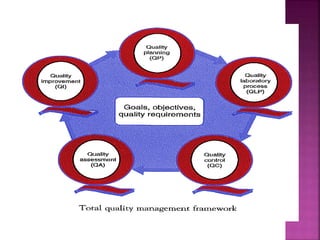
 QLPs - include analytical processes & the general
policies , practices, and procedures that define
how all aspects of the work are done
• QC- emphasizes statistical control procedures,
but also includes nonstatistical check procedures
• QA- concerned primarily with broader measures
& monitors of lab performance (turnaround
time, specimen identification, patient
identification, test utility)
• QI- a structured problem solving process to help
identify the root cause of a problem & a remedy
for that problem
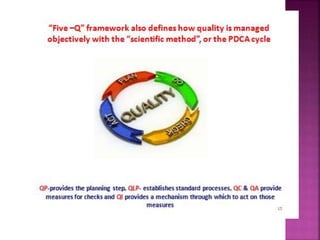
• QP- provides the planning steps
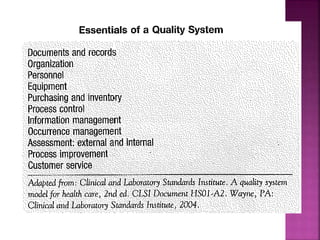
 TQM is also considered as a quality system
that is implemented to ensure quality
• QS- “ set of key quality elements that must
be in place for an organization’s work
operations to function in a manner to meet
the organization’s stated quality objectives”
 The main objective of a laboratory is to
provide reliable, timely and accurate test
results. This is only possible through
- consistent monitoring and evaluation of
the laboratory’s performance ,
implementation and
- follow-up of corrective actions for non-
conformance to procedure
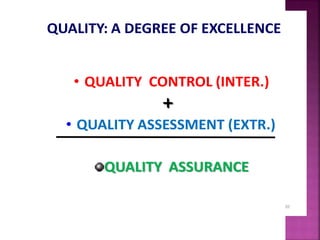
• QUALITY ASSESSMENT (EXTR.)
QUALITY: A DEGREE OF EXCELLENCE
• QUALITY CONTROL (INTER.)
+
QUALITY ASSURANCE
20
 Internal Quality Control (IQC)
– includes personnel, instrumentation,
document control, reagent control and
corrective action
• External Quality Assurance (EQA)
– External quality control is important to
ensure the laboratory is performing to an
external standard
 Quality Control -QC refers to operational
techniques that must be included during
each assay run to verify that the
requirements for Quality are met with
• Quality Assurance - QA refers to all those
planned and systematic activities to provide
confidence that the results given out by the
laboratory are correct
 The aim of QC is simply to ensure that the
results generated by the test are correct.
However quality assurance is concerned with
much more: that the right test is carried out
on the right specimen and that the right
result and right interpretation is delivered to
the right person at the right time
 Quality assurance program consists of broad spectrum
of practices, plans and procedures that will assure (to
be sure and confident) that the quality will be
maintained. There are several essential elements of
quality assurance program.
- Commitment
- Facilities and resources
- Technical competence
- Technical procedures
 Also known as proficiency testing
 → Quality Assessment is a means to
determine the quality of the results
generated by the laboratory
 → Quality Assessment is a challenge to the
QA and QC programs
 → Quality Assessment may be external or
internal.
 Right recording and reporting
• Right interpretation
– Range of normal values
• Right turnaround time
• Report to right user
 Proper procedure includes:
– All data entry results should be verified by a
section head or supervisor (when available) and
reviewed by management for final interpretation
and release of results
– In the event that a report has already been
sent out and needs correction, a new report is
issued with updated report written on it
• The old report remains in the patient file
– Verbal result reports should be documented,
listing the time of the receipt of the report
 Six sigma metrics are being adopted as the
universal measure of quality for the quality
management.
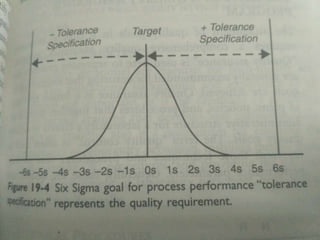
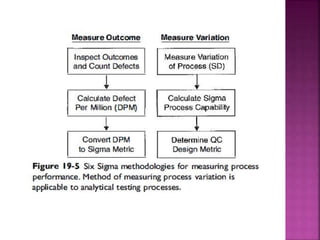
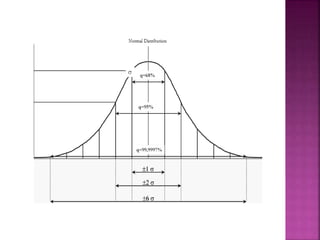
 Six sigma goal for process performance shows
that error distribution of a measurment
procedure should fit within the tolerance
specification or quality requirement for that
measurment.
 One approach is to measure outcome by
inspection.
 Other is to measure variation and predict
process performance.
Sigma metrics DPMO Percent defects Percentage yield
1 691,462 69% 31%
2 308,538 31% 69%
3 66,807 6.7% 93.3%
4 6,210 0.62% 99.38%
5 233 0.023% 99.977%
6 3.4 0.00034% 99.99966%
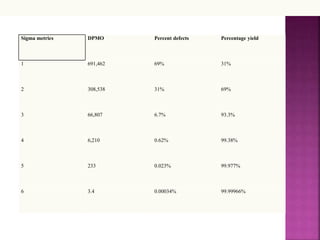
 Conversion to sigma metric is done by using
standard table available. In health care
organization a defect rate of 0.033% (333
DPM) is considered excellent, where error
rates from 1% to 5% are often considered
acceptable. A 5.0% (50000 DPM) error rate
corresponds to 3.15 sigma performance and
1.0% error rate corresponds to 3.85 sigma.
Six sigma shows that the goal should be error
rate of 0.1% (4.6 sigma) to 0.01% or 100 DPM
(5.2 sigma) and ultimately 0.001% (5.8
sigma).
 The application of sigma metrics for
assessing analytical performance uses the
variable obtained during method validation
studies, like accuracy, precision, PPP, NPP,
sensitivity, specificity parameters and that
available from internal and external quality
control processes.
 In the laboratory sigma performance of the
method can be determined from imprecision: SD
or CV and inaccuracy (bias) observed for a
method and quality requirement (allowable total
error, TEa) for the test. Sigma metric from 6.0 to
3.0 represents the range from best case to worst
case respectively. Methods with sigma
performance less than 3 are not considered
acceptable for production.
 The practical goal is to achieve a probability
of error detection of 0.90. This is easy to
accomplish for processes with 5 or 6 sigma
performance, it requires a more careful
selection and increased qc efforts for
processes from 4-5 sigma and very difficult
for processes with less than 4 sigma.
TOTAL QUALITY MANAGEMENT.pptx

TOTAL QUALITY MANAGEMENT.pptx

  • 1.
     sum-total ofall the characteristics of a product/service that has a bearing upon the utilization of the product/service to the entire satisfaction of the consumer  Conformance to the requirements of users or customers and the satisfaction of their needs and expectations
  • 2.
    1) Acceptable 2) Accessible 3)Affordable 4) Appropriate
  • 3.
     Total QualityManagement (TQM)→ an activity to improve pt. care by having the lab monitor, its work to detect deficiencies & subsequently correct them.  Continuous Quality Improvement (CQI) or Performance Improvement (PI)→ to improve the pt. care by placing the emphasis on not to make mistakes in the first place  Quality Assurance (QA)→ external activities that ensure positive pt. outcomes. It measures what a lab can do to improve reliability
  • 4.
     TQM alsoreferred to as : total quality control (QC), total quality leadership, continuous quality improvement, quality management science or industrial quality management  Quality systems in healthcare organization is evolving • Public & Private pressure to contain costs are now accompanied by pressure for quality improvement (QI) • TQM provides – management philosophy for organizational development & a management process for improvement of quality in all aspects of work
  • 5.
    The Universal principlesof TQM are  Customer focus  Management commitment  Training  Process capability & control  Measurement using quality-improvement tools
  • 6.
     Costs mustbe understood in the context of quality • Quality = conformance to requirements • “Quality costs” =“Costs of conformance” + “Costs of non conformance
  • 7.
    Quality Costs Costs of Conformance Costsof Nonconformance Prevention Costs Appraisal Costs External failure Costs Internal failure Costs Examples: Training Calibration Maintenance Examples: Inspection Quality control Examples: Scrap Rework Repeat runs Examples: Complaints Service Repeat request Understanding of quality & cost leads to a new perspective of relationship b/n these two concepts: “ Improvement in quality lead to reduction in costs” 10
  • 8.
     Quality improvementoccurs when problems are eliminated permanently • Quality problems are primarily management problems because only management has the power to change work process • TQM views the organization as a support structure rather than a command structure • Most immediate processes required for the delivery of services are those of the frontline employees • Senior management’s role is to support the frontline employees & empower them
  • 9.
  • 11.
     QLPs -include analytical processes & the general policies , practices, and procedures that define how all aspects of the work are done • QC- emphasizes statistical control procedures, but also includes nonstatistical check procedures • QA- concerned primarily with broader measures & monitors of lab performance (turnaround time, specimen identification, patient identification, test utility) • QI- a structured problem solving process to help identify the root cause of a problem & a remedy for that problem • QP- provides the planning steps
  • 13.
     TQM isalso considered as a quality system that is implemented to ensure quality • QS- “ set of key quality elements that must be in place for an organization’s work operations to function in a manner to meet the organization’s stated quality objectives”
  • 15.
     The mainobjective of a laboratory is to provide reliable, timely and accurate test results. This is only possible through - consistent monitoring and evaluation of the laboratory’s performance , implementation and - follow-up of corrective actions for non- conformance to procedure
  • 16.
    • QUALITY ASSESSMENT(EXTR.) QUALITY: A DEGREE OF EXCELLENCE • QUALITY CONTROL (INTER.) + QUALITY ASSURANCE 20
  • 17.
     Internal QualityControl (IQC) – includes personnel, instrumentation, document control, reagent control and corrective action • External Quality Assurance (EQA) – External quality control is important to ensure the laboratory is performing to an external standard
  • 18.
     Quality Control-QC refers to operational techniques that must be included during each assay run to verify that the requirements for Quality are met with • Quality Assurance - QA refers to all those planned and systematic activities to provide confidence that the results given out by the laboratory are correct
  • 19.
     The aimof QC is simply to ensure that the results generated by the test are correct. However quality assurance is concerned with much more: that the right test is carried out on the right specimen and that the right result and right interpretation is delivered to the right person at the right time
  • 20.
     Quality assuranceprogram consists of broad spectrum of practices, plans and procedures that will assure (to be sure and confident) that the quality will be maintained. There are several essential elements of quality assurance program. - Commitment - Facilities and resources - Technical competence - Technical procedures
  • 21.
     Also knownas proficiency testing  → Quality Assessment is a means to determine the quality of the results generated by the laboratory  → Quality Assessment is a challenge to the QA and QC programs  → Quality Assessment may be external or internal.
  • 22.
     Right recordingand reporting • Right interpretation – Range of normal values • Right turnaround time • Report to right user
  • 23.
     Proper procedureincludes: – All data entry results should be verified by a section head or supervisor (when available) and reviewed by management for final interpretation and release of results – In the event that a report has already been sent out and needs correction, a new report is issued with updated report written on it • The old report remains in the patient file – Verbal result reports should be documented, listing the time of the receipt of the report
  • 24.
     Six sigmametrics are being adopted as the universal measure of quality for the quality management.  Six sigma goal for process performance shows that error distribution of a measurment procedure should fit within the tolerance specification or quality requirement for that measurment.
  • 26.
     One approachis to measure outcome by inspection.  Other is to measure variation and predict process performance.
  • 29.
    Sigma metrics DPMOPercent defects Percentage yield 1 691,462 69% 31% 2 308,538 31% 69% 3 66,807 6.7% 93.3% 4 6,210 0.62% 99.38% 5 233 0.023% 99.977% 6 3.4 0.00034% 99.99966%
  • 30.
     Conversion tosigma metric is done by using standard table available. In health care organization a defect rate of 0.033% (333 DPM) is considered excellent, where error rates from 1% to 5% are often considered acceptable. A 5.0% (50000 DPM) error rate corresponds to 3.15 sigma performance and 1.0% error rate corresponds to 3.85 sigma. Six sigma shows that the goal should be error rate of 0.1% (4.6 sigma) to 0.01% or 100 DPM (5.2 sigma) and ultimately 0.001% (5.8 sigma).
  • 31.
     The applicationof sigma metrics for assessing analytical performance uses the variable obtained during method validation studies, like accuracy, precision, PPP, NPP, sensitivity, specificity parameters and that available from internal and external quality control processes.
  • 32.
     In thelaboratory sigma performance of the method can be determined from imprecision: SD or CV and inaccuracy (bias) observed for a method and quality requirement (allowable total error, TEa) for the test. Sigma metric from 6.0 to 3.0 represents the range from best case to worst case respectively. Methods with sigma performance less than 3 are not considered acceptable for production.
  • 33.
     The practicalgoal is to achieve a probability of error detection of 0.90. This is easy to accomplish for processes with 5 or 6 sigma performance, it requires a more careful selection and increased qc efforts for processes from 4-5 sigma and very difficult for processes with less than 4 sigma.