Dr. R.P.Rethaliya , Ämitava Mitra ,IS :1077-
1976 ,IS : 383-1970, IS:1200,IS:2505/6 -
1968,IS:651,IS:2556-,IS:657
,IS:1537,IS:772,IS:2470-1,2 ,IS:774,IS:14687
CONSTRUCTION QUALITY CONTROL INSPECTION
PROGRAM (QCIP)
Reference
book :
Presented By :
Er.Damani Mital
 Quality
 QCIP
 Quality Material [cement,bricks,aggregate,water]
 Pre-construction preparation
 Important point for good quality
 Quality control in cement ,plumbing ,Drainage , doors –windows
,formwork ]
CONTENT
Degree of excellence a product or service provides.
In other words we can say :
Fitness for purpose
Conformance to requirement
Grade
I. Suitability
II. Reliability
III. Durability
IV. Safe
V. Affordability
VI. Maintainability
VII. Aesthetic look
VIII. Satisfaction
IX. Economical
X. Versatility
WHAT IS QUALITY ?
 Architecture view of any project should be good .
 Structure design should be good and safe .
 Testing of required material should be carried and confirm it feasibility in
use.
 Selection of material should be done according to structure.
 Methodology accepted according to Material .
 Workmanship should be good.
 Supervising of project should be done properly .
 Construction management technique should be used.
 Team who engage in construction have aim acc to quality conscious.
STEPS TO ACHIEVE QUALITY
Every operation is connected with the quality of the product. In the case of
construction the quality of construction is to be maintained as per project
specifications. It is important that quality requirements be satisfied and production
schedules are met. The satisfaction of the owner of the project is mainly derived by
the quality of the work.
Stiff competition in the national and international level of construction sector
demands a high quality oriented attitude of engineers. However, the management
is required to achieve the satisfaction of the owner by completing the project
within the cost constraints for the project. Both of these things are dependent on
properly integrating quality development, quality maintenance and quality
improvement in construction. The integration of all these three aspects can be
achieved through a sound quality control system.
REVIEW OF QUALITY
 Introduction
 Organization charts
 Inspector
 Responsibility
 Field testing
 Field laboratory
 Inspector plan
 Consultant for Quality
 Construction schedule
 Environment friendly
QCIP CONTENT
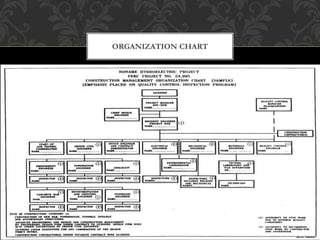
ORGANIZATION CHART
The necessary qualifications for QCIP staff should be established in
the QCIP and resumes for QCIP personnel assigned to specific
functions included in the initial submittal of the QCIP. At a minimum,
resumes should be included for QCIP personnel who have authority to
stop work or authority to recommend stop work due to adverse quality
conditions. The qualification standard can be based on existing
standards established by professional organizations such as ASCE and
ACI orthe qualification standard can be specified in the QCIP. The
information should be supplemented on a continuing basis by
submittal of qualifications of personnel actually employed.
QCIP DUTIES , RESPONSIBILITY, QUALIFICATION & AUTHORITY
The responsibilities of the various organizations involved with the
construction, such as the licensee, designer, construction management
organization, QCIP staff, testing laboratory and construction
contractor, should be addressed to provide an understanding of the
necessary coordination and relationship for construction of the
project. The services to be provided by each organization should be
clearly delineated and discussed.
CONT..
The responsibilities, duties and authority of key QCIP staff should be clear
and definitive, and should correlate with the organization chart. The position
description should contain such items as the job title; complete description
of all duties and responsibilities; authority, such as, authority to initiate a non
conformance report, authority to stop work and authority to recommend
stop work; responsibility relative to contractor negotiations and scheduling of
construction; and reporting authority. During construction, there should be
someone in the field at all times who has the authority to stop work. There
should be a separation of authority between the QCIP staff and construction
personnel. The principal QCIP supervisor in the field should have limited or
no involvement with contractor negotiations, scheduling of construction and
cost justification.
CONT..
Earth Work :
Stages
 Measurement of dimensions in different directions in terms of
height, width and length
 Excavation of soil
 Determination of soil properties
 Compacting soil
Quality Control Considerations
 Accurate measurements with precise instruments
 Use of good equipment
 Use of standard procedures for testing of soil
 Use of equipment for compaction
CIVIL INSPECTION WORK
Masonry
Stages
 Measurement of dimensions in different directions in terms of
height,
width and length
 Construction of masonry
 Curing of masonry work
Quality Control Considerations
 Use of good quality materials
 Use of right construction procedures and correct bonds
 Employment of people with experience and expertise
 Adequate curing of masonry
CONT..
Reinforced Cement Concrete (RCC)
Stages
 Measurement of all dimensions
 Creation and installation of formwork
 Provision of reinforcement
 Casting of concrete
Curing of concrete
Quality Control Considerations
 Use of good quality materials
 Use of right construction procedures
 Correct detailing of reinforcement
 Adequate curing of concrete
CONT..
Sanitary and Water Supply Services
Stages
 Measurement of dimensions in different directions in terms of
length as well as area covered
 Procurement of sanitary and water supply items
 Installation of these items correctly
Testing of these items
Quality Control Considerations
 Use of good quality materials and items
 Use of right construction procedures
 Employment of people with experience and expertise
CONT..
 Date
 Weather condition
 Recommendation provided to the contractor
 Description of nonconformance of material & work
 A brief description of work performed for the day
 A brief description of type & amount of material placed
 A brief description of public safety measure in place & accident if any
 Description of any delay
 Description of any disputes between any vendor , contractor , engineer
etc..
 Review of testing , laboratory procedures & equipment
 The name of visitor
 Record of correspondence
DAILY PROGRESSIVE REPORT
(DPR)
The quality of construction depend on :
I. Material
II. w/c ratio
III. Workability
IV. Curing
V. Machinery
VI. Methodology
VII. Experience of worker
VIII.Design work of project
IX. Mistake likely to happen while construction
X. Supervising of project on going work
QUALITY OF CONSTRUCTION
MATERIAL
 Uses: Concrete, Plaster, Flooring, Grouting, etc.
QUALITY OF CEMENT
Laboratory
test
Field test
TEST ON CEMENT
Laboratory test
Consistency Fineness Setting time Compressive Soundness Heat of Hydration
Chemical
composition
Is:12269-
1987 OPC
2250 RHC
3250
OPC<30
RHC<30
LHC<60
>600
OPC
30%,70%
,100%
10mm
 The condition of store room should be well
 Level between cement bag and ground should be considerably high
 The distance from wall and cement bag should be around 30 cm
 In a column structure of cement bag no more than 14 bag allow
 The weather condition should be good and not foggy
 The priority to use old bag given first then to new bag
 The storage of cement bag should be under limited time
CAUTION ON CEMENT WHILE
STORING
 Uses: General construction ,Flooring , etc.
 The brick should be properly heated
 The brick should be strong enough if we throw from even 1.2 m
 The edge of brick should be sharp
 If we clap with brick then sound comes out to be metallic
 Texture of brick should be uniform
 Size of brick should be standard
 The weight of brick should be 2.7 to 3.1 kg
QUALITY OF BRICK
Test on Brick
Measurement 1st Class Brick 2nd class brick
Length 368 – 392 (20%) [7] 350 – 410 (22-25%) [3.5]
Width 174 – 186 165 – 195
Height 174 – 186 165 – 195
BRICK CONT..
IS: 1077-1976
Observation Result
No perceptible deposit Nil efflorescence
10% Slight
50% salt without flaking Moderate
50 % salt with flaking Heavy
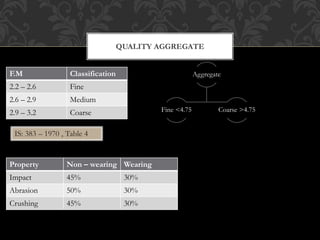
Aggregate
Fine <4.75 Coarse >4.75
QUALITY AGGREGATE
IS: 383 – 1970 , Table 4
F.M Classification
2.2 – 2.6 Fine
2.6 – 2.9 Medium
2.9 – 3.2 Coarse
Property Non – wearing Wearing
Impact 45% 30%
Abrasion 50% 30%
Crushing 45% 30%
 The impurity in water found is as follow :
I. Organic
II. Inorganic
III. Sulphate
IV. Alkali chloride
 Dissolved salts in water can decrease compressive strength by 10 -30 %
 Chlorides in water can affect dampness
 Corrosion & calcium chloride can set concrete faster same effect can
happen if sugar contain is more than 0.2%
 Inorganic strength can reduced the strength of concrete
QUALITY OF WATER
Impact of impurities on
concrete
QUALITY OF PRECONSTRUCTION
PREPARATION

Construction quality control inspection program (qcip)

  • 1.
    Dr. R.P.Rethaliya ,Ämitava Mitra ,IS :1077- 1976 ,IS : 383-1970, IS:1200,IS:2505/6 - 1968,IS:651,IS:2556-,IS:657 ,IS:1537,IS:772,IS:2470-1,2 ,IS:774,IS:14687 CONSTRUCTION QUALITY CONTROL INSPECTION PROGRAM (QCIP) Reference book : Presented By : Er.Damani Mital
  • 2.
     Quality  QCIP Quality Material [cement,bricks,aggregate,water]  Pre-construction preparation  Important point for good quality  Quality control in cement ,plumbing ,Drainage , doors –windows ,formwork ] CONTENT
  • 3.
    Degree of excellencea product or service provides. In other words we can say : Fitness for purpose Conformance to requirement Grade I. Suitability II. Reliability III. Durability IV. Safe V. Affordability VI. Maintainability VII. Aesthetic look VIII. Satisfaction IX. Economical X. Versatility WHAT IS QUALITY ?
  • 4.
     Architecture viewof any project should be good .  Structure design should be good and safe .  Testing of required material should be carried and confirm it feasibility in use.  Selection of material should be done according to structure.  Methodology accepted according to Material .  Workmanship should be good.  Supervising of project should be done properly .  Construction management technique should be used.  Team who engage in construction have aim acc to quality conscious. STEPS TO ACHIEVE QUALITY
  • 5.
    Every operation isconnected with the quality of the product. In the case of construction the quality of construction is to be maintained as per project specifications. It is important that quality requirements be satisfied and production schedules are met. The satisfaction of the owner of the project is mainly derived by the quality of the work. Stiff competition in the national and international level of construction sector demands a high quality oriented attitude of engineers. However, the management is required to achieve the satisfaction of the owner by completing the project within the cost constraints for the project. Both of these things are dependent on properly integrating quality development, quality maintenance and quality improvement in construction. The integration of all these three aspects can be achieved through a sound quality control system. REVIEW OF QUALITY
  • 6.
     Introduction  Organizationcharts  Inspector  Responsibility  Field testing  Field laboratory  Inspector plan  Consultant for Quality  Construction schedule  Environment friendly QCIP CONTENT
  • 7.
  • 8.
    The necessary qualificationsfor QCIP staff should be established in the QCIP and resumes for QCIP personnel assigned to specific functions included in the initial submittal of the QCIP. At a minimum, resumes should be included for QCIP personnel who have authority to stop work or authority to recommend stop work due to adverse quality conditions. The qualification standard can be based on existing standards established by professional organizations such as ASCE and ACI orthe qualification standard can be specified in the QCIP. The information should be supplemented on a continuing basis by submittal of qualifications of personnel actually employed. QCIP DUTIES , RESPONSIBILITY, QUALIFICATION & AUTHORITY
  • 9.
    The responsibilities ofthe various organizations involved with the construction, such as the licensee, designer, construction management organization, QCIP staff, testing laboratory and construction contractor, should be addressed to provide an understanding of the necessary coordination and relationship for construction of the project. The services to be provided by each organization should be clearly delineated and discussed. CONT..
  • 10.
    The responsibilities, dutiesand authority of key QCIP staff should be clear and definitive, and should correlate with the organization chart. The position description should contain such items as the job title; complete description of all duties and responsibilities; authority, such as, authority to initiate a non conformance report, authority to stop work and authority to recommend stop work; responsibility relative to contractor negotiations and scheduling of construction; and reporting authority. During construction, there should be someone in the field at all times who has the authority to stop work. There should be a separation of authority between the QCIP staff and construction personnel. The principal QCIP supervisor in the field should have limited or no involvement with contractor negotiations, scheduling of construction and cost justification. CONT..
  • 11.
    Earth Work : Stages Measurement of dimensions in different directions in terms of height, width and length  Excavation of soil  Determination of soil properties  Compacting soil Quality Control Considerations  Accurate measurements with precise instruments  Use of good equipment  Use of standard procedures for testing of soil  Use of equipment for compaction CIVIL INSPECTION WORK
  • 12.
    Masonry Stages  Measurement ofdimensions in different directions in terms of height, width and length  Construction of masonry  Curing of masonry work Quality Control Considerations  Use of good quality materials  Use of right construction procedures and correct bonds  Employment of people with experience and expertise  Adequate curing of masonry CONT..
  • 13.
    Reinforced Cement Concrete(RCC) Stages  Measurement of all dimensions  Creation and installation of formwork  Provision of reinforcement  Casting of concrete Curing of concrete Quality Control Considerations  Use of good quality materials  Use of right construction procedures  Correct detailing of reinforcement  Adequate curing of concrete CONT..
  • 14.
    Sanitary and WaterSupply Services Stages  Measurement of dimensions in different directions in terms of length as well as area covered  Procurement of sanitary and water supply items  Installation of these items correctly Testing of these items Quality Control Considerations  Use of good quality materials and items  Use of right construction procedures  Employment of people with experience and expertise CONT..
  • 15.
     Date  Weathercondition  Recommendation provided to the contractor  Description of nonconformance of material & work  A brief description of work performed for the day  A brief description of type & amount of material placed  A brief description of public safety measure in place & accident if any  Description of any delay  Description of any disputes between any vendor , contractor , engineer etc..  Review of testing , laboratory procedures & equipment  The name of visitor  Record of correspondence DAILY PROGRESSIVE REPORT (DPR)
  • 16.
    The quality ofconstruction depend on : I. Material II. w/c ratio III. Workability IV. Curing V. Machinery VI. Methodology VII. Experience of worker VIII.Design work of project IX. Mistake likely to happen while construction X. Supervising of project on going work QUALITY OF CONSTRUCTION MATERIAL
  • 17.
     Uses: Concrete,Plaster, Flooring, Grouting, etc. QUALITY OF CEMENT Laboratory test Field test
  • 18.
    TEST ON CEMENT Laboratorytest Consistency Fineness Setting time Compressive Soundness Heat of Hydration Chemical composition Is:12269- 1987 OPC 2250 RHC 3250 OPC<30 RHC<30 LHC<60 >600 OPC 30%,70% ,100% 10mm
  • 19.
     The conditionof store room should be well  Level between cement bag and ground should be considerably high  The distance from wall and cement bag should be around 30 cm  In a column structure of cement bag no more than 14 bag allow  The weather condition should be good and not foggy  The priority to use old bag given first then to new bag  The storage of cement bag should be under limited time CAUTION ON CEMENT WHILE STORING
  • 20.
     Uses: Generalconstruction ,Flooring , etc.  The brick should be properly heated  The brick should be strong enough if we throw from even 1.2 m  The edge of brick should be sharp  If we clap with brick then sound comes out to be metallic  Texture of brick should be uniform  Size of brick should be standard  The weight of brick should be 2.7 to 3.1 kg QUALITY OF BRICK Test on Brick
  • 21.
    Measurement 1st ClassBrick 2nd class brick Length 368 – 392 (20%) [7] 350 – 410 (22-25%) [3.5] Width 174 – 186 165 – 195 Height 174 – 186 165 – 195 BRICK CONT.. IS: 1077-1976 Observation Result No perceptible deposit Nil efflorescence 10% Slight 50% salt without flaking Moderate 50 % salt with flaking Heavy
  • 22.
    Aggregate Fine <4.75 Coarse>4.75 QUALITY AGGREGATE IS: 383 – 1970 , Table 4 F.M Classification 2.2 – 2.6 Fine 2.6 – 2.9 Medium 2.9 – 3.2 Coarse Property Non – wearing Wearing Impact 45% 30% Abrasion 50% 30% Crushing 45% 30%
  • 23.
     The impurityin water found is as follow : I. Organic II. Inorganic III. Sulphate IV. Alkali chloride  Dissolved salts in water can decrease compressive strength by 10 -30 %  Chlorides in water can affect dampness  Corrosion & calcium chloride can set concrete faster same effect can happen if sugar contain is more than 0.2%  Inorganic strength can reduced the strength of concrete QUALITY OF WATER Impact of impurities on concrete
  • 24.