New definition of quality:


  “Degree to which a set of
  inherent characteristics
  fulfils requirements”

    ISO 9000:2000, Quality management systems –
    fundamentals and vocabulary.


                                                  1
WHAT IS ISO

• ISO (pronounced aizo) is a Greek word
  that means equal.

• It is a set of international standards
  prepared by the International
  Organisation for Standardization, a
  voluntary body that has representation
  from more than 100 countries and is
  headquartered in Geneva
                                           2
History of ISO
The International Organization for
Standardization (ISO) was formed in 1946 in
Geneva Switzerland. The ISO’s intention was to
promote the development of international
standards and related activities so as to foster the
increased trade of products and services between
countries. ISO was initially focused on the
increasing technological complexities in engineering
and defence industries where consequences of
failure were very high. Today the ISO 9000
standards have been mandated by many
governments and organizations around the world.
                                                3
Purpose of ISO

• Harmonise standards at international level.
• Ensure consistency of output
• Make organisations more competitive by
  reducing wastage at various places in the
  company


                                         4
ISO 9000 Standards
• A number of standards have been issued since its
  inception about 50 years ago.
• The first set of harmonised standards on Quality
  Assurance were issued in the year 1987.
• Subsequent revision was done in the year 1994.
• Last revision has been done in 2000
• New structure is process based and more generic
  in nature,
• Clearly based on the Plan – Do – Check – Act
  principle
• Recommendatory in nature.
• They do not over-ride the laws of any country.
                                                     5
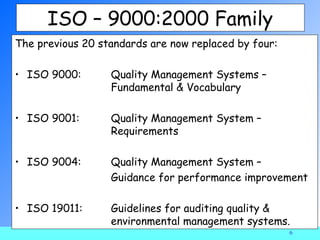
ISO – 9000:2000 Family
The previous 20 standards are now replaced by four:

• ISO 9000:       Quality Management Systems –
                  Fundamental & Vocabulary

• ISO 9001:       Quality Management System –
                  Requirements

• ISO 9004:       Quality Management System –
                  Guidance for performance improvement

• ISO 19011:      Guidelines for auditing quality &
                  environmental management systems.
                                                      6
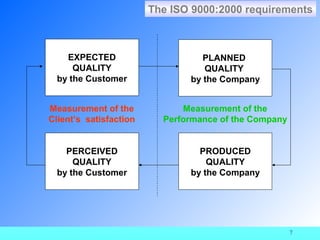
The ISO 9000:2000 requirements


    EXPECTED                      PLANNED
      QUALITY                     QUALITY
  by the Customer              by the Company


Measurement of the            Measurement of the
Client’s satisfaction     Performance of the Company


    PERCEIVED                    PRODUCED
      QUALITY                      QUALITY
  by the Customer              by the Company


                                                       7
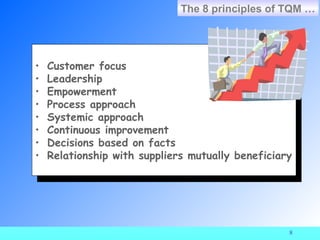
The 8 principles of TQM …


• Customer focus
 • Customer focus
• Leadership
 • Leadership
• Empowerment
 • Empowerment
• Process approach
 • Process approach
• Systemic approach
 • Systemic approach
• Continuous improvement
 • Continuous improvement
• Decisions based on facts
 • Decisions based on facts
• Relationship with suppliers mutually beneficiary
 • Relationship with suppliers mutually beneficiary


                                                 8
The 8 principles of TQM …

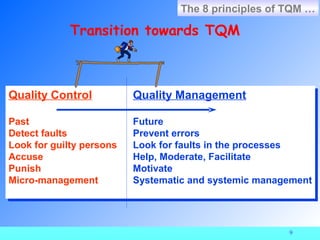
            Transition towards TQM


Quality Control
Quality Control           Quality Management
                          Quality Management

Past
Past                      Future
                          Future
Detect faults
Detect faults             Prevent errors
                          Prevent errors
Look for guilty persons
Look for guilty persons   Look for faults in the processes
                          Look for faults in the processes
Accuse
Accuse                    Help, Moderate, Facilitate
                          Help, Moderate, Facilitate
Punish
Punish                    Motivate
                          Motivate
Micro-management
Micro-management          Systematic and systemic management
                          Systematic and systemic management


                                                       9
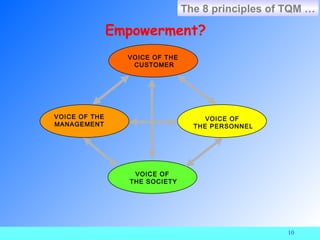
The 8 principles of TQM …

               Empowerment?
                 VOICE OF THE
                  CUSTOMER


VOICE OF THE                         VOICE OF
MANAGEMENT                        THE PERSONNEL


                  VOICE OF
                 THE SOCIETY


                                                   10
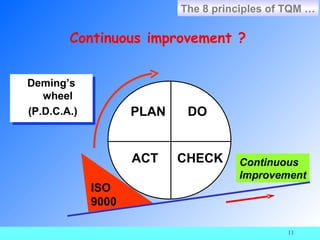
The 8 principles of TQM …

        Continuous improvement ?


Deming’s
 Deming’s
   wheel
    wheel
(P.D.C.A.)
 (P.D.C.A.)          PLAN    DO


                     ACT    CHECK     Continuous
                                      Improvement
              ISO
              9000

                                               11
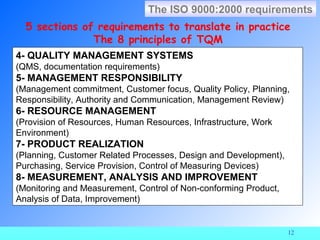
The ISO 9000:2000 requirements
  5 sections of requirements to translate in practice
               The 8 principles of TQM
4- QUALITY MANAGEMENT SYSTEMS
(QMS, documentation requirements)
5- MANAGEMENT RESPONSIBILITY
(Management commitment, Customer focus, Quality Policy, Planning,
Responsibility, Authority and Communication, Management Review)
6- RESOURCE MANAGEMENT
(Provision of Resources, Human Resources, Infrastructure, Work
Environment)
7- PRODUCT REALIZATION
(Planning, Customer Related Processes, Design and Development),
Purchasing, Service Provision, Control of Measuring Devices)
8- MEASUREMENT, ANALYSIS AND IMPROVEMENT
(Monitoring and Measurement, Control of Non-conforming Product,
Analysis of Data, Improvement)


                                                                  12
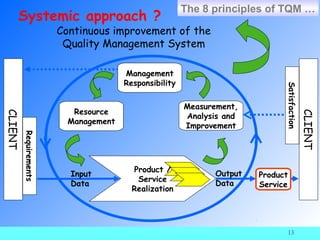
The 8 principles of TQM …
    Systemic approach ?
                        Continuous improvement of the
                         Quality Management System

                                       Management
                                       Responsibility


                                                                             Satisfaction
                                                        Measurement,
                           Resource
CLIENT


                                                                                            CLIENT
                                                        Analysis and
                          Management
                                                        Improvement
         Requirements


                                         Product /
                          Input                               Output   Product
                                          Service
                          Data                                Data     Service
                                         Realization


                                                                                 13
Presentation of ISO 9000:2000


“A COHERENT PAIR”:

  •ISO 9001:2000 – Quality Management Systems:
  REQUIREMENTS (WHAT ?)
  ISO 9001 oriented effectiveness and certification,

  •ISO 9004:2000 - Quality Management Systems:
  GUIDELINES FOR PERFORMANCE IMPROVEMENTS
  (HOW ...?)
   ISO 9004 oriented effectiveness and efficiency


                                                  14
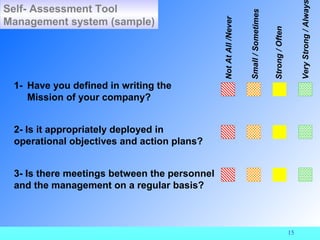
Self- Assessment Tool


                                                                                                            Very Strong / Alway
                                                                  Small / Sometimes
Management system (sample)


                                              Not At All /Never


                                                                                      Strong / Often
 1- Have you defined in writing the
    Mission of your company?


 2- Is it appropriately deployed in
 operational objectives and action plans?


 3- Is there meetings between the personnel
 and the management on a regular basis?


                                                                                                       15
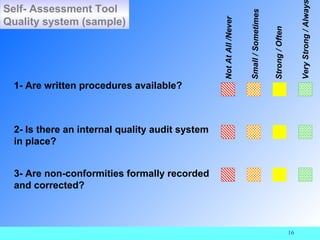
Self- Assessment Tool


                                                                                                               Very Strong / Alway
                                                                     Small / Sometimes
Quality system (sample)


                                                 Not At All /Never


                                                                                         Strong / Often
 1- Are written procedures available?


  2- Is there an internal quality audit system
  in place?


  3- Are non-conformities formally recorded
  and corrected?


                                                                                                          16
Self- Assessment Tool


                                                                                                              Very Strong / Alway
                                                                    Small / Sometimes
Human Resources (sample)


                                                Not At All /Never


                                                                                        Strong / Often
 1- Is there job descriptions in place for
 all the personnel?


 2- Is there a formal system in place for the
 yearly evaluation of performance?


 3- Is the training of the personnel well
 adapted to the needs?


                                                                                                         17
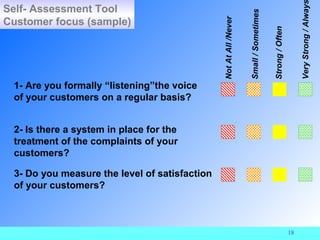
Self- Assessment Tool


                                                                                                             Very Strong / Alway
                                                                   Small / Sometimes
Customer focus (sample)


                                               Not At All /Never


                                                                                       Strong / Often
 1- Are you formally “listening”the voice
 of your customers on a regular basis?


 2- Is there a system in place for the
 treatment of the complaints of your
 customers?

 3- Do you measure the level of satisfaction
 of your customers?


                                                                                                        18

ISO 9001

  • 1.
    New definition ofquality: “Degree to which a set of inherent characteristics fulfils requirements” ISO 9000:2000, Quality management systems – fundamentals and vocabulary. 1
  • 2.
    WHAT IS ISO •ISO (pronounced aizo) is a Greek word that means equal. • It is a set of international standards prepared by the International Organisation for Standardization, a voluntary body that has representation from more than 100 countries and is headquartered in Geneva 2
  • 3.
    History of ISO TheInternational Organization for Standardization (ISO) was formed in 1946 in Geneva Switzerland. The ISO’s intention was to promote the development of international standards and related activities so as to foster the increased trade of products and services between countries. ISO was initially focused on the increasing technological complexities in engineering and defence industries where consequences of failure were very high. Today the ISO 9000 standards have been mandated by many governments and organizations around the world. 3
  • 4.
    Purpose of ISO •Harmonise standards at international level. • Ensure consistency of output • Make organisations more competitive by reducing wastage at various places in the company 4
  • 5.
    ISO 9000 Standards •A number of standards have been issued since its inception about 50 years ago. • The first set of harmonised standards on Quality Assurance were issued in the year 1987. • Subsequent revision was done in the year 1994. • Last revision has been done in 2000 • New structure is process based and more generic in nature, • Clearly based on the Plan – Do – Check – Act principle • Recommendatory in nature. • They do not over-ride the laws of any country. 5
  • 6.
    ISO – 9000:2000Family The previous 20 standards are now replaced by four: • ISO 9000: Quality Management Systems – Fundamental & Vocabulary • ISO 9001: Quality Management System – Requirements • ISO 9004: Quality Management System – Guidance for performance improvement • ISO 19011: Guidelines for auditing quality & environmental management systems. 6
  • 7.
    The ISO 9000:2000requirements EXPECTED PLANNED QUALITY QUALITY by the Customer by the Company Measurement of the Measurement of the Client’s satisfaction Performance of the Company PERCEIVED PRODUCED QUALITY QUALITY by the Customer by the Company 7
  • 8.
    The 8 principlesof TQM … • Customer focus • Customer focus • Leadership • Leadership • Empowerment • Empowerment • Process approach • Process approach • Systemic approach • Systemic approach • Continuous improvement • Continuous improvement • Decisions based on facts • Decisions based on facts • Relationship with suppliers mutually beneficiary • Relationship with suppliers mutually beneficiary 8
  • 9.
    The 8 principlesof TQM … Transition towards TQM Quality Control Quality Control Quality Management Quality Management Past Past Future Future Detect faults Detect faults Prevent errors Prevent errors Look for guilty persons Look for guilty persons Look for faults in the processes Look for faults in the processes Accuse Accuse Help, Moderate, Facilitate Help, Moderate, Facilitate Punish Punish Motivate Motivate Micro-management Micro-management Systematic and systemic management Systematic and systemic management 9
  • 10.
    The 8 principlesof TQM … Empowerment? VOICE OF THE CUSTOMER VOICE OF THE VOICE OF MANAGEMENT THE PERSONNEL VOICE OF THE SOCIETY 10
  • 11.
    The 8 principlesof TQM … Continuous improvement ? Deming’s Deming’s wheel wheel (P.D.C.A.) (P.D.C.A.) PLAN DO ACT CHECK Continuous Improvement ISO 9000 11
  • 12.
    The ISO 9000:2000requirements 5 sections of requirements to translate in practice The 8 principles of TQM 4- QUALITY MANAGEMENT SYSTEMS (QMS, documentation requirements) 5- MANAGEMENT RESPONSIBILITY (Management commitment, Customer focus, Quality Policy, Planning, Responsibility, Authority and Communication, Management Review) 6- RESOURCE MANAGEMENT (Provision of Resources, Human Resources, Infrastructure, Work Environment) 7- PRODUCT REALIZATION (Planning, Customer Related Processes, Design and Development), Purchasing, Service Provision, Control of Measuring Devices) 8- MEASUREMENT, ANALYSIS AND IMPROVEMENT (Monitoring and Measurement, Control of Non-conforming Product, Analysis of Data, Improvement) 12
  • 13.
    The 8 principlesof TQM … Systemic approach ? Continuous improvement of the Quality Management System Management Responsibility Satisfaction Measurement, Resource CLIENT CLIENT Analysis and Management Improvement Requirements Product / Input Output Product Service Data Data Service Realization 13
  • 14.
    Presentation of ISO9000:2000 “A COHERENT PAIR”: •ISO 9001:2000 – Quality Management Systems: REQUIREMENTS (WHAT ?) ISO 9001 oriented effectiveness and certification, •ISO 9004:2000 - Quality Management Systems: GUIDELINES FOR PERFORMANCE IMPROVEMENTS (HOW ...?) ISO 9004 oriented effectiveness and efficiency 14
  • 15.
    Self- Assessment Tool Very Strong / Alway Small / Sometimes Management system (sample) Not At All /Never Strong / Often 1- Have you defined in writing the Mission of your company? 2- Is it appropriately deployed in operational objectives and action plans? 3- Is there meetings between the personnel and the management on a regular basis? 15
  • 16.
    Self- Assessment Tool Very Strong / Alway Small / Sometimes Quality system (sample) Not At All /Never Strong / Often 1- Are written procedures available? 2- Is there an internal quality audit system in place? 3- Are non-conformities formally recorded and corrected? 16
  • 17.
    Self- Assessment Tool Very Strong / Alway Small / Sometimes Human Resources (sample) Not At All /Never Strong / Often 1- Is there job descriptions in place for all the personnel? 2- Is there a formal system in place for the yearly evaluation of performance? 3- Is the training of the personnel well adapted to the needs? 17
  • 18.
    Self- Assessment Tool Very Strong / Alway Small / Sometimes Customer focus (sample) Not At All /Never Strong / Often 1- Are you formally “listening”the voice of your customers on a regular basis? 2- Is there a system in place for the treatment of the complaints of your customers? 3- Do you measure the level of satisfaction of your customers? 18