Environmental and Social Values - Implementing
the new EU Public Procurement Directives :
Possibilities and Challenges’
Professor Peter Kunzlik
May 7, 2014
The New Approach
A new approach:
Public procurement as an instrument of EU economic
policy – the Europe 2020 Strategy (‘smart, sustainable
and inclusive growth’) ; and
The goal of increasing the efficiency of public spending
and supporting common societal goals.’
Recital 2
Member States’ duty to ensure compliance with
applicable social & environmental laws, and Annex X
Conventions; Art 18(2) (hereafter ‘Article 18(2)
obligations’)
Note however that applicable obligations must be
consistent with the TFEU and the Posted Workers
Directive.
May 7, 2014
Possibilities (1) Ensuring compliance
with applicable laws
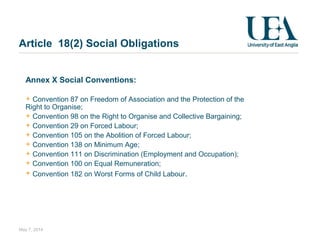
Article 18(2) Social Obligations
Annex X Social Conventions:
Convention 87 on Freedom of Association and the Protection of the
Right to Organise;
Convention 98 on the Right to Organise and Collective Bargaining;
Convention 29 on Forced Labour;
Convention 105 on the Abolition of Forced Labour;
Convention 138 on Minimum Age;
Convention 111 on Discrimination (Employment and Occupation);
Convention 100 on Equal Remuneration;
Convention 182 on Worst Forms of Child Labour.
May 7, 2014
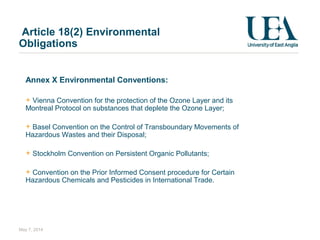
Article 18(2) Environmental
Obligations
Annex X Environmental Conventions:
Vienna Convention for the protection of the Ozone Layer and its
Montreal Protocol on substances that deplete the Ozone Layer;
Basel Convention on the Control of Transboundary Movements of
Hazardous Wastes and their Disposal;
Stockholm Convention on Persistent Organic Pollutants;
Convention on the Prior Informed Consent procedure for Certain
Hazardous Chemicals and Pesticides in International Trade.
May 7, 2014
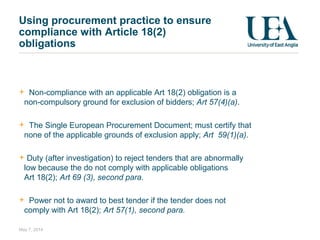
Using procurement practice to ensure
compliance with Article 18(2)
obligations
Non-compliance with an applicable Art 18(2) obligation is a
non-compulsory ground for exclusion of bidders; Art 57(4)(a).
The Single European Procurement Document; must certify that
none of the applicable grounds of exclusion apply; Art 59(1)(a).
Duty (after investigation) to reject tenders that are abnormally
low because the do not comply with applicable obligations
Art 18(2); Art 69 (3), second para.
Power not to award to best tender if the tender does not
comply with Art 18(2); Art 57(1), second para.
May 7, 2014
Ensuring compliance with Article 18(2)
obligations by sub-contractors
Competent authorities to ensure compliance by sub-
contractors; Art 71(1) & Art 71(6)(a).
May 7, 2014
Accessibility:
Specifications must take into account accessibility
criteria for persons with disabilities or design for all users;
Art 42(1), fourth para;
Specifications must be framed by reference to
mandatory EU accessibility rules where they exist; Art
43(1), fifth para.
May 7, 2014
Possibilities – (2)Technical
specifications
Technical specifications
Production & Process Methods (‘PPMs’):
Specifications may include PPM requirements ‘linked
to the subject matter of the contract’ even if not affecting
the material substance of the thing purchased
PROVIDED that such requirements are ‘proportionate
to its value and its objectives’
Annex VII(1) (a) & (b), Art 42(1) second para; Art 40(3)
(a).Cf C-513/99, Concordia Bus; C-448/01, EVN; and C-
368/10, Commission v Netherlands
May 7, 2014
Possibilities (3) Selection – attestation
of compliance with quality standards
Attestation of standards ‘including on accessibility
for disabled persons’; Art 62(1).
Attestation re environmental management systems
European Union Eco-Management and Audit Scheme
(EMAS) etc.; Art 62(2).
May 7, 2014
Possibilities (4) Exclusion
Compulsory grounds for exclusion now include
conviction for use of child labour and ‘other forms of
trafficking in human beings’; Art 57(1)(f);
Non-compliance with applicable obligations under Art
18(2) is a non-compulsory ground of exclusion (see
above).
May 7, 2014
Possibilities (5) Basis of award
May 7, 2014
The only basis of award is award to the bidder offering the
‘most economically advantageous tender from the point of
view of the contracting authority’ but contracting authorities
may define MEAT in one of three ways;
best price;
best cost, using a cost-effectiveness approach such as
life-cycle costing in accordance with Article 68; or
best price-quality ratio, ‘which shall be assessed on the
basis of – criteria including qualitative, environmental and/or
social aspects linked to the subject-matter of the public
contract in question.’
Art 67(1) & (2)
Best price-quality ratio
Qualitative criteria must be ‘linked to the subject-matter
of the contract’:
As well as price or cost, criteria they may relate to
‘qualitative environmental and/or social aspects linked to
the subject-matter of the contract, including ‘for
instance’:
‘quality, including technical merit, aesthetic and
functional characteristics, accessibility, design for all
users, social, environmental and innovation
characteristics, trading and its conditions.’
Art 67(2)(a).
May 7, 2014
Best price-quality ratio
Award criteria are linked to the subject-matter of the contract
‘where they relate to works, supplies or services to be
provided under that contract in any respect and at any stage
of their life cycle, including factors involved in
(a) the specific process of production, provision or trading of
those works, supplies or services, or
(b) (in a specific process for another stage of their life cycle
even where such factors do not form part of their material
substance’; Art 67(3).
May 7, 2014
Possibilities (6) Contract performance
conditions
‘Contracting authorities may lay down special conditions
relating to the performance of a contract, provided that
they are linked to the subject-matter of the contract
…and indicated in the call for competition or in the
procurement documents. Those conditions may include
economic, innovation-related, environmental, social
or employment related considerations’; Art 70.
These may include PPM requirements linked to the
subject-mater of the contract even those which do not
form part of the material substance of the works,
supplies or services purchased ; Recital 97
May 7, 2014
Possibilities (7) Reserved contracts
  ‘Member States may reserve contracts for ‘sheltered
workshops and economic operators whose main aim is
the social and professional integration of disabled and
disadvantaged persons or provide for such contracts to
be performed in the context of sheltered employment
programme’
PROVIDED that at least 30% of the employees of
those workshops, economic operators or programmes
are disabled or disadvantaged workers.
Art 20
May 7, 2014
Possibilities (8) Eco and fair trade
labels
Specifications, award criteria, contract performance
conditions can require eco / fair trade labels in
specifications so long as five conditions are satisfied
(including that the label criteria are ‘linked to the
subject-matter of the contract)’; Art 43(1).
May 7, 2014
The duty to comply with the Treaty on the
Functioning of the European Union and principles
derived therefrom;
The principles of procurement:
‘Contracting authorities shall treat economic operators
equally and without discrimination and shall act in a
transparent and proportionate manner….’; Art 18(1);
The duty of precision:
Specifications: Art 42(3)(a). 
Specifications and award criteria): C-368/10,
Commission Netherlands 
May 7, 2014
Challenges (1) Practicalities
Challenges – Practicalities
Award criteria
must not confer an unrestricted freedom of choice
on the contracting authority;
must ensure the possibility of effective competition;
and
must be shall be accompanied by specifications that
allow the information provided by the tenderers to be
effectively verified in order to assess how well the
tenders meet the award criteria.
Art 67(4). See also Recitals 90-99
May 7, 2014
The
Challenges (2) Taxation
Taxation of economic undertakings carrying out
public contracts, especially major, long-term contracts
such as public private partnerships;
Can contracting authorities favour firms that will pay
taxes on the profits of the public contract in question?
MEAT contract award criteria;
Contract performance conditions.
In each case: would the factor be ‘linked to the
subject matter of the contact’? Discrimination?
May 7, 2014

Peter Kunzlik

  • 1.
    Environmental and SocialValues - Implementing the new EU Public Procurement Directives : Possibilities and Challenges’ Professor Peter Kunzlik
  • 2.
    May 7, 2014 TheNew Approach A new approach: Public procurement as an instrument of EU economic policy – the Europe 2020 Strategy (‘smart, sustainable and inclusive growth’) ; and The goal of increasing the efficiency of public spending and supporting common societal goals.’ Recital 2
  • 3.
    Member States’ dutyto ensure compliance with applicable social & environmental laws, and Annex X Conventions; Art 18(2) (hereafter ‘Article 18(2) obligations’) Note however that applicable obligations must be consistent with the TFEU and the Posted Workers Directive. May 7, 2014 Possibilities (1) Ensuring compliance with applicable laws
  • 4.
    Article 18(2) SocialObligations Annex X Social Conventions: Convention 87 on Freedom of Association and the Protection of the Right to Organise; Convention 98 on the Right to Organise and Collective Bargaining; Convention 29 on Forced Labour; Convention 105 on the Abolition of Forced Labour; Convention 138 on Minimum Age; Convention 111 on Discrimination (Employment and Occupation); Convention 100 on Equal Remuneration; Convention 182 on Worst Forms of Child Labour. May 7, 2014
  • 5.
    Article 18(2) Environmental Obligations AnnexX Environmental Conventions: Vienna Convention for the protection of the Ozone Layer and its Montreal Protocol on substances that deplete the Ozone Layer; Basel Convention on the Control of Transboundary Movements of Hazardous Wastes and their Disposal; Stockholm Convention on Persistent Organic Pollutants; Convention on the Prior Informed Consent procedure for Certain Hazardous Chemicals and Pesticides in International Trade. May 7, 2014
  • 6.
    Using procurement practiceto ensure compliance with Article 18(2) obligations Non-compliance with an applicable Art 18(2) obligation is a non-compulsory ground for exclusion of bidders; Art 57(4)(a). The Single European Procurement Document; must certify that none of the applicable grounds of exclusion apply; Art 59(1)(a). Duty (after investigation) to reject tenders that are abnormally low because the do not comply with applicable obligations Art 18(2); Art 69 (3), second para. Power not to award to best tender if the tender does not comply with Art 18(2); Art 57(1), second para. May 7, 2014
  • 7.
    Ensuring compliance withArticle 18(2) obligations by sub-contractors Competent authorities to ensure compliance by sub- contractors; Art 71(1) & Art 71(6)(a). May 7, 2014
  • 8.
    Accessibility: Specifications must takeinto account accessibility criteria for persons with disabilities or design for all users; Art 42(1), fourth para; Specifications must be framed by reference to mandatory EU accessibility rules where they exist; Art 43(1), fifth para. May 7, 2014 Possibilities – (2)Technical specifications
  • 9.
    Technical specifications Production &Process Methods (‘PPMs’): Specifications may include PPM requirements ‘linked to the subject matter of the contract’ even if not affecting the material substance of the thing purchased PROVIDED that such requirements are ‘proportionate to its value and its objectives’ Annex VII(1) (a) & (b), Art 42(1) second para; Art 40(3) (a).Cf C-513/99, Concordia Bus; C-448/01, EVN; and C- 368/10, Commission v Netherlands May 7, 2014
  • 10.
    Possibilities (3) Selection– attestation of compliance with quality standards Attestation of standards ‘including on accessibility for disabled persons’; Art 62(1). Attestation re environmental management systems European Union Eco-Management and Audit Scheme (EMAS) etc.; Art 62(2). May 7, 2014
  • 11.
    Possibilities (4) Exclusion Compulsorygrounds for exclusion now include conviction for use of child labour and ‘other forms of trafficking in human beings’; Art 57(1)(f); Non-compliance with applicable obligations under Art 18(2) is a non-compulsory ground of exclusion (see above). May 7, 2014
  • 12.
    Possibilities (5) Basisof award May 7, 2014 The only basis of award is award to the bidder offering the ‘most economically advantageous tender from the point of view of the contracting authority’ but contracting authorities may define MEAT in one of three ways; best price; best cost, using a cost-effectiveness approach such as life-cycle costing in accordance with Article 68; or best price-quality ratio, ‘which shall be assessed on the basis of – criteria including qualitative, environmental and/or social aspects linked to the subject-matter of the public contract in question.’ Art 67(1) & (2)
  • 13.
    Best price-quality ratio Qualitativecriteria must be ‘linked to the subject-matter of the contract’: As well as price or cost, criteria they may relate to ‘qualitative environmental and/or social aspects linked to the subject-matter of the contract, including ‘for instance’: ‘quality, including technical merit, aesthetic and functional characteristics, accessibility, design for all users, social, environmental and innovation characteristics, trading and its conditions.’ Art 67(2)(a). May 7, 2014
  • 14.
    Best price-quality ratio Awardcriteria are linked to the subject-matter of the contract ‘where they relate to works, supplies or services to be provided under that contract in any respect and at any stage of their life cycle, including factors involved in (a) the specific process of production, provision or trading of those works, supplies or services, or (b) (in a specific process for another stage of their life cycle even where such factors do not form part of their material substance’; Art 67(3). May 7, 2014
  • 15.
    Possibilities (6) Contractperformance conditions ‘Contracting authorities may lay down special conditions relating to the performance of a contract, provided that they are linked to the subject-matter of the contract …and indicated in the call for competition or in the procurement documents. Those conditions may include economic, innovation-related, environmental, social or employment related considerations’; Art 70. These may include PPM requirements linked to the subject-mater of the contract even those which do not form part of the material substance of the works, supplies or services purchased ; Recital 97 May 7, 2014
  • 16.
    Possibilities (7) Reservedcontracts   ‘Member States may reserve contracts for ‘sheltered workshops and economic operators whose main aim is the social and professional integration of disabled and disadvantaged persons or provide for such contracts to be performed in the context of sheltered employment programme’ PROVIDED that at least 30% of the employees of those workshops, economic operators or programmes are disabled or disadvantaged workers. Art 20 May 7, 2014
  • 17.
    Possibilities (8) Ecoand fair trade labels Specifications, award criteria, contract performance conditions can require eco / fair trade labels in specifications so long as five conditions are satisfied (including that the label criteria are ‘linked to the subject-matter of the contract)’; Art 43(1). May 7, 2014
  • 18.
    The duty tocomply with the Treaty on the Functioning of the European Union and principles derived therefrom; The principles of procurement: ‘Contracting authorities shall treat economic operators equally and without discrimination and shall act in a transparent and proportionate manner….’; Art 18(1); The duty of precision: Specifications: Art 42(3)(a).  Specifications and award criteria): C-368/10, Commission Netherlands  May 7, 2014 Challenges (1) Practicalities
  • 19.
    Challenges – Practicalities Awardcriteria must not confer an unrestricted freedom of choice on the contracting authority; must ensure the possibility of effective competition; and must be shall be accompanied by specifications that allow the information provided by the tenderers to be effectively verified in order to assess how well the tenders meet the award criteria. Art 67(4). See also Recitals 90-99 May 7, 2014 The
  • 20.
    Challenges (2) Taxation Taxationof economic undertakings carrying out public contracts, especially major, long-term contracts such as public private partnerships; Can contracting authorities favour firms that will pay taxes on the profits of the public contract in question? MEAT contract award criteria; Contract performance conditions. In each case: would the factor be ‘linked to the subject matter of the contact’? Discrimination? May 7, 2014

Editor's Notes