INFRARED
SPECTROSCOPY
Presented by
Navaneethakrishnan P
Department of Pharmaceutics
Karpagam College of Pharmacy
Coimbatore -32
CONTENT
• INTRODUCTION
• THEORY
• SAMPLING TECHNIQUES IN IR SPECTROSCOPY
• DISPERSIVE SPECTROSCOPY
2Department of Pharmaceutics, KCP, CBE-32
INTRODUCTION
• Infrared Spectroscopy is spectroscopic analytical method that deals
with the Infra-red Region of the electromagnetic Spectrum.
• By Using the IR can determine the chemical molecules
• In a laboratory Fourier Transform Infra-red spectrometer is used
• The Infra-red portion is usually divided into three regions
S.No IR Portion Wavelength in cm-1
1. Near Infrared 14,000 cm-1 to 4000 cm-1 (0.8 μm to 2.5 μm )
2. Mid Infrared 4000cm-1 to 400 cm-1 (2.5μm to 25 μm )
3. Far Infrared 400cm-1 to 10 cm-1 (25 μm to 1000 μm)
3Department of Pharmaceutics, KCP, CBE-32
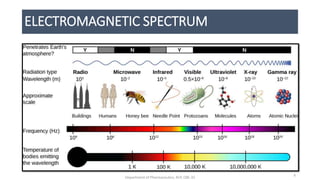
ELECTROMAGNETIC SPECTRUM
4
Department of Pharmaceutics, KCP, CBE-32
THEORY
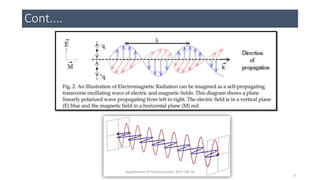
• The EM radiation is a combination of periodically changing or
oscillating electric field (EF) and magnetic field (MF) oscillating at the
same frequency, but perpendicular to the electrical field.
• The wavelength is represented by λ
• The frequency is represented by v is a number of oscillation per unit
time of EM waves per sec.
• The wave number is number of waves / unit length
• So it can be given as
C =hv
C = Velocity of light 3,00,000 Km/s
5Department of Pharmaceutics, KCP, CBE-32
Cont....
6
Department of Pharmaceutics, KCP, CBE-32
Cont..
• The wavelength (λ) is inversely proportional to the frequency (1/v)
• The energy in Quantum terms is given by Planks Constant equation,
E=hv or v =E/h
• Which was deduced later by Einstein, where E is the energy of the
Photon of frequency v and h is max Planks constant (h=4.13566 ×10⁻¹⁵
ev) wave and frequency are related by the equation
V = cv’
7Department of Pharmaceutics, KCP, CBE-32
Cont....
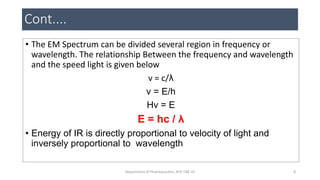
• The EM Spectrum can be divided several region in frequency or
wavelength. The relationship Between the frequency and wavelength
and the speed light is given below
v = c/λ
v = E/h
Hv = E
E = hc / λ
• Energy of IR is directly proportional to velocity of light and
inversely proportional to wavelength
8Department of Pharmaceutics, KCP, CBE-32
Cont...
9
Department of Pharmaceutics, KCP, CBE-32
Molecular Vibrational
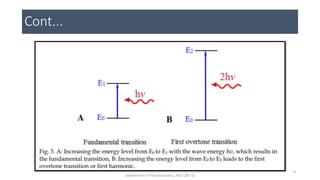
• The IR energy absorption corresponds to specific modes ; It
corresponding to combination of atomic movements.
• Vibrational force are two type
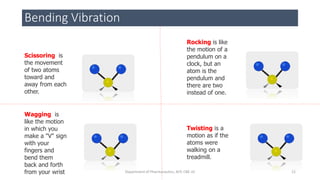
• BENDING VIBRATIONAL FORCE [change in bond angles]
• Scissoring
• Wagging
• Rocking
• Twisting
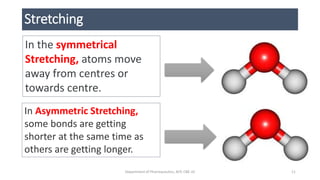
• STRETCHING VIBRATIONAL FORCE [Change in bond length]
• Symmetrical & Asymmetrical
• It corresponds to vibrational and rotational force
10Department of Pharmaceutics, KCP, CBE-32
Stretching
In the symmetrical
Stretching, atoms move
away from centres or
towards centre.
In Asymmetric Stretching,
some bonds are getting
shorter at the same time as
others are getting longer.
11Department of Pharmaceutics, KCP, CBE-32
Bending Vibration
Scissoring is
the movement
of two atoms
toward and
away from each
other.
Wagging is
like the motion
in which you
make a "V" sign
with your
fingers and
bend them
back and forth
from your wrist
Rocking is like
the motion of a
pendulum on a
clock, but an
atom is the
pendulum and
there are two
instead of one.
Twisting is a
motion as if the
atoms were
walking on a
treadmill.
12Department of Pharmaceutics, KCP, CBE-32
HOOKE's LAW
• Definition
Hooke’s law is a law of physics that states that the force needed to extend or
compress spring by some distance
• In Infrared spectroscopy, Hooke’s law is applied to determine the
molecules based on the peak range
• A vibrating bond in the IR can be compared to the physical model of a
vibrating spring system that can be described Hooke’s law of
harmonic oscillation.
• Using the force constant K and masses of two atoms M, then the
absorption should change as the properties of the system
13Department of Pharmaceutics, KCP, CBE-32
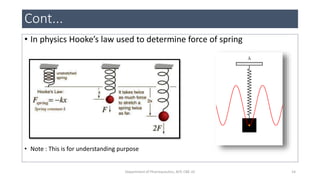
• In physics Hooke’s law used to determine force of spring
• Note : This is for understanding purpose
Cont...
14Department of Pharmaceutics, KCP, CBE-32
Cont ....
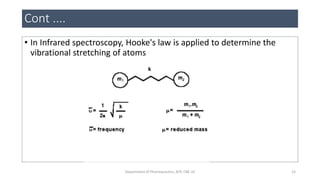
• In Infrared spectroscopy, Hooke's law is applied to determine the
vibrational stretching of atoms
15Department of Pharmaceutics, KCP, CBE-32
Cont...
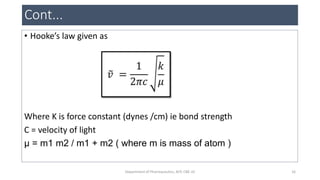
• Hooke’s law given as
Where K is force constant (dynes /cm) ie bond strength
C = velocity of light
µ = m1 m2 / m1 + m2 ( where m is mass of atom )
16Department of Pharmaceutics, KCP, CBE-32
Determination of %Transmission
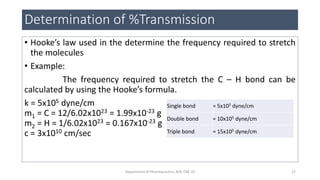
• Hooke’s law used in the determine the frequency required to stretch
the molecules
• Example:
The frequency required to stretch the C – H bond can be
calculated by using the Hooke’s formula.
k = 5x10⁵ dyne/cm
m1 = C = 12/6.02x1023 = 1.99x10⁻²³ g
m2 = H = 1/6.02x1023 = 0.167x10⁻²³ g
c = 3x1010 cm/sec
Single bond = 5x10⁵ dyne/cm
Double bond = 10x105 dyne/cm
Triple bond = 15x105 dyne/cm
17Department of Pharmaceutics, KCP, CBE-32
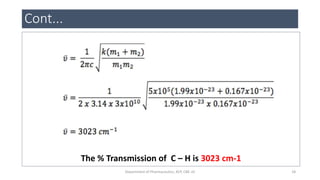
Cont...
The % Transmission of C – H is 3023 cm-1
18Department of Pharmaceutics, KCP, CBE-32
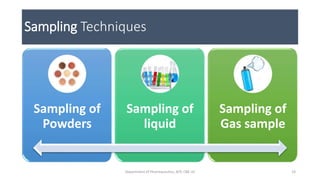
Sampling Techniques
Sampling of
Powders
Sampling of
liquid
Sampling of
Gas sample
19Department of Pharmaceutics, KCP, CBE-32
Sampling technique for Powders Sample
• Infrared spectroscopy incorporate several type of measurement
method like Diffuse reflectance method and attenuated total
reflection method
• The methods are selected according to sample form
• The KBr Method and Nujol method is classical method. How ever in
FTIR has become more common, The diffuse reflection method has
become more common and its widely used.
• The attenuated total reflection is method that allows direct
measurement of powder sample
20Department of Pharmaceutics, KCP, CBE-32
Cont....
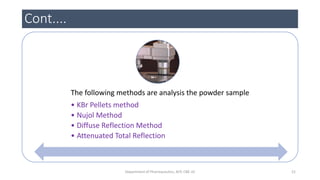
The following methods are analysis the powder sample
• KBr Pellets method
• Nujol Method
• Diffuse Reflection Method
• Attenuated Total Reflection
21Department of Pharmaceutics, KCP, CBE-32
KBr Pellets method
• KBr Pellets Method:
• Alkali Halides are used in this method because it form a
transparent sheet when it is subject high pressure and this
transparent pellets allow the IR.
• KBr is the commonest alkali halide used in the pellets.
Cesium Iodide may be used to measure the lR region of 400
to 250 cm-1 wave number region
22Department of Pharmaceutics, KCP, CBE-32
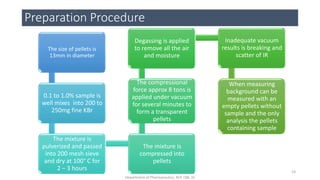
Preparation Procedure
The size of pellets is
13mm in diameter
0.1 to 1.0% sample is
well mixes into 200 to
250mg fine KBr
The mixture is
pulverized and passed
into 200 mesh sieve
and dry at 100° C for
2 – 3 hours
The mixture is
compressed into
pellets
The compressional
force approx 8 tons is
applied under vacuum
for several minutes to
form a transparent
pellets
Degassing is applied
to remove all the air
and moisture
Inadequate vacuum
results is breaking and
scatter of IR
When measuring
background can be
measured with an
empty pellets without
sample and the only
analysis the pellets
containing sample
23
Department of Pharmaceutics, KCP, CBE-32
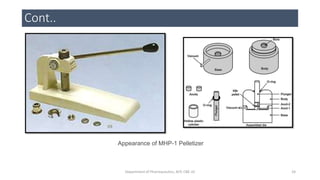
Cont..
Appearance of MHP-1 Pelletizer
24Department of Pharmaceutics, KCP, CBE-32
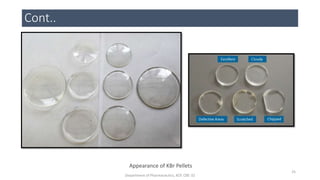
Cont..
Appearance of KBr Pellets
25
Department of Pharmaceutics, KCP, CBE-32
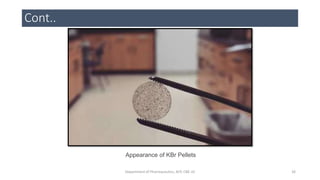
Cont..
Appearance of KBr Pellets
26Department of Pharmaceutics, KCP, CBE-32
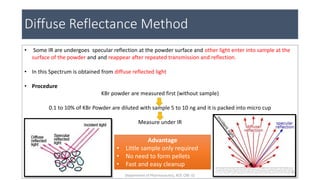
Diffuse Reflectance Method
• Some IR are undergoes specular reflection at the powder surface and other light enter into sample at the
surface of the powder and and reappear after repeated transmission and reflection.
• In this Spectrum is obtained from diffuse reflected light
• Procedure
KBr powder are measured first (without sample)
0.1 to 10% of KBr Powder are diluted with sample 5 to 10 ng and it is packed into micro cup
Measure under IR
Advantage
• Little sample only required
• No need to form pellets
• Fast and easy cleanup
27
Department of Pharmaceutics, KCP, CBE-32
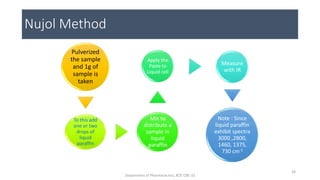
Pulverized
the sample
and 1g of
sample is
taken
To this add
one or two
drops of
liquid
paraffin
Mix to
distribute a
sample in
liquid
paraffin
Apply the
Paste to
Liquid cell
Measure
with IR
Note : Since
liquid paraffin
exhibit spectra
3000 ,2800,
1460, 1375,
730 cm-1
Nujol Method
28
Department of Pharmaceutics, KCP, CBE-32
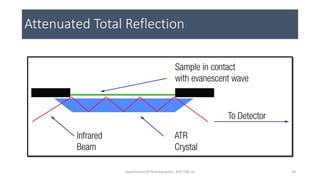
Attenuated Total Reflection
29Department of Pharmaceutics, KCP, CBE-32
•This method is used to measure the IR spectra of sample is KBr or in
Liquid paraffin
•In this method the sample is pressed against the High reflective index
prism (It made up of Zinc selenide or Germanium)
•A Sample is mixed with KBr / liquid paraffin, and background data
collected without sample and then sample along KBr is analysed.
Advantages
•Faster Sampling
• Improving sample to sample reproducibility
• Minimize the spectral variation
Cont...
30
Department of Pharmaceutics, KCP, CBE-32
Sampling Method for Liquid Sample
• The liquid samples are measured by transmission method.
• In the transmission method two types of cells are commonly
used
1. Liquid Cell
2. Fixed Cell
31Department of Pharmaceutics, KCP, CBE-32
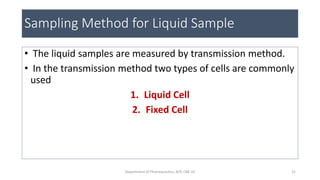
•In the liquid cell, the sample droplets are placed on to the sodium
chloride or potassium bromide the appitude plate and sandwich in a
under another appitude plate such that no gas bubbles are trapped.
•The thickness is adjusted according to sample by using the screws.
•It is demountable sales or disassemble
•This is very useful to measuring the high viscous liquid an unsuitable for
low boiling point
Liquid Cell
32Department of Pharmaceutics, KCP, CBE-32
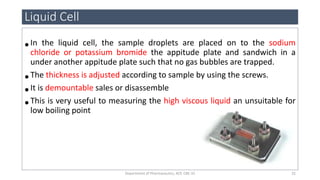
Liquid Cell
33Department of Pharmaceutics, KCP, CBE-32
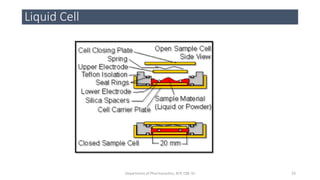
Cont...
Components of
Liquids Cell
34Department of Pharmaceutics, KCP, CBE-32
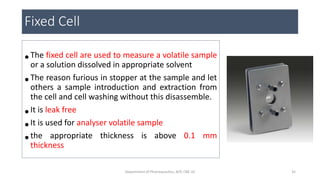
•The fixed cell are used to measure a volatile sample
or a solution dissolved in appropriate solvent
•The reason furious in stopper at the sample and let
others a sample introduction and extraction from
the cell and cell washing without this disassemble.
•It is leak free
•It is used for analyser volatile sample
•the appropriate thickness is above 0.1 mm
thickness
Fixed Cell
35Department of Pharmaceutics, KCP, CBE-32
Sampling Method for Gas Sample
• The Gas sample are analysed by using and gas cell.
• There are two types of gas cell.
• 5cm and 10cm Gas cell
• Each cell body is consist of Glass material
• End of the cell is covered with potassium bromide window it
allow infrared radiation.
• 5 cm cell capacity is 42 ml and 10cm gas cell capacity is 98ml
36Department of Pharmaceutics, KCP, CBE-32
Cont...
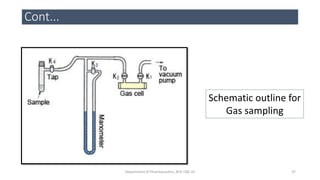
Schematic outline for
Gas sampling
37Department of Pharmaceutics, KCP, CBE-32
Cont...
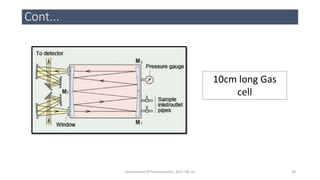
10cm long Gas
cell
38Department of Pharmaceutics, KCP, CBE-32
INSTRUMENTATION
• In the IR spectroscopy there are two types of instruments are
most commonly used, they are
1.Dispersive Infrared Spectrscopy
2.Fourier transform IR spectra
39Department of Pharmaceutics, KCP, CBE-32
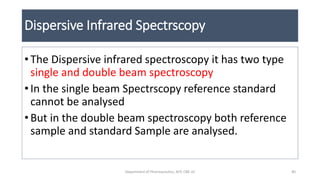
Dispersive Infrared Spectrscopy
• The Dispersive infrared spectroscopy it has two type
single and double beam spectroscopy
• In the single beam Spectrscopy reference standard
cannot be analysed
• But in the double beam spectroscopy both reference
sample and standard Sample are analysed.
40Department of Pharmaceutics, KCP, CBE-32
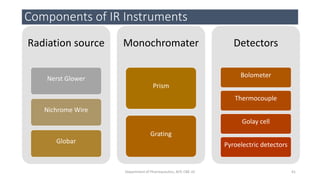
Radiation source
Nerst Glower
Nichrome Wire
Globar
Monochromater
Prism
Grating
Detectors
Bolometer
Thermocouple
Golay cell
Pyroelectric detectors
Components of IR Instruments
41Department of Pharmaceutics, KCP, CBE-32
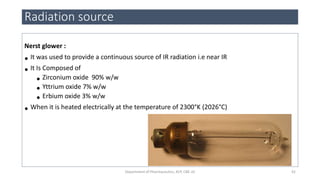
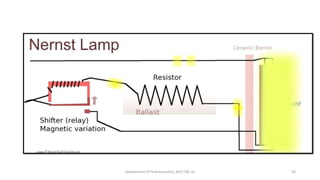
Nerst glower :
• It was used to provide a continuous source of IR radiation i.e near IR
• It Is Composed of
• Zirconium oxide 90% w/w
• Yttrium oxide 7% w/w
• Erbium oxide 3% w/w
• When it is heated electrically at the temperature of 2300°K (2026°C)
Radiation source
42Department of Pharmaceutics, KCP, CBE-32
43Department of Pharmaceutics, KCP, CBE-32
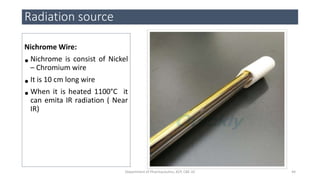
Nichrome Wire:
• Nichrome is consist of Nickel
– Chromium wire
• It is 10 cm long wire
• When it is heated 1100°C it
can emita IR radiation ( Near
IR)
Radiation source
44Department of Pharmaceutics, KCP, CBE-32
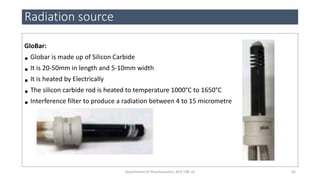
GloBar:
• Globar is made up of Silicon Carbide
• It is 20-50mm in length and 5-10mm width
• It is heated by Electrically
• The silicon carbide rod is heated to temperature 1000°C to 1650°C
• Interference filter to produce a radiation between 4 to 15 micrometre
Radiation source
45Department of Pharmaceutics, KCP, CBE-32
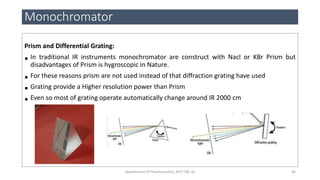
Prism and Differential Grating:
• In traditional IR instruments monochromator are construct with Nacl or KBr Prism but
disadvantages of Prism is hygroscopic in Nature.
• For these reasons prism are not used instead of that diffraction grating have used
• Grating provide a Higher resolution power than Prism
• Even so most of grating operate automatically change around IR 2000 cm
Monochromator
46Department of Pharmaceutics, KCP, CBE-32
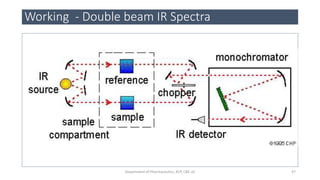
Working - Double beam IR Spectra
47Department of Pharmaceutics, KCP, CBE-32
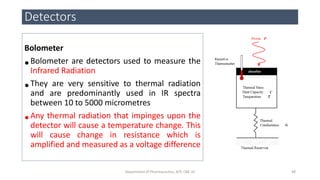
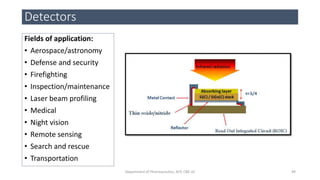
Bolometer
•Bolometer are detectors used to measure the
Infrared Radiation
•They are very sensitive to thermal radiation
and are predominantly used in IR spectra
between 10 to 5000 micrometres
•Any thermal radiation that impinges upon the
detector will cause a temperature change. This
will cause change in resistance which is
amplified and measured as a voltage difference
Detectors
48Department of Pharmaceutics, KCP, CBE-32
Fields of application:
• Aerospace/astronomy
• Defense and security
• Firefighting
• Inspection/maintenance
• Laser beam profiling
• Medical
• Night vision
• Remote sensing
• Search and rescue
• Transportation
Detectors
49Department of Pharmaceutics, KCP, CBE-32
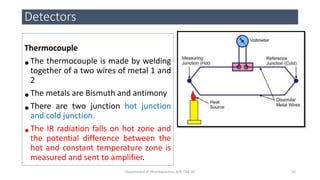
Thermocouple
•The thermocouple is made by welding
together of a two wires of metal 1 and
2
•The metals are Bismuth and antimony
•There are two junction hot junction
and cold junction.
•The IR radiation falls on hot zone and
the potential difference between the
hot and constant temperature zone is
measured and sent to amplifier.
Detectors
50Department of Pharmaceutics, KCP, CBE-32
Detectors
51Department of Pharmaceutics, KCP, CBE-32
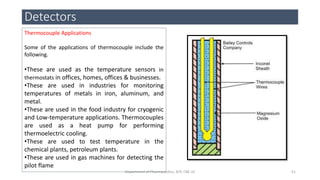
Thermocouple Applications
Some of the applications of thermocouple include the
following.
•These are used as the temperature sensors in
thermostats in offices, homes, offices & businesses.
•These are used in industries for monitoring
temperatures of metals in iron, aluminum, and
metal.
•These are used in the food industry for cryogenic
and Low-temperature applications. Thermocouples
are used as a heat pump for performing
thermoelectric cooling.
•These are used to test temperature in the
chemical plants, petroleum plants.
•These are used in gas machines for detecting the
pilot flame
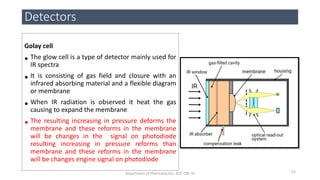
Golay cell
• The glow cell is a type of detector mainly used for
IR spectra
• It is consisting of gas field and closure with an
infrared absorbing material and a flexible diagram
or membrane
• When IR radiation is observed it heat the gas
causing to expand the membrane
• The resulting increasing in pressure deforms the
membrane and these reforms in the membrane
will be changes in the signal on photodiode
resulting increasing in pressure reforms than
membrane and these reforms in the membrane
will be changes engine signal on photodiode
Detectors
52Department of Pharmaceutics, KCP, CBE-32
1. Infrared spectroscopy https://www.ru.nl/systemschemistry/equipment/optical-
spectroscopy/infrared/
2. Vogel’s Text book of Quantitative chemical analysis by Jerrfy et.al
3. Infrared Spectroscopy theory and Interpretation of IR https://slideplayer.com/slide/8335494/
4. Fundamental of IR spectroscopy https://www.shimadzu.com/an/ftir/support/ftirtalk/index.html
5. Attenuated total reflection sampling
https://www.google.com/url?sa=t&source=web&rct=j&url=https://www.utsc.utoronto.ca/~traceslab/
ATR_FTIR.pdf&ved=2ahUKEwirjobmuujfAhUVAXIKHefqD5YQFjAZegQIAxAB&usg=AOvVaw1p-7DG-
txypQxhy1wqJSQq&cshid=1547303582941
6. Practical Sampling Techniques for Infrared Analysis edited by Patricia B. Coleman
https://books.google.co.in/books?hl=en&lr=&id=JY_H61INJqMC&oi=fnd&pg=PA2&dq=sample+handli
ng+techniques+infrared+spectroscopy&ots=DCbrdbqsy2&sig=KkZdnDxPzvitsd4lF14pGlzhA6w#v=onep
age&q=sample%20handling%20techniques%20infrared%20spectroscopy&f=false
7. Introduction to Infrared Spectroscopy April 2012, Research gate
https://www.researchgate.net/publication/224831013
Reference
53Department of Pharmaceutics, KCP, CBE-32
7. FT-IR vs. Dispersive Infrare Theory of Infrared Spectroscopy Instrumentation
https://www.google.com/url?sa=t&source=web&rct=j&url=http://www.thermo.com.cn/Resou
rces/200802/productPDF_21615.pdf&ved=2ahUKEwj8qPnNkevfAhUErI8KHUerBjYQFjAAegQIA
xAB&usg=AOvVaw2oR7zNrc-XIvb4HibRdXjc
8. Near Infrared Spectroscopy: fundamentals, practical aspects and analytical applications ,
Journal of the Brazilian Chemical Society vol 14 Sau paul April 2003
http://www.scielo.br/scielo.php?pid=S0103-50532003000200006&script=sci_arttext
9. Application of Non-Dispersive Infrared (NDIR) Spectroscopy to the Measurement of
Atmospheric Trace gases
https://www.google.com/url?sa=t&source=web&rct=j&url=https://ir.canterbury.ac.nz/bitstrea
m/handle/10092/2160/Thesis_fulltext.pdf%3Bsequence%3D1&ved=2ahUKEwj6zP7uherfAhXFL
48KHWOLCIsQFjATegQIAhAB&usg=AOvVaw06IQX-ysQupfLLm0HLASCZ
10. Monochromator
https://www.shimadzu.com/an/uv/support/fundamentals/monochromators.html
11. Golay cell https://en.m.wikipedia.org/wiki/Golay_cell
Reference
54Department of Pharmaceutics, KCP, CBE-32
Reference
12. Pyroelectric Detector https://www.infratec.in/sensor-division/service-
support/glossary/pyroelectric-detector/
13. Thermal detector https://www.slideshare.net/mobile/sampathramaswamy1/thermal-
detectors-of-ir
14. Introduction and calculations of IR https://www.chromacademy.com/lms/sco533/06-
infrared-spectroscopy-calculation-molecular-vibrations.html
15. Hand book of thermal detector Chapter 7
https://www.google.com/url?sa=t&source=web&rct=j&url=https://www.hamamatsu.
com/resources/pdf/ssd/e07_handbook_Thermal_detectors.pdf&ved=2ahUKEwi1gc7Y
k-vfAhWGNY8KHYQaAnkQFjAAegQIBRAB&usg=AOvVaw0NY1YMZO7MkrCMtm3-Gzek
55Department of Pharmaceutics, KCP, CBE-32
56Department of Pharmaceutics, KCP, CBE-32

Infrared spectroscopy

  • 1.
    INFRARED SPECTROSCOPY Presented by Navaneethakrishnan P Departmentof Pharmaceutics Karpagam College of Pharmacy Coimbatore -32
  • 2.
    CONTENT • INTRODUCTION • THEORY •SAMPLING TECHNIQUES IN IR SPECTROSCOPY • DISPERSIVE SPECTROSCOPY 2Department of Pharmaceutics, KCP, CBE-32
  • 3.
    INTRODUCTION • Infrared Spectroscopyis spectroscopic analytical method that deals with the Infra-red Region of the electromagnetic Spectrum. • By Using the IR can determine the chemical molecules • In a laboratory Fourier Transform Infra-red spectrometer is used • The Infra-red portion is usually divided into three regions S.No IR Portion Wavelength in cm-1 1. Near Infrared 14,000 cm-1 to 4000 cm-1 (0.8 μm to 2.5 μm ) 2. Mid Infrared 4000cm-1 to 400 cm-1 (2.5μm to 25 μm ) 3. Far Infrared 400cm-1 to 10 cm-1 (25 μm to 1000 μm) 3Department of Pharmaceutics, KCP, CBE-32
  • 4.
    ELECTROMAGNETIC SPECTRUM 4 Department ofPharmaceutics, KCP, CBE-32
  • 5.
    THEORY • The EMradiation is a combination of periodically changing or oscillating electric field (EF) and magnetic field (MF) oscillating at the same frequency, but perpendicular to the electrical field. • The wavelength is represented by λ • The frequency is represented by v is a number of oscillation per unit time of EM waves per sec. • The wave number is number of waves / unit length • So it can be given as C =hv C = Velocity of light 3,00,000 Km/s 5Department of Pharmaceutics, KCP, CBE-32
  • 6.
  • 7.
    Cont.. • The wavelength(λ) is inversely proportional to the frequency (1/v) • The energy in Quantum terms is given by Planks Constant equation, E=hv or v =E/h • Which was deduced later by Einstein, where E is the energy of the Photon of frequency v and h is max Planks constant (h=4.13566 ×10⁻¹⁵ ev) wave and frequency are related by the equation V = cv’ 7Department of Pharmaceutics, KCP, CBE-32
  • 8.
    Cont.... • The EMSpectrum can be divided several region in frequency or wavelength. The relationship Between the frequency and wavelength and the speed light is given below v = c/λ v = E/h Hv = E E = hc / λ • Energy of IR is directly proportional to velocity of light and inversely proportional to wavelength 8Department of Pharmaceutics, KCP, CBE-32
  • 9.
  • 10.
    Molecular Vibrational • TheIR energy absorption corresponds to specific modes ; It corresponding to combination of atomic movements. • Vibrational force are two type • BENDING VIBRATIONAL FORCE [change in bond angles] • Scissoring • Wagging • Rocking • Twisting • STRETCHING VIBRATIONAL FORCE [Change in bond length] • Symmetrical & Asymmetrical • It corresponds to vibrational and rotational force 10Department of Pharmaceutics, KCP, CBE-32
  • 11.
    Stretching In the symmetrical Stretching,atoms move away from centres or towards centre. In Asymmetric Stretching, some bonds are getting shorter at the same time as others are getting longer. 11Department of Pharmaceutics, KCP, CBE-32
  • 12.
    Bending Vibration Scissoring is themovement of two atoms toward and away from each other. Wagging is like the motion in which you make a "V" sign with your fingers and bend them back and forth from your wrist Rocking is like the motion of a pendulum on a clock, but an atom is the pendulum and there are two instead of one. Twisting is a motion as if the atoms were walking on a treadmill. 12Department of Pharmaceutics, KCP, CBE-32
  • 13.
    HOOKE's LAW • Definition Hooke’slaw is a law of physics that states that the force needed to extend or compress spring by some distance • In Infrared spectroscopy, Hooke’s law is applied to determine the molecules based on the peak range • A vibrating bond in the IR can be compared to the physical model of a vibrating spring system that can be described Hooke’s law of harmonic oscillation. • Using the force constant K and masses of two atoms M, then the absorption should change as the properties of the system 13Department of Pharmaceutics, KCP, CBE-32
  • 14.
    • In physicsHooke’s law used to determine force of spring • Note : This is for understanding purpose Cont... 14Department of Pharmaceutics, KCP, CBE-32
  • 15.
    Cont .... • InInfrared spectroscopy, Hooke's law is applied to determine the vibrational stretching of atoms 15Department of Pharmaceutics, KCP, CBE-32
  • 16.
    Cont... • Hooke’s lawgiven as Where K is force constant (dynes /cm) ie bond strength C = velocity of light µ = m1 m2 / m1 + m2 ( where m is mass of atom ) 16Department of Pharmaceutics, KCP, CBE-32
  • 17.
    Determination of %Transmission •Hooke’s law used in the determine the frequency required to stretch the molecules • Example: The frequency required to stretch the C – H bond can be calculated by using the Hooke’s formula. k = 5x10⁵ dyne/cm m1 = C = 12/6.02x1023 = 1.99x10⁻²³ g m2 = H = 1/6.02x1023 = 0.167x10⁻²³ g c = 3x1010 cm/sec Single bond = 5x10⁵ dyne/cm Double bond = 10x105 dyne/cm Triple bond = 15x105 dyne/cm 17Department of Pharmaceutics, KCP, CBE-32
  • 18.
    Cont... The % Transmissionof C – H is 3023 cm-1 18Department of Pharmaceutics, KCP, CBE-32
  • 19.
    Sampling Techniques Sampling of Powders Samplingof liquid Sampling of Gas sample 19Department of Pharmaceutics, KCP, CBE-32
  • 20.
    Sampling technique forPowders Sample • Infrared spectroscopy incorporate several type of measurement method like Diffuse reflectance method and attenuated total reflection method • The methods are selected according to sample form • The KBr Method and Nujol method is classical method. How ever in FTIR has become more common, The diffuse reflection method has become more common and its widely used. • The attenuated total reflection is method that allows direct measurement of powder sample 20Department of Pharmaceutics, KCP, CBE-32
  • 21.
    Cont.... The following methodsare analysis the powder sample • KBr Pellets method • Nujol Method • Diffuse Reflection Method • Attenuated Total Reflection 21Department of Pharmaceutics, KCP, CBE-32
  • 22.
    KBr Pellets method •KBr Pellets Method: • Alkali Halides are used in this method because it form a transparent sheet when it is subject high pressure and this transparent pellets allow the IR. • KBr is the commonest alkali halide used in the pellets. Cesium Iodide may be used to measure the lR region of 400 to 250 cm-1 wave number region 22Department of Pharmaceutics, KCP, CBE-32
  • 23.
    Preparation Procedure The sizeof pellets is 13mm in diameter 0.1 to 1.0% sample is well mixes into 200 to 250mg fine KBr The mixture is pulverized and passed into 200 mesh sieve and dry at 100° C for 2 – 3 hours The mixture is compressed into pellets The compressional force approx 8 tons is applied under vacuum for several minutes to form a transparent pellets Degassing is applied to remove all the air and moisture Inadequate vacuum results is breaking and scatter of IR When measuring background can be measured with an empty pellets without sample and the only analysis the pellets containing sample 23 Department of Pharmaceutics, KCP, CBE-32
  • 24.
    Cont.. Appearance of MHP-1Pelletizer 24Department of Pharmaceutics, KCP, CBE-32
  • 25.
    Cont.. Appearance of KBrPellets 25 Department of Pharmaceutics, KCP, CBE-32
  • 26.
    Cont.. Appearance of KBrPellets 26Department of Pharmaceutics, KCP, CBE-32
  • 27.
    Diffuse Reflectance Method •Some IR are undergoes specular reflection at the powder surface and other light enter into sample at the surface of the powder and and reappear after repeated transmission and reflection. • In this Spectrum is obtained from diffuse reflected light • Procedure KBr powder are measured first (without sample) 0.1 to 10% of KBr Powder are diluted with sample 5 to 10 ng and it is packed into micro cup Measure under IR Advantage • Little sample only required • No need to form pellets • Fast and easy cleanup 27 Department of Pharmaceutics, KCP, CBE-32
  • 28.
    Pulverized the sample and 1gof sample is taken To this add one or two drops of liquid paraffin Mix to distribute a sample in liquid paraffin Apply the Paste to Liquid cell Measure with IR Note : Since liquid paraffin exhibit spectra 3000 ,2800, 1460, 1375, 730 cm-1 Nujol Method 28 Department of Pharmaceutics, KCP, CBE-32
  • 29.
    Attenuated Total Reflection 29Departmentof Pharmaceutics, KCP, CBE-32
  • 30.
    •This method isused to measure the IR spectra of sample is KBr or in Liquid paraffin •In this method the sample is pressed against the High reflective index prism (It made up of Zinc selenide or Germanium) •A Sample is mixed with KBr / liquid paraffin, and background data collected without sample and then sample along KBr is analysed. Advantages •Faster Sampling • Improving sample to sample reproducibility • Minimize the spectral variation Cont... 30 Department of Pharmaceutics, KCP, CBE-32
  • 31.
    Sampling Method forLiquid Sample • The liquid samples are measured by transmission method. • In the transmission method two types of cells are commonly used 1. Liquid Cell 2. Fixed Cell 31Department of Pharmaceutics, KCP, CBE-32
  • 32.
    •In the liquidcell, the sample droplets are placed on to the sodium chloride or potassium bromide the appitude plate and sandwich in a under another appitude plate such that no gas bubbles are trapped. •The thickness is adjusted according to sample by using the screws. •It is demountable sales or disassemble •This is very useful to measuring the high viscous liquid an unsuitable for low boiling point Liquid Cell 32Department of Pharmaceutics, KCP, CBE-32
  • 33.
    Liquid Cell 33Department ofPharmaceutics, KCP, CBE-32
  • 34.
  • 35.
    •The fixed cellare used to measure a volatile sample or a solution dissolved in appropriate solvent •The reason furious in stopper at the sample and let others a sample introduction and extraction from the cell and cell washing without this disassemble. •It is leak free •It is used for analyser volatile sample •the appropriate thickness is above 0.1 mm thickness Fixed Cell 35Department of Pharmaceutics, KCP, CBE-32
  • 36.
    Sampling Method forGas Sample • The Gas sample are analysed by using and gas cell. • There are two types of gas cell. • 5cm and 10cm Gas cell • Each cell body is consist of Glass material • End of the cell is covered with potassium bromide window it allow infrared radiation. • 5 cm cell capacity is 42 ml and 10cm gas cell capacity is 98ml 36Department of Pharmaceutics, KCP, CBE-32
  • 37.
    Cont... Schematic outline for Gassampling 37Department of Pharmaceutics, KCP, CBE-32
  • 38.
    Cont... 10cm long Gas cell 38Departmentof Pharmaceutics, KCP, CBE-32
  • 39.
    INSTRUMENTATION • In theIR spectroscopy there are two types of instruments are most commonly used, they are 1.Dispersive Infrared Spectrscopy 2.Fourier transform IR spectra 39Department of Pharmaceutics, KCP, CBE-32
  • 40.
    Dispersive Infrared Spectrscopy •The Dispersive infrared spectroscopy it has two type single and double beam spectroscopy • In the single beam Spectrscopy reference standard cannot be analysed • But in the double beam spectroscopy both reference sample and standard Sample are analysed. 40Department of Pharmaceutics, KCP, CBE-32
  • 41.
    Radiation source Nerst Glower NichromeWire Globar Monochromater Prism Grating Detectors Bolometer Thermocouple Golay cell Pyroelectric detectors Components of IR Instruments 41Department of Pharmaceutics, KCP, CBE-32
  • 42.
    Nerst glower : •It was used to provide a continuous source of IR radiation i.e near IR • It Is Composed of • Zirconium oxide 90% w/w • Yttrium oxide 7% w/w • Erbium oxide 3% w/w • When it is heated electrically at the temperature of 2300°K (2026°C) Radiation source 42Department of Pharmaceutics, KCP, CBE-32
  • 43.
  • 44.
    Nichrome Wire: • Nichromeis consist of Nickel – Chromium wire • It is 10 cm long wire • When it is heated 1100°C it can emita IR radiation ( Near IR) Radiation source 44Department of Pharmaceutics, KCP, CBE-32
  • 45.
    GloBar: • Globar ismade up of Silicon Carbide • It is 20-50mm in length and 5-10mm width • It is heated by Electrically • The silicon carbide rod is heated to temperature 1000°C to 1650°C • Interference filter to produce a radiation between 4 to 15 micrometre Radiation source 45Department of Pharmaceutics, KCP, CBE-32
  • 46.
    Prism and DifferentialGrating: • In traditional IR instruments monochromator are construct with Nacl or KBr Prism but disadvantages of Prism is hygroscopic in Nature. • For these reasons prism are not used instead of that diffraction grating have used • Grating provide a Higher resolution power than Prism • Even so most of grating operate automatically change around IR 2000 cm Monochromator 46Department of Pharmaceutics, KCP, CBE-32
  • 47.
    Working - Doublebeam IR Spectra 47Department of Pharmaceutics, KCP, CBE-32
  • 48.
    Bolometer •Bolometer are detectorsused to measure the Infrared Radiation •They are very sensitive to thermal radiation and are predominantly used in IR spectra between 10 to 5000 micrometres •Any thermal radiation that impinges upon the detector will cause a temperature change. This will cause change in resistance which is amplified and measured as a voltage difference Detectors 48Department of Pharmaceutics, KCP, CBE-32
  • 49.
    Fields of application: •Aerospace/astronomy • Defense and security • Firefighting • Inspection/maintenance • Laser beam profiling • Medical • Night vision • Remote sensing • Search and rescue • Transportation Detectors 49Department of Pharmaceutics, KCP, CBE-32
  • 50.
    Thermocouple •The thermocouple ismade by welding together of a two wires of metal 1 and 2 •The metals are Bismuth and antimony •There are two junction hot junction and cold junction. •The IR radiation falls on hot zone and the potential difference between the hot and constant temperature zone is measured and sent to amplifier. Detectors 50Department of Pharmaceutics, KCP, CBE-32
  • 51.
    Detectors 51Department of Pharmaceutics,KCP, CBE-32 Thermocouple Applications Some of the applications of thermocouple include the following. •These are used as the temperature sensors in thermostats in offices, homes, offices & businesses. •These are used in industries for monitoring temperatures of metals in iron, aluminum, and metal. •These are used in the food industry for cryogenic and Low-temperature applications. Thermocouples are used as a heat pump for performing thermoelectric cooling. •These are used to test temperature in the chemical plants, petroleum plants. •These are used in gas machines for detecting the pilot flame
  • 52.
    Golay cell • Theglow cell is a type of detector mainly used for IR spectra • It is consisting of gas field and closure with an infrared absorbing material and a flexible diagram or membrane • When IR radiation is observed it heat the gas causing to expand the membrane • The resulting increasing in pressure deforms the membrane and these reforms in the membrane will be changes in the signal on photodiode resulting increasing in pressure reforms than membrane and these reforms in the membrane will be changes engine signal on photodiode Detectors 52Department of Pharmaceutics, KCP, CBE-32
  • 53.
    1. Infrared spectroscopyhttps://www.ru.nl/systemschemistry/equipment/optical- spectroscopy/infrared/ 2. Vogel’s Text book of Quantitative chemical analysis by Jerrfy et.al 3. Infrared Spectroscopy theory and Interpretation of IR https://slideplayer.com/slide/8335494/ 4. Fundamental of IR spectroscopy https://www.shimadzu.com/an/ftir/support/ftirtalk/index.html 5. Attenuated total reflection sampling https://www.google.com/url?sa=t&source=web&rct=j&url=https://www.utsc.utoronto.ca/~traceslab/ ATR_FTIR.pdf&ved=2ahUKEwirjobmuujfAhUVAXIKHefqD5YQFjAZegQIAxAB&usg=AOvVaw1p-7DG- txypQxhy1wqJSQq&cshid=1547303582941 6. Practical Sampling Techniques for Infrared Analysis edited by Patricia B. Coleman https://books.google.co.in/books?hl=en&lr=&id=JY_H61INJqMC&oi=fnd&pg=PA2&dq=sample+handli ng+techniques+infrared+spectroscopy&ots=DCbrdbqsy2&sig=KkZdnDxPzvitsd4lF14pGlzhA6w#v=onep age&q=sample%20handling%20techniques%20infrared%20spectroscopy&f=false 7. Introduction to Infrared Spectroscopy April 2012, Research gate https://www.researchgate.net/publication/224831013 Reference 53Department of Pharmaceutics, KCP, CBE-32
  • 54.
    7. FT-IR vs.Dispersive Infrare Theory of Infrared Spectroscopy Instrumentation https://www.google.com/url?sa=t&source=web&rct=j&url=http://www.thermo.com.cn/Resou rces/200802/productPDF_21615.pdf&ved=2ahUKEwj8qPnNkevfAhUErI8KHUerBjYQFjAAegQIA xAB&usg=AOvVaw2oR7zNrc-XIvb4HibRdXjc 8. Near Infrared Spectroscopy: fundamentals, practical aspects and analytical applications , Journal of the Brazilian Chemical Society vol 14 Sau paul April 2003 http://www.scielo.br/scielo.php?pid=S0103-50532003000200006&script=sci_arttext 9. Application of Non-Dispersive Infrared (NDIR) Spectroscopy to the Measurement of Atmospheric Trace gases https://www.google.com/url?sa=t&source=web&rct=j&url=https://ir.canterbury.ac.nz/bitstrea m/handle/10092/2160/Thesis_fulltext.pdf%3Bsequence%3D1&ved=2ahUKEwj6zP7uherfAhXFL 48KHWOLCIsQFjATegQIAhAB&usg=AOvVaw06IQX-ysQupfLLm0HLASCZ 10. Monochromator https://www.shimadzu.com/an/uv/support/fundamentals/monochromators.html 11. Golay cell https://en.m.wikipedia.org/wiki/Golay_cell Reference 54Department of Pharmaceutics, KCP, CBE-32
  • 55.
    Reference 12. Pyroelectric Detectorhttps://www.infratec.in/sensor-division/service- support/glossary/pyroelectric-detector/ 13. Thermal detector https://www.slideshare.net/mobile/sampathramaswamy1/thermal- detectors-of-ir 14. Introduction and calculations of IR https://www.chromacademy.com/lms/sco533/06- infrared-spectroscopy-calculation-molecular-vibrations.html 15. Hand book of thermal detector Chapter 7 https://www.google.com/url?sa=t&source=web&rct=j&url=https://www.hamamatsu. com/resources/pdf/ssd/e07_handbook_Thermal_detectors.pdf&ved=2ahUKEwi1gc7Y k-vfAhWGNY8KHYQaAnkQFjAAegQIBRAB&usg=AOvVaw0NY1YMZO7MkrCMtm3-Gzek 55Department of Pharmaceutics, KCP, CBE-32
  • 56.