Surendra sharma
Asisst. Professor
Amity university, Gurgoan
Defining and attempting to measure quality of
care is not new. Infact, the quality of health care is
an idea generally attributed to ernest Codman, a
physician who first proposed the end result idea in
1869.Quality of care can be evaluated from the
perceptive
in
individuals,
populations
or
communities. The main aim of quality assurance
us to achieved desired outcomes
Quality means usually think in terms of an
excellent product or service that fulfills or exceeds
our expectations.
 Quality is defined “as the degree to which a set of
inherent characteristics fulfills requirement”.



Quality care is the term used to describe care and
services that allow recipients to attain and
maintain their highest level of physical and
psychological health.


Quality assurance is achievable through on going
evaluation of patient care which would assure the
hospital that all that was done for the
patient.sakharkar B.M (1999)



Quality Assurance is a program adopted by an
institution that is designed to promote the best
possible care.Deloughery(1995)
Help patients by improving quality of care.
 Assess competence of medical staff, serve as an
impetus to keep up to date and prevent future
mistakes.
 Bring to notice of hospital administration the
deficiencies and in correcting the causative
factors.
 Help to exercise a regulatory function.
 Restricting undesirable procedures.









Quality assurance is a never ending process of
creative destruction, with rapid advances in science
and technology and medical knowledge continuous
updating is essential.
The emphasis is on establishing professional
excellence patient satisfaction at a reasonable cost.
Quality is not proportionate to the use of sophisticated
technology or to be expense incurred.
Technical imperative should not insist on prolonging
life at any lost with no consideration to quality of life.
If medical care given is substandard or it is of
poor quality, its effects may be immediately
noticed e.g. Fall from cot, wound infection, sudden
death etc, poor quality care can effect: patients
 family
 society
 hospitals
 staff
Effects on patients:a. Physical discomfort: e.g.
 Disturbed sleep due to noise of staff talking loudly,
cleaning utensils etc.
 Wound infection
 poor quality of food causing abdominal pain
 I V fluid going out vein causing swelling or
thrombophlebitis
b. Mental stress
c. Rise in complication
d. Higher mortality rate
e. Loss of working days
f. Increased expenses
Effects on family
 Inconveniences
 Higher expenses
 Frequent changes
 Loss of trust
 Black mailing, particularly for iatrogenic
complications, refusing to pay the bills.
Effects on society: Increased prevalence of certain disease
 Increased risk of certain infections
 Diminished productivity, unhealthy person is
medically more demanding and economically less
productive.
 Avoiding use of scientific hospital management
and taking treatment from other places.
Effects on hospital: Increased length of stay leading – overcrowding in
public hospitals, cross infection, reduction in
turnover leading to longer waiting list for routine
admissions, higher expenses, and shortage of
linen.
 Higher rate of complications leading to additional
investigations, additional medications, need for
revision surgery.
 Accidents and mishaps
 Hospital image getting tarnished
 Adverse publicity by media which undermines
other good services.
Effects on staff: Reduced motivation
 Indiscipline
 Risk of infection to staff
 Difficulty to attract good staff
 Fast turn over
 Frustration.
Concurrent quality assurance
 The Retrospective quality assurance

1. External quality assurance:
Quality assurance can be evaluated by
independent assessors (or) people from outside
the institution/hospital.
2. Internal quality assurance:
Quality assurance can be evaluated by local
assessors (or) senior person from the same
institution/hospital.
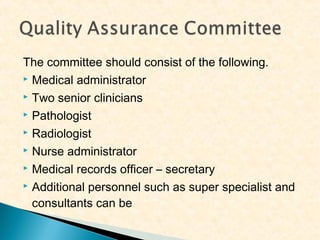
The committee should consist of the following.
 Medical administrator
 Two senior clinicians
 Pathologist
 Radiologist
 Nurse administrator
 Medical records officer – secretary
 Additional personnel such as super specialist and
consultants can be
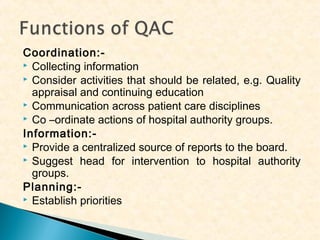
Coordination: Collecting information
 Consider activities that should be related, e.g. Quality
appraisal and continuing education
 Communication across patient care disciplines
 Co –ordinate actions of hospital authority groups.
Information: Provide a centralized source of reports to the board.
 Suggest head for intervention to hospital authority
groups.
Planning: Establish priorities
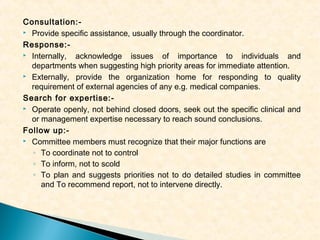
Consultation: Provide specific assistance, usually through the coordinator.
Response: Internally,
acknowledge issues of importance to individuals and
departments when suggesting high priority areas for immediate attention.
 Externally, provide the organization home for responding to quality
requirement of external agencies of any e.g. medical companies.
Search for expertise: Operate openly, not behind closed doors, seek out the specific clinical and
or management expertise necessary to reach sound conclusions.
Follow up: Committee members must recognize that their major functions are
◦ To coordinate not to control
◦ To inform, not to scold
◦ To plan and suggests priorities not to do detailed studies in committee
and To recommend report, not to intervene directly.


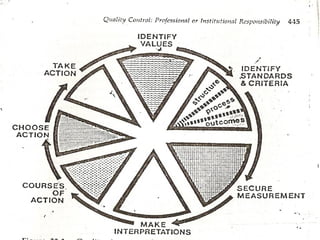
Quality assurance model in nursing is developed
by Lang and adapted by the American nurses
Association. The evaluation model is open and
circular, indicating a cyclical process that can be
entered at any point.


Emphasizes the need to clarify the social,
institutional, professional and individual values,
along with the advances in scientific knowledge
which influence nursing practice. Examination of
these beliefs offers insight into what clients,
nurses and others think is important in nursing
care.


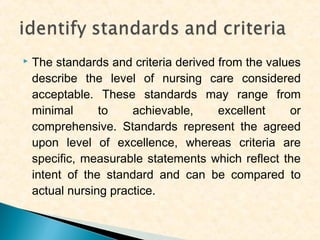
The standards and criteria derived from the values
describe the level of nursing care considered
acceptable. These standards may range from
minimal
to
achievable,
excellent
or
comprehensive. Standards represent the agreed
upon level of excellence, whereas criteria are
specific, measurable statements which reflect the
intent of the standard and can be compared to
actual nursing practice.




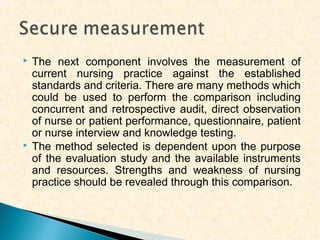
The next component involves the measurement of
current nursing practice against the established
standards and criteria. There are many methods which
could be used to perform the comparison including
concurrent and retrospective audit, direct observation
of nurse or patient performance, questionnaire, patient
or nurse interview and knowledge testing.
The method selected is dependent upon the purpose
of the evaluation study and the available instruments
and resources. Strengths and weakness of nursing
practice should be revealed through this comparison.


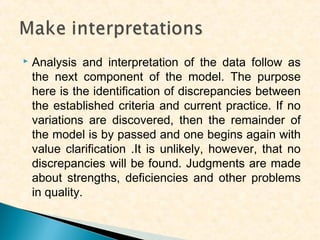
Analysis and interpretation of the data follow as
the next component of the model. The purpose
here is the identification of discrepancies between
the established criteria and current practice. If no
variations are discovered, then the remainder of
the model is by passed and one begins again with
value clarification .It is unlikely, however, that no
discrepancies will be found. Judgments are made
about strengths, deficiencies and other problems
in quality.


Suitable courses of action are then considered
.Alternatives intended to resolve discrepancies
and reward strengths are identified and examined.
Decisions may range from simple actions to
complex plans entailing many changes.


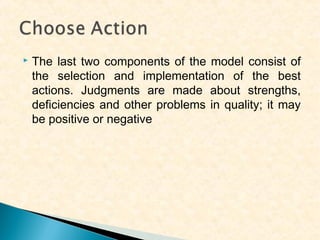
The last two components of the model consist of
the selection and implementation of the best
actions. Judgments are made about strengths,
deficiencies and other problems in quality; it may
be positive or negative


Some actions may need to be performed
immediately while others take longer to initiate.
The decisions as to which action to choose are
influenced by the organization context and
available resources. At this point the cycle is
repeated and the actions are reassessed to
determine if the expected improvements in
practice actually occurred or have been
maintained.











lack of Resources
personal problems
unreasonable patients and attendants
improper maintenance
absence of accreditation laws
lack of incident review procedures
lack of good hospital information system
absence of conducting patient satisfaction surveys
lack of nursing care records
Miscellaneous factors like lack of good supervision,
Absence of knowledge about philosophy of nursing
care, substandard education and training, lack of
policy and administrative manuals.
SUMMARY

CONCLUSION
Quality assurance

Quality assurance

  • 1.
  • 2.
    Defining and attemptingto measure quality of care is not new. Infact, the quality of health care is an idea generally attributed to ernest Codman, a physician who first proposed the end result idea in 1869.Quality of care can be evaluated from the perceptive in individuals, populations or communities. The main aim of quality assurance us to achieved desired outcomes
  • 3.
    Quality means usuallythink in terms of an excellent product or service that fulfills or exceeds our expectations.  Quality is defined “as the degree to which a set of inherent characteristics fulfills requirement”. 
  • 4.
     Quality care isthe term used to describe care and services that allow recipients to attain and maintain their highest level of physical and psychological health.
  • 5.
     Quality assurance isachievable through on going evaluation of patient care which would assure the hospital that all that was done for the patient.sakharkar B.M (1999)  Quality Assurance is a program adopted by an institution that is designed to promote the best possible care.Deloughery(1995)
  • 6.
    Help patients byimproving quality of care.  Assess competence of medical staff, serve as an impetus to keep up to date and prevent future mistakes.  Bring to notice of hospital administration the deficiencies and in correcting the causative factors.  Help to exercise a regulatory function.  Restricting undesirable procedures. 
  • 7.
        Quality assurance isa never ending process of creative destruction, with rapid advances in science and technology and medical knowledge continuous updating is essential. The emphasis is on establishing professional excellence patient satisfaction at a reasonable cost. Quality is not proportionate to the use of sophisticated technology or to be expense incurred. Technical imperative should not insist on prolonging life at any lost with no consideration to quality of life.
  • 8.
    If medical caregiven is substandard or it is of poor quality, its effects may be immediately noticed e.g. Fall from cot, wound infection, sudden death etc, poor quality care can effect: patients  family  society  hospitals  staff
  • 9.
    Effects on patients:a.Physical discomfort: e.g.  Disturbed sleep due to noise of staff talking loudly, cleaning utensils etc.  Wound infection  poor quality of food causing abdominal pain  I V fluid going out vein causing swelling or thrombophlebitis b. Mental stress c. Rise in complication d. Higher mortality rate e. Loss of working days f. Increased expenses
  • 10.
    Effects on family Inconveniences  Higher expenses  Frequent changes  Loss of trust  Black mailing, particularly for iatrogenic complications, refusing to pay the bills.
  • 11.
    Effects on society:Increased prevalence of certain disease  Increased risk of certain infections  Diminished productivity, unhealthy person is medically more demanding and economically less productive.  Avoiding use of scientific hospital management and taking treatment from other places.
  • 12.
    Effects on hospital:Increased length of stay leading – overcrowding in public hospitals, cross infection, reduction in turnover leading to longer waiting list for routine admissions, higher expenses, and shortage of linen.  Higher rate of complications leading to additional investigations, additional medications, need for revision surgery.  Accidents and mishaps  Hospital image getting tarnished  Adverse publicity by media which undermines other good services.
  • 13.
    Effects on staff:Reduced motivation  Indiscipline  Risk of infection to staff  Difficulty to attract good staff  Fast turn over  Frustration.
  • 14.
    Concurrent quality assurance The Retrospective quality assurance 
  • 15.
    1. External qualityassurance: Quality assurance can be evaluated by independent assessors (or) people from outside the institution/hospital. 2. Internal quality assurance: Quality assurance can be evaluated by local assessors (or) senior person from the same institution/hospital.
  • 16.
    The committee shouldconsist of the following.  Medical administrator  Two senior clinicians  Pathologist  Radiologist  Nurse administrator  Medical records officer – secretary  Additional personnel such as super specialist and consultants can be
  • 17.
    Coordination: Collecting information Consider activities that should be related, e.g. Quality appraisal and continuing education  Communication across patient care disciplines  Co –ordinate actions of hospital authority groups. Information: Provide a centralized source of reports to the board.  Suggest head for intervention to hospital authority groups. Planning: Establish priorities
  • 18.
    Consultation: Provide specificassistance, usually through the coordinator. Response: Internally, acknowledge issues of importance to individuals and departments when suggesting high priority areas for immediate attention.  Externally, provide the organization home for responding to quality requirement of external agencies of any e.g. medical companies. Search for expertise: Operate openly, not behind closed doors, seek out the specific clinical and or management expertise necessary to reach sound conclusions. Follow up: Committee members must recognize that their major functions are ◦ To coordinate not to control ◦ To inform, not to scold ◦ To plan and suggests priorities not to do detailed studies in committee and To recommend report, not to intervene directly.
  • 19.
     Quality assurance modelin nursing is developed by Lang and adapted by the American nurses Association. The evaluation model is open and circular, indicating a cyclical process that can be entered at any point.
  • 21.
     Emphasizes the needto clarify the social, institutional, professional and individual values, along with the advances in scientific knowledge which influence nursing practice. Examination of these beliefs offers insight into what clients, nurses and others think is important in nursing care.
  • 22.
     The standards andcriteria derived from the values describe the level of nursing care considered acceptable. These standards may range from minimal to achievable, excellent or comprehensive. Standards represent the agreed upon level of excellence, whereas criteria are specific, measurable statements which reflect the intent of the standard and can be compared to actual nursing practice.
  • 23.
      The next componentinvolves the measurement of current nursing practice against the established standards and criteria. There are many methods which could be used to perform the comparison including concurrent and retrospective audit, direct observation of nurse or patient performance, questionnaire, patient or nurse interview and knowledge testing. The method selected is dependent upon the purpose of the evaluation study and the available instruments and resources. Strengths and weakness of nursing practice should be revealed through this comparison.
  • 24.
     Analysis and interpretationof the data follow as the next component of the model. The purpose here is the identification of discrepancies between the established criteria and current practice. If no variations are discovered, then the remainder of the model is by passed and one begins again with value clarification .It is unlikely, however, that no discrepancies will be found. Judgments are made about strengths, deficiencies and other problems in quality.
  • 25.
     Suitable courses ofaction are then considered .Alternatives intended to resolve discrepancies and reward strengths are identified and examined. Decisions may range from simple actions to complex plans entailing many changes.
  • 26.
     The last twocomponents of the model consist of the selection and implementation of the best actions. Judgments are made about strengths, deficiencies and other problems in quality; it may be positive or negative
  • 27.
     Some actions mayneed to be performed immediately while others take longer to initiate. The decisions as to which action to choose are influenced by the organization context and available resources. At this point the cycle is repeated and the actions are reassessed to determine if the expected improvements in practice actually occurred or have been maintained.
  • 28.
              lack of Resources personalproblems unreasonable patients and attendants improper maintenance absence of accreditation laws lack of incident review procedures lack of good hospital information system absence of conducting patient satisfaction surveys lack of nursing care records Miscellaneous factors like lack of good supervision, Absence of knowledge about philosophy of nursing care, substandard education and training, lack of policy and administrative manuals.
  • 29.