






Mrs. Harpreet Kaur,
MSc Nursing 2nd Year
NIMS College of Nursing
NIMS University, Jaipur
INTRODUCTION
In the changing health care
environment, concerns over quality of
care are receiving greater attention
than ever before. As consumer become
more knowledgeable as a result of
increased information available to
them.
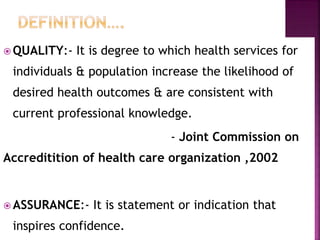
 QUALITY:- It is degree to which health services for
individuals & population increase the likelihood of
desired health outcomes & are consistent with
current professional knowledge.
- Joint Commission on
Accreditition of health care organization ,2002
 ASSURANCE:- It is statement or indication that
inspires confidence.
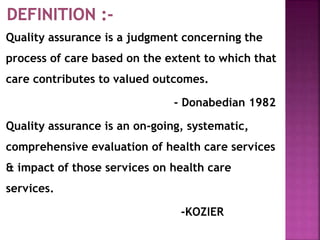
Quality assurance is a judgment concerning the
process of care based on the extent to which that
care contributes to valued outcomes.
- Donabedian 1982
Quality assurance is an on-going, systematic,
comprehensive evaluation of health care services
& impact of those services on health care
services.
-KOZIER
Quality assurance is defined as all
activities undertaken to predate & prevent
poor quality.
- NEETVERT
Quality assurance is a management system
designed to give maximum guarantee and ensure
confidence that the service provided is up to the
given accepted level of quality, the standards
prescribed for that service which is being
achieved with a minimum of total expenditure.
- -British Standards Institute
 To provide technical assistance in designing and
implementing effective strategies for monitoring
quality and correcting systemic deficiencies .
 To refine existing methods for ensuring optimal
quality health care through an applied research
programme .
 To support delivery of nursing care with
administrative & managerial services.
To explain quality assurance models as prerequisite
for quality nursing care.
 To state code of ethics & professional conduct for
nurses in India.
To appreciate importance of practicing standard
safety measures. To identify appropriate
management techniques to be used for managing
resources in given situation.
 To successfully achieve sustained improvement in health
care, clinics need to design processes to meet the needs
of patients.
 To design processes well and systematically monitor,
analyze, and improve their performance to improve
patient outcomes.
 To demonstrate efforts of health care providers to
provide good results.
 To prepare staff nurse for implementation
quality assurance model in nursing.
 To provide best care to patients by
maintaining standards.
 Rising expectations of consumer of services.
 Increasing pressure from national,
international, government and other
professional bodies to demonstrate that the
allocation of funds produces satisfactory
results in terms of patient care.
The increasing complexity of health care
organizations.
Improvement of job satisfaction.
Highly informed consumer
To prevent rising medical errors
Rise in health insurance industry
Accreditation bodies
Reducing global boundaries.
Customer focus- It focuses on patient’s care
with standard & recent medical knowledge.
Leadership – It helps to inculcate qualities of
leadership in staff.
Involvement of People- It should involve
maximum nursing staff so that standards can
be maintained.
 Process approach- There should be a systematic &
planned approach to provide quality care.
 Factual approach to decision making- There should
be fact or appropriate reason in taking certain
decision for quality assurance of patient.
 Managers and workers must be committed to
quality improvement. The goal of quality
management is to provide a system in which
workers can function effectively.
Customers define quality.
Quality improvement focuses on outcome.
Decisions must be based on data.
i) General approach
ii) Specific approach
i) General approach: - It involves large governing or
official bodies evaluating a person or agencies‘ ability to
meet established criteria or standard during a given time.
a) Credentialing- It is the formal recognition of
professional or technical competence and attainment of
minimum standards by a person and agency. Credentialing
process has 4 functional components
 To produce a quality product
 To confirm a unique identity
 To protect the provider and public
 To control the profession
b) Licensure- It is a contract between the profession and
the state in which the profession is granted control over
entry into an exit from the profession and over quality of
professional practice.
c) Accreditation- It is a process in which
certification of competency, authority, or
credibility is presented to an organization with
necessary standards.
d) Certification
e) Charter- It is a mechanism by which a state
government agency under state law grants corporate
state to institutions with or without right to award
degrees.
f) Recognition- It is defined as a process whereby one
agency accepts the credentialing states of and the
credential confined by another.
g) Academic degree
These are methods used to evaluate identified
instances of provider and client interactions.
a) Audit- It is an independent review conducted to
compare some aspect of quality performance, with a
standard for that performance.
b) Direct observation- Structured or unstructured
based on presence of set criteria.
c) Appropriateness evaluation- The extent to which the
managed care organization provides timely, necessary
care at right levels of service.
d) Peer review- Comparison of individual provider‘s
practice either with practice by the provider‘s peer or
with an acceptable standard of care.
e) Bench marking- A process used in performance
improvement to compare oneself with best practice.
f) Supervisory evaluation
g) Self-evaluation
h) Client satisfaction
i) Control committees
j) Services- Evaluates care delivered by an
institution rather than by an individual
provider.
l) Staging- It is the measurement of adverse outcomes
and the investigation of its antecedence.
m) Sentinel- It involves maintaining of factors that
may result in disease, disability or complications such
as;
 Review of accident reports
 Risk management
 Utilization review
I) Outpatient department- The points to be remembered
are;
 Reduction of waiting time in the OPD and for lab
investigations by creating more service outlets.
 Provide basic amenities like toilets, telephone, and
drinking water etc.
 Provision of polyclinic concept
to give all specialty services
under one roof.
Providing ambulatory services
or running day care centers.
II) Emergency medical services :-
Services must be provided by well trained and
dedicated staff, and they should have access to the
most sophisticated life- saving equipment and
materials, and also have the facility of rendering
pre- hospital emergency medical aid through a
quick reaction trauma care team provided with a
trauma care emergency van.
III) In- patient services :-
Provide a pleasant hospital stay to the patient through
provision of a safe, homely atmosphere, a listening ear,
human approach and well behaved, courteous staff.
IV) Specialty services :-
A high tech hospital with all types of specialty and super-
specialty services will increase the image of the hospital.
V) Training :-
A continuous training programme should
be present consisting of on the job
training‘, skill training workshops,
seminars, conferences, and case
presentations.
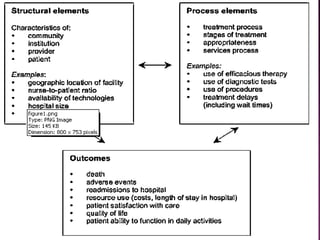
1. Donabedian Model (1985): It is a
model proposed for the structure, process
and outcome of quality. This linear model
has been widely accepted as the
fundamental structure to develop many
other models in QA.
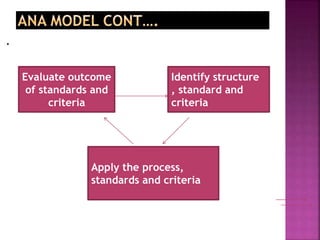
This first proposed and accepted model of
quality assurance was given by Long & Black in
1975. This helps in the self- determination of
patient and family, nursing health orientation,
patient‘s right to quality care and nursing
contributions.
.
Evaluate outcome
of standards and
criteria
Identify structure
, standard and
criteria
Apply the process,
standards and criteria
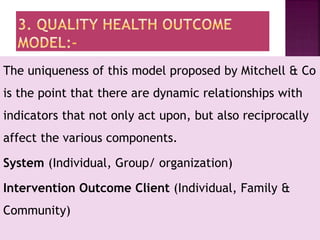
The uniqueness of this model proposed by Mitchell & Co
is the point that there are dynamic relationships with
indicators that not only act upon, but also reciprocally
affect the various components.
System (Individual, Group/ organization)
Intervention Outcome Client (Individual, Family &
Community)
 It is an improvement model advocated by Dr. Deming
which is still practiced widely that contains a distinct
improvement phase.
 Use of PDSA model assumes that a problem has been
identified and analyzed for its most likely causes and
that changes have been recommended for eliminating
the likely causes. Once the initial problem analysis is
completed, a Plan is developed to test one of the
improvement changes. During the Do phase, the change
is made, and data are collected to evaluate the results.
Study involves analysis of the data collected in
the previous step. Dataare evaluated for
evidence that an improvement has been made.
The Act step involves taking actions that will
‗hardwire‘ the change so that the gains made by
the improvement are sustained over time.
It refers to six standard deviations from the mean
and is generally used in quality improvement to
define the number of acceptable defects or errors
produced by a process. It consists of 5 steps:
define, measure, analyze, improve and control
(DMAIC).
 Define: Questions are asked about key customer
requirements and key processes to support those
requirements.
 Measure: Key processes are
identified and data are collected.
Analyze: Data are converted to
information; Causes of process
variation are identified.
Improve: This stage generates
solutions and make and measures
process changes.
Control: Processes that are
performing in a predictable way
at a desirable level are in control
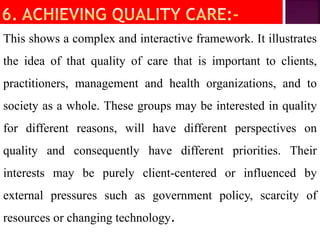
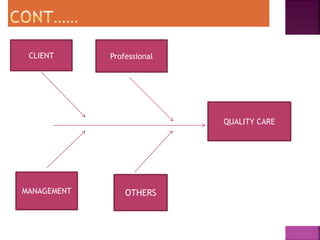
This shows a complex and interactive framework. It illustrates
the idea of that quality of care that is important to clients,
practitioners, management and health organizations, and to
society as a whole. These groups may be interested in quality
for different reasons, will have different perspectives on
quality and consequently have different priorities. Their
interests may be purely client-centered or influenced by
external pressures such as government policy, scarcity of
resources or changing technology.
At an individual level, everyone affects quality of
care-receptionists, telephones, building
maintenance staff, managers, clerical staff,
caterers, and professional staff. Quality is
everyone‘s business. There is a potential problem
here- since quality is everyone‘s business it can
become no one‘s business. In any organization
someone needs to take the responsibility for quality.
 Client
 Professional
CLIENT Professional
OTHERSMANAGEMENT
QUALITY CARE
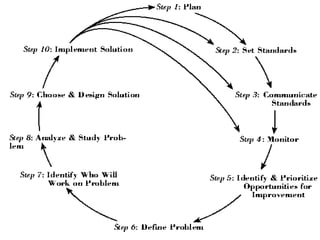
In practice, QA is a cyclical, iterative process that
must be applied flexibly to meet the needs of a
specific program. The process may begin with a
comprehensive effort to define standards and norms
as described in Steps 1-3, or it may start with small-
scale quality improvement activities (Steps 5-10).
Alternatively, the process may begin with monitoring
(Step 4). The ten steps in the QA process are
discussed.
1. Planning for Quality Assurance:- This first step prepares an
organization to carry out QA activities. Planning begins with a review of
the organizations scope of care to determine which services should be
addressed.
2. Setting Standards and Specifications :-To provide consistently
high-quality services, an organization must translate its programmatic
goals and objectives into operational procedures. In its widest sense, a
standard is a statement of the quality that is expected. Under the broad
rubric of standards there are practice guidelines or clinical protocols,
administrative procedures or standard operating procedures, product
specifications, and performance standards.
3. Communicating Guidelines and Standards :- Once standard
operating procedures, and performance standards have been
defined, it is essential that staff members communicate and
promote their use. This will ensure that each health worker,
supervisor, manager, and support person understands what is
expected of him or her. This is particularly important if ongoing
training and supervision have been weak or if guidelines and
procedures have recently changed. Assessing quality before
communicating expectations can lead to erroneously blaming
individuals for poor performance.
4. Monitoring Quality :-Monitoring is the routine
collection and review of data that helps to assess
whether program norms are being followed or whether
outcomes are improved. By monitoring key indicators,
managers and supervisors can determine whether the
services delivered follow the prescribed practices and
achieve the desired results.
5. Identifying Problems and Selecting Opportunities for
Improvement:- Program managers can identify quality
improvement opportunities by monitoring and evaluating
activities. Other means include soliciting suggestions from health
workers, performing system process analyses, reviewing patient
feedback or complaints, and generating ideas through
brainstorming or other group techniques. Once a health facility
team has identified several problems, it should set quality
improvement priorities by choosing one or two problem areas on
which to focus. Selection criteria will vary from program to
program.
6. Defining the Problem :- Having selected a
problem, the team must define it operationally-
as a gap between actual performance and
performance as prescribed by guidelines and
standards. The problem statement should
identify the problem and how it manifests itself.
It should clearly state where the problem begins
and ends, and how to recognize when the
problem is solved.
7. Choosing a Team :-Once a health facility staff has
employed a participatory approach to selecting and
defining a problem, it should assign a small team to address
the specific problem. The team will analyze the problem,
develop a quality improvement plan, and implement and
evaluate the quality improvement effort. The team should
comprise those who are involved with, contribute inputs or
resources to, and/or benefit from the activity or activities
in which the problem occurs.
8. Analyzing and Studying the Problem to Identify the
Root Cause:- Achieving a meaningful and sustainable
quality improvement effort depends on understanding the
problem and its root causes. Given the complexity of
health service delivery, clearly identifying root causes
requires systematic, in-depth analysis. Analytical tools such
as system modeling, flow charting, and cause-and-effect
diagrams can be used to analyze a process or problem.
9. Developing Solutions and Actions for Quality
Improvement :-The problem-solving team should now
be ready to develop and evaluate potential solutions.
Unless the procedure in question is the sole
responsibility of an individual, developing solutions
should be a team effort. It may be necessary to involve
personnel responsible for processes related to the root
cause.

10. Implementing and Evaluating Quality Improvement Efforts :-The
team must determine the necessary resources and time frame and
decide who will be responsible for implementation. It must also
decide whether implementation should begin with a pilot test in a
limited area or should be launched on a larger scale. The team should
select indicators to evaluate whether the solution was implemented
correctly and whether it resolved the problem it was designed to
address. In-depth monitoring should begin when the quality
improvement plan is implemented. It should continue until either the
solution is proven effective and sustainable, or the solution is proven
ineffective and is abandoned or modified. When a solution is
effective, the teams should continue limited monitoring.
Quality assurance is the responsibility of the
hospital management and (workers) health
personnel to assure a higher quality of care.
The administrators generally have to face
the consequences in terms of poor
reputation of the hospital, legal expenses
and higher hospital cost.
THANK YOU

Quality assurance

  • 1.
    Mrs. Harpreet Kaur, MScNursing 2nd Year NIMS College of Nursing NIMS University, Jaipur
  • 2.
    INTRODUCTION In the changinghealth care environment, concerns over quality of care are receiving greater attention than ever before. As consumer become more knowledgeable as a result of increased information available to them.
  • 3.
     QUALITY:- Itis degree to which health services for individuals & population increase the likelihood of desired health outcomes & are consistent with current professional knowledge. - Joint Commission on Accreditition of health care organization ,2002  ASSURANCE:- It is statement or indication that inspires confidence.
  • 4.
    Quality assurance isa judgment concerning the process of care based on the extent to which that care contributes to valued outcomes. - Donabedian 1982 Quality assurance is an on-going, systematic, comprehensive evaluation of health care services & impact of those services on health care services. -KOZIER
  • 5.
    Quality assurance isdefined as all activities undertaken to predate & prevent poor quality. - NEETVERT
  • 6.
    Quality assurance isa management system designed to give maximum guarantee and ensure confidence that the service provided is up to the given accepted level of quality, the standards prescribed for that service which is being achieved with a minimum of total expenditure. - -British Standards Institute
  • 7.
     To providetechnical assistance in designing and implementing effective strategies for monitoring quality and correcting systemic deficiencies .  To refine existing methods for ensuring optimal quality health care through an applied research programme .  To support delivery of nursing care with administrative & managerial services.
  • 8.
    To explain qualityassurance models as prerequisite for quality nursing care.  To state code of ethics & professional conduct for nurses in India. To appreciate importance of practicing standard safety measures. To identify appropriate management techniques to be used for managing resources in given situation.
  • 9.
     To successfullyachieve sustained improvement in health care, clinics need to design processes to meet the needs of patients.  To design processes well and systematically monitor, analyze, and improve their performance to improve patient outcomes.  To demonstrate efforts of health care providers to provide good results.
  • 10.
     To preparestaff nurse for implementation quality assurance model in nursing.  To provide best care to patients by maintaining standards.  Rising expectations of consumer of services.  Increasing pressure from national, international, government and other professional bodies to demonstrate that the allocation of funds produces satisfactory results in terms of patient care.
  • 11.
    The increasing complexityof health care organizations. Improvement of job satisfaction. Highly informed consumer To prevent rising medical errors
  • 12.
    Rise in healthinsurance industry Accreditation bodies Reducing global boundaries.
  • 13.
    Customer focus- Itfocuses on patient’s care with standard & recent medical knowledge. Leadership – It helps to inculcate qualities of leadership in staff. Involvement of People- It should involve maximum nursing staff so that standards can be maintained.
  • 14.
     Process approach-There should be a systematic & planned approach to provide quality care.  Factual approach to decision making- There should be fact or appropriate reason in taking certain decision for quality assurance of patient.  Managers and workers must be committed to quality improvement. The goal of quality management is to provide a system in which workers can function effectively.
  • 15.
    Customers define quality. Qualityimprovement focuses on outcome. Decisions must be based on data.
  • 16.
    i) General approach ii)Specific approach i) General approach: - It involves large governing or official bodies evaluating a person or agencies‘ ability to meet established criteria or standard during a given time. a) Credentialing- It is the formal recognition of professional or technical competence and attainment of minimum standards by a person and agency. Credentialing process has 4 functional components
  • 17.
     To producea quality product  To confirm a unique identity  To protect the provider and public  To control the profession b) Licensure- It is a contract between the profession and the state in which the profession is granted control over entry into an exit from the profession and over quality of professional practice.
  • 18.
    c) Accreditation- Itis a process in which certification of competency, authority, or credibility is presented to an organization with necessary standards. d) Certification
  • 19.
    e) Charter- Itis a mechanism by which a state government agency under state law grants corporate state to institutions with or without right to award degrees. f) Recognition- It is defined as a process whereby one agency accepts the credentialing states of and the credential confined by another. g) Academic degree
  • 20.
    These are methodsused to evaluate identified instances of provider and client interactions. a) Audit- It is an independent review conducted to compare some aspect of quality performance, with a standard for that performance. b) Direct observation- Structured or unstructured based on presence of set criteria.
  • 21.
    c) Appropriateness evaluation-The extent to which the managed care organization provides timely, necessary care at right levels of service. d) Peer review- Comparison of individual provider‘s practice either with practice by the provider‘s peer or with an acceptable standard of care. e) Bench marking- A process used in performance improvement to compare oneself with best practice.
  • 22.
    f) Supervisory evaluation g)Self-evaluation h) Client satisfaction i) Control committees j) Services- Evaluates care delivered by an institution rather than by an individual provider.
  • 23.
    l) Staging- Itis the measurement of adverse outcomes and the investigation of its antecedence. m) Sentinel- It involves maintaining of factors that may result in disease, disability or complications such as;  Review of accident reports  Risk management  Utilization review
  • 24.
    I) Outpatient department-The points to be remembered are;  Reduction of waiting time in the OPD and for lab investigations by creating more service outlets.  Provide basic amenities like toilets, telephone, and drinking water etc.
  • 25.
     Provision ofpolyclinic concept to give all specialty services under one roof. Providing ambulatory services or running day care centers.
  • 26.
    II) Emergency medicalservices :- Services must be provided by well trained and dedicated staff, and they should have access to the most sophisticated life- saving equipment and materials, and also have the facility of rendering pre- hospital emergency medical aid through a quick reaction trauma care team provided with a trauma care emergency van.
  • 27.
    III) In- patientservices :- Provide a pleasant hospital stay to the patient through provision of a safe, homely atmosphere, a listening ear, human approach and well behaved, courteous staff. IV) Specialty services :- A high tech hospital with all types of specialty and super- specialty services will increase the image of the hospital.
  • 28.
    V) Training :- Acontinuous training programme should be present consisting of on the job training‘, skill training workshops, seminars, conferences, and case presentations.
  • 29.
    1. Donabedian Model(1985): It is a model proposed for the structure, process and outcome of quality. This linear model has been widely accepted as the fundamental structure to develop many other models in QA.
  • 31.
    This first proposedand accepted model of quality assurance was given by Long & Black in 1975. This helps in the self- determination of patient and family, nursing health orientation, patient‘s right to quality care and nursing contributions.
  • 32.
    . Evaluate outcome of standardsand criteria Identify structure , standard and criteria Apply the process, standards and criteria
  • 33.
    The uniqueness ofthis model proposed by Mitchell & Co is the point that there are dynamic relationships with indicators that not only act upon, but also reciprocally affect the various components. System (Individual, Group/ organization) Intervention Outcome Client (Individual, Family & Community)
  • 34.
     It isan improvement model advocated by Dr. Deming which is still practiced widely that contains a distinct improvement phase.  Use of PDSA model assumes that a problem has been identified and analyzed for its most likely causes and that changes have been recommended for eliminating the likely causes. Once the initial problem analysis is completed, a Plan is developed to test one of the improvement changes. During the Do phase, the change is made, and data are collected to evaluate the results.
  • 35.
    Study involves analysisof the data collected in the previous step. Dataare evaluated for evidence that an improvement has been made. The Act step involves taking actions that will ‗hardwire‘ the change so that the gains made by the improvement are sustained over time.
  • 36.
    It refers tosix standard deviations from the mean and is generally used in quality improvement to define the number of acceptable defects or errors produced by a process. It consists of 5 steps: define, measure, analyze, improve and control (DMAIC).  Define: Questions are asked about key customer requirements and key processes to support those requirements.
  • 37.
     Measure: Keyprocesses are identified and data are collected. Analyze: Data are converted to information; Causes of process variation are identified. Improve: This stage generates solutions and make and measures process changes. Control: Processes that are performing in a predictable way at a desirable level are in control
  • 38.
    This shows acomplex and interactive framework. It illustrates the idea of that quality of care that is important to clients, practitioners, management and health organizations, and to society as a whole. These groups may be interested in quality for different reasons, will have different perspectives on quality and consequently have different priorities. Their interests may be purely client-centered or influenced by external pressures such as government policy, scarcity of resources or changing technology.
  • 39.
    At an individuallevel, everyone affects quality of care-receptionists, telephones, building maintenance staff, managers, clerical staff, caterers, and professional staff. Quality is everyone‘s business. There is a potential problem here- since quality is everyone‘s business it can become no one‘s business. In any organization someone needs to take the responsibility for quality.  Client  Professional
  • 40.
  • 41.
    In practice, QAis a cyclical, iterative process that must be applied flexibly to meet the needs of a specific program. The process may begin with a comprehensive effort to define standards and norms as described in Steps 1-3, or it may start with small- scale quality improvement activities (Steps 5-10). Alternatively, the process may begin with monitoring (Step 4). The ten steps in the QA process are discussed.
  • 43.
    1. Planning forQuality Assurance:- This first step prepares an organization to carry out QA activities. Planning begins with a review of the organizations scope of care to determine which services should be addressed. 2. Setting Standards and Specifications :-To provide consistently high-quality services, an organization must translate its programmatic goals and objectives into operational procedures. In its widest sense, a standard is a statement of the quality that is expected. Under the broad rubric of standards there are practice guidelines or clinical protocols, administrative procedures or standard operating procedures, product specifications, and performance standards.
  • 44.
    3. Communicating Guidelinesand Standards :- Once standard operating procedures, and performance standards have been defined, it is essential that staff members communicate and promote their use. This will ensure that each health worker, supervisor, manager, and support person understands what is expected of him or her. This is particularly important if ongoing training and supervision have been weak or if guidelines and procedures have recently changed. Assessing quality before communicating expectations can lead to erroneously blaming individuals for poor performance.
  • 45.
    4. Monitoring Quality:-Monitoring is the routine collection and review of data that helps to assess whether program norms are being followed or whether outcomes are improved. By monitoring key indicators, managers and supervisors can determine whether the services delivered follow the prescribed practices and achieve the desired results.
  • 46.
    5. Identifying Problemsand Selecting Opportunities for Improvement:- Program managers can identify quality improvement opportunities by monitoring and evaluating activities. Other means include soliciting suggestions from health workers, performing system process analyses, reviewing patient feedback or complaints, and generating ideas through brainstorming or other group techniques. Once a health facility team has identified several problems, it should set quality improvement priorities by choosing one or two problem areas on which to focus. Selection criteria will vary from program to program.
  • 47.
    6. Defining theProblem :- Having selected a problem, the team must define it operationally- as a gap between actual performance and performance as prescribed by guidelines and standards. The problem statement should identify the problem and how it manifests itself. It should clearly state where the problem begins and ends, and how to recognize when the problem is solved.
  • 48.
    7. Choosing aTeam :-Once a health facility staff has employed a participatory approach to selecting and defining a problem, it should assign a small team to address the specific problem. The team will analyze the problem, develop a quality improvement plan, and implement and evaluate the quality improvement effort. The team should comprise those who are involved with, contribute inputs or resources to, and/or benefit from the activity or activities in which the problem occurs.
  • 49.
    8. Analyzing andStudying the Problem to Identify the Root Cause:- Achieving a meaningful and sustainable quality improvement effort depends on understanding the problem and its root causes. Given the complexity of health service delivery, clearly identifying root causes requires systematic, in-depth analysis. Analytical tools such as system modeling, flow charting, and cause-and-effect diagrams can be used to analyze a process or problem.
  • 50.
    9. Developing Solutionsand Actions for Quality Improvement :-The problem-solving team should now be ready to develop and evaluate potential solutions. Unless the procedure in question is the sole responsibility of an individual, developing solutions should be a team effort. It may be necessary to involve personnel responsible for processes related to the root cause. 
  • 51.
    10. Implementing andEvaluating Quality Improvement Efforts :-The team must determine the necessary resources and time frame and decide who will be responsible for implementation. It must also decide whether implementation should begin with a pilot test in a limited area or should be launched on a larger scale. The team should select indicators to evaluate whether the solution was implemented correctly and whether it resolved the problem it was designed to address. In-depth monitoring should begin when the quality improvement plan is implemented. It should continue until either the solution is proven effective and sustainable, or the solution is proven ineffective and is abandoned or modified. When a solution is effective, the teams should continue limited monitoring.
  • 52.
    Quality assurance isthe responsibility of the hospital management and (workers) health personnel to assure a higher quality of care. The administrators generally have to face the consequences in terms of poor reputation of the hospital, legal expenses and higher hospital cost.
  • 53.