




MBA-IB                                      Global Marketing Management


                                                UNIT I

       OBJECTIVES
       To give a broader understanding of the Global marketing management concepts and
       main issues of Global business.      This unit gives students an understanding of the
       factors that how the international trade system and the economic, political, legal and
       cultural environments affect a company’s international marketing decisions.
              The main objectives of the chapter are:
              • to provide an overview of strategic concept of marketing with the major
                 principles of global market
              • to analyse the driving forces and various complexities of international
                 marketing
              • to evaluate the various entry strategies to international market
              • to identify the essentials of international market in the context of economic
                 development of less developed countries
       STRUCTURE
       1.     Introduction
       1.1    Meaning of Marketing
       1.2    Meaning of Global Marketing
       1.3    The Strategic Concept of Marketing
       1.4    The Three Principles of Marketing
       1.5    Transition from Domestic to International Marketing
       1.6    Driving Forces for International Market
       1.7    Complexities in International Marketing
       1.8    Significance of International Marketing and Economic Development
       1.9    The Global Marketing Environment
       1.10   Fundamental Different between International Trade and Interregional Trade
       1.11   Why Global Market is Imperative
       1.12   A Successful Global Marketing Plan
       1.13   International Market Orientation – FPRG
       1.14   International Market Entry Strategies
       1.15   Summary
       1.16   Self-Assessment Questions


       1. INTRODUCTION
       This unit is about “GLOBAL MARKETING” which we define as the process of
AcroPDF - A Quality PDF Writer(i.e. people, money, to create PDF assets) and objectives ofbuy a license.
      focusing the resources and PDF Converter and physical files. To remove the line, an
MBA-IB                                     Global Marketing Management


       organization on global market opportunities and threats. Two decades ago, the term
       global marketing did not even exist. Today, global marketing is essential not only for
       the realization of the full success potential of a business, but even more critically for
       the survival of a business. A company which fails to go global is in longer of losing
       it’s domestic business to competitors with lower costs, greater experience, better
       products and in a nutshell, more value for the customer.
       The importance of going global to ensure company survival is a more powerful motive
       for many companies than the attraction of opportunity abroad. Industries that were
       entirely national in scope only a few years ago are dominated today by a handful of
       global companies. This unit concentrate on the major dimensions of global marketing
       namely meaning and the strategic concept of marketing, the principles of marketing,
       transition from the domestic to transactional marketing, driving forces and
       complexities in International Marketing, Global Marketing Imperative, Global
       Marketing plan, International market orientation (EPRA) and International Market
       Entry Strategies.
       1.1. MEANING OF MARKETING
       Marketing is essentially a creative corporate activity involving the planning and
       execution of the conception, pricing, promotion, and distribution of ideas, products,
       and services in an exchange that not only satisfies customers’ current needs but also
       anticipates and creates their future needs at a profit. Marketing is not only much
       broader than selling, it also encompasses the entire company’s market orientation
       toward customer satisfaction in a competitive environment. In other words, marketing
       strategy requires close attention to both customers and competitors.
       1.2. MEANING OF GLOBAL MARKETING
       Global marketing refers to marketing activities by companies that emphasize the
       following:
       1. Reduction of cost inefficiencies and duplication of efforts among their national and
          regional subsidiaries
       2. Opportunities for the transfer of products, brands, and other ideas across
          subsidiaries
       3. Emergence of global customers
       4. Improved linkages among national marketing infrastructures leading to the development of a
          global marketing infrastructure.
       Although     Levitt’s   view   that   global   marketing   does    not   necessarily   mean
       standardization of products, promotion, pricing, and distribution worldwide, but
      rather, it is a company’s proactive willingness to adopt a global perspective instead of
AcroPDF - A Quality PDF Writer and PDF Converter to create PDF files. To remove the line, buy a license.
      a country-by-country or region-by-region perspective in developing a marketing
MBA-IB                                   Global Marketing Management


       strategy.
       1.3 The Strategic Concept of Marketing
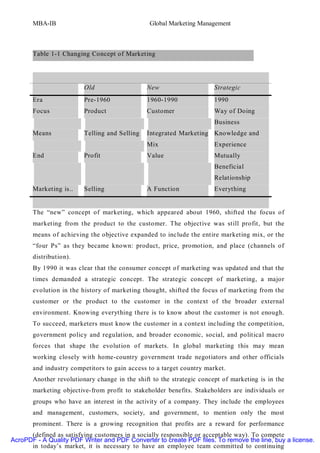
       During the past three decades the concept of marketing has changed dramatically. The
       marketing concept has evolved from the original concept, which focused marketing on
       the product. The objective was profit, and the means to achieving the objective was
       selling, or persuading the potential customer to exchange his or her money for the
       company’s product. (refer Table 1.1)


AcroPDF - A Quality PDF Writer and PDF Converter to create PDF files. To remove the line, buy a license.
MBA-IB                                   Global Marketing Management


       Table 1-1 Changing Concept of Marketing


                         Old                   New                     Strategic
       Era               Pre-1960              1960-1990               1990
       Focus             Product               Customer                Way of Doing
                                                                       Business
       Means             Telling and Selling   Integrated Marketing Knowledge and
                                               Mix                     Experience
       End               Profit                Value                   Mutually
                                                                       Beneficial
                                                                       Relationship
       Marketing is..    Selling               A Function              Everything


       The “new” concept of marketing, which appeared about 1960, shifted the focus of
       marketing from the product to the customer. The objective was still profit, but the
       means of achieving the objective expanded to include the entire marketing mix, or the
       “four Ps” as they became known: product, price, promotion, and place (channels of
       distribution).
       By 1990 it was clear that the consumer concept of marketing was updated and that the
       times demanded a strategic concept. The strategic concept of marketing, a major
       evolution in the history of marketing thought, shifted the focus of marketing from the
       customer or the product to the customer in the context of the broader external
       environment. Knowing everything there is to know about the customer is not enough.
       To succeed, marketers must know the customer in a context including the competition,
       government policy and regulation, and broader economic, social, and political macro
       forces that shape the evolution of markets. In global marketing this may mean
       working closely with home-country government trade negotiators and other officials
       and industry competitors to gain access to a target country market.
       Another revolutionary change in the shift to the strategic concept of marketing is in the
       marketing objective-from profit to stakeholder benefits. Stakeholders are individuals or
       groups who have an interest in the activity of a company. They include the employees
       and management, customers, society, and government, to mention only the most
       prominent. There is a growing recognition that profits are a reward for performance
      (defined as satisfying customers in a socially responsible or acceptable way). To compete
AcroPDF - A Quality PDF Writer and PDF Converter to create PDF files. To remove the line, buy a license.
      in today’s market, it is necessary to have an employee team committed to continuing
MBA-IB                                          Global Marketing Management


       innovation and to producing quality products. In other words, marketing must focus on
       the customer in context and deliver value by creating stakeholder benefits for both
       customers and employees.
       Profitabilit y is not forgotten in the strategic concept. Indeed, it is a critical means to
       the end of creating stakeholder benefits. The means of the strategic marketing concept
       is strategic management, which integrates marketing with the other management
       functions. One of the tasks of strategic management is to make a profit, which can be
       a source of funds for investing in the business and for rewarding shareholders and
       management. Thus, profit is still a critical objective and measure of marketing
       success, but it is not an end in itself. The aim of marketing is to create value for
       stakeholders, and the key stakeholder is the customer.
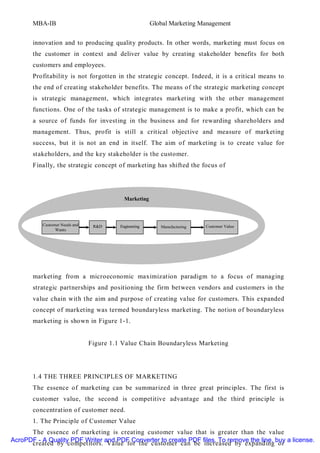
       Finally, the strategic concept of marketing has shifted the focus of


                                           Marketing


          Customer Needs and    R&D      Engineering      Manufacturing   Customer Value
                Wants


       marketing from a microeconomic maximization paradigm to a focus of managing
       strategic partnerships and positioning the firm between vendors and customers in the
       value chain with the aim and purpose of creating value for customers. This expanded
       concept of marketing was termed boundaryless marketing. The notion of boundaryless
       marketing is shown in Figure 1-1.


                               Figure 1.1 Value Chain Boundaryless Marketing


       1.4 THE THREE PRINCIPLES OF MARKETING
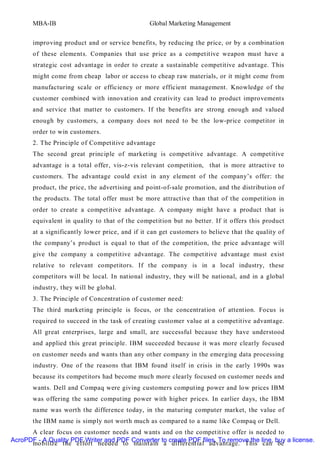
       The essence of marketing can be summarized in three great principles. The first is
       customer value, the second is competitive advantage and the third principle is
       concentration of customer need.
       1. The Principle of Customer Value
      The essence of marketing is creating customer value that is greater than the value
AcroPDF - A Quality PDF Writer and PDF Converter to create PDF files. To remove the line, buy a license.
      created by competitors. Value for the customer can be increased by expanding or
MBA-IB                                   Global Marketing Management


       improving product and or service benefits, by reducing the price, or by a combination
       of these elements. Companies that use price as a competitive weapon must have a
       strategic cost advantage in order to create a sustainable competitive advantage. This
       might come from cheap labor or access to cheap raw materials, or it might come from
       manufacturing scale or efficiency or more efficient management. Knowledge of the
       customer combined with innovation and creativity can lead to product improvements
       and service that matter to customers. If the benefits are strong enough and valued
       enough by customers, a company does not need to be the low-price competitor in
       order to win customers.
       2. The Principle of Competitive advantage
       The second great principle of marketing is competitive advantage. A competitive
       advantage is a total offer, vis-z-vis relevant competition, that is more attractive to
       customers. The advantage could exist in any element of the company’s offer: the
       product, the price, the advertising and point-of-sale promotion, and the distribution of
       the products. The total offer must be more attractive than that of the competition in
       order to create a competitive advantage. A company might have a product that is
       equivalent in quality to that of the competition but no better. If it offers this product
       at a significantly lower price, and if it can get customers to believe that the quality of
       the company’s product is equal to that of the competition, the price advantage will
       give the company a competitive advantage. The competitive advantage must exist
       relative to relevant competitors. If the company is in a local industry, these
       competitors will be local. In national industry, they will be national, and in a global
       industry, they will be global.
       3. The Principle of Concentration of customer need:
       The third marketing principle is focus, or the concentration of attention. Focus is
       required to succeed in the task of creating customer value at a competitive advantage.
       All great enterprises, large and small, are successful because they have understood
       and applied this great principle. IBM succeeded because it was more clearly focused
       on customer needs and wants than any other company in the emerging data processing
       industry. One of the reasons that IBM found itself in crisis in the early 1990s was
       because its competitors had become much more clearly focused on customer needs and
       wants. Dell and Compaq were giving customers computing power and low prices IBM
       was offering the same computing power with higher prices. In earlier days, the IBM
       name was worth the difference today, in the maturing computer market, the value of
       the IBM name is simply not worth much as compared to a name like Compaq or Dell.
      A clear focus on customer needs and wants and on the competitive offer is needed to
AcroPDF - A Quality PDF Writer and PDF Converter to create PDF files. To remove the line, buy a license.
      mobilize the effort needed to maintain a differential advantage. This can be
MBA-IB                                   Global Marketing Management


       accomplished only by focusing or concentrating resources and efforts on customer
       needs and wants and on how to deliver a product that will meet those needs and wants.
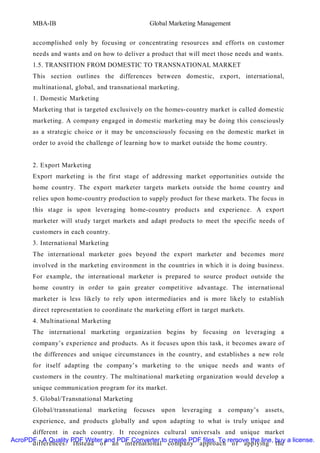
       1.5. TRANSITION FROM DOMESTIC TO TRANSNATIONAL MARKET
       This section outlines the differences between domestic, export, international,
       multinational, global, and transnational marketing.
       1. Domestic Marketing
       Marketing that is targeted exclusively on the homes-country market is called domestic
       marketing. A company engaged in domestic marketing may be doing this consciously
       as a strategic choice or it may be unconsciously focusing on the domestic market in
       order to avoid the challenge of learning how to market outside the home country.


       2. Export Marketing
       Export marketing is the first stage of addressing market opportunities outside the
       home country. The export marketer targets markets outside the home country and
       relies upon home-country production to supply product for these markets. The focus in
       this stage is upon leveraging home-country products and experience. A export
       marketer will study target markets and adapt products to meet the specific needs of
       customers in each country.
       3. International Marketing
       The international marketer goes beyond the export marketer and becomes more
       involved in the marketing environment in the countries in which it is doing business.
       For example, the international marketer is prepared to source product outside the
       home country in order to gain greater competitive advantage. The international
       marketer is less likely to rely upon intermediaries and is more likely to establish
       direct representation to coordinate the marketing effort in target markets.
       4. Multinational Marketing
       The international marketing organization begins by focusing on leveraging a
       company’s experience and products. As it focuses upon this task, it becomes aware of
       the differences and unique circumstances in the country, and establishes a new role
       for itself adapting the company’s marketing to the unique needs and wants of
       customers in the country. The multinational marketing organization would develop a
       unique communication program for its market.
       5. Global/Transnational Marketing
       Global/transnational   marketing    focuses upon      leveraging   a   company’s   assets,
       experience, and products globally and upon adapting to what is truly unique and
      different in each country. It recognizes cultural universals and unique market
AcroPDF - A Quality PDF Writer and PDF Converter to create PDF files. To remove the line, buy a license.
      differences. Instead of an international company approach of applying the
MBA-IB                                    Global Marketing Management


       communications campaign developed for the home country, or a multinational
       approach of creating a unique campaign in each country, the global/transnational
       company would distinguish between what was global and universal and what was
       country specific and unique. For example, it might conclude based upon in-depth
       research that it should develop a global creative platform for a product where
       sampling was a key success factor in gaining market penetration. The task of each
       country marketing team in this case would be to develop a unique national sampling
       plan. The country marketing team would draw upon global creative and combine that
       with national sampling.
       Global marketing does not mean entering every country in the world. The decision to
       enter markets outside the home country depends upon a company’s resources and the
       nature of opportunities and threats. Coke and IBM operate in over 100 countries
       because they began their international expansion over 50 years ago and they have had
       the resources to establish themselves wherever there is opportunity.
       1.6. DRIVING FORCES FOR INTERNATIONAL MARKETING
       The following are the forces that are contributing to the growth of international
       marketing.
       1. Market Needs and Effort
       There is a common element in human nature and in the human psyche that is the underlying
       basis for the opportunity to create and serve global markets. Most global markets do not
       exist in nature. They must be created by marketing effort. For example, soft drinks, one of
       the biggest successful global industries, are not needed by anyone and yet today in some
       countries soft-drink consumption per capita exceeds the consumption of water. Marketing
       has driven this change in behavior.
       Advanced global companies have discovered that the same basic segment need can be met
       with a global approach in selected product markets. Successful global strategies are based
       on performing a global function or serving a global need. Any industry which addresses
       these universals is a candidate for globalization. The advertising campaign for a global
       product may be a global appeal which is adapted to each national culture.
       2. Technology
       A powerful force drives the world toward a converging commonality, and that force is
       technology. Technology is a universal, uniform, consistent factor across national and
       cultural boundaries. There are no cultural boundaries limit ing the application of
       technology. Once a technology is developed, it immediately becomes available
       everywhere in the world. If a company knows how to manage a technology in one
      country, it has experience that is relevant for the rest of the world.
AcroPDF - A Quality PDF Writer and PDF Converter to create PDF files. To remove the line, buy a license.
      3. Cost
MBA-IB                                   Global Marketing Management


       The pressure for globalization is intense when new products involve major
       investments and long periods of development. This is true for pharmaceuticals, where
       new product typically cost $50 million to $100 million to develop over a period of six
       to ten years. The enormous cost and risk of new product development must be
       recovered in the global marketplace, as no single national market is large enough to
       support investments of this size.
       4. Quality
       Global volume generates greater revenue and greater operating margins to support
       design and manufacturing quality. A global and a local company may each spend 5
       percent of sales on research and development, but the global company may have two,
       three, or even ten times the total revenue of the local. With the same percentage of
       sales spent on research and development, the global will outspend the local by a factor
       of two, three, or ten times, as the case may be.
       5. Communications and Transportation
       The information revolution contributes toward the emergence of global markets.
       Everybody wants the best, latest, and most modern expression of a products. In
       regional markets such as Europe, the increasing overlap of advertising across national
       boundaries and the mobility of consumers have created a pressure on marketers to
       align product positioning and strategy in adjacent markets. You see this in companies
       like Nestle who have a tradition of decentralized country marketing efforts and who
       operate in markets where local tastes have developed over centuries. Even this
       combination of local preferences and decentralized marketing is subject to the
       pressure of overlapping communications and travel.
       6. Leverage
       One of the unique advantages of a global company is an opportunity to develop
       leverage and advantages that it has because it operates simultaneously in more than
       one national market. A global can develop five types of leverage.
       i) Experience Transfers: A global company can leverage its experience in any market
          in the world. It can draw upon strategies, products, advertising appeals, sales
          management practices, promotional ideas, and so on that have been tested in actual
          markets and apply them in other comparable markets.
       ii) Systems Transfers: A global company can refine its planning, analysis, research
          control, and other system and apply the refinements worldwide. The leveraging of
          systems improvements also makes it possible for company staff to communicate
          with each other.
      iii) Scale Economies: In manufacturing, the global company can take advantage of
AcroPDF - A Quality PDF Writer and PDF Converter to create PDF files. To remove the line, buy a license.
          its greater volume to obtain the traditional single-plant scale advantages and it can
MBA-IB                                    Global Marketing Management


          also combine into finished product components manufactured in scale efficient
          plants in different countries.
       iv) Resource Utilization: A major strength of the global company is its ability to scan
          the entire world to identify people, money, and materials will enable it to compete
          most effectively in world markets.
       v) Global Strategy: The global company’s greatest single advantage is its global
          strategy. A global strategy is based on scanning the world business environment to
          identify opportunities, threats, trends, and resources. The global company searches
          the world for markets that will provide an opportunity to apply its skills and
          resources to create value for customers that is greater than the value created by its
          competitors. The global strategy is a design to create a winning offering on a
          global scale. This takes great discipline, great creativity, and constant effort, but
          the reward is not just success-it’s survival.
       1.7. COMPLEXITIES IN INTERNATIONAL MARKETING
       This section outlines the various complexity in international marketing.
       1. Market Differences
       In every product category, differences are still great enough across national and
       cultural boundaries to require adoption of at least some elements of the marketing mix
       (product, price, advertising and promotion, and channels of distribution). Global
       marketing does not work without a strong local team who can adapt the product to
       local conditions.
       2. Brand History
       Even in cases where the product itself may be a good candidate for globalization, a
       brand’s history may require a distinct and different marketing strategy and positioning
       in each country. This is true even for high-potential products such as the image-driven
       brands. If a brand has an established identity in national markets, it may not be
       possible to achieve a single global position and strategy.
       3. Management Myopia
       In many cases, products and categories are candidates for globalization, but
       management does not seize the opportunity. A good example of management myopia
       is any company that does not maintain leadership in creating customer value in an
       expanding geographical territory. A company that looks backward will not expand
       geographically.


       4. Organizational Culture
      The successful global companies are marketers who have learned how to integrate
AcroPDF - A Quality PDF Writer and PDF Converter to create PDF files. To remove the line, buy a license.
      global vision and perspective with local market initiative and input.
MBA-IB                                   Global Marketing Management


       5. National Controls/Barriers to Entry
       Every country protects local enterprise and interests by maintaining control over
       market access and entry. Today, tariff barriers have been largely removed in the high-
       income countries. The significant barriers are the so-called nontraiff barriers that
       make it difficult for foreign companies to gain access to a domestic market. The
       worldwide movement toward deregulation and privatization, by breaking the link
       between government and enterprise, is an initiative that will lead to a significant
       opening up of formerly closed markets.
       1.8. SIGNIFICANCE OF INTERNATIONAL MARKETING AND ECONOMIC
              DEVELOPMENT
       The role of foreign trade in economic development is considerable. The classical and
       neo-classical economists attached so much importance to international trade in a
       country’s development that they regarded it as an engine of growth. We shall discuss
       how international trade helps economic development towards the progress of less
       developed countries. (LDCs)
       This section focus on direct and indirect benefits on foreign trade to LDCs
       International trade possesses great importance for LDCs.
       It provides the urge to develop the knowledge and experience that make development
       possible, and the means to accomplish it. Herberlier opines, “My overall conclusion is
       that international trade has made a tremendous contribution to the development of less
       developed countries in the 19 th and 20 th centuries and can be expected to make an
       equally big contribution in the future…. And that substantial free trade with marginal,
       insubstantial correction and deviations, is the best policy from the point of view of
       economic development”.
       When a country specializes in the production of a few goods due to international trade
       and division of labour, it exports those commodities which it produces cheaper in
       exchange for what others can produce at a lower cost. It gains from trade and there is
       increase in national income which, in turn, raises the level of output and the growth
       rate of economy. Thus the higher level of output through trade tends to break the
       vicious circle of poverty and promotes economic development.
       An LDC is hampered by the small size of its domestic market which fails to absorb
       sufficient volume of output. This leads to low inducement to investment. The size of
       the market is also small because of low per capita income and of purchasing power.
       International trade widens the market and increases the inducement to invest income
       and saving through more efficient resource allocation.
      Myint has applied Smith’s “vent for surplus” theory to the LDCs for measuring the
AcroPDF - A Quality PDF Writer and PDF Converter to create PDF files. To remove the line, buy a license.
      effects of gains from international trade. The introducing of foreign trade opens the
MBA-IB                                   Global Marketing Management


       possibilit y of a “vent for surplus” (or potential surplus) in the primary producing
       LDCs. Since land and labour are underutilized in the traditional subsistence sector in
       such a country, its opening up to foreign trade provides larger opportunities to
       produce more primary products in exchange for imports of manufactured products
       which it cannot itself produce. Thus it benefit from international trade.
       The vent for surplus theory, as applied to an LDC, is explained in Fig.1.2. Before
       trade with under utilised resources, the country is producing and consuming OX 1 of
       primary products and X 1 E of manufactured products at point E inside the production
       possibilit y curve AB. With the opening up of foreign trade, the production point
       shifts from E to D on the production possibilit y curve AB. Now the utilisation of
       formerly underutilised land and labour enables the country to increase its production
       of primary exportables from OX 1 to OX 2 without any sacrifice in the production of
       other goods and services. Given the international terms of trade line PP’, the country
       exchanges ED (=X 1 X 2 ) more of primary exportable against EC larger manufactured
       importables.


AcroPDF - A Quality PDF Writer and PDF Converter to create PDF files. To remove the line, buy a license.
MBA-IB                                            Global Marketing Management


                                            P


                                                     C
                       Importable


                                    A


                                                                  D
                                            E
                                                           Fig 1.2
                                                                  P’

                                        O       X1         X2         B

                                                     Exportable

              Moreover, many underdeveloped countries specialize in the production of one or
       two staple commodities. If efforts are made to export them, they tend to widen the
       market. The existing resources are employed more productively and the resources allocation
       becomes more efficient with given production functions.
       As a result, unemployment and underemployment are reduced; domestic saving and
       investment increase; there is a larger inflow of factor inputs into the expanding export
       sector; and greater backward and forward linkages with other sectors of the economy.
       This is known as the “staple theory of economic growth”, associated with Watkins.
       Foreign trade also helps to transform the subsistence sector into the monetized sector
       by providing markets for farm produce and raises the income and the standards of
       living of the peasantry. The expansion of the market leads to a number of internal and
       external economies, and hence to reduction in cost of production. These are the direct
       or static gains from international trade.
       Let us study the following indirect benefits of foreign trade to under developed
       countries in detail.
       First, foreign trade helps to exchange domestic goods having low growth potential for
       foreign goods with high growth potential. The staple commodities of underdeveloped
       countries are exchanged for machinery, capital goods, raw materials, and semi-
       finished products required for economic development. Being deficient in capital goods
       and materials, they are able to quicken the pace of development by importing them

AcroPDF - A Quality PDF countries, PDF Converter to create PDF files. To remove the line, and a license.
      from developed Writer and and establishing social and economic overheads buy
MBA-IB                                   Global Marketing Management


       directly productive activities. Thus larger exports enlarge the volume of imports of
       equipment that can be financed without endangering the balance of payments and the
       greater degree of freedom makes it easier to plan domestic investment for
       development.
       Second, foreign trade possesses an “educative effect”. Underdeveloped countries lack
       in critical skills, which are a greater hindrance to development than is the scarcity of
       capital goods. Foreign trade tends to overcome this weakness.
       Third, foreign trade provides the basis for the importation of foreign capital in LDCs.
       If there were no foreign trade, foreign capital would not flow from the rich to the poor
       countries. The volume of foreign capital depends, among other factors, on the volume
       of trade. The larger the volume of trade, the greater will be the ease with which a
       country can pay back interest and principal. It is, however, much easier to get foreign
       capital for export-increasing industries than for import substitution and public utilit y
       industries. But from the point of view of the importing country, the use of foreign
       capital for import substitution, public utilities and manufacturing industries is more
       beneficial for accelerating development than merely for export promotion. Foreign
       capital not only helps in increasing employment, output and income but also
       smoothens the balance of payments and inflationary pressures. Further; it provides
       machines, equipments, know-how, skills, ideas, and trains native labour.
       Lastly, foreign trade benefits an LDC indirectly by fostering healthy competition and
       checking inefficient monopolies. Healthy competition is essential for the development
       of the export sector of such economies and for checking inefficient exploitative
       monopolies that are usually established on the grounds of infant industry protection.
       1.9. THE GLOBAL MARKETING ENVIRONMENT
       1. Demographic Environment
       Demography is the study of human populations in terms of size, density, location, age,
       gender, race, occupation, and other statistics. The demographic environment is of
       major interest to marketers because it involves people, and people make up markets.
       The world population is growing at an explosive rate. It now totals more than 5.9
       billion and will exceed 7.9 billion by the year 2025. the explosive world population
       growth has major implications for business. A growing population means growing
       human needs to satisfy. Depending on purchasing power, it may also mean growing
       market opportunities.
       The world’s large and highly diverse population poses both opportunities and
       challenges. Thus, marketers keep close track of demographic trends and developments
      in their markets, both at home and abroad. They track changing age and family
AcroPDF - A Quality PDF Writer and PDF Converter to create PDF files. To remove the line, buy a license.
      structures, geographic population shifts, educational characteristics, and population
MBA-IB                                   Global Marketing Management


       diversity.
       2. Economic Environment
       The economic environment consists of factors that affect consumer purchasing power
       and spending patterns. Nations vary greatly in their levels and distribution of income.
       Some countries have subsistence economies they consume most of their own
       agricultural and industrial output. These countries offer few market opportunities. At
       the other extreme are industrial economies, which constitute rich markets for many
       different kinds of goods. Marketers must pay close attention to major trends and
       consumer spending patterns both across and within their world markets.
       Marketers should pay attention to income distribution as well as average income.
       Income distribution in the still very poor. At the top are upper-class consumers, whose
       spending patterns are not affected by current economic events and who are a major
       market for luxury goods. There is a comfortable middle class that is some what careful
       about its spending but can still afford the good life some of the time. The working
       class must stick close to the basics of food, clothing, and shelter and must try hard to
       save. Finally, the poor class must count their pennies when making even the most
       basic purchases. Over the past three decades, the rich have grown richer, the middle
       class has shrunk, and the poor have remained poor.
       3. Natural Environment
       The natural environment involves the natural resources that are needed as inputs by
       marketers or that are affected by marketing activities.
       Marketers should be aware of several trends in the natural environment. The first
       involves growing shortages of raw materials. Air and water may seem to be infinite
       resources, but some group see long-run dangers. Air pollution chokes many of the
       world’s large cities and water shortages are already a big problem in some parts of the
       world. Renewable resources, such as forests and food, also have to be used wisely.
       Nonrenewable resources, such as oil, coal, and various minerals, pose a serious
       problem. Firms making resources, such as oil, coal, and various minerals, pose a
       serious problem. Firms making products that require these scarce resources face large
       cost increases, even if the materials do remain available.
       A second environmental trend is increased pollution. Industry will almost always
       damage the quality of the natural environment. Consider the disposal of chemical and
       nuclear wastes; the dangerous mercury levels in the ocean; the quantity of chemical
       pollutants in the soil and food supply; and the littering of the environment with non-
       biodegradable bottles, plastics, and other packaging materials.
      A third trend is increased government intervention in natural resource management. The
AcroPDF - A Quality PDF Writer and PDF Converter to create PDF files. To remove the line, buy a license.
      governments of different countries vary in their concern and efforts to promote a clean
MBA-IB                                      Global Marketing Management


       environment.
       4. Technological Environment
       The technological environment is perhaps the most dramatic force now shaping our
       destiny. Technology has released such wonders as antibiotics, organ transplants,
       computers, and the Internet. It also has released such horrors as nuclear missiles,
       chemical weapons, and assault rifles. It has released such mixed blessing as the
       automobile, television, and credit cards.
       New technologies create new markets and opportunities. However, every new
       technology replaces an older technology. Transistors hurt the vacuum-tube industry,
       xerography hurt the carbon-paper business, the auto hurt the railroads, and compact
       disks hurt phonograph records. When old industries fought or ignored new
       technologies,   their   businesses   declined.    Thus,   marketers   should    watch   the
       technological environment closely. Companies that do not keep up with technological
       change soon will find their products outdated. And they will miss new product and
       market opportunities.
       4. Political Environment
       Marketing decisions are strongly affected by developments in the political environment.
       The political environment consists of laws, government agencies, and pressure groups that
       influence and limit various organizations and individuals in a given society.
       Even the most liberal advocates of free-market economies agree that the system works
       best with at least some regulation. Well-conceived regulation can encourage
       competition and ensure fair markets for goods and services. Thus, governments
       develop public policy to guide commerce-sets of laws and regulations that limit
       business for the good of society as a whole. Almost every marketing activity is subject
       to a wide range of laws and regulations.
       Legislation affecting business around the world has increased steadily over the years.
       The States has many laws covering issues such as competition, fair trade practices,
       environmental protection, product safety, truth in advertising, packaging and labeling,
       pricing, and other important areas. The European Commission has been active in
       establishing a new framework of laws covering competitive behavior, product
       standards, product liability, and commercial transactions for the nations of the
       European Union. Several countries have gone father than the United States in passing
       strong consumerism legislation. For example, Norway bans several forms of sales
       promotion trading stamps, contests, premiums as being inappropriate or unfair ways of
       promoting products. Thailand requires food         processors selling national brands to
      market low-price brands also, so that low-income consumers can find economy brands
AcroPDF - A Quality PDF Writer and PDF Converter to create PDF files. To remove the line, buy a license.
      on the shelves. In India, food companies must obtain special approval to launch
MBA-IB                                         Global Marketing Management


       brands that duplicate those already existing on the market.
       5. Cultural Environment
       The cultural environment is made up of institutions and other forces that affect a
       society’s basic values, perceptions, preferences, and behaviors. People grow up in a
       particular society that shapes their basic beliefs and values. They absorb a world view
       that defines their relationships with others.
       People in a given society hold many beliefs and values. Their core beliefs and values
       have a high degree of persistence. For example, most Indians believe in working,
       getting married, giving to charity, and being honest. These beliefs shape more-specific
       attitudes and behaviors found in everyday life. Core beliefs and values are passed on
       from parents to children and are reinforced by schools, churches, business, and
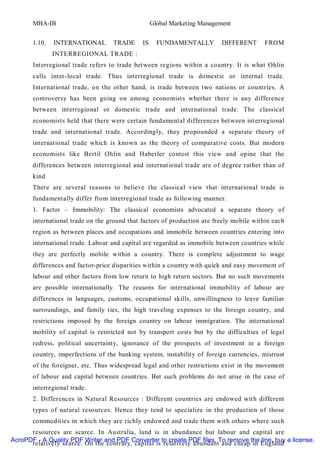
       government. The notion of various environmental forces to global company is shown
       in figure 1.3.


                                               l    Techn
                                        Natura            ol
                                  mi
                                    c   Forces        Forc ogica
                                                          es    l
                               ono es
                                                                      P
                             Ec orc                                 Fo olit
                               F                                      rc ica
                      hic                                               e l
                                                                         s
                     p
                    ra e s                       acro En                     C
                   g r c                  ’s M          vir               F u
                                                                          o ltu
                   o o                  ny                 on              r r
                  mF
                  e                   pa                     m             c a
                                                                            e l
                  D                  m                        e             s
                                    o                         n
                                    C                          t

                  Fig. 1.3 Environmental Forces to Global Company


AcroPDF - A Quality PDF Writer and PDF Converter to create PDF files. To remove the line, buy a license.
MBA-IB                                      Global Marketing Management


       1.10.   INTERNATIONAL       TRADE      IS     FUNDAMENTALLY         DIFFERENT      FROM
               INTERREGIONAL TRADE :
       Interregional trade refers to trade between regions within a country. It is what Ohlin
       calls inter-local trade. Thus interregional trade is domestic or internal trade.
       International trade, on the other hand, is trade between two nations or countries. A
       controversy has been going on among economists whether there is any difference
       between interregional or domestic trade and international trade. The classical
       economists held that there were certain fundamental differences between interregional
       trade and international trade. Accordingly, they propounded a separate theory of
       international trade which is known as the theory of comparative costs. But modern
       economists like Bertil Ohlin and Haberler contest this view and opine that the
       differences between interregional and international trade are of degree rather than of
       kind
       There are several reasons to believe the classical view that international trade is
       fundamentally differ from interregional trade as following manner.
       1. Factor – Immobility: The classical economists advocated a separate theory of
       international trade on the ground that factors of production are freely mobile within each
       region as between places and occupations and immobile between countries entering into
       international trade. Labour and capital are regarded as immobile between countries while
       they are perfectly mobile within a country. There is complete adjustment to wage
       differences and factor-price disparities within a country with quick and easy movement of
       labour and other factors from low return to high return sectors. But no such movements
       are possible internationally. The reasons for international immobility of labour are
       differences in languages, customs, occupational skills, unwillingness to leave familiar
       surroundings, and family ties, the high traveling expenses to the foreign country, and
       restrictions imposed by the foreign country on labour immigration. The international
       mobility of capital is restricted not by transport costs but by the difficulties of legal
       redress, political uncertainty, ignorance of the prospects of investment in a foreign
       country, imperfections of the banking system, instability of foreign currencies, mistrust
       of the foreigner, etc. Thus widespread legal and other restrictions exist in the movement
       of labour and capital between countries. But such problems do not arise in the case of
       interregional trade.
       2. Differences in Natural Resources : Different countries are endowed with different
       types of natural resources. Hence they tend to specialize in the production of those
       commodities in which they are richly endowed and trade them with others where such
      resources are scarce. In Australia, land is in abundance but labour and capital are
AcroPDF - A Quality PDF Writer and PDF Converter to create PDF files. To remove the line, buy a license.
      relatively scarce. On the contrary, capital is relatively abundant and cheap in England
MBA-IB                                       Global Marketing Management


       while land is scarce and dear there. Thus commodities requiring more capital, such as
       manufactures, can be produced in England; while such commodities as wool, mutton,
       wheat etc. requiring more land can be produced in Australia. Thus both countries can
       trades each other commodities on the basis of comparative cost differences in the
       production of different commodities.
       3. Geographical and Climate Differences : Every country cannot produce all
       commodities due to geographical and climatic conditions, except at possibly
       prohibitive costs. For instance, Brazil has favourable climate and geographical
       conditions for the production of coffee, Bangladesh for jute, Cuba for beet sugar, etc.
       So countries having climatic and geographical advantages specialize in the production
       of particular commodities and trade them with others.
       4. Different Market : International markets are separated by differences in language,
       usage, habit, taste, etc. Even the systems of weights and measures and pattern and
       styles in machinery and equipment differ from country to country. For instance,
       British railway engines and freight cars are basically different from those in France or
       in the United States. Thus goods which may be traded within regions may not be sold
       in other countries. That is why, in great many cases products to be sold in foreign
       countries are especially designed to confirm to the national characteristics of that country.
       5. Different Currencies : The principle difference between interregional and
       international trade lies in the use of different currencies in foreign trade but the same
       currency in domestic trade. Rupee is accepted throughout India. But if we cross over
       to Nepal or Pakistan, we must convert our rupee into their rupee to buy good and
       services there.
       It is not the differences in currencies alone that are important in international trade,
       but changes in their relative values. Every time a change occurs in the value of one
       currency in terms of another, a number of economic problems arise. Calculation and
       execution of monetary exchange transactions incident to international trading
       constitute costs and risks of a kind that are not ordinarily involved in domestic trade.
       Further currencies of some countries like the American dollar, the British pound, the
       German mark and the Japanese yen, are more widely used in international
       transactions, while others are almost inconvertible. Such tendencies tend to create
       more economic problems at the international market.
       6. Problem of Balance of Payment : Another important point which distinguishes
       international trade from interregional trade is the problem of balance of payments.
       The problem of balance of payment is perpetual in international trade while regions
      within a country have no such problem. This is because there is greater mobility of
AcroPDF - A Quality PDF Writer and PDF Converter to create PDF files. To remove the line, buy a license.
      capital within regions than between countries. Further, the policies which a country
MBA-IB                                    Global Marketing Management


       chooses to correct its disequilibrium in the balance of payments may give rise to a
       number of other problems. If it adopts deflation or devaluation or restrictions on
       imports or the movement of currency, they create further problems. But such problems
       do not arise in the case of interregional trade.
       7. Transport Cost : Trade between countries involves high transport costs as against
       interregionally within a country because of geographical distances.
       8. Different Political Groups : A significant distinction between interregional and
       international trade is that all regions within a country belong to one political unit while
       different countries have different political units. Interregional trade is among people
       belonging to the same country even though they may differ on the basis of castes, creeds,
       religions, tastes or customs. They have a sense of belonging to one nation and their loyalty
       to the region is secondary. The government is also interested more in the welfare of its
       nationals belonging to different regions. But in international trade there is no cohension
       among nations and every country trades with other countries in its own interests and often
       to the detriment of others.
       9. Different National Policies: Another difference between interregional and
       international trade arises from the fact that policies relating to commerce, trade,
       taxation, etc. are the same within a country. But in international trade there are
       artificial barriers in the form of quotas, import duties, tariffs, exchange controls, etc.
       on the movement of goods and services from one country to another. Such restrictions
       are not found in interregional trade to impede the flow of goods between regions.
       Therefore the classical economists asserted on the basis of the above arguments that
       international trade was fundamentally different from domestic or interregional trade.
       Hence, they evolved a separate theory for international trade based on the principle of
       comparative cost differences.
       1.11. WHY GLOBAL MAKETING IS IMPERATIVE
       In this section, we focus on reasons for global market as imperative concept.
       First and fundamentally, domestic-market saturation in the industrialized parts of the
       world forced many companies to look for marketing opportunities beyond their
       national boundaries. The economic and population growths in developing countries
       also, gave those companies an additional incentive to venture abroad. Now companies
       from emerging economies, such as Korea’s Samsung and Hyundai and Mexico’s
       Cemex and Grupo Modelo, have made inroads into the developed markets around the
       world.
       Second, there is a strong competition around the world. About twenty years ago, the
      world’s greatest automobile manufacturers were General Motors, Ford, and Chrysler.
AcroPDF - A Quality PDF Writer and PDF Converter to create PDF files. To remove the line, buy a license.
      Today, companies like Toyota, Honda, BMW, and DaimlerChrysler (a recent merger of
MBA-IB                                     Global Marketing Management


       Daimler-Benz and Chrysler), among others, stand out as competitive nameplates in the
       automobile market. Similarly, personal computer was almost synonymous with IBM, which
       dominated the PC business worldwide. Today, the computer market is crowded with Dell
       and Compaq from the United States, Toshiba and NEC from Japan, Acer from Taiwan, and
       so on. Color TVs were invented in the United States, but today it is almost impossible to
       find a color TV made by U.S. companies. Instead, foreign brands such as Sony, Panasonic,
       and Magnavox are in most home in the United States. Even RCA and Zenith television are
       made overseas. Nike is a U.S. company with a truly all-American shoe brand, but its shoes
       are all made in foreign countries and exported to the United States. Burger King and
       Pillsbury (known for its Haagen-Dazs ice cream brand) are two American institutions
       owned and managed across the Atlantic Ocean by Diageo, a newly created company as a
       result of the merger of Britain’s Grand Metropolitan PLC and Guinness PLC.
       Third, another profound change in the last decade is the proliferation of the Internet and
       electronic commerce, or e-commerce. The Internet opened the gates for companies to sell
       direct-to-consumers easily across national bondaries. Many argue that e-commerce is less
       intimate than face-to-face retail, but it could actually provide more targeted demographic
       and psychographic information. Manufacturers that traditionally sell through the retail
       channel may benefit the most from e-commerce. Furthermore, customer information no
       longer is held hostage by the retail channel. Most important, the data allow for the
       development of relevant marketing messages aimed at important customers and loyal
       relationships on a global basis.
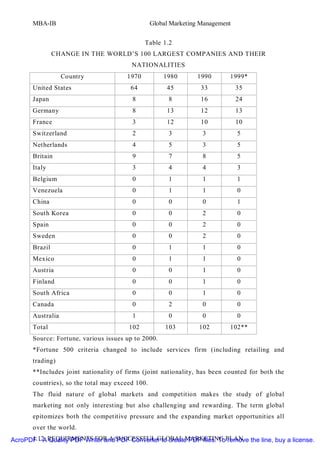
       An examination of the top one hundred largest companies in the world also vividly
       illustrates the profound changes in competitive milieu that we have seen in the past
       thirty years (see Table 1.2). Of the top hundred largest industrial companies in the
       world, sixty-four were from the United States in 1970 in 1980 the number declined to
       forty-five companies. The latest figure came down to twenty four in 1997 (not shown)
       and went back up to thirty-five in 1999.
       The number of Japanese companies in the top hundred has increased from eight in
       1970 to twenty-four in 1999, almost a threefold increase. A similar increase has also
       been observed with French companies, from three in 1970 to ten in 1997. The relative
       decline in the number of U.S. companies in the top is reflected in the banking,
       insurance, and other services sectors, as well as in the manufacturing sectors. The
       current world economy has changed drastically from what it was merely a decade ago.
       The changes observed in the past thirty years simply reflect that companies from other
       parts of the world have grown in size relative to those of the United States. In other
      words, today’s environment is characterized by much more competition from around
AcroPDF - A Quality PDF Writer and PDF Converter to create PDF files. To remove the line, buy a license.
      the world than in the past. As a result, many U.S. executives are feeling much more
MBA-IB                                  Global Marketing Management


       competitive urgency in product development, materials procurement, manufacturing,
       and marketing around the world.
       The competition is not the only force shaping global business today. Particularly in
       the past several years, many political and economic events have affected the nature of
       global business. The demise of the Soviet Union, the establishment of the European
       Union and the North American Free Trade Agreement, deregulation, and privatization
       of state-owned industries have also changed the market environments around the
       world. Furthermore, the emerging markets of Eastern Europe and the rapidly re-
       emerging markets of Southeast Asia contribute to an international climate.


AcroPDF - A Quality PDF Writer and PDF Converter to create PDF files. To remove the line, buy a license.
MBA-IB                                     Global Marketing Management


                                             Table 1.2
               CHANGE IN THE WORLD’S 100 LARGEST COMPANIES AND THEIR
                                        NATIONALITIES
                  Country             1970           1980       1990       1999*
      United States                     64            45          33           35
      Japan                             8              8          16           24
      Germany                           8             13          12           13
      France                            3             12          10           10
      Switzerland                       2              3          3            5
      Netherlands                       4              5          3            5
      Britain                           9              7          8            5
      Italy                             3              4          4            3
      Belgium                           0              1          1            1
      Venezuela                         0              1          1            0
      China                             0              0          0            1
      South Korea                       0              0          2            0
      Spain                             0              0          2            0
      Sweden                            0              0          2            0
      Brazil                            0              1          1            0
      Mexico                            0              1          1            0
      Austria                           0              0          1            0
      Finland                           0              0          1            0
      South Africa                      0              0          1            0
      Canada                            0              2          0            0
      Australia                         1              0          0            0
      Total                            102            103        102       102**
      Source: Fortune, various issues up to 2000.
      *Fortune 500 criteria changed to include services firm (including retailing and
      trading)
      **Includes joint nationality of firms (joint nationality, has been counted for both the
      countries), so the total may exceed 100.
      The fluid nature of global markets and competition makes the study of global
      marketing not only interesting but also challenging and rewarding. The term global
      epitomizes both the competitive pressure and the expanding market opportunities all
      over the world.
AcroPDF - A REQUIRMENTS FOR A SUCCESSFUL GLOBAL MARKETING PLAN the line, buy a license.
      1.12. Quality PDF Writer and PDF Converter to create PDF files. To remove
MBA-IB                                  Global Marketing Management


       The successful global plan is an integrated set of effective national marketing plans.
       Each national marketing plan should be based upon three foundations:
       1. Knowledge of the market and the marketing environment-especially of customers,
          competitors, and the government.
       2. Knowledge of the product-the formal product, its technology, and its core benefit.
       3. knowledge of the marketing function and discipline.


       A global/transnational company must decide how it will obtain these three key types
       of knowledge on a global basis. It must also decide how it will assign responsibilit y
       for formulating a marketing plan. If plan formulation is assigned to national
       subsidiaries, the global headquarters must ensure that the subsidiary planners are fully
       informed on the technical and engineering characteristics of the product as well as up
       to date in their functional skills. One of the ways of doing this is to involve
       headquarters marketing staff specialists in the planning process so that they can
       ensure that the highest standard of product and functional knowledge is associated
       with the local marketing staff’s market knowledge.
       Thus, the global/transnational plan is neither the product of the subsidiary nor the
       product of headquarters. It is neither “top down” nor “bottom up” but rather an
       interactive product that combines inputs from both the global and the local
       perspective. This balance is essential if the plan is to approximate the objective of
       global optimization as opposed to national suboptimizaiton.
       The global/transnational plan should be initiated by a global overview that assesses
       the broad nature of opportunity and threat on a global basis and breaks down this
       assessment on a country-by-country basis with an indication of sales and earnings
       targets for each country. These targets are proposed by headquarters as guidance to
       each national organization for the formulation of country plans. Guidance at this stage
       of the process should be guidance, and not a directive. The national organization
       should come up with its own target, and compare that to the target suggested by world
       headquarters. If there is a difference between the country target and the national
       organization target, this should openly challenge headquarters, and the challenge
       should produce a dialogue that searches for the realistic target. After receiving
       guidance from headquarters, country units need to develop programs that will achieve
       the targets specified by the guidance. After preparing their plans, headquarters and
       subsidiaries come together to negotiate an agreement. Headquarters is seeking to
       performance from each company unit and the integration of its global plan. If a
      country unit is a supplier for home-country and third-country markets, production
AcroPDF - A Quality PDF Writer and PDF Converter to create PDF files. To remove the line, buy a license.
      schedules and transfer prices must be agreed upon. If a country unit is to market a
MBA-IB                                   Global Marketing Management


       product produced elsewhere in the company, the sales and delivery plans must be
       coordinated.
              The following section explains three types of global marketing plan.
       1. Standardized global marketing plan
       A standardized global marketing plan offers a number of advantages. First, there are
       significant cost savings if standardization is practiced. A company that limits the
       number of models and variants of its product can achieve longer production runs and
       greater economies of scale. This is elementary and has been demonstrated in actual
       practice thousands of times over. Henry Ford was probably the first industrialist to
       demonstrate the potential of mass production for achieving scale economies and
       creating a national market. Similarly, the Italian appliance industry during the 1960s
       achieved remarkable cost reduction through standardization and long production runs
       and in the process took a leadership position in Europe. Of course, cost savings can be
       achieved not only in production     but also in packaging, in distribution, and in the
       creation of advertising materials. There are other benefits of standardization. In an
       increasingly mobile world a standardized product is the same in every national market
       and is therefore uniform for increasing numbers of customers who travel across
       national boundaries. There are pressures today to standardize products so that the
       customer can develop standardized programs in its operations. Another benefit of
       standardization is that it extends successful products and good ideas into all markets.
       There are, however, a number of obstacles to standardization. Market characteristics
       may be so different in so many major ways that it is impossible to offer a standardized
       product. There was, for example, simply no significant market in Europe (or Japan
       and many other countries) for the 3,500-4,000-1b, 120” wheel-base U.S. automobile.
       It was too big to fit in the streets, it consumed too much gasoline, it cost too much to
       license, and it did not appeal to the taste of automobile buyers outside the United
       States. American automobile manufactures who wish to compete in more than a very
       minor segment of the world market must adapt their product or develop products to
       suit market preferences in the rest of the world.
       2. Decentralized Global Marketing Plan
       Many companies have followed a decentralized planning approach either because of
       poor results using the standardized approach or after nothing the many differences
       from country to country in market environments. This approach has received perhaps
       more support in marketing than any other functional area. An executive of a major
       international company expressed this view as follows. “Marketing is conspicuous by
      its absence from the functions which can be planned at the corporate headquarters
AcroPDF - A Quality PDF Writer and PDF Converter to create PDF files. To remove the line, buy a license.
      level. It is in this phase of overseas business activity that the variations in social
MBA-IB                                    Global Marketing Management


       patterns and the subtlety of local conditions have the most pronounced effect on basic
       business strategy and tactics. For this reason, the responsibilit y for marketing
       planning must be carried out by those overseas executives who are most familiar with
       the local environment.”
       A common feature of both the standardized and the decentralized approaches is the
       absence of responsibilit y for analysis and planning at the headquarters level for
       multicountry marketing programs. In the standardized case such activities are assumed
       to be unnecessary. Once the marketing problem is solved for the home country, it is
       solved for the world. In the decentralized company the need for analysis and planning
       to respond to local conditions is recognized, but it is assumed that knowledgeable
       efforts can only be attempted at the country level and that there is no opportunity for
       effective supranational participation in these activities.


       3. Interactive Global Marketing Plan
       A third approach to formulating a global marketing plan is the interactive, or
       integrated, approach. This is superior to either the standardized or the local plan
       because it draws on the strengths of each of these approaches in planning to formulate
       a synthesis. Under the interactive marketing planning approach, subsidiaries are
       responsible for identifying the unique characteristics of their market and ensuring that
       the marketing plan responds to local characteristics.
       Headquarters, both global and regional, is responsible for establishing a broad
       strategic framework for planning in such matters as deciding on major goals and
       objectives and on where to allocate resources. In addition, headquarters must
       coordinate and rationalize the product design, advertising, pricing, and distribution
       activities of each subsidiary operation. Headquarters must constantly be alert to the
       trade-off of concentrating staff activities at headquarters location in an attempt to
       achieve a high level of performance versus the advantages of decentralizing staff
       activities and assigning people directly to subsidiaries.
       Each decision must stand on its own merit, but there are significant opportunities for
       the improvement of performance and cost saving by concentrating certain activities at
       one location. For example, many companies have successfully centralized the
       preparation of advertising appeals at world or regional headquarters. Another activity
       that can be done in one location is product design. Information and design criteria
       need to come from the world, but the design itself can be done by one design team in a
       single location.

AcroPDF - A Quality PDF Writer and PDF Converter to create PDF files. To remove the line, buy a license.
MBA-IB                                  Global Marketing Management


       1.13. INTERNATIONAL MARKET ORIENTATION – EPRG FRAMEWORK:
       Dr. Howard Perlmutter of the University of Pennsylvania first observed that there
       were three basic orientations guiding the work of international executives:
       ethnocentric, polycentric, and geocentric. This was later expanded to include a
       regional orientation and became an EPRG schema (ethnocentrism, polycentrism,
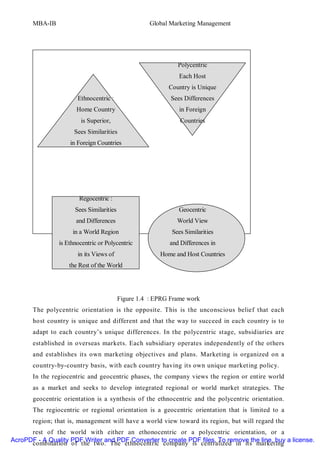
       regioncentrism, geocentrism). This typology, summarized in Figure 1.4, is the basis
       for the stages of corporate development framework.
       The ethnocentric orientation is an assumption that the home country is superior. It
       believes that the products and practices that succeed in the home country are superior
       and, therefore, should be used everywhere. In the ethnocentric company, overseas
       operations are viewed as being secondary to domestic and primarily as a means of
       disposing of surplus domestic production. Plans for overseas markets are developed in
       the home office utilizing policies and procedures identical to those employed at home.
       There is no systematic marketing research conducted overseas, there are no major
       modifications to products, and there is no real attention to consumer needs in foreign
       markets.


AcroPDF - A Quality PDF Writer and PDF Converter to create PDF files. To remove the line, buy a license.
MBA-IB                                        Global Marketing Management


                                                              Polycentric
                                                               Each Host
                                                           Country is Unique
                       Ethnocentric :                       Sees Differences
                       Home Country                            in Foreign
                        is Superior,                           Countries
                      Sees Similarities
                    in Foreign Countries


                        Regocentric :
                      Sees Similarities                       Geocentric
                      and Differences                         World View
                     in a World Region                      Sees Similarities
                is Ethnocentric or Polycentric             and Differences in
                       in its Views of                  Home and Host Countries
                    the Rest of the World


                                          Figure 1.4 : EPRG Frame work
       The polycentric orientation is the opposite. This is the unconscious belief that each
       host country is unique and different and that the way to succeed in each country is to
       adapt to each country’s unique differences. In the polycentric stage, subsidiaries are
       established in overseas markets. Each subsidiary operates independently of the others
       and establishes its own marketing objectives and plans. Marketing is organized on a
       country-by-country basis, with each country having its own unique marketing policy.
       In the regiocentric and geocentric phases, the company views the region or entire world
       as a market and seeks to develop integrated regional or world market strategies. The
       geocentric orientation is a synthesis of the ethnocentric and the polycentric orientation.
       The regiocentric or regional orientation is a geocentric orientation that is limited to a
       region; that is, management will have a world view toward its region, but will regard the
      rest of the world with either an ethonocentric or a polycentric orientation, or a
AcroPDF - A Quality PDF Writer and PDF Converter to create PDF files. To remove the line, buy a license.
      combination of the two. The ethnocentric company is centralized in its marketing
MBA-IB                                       Global Marketing Management


       management, the polycentric company is decentralized, and the regiocentric and
       geocentric companies are integrated.
       The ethnocentric orientation is based on a belief in home-country superiority. This
       leads to an extension of home country products, polices, and programs. The
       assumption of the polycentric approach is that there are so many differences in
       cultural, economic, and market conditions in each of the countries of the world that it
       is impossible to attempt to introduce any product, policy, or program from outside or
       to integrate any country’s program in a regional or world context.
       To implement the geocentric orientations, experienced international management and
       a great deal of commitment are required. For companies with limited experience, it
       may be wiser to adopt a centralized or a decentralized strategy and wait until
       experience accumulates before attempting to design and implement integrated
       marketing programs.


       1.14. INTERNATIONAL MARKET ENTRY STRATEGIES
       Entry decision of global market will heavily influence the firm’s other marketing-mix
       decisions. Several decision need to be made. The firm has to decide on (1) the target
       product/market, (2) the goals of target markets, (3) the mode of entry, (4) the time of entry,
       (5) a marketing-mix plan, and (6) a control system to monitor the performance in the
       entered market. This section will cover the major decisions that constitute market entry
       strategies.
       A crucial step in developing a global expansion strategy is the selection of potential
       target markets. Companies adopt many different approaches to pick target markets. A
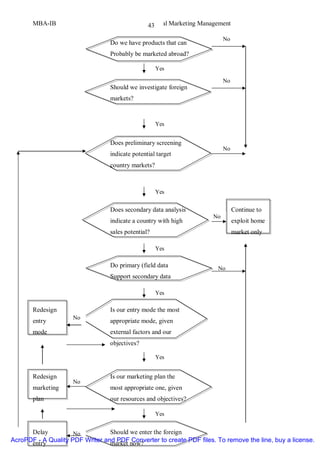
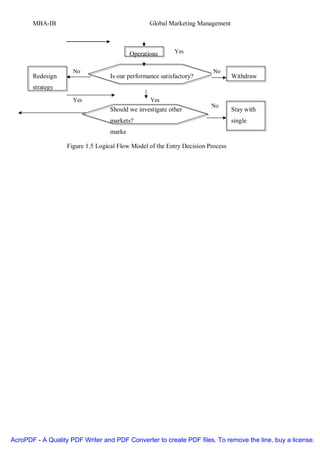
       flowchart for one of the approaches is given in figure 1.5. A four step procedure as
       given below may explain the initial screening process.
       Step 1:       Select indicators and collect data.
                     First, you need to pick a set of socioeconomic and political indicators you
                     believe are critical. The indicators that a company selects are, to a large
                     degree, driven by the strategic objectives spelled out in the company’s global
                     mission. Colgate-Palmolive, for instance, views per capita purchasing power as
                     a major driver behind market opportunities. Coca-Cola looks at per capita
                     income and the number of minutes that it would take somebody to work to be
                     able to afford a Coca-Cola product. McDonald’s starts with countries that are
                     similar to the United States in lifestyle, with a large proportion of women
                     working, and shorter hours for lunch. Information on these country indicators
                can easily be gathered from publicly available data sources. Typically,
AcroPDF - A Quality PDF Writer and PDF Converter to create PDF files. To remove the line, buy a license.
                countries that do well on one indictor (say, market size) rate poorly on other
MBA-IB                                  Global Marketing Management


                 indicators (say, market growth). Somehow, we need to combine our
                 information to come up with an overall measure of market attractiveness for
                 these candidate markets.


AcroPDF - A Quality PDF Writer and PDF Converter to create PDF files. To remove the line, buy a license.
MBA-IB                                     Global Marketing Management
                                                 43

                                                                            No
                                  Do we have products that can
                                  Probably be marketed abroad?

                                                     Yes

                                                                            No
                                  Should we investigate foreign
                                  markets?


                                                     Yes


                                  Does preliminary screening
                                                                            No
                                  indicate potential target
                                  country markets?


                                                     Yes


                                  Does secondary data analysis                   Continue to
                                                                       No
                                  indicate a country with high                   exploit home
                                  sales potential?                               market only

                                                     Yes

                                  Do primary (field data                No
                                  Support secondary data

                                                     Yes

       Redesign                   Is our entry mode the most
                     No
       entry                      appropriate mode, given
       mode                       external factors and our
                                  objectives?

                                                     Yes


       Redesign                   Is our marketing plan the
                     No
       marketing                  most appropriate one, given
       plan                       our resources and objectives?

                                                     Yes


      Delay          No          Should we enter the foreign
AcroPDF - A Quality PDF Writer and PDF Converter to create PDF files. To remove the line, buy a license.
      entry                      market now?
MBA-IB                                    Global Marketing Management


                                          Operations      Yes


                     No                                                  No
       Redesign                   Is our performance satisfactory?               Withdraw
       strategy
                     Yes                         Yes
                                                                        No
                                  Should we investigate other                    Stay with
                                  markets?                                       single
                                  marke

                   Figure 1.5 Logical Flow Model of the Entry Decision Process


AcroPDF - A Quality PDF Writer and PDF Converter to create PDF files. To remove the line, buy a license.
MBA-IB                                        Global Marketing Management


       Step 2 : Determine importance of country indicators.
                     The second step is to determine the importance weights of each of the different
                     country indicators identified in the previous step. One common method is the
                     “constant-sum” allocation technique. Here, you simply allocate one hundred
                     points across the set of indicators according to their importance in achieving
                     the company’s goals (e.g., market share). So, the more critical the indicator,
                     the higher the number of points it gets allocated. The total number of points
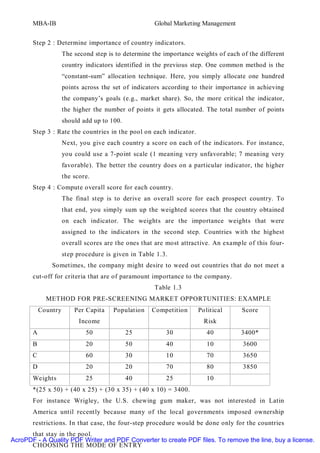
                     should add up to 100.
       Step 3 : Rate the countries in the pool on each indicator.
                     Next, you give each country a score on each of the indicators. For instance,
                     you could use a 7-point scale (1 meaning very unfavorable; 7 meaning very
                     favorable). The better the country does on a particular indicator, the higher
                     the score.
       Step 4 : Compute overall score for each country.
                     The final step is to derive an overall score for each prospect country. To
                     that end, you simply sum up the weighted scores that the country obtained
                     on each indicator. The weights are the importance weights that were
                     assigned to the indicators in the second step. Countries with the highest
                     overall scores are the ones that are most attractive. An example of this four-
                     step procedure is given in Table 1.3.
               Sometimes, the company might desire to weed out countries that do not meet a
       cut-off for criteria that are of paramount importance to the company.
                                                     Table 1.3
             METHOD FOR PRE-SCREENING MARKET OPPORTUNITIES: EXAMPLE
           Country       Per Capita    Population    Competition     Political       Score
                           Income                                      Risk
       A                     50              25           30            40          3400*
       B                     20              50           40            10           3600
       C                     60              30           10            70           3650
       D                     20              20           70            80           3850
       Weights               25              40           25            10
       *(25 x 50) + (40 x 25) + (30 x 35) + (40 x 10) = 3400.
       For instance Wrigley, the U.S. chewing gum maker, was not interested in Latin
       America until recently because many of the local governments imposed ownership
       restrictions. In that case, the four-step procedure would be done only for the countries
      that stay in the pool.
AcroPDF - A Quality PDF Writer and PDF Converter to create PDF files. To remove the line, buy a license.
      CHOOSING THE MODE OF ENTRY
MBA-IB                                       Global Marketing Management


       Several decision criteria will influence the choice of entry mode. In general, two classes of
       decision criteria can be distinguished.   1. internal (firm-specific) criteria 2. external
       (environment-specific) criteria. Let us first consider the major external criteria.
       1. Market Size and Growth: The key determinant of entry choice decision is the size of the
          market. Large markets justify major resource commitments in the form of joint ventures
          or wholly owned subsidiaries. Market potential can relate to the current size of the
          market. However, future market potential as measured via the growth rate is often even
          more critical, especially when the target markets include emerging markets.
       2. Risk: Another major concern when choosing entry modes is the risk factor. Risk
          relates to the instabilit y in the political and economic environment that may impact
          the company’s business prospects. Generally speaking, the greater the risk factor,
          the less eager companies are to make major resource commitments to the country
          (or region) concerned. Evidently, the level of country risk changes over time. For
          instance, the peace process in the Middle East and the abolishment of the apartheid
          regime in South Africa have lured many MNCs to these regions. Many companies
          opt to start their presence with a liaison office in markets that are high-risk but, at
          the same time, look very appealing because of their size or growth potential. For
          instance, MetLife, the insurance company, opened a liaison office in Shanghai and
          Beijing while it is waiting for permission from the Chinese government to start
          operations. A liaison office functions then as a low-cost listening post to gather
          market intelligence and establish contacts with potential distributors.
       3. Government Regulation: Government requirements are also a major consideration
          in entry mode choices. In scores of countries, government regulations heavily
          constrain the set of available options. Trade barriers of all different kinds restrict
          the entry choice decision. In the car industry, local content requirements in
          countries such as France and Italy played a major role behind the decision of
          Japanese car makers like Toyota and Nissan to build up a local manufacturing
          presence in Europe.
       4. Competitive Environment: The nature of the competitive situation in the local
          market is another driver. The dominance of Kellogg Co. as a global player in the
          ready-to-eat cereal market was a key motivation for the creation in the early 1990s
          of Cereal Partners Worldwide, a joint venture between Nestle and General Mills.
          The partnership gained some market share (compared to the combined share of
          Nestle and General Mills prior to the linkup) in some of the markets, though
          mostly at the expense of lesser players like Quaker Oats and Ralston Purina.
      5. Local Infrastructure: The physical infrastructure of a market refers to the country’s
AcroPDF - A Quality PDF Writer and PDF Converter to create PDF files. To remove the line, buy a license.
          distribution system, transportation network, and communication system. In
MBA-IB                                       Global Marketing Management


          general, the poorer the local infrastructure, the more reluctant the company is to
          commit major resources (monetary or human).
       All these factors combined determine the overall market attractiveness of the
       countries being considered. Markets can be classified in five types of countries based
       on their respective market attractiveness.
       • Platform countries can be used to gather intelligence and establish a network.
          Example include Singapore and Hong Kong.
       • Emerging countries include Vietnam and the Philippines. Here the major goal is to
          build up an initial presence for instance via a liaison office.
       • Growth countries such as China and India can offer early mover advantages. These
          often encourage companies to build up a significant presence in order to capitalize
          on future market opportunities.
       • Maturing and established countries include South Korea, Taiwan, and Japan. These
          countries have far fewer growth prospects than the other types of markets.
              We now given on overview of the key internal criteria:
       1. Company Objectives. Corporate objectives are a key influence in choosing entry
          modes. Firms that have limited aspirations will typically prefer entry options that
          entail a minimum amount of commit ment (e.g., licensing). Proactive companies
          with ambitious strategic objectives, on the other hand, will usually pick entry
          modes that give them the flexibilit y and control they need to achieve their goals.
          Bridgestone, the Japanese tire maker, needed a strong foothold in the U.S. market
          to become a leading firm in the tire industry. To that end, Bridgestone entered into
          a bidding war with Pirelli to acquire Firestone. More recently, the company is
          setting up factories in Central Europe and China and a joint venture in India with
          Tata, a major truck company, to achieve its goal of a 20 percent market share of
          the global tire market.
       2. Need for Control. Most MNCs would like to possess a certain amount of control
          over their foreign operations. Control may be desirable for any element of the
          marketing-mix plan: positioning, pricing, advertising, product design, branding,
          and so forth, Caterpillar, for instance, prefers to stay in complete control of its
          overseas operations to protect its proprietary know-how. For that reason,
          Caterpillar avoids joint ventures. To a large degree, the level of control is strongly
          correlated with the amount of resource commit ment: the smaller the commit ment,
          the lower the control. So, most firms face a trade-off between the degree of control
          over their foreign operations and the level of resource commit ment they are willing
          to take.
AcroPDF - A Quality PDF Writer and PDF Converter to create PDF files. To remove the line, buy a license.
MBA-IB                                      Global Marketing Management


       3. Internal Resources, Assets, and Capabilities. Companies with tight resources (human
          and/or financial) or limited assets are constrained to low commitment entry modes such
          as exporting and licensing that are not too demanding on their resources. Even large
          companies should carefully consider how to allocate their resources between their
          different markets, including the home market. In some cases, major resource
          commitments to a given target market might be premature given the amount of risk. On
          the other hand, if a firm is overly reluctant with committing resources, the firm might
          miss the boat by sacrificing major market opportunities. Internal competencies also
          influence the choice-of-entry strategy. When the firm lacks certain skills that are
          critical for the success of its global expansion strategy, the company can try to fill the
          gap by forming a strategic alliance.
       4. Flexibility. An entry mode that looks very appealing today is not necessarily
          attractive five or ten years down the road. The local environment changes
          constantly. New market segments emerge. Local customers become more
          demanding or more price conscious. Local competitors become more sophisticate.
          To cope with these environmental changes, global players need a certain amount of
          flexibilit y. The flexibilit y offered by the different entry-mode alternatives varies a
          great deal. Given their very nature, contractual arrangements like joint ventures or
          licensing tend to provide very little flexibilit y. When major exit barriers exist,
          wholly owned subsidiaries are hard to divest, and, therefore offer very little
          flexibilit y compared to other entry alternatives.
       A Transaction Cost Explanation For Mode-Of-Entry Choice
       The different modes of entry can be classified according to the degree of control they
       offer to the entrant from low-control (e.g., indirect exporting) to high control modes
       (e.g., wholly owned subsidiary, majority stake partnerships). To some extent, the
       appropriate entry-mode decision boils down to the issue of how much control is
       desirable, Ideally, the entrant would like to have as much control as possible.
       However, entry modes that offer a large degree of control also entail substantial
       resource commitments and huge amounts of risk. Therefore, the entrant faces a trade-
       off between the benefits of increased control and the costs of resource commit ment
       and risk.
       One useful framework to resolve this dilemma is the so-called transaction-cost
       analysis (TCA) perspective. A given task can be looked at as a “make-or-buy”
       decision: either the firm contracts the task out to outside agents or partners (low-
       control modes) or the job can be done internally (high control modes). TCA argues
      that the desirable governance structure (high- versus low-control mode) will depend
AcroPDF - A Quality PDF Writer and PDF Converter to create PDF files. To remove the line, buy a license.
      on the comparative transaction costs that is, the cost of running the operation.
MBA-IB                                      Global Marketing Management


       The TCA approach begins with the premise that markets are competitive. Therefore,
       market pressure minimizes the need for control. Under this utopian scenario, low-
       control modes are preferable since the competitive pressure force the outside partner
       to comply with his contractual duties. When the market mechanism fails, high-control
       entry modes become more desirable. From the TCA angle, market failure typically
       happens when transaction-specific assets become valuable. These are assets that are
       only valuable for a very narrow range of applications. Examples include brand equity,
       proprietary technology, and know-how. When these types of assets become very
       important, the firm might be better off to adopt a high-control entry mode in order to
       protect the value of these assets against opportunitistic behaviors and uncertainty.
       An empirical study of entry decisions made by the 180 largest MNCs over a fifteen-
       year period found that MNCs are most likely to enter with wholly owned subsidiaries
       when one of the following conditions holds.
       • The entry involves an R & D-intensive line of business
       • The entry involves an advertising-intensive line of business (high brand-equity)
       • The MNC has accumulated a substantial amount of experience with foreign entries.
          On the other hand, MNCs are most likely to prefer a partnership when one of these
          holds:
       • The entry is in a highly risky country
       • The entry is in a socioculturally distant country
       • There are legal restrictions on foreign ownership of assets.
       Merits and Demerits of Different Modes of Entry
       1. Exporting: Most companies start their international expansion with exporting. For many
       small businesses, exporting is very often the sole alternative for selling their goods in
       foreign markets. A fair number of Fortune 500 companies, such as Boeing and Caterpillar,
       also generate a major part of their global revenues via export sales. In 1998 Caterpillar’s
       exports from the United States were about $6 billion – this translates into $400,000 per
       Caterpillar job in the United States.
       Companies that plan to engage in exporting have choice between three broad options:
       indirect, co-operative, and direct exporting. Indirect exporting means that the firm
       uses a middleman based in its home market to do the exporting. With cooperative
       exporting, the firm enters into an agreement with another company (local or foreign)
       where the partner will use its distribution network to sell the exporter’s goods. Direct
       exporting means that the company sets up its own export organization within the
       company and relies on a middleman based in a foreign market (e.g., a foreign
      distributor).
AcroPDF - A Quality PDF Writer and PDF Converter to create PDF files. To remove the line, buy a license.
      Indirect exporting happens when the firm sells its products in the foreign market via an
MBA-IB                                       Global Marketing Management


       intermediary located in the firm’s home country. The middleman could be an export
       management company (EMC), a trading house, or simply a broker. Indirect exporting
       offers several advantages to the exporting company compared to other entry modes. The
       firm gets instant foreign market expertise. Very little risk is involved. Generally speaking,
       no major resource commitments are required.
       There are some downsides with indirect exporting. The company has little or no
       control over the way its product is marketed in the foreign country. Lack of adequate
       sales support, wrong pricing decisions, or poor distribution channels will inevitably
       lead to poor sales.
       Companies that are not willing to commit the resources to set up their own
       distribution organization but still want to have some control over their foreign
       operations should consider cooperative exporting. One of the most popular forms of
       cooperative exporting is piggyback exporting. With piggybacking, the company uses
       the overseas distribution network of another company (local or foreign) for selling its
       goods in the foreign market.
       Under direct exporting, the firm sets up its own exporting department and sells its
       products via a middleman located in the foreign market. Once the international sales
       potential becomes substantial, direct exporting often looks far more appealing than
       indirect exporting. To some degree, the choice between indirect and direct exporting
       is a “make-or-buy” decision.
       2. Licensing : Companies can also penetrate foreign markets via a licensing strategy.
       Licensing is a contractual transaction where the firm-the licensor-offers some
       proprietary assets to a foreign company-the licensee-in exchange for royalty fees.
       Examples of assets that can be part of a licensing agreement include trademarks,
       technology know-how, production processes, and patents. Royalty rates range between
       one-eight of 1 percent and 15 percent of sales revenue. For instance, Tokyo
       Disneyland is    owned and operated by Oriental Land Company under license from
       Disney. In return for being able to use the Disney name, Oriental Land Company pays
       royalties to Disney. In some industries, companies cross-licensing agreements are
       fairly common.
       For many companies, licensing has proven to be a very profitable means for
       penetrating foreign markets. In most cases, licensing is not very demanding on the
       company’s resources. Therefore, it is especially appealing to small companies that
       lack the resources and the wherewithal to invest in foreign facilities. One licensing
       expert notes that overseas licensing account for up to one third of the profits of some
      small companies. Compared to exporting, another low-commitment entry mode,
AcroPDF - A Quality PDF Writer and PDF Converter to create PDF files. To remove the line, buy a license.
      licensing allows the licensor to navigate around import barriers or get access to
MBA-IB                                       Global Marketing Management


       markets that are completely closed to imports. For instance, several foreign tobacco
       companies in China use licensing agreements to avoid the 240 percent import tax
       levied on imported cigarettes. Local governments may also favor licensing over other
       entry modes.
       Companies that use licensing as part of their global expansion strategy lower their
       exposure to political or economic instabilities in their foreign markets. The only
       volatilit y that the licensor faces are the ups and downs in the royalty income stream.
       Other risks are absorbed by the licensee.
       In high-tech industries, technology licensing has two further appeals. In highly
       competitive environments, rapid penetration of global markets allows the licensor of
       define the leading technology standard and to rapidly amortize R & D expenditures. A
       case in point is Motorola’s licensing of proprietary microprocessor technology to
       Toshiba.
       3. Franchising : Scores of service industry companies use franchising as a means for
       capturing opportunities in the global marketplace. For instance, of the 8,000 Tricon
       restaurants around the world, about 4,400 are franchised. Franchising is to some
       degree a “cousin” of licensing: it is an arrangement whereby the franchisor gives the
       franchisee the right to use the franchisor’s trade names, trademarks, business models,
       and/or know-how in given territory for a specific time period, normally ten years. In
       exchange, the franchisor gets royalty payment and other fees. The package might
       include the marketing plan, operating manuals, standards, training and quality
       monitoring.
       To snap up opportunities in foreign markets, the method of choice is often master
       franchising. With this system, the franchisor gives a master franchise to a local
       entrepreneur, who will, in turn, sell local franchises within his territory. The territory
       could be a certain region within a country or a group of countries (e.g., Greater
       China). Usually, the master franchise holder agrees to establish a certain number of
       outlets over a given time horizon.
       The benefits of franchising are clear. First and foremost, companies can capitalize on a
       winning business formula by expanding overseas with a minimum of investment. Just as
       with licensing, political risks for the rights-owner are very limited. Further, since the
       franchisees’ profits are directly tied to their efforts, franchisees are usually highly
       motivated. Finally, the franchisor can also capitalize on the local franchisees’ knowledge of
       the local market place. They usually have a much better understanding of local customs and
       laws than the foreign firm.
      4. Contract Manufacturing : With contract manufacturing, the company arranges with a
AcroPDF - A Quality PDF Writer and PDF Converter to create PDF files. To remove the line, buy a license.
      local manufacturer to manufacture parts of the product or even the entire product.
MBA-IB                                      Global Marketing Management


       Marketing the products is still the responsibility of the international firm.
       Numerous companies have become very successful by specializing in contract
       manufacturing. NatSteel Electronics (NEL) is one of the leading global electronics
       contract manufacturers. The company, based in Singapore, has facilit ies in countries
       such as Indonesia, Malaysia, Chinna, and Mexico. Its customers include Fortune 500
       companies such as Compaq, IBM, Apple, and Hewlett-Packard.
       Cost savings are the prime motivation behind contract manufacturing. Significant cost
       savings can be achieved for labor-intensive production processes by sourcing the
       product in a low-wage country. Typically, the countries of choice are places that have
       a substantial comparative labor cost advantage. Labor cost savings are not the only
       factor. Savings can also be achieved via taxation benefits, lower energy costs, raw
       materials costs, or overhead.
       Contract manufacturing is not without drawbacks though. The “nurture-a-future-
       competitor” concern raised for licensing and franchising also applies here. Because of
       this risk, many companies prefer to make high-value items or products that involve
       proprietary design features in-house. A fixation with low labor costs can often have
       painful consequences. Low-labor-cost countries typically have very low labor
       productivity. Some of these countries, such as India and South Korea, also have a long
       tradition of bad labor relation. Too much reliance on low-cost labor could also create
       a backlash in the company’s home-market among its employees and customers.
       Monitoring of quality and production levels is a must especially during the start-up
       phase when “teething problems” are not uncommon.
       5. Joint Ventures : For many MNCs who want to expand their global operations, joint
       ventures prove to be the most viable way to enter foreign markets, especially in
       emerging markets. With a joint venture, the foreign company agrees to share equity
       and other resources with other partners to establish a new entity in the target country.
       The partners typically are local companies, but they can also be local government
       authorities, other foreign companies, or a mixture of local and foreign players.
       Depending on the equity stake, three forms of partnerships can be distinguished:
       majority (more than 50 percent ownership), fifty-fift y, and minority (50 percent or
       less ownership) ventures. Huge infrastructure or high-tech projects that demand a
       large amount of expertise and money often involve multiple foreign and local
       partners. Another distinction is between cooperative and equity joint ventures. A
       cooperative joint venture is an agreement to collaborate between the partners that does
       not involve any equity investments.
      For instance, one partner might contribute manufacturing technology whereas the other
AcroPDF - A Quality PDF Writer and PDF Converter to create PDF files. To remove the line, buy a license.
      partner provides access to distribution channels. Cooperative joint ventures are quite
MBA-IB                                     Global Marketing Management


       common for partnerships between well-heeled MNCs and local players in emerging
       markets. A good example of the collaborative approach is Cisco’s sales strategy in Asia,
       Instead of investing in its own sales force, Cisco builds up partnerships with hardware
       vendors (e.g., IBM), consulting agencies (e.g., KPMG), or systems integators (e.g.,
       Singapore based Datacraft). These partners in essence act as front people for Cisco.
       They are the ones that sell and install Cisco’s routers and swiches. An equity joint
       venture goes one step further. It is an arrangement where the partners agree to raise
       capital in proportion to the equity stakes agreed upon. A typical example is the entry
       strategy of Cable & Wireless (C&W), a British telecommunications firm, in Japan. To
       gain credibility with the Japanese government, C&W set up a partnership with big Japanese
       corporations. The three major stakeholders – C& A Toyota, and C.Itoh-each hold roughly
       17 percent. The other partners share the balance. The alliance has gained a 16 percent
       market share of Japan’s international telecommunication market.
       A major advantage of joint ventures, compared to lesser forms of resource
       commitment such as licensing, is the return potential. With licensing, for instance, the
       company solely gets royalty payment instead of a share of the profits. Joint ventures
       also entail much more control over the operations that most of the previous entry
       modes we have discussed so far. MNCs that like to maximize their degree of control
       prefer full ownership. However, in many instances, local governments (e.g., China)
       discourage or even forbid wholly owned ventures in certain industries. Under such
       circumstances, partnerships are a second-best or temporary solution.
       Apart from the benefits listed above, the synergy argument is another compelling reason
       for setting up a joint venture. Partnerships not only mean a sharing of capital and risk.
       Possible contributions brought in by the local partner include: land, raw materials,
       expertise on the local environment (culture, legal, political), access to a distribution
       network, personal contacts with suppliers, government officials, and so on. Combined
       with the skills and resources owned by the foreign partner, these inputs offer the key to
       successful market entry. A recent fifty-fifty joint venture between Canada’s Sun Life
       Assurance and China Everbright Group, a large financial conglomerate, is one example.
       Sun Life, which got approval to sell life insurance in China in April 1999, chose China
       Everbright because it can provide the ventures access to a large distribution network
       and local contacts.
       6. Wholly Owned Subsidiaries : Multinational companies often prefer to enter new
       markets with 100 percent ownership. Ownership strategies in foreign markets can
       essentially take two routes: acquisitions, where the MNC buys up existing companies,
      or Greenfield operations that are started from scratch. As with the other entry modes,
AcroPDF - A Quality PDF Writer and PDF Converter to create PDF files. To remove the line, buy a license.
      full ownership entry entails certain benefits to the MNC but also carries risks.
MBA-IB                                      Global Marketing Management


       Wholly owned subsidiaries give MNCs full control of their operations. It is often the
       ideal solution for companies that do not want to be saddled with all the risks and
       anxieties associated with partnerships like joint venturing. Full ownership means that all
       the profits go to the company. Fully owned enterprises allow the investor to manage and
       control its own processes and tasks in term of marketing, production, and sourcing
       decisions. Setting up fully owned subsidiaries also sends a strong commitment signal to
       the local market. In some market China, for example wholly owned subsidiaries can be
       erected much faster than joint ventures with local companies, which may consume years
       of negotiations before their final take-off. The latter point is especially important when
       there are substantial advantages to being an early entrant in the target market.
       Despite the advantages of 100 percent ownership, many MNCs are quite reluctant to
       choose this particular mode of entry. The risks of full ownership cannot be easily
       discounted. Complete ownership means that the parent company will have to carry the
       full burden of possible losses. Developing a foreign presence without the support of a
       third party is also very demanding on the firm’s resources. Obviously, apart from the
       market-related risks, substantial political risks (e.g. nationalization) must be factored
       in.
       Companies that enter via a wholly owned enterprise are sometimes also perceived as a
       threat to the cultural and/or economic sovereignty of the host country. Shortly after
       Daewoo’s initially successful bid for the multimedia arm of the French group
       Thomson-CSF in the fall of 1996, the deal sparked controversy among French trade
       unions and the media. In the end, the French government vetoed the sale of the
       Thomson group following the negative opinion of the French privatization
       commission.
       7. Acquisitions and Mergers : Companies such as Sara Lee have built up strong global
       competitive positions via cleverly planned and finely executed acquisition strategies.
       MNCs choose acquisition entry to expand globally for a number of reasons. First and
       foremost, when contrasted with Greenfield operations, acquisitions provide a rapid means
       to get access to the local market. For relative latecomers in an industry, acquisitions are
       also a viable option to obtain well-established brand names, instant access to distribution
       outlets, or technology. In recent years, some of the South Korean chaebols have used
       acquisition entries in foreign markets to gain a foothold in high-tech industries. Highly
       visible examples include Samsung’s acquisition of the American computer maker AST and
       LG Electronics’ takeover of Zenith. LG would have needed to invest more than $1 billion
       to build up a strong global TV brand from scratch.
      Sara Lee, a U.S. conglomerate, has been extremely successful in building up growth
AcroPDF - A Quality PDF Writer and PDF Converter to create PDF files. To remove the line, buy a license.
      via well-chosen acquisitions. Instead of milking the acquired local brands and
MBA-IB                                    Global Marketing Management


       replacing them with a global brand, Sara Lee heavily invest in its local brand assets
       in the hope that one day they can be converted into prestigious regional or even global
       brand names. Success stories of local brands that became leading European brands
       include Douwe Egberts in coffee, Pickwick in tea, and Dim in hosiery. Sara Lee is
       also following the acquisition path in emergin markets, with an equal amount of
       success.
       Expansion via acquisitions or mergers carries substantial risks, though. Differences in
       the corporate culture of the two companies between managers are often extremely
       hard to bridge. A well-publicized example of a company that has been plagued with
       corporate culture disease is Pharmacia & Upjohn, a pharmaceutical company that was
       formed in 1995 via the merger of Sweden-based pharmacia AB and the American drug
       firm Upjohn. Swedish managers were stunned by the hard driving, mission-oriented
       approach of Upjohn executives. Their U.S. counterparts were shocked about European
       vacation habits.
       8. Greenfield Operations: Greenfield operations offer the company more flexibilit y
       than acquisitions in areas such as human resources, suppliers, logistics, plant layout,
       or manufacturing technology.       Greenfield investments also avoid the costs of
       integrating the acquisition into the parent company.       Another motivation is the
       package of goodies (e.g. tax holidays) that host government sometimes offer to whet
       the appetite of foreign investors. The down side of greenfield operations is that they
       require enormous investments of time and capital.


       1.15 SUMMARY
       Global marketing is a proactive response to the intertwined nature of business
       opportunities and competition that know no political boundaries. Global marketing
       does not necessarily mean that companies should market the same product in the same
       way around the world as world markets are converging.          Global marketing is a
       company’s willingness to adopt a global perspective instead of a country-by-country
       or region-by-region perspective in developing a marketing strategy for growth and
       profit. The six forces making up the company’s macro-global environment include
       demographic, economic, natural, technological, political and cultural forces. These
       forces shape opportunities and pose threats to the company. Global market possesses
       great importance of less developed countries (LDCs) It provides all urge to develop
       knowledge and experience that make development possible in LDC’s. The remarkable
       growth of the global economy over the post 50 years has occurred because of many
      driving forces contributing to the growth of international business, namely, market
AcroPDF - A Quality PDF Writer and PDF Converter to create PDF files. To remove the line, buy a license.
      needs, modern technology, minimum cost application, higher quality, information
MBA-IB                                      Global Marketing Management


       revolution and leverage advantages.        Several restraining forces also occurred in
       international trade in the form of tariff barriers and non-tariff barriers.
       There are four identifiable stages in the evolution of marketing across national
       boundaries. These are known as Ethnocentrism, poly centrism, regiocentrism and
       geocentrism. Companies have the plan of entry strategy choices to implement their
       global expansion efforts. Each alternative has its pros and cons. Global companies
       often adopt a phased entry strategy. They start off with a minimal risk strategy. Once
       the perceived risk declines, they switch to higher commitment mode. It is made clear
       that, a broad range of variables impact the entry mode choice.            The three major
       dimensions include the resource commitment a firm is willing to make, the amount of
       risk the firm is willing to take and the degree of control that is desirable.


       1.16 SELF-ASSESSMENT QUESTIONS
          1. How is global marketing different from international marketing?
          2. Discuss how companies can react to the marketing environment.
          3. Why do some MNCs prefer to enter certain markets with a liaison office first?
          4. Discuss the reasons why international business is much more complex today
              than it was twenty years ago.
          5. What are the three basic principles of marketing? Select a company that you
              know and assess how well the company is applying these principles?
       Reference Books
       1. International Economics – ML Jhingan
       2. Marketing – An Introduction – Philips Kotler
       3. Global Marketing Management Warren J. Keegan
       4. Global Marketing Management Masaaki Kotabe, Kristiaan Helsen


AcroPDF - A Quality PDF Writer and PDF Converter to create PDF files. To remove the line, buy a license.
MBA-IB                                          Global Marketing Management


                                                   UNIT – II

                            INTERNATIONAL MARKETING ENVIRONMENT


       This unit is divided into 4 lessons. First lesson contains an introduction about the International
       Marketing Environment along with an analysis of Internal Environment and External
       Environment. The second lesson explains the Geographical and Demographic Environment of
       International Marketing. Lesson 3 contains the Economic and Socio-cultural Environment. The
       last lesson analyses the Political and Legal Environment along with the Impact of Environment
       on International Marketing Decisions.
       Lesson – I International Marketing Environment: Internal Environment – External Environment
       Learning Objectives: By the end of this lesson you should be able to: 1. understand and describe
       the meaning of international marketing, the task of an international marketer, the types of
       environment – Internal and External 2. explain microenvironment and macro environment
       (controllable environment and uncontrollable environment). 3. describe the environmental forces
       that affect the company’s ability to serve its customers

       1.1. International Marketing Environment

       Marketing does not operate in a vacuum but it occurs in a complex and changing environment.
       Other actors in this environment – suppliers, intermediaries, customers, competitors, publics and
       others – may work with or against the company. Major environmental forces – demographic,
       economic, political and cultural – shape marketing opportunities, pose threats, and affect the
       company’s ability to serve its customers and develop lasting relationships with them. To
       understand marketing and to develop effective marketing strategies, we must first understand the
       context in which marketing operates. Many companies view the marketing environment as an
       uncontrollable element to which they must adapt. Other companies take an environmental
       management perspective in which the firm takes aggressive actions to affect the publics and
       forces in its marketing environment.
       International Marketing is the performance of business activities - flow of a company’s goods
       and services to consumers in more than one nation for profit. The only difference between
       domestic marketing and international marketing is that the marketing activities take place in
       more than one country. There is no difference in concepts of marketing but there is difference in
       the environment within which marketing plans are to be implemented. In the case of foreign
       marketing there are unfamiliar problems and hence different strategies are necessary to cope with
       the different levels of uncertainty. Hence, although, marketing principles and concepts are
       universally applicable, the environment within which the marketer must implement marketing
AcroPDF - A Quality PDF Writer and PDF Converter to create PDF files. To remove the line, buy a license.
MBA-IB                                           Global Marketing Management


       plan can change dramatically from country to country. The difficulties created by different
       environments are the international marketers primary concern.

       1.2. Marketing Environment

       As we know, marketing functions are to be carried out in a given environment. A company’s
       marketing environment consists of the factors and forces outside marketing that affect marketing
       management’s ability to develop and maintain successful transactions with its target customers.
       Thus, environment consists of those factors and forces, which affect the company’s working and
       decision-making ability. Even the marketing opportunity has to be scanned and identified
       carefully by observing the environment. The marketing mix i.e. product, price, physical
       distribution and promotion is also decided in the context of a given marketing environment.
       Though marketing managers are not capable of controlling the environmental factors, they must
       take them into account while taking marketing decisions. While formulating the market
       strategies, the marketer must keep on strict vigil on the environment in which the enterprise is
       functioning.

       The international environment is very important from the point of view of certain categories of
       business. It is particularly important for industries directly depending on imports or exports and
       import competing industries. For example, a recession in foreign markets, or the adoption of
       protectionist policies by foreign nations, may create difficulties for industries depending on
       exports. On the other hand, a boom in the export market or a relaxation of the protectionist
       policies may help the export oriented industries. A liberalisation may help some industries,
       which use imported items, but may adversely affect import competing industries. It has been
       observed that major international developments have their spread effects on domestic business.
       The Great Depression in the United States sent its shock waves to a number of other countries.
       Oil price hikes have seriously affected a number of economies. These hikes have increased the
       cost of production and the prices of certain products, such as fertilizers, synthetic fibres, etc. The
       high oil price has led to an increase in the demand for automobile models that economise energy
       consumption. The oil crisis also promoted some companies to resort to de-marketing —the
       process of cutting consumer demand for a product back to level that the firm can supply. Hence,
       developments like oil crisis affect the demand, consumption and investment pattern.
       A good export market enables a firm to develop a more profitable product mix and to consolidate
       its position in the domestic market. Many companies now plan production and investment taking
       into account also the foreign markets. Export marketing facilitates the attainment of optimum
       capacity utilisation; a company may be able to mitigate the effects of domestic recession by
       exporting. However, a company, which depends on the export market to a considerable extent,
      has also to face the impact of adverse developments in foreign markets.
AcroPDF - A Quality PDF Writer and PDF Converter to create PDF files. To remove the line, buy a license.
MBA-IB                                         Global Marketing Management


       The world is shrinking rapidly with the advent of faster communication, transportation and
       financial flows. Products developed in one country are finding acceptance in other countries.
       We would not be surprised to hear about a German businessman wearing an Italian Suit meeting
       an English friend at a Japanese restaurant who later returns home to drink Russian Vodka.
       International trade is booming and global competition is intensifying. Few industries are now
       free from foreign competition. Hence, for companies to compete is to continuously improve
       their products at home and expand into foreign markets.

       All marketing activities occur within in the framework of legal, economic, cultural, political and
       other environments to which strategies and policies are to be related. Each country has its own
       legal system, culture, socio economic infrastructure and so on. The problem in international
       marketing is that the environments confronted are vastly more complex and extensive than for
       domestic operations.

                                    1.3. The International Marketing Task
       The international marketer’s task is more complicated than that of the domestic markets. The
       international marketer must deal with at least 2 levels of uncontrollable uncertainty compared to
       one by a domestic marketer. Uncertainty is created by the uncontrollable elements of all business
       environments, but foreign country in which a company operates adds its own unique set of
       uncontrollable. Figure 2.1 illustrates the total environment of an international marketer. The
       inner circle depicts the controllable elements that constitute a marketer’s decision area. The
       second circle encompasses those environmental elements at home that have some effect on
       foreign operation decisions. The outer circles represent the elements of the foreign environment
       for each foreign market within which the marketer operates. As the outer circles show, each
       foreign market in which the company does business can present separate problems involving
       some or all of the uncontrollable elements. Thus, the more foreign markets in which a company
       operates, the greater the possible variety of foreign environmental uncontrollables with which to
       contend. Often a solution to a problem in country market A is not applicable to a problem in
       country market B.


                                                  Figure 2.1
                              The International Marketing Task


AcroPDF - A Quality PDF Writer and PDF Converter to create PDF files. To remove the line, buy a license.
MBA-IB                                           Global Marketing Management


                                              Marketing Controllables
       The successful manager constructs a marketing program designed for optional adjustment to the
       uncertainty of the business climate.
       The inner circle in figure 2.1 represents the area under control of the marketing manager.
       Assuming the necessary overall corporate resources, the marketing manager blend price, product,
       promotion, and channels of distribution activities to capitalization anticipated demand. The
       controllable elements can be altered to adjust to changing market conditions or corporate
       objectives.
       Domestic Uncontrollables
       The second circle (figure 2-1) includes home country elements that can have a direct effect on
       the success of a foreign venture, political forces, legal structure and economic climate. A
       political decision involving domestic foreign policy can have a direct effect on a firm’s
       international marketing success. For example, the U.S government imposed restrictions on sales
       of computers and computer software to South Africa to protest apartheid and hence was
       restricted    by domestic uncontrollables. Conversely, positive effects occur when there are
       changes in foreign policies and countries are given favoured treatment.
       The domestic economic climate is another important home-based uncontrollable variable with
       far reaching effects on company’s competitive position in foreign markets. The capacity to invest
       in plants and facilities either in domestic or foreign markets is to a large extent a function of
       domestic economic vitality. Currency value is another influence the home environment economy
       has on the marketer’s task. e.g. the relative strength of the dollar in world markets.

AcroPDF - A Quality PDF Writer and PDF Converter to create PDF files. To remove the line, buy a license.
MBA-IB                                           Global Marketing Management


                                                              Foreign Uncontrollables
       In addition to uncontrollable domestic elements, a significant source of uncertainty is the number
       of uncontrollable foreign business environments. (Figure 2-1 outer circles). The process of
       evaluating the uncontrollable elements in an international marketing program involves
       substantial doses of cultural, political, and economic shock. A business operating in a number of
       foreign countries might find polar extremes in political stability, class structure, and economic
       climate – critical elements in business decisions. For example, The Soviet Union-a single market
       that divided into 15 independent republics, 11 of which re-formed as the common wealth of
       independent states (CIS), self-investors uncertain about the future. This is an example for the
       uncertainties of the uncontrollable political factors of international business.
       Thus, international marketers face many challenges in understanding how the economic
       environment will affect the decisions and which global markets to enter and how.
       The more significant elements in the uncontrollable international environment (shown in the
       outer circles of fig 2-1) include: 1. Political/legal forces, 2. Economic forces, 3. Competitive
       forces, 4. Level of technology, 5. Structure of distribution, 6. Geography and infrastructure, 7.
       Cultural forces. Thus, these forces constitute the principal elements of uncertainty an
       international marketer must cope with in designing a marketing program. The uncertainty of
       different foreign business environments creates the need for a close study of the operating
       environment within each new country. Different solutions to fundamentally identical marketing
       tasks are often in order and are generally the result of changes in the environment of the market.
       Thus, a strategy successful in one country can be rendered ineffective in another by differences
       in political climate, stages of economic development, level of technology, or other cultural
       variation.
       1.3.1. Environmental Adjustment to Foreign Uncontrollables
       To adjust and adapt a marketing program to foreign markets, marketers must be able to interpret
       effectively the influence and impact of each of the uncontrollable environmental elements on the
       marketing plan for each foreign market in which they hope to do business. In a broad sense, the
       uncontrollable elements constitute the culture; the difficulty facing the marketer in adjusting to
       the culture (i.e., uncontrollable elements of the market place) lies in recognizing their impact.
       The task of cultural adjustment is the most challenging and important one confronting
       international marketers. They must adjust their marketing efforts to cultures to which they are
       not attuned. In dealing with unfamiliar markets, marketers must be aware of the frames of
       reference they are using in making their decisions of a market. The key to successful
       international marketing is adaptation to the environmental differences from one market to
       another. Adaptation is a conscious effort on the part of the international marketer to anticipate
      the influences of both the foreign and domestic uncontrollable environments on a marketing mix,
AcroPDF - A Quality PDF Writer and PDF Converter to create PDF files. To remove the line, buy a license.
      and then to adjust the marketing mix to minimize the effects.
MBA-IB                                          Global Marketing Management


       1.4. Adapting to the Environmental Change

       Marketing environment is dynamic, technology, taste and preferences of the people, competitive
       situations changes, demographic factors, including population size changes, attitude and value
       system changes, economic factors like income, government policies and regulations also change
       to cope with the changing environment. Hence marketing policy should be adaptable to the
       changing environment. Although an exact prediction of the future event is difficult, reliable
       forecasts are possible in many areas. For example, if relevant data are available, it is possible to
       forecasts the demand for a product. Similarly, forecasts can be made of such other factors as
       demographic factors, income levels, technological etc. Such forecasts of the changing marketing
       environment facilitate the formulation of appropriate marketing strategies. The marketing
       environment is fast changing all over the world.

          Successful companies take an outside-inside view of their business. They recognise that the
            marketing environment is constantly presenting new opportunities and threats, and they
        understand the importance of continuously monitoring and adapting to that environment. Many
         companies fail to see change as opportunity. They ignore or resist changes until it is too late.
        Their strategies, structures, systems, and organisational culture grow increasingly obsolete and
        disfunctional. Corporations as mighty as General Motors, IBM, and Sears have passed through
       difficult times because they ignored. The major responsibility for identifying significant changes
        falls to the company’s marketers. Marketers have marketing intelligence and marketing research
         for collecting information about the marketing environment. They also spend more time with
                                    customers and in watching competitors.

       Procedures are needed for the identification of fresh market opportunities resulting from
       environmental change. For this the firm should predict the external changes that might occur and
       then it should analyse how they would affect the organization and how it should respond. The
       firm should list the major functions of businesses followed by an outline of all environmental
       factors likely to affect these functions. The most important external variables that might affect a
       firms operation are:

                                          1.4.1. Internal Environment
       An organisations internal marketing system is largely controllable by the management. An
       outline of the important internal factors (organisational) is given below.
                                                  Value System
        The value system of the founders and those at the helps of affairs has important bearing on the
            choice of business, the mission and objectives of the organisation, business policies and
                                                    practices.
      Mission and objectives
AcroPDF - A Quality PDF Writer and PDF Converter to create PDF files. To remove the line, buy a license.
MBA-IB                                          Global Marketing Management


       The business domain of the company, priorities, direction of development, business philosophy,
       business policy etc. are guided by the mission and objectives of the company.
       Management structure and Nature
       The organisational structure, the composition of the Board of Directors, extent of
       professionalisation of management etc are important factors influencing business decisions.
       Internal Power Relationship
       Factors like the amount of support the top management enjoys from lower levels and workers,
       shareholders and Board of Directors have important influence on the decisions and their
       implementation. The relationship between the members of the Board of Directors is also a
       critical factor.
       Human Resources
       The characteristics of the human resources like skill, quality, morale, commitment attitudes etc.
       could contribute the strength or weakness of an organisation. Some organisational find it difficult
       to carry out restricting or modernisation because of resistance by employees whereas they are
       smoothly done in some others.
       Company Image
       The image of the company matters while raising finance, forming joint ventures or other
       alliances, soliciting marketing intermediaries, entering purchase or sale contracts, launching new
       products. etc.
       Other factors
       In addition to the factors mentioned above, there are other internal factors, which contribute to
       business success/failure or influence the decision-making. They are: the production capacity,
       technology and efficiency, the productive apparatus etc. These factors influence the
       competitiveness of a firm. Research and Development, the organisation for marketing, quality of
       the marketing men, distribution network etc. has direct bearing on the marketing efficiency. The
       financial policies, financial position and capital structure are also important internal environment
       affecting business performance, strategies and decisions.
                                          1.4.2. External Environment
       The external environment of a company may be broadly divided into two categories:
       Microenvironment and Macro environment.


       1.4.2.a. External Micro Environment
       The microenvironment consists of the forces close to the company that affects its ability to serve
       its customers. These forces are external but are a part of a company’s marketing system. These
       forces include suppliers, intermediaries, competitors, customers and publics. While they are
      generally uncontrollable, these external forces can be influenced. We will explain these factors in
AcroPDF - A Quality PDF Writer and PDF Converter to create PDF files. To remove the line, buy a license.
      a little detail.
MBA-IB                                          Global Marketing Management


       Suppliers
       For production of goods or service, a company requires a variety of inputs. The individuals or
       firms who supply these inputs are known as suppliers. They provide resources needed by the
       company. For this purpose, the company should go for developing specifications, searching the
       potential suppliers, identifying and analysing the suppliers and thereafter choosing the suppliers
       who can supply the best mix of quality, quantity, reliability, credit facility, warranties and low
       price. The suppliers are critical to company’s marketing success. Supply shortages or delays can
       adversely affect sales and damage company goodwill in the long-inn. Marketing manages should
       also monitor the price trends of their inputs and negotiate terms and conditions with the
       suppliers. The most suitable suppliers have to be clearly identified and listed.
       Customers
        The customers of a company may be of five kinds. They are i. Ultimate consumers: - They may
       be individuals and householders. ii. Industrial consumers: - Industrial consumers are
       organisations, which buy goods and services for producing other goods and services for the
       purpose of either earning profits or fulfilling other objectives. iii). Resellers: - These are
       intermediaries who purchase goods with a view to resell them at a profit. These may be
       wholesalers, retailers, distributors etc. iv. Government customers: - They include government
       office or agencies that buy goods and services in order to produce public service or transfer the
       goods and service to others who need them. v). International customers: - These are individuals
       and organisations of other countries that buy goods and services either for consumption or for
       industrial use. Such buyers may be consumers, producers, resellers and governments. It may be
       noted that each market type has special characteristics, which should be carefully studied by the
       marketer, and he should be fully acquainted with the art of persuading and selling to these
       customers. It should be remembered that the satisfaction of customers and consumer is the main
       motto of every business firm.
       Competitors
       A firm’s competitors include not only the other firms, which market the same or similar
       products, but also all those who compete for the income of the consumers. E.g. The competition
       for a company’s televisions may come not only from other TV manufacturers but also from two
       wheelers, refrigerators, CD from firms offering savings and investment schemes like banks,
       company’s accepting deposits etc. As a consequence, marketers must continually monitor
       competitors marketing activities their products, channel prices and promotional efforts. They
       must also gain strategic advantage by positioning their products and services strongly against
       those of their competitors, in the minds of the consumers. The competitive environment consists
       of certain basic things which every marketing manager must take note of. According to Philip
      Kotler, “the best way for a company to grasp the full range of its competition is to take the
AcroPDF - A Quality PDF Writer and PDF Converter to create PDF files. To remove the line, buy a license.
      viewpoint of a buyer what does a buyer think about that which eventually leads to purchasing
MBA-IB                                          Global Marketing Management


       something”. Kotler has also explained 4 basic type of competition (Desire, Generic, Form and
       Brand Competition). He also pointed out four basic dimensions, which a company must have in
       mind. These may be called the four C’s of marketing positioning. The company must consider
       the nature of customers, channels, competitors and its own characteristics.
       Marketing Intermediaries
       Marketing intermediaries are independent business organisations or firms that directly help the
       company to promote, sell and distribute its goods and services to the final buyers. There are 2
       types of intermediaries a) Middlemen and b) Facilitating organisations (Physical distribution
       firms)
       Middlemen (wholesalers and retailers and agents)
       These are distribution channels that help the company in finding customers or in making sales to
       them. They are often called ‘resellers’.
       Various Facilitating Organisations
       Various Facilitating Organisations that provide necessary marketing facilities such as physical
       distribution, marketing service, and financial help. The physical distribution firms help to
       company to stock goods and move them from their point of origin to their destinations. These
       firms include warehouses and transportations firms. Marketing services agencies or firms include
       marketing research firms, advertising agencies media firms and marketing constancy firms which
       help the company in targeting and promoting its products to the right market. The financial
       intermediaries include banks, credit companies, insurance companies and other firms who aid the
       company in financial transactions or insuring against the trade risks. Marketing intermediaries
       are vital links between the company and the final consumers. A dislocation or disturbance of this
       link, or a wrong choice of the links, may cost the company very heavily.
       Publics
       A ‘Public’ means any group that has an actual or potential (future) interest in or impact on the
       company’s ability to achieve its objectives. Kotler and Armstrong describe seven types of public
       as follows:
       Financial Publics
       They influence the company’s ability to obtain funds. E.g. banks, investment houses and
       shareholders.
                                                  Media Publics
        They are consisted of those mechanism or devices that carry news, features of editorial opinion.
                                  e.g.; Newspapers, magazines, Radio and TV s.
                                                            Government Publics
       Management must take Government developments into account. Marketers must often consult
      two company’s lawyers on issues of product safety, truth in advertising and other matters.
AcroPDF - A Quality PDF Writer and PDF Converter to create PDF files. To remove the line, buy a license.
MBA-IB                                            Global Marketing Management


       Citizen - Action Public
       Consumer organisations, environmental groups, minority groups and others may question a
       company’s marketing decisions. Its public relations department can help it stay in touch with
       consumer and citizen groups.
                                                    Local Publics
              Every company’s has local publics such as neighbourhood residents and community
                                                   organisations.
       General Publics
           A company needs be concerned about the general publics attitude towards its product and
                           activities. The public image of the company affects it’s buying.
       Internal Publics
       A company’s internal publics include its workers, managers, volunteers and the board of
       directors. Large company’s use newsletters and other means to inform and motivate their internal
       publics. When employees feel good about their company, this positive attitude spills over to
       external publics.
       1.4.2.a. External Macro Environment
       The macro forces are more uncontrollable than the micro forces. Macro environment refer to
       those factors, which are not concerned to the immediate environment. These factors are external
       to the company and are quite uncontrollable. These factors do not affect the marketing ability of
       the concern directly but it indirectly influences marketing decisions of the company. A company
       may be able to influence these forces to some extent. The macro environment consists of the
       larger societal forces that affect the microenvironment- demographic, economic, natural,
       technological, political and cultural forces.
       Demographic Forces
        Demography is the study of human populations in terms of size, density, location, age, gender,
          race, occupation, and other statistics. The demographic environment is of major interest to
            marketers because it involves people, and people make up markets. A rapidly growing
        population indicates a rising demand for products. When population characteristics change, the
          nature of demand also changes. For example, when both husband and wife go for jobs, the
          demand for fast foods, electronic home appliances and the need for crèches increase. Rapid
       growth of population also results in increased labour supply. The changing life styles, habits and
                                tastes of the population have potential for marketers.
                                                  Economic Forces
         The purchasing power of people in a country is a crucial factor in determining the demand for
        products. Marketers must pay close attention to major trends in income and consumer spending
      patterns. In short, the economic conditions of a country – the nature of the economy, the stage of
AcroPDF - A Quality PDF Writer and PDF Converter to create PDF files. To remove the line, buy a license.
       development of the economy, economic resources, the level and distribution of income, etc. are
MBA-IB                                          Global Marketing Management


         all very important factors in marketing. Further economic factors like inflation, productivity,
            shortages, unemployment etc have a tremendous impact on prices and incomes. Hence,
               marketers must incorporate these factors while preparing marketing programmes.
                                                 Natural Forces
         The deterioration of the natural environment is a major global problem. In many cities, air and
         water pollution have reached dangerous levels. The natural environment involves the natural
          resources that are needed as inputs by marketers or that are affected by marketing activities.
          Marketers should be aware of several trends in the natural environment. There are growing
        shortages of raw materials. Moreover, although air and water may seem to be infinite resources,
         air pollution and water shortages have become already a big problem in many countries of the
       world. Owing to these factors, governments in many courtiers have started controlling the use of
           natural resources. Concern for the natural environment has resulted in the so-called green
         movement. Marketers shall have to take all these factors into consideration while formulating
                                            their marketing policies.
                                              Technological Forces
             One of the most dramatic forces shaping people’s lives is technology. Technological
          developments are uncontrollable environmental factors that are important to the marketers.
          Technology has tremendous impact on our life styles. Technological progress creates new
            opportunities to some companies whereas it is a threat to some other companies. As an
         opportunity, technology is a source of new and improved product. As a threat, technological
          development may result in loss of markets. The technological changes result in changes in
         consumption pattern and marketing systems. A new technology may improve our lives in one
         area while creating environmental and social problem in another area. The marketers should
       monitor the following trends in technology: the pace of change, the opportunities for innovation,
       varying research and development budgets, and increased regulation. He should watch the trends
                  in technology and adopt the latest technology so as to stay alive in the field.
                                                 Political Forces
       Marketing decisions are strongly affected by developments in the political environment. The
       political environment consists of laws, government agencies, and pressure groups that influence
       various organisations and individuals in the group. Well-conceived regulation can encourage
       competition and ensure fair markets for goods and services. Thus, governments develop public
       policy to guide commerce-sets of laws and regulations that limit business for the good of the
       society as a whole. Business legislations are made to protect the comps from each other, to
       protect consumers from unfair business practices, to protect the interests of society against
       unrestrained business practices. Almost every marketing activity is subject to a wide range of
      laws and regulations. Certain changes in government policies such as fiscal policy, tariff policy,
AcroPDF - A Quality PDF Writer and PDF Converter to create PDF files. To remove the line, buy a license.
      industrial policy etc. may have its impact on marketing. Some policy developments create
MBA-IB                                           Global Marketing Management


       opportunities as well as threats.       The political system spans all of the other systems.
       Governments undertake many specific functions that involve the other systems, which, as they
       have expanded, have passed beyond the individuals control in many respects.
       Cultural Forces
        The cultural environment is made up of institutions and other forces that affect a society’s basic
          values, perceptions, preferences, and behaviours. People grew up in a particular society that
        shapes their basic beliefs and values. People absorb a worldview that defines their relationships
        to themselves, to others, to organisations, to society, to nature, and to the universe. People differ
        in the relative emphasis they place on self-satisfaction. Marketers must recognize that there are
          many different groups with different views of themselves. People also vary in their attitudes
        towards corporations, government agencies, trade unions, and other organisations. People also
        vary in their attitude toward society. They also vary in their attitude toward nature. People also
        vary in their beliefs about the origin of the universe. Marketers should also take into account the
                                       cultural characteristics of the people.


                                                     Summary
       International Marketing is the marketing of goods and services in more than one country. The
       marketing activities are carried out in a complex and changing environment. Marketing
       environment consists of the factors and forces outside marketing that affect marketing
       management’s ability to develop and maintain successful transactions with its target customers.
       Marketing environment can be broadly divided in to two. They are internal environment and
       external environment. The internal factors, which influence the strategy and decisions of a
       company, are the value system, the mission and objectives, the organisation structure, the
       internal power relationship, and the characteristics of human resources etc. External environment
       consists of microenvironment and macroenvironment. Microenvironment consists of the forces
       close to the company that affects its ability to serve its customers like suppliers, intermediaries,
       competitors, customers and publics. The macro environment consists of the larger societal forces
       that affect the microenvironment- demographic, economic, natural, technological, political and
       cultural forces.
       Marketing environment can also be classified into controllable and uncontrollable forces.
       Controllable forces consist of marketing policies and strategies framed by the company.
       Uncontrollable forces are those forces, which are beyond the control of the company.
       Uncontrollables may be again classified into domestic uncontrollables and foreign
       uncontrollables. Domestic uncontrollables include home country elements that can have a direct
      effect on the success of a firm like political forces, legal structure and economic climate.
AcroPDF - A Quality PDF Writer and PDF Converter to create PDF files. To remove the line, buy a license.
      Foreign uncontrollables are a significant source of uncertainty in foreign business environments.
MBA-IB                                          Global Marketing Management


       The most important among them are geographical, economic, socio-cultural, political and legal
       environment. A business operating in a number of foreign countries might find polar extremes in
       political stability, class structure, and economic climate, which are crucial in business decisions.
       While they are generally uncontrollable, these external forces can be influenced. Successful
       companies realize that the marketing environment presents a never-ending series of opportunities
       and threats. The major responsibility for identifying significant changes in the macro
       environment falls to a company’s marketers. Marketing managers must be the trend trackers and
       opportunity seekers. Many opportunities are found by identifying trends (major social, economic,
       political). Within the rapidly growing global picture, marketers must monitor major
       environmental forces: demographic, economic, political-legal and social cultural. Companies can
       passively accept the marketing environment as an uncontrollable element to which they must
       adapt, avoiding threats and taking advantage of opportunities as they arise. Or they can take an
       environmental management perspective, proactively working to change the environment rather
       than simply reacting to it. Whenever possible, companies should try to be proactive rather than
       reactive.
       Self -Assessment Questions (Sass)
        1. Describe the environmental forces that affect the company’s ability to serve its customers.
       Marketing operations are carried out in a complex and changing environment. The company’s
       environment consists of micro and macroenvironments. The microenvironment consists of actors
       close to the company. The actors in this environment are suppliers, intermediaries, customers,
       competitors, publics and others. These actors may work with or against the company. The
       macroenvironment consist of larger societal forces affecting the environment. They are
       demographic, technological, economic, political and cultural forces. These forces may shape
       marketing opportunities and may pose threats, and affect the company’s ability to save
       customers. To understand marketing, and to develop effective marketing strategies, a marketer
       must understand the context in which marketing operates. Many companies view the marketing
       environment as an uncontrollable element to which they must adapt. Other companies take an
       environmental management perspective in which the firm takes aggressive actions to affect the
       publics and its marketing environment.
        2. Explain the factors and forces of Internal environment that affect the company’s ability to
           serve its customers?
        The internal marketing environment is largely controllable by the management. The internal
       environmental factors that affect the company are value system of the founders, the mission and
       objectives of the company, the organisational structure, the composition of the board of directors,
       and the extent of professionalisation of management, the amount of support the top management
      enjoys from lower levels and workers, shareholders and Board of Directors, the characteristics of
AcroPDF - A Quality PDF Writer and PDF Converter to create PDF files. To remove the line, buy a license.
      the human resources like skill, quality, morale, commitment etc. could contribute the strength or
MBA-IB                                          Global Marketing Management


       weakness of an organisation.      Thus, company image, location, production, finance, human
       resource, research and development, ability and skill of marketing managers are the most
       important internal forces that affect the company’s ability to serve its customers.
        3. Explain the meaning of External environment and how it affects the company’s ability to
           serve its customers.
       The external environment of a company may be microenvironment or macro environment. The
       forces close to the company are microenvironment and these include suppliers, intermediaries,
       competitors, customers and publics.       Although, they are uncontrollable, the company can
       influence these forces. The success of marketing depends up on the supply or resources and
       shortages or delays in it can unfavorably affect sales and damage company. There are various
       kinds of customers and the marketers should cautiously take this factor while selling products to
       these customers. Marketers should also keep an eye on competitors marketing behavior. The
       wholesalers and retailers in the distribution channels and public are all important micro
       environmental factors that should be taken care of by the marketer. The major external macro
       environmental forces affecting the company are demographic, economic, natural, technological,
       political and cultural forces.

       Key words

       Cultural environment
       Demography
       Domestic Uncontrollables
       Economic environment
       Environmental Adjustment
       Foreign Uncontrollables
       International Marketing Task
       Macroenvironment
       Marketing Controllables
       Marketing environment
       Marketing intermediaries
       Microenvironment Natural environment
       Political environment
       Public
       Technological environment


AcroPDF - A Quality PDF Writer and PDF Converter to create PDF files. To remove the line, buy a license.
MBA-IB                                           Global Marketing Management


                                                     Lesson II
       Lesson II explains the Geographical and Demographic Environment of International marketing.


       Learning Objectives: After studying this chapter you should be able to:


             1.understand the importance of geography in international marketing. 2. the effects of
       topography and climate on products, population, transportation, and economic growth 3. the need
          for conservation of the world’s natural resources. 4. explain the importance of demographic
                                        changes in international marketing.


           1. Geographical and Demographic Environment of International Marketing
         Geographical environment of foreign marketing should be understood and must be included in
          foreign marketing plans to a degree commensurate with their influence on marketing effort.
           Understanding of a country’s geography is essential if a marketer is to interpret a society’s
         behaviour and fundamental attitudes. Knowledge about the geographical characteristics by an
        international marketer is also essential for the understanding a country’s culture and to adapt to
           it’s culture. An international marketer should be familiar with the world – its climate, and
         topographic differences. If not, the important marketing characteristics of geography could be
       completely overlooked when marketing in another country. Without a historical understanding of
        a culture, the attitudes within the market place may not be understood. Similarly, every marketer
          is interested in the demographic environment of a country as people make the markets. For
         marketing decisions, various population characteristics like size of the world’s population, its
         geographical distributions, density, mobility trends, age distribution, birth, death and marriage
         rates and racial, ethnic and religious structure, etc are all important to marketers. These factors
        have a larger impact on marketing decisions of a company. Demographic data helps marketers in
          preparing their sectoral plans according to the life styles, habits and tastes of the population.
        This lesson concentrates on the important geographic characteristics that affect markets and the
           need to consider these while examining the environmental aspects of marketing in another
         country. The reader is taken to the broad scope of world markets and the effects of geographic
           diversity on the economic profiles of various nations. It also provides an awareness of the
        world’s complexities and diversities that can mean the difference between success and failure in
            marketing ventures. The important demographic characteristics that are important to an
                            international marketer are briefly discussed in this lesson.

       2.1. Geographical Perspectives on International Marketing

       The Globalization of business has made geography indispensable for the study of international
AcroPDF - A Quality Without significant attention to to create PDF geography, critical ideas and a license.
      marketing.    PDF Writer and PDF Converter the study of files. To remove the line, buy
MBA-IB                                          Global Marketing Management


       information about the world in which business occurs will be missing. Geography answers
       questions related to the location of different kinds of economic activity and the transactions that
       flow across national boundaries. It provides insights into the natural and human factors that
       influence patterns of production and consumption in different parts of the world. It explains why
       patterns of trade and exchange evolve over time. In recent decades, however, geography has
       become more familiar and more relevant to many people because emphasis has been placed on
       location, place, interaction, movement and region.

         Geography studies the earth’s surface, climate, continents, countries, peoples, industries, and
        resources. It is an uncontrollable environment that confronts every marketer although very little
         attention is paid to this factor. There is a tendency to study climate, topography, and available
              resources as isolated entities rather than as important causal agents in the marketing
       environment. The physical character of a nation is the principal determinant of the characteristics
        of a society and the means by which that society undertakes to supply its needs. Thus the study
           of geography is important for the student of marketing when evaluating marketing and its
          environment. Climate and topography are the two important facets of geography. Also the
         earth’s resources and population are important factors in world markets along with the world
                                      trade routes presented in geography.
                          2.1.1. Social Responsibility of Environmental Management
        The 1990s have been called the decade of the environment. The nations, companies, and people
          are attaching utmost priority to environmental protection and accepted that it is essential for
         doing business. The Governments, the Green activists, media and businesses are focusing on
       ways to stem the tide of pollution and to clean up their environment. Many view the problem as a
         global issue rather than a national issue and one that poses common threats to mankind. These
             are issue that cannot be addressed by nations in isolation. Companies looking to build
           manufacturing plants in countries with more liberal pollution regulations are finding that
        regulations are becoming strictor. Governments all over the world are drafting new regulations
       and are strictly enforcing the existing ones. Toxic substances pollute Rivers, lakes, and reservoirs
          and the disposal of hazardous waste is a critical issue affecting the world environment. The
           export of hazardous waste by developed countries to less developed countries has ethical
        implications and environmental consequences. Governments, organisations, and businesses are
        increasingly concerned with the social responsibility and ethical issues surrounding the problem
                                     of generating and disposing of wastes.


      Climate, Topography, Location and Place
AcroPDF - A Quality PDF Writer and PDF Converter to create PDF files. To remove the line, buy a license.
MBA-IB                                          Global Marketing Management


       Climate and topography are important environmental considerations when appraising the market.
       The effect of these geographical features on marketing ranges from the obvious influences on
       product adaptation to more profound influences on the development of marketing system.
       Altitude, humidity and temperature extremes are climatic features that affect the uses and
       functions of products and equipment. Products that perform well in temperature zones may
       require special cooling to function in tropical zones. Within even a single national market,
       climate can be sufficiently diverse to require major adjustments. South America is an excellent
       example of the importance of geography in marketing considerations. The social and economic
       systems can be explained in terms of the geographical characteristics of the area. It consists of
       natural barriers inhibiting national growth, trade, and communication. It is a vast land area with
       population concentrations on the outer periphery and an isolated and uninhabited interior.
       National unity and balanced development are hardly possible when inadequate roads and poor
       communications separate major cities from each other. Many citizens of South America are so
       isolated that they do not recognise themselves as part of the nation that claims their citizenship.
       Geography has always separated South America into secluded communities. There are many
       other regions of the world that have extreme topographic and climatic variations as well. China,
       the former Soviet Union, India and Canada each have formidable physical or climatic conditions
       within their trading regions. This statement also highlights the importance of locations for
       international marketing. Learning the location and characteristics other places has always been
       important to those interested in conducting business outside their local areas. The drive to learn
       about other kinds of places, and especially their resources and potential as markets has
       stimulated geographic exploration throughout history. An understanding of the location
       influences business and therefore is critical for the international marketing executive. Without
       clear knowledge of an enterprise’s location relative to its suppliers, to its market, and to its
       competitors, an executive operates like the captain of fog-bound vessel that has lost all
       navigational instruments and is heading for danger. Climate is another natural feature that has
       profound impact on economic activity within a place. Many activities are directly affected by
       climate. Agricultural production is also influenced by climate. The average daily and evening
       temperatures, the amount and timing of precipitation, the timing of frosts and freezing weather,
       and the variability of weather from one year to the next all influence the kinds of crops grown in
       an area. Variations in soils have a profound impact on agricultural production. In addition to its
       location, each place has a diverse set of characteristics. The characteristics of places-both natural
       and human-profoundly influence the ways that business executives in different places participate
       in international economic transactions.

         Geographic hurdles must be recognised as having a direct effect on marketing and the related
           activities of communications and distribution. The effect of natural barriers on market
AcroPDF - A Quality PDF Writer and PDF Converter to create PDF files. To remove the line, buy a license.
      development is also important. Because of the ease of distribution, coastal cities or cities situated
MBA-IB                                           Global Marketing Management


         on navigable waterways are more likely to be trading centres than are land locked cities. Road
                            condition is also an important factor affecting marketing.
                                          Natural Features and Resources

        The location, quality, and availability of resources are all vital factors in international marketing,
        as these will affect the pattern of world development and trade. International marketers in
        making worldwide international investment decisions must weigh this factor. In addition to the
        raw materials of industrialization, there must be sufficient supply of economically feasible
        energy to transform resources into usable products. Because of the disparity in the location of the
        earth’s resources, there is world trade between those who do not have all they need and those
        who have more than they need and are willing to sell.

        Many of the characteristics of a place relate to its natural attributes. Geologic characteristics can
        be especially important, as the presence of critical minerals or energy resources may make a
        place a world-renowned supplier of valuable products. Gold and diamonds make South Africa’s
        economy the most prosperous on that continent.          Because of abundant pools of petroleum
        beneath desert sands, standards of living in Saudi Arabia and nearby nations have risen rapidly to
        be among the highest in the world. The geology of places also shapes its terrain. Terrain also
        plays a critical role in focusing and inhibiting the movement of people and goods. The terrain of
        a place is related to its hydrology. Rivers, lakes, and other bodies of water influence the kinds of
        economic activities that occur in a place. In general, abundant supplies of water boost economic
        development, because water is necessary for the sustenance of people and for both agricultural
        an industrial production.

                                    Human Features/ World Population Trends

        The physical features of a place provide natural resources and influence the types of economic
        activities in which people engage, but its human characteristics also are critical. The population
        of a place is important because farm production may require intensive labor to be successful, as
        is true in rice-growing areas of eastern Asia. The skills and qualifications of the population also
        play a role in determining how a place fits into global economic affairs. The number of people is
        a significant determinant of potential consumer demand. Current population, rates of growth, age
        levels, and rural/urban population distribution are closely related to today’s demand for various
        categories of goods. Changes in the composition and distribution of population among the
        world’s countries will strongly affect future demand.


                                                Rural/Urban Shifts
        There is a marked shift of the world’s population from rural to urban areas. Migration from rural

AcroPDF - A Quality PDF Writer and of a desire for greater access to sources To education, health care, a license.
      to urban areas is largely a result PDF Converter to create PDF files. of remove the line, buy
MBA-IB                                          Global Marketing Management


         and improved job opportunities. Once The trends of increasing population in the developing
             world with substantial shifts from rural to urban areas, and declining birthrates in the
           industrialised world, will have profound effects on the state of world business and world
           economic conditions. In spite of an increase in world population, multinational firms are
         experiencing a decrease in world markets on a relative basis owing to the factor that moneyed
          world is loosing numbers and poor nations are gaining numbers. Population size is vital in
                  marketing, but people must have a means to buy to be an effective demand.

       Movement/ World Trade Routes

       International marketing exists because movement permits the transportation of people and goods
       and communication of information and ideas among different places. The location and character
       of transportation and communication systems long have had powerful influences on the
       economic standing of places. Many ports have become prosperous cities because they channeled
       the movement of goods on people between ocean and inland waterways. Business also has
       succeeded at well-situated places along overland routs. Places where transfers from one mode of
       transportation to another were required often were chosen as sites for manufacturing activities.
       Favourable location along transportation lines is beneficial for a place. Conversely an absence of
       good transportation severely limits the potential for firms to succeed in a specific place.
       Transportation patterns change over time, however, and so does their impact on places. The role
       of advanced technology and its effect on international marketing is even more apparent with
       respect to advances in communications systems. Sophisticated forms of telecommunication that
       began more than 150 years ago with the telegraph have advanced through the telephone to
       facsimile transmissions and electronic mail networks. As a result, distance has practically ceased
       to be a consideration with respect to the transmission of information. Whereas information once
       moved only as rapidly as the person carrying the paper on which the information was written,
       data and ideas now can be sent instantaneously almost anywhere in the world. These
       communication advances have had a staggering impact on the way that international marketing is
       conducted. They have fostered the growth of multinational corporations, which operate in
       diverse sites around the globe while maintaining effective links with headquarters and regional
       control centers.   International financial operations also have been transformed because of
       communication advances. Major world trade routes have developed among the most
       industrialised countries of the world – Europe, North America, and Japan. It might be said that
       trade routes bind the world together, minimizing distance, natural barriers, and the fundamental
       differences between peoples and economies. Early trade routes were overland, later came sea
       routes and, finally, air routes to connect countries. Trade routes represent the attempts of
       countries to overcome economic and social imbalances created in part by the influence of
      geography.
AcroPDF - A Quality PDF Writer and PDF Converter to create PDF files. To remove the line, buy a license.
MBA-IB                                         Global Marketing Management


       Interaction and Region

       The international marketing professional seeking to take advantage of opportunities present in
       different places learns not to view each place separately. The way a place function depends not
       only on the presence and form of certain characteristics but also on interactions among those
       characteristics. Growing concerns about environmental quality have led many people in more
       economically advanced nations to call for changes in economic systems that harm the natural
       environment. Like so many other geographical relationships, the nature of human-environmental
       interaction changes over time. With technological advances, people have been able to modify
       and adapt to natural features in increasingly sophisticated ways.      The development of air
       conditioning has permitted people to function more effectively in hot tropical environments.
       Advanced irrigation systems now permit crops to be grown in places such as the southwestern
       United States, Northern Africa, and Israel. A region is a set of places that share certain
       characteristics. Many regions are defined by characteristics that all of the places in the group
       have in common. Agricultural region include areas where certain farm products dominate.

       2.2. Demographic Environment of International Marketing
    Demography is the study of the characteristics of human populations. Today’s demographic
    environment shows a changing age structure, shifting family profiles, geographic population shits, a
    better-educated and more white-collar population, and increasing diversity. Marketers are interested
    in population data because people make the markets. Demographic data helps marketers in preparing
    their sectoral plans. In the demographic environment, marketers must be aware of world wide
    population growth; changing mixes of age, ethnic composition, and educational levels; the rise of
    non-traditional families; large geographical shifts in population; the size and growth rate of
    population in cities, regions, and nations; household patterns; and regional characteristics and
    movements and the move to micro marketing and away from mass marketing. These factors have a
    larger impact on marketing decisions of a company. The world population is showing explosive
    growth: it totaled 6.1 billion in 2000 and will exceed 7.9 billion by the year 2025. Explosive
    population has major implications for business. A growing population does not mean growing
    markets unless these markets have sufficient purchasing power. However, companies that carefully
    analyse their markets can find major opportunities. For example, to control rapid growth of
    population, the Chinese government has passed regulations limiting families to one child. One
    consequence of these regulations is these children are spoiled and fussed over as never before.
    Known in China as “little emperors,” Chinese children are being showered with everything from
    candy to computers as a result of the “six pocket syndrome”. As many six adults – parents,
    grandparent, great grand parents, and aunts and uncles- may be indulging the whims of each child.
    This trend has encouraged toy companies such as Japan’s Bandi Company, Denmark’s Lego Group
    to enter the Chinese market.
AcroPDF - A Quality PDF Writer and PDF Converter to create PDF files. To remove the line, buy a license.
MBA-IB                                           Global Marketing Management


    Population Age Mix
    National populations vary in their age mix. At one extreme is Mexico, a country with a very young
    population and rapid population growth. At the other extreme is Japan, a country with one of the
    world’s oldest populations. Milk, school suppliers, and toys would be important products in Mexico.
    Japan’s population would consume many more adult products. A population can be subdivided into
    six age groups: preschool, school-age children, teens, young adults age 25-40, middle-aged adults
    age 40-65, and older adults age 65 and up. For marketers, the most populous age groups shape the
    marketing environment.
                                             Ethnic and other markets
       Countries also vary in ethnic and racial makeup. At one extreme is Japan, where almost everyone
       is Japanese; at the other is the United States, where people come virtually all nations. Each group
          has certain specific wants and buying habits. Several food, clothing, and furniture companies
        have directed their products and promotions to one or more of these groups. Within each ethnic
       group, there are consumers who are quite different from each other. Diversity goes beyond ethnic
                                                and racial markets.
                                               Educational Groups
        The population in different countries differs in their achieved educational level. For example in
        Japan, 99 percent of the population is literate, whereas the United States has one of the world’s
            highest percentages of college-educated citizens, around 36 percent. The high number of
          educated people in the United States spells a high demand for quality books, magazines, and
                                        travel, and a high supply of skills.

       Household Patterns

        The “traditional household” consists of a husband, wife, and children. Yet, in the United States
          today, one out of eight households is “diverse” or “non-traditional”, and includes single live-
        alones, adult live-together of one or both sexes, single parent families, childless married couples,
           and others. More people are divorcing, choosing not to marry, marrying later, or marrying
          without the intention to have children. Each group has a distinctive set of needs and buying
         habits. For example, in the single, separated, widowed, divorced (SSWD) group need smaller
       apartments; inexpensive and smaller appliances, furniture, and furnishings; and smaller size food
        packages. Marketers must increasingly consider the special needs of nontraditional households,
                    because they are now growing more rapidly than traditional households.

       Shifts in Population

                 This is a period of great migratory movements between and within countries. Forward-
                 looking companies and entrepreneurs are taking advantage of the growth in immigrant

AcroPDF - A Quality PDF Writer marketing Converter to specifically to these new members of buy a license.
              populations and and PDF their goods create PDF files. To remove the line, the
MBA-IB                                           Global Marketing Management


                 population. Population movement also occurs as people migrate from rural to urban
                 areas, and then to suburban areas changing the demand for products. There is little
                 excuse for a company for being suddenly surprised by demographic developments.

                                                    Summary

        Geography is the study of the earth’s surface, climate, continents, countries, people, industries,
       resources etc. A prospective international marketer should be familiar with the world, its climate,
       and topographic differences. Otherwise, the important marketing characteristics of geography
       will be completely overlooked when marketing in another country. Location, place, interaction,
       movement, and region are all important geographical factors in international marketing. There
       are complex geographical influences on the development of the general economy and society of
       a country. The need for studying geography is to provide the marketer with an understanding of
       why a country has developed. Geography is one of the important environments of foreign
       marketing that should be understood and that must be included in foreign marketing plans to the
       extent they influence on marketing effort.

       Climate and topography demands product adaptation. Products that are fit in temperature zones
       may be unfit in cold zones. There are differences even in a single national market, as climate
       may be so diverse that require major adjustments. The socio-economic characteristics of the
       people in a country also depend upon geography. Other vital factors in geography affecting
       international marketing are the location, quality, and availability of resources. Water availability
       is an important factor affecting the economic activity of a region or place. The qualifications of
       the population, the number of people, changes in the composition and distribution of population
       among the world’s countries are all important in demand.

         Demography deals with population characteristics like size, rate of growth, density, location,
         age, gender, race, occupation, and other statistics. Today’s demographic environment shows a
        changing age structure, shifting family profiles, geographical shifts in population, and a better-
           educated population. Changes in the population characteristics will have its impact on the
           international marketing decisions. Data on demographic characteristics help marketers to
               produce goods according to the specific requirements of population and household
         characteristics. The population in different countries differs in their achieved educational level
        and this will have its implications on the demand. Changes in household patterns also change
                                            the demand for products.


       Self Assessment Questions (SAQs)

          1. Describe the importance geography in understanding the international markets?
AcroPDF - A Quality PDF Writer and PDF Converter to create PDF files. To remove the line, buy a license.
MBA-IB                                           Global Marketing Management


           Geography is the study of earth’s surface, climate people, resources etc. Globalisation of
           business has made geography very important in international marketing. The physical
           character of a nation is crucial in determining the character of a society. There should
           variations in products and equipments according to the climate. There are natural barriers,
           which inhibit national growth trade and communication. Geographic hurdles must be
           recognised as having a direct impact on marketing. Availability of resources, world
           population trends, rural urban migration and trade routes are vital factors affecting
           production and marketing and demand.

           2. Examine the effects of topography and climate on products, population, transportation,
              and economic growth?
           The location and climate of a country are important environmental considerations to an
           international marketer. It influences production and development of marketing systems.
           There are many regions of the world that have extreme topographic and climatic variations.
           For example, manufacturers found that construction equipment used in the United States
           required extensive modifications to cope with the intense heat and dust of the Sahara Desert.
           Locational and climatical differences will result in variations in production and marketing.
           Even within a nation there are locational and climatical differences which demand variations
           in product and marketing. There are natural barriers on market development and these are to
           be recognised as vital factors in international marketing.
           3. Explain how changes in the demographic environments affect marketing decisions?
        Demographic factors like the size, growth rate, age composition, sex composition of population
         and family size, educational levels, religion etc. is all factors, which are relevant to business.
            Hence, the marketers must be aware of changes in demographic factors like worldwide
        population growth, age composition, ethnic composition, and educational levels, the rise of non
        traditional families; large geographic shifts in population, and the move to micro marketing and
           away from macro marketing. For the marketers, the most populous age groups shape the
         marketing environment. The level of education is an important factor affecting marketing. For
        example, the high number of educated people in the United States has resulted in a high demand
           for quality books, magazines etc. There are rapid changes in the household patterns from
           traditional to non-traditional and marketers must meet the special needs of nontraditional
                       households, who are growing rapidly than traditional households.
                                                             Key Words
       Demography
       Environmental damage
       Topography and Climate
AcroPDF - A urban shifts Writer and PDF Converter to create PDF files. To remove the line, buy a license.
      Rural Quality PDF
MBA-IB                                    Global Marketing Management


       World population trends
       World Trade routes


AcroPDF - A Quality PDF Writer and PDF Converter to create PDF files. To remove the line, buy a license.
MBA-IB                                          Global Marketing Management


                                                    Lesson III
           Economic and Socio-Cultural Environment
       Learning Objectives: By the end of this lesson you should be able to: 1. provide an overview of
       the world economic environment- micro and macro and explain the economic variables affecting
       international marketing 2. explain differences among nations in the levels of economic
       development      4. the impact of economic environment on international marketing strategy 5.
       explain soico-cultural elements most relevant to marketing 6. describe the influence of socio-
       cultural factors on people’s lifestyles, behaviour patterns and in market place.
           3. Economic and Socio-cultural Environments

                The economic conditions, economic policies and economic systems are important
                factors affecting international business. The economic environment of the world is fast
                changing and economic reforms are carried out in almost all countries of the world.
                These changes will have vital implications to international marketing. Similarly, the
                socio-cultural factors are very important in international marketing. This lesson
                examines the influence of economic and socio-cultural environments on international
                marketing. This lesson describes the meaning of culture; explore the profound effect of
                culture on marketing along with the various elements of culture. The need for cultural
                adaptation overseas is explored. An attempt is also made to analyse the impact of
                foreign business on local culture is examined.

       3.1. Economic Environment

        The economic environment is of critical importance to marketers because business cycles and
       other economic environment such as inflation, productivity, shortages, unemployment, resource
       availability, etc.    have a tremendous impact on marketing. This affects consumer’s real
       purchasing power as well as their confidence in purchasing. Economic changes may affect
       different organisations in unequal ways. Hence, they have to prepare the marketing programmes
       and strategies according to their individual requirements. Key factors in the economic
       environment of a country in which a firm is doing business are the nature and the extent of
       competition, growth rates and living standards, tax regimes, import controls and market
       opportunities as a whole. The balance of payment is also an important economic factor affecting
       international marketing.

                                3.1.1 Economic Differences in Standards of Living
         Many variations in marketing systems originate in straightforward economic differences- they
        are due to differences in standards of living found around the world. The significant differences
                            are those between low, moderate and high-income societies.
      Low Income Countries
AcroPDF - A Quality PDF Writer and PDF Converter to create PDF files. To remove the line, buy a license.
MBA-IB                                         Global Marketing Management


       Low-income countries are those with percapita national incomes of less than $400 per year. The
       marketing in these societies is relatively simple. A large proportion of population live by
       subsistence farming, producing most of the food, housing, clothing, and other goods they need
       with their own labour. They engage in a small amount of selling in order to buy a few
       manufactured goods. A marketing system exists to accomplish this exchange, but the volume is
       small and the variety of goods involved is very limited. Hence, the volume of goods limits the
       marketing process. The channels of distribution are simple. Sales promotion is practices, but
       typically at a low level of development.
       The Moderate-Income Category: The important distinction between moderate-income countries
       and low-income countries is that with the ability to purchase many items beyond the bare
       subsistence level, appreciable discretionary buying power emerges in moderate income
       countries. The magnitude of the marketing system is greater and therefore, different types of
       distribution channels appear, and the advertising and sales-promotion process develops as sellers
       seek to steer the discretionary buying power in one direction or another.
       High Income Societies:
        The United States is an excellent example for high-income societies and differs from moderate-
       income group of societies as the large part of societies in U.S. could achieve an adequate level of
         income by prevailing social standards. In high-income societies, most people can afford many
        luxury items of a good life. The marketing system in these societies show increased complexity
       because of the greater volume of goods handled. But the most important characteristic is the high
        degree to which their distribution and sales promotion systems are geared to influence the buyer
                          because they must not only guide but also generate demand.
        3.1.2. Element of Dynamism
        The second aspect of the economic dimension in marketing systems is the element of change. A
        society that is stagnant is quite different for marketing purposes from one that is moving ahead.
        We have seen many of the low-income countries move from stagnation to rapid progress. In a
        stagnant society, consumption pattern tend to become set, and the whole marketing process
        becomes a routine supply operation. In contrast, in a dynamic society, consumption patterns are
        changing and the marketing system must organise itself to the new patterns and it has to
        influence the process of change through distribution methods and promotion. For example, in
        Germany, in 1953, 92 percent of the average family’s income went for necessities, by 1967,
        income had roughly doubled and the portion going for luxuries had jumped from 8 percent to 33
        percent.
       3.1.3. Geography
       The third aspect of the economic dimension is geography. The most important elements in this
      category are natural resources, climate, and conditions that affect transportation. Some of the
AcroPDF - A Quality PDF Writer and PDF Converter to create PDF files. To remove the line, buy a license.
      effects of geography are of simple nature-such as the greater need for clothing and shelter in
MBA-IB                                          Global Marketing Management


       harsh climates. Others are more complex and influence the character of an economy. For
       example, some countries because of their rich natural resources have developed a much greater
       money economy than is typical of others in their vicinity – Venezuela and Saudi Arabia, to cite
       two cases in point. Other countries, weak in natural resources, but favoured by good
       transportation conditions, have prospered by importing raw materials, manufacturing and
       exporting finished goods- England and Japan being the classic examples. These characteristics
       are most important in the development of international marketing plans.

       The economic environment can be viewed from two different angles - the micro view and the
       macro view. According to the macro view, people’ s wants, needs and economic policy of a
       country establish market scope and economic outlook. A micro environmental view focuses on a
       firm’s ability to compete within a market.

                                      3.1a. Macroeconomic Environment
        The most important macroeconomic environmental factors are population and income, concept
       of economic advancement, structure of consumption in addition to other economic indicators like
                             economic systems and mutual economic dependence.
                                            Population and income
         The aggregate consuming capacity depends upon total population as well as percapita income.
        The consumption rate can be satisfied either domestically or through imports. The reason for the
        concentration of U.S. multinationals in Western Europe, Japan and Canada are due to their high
          percapita income. In contrast, despite a large population, India does not offer a huge market
                                                    potential.


AcroPDF - A Quality PDF Writer and PDF Converter to create PDF files. To remove the line, buy a license.
MBA-IB                                            Global Marketing Management


                                       Concept of Economic Advancement
        Economic advancement is characterized by such factors as relatively small allocation of labour
          force to agriculture: energy available in large amounts at low cost; high level of output and
          income; high level of percapita consumption; relatively low rates of population growth etc.
                                             Structure of Consumption
       Consumption in most advanced countries is characterized by a higher proportion of expenditures
         devoted to capital goods than consumption goods against poor countries, where substantially
        more is spent on consumer goods. The structural differences with regard to expenditures among
        nations can be explained by a theory propounded by the German Statistician Engel. The law of
          consumption (Engel’s Law) states that poorer families and societies tend to spend a greater
                          proportion of their incomes on food than well to –do people.
                                            Other Economic Indicators
        In addition to population, income, and expenditures, there are many other aspects of economic
           environment that are important to an international marketer. Raw materials – natural and
        industrial, production of food stuffs, prices, supply of electricity, finance etc are all important as
         far as international marketing is concerned. A marketer need not gather information about all
        these indicators. The purpose of the project determines the economic indicators to be examined
                                                at a particular time.
                                                Economic Systems
         The economic system of a country - Capitalism, Socialism, Communism and Mixed Economy
         are other economic factors that a marketer must understand. The nature of economic systems
                              affects the political/regulatory control of the economy.
         Thus, when performing an economic analysis, an international marketer needs to consider the
          economic perspectives of the overall world economy, particularly those of its major trading
                                           partners and the host country.
                                       3.1b. Microeconomic Environment
          Microeconomic environment refers to the environment surrounding a product or market of
        interest to a company. An examination of microenvironment indicates whether the company can
       successfully enter the market. Essentially the microeconomic environment concerns competition.
                                              Sources of Competition
        A company may face competition in an international market from three different sources: local
             business, other companies of the home country and other foreign companies. Different
       competitors may satisfy different types of demand: existing demand, latent demand and incipient
        demand. Existing demand refers to a product bought to satisfy a particular need. Latent demand
         applies in a situation where a particular need has been recognized, but no products have been
       offered. Incipient demand describes a projected need that will emerge when customers become
AcroPDF - A Quality PDF Writer and PDF Converter to create PDF files. To remove the line, buy a license.
          aware of it some time in future. Competition can also be analysed by the characteristics of
MBA-IB                                           Global Marketing Management


          products. Three product categories are in use and they are breakthrough product – a unique
         innovation that is mainly technical in nature, such as a digital watch, a colour television etc., a
         competitive product - one of many brands currently available in the market and has no special
        advantage over the competing products, and an improved product - not unique but is generally
                                        superior to many existing brands.
           The nature of the competition that a company faces in entering an overseas market can be
       determined by relating the three types of products to the three types of demand. After examining
        the competition, a company should be able to ascertain which product/market is most suitable to
                                                   the company.


AcroPDF - A Quality PDF Writer and PDF Converter to create PDF files. To remove the line, buy a license.
MBA-IB                                           Global Marketing Management


       3.2. Socio-cultural Environment

       Cultural differences deeply affect market behaviour. International marketers, therefore, need to
       be familiar with the cultural traits of any country they want to do business with. International
       business literature is full of instances where stereotyped notions of countries’ cultures have led to
       insurmountable problems. Practically international marketing decisions are culture bound. To
       understand the ways in which marketing differs among countries, one should look the role of
       marketing in the structure of society. The simple social systems of the primitive tribe have
       progressed in to a proliferation of organisations including the social, religions, family,
       educational, and work groups as well as other units like fraternal societies that are primarily
       social in purpose. Since the early days of subsistence production, the process by making goods
       and getting them from producer to consumer has expanded into our extensive economic structure
       of which the marketing system is a central component. Religion plays a major role in family
       systems, and much education is accomplished. within work units. We must therefore consider
       marketing not only in its direct role as the physical process by which goods move to the
       consumer, but also in its relation to the other systems of society. Material goods and marketing
       process contribute to the satisfaction of the other needs of man. Probably the most significant
       effects are in the social area, for the marketing system often satisfies a sizeable part of a person’s
       social needs.

           The influences of the religious, family, educational, and social systems of a society on the
          marketing system comprise the cultural dimension of our picture. The cultural attitudes vary
        among countries and it is difficult to find a general pattern. To determine the cultural aspects of
         markets, we must analyse each society by itself without the benefit of guiding generalizations.
         Religion, Family systems, social and educational systems are some of the common threads that
                                 run through the cultures of groups of countries.
       Religion
       A few major religions have spread over large areas. Religion has much to do with the types of
       products people buy, the way they buy them, and the way they manage businesses. Roman
       Catholicism dominates a large segment of the world, notably Latin America and the southern
       European countries. Islam covers another large area stretching across northern Africa, through
       the Middle East, and on as far as Indonesia. These religions have a number of specific marketing
       effects, such as the Moslem prohibition of liquor etc. Religions are a major determinant of the
       moral and ethical standards that play a large part in the marketing process. Religions are a major
       determinant of the moral and ethical standards that play a large part in the marketing process.
       Family System
      Family system differs widely among countries. It differs in placing subordinate or equal role to
AcroPDF - A rights and control over the PDF Converter to create PDF files. To remove the line, buy a license.
      wife, Quality PDF Writer and affairs of the family.
MBA-IB                                           Global Marketing Management


       Educational System
       There are also differences in educational methods common to large areas. The differences in
       educational system have its effects on marketing management and market research.
       Social Relationships
       We know that the value systems of people are strongly influenced by their quest for the social
       prestige attached to status symbols, among which is the ownership of various material goods.
       There are attitudes among each population not encompassed by the basic systems we have been
       considering. Notable for marketing purposes are the artistic tastes of people, which are important
       factors in the appearance of products and the character of advertising and other promotion
       efforts. There are also a host of specific elements in the life of each country that are significant in
       some way- white is for mourning in China, a cow is sacred in India, and so on. In the socio-
       cultural arena, marketers must understand people’s views of themselves, others, organisations,
       society, and the nature. They must market products that correspond to society’s core and
       secondary value, and address the needs of different subcultures within a society.
        The cultural traits of a country have a profound effect on people’s life style and behaviour
       patterns, and these are reflected in the market place. Culture is a complex term, and its precise
       definition is difficult. Broadly defined, however, it refers to all learned behaviour of all facets of
       life and living transmitted from generation to generation. Cultural differences among countries
       can be subtle and zealously followed. The study of culture includes material life; social
       interactions, between individuals and groups in formal and informal situations; language
       (spoken/written words, symbols and physical expressions that people use to communicate);
       aesthetics (art, drama, music); religion and faith; pride and prejudice and ethics and more.
       Cultural traits account for such differences among nations as colour preferences, concept of time,
       and authority patterns. For example, in Western countries a bride’s gown is usually white. In the
       Far East, however, women wear white during mourning. Cultural differences have impact on
       marketing decisions affecting product, price, distribution, and promotion. To conduct business
       successfully across national boundaries, marketers must adapt themselves to local cultures. For
       cultural adaptation, self-reference criterion (SRC) should be avoided so as to understand new
       foreign situations. A discussion of culture must also deal with cultural change. Cultures do
       change, but change is usually slow in coming. Induatrialisation is an important factor behind
       cultural change. Multinational corporations, through involvement in the industrialisation process,
       serve as change agents in foreign cultures. Their worldwide networks of affiliates transmit the
       values of the parent corporation culture through advertising media and through the
       internationalisation of business education.

       Each country has its own folkways, norms and taboos when designing international marketing
      strategies. Companies must understand how culture affects consumer reflections in each of its
AcroPDF - A Quality PDF Writer and PDF Converter to create PDF files. To remove the line, buy a license.
      world markets. In turn, they must also understand how their strategies affect local cultures. The
MBA-IB                                         Global Marketing Management


       seller must examine the ways consumers in different countries think about and use certain
       products before planning marketing program. For example, the average French man uses almost
       twice as many cosmetics and beauty aids as his wife. Italian children like to eat Chocolate bars
       between slices of breed as a snack. Women in Tanzania will not give their children eggs for fear
       of making them bald or impotent. Overlooking cultural differences can result in embarrassing
       mistakes.

       A nations culture represents a collective frame of reference through which a wide range of issues
       and problems are interpreted.      It determines how individuals and affects specialization,
       friendship patterns, social institutions, and aesthetics of language perceive symbols, sounds,
       pictures and behaviour. An important function of culture is that it helps the individual to define
       concepts. This is vitally important for the design of advertising images because culturally based
       conceptualizations can determine how a message is interpreted and how the message recipient
       responds to its contents. National media that carry advertisements are influenced by a nations
       culture in terms of the spoken and written language, the editorial of magazines, newspapers and
       radio and television programmes.


       Attitudes Expressed by the Media towards National Issues

       Culture affects what people buy (taboos, local tastes, historical traditions etc.), when they buy
       (e.g. the spending boom around Christmas in Christian countries) who does the purchasing (men
       or women) and the overall pattern of consumer buying behaviour. Culture can also affect
       consumer behaviour in relation to: which consumer needs are felt more intensely, which family
       members take which purchasing decisions.

       Attitudes Towards Foreign Products

       Cultural influences are evident in some aspects of a country’s demographic make up. E.g. Fords
       Pinto car sold poorly in certain parts of Latin America, where the word ‘Pinto’ is slang for ‘small
       make sexual organ’.

       Social Values

       These are moral principles or standards against which the desirability of certain modes of
       behaviour may be assessed. Values help determine what an individual considers important
       personal priorities, and how he or she assesses other people’s worth.            Values influence
       perspectives on a variety of matters: the work ethic, honestly, social responsibility, choice of
       career and so on. Values change over time; some may disappear entirely as environmental
       circumstances alter. Also values may vary across industries and from state to state.

AcroPDF - A Quality PDF WriterCulture
              3.2.1 Concept of and PDF Converter to create PDF files. To remove the line, buy a license.
MBA-IB                                         Global Marketing Management


                Culture has been defined in different ways. It includes all learned behaviour and values
                that are transmitted to an individual living within the society through shared experience.
                The concept of culture is broad and extremely complex. It encompasses virtually every
                part of person’s life. A nation may embody more than one culture. The two cultures
                may exhibit fundamental cultural differences.          Cultural understanding requires
                examination of cultural elements within a country like material life, social interactions,
                language, aesthetics, religion and faith, ethics and mores, role and responsibility, and
                pride and prejudice.

                Material life

                Material life refers to economics- how people derive their livelihood. Material life
                reflects standard of living and degree of economic advancement. In a less developed
                country, a large proportion of population is engaged in agriculture. The medium of
                exchange is a barter system, markets are local, and living is entirely rural. These
                descriptions suggest that the society is primitive and in primitive societies,
                multinational business will be nonexistent. In contrast, the culture of a society where
                manufacturing industry serves as the major source of employment, people live in urban
                centres, money is the medium of exchange, business across national boundaries would
                make sense.

                Social Interactions

                Social interactions establish the role that people play in a society and their
                authority/responsibility pattern. Social roles also are established by culture. For
                example a woman can be a wife, a mother, a community leader, and/or employee. What
                role is preferred in different situations is culture bound. The authority of the aged, the
                teacher, and the religious in many societies is held high. The educational system, the
                social settings and customs and traditions reassert the prescribed roles and patterns of
                individuals and groups. With reference to marketing, the social interactions influence
                family decision-making and buying behaviour and define the scope of personal
                influence and opinion. An empirical study showed how cultural differences affect the
                husband-wife influence in buying decisions. A Singapore husband played a more
                dominant role than his U.S. counterpart in family decision-making. Language as part of
                culture is important in international marketing. Some times same word may mean an
                entirely different thing in different cultures. Therefore, an international marketer must
                be careful in handling the matter of language in business dealings, contracts,
                negotiations, advertising, and so on. Symbolic communication is equally important. In
              many situations the symbolic language of communication is more important than the
AcroPDF - A Quality PDF Writer and PDF Converter to create PDF files. To remove the line, buy a license.
              actual words, and people respond accordingly. Therefore, an international
MBA-IB                                          Global Marketing Management


                businessperson must understand cultural differences and behave accordingly to avoid
                inadvertently communicating the wrong message.

                Aesthetics

                Aesthetics    include art, the drama, the music, the folkways, and the architecture
                endemic in a society. These aspects of society convey the concept of beauty and
                expression revered in a culture. For example, different colours have different meanings
                worldwide. In Western societies, wedding gowns are usually white, but in Asia white
                symbolizes sorrow. The aesthetic values have an impact on the design and marketing of
                different people.

                Religion and Faith

                Religion influences a culture’s outlook on life; it’s meaning, and concept. Religion also
                influences male-female roles, as well as societal institutions and customs, such as
                marriage and funeral rites. It also affects patterns of living in various other ways. It
                establishes authority relationships, and individual’s duties and responsibilities. The
                religious traits and tenets may profoundly affect marketing and international marketers
                must be sensitive to the religious principles of the host country.

                Pride and Prejudice

                Culture fosters pride and prejudice in its inhabitants. Cultural pride and prejudice make
                many nations reject foreign ideas and imported goods.

                Ethics and Customs

                The concept of what is right or wrong is based on culture.

                3.2.2 Culture and Marketing

                Culture influences every aspect of marketing. Figure 2.2 describes the linkage between
                culture and marketing. A marketing oriented firm should make decisions based on
                customer perspectives. Customers’ actions are shaped by their lifestyles and behaviour
                patterns as they stem from their society’s culture. Thus, the products that people buy,
                the attributes that they value are all culture-based choices. Thus, a person’s
                perspectives, resources, problems and opportunities are generated and conditioned by
                culture to a considerable extent.


                                    Figure 2.2 Impact of Culture on Marketing Decisions


AcroPDF - A Quality PDF Writer and PDF Converter to create PDF files. To remove the line, buy a license.
MBA-IB                                          Global Marketing Management


                Culture will have its impact on the food habits of people. Food consumption,
                acquisition, and preparation also are interrelated with many of the other universals of
                culture, including religious observances and ceremonies, fasting, folklore, and the
                division of labour. Cultural pressures easily overrule physiological necessities.
                Therefore, it becomes even more difficult for an individual alien to a culture to predict
                that culture’s preference for or rejection of certain food habits. No matter who shops, or
                where, cultural differences always affect decision making when it comes to the product
                and its price, as well as to the way it is distributed and promoted.

                The product

                The performance of a product /market depends on a variety of factors. The failure of a
                product in a country is traceable to cultural blunders. A product that has been highly
                profitable in a country may fail in another country due to cultural differences. Thus the
                product positioning in a foreign market should match the country’s unique cultural
                environment.

                Distribution

                Channels of distribution may need to be modified to suit local conditions. The method
                of door-to door and other direct selling may work in some countries, which may fail in
                certain other countries.

                Promotion

                Promotion practices, particularly advertising, are most susceptible to cultural error.
AcroPDF - A Quality PDF Writer and PDF Converter to createdesign files. To removerevolting and a license.
              Examples abound where advertising copy and PDF were culturally the line, buy
MBA-IB                                          Global Marketing Management


                therefore, totally ineffective. Pepsi ran into difficulties in Germany for using its U.S.
                ad, “Come alive, you’re in the Pepsi generation,” which in German meant, “Come alive
                out of the grave.’’

                3.2.3. Cultural Analysis

                The analysis of cultural differences is necessary for the formulation of international
                marketing strategy. The cultural analysis may be based on three - ethnocentrism,
                assimilation, and primacy of host country viewpoint. The ethnocentrism assumes that
                what is good at home should work in foreign countries a well. The assimilation
                approach assumes that the cultural traits demonstrated in one society is relevant
                anywhere. The primacy of host country approach concerns market composition and
                emphasizes basing decisions on host country cultural traits. This approach considers
                domestic information as inappropriate to successful operation in markets outside the
                home country.

                3.2.4. Assessment of Culture

                An assessment of country’s culture for marketing’s sake involves the analysis of the
                people’s attitudes, motivations, perceptions, and learning processes. However, simply
                knowing about the religion or morality of a culture is not enough. The marketer must
                analyse the product planned to be introduced into the country has any direct or indirect
                connotations that conflict with the cultural patterns of the society. Similarly, an
                examination of advertising themes, phrases, words, or expressions should confirm the
                viability of promotional decisions. The cultural values of a nation may be studied
                through either observation or fieldwork.

                3.2.5. Cultural Adaptation

                It refers to the making of business decisions appropriate to the cultural traits of the
                society. Thus, the decisions should be sensitive to the local culture to ensure that the
                native customs, traditions, and taboos offer no constraint to their implementation.

                The impact of culture is ever-present in all marketing decisions. Obviously,
                international marketers must seek cultural adaptation overseas. All their decisions and
                actions should be fully similar with local culture. The cultural adaptation is very
                difficult to practice. The major reason for this difficulty is the Self Reference Criterion
                (SRC). The SRC explains that whenever people are faced with unique situations, their
                own values are the measure for their understanding and response to the circumstances.
                For example, if some one in the United States is late for an appointment, that person
              will feel guilty about it and apologize for being late. On the other hand, to the Arab, a 9
AcroPDF - A Quality PDF Writer and PDF Converter to create PDF files. To remove the line, buy a license.
              A.M. meeting does not communicate an exact time but would be understood as
MBA-IB                                         Global Marketing Management


                sometime in the morning. The tendency toward SRC is a stumbling block in cultural
                adaptation.

                Areas of Adaptation

                There are three areas of foreign business adaptation: product, institutional, and
                individual. The product may be modified to fit to the foreign country climate. The
                Institutional behaviour includes adaptation of the organisation and business interactions
                to match the host’s perspective. The adaptation of Individuals’ responses to foreign
                situations should strive to be free of SRC. Such adaptation may be required in all
                regards-the meaning of time, social behaviour, play behaviour, family interactions, and
                more.

       Views of themselves
       People vary in the relative emphasis they place on self-gratification. In the United States during
       the 1960s and 1970s, “pleasure seekers” sought fun, change, and escape. Others sought "self-
       realization.” People bought dream cars and dream vacations and spent more time in health
       activities, in introspection, and in arts and crafts. Today, some people are adopting more
       conservative behaviours and ambitions. Marketers must recognize that there are many different
       groups with different views of themselves.
       Views of others
       People are concerned about the homeless, crime and victims, and other social problems. They
       would like to live in a more human society. At the same time, people are seeking out their “own
       kind” and avoiding strangers. These trends signify a growing market for social-support products
       and services that promote direct relations between human beings, such as health clubs, and
       religious activity. They also suggest a growing market for “social surrogates,” things that allow
       people who are alone to feel that they are not, such as television, home video games, and chat
       rooms on the Internet.
                                            Views of Organisations
       People vary in their attitudes toward corporations, government agencies, trade unions, and other
       organisations. Most people are willing to work for these organisations, but there has been an
       overall decline in organisational loyalty. Many people today see work not as a source of
       satisfaction, but as a required task to earn money to enjoy their no work hours. This outlook has
       several marketing implications. Companies need to find new ways to win back consumer and
       employee confidence. They need to make sure that they are good corporate citizens and that their
       consumer messages are honest.
                                               Views of Society
      People vary in their attitudes toward their society. Some defend it (preservers), some want to
AcroPDF - A Quality PDF Writer and PDF Converter to create PDF files. To remove the line, buy a license.
      change it (changers) some are looking for something deeper (seekers), and some want to leave it
MBA-IB                                          Global Marketing Management


       (escapers). Consumption patterns often reflect social attitude. Changers usually live more
       thriftily, driving smaller cars and wearing simpler clothes. Escapers and seekers are a major
       market for movies, music, surfing and camping.
                                                Views of Nature
       People vary in their attitudes toward nature. Some feel dominated by it, others feel in harmony
       with it, and still others seek mastery over it. Recently, people recognise that nature can be
       destroyed by human activities. Business has responded to this as Tour operators are packaging
       tours to wilderness areas and Food producers preparing natural food products. There are some
       other cultural characteristics of interest to marketers- the persistence of core cultural values, the
       existence of subcultures, and shifts of values through time.

       3.2.6. Persistence of Core cultural values

       The people living in a particular society hold many core beliefs and values that tend to persist.
       Core beliefs and values are passed on from parents to children and are reinforced by major social
       institutions- schools, churches, businesses, and governments. Secondary beliefs and values are
       more open to change. Believing in the institution of marriage is a core belief; believing that
       people ought to get married early is a secondary belief. Thus family planning marketers could
       make some headway arguing that people should get married later, rather than that they should
       not get married at all. Marketers have some chance of changing secondary values but little
       chance of changing core values.

       3.2.7. Existence of Subcultures

       Each society contains subcultures, groups with shared values emerging from their special life
       experiences or circumstances. To the extent that sub cultural groups exhibit different wants and
       consumption behaviour, marketers can choose particular subcultures as target markets. Although
       core values are fairly persistent, cultural swings do take place. IN the 1960s, hippies and other
       cultural phenomena had a major impact on young peoples hairstyles, clothing and life goals.
       New heroes and new activities influence today’s young people.

       Summary

       Economic variables relating to the various markets characteristics - population, income,
       consumption patterns, infrastructure, geography, and attitudes toward foreign involvement in the
       economy-form a starting point for assessment of market potential for the international marketer.
       These data are readily available but should be used in conjunction with other, more interpretive
       data because the marketer’s plans often require a long-term approach. Data on the economic
       environment produce a snapshot of the past; in some cases, old data are used to make decisions
       affecting operations two years in the future. Even if the data are recent, they cannot themselves
AcroPDF - A Quality PDF and the and PDFof development. SomePDF files. To remove the line, buy a license.
      indicate the growth Writer intensity Converter to create economies remain stagnant, plagued
MBA-IB                                             Global Marketing Management


       by natural calamities, internal problems and lack of export markets, whereas some witness
       booming economic development. Economic data provide a baseline from which other more
       market/product-specific and even experimental data can be collected.          Understanding the
       composition and interrelationships between economic indicators is essential for the assessment
       of the other environments and their joint impact on market potential. The international marketer
       needs to understand the impact of the economic environment on social development.

       The emergence of economic integration in the world economy poses unique opportunities and
       challenges to the international marketer. Eliminating barriers between member markets and
       erecting new ones vis-à-vis nonmembers will call for adjustments in past strategies to fully
       exploit the new situations. In the late 1980s and early 1990s, economic integration increased
       substantially. The signing of the North American Free Trade Agreement produced the largest
       trading bloc in the world, whereas the Europeans are moving in their cooperation beyond the
       pure trade dimension. In the economic arena, marketers need to focus on income distribution and
       levels of saving, debt, and credit availability.

       Culture is one of the most challenging elements of the international market place. This system of
       learned behaviour patterns characteristic of the members of a given society is constantly shaped
       by a set of dynamic variables: language, religion, values and attitudes, manners and customs,
       aesthetics, technology, education and social institutions. An international manager, to cope with
       this system, needs both factual and interpretive knowledge of culture. To some extent, the
       factual can be learned; the interpretation comes only through experience. The most complicated
       problems in dealing with the cultural environment stem from the fact that we cannot learn
       culture-we have to live it. Two schools of thought exist in the business world on how to deal
       with cultural diversity. One is that business is business the world around, following the model of
       Pepsi and McDonald’s.        In some cases, globalization is a fact of life, however, cultural
       differences are still far from converging.

               The other school proposes that companies must tailor business approaches to individual
       cultures. Setting up policies and procedures in each country has been compared to an organ
       transplant; the critical question centers on acceptance or rejection. The major challenge to the
       international manager is to make sure that rejection is not a result of cultural myopia or even
       blindness. The internationally successful companies all share an important quality- patience.
       They have not rushed into situations but rather built their operations carefully by following the
       most basic business principles.       These principles are to know your adversary, know your
       audience, and know your customer.

       Culture has both a pervasive and changing influence on each national market environment.
      International marketers must recognize the influence of culture and must be prepared to either
AcroPDF - A Quality PDF Writer and PDF Converter to create PDF files. To remove the line, buy a license.
      respond to it or change it. International marketers have played an important and even a leading
MBA-IB                                           Global Marketing Management


       role in influencing the rate of cultural change around the world. This is particularly true of food,
       but it includes virtually every industry, particularly in consumer products. Soap and detergent
       manufacturers have changed washing habits, the electronics industry has changed entertainment
       patterns, clothing marketers have changed styles, and so on. In industrial products culture does
       affect product characteristics and demand but is more important as an influence on the marketing
       process, particularly in the way business is done. International marketers have learned to rely
       upon people who know and understand local customs and attitudes for marketing expertise.
       Often, but not always, these are local nationals. The world is becoming more and more
       monocultural.    Today you can get Japanese noodles in the United States and McDonald’s
       hamburgers in Japan. Cultural factors are simply not as important as they were 50, even 10,
       years ago.

       Self-Assessment Questions (SAQs)
           1. What is the impact of economic environment on international marketing?
           The economic environment of a country is a significant factor in international marketing.
        Population and income, consumption expenditure, business cycles, productivity, shortages of
            raw materials, unemployment, resource availability, etc. have a tremendous impact on
         marketing. Significant economic factors affecting business in a country are the nature and the
       extent of competition, growth rates and living standards, tax regimes, import controls and market
         opportunities etc. The balance of payment of a country is also an important economic factor
        affecting international marketing. Differences in standards of living among low, moderate and
       high-income societies are an important factor to a marketer. In low-income countries, the volume
          of goods limits the marketing process. In moderate-income countries, the magnitude of the
        marketing system is greater. In high income societies, the marketing system is complex, volume
        of goods traded are greater, distribution and sales promotion systems are geared to influence the
                                        buyers to generate even demand.
              2. What are the key methods for tracking and identifying opportunities in the macro
                                                  environment?
            The economic environment can be divided into micro and macro. The most important
             macroeconomic environmental factors are population and income, level of economic
       development, pattern of consumption, economic systems are the most important macroeconomic
           environmental factors in affecting international marketing. Apart from these factors, raw
         materials, prices, finance etc are all important as far as an international marketer is concerned.
       3. Explain how changes in Socio -cultural environments affect marketing decisions?
       Almost all international marketing decisions are culture bound.           Social, religions, family,
       educational, volume and method of production affect the international marketing. Religions are a
      major determinant of the moral and ethical standards that play a large part in the marketing
AcroPDF - A Quality PDF Writer and PDF Converter to create PDF files. To remove the line, buy a license.
      process and on marketing. For example, liquor is prohibited among Muslims. The differences in
MBA-IB                                         Global Marketing Management


       the system of families will also influence marketing decisions. Cultural traits account for such
       differences among nations as colour preferences, concept of time, and authority patterns. For
       successful business across national boundaries, marketers must adapt themselves to local
       cultures. The self-reference criterion (SRC) should be avoided so as to understand new foreign
       situations. The marketers must understand people’s views of themselves, others, organisations,
       societies, nature, and the universe. They must market products that correspond to society’s core
       and secondary values, and address the needs of different subcultures within a society.
       Transnational corporations serve as        agents of change in foreign cultures through their
       advertising. Neglect of cultural differences will result in severe damages to the marketer.
       Aesthetic aspects of society convey the concept of beauty and expression and have an impact on
       the design and marketing. Cultural adaptation in business appropriate to the local culture will
       result in the advantage of the marketer.

       Key words

       Cultural environment
       Economic Environment
       Engle’s law
       Macroeconomic environment
       Microeconomic environment


AcroPDF - A Quality PDF Writer and PDF Converter to create PDF files. To remove the line, buy a license.
MBA-IB                                          Global Marketing Management


                                                    Lesson IV
         Political and Legal Environment and The impact of Environment on International Marketing
                                                    Decisions

       Learning Objectives: By the end of this chapter you should be able to: 1. explain how
       international law, home country law, and host country law affect international marketing.         2.
       describe the development of international law as it relates to marketing, 3. explain basic elements
       of the international legal, political, and regulatory environment including           the rules and
       organizations now in existence to deal with them, the important factors in jurisdiction of
       international legal disputes and 4. describe the impact of environment on international marketing
       decisions

       4.1. Political Environment of International Marketing

       The role of the political system on marketing comes from laws, regulations, and other
       government actions that restrict or direct the way in which business may be conducted.
       Companies planning international marketing must have an in depth knowledge of the political
       environment in the countries where they like to do business. There are many types of political
       risk associated with actions of the governing bodies. There are wide variations in the political
       environments of countries and if the political environment is characterized by instability and
       uncertainty, entry for marketing will be prevented. In brief a thorough review of the political
       environment must pave the way to a new market in a foreign country. Furthermore, the political
       environments of countries do not remain static. Political changes and upheavals may occur after
       an international marketer has made a promise and has and established business. Political
       environment connotes diverse happenings. It may be a national difficulty           like the conflict
       between the Communist government in Poland and solidarity or acts of terrorism against
       business (for example, kidnappings, arson) or conflicts between countries in a particular region
       like the war between India and China or an unending problem like the enmity between Israel and
       its Arab neighbours.

       Political risk is associated with the actions of local and regional governing bodies affecting the
       international company with the overall economic and political stability within a particular
       country. Political stability of a country is one of the fundamental factors that companies consider
       when going overseas. There are various types political risks in international marketing. Political
       risks will emerge to due to unstable political environment such as violence, expropriation,
       restriction of operations, and restrictions on repatriation of capital and remittances of profits. If
       the risk is high in a particular politically unstable country, it is necessary to know how to monitor
       that country’s ongoing political situation. The political conflicts and difficulties in foreign
      countries and their effects on overseas business are analysed here. Planned responses to political
AcroPDF - A Quality PDF Writer and PDF Converter to create PDF files. To remove the line, buy a license.
      change accessible to multinational marketers are also examined.
MBA-IB                                           Global Marketing Management


       4.1.a. Politics and marketing
       Marketing decisions in the international context are deeply affected by the political perspectives
       of both home and host countries. For example, government decisions have significantly affected
       the U.S automotive industry. Stringent requirements such as the fuel efficiency standards have
       burdened the industry in several ways. Government around the world helps their domestic
       industries to strengthen their competitiveness through various fiscal and monetary measures.
       Such political support can play a key role in an industry’s search for markets abroad. Without
       such assistance, an industry may face a difficult situation. The competition facing U.S
       manufacturers, therefore, both at home and in international markets, is potent and resourceful.
       Moreover a number of these overseas competitors are wholly or partly state-owned and respond
       to the direction of their governments, which depend heavily on their export business for the
       maintenance of employment and the earning of foreign exchange. This makes politics important,
       deeply influencing the perspectives of international marketing. Politics may affect international
       marketing in various ways. For example, during late 1980’s Japan liberalized tobacco imports
       by lifting restrictions on price, distribution, and the number of retail outlets that can handle their
       products. This was to encourage foreign suppliers to intensify their marketing efforts. In July
       1985, Mexico approved the long-delayed, once-rejected 100 percent IBM-owned microcomputer
       plant to encourage more foreign investment.
       Theoretically, multinational enterprises are affected by politics in three areas. They are the
       pattern of ownership in the parent company of the affiliate, the direction and nature of growth of
       the affiliate, and the flow of product, technology, and managerial skills within the companies of
       the group.     The government can substantially influence the strategy of Multinational
       Corporations (MNCs) affiliates in ways that were thought impossible even a few years ago. In
       India, many MNC affiliates had to diversify into areas where neither the parent company nor the
       affiliate had the core capabilities. Competence ceased to be an important factor in strategy
       formulation compared to the need to conform to political directives and regulations. In general,
       the transfer of product and technology from the parent company in order to exploit new markets
       in the host country meets with obstruction from the government unless the technology is in the
       areas specified by regulation.
       The political impact does not end here. It has further ramifications on the MNC’s worldwide
       operations. With regulations forcing MNC affiliates, operating in controlled economies, to move
       into areas where the parent company may or may not have prior experience, the parent company
       will find increasing difficulties in developing worldwide strategies to maximize their corporate
       interests. The large MNCs will have problems in achieving worldwide integration of resources,
       physical, human, and financial. Dilution of ownership will lead to erosion of the power of the
      parent company to control the management process in the affiliates. In short, the dissimilarity of
AcroPDF - A Quality PDF Writer and PDF Converter to create PDF files. To remove the line, buy a license.
      business between the affiliates and the parent, along with reduced ownership by parent, will
MBA-IB                                          Global Marketing Management


       make the latter primarily an investor. If this pattern continues, parent companies will soon find
       that they are no longer in a position to integrate their resources worldwide.

       4.1.b. Sources of Political Problems

       Figure 2.3 illustrates sources of political problems for firms doing business in foreign countries.
       Political impact on business comes mainly from political sovereignty and political conflict.


                                 Figure 2.3 Politics and International Marketing


       Political sovereignty

       Political sovereignty refers to a country’s aspiration to declare its power over foreign business
       through diverse sanctions. Such sanctions are normal and evolutionary predictable. An example
       is increases in taxes over foreign operations. Many of the less-developed countries impose
       restrictions on foreign business to protect their independence. These nations are envious of their
       political freedom and want to protect it at all costs, even if it means going at a slow economic
       pace and without the help of multinational corporations. The industrialized nations require a
       more open policy for the economic realities of today’s world. Today, governments are likely to
       curtail unemployment, reduce inflation, redistribute income, provide health services, and not
       misuse the environment. These objectives make developed countries seek foreign technology,
       use foreign capital and foreign raw materials, and sell their products in foreign markets. In brief,
       among the developed countries multinationalism of business is politically tolerable and
AcroPDF - A Quality attractive. and PDF Converter to create PDF files. To remove the line, buy a license.
      economically PDF Writer
MBA-IB                                          Global Marketing Management


       Political Conflict

       Several countries of the world experience political conflict of diverse sorts. Political conflicts
       may be categorized as turmoil, internal war and conspiracy. Turmoil refers to instant upheaval
       on a massive scale against an established. Internal war means large-scale, organized violence
       against a government such as guerrilla warfare. Conspiracy represents an immediate, deliberate
       act of violence against those in power (for example, the assassination of Egyptian President
       Anwar sadat). Political conflict may have an impact on business. Political change may also lead
       to a more favourable business climate. After the assassination of Prime Minister Indira Gandhi
       in 1984, India’s policy became highly good for international business. Gillette Company, for
       example, obtained the Indian government’s permission to set up a razor blade plant after some
       eight years of asking. It is important to make a distinction between political risk and political
       conflict. Political conflict in a country may lead to unstable conditions, but those conditions may
       or may not result from political unrest. Business must analyze each occurrence of political
       conflict and assess the likelihood of its impact on business. The effect of political conflict on
       business may be direct or indirect. Direct effects would be violence against the firm such as the
       kidnapping of an executive, damage to company property, a labour strike, and the like. Overall,
       direct effects are usually temporary and do not result in huge losses. Indirect effects occur
       because of changes in government policy.
       In short, political conflict may change a government’s economic perception. Such change may
       come from a new attitude on the part of an existing government or through a new government.
       Further, the changes may be motivated by a sincere desire to set right things to divert public
       attention from other domestic problems of the country. From the viewpoint of foreign
       businesses, it is important to understand the nature of political conflict and the motivation behind
       government action. If a change in government policy is for names sake, it represents less risk to
       foreign businesses. On the other hand, when a new policy is expressed through the imposition of
       certain constraints, requirements, and controls on foreign businesses, the government must
       spread and enforce the new policy. Otherwise, the new policy will be futile without any actual
       effects on foreign businesses.

       4.1.c. Political Intervention

       Political intervention may be defined as a decision on the part of the host country government
       that may force a change in the operations, policies, and strategies of a foreign firm. The
       intervention may range from some sort of control to complete take over of the foreign enterprise.
       The magnitude of intervention would vary according to the company’s business in the country
       and nature of the intervention.      There are different forms of intervention: expropriation,
      domestication, exchange control, import restrictions, market control, tax control, price control,
AcroPDF - A Quality PDF Writer and PDF Converter to create PDF files. To remove the line, buy a license.
      and labour problems.
MBA-IB                                         Global Marketing Management


       Expropriation

       Among the various forms of political intervention, expropriation is the most severe. It is official
       seizure of foreign property by a host country whose intention is to use the seized property in the
       public interest. Expropriation is recognized by international law as the right of sovereign states,
       if the expropriated firms are given prompt compensation at fair market value, in convertible
       currencies. Other terms used interchangeably with expropriation are nationalization and
       socialization. Nationalization refers to a transfer of the entire industry within that country from
       private to public ownership with no discrimination as to foreign ownership or local ownership.
       Socialization, also referred to as communisation, differs from nationalization in that it is a
       transfer of all the industries within the country. Confiscation means expropriation without
       compensation. Patterns of expropriation have been differentiated according to industry, region,
       type of ownership, technology, asset size, and politico -economic situation.

       Domestication

       Domestication is a process of controls and restrictions placed on the foreign firm, which
       gradually reduces the control of the owners. Although, domestication may ultimately lead to
       expropriation, it offers a compromise to both parties. The multinational corporation continues to
       operate in the country while the host government is able to maintain leverage on the foreign firm
       through imposing different controls. Measures of domestication involve several forms, including
       gradual transfer of ownership to nationals, promotion of a large number of nationals to higher
       levels of management, greater decision-making powers to nationals, more products produced
       locally rather than imported, and specific export regulations to dictate participation in world
       markets.
                                                            Other Forms of intervention
       The other forms of intervention include government involvement in foreign enterprise        taking
       the form of legislative action enacted in the national interest. Moreover, intervention applies to
       both domestic and foreign business. However, in actual practice, certain aspects of the law are
       irrelevant for domestic business and are meant to control foreign business. For example, a clause
       in a decree restricting repatriation or profits to stockholders outside the country would be
       meaningless for native companies.
       Exchange control, import restrictions, market control, tax control, price control, and labour
       restrictions are the other important forms of intervention by the government.

       Exchange Control

       Those countries having difficulties with the balance of trade impose restrictions on the free use
       of foreign exchange. For example, import of luxuries from outside the country is restricted. In
AcroPDF - A Quality PDF Writer and PDF Converter remittances from the To remove the line,hard a license.
      the same way, limitations are placed on the to create PDF files. country involving buy
MBA-IB                                          Global Marketing Management


       currency. The exchange control may also be an effort to encourage domestic industry. Exchange
       control measures affect foreign business in two ways.         First, profits and capital cannot be
       returned to the parent company at will. Second, raw material, machinery, spare parts and the like
       cannot be liberally imported for operating purposes. Most developing countries utilize exchange
       control to regulate their hard currency balances. The need for such regulations is one important
       reason for restrictions on imports of consumer in most emerging countries. Sometimes even
       developed countries may resort to exchange control.

       Import Restrictions

       Import restrictions are primarily for the support of native industries.         Consider a foreign
       pharmaceutical company traditionally importing certain compounds and chemicals from the
       parent company. If the host country places restrictions on imports, it may be forced to depend on
       local sources of supply for these new materials. This can create two types of problems for the
       foreign firm. First, the local product may be of inferior quality, which would affect the quality of
       the finished product.    Second, locally the product may be in such short supply that the
       pharmaceutical manufacturer cannot acquire it in adequate quantity. Apparently governments
       legislate import restrictions to all industries and the difficulties to be faced by a foreign company
       do not figure in the discussion. Further, when a country wants to encourage domestic industry as
       a matter of industrial policy, import restrictions are adopted with the realization that the local
       product will be inferior, at least initially. Strictly from the point of view of the government,
       import restrictions seem reasonable, but they ordinarily jeopardize the functions of foreign
       business.

       Market Control

       The government of a country sometimes imposes controls to prevent foreign companies from
       competing in certain markets.       For example, until recently Japan had prohibited foreign
       companies from selling sophisticated communication equipment to the Japanese government. As
       a result many popular companies could not do business with Japan. The Arab boycott of
       companies doing business with Israel is an interesting example of market control.


AcroPDF - A Quality PDF Writer and PDF Converter to create PDF files. To remove the line, buy a license.
MBA-IB                                          Global Marketing Management


       Tax Control

       Government may also impose heavy taxes on foreign business. For example, a new form of
       excise tax for which there is no precedent may be placed on the output of a foreign firm. As a
       result, problems may arise due to taxes imposed at variance with the company’s agreement with
       the government. For example, the host government may have agreed to give a tax holiday to a
       company, say for five years, to establish its operations in the country. Three years later, the
       government chooses to reverse its position for some reason, such as a new government’s refusing
       to live with the agreement entered into by its predecessor.

       Price Control

       For the sake of the public interest, countries may resort price controls. Likewise, countries use
       price control devices in various ways to improve their economies. For example, a country may
       set an official price on essential products such as drugs, oil, sugar, and cereals. Further, if the
       product of a particular foreign company has been singled out for price control without any
       economic rationale, such a measure amounts to undesirable intervention in the working of a
       foreign firm.

       Labour Restrictions

          In many nations, labour unions are very strong and have great political influence. Using its
        strength, they may be able to talk the government into passing very restrictive laws that support
          them at heavy cost to business. For example, labour unions in Latin America were able to
       prevent layoffs, plant shutdowns, and the like, even when business could not afford to meet such
           demands.              Foreign firms may find it difficult to accommodate labour demands
       transformed into laws. Even where there are no labour laws to comply with, there may be labour
       problems. Problems can reach such a level that the foreign enterprise is left with no other choice
                                                  but to leave.

       4.1.d. Political Perspectives

       An international marketer must make a thorough analysis of the political risks peculiar to a
       foreign country’s political system as well as risks peculiar to the company’s industry in foreign
       settings. The political perspectives of a nation can be studied using very important factors such
       as type of government, change in government’s policy, host country’s attitude toward foreign
       investment etc. The importance of these factors varies from country to country, although, it is
       desirable to consider them all to ensure a complete knowledge of the political outlook for doing
       business in a particular country.


AcroPDF - A Quality PDF Writer and PDF Converter to create PDF files. To remove the line, buy a license.
MBA-IB                                          Global Marketing Management


       Type of Government

       World governments can be realistically grouped in four categories: democratic republics,
       communist dictatorships, dictatorships and monarchies. In each category there is a spectrum of
       variation. Democratic governments are formed through regular elections and have different
       party systems. Communist governments are rigidly regulated by complete government control
       of all business activity. Dictatorships are authoritarian regimes. These governments are run
       either by military dictators or by civilian dictators. Monarchy refers to a government whose ruler
       derives power through inheritance. A country may have a monarchy and yet be democratic, such
       as Great Britain, whose Queen Elizabeth II is titular head of the country but not head of the
       British government. But in many countries, the government is actually run with the monarch as
       the head. Saudi Arabia and Jordan have monarchies. Any review of a country’s political system
       and its impact on foreign business must remain free of stereotyped notions.                 Political
       philosophies change over time. Thus, what a government or a party stood for in the 1960s may
       not hold true in the 1990s. Obviously, current and emerging perspectives should be analyzed
       and understood. Clearly, economic and political trends in a country require close scrutiny by
       potential foreign investors and marketers.

       Government Stability

           A country’s government may change frequently. Such changes may create difficulties in
          implementing the agreement because the new government may or may not subscribe to the
        commitments made by its predecessor. Thus, its is important for the international marketers to
       examine in advance of making agreements whether the current government will continue to be in
                                 office to implement agreements made with it.

       Change in Government Policy

       Policy changes may occur even without a change in government. When this type of environment
       exists, it makes things so uncertain that foreign business cannot know what it is getting into. It is
       important, therefore, for the foreign business to analyze the mechanism of governmental policy
       changes.

       Attitude Toward Foreign Investment

       In response to national attitudes, nations legislate a variety of laws and regulations to prescribe
       the role of foreign investment in their economies. It is appropriate, therefore, to review the host
       country’s regulations and identify underlying attitudes and motivations. Indirectly, the success
       of other multinational business in a country indicates a favourable attitude.

       4.2. Legal Environment of International Marketing

AcroPDF - A Quality PDF Writer and PDF Converter to create PDF files. To remove the line, buy a license.
MBA-IB                                           Global Marketing Management


       International legal considerations impose restrictions on contracts of sale, carriage of goods,
       insurance of payments and of consignments, and the means for financing transactions. Disputes
       concerning these matters must be resolved, ultimately, through the courts. There are
       complications due to different laws, interpretations and legal methods applying to commercial
       litigation within each nation, and conflicts between the legal systems of specific countries
       frequently occur. There is no informal law governing international trade and it is the application
       of a nation’s domestic law to international transactions. However, the domestic commercial laws
       adhere to rules established via international conventions. Three bodies of law affect the
       International marketing. They are International laws, Host-country laws and Home-country laws.

       International laws

             International laws are a body of rules and regulations that countries agree to abide by.
          International law addresses agreements among countries with regard to trade, protection of
           property, and other issues in the political and economic sphere. International law bodies,
        although not enforceable, can appropriately address international law agreements. A variety of
        international laws regulate business across national boarders. The agreements of institutions like
        General Agreement on Tariffs and Trade (GATT), the International Monetary Fund (IMF) and
            the World Bank etc are some type of laws, which influence business in different ways.

       GATT (General Agreement of Tariffs and Trade) is a set of norms and procedures that 92
       governments have accepted to create order and predictability in international trade relations.
       There are three basic principles in the GATT 1. nondiscrimination, whereby each member
       country must treat the trade of all other member countries equally; 2. open markets, which are
       encouraged by the GATT through a prohibition of all forms of protection except customs tariffs,
       and 3. fair trade, which prohibits export subsidies on manufactured products and limits the use of
       export subsidies on primary products.

          The real function of GATT is to enable countries to defend national economic interests not
         against the national interests of other countries but against sectional interests within their own
        and other countries. Thus, GATT is formally an international agreement among countries, but
          functionally it is part of the domestic legal order of each country. It serves as a defense that
             governments can refer to in defending themselves against pressure groups. The GATT
          regulations are particularly relevant for marketers since they deal with trade restrictions and
                                       barriers that affect market potential.
          One of the most important influence on business affairs is the actions of regulatory agencies
           (IEOs) that address such matters as price control, valuation of imports and exports, trade
         practices, labeling, food and drug regulations, employment conditions, collective bargaining,
        advertising content, competitive practices, and so on. The influence of regulatory agencies is
AcroPDF - A Quality PDF Writer and PDF Converter to create PDF files. To remove the line, buy a license.
MBA-IB                                           Global Marketing Management


        pervasive, and an understanding of how they operate is essential to protecting business interests
                                      and the advancing of new programs.
       In addition to these institutions, the other areas covered by international law and the agencies that
                                        administer international laws are:
                                              Protection of Property
        Property here refers to patents, trademarks, and the like. Companies spend millions of dollars to
            build up and establish trademarks and brand names. If a foreign firm steals a company’s
           established brand name and uses it on a locally manufactured product, the interests of the
         established company could be hurt. It would mean not only loosing potential markets, but also
           gaining a bad name for poor performance. For the protection of property out side the home
        country, there are international conventions and agreements. The most important among them are
             the International Bureau for the Protection of Industrial Property, the Inter – American
         Convention, UN Treaties and Conventions, UN Guidelines on Consumer Protection, Regional
         Laws and Arbitration. The United Nations has established a number of autonomous bodies and
           agencies to encourage world wide economic cooperation and prosperity. Among them, the
            World Health Organisation (WHO), International Civil Aviation Organisation (ICAO),
          International Telecommunications Union (ITU), Universal Postal Union (UPI), International
              Labour Organisation (ILO), International Telecommunications Satellite Consortium
         (INTELSAT), and International Standards Organisation (ISO) are the most important. ISO is a
          specialised UN agency, which directly related to marketing. ISO promotes standardization of
        different products and processes. The ultimate purpose is to encourage world trade and business
                     without hindrance from design/style/feature variations among nations.
          Regional Laws pertain to specific areas involving a group of countries tied together through
            some kind of regional economic cooperation (e.g. European Community, NAFTA etc.).
           Arbitration is a method by which a multinational firm can resolve a conflict regarding the
          interpretation of the contractual terms with the host country government; a native firm; or an
           international firm belonging to a third country in a foreign environment. Arbitration can be
          defined as a process of settling disputes by referring the matter to a disinterested party for a
           review of the merits of the case and for a judgment. There are a number of institutions for
          arbitration like The International Center for Settlement of Investment Disputes (ICSID), The
        Inter-American Commercial Arbitration Commission, The International Chamber of Commerce
                         (ICC), and The American Arbitration Association (AAA) etc.

       Host-country laws

          Host- country laws are laws of the different countries where the company operates. The legal
         system in the host country could differ substantially from that of the company’s home country.
AcroPDF - A Quality PDF Writer andcontrol foreign business in their economies. remove the line, buy a license.
      Hence, countries enact laws to PDF Converter to create PDF files. To Some of the laws are
MBA-IB                                          Global Marketing Management


         discriminatory against foreign goods and businesses. Laws are sometimes designed to allow
       reciprocity with on good trading terms with the country. In some instances, extremely favourable
        laws may be passed to attract foreign investment. In general, the legal environment of a country
         for foreign commerce depends on that country’s economic objectives and its obligations and
       position in relation to worldwide commerce. In some situations, the laws may have political aims
          as well. For example, a government may decide to restrict all imports in order to promote a
          national feeling among the people and their political supporters. On the other hand, political
           considerations may require a country to liberalize its laws pertaining to foreign business.
        Laws pertaining to entry into foreign markets take several forms including tariffs, antidumping
         laws, export/import licensing, investment regulations, legal incentives, and restrictive trading
                                                      laws.


AcroPDF - A Quality PDF Writer and PDF Converter to create PDF files. To remove the line, buy a license.
MBA-IB                                           Global Marketing Management


                                                      Tariffs
        It is a tax that a government levies on exports and imports. If the tax is imposed on exports, it is
       called export duty or customs duty. On the other hand, subsidy is a reverse tariff. Many countries
                              provide a subsidy for local manufacturers for export.
                                                Antidumping Laws
          Dumping is a type of pricing strategy for selling products in foreign markets below cost, or
           below the price charged to domestic consumers. Dumping is practiced to capture a foreign
          market and to damage rival foreign national enterprises. Host government’s often pass laws
          against dumping with a view to protect local industries. In international business, dumping
        inhibit the orderly development of national industry. From this point, attacks on rival markets by
        dumping amount to destructive as well as unscrupulous means of securing market position. It is
                            for this reason that countries legislate anti-dumping laws.
                                             Export Import Licensing
         Many countries have laws on the books that require exporters and importers to obtain licenses
           before engaging in trade across national boundaries. This may be for statistical records on
        exports or to ensure that certain goods are not exported to certain countries. Import licensing is
                  enforced to control the unnecessary purchase of goods from other countries.
                                         Foreign Investment Regulations
       One of the primary aims of laws and regulations on foreign investment is to limit the influence of
          multinational corporations. It may be also for achieving a pattern of foreign investment that
                 contributes most effectively to the realization of the host country’s objectives.
                                                 Legal Incentives
            Governments to attract foreign investments in most of the developing countries provide
                                              investment incentives.
                                             Restrictive Trading Laws
         Many governments adopt measures that restrict imports or artificially stimulate exports. Such
           laws are refereed as non-tariff barriers in international trade. The major types of non tariff
         barriers are government participation in trade – subsidies, government procurement, and state
          trading, or customs and entry procedures – documentation, health and safety regulations, or
         standards – product standards, packaging, specific limitations, or quotas - exchange controls,
         import restraints and licensing, import charges, or credit restrictions for imports, special duties
                                                        etc.

       Home –country laws

       Home-country laws are the laws of the company’s home country. Home country laws follow the
       company all over the world. For example U.S. companies must abide by all three types of law.
AcroPDF - A must abide by Writer and PDF Converter agreements, such as World Trade the line, buy a license.
      They Quality PDF international trade laws and to create PDF files. To remove Organisation
MBA-IB                                           Global Marketing Management


       (WTO) trade regulations; they must abide by host –country laws governing every aspect of the
       company’s operations; and they must abide by home-country laws, such as anti-trust regulations
       and corrupt practices regulations.

       Legal Systems

       The three important types of legal systems are: common law, civil codes (code law) and Islamic
       law.

       Common Law

       Common law is based on prior court rulings. It applies in English speaking countries and many
       other countries formerly colonised by Britain.

       Code Law (Civil Law)

       Code law has written rules that specify what constitutes legal behaviour. It has its root in Roman
       law. This law is shared by most of the countries of the world, including Latin America, China,
       Taiwan, Japan and others.


AcroPDF - A Quality PDF Writer and PDF Converter to create PDF files. To remove the line, buy a license.
MBA-IB                                            Global Marketing Management


       Islamic Law

       Islamic law is a system of law based on the interpretation of the Koran, Islam’s holy book.
       Islamic law establishes rules for business practices that can affect firm operation s. Islamic law
       affect a firm’s operations in North Africa, the Middle East, Pakistan and Malaysia, among others.

       Conflict and Jurisdiction of Laws

           The export of goods from one country to another necessarily involves transactions that are
         subject to the laws of different nations, and these laws might conflict. Owing to the different
            legal systems across nations, there is a need to establish jurisdiction in international legal
        disputes. There is no international body to make rules and oversee their fulfillment by different
          parties. Thus, a business incorporated in a particular country carries the burden of complying
        with the laws of both the incorporating nation and the host country. Often problems occur when
           laws of more than one country must be respected and these laws have different values. If a
          conflict occurs between two contracting parties, the question arises as to which nation’s laws
         should be used to resolve the problem. If the contract contains a jurisdiction clause stipulated
            which country’s legal system should be used to settle disputes, the matter can be settled
         accordingly. However, if the parties have failed to include a jurisdiction clause in this contract,
         there are 2 alternatives. They are: settle the dispute by following the laws of the country where
         the agreement was made or resolve the dispute by applying the laws of the country where the
                                            contract has to be fulfilled.
        If these two alternatives were likely to result in different conclusions, each party naturally would
        like to settle the issue according to the legal system that favours its position. Obviously, this may
       lead to legal actions, presumably in different courts, perhaps in different countries. An alternative
         to legal action is arbitration. For example, the Bhopal tragedy in which over 2000 people died
       from a gas leakage accident in a Union Carbide plant in India. The Indian government would like
        the question of compensation to survivors settled in the U.S. courts, because the U.S. courts have
          been more liberal than the Indian courts in granting compensations to victims in such cases.
         However, the Union Carbide was interested to settle the case in Indian courts, in the hope that
                                   their liability would be reduced substantially.
                        4.3. Impact of Environment on International Marketing Decisions
             Marketing environment can be internal or external. The most important internal factors
          influencing the decisions of a company are the objectives, the organisational structure, the
            internal power relationship, and the characteristics of human resources etc. The external
                  environment again is divided into microenvironment and macro environment.
        Microenvironment consists of the forces close to the company that affects its ability to serve its
       customers. Marketing environment can also be classified into controllable and uncontrollable.
AcroPDF - A Quality PDF Writer and PDF framed by the company are controllable forcesthe line, buy a license.
          Marketing policies and strategies Converter to create PDF files. To remove whereas
MBA-IB                                          Global Marketing Management


             uncontrollable forces are those forces, which are beyond the control of the company.
           Uncontrollables are classified into domestic uncontrollables and foreign uncontrollables.
         Political forces, legal structure and economic climate are uncontrollables, which affect foreign
        business. The most important among them are geographical, economic, socio-cultural, political
                                             and legal environment.
          Although marketing principles are universally applicable, the environment within which the
          marketer must implement marketing plans can change dramatically from country to country.
             Most problems encountered by the foreign marketer result from the strangeness of the
          environment within which marketing programmes are to be implemented. An international
        marketer must have the capability to adapt to the changing environment. To adapt marketing to
        foreign markets, marketers must be able to interpret effectively the influence and impact of each
        of the environmental elements on the marketing plan for each foreign market in which they hope
         to do business. In dealing with unfamiliar markets, marketers must be aware of the frames of
             reference they are using in making their decisions of a market. The key to successful
           international marketing is adaptation to the environmental differences from one market to
         another. Adaptation is a conscious effort on the part of the international marketer to anticipate
        the influences of both the foreign and domestic environments on a marketing mix, and then to
                                adjust the marketing mix to minimize the effects.

       Geography of country is a vital factor affecting the marketing decision of a marketer. An
       international marketer must adapt to the climate and topographical differences. Location, place,
       movement, and region are all important factors in international marketing. There are
       geographical influences on the development of the economy and society of a country. Climate
       and topography demands product adaptation.

            Changes in the demographic environment will also have its impact on the international
          marketing decisions. Data on demographic characteristics help marketers to produce goods
       according to the specific requirements of population. The population in different countries differs
        in their achieved educational level and this will have its implications on the demand. Changes
        in household patterns also change the demand for products. Hence an international marketer has
                    to adapt his production to suit the requirements of different age groups.

       The international marketer needs to understand the impact of the economic environment on
       social development. Economic environment does affect international marketing decisions. The
       impact of the U.S. economic environment on international business activity is very popular. For
       example, U.S. firms enter the international market during a recession (low economic activity) to
       sustain their business only to withdraw as the domestic scene improves. The economic
      environment sets the limit of activity in different sectors of the economy. For example, when the
AcroPDF - A Qualitybooming, there will beConverter to create PDF files. To remove the line, buy a license.
      economy is PDF Writer and PDF plenty of jobs, consumers will be optimistic, and the
MBA-IB                                          Global Marketing Management


       international marketer will have more opportunities in the market place. But when an economy is
       down, unemployment mar rise, interest rates may go up, sales could be more difficult and the
       international marketer’s decisions will take a different shape.

       Cultural differences have impact on marketing decisions affecting product, price, distribution
       and promotion. To conduct business successfully across national boundaries, marketers must
       adapt themselves to local cultures. Culture is another important factor affecting marketing and an
       international marketer must alter business approaches to individual cultures. Culture has both a
       pervasive and changing influence on each national market environment. International marketers
       must recognize the influence of culture and must respond to it.

       The political situation of a country may or may not be conducive to profitable business. Political
       problems related to foreign business occur mainly because of political sovereignty.          Such
       troubles may lead a country to intervene politically in the affairs of a foreign firm. Intervention
       may range from some form of control to complete takeover.

       The legal environment in the home country, the environment in the host country, and the laws
       and agreements governing relationship among nations are all-important to the international
       marketer. These laws can control exports and imports both directly and indirectly, and can also
       regulate the international business behavior of firms. To avoid the problems that can result from
       changes in the political and legal environment, the international marketer must anticipate
       changes and develop strategies for coping with them.

       Company’s can passively accept the marketing environment as an uncontrollable element to
       which they must adapt. They must avoid threats and take advantage of opportunities as they
       arise. Many companies view the marketing environment as an uncontrollable element to which
       they must adapt. They analyse the environmental forces and design strategies that will help the
       company avoid the threats and take advantage of the opportunities the environment provides.
       Some other companies take an environmental management perspective and these firms will try to
       influence the publics and forces to their advantage. Such companies influence legislation
       affecting their industries. They run advertisements and editorials to shape public opinion to
       favour them. They file complaints with regulators to keep competitors in line, and they form
       contractual agreements to better control their distribution channels. Often companies can find
       positive ways to overcome uncontrollable environmental constraints.

        Summary

       The political situation of a country may or may not be conducive to profitable business. Political
       problems related to foreign business occur mainly because of political sovereignty.          Such
       troubles may lead a country to intervene politically in the affairs of a foreign firm. Intervention
AcroPDF - A Quality PDF Writer and PDF Converter to create PDF files. To remove the line, buy a license.
      may range from some form of control to complete takeover.
MBA-IB                                           Global Marketing Management


       The legal environment in the home country, the environment in the host country, and the laws
       and agreements governing relationship among nations are all-important to the international
       marketer. These laws can control exports and imports both directly and indirectly, and can also
       regulate the international business behavior of firms. To avoid the problems that can result from
       changes in the political and legal environment, the international marketer must anticipate
       changes and develop strategies for coping with them.

        An international marketer should be familiar with host country laws pertaining to competition,
            price setting, distribution arrangements, product liability, patents and trade marks, and
                   advertising as there are differences among countries regarding these laws.
                                       Self-Assessment Questions (SAQs)
           1. Why is it necessary for international marketers to study political environment? How can
              foreign politics affect marketing decision?

           Political environment consists of laws, agencies, and groups that limit marketing actions.
           The political environment has undergone changes that affect marketing worldwide. They
           may increase legislation regulating business. Political interventions like expropriation,
           domestication and other forms of intervention –exchange control, import restrictions, market
           control etc. are all-important factors affecting the international marketing. The political
           environment of countries may be characterized by instability and uncertainty.            Political
           upheavals may be conflicts between countries in a particular region. Unstable political
           environment will result in political risks to a foreign business. Political risks may also arise
           due to violence, expropriation, restriction of operations, and restrictions on repatriation of
           capital and remittances of profits. Politics may affect international marketing in various
           ways.

           2. Describe how international law, home country law, and host country law affect
              international marketing?
              International companies are subject to different sets of laws. They are laws of the host
            country, laws of the home country and international laws. International laws are laws of an
           international body, such as the WTO. Under this complex context, jurisdiction often becomes
           a problem. As such it is advisable that firms entering into agreements agree upon jurisdiction
                                and on the procedure needed for conflict resolution.
          3. Define the terms dumping and arbitration. Why do countries legislate antidumping laws?
        Dumping is selling products in foreign markets at a price below the domestic price. Arbitration
        is the process of settling disputes by referring the matter to a disinterested party for a judgment.
             Antidumping laws are passed against dumping with a view to protect local industries.
                                                    Key terms
AcroPDF - A Quality PDF Writer and PDF Converter to create PDF files. To remove the line, buy a license.
      Arbitration
MBA-IB                                        Global Marketing Management


       Code law
       Common law
       Communism
       Confiscation
       Domestication
       Expropriation
       Foreign Corrupt Practices Act
       Home country laws
       Home country laws
       Islamic law
       Jurisdiction
       Political risk
       Review Questions
       1. Describe the environmental forces that affect the company’s ability to serve its customers?
       2. Describe the importance geography in understanding the international
          markets?
       3. Examine the effects of topography and climate on products, population, transportation, and
          economic growth?
       4. Explain how changes in the demographic environments affect marketing
          decisions?
       5. Examine the effects of topography and climate on products, population, transportation, and
           economic growth?
       6. Explain how changes in the demographic environments affect marketing
          decisions?
       7. That are the key methods for tracking and identifying opportunities in the
                                               macro environment?
       8. Explain how changes in Socio -cultural environments affect marketing
          decisions?
       9. Why is it necessary for international marketers to study political
           environment? How can foreign politics affect marketing decision?

       10. Define the terms dumping and arbitration. Why do countries legislate
             antidumping laws?


AcroPDF - A Quality PDF Writer and PDF Converter to create PDF files. To remove the line, buy a license.
MBA-IB                                            Global Marketing Management


                                                      Unit III


                                            PRODUCT DECISIONS


      The learning objectives from this lesson are as follows:


          1.   To understand the basic concept of a product
          2.   How to position the product in the market.
          3.   Product design considerations
          4.   Strategic alternatives towards the product
          5.   New product in global marketing
          6.   To understand the strategic significance of Branding
          7.   To understand the significance of Packaging
          8.   To understand the significance of Sales related Services

      PRODUCTS: DEFFINITION AND CALSSIFICATION


      What is a product?
      On the surface, this seems like a simple question with an obvious answer.
      A product can be defined in terms of its tangible physical attributes – such as
                                  • weight,
                                  • dimensions, and
                                  • materials,

      thus, an automobile could be defined as 3,000 kgs of metal or plastic, measuring 190” long, 75”
      wide, and 59” high. However, any description limited to physical attributes gives an incomplete
      account of the benefits a product provides. At a minimum, car buyers expect an automobile to
      provide safe, comfortable transportation, which derives from physical features such as air bags
      and adjustable seats. However, marketers cannot ignore status, mystique, and other intangible
      product attributes that a particular model of automobile may provide. Indeed, major segments of
      the auto market are developed around these intangible attributes.
      A product, can be defined as a collection of physical, psychological, service, and symbolic
      attributes that collectively yield satisfaction. Or benefits, to a buyer or user.
      A number of frameworks for classifying products have been developed. A frequently used
      classification is based on users and distinguishes between consumer and industrial goods. Both
      types of goods, in turn, can be further classified on the basis of other criteria, such as how they
      are purchased (convenience, preference, shopping, and specialty goods) and their life span
      (durable, nondurable, and disposable). These and other classification frameworks developed for
      domestic marketing are fully applicable to global marketing.

AcroPDF - A Quality LOCAL, NATIONAL, INTERNATIONAL, AND GLOBALremove the line, buy a license.
      PRODUCTS: PDF Writer and PDF Converter to create PDF files. To
MBA-IB                                          Global Marketing Management


       Many companies find that, as a result of expanding existing businesses or acquiring a new
       business, they have products for sale in a single national market. For example, Kraft Foods at
       one found itself in the chewing gum business in France, the ice cream business in Brazil, and the
       pasta business in Italy. Although each of these unrelated businesses was, in isolation, quite
       profitable, the scale of each was too small to justify heavy expenditures on R&D, let alone
       marketing, production, and financial management form international bead quarters, an important
       question regarding any product is whether it has the potential for expansion into other markets.
       The answer will depend on the company’s goals and objectives and on perceptions of
       opportunity.
       Managers run the risk of committing two types of errors regarding product decisions in global
       marketing.


       One error is to fall victim to the “not invented here” (NIH) syndrome, ignoring product decisions
       made by subsidiary or affiliate managers. Managers who behave in this way are essentially
       abandoning any effort to leverage product decision policy on all affiliate companies on the
       assumption that what is right for customers in the home market must also be right for customers
       everywhere.
       The four product categories in the local-to-global continuum –
                  • local,
                  • national,
                  • international, and
                  • global
       are described in the following sections.
       1. Local products
       A local product is available in a portion of a national market. In the United States, the term
       regional product is synonymous with local product. These products may be new products that a
       company is introducing using a rollout strategy or a product that is distributed exclusively in that
       region. Originally, cape Cod Potato Chips was a local product in the New England market. The
       company was later purchased by Frito-Lay and distribution was expanded to other regions of the
       United States.
       2. National Products
       A national product is one that, in the context of a particular company, is offered in a single
       national market. Sometimes national products appear when a global company caters to the needs
       and preferences of particular country markets. For example, Coca-Cola developed a no
       carbonated, ginseng-flavored beverage for sale only in Japan and a yellow, carbonated flavored
       drink called Pasturing to compete with Peru’s favorite soft drink, Inca Cola. After years of
       failing to dislodge Inca Cola, Coke followed the old strategic maxim. “If you can’t beat them,
AcroPDF - A Quality PDF Writer and PDF Converter to create PDF files. To remove the line, buy a license.
      buy them,” and acquired Inca Cola.
MBA-IB                                          Global Marketing Management


       Similarly, Sony and other Japanese consumer electronics companies produce a variety of
       products that are not sold outside of Japan. The reason: Japanese consumers have a seemingly
       insatiable appetite for electronic gadgets.
       3. International Products
       International products are offered in multinational, regional markets. The classic international
       product is the Euro product, offered throughout Europe but not in the rest of the world. Renault
       was for many years a Euro product When Renault entered the Brazilian market, it became a
       multiregional company. Most recently, Renault invested, in Nissan and has taken control of the
       company. The combination of Renault in Europe: and Latin America, and Nissan in Asia, the
       Americas, Europe, the Middle East and! Africa, has catapulted Renault from a multiregional to a
       global position. Renault is an example of how a company can move overnight through
       investment or acquisition from an international to a global position.


AcroPDF - A Quality PDF Writer and PDF Converter to create PDF files. To remove the line, buy a license.
MBA-IB                                         Global Marketing Management


       4. Global Products and Global Brands
       Global products are offered in global markets. A truly global product is offered in the Triad, in
       every world region, and in counties at every stage of development. Some global products were
       designed to meet the needs of a global market; others were designed to meet the needs of a
       national market but also, happily, meet the needs of a global market.
              Note that a product is not a brand.
       For example, portable personal sound systems or personal stereos are a category of global
       product; Sony is a global brand. A global brand, like a national or international brand, is a
       symbol about which customers have beliefs or perceptions. Many companies, including Sony,
       make personal stereos. Sony created the category more than 10 years ago, when it introduced the
       Walkman. It is important to understand that marketers must create global brands; a global brand
       name can be used as an umbrella for introducing new products. Although Sony, as noted
       previously, markets a number of local products, the company also has a stellar track record both
       as a global brand and "a manufacturer of global products.
       The qualities of a global brand: It has the same name as is the case for Coke, Sony, BMW,
       Harley-Davidson, and so on; or it may be the same meaning in different languages, as is true of
       Unilever’s Snuggle (United States) fabric softener, which carries a cuddly teddy bear logo and
       the local translation of a meaning identical or similar to the meaning of snuggle in American
       English. A global brand has a similar image, similar positioning, and is guided by the same
       strategic principles. However, the marketing mix for a global brand may vary from country to
       country. That means that the product, price, promotion, and place (channels of distribution) may
       vary from country to country. Indeed, if one tracks the examples-Marlboro, Coke, Sony,
       Mercedes, and Avon-one will indeed find that the marketing mix for these products varies from
       country to country.
       The Mercedes, which is exclusively a luxury car in the United States, is also a strong competitor
       in the taxi market in Europe. Avon, which is a premium-priced and packaged cosmetic line in
       Japan, is popularly priced in the rest of the world. In spite of these variations in marketing mix,
       each of these products is a world or global brand.
       Global product differs from a global brand in one important respect: It does not carry the same
       name and image from country to country. Like the global brand, however, it is guided by the
       same strategic principles, is similarly positioned, and may have a marketing mix that varies from
       country to country. Whenever a company finds itself with global products, it faces an issue:
       Should the global product be turned into a global brand? This requires that the name and image
       of the product be standardized. The two biggest examples of this move were the shift from
       Standard Oil's many different local brands to Exxon, and Nissan's decision to drop the Datsun
      marque in the United States and adopt various model names for Nissan's worldwide product line.
AcroPDF - A Quality PDF Writer and PDF Converter to create PDF files. To remove the line, buy a license.
MBA-IB                                          Global Marketing Management


       When an industry globalizes, companies are under pressure to develop global products. A major
       driver for the globalization of products is the cost of product R&D. As competition intensifies,
       companies discover that they can reduce the cost of R&D for a product by developing a global
       product design. Even products such as automobiles, which must meet national safety and
       pollution standards, are under pressure to become global: With a global product, companies can
       offer an adaptation of a global design instead of a unique national design in each country.


AcroPDF - A Quality PDF Writer and PDF Converter to create PDF files. To remove the line, buy a license.
MBA-IB                                           Global Marketing Management


       Coke is arguably the quintessential global product and global brand. Coke's positioning and
       strategy are the same in all countries; it projects a global image of fun, good times, and
       enjoyment. Coke is "the real thing." There is only one Coke. It is unique. It is a brilliant example
       of marketing differentiation. The essence of discrimination is to show the difference between
       your products and other competing products and services)
       This positioning is a considerable accomplishment when you consider the fact that Coke-is a
       low/no-tech product. It is flavored, carbonated, sweetened water in a plastic, glass, or metal
       container. The company's strategy is to make sure that the product is within arm's reach of desire.
       However, the marketing mix for Coke varies. The product itself is adapted to suit local tastes; for
       example, Coke increases the sweetness of its beverages in the Middle East, where customers
       prefer a sweeter drink. Also, prices may vary to suit local competitive conditions, and the
       channels of distribution may differ. However, the basic, underlying, strategic principles that
       guide the management of the brand are the same worldwide. Only an ideologue would insist that
       a global product couldn’t be adapted to meet local preferences; certainly, no company building a
       global brand needs to limit itself to absolute marketing mix uniformity. The issue is not exact
       uniformity but rather offering essentially the same value.
       Global marketers should systematically identify and assess opportunities for developing global
       brands. Creating a global brand requires a different type of marketing effort-including up-front
       creative vision than that required to create one or more national brands. On the other hand, the
       ongoing effort to maintain brand awareness is less for a leading global brand than it is for a
       collection of local brands. What criteria do marketers use to decide whether to establish global
       brands? One expert has argued that the decision must be "determined by bottom-up consumer-
       driven considerations, not by top-down manufacturer-driven business convenience’ A major
       determinant of success will be whether the marketing effort is starting from scratch with a "blank
       slate, or whether the task is to reposition or rename an existing local brand in an attempt to create
       a global brand. Starting with a blank slate is vastly easier-than repositioning existing brands.
       Activity:1
       Differentiate between Global Products and Brands. List five Global Products and Brands.
       ________________________________________________________________
       ________________________________________________________________
       ________________________________________________________________
       ________________________________________________________________
       ________________________________________________________________
       ________________________________________________________________
       ________________________________________________________________
      ________________________________________________________________
AcroPDF - A Quality PDF Writer and PDF Converter to create PDF files. To remove the line, buy a license.
      ________________________________________________________________
MBA-IB                                          Global Marketing Management


       ________________________________________________________________
       PRODUCT POSITIONING
       Product positioning is a communications strategy based on the notion of mental "space"
       positioning refers to the act of locating a brand in customers' minds over and against other
       products in terms of product attributes and benefits that the brand does and does not offer. The
       word positioning, first formally used in 1969 by Ries and Trout in an article that appeared in
       Industrial Marketing, describes a strategy for "staking out turf' or" filling a slot" in the minds of
       target customers.
       Several general strategies have been suggested for positioning products: positioning by attribute
       or benefit, quality/price, use or application, and use/user? Two additional strategies, high-tech
       and high-touch, have been suggested for global products.
       1. ATTRIBUTE OR BENEFIT
       A frequently used positioning strategy exploits a particular product attribute, benefit, or feature.
       In global marketing, the fact that a product is imported can itself represent a benefit positioning.
       Economy, reliability, and durability are other frequently used attribute/benefit positions. Volvo
       automobiles are known for solid construction that offers safety in the event of a crash. In the
       ongoing credit card wars, VISA's advertising focuses on the benefit of worldwide merchant
       acceptance.
       2. QUALITY/PRICE
       This strategy can be thought of in terms of a continuum from high fashion/quality and 'nigh price
       to good value (rather than low quality) at a low price.The American Express Card, for example,
       has traditionally been positioned as an upscale card whose prestige justifies higher annual fees
       than VISA or MasterCard. The Discover card is at the other end of the continuum. Discover’s
       value position results from no annual fee and a cash rebate to cardholders each year.


       3. USE/USER
       Positioning can also be achieved by describing how a product is used or associating a product
       with a user or class of users the same way in every market. For example, Benetton user s the
       same positioning for it’s clothing when it targets the global youth market. Marlboro’s
       extraordinary success as a global brand is due in part to the product’s association with
       cowboys—the archetypal symbol of rugged independence, freedom, space, and Americana—and
       transformation advertising that targets urban smokers.
       Why choose Marlboro instead of another brand? Smoking Marlboro is a way of getting in touch
       with a powerful urge to be free and independent. Lack of physical space may be a reflection of
       the Marlboro user’s own sense of “macho-ness” or a symbol of freedom and
      Independence. The message is reinforced in advertising with an image carefully calculated to
AcroPDF - A Quality PDF Writer and PDF Converter to create PDF files. To remove the line, buy a license.
      appeal to the universal human desire for those things and urges smokers to “join that rugged,
MBA-IB                                          Global Marketing Management


       independent cowboy in the Old West!” The advertising succeeds because it is very well done
       and, evidently, addresses a deep, powerful need that is found around the globe, not surprisingly,
       Marlboro is the most popular cigarette brand in the former Soviet Union.
       4. HIGH-TECH POSITIONING
       Personal computers, video and stereo equipment, and automobiles are product categories for
       which high-tech positioning has proven effective. Such products are frequently purchased on the
       basis of physical product features, although image may also be important. Buyers typically
       already possess or wish to acquire considerable technical information. High-tech products may
       be divided into three categories technical products, special interest products, and demonstrable
       products.
       Computers, chemicals, tires, and financial services are technical products in the sense that buyers
       have specialized needs, require a great deal of product information, and share a common
       language. Computer buyers in Russia and the United States are equally knowledgeable about
       Pentium microprocessors, hard drives, and random access memory (RAM) requirements.
       Marketing communications for high-tech products should be in-formative and emphasize
       features.
       Special-interest products also are characterized by a shared experience and high involvement
       among users, although they are less technical and mote leisure or recreation oriented. Again, the
       common language and symbols associated with such products can transcend language and
       cultural barriers. Fuji bicycles, Adidas and Nike sports equipment, Canon cameras, and Sega
       video game players are examples of successful global special-interest products.
       5. HIGH-TOUCH POSITIONING
       Marketing of high-touch products requires less emphasis on specialized information and more
       emphasis on image. Like high-tech products, however, high-touch categories are highly
       involving for consumers. Buyers of high-touch products also share a common language and set
       of symbols relating to themes of wealth, materialism, and romance. There are three categories of
       high-touch products: products that solve a common problem, 'global village products, and
       products with a universal theme. At the other end of the price spectrum from high-tech, high-
       touch products that can solve a problem often provide benefits linked to "life's little moments."
       Ads that show friends talking over a cup of coffee in a cafe or quenching thirst with a soft drink
       during a day at the beach put the product at the center of everyday life and communicate the
       benefit offered in a way that is understood worldwide. Upscale fragrances and designer fashions
       are examples of products whose positioning is strongly cosmopolitan in nature. Fragrances and
       fashions have traveled as a result of growing worldwide interest in high-quality, highly visible,
       high-priced products that often 'enhance social status.

AcroPDF - A Quality PDF Writer and PDF Converter to create PDF files. To remove the line, buy a license.
MBA-IB                                          Global Marketing Management


       Products may have a global appeal by virtue of their country of origin. The Americanness of
       Levi's, Marlboro, McDonald's, and Harley-Davidson enhances their appeal to cosmopolitans
       around the world and offers opportunities for benefit positioning. In consumer electronics, Sony
       is a name synonymous with vaunted Japanese quality; in automobiles, Mercedes is the
       embodiment of legendary German engineering.
       Some products can be positioned in more than one way, within either the high-tech or high-touch
       poles of the continuum. A sophisticated camera, for example, could simultaneously be classified
       as technical and special interest. Other products may be positioned in a bipolar fashion, that is, as
       both high-tech and high-touch. For example, Bang & Olufsen consumer electronics product by
       virtue of their design elegance, are perceived as both high-tech and high-touch.
       Activity: 2
       Give examples of each type of positioning for both National and Global Products .
       ________________________________________________________________
       ________________________________________________________________
       ________________________________________________________________
       ________________________________________________________________
       ________________________________________________________________
       ________________________________________________________________
       PRODUCT DESIGN CONSIDERATIONS
       Product design is a key factor in determining success in global marketing. Should a company
       adapt product design for various national markets or offer a single design to the global market?
       In some instances, making a design change may increase sales. However, the benefits of such
       potential sales increases must be weighed against the cost of changing a product's design and
       testing it in the market. Global marketers need to consider four factors when making product
       design decisions: preferences, cost, laws and regulations, and compatibility.
       1. PREFERENCES
       There are marked and important differences in preferences around the world factors such as color
       and taste. Marketers who ignore preferences do so at their own peril. In the 1960s, for example,
       Italy's Olivetti Corporation had gained considerable distinction in Europe for its award-winning
       modern consumer typewriter designs; Olivetti typewriters had been displayed at the Museum of
       Modern Art in New York City. Although critically acclaimed, Olivetti's designs did not enjoy
       commercial success in the United States. The U.S. consumer wanted a heavy, bulky typewriter
       that was ugly by modern European design standards. American consumers considered bulk and
       weight prima facie evidence of quality, and Olivetti was, therefore, forced to adapt its award-
       winning design in the United States.
      Sometimes, a product design that is successful in one world region does meet with success in the
AcroPDF - A Quality PDF Writer and PDF Converter to create PDF files. To remove the line, buy a license.
      rest of the world. BMW and Mercedes dominate the luxury car market in Europe and are strong
MBA-IB                                         Global Marketing Management


       competitors in the rest of the world, with exactly the same design. In effect, these companies
       have a world design. The other global luxury car manufacturers are Japanese, and they have
       expressed their flattery and appreciation for the appeal of the BMW and Mercedes look by
       styling cars that are influenced by the BMW and Mercedes line and design philosophy. If
       imitation is the most sincere form of flattery, BMW and Mercedes have been honored by their
       competition.
       2. COST
       In approaching the issue of product design, company managers must consider cost factors
       broadly. Of course, the actual cost of producing the product will create a cost floor. Other
       design-related cost whether incurred by the manufacturer or the end user-must also be consider.
       It is found out that the cost of repair services varies around the world and has an impact on
       product design.
       3. LAWS AND REGULATIONS
       Compliance with laws and regulations in different countries ahs a direct impact on product
       design decisions, frequently leading to product design adaptations that increase costs. This may
       be seen especially clearly in Europe, where one impetus for the creation of the single market was
       to dismantle regulatory and legal barriers-particularly in the areas of technical standards and
       health and safety standards-that prevented pan-European sales of standardized products. In the
       food industry, for example, there were 200 legal and regulatory barriers to cross-border trade
       within the European Union (EU) in 10 food categories. Among these were prohibitions or-taxes
       on products with certain ingredients, and different packaging and labeling laws. Experts predict
       that the removal of such barriers will reduce the need to adapt product designs and will result in
       the creation of standardized Euro-products.
       4. COMPATIBILITY
       The last product design issue that must be addressed by company managers is product
       compatibility with the environment in which it is used. A simple thing such as failing to translate
       the user's manual into various languages can hurt sales of American-made: home appliances built
       in America outside the United States. Also, electrical systems range from 50 to 230 volts and
       from 50 to 60 cycles. This means that the design of any product powered by electricity must be
       compatible with the power system in the country of use.
       Manufacturers of televisions and video equipment find that the world is a very in-compatible
       place for reasons besides those related to electricity. Three different TV broadcast and video
       systems are found in the world today: the U.S. NTSC system, the French SECAM system, and
       the German PAL system. Companies that are targeting global markets design multi system TVs
       and VCRs that allow users to simply flip a witch for proper operation with any system.
      Companies that are not aiming for the global market design products that comply with a single
AcroPDF - A Quality PDF Writer and PDF Converter to create PDF files. To remove the line, buy a license.
      type of technical requirements.
MBA-IB                                         Global Marketing Management


       Measuring systems do not demand compatibility, but the absence of compatibility in measuring
       systems can create product resistance. The lack of compatibility is a particular danger for the
       United States, which is the only nonmetric country in the world. Products calibrated in inches
       and pounds are at a competitive disadvantage in metric markets. When companies integrate their
       worldwide manufacturing and design activity, the metric-English measuring system conflict
       requires expensive conversion and harmonization efforts.
       5. LABELING AND INSTRUCTIONS
       Product labeling and instructions must comply with national law and regulation. For example,
       there are very precise labeling requirements for prescription drugs and poisons. In addition,
       however, labeling can provide valuable consumer information on nutrition, for example. Finally,
       many products require operating and installation instructions.
       In which languages should labeling and instructions be printed? One approach to this issue is to
       print labels and instructions in languages that are used in all of the "major markets for the
       product. The use of multiple languages on labels and instructions simplifies inventory control:
       The same packaging can be used for multiple markets. The savings from simplicity must be
       weighed against the cost of longer instruction booklet and more space on labels for information.
       Activity: 3
       Give examples of each attributes discussed above for designing a Global Product .
       ________________________________________________________________
       ________________________________________________________________
       ________________________________________________________________
       ________________________________________________________________
       ________________________________________________________________
       ________________________________________________________________
       _______________________________________________________________


       GEOGRAPHIC EXPANSION – STRATEGIC ALTERNATIVES


AcroPDF - A Quality PDF Writer and PDF Converter to create PDF files. To remove the line, buy a license.
MBA-IB                                          Global Marketing Management


       Companies can grow in three different ways. The traditional methods of market expansion-
       further penetration of existing markets to increase market share and extension of the product line
       into new-product market areas in a single national market are both available in domestic
       operations. In addition, a company can expand by extending its existing operations into new
       countries and areas of the world. The latter method, geographic expansion, is one of the major
       opportunities of global marketing. To pursue geographic expansion effectively, a framework for
       considering alternatives is required. When a company has a product/market base, it can select
       from five strategic alternatives to extend this base into other geographic markets, or it can create
       a new product designed for global markets
       STRATEGY 1. PRODUCT/COMMUNICATION EXTENSION (DUAL EXTENSION)
       Many companies employ product/communication extension as a strategy for pursuing
       opportunities outside the home market. Under the right conditions, this is the easiest product
       marketing strategy and, in many instances, the most profitable one as well. Companies pursuing
       this strategy sell exactly the same product, with the same advertising and promotional appeals as
       used in the home country, in some or all world-market countries or segments.


       The critical difference is one of execution and mind-set. In the stage 2 companies, the dual
       extension strategy grows out of an ethnocentric orientation; the stage 2 companies are making
       the assumption that all markets are alike. A company in stage 4 or 5 does not make such as
       assumptions; the company's geocentric orientation allows it to thorough understand its markets
       and consciously take advantage of similarities in world markets.
       The product/ communication extension strategy has an enormous appeal to global companies
       because of the cost savings associated with this approach. The two most obvious sources of
       savings are manufacturing economies of scale and elimination of duplicate product R&D costs.
       Also important are the substantial economies associated with standardization of marketing
       communications. For a company with worldwide operations, the cost of preparing separate print
       and TV ads for each market can be enormous. Although these cost savings are important, they
       should not distract executives Item the more important objective of maximum profit
       performance, which may require the use of an adaptation or invention strategy. As we have seen,
       product extension, in spite of its immediate cost savings, may in fact result in market failure.
       STRATEGY 2: PRODUT EXTENSION/COMMUNICATION ADAPTATION
       When a product fills a different need, appeals to a different segment, or serves a different
       function under conditions of use that are the same or similar to those in the domestic market, the
       only adjustment that may be required is in marketing communications. Bicycles and motor
      scooters are examples of products that have been marketed with this approach. They satisfy
AcroPDF - A Quality PDF Writer and PDF Converter to create PDF files. To remove the line, buy a license.
      recreational needs in the United States but serve as basic or urban transportation in many other
MBA-IB                                            Global Marketing Management


       countries. Similarly, outboard marine motors are usually sold to a recreation market in the high-
       income countries, whereas the same motors in lower-income countries are mainly sold to fishing
       and transportation fleets. Another example is the U.S. farm machinery company that decided to
       market its U.S. line of home lawn and garden power equipment in: less developed countries
       (LDCs) as agricultural implements. The equipment was ideally suited to the needs of farmers in
       many LDCs. Equally important was the lower price almost a third less than competing
       equipment especially designed for small acreage farming, and offered for sale by competing
       foreign manufacturers.
       As these examples show, the product extension/communication adaptation strategy either design
       or by accident-results in product transformation. The same physical product ends u serving a
       different function or use than that for which it was originally designed or created.
       The appeal of the product extension/communication adaptation strategy is its relative y low cost
       of implementation. Because the product in this strategy is unchanged" R&D, tooling,
       manufacturing setup, and inventory costs associated with additions to the product line are
       avoided. The only costs of this approach are hi identifying different product functions and
       revising marketing communications (including advertising, sales promotion, and point of-sale
       material) around the newly identified function.
       STRATEGY 3: PRODUCT ADAPTATION/COMMUNICATION EXTENSION
       A third approach to global product planning is to extend, without change, the basic home-market
       communications strategy while adapting the product to local use or preference conditions. Note
       that this strategy (and the one that follows) may be utilized by both stage 3 and stage 4
       companies. The critical difference is, as noted earlier, one of execution and mind-set. In the stage
       3 company, the product adaptation strategy grows out of a polycentric orientation; the stage 3
       company assumes that all’ markets are different. By contrast, the geocentric orientation of
       managers and executives in a Stage 4 global company has sensitized them to actual, rather than
       assumed, differences between markets.


       Exxon adheres to this third strategy: It adapts its gasoline formulations to meet the weather
       conditions prevailing in different markets while extending the basic communications appeal,
       "Put a tiger in your tank," without change.
       There are many other examples of products that have been adjusted to perform the same function
       around the globe under different environmental conditions. Soap and detergent manufacturers
       have adjusted their product formulations to meet local water and washing equipment conditions
       with no change in their basic communications approach. Household appliances have been scaled
       to sizes appropriate to different use environments, and clothing has been adapted to meet fashion
      criteria. Also, food products, by virtue of their potentially high degree of environmental
AcroPDF - A Quality PDF Writer and PDF Converter to create PDF files. To remove the line, buy a license.
      sensitivity, are often adapted.
MBA-IB                                           Global Marketing Management


       STRATEGY 4: DUAL ADAPTATION
       Sometimes, when comparing a new geographic market to the home market, marketers discover
       that environmental conditions or consumer preferences differ; the same may be true of the
       function a product serves or consumer receptivity to advertising appeals. In essence, this is a
       combination of the market conditions of strategies 2 and 3. In such a situation, stage 4/5
       companies will utilize the strategy of product and communications adaptation. As is true about
       strategy 3, stage 3 companies will also use dual adaptation-regardless of whether the strategy is
       warranted by market conditions, Preferences, function, or receptivity.
       Unilever’s experience with fabric softener in Europe exemplifies the classic multinational road to
       adaptation. For years, the product was sold in 10 countries under seven different brand names,
       with different bottles and marketing strategies. Unilever's de-centralized structure meant that
       product and marketing decisions were left to country managers. They chose names that had
       local-language appeal and selected 'package de-signs to fit local tastes. Today, rival Procter &
       Gamble is introducing competitive products with a pan-European strategy of standardized
       product$ with single names, suggesting that the European market is more similar than Unilever
       assumed. In response, Unilever’s European brand managers are attempting to move gradually
       toward standardization
       Sometimes, a company will draw on all four of these strategies simultaneously when marketing a
       given product in different parts of the world. For example, Heinz utilizes a mix of strategies in its
       ketchup marketing. Whereas a dual extension strategy works in England, spicier, hotter
       formulations are also popular in Central Europe and Sweden. Recent ads in France featured a
       cowboy lassoing a bottle of ketchup and, thus, reminded consumers of 'the product's American
       heritage. Swedish ads conveyed a more cosmopolitan message; by promoting Heinz as "the taste
       of the big world" and featuring well known landmarks such as the Eiffel Tower, the ads
       disguised the product's origin.
       STRATEGY 5: PRODUCT INVENTION
       Adaptation strategies are effective approaches to international and multinational marketing, but
       they may not respond to global market opportunities. They do not respond to the situation in
       markets in which customers do not have the purchasing power to buy either the existing or
       adapted product. This latter situation applies to the LDCs of the world, which are home to
       roughly three quarters of the world's population. When potential customers have limited
       purchasing power, a company may need to develop an entirely new product, designed to satisfy
       the need or want at a price that is within the reach of the potential customer. Invention is a
       demanding but potentially rewarding product strategy for reaching mass markets in LDCs.


AcroPDF - A Quality PDF Writer and PDF Converter to create PDF files. To remove the line, buy a license.
MBA-IB                                          Global Marketing Management


       The winners in global competition are the companies that can develop products offering the most
       benefits, which in turn create the greatest value for buyers. In some instances, value is not
       defined in terms of performance but rather in terms of customer perception. The latter is as
       important for an expensive perfume or champagne as it is for an inexpensive soft drink. Product
       quality is essential-indeed, it is frequently a given but it is also necessary to support the product
       quality with imaginative, value-creating advertising and marketing communications. Most
       industry experts believe that a global, appeal and a global advertising campaign are more
       effective in creating the perception, of value than a series of separate national campaigns.
       Activity: 4
       Prepare a list of Geographical alternatives while expanding a product reach in the Global
       Market.
       ________________________________________________________________
       ________________________________________________________________
       ________________________________________________________________
       ________________________________________________________________
       ________________________________________________________________
       HOW TO CHOOSE A STRATEGY
       Most companies seek a product strategy that optimizes company profits over the long term.
       Which strategy for global markets best achieves this goal? There is, unfortunately, no general
       answer to this question. Rather, the answer depends on the specific product market-company
       mix.
       Companies differ in both their willingness and capability to identify and produce profitable
       product adaptations. Unfortunately, too many stage one and stage two companies are oblivious to
       the foregoing issues. One new-product expert has described three stages that a company must go
       through as follows:
       1. Cave dweller- The primary motivation behind launching new products internationally is to
       dispose of excess production or increase plant-capacity utilization.


       2. Naive nationalist- The Company recognizes growth opportunities outside the domestic market.
       It realizes that cultures and markets differ from country to country, and as a result, it sees'
       product adaptation as the only possible alternative.
       3. Globally sensitive- This Company views regions or the entire world as the competitive
       marketplace.   New-product      opportunities are      evaluated   across countries,    with some
       standardization planned as well as some differentiation to accommodate cultural variances. New-
       product planning processes and control systems are reasonably standardized.
      To sum up, choice of product and communications strategy in international marketing is a
AcroPDF - A Quality PDF Writer and PDF Converter to create PDF files. To remove the line, buy a license.
      function of three key factors: (1) the product itself, defined in terms of the function or need it
MBA-IB                                          Global Marketing Management


       serves; (2) the market, defined in terms of the conditions under which the product is used, the
       preferences of potential customer and the ability to buy the products in question; and (3) the
       costs of adaptation and manufacture to the company considering these product/communications
       approaches. Only after analysis of the product/ market fit and of company capabilities and costs
       can executives choose the most profitable international strategy.
       NEW PRODUCTS IN GLOBAL MARKETING
       What is new product? Newness can be assessed in the context of the product itself, the
       organization, and the market. The product may be an entirely new invention or innovation; for
       example, the videocassette recorder (VCR) or the compact disc. It may be a line extension (a
       modification of an existing product) such as Diet Coke. Newness may also be organizational, as
       when a company acquires an already existing product with which it has no previous experience.
       Finally, an existing product that is not new to a company may be new to a particular market.


       In today's dynamic, competitive market environment, many companies realize that continuous
       development and introduction of new products are keys to survival and growth. Which
       companies excel at these activities? Gary Rainer, a new-product specialist with the Boston
       Consulting Group, has compiled the following list: Honda Compaq, Motorola, Canon, Boeing,
       Merck, Microsoft, Intel, and Toyota. One common characteristic: They are global companies that
       pursue opportunities in global markets in which competition is fierce, thus ensuring that new
       products will be world class. Other characteristics noted by Reiner are as follows:
          1. They focus on one or only a few businesses.
          2. Senior management is actively involved in defining and improving the product
              development process.
          3. They have the ability to recruit and retain the best and the brightest people in their fields.
          4. They understand that speed in bringing new products to market reinforces product
              quality.
       Activity: 5
       Prepare a presentation for adopting new product ideas in the targeted Market.
       ________________________________________________________________
       ________________________________________________________________
       ________________________________________________________________
       ________________________________________________________________
       IDENTIFYING NEW PRODUCT IDEAS
       The starting point for an effective worldwide new-product program is an information system that
       seeks new product ideas from all potentially useful sources and channels. Those ideas relevant to
      the company undergo screening at decision centers within the organization. There are many
AcroPDF - A Quality PDF Writer and PDF Converter to create PDF files. To remove the line, buy a license.
      sources of new-product ideas, including customers, suppliers, competitors, company salespeople,
MBA-IB                                          Global Marketing Management


       distributors and agents, subsidiary executives;” headquarters executives, documentary sources
       (for example, information service reports and publications), and, finally, actual firsthand
       observation of the market environment.
       NEW-PRODUCT DEVELOPMENT LOCATION
       A global company must make an important decision regarding new-product development.
       Should development activity be dispersed to different country/regional locations, or should new-
       product activities’ be concentrated in a single location? The advantage of concentration is that all
       of the new-product development people can interact daily on a face-to-face basis. There may also
       be cost efficiencies in a single location. The disadvantage of concentration is that it does not take
       advantage of global thinking and separates the developers from the ultimate consumer. Utilizing
       a dispersed strategy requires co-ordination of employees and the effective transfer of information
       between locations, and may result in duplicated efforts.
       Regardless of which strategy a company selects, a high volume of information flow is required to
       scan adequately for new-product opportunities, and considerable effort is subsequently required
       tO5creen these opportunities to identify candidates for product development. An organizational
       design for addressing these requirements is a new-product department. The function of such a
       department is fourfold: (1) to ensure that all relevant information sources are continuously
       tapped for new-product: ideas; (2) to screen these ideas to identify candidates for investigation;
       (3) to investigate and analyze selected new-product ideas; and (4) to ensure that the organization
       commits resources to the most likely. New product candidates and is continuously involved in an
       orderly program of new-product introduction and development on a worldwide basis.


       With the enormous number of possible new products, most companies establish screening grids
       to focus on those ideas that are most appropriate for investigation. The following questions are
       relevant to this task:
               1. How big is the market for this product at various prices?
               2. Can we market the product through our existing structure? If not, what changes will
                   be necessary and what costs will be required to make the changes?
               3. Given estimates of potential demand for this product at specified prices with
                   estimated levels of competition, can we source the product at a cost that will yield an
                   adequate profit?
               4. What are the likely competitive moves in response to our activity with this product?
               5. Does this product fit our strategic development plan?
                   a. Is the product consistent with our overall goals and objectives?
                   b. Is the product consistent with our available resources?
                c. Is the product consistent with our management structure?
AcroPDF - A Quality PDF Writer and PDF Converter to create PDF files. To remove the line, buy a license.
                d. Does the product have adequate global potential?)
MBA-IB                                           Global Marketing Management


       TESTING NEW PRODUCTS IN NATIONAL MARKETS
       The major lesson of new product introduction outside the home market has been that whenever a
       product interacts with human, mechanical, or chemical elements, there is the potential for a
       surprising and unexpected incompatibility. Since virtually every product matches this
       description, it is important to test a product under actual market conditions before proceeding
       with full-scale introduction. A test does not necessarily involve a full-scale test-marketing effort.
       It may simply involve observing the actual use of the product in the target market.
       Failure to assess actual use conditions can lead to big surprises, as in the case of Singer sewing
       machines sold in African markets. These machines, manufactured in Scotland by Singer, were
       slightly redesigned by Scottish engineers. The location of a small bolt on the product's base was
       changed; the change had no effect on product performance but did save a few pennies per unit in
       manufacturing costs. Unfortunately, when the modified machine reached Africa, it was
       discovered that this small change was disastrous for product sales. The Scottish engineers did not
       take into account the fact that in Africa, it is customary for women to transport any bundle or
       load-including sewing machines-on their heads. The relocated bolt was positioned at exactly the
       place where head met machine for proper balance; since the sewing machines were no longer
       transportable, demand decreased substantially.
       MANAGEMENT OF INTERNATIONAL BRANDS
       In many countries, branding may be nothing more than the simple process of putting a
       manufacturer's name, signature, 'or picture on a product or its package. Many U.S. firms did
       precisely this in the old days, as illustrated by King Gillette's own portrait being used as a
       trademark for his Gillette razor blades.
       Exhibit:
       Marketing Strategy 1
       Name Selection
       Brand name selection, although an artistic process has become more scientific. In the case of
       automobiles, brand names are carefully chosen so they can connote certain positive meanings.

       Oldsmobile has changed some of its name plates. Calais has become Achieva. Calais is a
       Seaport in northern France on the Strait of Dover. Achieva, in contrast, can communicate the
       idea that the car is a “compact, dependable, nimble, and responsive automobile”. Achieva is a
       computer-generated name. Although it does not really mean anything, it connotes achievement.
       Olds mobile initially called it the Achiever, which implied somewhat negatively a young urban
       professional who had "made it."

       Just like Achieva, Acura is a neologism. Created by Name Lab, the name suggests precision.

      One of Honda's desired hallmarks for the brand was precise engineering.
AcroPDF - A Quality PDF Writer and PDF Converter to create PDF files. To remove the line, buy a license.
MBA-IB                                         Global Marketing Management


       Altima is a neologism. The word has no real meaning but hints at ultimate or best.
       Geo is a morpheme or the smallest meaningful language unit. It means world in many
       languages.
       Mondeo menad world in Italian
       Mitsubishi, in Japanese, means three pebbles. The company changed it to three diamonds whose
       design serves as the company's logo.
       The wives of the vice president and the top engineer of ford car product development were born
       under the Taurus sign of the Zodiac. As a result, Taurus was used as the project code name and
       in the end stayed as the name of the car.
       Wind star is a successor to Ford's aero star minivan. The company, while wanting to keep a
       family relationship to the Aerostar, also wanted a different name to tell buyers that Wind star
       was a new vehicle.


AcroPDF - A Quality PDF Writer and PDF Converter to create PDF files. To remove the line, buy a license.
MBA-IB                                          Global Marketing Management


       The basic purposes of branding are the same everywhere in the world. In general, the functions
       of a brand are to (1) create identification and brand awareness, (2) guarantee a certain level of
       quality, quality, and satisfaction, and (3) help with promotion. All of these purposes have the
       same ultimate goal: to induce repeat sales. The Spalding name, for example, has a great deal of
       marketing clout in Japan. In fact, a group of investors bought the company in 1982 because they
       felt that Spalding was the best-known name in sports in the free world and that the name was
       underutilized.
       For American consumers, brands are important. Overseas consumers are just as brand conscious
       if not more so because of their social aspirations and the social meanings that brand names can
       offer. Eastern European consumers recognize many Western brand names, including some that
       are unavailable in their countries. Among the most powerful brand names are Sony, Adidas,
       Ford, Toyota, Volvo, BMW, and Mercedes. When International Semi Tech Microelectronics Inc.
       acquired troubled SSMC Inc.; the most important asset was probably the Singer trademark.
       When a company is for sale, the remainder of the purchase price after deducting the fair value of
       the physical assets is called goodwill, "going concern value:' or an intangible asset. In the case of
       service businesses, nearly the entire purchase price that companies generate tends to be goodwill.
       The brand has brand equity when there is value that is attached to that brand. Perhaps, Coca-
       Cola's most valuable asset is its brand equity, which is worth $39 billion.
       Taking into consideration the importance of branding as a marketing tool, one would expect that
       corporate headquarters would normally have a major role in brand planning for overseas
       markets. As a component of an MNC's marketing mix, branding is the area in which
       standardization appears to be relatively high. One study found a standardization-branding rate of
       82.5 percent among U.S. consumer-goods manufacturers. In comparison to the large U.S.-based
       industrial firms' European marketing strategies, these same firms' marketing mix strategies in
       Latin America appear to be more standardized. As expected, branding and product were least
       adapted, probably because of the relatively greater cost of adapting products and brands.
       Another study found that international marketing managers considered some cultural and
       socioeconomic conditions of foreign countries in making global brand image strategy decisions.
       If the markets are similar, a firm may be able to use the standardization strategy by extending its
       brand-image theme to the other markets. However, when markets differ in cultural uncertainty
       avoidance, individualism, and national socioeconomic, managers tend to employ the image-
       customization strategy.


       BRANDING LEVELS AND ALTERNATIVES

      There are four levels of branding decisions:
AcroPDF - A Quality PDF Writer and PDF Converter to create PDF files. To remove the line, buy a license.
MBA-IB                                          Global Marketing Management


              1. No brand versus brand
              2. Private brand versus manufacturer's brand
              3. Single brand versus multiple brands
              4. Local brands versus worldwide brand


AcroPDF - A Quality PDF Writer and PDF Converter to create PDF files. To remove the line, buy a license.
MBA-IB                                         Global Marketing Management


       Branding versus No Brand

       To brand or not to brand, that is the question. Most U.S. exported products are branded, but that
       does not mean that all products should be. Branding is not a cost-free proposition because of the
       added costs associated with marking, labeling, packaging, and legal procedures. These costs are
       especially relevant in the case of commodities (e.g. salt, cement, diamonds, produce, beef, and
       other agricultural and chemical products).
       Commodities are "unbranded or undifferentiated products which are sold by grade, not by
       brands." As such, there is no uniqueness, other than grade differential, that can be used to
       distinguish the offerings of one supplier from those of another. Branding is then probably
       undesirable because brand promotion is ineffective in a practical sense and adds unnecessary
       expenses to operations costs. The value of a diamond, for example, is determined by the so-
       called four Cs cut, color, clarity, and carat weight and not by brand. This is why DeBeers
       promotes the primary demand for diamonds in general rather than the selective demand for
       specific brands of diamonds.
       On the positive scale, a brand less product allows flexibility in quality and quantity control,
       resulting in lower production costs along with lower marketing and legal costs.
       The basic problem with a commodity or unbranded product is that its demand is strictly a
       function of price. The brand less product is thus vulnerable to any price swing or price cutting.
       Farmers can well attest to this vulnerability because prices of farm products have been greatly
       affected by competition from overseas producers. Yet, there are-ways to--remove-a company
       from this kind-of cutthroat competition Branding, when feasible, transforms a commodity into a
       product (e.g., /Chiquita bananas, Dole pineapples, Sunkist oranges, Morton salt, Holly Farms
       fryers, and Perdue fryers).
       A product is a "value-added commodity," and this bundle of added values includes the brand
       itself as well as other product attributes, regardless of whether such attributes are physical or
       psychological and whether they are real or imaginary. The 3M company developed brand
       identity and packaging for its Scotch videotapes for the specific purpose of preventing them from
       becoming just another commodity item in the worldwide, price-sensitive market.
       Branding makes premium pricing possible because of better identification, awareness,
       promotion, differentiation, consumer confidence, brand loyalty, and repeats sales.
       Although branding provides the manufacturer with some insulation from price competition, a
       firm must still find out whether it is worthwhile to brand the product. In general, these
       prerequisites should be met:
              1. Quality and quantity consistency, not necessarily the best quality or the greatest
                  quantity.
AcroPDF - A Quality PDF Writerof product differentiation.create PDF files. To remove the line, buy a license.
             2. The possibility and PDF Converter to
MBA-IB                                     Global Marketing Management


              3. The degree of importance consumers place on the product attribute to be
                 differentiated.


              As an example, Nike's unique designs (e. -g. waffle sole) allowed the company to
              differentiate its brand from others and to become the top-rated brand among serious
              joggers.


AcroPDF - A Quality PDF Writer and PDF Converter to create PDF files. To remove the line, buy a license.
MBA-IB                                        Global Marketing Management


       Activity: 6
       Prepare a list of examples of Branding Decisions.
       ________________________________________________________________
       ________________________________________________________________
       ________________________________________________________________
       ________________________________________________________________
       ________________________________________________________________


          EXHIBIT Advantages of Each Branding Alternative (from manufacturer's viewpoint)


AcroPDF - A Quality PDF Writer and PDF Converter to create PDF files. To remove the line, buy a license.
MBA-IB                                        Global Marketing Management


                       No Brand                                      Brand


          • Lower production cost                      • Better identification
          • Lower marketing cost                       • Better awareness
          • Lower legal cost                           • Better     chance     for    product
          • More flexibility in quality and              differentiation
            quantity control (i.e., possibility of     • Better chance for repeat sales
            less rigidity in control)                  • Possible premium pricing (i.e.,
          • Good           for        commodities        removal from price com
            (undifferentiated items)                   • Petition)
                                                       • Possibility of making demand more
                                                         price inelastic

                                                              Manufacturer's Brand


                     Private Brand                     • Better control of products and
                                                         features
                                                       • Better price because of more price
          • Ease in gaining dealers' acceptance          inelasticity retention of brand
          • Possibility of larger market share           loyalty
          • No promotional hassles and                 • Better bargaining power
            expenses                                   • Assurance of not being bypassed by
          • Good for small manufacturer with             channel members
            unknown brand and identity


                                                       Single Brand (in single market)


                                                       • Better marketing impact
                                                       • Permitting more focused marketing
          Multiple Brands (in single market)
                                                       • Brand receiving full attention
                                                       • Reduction of advertising costs
          • Utilization of market segmentation           because of better
            technique                                  • Economies of scale and lack of
          • Creation of excitement among                 duplication
            employees                                  • Elimination of brand confusion
          • Creation of competitive spirits              among employees, dealer, and
                                                         consumers
          • Avoidance of negative connotation
            of existing brand gain of more retail      • Good for product with good
            shelf space                                  reputation and quality (halo effect)
          • Retention of customers who are not
            brand loyal allowance of trading up
            or down without hurting existing
            brand
                                             Worldwide Brand
AcroPDF - A Quality PDF Writer and PDF Converter to create PDF files. To remove the line, buy a license.
                                                 • Better marketing impact and focus
MBA-IB                                           Global Marketing Management


                                                           • Reduction of advertising costs
                                                           • Elimination of brand confusion
       Local Brands                                        • Good for culture-free product
                                                           • Good for prestigious brand
                                                           • Easy identification/recognition for
          • Legal necessity (e.g., name already              international travelers
            used by someone else in local
                                                           • Good for well-known designer
            market)
          • Elimination of difficulty in
            pronunciation
          • Allowance for more meaningful
            names        (i.e.,     more      local
            identification!
          • Elimination          of        negative
            connotations.
          • Avoidance         of    taxation     on
            international brand
          • Quick market penetration by
            acquiring local brand allowance of
            variations of quantity and quality
            across markets


       Private Brand versus Manufacturer's Brand

       Branding to promote sales and move product necessitates a further branding decision: whether
       the manufacturer should use its own brand or a distributor's brand on its product. Distributors in
       the world of international business include trading companies, importers, and retailers, among
       others; their brands are called private brands. Many portable TV sets made in Japan for the U.S.
       market are under private labels. In rare instances, Japanese marketers put their brands on
       products made by U.S. companies, as evidenced by Matsushita's purchases of major appliances
       from White and D&M for sale in the United States. The Oleg Cassini trademark is put on the
       shirts actually made by Daewoo.
       Even though it may seem logical for a distributor to carry the manufacturer's well-known brand,
       many distributors often insist on their own private brands for several reasons.
       First, a distributor may be able to create a unique product by bundling or unbundling product
       attributes and then adjusting the price to reflect the proper value. Carrefour, a French retail giant,
       and sells some 3,000 in-house products at prices about 15 percent lower than national brands. J.
       Sainsbury PLC, a British retailer, has a private brand that is able to get 30 percent of the
       detergent market, moving it ahead of Unilever's Persil and just behind Procter & Gamble's Ariel,
       which is the market leader. It is believed that private-label products now account for 32 percent
       of supermarket sales in the United Kingdom and 24 percent in France.
       Second, a private brand is a defensive strategy that guarantees that a distributor is not bypassed
      by its supplier. For example, Ponder and Best, after losing the Rolleiflex and Olympus
AcroPDF - A Quality PDF Writer and PDF Converter to create PDF files. To remove the line, buy a license.
      distributorships, came up with its own brand of photographic products, Vivitar.
MBA-IB                                          Global Marketing Management


       Third, distributors can convert fixed production costs into variable costs by buying products
       made by others. Sperry's products are made by more than 200 manufacturers (e.g., Sperry's
       personal computer is manufactured by Mitsubishi). With this practice, Sperry is able to save cash
       and research-and-development expenses. Of course, it is important for a distributor with a private
       brand to have a reliable supplier.
       Fourth and perhaps the most important reason for a distributor's insistence on a private brand is
       brand loyalty, bargaining power, and price. In spite of the lower prices paid by the distributor
       and ultimately by its customers, the distributor is still able to command a higher gross margin
       than what a manufacturer's brand usually offers. The lower price can also be attributed to the
       distributor's refusal to pay for the manufacturer's full costs. A distributor may want to pay for the
       manufactures variable costs but not all of the fixed costs. Or a distributor may want to pay for
       production costs only but not the manufacturer's promotional expenditures, because a distributor
       gets no benefit from the goodwill of a manufacturer's advertised brand. If a firm has any problem
       with the supplier (manufacturer), it has the flexibility of switching .to another supplier to make
       the-identical product, thus maintaining brand loyalty and bargaining power without any adverse
       effect on sales. RCA; for example, switched' from Matsushita to Hitachi for its portable units of
       VCRs.
       Single Brand versus Multiple Brands

       When a single brand is marketed by the manufacturer, the brand is assured of receiving full
       attention for maximum impact. But a company may choose to market several brands within a
       single market based on the assumption that the market is heterogeneous and thus-must be
       segmented. Consequently, a specific brand is designed for a specific market segment.

       The watch industry provides a good illustration for the practice-of-using-multiple brands in a
       single market for different market segments. Bulova, a well-known brand, also has the Accutron
       and Caravelle brands. Citizen, in its attempt to capture the new youth and multiple-watch owners
       market, traded down to include a new brand called Vega. Likewise, Hattori Seiko is well known
       for its Seiko brand, which is sold at the upper-medium price range ($100-300) in better stores; to
       appeal to a more affluent segment, the firm traded up with the Lassale name. Seiko's strategy is
       to deliberately divorce the Seiko and Lassale names, once used together, in the public mind, with
       the gold-plated Lassale line retailing for $225-750 and the karat-gold Jean Lassale line retailing
       for $675-35,000. Lassale watches have Seiko movements but are made only in the United States
       and Western Europe in order to curb parallel trading and they are distributed only through
       jewelers and department stores. The company also trades down, with Pulsar (the cheapest model
       at $50). Lorus ($12.95-49.95), and Alba ($9.95-19.95) for Asia.
AcroPDF - A Quality PDF Writer and PDF Converter to create PDF files. To remove the line, buy a license.
MBA-IB                                         Global Marketing Management


       Multiple brands are suitable when a company wants to trade either up or down because both
       moves have a tendency to hurt the firm's main business. If a company has the reputation for
       quality, trading down without creating a new brand will hurt the prestige of the existing brand.
       By the same rationale, if a company is known for its low-priced. Mass-produced products,
       trading up without creating a new brand is hampered by the image of the existing products. Casio
       is perceived as a manufacturer of low-priced watches and calculators and the name adversely
       affects its attempt to trade up to personal computers and electronic musical instruments. To
       overcome this kind of problem, Honda uses the Acura name for its sporty cars so that Acura's
       image is not affected by the more pedestrian Honda image.
       IBM has begun to segment the PC market and has employed a multi brand strategy. Toward this
       end, the company aims different brands and separate sales channels at different groups of
       customers. In Europe it has four product lines, which range from a law-priced PS/1 home model
       to a relatively expensive PS/2 hub far corporate networks. The other two lines are Ambra and
       Value Paint. Ambra is noteworthy because it is it product line of imparted Asian computers
       which are said in Europe under a non IBM label.
        Exhibit:
        Cultural Dimension Multi-brand Marketing
        Timex's most valuable asset may be its brand name. Its advertisements showing how rugged.
        Timex watches have been well received over the years. As a matter of fact, the 1992 Gallup
        Watch Brand Survey found that Timex is number one in terms of name recognition, with
        98percent of consumers knowing the Timex name. Seiko, with 87 percent recognition, took
        second place.
        Timex's marketing error was its failure to keep' up with market trends as the watch evolved
        from a functional object to a fashion accessory. According to the Jewelers of America, the
        average consumer has five watches, drastically different from 1.5 watches from thirty years
        ago. Timex's Japanese rivals, Seiko and Citizen, have long adjusted by introducing a wide
        variety of styles and prices so that customers can have different watches for different looks.
        In the meantime, Timex was moving along as a one-brand company. The company has finally
        decided to go multi-brand.
        Source: "At Timex, They're Positively Glowing," Business Week, 12 July 1993. 141.


AcroPDF - A Quality PDF Writer and PDF Converter to create PDF files. To remove the line, buy a license.
MBA-IB                                            Global Marketing Management


       Local Brands versus Worldwide Brand

       When the manufacturer decides to put its awn brand name and the product, the problem does not
       end there if the manufacturer is an International marketer. The possibility of having to modify
       the trademark cannot be dismissed: The international marketer must then consider whether to use
       just one brand name worldwide are different brands far different markets are countries. To
       market brands worldwide and to market worldwide brands are not the same thing .A single,
       worldwide brand is also known as: an international, universal, or global brand. A Euro-brand is a
       slight modification of this approach, as it is a single product far a single
       For a brand to be global or worldwide it must by definition have a commonly understood set of
       characteristics and benefits in all of the markets where it is marketed. Coca cola is a global brand
       in the sense that it has been successful in maintaining similar perceptions across countries and
       cultures. However, most other brand does not enjoy this kind of consistency thus making it
       debatable whether a gullible brand is a practical solution.
       A worldwide brand has several advantages. First, it tends to be associated with status and
       prestige. Second, it achieves maximum market impact overall while reducing advertising costs
       because only one brand is pushed. Bata Ltd. a Canadian shoe marketer and retailer in ninety-two
       countries found out form it s research that consumers greatly though Bata to be a local concern,
       no matter the country surveyed. The company thus decided to become and official sponsor of
       world cup soccer in order to enhance Bata’s international stature. For Bata and others it is easier
       to achiever worldwide exposure for one brand than it is for multiple local brands. Too many
       brands create confusion and fragmentation.
       Third, a worldwide brand provides a convenient identification, and international travelers can
       easily recognize the product. There would be no sense in creating multiple brands for such
       international products as Time magazine, American Express credit card, Diner's Club credit card,
       Shell gasoline, and so on;
       Finally, a worldwide brand is an appropriate approach when a product has a good reputation or is
       known for quality. In such a case, a company would be wise to extend the brand name to other
       products in the product line. This strategy has been used extensively by GE In another case, 3M
       perceived commonalities in consumer demographics and market development worldwide; in
       response, it devised a "convergence remarketing" strategy to develop global identity for its
       Scotch brand of electronic recording products, whose design prominently displays the Scotch
       name and a globelike logo.
       The use of multiple brands, also known as the local or individual approach, is probably much
       more common than many people realize. The automobile industry is a good example. The
       Japanese strategy is to introduce a new car in Japan for one year before exporting it to the U.S.
AcroPDF - A QualityaPDF Writer andToyota XX and Datsun Sunny, dubbed To remove the line, buy a license.
      market under different name. PDF Converter to create PDF files. Toyota Supra and Nissan
MBA-IB                                          Global Marketing Management


       Sentra for the United States, are examples of this practice. In the case of Unilever, its fabric
       softener is sold in ten European countries under seven names. Due to decentralization, the
       multinational firm allows country managers to choose names, packages, and formulas that will
       appeal to local tastes. More recently, the company, while keeping local brand names, has been
       gradually standardizing packaging and product formulas.

       PACKAGING AND LABELING

       Much like the brand name packaging is another integral part of a product. Packaging serves two
       primary purposes: functional and promotional. First and foremost, a package must be functional
       in the sense that it is capable of protecting the product at minimum cost.
       If a product is not manufactured locally and has to be exported to another country, extra
       protection is needed to compensate for the time and distance involved. A country's adverse
       environment should also be taken into account. When moisture is a problem, a company may
       have to wrap pills in foil or put food in tin boxes or vacuum-sealed cans. Still, the type of
       package chosen must be economical. In Mexico, where most consumers cannot afford to buy
       detergents in large packages, detergent suppliers found it necessary to use plastic bags for small
       packages because cardboard would be too expensive for that purpose.


       For most packaging applications, marketers should keep in mind that foreign consumers are
       more concerned with the functional aspect of a package than they are with convenience. As such,
       there is usually no reason to offer the great variety of package sizes or styles demanded by
       Americans. Plastic and throwaway bottles are regarded as being wasteful, especially in LDCs,
       where the labor cost for handling returnable is modest. Non-American consumers prefer a
       package to have secondary functions. A tin box or a glass bottle can be used after the product
       content is gone to store something else. Empty glass containers can be sold by consumers to
       recoup a part of the purchase price.
       From the marketing standpoint, the promotional function of packaging is just as critical as the
       functional aspect. To satisfy the Japanese preference for beautiful packaging, Avon upgraded its
       inexpensive plastic packaging to crystalline glass. Similarly, BSR packs its product into two
       cartons, one for shipping and one for point-of purchase display, because Japanese buyers want a
       carton to be in top condition. The successful campaign for Bailey's Irish Cream in the United
       States included a fancy gold foil box package that promotes this whiskey-based drink's upscale
       image. In any case, packaging does not have to be dull. Novel shapes and designs can be used to
       stimulate interest and create excitement.


AcroPDF - A Quality PDF Writer and PDF Converter to create PDF files. To remove the line, buy a license.
MBA-IB                                          Global Marketing Management


                                                            MANDATORY                         PACKAGE
                                                            MODIFICATION
       A package change may be either mandatory or at the discretion of the marketer. A mandatory
       change is usually necessitated by government regulations. Sometimes, it is for safety and other
       reasons. Sometimes, packaging regulations are designed more for protection against imports than
       for consumer protection.
       Several countries require bilinguality (e.g., French and English in Canada and French and
       Flemish in Belgium). This requirement may force the manufacturer to increase package size or
       shorten messages and product name, as a bilingual package must have twice the space for copy
       communications. In some cases, modification is dictated by mechanical or technical difficulties,
       such as the unavailability of certain typographic fonts or good advertising typographers:
       In many cases, packaging and labeling are highway related. Packages may be required to
       describe contents, quantity, manufacturer’s name and address, and so on in letters of designated
       sizes. Any pictorial illustration that is used should not be misleading. In Singapore, Certain foods
       must be labeled to conform to defined standards. When terms, are used, that-imply added
       vitamins or minerals (e.g., enriched, fortified, vitaminized), packages must show the quantities of
       vitamins or minerals added per metric unit. In addition, if the product is hazardous m. any way,
       marketers should adopt the United Nations' recommendations for the labeling and packaging of
       hazardous materials.
       Exporters of textile products must conform to countries' varying regulations. Spain has specific
       and extensive requirements concerning fiber content, labeling, and packaging. In addition to its
       flammability requirements, Sweden's labeling regulations include size, material, care, and origin.
       Venezuela requires all packaged goods to be labeled in metric units while specifically
       prohibiting dual labeling to show both metric and non metric units. Germany wants the
       description of fiber content to be in German, but labeling for Denmark must be in Danish or
       kindred. In the case of France care labeling (if used) must meet an International Standardization
       Organization (ISO) directive.
       Different countries' different measurement systems may necessitate some form of product
       modification, and necessity applies to packaging as well. Products, toiletries included, cannot be
       sold in Australia in ounces. The Australian regulations require products to be sold in metric
       numbers, in increments of 25 mm. In Germany, liquid products must be bottled or packaged in
       standard metric sizes. Interestingly, the United States, a non-metric nation, has the same
       requirement for liquor products.


                                                            OPTIONAL PACKAGE MODIFICATION
      Optional modification of package, although not absolutely necessary, may have to be undertaken
AcroPDF - A Quality PDF Writer and PDF Converter to create PDF files. To remove the line, buy a license.
      for marketing impact or for facilitating marketing activities. Through accidents and history, users
MBA-IB                                           Global Marketing Management


       in many countries have grown accustomed to particular types of packages. Mayonnaise, cheese,
       and mustard come in tubes in Europe, but mustard is sold in jars in the United States. Orange
       bottles are popular in the Netherlands. While non-Dutch beer drinkers all over the world readily
       recognize a green Heineken bottle; the domestic Heineken beer comes in a brown bottle.
       Ironically, because of a strike at home, Heineken was forced to import 1.8 million gallons at one
       time from some of its ninety breweries worldwide.
       In selecting or modifying a package, a marketer should consider local conditions related to
       purchasing habits. Products conventionally sold in packs in the United States are not necessarily
       sold that way elsewhere and may require further bulk breaking. This phenomenon is in part the
       result of lower income levels overseas and in part the result of a lack of unit pricing, which
       makes it difficult for buyers to see any savings derived from the purchase of a bigger package.
       Foreign consumers may, desire to buy one bottle of beer or soft drink at a time instead of buying
       a six-pack or eight pack. Likewise, one cigarette, not the whole pack, may be bought in a
       purchase transaction.
       Activity: 7
       Prepare a list of examples where Packaging helped in creation of Brand Value..
       _______________________________________________________________
       ________________________________________________________________
       ________________________________________________________________
       ________________________________________________________________


       PROVISION OF SALES RELATED SERVICES:


       Business Practices in International Product Delivery
       Companies should be aware of basic business practices that are paramount to successful
       international selling. Because cultures vary, there is no single code by which to conduct business.
       These practices transcend culture barriers and will help the U.S. company conduct business
       overseas.
              • Keep promises. The biggest complaint from foreign importers about U.S. suppliers is
       failure to ship as promised. A first order is particularly important because it shapes the
       customer's image of a firm as a dependable or an undependable supplier.
              • Be polite, courteous, and friendly. However, it is important to avoid undue familiarity
       or slang. Some overseas firms feel that the usual brief U.S. business letter is lacking in courtesy.
              • Personally sign all letters. Form letters are not satisfactory.
      Building a Working Relationship
AcroPDF - A Quality PDF Writer and PDF Converter to create PDF files. To remove the line, buy a license.
MBA-IB                                           Global Marketing Management


       Once a relationship has been established with an overseas customer, representative, or
       distributor, it is important that the exporter work on building and maintaining that relationship.
       Common courtesy should dictate business activity. By following the points outlined in this
       chapter, a U.S. firm can present itself well. Beyond these points, the exporter should keep in
       mind that a foreign contact should be treated and served as well as a domestic contact. For
       example, the U.S. company should keep customers and contacts notified of all changes,
       including price, personnel, address, and phone numbers.
       Because of distance, a contact can "age" quickly and cease to be useful unless communication is
       maintained. For many companies, monthly or quarterly visits should be made to customers or
       distributors. This commitment to the business relationship, although not absolutely necessary,
       ensures that both the company and the product maintain high visibility in the marketplace.
       After-sales Service
       Quality, price, and service are three factors are critical to the success of any export sales effort.
       Quality and price are addressed in earlier chapters. Service, which is addressed here, should be
       an integral part of any company's export strategy from the start. Properly handled, service can be
       a foundation for growth. Ignored or left to chance, it can cause an export effort to fail.
       Service is the prompt delivery of the product. It is courteous sales personnel. It is a user or
       service manual modified to meet your customer's needs. It is ready access to a service facility. It
       is knowledgeable, cost-effective maintenance, repair, or replacement. Service is location. Service
       is dealer support.
       Service varies by the product type, the quality of the product, the price of the product, and the
       distribution channel employed. For export products that require no service - such as food
       products, some consumer goods, and commercial disposables - the issue is resolved once
       distribution channels, quality criteria, and return policies have been identified.
       On the other hand, the characteristics of consumer durables and some consumables demand that
       service be available. For such products, service is a feature expected by the consumer. In fact,
       foreign buyers of industrial goods typically place service at the forefront of the criteria they
       evaluate when making a purchase decision.
       All foreign markets are sophisticated, and each has its own expectations of suppliers and
       vendors. U.S. manufacturers or distributors must therefore ensure that their service performance
       is comparable to that of the predominant competitors in the market. This level of performance is
       an important determinant in ensuring a reasonable competitive position, given the other factors
       of product quality, price, promotion, and delivery.
       An exporting firm's strategy and market entry decision may dictate that it does not provide after-
       sale service. It may determine that its export objective is the single or multiple opportunistic
      entry into export markets. Although this approach may work in the short term, subsequent
AcroPDF - A Quality PDF Writer and PDF Converter to create PDF files. To remove the line, buy a license.
MBA-IB                                          Global Marketing Management


       product offerings will be less successful as buyers recall the failure to provide expected levels of
       service. As a result, market development and sales expenditures may result in one-time sales.
       Service Delivery Options
       Service is an important factor in the initial export sale and ongoing success of products in foreign
       markets. U.S. firms have many options for the delivery of service to foreign buyers.
       A high-cost option - and the most inconvenient for the foreign retail, wholesale, commercial, or
       industrial buyer - is for the product to be returned to the manufacturing or distribution facility in
       the United States for service or repair. The buyer incurs a high cost and loses the use of the
       product for an extended period, while the seller must incur the export cost of the same product a
       second time to return it. Fortunately, there are practical, cost-effective alternatives to this
       approach.
       If the selected export distribution channel is a joint venture or other partnership arrangement, the
       overseas partner may have a service or repair capability in the markets to be penetrated. An
       exporting firm's negotiations and agreements with its partner should include explicit provisions
       for repairs, maintenance, and warranty service. The cost of providing this service should be
       negotiated into the agreement.
       For goods sold at retail outlets, a preferred service option is to identify and use local service
       facilities. Though this requires up-front expenses to identify and train local service outlets, the
       costs are more than repaid in the long run.


       For example, a leading Canadian manufacturer of consumer personal care items uses U.S.
       distributors and sales representatives to generate purchases by large and small retailers across the
       United States. Individual consumers purchase the products at retail. The Canadian firm
       contracted with local consumer electronic repair facilities in leading U.S. cities to provide
       service or replacement for its product line. Consequently, the manufacturer can include a
       certificate with each product listing "authorized" local warranty and service centers.


AcroPDF - A Quality PDF Writer and PDF Converter to create PDF files. To remove the line, buy a license.
MBA-IB                                           Global Marketing Management


       There are administrative, training, and supervisory overhead costs associated with such a
       warranty and service program. The benefit, however, is that the company is now perceived to be
       a local company that competes on equal footing with domestic U.S. manufacturers. U.S.
       exporters should keep this example in mind when entering foreign markets.
       Exporting a product into commercial or industrial markets may dictate a different approach. For
       the many U.S. companies that sell through distributors, selection of a representative to serve a
       region, a nation, or a market should be based not only on the distributing company's ability to
       sell effectively but also on its ability and willingness to service the product.
       Assessing that ability to service requires that the exporter ask questions about existing service
       facilities; about the types, models, and age of existing service equipment; about training practices
       for service personnel; and about the firm's experience in servicing similar products.
       If the product being exported is to be sold directly to end users, service and timely performance
       are critical to success. The nature of the product may require delivery of on-site service to the
       buyer within very specific time parameters. These are negotiable issues for which the U.S.
       exporter must be prepared. Such on-site service may be available from service organizations in
       the buyer's country; or the exporting company may have to send personnel to the site to provide
       service. The sales contract should anticipate a reasonable level of on-site service and should
       include the associated costs. Existing performance and service history can serve as a guide for
       estimating service and warranty requirements on export sales, and sales can be costed
       accordingly. Small and large exporters alike accept this practice.
       At some level of export activity, it may become cost-effective for a U.S. company to establish its
       own branch or subsidiary operation in the foreign market. The branch or subsidiary may be a
       one-person operation or a more extensive facility staffed with sales, administration, service, and
       other personnel, most of whom are local nationals in the market. This high-cost option enables
       the exporter to ensure sales and service quality, provided that personnel are trained in sales,
       products, and service on an ongoing basis. The benefits of this option include the control it gives
       to the exporter and the ability to serve multiple markets in a single region.
       Manufacturers of similar or related products may find it cost-effective to consolidate service,
       training, and support in each export market. U.S.-based personnel, a foreign facility under
       contract, or a jointly owned foreign-based service facility can deliver Service. Despite its cost
       benefits, this option raises a number of issues. Such joint activity may be interpreted as being in
       restraint of trade or otherwise market controlling or monopolistic. Exporters that are considering
       it should therefore obtain competent legal counsel when developing this joint operating
       arrangement. Exporters may wish to consider obtaining an export trade certificate of review,
       which provides limited immunity from U.S. antitrust laws.
      Legal Considerations
AcroPDF - A Quality PDF Writer and PDF Converter to create PDF files. To remove the line, buy a license.
MBA-IB                                          Global Marketing Management


       Service is a very important part of many types of representation agreements. For better or worse,
       the quality of service in a country or region affects the U.S. manufacturer's reputation there.


AcroPDF - A Quality PDF Writer and PDF Converter to create PDF files. To remove the line, buy a license.
MBA-IB                                          Global Marketing Management


       Quality of service also affects the intellectual property rights of the manufacturer. A trademark is
       a mark of source, with associated quality and performance. If quality control is not maintained,
       the manufacturer can lose its rights to the product, because one can argue that, within that foreign
       market, the manufacturer has abandoned the trademark to the distributor.
       It is, therefore, imperative that agreements with a representative be specific about the form of the
       repair or service facility, the number of people on the staff, inspection provisions, training
       programs, and payment of costs associated with maintaining a suitable facility. The depth or
       breadth of a warranty in a given country or region should be tied to the service facility to which
       the manufacturer has access in that market. It is important to promise only what can be delivered.
       Another part of the representative agreement may detail the training the exporter will provide to
       its foreign representative. This detail can include frequency of training, who must be trained,
       where the training is provided, and which party absorbs travel and per diem costs.
       New Sales Opportunities and Improved Customer Relations
       Foreign buyers of U.S.-manufactured products typically have limited contact with the
       manufacturer or its personnel. The foreign service facility is, in fact, one of the major contact
       points between the exporter and the buyer. To a great extent, the U.S. manufacturer's reputation
       is made by the overseas service facility.
       The service experience can be a positive and reinforcing sales and service encounter. It can also
       be an excellent sales opportunity if the service personnel are trained to take advantage of the
       situation. Service personnel can help the customer make life cycle decisions regarding the
       efficient operation of the product, how to update it for more and longer cost-effective operation,
       and when to replace it as the task expands or changes. Each service contact is an opportunity to
       educate the customer and expand the exporter's sales opportunities.
       Service is also an important aspect of selling solutions and benefits rather than product features.
       More than one leading U.S. industrial products exporter sells its products as a "tool to do the job"
       rather than as a "truck" or a "cutting machine" or "software." Service capability enables
       customers to complete their jobs more efficiently with the exporter's "tool." Training service
       managers and personnel in this type of thinking vitalizes service facilities and generates new
       sales opportunities.
       Each foreign market offers a unique opportunity for the U.S. exporter. Care and attention to the
       development of in-country sales and distribution capabilities is paramount. Delivery of after-
       sales service is critical to the near- and long-term success of the U.S. company's efforts in any
       market.
       Senior personnel should commit to a program of regular travel to each foreign market to meet
      with the company's representatives, clients, and others who are important to the success of the
AcroPDF - A Quality PDF Writer and PDF Converter to create PDF files. To remove the line, buy a license.
      firm in that market. Among those persons would be the commercial officer at the Commercial
MBA-IB                                      Global Marketing Management


       Service's post and representatives of the American Chamber of Commerce and the local chamber
       of commerce or business association.


AcroPDF - A Quality PDF Writer and PDF Converter to create PDF files. To remove the line, buy a license.
The benefits of such a program are twofold. First, executive management learns more about the
       foreign marketplace and the firm's capabilities. Second, the in-country representative appreciates
       the attention and understands the importance of the foreign market in the exporter's long-term
       plans. As a result, such visits help build a strong, productive relationship.

       Conclusion

       A product is a bundle of utilities, and the brand and package are part of this bundle. There is
       nothing unusual about consumers' reliance on brand names as a guide to product quality. As
       shown by the perfume industry, the mystique of a brand name may be so strong as to
       overshadow the product's physical attributes. When practical and well executed, branding allows
       a commodity to be transformed into a product. In doing so with the aid of product differentiation,
       brand loyalty is created, and the product can command a premium price.
       Branding decisions involve more than merely deciding whether a product should be branded or
       not. Branding entails other managerial decisions. A manufacturer must decide whether to use its
       own brand or that of its dealer on its product. A marketer must also determine whether to use a
       single brand for maximum impact or multiple brands to satisfy the different segments and
       markets more precisely. Regardless of the number of brands used, each brand name must be
       selected carefully with the international market in mind. Once selected, the brand name must be
       protected through registration, and other measures should be taken to prevent any infringement
       on that name.
       Like the brand name, which may have to be varied from one country to another, packaging
       should be changed when needed. Mandatory modification of packaging should not be considered
       a problem because the marketer has no choice in the matter-if a marketer wants to market a
       product; the marketer must conform to the country's stated packaging requirements. Unilever, for
       instance, has to conform to the French requirement of selling cube-shaped packs, not rectangular
       packs, of margarine. Its descriptions for mayonnaise and-salad dressing also have to vary from
       country to country.
       Optional or discretionary packaging modification, in contrast, is a more controllable variable
       within a marketer's marketing mix. Usually, discretionary packaging is moreJe1ated-to product
       promotion, and it can take on the same importance as mandatory packaging. Soft-drink
       containers are good example-of-how packaging requirements. must be observed. In many
       countries bottles are manufactured in metric sizes because of government requirements. And the
       containers must be made of glass because consumers abroad regard plastic throw-away bottles as
       being wasteful. Therefore, both mandatory and optional packaging changes should be considered
       at the same time.


AcroPDF - A Quality PDF Writer and PDF Converter to create PDF files. To remove the line, buy a license.
Questions

       I. What are the requirements that must be met so that a commodity can effectively be trans-
       formed into a branded product?
       2. Explain the "least dependent person" hypothesis and its branding implications.
       3. When is it appropriate to use multiple brands in
              (a) the same market and
              (b) several markets/countries?
       4. What are the characteristics of a good international brand name?
       5. Explain these legal requirements related to branding:
                      (a) registration,
                      (b) registration eligibility,
                      (c) use,
                      (d) renewal, and
                      (e) generic trademark.


       6. Distinguish colorable imitation from counterfeit trademark.


       7. Cite the factors that may force a company to modify its package for overseas markets. Discuss
       both mandatory and optional modification.


AcroPDF - A Quality PDF Writer and PDF Converter to create PDF files. To remove the line, buy a license.
UNIT – IV


                                                AN OVERVIEW
       Lesson Outline

       Pricing Decisions and
       Environmental influences in Pricing Decisions.
       International Pricing policies and strategies and
       Promotion Decisions
       Complexities and issues and International Advertisement
       Personal selling
       Sales Promotion and
       Public Relations.

       Learning Objectives


       Understand the nature and scope of Global Marketing Management.
       Define Global Marketing Management.
       Understand the nature and technique of Pricing Mechanism
       Understand the importance of Personal Selling and Sales promotion
       Understand the influences of environmental factors and pricing decisions.


AcroPDF - A Quality PDF Writer and PDF Converter to create PDF files. To remove the line, buy a license.
LESSON – 1
       Pricing Decisions and environmental influences in pricing decisions.

       1.1     Introduction


       It is a universally accepted fact that “Price” is the hero of any transaction, because the Demand
       for any commodity or service, depends on the price quoted for it; Similarly the supply of any
       commodity or service also depends an the price is paid for it.

       The transaction takes place where the prices for demand and supply meet. Under the conditions
       of perfect competition, “bargaining” takes place and an average price is arrived at.
       Here, it will be pertinent to define the 2 words “ Price’ and “Price Level”
       Price is defined as the particular value of exchange or money quoted for a particular commodity
       at a particular time of a particular day. (For instance the price in share market as well as the
       foreign exchange market varies 3 times a day i.e., at 10 A.M., 2 A.M. and 5. P.M.)
       Price level is defined as the average of higher quotations and lower quotations given by various
       dealers for one particular commodity (for example the price of goods is higher in air –
       conditioned shops with all facilites when compared to the price of the same commodity on a
       road – side dealers shop. This average price is the basis for demand and also repeated demand for
       goods. In the matter of Services like very popular high class hospitals, the changes ae very high
       than the Government Hospitals.
       Therefore wherever a new product is introduced in the market, this factor called ‘Price Level’
       must be considered as the basis for the Sales Price or selling price. In this connection the famous
       formula is CP + P = SP. Where CP is cost of purchase / production; P is profit margin and SP is
       the selling price. In the market economy of the capitalistic countries, this formula is generally
       followed because P is determined by Demand and supply, as per law of Demand.
       For a need product in the market if there is not much of competition, P can be more. In contrast,
       when there is cut – throat competition P may be less. Here, we may recollect the old saying that
       “failing at one unit in a million is better than aiming at one hundred and getting full success”.
       In the long run when the total sales is very high the P (Profit margin may be kept lower).
       Equally the P has to be fixed at a lowest level in market penetration conditions for a new
       product.
       In the global marketing management “Price” refers to the “Export Price” mainly. The global
       marketing management should pay a special attention to the development of suitable policies for
       pricing. They are analysed thoroughly as product policies.
       Almost all information on global firms apply a standard “mark-ups” to sales in any part of the
      global. This is probably because of the greater diversity of foreign market conditions, the various
AcroPDF - A Quality PDF Writer and PDF Converter to create PDF files. To remove the line, buy a license.
levels of intervention by government, the escalation cost for certain exports, due to tariff and
       non-tariff barriers and the volatility of currencies in the exporting and importing countries.
       Therefore, the Global Marketing Management must consider the “Price” as the integral part of
       the whole global marketing strategy. The Price is very closely related to the utility, as utility in
       the ability of a commodity to satisfy human wants.
       The global marketing management is comprised of 3 different stages.

       (1).        Export,
       (2).        Create foreign exchange, and
       (3).        Import

       When these stages or steps are followed especially in multi national corporations there will be a
       smooth outflow of goods. Hence, the export pricing decisions are very important.
       Generally, the pricing policy covers export pricing as well as transfer pricing. The transfer –
       pricing is the pricing within an MNC global system or between 2 countries, if 2 firms that are
       inter – dependant in each other, of course, ‘finance’ is considered as a vital supporting – activity
       for global marketing programmes.
       The pricing decisions may be divided into the following sections.

              1.        Export pricing in the global markets.
              2.        The MNC pricing, including transfer pricing
              3.        Discussion on tax – incentives
              4.        Financial Exposure, cash management moving money across national boundaries.
              5.        Describing the government support systems for financing exports, foreign investment
                        and foreign trade and
              6.        Comments on foreign aid as finance for creating markets.

       1.2         EXPORT PRICING IN THE GLOBAL MARKETS

       The market place in Global Marketing Management may be divided into 3 different segments.

                   a.        This is the segment where the market prices are determined by the relativity of
                             free play of Demand and Supply factors. Hence, this may be called as the ‘free
                             market – price segment”

                   b.        This is the segment where the prices are fixed by the global commodity
                             agreements and similar forms of long term contracts through government
                             decisions and.

                   c.        This is the Segment for MNC firms and / or other firms that are not independent
                             but inter – dependant of each other, Thus, this is called as the ‘transfer pricing
                             segment”.

      Each of the above segments is equally large in terms of values of global trade.
AcroPDF - A Quality PDF Writer and PDF Converter to create PDF files. To remove the line, buy a license.
This lesson mainly deals with free market – pricing of products as well as services, including
       licensing and leasing. The exporters pricing decisions are depending upon the Demand curve,
       costs of procurement and the long term marketing strategy. Hence the exporter is a ‘price –
       taker”, with no choice but to meet the existing global price. Hence, he can use the ‘Cost plus
       method’. This is to fix the price by adding on the full cost of the freight and forwarding charges,
       customs and other duties, currency fluetnatious etc., This is how a price – maker in the domestic
       market becomes the price – taker in the world market. In some cases, this is because of the
       barriers in the domestic market etc.,
       1.3.   EXPORT PRICING IN PRACTICE

       High prices, for example, will combine with a high – quality image and must be supported by
       appropriate distribution and promotion. Low prices may result in quicker penetration and the
       target segment wants this and competition permits.

       Globally, pricing must consider costs and then be adopted to local requirements in foreign
       markets but, at the same time, it must be consistent with the firms worldwide objectives, such as
       profit maximization, ROI (Return on Investment), or market – share. In the global arena the
       complexity and scope of pricing tends to raise the member of countries.
       Global pricing decisions include the fees, tariffs, special taxes, additional packaging, labeling,
       shipping middle – men costs, additional risks, insurance, and financing costs arising from
       varying levels of inflation and fluctuation in currency rates. Volkswagen concluded that may of
       these charges forced the price of there “Rabbit” model in the American market to uncompetitive
       levels. So, they decided to produce “Rabbit” in the United States of America.


       1.4    MNC’s PRICING IN A NATIONAL MARKET

              Generally, the goals of an MNC are achieving a satisfactory ROI, followed by
              maintaining the market share and meeting a specific profit goal.

       TRANSFER PRICING WITHIN AN MNC
       The need occurs for rational systems to price MNC intra – firm transfer of goods at various
       stages of production which would satisfy the goal of manages abroad to earn adequate profits for
       their subsidiaries and affiliates, while simultaneously furthering corporate project goals.
       Evidence indivates that head quarters management, in setting transfer prices, often considers the
       differential incidence in taxation in various nations in which MNC operates.
       This practice raises 2 kinds of problems.      One is an external problem as government tax
       authorities in most countries try to contract the MNC. The second is internal. Pricing for tax
AcroPDF - A Quality PDF Writerin thePDF Converter to create PDF files. To remove the line, buy a license.
      savings causes aberrations and subsidiary and affiliate operational result.
There are 2 alternatives, one is to transfer at cost or cost plus, and the other is to transfer at an
       arm’s length price, which is the price which would have been arrived at by independent parties,
       in a similar transaction.
       In MNCS the corporate costs and projects are affected by import duties. Sending goods at low
       prices to countries with high rates of duties adds on to an MNC’s profits. Also the transfer prices
       actually are used as a device at times to counter act the inflationary erosion of assets. An MNC
       can also help an oiling subsidiary or affiliate, which is faced with a competitive problem, by
       lowering the transfer prices charged. MNC operations in the high tax countries can sell at or
       below costs to the ones in the low tax rate countries.

       The transfer prices must be acceptable to national tax and customs authorities, Moreover, it must
       enable the purchasing unit to meet project targets despite the pressure.


       1.5      ENVIRONMENTAL INELUENCE IN PRICING DECISIONS
       For a study of Global Marketing Management, the environmental analysis is very important.
       The differences in culture, the economic environment and political and legal factors are
       considered as important in global marketing.


       1.6      SOCIAL AND CULTURAL FORCES:-
       Culture is a set of shared values passed down from generation to generation in a society. These
       values determine the socially acceptable behaviour. Some of the Cultural elements are given
       below.

       (a).     Family
       In some countries the family is an extremely close – knit unit, whereas in some other countries
       the family members act more independently.

       (b).     Social customs and Behaviour
       Customary behaviour varies from country to country. For example, in taking medicine, the
       English and Dutch customers prefer white pills, the French customers like purple and all the
       three dislike red which is more popular in USA.

       (c).     Education
       The literacy level influences advertising, branding and labeling. The ‘Brand’ mark may become
       dominant marketing strategy. When customers look into the label only or the picture in the label.


       (d).     Language Differences.
AcroPDF - A Quality PDF Writer and PDF Converter to create PDF files. To remove the line, buy a license.
Some words may have different meanings in some language. Therefore it is better to print the
       contents of label in the local and national language. If possible in the international language
       “English” also.
       In the matter of economic environment, a countrys infrastructure and the stage of economic
       development are the key economic factors that affect the attractiveness of a market and suggest
       the appropriate marketing strategy in the Global Marketing Management.

       1.6    POLITICAL AND LEGAL FACTORS.

       In this area, the stability of government and its attitudes towards free trade is more important.
       The major legal forces affecting global markets are the barriers created by governments to
       restrict trade to protect domestic industries.

       The following are some of such barriers.

       a.     Tariff

       This is normally a tax imposed on a product, entering a country. The tariffs are used to protect
       the domestic producers. For example, Japan has a very high tariff on imported rice.
       b.     Import Quota
       This is a limitation on the amount of a particular product that may be brought into a country.
       Like tariffs, the quotas are also intended to protect the local industries. For example U.S.A has
       promulgated a law called “The Quantity Restriction Act”.
       c.     Local content law
       This is a regulation, specifying the particular proportion of a finished products components and
       labour which must be provided by the importing country. For example, to sell a Japanese Car in
       Taiwan, the car must be assembled in Taiwan. A firm may import most of the products parts and
       buy some parts locally and have the final product assembled locally. These laws are used, to
       provide jobs and protect domestic industries.


       1.8    TRADE AGREEMENTS
       These trade agreements will reduce the trade barriers by giving preferential treatment to the firms
       in the member – countries. By analyzing the major trade agreements, we can form an impression
       of the role they play in global marketing.

       a.     The General Agreement on Tariffs and Trade (GATT)
       This agreement was created in 1948 to develop certain fair trade practices among members.
      Presently, about 100 nations participate in its periodical negotiations, on such issues like tariff
AcroPDF - A Quality PDF Writer and PDF Converter to create PDF files. To remove the line, buy a license.
      reductions, import restrictions, subsidization of industry by government etc.,
b.      The European Community (E.C.)

       A political and economic alliance was evolved among to countries (France, Italy, Belgium, West
       Germany, Luxembourg and Netherlands) under the Treaty of Rome in 1957. This was otherwise
       known as the European Common Market.
       The aim of the E.C. is a single market for its members which would permit the free movement
       of goods, services, people and capital. The member – countries would be governed by the same
       set of rules for transporting goods, etc.,
       c.      The European Free Trade Association (EFTA)
       This association was formed in 1960, with a view to eliminate most of the trade barriers between
       the member countries. In 1992, a treaty was reached between EFTA and E.C. towards the single
       market concept.

       d.      The North American Free Trade Agreement (NAFTA)
       The Governments of U.S.A. and Canada have entered into an Agreement in 1989, with the
       intention of eliminating tariffs between them, for a period of 10 years.
       Finally we would end lesson one by emphasizing that an understanding of the environmental
       factors of global marketing is yet another important aspect for the global marketer.
                                                    LESSON – 2
                        International Pricing policies and strategies and promotion decisions.
       2.1     Introduction
       International pricing policies have, probably not been analysed as thoroughly as product policies.
       For example, many global or international firms tend to apply standard mark – ups to sales
       anywhere in the world. This is too simplistic because of the greater diversity of foreign markets,
       the different degrees of government intervention, the cost escalation that builds into certain
       exports due to the tariff and non – tariff barriers and also the volatility of currencies.


       Moreover the international pricing policies must consider the ‘price’ as the essential part of
       global marketing strategy. Therefore the policy must be closely related to the utilities created by
       the product, the promotional messages and the channel structure. The international pricing
       policy covers export pricing as well as transfer pricing. The latter is the pricing within an MNC
       global system or between 2 firms which are not independent of each other; but inter – dependant
       of each other.
       The international pricing policy covers all sources of funds and safeguarding of monies. The
       exporter, here, is assumed to be marketing to an independent party in a foreign country,
      Therefore, the exporter’s pricing policy is depending upon the Demand curve, costs, and also the
AcroPDF - A Quality PDF Writer and PDF Converter to create PDF files. To remove the line, buy a license.
      long – term strategy. On one side is the case of the very elstic demand curve, under the
conditions of the intense competitiveness in the global market palace. So, the exports must meet
       the existing global price. Also the exporter faces an in elastic demand curve and can use the cost
       – plus method.
       The common and more usual case, especially for the branded goods, is to go in – between the
       cost and the price. The demand in the world market place is elastic because of profit competition
       in the world market place. Hence the world market place prices are generally lowest and that the
       firm can be a price – maker in the domestic market and a price – taker in the world market.
       The international pricing policy process starts with the selection of the target market. The next
       step is determining the market mix. The policy must be consistent with the firms world – wide
       objectives such as profit maximization.
       The global marketing management deals with multiple sets of environmental constrains, market
       factors and varying foreign exchange and inflation rates. Hence, the prices, mark – ups and other
       allowances will have to vary between domestic and foreign and also between several foreign
       markets. The main question regarding cost as a price – determinant is whether to utilize full or
       variable costs. Export sales are going to be a significant proportion of total sales, the firm must
       recover full cost to remain profitable.

       The international pricing policy should recognize that mere cost plus pricing where plus is based
       on the firms usual profit margin is a defensive policy which pays little attention to foreign
       demand.

       The combined effect of cost factors and the international environment very often, signifies that
       the consumer prices in some foreign markets are far in excess of the exporters price in the
       domestic market. This phenomenon is called as “International price escalation”. It can occur for
       several reasons, for example, exporting to the less Developed countries (LDCs) where
       competition is low or competition among foreign products with high quality images and
       consequently high prices. Also, a product which is already at the maturity stage in the home
       market may initially be introduced in a foreign market as a luxury product at a high price.
       Kentucky’s blended whisky which s exported to West Germany and Japan and the “Perrier”
       mineral water to the united states are best examples.       As is always seen,     profiteering by
       middlemen could also cause high prices. Frequently, a relatively large manufacturer – exporter
       has to decide on what price quotations to submit to foreign markets.

       A recent survey showed that the cost plus export pricing is common among the small North –
       American manufacturers across a range of electronics, machinery, and light industry. Some of
       the products were as common place as frozen vegetables, fruits, windshield wipers, display
      shelves and kiosks, key blanks and lock components and sets. Others were in the sectors of
AcroPDF - A Quality PDF Writer and PDF Converter to create PDF files. To remove the line, buy a license.
      avionics, flight simulators and petroleum exploration supplies.
However, a major firm usually adopts a more aggressive international pricing policy which takes
       due consider action of demand and its selected inter national marketing segments. It, then,
       develops its product positioning strategy which encompasses pricing as a the key element in the
       international transactions. The MNCs are involved in 2 specific types of international pricing
       policy as their own strategy. One relates to pricing in each foreign market and the other relates to
       intra – firm pricing.
       2.2      International pricing strategies

       Introduction

       The components of strategic planning process involve 4 sets of inter – related decisions. The first
       defines the business. The second determines the mission and sets specific performance
       expectations. The third formulates functional strategies and the fourth connects resource
       allocation and the required budget.

       Also, the strategic planning deals with five areas such as the commitment, market selection,
       mode of entry, marketing organization and marketing mix.


       2.3      International Marketing Strategy

       To develop a strategy, involves 4 sets of inter – related decisions.

       The first decision defines the business. This includes product and market scope, as to what type
       of products are to be served? Which needs are to be satisfied? and what technologies are to be
       used to satisfy these needs?
       Evolving a strategy on the basis of these questions are related to products, The strategy on
       market segmentation forms the market scope.

       The Second decision is to determine the mission and set specific performance expectations for
       each business and progammes across the International markets in which the firm functions. This
       involves fixing the market – share gains, project etc.,
       The third decision is to formulate functional strategies for international Marketing,
       manufacturing, Research and Development (R&D) Service and physical distribution.

       The fourth decision includes the resource allocation and establishing the budget for executing the
       plans.
       2.4      Methods of entry, as a Strategy

AcroPDF - A Quality PDF Writer and PDF Converter to create PDF files. To remove the line, buy a license.
The most important strategic decision in international marketing is the mode of entering into the
       foreign market. There are many alternatives in between the choice of a suitable alternative and
       the foreign market.

       The important international market entry strategies are as shown below.

          1.      Exporting
          2.      Contract Manufacturing.
          3.      Management contract.
          4.      Assembly operations.
          5.      Fully owned manufacturing
          6.      Counter trade
          7.      Strategies Alliance and
          8.      Third country location

       Besides, what is stated above, there are certain other avenues of strategy, like joint ventures,
       joint ownership ventures, Merger and Acquisition etc.,
       JOINT VENTURES
       These have become very popular now – a – days. An international joint venture is an association
       between 2 or more firms to carry on a separate local entity, established and controlled by the
       participants. In the widest sense, any form of association, which implies collaboration for more
       than a transitory period, is a joint venture. There are different forms of joint venture.

       JOINT OWNERSHIP VENTURE
       In this venture, ownership and control are shared between a foreign firm and a local firm. This
       may be brought about by a foreign investor baying an interest in a local company, buying an
       interest in an existing operation of a foreign company or by both the parties jointly forming a
       new company. It is a method of overseas operation whereby a company in one country (the
       licensor) enters into an agreement with a company in another country ( the licensee) to use
       manufacturing, processing, trade mark or name, patent, technical assistance etc provided by the
       licensor. In exchange, the licensee pays the licensor some royalties or fees which are the major
       source of income to the licensor.


       MERGERS AND ACQUISITIONS
       This is considered to be the very important entry strategy as well as expansion strategy. This
       provides the interact access to markets and the distribution net work. For example, vijay
       Mallayas U.B.Group (Indian largest brewing and distilling group) has acquired a small British
       company called Wiltshire brewary. The attraction of Wiltshire for U.B. is that the former offers
       a ready made chain of 40 public houses throughout England.

AcroPDF - A Quality PDF Writer and PDF Converter to create PDF files. To remove the line, buy a license.
This could be used by U.B.Group to market its beer brands like King fisher and U.B.Lager
       brands in U.K.There are also other advantages such as new technology and reduction in the level
       of competition.


       PROMOTION DECISIONS
       INTRODUCTION
       It is vital that interntional or global marketing managers understand the power and the constraints
       of international promotion decision policy. International or Global promotion policy determines
       the positioning of the product abroad.
       The formulation of this technique is dependent, to an extent, on where the product is in its life
       cycle in, particular markets. This is likely to vary between different foreign markets, depending
       on the time of entry, market structure, competitors and customers.            Further, the effective
       implementation of promotion decisions are the key points, for the success in the international
       marketing programmes.
       The coordinating and integrating of promotional mix elements with other aspects of the
       marketing programme is often more difficult in foreign markets. The type of promotional tools
       available and the media vehicles, plus existing regulations are the parameters which limit what
       can be done. The international marketer must know these parameters well.
       Used in it wider sense, the promotion in international marketing covers advertising, sales
       literature, trade fairs and other trade exhibitions, international direct mail, publicity releases and
       point – of – purchase and other materials. It also corers a very powerful promotion vehicle – the
       “sales forece”. There are 2 parts.
       The first part relates to the international advertising and the second part, to the remainder of
       promotion. Prior to the 2 parts, we look at how the promotion helps the product positioning. Part
       1 comprises of sections. The first section gives an overview of advertising Worldwide but
       concentrates an the major countries. The second section comments on advertising in selected
       counties or segments to yield a flavour of this medicines impact in various countries.
       The third section discuses the aspects of standardization Vs adoption of international advertising.
       The fourth section for focuses on the development of an international advertising strategy. The
       fifth section deals with the management of advertising function. The sixth section reviews the
       international advertising research, and reviews the international advertising research.          The
       seventh section looks at the sales literature, trade fairs, direct mail and publicity relases Also, it
       deals with the point of purchase promotion and includes an example of a new foreign product
       launch, along with the international sales force and their management.

       2.5    Promotion and Products Positioning
AcroPDF - A Quality PDF Writer and PDF Converter to create PDF files. To remove the line, buy a license.
In the early 1950s, only a very few brands competed in most product categories, so a little hard-
       sell TV advertising would generally result in the increase in sales. In the 1960s, more products
       were being introduced through TV advertising. The hard-sell competition for a smaller market
       share of each market caused marketers to seek new methods of communication to differentiate
       their products. The idea grew that each brand has to have its own image. ESSO’s “put a Tiger in
       your Tank” used an animated tiger to build an image for an unromantic product like gasoline, but
       imitations crowded in and eventually brought an end to the “image – era” of the 1960s.
       Then came, the concept of product positioning – promotion policy can help in such positions.
       The concept positioning emphasizes marketing and promotion technique but includes creativity.
       Two classic North – American examples are “Seven up” the “uncola” and the “Avis rental car”
       “we are 2” campaigns. The positioning concept, however, is yet to be used extensively on a
       multi-national basis, although it has helped those who have tried it. To illustrate, the seven up
       introduced the “Wet and wild” campaign it failed.
       Marketing research revealed that even though consumers know seven-up was a soft drink, they
       could not differentiate it. Since coke and pepsi accounted for a 40% share, and both promoted a
       similar image, the word ‘cola’ became generic to mean soft drink. As cola occupied the leading
       soft drink position in consumers minds, seven up had to differenhafe itself in terms as an
       alternative to “Cola the Uncola”. It succeeded.

       The Uncola campaign could not be exported because the slogan could not be translated into other
       languages and still retain its special meaning. But J.Walter Thompson, the advertising agency,
       created an unusual character who lived in a little green box. The activity of this amusing visual
       device cut across may levels of sophistication to develop a styole, very distinctive from cola. In
       effect the uncola compaign strategy was being used on a multi – national basis, but through the
       little green box.
       In the second year of campaign, the green box impact was tested in 10 selected national markets
       compared to sales over the same period in 10 other markets of roughly similar siz which used
       different advertising or promotional material, The difference was significant, even after
       adjustments were made for market variations.


AcroPDF - A Quality PDF Writer and PDF Converter to create PDF files. To remove the line, buy a license.
LESSON – 3

                           Complexities and issues and International Advertisement.

       3.1    Introduction

       It is common knowledge that “Internation Marketing” has received an increased attention from
       Governments and Business firms in the four decades since the end of the second world war.
       Exports are growing year by year. In this context it is very much imperative and essential to
       understand the special features of international or global marketing, its basis, its benefits,
       important and especially the complexities and the issues arising from such complexities.

       Every country is an independent sovereign and hence each Government enacts its own
       legislation, the order to control its foreign trade. Proteeting the domestic industries, in the eye of
       cut-throat competition is much more important than importing goods from outside. International
       Marketing has to cross many barriers, arising from many factors. Similarly, the foreign exchange
       regulations, such as the “Quantity Regulation Act” are a big hurdle. To add to this, there will be
       considerable controls on financing of overseas operations. Likewise the human needs and wants
       will have different attributes in international markets.

       3.2    Competition within and without the country


       By competition within, we mean that, within the exporting country, there may be a lot of other
       organizations exporting the same goods to the same same countries. For example, after the tenth
       five year plan, India has made a significant advertisement in the production of electronic goods
       and computer software. When India tries to export these goods, especially to the fully developed
       countries like, U.S.A., U.K., CANADA AND FRANCE she has to face competition from Japan
       and other countries who are already exporting such goods to these countries.

       There are only 2 strategies to be adopted for attracting the foreign markets – one is produce
       goods of high quality and durability and the other is to fix a competitive price in the export
       market. In this connection we may recall the famous Devaluation of Indian Rupee on 6th June
       1966, reducing voluntarily the value of one Indian Rupee by 36.5 percent, This is for the export
       market only.
       The net favourable result was that the importing countries which had to pay 100 paise per Rupee
       upto 5th June 1966, had to pay only 63.5 paise. When they pay 127 paise (Rs.1.27) they get 2
       units of the same goods (Just for 27 paise more according to the previous position)
      It is said that this Devaluation of 6.6.’66 has brought wonderful and magical effect on India’s
AcroPDF - A Quality PDF Writer and PDF Converter to create PDF files. To remove the line, buy a license.
      Exports. All the produced goods stocked unsold were sold like hot cakes within a period of 3
months. The producers were rid of the botheration of paying bank interest and installment dues
       (When the goods are not exported).
       Competition without or outside the country is more dangerous, i.e., instead of fighting at home,
       we are fighting outside the home country. This is the case of cocacola and Pepsi. They both are
       multimillionaire giants in U.S.A., but they are fighting with each other in their foreign market.
       As already mentioned the competition outside the country is more cruel and more expensive.
       There are 2 ways – one is giving new Brand Names for their own additional products like Fanta
       etc., changing the colour of the content – e.g. from original black plus orange Blue and Green
       (for the by-product Fanta etc.)
       Price – wise also they have to compete Pepsi and Cocacola are the 2 main players in the soft-
       drinks market in India. One company is carefully watching the other in the matter of
       advertisement, size and shape of bottle and other steps in sales promotion. To cite one example,
       if cocacola presents a visible door refrigerator to its dealers, immediately Pepsi follows the some
       technique. Similarly in the case of painting their name in the name of the dealers. This kind of
       watching, what the competitor does, by way of sales promotion, by one producer and then
       copying the same for their goods is called as “GAME THEORY” in Marketing Management. In
       the matter of global marketing management, it is done in every country to which they export. To
       sum up, the exporters are fighting, not in their own native country, but in a foreign country for
       example, the 2 U.S.A. manufacturers (Cocacola and Pepsi) are fighting with each other in all
       other countries, (Outside U.S.A.) where they sell their products.
       These activities cause a big blow on their finance in such countries. As they both are MNCS they
       transfer the sales - profit of one country to another and then they balance. Their annual Balance
       sheet is for their international market sales. They look at the total net project from their global
       operation (and not in individual country’s operation). This is possible only for multinational
       companies.
       3.3    International Advertising

       International Advertising Standardisation

       For the study of the Global Marketing Management, a scrutiny of developing international
       advertising strategy is necessary. The central issue in the development of international
       advertising strategy is the extent to which the advertising should be standardized or adopted to
       the local needs.
       Therefore, a “Two – Tier” advertising strategy has become possible. The first tier comprises of
       standard “ads” crossing the borders through international magazines such as Time, Newsweek,
       the Economist, Asia Magazine, playboy etc.,

AcroPDF - A Quality PDF Writer and PDF Converter to create PDF files. To remove the line, buy a license.
The second are similar type of ‘ads’ in the local media and outdoor or transit sites in urban
       communities. This latter advertising should look very familiar to the visitors from abroad, but it
       should also look local and use the domestic language in its messages.
       International advertisers are well aware that the visual elements in the advertising designs and
       logos encourage the international familiarity which is effective across national cultures while it
       actives cost – efficiencies. International campaigns should be with a more common theme.
       In Sum, the following factors influence the need for declaration in international advertising.
       1.     Market Criteria

       Low competition, dis – similar demographics, sparse distribution and low industrialization make
       the market criteria more effective.

       2.     Cultural Criteria
       Cultural taboos, religious barriers towards foreign firms, culture – bound, as supposed to
       cosmopolitan outlook will make the cultural criteria.

       3.     Media Criteria
       This pertains to the dis – similar media from others, in the home market.

       4.     Other Criteria
       High importance for price – factor, low levels of advertising acceptance, highly subjective and
       concepts, and high emotional appeal in the ads do fall under this criteria.

       Most of the MNCs use these kinds of standardized ads. Nestle, used its standardized ‘fresh
       ground aroma” appeal in several countries when it launched its New Nescafe in the early 1960’s.
       Moreover, to accommodate the differences in the different national tastes, the “Instant Coffee”
       was brewed in 40 different varieties.
       “Goodyear” has a universal advertising campaign which uses the basic international appeals of
       tyre safety, durability and road – holding ability.
       These examples point to the fact that market segments are growing up across nations, to which
       the appeals can be made.
       However, Standardising requires care. Language translations present a problem – symbols in
       illustrations must be carefully chosen, so that they do not offend traditions, customs, religious
       and other related cultural features of different societies, In Malaysia, a consumer product
       coloured ‘green” failed to sell because green suggested illness. Japanese never like “black”
       colour, because Lord Budda, according to them, was against black colour.
       To some Americans “yellow” colour suggest cowardice. In Holland, “Blue” colour is considered
       as feminine, and warm, whereas, in contrast, the Swedish people associate Blue colour for
AcroPDF - A Quality PDF WriterUnion Carbide was advised by its agency, not to advertise a line, buy a license.
      Masculinity and coldness. and PDF Converter to create PDF files. To remove the money –
back guarantee in Europe. Generally the Consumers become suspicious whenever they see the
       money – back guarantee.

       3.4    Pattern and Prototype Standardisation.

       In pattern campaign, the overall theme, slogan and samples of art – work, advertisement copy
       and merchandise materials are developed to provide the uniformity in direction. The Campaign
       is designed for use in multiple markets. What is new in pattern Standardisation is that it is a
       pre – planned effort to provide many or all the benefits attributed to Standardisation. In prototype
       standardization, the same ad is used in multiple markets with the only difference being the
       language translation.


AcroPDF - A Quality PDF Writer and PDF Converter to create PDF files. To remove the line, buy a license.
Generally, some people feel that the prototype standardization could be effectively employed for
       industrial goods.    However, even for these products, the advertiser must recognize the
       differences in product line, size of market, media availability and degree of ownership influences
       on the actual amount of standardization used.
       Standardised International Advertising strategy.
       An advertising programme designed to respond to market similarities could develop to become a
       source of major international synergy. The particular benchmark design developed by “Colgate
       – Palmolive” is based on the seven “P” principles outlined below.

          1.      Positioning – position the product within a specific market segment.
          2.      Promise competitiveness – identification of consumer benefits.
          3.      Point of differences - products’ differential advantage.
          4.      Platform – identification of media priority – Communication of one or two most
                  motivating product attributes.
          5.      Priority – Communication of one or two most motivating product attributes.
          6.      Proof – show effectiveness of product and
          7.      presentation – define important presentation characteristics.

       Colgate’s advertising strategy for tooth – paste in western Europe is standardized in two different
       benchmarks. One, which is most widely used, has positioned. Colgate as a therapentie and anti –
       cavity tooth – paste in all counties where the consumer – awareness of the therapeutic attributes
       of the product is high.
       The other benchmark appeals to the cosmetic benefits of fresh – taste and clean mouth and is
       used in those countries which have larger, more promising cosmetic segments. In contrast
       Unilever has standardized across Europe through 2 distinct products. Signal and close – up are
       both utilising single themes all over western Europe, appealing to the other therapeutic and
       cosmetic segments respectively. Colgate used some different brand names in order to take
       advantage of linguistics. It is used as “Dentagard” in West Germany, Spain and Switzerland and
       as “odorant” in Greece.

       Advertising for “Shampoo”

       The international marketers feel that the basic motivation of consumers in laying a shampoo
       generally reflects the desire to have healthy and beautiful hair. When Bristol introduced Clairol.
       Herbal shampoo, with its natural ingredieur benchmark, it had a great suceess in North America.
       This example was followed by Johnson and Johnson which developed the baby shampoo and
       sunsilk the 2 brands whose concepts were communicated across western Europe.
AcroPDF - A Quality PDF Writer and PDF Converter to create PDF files. To remove the line, buy a license.
In the toilet soaps, international advertising trends are standardized. There are 4 market segments
       – cosmetics / beauty deodarant, mildness / skin care and freshness, Lux was connected with film
       stars, unibrer’s Rexona was positional across western Europe on a common theme as a
       deodorizing soap and it is also becoming a major brand. Colgates “Irish Spring” succeeded in the
       U.S. but failed in western Europe.

       To facilitate the process through creative communication, some suggestions worth consideration
       follow.
           1.     Consumer Orientation is preferable to product orientation
           2.     The concept presentation should be developed within the simplest possible structure.
           3.     The consumer should feel rapport with the characters in the situation presented in the
                  ad and
           4.     A literal translation of appeal should be avoided. The concept can be generally
                  conveyed with minor copy adaptations.

       MANAGEMENT OF ADVERTISING FUNCTION

       The standardized approach is of key importance in the advertising function. It is a part of
       managerial function. The management has to consider the following areas, (1) Objectives
       advocacy (2) image building, (3) Budgets, (4) Overall strategy (5) Creative strategy (6) Media
       strategy (7) Control organization (8) Agency Relationship and (9) The general regulations. In the
       international firm, the variety of objectives will be diverse.
       Most of the MNCs that choose to centalise control over advertising and to make the least
       adaptation are likely to lean towards having one agency throughout the world. The regulatory
       impact on advertising is a matter of major concern for the MNCs. International advertising must
       be tied to international market planning.
       Goodyears Development of its international Advertising Campaign.
       Goodyear International Corporation decided to develop an international pattern advertising
       campaign. However Goodyear marketing management has allowed to pattern standardization
       concepts to the be modified by subsidiary managers to ensure a high level cooperation and
       adequate response to local differences.
       The Head office, along with its network ad agency, work directly with both the agencies in the
       host countries and the firms local subsidiary representations.
       International advertising is necessary for promoting sales globally. For the success of any
       organization, producing and selling, advertising in international magazines will work as a strong
       backbone for the firms Global Marketing Management.
       Now – a – days, the concept of Multi National Corporation has spread its wings globally. What
       is produced, invented or patented in one corner of the earth, will be spread all over the world
      within a very short period. Probably, based an all these efforts, the world is rightly called as the
AcroPDF - A Quality PDF Writer and PDF Converter to create PDF files. To remove the line, buy a license.
      “Global Village”.
LESSON – 4

       4.1         PERSONAL SELLING AND SALE PROMOTION

       INTRODUCTION
       Philip Kotler is of the opinion that personal selling involves oral presentation in a conservation
       with one or more prospective purchasers, for the purpose of making sales. Like advertising,
       personal selling is also a method of Communication. It is a two way form of Communication. It
       involves individual and social behaviour. It is also a face – to – face conversation. Personal
       selling influences the buyers to buy a product.
       Personal selling reaches the goal of marketing effort i.e., purpose is to bring the right products
       into contact with the right customers. Personal selling creaters product awareness, stimulates
       interest, develops brand preferences, negotiable price etc.,

       4.2         OBJECTIVES OF PERSONAL SELLING.
             1.      To do the entire job.
             2.      To Serve the existing customers.
             3.      To search out and obtain new customers.
             4.      To secure and maintain customers cooperation in stocking and promoting the product
                     line.
             5.      To keep the customers well informed of changes in the product line.
             6.      To assist the customers in selling the product line.
             7.      To provide technical advice and assistance to customers.
             8.      To handle the sales personnel of middlemen.
             9.      To provide advice and assistance to middlemen wherever needed and.
             10.     To collect and report market information in interested matters to the company
                     management by periodical returns and in meetings.

       QUANTITATIVE OBJECTIVES

             1.      To obtain a specified sales volume.
             2.      To obtain the sales volume in certain ways that contribute to profit objectives, by
                     selling proper mix of products.
             3.      To keep the personal selling expenses within a specified limit and
             4.      To secure and retain a specified share of the market.

       Based on all the above points salesmanship” becomes a key factor in personal selling by the sales
       force of the company. The expressions like “Personal selling” and “Salesmanship” are often
       used interchangeably but thee is an important difference.
      Personal selling is a broader concept. Salesmanship in only an important part. Along with the
AcroPDF - A Quality PDF Writer and PDF Converter to create PDF files. To remove the line, buy a license.
      other key marketing elements such as pricing, advertising, product development and research,
marketing channels and physical distribution, the ‘personal selling’ is a means through which
       marketing programmes are implemented. The very purpose of personal selling is to bring the
       right products into right contact with the right customers and the ownership transfer.
       As defined by the author stork it is a direct, face – to face, seller – to – buyer influence which can
       Communicate the facts, necessary for marketing a buying decision or it can utilize the
       psychology of persuasion to encourage the formation of a laying decision. Apart from the
       knowledge of the product a salesman has to be a psychologist with one prospect, a human
       computer with another, an adviser to another, and a friend with the buyers, salesmanship may be
       implemented, not only through personal selling but also through advertisement. Therefore,
       ‘advertising’ has been described as “Salesmanship in print”.
       Salesmanship is the art of influencing people. It is like Contractors, teachers, Ministers, authors,
       politicians, Industrial engineers and others.
       It is pertinent and not out of place to quote hereunder the famous American Statement.


             “ He who works with his hands is a labourer” “He who works
             with his hands and his head is a craftsman”.
             “He who works with his hands, head and heart is an artist” – but
             “He who works with hands, head, heart and feet is a Salesman”
                           “ A Salesman is not born, but made”


       4.3     Importance of Salesmanship

       1.      Importance to Producers.
               For pushing the products into the competitive market.
               To Capture new markets.
               To increase the sales volume
               To bring larger profits to producers
               To give suggestions, impressions and complaints of the consumers.
               Create extra demand.
               To increase thereby, employment.
               Opportunity as well as personal incomes.


       2.      Importance to Consumers.

       Salesman educates and guides the consumers, He gives them more satisfaction “consumes are
       right” is the motto in marketing. As such the sales man gives more importance to the consumers.
      He helps the consumers in making the right decision and proper selection of the products which
AcroPDF - A Quality PDF Writer and PDF Converter to create PDF files. To remove the line, buy a license.
they want to buy. Salesmanship increases the rate of turnover. And hence reduces the unsold
       stock. This minimizes the economic stagnation. So, the consumers can select the best products
       according to their requirements, taste and money.


       4.4    Qualities of A Good Salesman.
        1.    Sound Health.

       A Salesman must have a good posture when he meets the prospective buyers. Sound health and
       good physique are essential for a business salesman. The Travelling Salesman needs good
       health to travel many places, eating different varieties of food, to face the different kinds of
       whether conditions, because “health is wealth”. A salesman, without a sound health fails to carry
       out his duties. A sound mind occupies a sound body.
       2.     Good Appearance.

       The outward appearance makes some impressions n the mind of the customers. A good looking
       salesman, in a neat dress, with a pleasing appearance will succeed in computering the minds of
       the consumers. Cleanliness is important for a better look. He must have a cheerful smiling face,
       which is considered as the mirror of his mind.
       3.     Good Posture
       The way or the style of holding the body is another controllable factor. A defective posture
       makes his appearance unwanted. He must display a good posture while standing or sitting and
       while walking his head must be kept erect.
       4.     Pleasing Voice
       The Voice is very important. The voice is the index of ones own feelings. The words uttered by
       him should be clear, pleasant and sweet.


       THE MENTAL QUALITIES
       1.     Quick Action
       A Salesman must be alert and quick in action. He has to meet may people of different
       temperament. He must have the mentality to face any situation and be ready to answer any
       question. He should not be absent – minded. He must have a quick thought of answering – what
       to say, how to say and how to tackle the situation etc, without throwing away the Customers.
       2.     Imagination
       The possession of a rich imagination is of great help in solving problems. The salesman has to
       imagine things from the point of view of the Consumers. He becomes consumer – oriented and
       tackles the difficulties and problems of the consumers. He should put himself in the buyer’s
      position.
AcroPDF - A Quality PDF Writer and PDF Converter to create PDF files. To remove the line, buy a license.
3.      Self – Confidence.
       A confident man never fails. He has the confidence in his own work, capacity and power.
       Confidence makes him optimistic and enthusiastic. He engages or talks with a Customer. Makes
       him believe and the Customer acts on his suggestions. Experience and knowledge are the lease
       for confidence.

       4.      Enthusiasm
       It makes the work of a seller Pleasant. Enthusiastic talk is always listened to by people. It gains
       interest and confidence of buyers and in turn, more sales, thereby the profit enhances, apart from
       satisfaction of the firm.

       5.      Observation
       A Salesman should have a keen sense of observation. He must have an upto date knowledge of
       the products and the changes is style and fashions, attitudes of competitors and Government etc,
       to make a clever salesman. When a customer enters into his shop, an experienced salesman can
       imagine the chances of a sale by a look at his face.
       4.5     Sales Promotion
       Definition
       According to the American Marketing Association, Sales promotion is “those marketing”
       activities, other than personal selling, advertising and publicity, that stimulate consumer
       purchasing and the dealer effectiveness such as display shows, expositions, demon - stations and
       various non – recurrent selling efforts which are not in the ordinary routine”.
       According to george W.Hopkins, “Sales promotion is an organized effort applied to the selling
       job to secure the greatest effectiveness for advertising and for dealers help”.
       The major function of sales promotion is to serve as a connecting link or a bridge between
       advertising and personal selling, which are the 2 wings of promotion.
       PURPOSE OF SALES PROMOTION
       The basic purpose of sales promotion is to disseminate information to the potential customers.
       The sellers use incentive – type promotions to attract customer and to increase the re – purchase
       rates of occasional users. Sales Promotions yield faster responses in sales than advertising. Sales
       Promotion is considered as a special selling effort to accelerate sales.
       IMPORTANCE OF SALES PROMOTION
       Now – a – days, the amount spent in sales promotion equals the amount spent on advertising.
       Sales Promotion increases according to the changing market environment. The importance
       increases due to new ideas for favourable consideration of selling promoting sales and future
       expansion.
      4.6    Objectives of Sales Promotion
AcroPDF - A Quality PDF Writer and PDF Converter to create PDF files. To remove the line, buy a license.
      1.     To increase buying response at the Consumers level.
2.     To increase the sales effort of dealers and sales personnel.
       3.     To attract new customers.
       4.     To inform the public abut the new product and its specialties, attraction, and advantages.
       5.     To capture the major share of the market
       6.     To enable a favourable attitude towards the product.
       7.     To simplify the job of middlemen.
       8.     To meet the competition of other firms.
       9.     To effect off – season sales to boost the total sales.
       10.    To stock more at the level of traders, through whom aggressive sales can be effected.
       11.    To stimulate the demand by popular using of the products.
       12.    To establish and maintain communications with large market segments.
       13.    To keep the memory of the product alive in the minds of the buyers.
       14.    To create brand images.
       15.    To create additional talking points to sales persons.
       16.    To remove customers dissatisfaction.
       17.    To bridge the gap between advertising and personal selling
       18.    To retraining the lost account.

       Sales promotion encourages quick movements of products along with the channel distribution. It
       gives extra inclusive to consumers, dealers and salesmen, and thereby producers push out
       maximum products.
       All the manufacturers use various sales forces to maintain the current sales and more particularly
       to increase the volume of sales for their products. All vigorous efforts to sell more products by
       widening the market result in aggressive selling. The aggressive sales can be gained by utilizing
       the various sales promotions, described is lesson. These promotions will facilitate the progress of
       the organization as a whole.
                                                  LESSON – 5
                                  INTERNATIONAL PUBLIC RELATIONS

       INTRODUCTION


       5.1    Why International Public Relation is important ?

       Public Relations is in the business of altering or negotiating relationships between organizations
       and other nations. Moreover, because of the professions research skills, public relations serves
       as the eyes, ears and the voice of organizations. When the organizations move into the global
       economy, the practioners will need to adjust to see, listen and speak to global publics. An
       Internationalization of public relations is both an opportunity and a analyse for professionals.
       Public Relations has opportunities to positively affect the developing nations of the world
       through participation in development communication (newson, carrel & kruck berg 1993)
       Nathan – binding (Taylor 1998) and advocating war between states (Kunezik 1990) and
       advocating war between states (Kunezik 1990 and Signitzer & coombs 1992)
      Global Public Relations.
AcroPDF - A Quality PDF Writer and PDF Converter to create PDF files. To remove the line, buy a license.
5.2    Sri Ramesh and white (1992) suggested that Global Public Relations will have to neglect
              the cultural and social norms of the host nation. This will create a unique Public Relations
              situations in every society. Languages, probably, will present other problems. Corporate
              slogans, marketing and other advertising themes and the translation of organizational
              materials, all will need to be checked and re – checked for global audiences. Everyone
              remembers the “NOVA”, by Chevrolet and its demise in South America. It is only by
              research and cultural awareness that this situation will not happen again.

       CONTEXTUALISED RESEARCH
        This has described the practices of public relations in diverse countries of the world. Hiehert
       (1994) explored advertising and public relations in the nation of Hungary and observed that
       public relations, as a profession is aften mis – interpreted as advertising, Helibert reported that
       employee relations and internet communications are becoming “even more important than public
       and media relations”, because OF CROSS - ………….. Communication problems.
       According to HIebert, two change agents – new technology and public relations are influencing
       the nature of public. Communication in former Communist states. In Hierbusfs vision of the post
       – communist world, public relations generate information through new media technologies and
       this information contributes to development.
       Next, Haug and Koppang (1997) explored the proliferation of certain practices in Europe and
       noted that governments in Western European Nations affect private Corporations in may ways.
       Because of large public sector spending, the inter – twine of private business and government,
       the enormity of red – tape, and a system of government subsidies, there is a growing need for the
       corporations to use “lobbying as a tool to gain maximum influence”. Lobbying is conducted by
       the Chief Executive officers and the Public Relations Managers.
       PEDAGOGY AND ETHICS
       5.3    This educational approach to global public relations has examined the various bodies of
              knowledge that guide practioners in other parts of the world.         For example, Public
              relations education and training in India have been explored. Newsom and carrel (1994)
              reported that public relations education in India suffers from a short supply of qualified
              teachers. Public Relations Courses are taught in “Open Universities” that serve office
              and industrial workers. One of the major causes for concern in Indian public relations
              education is the lack of professors with experience and exposure to the Communication
              theory and behavioural services.
       These discussions of pedagogy and ethics in global public relations not only strengthen our
       understanding of public relations in the international settings but also strengthen our
       understanding of other countries’ educational and ethical issues.
      Exploring presupposition
AcroPDF - A Quality PDF Writer and PDF Converter to create PDF files. To remove the line, buy a license.
5.4    The final stage of global public relations scholarship identified in the literature isthe pre-
              supposition path. J Gruning (1989) argued that the field of public relations should
              carefully examine the pre-suppositions to understand where the field currently is, and
              more important, where it is going. The area of global public relations is not except from
              this introspection and some scholars have looked beyond the U.S. understanding of
              public relations to question the assumptions underlying Cross – cultural public relations
              theory and practices.


       For example, Botan (1992) discussed how culturally based assumptions obscure, how they can
       help organizations to better understand their publics. Conflict as a function of public relations
       can “make sure that unfair policies are changed” lest it is also “is the loss of time and energy.
       Either way, simoes argued that relationships between organisations and publics create political
       dimensions to organisational decisions.
       Banks (1995) also offered scholars’ and practitioners’ suggestions for improved inter – cultural
       public relations.   Banks suggested that public relations assumptions has to be flexible and
       adaptable to whatever the inter – cultural situation presented.

       Effective public relations in Multinational organisations :
       The convergence of financial markets, technologies and communication is festering
       unprecedented interaction between people and societies. The world becomes a more and more
       inter – dependent as we seek solutions to global problems, such as the environment, health,
       human rights and other mutual challenges. But, although the interaction of diverse cultural
       groups can faster harmony, theory also can produce opposite effect such as more entrenched
       stereotypes and increased suspicious, misunderstandings, tribalism and conflict.
       The evolution of public relations in multinationals:
       In the past, those who operated in foreign environments relied in their own intention. But
       intention, devoid of any reliable road maps can result in mistakes that “jeopardise millions of
       dollars” in revenues (Harris & Moran 1991 P.21). To avoid these calamities, the global public
       relations people must be guided by sound knowledge about cross – cultural practice. They must
       know how to maintain consistent communication and project their entities’ reputation around the
       world. At the same time, the multinationals need to understand the nuances of public relations
       between countries, or even in different regions within countries and how misunderstandings of
       those nuances can bring problems in global scale.
       Unfortunately, public relations and other human elements of organizations have lagged behind as
       international evaluation followed the bottom- line demands of markets, production and finance.
       Organisations typically conducted “Worldwide management of people as if neither the external
AcroPDF - A Quality PDF Writer and PDF Converter to create PDF files. To remove the line, buy a license.
economic and technological environment nor the internal structure and organization of the firm
       had changed”. (Adler 1997 p.5)
       Lacking international savvy, the managers usually resort to one of the two approaches to
       international public relations, Some merely extend their domestic practices to other countries
       with a few minor modifications. This approach ignores the subtle factors in other cultures that
       mandate departures from the traditional programmes.
       The reminder of this lesson, sets forth a discussion on how to make public relations effective
       within the multinational. Through this explanation, the lesion should contribute to the literature
       an international public relations. It starts with a discussion of how domestic and international
       public relations are both similar to and different from each other.
       5.5    Simulations between Domestic and International.

       Public Relations
       There is a mounting evidence that many of the basics of public relations are more or less
       universal. The specific tactics certainly change from country to country, but strategic public
       relations seems to be valued among practitioners worldwide, at least in the surface, some form of
       media relations occurs almost every where, as do advertising, promotional, communication with
       targeted publics, issues and management, and a growing amount of community relations, often,
       these functions have been introduced by multinational corporations and public relations firms or
       by local practitioners who were educated in the united states or united kingdom.
       But, perhaps, the greatest argument comes from why public relations exists in the first place. All
       crudities whether domestic or multinational strive to preserve their reputation from internal or
       external threats. They all try to identify and build relationships with vital publics. They anticipate
       problems and seek to eliminate them or reduce the adverse effects. They want to be like coca –
       cola, whose logo is globally consistent and for example, is recognized by 80% of all consumers
       in China. Such goals are basic to any organization and never should be decentralized, whether
       domestic or international.
       5.6    A Comprehensive Approach For Balancing Global And Local Public Relations.
       It seems possible, then to reconcile the apparent contradiction that international and domestic
       public relations are both similar and different. All public relations should exist to preserve a
       consistent reputation and build relationships. These over all goals must be similar throughout the
       world, but they can be fulfilled in different ways from one culture to the next. Achieving these
       goals is much more difficult in global arena due to cultural and language
       differences, regulatory environments, political and economic systems, media and other local
       variables, that must be considered. But with a proper organizational thinking, it is possible to
       respond to all of these factors, while at the same time pre-serving the local and global mandates.
AcroPDF - A Quality PDF Writer and PDF Converter to create PDF files. To remove the line, buy a license.
5.7     Effective public relations in multinationals.
       When talking about international public relations, there is no one list of prescription. All
       multinational entities work in the same global arena, but each has its unique traits and
       challenges. For example, a few corporations are huge and dispersed whereas others are in
       relatively few countries. Many are product oriented, whereas others are in the service mode,
       companies in the heavy manufacturing industries can face significantly more activism than can
       those in technology.
       Despite these differences, we believe that certain minimum standards must exist within any
       multinational organization for it to be effective in its public relations. So, the remaining parts of
       this lesson, risk on proposing some of these minimum standards. Some managers might say that
       the guidelines do not apply to their organizations, but the suggestions that follow should offer
       possible foundations and road maps to start taking international practitioners beyond the
       dangerous realm of intuition. So, in general, what comprises effective public relations in the
       Multi-National entity.


       5.8                            CONCLUSION


       As should now be apparent, there are many challenges in creating effective public relations for
       the multi-national entity. Those, just listed really are just a few of the major organizational
       challenges. It is not as easy as extending traditional domestic activities into the global realm. To
       be effective, as described, multi-national public relations presupposes qualified personnel. A
       team leader should be well versed in international issues and events, skilled in cultural
       integration and knowledgeable about public relations. Local officers should be experienced in
       local public relations.


AcroPDF - A Quality PDF Writer and PDF Converter to create PDF files. To remove the line, buy a license.
SELF – ASSESSMENT QUESTIONS (SAQS)


       1.     Define export pricing
       2.     “High prices will combine with a high Quality image” – Do you agree?
       3.     Environmental analysis is an important jobs for the international marketer Explain.
       4.     What do you understand by “ International marketing strategy”?
       5.     Explain the important steps to be taken for methods of entry, as a strategy
       6.     Explain joint ownership venture
       7.     “Competition outside the country is more dangerous” – Comment
       8.     What is meant by “International Advertising standardization?
       9.     Suggest some measures to facilitate creative communication with other countries
       10.    What are the objectives of “Personal selling”?
       11.    Bring out the importance of salesmanship
       13.    Explain why International public relations is important
       14.    Explain the evolution of public relations in multinationals.
       15.    What do you understand by the term “Effective Public Relations”?


AcroPDF - A Quality PDF Writer and PDF Converter to create PDF files. To remove the line, buy a license.
SUMMARY
       Price for any product is fixed an the general average of both high and low quotations. The selling
       price is the total of cost of production or cost of purchase and the level of project margin.
       The price paid should be equal to the satisfaction obtained, a per the concept of “consumer’s
       surplus”. The pricing decision depends upon environment, especially the political environment.
       A “price-marker” in the domestic market is the “Price-taker” in export market. Various trade
       agreements help the global community to help each other in international trade.
       International marketing strategy depends an what types of products are to be served, which needs
       are to be satisfied and what technologies are to be used to satisfy the needs.
       The complexities of global marketing management make many hurdles like Quantity regulation
       Act of U.S. etc. An exporter has to face the competitions, both in the domestic and international
       markets. The Devaluation of India was made with effect from 06.06.1966. The importing
       countries which had to pay 100 paise per Rupee upto 05.06.1966, had to pay only 63.5 paise
       from the next day.
       Personal selling is the best way to promote high sales. Salesmanship becomes a key-factor in
       personal selling, because salesmanship is the art of influencing people. A salesman’s top quality
       is “enthusiasm”.
       The global or international public relation create a good situation for maximum international
       business. Language presents a peculiar problem. Corporate slogans, marketing themes and
       translation in other local language - all these are necessary. On the label of the product – both the
       local language of the importing country and the international language must be printed.


                                                     ANSWER KEY


       “Price” is the common element in deciding both Demand and supply.
       A full analysis of the environment, especially the political environment, must be made before
       exporting any product to any country.
       In international marketing strategy, the “Cost plus” method will be useful
       The exporters should meet the competition from within and without.
       Every country likes a particular colour of the label.
       Personal selling is always better than advertisement – selling.
       Effective public relations is necessary to boost the export in The Global Market.
       More and more advertisement will facilitate more and more global business.
                                                 REFERENCES

AcroPDF - A Quality PDF Writer and PDF Converter to create PDF files. To remove the line, buy a license.
      1.     Czubjita M.R. “International Marketing” – Drydon Press, BOSTON
2.     Fayer weather “Internation Marketing” – Prentice Hall – New Delhi
       3.     Jain S.C. “International Marketing” – CBS Publications – New Delhi
       4.     Keegan Warren J.”Global Marketing Management” – Prentice Hall New Delhi
       5.     Orkuisih, Sak and John.S.Shaw _ “International Marketing” Analysis and strategy” –
              Prentice Hall, New Delhi.
       6.     Robert L.Heath – “Hand Book of Public Relations” – Sage Publications India (P) Ltd.,
              M32, Market, Greater Kailash I, New Delhi – 110 048.
       7.     Philip Lesly, Lesly’s “Public Relations Hand Book” Prentice Hall Inc, Englewood, New
              Jersy U.S.A.


AcroPDF - A Quality PDF Writer and PDF Converter to create PDF files. To remove the line, buy a license.
UNIT V


                                 GLOBAL MARKETING MANAGEMENT
                            LESSON NO. 1:          DISTRIBUTION CHANNELS


       STRUCTURE
       1.1    Introduction
       1.2    Meaning of Channel of Distribution
       1.3    Types of Channels
       1.4    Channel Structure and Selection
       1.5    Summary
       1.6    Questions for Discussion

       OBJECTIVES
              After studying the lesson you should be able to understand the different forms of
              distribution like institutional and physical in global marketing; to describe the different
              channels of distribution and show their advantages and disadvantages and, to illustrate
              the importance and role of channels of distribution in global marketing.
       1.1    INTRODUCTION
              'Distribution' is one of the four aspects of marketing. A distributor is the middleman
              between the manufacturer and retailer. After a product is manufactured by a
              supplier/factory, it is typically stored in the distributor's warehouse. The product is then
              sold to retailers or customers. The other three parts of the marketing mix are product
              management, pricing, and promotion.
              Distribution has two elements, the institutional and the physical. Whilst most agricultural
              exports from developing countries are either in a "primary" format (for example cotton,
              maize) or "finished" format (for example flowers, vegetables) increasing attention is
              being put on "processed" or "added value" formats. This means that, whereas in the
              former, exporters are in the hands of agents, merchants or other middlemen, in the latter
              much more needs to be understood of the channel itself. The more is known about the
              end user and the channel to reach him/her the better equipped will be the exporter to
              understand and meet the needs and also to perhaps gain more of the exported added
              value. It is a fact in flowers; for example, that these are sold on from the Dutch market to
              the Far East, where the price commanded is much more than the original exporter price.
              If the original exporter could participate in this channel, the greater would be the return.
              The longer the channel; the more likely that producer profits will be indirectly reduced.
              This is because the end product's price may be too expensive to sell in volume, sufficient
AcroPDF - A Quality PDF Writer and PDF Converter to create PDF files. To remove theas per buy a license.
             for the producer to cover costs. If the cutting of channel length is impossible line, the
country’s infrastructure requirements then it may be beneficial for international
              consumers and sellers.
       1.2    MEANING OF CHANNEL OF DISTRIBUTION
              There may be a chain of intermediaries, each passing the product down the chain to the
              next organization, before it finally reaches the consumer or end-user. This process is
              known as the 'distribution chain' or, rather more exotically, as the 'channel'. Each of the
              elements in these chains will have their own specific needs; which the producer must take
              into account, along with those of the all-important end-user.
              A channel is an institution through which goods and services are marketed. Channels give
              place and time utilities to consumers. In order to provide these and other services,
              channels charge a margin. The longer the channel the more margins are added. Channels
              are an integrative part of the marketer's activities and as such are very important. They
              also give a very vital information flow to the exporter. The degree of control one has over
              a channel depends on the channel type, which is employed.

       1.3    TYPES OF CHANNELS

              There are many types of channel members relevant to global marketing.
              1.3.1 Brokers
              Brokers do not take title to the goods traded but link suppliers and customers. They are
              commonly found in international markets and especially agricultural markets. Brokers
              have many advantages, not least of which is they can be less costly overall for suppliers
              and customers.
              (i)     They are better informed by buyers and or sellers;
              (ii)    They are skilled socially to bargain and forge links between buyers and sellers;
              (iii)   They bring the "personal touch" to parties who may not communicate with each
                      other;
              (iv)    They bring economies of scale by accumulating small suppliers and selling to
                      many other parties;
              (v)     They stabilise market conditions for a supplier or buyer faced with many outlets
                      and supply sources.
              1.3.2 Personalised Trading Networks
              Frequently, relationships may be built up between a buyer and a seller, in which over
              time as confidence grows, unwritten and informal understandings develop. These
              relationships reduce information, bargaining, monitoring and enforcement costs. Often,
              as relationships build, then trust develops which may become proxy for laws. Flexibility
              ensues which often means priorities or "favours" can be expedited. Trust and reciprocity
AcroPDF - A Quality PDFtrade toand PDF in unstable to create PDF files. To remove the line, buy a license.
             can enable Writer develop Converter economic circumstances, but both parties are
aware the relationship can be undermined through opportunistic behaviour. The Kenyan
              fresh vegetable industry is a classic example of personalised trading networks enabling
              international trade between Kenya suppliers and their familial (often Asian) buyers in the
              United Kingdom.
              1.3.3 Associations, Voluntary Chains, Cooperatives
              Associations, voluntary chains and cooperatives can be made up of producers,
              wholesalers, retailers, exporters and processors who agree to act collectively to further
              their individual or joint interests. Members may have implicit or exclusive contracts,
              membership terms and standard operating procedures. These forms of coordination have
              a number of advantages:
              (i)     They counter the "lumpy investment" phenomenon by spreading the cost of
                      investment among members;
              (ii)    They can reduce or pool members' risks by bulk buying, providing insurance and
                      credits, pooling market prices and risk;
              (iii)   They lower transaction costs of members through arbitration of disputes,
                      provision of market information systems, been a first stop for output;
              (iv)    They can reduce marketing costs through the provision of promotion, protection
                      of qualities and monitoring members' standards;
              (v)     They can act as a countervailing power between buyers and producers.
              This is very important where supermarkets in the UK, for example, are now buying in
              such quantities that they are dictating terms to suppliers. Developing countries do not
              have a history of good cooperative development, primarily because of poor management,
              financial ineptitude and over-reaching themselves. However, the Bombay Milk Scheme
              in India is working very well. The latter has been very successful in going into value
              added processing as well.
              1.3.4 Contracting
              Contracting represents an intermediate institutional arrangement between spot market
              trading and vertical integration. Marketing and production contracts allow a degree of
              continuity over a season, cycle or other period of time, without the "instantaneous" of
              spot trading. The two main types of contract are:
              (i)     Forward Markets: These involve commitments by buyers and sellers to sell and
                      purchase a particular commodity over a stated period of time. Specifications
                      usually include weight, volumes, standards and values. Prices may be based on
                      cost plus or negotiated. These contracts exist between farmers and first handlers
                      and exporters and importers.
             (ii)   Forward resource/management contracts: These arrangements combine forward
AcroPDF - A Quality PDF Writer and PDF Converter to create PDF files. To remove the line, buy a license.
                    market sale and purchase commitments with stipulations regarding the transfer
and use of specific resources and/or managerial functions. In such a contract the
                      exchange of raw material or commodity is made on condition that it involves the
                      use of certain inputs or methods, advised by the buyer, who may even take over
                      the distribution function. This is a typical Marks and Spencer arrangement. Marks
                      and Spencer is a very successful, high quality and price retail operation in the UK
                      Such    arrangements     are   found    in   many     franchising,    distributor   or
                      marketing/management agreements and help to internalise many future product
                      transactions.
              Both these forms of contract reduce the risks on both the buyers' and the sellers' side. By
              creating forward markets, the seller reduces market risk, and the buyer ensures that he
              receives commodities to certain specifications. Forward/resource management contracts
              also have the advantage of the provision of credit, market information and, perhaps, other
              "trade" secrets. Production contracts to farmers are also a source of credit collateral.
              1.3.5 Integration
              Integration vertically involves the combination of two or more separate marketing or
              production components under common ownership or management. It can involve
              investments "forward" or "backward" in existing activities or investments in interlinked
              activities. Integration horizontally means the linking of marketing or production
              separables at the same level in the system, for example, a group of retailers.
              Integration can bring a number of advantages especially in food marketing systems,
              which as follows:
              (i)     Production/logistical economies: integration can bring economies of bulk,
                      transport, and inventories,
              (ii)    Transaction cost economies: integration brings cost economies because the firm
                      may become the sole supplier of goods and services to itself; these include
                      bargaining costs, information system streamlining and centralised decision
                      making,
              (iii)   Risk bearing advantages: vertical integration can overcome risk and uncertainty,
                      i.e. by internalising flows the organisation can eliminate the risk of variability in
                      supplies, outlets, qualities and so on. More direct control over assets may enable
                      the firm to invest in processing and marketing facilities, which further enable the
                      development of economies of scale. Typical examples include nuclear estates and
                      out grower schemes.
              (iv)    Market imperfections: These can be "absorbed" often by vertically integrated
                      organisations. Taxes, prices and exchange controls and other regulations may be
                    "absorbed" to give pecuniary gain. Also, integration enables the firm to increase
AcroPDF - A Quality PDF Writer and PDF Converter to create PDF files. To remove the line, buy a license.
                    its market share and leverage with suppliers and customers.
For example, Lonrho and Anglo American are vertically integrated organisations in
              agricultural marketing at global level. Lonrho, with its estates in Kenya, is also in
              processing. Anglo American is also in agriculture and provides an interesting case of
              vertical integration giving advantages. If one takes the Anglo American operation in
              Zimbabwe, it owns, amongst other things, citrus estates. It not only grows, but processes
              and markets domestically and internationally. In addition, Anglo owns training facilities,
              transport facilities and gives credit and investment capabilities. Its international operation
              means it knows the Government tax, regulations, exchange controls and other measures
              very well, and so can "negotiate" around or within this legal/monetary framework.
              1.3.6 Government
              It can be seen that Government can take a leading role in the distribution of goods and
              services via state-owned Marketing Boards. Government may provide an infrastructure,
              which the private sector just cannot afford for example roads, utilities, training and
              extension. Government has the sovereign authority to provide the regulatory framework
              within which commodity or agricultural export systems can be developed. It can also
              define the rules for international trade and market entry. It can negotiate in either a
              bilateral or multilateral form, to facilitate a particular commodity transfer or arrange
              lower terms of access.
              Government also has other roles to play like cooperating or providing services in defined
              markets. It can provide credit or market information. It may stabilise prices with price
              controls like floor or ceiling prices, buffer stocks, quantity controls and so on.
              Government can regulate the competitive position of markets by passing regulations,
              which protect or promote a market structure. It may force suppliers into Marketing
              Boards as the only outlet and so alter the whole competitive structure of industry. Both
              Marketing Boards and Marketing Orders can be used to control physical commodity
              flows, enforce market quality standards and pool market risk. Finally Government can
              "enable" suppliers through the introduction of export incentives, reduced taxes or export
              retention schemes.
       1.4    CHANNEL STRUCTURE AND SELECTION
              The channel decision is very important. In theory at least, there is a form of trade-off: the
              cost of using intermediaries to achieve wider distribution is supposedly lower. Indeed,
              most consumer goods manufacturers could never justify the cost of selling direct to their
              consumers, except by mail order. In practice, if the producer is large enough, the use of
              intermediaries (particularly at the agent and wholesaler level) can sometimes cost more
              than going direct. Many of the theoretical arguments about channels therefore revolve
             around cost. On the other hand, most of the practical decisions are concerned with control
AcroPDF - A Quality PDF Writer and PDF Converter to create PDF files. To remove the line, buy a license.
of the consumer. The small company has no alternative but to use intermediaries, often
              several layers of them, but large companies 'do' have the choice.
              However, many suppliers seem to assume that once their product has been sold into the
              channel, into the beginning of the distribution chain, their job is finished. Yet that
              distribution chain is merely assuming a part of the supplier's responsibility; and, if he has
              any aspirations to be market-oriented, his job should really be extended to managing,
              albeit very indirectly, all the processes involved in that chain, until the product or service
              arrives with the end-user.
              Channel structure varies considerably according to whether the product is consumer or
              business-to-business oriented. The former tends to have a variety of formats, whereas the
              latter is less complicated. In deciding on channel design the following have to be
              considered carefully:
              (i)      Market needs and preferences;
              (ii)     The cost of channel service provision;
              (iii)    Incentives for channel members and methods of payment;
              (iv)     The size of the end market to be served;
              (v)      Product characteristics required, complexity of product, price, perishability,
                       packaging;
              (vi)     Middlemen characteristics - whether they will push products or be passive;
              (vii)    Market and channel concentration and organisation;
              (viii)   Appropriate contractual agreements;
              (ix)     Degree of control.
              In many countries there is a move to vertical or horizontal integration within channels,
              especially in developed countries where large chains dominate, as in the UK food retail
              trade. The converse is the scenario in many less developed countries. In East Africa, for
              example, small dukas (carrying less than 100 items and occupying no more than 506.75
              square feet of space) operate widely on a margin of 12% as opposed to the developed
              countries' average of 24% margin. Also there can be very thriving parallel market
              systems, often difficult to track down. Decisions on what channels and entry strategy to
              adopt depend heavily on the risks, availability and costs of channels.
              Most developing countries rely heavily on agents in distributing their products. Whilst
              criticism of being "ripped off" is often made, the loss caused by the shrinkage is less than
              that associated with more sophisticated channel forms.
       1.5    SUMMARY

              Along with price and promotion decisions, a decision has to be made on the distribution
             system. There are two components to this - the physical (order processing
AcroPDF - A Quality PDF Writer and PDF Converter to create PDF files. To remove the line, buy a license.
storage/warehousing and transport) and the institutional aspects. The latter involves the
                choice of agents, distributors, wholesalers, retailers, direct sales or sales forces. Again,
                each has its own advantages and disadvantages.

                However, it is in the channel of distribution that the international marketer can encounter
                many risks and dangers. These involve many transaction costs both apparent and hidden.
                Risks include loss in transit, destruction, negligence, non-payment and so on. So careful
                choice and evaluation of channel partner is a necessity.
       1.6      QUESTIONS FOR DISCUSSION
             1. Distinguish between "institutional" and "physical" distribution.
             2. What are the principle advantages of using brokers, personalised trading networks and
                associations in the marketing of international commodities?
             3. For any agricultural product of your choice discuss the factors which have to be
                considered in the choice of a channel of distribution.
             4. What are the benefits of different channels of distribution?
             5. Explain the structure of channels of distribution at global level.


AcroPDF - A Quality PDF Writer and PDF Converter to create PDF files. To remove the line, buy a license.
UNIT V
                                  GLOBAL MARKETING MANAGEMENT
                            LESSON NO. 2:          INTERNATIONAL LOGISTICS


       STRUCTURE
       2.1    Introduction and Definition of Logistics
       2.2    Strategies of Logistics in Global Marketing
       2.3    Logistic Operation Design
       2.4    Logistic Information System
       2.5    Logistics Audit Program
       2.6    Practices in International Logistics
       2.7    The Challenges of International Logistics
       2.8    Strategies for International Logistics
       2.9    Summary
       2.10   Questions For Discussion

       OBJECTIVES
              After studying the lesson you should be able to define logistics, understand strategies of
              logistics in global marketing, logistic operation design, logistic information system, and
              logistics audit program. Further, the lesson explains practices in international logistics,
              the challenges of international logistics, and strategies for international logistics
       2.1    INTRODUCTION AND DEFINITION OF LOGISTICS
              The term “logistics” broadly defined as the flow of material and information between
              consumers and suppliers. In our definition of logistics we include the interdependent
              processes of customer service and order processing, inventory planning and management,
              supply, transportation and distribution, and warehousing. In customer service and order
              processing we include customer service policy design, order entry, order processing,
              status communication, invoicing, etc. In inventory planning and management we include
              forecasting, fill rate policy design, order quantity engineering, replenishment design, and
              deployment. In supply we include supply chain integration, supplier relationships,
              procurement, and manufacturing engineering. In transportation and distribution we
              include logistics network design, routing and scheduling, shipment planning and tracking,
              mode selection, and carrier selection. In warehousing we include cross docking, receiving
              and putaway, storage and handling systems, order picking, shipping, and layout. Our
              logistics planning methodology addresses in turn performance measures and goals,
              process design, information systems and infrastructure, and organization design.
       2.2    STRATEGIES OF LOGISTICS IN GLOBAL MARKETING
             There are following strategies of logistics may be followed in global marketing:
AcroPDF - A Quality PDF Writer and Planning (LMP) to create PDF files. To remove the line, buy a license.
             2.2.1 Logistics Master PDF Converter
Logistic master planning is a systematic approach to logistics re-engineering based our
              logistics-planning pyramid. The LMP process defines performance measures and goals,
              processes, system requirements, and organization requirements for customer service and
              order processing, inventory planning and management, supply, transportation and
              distribution, and DC operations. LMP short-term and long-term recommendations are
              evaluated and time-phased with the principles of incremental justification and
              implementation. The LMP process requires the client to assemble a cross-functional
              logistics planning and management team. LMP deliverables include detailed, prioritized,
              and scheduled short and long-term action plans for performance measures and goals,
              processes, information systems, and organization design; logistics information system
              requirements; detailed material and information flows; and detailed organizational and
              training requirements. In some cases Logistics Resources International equips LMP
              clients with decision support tools for on-going computer-aided logistics planning and
              management.
              2.2.2 Supply Chain Engineering (SCE)
              Supply chain engineering program brings together manufacturers, wholesalers, and
              retailers in a given industry to jointly re-engineer their logistics chain. Our SCE program
              includes the creation of a supply chain scoreboard, supply chain value analysis, short and
              long-term recommendations for inventory and cycle time reductions, and supply chain
              information systems requirements analysis. The SCE program is conducted in a
              workshop format with facilitated breakout and general working sessions.
              2.2.3 Global Logistics (GL)
              Global logistics master planning program extends the traditional scope of logistics to
              include international commerce, global sourcing, international transportation and
              distribution, INCOTERMS, terms of trade, customs management, global warehousing,
              international facilities management, EDI and documentation strategies, and international
              cash flow.
              2.2.3 Logistics Organization Design (LOD)
              Logistics organization design program assists clients to determine skill, participation, and
              culture requirements for logistics planning and management teams; to facilitate change
              and transition management; to identify appropriate performance measures and incentives;
              and to instill a culture of coordinated, team-based logistics planning and decision making.
              2.2.4 Business Case Development (BCD)
              Business case development program assists clients to identify, assess and convert
              business opportunities in the logistics industry. Examples include the creation of a
             business case and plan for third-party logistics in Latin America, a market assessment of
AcroPDF - A Quality PDF Writer and PDF Converter to create PDF files. To remove the line, buy a license.
pick-to-light systems in North America, an evaluation of third-party logistics options for
                three major U.S. corporations.
       2.3      LOGISTIC OPERATION DESIGN
                The designs for logistic operation are as follows:
                2.3.1 Warehouse Master Planning (WMP)
                The Warehouse Master Planning program evaluates current warehousing performance
                and practices and specifies action steps required to achieve world-class performance and
                practices in warehousing and distribution center operations. The program addresses all
                functional areas in the warehouse including receiving, put away, storage, replenishment,
                order picking, shipping, layout, and material handling systems engineering. Typical
                deliverables include warehouse process definitions, material and information flows,
                layout drawings, material and information handling system design and justification, and
                RFPs. The WMS process requires between four and eight weeks to complete and requires
                the client to assemble a cross-functional warehouse planning and management team.
                2.3.2 Transportation Master Planning (TMP)
                The Transportation Master Planning program is based on transportation and distribution-
                planning pyramid addressing performance measures and goals, process design (logistics
                network design, routing and scheduling, shipment planning and tracking, mode and
                carrier selection, and fleet configuration and management), transportation management
                system requirements, and transportation organization design. The program makes use of
                the logistics modeling software and typical deliverables include a reconfigured logistics
                network design, routing and scheduling plans, shipment planning tools, and mode/carrier
                selection policies. The TMP process requires between six and ten weeks to complete.
       2.4      LOGISTIC INFORMATION SYSTEM

             For the purpose of maintaining the relationship with the distributors at global level, following
             decision are taken:

                2.4.1 Warehouse Management Systems (WMS)
                The WMS consulting program assists clients to develop functional and technical
                requirements for warehouse management systems; to determine appropriate and
                justifiable system investments; to decide whether to enhance, build, or buy system
                functionality to close functional and/or technical gaps; to identify and select appropriate
                WMS vendor(s); to provide expert facilitation and/or project management throughout the
                WMS implementation process.
                2.4.2 Logistics Information Systems (LIS)
                The LIS consulting program assists clients to develop functional and technical
AcroPDF - A Quality PDF Writer and PDF Converter to create PDF files. logistics database design, a license.
             requirements for logistics information systems incorporating To remove the line, buy
customer response systems, inventory management systems, supply and production
                management systems, transportation management systems, warehouse management
                systems, and supporting logistics decision support tools. The program includes system
                requirements definition, system justification, buy/build analysis, vendor selection criteria,
                and implementation support.
       2.5      LOGISTICS AUDIT

             The following programs are prepared for the audit of logistics:

                2.5.1 LOGISTICS AUDIT PROGRAM
                The logistics audit program is designed to compare the client's logistics performance,
                practices, systems, and organization with world-class standards. The framework for the
                audit is logistics-planning pyramid. The audit requires between two and four weeks to
                complete and relies on the client's completion of forms provided in our Logistics Audit
                Workbook. The deliverables include a performance, practices, systems, and organization
                gap analysis; short and long term recommendations; savings projections associated with
                recommended logistics initiatives; and a logistics master planning project plan.
                2.5.2 Warehouse Audit Program
                The warehouse audit program is designed to compare the client's warehouse performance,
                practices, systems, and organization with world-class standards. The framework for the
                audit is our warehouse-planning pyramid including receiving, put away, storage,
                restocking, order picking, shipping, and layout. The audit requires between two and four
                weeks to complete and relies on the client's completion of forms provided in our
                Warehouse Audit Workbook. The deliverables include a performance, practices, systems,
                and organization gap analysis; short and long term recommendations; savings projections
                associated with recommended logistics initiatives; and a warehouse master planning
                project plan.
       2.6      PRACTICES IN INTERNATIONAL LOGISTICS
                Companies seeking to improve their international logistics performance should consider
                these best practice tenets as they construct their transformation roadmap. 2.6.1
                        Envision the Future, Act on The Foundation
                 Best practice winners set the strategy for international logistics in the context of how
                their companies compete as businesses. However, they realize logistics excellence is a
                journey. As a result, they focus their actions on transforming specific, foundational
                components on which they can drive future improvements. Visibility, trade compliance,
                and transportation contract management are some of the most common cornerstones.
                2.6.2 PARTNER FOR SUCCESS
AcroPDF - A Quality PDF Writer and PDF Converter to create PDF files. To remove the line, buy a license.
Unlike in domestic logistics, it’s impossible to “go it alone” in the international arena. To
              drive their success, best practice winners are creating better ways to leverage the skills
              (and technology) of partners. They are figuring out new ways to synchronize activities
              and increase process visibility and control with customs brokers, freight forwarders,
              ocean carriers, logistics service providers, and others. Best practice winners stress that it
              is vital to choose partners that provide the best value, not the lowest contract cost.
              2.6.3 Automate with Internet-Based Technology
              Without exception, best practice winners’ logistics strategies revolve around decreasing
              manual processes and increasing automation. Internet-based technology is enabling a new
              level of transaction automation and partner synchronization previously not practical or
              possible. On-demand global trade management platforms and data gateways are driving
              more electronic collaboration for significantly reduced IT costs.
              2.6.4 Create Visibility to Create Control
              International logistics is all about managing a network of third-party providers. The
              foundation for controlling this process is visibility. For a number of best practice winners,
              visibility does not stop at identifying a shipment delay or inventory issue. Rather, an alert
              is the first step in a structured notification, resolution, and root cause analysis process. In
              particular, those companies with strong Six Sigma heritage are using that discipline to
              create improved international logistics reliability.
              2.6.5 Use Inventory More Effectively
              A number of international logistics leaders are focusing on extracting more value from
              their inventory. In some cases, this means creating better in-transit visibility so they can
              redirect inventory around port congestion or other bottlenecks or to higher points of
              demand. In other instances, the focus is on optimizing where and how much inventory to
              hold in the first place. Better leveraging the networks of logistics partners and using
              multi-echelon inventory optimization tools are some of the success tactics being applied.
              2.6.6 Implement Transportation Spend Management.
              Although companies have focused on spend management discipline in areas like office
              suppliers, travel expenses, and telecom costs, they have mostly ignored ocean and air
              freight costs. Two of the best practice winners focused specifically on aspects of
              transportation spend management to jump-start their improvement initiatives.
              2.6.7 Streamline Customs Processes and Maximize Trade Agreements
              Without a solid foundation of trade compliance and documentation, purchasing will make
              the wrong sourcing decisions, goods will be delayed clearing customs, and the business
              will be put at risk of regulatory infractions. Trade agreement management and integration
             with broker partners to avoid data keying errors and costs are among the key trade
AcroPDF - A Quality PDF Writer and PDF Converter to create PDF files. To remove the line, buy a license.
compliance initiatives for best practice winners. 2.6.8       Obsess about Organizational
                Buy-In

             Best practice winners are intensely focused on gaining and maintaining organizational buy-in
             for their logistics transformation initiatives. This includes gaining the CFO and finance
             organization’s support by focusing not just on logistics-related savings but also translating
             the initiatives to tangible, direct benefits for them. The heat is turning up on logistics
             processes as sourcing and manufacturing activities are increasingly being done
             internationally. Companies going global are experiencing unexpected transportation costs,
             higher inventory investment, and longer and more unpredictable cycle times, while at the
             same time their local customers are demanding lower prices, more unique execution, and
             improved responsiveness. As a result, companies are seeking ways to make their
             international logistics processes more reliable, more flexible, and less expensive.

       2.7      THE CHALLENGES OF INTERNATIONAL LOGISTICS

             In most companies, international logistics processes mirror domestic supply chain practices
             in the 1970s: logistics staffs keep their supply chains moving through experience-based
             problem solving, and insistent phoning and faxing of logistics partners. At nearly two-thirds
             of companies, spreadsheets, department-built Access database applications, and emails round
             out the technology portfolio. Many international logistics groups have reached the breaking
             point, however. As global sourcing and selling increases, so do transactions, partners, and
             problems to be managed. But budgets don’t allow logistics departments to continue throwing
             people at these issues. The current manual-intensive process of global logistics is becoming
             unsustainable. Companies adopting automation are starting to experience cost and speed
             advantages over their competitors. These companies are using automation to tackle both
             physical distribution challenges and cost control challenges.

             2.7.1       Physical Distribution Challenges

             Companies are seeking to improve international logistics processes because of longer lead
             times, greater supply chain uncertainty, and increased business risk. The greatest handicap to
             logistics performance, according to two-thirds of firms, is the lack of visibility and metrics
             for managing overseas vendors and logistics service providers.

                2.7.2 Cost Challenges
                A parallel issue is cost control. “In our domestic supply chain, we can easily attribute
                freight costs and even understand the impact of truck fuel surcharges at a carton level,”
                says a retail international transportation director. “But on the international side, we were
                challenged to answer even basic questions such as, “What’s the average ocean freight
AcroPDF - A Qualityper month, by lane?” Because we lacked integratedfiles. To and normalized data.” a license.
             spend PDF Writer and PDF Converter to create PDF systems remove the line, buy
Companies are finding that inadequate transportation spend visibility is leading to
                unanticipated budget discrepancies, unexpectedly low product margins, and, in some
                cases, higher rather than lower total costs when sourcing from low-cost countries.

       2.8      STRATEGIES FOR INTERNATIONAL LOGISTICS

             Top performers are succeeding in using international logistics transformation to drive
             quantifiable business benefits for their corporations, including cost and speed advantages.
             These companies are able to invest less capital in international logistics yet provide better
             service to their customers. They are arming their logistics staffs with up-to-date technology
             and integration-friendly logistics partners to support today’s global-intensive business
             environment. Analysis of the eight best practice winners found that greater process
             automation, improved technologies, and increased reliance on logistics partners were
             instrumental in driving their successes. Although winners focused on different areas of
             international logistics improvement, they shared common views on how to achieve success.
             Companies seeking to improve their international logistics performance should consider
             these best practice tenets as they construct their transformation roadmap.

             The strategy for international logistics has to be set in the context of how a company
             competes as a business. “We have a highly leveraged business model based on product
             leadership,” says the senior vice president of operations for a mid-size high-tech winner. “We
             needed a logistics strategy that supported our corporate strategy. For us, this meant
             outsourcing logistics to a domain expert and creating an international distribution network
             that was simple, visible, and accountable.” The logistics strategy must envision the future but
             action needs to be taken on the discrete, foundational components. These elements include
             such areas as ocean contract management, trade compliance, and visibility. For instance,
             automating the trade compliance process lays the groundwork for better total landed costing
             and margin management, smarter sourcing and inventory management decisions, and fewer
             supply chain delays. Best practice winners seek rapid time to benefit on their logistics
             transformation projects, often achieving payback on their initiatives in less than a year. The
             other aspect of a sound international logistics strategy is that it needs to be built for
             flexibility. “Expect and prepare a foundation for change,” says the vice president of global
             logistics for an apparel company. “C-TPAT, advanced manifest requirements, changing trade
             agreements and free trade zones, new partners and events to track, new distribution
             bottlenecks to avoid— change is constant.” “Our next core competency,” says an appliance
             manufacturer’s global value chain leader, “is focusing on the speed and velocity in which we
             can execute the results of new logistics strategies.” Being able to .ex the international supply
          chain quickly to avoid cost and service issues and take advantage of new productivity
AcroPDF - A Quality PDF Writer and PDF Converter to create PDF files. To remove the line, buy a license.
advances requires technology and partners built for change. Key areas to address in building
          an international logistics strategy are shown in Figure 2.1.


                                          Figure 2.1. International Logistics Strategy

                     2.8.1 Partner for Success

                     Unlike domestic logistics, it’s impossible to “go it alone” in the international
                     arena. Best practice winners are figuring out new ways to synchronize activities
                     and increase visibility and control of processes with customs brokers, freight
                     forwarders, ocean carriers, logistics service providers, and others. These
                     companies are leveraging the skills (and technology) of partners to achieve cost
                     and lead time benefits. “Rather than displace our brokers, we want to automate
                     our interactions,” says a logistics manager. “The manual process of interacting
                     with them results in high document fees and additional errors because they are re-
                     keying data. We want to .x that, not take over their activities.” Two of the best
                     practice winners embraced total logistics outsourcing. “Don’t do outsourcing for
                     the sake of outsourcing,” says an executive of one of the winners. “Your strategy
                     needs to take into account the complexity of your products and business model or
                     it will fail.” For this company, logistics outsourcing was the right strategy and
                     resulted in a 30% decrease in logistics costs. “If you do outsource, never go with
                     the lowest contract cost,” continues the executive. “Go with the best value
                     proposition.” “If outsourcing is right for you, move immediately to a single end-
                     to-end logistics provider that can provide you with .exibility, reliability, and
                     visibility,” urges another logistics executive. “But make sure you’re diligent in
                     your evaluation to pick the right partner and consider not just cost but also quality
                     and communications capabilities.”

AcroPDF - A Quality PDF Writer and PDF Internet-Basedcreate PDF files. To remove the line, buy a license.
                    2.8.2 Automate with Converter to Technology
Without exception, best practice winners’ logistics strategies revolve around
                      decreasing manual processes and increasing automation. “Automation translates
                      into speed,” says one best practice winner. “Manual processes translate into
                      delays and errors.” According to another winner, “Having technology that lets
                      you manage by exception is instrumental to boosting efficiency.” Internet-based
                      technology is enabling a new level of transaction automation and partner
                      synchronization previously not practical or possible. On-demand global trade
                      management platforms and data gateways are driving more electronic
                      collaboration for significantly reduced IT costs. Best practice winners report very
                      little internal resistance to using on-demand technology, also known as “software
                      as a service” or “hosted, web-based” systems. International logistics has
                      historically been on the bottom of the corporate IT priority list, so CIOs are
                      generally supportive of trying on-demand models in this area rather than having to
                      reprioritize their projects and reallocate staff for traditional software installations.
                      Supplementing existing enterprise systems with advanced optimization is another
                      favored strategy of best practice winners. They realize that optimizing end-to-end
                      inventory or optimizing lane-by-lane awards to carriers or forwarders is too
                      complex to figure out on spreadsheets. Multi-echelon inventory optimization and
                      ocean bid optimization are two areas driving quickly, multi-million dollar savings
                      for companies.

                      2.8.3 Lay the Foundation for Visibility and Control

                      International logistics is all about managing a network of third-party providers.
                      The foundation for controlling this process is visibility. Some of the best practice
                      winners have integrated their enterprise customer service and logistics systems
                      with the visibility systems of their logistics providers to obtain automatic status
                      and alert information. Other winners are using on-demand visibility solutions that
                      are independent of their logistics providers’ technology. This provides more
                      control of how the technology can be used and also enables easier plug-and-play
                      of logistics providers because technology does not have to be reinstalled when
                      switching providers. Companies that still rely on phone calls, emails, or manual
                      web lookups to track down shipments are at a competitive disadvantage. Real-
                      time knowledge of the location of goods throughout the supply chain makes for
                      faster-moving inventory speeds, cash flow, and receivables, all while reducing
                      inventory carrying costs. For a number of best practice winners, visibility does not
                      stop at identifying a shipment delay or inventory issue. Rather, an alert is the first
AcroPDF - A Quality PDF in a structured notification, resolution, PDF root cause analysis process.buy a license.
                    step Writer and PDF Converter to create and files. To remove the line, In
particular, those companies with strong Six Sigma heritage are using that
                    discipline to create improved international logistics reliability.

                    2.8.4 Use Inventory More Effectively

                    Best practice winners also focus on extracting more value from their inventory. In
                    some cases, this means creating better in-transit visibility so they can redirect
                    inventory around port congestion or other bottlenecks or to higher points of
                    demand. In other instances, the focus is on optimizing where and how much to
                    hold inventory in the first place. Aberdeen research shows that traditional
                    inventory target setting practices are insufficient for situations where there is
                    varying demand and supply uncertainty, often resulting in a company holding 20-
                    30% too much inventory across its supply chain. Many companies use weeks of
                    supply and rules of thumb based on past history to set raw material and work-in-
                    process (WIP) inventory buffers. Whenever the supply base has poor
                    performance, inventory planners ratchet up the inventory targets—but they rarely
                    ratchet them down to account for better performance. So over time, companies
                    can find themselves holding more and more of this just-in-case inventory. By
                    using multi-echelon inventory optimization, which more accurately accounts for
                    supply and demand variability, companies can take out redundant and
                    unnecessary inventory while improving customer service levels.

                    2.8.5 Implement Transportation Spend Management

                    A missing discipline in many companies is transportation spend management.
                    Although companies have focused on spend management in areas like office
                    suppliers, travel expenses, and telecom costs, they have mostly ignored ocean and
                    air freight costs. Yet international transportation costs can be two to three times
                    higher than domestic costs and much more variable. Two of the best practice
                    winners focused specifically on aspects of freight spend management to jump-
                    start their improvement initiatives. “Electronic contract management is the
                    foundation for spend management,” explains an international transportation
                    director. “We can exploit this foundation to improve product costing and margin
                    management, automate freight audit processes, and take preemptive action on cost
                    and allocation issues.”

                    2.8.6 Streamline Customs Processes and Maximize Trade Agreements

                    Another foundational focus for best practice winners is trade compliance and
                    documentation,     which    drives    streamlined,    cost-efficient,   and   low-risk
AcroPDF - A Quality PDF Writer and PDF Converter to create PDFcompaniesremove the line, buy a license.
                    international logistics processes. Best practice files. To that focus on trade
compliance excellence are realizing improvements in a number of areas:
                    automating import/export compliance and documentation processes; maximizing
                    free trade agreement program benefits and automating certificate of origin
                    management with suppliers; and creating paperless workflows with brokers to
                    lower document costs and increase classification consistency.

                    2.8.7 Obsess about Organizational Buy-In

                    Generally, the eight best practice winners are intensely focused on gaining and
                    maintaining organizational buy-in for their logistics transformation initiatives.
                    “Communicate and educate everyone on the costs, risks, and benefits involved
                    make them aware of how it personally affects them,” advises a global logistics
                    manager. “Start with a small, manageable piece, gain success, and build on it.” In
                    addition to the usual executive support needed for corporate initiatives,
                    international logistics initiatives need to focus on securing:

                    (i)     Local operational support: Involve subject matter experts and local
                            logistics, manufacturing, and purchasing managers early and often. Early,
                            collaborative review of workflow, data feeds, and optimization models is
                            vital to creating buy-in and realizing the savings of new logistics
                            strategies. Focus on changing the culture from a “We’ve always done it
                            this way” mentality to an innovation mentality where operations staff
                            actively thinks of how to create better ways to do business. Intimately
                            involving the operations staff in the transformation project is the most
                            effective way to foster an innovation mentality.
                    (ii)    Vendor and logistics provider support: Similarly, engage vendors and
                            logistics providers as early as possible in the process. Look for ways to
                            leverage their expertise while laying the groundwork for paperless
                            transactions.
                    (iii)   Finance    organization    support:   CFOs     and       finance   organizations
                            increasingly realize the value of enhanced international logistics
                            automation and visibility. Key to gaining their support is not just focusing
                            on logistics related savings but also translating the initiatives to tangible,
                            direct benefits for them (e.g., improve margin management, enhance cash
                            flow forward visibility, automate human-intensive freight audit and
                            settlement processes, and decrease cash-to-cash cycles). “To succeed, you
                            absolutely need your finance community and the functional groups in lock
                         stop with you throughout the process,” says one logistics manager. Other
AcroPDF - A Quality PDF Writer and PDF Converter to create PDF files. To remove the line, buy a license.
companies cite Lean and Six Sigma leadership and staff as being key
                                centers of support for international logistics transformations.
       2.9      SUMMARY

             Business success is increasingly linked to effectively managing international logistics.
             Growing low-cost country sourcing and rising sales to international customers are triggering
             companies to seek new ways to manage the costs, complexities, and uncertainties of moving
             goods across borders. At global level, customer service policy design, order entry, order
             processing, status communication, invoicing, etc. are included in customer service and order
             processing. In inventory planning and management we include forecasting, fill rate policy
             design, order quantity engineering, replenishment design, and deployment. In supply we
             include supply chain integration, supplier relationships, procurement, and manufacturing
             engineering. These all activities are processed through logistics.

       2.10     QUESTIONS FOR DISCUSSION
                1.      Define logistics at global level.
                2.      What do understand strategies of logistics in global marketing?
                3.      Explain the logistic operation design, logistic information system, and logistics
                        audit program.
                4.      Discuss the practices in International Logistics.
                5.      What are the challenges of International Logistics? Explain.
                6.      What types of strategies are followed in International Logistics?


AcroPDF - A Quality PDF Writer and PDF Converter to create PDF files. To remove the line, buy a license.

Global marketing management

  • 1.
    MBA-IB Global Marketing Management UNIT I OBJECTIVES To give a broader understanding of the Global marketing management concepts and main issues of Global business. This unit gives students an understanding of the factors that how the international trade system and the economic, political, legal and cultural environments affect a company’s international marketing decisions. The main objectives of the chapter are: • to provide an overview of strategic concept of marketing with the major principles of global market • to analyse the driving forces and various complexities of international marketing • to evaluate the various entry strategies to international market • to identify the essentials of international market in the context of economic development of less developed countries STRUCTURE 1. Introduction 1.1 Meaning of Marketing 1.2 Meaning of Global Marketing 1.3 The Strategic Concept of Marketing 1.4 The Three Principles of Marketing 1.5 Transition from Domestic to International Marketing 1.6 Driving Forces for International Market 1.7 Complexities in International Marketing 1.8 Significance of International Marketing and Economic Development 1.9 The Global Marketing Environment 1.10 Fundamental Different between International Trade and Interregional Trade 1.11 Why Global Market is Imperative 1.12 A Successful Global Marketing Plan 1.13 International Market Orientation – FPRG 1.14 International Market Entry Strategies 1.15 Summary 1.16 Self-Assessment Questions 1. INTRODUCTION This unit is about “GLOBAL MARKETING” which we define as the process of AcroPDF - A Quality PDF Writer(i.e. people, money, to create PDF assets) and objectives ofbuy a license. focusing the resources and PDF Converter and physical files. To remove the line, an
  • 2.
    MBA-IB Global Marketing Management organization on global market opportunities and threats. Two decades ago, the term global marketing did not even exist. Today, global marketing is essential not only for the realization of the full success potential of a business, but even more critically for the survival of a business. A company which fails to go global is in longer of losing it’s domestic business to competitors with lower costs, greater experience, better products and in a nutshell, more value for the customer. The importance of going global to ensure company survival is a more powerful motive for many companies than the attraction of opportunity abroad. Industries that were entirely national in scope only a few years ago are dominated today by a handful of global companies. This unit concentrate on the major dimensions of global marketing namely meaning and the strategic concept of marketing, the principles of marketing, transition from the domestic to transactional marketing, driving forces and complexities in International Marketing, Global Marketing Imperative, Global Marketing plan, International market orientation (EPRA) and International Market Entry Strategies. 1.1. MEANING OF MARKETING Marketing is essentially a creative corporate activity involving the planning and execution of the conception, pricing, promotion, and distribution of ideas, products, and services in an exchange that not only satisfies customers’ current needs but also anticipates and creates their future needs at a profit. Marketing is not only much broader than selling, it also encompasses the entire company’s market orientation toward customer satisfaction in a competitive environment. In other words, marketing strategy requires close attention to both customers and competitors. 1.2. MEANING OF GLOBAL MARKETING Global marketing refers to marketing activities by companies that emphasize the following: 1. Reduction of cost inefficiencies and duplication of efforts among their national and regional subsidiaries 2. Opportunities for the transfer of products, brands, and other ideas across subsidiaries 3. Emergence of global customers 4. Improved linkages among national marketing infrastructures leading to the development of a global marketing infrastructure. Although Levitt’s view that global marketing does not necessarily mean standardization of products, promotion, pricing, and distribution worldwide, but rather, it is a company’s proactive willingness to adopt a global perspective instead of AcroPDF - A Quality PDF Writer and PDF Converter to create PDF files. To remove the line, buy a license. a country-by-country or region-by-region perspective in developing a marketing
  • 3.
    MBA-IB Global Marketing Management strategy. 1.3 The Strategic Concept of Marketing During the past three decades the concept of marketing has changed dramatically. The marketing concept has evolved from the original concept, which focused marketing on the product. The objective was profit, and the means to achieving the objective was selling, or persuading the potential customer to exchange his or her money for the company’s product. (refer Table 1.1) AcroPDF - A Quality PDF Writer and PDF Converter to create PDF files. To remove the line, buy a license.
  • 4.
    MBA-IB Global Marketing Management Table 1-1 Changing Concept of Marketing Old New Strategic Era Pre-1960 1960-1990 1990 Focus Product Customer Way of Doing Business Means Telling and Selling Integrated Marketing Knowledge and Mix Experience End Profit Value Mutually Beneficial Relationship Marketing is.. Selling A Function Everything The “new” concept of marketing, which appeared about 1960, shifted the focus of marketing from the product to the customer. The objective was still profit, but the means of achieving the objective expanded to include the entire marketing mix, or the “four Ps” as they became known: product, price, promotion, and place (channels of distribution). By 1990 it was clear that the consumer concept of marketing was updated and that the times demanded a strategic concept. The strategic concept of marketing, a major evolution in the history of marketing thought, shifted the focus of marketing from the customer or the product to the customer in the context of the broader external environment. Knowing everything there is to know about the customer is not enough. To succeed, marketers must know the customer in a context including the competition, government policy and regulation, and broader economic, social, and political macro forces that shape the evolution of markets. In global marketing this may mean working closely with home-country government trade negotiators and other officials and industry competitors to gain access to a target country market. Another revolutionary change in the shift to the strategic concept of marketing is in the marketing objective-from profit to stakeholder benefits. Stakeholders are individuals or groups who have an interest in the activity of a company. They include the employees and management, customers, society, and government, to mention only the most prominent. There is a growing recognition that profits are a reward for performance (defined as satisfying customers in a socially responsible or acceptable way). To compete AcroPDF - A Quality PDF Writer and PDF Converter to create PDF files. To remove the line, buy a license. in today’s market, it is necessary to have an employee team committed to continuing
  • 5.
    MBA-IB Global Marketing Management innovation and to producing quality products. In other words, marketing must focus on the customer in context and deliver value by creating stakeholder benefits for both customers and employees. Profitabilit y is not forgotten in the strategic concept. Indeed, it is a critical means to the end of creating stakeholder benefits. The means of the strategic marketing concept is strategic management, which integrates marketing with the other management functions. One of the tasks of strategic management is to make a profit, which can be a source of funds for investing in the business and for rewarding shareholders and management. Thus, profit is still a critical objective and measure of marketing success, but it is not an end in itself. The aim of marketing is to create value for stakeholders, and the key stakeholder is the customer. Finally, the strategic concept of marketing has shifted the focus of Marketing Customer Needs and R&D Engineering Manufacturing Customer Value Wants marketing from a microeconomic maximization paradigm to a focus of managing strategic partnerships and positioning the firm between vendors and customers in the value chain with the aim and purpose of creating value for customers. This expanded concept of marketing was termed boundaryless marketing. The notion of boundaryless marketing is shown in Figure 1-1. Figure 1.1 Value Chain Boundaryless Marketing 1.4 THE THREE PRINCIPLES OF MARKETING The essence of marketing can be summarized in three great principles. The first is customer value, the second is competitive advantage and the third principle is concentration of customer need. 1. The Principle of Customer Value The essence of marketing is creating customer value that is greater than the value AcroPDF - A Quality PDF Writer and PDF Converter to create PDF files. To remove the line, buy a license. created by competitors. Value for the customer can be increased by expanding or
  • 6.
    MBA-IB Global Marketing Management improving product and or service benefits, by reducing the price, or by a combination of these elements. Companies that use price as a competitive weapon must have a strategic cost advantage in order to create a sustainable competitive advantage. This might come from cheap labor or access to cheap raw materials, or it might come from manufacturing scale or efficiency or more efficient management. Knowledge of the customer combined with innovation and creativity can lead to product improvements and service that matter to customers. If the benefits are strong enough and valued enough by customers, a company does not need to be the low-price competitor in order to win customers. 2. The Principle of Competitive advantage The second great principle of marketing is competitive advantage. A competitive advantage is a total offer, vis-z-vis relevant competition, that is more attractive to customers. The advantage could exist in any element of the company’s offer: the product, the price, the advertising and point-of-sale promotion, and the distribution of the products. The total offer must be more attractive than that of the competition in order to create a competitive advantage. A company might have a product that is equivalent in quality to that of the competition but no better. If it offers this product at a significantly lower price, and if it can get customers to believe that the quality of the company’s product is equal to that of the competition, the price advantage will give the company a competitive advantage. The competitive advantage must exist relative to relevant competitors. If the company is in a local industry, these competitors will be local. In national industry, they will be national, and in a global industry, they will be global. 3. The Principle of Concentration of customer need: The third marketing principle is focus, or the concentration of attention. Focus is required to succeed in the task of creating customer value at a competitive advantage. All great enterprises, large and small, are successful because they have understood and applied this great principle. IBM succeeded because it was more clearly focused on customer needs and wants than any other company in the emerging data processing industry. One of the reasons that IBM found itself in crisis in the early 1990s was because its competitors had become much more clearly focused on customer needs and wants. Dell and Compaq were giving customers computing power and low prices IBM was offering the same computing power with higher prices. In earlier days, the IBM name was worth the difference today, in the maturing computer market, the value of the IBM name is simply not worth much as compared to a name like Compaq or Dell. A clear focus on customer needs and wants and on the competitive offer is needed to AcroPDF - A Quality PDF Writer and PDF Converter to create PDF files. To remove the line, buy a license. mobilize the effort needed to maintain a differential advantage. This can be
  • 7.
    MBA-IB Global Marketing Management accomplished only by focusing or concentrating resources and efforts on customer needs and wants and on how to deliver a product that will meet those needs and wants. 1.5. TRANSITION FROM DOMESTIC TO TRANSNATIONAL MARKET This section outlines the differences between domestic, export, international, multinational, global, and transnational marketing. 1. Domestic Marketing Marketing that is targeted exclusively on the homes-country market is called domestic marketing. A company engaged in domestic marketing may be doing this consciously as a strategic choice or it may be unconsciously focusing on the domestic market in order to avoid the challenge of learning how to market outside the home country. 2. Export Marketing Export marketing is the first stage of addressing market opportunities outside the home country. The export marketer targets markets outside the home country and relies upon home-country production to supply product for these markets. The focus in this stage is upon leveraging home-country products and experience. A export marketer will study target markets and adapt products to meet the specific needs of customers in each country. 3. International Marketing The international marketer goes beyond the export marketer and becomes more involved in the marketing environment in the countries in which it is doing business. For example, the international marketer is prepared to source product outside the home country in order to gain greater competitive advantage. The international marketer is less likely to rely upon intermediaries and is more likely to establish direct representation to coordinate the marketing effort in target markets. 4. Multinational Marketing The international marketing organization begins by focusing on leveraging a company’s experience and products. As it focuses upon this task, it becomes aware of the differences and unique circumstances in the country, and establishes a new role for itself adapting the company’s marketing to the unique needs and wants of customers in the country. The multinational marketing organization would develop a unique communication program for its market. 5. Global/Transnational Marketing Global/transnational marketing focuses upon leveraging a company’s assets, experience, and products globally and upon adapting to what is truly unique and different in each country. It recognizes cultural universals and unique market AcroPDF - A Quality PDF Writer and PDF Converter to create PDF files. To remove the line, buy a license. differences. Instead of an international company approach of applying the
  • 8.
    MBA-IB Global Marketing Management communications campaign developed for the home country, or a multinational approach of creating a unique campaign in each country, the global/transnational company would distinguish between what was global and universal and what was country specific and unique. For example, it might conclude based upon in-depth research that it should develop a global creative platform for a product where sampling was a key success factor in gaining market penetration. The task of each country marketing team in this case would be to develop a unique national sampling plan. The country marketing team would draw upon global creative and combine that with national sampling. Global marketing does not mean entering every country in the world. The decision to enter markets outside the home country depends upon a company’s resources and the nature of opportunities and threats. Coke and IBM operate in over 100 countries because they began their international expansion over 50 years ago and they have had the resources to establish themselves wherever there is opportunity. 1.6. DRIVING FORCES FOR INTERNATIONAL MARKETING The following are the forces that are contributing to the growth of international marketing. 1. Market Needs and Effort There is a common element in human nature and in the human psyche that is the underlying basis for the opportunity to create and serve global markets. Most global markets do not exist in nature. They must be created by marketing effort. For example, soft drinks, one of the biggest successful global industries, are not needed by anyone and yet today in some countries soft-drink consumption per capita exceeds the consumption of water. Marketing has driven this change in behavior. Advanced global companies have discovered that the same basic segment need can be met with a global approach in selected product markets. Successful global strategies are based on performing a global function or serving a global need. Any industry which addresses these universals is a candidate for globalization. The advertising campaign for a global product may be a global appeal which is adapted to each national culture. 2. Technology A powerful force drives the world toward a converging commonality, and that force is technology. Technology is a universal, uniform, consistent factor across national and cultural boundaries. There are no cultural boundaries limit ing the application of technology. Once a technology is developed, it immediately becomes available everywhere in the world. If a company knows how to manage a technology in one country, it has experience that is relevant for the rest of the world. AcroPDF - A Quality PDF Writer and PDF Converter to create PDF files. To remove the line, buy a license. 3. Cost
  • 9.
    MBA-IB Global Marketing Management The pressure for globalization is intense when new products involve major investments and long periods of development. This is true for pharmaceuticals, where new product typically cost $50 million to $100 million to develop over a period of six to ten years. The enormous cost and risk of new product development must be recovered in the global marketplace, as no single national market is large enough to support investments of this size. 4. Quality Global volume generates greater revenue and greater operating margins to support design and manufacturing quality. A global and a local company may each spend 5 percent of sales on research and development, but the global company may have two, three, or even ten times the total revenue of the local. With the same percentage of sales spent on research and development, the global will outspend the local by a factor of two, three, or ten times, as the case may be. 5. Communications and Transportation The information revolution contributes toward the emergence of global markets. Everybody wants the best, latest, and most modern expression of a products. In regional markets such as Europe, the increasing overlap of advertising across national boundaries and the mobility of consumers have created a pressure on marketers to align product positioning and strategy in adjacent markets. You see this in companies like Nestle who have a tradition of decentralized country marketing efforts and who operate in markets where local tastes have developed over centuries. Even this combination of local preferences and decentralized marketing is subject to the pressure of overlapping communications and travel. 6. Leverage One of the unique advantages of a global company is an opportunity to develop leverage and advantages that it has because it operates simultaneously in more than one national market. A global can develop five types of leverage. i) Experience Transfers: A global company can leverage its experience in any market in the world. It can draw upon strategies, products, advertising appeals, sales management practices, promotional ideas, and so on that have been tested in actual markets and apply them in other comparable markets. ii) Systems Transfers: A global company can refine its planning, analysis, research control, and other system and apply the refinements worldwide. The leveraging of systems improvements also makes it possible for company staff to communicate with each other. iii) Scale Economies: In manufacturing, the global company can take advantage of AcroPDF - A Quality PDF Writer and PDF Converter to create PDF files. To remove the line, buy a license. its greater volume to obtain the traditional single-plant scale advantages and it can
  • 10.
    MBA-IB Global Marketing Management also combine into finished product components manufactured in scale efficient plants in different countries. iv) Resource Utilization: A major strength of the global company is its ability to scan the entire world to identify people, money, and materials will enable it to compete most effectively in world markets. v) Global Strategy: The global company’s greatest single advantage is its global strategy. A global strategy is based on scanning the world business environment to identify opportunities, threats, trends, and resources. The global company searches the world for markets that will provide an opportunity to apply its skills and resources to create value for customers that is greater than the value created by its competitors. The global strategy is a design to create a winning offering on a global scale. This takes great discipline, great creativity, and constant effort, but the reward is not just success-it’s survival. 1.7. COMPLEXITIES IN INTERNATIONAL MARKETING This section outlines the various complexity in international marketing. 1. Market Differences In every product category, differences are still great enough across national and cultural boundaries to require adoption of at least some elements of the marketing mix (product, price, advertising and promotion, and channels of distribution). Global marketing does not work without a strong local team who can adapt the product to local conditions. 2. Brand History Even in cases where the product itself may be a good candidate for globalization, a brand’s history may require a distinct and different marketing strategy and positioning in each country. This is true even for high-potential products such as the image-driven brands. If a brand has an established identity in national markets, it may not be possible to achieve a single global position and strategy. 3. Management Myopia In many cases, products and categories are candidates for globalization, but management does not seize the opportunity. A good example of management myopia is any company that does not maintain leadership in creating customer value in an expanding geographical territory. A company that looks backward will not expand geographically. 4. Organizational Culture The successful global companies are marketers who have learned how to integrate AcroPDF - A Quality PDF Writer and PDF Converter to create PDF files. To remove the line, buy a license. global vision and perspective with local market initiative and input.
  • 11.
    MBA-IB Global Marketing Management 5. National Controls/Barriers to Entry Every country protects local enterprise and interests by maintaining control over market access and entry. Today, tariff barriers have been largely removed in the high- income countries. The significant barriers are the so-called nontraiff barriers that make it difficult for foreign companies to gain access to a domestic market. The worldwide movement toward deregulation and privatization, by breaking the link between government and enterprise, is an initiative that will lead to a significant opening up of formerly closed markets. 1.8. SIGNIFICANCE OF INTERNATIONAL MARKETING AND ECONOMIC DEVELOPMENT The role of foreign trade in economic development is considerable. The classical and neo-classical economists attached so much importance to international trade in a country’s development that they regarded it as an engine of growth. We shall discuss how international trade helps economic development towards the progress of less developed countries. (LDCs) This section focus on direct and indirect benefits on foreign trade to LDCs International trade possesses great importance for LDCs. It provides the urge to develop the knowledge and experience that make development possible, and the means to accomplish it. Herberlier opines, “My overall conclusion is that international trade has made a tremendous contribution to the development of less developed countries in the 19 th and 20 th centuries and can be expected to make an equally big contribution in the future…. And that substantial free trade with marginal, insubstantial correction and deviations, is the best policy from the point of view of economic development”. When a country specializes in the production of a few goods due to international trade and division of labour, it exports those commodities which it produces cheaper in exchange for what others can produce at a lower cost. It gains from trade and there is increase in national income which, in turn, raises the level of output and the growth rate of economy. Thus the higher level of output through trade tends to break the vicious circle of poverty and promotes economic development. An LDC is hampered by the small size of its domestic market which fails to absorb sufficient volume of output. This leads to low inducement to investment. The size of the market is also small because of low per capita income and of purchasing power. International trade widens the market and increases the inducement to invest income and saving through more efficient resource allocation. Myint has applied Smith’s “vent for surplus” theory to the LDCs for measuring the AcroPDF - A Quality PDF Writer and PDF Converter to create PDF files. To remove the line, buy a license. effects of gains from international trade. The introducing of foreign trade opens the
  • 12.
    MBA-IB Global Marketing Management possibilit y of a “vent for surplus” (or potential surplus) in the primary producing LDCs. Since land and labour are underutilized in the traditional subsistence sector in such a country, its opening up to foreign trade provides larger opportunities to produce more primary products in exchange for imports of manufactured products which it cannot itself produce. Thus it benefit from international trade. The vent for surplus theory, as applied to an LDC, is explained in Fig.1.2. Before trade with under utilised resources, the country is producing and consuming OX 1 of primary products and X 1 E of manufactured products at point E inside the production possibilit y curve AB. With the opening up of foreign trade, the production point shifts from E to D on the production possibilit y curve AB. Now the utilisation of formerly underutilised land and labour enables the country to increase its production of primary exportables from OX 1 to OX 2 without any sacrifice in the production of other goods and services. Given the international terms of trade line PP’, the country exchanges ED (=X 1 X 2 ) more of primary exportable against EC larger manufactured importables. AcroPDF - A Quality PDF Writer and PDF Converter to create PDF files. To remove the line, buy a license.
  • 13.
    MBA-IB Global Marketing Management P C Importable A D E Fig 1.2 P’ O X1 X2 B Exportable Moreover, many underdeveloped countries specialize in the production of one or two staple commodities. If efforts are made to export them, they tend to widen the market. The existing resources are employed more productively and the resources allocation becomes more efficient with given production functions. As a result, unemployment and underemployment are reduced; domestic saving and investment increase; there is a larger inflow of factor inputs into the expanding export sector; and greater backward and forward linkages with other sectors of the economy. This is known as the “staple theory of economic growth”, associated with Watkins. Foreign trade also helps to transform the subsistence sector into the monetized sector by providing markets for farm produce and raises the income and the standards of living of the peasantry. The expansion of the market leads to a number of internal and external economies, and hence to reduction in cost of production. These are the direct or static gains from international trade. Let us study the following indirect benefits of foreign trade to under developed countries in detail. First, foreign trade helps to exchange domestic goods having low growth potential for foreign goods with high growth potential. The staple commodities of underdeveloped countries are exchanged for machinery, capital goods, raw materials, and semi- finished products required for economic development. Being deficient in capital goods and materials, they are able to quicken the pace of development by importing them AcroPDF - A Quality PDF countries, PDF Converter to create PDF files. To remove the line, and a license. from developed Writer and and establishing social and economic overheads buy
  • 14.
    MBA-IB Global Marketing Management directly productive activities. Thus larger exports enlarge the volume of imports of equipment that can be financed without endangering the balance of payments and the greater degree of freedom makes it easier to plan domestic investment for development. Second, foreign trade possesses an “educative effect”. Underdeveloped countries lack in critical skills, which are a greater hindrance to development than is the scarcity of capital goods. Foreign trade tends to overcome this weakness. Third, foreign trade provides the basis for the importation of foreign capital in LDCs. If there were no foreign trade, foreign capital would not flow from the rich to the poor countries. The volume of foreign capital depends, among other factors, on the volume of trade. The larger the volume of trade, the greater will be the ease with which a country can pay back interest and principal. It is, however, much easier to get foreign capital for export-increasing industries than for import substitution and public utilit y industries. But from the point of view of the importing country, the use of foreign capital for import substitution, public utilities and manufacturing industries is more beneficial for accelerating development than merely for export promotion. Foreign capital not only helps in increasing employment, output and income but also smoothens the balance of payments and inflationary pressures. Further; it provides machines, equipments, know-how, skills, ideas, and trains native labour. Lastly, foreign trade benefits an LDC indirectly by fostering healthy competition and checking inefficient monopolies. Healthy competition is essential for the development of the export sector of such economies and for checking inefficient exploitative monopolies that are usually established on the grounds of infant industry protection. 1.9. THE GLOBAL MARKETING ENVIRONMENT 1. Demographic Environment Demography is the study of human populations in terms of size, density, location, age, gender, race, occupation, and other statistics. The demographic environment is of major interest to marketers because it involves people, and people make up markets. The world population is growing at an explosive rate. It now totals more than 5.9 billion and will exceed 7.9 billion by the year 2025. the explosive world population growth has major implications for business. A growing population means growing human needs to satisfy. Depending on purchasing power, it may also mean growing market opportunities. The world’s large and highly diverse population poses both opportunities and challenges. Thus, marketers keep close track of demographic trends and developments in their markets, both at home and abroad. They track changing age and family AcroPDF - A Quality PDF Writer and PDF Converter to create PDF files. To remove the line, buy a license. structures, geographic population shifts, educational characteristics, and population
  • 15.
    MBA-IB Global Marketing Management diversity. 2. Economic Environment The economic environment consists of factors that affect consumer purchasing power and spending patterns. Nations vary greatly in their levels and distribution of income. Some countries have subsistence economies they consume most of their own agricultural and industrial output. These countries offer few market opportunities. At the other extreme are industrial economies, which constitute rich markets for many different kinds of goods. Marketers must pay close attention to major trends and consumer spending patterns both across and within their world markets. Marketers should pay attention to income distribution as well as average income. Income distribution in the still very poor. At the top are upper-class consumers, whose spending patterns are not affected by current economic events and who are a major market for luxury goods. There is a comfortable middle class that is some what careful about its spending but can still afford the good life some of the time. The working class must stick close to the basics of food, clothing, and shelter and must try hard to save. Finally, the poor class must count their pennies when making even the most basic purchases. Over the past three decades, the rich have grown richer, the middle class has shrunk, and the poor have remained poor. 3. Natural Environment The natural environment involves the natural resources that are needed as inputs by marketers or that are affected by marketing activities. Marketers should be aware of several trends in the natural environment. The first involves growing shortages of raw materials. Air and water may seem to be infinite resources, but some group see long-run dangers. Air pollution chokes many of the world’s large cities and water shortages are already a big problem in some parts of the world. Renewable resources, such as forests and food, also have to be used wisely. Nonrenewable resources, such as oil, coal, and various minerals, pose a serious problem. Firms making resources, such as oil, coal, and various minerals, pose a serious problem. Firms making products that require these scarce resources face large cost increases, even if the materials do remain available. A second environmental trend is increased pollution. Industry will almost always damage the quality of the natural environment. Consider the disposal of chemical and nuclear wastes; the dangerous mercury levels in the ocean; the quantity of chemical pollutants in the soil and food supply; and the littering of the environment with non- biodegradable bottles, plastics, and other packaging materials. A third trend is increased government intervention in natural resource management. The AcroPDF - A Quality PDF Writer and PDF Converter to create PDF files. To remove the line, buy a license. governments of different countries vary in their concern and efforts to promote a clean
  • 16.
    MBA-IB Global Marketing Management environment. 4. Technological Environment The technological environment is perhaps the most dramatic force now shaping our destiny. Technology has released such wonders as antibiotics, organ transplants, computers, and the Internet. It also has released such horrors as nuclear missiles, chemical weapons, and assault rifles. It has released such mixed blessing as the automobile, television, and credit cards. New technologies create new markets and opportunities. However, every new technology replaces an older technology. Transistors hurt the vacuum-tube industry, xerography hurt the carbon-paper business, the auto hurt the railroads, and compact disks hurt phonograph records. When old industries fought or ignored new technologies, their businesses declined. Thus, marketers should watch the technological environment closely. Companies that do not keep up with technological change soon will find their products outdated. And they will miss new product and market opportunities. 4. Political Environment Marketing decisions are strongly affected by developments in the political environment. The political environment consists of laws, government agencies, and pressure groups that influence and limit various organizations and individuals in a given society. Even the most liberal advocates of free-market economies agree that the system works best with at least some regulation. Well-conceived regulation can encourage competition and ensure fair markets for goods and services. Thus, governments develop public policy to guide commerce-sets of laws and regulations that limit business for the good of society as a whole. Almost every marketing activity is subject to a wide range of laws and regulations. Legislation affecting business around the world has increased steadily over the years. The States has many laws covering issues such as competition, fair trade practices, environmental protection, product safety, truth in advertising, packaging and labeling, pricing, and other important areas. The European Commission has been active in establishing a new framework of laws covering competitive behavior, product standards, product liability, and commercial transactions for the nations of the European Union. Several countries have gone father than the United States in passing strong consumerism legislation. For example, Norway bans several forms of sales promotion trading stamps, contests, premiums as being inappropriate or unfair ways of promoting products. Thailand requires food processors selling national brands to market low-price brands also, so that low-income consumers can find economy brands AcroPDF - A Quality PDF Writer and PDF Converter to create PDF files. To remove the line, buy a license. on the shelves. In India, food companies must obtain special approval to launch
  • 17.
    MBA-IB Global Marketing Management brands that duplicate those already existing on the market. 5. Cultural Environment The cultural environment is made up of institutions and other forces that affect a society’s basic values, perceptions, preferences, and behaviors. People grow up in a particular society that shapes their basic beliefs and values. They absorb a world view that defines their relationships with others. People in a given society hold many beliefs and values. Their core beliefs and values have a high degree of persistence. For example, most Indians believe in working, getting married, giving to charity, and being honest. These beliefs shape more-specific attitudes and behaviors found in everyday life. Core beliefs and values are passed on from parents to children and are reinforced by schools, churches, business, and government. The notion of various environmental forces to global company is shown in figure 1.3. l Techn Natura ol mi c Forces Forc ogica es l ono es P Ec orc Fo olit F rc ica hic e l s p ra e s acro En C g r c ’s M vir F u o ltu o o ny on r r mF e pa m c a e l D m e s o n C t Fig. 1.3 Environmental Forces to Global Company AcroPDF - A Quality PDF Writer and PDF Converter to create PDF files. To remove the line, buy a license.
  • 18.
    MBA-IB Global Marketing Management 1.10. INTERNATIONAL TRADE IS FUNDAMENTALLY DIFFERENT FROM INTERREGIONAL TRADE : Interregional trade refers to trade between regions within a country. It is what Ohlin calls inter-local trade. Thus interregional trade is domestic or internal trade. International trade, on the other hand, is trade between two nations or countries. A controversy has been going on among economists whether there is any difference between interregional or domestic trade and international trade. The classical economists held that there were certain fundamental differences between interregional trade and international trade. Accordingly, they propounded a separate theory of international trade which is known as the theory of comparative costs. But modern economists like Bertil Ohlin and Haberler contest this view and opine that the differences between interregional and international trade are of degree rather than of kind There are several reasons to believe the classical view that international trade is fundamentally differ from interregional trade as following manner. 1. Factor – Immobility: The classical economists advocated a separate theory of international trade on the ground that factors of production are freely mobile within each region as between places and occupations and immobile between countries entering into international trade. Labour and capital are regarded as immobile between countries while they are perfectly mobile within a country. There is complete adjustment to wage differences and factor-price disparities within a country with quick and easy movement of labour and other factors from low return to high return sectors. But no such movements are possible internationally. The reasons for international immobility of labour are differences in languages, customs, occupational skills, unwillingness to leave familiar surroundings, and family ties, the high traveling expenses to the foreign country, and restrictions imposed by the foreign country on labour immigration. The international mobility of capital is restricted not by transport costs but by the difficulties of legal redress, political uncertainty, ignorance of the prospects of investment in a foreign country, imperfections of the banking system, instability of foreign currencies, mistrust of the foreigner, etc. Thus widespread legal and other restrictions exist in the movement of labour and capital between countries. But such problems do not arise in the case of interregional trade. 2. Differences in Natural Resources : Different countries are endowed with different types of natural resources. Hence they tend to specialize in the production of those commodities in which they are richly endowed and trade them with others where such resources are scarce. In Australia, land is in abundance but labour and capital are AcroPDF - A Quality PDF Writer and PDF Converter to create PDF files. To remove the line, buy a license. relatively scarce. On the contrary, capital is relatively abundant and cheap in England
  • 19.
    MBA-IB Global Marketing Management while land is scarce and dear there. Thus commodities requiring more capital, such as manufactures, can be produced in England; while such commodities as wool, mutton, wheat etc. requiring more land can be produced in Australia. Thus both countries can trades each other commodities on the basis of comparative cost differences in the production of different commodities. 3. Geographical and Climate Differences : Every country cannot produce all commodities due to geographical and climatic conditions, except at possibly prohibitive costs. For instance, Brazil has favourable climate and geographical conditions for the production of coffee, Bangladesh for jute, Cuba for beet sugar, etc. So countries having climatic and geographical advantages specialize in the production of particular commodities and trade them with others. 4. Different Market : International markets are separated by differences in language, usage, habit, taste, etc. Even the systems of weights and measures and pattern and styles in machinery and equipment differ from country to country. For instance, British railway engines and freight cars are basically different from those in France or in the United States. Thus goods which may be traded within regions may not be sold in other countries. That is why, in great many cases products to be sold in foreign countries are especially designed to confirm to the national characteristics of that country. 5. Different Currencies : The principle difference between interregional and international trade lies in the use of different currencies in foreign trade but the same currency in domestic trade. Rupee is accepted throughout India. But if we cross over to Nepal or Pakistan, we must convert our rupee into their rupee to buy good and services there. It is not the differences in currencies alone that are important in international trade, but changes in their relative values. Every time a change occurs in the value of one currency in terms of another, a number of economic problems arise. Calculation and execution of monetary exchange transactions incident to international trading constitute costs and risks of a kind that are not ordinarily involved in domestic trade. Further currencies of some countries like the American dollar, the British pound, the German mark and the Japanese yen, are more widely used in international transactions, while others are almost inconvertible. Such tendencies tend to create more economic problems at the international market. 6. Problem of Balance of Payment : Another important point which distinguishes international trade from interregional trade is the problem of balance of payments. The problem of balance of payment is perpetual in international trade while regions within a country have no such problem. This is because there is greater mobility of AcroPDF - A Quality PDF Writer and PDF Converter to create PDF files. To remove the line, buy a license. capital within regions than between countries. Further, the policies which a country
  • 20.
    MBA-IB Global Marketing Management chooses to correct its disequilibrium in the balance of payments may give rise to a number of other problems. If it adopts deflation or devaluation or restrictions on imports or the movement of currency, they create further problems. But such problems do not arise in the case of interregional trade. 7. Transport Cost : Trade between countries involves high transport costs as against interregionally within a country because of geographical distances. 8. Different Political Groups : A significant distinction between interregional and international trade is that all regions within a country belong to one political unit while different countries have different political units. Interregional trade is among people belonging to the same country even though they may differ on the basis of castes, creeds, religions, tastes or customs. They have a sense of belonging to one nation and their loyalty to the region is secondary. The government is also interested more in the welfare of its nationals belonging to different regions. But in international trade there is no cohension among nations and every country trades with other countries in its own interests and often to the detriment of others. 9. Different National Policies: Another difference between interregional and international trade arises from the fact that policies relating to commerce, trade, taxation, etc. are the same within a country. But in international trade there are artificial barriers in the form of quotas, import duties, tariffs, exchange controls, etc. on the movement of goods and services from one country to another. Such restrictions are not found in interregional trade to impede the flow of goods between regions. Therefore the classical economists asserted on the basis of the above arguments that international trade was fundamentally different from domestic or interregional trade. Hence, they evolved a separate theory for international trade based on the principle of comparative cost differences. 1.11. WHY GLOBAL MAKETING IS IMPERATIVE In this section, we focus on reasons for global market as imperative concept. First and fundamentally, domestic-market saturation in the industrialized parts of the world forced many companies to look for marketing opportunities beyond their national boundaries. The economic and population growths in developing countries also, gave those companies an additional incentive to venture abroad. Now companies from emerging economies, such as Korea’s Samsung and Hyundai and Mexico’s Cemex and Grupo Modelo, have made inroads into the developed markets around the world. Second, there is a strong competition around the world. About twenty years ago, the world’s greatest automobile manufacturers were General Motors, Ford, and Chrysler. AcroPDF - A Quality PDF Writer and PDF Converter to create PDF files. To remove the line, buy a license. Today, companies like Toyota, Honda, BMW, and DaimlerChrysler (a recent merger of
  • 21.
    MBA-IB Global Marketing Management Daimler-Benz and Chrysler), among others, stand out as competitive nameplates in the automobile market. Similarly, personal computer was almost synonymous with IBM, which dominated the PC business worldwide. Today, the computer market is crowded with Dell and Compaq from the United States, Toshiba and NEC from Japan, Acer from Taiwan, and so on. Color TVs were invented in the United States, but today it is almost impossible to find a color TV made by U.S. companies. Instead, foreign brands such as Sony, Panasonic, and Magnavox are in most home in the United States. Even RCA and Zenith television are made overseas. Nike is a U.S. company with a truly all-American shoe brand, but its shoes are all made in foreign countries and exported to the United States. Burger King and Pillsbury (known for its Haagen-Dazs ice cream brand) are two American institutions owned and managed across the Atlantic Ocean by Diageo, a newly created company as a result of the merger of Britain’s Grand Metropolitan PLC and Guinness PLC. Third, another profound change in the last decade is the proliferation of the Internet and electronic commerce, or e-commerce. The Internet opened the gates for companies to sell direct-to-consumers easily across national bondaries. Many argue that e-commerce is less intimate than face-to-face retail, but it could actually provide more targeted demographic and psychographic information. Manufacturers that traditionally sell through the retail channel may benefit the most from e-commerce. Furthermore, customer information no longer is held hostage by the retail channel. Most important, the data allow for the development of relevant marketing messages aimed at important customers and loyal relationships on a global basis. An examination of the top one hundred largest companies in the world also vividly illustrates the profound changes in competitive milieu that we have seen in the past thirty years (see Table 1.2). Of the top hundred largest industrial companies in the world, sixty-four were from the United States in 1970 in 1980 the number declined to forty-five companies. The latest figure came down to twenty four in 1997 (not shown) and went back up to thirty-five in 1999. The number of Japanese companies in the top hundred has increased from eight in 1970 to twenty-four in 1999, almost a threefold increase. A similar increase has also been observed with French companies, from three in 1970 to ten in 1997. The relative decline in the number of U.S. companies in the top is reflected in the banking, insurance, and other services sectors, as well as in the manufacturing sectors. The current world economy has changed drastically from what it was merely a decade ago. The changes observed in the past thirty years simply reflect that companies from other parts of the world have grown in size relative to those of the United States. In other words, today’s environment is characterized by much more competition from around AcroPDF - A Quality PDF Writer and PDF Converter to create PDF files. To remove the line, buy a license. the world than in the past. As a result, many U.S. executives are feeling much more
  • 22.
    MBA-IB Global Marketing Management competitive urgency in product development, materials procurement, manufacturing, and marketing around the world. The competition is not the only force shaping global business today. Particularly in the past several years, many political and economic events have affected the nature of global business. The demise of the Soviet Union, the establishment of the European Union and the North American Free Trade Agreement, deregulation, and privatization of state-owned industries have also changed the market environments around the world. Furthermore, the emerging markets of Eastern Europe and the rapidly re- emerging markets of Southeast Asia contribute to an international climate. AcroPDF - A Quality PDF Writer and PDF Converter to create PDF files. To remove the line, buy a license.
  • 23.
    MBA-IB Global Marketing Management Table 1.2 CHANGE IN THE WORLD’S 100 LARGEST COMPANIES AND THEIR NATIONALITIES Country 1970 1980 1990 1999* United States 64 45 33 35 Japan 8 8 16 24 Germany 8 13 12 13 France 3 12 10 10 Switzerland 2 3 3 5 Netherlands 4 5 3 5 Britain 9 7 8 5 Italy 3 4 4 3 Belgium 0 1 1 1 Venezuela 0 1 1 0 China 0 0 0 1 South Korea 0 0 2 0 Spain 0 0 2 0 Sweden 0 0 2 0 Brazil 0 1 1 0 Mexico 0 1 1 0 Austria 0 0 1 0 Finland 0 0 1 0 South Africa 0 0 1 0 Canada 0 2 0 0 Australia 1 0 0 0 Total 102 103 102 102** Source: Fortune, various issues up to 2000. *Fortune 500 criteria changed to include services firm (including retailing and trading) **Includes joint nationality of firms (joint nationality, has been counted for both the countries), so the total may exceed 100. The fluid nature of global markets and competition makes the study of global marketing not only interesting but also challenging and rewarding. The term global epitomizes both the competitive pressure and the expanding market opportunities all over the world. AcroPDF - A REQUIRMENTS FOR A SUCCESSFUL GLOBAL MARKETING PLAN the line, buy a license. 1.12. Quality PDF Writer and PDF Converter to create PDF files. To remove
  • 24.
    MBA-IB Global Marketing Management The successful global plan is an integrated set of effective national marketing plans. Each national marketing plan should be based upon three foundations: 1. Knowledge of the market and the marketing environment-especially of customers, competitors, and the government. 2. Knowledge of the product-the formal product, its technology, and its core benefit. 3. knowledge of the marketing function and discipline. A global/transnational company must decide how it will obtain these three key types of knowledge on a global basis. It must also decide how it will assign responsibilit y for formulating a marketing plan. If plan formulation is assigned to national subsidiaries, the global headquarters must ensure that the subsidiary planners are fully informed on the technical and engineering characteristics of the product as well as up to date in their functional skills. One of the ways of doing this is to involve headquarters marketing staff specialists in the planning process so that they can ensure that the highest standard of product and functional knowledge is associated with the local marketing staff’s market knowledge. Thus, the global/transnational plan is neither the product of the subsidiary nor the product of headquarters. It is neither “top down” nor “bottom up” but rather an interactive product that combines inputs from both the global and the local perspective. This balance is essential if the plan is to approximate the objective of global optimization as opposed to national suboptimizaiton. The global/transnational plan should be initiated by a global overview that assesses the broad nature of opportunity and threat on a global basis and breaks down this assessment on a country-by-country basis with an indication of sales and earnings targets for each country. These targets are proposed by headquarters as guidance to each national organization for the formulation of country plans. Guidance at this stage of the process should be guidance, and not a directive. The national organization should come up with its own target, and compare that to the target suggested by world headquarters. If there is a difference between the country target and the national organization target, this should openly challenge headquarters, and the challenge should produce a dialogue that searches for the realistic target. After receiving guidance from headquarters, country units need to develop programs that will achieve the targets specified by the guidance. After preparing their plans, headquarters and subsidiaries come together to negotiate an agreement. Headquarters is seeking to performance from each company unit and the integration of its global plan. If a country unit is a supplier for home-country and third-country markets, production AcroPDF - A Quality PDF Writer and PDF Converter to create PDF files. To remove the line, buy a license. schedules and transfer prices must be agreed upon. If a country unit is to market a
  • 25.
    MBA-IB Global Marketing Management product produced elsewhere in the company, the sales and delivery plans must be coordinated. The following section explains three types of global marketing plan. 1. Standardized global marketing plan A standardized global marketing plan offers a number of advantages. First, there are significant cost savings if standardization is practiced. A company that limits the number of models and variants of its product can achieve longer production runs and greater economies of scale. This is elementary and has been demonstrated in actual practice thousands of times over. Henry Ford was probably the first industrialist to demonstrate the potential of mass production for achieving scale economies and creating a national market. Similarly, the Italian appliance industry during the 1960s achieved remarkable cost reduction through standardization and long production runs and in the process took a leadership position in Europe. Of course, cost savings can be achieved not only in production but also in packaging, in distribution, and in the creation of advertising materials. There are other benefits of standardization. In an increasingly mobile world a standardized product is the same in every national market and is therefore uniform for increasing numbers of customers who travel across national boundaries. There are pressures today to standardize products so that the customer can develop standardized programs in its operations. Another benefit of standardization is that it extends successful products and good ideas into all markets. There are, however, a number of obstacles to standardization. Market characteristics may be so different in so many major ways that it is impossible to offer a standardized product. There was, for example, simply no significant market in Europe (or Japan and many other countries) for the 3,500-4,000-1b, 120” wheel-base U.S. automobile. It was too big to fit in the streets, it consumed too much gasoline, it cost too much to license, and it did not appeal to the taste of automobile buyers outside the United States. American automobile manufactures who wish to compete in more than a very minor segment of the world market must adapt their product or develop products to suit market preferences in the rest of the world. 2. Decentralized Global Marketing Plan Many companies have followed a decentralized planning approach either because of poor results using the standardized approach or after nothing the many differences from country to country in market environments. This approach has received perhaps more support in marketing than any other functional area. An executive of a major international company expressed this view as follows. “Marketing is conspicuous by its absence from the functions which can be planned at the corporate headquarters AcroPDF - A Quality PDF Writer and PDF Converter to create PDF files. To remove the line, buy a license. level. It is in this phase of overseas business activity that the variations in social
  • 26.
    MBA-IB Global Marketing Management patterns and the subtlety of local conditions have the most pronounced effect on basic business strategy and tactics. For this reason, the responsibilit y for marketing planning must be carried out by those overseas executives who are most familiar with the local environment.” A common feature of both the standardized and the decentralized approaches is the absence of responsibilit y for analysis and planning at the headquarters level for multicountry marketing programs. In the standardized case such activities are assumed to be unnecessary. Once the marketing problem is solved for the home country, it is solved for the world. In the decentralized company the need for analysis and planning to respond to local conditions is recognized, but it is assumed that knowledgeable efforts can only be attempted at the country level and that there is no opportunity for effective supranational participation in these activities. 3. Interactive Global Marketing Plan A third approach to formulating a global marketing plan is the interactive, or integrated, approach. This is superior to either the standardized or the local plan because it draws on the strengths of each of these approaches in planning to formulate a synthesis. Under the interactive marketing planning approach, subsidiaries are responsible for identifying the unique characteristics of their market and ensuring that the marketing plan responds to local characteristics. Headquarters, both global and regional, is responsible for establishing a broad strategic framework for planning in such matters as deciding on major goals and objectives and on where to allocate resources. In addition, headquarters must coordinate and rationalize the product design, advertising, pricing, and distribution activities of each subsidiary operation. Headquarters must constantly be alert to the trade-off of concentrating staff activities at headquarters location in an attempt to achieve a high level of performance versus the advantages of decentralizing staff activities and assigning people directly to subsidiaries. Each decision must stand on its own merit, but there are significant opportunities for the improvement of performance and cost saving by concentrating certain activities at one location. For example, many companies have successfully centralized the preparation of advertising appeals at world or regional headquarters. Another activity that can be done in one location is product design. Information and design criteria need to come from the world, but the design itself can be done by one design team in a single location. AcroPDF - A Quality PDF Writer and PDF Converter to create PDF files. To remove the line, buy a license.
  • 27.
    MBA-IB Global Marketing Management 1.13. INTERNATIONAL MARKET ORIENTATION – EPRG FRAMEWORK: Dr. Howard Perlmutter of the University of Pennsylvania first observed that there were three basic orientations guiding the work of international executives: ethnocentric, polycentric, and geocentric. This was later expanded to include a regional orientation and became an EPRG schema (ethnocentrism, polycentrism, regioncentrism, geocentrism). This typology, summarized in Figure 1.4, is the basis for the stages of corporate development framework. The ethnocentric orientation is an assumption that the home country is superior. It believes that the products and practices that succeed in the home country are superior and, therefore, should be used everywhere. In the ethnocentric company, overseas operations are viewed as being secondary to domestic and primarily as a means of disposing of surplus domestic production. Plans for overseas markets are developed in the home office utilizing policies and procedures identical to those employed at home. There is no systematic marketing research conducted overseas, there are no major modifications to products, and there is no real attention to consumer needs in foreign markets. AcroPDF - A Quality PDF Writer and PDF Converter to create PDF files. To remove the line, buy a license.
  • 28.
    MBA-IB Global Marketing Management Polycentric Each Host Country is Unique Ethnocentric : Sees Differences Home Country in Foreign is Superior, Countries Sees Similarities in Foreign Countries Regocentric : Sees Similarities Geocentric and Differences World View in a World Region Sees Similarities is Ethnocentric or Polycentric and Differences in in its Views of Home and Host Countries the Rest of the World Figure 1.4 : EPRG Frame work The polycentric orientation is the opposite. This is the unconscious belief that each host country is unique and different and that the way to succeed in each country is to adapt to each country’s unique differences. In the polycentric stage, subsidiaries are established in overseas markets. Each subsidiary operates independently of the others and establishes its own marketing objectives and plans. Marketing is organized on a country-by-country basis, with each country having its own unique marketing policy. In the regiocentric and geocentric phases, the company views the region or entire world as a market and seeks to develop integrated regional or world market strategies. The geocentric orientation is a synthesis of the ethnocentric and the polycentric orientation. The regiocentric or regional orientation is a geocentric orientation that is limited to a region; that is, management will have a world view toward its region, but will regard the rest of the world with either an ethonocentric or a polycentric orientation, or a AcroPDF - A Quality PDF Writer and PDF Converter to create PDF files. To remove the line, buy a license. combination of the two. The ethnocentric company is centralized in its marketing
  • 29.
    MBA-IB Global Marketing Management management, the polycentric company is decentralized, and the regiocentric and geocentric companies are integrated. The ethnocentric orientation is based on a belief in home-country superiority. This leads to an extension of home country products, polices, and programs. The assumption of the polycentric approach is that there are so many differences in cultural, economic, and market conditions in each of the countries of the world that it is impossible to attempt to introduce any product, policy, or program from outside or to integrate any country’s program in a regional or world context. To implement the geocentric orientations, experienced international management and a great deal of commitment are required. For companies with limited experience, it may be wiser to adopt a centralized or a decentralized strategy and wait until experience accumulates before attempting to design and implement integrated marketing programs. 1.14. INTERNATIONAL MARKET ENTRY STRATEGIES Entry decision of global market will heavily influence the firm’s other marketing-mix decisions. Several decision need to be made. The firm has to decide on (1) the target product/market, (2) the goals of target markets, (3) the mode of entry, (4) the time of entry, (5) a marketing-mix plan, and (6) a control system to monitor the performance in the entered market. This section will cover the major decisions that constitute market entry strategies. A crucial step in developing a global expansion strategy is the selection of potential target markets. Companies adopt many different approaches to pick target markets. A flowchart for one of the approaches is given in figure 1.5. A four step procedure as given below may explain the initial screening process. Step 1: Select indicators and collect data. First, you need to pick a set of socioeconomic and political indicators you believe are critical. The indicators that a company selects are, to a large degree, driven by the strategic objectives spelled out in the company’s global mission. Colgate-Palmolive, for instance, views per capita purchasing power as a major driver behind market opportunities. Coca-Cola looks at per capita income and the number of minutes that it would take somebody to work to be able to afford a Coca-Cola product. McDonald’s starts with countries that are similar to the United States in lifestyle, with a large proportion of women working, and shorter hours for lunch. Information on these country indicators can easily be gathered from publicly available data sources. Typically, AcroPDF - A Quality PDF Writer and PDF Converter to create PDF files. To remove the line, buy a license. countries that do well on one indictor (say, market size) rate poorly on other
  • 30.
    MBA-IB Global Marketing Management indicators (say, market growth). Somehow, we need to combine our information to come up with an overall measure of market attractiveness for these candidate markets. AcroPDF - A Quality PDF Writer and PDF Converter to create PDF files. To remove the line, buy a license.
  • 31.
    MBA-IB Global Marketing Management 43 No Do we have products that can Probably be marketed abroad? Yes No Should we investigate foreign markets? Yes Does preliminary screening No indicate potential target country markets? Yes Does secondary data analysis Continue to No indicate a country with high exploit home sales potential? market only Yes Do primary (field data No Support secondary data Yes Redesign Is our entry mode the most No entry appropriate mode, given mode external factors and our objectives? Yes Redesign Is our marketing plan the No marketing most appropriate one, given plan our resources and objectives? Yes Delay No Should we enter the foreign AcroPDF - A Quality PDF Writer and PDF Converter to create PDF files. To remove the line, buy a license. entry market now?
  • 32.
    MBA-IB Global Marketing Management Operations Yes No No Redesign Is our performance satisfactory? Withdraw strategy Yes Yes No Should we investigate other Stay with markets? single marke Figure 1.5 Logical Flow Model of the Entry Decision Process AcroPDF - A Quality PDF Writer and PDF Converter to create PDF files. To remove the line, buy a license.
  • 33.
    MBA-IB Global Marketing Management Step 2 : Determine importance of country indicators. The second step is to determine the importance weights of each of the different country indicators identified in the previous step. One common method is the “constant-sum” allocation technique. Here, you simply allocate one hundred points across the set of indicators according to their importance in achieving the company’s goals (e.g., market share). So, the more critical the indicator, the higher the number of points it gets allocated. The total number of points should add up to 100. Step 3 : Rate the countries in the pool on each indicator. Next, you give each country a score on each of the indicators. For instance, you could use a 7-point scale (1 meaning very unfavorable; 7 meaning very favorable). The better the country does on a particular indicator, the higher the score. Step 4 : Compute overall score for each country. The final step is to derive an overall score for each prospect country. To that end, you simply sum up the weighted scores that the country obtained on each indicator. The weights are the importance weights that were assigned to the indicators in the second step. Countries with the highest overall scores are the ones that are most attractive. An example of this four- step procedure is given in Table 1.3. Sometimes, the company might desire to weed out countries that do not meet a cut-off for criteria that are of paramount importance to the company. Table 1.3 METHOD FOR PRE-SCREENING MARKET OPPORTUNITIES: EXAMPLE Country Per Capita Population Competition Political Score Income Risk A 50 25 30 40 3400* B 20 50 40 10 3600 C 60 30 10 70 3650 D 20 20 70 80 3850 Weights 25 40 25 10 *(25 x 50) + (40 x 25) + (30 x 35) + (40 x 10) = 3400. For instance Wrigley, the U.S. chewing gum maker, was not interested in Latin America until recently because many of the local governments imposed ownership restrictions. In that case, the four-step procedure would be done only for the countries that stay in the pool. AcroPDF - A Quality PDF Writer and PDF Converter to create PDF files. To remove the line, buy a license. CHOOSING THE MODE OF ENTRY
  • 34.
    MBA-IB Global Marketing Management Several decision criteria will influence the choice of entry mode. In general, two classes of decision criteria can be distinguished. 1. internal (firm-specific) criteria 2. external (environment-specific) criteria. Let us first consider the major external criteria. 1. Market Size and Growth: The key determinant of entry choice decision is the size of the market. Large markets justify major resource commitments in the form of joint ventures or wholly owned subsidiaries. Market potential can relate to the current size of the market. However, future market potential as measured via the growth rate is often even more critical, especially when the target markets include emerging markets. 2. Risk: Another major concern when choosing entry modes is the risk factor. Risk relates to the instabilit y in the political and economic environment that may impact the company’s business prospects. Generally speaking, the greater the risk factor, the less eager companies are to make major resource commitments to the country (or region) concerned. Evidently, the level of country risk changes over time. For instance, the peace process in the Middle East and the abolishment of the apartheid regime in South Africa have lured many MNCs to these regions. Many companies opt to start their presence with a liaison office in markets that are high-risk but, at the same time, look very appealing because of their size or growth potential. For instance, MetLife, the insurance company, opened a liaison office in Shanghai and Beijing while it is waiting for permission from the Chinese government to start operations. A liaison office functions then as a low-cost listening post to gather market intelligence and establish contacts with potential distributors. 3. Government Regulation: Government requirements are also a major consideration in entry mode choices. In scores of countries, government regulations heavily constrain the set of available options. Trade barriers of all different kinds restrict the entry choice decision. In the car industry, local content requirements in countries such as France and Italy played a major role behind the decision of Japanese car makers like Toyota and Nissan to build up a local manufacturing presence in Europe. 4. Competitive Environment: The nature of the competitive situation in the local market is another driver. The dominance of Kellogg Co. as a global player in the ready-to-eat cereal market was a key motivation for the creation in the early 1990s of Cereal Partners Worldwide, a joint venture between Nestle and General Mills. The partnership gained some market share (compared to the combined share of Nestle and General Mills prior to the linkup) in some of the markets, though mostly at the expense of lesser players like Quaker Oats and Ralston Purina. 5. Local Infrastructure: The physical infrastructure of a market refers to the country’s AcroPDF - A Quality PDF Writer and PDF Converter to create PDF files. To remove the line, buy a license. distribution system, transportation network, and communication system. In
  • 35.
    MBA-IB Global Marketing Management general, the poorer the local infrastructure, the more reluctant the company is to commit major resources (monetary or human). All these factors combined determine the overall market attractiveness of the countries being considered. Markets can be classified in five types of countries based on their respective market attractiveness. • Platform countries can be used to gather intelligence and establish a network. Example include Singapore and Hong Kong. • Emerging countries include Vietnam and the Philippines. Here the major goal is to build up an initial presence for instance via a liaison office. • Growth countries such as China and India can offer early mover advantages. These often encourage companies to build up a significant presence in order to capitalize on future market opportunities. • Maturing and established countries include South Korea, Taiwan, and Japan. These countries have far fewer growth prospects than the other types of markets. We now given on overview of the key internal criteria: 1. Company Objectives. Corporate objectives are a key influence in choosing entry modes. Firms that have limited aspirations will typically prefer entry options that entail a minimum amount of commit ment (e.g., licensing). Proactive companies with ambitious strategic objectives, on the other hand, will usually pick entry modes that give them the flexibilit y and control they need to achieve their goals. Bridgestone, the Japanese tire maker, needed a strong foothold in the U.S. market to become a leading firm in the tire industry. To that end, Bridgestone entered into a bidding war with Pirelli to acquire Firestone. More recently, the company is setting up factories in Central Europe and China and a joint venture in India with Tata, a major truck company, to achieve its goal of a 20 percent market share of the global tire market. 2. Need for Control. Most MNCs would like to possess a certain amount of control over their foreign operations. Control may be desirable for any element of the marketing-mix plan: positioning, pricing, advertising, product design, branding, and so forth, Caterpillar, for instance, prefers to stay in complete control of its overseas operations to protect its proprietary know-how. For that reason, Caterpillar avoids joint ventures. To a large degree, the level of control is strongly correlated with the amount of resource commit ment: the smaller the commit ment, the lower the control. So, most firms face a trade-off between the degree of control over their foreign operations and the level of resource commit ment they are willing to take. AcroPDF - A Quality PDF Writer and PDF Converter to create PDF files. To remove the line, buy a license.
  • 36.
    MBA-IB Global Marketing Management 3. Internal Resources, Assets, and Capabilities. Companies with tight resources (human and/or financial) or limited assets are constrained to low commitment entry modes such as exporting and licensing that are not too demanding on their resources. Even large companies should carefully consider how to allocate their resources between their different markets, including the home market. In some cases, major resource commitments to a given target market might be premature given the amount of risk. On the other hand, if a firm is overly reluctant with committing resources, the firm might miss the boat by sacrificing major market opportunities. Internal competencies also influence the choice-of-entry strategy. When the firm lacks certain skills that are critical for the success of its global expansion strategy, the company can try to fill the gap by forming a strategic alliance. 4. Flexibility. An entry mode that looks very appealing today is not necessarily attractive five or ten years down the road. The local environment changes constantly. New market segments emerge. Local customers become more demanding or more price conscious. Local competitors become more sophisticate. To cope with these environmental changes, global players need a certain amount of flexibilit y. The flexibilit y offered by the different entry-mode alternatives varies a great deal. Given their very nature, contractual arrangements like joint ventures or licensing tend to provide very little flexibilit y. When major exit barriers exist, wholly owned subsidiaries are hard to divest, and, therefore offer very little flexibilit y compared to other entry alternatives. A Transaction Cost Explanation For Mode-Of-Entry Choice The different modes of entry can be classified according to the degree of control they offer to the entrant from low-control (e.g., indirect exporting) to high control modes (e.g., wholly owned subsidiary, majority stake partnerships). To some extent, the appropriate entry-mode decision boils down to the issue of how much control is desirable, Ideally, the entrant would like to have as much control as possible. However, entry modes that offer a large degree of control also entail substantial resource commitments and huge amounts of risk. Therefore, the entrant faces a trade- off between the benefits of increased control and the costs of resource commit ment and risk. One useful framework to resolve this dilemma is the so-called transaction-cost analysis (TCA) perspective. A given task can be looked at as a “make-or-buy” decision: either the firm contracts the task out to outside agents or partners (low- control modes) or the job can be done internally (high control modes). TCA argues that the desirable governance structure (high- versus low-control mode) will depend AcroPDF - A Quality PDF Writer and PDF Converter to create PDF files. To remove the line, buy a license. on the comparative transaction costs that is, the cost of running the operation.
  • 37.
    MBA-IB Global Marketing Management The TCA approach begins with the premise that markets are competitive. Therefore, market pressure minimizes the need for control. Under this utopian scenario, low- control modes are preferable since the competitive pressure force the outside partner to comply with his contractual duties. When the market mechanism fails, high-control entry modes become more desirable. From the TCA angle, market failure typically happens when transaction-specific assets become valuable. These are assets that are only valuable for a very narrow range of applications. Examples include brand equity, proprietary technology, and know-how. When these types of assets become very important, the firm might be better off to adopt a high-control entry mode in order to protect the value of these assets against opportunitistic behaviors and uncertainty. An empirical study of entry decisions made by the 180 largest MNCs over a fifteen- year period found that MNCs are most likely to enter with wholly owned subsidiaries when one of the following conditions holds. • The entry involves an R & D-intensive line of business • The entry involves an advertising-intensive line of business (high brand-equity) • The MNC has accumulated a substantial amount of experience with foreign entries. On the other hand, MNCs are most likely to prefer a partnership when one of these holds: • The entry is in a highly risky country • The entry is in a socioculturally distant country • There are legal restrictions on foreign ownership of assets. Merits and Demerits of Different Modes of Entry 1. Exporting: Most companies start their international expansion with exporting. For many small businesses, exporting is very often the sole alternative for selling their goods in foreign markets. A fair number of Fortune 500 companies, such as Boeing and Caterpillar, also generate a major part of their global revenues via export sales. In 1998 Caterpillar’s exports from the United States were about $6 billion – this translates into $400,000 per Caterpillar job in the United States. Companies that plan to engage in exporting have choice between three broad options: indirect, co-operative, and direct exporting. Indirect exporting means that the firm uses a middleman based in its home market to do the exporting. With cooperative exporting, the firm enters into an agreement with another company (local or foreign) where the partner will use its distribution network to sell the exporter’s goods. Direct exporting means that the company sets up its own export organization within the company and relies on a middleman based in a foreign market (e.g., a foreign distributor). AcroPDF - A Quality PDF Writer and PDF Converter to create PDF files. To remove the line, buy a license. Indirect exporting happens when the firm sells its products in the foreign market via an
  • 38.
    MBA-IB Global Marketing Management intermediary located in the firm’s home country. The middleman could be an export management company (EMC), a trading house, or simply a broker. Indirect exporting offers several advantages to the exporting company compared to other entry modes. The firm gets instant foreign market expertise. Very little risk is involved. Generally speaking, no major resource commitments are required. There are some downsides with indirect exporting. The company has little or no control over the way its product is marketed in the foreign country. Lack of adequate sales support, wrong pricing decisions, or poor distribution channels will inevitably lead to poor sales. Companies that are not willing to commit the resources to set up their own distribution organization but still want to have some control over their foreign operations should consider cooperative exporting. One of the most popular forms of cooperative exporting is piggyback exporting. With piggybacking, the company uses the overseas distribution network of another company (local or foreign) for selling its goods in the foreign market. Under direct exporting, the firm sets up its own exporting department and sells its products via a middleman located in the foreign market. Once the international sales potential becomes substantial, direct exporting often looks far more appealing than indirect exporting. To some degree, the choice between indirect and direct exporting is a “make-or-buy” decision. 2. Licensing : Companies can also penetrate foreign markets via a licensing strategy. Licensing is a contractual transaction where the firm-the licensor-offers some proprietary assets to a foreign company-the licensee-in exchange for royalty fees. Examples of assets that can be part of a licensing agreement include trademarks, technology know-how, production processes, and patents. Royalty rates range between one-eight of 1 percent and 15 percent of sales revenue. For instance, Tokyo Disneyland is owned and operated by Oriental Land Company under license from Disney. In return for being able to use the Disney name, Oriental Land Company pays royalties to Disney. In some industries, companies cross-licensing agreements are fairly common. For many companies, licensing has proven to be a very profitable means for penetrating foreign markets. In most cases, licensing is not very demanding on the company’s resources. Therefore, it is especially appealing to small companies that lack the resources and the wherewithal to invest in foreign facilities. One licensing expert notes that overseas licensing account for up to one third of the profits of some small companies. Compared to exporting, another low-commitment entry mode, AcroPDF - A Quality PDF Writer and PDF Converter to create PDF files. To remove the line, buy a license. licensing allows the licensor to navigate around import barriers or get access to
  • 39.
    MBA-IB Global Marketing Management markets that are completely closed to imports. For instance, several foreign tobacco companies in China use licensing agreements to avoid the 240 percent import tax levied on imported cigarettes. Local governments may also favor licensing over other entry modes. Companies that use licensing as part of their global expansion strategy lower their exposure to political or economic instabilities in their foreign markets. The only volatilit y that the licensor faces are the ups and downs in the royalty income stream. Other risks are absorbed by the licensee. In high-tech industries, technology licensing has two further appeals. In highly competitive environments, rapid penetration of global markets allows the licensor of define the leading technology standard and to rapidly amortize R & D expenditures. A case in point is Motorola’s licensing of proprietary microprocessor technology to Toshiba. 3. Franchising : Scores of service industry companies use franchising as a means for capturing opportunities in the global marketplace. For instance, of the 8,000 Tricon restaurants around the world, about 4,400 are franchised. Franchising is to some degree a “cousin” of licensing: it is an arrangement whereby the franchisor gives the franchisee the right to use the franchisor’s trade names, trademarks, business models, and/or know-how in given territory for a specific time period, normally ten years. In exchange, the franchisor gets royalty payment and other fees. The package might include the marketing plan, operating manuals, standards, training and quality monitoring. To snap up opportunities in foreign markets, the method of choice is often master franchising. With this system, the franchisor gives a master franchise to a local entrepreneur, who will, in turn, sell local franchises within his territory. The territory could be a certain region within a country or a group of countries (e.g., Greater China). Usually, the master franchise holder agrees to establish a certain number of outlets over a given time horizon. The benefits of franchising are clear. First and foremost, companies can capitalize on a winning business formula by expanding overseas with a minimum of investment. Just as with licensing, political risks for the rights-owner are very limited. Further, since the franchisees’ profits are directly tied to their efforts, franchisees are usually highly motivated. Finally, the franchisor can also capitalize on the local franchisees’ knowledge of the local market place. They usually have a much better understanding of local customs and laws than the foreign firm. 4. Contract Manufacturing : With contract manufacturing, the company arranges with a AcroPDF - A Quality PDF Writer and PDF Converter to create PDF files. To remove the line, buy a license. local manufacturer to manufacture parts of the product or even the entire product.
  • 40.
    MBA-IB Global Marketing Management Marketing the products is still the responsibility of the international firm. Numerous companies have become very successful by specializing in contract manufacturing. NatSteel Electronics (NEL) is one of the leading global electronics contract manufacturers. The company, based in Singapore, has facilit ies in countries such as Indonesia, Malaysia, Chinna, and Mexico. Its customers include Fortune 500 companies such as Compaq, IBM, Apple, and Hewlett-Packard. Cost savings are the prime motivation behind contract manufacturing. Significant cost savings can be achieved for labor-intensive production processes by sourcing the product in a low-wage country. Typically, the countries of choice are places that have a substantial comparative labor cost advantage. Labor cost savings are not the only factor. Savings can also be achieved via taxation benefits, lower energy costs, raw materials costs, or overhead. Contract manufacturing is not without drawbacks though. The “nurture-a-future- competitor” concern raised for licensing and franchising also applies here. Because of this risk, many companies prefer to make high-value items or products that involve proprietary design features in-house. A fixation with low labor costs can often have painful consequences. Low-labor-cost countries typically have very low labor productivity. Some of these countries, such as India and South Korea, also have a long tradition of bad labor relation. Too much reliance on low-cost labor could also create a backlash in the company’s home-market among its employees and customers. Monitoring of quality and production levels is a must especially during the start-up phase when “teething problems” are not uncommon. 5. Joint Ventures : For many MNCs who want to expand their global operations, joint ventures prove to be the most viable way to enter foreign markets, especially in emerging markets. With a joint venture, the foreign company agrees to share equity and other resources with other partners to establish a new entity in the target country. The partners typically are local companies, but they can also be local government authorities, other foreign companies, or a mixture of local and foreign players. Depending on the equity stake, three forms of partnerships can be distinguished: majority (more than 50 percent ownership), fifty-fift y, and minority (50 percent or less ownership) ventures. Huge infrastructure or high-tech projects that demand a large amount of expertise and money often involve multiple foreign and local partners. Another distinction is between cooperative and equity joint ventures. A cooperative joint venture is an agreement to collaborate between the partners that does not involve any equity investments. For instance, one partner might contribute manufacturing technology whereas the other AcroPDF - A Quality PDF Writer and PDF Converter to create PDF files. To remove the line, buy a license. partner provides access to distribution channels. Cooperative joint ventures are quite
  • 41.
    MBA-IB Global Marketing Management common for partnerships between well-heeled MNCs and local players in emerging markets. A good example of the collaborative approach is Cisco’s sales strategy in Asia, Instead of investing in its own sales force, Cisco builds up partnerships with hardware vendors (e.g., IBM), consulting agencies (e.g., KPMG), or systems integators (e.g., Singapore based Datacraft). These partners in essence act as front people for Cisco. They are the ones that sell and install Cisco’s routers and swiches. An equity joint venture goes one step further. It is an arrangement where the partners agree to raise capital in proportion to the equity stakes agreed upon. A typical example is the entry strategy of Cable & Wireless (C&W), a British telecommunications firm, in Japan. To gain credibility with the Japanese government, C&W set up a partnership with big Japanese corporations. The three major stakeholders – C& A Toyota, and C.Itoh-each hold roughly 17 percent. The other partners share the balance. The alliance has gained a 16 percent market share of Japan’s international telecommunication market. A major advantage of joint ventures, compared to lesser forms of resource commitment such as licensing, is the return potential. With licensing, for instance, the company solely gets royalty payment instead of a share of the profits. Joint ventures also entail much more control over the operations that most of the previous entry modes we have discussed so far. MNCs that like to maximize their degree of control prefer full ownership. However, in many instances, local governments (e.g., China) discourage or even forbid wholly owned ventures in certain industries. Under such circumstances, partnerships are a second-best or temporary solution. Apart from the benefits listed above, the synergy argument is another compelling reason for setting up a joint venture. Partnerships not only mean a sharing of capital and risk. Possible contributions brought in by the local partner include: land, raw materials, expertise on the local environment (culture, legal, political), access to a distribution network, personal contacts with suppliers, government officials, and so on. Combined with the skills and resources owned by the foreign partner, these inputs offer the key to successful market entry. A recent fifty-fifty joint venture between Canada’s Sun Life Assurance and China Everbright Group, a large financial conglomerate, is one example. Sun Life, which got approval to sell life insurance in China in April 1999, chose China Everbright because it can provide the ventures access to a large distribution network and local contacts. 6. Wholly Owned Subsidiaries : Multinational companies often prefer to enter new markets with 100 percent ownership. Ownership strategies in foreign markets can essentially take two routes: acquisitions, where the MNC buys up existing companies, or Greenfield operations that are started from scratch. As with the other entry modes, AcroPDF - A Quality PDF Writer and PDF Converter to create PDF files. To remove the line, buy a license. full ownership entry entails certain benefits to the MNC but also carries risks.
  • 42.
    MBA-IB Global Marketing Management Wholly owned subsidiaries give MNCs full control of their operations. It is often the ideal solution for companies that do not want to be saddled with all the risks and anxieties associated with partnerships like joint venturing. Full ownership means that all the profits go to the company. Fully owned enterprises allow the investor to manage and control its own processes and tasks in term of marketing, production, and sourcing decisions. Setting up fully owned subsidiaries also sends a strong commitment signal to the local market. In some market China, for example wholly owned subsidiaries can be erected much faster than joint ventures with local companies, which may consume years of negotiations before their final take-off. The latter point is especially important when there are substantial advantages to being an early entrant in the target market. Despite the advantages of 100 percent ownership, many MNCs are quite reluctant to choose this particular mode of entry. The risks of full ownership cannot be easily discounted. Complete ownership means that the parent company will have to carry the full burden of possible losses. Developing a foreign presence without the support of a third party is also very demanding on the firm’s resources. Obviously, apart from the market-related risks, substantial political risks (e.g. nationalization) must be factored in. Companies that enter via a wholly owned enterprise are sometimes also perceived as a threat to the cultural and/or economic sovereignty of the host country. Shortly after Daewoo’s initially successful bid for the multimedia arm of the French group Thomson-CSF in the fall of 1996, the deal sparked controversy among French trade unions and the media. In the end, the French government vetoed the sale of the Thomson group following the negative opinion of the French privatization commission. 7. Acquisitions and Mergers : Companies such as Sara Lee have built up strong global competitive positions via cleverly planned and finely executed acquisition strategies. MNCs choose acquisition entry to expand globally for a number of reasons. First and foremost, when contrasted with Greenfield operations, acquisitions provide a rapid means to get access to the local market. For relative latecomers in an industry, acquisitions are also a viable option to obtain well-established brand names, instant access to distribution outlets, or technology. In recent years, some of the South Korean chaebols have used acquisition entries in foreign markets to gain a foothold in high-tech industries. Highly visible examples include Samsung’s acquisition of the American computer maker AST and LG Electronics’ takeover of Zenith. LG would have needed to invest more than $1 billion to build up a strong global TV brand from scratch. Sara Lee, a U.S. conglomerate, has been extremely successful in building up growth AcroPDF - A Quality PDF Writer and PDF Converter to create PDF files. To remove the line, buy a license. via well-chosen acquisitions. Instead of milking the acquired local brands and
  • 43.
    MBA-IB Global Marketing Management replacing them with a global brand, Sara Lee heavily invest in its local brand assets in the hope that one day they can be converted into prestigious regional or even global brand names. Success stories of local brands that became leading European brands include Douwe Egberts in coffee, Pickwick in tea, and Dim in hosiery. Sara Lee is also following the acquisition path in emergin markets, with an equal amount of success. Expansion via acquisitions or mergers carries substantial risks, though. Differences in the corporate culture of the two companies between managers are often extremely hard to bridge. A well-publicized example of a company that has been plagued with corporate culture disease is Pharmacia & Upjohn, a pharmaceutical company that was formed in 1995 via the merger of Sweden-based pharmacia AB and the American drug firm Upjohn. Swedish managers were stunned by the hard driving, mission-oriented approach of Upjohn executives. Their U.S. counterparts were shocked about European vacation habits. 8. Greenfield Operations: Greenfield operations offer the company more flexibilit y than acquisitions in areas such as human resources, suppliers, logistics, plant layout, or manufacturing technology. Greenfield investments also avoid the costs of integrating the acquisition into the parent company. Another motivation is the package of goodies (e.g. tax holidays) that host government sometimes offer to whet the appetite of foreign investors. The down side of greenfield operations is that they require enormous investments of time and capital. 1.15 SUMMARY Global marketing is a proactive response to the intertwined nature of business opportunities and competition that know no political boundaries. Global marketing does not necessarily mean that companies should market the same product in the same way around the world as world markets are converging. Global marketing is a company’s willingness to adopt a global perspective instead of a country-by-country or region-by-region perspective in developing a marketing strategy for growth and profit. The six forces making up the company’s macro-global environment include demographic, economic, natural, technological, political and cultural forces. These forces shape opportunities and pose threats to the company. Global market possesses great importance of less developed countries (LDCs) It provides all urge to develop knowledge and experience that make development possible in LDC’s. The remarkable growth of the global economy over the post 50 years has occurred because of many driving forces contributing to the growth of international business, namely, market AcroPDF - A Quality PDF Writer and PDF Converter to create PDF files. To remove the line, buy a license. needs, modern technology, minimum cost application, higher quality, information
  • 44.
    MBA-IB Global Marketing Management revolution and leverage advantages. Several restraining forces also occurred in international trade in the form of tariff barriers and non-tariff barriers. There are four identifiable stages in the evolution of marketing across national boundaries. These are known as Ethnocentrism, poly centrism, regiocentrism and geocentrism. Companies have the plan of entry strategy choices to implement their global expansion efforts. Each alternative has its pros and cons. Global companies often adopt a phased entry strategy. They start off with a minimal risk strategy. Once the perceived risk declines, they switch to higher commitment mode. It is made clear that, a broad range of variables impact the entry mode choice. The three major dimensions include the resource commitment a firm is willing to make, the amount of risk the firm is willing to take and the degree of control that is desirable. 1.16 SELF-ASSESSMENT QUESTIONS 1. How is global marketing different from international marketing? 2. Discuss how companies can react to the marketing environment. 3. Why do some MNCs prefer to enter certain markets with a liaison office first? 4. Discuss the reasons why international business is much more complex today than it was twenty years ago. 5. What are the three basic principles of marketing? Select a company that you know and assess how well the company is applying these principles? Reference Books 1. International Economics – ML Jhingan 2. Marketing – An Introduction – Philips Kotler 3. Global Marketing Management Warren J. Keegan 4. Global Marketing Management Masaaki Kotabe, Kristiaan Helsen AcroPDF - A Quality PDF Writer and PDF Converter to create PDF files. To remove the line, buy a license.
  • 45.
    MBA-IB Global Marketing Management UNIT – II INTERNATIONAL MARKETING ENVIRONMENT This unit is divided into 4 lessons. First lesson contains an introduction about the International Marketing Environment along with an analysis of Internal Environment and External Environment. The second lesson explains the Geographical and Demographic Environment of International Marketing. Lesson 3 contains the Economic and Socio-cultural Environment. The last lesson analyses the Political and Legal Environment along with the Impact of Environment on International Marketing Decisions. Lesson – I International Marketing Environment: Internal Environment – External Environment Learning Objectives: By the end of this lesson you should be able to: 1. understand and describe the meaning of international marketing, the task of an international marketer, the types of environment – Internal and External 2. explain microenvironment and macro environment (controllable environment and uncontrollable environment). 3. describe the environmental forces that affect the company’s ability to serve its customers 1.1. International Marketing Environment Marketing does not operate in a vacuum but it occurs in a complex and changing environment. Other actors in this environment – suppliers, intermediaries, customers, competitors, publics and others – may work with or against the company. Major environmental forces – demographic, economic, political and cultural – shape marketing opportunities, pose threats, and affect the company’s ability to serve its customers and develop lasting relationships with them. To understand marketing and to develop effective marketing strategies, we must first understand the context in which marketing operates. Many companies view the marketing environment as an uncontrollable element to which they must adapt. Other companies take an environmental management perspective in which the firm takes aggressive actions to affect the publics and forces in its marketing environment. International Marketing is the performance of business activities - flow of a company’s goods and services to consumers in more than one nation for profit. The only difference between domestic marketing and international marketing is that the marketing activities take place in more than one country. There is no difference in concepts of marketing but there is difference in the environment within which marketing plans are to be implemented. In the case of foreign marketing there are unfamiliar problems and hence different strategies are necessary to cope with the different levels of uncertainty. Hence, although, marketing principles and concepts are universally applicable, the environment within which the marketer must implement marketing AcroPDF - A Quality PDF Writer and PDF Converter to create PDF files. To remove the line, buy a license.
  • 46.
    MBA-IB Global Marketing Management plan can change dramatically from country to country. The difficulties created by different environments are the international marketers primary concern. 1.2. Marketing Environment As we know, marketing functions are to be carried out in a given environment. A company’s marketing environment consists of the factors and forces outside marketing that affect marketing management’s ability to develop and maintain successful transactions with its target customers. Thus, environment consists of those factors and forces, which affect the company’s working and decision-making ability. Even the marketing opportunity has to be scanned and identified carefully by observing the environment. The marketing mix i.e. product, price, physical distribution and promotion is also decided in the context of a given marketing environment. Though marketing managers are not capable of controlling the environmental factors, they must take them into account while taking marketing decisions. While formulating the market strategies, the marketer must keep on strict vigil on the environment in which the enterprise is functioning. The international environment is very important from the point of view of certain categories of business. It is particularly important for industries directly depending on imports or exports and import competing industries. For example, a recession in foreign markets, or the adoption of protectionist policies by foreign nations, may create difficulties for industries depending on exports. On the other hand, a boom in the export market or a relaxation of the protectionist policies may help the export oriented industries. A liberalisation may help some industries, which use imported items, but may adversely affect import competing industries. It has been observed that major international developments have their spread effects on domestic business. The Great Depression in the United States sent its shock waves to a number of other countries. Oil price hikes have seriously affected a number of economies. These hikes have increased the cost of production and the prices of certain products, such as fertilizers, synthetic fibres, etc. The high oil price has led to an increase in the demand for automobile models that economise energy consumption. The oil crisis also promoted some companies to resort to de-marketing —the process of cutting consumer demand for a product back to level that the firm can supply. Hence, developments like oil crisis affect the demand, consumption and investment pattern. A good export market enables a firm to develop a more profitable product mix and to consolidate its position in the domestic market. Many companies now plan production and investment taking into account also the foreign markets. Export marketing facilitates the attainment of optimum capacity utilisation; a company may be able to mitigate the effects of domestic recession by exporting. However, a company, which depends on the export market to a considerable extent, has also to face the impact of adverse developments in foreign markets. AcroPDF - A Quality PDF Writer and PDF Converter to create PDF files. To remove the line, buy a license.
  • 47.
    MBA-IB Global Marketing Management The world is shrinking rapidly with the advent of faster communication, transportation and financial flows. Products developed in one country are finding acceptance in other countries. We would not be surprised to hear about a German businessman wearing an Italian Suit meeting an English friend at a Japanese restaurant who later returns home to drink Russian Vodka. International trade is booming and global competition is intensifying. Few industries are now free from foreign competition. Hence, for companies to compete is to continuously improve their products at home and expand into foreign markets. All marketing activities occur within in the framework of legal, economic, cultural, political and other environments to which strategies and policies are to be related. Each country has its own legal system, culture, socio economic infrastructure and so on. The problem in international marketing is that the environments confronted are vastly more complex and extensive than for domestic operations. 1.3. The International Marketing Task The international marketer’s task is more complicated than that of the domestic markets. The international marketer must deal with at least 2 levels of uncontrollable uncertainty compared to one by a domestic marketer. Uncertainty is created by the uncontrollable elements of all business environments, but foreign country in which a company operates adds its own unique set of uncontrollable. Figure 2.1 illustrates the total environment of an international marketer. The inner circle depicts the controllable elements that constitute a marketer’s decision area. The second circle encompasses those environmental elements at home that have some effect on foreign operation decisions. The outer circles represent the elements of the foreign environment for each foreign market within which the marketer operates. As the outer circles show, each foreign market in which the company does business can present separate problems involving some or all of the uncontrollable elements. Thus, the more foreign markets in which a company operates, the greater the possible variety of foreign environmental uncontrollables with which to contend. Often a solution to a problem in country market A is not applicable to a problem in country market B. Figure 2.1 The International Marketing Task AcroPDF - A Quality PDF Writer and PDF Converter to create PDF files. To remove the line, buy a license.
  • 48.
    MBA-IB Global Marketing Management Marketing Controllables The successful manager constructs a marketing program designed for optional adjustment to the uncertainty of the business climate. The inner circle in figure 2.1 represents the area under control of the marketing manager. Assuming the necessary overall corporate resources, the marketing manager blend price, product, promotion, and channels of distribution activities to capitalization anticipated demand. The controllable elements can be altered to adjust to changing market conditions or corporate objectives. Domestic Uncontrollables The second circle (figure 2-1) includes home country elements that can have a direct effect on the success of a foreign venture, political forces, legal structure and economic climate. A political decision involving domestic foreign policy can have a direct effect on a firm’s international marketing success. For example, the U.S government imposed restrictions on sales of computers and computer software to South Africa to protest apartheid and hence was restricted by domestic uncontrollables. Conversely, positive effects occur when there are changes in foreign policies and countries are given favoured treatment. The domestic economic climate is another important home-based uncontrollable variable with far reaching effects on company’s competitive position in foreign markets. The capacity to invest in plants and facilities either in domestic or foreign markets is to a large extent a function of domestic economic vitality. Currency value is another influence the home environment economy has on the marketer’s task. e.g. the relative strength of the dollar in world markets. AcroPDF - A Quality PDF Writer and PDF Converter to create PDF files. To remove the line, buy a license.
  • 49.
    MBA-IB Global Marketing Management Foreign Uncontrollables In addition to uncontrollable domestic elements, a significant source of uncertainty is the number of uncontrollable foreign business environments. (Figure 2-1 outer circles). The process of evaluating the uncontrollable elements in an international marketing program involves substantial doses of cultural, political, and economic shock. A business operating in a number of foreign countries might find polar extremes in political stability, class structure, and economic climate – critical elements in business decisions. For example, The Soviet Union-a single market that divided into 15 independent republics, 11 of which re-formed as the common wealth of independent states (CIS), self-investors uncertain about the future. This is an example for the uncertainties of the uncontrollable political factors of international business. Thus, international marketers face many challenges in understanding how the economic environment will affect the decisions and which global markets to enter and how. The more significant elements in the uncontrollable international environment (shown in the outer circles of fig 2-1) include: 1. Political/legal forces, 2. Economic forces, 3. Competitive forces, 4. Level of technology, 5. Structure of distribution, 6. Geography and infrastructure, 7. Cultural forces. Thus, these forces constitute the principal elements of uncertainty an international marketer must cope with in designing a marketing program. The uncertainty of different foreign business environments creates the need for a close study of the operating environment within each new country. Different solutions to fundamentally identical marketing tasks are often in order and are generally the result of changes in the environment of the market. Thus, a strategy successful in one country can be rendered ineffective in another by differences in political climate, stages of economic development, level of technology, or other cultural variation. 1.3.1. Environmental Adjustment to Foreign Uncontrollables To adjust and adapt a marketing program to foreign markets, marketers must be able to interpret effectively the influence and impact of each of the uncontrollable environmental elements on the marketing plan for each foreign market in which they hope to do business. In a broad sense, the uncontrollable elements constitute the culture; the difficulty facing the marketer in adjusting to the culture (i.e., uncontrollable elements of the market place) lies in recognizing their impact. The task of cultural adjustment is the most challenging and important one confronting international marketers. They must adjust their marketing efforts to cultures to which they are not attuned. In dealing with unfamiliar markets, marketers must be aware of the frames of reference they are using in making their decisions of a market. The key to successful international marketing is adaptation to the environmental differences from one market to another. Adaptation is a conscious effort on the part of the international marketer to anticipate the influences of both the foreign and domestic uncontrollable environments on a marketing mix, AcroPDF - A Quality PDF Writer and PDF Converter to create PDF files. To remove the line, buy a license. and then to adjust the marketing mix to minimize the effects.
  • 50.
    MBA-IB Global Marketing Management 1.4. Adapting to the Environmental Change Marketing environment is dynamic, technology, taste and preferences of the people, competitive situations changes, demographic factors, including population size changes, attitude and value system changes, economic factors like income, government policies and regulations also change to cope with the changing environment. Hence marketing policy should be adaptable to the changing environment. Although an exact prediction of the future event is difficult, reliable forecasts are possible in many areas. For example, if relevant data are available, it is possible to forecasts the demand for a product. Similarly, forecasts can be made of such other factors as demographic factors, income levels, technological etc. Such forecasts of the changing marketing environment facilitate the formulation of appropriate marketing strategies. The marketing environment is fast changing all over the world. Successful companies take an outside-inside view of their business. They recognise that the marketing environment is constantly presenting new opportunities and threats, and they understand the importance of continuously monitoring and adapting to that environment. Many companies fail to see change as opportunity. They ignore or resist changes until it is too late. Their strategies, structures, systems, and organisational culture grow increasingly obsolete and disfunctional. Corporations as mighty as General Motors, IBM, and Sears have passed through difficult times because they ignored. The major responsibility for identifying significant changes falls to the company’s marketers. Marketers have marketing intelligence and marketing research for collecting information about the marketing environment. They also spend more time with customers and in watching competitors. Procedures are needed for the identification of fresh market opportunities resulting from environmental change. For this the firm should predict the external changes that might occur and then it should analyse how they would affect the organization and how it should respond. The firm should list the major functions of businesses followed by an outline of all environmental factors likely to affect these functions. The most important external variables that might affect a firms operation are: 1.4.1. Internal Environment An organisations internal marketing system is largely controllable by the management. An outline of the important internal factors (organisational) is given below. Value System The value system of the founders and those at the helps of affairs has important bearing on the choice of business, the mission and objectives of the organisation, business policies and practices. Mission and objectives AcroPDF - A Quality PDF Writer and PDF Converter to create PDF files. To remove the line, buy a license.
  • 51.
    MBA-IB Global Marketing Management The business domain of the company, priorities, direction of development, business philosophy, business policy etc. are guided by the mission and objectives of the company. Management structure and Nature The organisational structure, the composition of the Board of Directors, extent of professionalisation of management etc are important factors influencing business decisions. Internal Power Relationship Factors like the amount of support the top management enjoys from lower levels and workers, shareholders and Board of Directors have important influence on the decisions and their implementation. The relationship between the members of the Board of Directors is also a critical factor. Human Resources The characteristics of the human resources like skill, quality, morale, commitment attitudes etc. could contribute the strength or weakness of an organisation. Some organisational find it difficult to carry out restricting or modernisation because of resistance by employees whereas they are smoothly done in some others. Company Image The image of the company matters while raising finance, forming joint ventures or other alliances, soliciting marketing intermediaries, entering purchase or sale contracts, launching new products. etc. Other factors In addition to the factors mentioned above, there are other internal factors, which contribute to business success/failure or influence the decision-making. They are: the production capacity, technology and efficiency, the productive apparatus etc. These factors influence the competitiveness of a firm. Research and Development, the organisation for marketing, quality of the marketing men, distribution network etc. has direct bearing on the marketing efficiency. The financial policies, financial position and capital structure are also important internal environment affecting business performance, strategies and decisions. 1.4.2. External Environment The external environment of a company may be broadly divided into two categories: Microenvironment and Macro environment. 1.4.2.a. External Micro Environment The microenvironment consists of the forces close to the company that affects its ability to serve its customers. These forces are external but are a part of a company’s marketing system. These forces include suppliers, intermediaries, competitors, customers and publics. While they are generally uncontrollable, these external forces can be influenced. We will explain these factors in AcroPDF - A Quality PDF Writer and PDF Converter to create PDF files. To remove the line, buy a license. a little detail.
  • 52.
    MBA-IB Global Marketing Management Suppliers For production of goods or service, a company requires a variety of inputs. The individuals or firms who supply these inputs are known as suppliers. They provide resources needed by the company. For this purpose, the company should go for developing specifications, searching the potential suppliers, identifying and analysing the suppliers and thereafter choosing the suppliers who can supply the best mix of quality, quantity, reliability, credit facility, warranties and low price. The suppliers are critical to company’s marketing success. Supply shortages or delays can adversely affect sales and damage company goodwill in the long-inn. Marketing manages should also monitor the price trends of their inputs and negotiate terms and conditions with the suppliers. The most suitable suppliers have to be clearly identified and listed. Customers The customers of a company may be of five kinds. They are i. Ultimate consumers: - They may be individuals and householders. ii. Industrial consumers: - Industrial consumers are organisations, which buy goods and services for producing other goods and services for the purpose of either earning profits or fulfilling other objectives. iii). Resellers: - These are intermediaries who purchase goods with a view to resell them at a profit. These may be wholesalers, retailers, distributors etc. iv. Government customers: - They include government office or agencies that buy goods and services in order to produce public service or transfer the goods and service to others who need them. v). International customers: - These are individuals and organisations of other countries that buy goods and services either for consumption or for industrial use. Such buyers may be consumers, producers, resellers and governments. It may be noted that each market type has special characteristics, which should be carefully studied by the marketer, and he should be fully acquainted with the art of persuading and selling to these customers. It should be remembered that the satisfaction of customers and consumer is the main motto of every business firm. Competitors A firm’s competitors include not only the other firms, which market the same or similar products, but also all those who compete for the income of the consumers. E.g. The competition for a company’s televisions may come not only from other TV manufacturers but also from two wheelers, refrigerators, CD from firms offering savings and investment schemes like banks, company’s accepting deposits etc. As a consequence, marketers must continually monitor competitors marketing activities their products, channel prices and promotional efforts. They must also gain strategic advantage by positioning their products and services strongly against those of their competitors, in the minds of the consumers. The competitive environment consists of certain basic things which every marketing manager must take note of. According to Philip Kotler, “the best way for a company to grasp the full range of its competition is to take the AcroPDF - A Quality PDF Writer and PDF Converter to create PDF files. To remove the line, buy a license. viewpoint of a buyer what does a buyer think about that which eventually leads to purchasing
  • 53.
    MBA-IB Global Marketing Management something”. Kotler has also explained 4 basic type of competition (Desire, Generic, Form and Brand Competition). He also pointed out four basic dimensions, which a company must have in mind. These may be called the four C’s of marketing positioning. The company must consider the nature of customers, channels, competitors and its own characteristics. Marketing Intermediaries Marketing intermediaries are independent business organisations or firms that directly help the company to promote, sell and distribute its goods and services to the final buyers. There are 2 types of intermediaries a) Middlemen and b) Facilitating organisations (Physical distribution firms) Middlemen (wholesalers and retailers and agents) These are distribution channels that help the company in finding customers or in making sales to them. They are often called ‘resellers’. Various Facilitating Organisations Various Facilitating Organisations that provide necessary marketing facilities such as physical distribution, marketing service, and financial help. The physical distribution firms help to company to stock goods and move them from their point of origin to their destinations. These firms include warehouses and transportations firms. Marketing services agencies or firms include marketing research firms, advertising agencies media firms and marketing constancy firms which help the company in targeting and promoting its products to the right market. The financial intermediaries include banks, credit companies, insurance companies and other firms who aid the company in financial transactions or insuring against the trade risks. Marketing intermediaries are vital links between the company and the final consumers. A dislocation or disturbance of this link, or a wrong choice of the links, may cost the company very heavily. Publics A ‘Public’ means any group that has an actual or potential (future) interest in or impact on the company’s ability to achieve its objectives. Kotler and Armstrong describe seven types of public as follows: Financial Publics They influence the company’s ability to obtain funds. E.g. banks, investment houses and shareholders. Media Publics They are consisted of those mechanism or devices that carry news, features of editorial opinion. e.g.; Newspapers, magazines, Radio and TV s. Government Publics Management must take Government developments into account. Marketers must often consult two company’s lawyers on issues of product safety, truth in advertising and other matters. AcroPDF - A Quality PDF Writer and PDF Converter to create PDF files. To remove the line, buy a license.
  • 54.
    MBA-IB Global Marketing Management Citizen - Action Public Consumer organisations, environmental groups, minority groups and others may question a company’s marketing decisions. Its public relations department can help it stay in touch with consumer and citizen groups. Local Publics Every company’s has local publics such as neighbourhood residents and community organisations. General Publics A company needs be concerned about the general publics attitude towards its product and activities. The public image of the company affects it’s buying. Internal Publics A company’s internal publics include its workers, managers, volunteers and the board of directors. Large company’s use newsletters and other means to inform and motivate their internal publics. When employees feel good about their company, this positive attitude spills over to external publics. 1.4.2.a. External Macro Environment The macro forces are more uncontrollable than the micro forces. Macro environment refer to those factors, which are not concerned to the immediate environment. These factors are external to the company and are quite uncontrollable. These factors do not affect the marketing ability of the concern directly but it indirectly influences marketing decisions of the company. A company may be able to influence these forces to some extent. The macro environment consists of the larger societal forces that affect the microenvironment- demographic, economic, natural, technological, political and cultural forces. Demographic Forces Demography is the study of human populations in terms of size, density, location, age, gender, race, occupation, and other statistics. The demographic environment is of major interest to marketers because it involves people, and people make up markets. A rapidly growing population indicates a rising demand for products. When population characteristics change, the nature of demand also changes. For example, when both husband and wife go for jobs, the demand for fast foods, electronic home appliances and the need for crèches increase. Rapid growth of population also results in increased labour supply. The changing life styles, habits and tastes of the population have potential for marketers. Economic Forces The purchasing power of people in a country is a crucial factor in determining the demand for products. Marketers must pay close attention to major trends in income and consumer spending patterns. In short, the economic conditions of a country – the nature of the economy, the stage of AcroPDF - A Quality PDF Writer and PDF Converter to create PDF files. To remove the line, buy a license. development of the economy, economic resources, the level and distribution of income, etc. are
  • 55.
    MBA-IB Global Marketing Management all very important factors in marketing. Further economic factors like inflation, productivity, shortages, unemployment etc have a tremendous impact on prices and incomes. Hence, marketers must incorporate these factors while preparing marketing programmes. Natural Forces The deterioration of the natural environment is a major global problem. In many cities, air and water pollution have reached dangerous levels. The natural environment involves the natural resources that are needed as inputs by marketers or that are affected by marketing activities. Marketers should be aware of several trends in the natural environment. There are growing shortages of raw materials. Moreover, although air and water may seem to be infinite resources, air pollution and water shortages have become already a big problem in many countries of the world. Owing to these factors, governments in many courtiers have started controlling the use of natural resources. Concern for the natural environment has resulted in the so-called green movement. Marketers shall have to take all these factors into consideration while formulating their marketing policies. Technological Forces One of the most dramatic forces shaping people’s lives is technology. Technological developments are uncontrollable environmental factors that are important to the marketers. Technology has tremendous impact on our life styles. Technological progress creates new opportunities to some companies whereas it is a threat to some other companies. As an opportunity, technology is a source of new and improved product. As a threat, technological development may result in loss of markets. The technological changes result in changes in consumption pattern and marketing systems. A new technology may improve our lives in one area while creating environmental and social problem in another area. The marketers should monitor the following trends in technology: the pace of change, the opportunities for innovation, varying research and development budgets, and increased regulation. He should watch the trends in technology and adopt the latest technology so as to stay alive in the field. Political Forces Marketing decisions are strongly affected by developments in the political environment. The political environment consists of laws, government agencies, and pressure groups that influence various organisations and individuals in the group. Well-conceived regulation can encourage competition and ensure fair markets for goods and services. Thus, governments develop public policy to guide commerce-sets of laws and regulations that limit business for the good of the society as a whole. Business legislations are made to protect the comps from each other, to protect consumers from unfair business practices, to protect the interests of society against unrestrained business practices. Almost every marketing activity is subject to a wide range of laws and regulations. Certain changes in government policies such as fiscal policy, tariff policy, AcroPDF - A Quality PDF Writer and PDF Converter to create PDF files. To remove the line, buy a license. industrial policy etc. may have its impact on marketing. Some policy developments create
  • 56.
    MBA-IB Global Marketing Management opportunities as well as threats. The political system spans all of the other systems. Governments undertake many specific functions that involve the other systems, which, as they have expanded, have passed beyond the individuals control in many respects. Cultural Forces The cultural environment is made up of institutions and other forces that affect a society’s basic values, perceptions, preferences, and behaviours. People grew up in a particular society that shapes their basic beliefs and values. People absorb a worldview that defines their relationships to themselves, to others, to organisations, to society, to nature, and to the universe. People differ in the relative emphasis they place on self-satisfaction. Marketers must recognize that there are many different groups with different views of themselves. People also vary in their attitudes towards corporations, government agencies, trade unions, and other organisations. People also vary in their attitude toward society. They also vary in their attitude toward nature. People also vary in their beliefs about the origin of the universe. Marketers should also take into account the cultural characteristics of the people. Summary International Marketing is the marketing of goods and services in more than one country. The marketing activities are carried out in a complex and changing environment. Marketing environment consists of the factors and forces outside marketing that affect marketing management’s ability to develop and maintain successful transactions with its target customers. Marketing environment can be broadly divided in to two. They are internal environment and external environment. The internal factors, which influence the strategy and decisions of a company, are the value system, the mission and objectives, the organisation structure, the internal power relationship, and the characteristics of human resources etc. External environment consists of microenvironment and macroenvironment. Microenvironment consists of the forces close to the company that affects its ability to serve its customers like suppliers, intermediaries, competitors, customers and publics. The macro environment consists of the larger societal forces that affect the microenvironment- demographic, economic, natural, technological, political and cultural forces. Marketing environment can also be classified into controllable and uncontrollable forces. Controllable forces consist of marketing policies and strategies framed by the company. Uncontrollable forces are those forces, which are beyond the control of the company. Uncontrollables may be again classified into domestic uncontrollables and foreign uncontrollables. Domestic uncontrollables include home country elements that can have a direct effect on the success of a firm like political forces, legal structure and economic climate. AcroPDF - A Quality PDF Writer and PDF Converter to create PDF files. To remove the line, buy a license. Foreign uncontrollables are a significant source of uncertainty in foreign business environments.
  • 57.
    MBA-IB Global Marketing Management The most important among them are geographical, economic, socio-cultural, political and legal environment. A business operating in a number of foreign countries might find polar extremes in political stability, class structure, and economic climate, which are crucial in business decisions. While they are generally uncontrollable, these external forces can be influenced. Successful companies realize that the marketing environment presents a never-ending series of opportunities and threats. The major responsibility for identifying significant changes in the macro environment falls to a company’s marketers. Marketing managers must be the trend trackers and opportunity seekers. Many opportunities are found by identifying trends (major social, economic, political). Within the rapidly growing global picture, marketers must monitor major environmental forces: demographic, economic, political-legal and social cultural. Companies can passively accept the marketing environment as an uncontrollable element to which they must adapt, avoiding threats and taking advantage of opportunities as they arise. Or they can take an environmental management perspective, proactively working to change the environment rather than simply reacting to it. Whenever possible, companies should try to be proactive rather than reactive. Self -Assessment Questions (Sass) 1. Describe the environmental forces that affect the company’s ability to serve its customers. Marketing operations are carried out in a complex and changing environment. The company’s environment consists of micro and macroenvironments. The microenvironment consists of actors close to the company. The actors in this environment are suppliers, intermediaries, customers, competitors, publics and others. These actors may work with or against the company. The macroenvironment consist of larger societal forces affecting the environment. They are demographic, technological, economic, political and cultural forces. These forces may shape marketing opportunities and may pose threats, and affect the company’s ability to save customers. To understand marketing, and to develop effective marketing strategies, a marketer must understand the context in which marketing operates. Many companies view the marketing environment as an uncontrollable element to which they must adapt. Other companies take an environmental management perspective in which the firm takes aggressive actions to affect the publics and its marketing environment. 2. Explain the factors and forces of Internal environment that affect the company’s ability to serve its customers? The internal marketing environment is largely controllable by the management. The internal environmental factors that affect the company are value system of the founders, the mission and objectives of the company, the organisational structure, the composition of the board of directors, and the extent of professionalisation of management, the amount of support the top management enjoys from lower levels and workers, shareholders and Board of Directors, the characteristics of AcroPDF - A Quality PDF Writer and PDF Converter to create PDF files. To remove the line, buy a license. the human resources like skill, quality, morale, commitment etc. could contribute the strength or
  • 58.
    MBA-IB Global Marketing Management weakness of an organisation. Thus, company image, location, production, finance, human resource, research and development, ability and skill of marketing managers are the most important internal forces that affect the company’s ability to serve its customers. 3. Explain the meaning of External environment and how it affects the company’s ability to serve its customers. The external environment of a company may be microenvironment or macro environment. The forces close to the company are microenvironment and these include suppliers, intermediaries, competitors, customers and publics. Although, they are uncontrollable, the company can influence these forces. The success of marketing depends up on the supply or resources and shortages or delays in it can unfavorably affect sales and damage company. There are various kinds of customers and the marketers should cautiously take this factor while selling products to these customers. Marketers should also keep an eye on competitors marketing behavior. The wholesalers and retailers in the distribution channels and public are all important micro environmental factors that should be taken care of by the marketer. The major external macro environmental forces affecting the company are demographic, economic, natural, technological, political and cultural forces. Key words Cultural environment Demography Domestic Uncontrollables Economic environment Environmental Adjustment Foreign Uncontrollables International Marketing Task Macroenvironment Marketing Controllables Marketing environment Marketing intermediaries Microenvironment Natural environment Political environment Public Technological environment AcroPDF - A Quality PDF Writer and PDF Converter to create PDF files. To remove the line, buy a license.
  • 59.
    MBA-IB Global Marketing Management Lesson II Lesson II explains the Geographical and Demographic Environment of International marketing. Learning Objectives: After studying this chapter you should be able to: 1.understand the importance of geography in international marketing. 2. the effects of topography and climate on products, population, transportation, and economic growth 3. the need for conservation of the world’s natural resources. 4. explain the importance of demographic changes in international marketing. 1. Geographical and Demographic Environment of International Marketing Geographical environment of foreign marketing should be understood and must be included in foreign marketing plans to a degree commensurate with their influence on marketing effort. Understanding of a country’s geography is essential if a marketer is to interpret a society’s behaviour and fundamental attitudes. Knowledge about the geographical characteristics by an international marketer is also essential for the understanding a country’s culture and to adapt to it’s culture. An international marketer should be familiar with the world – its climate, and topographic differences. If not, the important marketing characteristics of geography could be completely overlooked when marketing in another country. Without a historical understanding of a culture, the attitudes within the market place may not be understood. Similarly, every marketer is interested in the demographic environment of a country as people make the markets. For marketing decisions, various population characteristics like size of the world’s population, its geographical distributions, density, mobility trends, age distribution, birth, death and marriage rates and racial, ethnic and religious structure, etc are all important to marketers. These factors have a larger impact on marketing decisions of a company. Demographic data helps marketers in preparing their sectoral plans according to the life styles, habits and tastes of the population. This lesson concentrates on the important geographic characteristics that affect markets and the need to consider these while examining the environmental aspects of marketing in another country. The reader is taken to the broad scope of world markets and the effects of geographic diversity on the economic profiles of various nations. It also provides an awareness of the world’s complexities and diversities that can mean the difference between success and failure in marketing ventures. The important demographic characteristics that are important to an international marketer are briefly discussed in this lesson. 2.1. Geographical Perspectives on International Marketing The Globalization of business has made geography indispensable for the study of international AcroPDF - A Quality Without significant attention to to create PDF geography, critical ideas and a license. marketing. PDF Writer and PDF Converter the study of files. To remove the line, buy
  • 60.
    MBA-IB Global Marketing Management information about the world in which business occurs will be missing. Geography answers questions related to the location of different kinds of economic activity and the transactions that flow across national boundaries. It provides insights into the natural and human factors that influence patterns of production and consumption in different parts of the world. It explains why patterns of trade and exchange evolve over time. In recent decades, however, geography has become more familiar and more relevant to many people because emphasis has been placed on location, place, interaction, movement and region. Geography studies the earth’s surface, climate, continents, countries, peoples, industries, and resources. It is an uncontrollable environment that confronts every marketer although very little attention is paid to this factor. There is a tendency to study climate, topography, and available resources as isolated entities rather than as important causal agents in the marketing environment. The physical character of a nation is the principal determinant of the characteristics of a society and the means by which that society undertakes to supply its needs. Thus the study of geography is important for the student of marketing when evaluating marketing and its environment. Climate and topography are the two important facets of geography. Also the earth’s resources and population are important factors in world markets along with the world trade routes presented in geography. 2.1.1. Social Responsibility of Environmental Management The 1990s have been called the decade of the environment. The nations, companies, and people are attaching utmost priority to environmental protection and accepted that it is essential for doing business. The Governments, the Green activists, media and businesses are focusing on ways to stem the tide of pollution and to clean up their environment. Many view the problem as a global issue rather than a national issue and one that poses common threats to mankind. These are issue that cannot be addressed by nations in isolation. Companies looking to build manufacturing plants in countries with more liberal pollution regulations are finding that regulations are becoming strictor. Governments all over the world are drafting new regulations and are strictly enforcing the existing ones. Toxic substances pollute Rivers, lakes, and reservoirs and the disposal of hazardous waste is a critical issue affecting the world environment. The export of hazardous waste by developed countries to less developed countries has ethical implications and environmental consequences. Governments, organisations, and businesses are increasingly concerned with the social responsibility and ethical issues surrounding the problem of generating and disposing of wastes. Climate, Topography, Location and Place AcroPDF - A Quality PDF Writer and PDF Converter to create PDF files. To remove the line, buy a license.
  • 61.
    MBA-IB Global Marketing Management Climate and topography are important environmental considerations when appraising the market. The effect of these geographical features on marketing ranges from the obvious influences on product adaptation to more profound influences on the development of marketing system. Altitude, humidity and temperature extremes are climatic features that affect the uses and functions of products and equipment. Products that perform well in temperature zones may require special cooling to function in tropical zones. Within even a single national market, climate can be sufficiently diverse to require major adjustments. South America is an excellent example of the importance of geography in marketing considerations. The social and economic systems can be explained in terms of the geographical characteristics of the area. It consists of natural barriers inhibiting national growth, trade, and communication. It is a vast land area with population concentrations on the outer periphery and an isolated and uninhabited interior. National unity and balanced development are hardly possible when inadequate roads and poor communications separate major cities from each other. Many citizens of South America are so isolated that they do not recognise themselves as part of the nation that claims their citizenship. Geography has always separated South America into secluded communities. There are many other regions of the world that have extreme topographic and climatic variations as well. China, the former Soviet Union, India and Canada each have formidable physical or climatic conditions within their trading regions. This statement also highlights the importance of locations for international marketing. Learning the location and characteristics other places has always been important to those interested in conducting business outside their local areas. The drive to learn about other kinds of places, and especially their resources and potential as markets has stimulated geographic exploration throughout history. An understanding of the location influences business and therefore is critical for the international marketing executive. Without clear knowledge of an enterprise’s location relative to its suppliers, to its market, and to its competitors, an executive operates like the captain of fog-bound vessel that has lost all navigational instruments and is heading for danger. Climate is another natural feature that has profound impact on economic activity within a place. Many activities are directly affected by climate. Agricultural production is also influenced by climate. The average daily and evening temperatures, the amount and timing of precipitation, the timing of frosts and freezing weather, and the variability of weather from one year to the next all influence the kinds of crops grown in an area. Variations in soils have a profound impact on agricultural production. In addition to its location, each place has a diverse set of characteristics. The characteristics of places-both natural and human-profoundly influence the ways that business executives in different places participate in international economic transactions. Geographic hurdles must be recognised as having a direct effect on marketing and the related activities of communications and distribution. The effect of natural barriers on market AcroPDF - A Quality PDF Writer and PDF Converter to create PDF files. To remove the line, buy a license. development is also important. Because of the ease of distribution, coastal cities or cities situated
  • 62.
    MBA-IB Global Marketing Management on navigable waterways are more likely to be trading centres than are land locked cities. Road condition is also an important factor affecting marketing. Natural Features and Resources The location, quality, and availability of resources are all vital factors in international marketing, as these will affect the pattern of world development and trade. International marketers in making worldwide international investment decisions must weigh this factor. In addition to the raw materials of industrialization, there must be sufficient supply of economically feasible energy to transform resources into usable products. Because of the disparity in the location of the earth’s resources, there is world trade between those who do not have all they need and those who have more than they need and are willing to sell. Many of the characteristics of a place relate to its natural attributes. Geologic characteristics can be especially important, as the presence of critical minerals or energy resources may make a place a world-renowned supplier of valuable products. Gold and diamonds make South Africa’s economy the most prosperous on that continent. Because of abundant pools of petroleum beneath desert sands, standards of living in Saudi Arabia and nearby nations have risen rapidly to be among the highest in the world. The geology of places also shapes its terrain. Terrain also plays a critical role in focusing and inhibiting the movement of people and goods. The terrain of a place is related to its hydrology. Rivers, lakes, and other bodies of water influence the kinds of economic activities that occur in a place. In general, abundant supplies of water boost economic development, because water is necessary for the sustenance of people and for both agricultural an industrial production. Human Features/ World Population Trends The physical features of a place provide natural resources and influence the types of economic activities in which people engage, but its human characteristics also are critical. The population of a place is important because farm production may require intensive labor to be successful, as is true in rice-growing areas of eastern Asia. The skills and qualifications of the population also play a role in determining how a place fits into global economic affairs. The number of people is a significant determinant of potential consumer demand. Current population, rates of growth, age levels, and rural/urban population distribution are closely related to today’s demand for various categories of goods. Changes in the composition and distribution of population among the world’s countries will strongly affect future demand. Rural/Urban Shifts There is a marked shift of the world’s population from rural to urban areas. Migration from rural AcroPDF - A Quality PDF Writer and of a desire for greater access to sources To education, health care, a license. to urban areas is largely a result PDF Converter to create PDF files. of remove the line, buy
  • 63.
    MBA-IB Global Marketing Management and improved job opportunities. Once The trends of increasing population in the developing world with substantial shifts from rural to urban areas, and declining birthrates in the industrialised world, will have profound effects on the state of world business and world economic conditions. In spite of an increase in world population, multinational firms are experiencing a decrease in world markets on a relative basis owing to the factor that moneyed world is loosing numbers and poor nations are gaining numbers. Population size is vital in marketing, but people must have a means to buy to be an effective demand. Movement/ World Trade Routes International marketing exists because movement permits the transportation of people and goods and communication of information and ideas among different places. The location and character of transportation and communication systems long have had powerful influences on the economic standing of places. Many ports have become prosperous cities because they channeled the movement of goods on people between ocean and inland waterways. Business also has succeeded at well-situated places along overland routs. Places where transfers from one mode of transportation to another were required often were chosen as sites for manufacturing activities. Favourable location along transportation lines is beneficial for a place. Conversely an absence of good transportation severely limits the potential for firms to succeed in a specific place. Transportation patterns change over time, however, and so does their impact on places. The role of advanced technology and its effect on international marketing is even more apparent with respect to advances in communications systems. Sophisticated forms of telecommunication that began more than 150 years ago with the telegraph have advanced through the telephone to facsimile transmissions and electronic mail networks. As a result, distance has practically ceased to be a consideration with respect to the transmission of information. Whereas information once moved only as rapidly as the person carrying the paper on which the information was written, data and ideas now can be sent instantaneously almost anywhere in the world. These communication advances have had a staggering impact on the way that international marketing is conducted. They have fostered the growth of multinational corporations, which operate in diverse sites around the globe while maintaining effective links with headquarters and regional control centers. International financial operations also have been transformed because of communication advances. Major world trade routes have developed among the most industrialised countries of the world – Europe, North America, and Japan. It might be said that trade routes bind the world together, minimizing distance, natural barriers, and the fundamental differences between peoples and economies. Early trade routes were overland, later came sea routes and, finally, air routes to connect countries. Trade routes represent the attempts of countries to overcome economic and social imbalances created in part by the influence of geography. AcroPDF - A Quality PDF Writer and PDF Converter to create PDF files. To remove the line, buy a license.
  • 64.
    MBA-IB Global Marketing Management Interaction and Region The international marketing professional seeking to take advantage of opportunities present in different places learns not to view each place separately. The way a place function depends not only on the presence and form of certain characteristics but also on interactions among those characteristics. Growing concerns about environmental quality have led many people in more economically advanced nations to call for changes in economic systems that harm the natural environment. Like so many other geographical relationships, the nature of human-environmental interaction changes over time. With technological advances, people have been able to modify and adapt to natural features in increasingly sophisticated ways. The development of air conditioning has permitted people to function more effectively in hot tropical environments. Advanced irrigation systems now permit crops to be grown in places such as the southwestern United States, Northern Africa, and Israel. A region is a set of places that share certain characteristics. Many regions are defined by characteristics that all of the places in the group have in common. Agricultural region include areas where certain farm products dominate. 2.2. Demographic Environment of International Marketing Demography is the study of the characteristics of human populations. Today’s demographic environment shows a changing age structure, shifting family profiles, geographic population shits, a better-educated and more white-collar population, and increasing diversity. Marketers are interested in population data because people make the markets. Demographic data helps marketers in preparing their sectoral plans. In the demographic environment, marketers must be aware of world wide population growth; changing mixes of age, ethnic composition, and educational levels; the rise of non-traditional families; large geographical shifts in population; the size and growth rate of population in cities, regions, and nations; household patterns; and regional characteristics and movements and the move to micro marketing and away from mass marketing. These factors have a larger impact on marketing decisions of a company. The world population is showing explosive growth: it totaled 6.1 billion in 2000 and will exceed 7.9 billion by the year 2025. Explosive population has major implications for business. A growing population does not mean growing markets unless these markets have sufficient purchasing power. However, companies that carefully analyse their markets can find major opportunities. For example, to control rapid growth of population, the Chinese government has passed regulations limiting families to one child. One consequence of these regulations is these children are spoiled and fussed over as never before. Known in China as “little emperors,” Chinese children are being showered with everything from candy to computers as a result of the “six pocket syndrome”. As many six adults – parents, grandparent, great grand parents, and aunts and uncles- may be indulging the whims of each child. This trend has encouraged toy companies such as Japan’s Bandi Company, Denmark’s Lego Group to enter the Chinese market. AcroPDF - A Quality PDF Writer and PDF Converter to create PDF files. To remove the line, buy a license.
  • 65.
    MBA-IB Global Marketing Management Population Age Mix National populations vary in their age mix. At one extreme is Mexico, a country with a very young population and rapid population growth. At the other extreme is Japan, a country with one of the world’s oldest populations. Milk, school suppliers, and toys would be important products in Mexico. Japan’s population would consume many more adult products. A population can be subdivided into six age groups: preschool, school-age children, teens, young adults age 25-40, middle-aged adults age 40-65, and older adults age 65 and up. For marketers, the most populous age groups shape the marketing environment. Ethnic and other markets Countries also vary in ethnic and racial makeup. At one extreme is Japan, where almost everyone is Japanese; at the other is the United States, where people come virtually all nations. Each group has certain specific wants and buying habits. Several food, clothing, and furniture companies have directed their products and promotions to one or more of these groups. Within each ethnic group, there are consumers who are quite different from each other. Diversity goes beyond ethnic and racial markets. Educational Groups The population in different countries differs in their achieved educational level. For example in Japan, 99 percent of the population is literate, whereas the United States has one of the world’s highest percentages of college-educated citizens, around 36 percent. The high number of educated people in the United States spells a high demand for quality books, magazines, and travel, and a high supply of skills. Household Patterns The “traditional household” consists of a husband, wife, and children. Yet, in the United States today, one out of eight households is “diverse” or “non-traditional”, and includes single live- alones, adult live-together of one or both sexes, single parent families, childless married couples, and others. More people are divorcing, choosing not to marry, marrying later, or marrying without the intention to have children. Each group has a distinctive set of needs and buying habits. For example, in the single, separated, widowed, divorced (SSWD) group need smaller apartments; inexpensive and smaller appliances, furniture, and furnishings; and smaller size food packages. Marketers must increasingly consider the special needs of nontraditional households, because they are now growing more rapidly than traditional households. Shifts in Population This is a period of great migratory movements between and within countries. Forward- looking companies and entrepreneurs are taking advantage of the growth in immigrant AcroPDF - A Quality PDF Writer marketing Converter to specifically to these new members of buy a license. populations and and PDF their goods create PDF files. To remove the line, the
  • 66.
    MBA-IB Global Marketing Management population. Population movement also occurs as people migrate from rural to urban areas, and then to suburban areas changing the demand for products. There is little excuse for a company for being suddenly surprised by demographic developments. Summary Geography is the study of the earth’s surface, climate, continents, countries, people, industries, resources etc. A prospective international marketer should be familiar with the world, its climate, and topographic differences. Otherwise, the important marketing characteristics of geography will be completely overlooked when marketing in another country. Location, place, interaction, movement, and region are all important geographical factors in international marketing. There are complex geographical influences on the development of the general economy and society of a country. The need for studying geography is to provide the marketer with an understanding of why a country has developed. Geography is one of the important environments of foreign marketing that should be understood and that must be included in foreign marketing plans to the extent they influence on marketing effort. Climate and topography demands product adaptation. Products that are fit in temperature zones may be unfit in cold zones. There are differences even in a single national market, as climate may be so diverse that require major adjustments. The socio-economic characteristics of the people in a country also depend upon geography. Other vital factors in geography affecting international marketing are the location, quality, and availability of resources. Water availability is an important factor affecting the economic activity of a region or place. The qualifications of the population, the number of people, changes in the composition and distribution of population among the world’s countries are all important in demand. Demography deals with population characteristics like size, rate of growth, density, location, age, gender, race, occupation, and other statistics. Today’s demographic environment shows a changing age structure, shifting family profiles, geographical shifts in population, and a better- educated population. Changes in the population characteristics will have its impact on the international marketing decisions. Data on demographic characteristics help marketers to produce goods according to the specific requirements of population and household characteristics. The population in different countries differs in their achieved educational level and this will have its implications on the demand. Changes in household patterns also change the demand for products. Self Assessment Questions (SAQs) 1. Describe the importance geography in understanding the international markets? AcroPDF - A Quality PDF Writer and PDF Converter to create PDF files. To remove the line, buy a license.
  • 67.
    MBA-IB Global Marketing Management Geography is the study of earth’s surface, climate people, resources etc. Globalisation of business has made geography very important in international marketing. The physical character of a nation is crucial in determining the character of a society. There should variations in products and equipments according to the climate. There are natural barriers, which inhibit national growth trade and communication. Geographic hurdles must be recognised as having a direct impact on marketing. Availability of resources, world population trends, rural urban migration and trade routes are vital factors affecting production and marketing and demand. 2. Examine the effects of topography and climate on products, population, transportation, and economic growth? The location and climate of a country are important environmental considerations to an international marketer. It influences production and development of marketing systems. There are many regions of the world that have extreme topographic and climatic variations. For example, manufacturers found that construction equipment used in the United States required extensive modifications to cope with the intense heat and dust of the Sahara Desert. Locational and climatical differences will result in variations in production and marketing. Even within a nation there are locational and climatical differences which demand variations in product and marketing. There are natural barriers on market development and these are to be recognised as vital factors in international marketing. 3. Explain how changes in the demographic environments affect marketing decisions? Demographic factors like the size, growth rate, age composition, sex composition of population and family size, educational levels, religion etc. is all factors, which are relevant to business. Hence, the marketers must be aware of changes in demographic factors like worldwide population growth, age composition, ethnic composition, and educational levels, the rise of non traditional families; large geographic shifts in population, and the move to micro marketing and away from macro marketing. For the marketers, the most populous age groups shape the marketing environment. The level of education is an important factor affecting marketing. For example, the high number of educated people in the United States has resulted in a high demand for quality books, magazines etc. There are rapid changes in the household patterns from traditional to non-traditional and marketers must meet the special needs of nontraditional households, who are growing rapidly than traditional households. Key Words Demography Environmental damage Topography and Climate AcroPDF - A urban shifts Writer and PDF Converter to create PDF files. To remove the line, buy a license. Rural Quality PDF
  • 68.
    MBA-IB Global Marketing Management World population trends World Trade routes AcroPDF - A Quality PDF Writer and PDF Converter to create PDF files. To remove the line, buy a license.
  • 69.
    MBA-IB Global Marketing Management Lesson III Economic and Socio-Cultural Environment Learning Objectives: By the end of this lesson you should be able to: 1. provide an overview of the world economic environment- micro and macro and explain the economic variables affecting international marketing 2. explain differences among nations in the levels of economic development 4. the impact of economic environment on international marketing strategy 5. explain soico-cultural elements most relevant to marketing 6. describe the influence of socio- cultural factors on people’s lifestyles, behaviour patterns and in market place. 3. Economic and Socio-cultural Environments The economic conditions, economic policies and economic systems are important factors affecting international business. The economic environment of the world is fast changing and economic reforms are carried out in almost all countries of the world. These changes will have vital implications to international marketing. Similarly, the socio-cultural factors are very important in international marketing. This lesson examines the influence of economic and socio-cultural environments on international marketing. This lesson describes the meaning of culture; explore the profound effect of culture on marketing along with the various elements of culture. The need for cultural adaptation overseas is explored. An attempt is also made to analyse the impact of foreign business on local culture is examined. 3.1. Economic Environment The economic environment is of critical importance to marketers because business cycles and other economic environment such as inflation, productivity, shortages, unemployment, resource availability, etc. have a tremendous impact on marketing. This affects consumer’s real purchasing power as well as their confidence in purchasing. Economic changes may affect different organisations in unequal ways. Hence, they have to prepare the marketing programmes and strategies according to their individual requirements. Key factors in the economic environment of a country in which a firm is doing business are the nature and the extent of competition, growth rates and living standards, tax regimes, import controls and market opportunities as a whole. The balance of payment is also an important economic factor affecting international marketing. 3.1.1 Economic Differences in Standards of Living Many variations in marketing systems originate in straightforward economic differences- they are due to differences in standards of living found around the world. The significant differences are those between low, moderate and high-income societies. Low Income Countries AcroPDF - A Quality PDF Writer and PDF Converter to create PDF files. To remove the line, buy a license.
  • 70.
    MBA-IB Global Marketing Management Low-income countries are those with percapita national incomes of less than $400 per year. The marketing in these societies is relatively simple. A large proportion of population live by subsistence farming, producing most of the food, housing, clothing, and other goods they need with their own labour. They engage in a small amount of selling in order to buy a few manufactured goods. A marketing system exists to accomplish this exchange, but the volume is small and the variety of goods involved is very limited. Hence, the volume of goods limits the marketing process. The channels of distribution are simple. Sales promotion is practices, but typically at a low level of development. The Moderate-Income Category: The important distinction between moderate-income countries and low-income countries is that with the ability to purchase many items beyond the bare subsistence level, appreciable discretionary buying power emerges in moderate income countries. The magnitude of the marketing system is greater and therefore, different types of distribution channels appear, and the advertising and sales-promotion process develops as sellers seek to steer the discretionary buying power in one direction or another. High Income Societies: The United States is an excellent example for high-income societies and differs from moderate- income group of societies as the large part of societies in U.S. could achieve an adequate level of income by prevailing social standards. In high-income societies, most people can afford many luxury items of a good life. The marketing system in these societies show increased complexity because of the greater volume of goods handled. But the most important characteristic is the high degree to which their distribution and sales promotion systems are geared to influence the buyer because they must not only guide but also generate demand. 3.1.2. Element of Dynamism The second aspect of the economic dimension in marketing systems is the element of change. A society that is stagnant is quite different for marketing purposes from one that is moving ahead. We have seen many of the low-income countries move from stagnation to rapid progress. In a stagnant society, consumption pattern tend to become set, and the whole marketing process becomes a routine supply operation. In contrast, in a dynamic society, consumption patterns are changing and the marketing system must organise itself to the new patterns and it has to influence the process of change through distribution methods and promotion. For example, in Germany, in 1953, 92 percent of the average family’s income went for necessities, by 1967, income had roughly doubled and the portion going for luxuries had jumped from 8 percent to 33 percent. 3.1.3. Geography The third aspect of the economic dimension is geography. The most important elements in this category are natural resources, climate, and conditions that affect transportation. Some of the AcroPDF - A Quality PDF Writer and PDF Converter to create PDF files. To remove the line, buy a license. effects of geography are of simple nature-such as the greater need for clothing and shelter in
  • 71.
    MBA-IB Global Marketing Management harsh climates. Others are more complex and influence the character of an economy. For example, some countries because of their rich natural resources have developed a much greater money economy than is typical of others in their vicinity – Venezuela and Saudi Arabia, to cite two cases in point. Other countries, weak in natural resources, but favoured by good transportation conditions, have prospered by importing raw materials, manufacturing and exporting finished goods- England and Japan being the classic examples. These characteristics are most important in the development of international marketing plans. The economic environment can be viewed from two different angles - the micro view and the macro view. According to the macro view, people’ s wants, needs and economic policy of a country establish market scope and economic outlook. A micro environmental view focuses on a firm’s ability to compete within a market. 3.1a. Macroeconomic Environment The most important macroeconomic environmental factors are population and income, concept of economic advancement, structure of consumption in addition to other economic indicators like economic systems and mutual economic dependence. Population and income The aggregate consuming capacity depends upon total population as well as percapita income. The consumption rate can be satisfied either domestically or through imports. The reason for the concentration of U.S. multinationals in Western Europe, Japan and Canada are due to their high percapita income. In contrast, despite a large population, India does not offer a huge market potential. AcroPDF - A Quality PDF Writer and PDF Converter to create PDF files. To remove the line, buy a license.
  • 72.
    MBA-IB Global Marketing Management Concept of Economic Advancement Economic advancement is characterized by such factors as relatively small allocation of labour force to agriculture: energy available in large amounts at low cost; high level of output and income; high level of percapita consumption; relatively low rates of population growth etc. Structure of Consumption Consumption in most advanced countries is characterized by a higher proportion of expenditures devoted to capital goods than consumption goods against poor countries, where substantially more is spent on consumer goods. The structural differences with regard to expenditures among nations can be explained by a theory propounded by the German Statistician Engel. The law of consumption (Engel’s Law) states that poorer families and societies tend to spend a greater proportion of their incomes on food than well to –do people. Other Economic Indicators In addition to population, income, and expenditures, there are many other aspects of economic environment that are important to an international marketer. Raw materials – natural and industrial, production of food stuffs, prices, supply of electricity, finance etc are all important as far as international marketing is concerned. A marketer need not gather information about all these indicators. The purpose of the project determines the economic indicators to be examined at a particular time. Economic Systems The economic system of a country - Capitalism, Socialism, Communism and Mixed Economy are other economic factors that a marketer must understand. The nature of economic systems affects the political/regulatory control of the economy. Thus, when performing an economic analysis, an international marketer needs to consider the economic perspectives of the overall world economy, particularly those of its major trading partners and the host country. 3.1b. Microeconomic Environment Microeconomic environment refers to the environment surrounding a product or market of interest to a company. An examination of microenvironment indicates whether the company can successfully enter the market. Essentially the microeconomic environment concerns competition. Sources of Competition A company may face competition in an international market from three different sources: local business, other companies of the home country and other foreign companies. Different competitors may satisfy different types of demand: existing demand, latent demand and incipient demand. Existing demand refers to a product bought to satisfy a particular need. Latent demand applies in a situation where a particular need has been recognized, but no products have been offered. Incipient demand describes a projected need that will emerge when customers become AcroPDF - A Quality PDF Writer and PDF Converter to create PDF files. To remove the line, buy a license. aware of it some time in future. Competition can also be analysed by the characteristics of
  • 73.
    MBA-IB Global Marketing Management products. Three product categories are in use and they are breakthrough product – a unique innovation that is mainly technical in nature, such as a digital watch, a colour television etc., a competitive product - one of many brands currently available in the market and has no special advantage over the competing products, and an improved product - not unique but is generally superior to many existing brands. The nature of the competition that a company faces in entering an overseas market can be determined by relating the three types of products to the three types of demand. After examining the competition, a company should be able to ascertain which product/market is most suitable to the company. AcroPDF - A Quality PDF Writer and PDF Converter to create PDF files. To remove the line, buy a license.
  • 74.
    MBA-IB Global Marketing Management 3.2. Socio-cultural Environment Cultural differences deeply affect market behaviour. International marketers, therefore, need to be familiar with the cultural traits of any country they want to do business with. International business literature is full of instances where stereotyped notions of countries’ cultures have led to insurmountable problems. Practically international marketing decisions are culture bound. To understand the ways in which marketing differs among countries, one should look the role of marketing in the structure of society. The simple social systems of the primitive tribe have progressed in to a proliferation of organisations including the social, religions, family, educational, and work groups as well as other units like fraternal societies that are primarily social in purpose. Since the early days of subsistence production, the process by making goods and getting them from producer to consumer has expanded into our extensive economic structure of which the marketing system is a central component. Religion plays a major role in family systems, and much education is accomplished. within work units. We must therefore consider marketing not only in its direct role as the physical process by which goods move to the consumer, but also in its relation to the other systems of society. Material goods and marketing process contribute to the satisfaction of the other needs of man. Probably the most significant effects are in the social area, for the marketing system often satisfies a sizeable part of a person’s social needs. The influences of the religious, family, educational, and social systems of a society on the marketing system comprise the cultural dimension of our picture. The cultural attitudes vary among countries and it is difficult to find a general pattern. To determine the cultural aspects of markets, we must analyse each society by itself without the benefit of guiding generalizations. Religion, Family systems, social and educational systems are some of the common threads that run through the cultures of groups of countries. Religion A few major religions have spread over large areas. Religion has much to do with the types of products people buy, the way they buy them, and the way they manage businesses. Roman Catholicism dominates a large segment of the world, notably Latin America and the southern European countries. Islam covers another large area stretching across northern Africa, through the Middle East, and on as far as Indonesia. These religions have a number of specific marketing effects, such as the Moslem prohibition of liquor etc. Religions are a major determinant of the moral and ethical standards that play a large part in the marketing process. Religions are a major determinant of the moral and ethical standards that play a large part in the marketing process. Family System Family system differs widely among countries. It differs in placing subordinate or equal role to AcroPDF - A rights and control over the PDF Converter to create PDF files. To remove the line, buy a license. wife, Quality PDF Writer and affairs of the family.
  • 75.
    MBA-IB Global Marketing Management Educational System There are also differences in educational methods common to large areas. The differences in educational system have its effects on marketing management and market research. Social Relationships We know that the value systems of people are strongly influenced by their quest for the social prestige attached to status symbols, among which is the ownership of various material goods. There are attitudes among each population not encompassed by the basic systems we have been considering. Notable for marketing purposes are the artistic tastes of people, which are important factors in the appearance of products and the character of advertising and other promotion efforts. There are also a host of specific elements in the life of each country that are significant in some way- white is for mourning in China, a cow is sacred in India, and so on. In the socio- cultural arena, marketers must understand people’s views of themselves, others, organisations, society, and the nature. They must market products that correspond to society’s core and secondary value, and address the needs of different subcultures within a society. The cultural traits of a country have a profound effect on people’s life style and behaviour patterns, and these are reflected in the market place. Culture is a complex term, and its precise definition is difficult. Broadly defined, however, it refers to all learned behaviour of all facets of life and living transmitted from generation to generation. Cultural differences among countries can be subtle and zealously followed. The study of culture includes material life; social interactions, between individuals and groups in formal and informal situations; language (spoken/written words, symbols and physical expressions that people use to communicate); aesthetics (art, drama, music); religion and faith; pride and prejudice and ethics and more. Cultural traits account for such differences among nations as colour preferences, concept of time, and authority patterns. For example, in Western countries a bride’s gown is usually white. In the Far East, however, women wear white during mourning. Cultural differences have impact on marketing decisions affecting product, price, distribution, and promotion. To conduct business successfully across national boundaries, marketers must adapt themselves to local cultures. For cultural adaptation, self-reference criterion (SRC) should be avoided so as to understand new foreign situations. A discussion of culture must also deal with cultural change. Cultures do change, but change is usually slow in coming. Induatrialisation is an important factor behind cultural change. Multinational corporations, through involvement in the industrialisation process, serve as change agents in foreign cultures. Their worldwide networks of affiliates transmit the values of the parent corporation culture through advertising media and through the internationalisation of business education. Each country has its own folkways, norms and taboos when designing international marketing strategies. Companies must understand how culture affects consumer reflections in each of its AcroPDF - A Quality PDF Writer and PDF Converter to create PDF files. To remove the line, buy a license. world markets. In turn, they must also understand how their strategies affect local cultures. The
  • 76.
    MBA-IB Global Marketing Management seller must examine the ways consumers in different countries think about and use certain products before planning marketing program. For example, the average French man uses almost twice as many cosmetics and beauty aids as his wife. Italian children like to eat Chocolate bars between slices of breed as a snack. Women in Tanzania will not give their children eggs for fear of making them bald or impotent. Overlooking cultural differences can result in embarrassing mistakes. A nations culture represents a collective frame of reference through which a wide range of issues and problems are interpreted. It determines how individuals and affects specialization, friendship patterns, social institutions, and aesthetics of language perceive symbols, sounds, pictures and behaviour. An important function of culture is that it helps the individual to define concepts. This is vitally important for the design of advertising images because culturally based conceptualizations can determine how a message is interpreted and how the message recipient responds to its contents. National media that carry advertisements are influenced by a nations culture in terms of the spoken and written language, the editorial of magazines, newspapers and radio and television programmes. Attitudes Expressed by the Media towards National Issues Culture affects what people buy (taboos, local tastes, historical traditions etc.), when they buy (e.g. the spending boom around Christmas in Christian countries) who does the purchasing (men or women) and the overall pattern of consumer buying behaviour. Culture can also affect consumer behaviour in relation to: which consumer needs are felt more intensely, which family members take which purchasing decisions. Attitudes Towards Foreign Products Cultural influences are evident in some aspects of a country’s demographic make up. E.g. Fords Pinto car sold poorly in certain parts of Latin America, where the word ‘Pinto’ is slang for ‘small make sexual organ’. Social Values These are moral principles or standards against which the desirability of certain modes of behaviour may be assessed. Values help determine what an individual considers important personal priorities, and how he or she assesses other people’s worth. Values influence perspectives on a variety of matters: the work ethic, honestly, social responsibility, choice of career and so on. Values change over time; some may disappear entirely as environmental circumstances alter. Also values may vary across industries and from state to state. AcroPDF - A Quality PDF WriterCulture 3.2.1 Concept of and PDF Converter to create PDF files. To remove the line, buy a license.
  • 77.
    MBA-IB Global Marketing Management Culture has been defined in different ways. It includes all learned behaviour and values that are transmitted to an individual living within the society through shared experience. The concept of culture is broad and extremely complex. It encompasses virtually every part of person’s life. A nation may embody more than one culture. The two cultures may exhibit fundamental cultural differences. Cultural understanding requires examination of cultural elements within a country like material life, social interactions, language, aesthetics, religion and faith, ethics and mores, role and responsibility, and pride and prejudice. Material life Material life refers to economics- how people derive their livelihood. Material life reflects standard of living and degree of economic advancement. In a less developed country, a large proportion of population is engaged in agriculture. The medium of exchange is a barter system, markets are local, and living is entirely rural. These descriptions suggest that the society is primitive and in primitive societies, multinational business will be nonexistent. In contrast, the culture of a society where manufacturing industry serves as the major source of employment, people live in urban centres, money is the medium of exchange, business across national boundaries would make sense. Social Interactions Social interactions establish the role that people play in a society and their authority/responsibility pattern. Social roles also are established by culture. For example a woman can be a wife, a mother, a community leader, and/or employee. What role is preferred in different situations is culture bound. The authority of the aged, the teacher, and the religious in many societies is held high. The educational system, the social settings and customs and traditions reassert the prescribed roles and patterns of individuals and groups. With reference to marketing, the social interactions influence family decision-making and buying behaviour and define the scope of personal influence and opinion. An empirical study showed how cultural differences affect the husband-wife influence in buying decisions. A Singapore husband played a more dominant role than his U.S. counterpart in family decision-making. Language as part of culture is important in international marketing. Some times same word may mean an entirely different thing in different cultures. Therefore, an international marketer must be careful in handling the matter of language in business dealings, contracts, negotiations, advertising, and so on. Symbolic communication is equally important. In many situations the symbolic language of communication is more important than the AcroPDF - A Quality PDF Writer and PDF Converter to create PDF files. To remove the line, buy a license. actual words, and people respond accordingly. Therefore, an international
  • 78.
    MBA-IB Global Marketing Management businessperson must understand cultural differences and behave accordingly to avoid inadvertently communicating the wrong message. Aesthetics Aesthetics include art, the drama, the music, the folkways, and the architecture endemic in a society. These aspects of society convey the concept of beauty and expression revered in a culture. For example, different colours have different meanings worldwide. In Western societies, wedding gowns are usually white, but in Asia white symbolizes sorrow. The aesthetic values have an impact on the design and marketing of different people. Religion and Faith Religion influences a culture’s outlook on life; it’s meaning, and concept. Religion also influences male-female roles, as well as societal institutions and customs, such as marriage and funeral rites. It also affects patterns of living in various other ways. It establishes authority relationships, and individual’s duties and responsibilities. The religious traits and tenets may profoundly affect marketing and international marketers must be sensitive to the religious principles of the host country. Pride and Prejudice Culture fosters pride and prejudice in its inhabitants. Cultural pride and prejudice make many nations reject foreign ideas and imported goods. Ethics and Customs The concept of what is right or wrong is based on culture. 3.2.2 Culture and Marketing Culture influences every aspect of marketing. Figure 2.2 describes the linkage between culture and marketing. A marketing oriented firm should make decisions based on customer perspectives. Customers’ actions are shaped by their lifestyles and behaviour patterns as they stem from their society’s culture. Thus, the products that people buy, the attributes that they value are all culture-based choices. Thus, a person’s perspectives, resources, problems and opportunities are generated and conditioned by culture to a considerable extent. Figure 2.2 Impact of Culture on Marketing Decisions AcroPDF - A Quality PDF Writer and PDF Converter to create PDF files. To remove the line, buy a license.
  • 79.
    MBA-IB Global Marketing Management Culture will have its impact on the food habits of people. Food consumption, acquisition, and preparation also are interrelated with many of the other universals of culture, including religious observances and ceremonies, fasting, folklore, and the division of labour. Cultural pressures easily overrule physiological necessities. Therefore, it becomes even more difficult for an individual alien to a culture to predict that culture’s preference for or rejection of certain food habits. No matter who shops, or where, cultural differences always affect decision making when it comes to the product and its price, as well as to the way it is distributed and promoted. The product The performance of a product /market depends on a variety of factors. The failure of a product in a country is traceable to cultural blunders. A product that has been highly profitable in a country may fail in another country due to cultural differences. Thus the product positioning in a foreign market should match the country’s unique cultural environment. Distribution Channels of distribution may need to be modified to suit local conditions. The method of door-to door and other direct selling may work in some countries, which may fail in certain other countries. Promotion Promotion practices, particularly advertising, are most susceptible to cultural error. AcroPDF - A Quality PDF Writer and PDF Converter to createdesign files. To removerevolting and a license. Examples abound where advertising copy and PDF were culturally the line, buy
  • 80.
    MBA-IB Global Marketing Management therefore, totally ineffective. Pepsi ran into difficulties in Germany for using its U.S. ad, “Come alive, you’re in the Pepsi generation,” which in German meant, “Come alive out of the grave.’’ 3.2.3. Cultural Analysis The analysis of cultural differences is necessary for the formulation of international marketing strategy. The cultural analysis may be based on three - ethnocentrism, assimilation, and primacy of host country viewpoint. The ethnocentrism assumes that what is good at home should work in foreign countries a well. The assimilation approach assumes that the cultural traits demonstrated in one society is relevant anywhere. The primacy of host country approach concerns market composition and emphasizes basing decisions on host country cultural traits. This approach considers domestic information as inappropriate to successful operation in markets outside the home country. 3.2.4. Assessment of Culture An assessment of country’s culture for marketing’s sake involves the analysis of the people’s attitudes, motivations, perceptions, and learning processes. However, simply knowing about the religion or morality of a culture is not enough. The marketer must analyse the product planned to be introduced into the country has any direct or indirect connotations that conflict with the cultural patterns of the society. Similarly, an examination of advertising themes, phrases, words, or expressions should confirm the viability of promotional decisions. The cultural values of a nation may be studied through either observation or fieldwork. 3.2.5. Cultural Adaptation It refers to the making of business decisions appropriate to the cultural traits of the society. Thus, the decisions should be sensitive to the local culture to ensure that the native customs, traditions, and taboos offer no constraint to their implementation. The impact of culture is ever-present in all marketing decisions. Obviously, international marketers must seek cultural adaptation overseas. All their decisions and actions should be fully similar with local culture. The cultural adaptation is very difficult to practice. The major reason for this difficulty is the Self Reference Criterion (SRC). The SRC explains that whenever people are faced with unique situations, their own values are the measure for their understanding and response to the circumstances. For example, if some one in the United States is late for an appointment, that person will feel guilty about it and apologize for being late. On the other hand, to the Arab, a 9 AcroPDF - A Quality PDF Writer and PDF Converter to create PDF files. To remove the line, buy a license. A.M. meeting does not communicate an exact time but would be understood as
  • 81.
    MBA-IB Global Marketing Management sometime in the morning. The tendency toward SRC is a stumbling block in cultural adaptation. Areas of Adaptation There are three areas of foreign business adaptation: product, institutional, and individual. The product may be modified to fit to the foreign country climate. The Institutional behaviour includes adaptation of the organisation and business interactions to match the host’s perspective. The adaptation of Individuals’ responses to foreign situations should strive to be free of SRC. Such adaptation may be required in all regards-the meaning of time, social behaviour, play behaviour, family interactions, and more. Views of themselves People vary in the relative emphasis they place on self-gratification. In the United States during the 1960s and 1970s, “pleasure seekers” sought fun, change, and escape. Others sought "self- realization.” People bought dream cars and dream vacations and spent more time in health activities, in introspection, and in arts and crafts. Today, some people are adopting more conservative behaviours and ambitions. Marketers must recognize that there are many different groups with different views of themselves. Views of others People are concerned about the homeless, crime and victims, and other social problems. They would like to live in a more human society. At the same time, people are seeking out their “own kind” and avoiding strangers. These trends signify a growing market for social-support products and services that promote direct relations between human beings, such as health clubs, and religious activity. They also suggest a growing market for “social surrogates,” things that allow people who are alone to feel that they are not, such as television, home video games, and chat rooms on the Internet. Views of Organisations People vary in their attitudes toward corporations, government agencies, trade unions, and other organisations. Most people are willing to work for these organisations, but there has been an overall decline in organisational loyalty. Many people today see work not as a source of satisfaction, but as a required task to earn money to enjoy their no work hours. This outlook has several marketing implications. Companies need to find new ways to win back consumer and employee confidence. They need to make sure that they are good corporate citizens and that their consumer messages are honest. Views of Society People vary in their attitudes toward their society. Some defend it (preservers), some want to AcroPDF - A Quality PDF Writer and PDF Converter to create PDF files. To remove the line, buy a license. change it (changers) some are looking for something deeper (seekers), and some want to leave it
  • 82.
    MBA-IB Global Marketing Management (escapers). Consumption patterns often reflect social attitude. Changers usually live more thriftily, driving smaller cars and wearing simpler clothes. Escapers and seekers are a major market for movies, music, surfing and camping. Views of Nature People vary in their attitudes toward nature. Some feel dominated by it, others feel in harmony with it, and still others seek mastery over it. Recently, people recognise that nature can be destroyed by human activities. Business has responded to this as Tour operators are packaging tours to wilderness areas and Food producers preparing natural food products. There are some other cultural characteristics of interest to marketers- the persistence of core cultural values, the existence of subcultures, and shifts of values through time. 3.2.6. Persistence of Core cultural values The people living in a particular society hold many core beliefs and values that tend to persist. Core beliefs and values are passed on from parents to children and are reinforced by major social institutions- schools, churches, businesses, and governments. Secondary beliefs and values are more open to change. Believing in the institution of marriage is a core belief; believing that people ought to get married early is a secondary belief. Thus family planning marketers could make some headway arguing that people should get married later, rather than that they should not get married at all. Marketers have some chance of changing secondary values but little chance of changing core values. 3.2.7. Existence of Subcultures Each society contains subcultures, groups with shared values emerging from their special life experiences or circumstances. To the extent that sub cultural groups exhibit different wants and consumption behaviour, marketers can choose particular subcultures as target markets. Although core values are fairly persistent, cultural swings do take place. IN the 1960s, hippies and other cultural phenomena had a major impact on young peoples hairstyles, clothing and life goals. New heroes and new activities influence today’s young people. Summary Economic variables relating to the various markets characteristics - population, income, consumption patterns, infrastructure, geography, and attitudes toward foreign involvement in the economy-form a starting point for assessment of market potential for the international marketer. These data are readily available but should be used in conjunction with other, more interpretive data because the marketer’s plans often require a long-term approach. Data on the economic environment produce a snapshot of the past; in some cases, old data are used to make decisions affecting operations two years in the future. Even if the data are recent, they cannot themselves AcroPDF - A Quality PDF and the and PDFof development. SomePDF files. To remove the line, buy a license. indicate the growth Writer intensity Converter to create economies remain stagnant, plagued
  • 83.
    MBA-IB Global Marketing Management by natural calamities, internal problems and lack of export markets, whereas some witness booming economic development. Economic data provide a baseline from which other more market/product-specific and even experimental data can be collected. Understanding the composition and interrelationships between economic indicators is essential for the assessment of the other environments and their joint impact on market potential. The international marketer needs to understand the impact of the economic environment on social development. The emergence of economic integration in the world economy poses unique opportunities and challenges to the international marketer. Eliminating barriers between member markets and erecting new ones vis-à-vis nonmembers will call for adjustments in past strategies to fully exploit the new situations. In the late 1980s and early 1990s, economic integration increased substantially. The signing of the North American Free Trade Agreement produced the largest trading bloc in the world, whereas the Europeans are moving in their cooperation beyond the pure trade dimension. In the economic arena, marketers need to focus on income distribution and levels of saving, debt, and credit availability. Culture is one of the most challenging elements of the international market place. This system of learned behaviour patterns characteristic of the members of a given society is constantly shaped by a set of dynamic variables: language, religion, values and attitudes, manners and customs, aesthetics, technology, education and social institutions. An international manager, to cope with this system, needs both factual and interpretive knowledge of culture. To some extent, the factual can be learned; the interpretation comes only through experience. The most complicated problems in dealing with the cultural environment stem from the fact that we cannot learn culture-we have to live it. Two schools of thought exist in the business world on how to deal with cultural diversity. One is that business is business the world around, following the model of Pepsi and McDonald’s. In some cases, globalization is a fact of life, however, cultural differences are still far from converging. The other school proposes that companies must tailor business approaches to individual cultures. Setting up policies and procedures in each country has been compared to an organ transplant; the critical question centers on acceptance or rejection. The major challenge to the international manager is to make sure that rejection is not a result of cultural myopia or even blindness. The internationally successful companies all share an important quality- patience. They have not rushed into situations but rather built their operations carefully by following the most basic business principles. These principles are to know your adversary, know your audience, and know your customer. Culture has both a pervasive and changing influence on each national market environment. International marketers must recognize the influence of culture and must be prepared to either AcroPDF - A Quality PDF Writer and PDF Converter to create PDF files. To remove the line, buy a license. respond to it or change it. International marketers have played an important and even a leading
  • 84.
    MBA-IB Global Marketing Management role in influencing the rate of cultural change around the world. This is particularly true of food, but it includes virtually every industry, particularly in consumer products. Soap and detergent manufacturers have changed washing habits, the electronics industry has changed entertainment patterns, clothing marketers have changed styles, and so on. In industrial products culture does affect product characteristics and demand but is more important as an influence on the marketing process, particularly in the way business is done. International marketers have learned to rely upon people who know and understand local customs and attitudes for marketing expertise. Often, but not always, these are local nationals. The world is becoming more and more monocultural. Today you can get Japanese noodles in the United States and McDonald’s hamburgers in Japan. Cultural factors are simply not as important as they were 50, even 10, years ago. Self-Assessment Questions (SAQs) 1. What is the impact of economic environment on international marketing? The economic environment of a country is a significant factor in international marketing. Population and income, consumption expenditure, business cycles, productivity, shortages of raw materials, unemployment, resource availability, etc. have a tremendous impact on marketing. Significant economic factors affecting business in a country are the nature and the extent of competition, growth rates and living standards, tax regimes, import controls and market opportunities etc. The balance of payment of a country is also an important economic factor affecting international marketing. Differences in standards of living among low, moderate and high-income societies are an important factor to a marketer. In low-income countries, the volume of goods limits the marketing process. In moderate-income countries, the magnitude of the marketing system is greater. In high income societies, the marketing system is complex, volume of goods traded are greater, distribution and sales promotion systems are geared to influence the buyers to generate even demand. 2. What are the key methods for tracking and identifying opportunities in the macro environment? The economic environment can be divided into micro and macro. The most important macroeconomic environmental factors are population and income, level of economic development, pattern of consumption, economic systems are the most important macroeconomic environmental factors in affecting international marketing. Apart from these factors, raw materials, prices, finance etc are all important as far as an international marketer is concerned. 3. Explain how changes in Socio -cultural environments affect marketing decisions? Almost all international marketing decisions are culture bound. Social, religions, family, educational, volume and method of production affect the international marketing. Religions are a major determinant of the moral and ethical standards that play a large part in the marketing AcroPDF - A Quality PDF Writer and PDF Converter to create PDF files. To remove the line, buy a license. process and on marketing. For example, liquor is prohibited among Muslims. The differences in
  • 85.
    MBA-IB Global Marketing Management the system of families will also influence marketing decisions. Cultural traits account for such differences among nations as colour preferences, concept of time, and authority patterns. For successful business across national boundaries, marketers must adapt themselves to local cultures. The self-reference criterion (SRC) should be avoided so as to understand new foreign situations. The marketers must understand people’s views of themselves, others, organisations, societies, nature, and the universe. They must market products that correspond to society’s core and secondary values, and address the needs of different subcultures within a society. Transnational corporations serve as agents of change in foreign cultures through their advertising. Neglect of cultural differences will result in severe damages to the marketer. Aesthetic aspects of society convey the concept of beauty and expression and have an impact on the design and marketing. Cultural adaptation in business appropriate to the local culture will result in the advantage of the marketer. Key words Cultural environment Economic Environment Engle’s law Macroeconomic environment Microeconomic environment AcroPDF - A Quality PDF Writer and PDF Converter to create PDF files. To remove the line, buy a license.
  • 86.
    MBA-IB Global Marketing Management Lesson IV Political and Legal Environment and The impact of Environment on International Marketing Decisions Learning Objectives: By the end of this chapter you should be able to: 1. explain how international law, home country law, and host country law affect international marketing. 2. describe the development of international law as it relates to marketing, 3. explain basic elements of the international legal, political, and regulatory environment including the rules and organizations now in existence to deal with them, the important factors in jurisdiction of international legal disputes and 4. describe the impact of environment on international marketing decisions 4.1. Political Environment of International Marketing The role of the political system on marketing comes from laws, regulations, and other government actions that restrict or direct the way in which business may be conducted. Companies planning international marketing must have an in depth knowledge of the political environment in the countries where they like to do business. There are many types of political risk associated with actions of the governing bodies. There are wide variations in the political environments of countries and if the political environment is characterized by instability and uncertainty, entry for marketing will be prevented. In brief a thorough review of the political environment must pave the way to a new market in a foreign country. Furthermore, the political environments of countries do not remain static. Political changes and upheavals may occur after an international marketer has made a promise and has and established business. Political environment connotes diverse happenings. It may be a national difficulty like the conflict between the Communist government in Poland and solidarity or acts of terrorism against business (for example, kidnappings, arson) or conflicts between countries in a particular region like the war between India and China or an unending problem like the enmity between Israel and its Arab neighbours. Political risk is associated with the actions of local and regional governing bodies affecting the international company with the overall economic and political stability within a particular country. Political stability of a country is one of the fundamental factors that companies consider when going overseas. There are various types political risks in international marketing. Political risks will emerge to due to unstable political environment such as violence, expropriation, restriction of operations, and restrictions on repatriation of capital and remittances of profits. If the risk is high in a particular politically unstable country, it is necessary to know how to monitor that country’s ongoing political situation. The political conflicts and difficulties in foreign countries and their effects on overseas business are analysed here. Planned responses to political AcroPDF - A Quality PDF Writer and PDF Converter to create PDF files. To remove the line, buy a license. change accessible to multinational marketers are also examined.
  • 87.
    MBA-IB Global Marketing Management 4.1.a. Politics and marketing Marketing decisions in the international context are deeply affected by the political perspectives of both home and host countries. For example, government decisions have significantly affected the U.S automotive industry. Stringent requirements such as the fuel efficiency standards have burdened the industry in several ways. Government around the world helps their domestic industries to strengthen their competitiveness through various fiscal and monetary measures. Such political support can play a key role in an industry’s search for markets abroad. Without such assistance, an industry may face a difficult situation. The competition facing U.S manufacturers, therefore, both at home and in international markets, is potent and resourceful. Moreover a number of these overseas competitors are wholly or partly state-owned and respond to the direction of their governments, which depend heavily on their export business for the maintenance of employment and the earning of foreign exchange. This makes politics important, deeply influencing the perspectives of international marketing. Politics may affect international marketing in various ways. For example, during late 1980’s Japan liberalized tobacco imports by lifting restrictions on price, distribution, and the number of retail outlets that can handle their products. This was to encourage foreign suppliers to intensify their marketing efforts. In July 1985, Mexico approved the long-delayed, once-rejected 100 percent IBM-owned microcomputer plant to encourage more foreign investment. Theoretically, multinational enterprises are affected by politics in three areas. They are the pattern of ownership in the parent company of the affiliate, the direction and nature of growth of the affiliate, and the flow of product, technology, and managerial skills within the companies of the group. The government can substantially influence the strategy of Multinational Corporations (MNCs) affiliates in ways that were thought impossible even a few years ago. In India, many MNC affiliates had to diversify into areas where neither the parent company nor the affiliate had the core capabilities. Competence ceased to be an important factor in strategy formulation compared to the need to conform to political directives and regulations. In general, the transfer of product and technology from the parent company in order to exploit new markets in the host country meets with obstruction from the government unless the technology is in the areas specified by regulation. The political impact does not end here. It has further ramifications on the MNC’s worldwide operations. With regulations forcing MNC affiliates, operating in controlled economies, to move into areas where the parent company may or may not have prior experience, the parent company will find increasing difficulties in developing worldwide strategies to maximize their corporate interests. The large MNCs will have problems in achieving worldwide integration of resources, physical, human, and financial. Dilution of ownership will lead to erosion of the power of the parent company to control the management process in the affiliates. In short, the dissimilarity of AcroPDF - A Quality PDF Writer and PDF Converter to create PDF files. To remove the line, buy a license. business between the affiliates and the parent, along with reduced ownership by parent, will
  • 88.
    MBA-IB Global Marketing Management make the latter primarily an investor. If this pattern continues, parent companies will soon find that they are no longer in a position to integrate their resources worldwide. 4.1.b. Sources of Political Problems Figure 2.3 illustrates sources of political problems for firms doing business in foreign countries. Political impact on business comes mainly from political sovereignty and political conflict. Figure 2.3 Politics and International Marketing Political sovereignty Political sovereignty refers to a country’s aspiration to declare its power over foreign business through diverse sanctions. Such sanctions are normal and evolutionary predictable. An example is increases in taxes over foreign operations. Many of the less-developed countries impose restrictions on foreign business to protect their independence. These nations are envious of their political freedom and want to protect it at all costs, even if it means going at a slow economic pace and without the help of multinational corporations. The industrialized nations require a more open policy for the economic realities of today’s world. Today, governments are likely to curtail unemployment, reduce inflation, redistribute income, provide health services, and not misuse the environment. These objectives make developed countries seek foreign technology, use foreign capital and foreign raw materials, and sell their products in foreign markets. In brief, among the developed countries multinationalism of business is politically tolerable and AcroPDF - A Quality attractive. and PDF Converter to create PDF files. To remove the line, buy a license. economically PDF Writer
  • 89.
    MBA-IB Global Marketing Management Political Conflict Several countries of the world experience political conflict of diverse sorts. Political conflicts may be categorized as turmoil, internal war and conspiracy. Turmoil refers to instant upheaval on a massive scale against an established. Internal war means large-scale, organized violence against a government such as guerrilla warfare. Conspiracy represents an immediate, deliberate act of violence against those in power (for example, the assassination of Egyptian President Anwar sadat). Political conflict may have an impact on business. Political change may also lead to a more favourable business climate. After the assassination of Prime Minister Indira Gandhi in 1984, India’s policy became highly good for international business. Gillette Company, for example, obtained the Indian government’s permission to set up a razor blade plant after some eight years of asking. It is important to make a distinction between political risk and political conflict. Political conflict in a country may lead to unstable conditions, but those conditions may or may not result from political unrest. Business must analyze each occurrence of political conflict and assess the likelihood of its impact on business. The effect of political conflict on business may be direct or indirect. Direct effects would be violence against the firm such as the kidnapping of an executive, damage to company property, a labour strike, and the like. Overall, direct effects are usually temporary and do not result in huge losses. Indirect effects occur because of changes in government policy. In short, political conflict may change a government’s economic perception. Such change may come from a new attitude on the part of an existing government or through a new government. Further, the changes may be motivated by a sincere desire to set right things to divert public attention from other domestic problems of the country. From the viewpoint of foreign businesses, it is important to understand the nature of political conflict and the motivation behind government action. If a change in government policy is for names sake, it represents less risk to foreign businesses. On the other hand, when a new policy is expressed through the imposition of certain constraints, requirements, and controls on foreign businesses, the government must spread and enforce the new policy. Otherwise, the new policy will be futile without any actual effects on foreign businesses. 4.1.c. Political Intervention Political intervention may be defined as a decision on the part of the host country government that may force a change in the operations, policies, and strategies of a foreign firm. The intervention may range from some sort of control to complete take over of the foreign enterprise. The magnitude of intervention would vary according to the company’s business in the country and nature of the intervention. There are different forms of intervention: expropriation, domestication, exchange control, import restrictions, market control, tax control, price control, AcroPDF - A Quality PDF Writer and PDF Converter to create PDF files. To remove the line, buy a license. and labour problems.
  • 90.
    MBA-IB Global Marketing Management Expropriation Among the various forms of political intervention, expropriation is the most severe. It is official seizure of foreign property by a host country whose intention is to use the seized property in the public interest. Expropriation is recognized by international law as the right of sovereign states, if the expropriated firms are given prompt compensation at fair market value, in convertible currencies. Other terms used interchangeably with expropriation are nationalization and socialization. Nationalization refers to a transfer of the entire industry within that country from private to public ownership with no discrimination as to foreign ownership or local ownership. Socialization, also referred to as communisation, differs from nationalization in that it is a transfer of all the industries within the country. Confiscation means expropriation without compensation. Patterns of expropriation have been differentiated according to industry, region, type of ownership, technology, asset size, and politico -economic situation. Domestication Domestication is a process of controls and restrictions placed on the foreign firm, which gradually reduces the control of the owners. Although, domestication may ultimately lead to expropriation, it offers a compromise to both parties. The multinational corporation continues to operate in the country while the host government is able to maintain leverage on the foreign firm through imposing different controls. Measures of domestication involve several forms, including gradual transfer of ownership to nationals, promotion of a large number of nationals to higher levels of management, greater decision-making powers to nationals, more products produced locally rather than imported, and specific export regulations to dictate participation in world markets. Other Forms of intervention The other forms of intervention include government involvement in foreign enterprise taking the form of legislative action enacted in the national interest. Moreover, intervention applies to both domestic and foreign business. However, in actual practice, certain aspects of the law are irrelevant for domestic business and are meant to control foreign business. For example, a clause in a decree restricting repatriation or profits to stockholders outside the country would be meaningless for native companies. Exchange control, import restrictions, market control, tax control, price control, and labour restrictions are the other important forms of intervention by the government. Exchange Control Those countries having difficulties with the balance of trade impose restrictions on the free use of foreign exchange. For example, import of luxuries from outside the country is restricted. In AcroPDF - A Quality PDF Writer and PDF Converter remittances from the To remove the line,hard a license. the same way, limitations are placed on the to create PDF files. country involving buy
  • 91.
    MBA-IB Global Marketing Management currency. The exchange control may also be an effort to encourage domestic industry. Exchange control measures affect foreign business in two ways. First, profits and capital cannot be returned to the parent company at will. Second, raw material, machinery, spare parts and the like cannot be liberally imported for operating purposes. Most developing countries utilize exchange control to regulate their hard currency balances. The need for such regulations is one important reason for restrictions on imports of consumer in most emerging countries. Sometimes even developed countries may resort to exchange control. Import Restrictions Import restrictions are primarily for the support of native industries. Consider a foreign pharmaceutical company traditionally importing certain compounds and chemicals from the parent company. If the host country places restrictions on imports, it may be forced to depend on local sources of supply for these new materials. This can create two types of problems for the foreign firm. First, the local product may be of inferior quality, which would affect the quality of the finished product. Second, locally the product may be in such short supply that the pharmaceutical manufacturer cannot acquire it in adequate quantity. Apparently governments legislate import restrictions to all industries and the difficulties to be faced by a foreign company do not figure in the discussion. Further, when a country wants to encourage domestic industry as a matter of industrial policy, import restrictions are adopted with the realization that the local product will be inferior, at least initially. Strictly from the point of view of the government, import restrictions seem reasonable, but they ordinarily jeopardize the functions of foreign business. Market Control The government of a country sometimes imposes controls to prevent foreign companies from competing in certain markets. For example, until recently Japan had prohibited foreign companies from selling sophisticated communication equipment to the Japanese government. As a result many popular companies could not do business with Japan. The Arab boycott of companies doing business with Israel is an interesting example of market control. AcroPDF - A Quality PDF Writer and PDF Converter to create PDF files. To remove the line, buy a license.
  • 92.
    MBA-IB Global Marketing Management Tax Control Government may also impose heavy taxes on foreign business. For example, a new form of excise tax for which there is no precedent may be placed on the output of a foreign firm. As a result, problems may arise due to taxes imposed at variance with the company’s agreement with the government. For example, the host government may have agreed to give a tax holiday to a company, say for five years, to establish its operations in the country. Three years later, the government chooses to reverse its position for some reason, such as a new government’s refusing to live with the agreement entered into by its predecessor. Price Control For the sake of the public interest, countries may resort price controls. Likewise, countries use price control devices in various ways to improve their economies. For example, a country may set an official price on essential products such as drugs, oil, sugar, and cereals. Further, if the product of a particular foreign company has been singled out for price control without any economic rationale, such a measure amounts to undesirable intervention in the working of a foreign firm. Labour Restrictions In many nations, labour unions are very strong and have great political influence. Using its strength, they may be able to talk the government into passing very restrictive laws that support them at heavy cost to business. For example, labour unions in Latin America were able to prevent layoffs, plant shutdowns, and the like, even when business could not afford to meet such demands. Foreign firms may find it difficult to accommodate labour demands transformed into laws. Even where there are no labour laws to comply with, there may be labour problems. Problems can reach such a level that the foreign enterprise is left with no other choice but to leave. 4.1.d. Political Perspectives An international marketer must make a thorough analysis of the political risks peculiar to a foreign country’s political system as well as risks peculiar to the company’s industry in foreign settings. The political perspectives of a nation can be studied using very important factors such as type of government, change in government’s policy, host country’s attitude toward foreign investment etc. The importance of these factors varies from country to country, although, it is desirable to consider them all to ensure a complete knowledge of the political outlook for doing business in a particular country. AcroPDF - A Quality PDF Writer and PDF Converter to create PDF files. To remove the line, buy a license.
  • 93.
    MBA-IB Global Marketing Management Type of Government World governments can be realistically grouped in four categories: democratic republics, communist dictatorships, dictatorships and monarchies. In each category there is a spectrum of variation. Democratic governments are formed through regular elections and have different party systems. Communist governments are rigidly regulated by complete government control of all business activity. Dictatorships are authoritarian regimes. These governments are run either by military dictators or by civilian dictators. Monarchy refers to a government whose ruler derives power through inheritance. A country may have a monarchy and yet be democratic, such as Great Britain, whose Queen Elizabeth II is titular head of the country but not head of the British government. But in many countries, the government is actually run with the monarch as the head. Saudi Arabia and Jordan have monarchies. Any review of a country’s political system and its impact on foreign business must remain free of stereotyped notions. Political philosophies change over time. Thus, what a government or a party stood for in the 1960s may not hold true in the 1990s. Obviously, current and emerging perspectives should be analyzed and understood. Clearly, economic and political trends in a country require close scrutiny by potential foreign investors and marketers. Government Stability A country’s government may change frequently. Such changes may create difficulties in implementing the agreement because the new government may or may not subscribe to the commitments made by its predecessor. Thus, its is important for the international marketers to examine in advance of making agreements whether the current government will continue to be in office to implement agreements made with it. Change in Government Policy Policy changes may occur even without a change in government. When this type of environment exists, it makes things so uncertain that foreign business cannot know what it is getting into. It is important, therefore, for the foreign business to analyze the mechanism of governmental policy changes. Attitude Toward Foreign Investment In response to national attitudes, nations legislate a variety of laws and regulations to prescribe the role of foreign investment in their economies. It is appropriate, therefore, to review the host country’s regulations and identify underlying attitudes and motivations. Indirectly, the success of other multinational business in a country indicates a favourable attitude. 4.2. Legal Environment of International Marketing AcroPDF - A Quality PDF Writer and PDF Converter to create PDF files. To remove the line, buy a license.
  • 94.
    MBA-IB Global Marketing Management International legal considerations impose restrictions on contracts of sale, carriage of goods, insurance of payments and of consignments, and the means for financing transactions. Disputes concerning these matters must be resolved, ultimately, through the courts. There are complications due to different laws, interpretations and legal methods applying to commercial litigation within each nation, and conflicts between the legal systems of specific countries frequently occur. There is no informal law governing international trade and it is the application of a nation’s domestic law to international transactions. However, the domestic commercial laws adhere to rules established via international conventions. Three bodies of law affect the International marketing. They are International laws, Host-country laws and Home-country laws. International laws International laws are a body of rules and regulations that countries agree to abide by. International law addresses agreements among countries with regard to trade, protection of property, and other issues in the political and economic sphere. International law bodies, although not enforceable, can appropriately address international law agreements. A variety of international laws regulate business across national boarders. The agreements of institutions like General Agreement on Tariffs and Trade (GATT), the International Monetary Fund (IMF) and the World Bank etc are some type of laws, which influence business in different ways. GATT (General Agreement of Tariffs and Trade) is a set of norms and procedures that 92 governments have accepted to create order and predictability in international trade relations. There are three basic principles in the GATT 1. nondiscrimination, whereby each member country must treat the trade of all other member countries equally; 2. open markets, which are encouraged by the GATT through a prohibition of all forms of protection except customs tariffs, and 3. fair trade, which prohibits export subsidies on manufactured products and limits the use of export subsidies on primary products. The real function of GATT is to enable countries to defend national economic interests not against the national interests of other countries but against sectional interests within their own and other countries. Thus, GATT is formally an international agreement among countries, but functionally it is part of the domestic legal order of each country. It serves as a defense that governments can refer to in defending themselves against pressure groups. The GATT regulations are particularly relevant for marketers since they deal with trade restrictions and barriers that affect market potential. One of the most important influence on business affairs is the actions of regulatory agencies (IEOs) that address such matters as price control, valuation of imports and exports, trade practices, labeling, food and drug regulations, employment conditions, collective bargaining, advertising content, competitive practices, and so on. The influence of regulatory agencies is AcroPDF - A Quality PDF Writer and PDF Converter to create PDF files. To remove the line, buy a license.
  • 95.
    MBA-IB Global Marketing Management pervasive, and an understanding of how they operate is essential to protecting business interests and the advancing of new programs. In addition to these institutions, the other areas covered by international law and the agencies that administer international laws are: Protection of Property Property here refers to patents, trademarks, and the like. Companies spend millions of dollars to build up and establish trademarks and brand names. If a foreign firm steals a company’s established brand name and uses it on a locally manufactured product, the interests of the established company could be hurt. It would mean not only loosing potential markets, but also gaining a bad name for poor performance. For the protection of property out side the home country, there are international conventions and agreements. The most important among them are the International Bureau for the Protection of Industrial Property, the Inter – American Convention, UN Treaties and Conventions, UN Guidelines on Consumer Protection, Regional Laws and Arbitration. The United Nations has established a number of autonomous bodies and agencies to encourage world wide economic cooperation and prosperity. Among them, the World Health Organisation (WHO), International Civil Aviation Organisation (ICAO), International Telecommunications Union (ITU), Universal Postal Union (UPI), International Labour Organisation (ILO), International Telecommunications Satellite Consortium (INTELSAT), and International Standards Organisation (ISO) are the most important. ISO is a specialised UN agency, which directly related to marketing. ISO promotes standardization of different products and processes. The ultimate purpose is to encourage world trade and business without hindrance from design/style/feature variations among nations. Regional Laws pertain to specific areas involving a group of countries tied together through some kind of regional economic cooperation (e.g. European Community, NAFTA etc.). Arbitration is a method by which a multinational firm can resolve a conflict regarding the interpretation of the contractual terms with the host country government; a native firm; or an international firm belonging to a third country in a foreign environment. Arbitration can be defined as a process of settling disputes by referring the matter to a disinterested party for a review of the merits of the case and for a judgment. There are a number of institutions for arbitration like The International Center for Settlement of Investment Disputes (ICSID), The Inter-American Commercial Arbitration Commission, The International Chamber of Commerce (ICC), and The American Arbitration Association (AAA) etc. Host-country laws Host- country laws are laws of the different countries where the company operates. The legal system in the host country could differ substantially from that of the company’s home country. AcroPDF - A Quality PDF Writer andcontrol foreign business in their economies. remove the line, buy a license. Hence, countries enact laws to PDF Converter to create PDF files. To Some of the laws are
  • 96.
    MBA-IB Global Marketing Management discriminatory against foreign goods and businesses. Laws are sometimes designed to allow reciprocity with on good trading terms with the country. In some instances, extremely favourable laws may be passed to attract foreign investment. In general, the legal environment of a country for foreign commerce depends on that country’s economic objectives and its obligations and position in relation to worldwide commerce. In some situations, the laws may have political aims as well. For example, a government may decide to restrict all imports in order to promote a national feeling among the people and their political supporters. On the other hand, political considerations may require a country to liberalize its laws pertaining to foreign business. Laws pertaining to entry into foreign markets take several forms including tariffs, antidumping laws, export/import licensing, investment regulations, legal incentives, and restrictive trading laws. AcroPDF - A Quality PDF Writer and PDF Converter to create PDF files. To remove the line, buy a license.
  • 97.
    MBA-IB Global Marketing Management Tariffs It is a tax that a government levies on exports and imports. If the tax is imposed on exports, it is called export duty or customs duty. On the other hand, subsidy is a reverse tariff. Many countries provide a subsidy for local manufacturers for export. Antidumping Laws Dumping is a type of pricing strategy for selling products in foreign markets below cost, or below the price charged to domestic consumers. Dumping is practiced to capture a foreign market and to damage rival foreign national enterprises. Host government’s often pass laws against dumping with a view to protect local industries. In international business, dumping inhibit the orderly development of national industry. From this point, attacks on rival markets by dumping amount to destructive as well as unscrupulous means of securing market position. It is for this reason that countries legislate anti-dumping laws. Export Import Licensing Many countries have laws on the books that require exporters and importers to obtain licenses before engaging in trade across national boundaries. This may be for statistical records on exports or to ensure that certain goods are not exported to certain countries. Import licensing is enforced to control the unnecessary purchase of goods from other countries. Foreign Investment Regulations One of the primary aims of laws and regulations on foreign investment is to limit the influence of multinational corporations. It may be also for achieving a pattern of foreign investment that contributes most effectively to the realization of the host country’s objectives. Legal Incentives Governments to attract foreign investments in most of the developing countries provide investment incentives. Restrictive Trading Laws Many governments adopt measures that restrict imports or artificially stimulate exports. Such laws are refereed as non-tariff barriers in international trade. The major types of non tariff barriers are government participation in trade – subsidies, government procurement, and state trading, or customs and entry procedures – documentation, health and safety regulations, or standards – product standards, packaging, specific limitations, or quotas - exchange controls, import restraints and licensing, import charges, or credit restrictions for imports, special duties etc. Home –country laws Home-country laws are the laws of the company’s home country. Home country laws follow the company all over the world. For example U.S. companies must abide by all three types of law. AcroPDF - A must abide by Writer and PDF Converter agreements, such as World Trade the line, buy a license. They Quality PDF international trade laws and to create PDF files. To remove Organisation
  • 98.
    MBA-IB Global Marketing Management (WTO) trade regulations; they must abide by host –country laws governing every aspect of the company’s operations; and they must abide by home-country laws, such as anti-trust regulations and corrupt practices regulations. Legal Systems The three important types of legal systems are: common law, civil codes (code law) and Islamic law. Common Law Common law is based on prior court rulings. It applies in English speaking countries and many other countries formerly colonised by Britain. Code Law (Civil Law) Code law has written rules that specify what constitutes legal behaviour. It has its root in Roman law. This law is shared by most of the countries of the world, including Latin America, China, Taiwan, Japan and others. AcroPDF - A Quality PDF Writer and PDF Converter to create PDF files. To remove the line, buy a license.
  • 99.
    MBA-IB Global Marketing Management Islamic Law Islamic law is a system of law based on the interpretation of the Koran, Islam’s holy book. Islamic law establishes rules for business practices that can affect firm operation s. Islamic law affect a firm’s operations in North Africa, the Middle East, Pakistan and Malaysia, among others. Conflict and Jurisdiction of Laws The export of goods from one country to another necessarily involves transactions that are subject to the laws of different nations, and these laws might conflict. Owing to the different legal systems across nations, there is a need to establish jurisdiction in international legal disputes. There is no international body to make rules and oversee their fulfillment by different parties. Thus, a business incorporated in a particular country carries the burden of complying with the laws of both the incorporating nation and the host country. Often problems occur when laws of more than one country must be respected and these laws have different values. If a conflict occurs between two contracting parties, the question arises as to which nation’s laws should be used to resolve the problem. If the contract contains a jurisdiction clause stipulated which country’s legal system should be used to settle disputes, the matter can be settled accordingly. However, if the parties have failed to include a jurisdiction clause in this contract, there are 2 alternatives. They are: settle the dispute by following the laws of the country where the agreement was made or resolve the dispute by applying the laws of the country where the contract has to be fulfilled. If these two alternatives were likely to result in different conclusions, each party naturally would like to settle the issue according to the legal system that favours its position. Obviously, this may lead to legal actions, presumably in different courts, perhaps in different countries. An alternative to legal action is arbitration. For example, the Bhopal tragedy in which over 2000 people died from a gas leakage accident in a Union Carbide plant in India. The Indian government would like the question of compensation to survivors settled in the U.S. courts, because the U.S. courts have been more liberal than the Indian courts in granting compensations to victims in such cases. However, the Union Carbide was interested to settle the case in Indian courts, in the hope that their liability would be reduced substantially. 4.3. Impact of Environment on International Marketing Decisions Marketing environment can be internal or external. The most important internal factors influencing the decisions of a company are the objectives, the organisational structure, the internal power relationship, and the characteristics of human resources etc. The external environment again is divided into microenvironment and macro environment. Microenvironment consists of the forces close to the company that affects its ability to serve its customers. Marketing environment can also be classified into controllable and uncontrollable. AcroPDF - A Quality PDF Writer and PDF framed by the company are controllable forcesthe line, buy a license. Marketing policies and strategies Converter to create PDF files. To remove whereas
  • 100.
    MBA-IB Global Marketing Management uncontrollable forces are those forces, which are beyond the control of the company. Uncontrollables are classified into domestic uncontrollables and foreign uncontrollables. Political forces, legal structure and economic climate are uncontrollables, which affect foreign business. The most important among them are geographical, economic, socio-cultural, political and legal environment. Although marketing principles are universally applicable, the environment within which the marketer must implement marketing plans can change dramatically from country to country. Most problems encountered by the foreign marketer result from the strangeness of the environment within which marketing programmes are to be implemented. An international marketer must have the capability to adapt to the changing environment. To adapt marketing to foreign markets, marketers must be able to interpret effectively the influence and impact of each of the environmental elements on the marketing plan for each foreign market in which they hope to do business. In dealing with unfamiliar markets, marketers must be aware of the frames of reference they are using in making their decisions of a market. The key to successful international marketing is adaptation to the environmental differences from one market to another. Adaptation is a conscious effort on the part of the international marketer to anticipate the influences of both the foreign and domestic environments on a marketing mix, and then to adjust the marketing mix to minimize the effects. Geography of country is a vital factor affecting the marketing decision of a marketer. An international marketer must adapt to the climate and topographical differences. Location, place, movement, and region are all important factors in international marketing. There are geographical influences on the development of the economy and society of a country. Climate and topography demands product adaptation. Changes in the demographic environment will also have its impact on the international marketing decisions. Data on demographic characteristics help marketers to produce goods according to the specific requirements of population. The population in different countries differs in their achieved educational level and this will have its implications on the demand. Changes in household patterns also change the demand for products. Hence an international marketer has to adapt his production to suit the requirements of different age groups. The international marketer needs to understand the impact of the economic environment on social development. Economic environment does affect international marketing decisions. The impact of the U.S. economic environment on international business activity is very popular. For example, U.S. firms enter the international market during a recession (low economic activity) to sustain their business only to withdraw as the domestic scene improves. The economic environment sets the limit of activity in different sectors of the economy. For example, when the AcroPDF - A Qualitybooming, there will beConverter to create PDF files. To remove the line, buy a license. economy is PDF Writer and PDF plenty of jobs, consumers will be optimistic, and the
  • 101.
    MBA-IB Global Marketing Management international marketer will have more opportunities in the market place. But when an economy is down, unemployment mar rise, interest rates may go up, sales could be more difficult and the international marketer’s decisions will take a different shape. Cultural differences have impact on marketing decisions affecting product, price, distribution and promotion. To conduct business successfully across national boundaries, marketers must adapt themselves to local cultures. Culture is another important factor affecting marketing and an international marketer must alter business approaches to individual cultures. Culture has both a pervasive and changing influence on each national market environment. International marketers must recognize the influence of culture and must respond to it. The political situation of a country may or may not be conducive to profitable business. Political problems related to foreign business occur mainly because of political sovereignty. Such troubles may lead a country to intervene politically in the affairs of a foreign firm. Intervention may range from some form of control to complete takeover. The legal environment in the home country, the environment in the host country, and the laws and agreements governing relationship among nations are all-important to the international marketer. These laws can control exports and imports both directly and indirectly, and can also regulate the international business behavior of firms. To avoid the problems that can result from changes in the political and legal environment, the international marketer must anticipate changes and develop strategies for coping with them. Company’s can passively accept the marketing environment as an uncontrollable element to which they must adapt. They must avoid threats and take advantage of opportunities as they arise. Many companies view the marketing environment as an uncontrollable element to which they must adapt. They analyse the environmental forces and design strategies that will help the company avoid the threats and take advantage of the opportunities the environment provides. Some other companies take an environmental management perspective and these firms will try to influence the publics and forces to their advantage. Such companies influence legislation affecting their industries. They run advertisements and editorials to shape public opinion to favour them. They file complaints with regulators to keep competitors in line, and they form contractual agreements to better control their distribution channels. Often companies can find positive ways to overcome uncontrollable environmental constraints. Summary The political situation of a country may or may not be conducive to profitable business. Political problems related to foreign business occur mainly because of political sovereignty. Such troubles may lead a country to intervene politically in the affairs of a foreign firm. Intervention AcroPDF - A Quality PDF Writer and PDF Converter to create PDF files. To remove the line, buy a license. may range from some form of control to complete takeover.
  • 102.
    MBA-IB Global Marketing Management The legal environment in the home country, the environment in the host country, and the laws and agreements governing relationship among nations are all-important to the international marketer. These laws can control exports and imports both directly and indirectly, and can also regulate the international business behavior of firms. To avoid the problems that can result from changes in the political and legal environment, the international marketer must anticipate changes and develop strategies for coping with them. An international marketer should be familiar with host country laws pertaining to competition, price setting, distribution arrangements, product liability, patents and trade marks, and advertising as there are differences among countries regarding these laws. Self-Assessment Questions (SAQs) 1. Why is it necessary for international marketers to study political environment? How can foreign politics affect marketing decision? Political environment consists of laws, agencies, and groups that limit marketing actions. The political environment has undergone changes that affect marketing worldwide. They may increase legislation regulating business. Political interventions like expropriation, domestication and other forms of intervention –exchange control, import restrictions, market control etc. are all-important factors affecting the international marketing. The political environment of countries may be characterized by instability and uncertainty. Political upheavals may be conflicts between countries in a particular region. Unstable political environment will result in political risks to a foreign business. Political risks may also arise due to violence, expropriation, restriction of operations, and restrictions on repatriation of capital and remittances of profits. Politics may affect international marketing in various ways. 2. Describe how international law, home country law, and host country law affect international marketing? International companies are subject to different sets of laws. They are laws of the host country, laws of the home country and international laws. International laws are laws of an international body, such as the WTO. Under this complex context, jurisdiction often becomes a problem. As such it is advisable that firms entering into agreements agree upon jurisdiction and on the procedure needed for conflict resolution. 3. Define the terms dumping and arbitration. Why do countries legislate antidumping laws? Dumping is selling products in foreign markets at a price below the domestic price. Arbitration is the process of settling disputes by referring the matter to a disinterested party for a judgment. Antidumping laws are passed against dumping with a view to protect local industries. Key terms AcroPDF - A Quality PDF Writer and PDF Converter to create PDF files. To remove the line, buy a license. Arbitration
  • 103.
    MBA-IB Global Marketing Management Code law Common law Communism Confiscation Domestication Expropriation Foreign Corrupt Practices Act Home country laws Home country laws Islamic law Jurisdiction Political risk Review Questions 1. Describe the environmental forces that affect the company’s ability to serve its customers? 2. Describe the importance geography in understanding the international markets? 3. Examine the effects of topography and climate on products, population, transportation, and economic growth? 4. Explain how changes in the demographic environments affect marketing decisions? 5. Examine the effects of topography and climate on products, population, transportation, and economic growth? 6. Explain how changes in the demographic environments affect marketing decisions? 7. That are the key methods for tracking and identifying opportunities in the macro environment? 8. Explain how changes in Socio -cultural environments affect marketing decisions? 9. Why is it necessary for international marketers to study political environment? How can foreign politics affect marketing decision? 10. Define the terms dumping and arbitration. Why do countries legislate antidumping laws? AcroPDF - A Quality PDF Writer and PDF Converter to create PDF files. To remove the line, buy a license.
  • 104.
    MBA-IB Global Marketing Management Unit III PRODUCT DECISIONS The learning objectives from this lesson are as follows: 1. To understand the basic concept of a product 2. How to position the product in the market. 3. Product design considerations 4. Strategic alternatives towards the product 5. New product in global marketing 6. To understand the strategic significance of Branding 7. To understand the significance of Packaging 8. To understand the significance of Sales related Services PRODUCTS: DEFFINITION AND CALSSIFICATION What is a product? On the surface, this seems like a simple question with an obvious answer. A product can be defined in terms of its tangible physical attributes – such as • weight, • dimensions, and • materials, thus, an automobile could be defined as 3,000 kgs of metal or plastic, measuring 190” long, 75” wide, and 59” high. However, any description limited to physical attributes gives an incomplete account of the benefits a product provides. At a minimum, car buyers expect an automobile to provide safe, comfortable transportation, which derives from physical features such as air bags and adjustable seats. However, marketers cannot ignore status, mystique, and other intangible product attributes that a particular model of automobile may provide. Indeed, major segments of the auto market are developed around these intangible attributes. A product, can be defined as a collection of physical, psychological, service, and symbolic attributes that collectively yield satisfaction. Or benefits, to a buyer or user. A number of frameworks for classifying products have been developed. A frequently used classification is based on users and distinguishes between consumer and industrial goods. Both types of goods, in turn, can be further classified on the basis of other criteria, such as how they are purchased (convenience, preference, shopping, and specialty goods) and their life span (durable, nondurable, and disposable). These and other classification frameworks developed for domestic marketing are fully applicable to global marketing. AcroPDF - A Quality LOCAL, NATIONAL, INTERNATIONAL, AND GLOBALremove the line, buy a license. PRODUCTS: PDF Writer and PDF Converter to create PDF files. To
  • 105.
    MBA-IB Global Marketing Management Many companies find that, as a result of expanding existing businesses or acquiring a new business, they have products for sale in a single national market. For example, Kraft Foods at one found itself in the chewing gum business in France, the ice cream business in Brazil, and the pasta business in Italy. Although each of these unrelated businesses was, in isolation, quite profitable, the scale of each was too small to justify heavy expenditures on R&D, let alone marketing, production, and financial management form international bead quarters, an important question regarding any product is whether it has the potential for expansion into other markets. The answer will depend on the company’s goals and objectives and on perceptions of opportunity. Managers run the risk of committing two types of errors regarding product decisions in global marketing. One error is to fall victim to the “not invented here” (NIH) syndrome, ignoring product decisions made by subsidiary or affiliate managers. Managers who behave in this way are essentially abandoning any effort to leverage product decision policy on all affiliate companies on the assumption that what is right for customers in the home market must also be right for customers everywhere. The four product categories in the local-to-global continuum – • local, • national, • international, and • global are described in the following sections. 1. Local products A local product is available in a portion of a national market. In the United States, the term regional product is synonymous with local product. These products may be new products that a company is introducing using a rollout strategy or a product that is distributed exclusively in that region. Originally, cape Cod Potato Chips was a local product in the New England market. The company was later purchased by Frito-Lay and distribution was expanded to other regions of the United States. 2. National Products A national product is one that, in the context of a particular company, is offered in a single national market. Sometimes national products appear when a global company caters to the needs and preferences of particular country markets. For example, Coca-Cola developed a no carbonated, ginseng-flavored beverage for sale only in Japan and a yellow, carbonated flavored drink called Pasturing to compete with Peru’s favorite soft drink, Inca Cola. After years of failing to dislodge Inca Cola, Coke followed the old strategic maxim. “If you can’t beat them, AcroPDF - A Quality PDF Writer and PDF Converter to create PDF files. To remove the line, buy a license. buy them,” and acquired Inca Cola.
  • 106.
    MBA-IB Global Marketing Management Similarly, Sony and other Japanese consumer electronics companies produce a variety of products that are not sold outside of Japan. The reason: Japanese consumers have a seemingly insatiable appetite for electronic gadgets. 3. International Products International products are offered in multinational, regional markets. The classic international product is the Euro product, offered throughout Europe but not in the rest of the world. Renault was for many years a Euro product When Renault entered the Brazilian market, it became a multiregional company. Most recently, Renault invested, in Nissan and has taken control of the company. The combination of Renault in Europe: and Latin America, and Nissan in Asia, the Americas, Europe, the Middle East and! Africa, has catapulted Renault from a multiregional to a global position. Renault is an example of how a company can move overnight through investment or acquisition from an international to a global position. AcroPDF - A Quality PDF Writer and PDF Converter to create PDF files. To remove the line, buy a license.
  • 107.
    MBA-IB Global Marketing Management 4. Global Products and Global Brands Global products are offered in global markets. A truly global product is offered in the Triad, in every world region, and in counties at every stage of development. Some global products were designed to meet the needs of a global market; others were designed to meet the needs of a national market but also, happily, meet the needs of a global market. Note that a product is not a brand. For example, portable personal sound systems or personal stereos are a category of global product; Sony is a global brand. A global brand, like a national or international brand, is a symbol about which customers have beliefs or perceptions. Many companies, including Sony, make personal stereos. Sony created the category more than 10 years ago, when it introduced the Walkman. It is important to understand that marketers must create global brands; a global brand name can be used as an umbrella for introducing new products. Although Sony, as noted previously, markets a number of local products, the company also has a stellar track record both as a global brand and "a manufacturer of global products. The qualities of a global brand: It has the same name as is the case for Coke, Sony, BMW, Harley-Davidson, and so on; or it may be the same meaning in different languages, as is true of Unilever’s Snuggle (United States) fabric softener, which carries a cuddly teddy bear logo and the local translation of a meaning identical or similar to the meaning of snuggle in American English. A global brand has a similar image, similar positioning, and is guided by the same strategic principles. However, the marketing mix for a global brand may vary from country to country. That means that the product, price, promotion, and place (channels of distribution) may vary from country to country. Indeed, if one tracks the examples-Marlboro, Coke, Sony, Mercedes, and Avon-one will indeed find that the marketing mix for these products varies from country to country. The Mercedes, which is exclusively a luxury car in the United States, is also a strong competitor in the taxi market in Europe. Avon, which is a premium-priced and packaged cosmetic line in Japan, is popularly priced in the rest of the world. In spite of these variations in marketing mix, each of these products is a world or global brand. Global product differs from a global brand in one important respect: It does not carry the same name and image from country to country. Like the global brand, however, it is guided by the same strategic principles, is similarly positioned, and may have a marketing mix that varies from country to country. Whenever a company finds itself with global products, it faces an issue: Should the global product be turned into a global brand? This requires that the name and image of the product be standardized. The two biggest examples of this move were the shift from Standard Oil's many different local brands to Exxon, and Nissan's decision to drop the Datsun marque in the United States and adopt various model names for Nissan's worldwide product line. AcroPDF - A Quality PDF Writer and PDF Converter to create PDF files. To remove the line, buy a license.
  • 108.
    MBA-IB Global Marketing Management When an industry globalizes, companies are under pressure to develop global products. A major driver for the globalization of products is the cost of product R&D. As competition intensifies, companies discover that they can reduce the cost of R&D for a product by developing a global product design. Even products such as automobiles, which must meet national safety and pollution standards, are under pressure to become global: With a global product, companies can offer an adaptation of a global design instead of a unique national design in each country. AcroPDF - A Quality PDF Writer and PDF Converter to create PDF files. To remove the line, buy a license.
  • 109.
    MBA-IB Global Marketing Management Coke is arguably the quintessential global product and global brand. Coke's positioning and strategy are the same in all countries; it projects a global image of fun, good times, and enjoyment. Coke is "the real thing." There is only one Coke. It is unique. It is a brilliant example of marketing differentiation. The essence of discrimination is to show the difference between your products and other competing products and services) This positioning is a considerable accomplishment when you consider the fact that Coke-is a low/no-tech product. It is flavored, carbonated, sweetened water in a plastic, glass, or metal container. The company's strategy is to make sure that the product is within arm's reach of desire. However, the marketing mix for Coke varies. The product itself is adapted to suit local tastes; for example, Coke increases the sweetness of its beverages in the Middle East, where customers prefer a sweeter drink. Also, prices may vary to suit local competitive conditions, and the channels of distribution may differ. However, the basic, underlying, strategic principles that guide the management of the brand are the same worldwide. Only an ideologue would insist that a global product couldn’t be adapted to meet local preferences; certainly, no company building a global brand needs to limit itself to absolute marketing mix uniformity. The issue is not exact uniformity but rather offering essentially the same value. Global marketers should systematically identify and assess opportunities for developing global brands. Creating a global brand requires a different type of marketing effort-including up-front creative vision than that required to create one or more national brands. On the other hand, the ongoing effort to maintain brand awareness is less for a leading global brand than it is for a collection of local brands. What criteria do marketers use to decide whether to establish global brands? One expert has argued that the decision must be "determined by bottom-up consumer- driven considerations, not by top-down manufacturer-driven business convenience’ A major determinant of success will be whether the marketing effort is starting from scratch with a "blank slate, or whether the task is to reposition or rename an existing local brand in an attempt to create a global brand. Starting with a blank slate is vastly easier-than repositioning existing brands. Activity:1 Differentiate between Global Products and Brands. List five Global Products and Brands. ________________________________________________________________ ________________________________________________________________ ________________________________________________________________ ________________________________________________________________ ________________________________________________________________ ________________________________________________________________ ________________________________________________________________ ________________________________________________________________ AcroPDF - A Quality PDF Writer and PDF Converter to create PDF files. To remove the line, buy a license. ________________________________________________________________
  • 110.
    MBA-IB Global Marketing Management ________________________________________________________________ PRODUCT POSITIONING Product positioning is a communications strategy based on the notion of mental "space" positioning refers to the act of locating a brand in customers' minds over and against other products in terms of product attributes and benefits that the brand does and does not offer. The word positioning, first formally used in 1969 by Ries and Trout in an article that appeared in Industrial Marketing, describes a strategy for "staking out turf' or" filling a slot" in the minds of target customers. Several general strategies have been suggested for positioning products: positioning by attribute or benefit, quality/price, use or application, and use/user? Two additional strategies, high-tech and high-touch, have been suggested for global products. 1. ATTRIBUTE OR BENEFIT A frequently used positioning strategy exploits a particular product attribute, benefit, or feature. In global marketing, the fact that a product is imported can itself represent a benefit positioning. Economy, reliability, and durability are other frequently used attribute/benefit positions. Volvo automobiles are known for solid construction that offers safety in the event of a crash. In the ongoing credit card wars, VISA's advertising focuses on the benefit of worldwide merchant acceptance. 2. QUALITY/PRICE This strategy can be thought of in terms of a continuum from high fashion/quality and 'nigh price to good value (rather than low quality) at a low price.The American Express Card, for example, has traditionally been positioned as an upscale card whose prestige justifies higher annual fees than VISA or MasterCard. The Discover card is at the other end of the continuum. Discover’s value position results from no annual fee and a cash rebate to cardholders each year. 3. USE/USER Positioning can also be achieved by describing how a product is used or associating a product with a user or class of users the same way in every market. For example, Benetton user s the same positioning for it’s clothing when it targets the global youth market. Marlboro’s extraordinary success as a global brand is due in part to the product’s association with cowboys—the archetypal symbol of rugged independence, freedom, space, and Americana—and transformation advertising that targets urban smokers. Why choose Marlboro instead of another brand? Smoking Marlboro is a way of getting in touch with a powerful urge to be free and independent. Lack of physical space may be a reflection of the Marlboro user’s own sense of “macho-ness” or a symbol of freedom and Independence. The message is reinforced in advertising with an image carefully calculated to AcroPDF - A Quality PDF Writer and PDF Converter to create PDF files. To remove the line, buy a license. appeal to the universal human desire for those things and urges smokers to “join that rugged,
  • 111.
    MBA-IB Global Marketing Management independent cowboy in the Old West!” The advertising succeeds because it is very well done and, evidently, addresses a deep, powerful need that is found around the globe, not surprisingly, Marlboro is the most popular cigarette brand in the former Soviet Union. 4. HIGH-TECH POSITIONING Personal computers, video and stereo equipment, and automobiles are product categories for which high-tech positioning has proven effective. Such products are frequently purchased on the basis of physical product features, although image may also be important. Buyers typically already possess or wish to acquire considerable technical information. High-tech products may be divided into three categories technical products, special interest products, and demonstrable products. Computers, chemicals, tires, and financial services are technical products in the sense that buyers have specialized needs, require a great deal of product information, and share a common language. Computer buyers in Russia and the United States are equally knowledgeable about Pentium microprocessors, hard drives, and random access memory (RAM) requirements. Marketing communications for high-tech products should be in-formative and emphasize features. Special-interest products also are characterized by a shared experience and high involvement among users, although they are less technical and mote leisure or recreation oriented. Again, the common language and symbols associated with such products can transcend language and cultural barriers. Fuji bicycles, Adidas and Nike sports equipment, Canon cameras, and Sega video game players are examples of successful global special-interest products. 5. HIGH-TOUCH POSITIONING Marketing of high-touch products requires less emphasis on specialized information and more emphasis on image. Like high-tech products, however, high-touch categories are highly involving for consumers. Buyers of high-touch products also share a common language and set of symbols relating to themes of wealth, materialism, and romance. There are three categories of high-touch products: products that solve a common problem, 'global village products, and products with a universal theme. At the other end of the price spectrum from high-tech, high- touch products that can solve a problem often provide benefits linked to "life's little moments." Ads that show friends talking over a cup of coffee in a cafe or quenching thirst with a soft drink during a day at the beach put the product at the center of everyday life and communicate the benefit offered in a way that is understood worldwide. Upscale fragrances and designer fashions are examples of products whose positioning is strongly cosmopolitan in nature. Fragrances and fashions have traveled as a result of growing worldwide interest in high-quality, highly visible, high-priced products that often 'enhance social status. AcroPDF - A Quality PDF Writer and PDF Converter to create PDF files. To remove the line, buy a license.
  • 112.
    MBA-IB Global Marketing Management Products may have a global appeal by virtue of their country of origin. The Americanness of Levi's, Marlboro, McDonald's, and Harley-Davidson enhances their appeal to cosmopolitans around the world and offers opportunities for benefit positioning. In consumer electronics, Sony is a name synonymous with vaunted Japanese quality; in automobiles, Mercedes is the embodiment of legendary German engineering. Some products can be positioned in more than one way, within either the high-tech or high-touch poles of the continuum. A sophisticated camera, for example, could simultaneously be classified as technical and special interest. Other products may be positioned in a bipolar fashion, that is, as both high-tech and high-touch. For example, Bang & Olufsen consumer electronics product by virtue of their design elegance, are perceived as both high-tech and high-touch. Activity: 2 Give examples of each type of positioning for both National and Global Products . ________________________________________________________________ ________________________________________________________________ ________________________________________________________________ ________________________________________________________________ ________________________________________________________________ ________________________________________________________________ PRODUCT DESIGN CONSIDERATIONS Product design is a key factor in determining success in global marketing. Should a company adapt product design for various national markets or offer a single design to the global market? In some instances, making a design change may increase sales. However, the benefits of such potential sales increases must be weighed against the cost of changing a product's design and testing it in the market. Global marketers need to consider four factors when making product design decisions: preferences, cost, laws and regulations, and compatibility. 1. PREFERENCES There are marked and important differences in preferences around the world factors such as color and taste. Marketers who ignore preferences do so at their own peril. In the 1960s, for example, Italy's Olivetti Corporation had gained considerable distinction in Europe for its award-winning modern consumer typewriter designs; Olivetti typewriters had been displayed at the Museum of Modern Art in New York City. Although critically acclaimed, Olivetti's designs did not enjoy commercial success in the United States. The U.S. consumer wanted a heavy, bulky typewriter that was ugly by modern European design standards. American consumers considered bulk and weight prima facie evidence of quality, and Olivetti was, therefore, forced to adapt its award- winning design in the United States. Sometimes, a product design that is successful in one world region does meet with success in the AcroPDF - A Quality PDF Writer and PDF Converter to create PDF files. To remove the line, buy a license. rest of the world. BMW and Mercedes dominate the luxury car market in Europe and are strong
  • 113.
    MBA-IB Global Marketing Management competitors in the rest of the world, with exactly the same design. In effect, these companies have a world design. The other global luxury car manufacturers are Japanese, and they have expressed their flattery and appreciation for the appeal of the BMW and Mercedes look by styling cars that are influenced by the BMW and Mercedes line and design philosophy. If imitation is the most sincere form of flattery, BMW and Mercedes have been honored by their competition. 2. COST In approaching the issue of product design, company managers must consider cost factors broadly. Of course, the actual cost of producing the product will create a cost floor. Other design-related cost whether incurred by the manufacturer or the end user-must also be consider. It is found out that the cost of repair services varies around the world and has an impact on product design. 3. LAWS AND REGULATIONS Compliance with laws and regulations in different countries ahs a direct impact on product design decisions, frequently leading to product design adaptations that increase costs. This may be seen especially clearly in Europe, where one impetus for the creation of the single market was to dismantle regulatory and legal barriers-particularly in the areas of technical standards and health and safety standards-that prevented pan-European sales of standardized products. In the food industry, for example, there were 200 legal and regulatory barriers to cross-border trade within the European Union (EU) in 10 food categories. Among these were prohibitions or-taxes on products with certain ingredients, and different packaging and labeling laws. Experts predict that the removal of such barriers will reduce the need to adapt product designs and will result in the creation of standardized Euro-products. 4. COMPATIBILITY The last product design issue that must be addressed by company managers is product compatibility with the environment in which it is used. A simple thing such as failing to translate the user's manual into various languages can hurt sales of American-made: home appliances built in America outside the United States. Also, electrical systems range from 50 to 230 volts and from 50 to 60 cycles. This means that the design of any product powered by electricity must be compatible with the power system in the country of use. Manufacturers of televisions and video equipment find that the world is a very in-compatible place for reasons besides those related to electricity. Three different TV broadcast and video systems are found in the world today: the U.S. NTSC system, the French SECAM system, and the German PAL system. Companies that are targeting global markets design multi system TVs and VCRs that allow users to simply flip a witch for proper operation with any system. Companies that are not aiming for the global market design products that comply with a single AcroPDF - A Quality PDF Writer and PDF Converter to create PDF files. To remove the line, buy a license. type of technical requirements.
  • 114.
    MBA-IB Global Marketing Management Measuring systems do not demand compatibility, but the absence of compatibility in measuring systems can create product resistance. The lack of compatibility is a particular danger for the United States, which is the only nonmetric country in the world. Products calibrated in inches and pounds are at a competitive disadvantage in metric markets. When companies integrate their worldwide manufacturing and design activity, the metric-English measuring system conflict requires expensive conversion and harmonization efforts. 5. LABELING AND INSTRUCTIONS Product labeling and instructions must comply with national law and regulation. For example, there are very precise labeling requirements for prescription drugs and poisons. In addition, however, labeling can provide valuable consumer information on nutrition, for example. Finally, many products require operating and installation instructions. In which languages should labeling and instructions be printed? One approach to this issue is to print labels and instructions in languages that are used in all of the "major markets for the product. The use of multiple languages on labels and instructions simplifies inventory control: The same packaging can be used for multiple markets. The savings from simplicity must be weighed against the cost of longer instruction booklet and more space on labels for information. Activity: 3 Give examples of each attributes discussed above for designing a Global Product . ________________________________________________________________ ________________________________________________________________ ________________________________________________________________ ________________________________________________________________ ________________________________________________________________ ________________________________________________________________ _______________________________________________________________ GEOGRAPHIC EXPANSION – STRATEGIC ALTERNATIVES AcroPDF - A Quality PDF Writer and PDF Converter to create PDF files. To remove the line, buy a license.
  • 115.
    MBA-IB Global Marketing Management Companies can grow in three different ways. The traditional methods of market expansion- further penetration of existing markets to increase market share and extension of the product line into new-product market areas in a single national market are both available in domestic operations. In addition, a company can expand by extending its existing operations into new countries and areas of the world. The latter method, geographic expansion, is one of the major opportunities of global marketing. To pursue geographic expansion effectively, a framework for considering alternatives is required. When a company has a product/market base, it can select from five strategic alternatives to extend this base into other geographic markets, or it can create a new product designed for global markets STRATEGY 1. PRODUCT/COMMUNICATION EXTENSION (DUAL EXTENSION) Many companies employ product/communication extension as a strategy for pursuing opportunities outside the home market. Under the right conditions, this is the easiest product marketing strategy and, in many instances, the most profitable one as well. Companies pursuing this strategy sell exactly the same product, with the same advertising and promotional appeals as used in the home country, in some or all world-market countries or segments. The critical difference is one of execution and mind-set. In the stage 2 companies, the dual extension strategy grows out of an ethnocentric orientation; the stage 2 companies are making the assumption that all markets are alike. A company in stage 4 or 5 does not make such as assumptions; the company's geocentric orientation allows it to thorough understand its markets and consciously take advantage of similarities in world markets. The product/ communication extension strategy has an enormous appeal to global companies because of the cost savings associated with this approach. The two most obvious sources of savings are manufacturing economies of scale and elimination of duplicate product R&D costs. Also important are the substantial economies associated with standardization of marketing communications. For a company with worldwide operations, the cost of preparing separate print and TV ads for each market can be enormous. Although these cost savings are important, they should not distract executives Item the more important objective of maximum profit performance, which may require the use of an adaptation or invention strategy. As we have seen, product extension, in spite of its immediate cost savings, may in fact result in market failure. STRATEGY 2: PRODUT EXTENSION/COMMUNICATION ADAPTATION When a product fills a different need, appeals to a different segment, or serves a different function under conditions of use that are the same or similar to those in the domestic market, the only adjustment that may be required is in marketing communications. Bicycles and motor scooters are examples of products that have been marketed with this approach. They satisfy AcroPDF - A Quality PDF Writer and PDF Converter to create PDF files. To remove the line, buy a license. recreational needs in the United States but serve as basic or urban transportation in many other
  • 116.
    MBA-IB Global Marketing Management countries. Similarly, outboard marine motors are usually sold to a recreation market in the high- income countries, whereas the same motors in lower-income countries are mainly sold to fishing and transportation fleets. Another example is the U.S. farm machinery company that decided to market its U.S. line of home lawn and garden power equipment in: less developed countries (LDCs) as agricultural implements. The equipment was ideally suited to the needs of farmers in many LDCs. Equally important was the lower price almost a third less than competing equipment especially designed for small acreage farming, and offered for sale by competing foreign manufacturers. As these examples show, the product extension/communication adaptation strategy either design or by accident-results in product transformation. The same physical product ends u serving a different function or use than that for which it was originally designed or created. The appeal of the product extension/communication adaptation strategy is its relative y low cost of implementation. Because the product in this strategy is unchanged" R&D, tooling, manufacturing setup, and inventory costs associated with additions to the product line are avoided. The only costs of this approach are hi identifying different product functions and revising marketing communications (including advertising, sales promotion, and point of-sale material) around the newly identified function. STRATEGY 3: PRODUCT ADAPTATION/COMMUNICATION EXTENSION A third approach to global product planning is to extend, without change, the basic home-market communications strategy while adapting the product to local use or preference conditions. Note that this strategy (and the one that follows) may be utilized by both stage 3 and stage 4 companies. The critical difference is, as noted earlier, one of execution and mind-set. In the stage 3 company, the product adaptation strategy grows out of a polycentric orientation; the stage 3 company assumes that all’ markets are different. By contrast, the geocentric orientation of managers and executives in a Stage 4 global company has sensitized them to actual, rather than assumed, differences between markets. Exxon adheres to this third strategy: It adapts its gasoline formulations to meet the weather conditions prevailing in different markets while extending the basic communications appeal, "Put a tiger in your tank," without change. There are many other examples of products that have been adjusted to perform the same function around the globe under different environmental conditions. Soap and detergent manufacturers have adjusted their product formulations to meet local water and washing equipment conditions with no change in their basic communications approach. Household appliances have been scaled to sizes appropriate to different use environments, and clothing has been adapted to meet fashion criteria. Also, food products, by virtue of their potentially high degree of environmental AcroPDF - A Quality PDF Writer and PDF Converter to create PDF files. To remove the line, buy a license. sensitivity, are often adapted.
  • 117.
    MBA-IB Global Marketing Management STRATEGY 4: DUAL ADAPTATION Sometimes, when comparing a new geographic market to the home market, marketers discover that environmental conditions or consumer preferences differ; the same may be true of the function a product serves or consumer receptivity to advertising appeals. In essence, this is a combination of the market conditions of strategies 2 and 3. In such a situation, stage 4/5 companies will utilize the strategy of product and communications adaptation. As is true about strategy 3, stage 3 companies will also use dual adaptation-regardless of whether the strategy is warranted by market conditions, Preferences, function, or receptivity. Unilever’s experience with fabric softener in Europe exemplifies the classic multinational road to adaptation. For years, the product was sold in 10 countries under seven different brand names, with different bottles and marketing strategies. Unilever's de-centralized structure meant that product and marketing decisions were left to country managers. They chose names that had local-language appeal and selected 'package de-signs to fit local tastes. Today, rival Procter & Gamble is introducing competitive products with a pan-European strategy of standardized product$ with single names, suggesting that the European market is more similar than Unilever assumed. In response, Unilever’s European brand managers are attempting to move gradually toward standardization Sometimes, a company will draw on all four of these strategies simultaneously when marketing a given product in different parts of the world. For example, Heinz utilizes a mix of strategies in its ketchup marketing. Whereas a dual extension strategy works in England, spicier, hotter formulations are also popular in Central Europe and Sweden. Recent ads in France featured a cowboy lassoing a bottle of ketchup and, thus, reminded consumers of 'the product's American heritage. Swedish ads conveyed a more cosmopolitan message; by promoting Heinz as "the taste of the big world" and featuring well known landmarks such as the Eiffel Tower, the ads disguised the product's origin. STRATEGY 5: PRODUCT INVENTION Adaptation strategies are effective approaches to international and multinational marketing, but they may not respond to global market opportunities. They do not respond to the situation in markets in which customers do not have the purchasing power to buy either the existing or adapted product. This latter situation applies to the LDCs of the world, which are home to roughly three quarters of the world's population. When potential customers have limited purchasing power, a company may need to develop an entirely new product, designed to satisfy the need or want at a price that is within the reach of the potential customer. Invention is a demanding but potentially rewarding product strategy for reaching mass markets in LDCs. AcroPDF - A Quality PDF Writer and PDF Converter to create PDF files. To remove the line, buy a license.
  • 118.
    MBA-IB Global Marketing Management The winners in global competition are the companies that can develop products offering the most benefits, which in turn create the greatest value for buyers. In some instances, value is not defined in terms of performance but rather in terms of customer perception. The latter is as important for an expensive perfume or champagne as it is for an inexpensive soft drink. Product quality is essential-indeed, it is frequently a given but it is also necessary to support the product quality with imaginative, value-creating advertising and marketing communications. Most industry experts believe that a global, appeal and a global advertising campaign are more effective in creating the perception, of value than a series of separate national campaigns. Activity: 4 Prepare a list of Geographical alternatives while expanding a product reach in the Global Market. ________________________________________________________________ ________________________________________________________________ ________________________________________________________________ ________________________________________________________________ ________________________________________________________________ HOW TO CHOOSE A STRATEGY Most companies seek a product strategy that optimizes company profits over the long term. Which strategy for global markets best achieves this goal? There is, unfortunately, no general answer to this question. Rather, the answer depends on the specific product market-company mix. Companies differ in both their willingness and capability to identify and produce profitable product adaptations. Unfortunately, too many stage one and stage two companies are oblivious to the foregoing issues. One new-product expert has described three stages that a company must go through as follows: 1. Cave dweller- The primary motivation behind launching new products internationally is to dispose of excess production or increase plant-capacity utilization. 2. Naive nationalist- The Company recognizes growth opportunities outside the domestic market. It realizes that cultures and markets differ from country to country, and as a result, it sees' product adaptation as the only possible alternative. 3. Globally sensitive- This Company views regions or the entire world as the competitive marketplace. New-product opportunities are evaluated across countries, with some standardization planned as well as some differentiation to accommodate cultural variances. New- product planning processes and control systems are reasonably standardized. To sum up, choice of product and communications strategy in international marketing is a AcroPDF - A Quality PDF Writer and PDF Converter to create PDF files. To remove the line, buy a license. function of three key factors: (1) the product itself, defined in terms of the function or need it
  • 119.
    MBA-IB Global Marketing Management serves; (2) the market, defined in terms of the conditions under which the product is used, the preferences of potential customer and the ability to buy the products in question; and (3) the costs of adaptation and manufacture to the company considering these product/communications approaches. Only after analysis of the product/ market fit and of company capabilities and costs can executives choose the most profitable international strategy. NEW PRODUCTS IN GLOBAL MARKETING What is new product? Newness can be assessed in the context of the product itself, the organization, and the market. The product may be an entirely new invention or innovation; for example, the videocassette recorder (VCR) or the compact disc. It may be a line extension (a modification of an existing product) such as Diet Coke. Newness may also be organizational, as when a company acquires an already existing product with which it has no previous experience. Finally, an existing product that is not new to a company may be new to a particular market. In today's dynamic, competitive market environment, many companies realize that continuous development and introduction of new products are keys to survival and growth. Which companies excel at these activities? Gary Rainer, a new-product specialist with the Boston Consulting Group, has compiled the following list: Honda Compaq, Motorola, Canon, Boeing, Merck, Microsoft, Intel, and Toyota. One common characteristic: They are global companies that pursue opportunities in global markets in which competition is fierce, thus ensuring that new products will be world class. Other characteristics noted by Reiner are as follows: 1. They focus on one or only a few businesses. 2. Senior management is actively involved in defining and improving the product development process. 3. They have the ability to recruit and retain the best and the brightest people in their fields. 4. They understand that speed in bringing new products to market reinforces product quality. Activity: 5 Prepare a presentation for adopting new product ideas in the targeted Market. ________________________________________________________________ ________________________________________________________________ ________________________________________________________________ ________________________________________________________________ IDENTIFYING NEW PRODUCT IDEAS The starting point for an effective worldwide new-product program is an information system that seeks new product ideas from all potentially useful sources and channels. Those ideas relevant to the company undergo screening at decision centers within the organization. There are many AcroPDF - A Quality PDF Writer and PDF Converter to create PDF files. To remove the line, buy a license. sources of new-product ideas, including customers, suppliers, competitors, company salespeople,
  • 120.
    MBA-IB Global Marketing Management distributors and agents, subsidiary executives;” headquarters executives, documentary sources (for example, information service reports and publications), and, finally, actual firsthand observation of the market environment. NEW-PRODUCT DEVELOPMENT LOCATION A global company must make an important decision regarding new-product development. Should development activity be dispersed to different country/regional locations, or should new- product activities’ be concentrated in a single location? The advantage of concentration is that all of the new-product development people can interact daily on a face-to-face basis. There may also be cost efficiencies in a single location. The disadvantage of concentration is that it does not take advantage of global thinking and separates the developers from the ultimate consumer. Utilizing a dispersed strategy requires co-ordination of employees and the effective transfer of information between locations, and may result in duplicated efforts. Regardless of which strategy a company selects, a high volume of information flow is required to scan adequately for new-product opportunities, and considerable effort is subsequently required tO5creen these opportunities to identify candidates for product development. An organizational design for addressing these requirements is a new-product department. The function of such a department is fourfold: (1) to ensure that all relevant information sources are continuously tapped for new-product: ideas; (2) to screen these ideas to identify candidates for investigation; (3) to investigate and analyze selected new-product ideas; and (4) to ensure that the organization commits resources to the most likely. New product candidates and is continuously involved in an orderly program of new-product introduction and development on a worldwide basis. With the enormous number of possible new products, most companies establish screening grids to focus on those ideas that are most appropriate for investigation. The following questions are relevant to this task: 1. How big is the market for this product at various prices? 2. Can we market the product through our existing structure? If not, what changes will be necessary and what costs will be required to make the changes? 3. Given estimates of potential demand for this product at specified prices with estimated levels of competition, can we source the product at a cost that will yield an adequate profit? 4. What are the likely competitive moves in response to our activity with this product? 5. Does this product fit our strategic development plan? a. Is the product consistent with our overall goals and objectives? b. Is the product consistent with our available resources? c. Is the product consistent with our management structure? AcroPDF - A Quality PDF Writer and PDF Converter to create PDF files. To remove the line, buy a license. d. Does the product have adequate global potential?)
  • 121.
    MBA-IB Global Marketing Management TESTING NEW PRODUCTS IN NATIONAL MARKETS The major lesson of new product introduction outside the home market has been that whenever a product interacts with human, mechanical, or chemical elements, there is the potential for a surprising and unexpected incompatibility. Since virtually every product matches this description, it is important to test a product under actual market conditions before proceeding with full-scale introduction. A test does not necessarily involve a full-scale test-marketing effort. It may simply involve observing the actual use of the product in the target market. Failure to assess actual use conditions can lead to big surprises, as in the case of Singer sewing machines sold in African markets. These machines, manufactured in Scotland by Singer, were slightly redesigned by Scottish engineers. The location of a small bolt on the product's base was changed; the change had no effect on product performance but did save a few pennies per unit in manufacturing costs. Unfortunately, when the modified machine reached Africa, it was discovered that this small change was disastrous for product sales. The Scottish engineers did not take into account the fact that in Africa, it is customary for women to transport any bundle or load-including sewing machines-on their heads. The relocated bolt was positioned at exactly the place where head met machine for proper balance; since the sewing machines were no longer transportable, demand decreased substantially. MANAGEMENT OF INTERNATIONAL BRANDS In many countries, branding may be nothing more than the simple process of putting a manufacturer's name, signature, 'or picture on a product or its package. Many U.S. firms did precisely this in the old days, as illustrated by King Gillette's own portrait being used as a trademark for his Gillette razor blades. Exhibit: Marketing Strategy 1 Name Selection Brand name selection, although an artistic process has become more scientific. In the case of automobiles, brand names are carefully chosen so they can connote certain positive meanings. Oldsmobile has changed some of its name plates. Calais has become Achieva. Calais is a Seaport in northern France on the Strait of Dover. Achieva, in contrast, can communicate the idea that the car is a “compact, dependable, nimble, and responsive automobile”. Achieva is a computer-generated name. Although it does not really mean anything, it connotes achievement. Olds mobile initially called it the Achiever, which implied somewhat negatively a young urban professional who had "made it." Just like Achieva, Acura is a neologism. Created by Name Lab, the name suggests precision. One of Honda's desired hallmarks for the brand was precise engineering. AcroPDF - A Quality PDF Writer and PDF Converter to create PDF files. To remove the line, buy a license.
  • 122.
    MBA-IB Global Marketing Management Altima is a neologism. The word has no real meaning but hints at ultimate or best. Geo is a morpheme or the smallest meaningful language unit. It means world in many languages. Mondeo menad world in Italian Mitsubishi, in Japanese, means three pebbles. The company changed it to three diamonds whose design serves as the company's logo. The wives of the vice president and the top engineer of ford car product development were born under the Taurus sign of the Zodiac. As a result, Taurus was used as the project code name and in the end stayed as the name of the car. Wind star is a successor to Ford's aero star minivan. The company, while wanting to keep a family relationship to the Aerostar, also wanted a different name to tell buyers that Wind star was a new vehicle. AcroPDF - A Quality PDF Writer and PDF Converter to create PDF files. To remove the line, buy a license.
  • 123.
    MBA-IB Global Marketing Management The basic purposes of branding are the same everywhere in the world. In general, the functions of a brand are to (1) create identification and brand awareness, (2) guarantee a certain level of quality, quality, and satisfaction, and (3) help with promotion. All of these purposes have the same ultimate goal: to induce repeat sales. The Spalding name, for example, has a great deal of marketing clout in Japan. In fact, a group of investors bought the company in 1982 because they felt that Spalding was the best-known name in sports in the free world and that the name was underutilized. For American consumers, brands are important. Overseas consumers are just as brand conscious if not more so because of their social aspirations and the social meanings that brand names can offer. Eastern European consumers recognize many Western brand names, including some that are unavailable in their countries. Among the most powerful brand names are Sony, Adidas, Ford, Toyota, Volvo, BMW, and Mercedes. When International Semi Tech Microelectronics Inc. acquired troubled SSMC Inc.; the most important asset was probably the Singer trademark. When a company is for sale, the remainder of the purchase price after deducting the fair value of the physical assets is called goodwill, "going concern value:' or an intangible asset. In the case of service businesses, nearly the entire purchase price that companies generate tends to be goodwill. The brand has brand equity when there is value that is attached to that brand. Perhaps, Coca- Cola's most valuable asset is its brand equity, which is worth $39 billion. Taking into consideration the importance of branding as a marketing tool, one would expect that corporate headquarters would normally have a major role in brand planning for overseas markets. As a component of an MNC's marketing mix, branding is the area in which standardization appears to be relatively high. One study found a standardization-branding rate of 82.5 percent among U.S. consumer-goods manufacturers. In comparison to the large U.S.-based industrial firms' European marketing strategies, these same firms' marketing mix strategies in Latin America appear to be more standardized. As expected, branding and product were least adapted, probably because of the relatively greater cost of adapting products and brands. Another study found that international marketing managers considered some cultural and socioeconomic conditions of foreign countries in making global brand image strategy decisions. If the markets are similar, a firm may be able to use the standardization strategy by extending its brand-image theme to the other markets. However, when markets differ in cultural uncertainty avoidance, individualism, and national socioeconomic, managers tend to employ the image- customization strategy. BRANDING LEVELS AND ALTERNATIVES There are four levels of branding decisions: AcroPDF - A Quality PDF Writer and PDF Converter to create PDF files. To remove the line, buy a license.
  • 124.
    MBA-IB Global Marketing Management 1. No brand versus brand 2. Private brand versus manufacturer's brand 3. Single brand versus multiple brands 4. Local brands versus worldwide brand AcroPDF - A Quality PDF Writer and PDF Converter to create PDF files. To remove the line, buy a license.
  • 125.
    MBA-IB Global Marketing Management Branding versus No Brand To brand or not to brand, that is the question. Most U.S. exported products are branded, but that does not mean that all products should be. Branding is not a cost-free proposition because of the added costs associated with marking, labeling, packaging, and legal procedures. These costs are especially relevant in the case of commodities (e.g. salt, cement, diamonds, produce, beef, and other agricultural and chemical products). Commodities are "unbranded or undifferentiated products which are sold by grade, not by brands." As such, there is no uniqueness, other than grade differential, that can be used to distinguish the offerings of one supplier from those of another. Branding is then probably undesirable because brand promotion is ineffective in a practical sense and adds unnecessary expenses to operations costs. The value of a diamond, for example, is determined by the so- called four Cs cut, color, clarity, and carat weight and not by brand. This is why DeBeers promotes the primary demand for diamonds in general rather than the selective demand for specific brands of diamonds. On the positive scale, a brand less product allows flexibility in quality and quantity control, resulting in lower production costs along with lower marketing and legal costs. The basic problem with a commodity or unbranded product is that its demand is strictly a function of price. The brand less product is thus vulnerable to any price swing or price cutting. Farmers can well attest to this vulnerability because prices of farm products have been greatly affected by competition from overseas producers. Yet, there are-ways to--remove-a company from this kind-of cutthroat competition Branding, when feasible, transforms a commodity into a product (e.g., /Chiquita bananas, Dole pineapples, Sunkist oranges, Morton salt, Holly Farms fryers, and Perdue fryers). A product is a "value-added commodity," and this bundle of added values includes the brand itself as well as other product attributes, regardless of whether such attributes are physical or psychological and whether they are real or imaginary. The 3M company developed brand identity and packaging for its Scotch videotapes for the specific purpose of preventing them from becoming just another commodity item in the worldwide, price-sensitive market. Branding makes premium pricing possible because of better identification, awareness, promotion, differentiation, consumer confidence, brand loyalty, and repeats sales. Although branding provides the manufacturer with some insulation from price competition, a firm must still find out whether it is worthwhile to brand the product. In general, these prerequisites should be met: 1. Quality and quantity consistency, not necessarily the best quality or the greatest quantity. AcroPDF - A Quality PDF Writerof product differentiation.create PDF files. To remove the line, buy a license. 2. The possibility and PDF Converter to
  • 126.
    MBA-IB Global Marketing Management 3. The degree of importance consumers place on the product attribute to be differentiated. As an example, Nike's unique designs (e. -g. waffle sole) allowed the company to differentiate its brand from others and to become the top-rated brand among serious joggers. AcroPDF - A Quality PDF Writer and PDF Converter to create PDF files. To remove the line, buy a license.
  • 127.
    MBA-IB Global Marketing Management Activity: 6 Prepare a list of examples of Branding Decisions. ________________________________________________________________ ________________________________________________________________ ________________________________________________________________ ________________________________________________________________ ________________________________________________________________ EXHIBIT Advantages of Each Branding Alternative (from manufacturer's viewpoint) AcroPDF - A Quality PDF Writer and PDF Converter to create PDF files. To remove the line, buy a license.
  • 128.
    MBA-IB Global Marketing Management No Brand Brand • Lower production cost • Better identification • Lower marketing cost • Better awareness • Lower legal cost • Better chance for product • More flexibility in quality and differentiation quantity control (i.e., possibility of • Better chance for repeat sales less rigidity in control) • Possible premium pricing (i.e., • Good for commodities removal from price com (undifferentiated items) • Petition) • Possibility of making demand more price inelastic Manufacturer's Brand Private Brand • Better control of products and features • Better price because of more price • Ease in gaining dealers' acceptance inelasticity retention of brand • Possibility of larger market share loyalty • No promotional hassles and • Better bargaining power expenses • Assurance of not being bypassed by • Good for small manufacturer with channel members unknown brand and identity Single Brand (in single market) • Better marketing impact • Permitting more focused marketing Multiple Brands (in single market) • Brand receiving full attention • Reduction of advertising costs • Utilization of market segmentation because of better technique • Economies of scale and lack of • Creation of excitement among duplication employees • Elimination of brand confusion • Creation of competitive spirits among employees, dealer, and consumers • Avoidance of negative connotation of existing brand gain of more retail • Good for product with good shelf space reputation and quality (halo effect) • Retention of customers who are not brand loyal allowance of trading up or down without hurting existing brand Worldwide Brand AcroPDF - A Quality PDF Writer and PDF Converter to create PDF files. To remove the line, buy a license. • Better marketing impact and focus
  • 129.
    MBA-IB Global Marketing Management • Reduction of advertising costs • Elimination of brand confusion Local Brands • Good for culture-free product • Good for prestigious brand • Easy identification/recognition for • Legal necessity (e.g., name already international travelers used by someone else in local • Good for well-known designer market) • Elimination of difficulty in pronunciation • Allowance for more meaningful names (i.e., more local identification! • Elimination of negative connotations. • Avoidance of taxation on international brand • Quick market penetration by acquiring local brand allowance of variations of quantity and quality across markets Private Brand versus Manufacturer's Brand Branding to promote sales and move product necessitates a further branding decision: whether the manufacturer should use its own brand or a distributor's brand on its product. Distributors in the world of international business include trading companies, importers, and retailers, among others; their brands are called private brands. Many portable TV sets made in Japan for the U.S. market are under private labels. In rare instances, Japanese marketers put their brands on products made by U.S. companies, as evidenced by Matsushita's purchases of major appliances from White and D&M for sale in the United States. The Oleg Cassini trademark is put on the shirts actually made by Daewoo. Even though it may seem logical for a distributor to carry the manufacturer's well-known brand, many distributors often insist on their own private brands for several reasons. First, a distributor may be able to create a unique product by bundling or unbundling product attributes and then adjusting the price to reflect the proper value. Carrefour, a French retail giant, and sells some 3,000 in-house products at prices about 15 percent lower than national brands. J. Sainsbury PLC, a British retailer, has a private brand that is able to get 30 percent of the detergent market, moving it ahead of Unilever's Persil and just behind Procter & Gamble's Ariel, which is the market leader. It is believed that private-label products now account for 32 percent of supermarket sales in the United Kingdom and 24 percent in France. Second, a private brand is a defensive strategy that guarantees that a distributor is not bypassed by its supplier. For example, Ponder and Best, after losing the Rolleiflex and Olympus AcroPDF - A Quality PDF Writer and PDF Converter to create PDF files. To remove the line, buy a license. distributorships, came up with its own brand of photographic products, Vivitar.
  • 130.
    MBA-IB Global Marketing Management Third, distributors can convert fixed production costs into variable costs by buying products made by others. Sperry's products are made by more than 200 manufacturers (e.g., Sperry's personal computer is manufactured by Mitsubishi). With this practice, Sperry is able to save cash and research-and-development expenses. Of course, it is important for a distributor with a private brand to have a reliable supplier. Fourth and perhaps the most important reason for a distributor's insistence on a private brand is brand loyalty, bargaining power, and price. In spite of the lower prices paid by the distributor and ultimately by its customers, the distributor is still able to command a higher gross margin than what a manufacturer's brand usually offers. The lower price can also be attributed to the distributor's refusal to pay for the manufacturer's full costs. A distributor may want to pay for the manufactures variable costs but not all of the fixed costs. Or a distributor may want to pay for production costs only but not the manufacturer's promotional expenditures, because a distributor gets no benefit from the goodwill of a manufacturer's advertised brand. If a firm has any problem with the supplier (manufacturer), it has the flexibility of switching .to another supplier to make the-identical product, thus maintaining brand loyalty and bargaining power without any adverse effect on sales. RCA; for example, switched' from Matsushita to Hitachi for its portable units of VCRs. Single Brand versus Multiple Brands When a single brand is marketed by the manufacturer, the brand is assured of receiving full attention for maximum impact. But a company may choose to market several brands within a single market based on the assumption that the market is heterogeneous and thus-must be segmented. Consequently, a specific brand is designed for a specific market segment. The watch industry provides a good illustration for the practice-of-using-multiple brands in a single market for different market segments. Bulova, a well-known brand, also has the Accutron and Caravelle brands. Citizen, in its attempt to capture the new youth and multiple-watch owners market, traded down to include a new brand called Vega. Likewise, Hattori Seiko is well known for its Seiko brand, which is sold at the upper-medium price range ($100-300) in better stores; to appeal to a more affluent segment, the firm traded up with the Lassale name. Seiko's strategy is to deliberately divorce the Seiko and Lassale names, once used together, in the public mind, with the gold-plated Lassale line retailing for $225-750 and the karat-gold Jean Lassale line retailing for $675-35,000. Lassale watches have Seiko movements but are made only in the United States and Western Europe in order to curb parallel trading and they are distributed only through jewelers and department stores. The company also trades down, with Pulsar (the cheapest model at $50). Lorus ($12.95-49.95), and Alba ($9.95-19.95) for Asia. AcroPDF - A Quality PDF Writer and PDF Converter to create PDF files. To remove the line, buy a license.
  • 131.
    MBA-IB Global Marketing Management Multiple brands are suitable when a company wants to trade either up or down because both moves have a tendency to hurt the firm's main business. If a company has the reputation for quality, trading down without creating a new brand will hurt the prestige of the existing brand. By the same rationale, if a company is known for its low-priced. Mass-produced products, trading up without creating a new brand is hampered by the image of the existing products. Casio is perceived as a manufacturer of low-priced watches and calculators and the name adversely affects its attempt to trade up to personal computers and electronic musical instruments. To overcome this kind of problem, Honda uses the Acura name for its sporty cars so that Acura's image is not affected by the more pedestrian Honda image. IBM has begun to segment the PC market and has employed a multi brand strategy. Toward this end, the company aims different brands and separate sales channels at different groups of customers. In Europe it has four product lines, which range from a law-priced PS/1 home model to a relatively expensive PS/2 hub far corporate networks. The other two lines are Ambra and Value Paint. Ambra is noteworthy because it is it product line of imparted Asian computers which are said in Europe under a non IBM label. Exhibit: Cultural Dimension Multi-brand Marketing Timex's most valuable asset may be its brand name. Its advertisements showing how rugged. Timex watches have been well received over the years. As a matter of fact, the 1992 Gallup Watch Brand Survey found that Timex is number one in terms of name recognition, with 98percent of consumers knowing the Timex name. Seiko, with 87 percent recognition, took second place. Timex's marketing error was its failure to keep' up with market trends as the watch evolved from a functional object to a fashion accessory. According to the Jewelers of America, the average consumer has five watches, drastically different from 1.5 watches from thirty years ago. Timex's Japanese rivals, Seiko and Citizen, have long adjusted by introducing a wide variety of styles and prices so that customers can have different watches for different looks. In the meantime, Timex was moving along as a one-brand company. The company has finally decided to go multi-brand. Source: "At Timex, They're Positively Glowing," Business Week, 12 July 1993. 141. AcroPDF - A Quality PDF Writer and PDF Converter to create PDF files. To remove the line, buy a license.
  • 132.
    MBA-IB Global Marketing Management Local Brands versus Worldwide Brand When the manufacturer decides to put its awn brand name and the product, the problem does not end there if the manufacturer is an International marketer. The possibility of having to modify the trademark cannot be dismissed: The international marketer must then consider whether to use just one brand name worldwide are different brands far different markets are countries. To market brands worldwide and to market worldwide brands are not the same thing .A single, worldwide brand is also known as: an international, universal, or global brand. A Euro-brand is a slight modification of this approach, as it is a single product far a single For a brand to be global or worldwide it must by definition have a commonly understood set of characteristics and benefits in all of the markets where it is marketed. Coca cola is a global brand in the sense that it has been successful in maintaining similar perceptions across countries and cultures. However, most other brand does not enjoy this kind of consistency thus making it debatable whether a gullible brand is a practical solution. A worldwide brand has several advantages. First, it tends to be associated with status and prestige. Second, it achieves maximum market impact overall while reducing advertising costs because only one brand is pushed. Bata Ltd. a Canadian shoe marketer and retailer in ninety-two countries found out form it s research that consumers greatly though Bata to be a local concern, no matter the country surveyed. The company thus decided to become and official sponsor of world cup soccer in order to enhance Bata’s international stature. For Bata and others it is easier to achiever worldwide exposure for one brand than it is for multiple local brands. Too many brands create confusion and fragmentation. Third, a worldwide brand provides a convenient identification, and international travelers can easily recognize the product. There would be no sense in creating multiple brands for such international products as Time magazine, American Express credit card, Diner's Club credit card, Shell gasoline, and so on; Finally, a worldwide brand is an appropriate approach when a product has a good reputation or is known for quality. In such a case, a company would be wise to extend the brand name to other products in the product line. This strategy has been used extensively by GE In another case, 3M perceived commonalities in consumer demographics and market development worldwide; in response, it devised a "convergence remarketing" strategy to develop global identity for its Scotch brand of electronic recording products, whose design prominently displays the Scotch name and a globelike logo. The use of multiple brands, also known as the local or individual approach, is probably much more common than many people realize. The automobile industry is a good example. The Japanese strategy is to introduce a new car in Japan for one year before exporting it to the U.S. AcroPDF - A QualityaPDF Writer andToyota XX and Datsun Sunny, dubbed To remove the line, buy a license. market under different name. PDF Converter to create PDF files. Toyota Supra and Nissan
  • 133.
    MBA-IB Global Marketing Management Sentra for the United States, are examples of this practice. In the case of Unilever, its fabric softener is sold in ten European countries under seven names. Due to decentralization, the multinational firm allows country managers to choose names, packages, and formulas that will appeal to local tastes. More recently, the company, while keeping local brand names, has been gradually standardizing packaging and product formulas. PACKAGING AND LABELING Much like the brand name packaging is another integral part of a product. Packaging serves two primary purposes: functional and promotional. First and foremost, a package must be functional in the sense that it is capable of protecting the product at minimum cost. If a product is not manufactured locally and has to be exported to another country, extra protection is needed to compensate for the time and distance involved. A country's adverse environment should also be taken into account. When moisture is a problem, a company may have to wrap pills in foil or put food in tin boxes or vacuum-sealed cans. Still, the type of package chosen must be economical. In Mexico, where most consumers cannot afford to buy detergents in large packages, detergent suppliers found it necessary to use plastic bags for small packages because cardboard would be too expensive for that purpose. For most packaging applications, marketers should keep in mind that foreign consumers are more concerned with the functional aspect of a package than they are with convenience. As such, there is usually no reason to offer the great variety of package sizes or styles demanded by Americans. Plastic and throwaway bottles are regarded as being wasteful, especially in LDCs, where the labor cost for handling returnable is modest. Non-American consumers prefer a package to have secondary functions. A tin box or a glass bottle can be used after the product content is gone to store something else. Empty glass containers can be sold by consumers to recoup a part of the purchase price. From the marketing standpoint, the promotional function of packaging is just as critical as the functional aspect. To satisfy the Japanese preference for beautiful packaging, Avon upgraded its inexpensive plastic packaging to crystalline glass. Similarly, BSR packs its product into two cartons, one for shipping and one for point-of purchase display, because Japanese buyers want a carton to be in top condition. The successful campaign for Bailey's Irish Cream in the United States included a fancy gold foil box package that promotes this whiskey-based drink's upscale image. In any case, packaging does not have to be dull. Novel shapes and designs can be used to stimulate interest and create excitement. AcroPDF - A Quality PDF Writer and PDF Converter to create PDF files. To remove the line, buy a license.
  • 134.
    MBA-IB Global Marketing Management MANDATORY PACKAGE MODIFICATION A package change may be either mandatory or at the discretion of the marketer. A mandatory change is usually necessitated by government regulations. Sometimes, it is for safety and other reasons. Sometimes, packaging regulations are designed more for protection against imports than for consumer protection. Several countries require bilinguality (e.g., French and English in Canada and French and Flemish in Belgium). This requirement may force the manufacturer to increase package size or shorten messages and product name, as a bilingual package must have twice the space for copy communications. In some cases, modification is dictated by mechanical or technical difficulties, such as the unavailability of certain typographic fonts or good advertising typographers: In many cases, packaging and labeling are highway related. Packages may be required to describe contents, quantity, manufacturer’s name and address, and so on in letters of designated sizes. Any pictorial illustration that is used should not be misleading. In Singapore, Certain foods must be labeled to conform to defined standards. When terms, are used, that-imply added vitamins or minerals (e.g., enriched, fortified, vitaminized), packages must show the quantities of vitamins or minerals added per metric unit. In addition, if the product is hazardous m. any way, marketers should adopt the United Nations' recommendations for the labeling and packaging of hazardous materials. Exporters of textile products must conform to countries' varying regulations. Spain has specific and extensive requirements concerning fiber content, labeling, and packaging. In addition to its flammability requirements, Sweden's labeling regulations include size, material, care, and origin. Venezuela requires all packaged goods to be labeled in metric units while specifically prohibiting dual labeling to show both metric and non metric units. Germany wants the description of fiber content to be in German, but labeling for Denmark must be in Danish or kindred. In the case of France care labeling (if used) must meet an International Standardization Organization (ISO) directive. Different countries' different measurement systems may necessitate some form of product modification, and necessity applies to packaging as well. Products, toiletries included, cannot be sold in Australia in ounces. The Australian regulations require products to be sold in metric numbers, in increments of 25 mm. In Germany, liquid products must be bottled or packaged in standard metric sizes. Interestingly, the United States, a non-metric nation, has the same requirement for liquor products. OPTIONAL PACKAGE MODIFICATION Optional modification of package, although not absolutely necessary, may have to be undertaken AcroPDF - A Quality PDF Writer and PDF Converter to create PDF files. To remove the line, buy a license. for marketing impact or for facilitating marketing activities. Through accidents and history, users
  • 135.
    MBA-IB Global Marketing Management in many countries have grown accustomed to particular types of packages. Mayonnaise, cheese, and mustard come in tubes in Europe, but mustard is sold in jars in the United States. Orange bottles are popular in the Netherlands. While non-Dutch beer drinkers all over the world readily recognize a green Heineken bottle; the domestic Heineken beer comes in a brown bottle. Ironically, because of a strike at home, Heineken was forced to import 1.8 million gallons at one time from some of its ninety breweries worldwide. In selecting or modifying a package, a marketer should consider local conditions related to purchasing habits. Products conventionally sold in packs in the United States are not necessarily sold that way elsewhere and may require further bulk breaking. This phenomenon is in part the result of lower income levels overseas and in part the result of a lack of unit pricing, which makes it difficult for buyers to see any savings derived from the purchase of a bigger package. Foreign consumers may, desire to buy one bottle of beer or soft drink at a time instead of buying a six-pack or eight pack. Likewise, one cigarette, not the whole pack, may be bought in a purchase transaction. Activity: 7 Prepare a list of examples where Packaging helped in creation of Brand Value.. _______________________________________________________________ ________________________________________________________________ ________________________________________________________________ ________________________________________________________________ PROVISION OF SALES RELATED SERVICES: Business Practices in International Product Delivery Companies should be aware of basic business practices that are paramount to successful international selling. Because cultures vary, there is no single code by which to conduct business. These practices transcend culture barriers and will help the U.S. company conduct business overseas. • Keep promises. The biggest complaint from foreign importers about U.S. suppliers is failure to ship as promised. A first order is particularly important because it shapes the customer's image of a firm as a dependable or an undependable supplier. • Be polite, courteous, and friendly. However, it is important to avoid undue familiarity or slang. Some overseas firms feel that the usual brief U.S. business letter is lacking in courtesy. • Personally sign all letters. Form letters are not satisfactory. Building a Working Relationship AcroPDF - A Quality PDF Writer and PDF Converter to create PDF files. To remove the line, buy a license.
  • 136.
    MBA-IB Global Marketing Management Once a relationship has been established with an overseas customer, representative, or distributor, it is important that the exporter work on building and maintaining that relationship. Common courtesy should dictate business activity. By following the points outlined in this chapter, a U.S. firm can present itself well. Beyond these points, the exporter should keep in mind that a foreign contact should be treated and served as well as a domestic contact. For example, the U.S. company should keep customers and contacts notified of all changes, including price, personnel, address, and phone numbers. Because of distance, a contact can "age" quickly and cease to be useful unless communication is maintained. For many companies, monthly or quarterly visits should be made to customers or distributors. This commitment to the business relationship, although not absolutely necessary, ensures that both the company and the product maintain high visibility in the marketplace. After-sales Service Quality, price, and service are three factors are critical to the success of any export sales effort. Quality and price are addressed in earlier chapters. Service, which is addressed here, should be an integral part of any company's export strategy from the start. Properly handled, service can be a foundation for growth. Ignored or left to chance, it can cause an export effort to fail. Service is the prompt delivery of the product. It is courteous sales personnel. It is a user or service manual modified to meet your customer's needs. It is ready access to a service facility. It is knowledgeable, cost-effective maintenance, repair, or replacement. Service is location. Service is dealer support. Service varies by the product type, the quality of the product, the price of the product, and the distribution channel employed. For export products that require no service - such as food products, some consumer goods, and commercial disposables - the issue is resolved once distribution channels, quality criteria, and return policies have been identified. On the other hand, the characteristics of consumer durables and some consumables demand that service be available. For such products, service is a feature expected by the consumer. In fact, foreign buyers of industrial goods typically place service at the forefront of the criteria they evaluate when making a purchase decision. All foreign markets are sophisticated, and each has its own expectations of suppliers and vendors. U.S. manufacturers or distributors must therefore ensure that their service performance is comparable to that of the predominant competitors in the market. This level of performance is an important determinant in ensuring a reasonable competitive position, given the other factors of product quality, price, promotion, and delivery. An exporting firm's strategy and market entry decision may dictate that it does not provide after- sale service. It may determine that its export objective is the single or multiple opportunistic entry into export markets. Although this approach may work in the short term, subsequent AcroPDF - A Quality PDF Writer and PDF Converter to create PDF files. To remove the line, buy a license.
  • 137.
    MBA-IB Global Marketing Management product offerings will be less successful as buyers recall the failure to provide expected levels of service. As a result, market development and sales expenditures may result in one-time sales. Service Delivery Options Service is an important factor in the initial export sale and ongoing success of products in foreign markets. U.S. firms have many options for the delivery of service to foreign buyers. A high-cost option - and the most inconvenient for the foreign retail, wholesale, commercial, or industrial buyer - is for the product to be returned to the manufacturing or distribution facility in the United States for service or repair. The buyer incurs a high cost and loses the use of the product for an extended period, while the seller must incur the export cost of the same product a second time to return it. Fortunately, there are practical, cost-effective alternatives to this approach. If the selected export distribution channel is a joint venture or other partnership arrangement, the overseas partner may have a service or repair capability in the markets to be penetrated. An exporting firm's negotiations and agreements with its partner should include explicit provisions for repairs, maintenance, and warranty service. The cost of providing this service should be negotiated into the agreement. For goods sold at retail outlets, a preferred service option is to identify and use local service facilities. Though this requires up-front expenses to identify and train local service outlets, the costs are more than repaid in the long run. For example, a leading Canadian manufacturer of consumer personal care items uses U.S. distributors and sales representatives to generate purchases by large and small retailers across the United States. Individual consumers purchase the products at retail. The Canadian firm contracted with local consumer electronic repair facilities in leading U.S. cities to provide service or replacement for its product line. Consequently, the manufacturer can include a certificate with each product listing "authorized" local warranty and service centers. AcroPDF - A Quality PDF Writer and PDF Converter to create PDF files. To remove the line, buy a license.
  • 138.
    MBA-IB Global Marketing Management There are administrative, training, and supervisory overhead costs associated with such a warranty and service program. The benefit, however, is that the company is now perceived to be a local company that competes on equal footing with domestic U.S. manufacturers. U.S. exporters should keep this example in mind when entering foreign markets. Exporting a product into commercial or industrial markets may dictate a different approach. For the many U.S. companies that sell through distributors, selection of a representative to serve a region, a nation, or a market should be based not only on the distributing company's ability to sell effectively but also on its ability and willingness to service the product. Assessing that ability to service requires that the exporter ask questions about existing service facilities; about the types, models, and age of existing service equipment; about training practices for service personnel; and about the firm's experience in servicing similar products. If the product being exported is to be sold directly to end users, service and timely performance are critical to success. The nature of the product may require delivery of on-site service to the buyer within very specific time parameters. These are negotiable issues for which the U.S. exporter must be prepared. Such on-site service may be available from service organizations in the buyer's country; or the exporting company may have to send personnel to the site to provide service. The sales contract should anticipate a reasonable level of on-site service and should include the associated costs. Existing performance and service history can serve as a guide for estimating service and warranty requirements on export sales, and sales can be costed accordingly. Small and large exporters alike accept this practice. At some level of export activity, it may become cost-effective for a U.S. company to establish its own branch or subsidiary operation in the foreign market. The branch or subsidiary may be a one-person operation or a more extensive facility staffed with sales, administration, service, and other personnel, most of whom are local nationals in the market. This high-cost option enables the exporter to ensure sales and service quality, provided that personnel are trained in sales, products, and service on an ongoing basis. The benefits of this option include the control it gives to the exporter and the ability to serve multiple markets in a single region. Manufacturers of similar or related products may find it cost-effective to consolidate service, training, and support in each export market. U.S.-based personnel, a foreign facility under contract, or a jointly owned foreign-based service facility can deliver Service. Despite its cost benefits, this option raises a number of issues. Such joint activity may be interpreted as being in restraint of trade or otherwise market controlling or monopolistic. Exporters that are considering it should therefore obtain competent legal counsel when developing this joint operating arrangement. Exporters may wish to consider obtaining an export trade certificate of review, which provides limited immunity from U.S. antitrust laws. Legal Considerations AcroPDF - A Quality PDF Writer and PDF Converter to create PDF files. To remove the line, buy a license.
  • 139.
    MBA-IB Global Marketing Management Service is a very important part of many types of representation agreements. For better or worse, the quality of service in a country or region affects the U.S. manufacturer's reputation there. AcroPDF - A Quality PDF Writer and PDF Converter to create PDF files. To remove the line, buy a license.
  • 140.
    MBA-IB Global Marketing Management Quality of service also affects the intellectual property rights of the manufacturer. A trademark is a mark of source, with associated quality and performance. If quality control is not maintained, the manufacturer can lose its rights to the product, because one can argue that, within that foreign market, the manufacturer has abandoned the trademark to the distributor. It is, therefore, imperative that agreements with a representative be specific about the form of the repair or service facility, the number of people on the staff, inspection provisions, training programs, and payment of costs associated with maintaining a suitable facility. The depth or breadth of a warranty in a given country or region should be tied to the service facility to which the manufacturer has access in that market. It is important to promise only what can be delivered. Another part of the representative agreement may detail the training the exporter will provide to its foreign representative. This detail can include frequency of training, who must be trained, where the training is provided, and which party absorbs travel and per diem costs. New Sales Opportunities and Improved Customer Relations Foreign buyers of U.S.-manufactured products typically have limited contact with the manufacturer or its personnel. The foreign service facility is, in fact, one of the major contact points between the exporter and the buyer. To a great extent, the U.S. manufacturer's reputation is made by the overseas service facility. The service experience can be a positive and reinforcing sales and service encounter. It can also be an excellent sales opportunity if the service personnel are trained to take advantage of the situation. Service personnel can help the customer make life cycle decisions regarding the efficient operation of the product, how to update it for more and longer cost-effective operation, and when to replace it as the task expands or changes. Each service contact is an opportunity to educate the customer and expand the exporter's sales opportunities. Service is also an important aspect of selling solutions and benefits rather than product features. More than one leading U.S. industrial products exporter sells its products as a "tool to do the job" rather than as a "truck" or a "cutting machine" or "software." Service capability enables customers to complete their jobs more efficiently with the exporter's "tool." Training service managers and personnel in this type of thinking vitalizes service facilities and generates new sales opportunities. Each foreign market offers a unique opportunity for the U.S. exporter. Care and attention to the development of in-country sales and distribution capabilities is paramount. Delivery of after- sales service is critical to the near- and long-term success of the U.S. company's efforts in any market. Senior personnel should commit to a program of regular travel to each foreign market to meet with the company's representatives, clients, and others who are important to the success of the AcroPDF - A Quality PDF Writer and PDF Converter to create PDF files. To remove the line, buy a license. firm in that market. Among those persons would be the commercial officer at the Commercial
  • 141.
    MBA-IB Global Marketing Management Service's post and representatives of the American Chamber of Commerce and the local chamber of commerce or business association. AcroPDF - A Quality PDF Writer and PDF Converter to create PDF files. To remove the line, buy a license.
  • 142.
    The benefits ofsuch a program are twofold. First, executive management learns more about the foreign marketplace and the firm's capabilities. Second, the in-country representative appreciates the attention and understands the importance of the foreign market in the exporter's long-term plans. As a result, such visits help build a strong, productive relationship. Conclusion A product is a bundle of utilities, and the brand and package are part of this bundle. There is nothing unusual about consumers' reliance on brand names as a guide to product quality. As shown by the perfume industry, the mystique of a brand name may be so strong as to overshadow the product's physical attributes. When practical and well executed, branding allows a commodity to be transformed into a product. In doing so with the aid of product differentiation, brand loyalty is created, and the product can command a premium price. Branding decisions involve more than merely deciding whether a product should be branded or not. Branding entails other managerial decisions. A manufacturer must decide whether to use its own brand or that of its dealer on its product. A marketer must also determine whether to use a single brand for maximum impact or multiple brands to satisfy the different segments and markets more precisely. Regardless of the number of brands used, each brand name must be selected carefully with the international market in mind. Once selected, the brand name must be protected through registration, and other measures should be taken to prevent any infringement on that name. Like the brand name, which may have to be varied from one country to another, packaging should be changed when needed. Mandatory modification of packaging should not be considered a problem because the marketer has no choice in the matter-if a marketer wants to market a product; the marketer must conform to the country's stated packaging requirements. Unilever, for instance, has to conform to the French requirement of selling cube-shaped packs, not rectangular packs, of margarine. Its descriptions for mayonnaise and-salad dressing also have to vary from country to country. Optional or discretionary packaging modification, in contrast, is a more controllable variable within a marketer's marketing mix. Usually, discretionary packaging is moreJe1ated-to product promotion, and it can take on the same importance as mandatory packaging. Soft-drink containers are good example-of-how packaging requirements. must be observed. In many countries bottles are manufactured in metric sizes because of government requirements. And the containers must be made of glass because consumers abroad regard plastic throw-away bottles as being wasteful. Therefore, both mandatory and optional packaging changes should be considered at the same time. AcroPDF - A Quality PDF Writer and PDF Converter to create PDF files. To remove the line, buy a license.
  • 143.
    Questions I. What are the requirements that must be met so that a commodity can effectively be trans- formed into a branded product? 2. Explain the "least dependent person" hypothesis and its branding implications. 3. When is it appropriate to use multiple brands in (a) the same market and (b) several markets/countries? 4. What are the characteristics of a good international brand name? 5. Explain these legal requirements related to branding: (a) registration, (b) registration eligibility, (c) use, (d) renewal, and (e) generic trademark. 6. Distinguish colorable imitation from counterfeit trademark. 7. Cite the factors that may force a company to modify its package for overseas markets. Discuss both mandatory and optional modification. AcroPDF - A Quality PDF Writer and PDF Converter to create PDF files. To remove the line, buy a license.
  • 144.
    UNIT – IV AN OVERVIEW Lesson Outline Pricing Decisions and Environmental influences in Pricing Decisions. International Pricing policies and strategies and Promotion Decisions Complexities and issues and International Advertisement Personal selling Sales Promotion and Public Relations. Learning Objectives Understand the nature and scope of Global Marketing Management. Define Global Marketing Management. Understand the nature and technique of Pricing Mechanism Understand the importance of Personal Selling and Sales promotion Understand the influences of environmental factors and pricing decisions. AcroPDF - A Quality PDF Writer and PDF Converter to create PDF files. To remove the line, buy a license.
  • 145.
    LESSON – 1 Pricing Decisions and environmental influences in pricing decisions. 1.1 Introduction It is a universally accepted fact that “Price” is the hero of any transaction, because the Demand for any commodity or service, depends on the price quoted for it; Similarly the supply of any commodity or service also depends an the price is paid for it. The transaction takes place where the prices for demand and supply meet. Under the conditions of perfect competition, “bargaining” takes place and an average price is arrived at. Here, it will be pertinent to define the 2 words “ Price’ and “Price Level” Price is defined as the particular value of exchange or money quoted for a particular commodity at a particular time of a particular day. (For instance the price in share market as well as the foreign exchange market varies 3 times a day i.e., at 10 A.M., 2 A.M. and 5. P.M.) Price level is defined as the average of higher quotations and lower quotations given by various dealers for one particular commodity (for example the price of goods is higher in air – conditioned shops with all facilites when compared to the price of the same commodity on a road – side dealers shop. This average price is the basis for demand and also repeated demand for goods. In the matter of Services like very popular high class hospitals, the changes ae very high than the Government Hospitals. Therefore wherever a new product is introduced in the market, this factor called ‘Price Level’ must be considered as the basis for the Sales Price or selling price. In this connection the famous formula is CP + P = SP. Where CP is cost of purchase / production; P is profit margin and SP is the selling price. In the market economy of the capitalistic countries, this formula is generally followed because P is determined by Demand and supply, as per law of Demand. For a need product in the market if there is not much of competition, P can be more. In contrast, when there is cut – throat competition P may be less. Here, we may recollect the old saying that “failing at one unit in a million is better than aiming at one hundred and getting full success”. In the long run when the total sales is very high the P (Profit margin may be kept lower). Equally the P has to be fixed at a lowest level in market penetration conditions for a new product. In the global marketing management “Price” refers to the “Export Price” mainly. The global marketing management should pay a special attention to the development of suitable policies for pricing. They are analysed thoroughly as product policies. Almost all information on global firms apply a standard “mark-ups” to sales in any part of the global. This is probably because of the greater diversity of foreign market conditions, the various AcroPDF - A Quality PDF Writer and PDF Converter to create PDF files. To remove the line, buy a license.
  • 146.
    levels of interventionby government, the escalation cost for certain exports, due to tariff and non-tariff barriers and the volatility of currencies in the exporting and importing countries. Therefore, the Global Marketing Management must consider the “Price” as the integral part of the whole global marketing strategy. The Price is very closely related to the utility, as utility in the ability of a commodity to satisfy human wants. The global marketing management is comprised of 3 different stages. (1). Export, (2). Create foreign exchange, and (3). Import When these stages or steps are followed especially in multi national corporations there will be a smooth outflow of goods. Hence, the export pricing decisions are very important. Generally, the pricing policy covers export pricing as well as transfer pricing. The transfer – pricing is the pricing within an MNC global system or between 2 countries, if 2 firms that are inter – dependant in each other, of course, ‘finance’ is considered as a vital supporting – activity for global marketing programmes. The pricing decisions may be divided into the following sections. 1. Export pricing in the global markets. 2. The MNC pricing, including transfer pricing 3. Discussion on tax – incentives 4. Financial Exposure, cash management moving money across national boundaries. 5. Describing the government support systems for financing exports, foreign investment and foreign trade and 6. Comments on foreign aid as finance for creating markets. 1.2 EXPORT PRICING IN THE GLOBAL MARKETS The market place in Global Marketing Management may be divided into 3 different segments. a. This is the segment where the market prices are determined by the relativity of free play of Demand and Supply factors. Hence, this may be called as the ‘free market – price segment” b. This is the segment where the prices are fixed by the global commodity agreements and similar forms of long term contracts through government decisions and. c. This is the Segment for MNC firms and / or other firms that are not independent but inter – dependant of each other, Thus, this is called as the ‘transfer pricing segment”. Each of the above segments is equally large in terms of values of global trade. AcroPDF - A Quality PDF Writer and PDF Converter to create PDF files. To remove the line, buy a license.
  • 147.
    This lesson mainlydeals with free market – pricing of products as well as services, including licensing and leasing. The exporters pricing decisions are depending upon the Demand curve, costs of procurement and the long term marketing strategy. Hence the exporter is a ‘price – taker”, with no choice but to meet the existing global price. Hence, he can use the ‘Cost plus method’. This is to fix the price by adding on the full cost of the freight and forwarding charges, customs and other duties, currency fluetnatious etc., This is how a price – maker in the domestic market becomes the price – taker in the world market. In some cases, this is because of the barriers in the domestic market etc., 1.3. EXPORT PRICING IN PRACTICE High prices, for example, will combine with a high – quality image and must be supported by appropriate distribution and promotion. Low prices may result in quicker penetration and the target segment wants this and competition permits. Globally, pricing must consider costs and then be adopted to local requirements in foreign markets but, at the same time, it must be consistent with the firms worldwide objectives, such as profit maximization, ROI (Return on Investment), or market – share. In the global arena the complexity and scope of pricing tends to raise the member of countries. Global pricing decisions include the fees, tariffs, special taxes, additional packaging, labeling, shipping middle – men costs, additional risks, insurance, and financing costs arising from varying levels of inflation and fluctuation in currency rates. Volkswagen concluded that may of these charges forced the price of there “Rabbit” model in the American market to uncompetitive levels. So, they decided to produce “Rabbit” in the United States of America. 1.4 MNC’s PRICING IN A NATIONAL MARKET Generally, the goals of an MNC are achieving a satisfactory ROI, followed by maintaining the market share and meeting a specific profit goal. TRANSFER PRICING WITHIN AN MNC The need occurs for rational systems to price MNC intra – firm transfer of goods at various stages of production which would satisfy the goal of manages abroad to earn adequate profits for their subsidiaries and affiliates, while simultaneously furthering corporate project goals. Evidence indivates that head quarters management, in setting transfer prices, often considers the differential incidence in taxation in various nations in which MNC operates. This practice raises 2 kinds of problems. One is an external problem as government tax authorities in most countries try to contract the MNC. The second is internal. Pricing for tax AcroPDF - A Quality PDF Writerin thePDF Converter to create PDF files. To remove the line, buy a license. savings causes aberrations and subsidiary and affiliate operational result.
  • 148.
    There are 2alternatives, one is to transfer at cost or cost plus, and the other is to transfer at an arm’s length price, which is the price which would have been arrived at by independent parties, in a similar transaction. In MNCS the corporate costs and projects are affected by import duties. Sending goods at low prices to countries with high rates of duties adds on to an MNC’s profits. Also the transfer prices actually are used as a device at times to counter act the inflationary erosion of assets. An MNC can also help an oiling subsidiary or affiliate, which is faced with a competitive problem, by lowering the transfer prices charged. MNC operations in the high tax countries can sell at or below costs to the ones in the low tax rate countries. The transfer prices must be acceptable to national tax and customs authorities, Moreover, it must enable the purchasing unit to meet project targets despite the pressure. 1.5 ENVIRONMENTAL INELUENCE IN PRICING DECISIONS For a study of Global Marketing Management, the environmental analysis is very important. The differences in culture, the economic environment and political and legal factors are considered as important in global marketing. 1.6 SOCIAL AND CULTURAL FORCES:- Culture is a set of shared values passed down from generation to generation in a society. These values determine the socially acceptable behaviour. Some of the Cultural elements are given below. (a). Family In some countries the family is an extremely close – knit unit, whereas in some other countries the family members act more independently. (b). Social customs and Behaviour Customary behaviour varies from country to country. For example, in taking medicine, the English and Dutch customers prefer white pills, the French customers like purple and all the three dislike red which is more popular in USA. (c). Education The literacy level influences advertising, branding and labeling. The ‘Brand’ mark may become dominant marketing strategy. When customers look into the label only or the picture in the label. (d). Language Differences. AcroPDF - A Quality PDF Writer and PDF Converter to create PDF files. To remove the line, buy a license.
  • 149.
    Some words mayhave different meanings in some language. Therefore it is better to print the contents of label in the local and national language. If possible in the international language “English” also. In the matter of economic environment, a countrys infrastructure and the stage of economic development are the key economic factors that affect the attractiveness of a market and suggest the appropriate marketing strategy in the Global Marketing Management. 1.6 POLITICAL AND LEGAL FACTORS. In this area, the stability of government and its attitudes towards free trade is more important. The major legal forces affecting global markets are the barriers created by governments to restrict trade to protect domestic industries. The following are some of such barriers. a. Tariff This is normally a tax imposed on a product, entering a country. The tariffs are used to protect the domestic producers. For example, Japan has a very high tariff on imported rice. b. Import Quota This is a limitation on the amount of a particular product that may be brought into a country. Like tariffs, the quotas are also intended to protect the local industries. For example U.S.A has promulgated a law called “The Quantity Restriction Act”. c. Local content law This is a regulation, specifying the particular proportion of a finished products components and labour which must be provided by the importing country. For example, to sell a Japanese Car in Taiwan, the car must be assembled in Taiwan. A firm may import most of the products parts and buy some parts locally and have the final product assembled locally. These laws are used, to provide jobs and protect domestic industries. 1.8 TRADE AGREEMENTS These trade agreements will reduce the trade barriers by giving preferential treatment to the firms in the member – countries. By analyzing the major trade agreements, we can form an impression of the role they play in global marketing. a. The General Agreement on Tariffs and Trade (GATT) This agreement was created in 1948 to develop certain fair trade practices among members. Presently, about 100 nations participate in its periodical negotiations, on such issues like tariff AcroPDF - A Quality PDF Writer and PDF Converter to create PDF files. To remove the line, buy a license. reductions, import restrictions, subsidization of industry by government etc.,
  • 150.
    b. The European Community (E.C.) A political and economic alliance was evolved among to countries (France, Italy, Belgium, West Germany, Luxembourg and Netherlands) under the Treaty of Rome in 1957. This was otherwise known as the European Common Market. The aim of the E.C. is a single market for its members which would permit the free movement of goods, services, people and capital. The member – countries would be governed by the same set of rules for transporting goods, etc., c. The European Free Trade Association (EFTA) This association was formed in 1960, with a view to eliminate most of the trade barriers between the member countries. In 1992, a treaty was reached between EFTA and E.C. towards the single market concept. d. The North American Free Trade Agreement (NAFTA) The Governments of U.S.A. and Canada have entered into an Agreement in 1989, with the intention of eliminating tariffs between them, for a period of 10 years. Finally we would end lesson one by emphasizing that an understanding of the environmental factors of global marketing is yet another important aspect for the global marketer. LESSON – 2 International Pricing policies and strategies and promotion decisions. 2.1 Introduction International pricing policies have, probably not been analysed as thoroughly as product policies. For example, many global or international firms tend to apply standard mark – ups to sales anywhere in the world. This is too simplistic because of the greater diversity of foreign markets, the different degrees of government intervention, the cost escalation that builds into certain exports due to the tariff and non – tariff barriers and also the volatility of currencies. Moreover the international pricing policies must consider the ‘price’ as the essential part of global marketing strategy. Therefore the policy must be closely related to the utilities created by the product, the promotional messages and the channel structure. The international pricing policy covers export pricing as well as transfer pricing. The latter is the pricing within an MNC global system or between 2 firms which are not independent of each other; but inter – dependant of each other. The international pricing policy covers all sources of funds and safeguarding of monies. The exporter, here, is assumed to be marketing to an independent party in a foreign country, Therefore, the exporter’s pricing policy is depending upon the Demand curve, costs, and also the AcroPDF - A Quality PDF Writer and PDF Converter to create PDF files. To remove the line, buy a license. long – term strategy. On one side is the case of the very elstic demand curve, under the
  • 151.
    conditions of theintense competitiveness in the global market palace. So, the exports must meet the existing global price. Also the exporter faces an in elastic demand curve and can use the cost – plus method. The common and more usual case, especially for the branded goods, is to go in – between the cost and the price. The demand in the world market place is elastic because of profit competition in the world market place. Hence the world market place prices are generally lowest and that the firm can be a price – maker in the domestic market and a price – taker in the world market. The international pricing policy process starts with the selection of the target market. The next step is determining the market mix. The policy must be consistent with the firms world – wide objectives such as profit maximization. The global marketing management deals with multiple sets of environmental constrains, market factors and varying foreign exchange and inflation rates. Hence, the prices, mark – ups and other allowances will have to vary between domestic and foreign and also between several foreign markets. The main question regarding cost as a price – determinant is whether to utilize full or variable costs. Export sales are going to be a significant proportion of total sales, the firm must recover full cost to remain profitable. The international pricing policy should recognize that mere cost plus pricing where plus is based on the firms usual profit margin is a defensive policy which pays little attention to foreign demand. The combined effect of cost factors and the international environment very often, signifies that the consumer prices in some foreign markets are far in excess of the exporters price in the domestic market. This phenomenon is called as “International price escalation”. It can occur for several reasons, for example, exporting to the less Developed countries (LDCs) where competition is low or competition among foreign products with high quality images and consequently high prices. Also, a product which is already at the maturity stage in the home market may initially be introduced in a foreign market as a luxury product at a high price. Kentucky’s blended whisky which s exported to West Germany and Japan and the “Perrier” mineral water to the united states are best examples. As is always seen, profiteering by middlemen could also cause high prices. Frequently, a relatively large manufacturer – exporter has to decide on what price quotations to submit to foreign markets. A recent survey showed that the cost plus export pricing is common among the small North – American manufacturers across a range of electronics, machinery, and light industry. Some of the products were as common place as frozen vegetables, fruits, windshield wipers, display shelves and kiosks, key blanks and lock components and sets. Others were in the sectors of AcroPDF - A Quality PDF Writer and PDF Converter to create PDF files. To remove the line, buy a license. avionics, flight simulators and petroleum exploration supplies.
  • 152.
    However, a majorfirm usually adopts a more aggressive international pricing policy which takes due consider action of demand and its selected inter national marketing segments. It, then, develops its product positioning strategy which encompasses pricing as a the key element in the international transactions. The MNCs are involved in 2 specific types of international pricing policy as their own strategy. One relates to pricing in each foreign market and the other relates to intra – firm pricing. 2.2 International pricing strategies Introduction The components of strategic planning process involve 4 sets of inter – related decisions. The first defines the business. The second determines the mission and sets specific performance expectations. The third formulates functional strategies and the fourth connects resource allocation and the required budget. Also, the strategic planning deals with five areas such as the commitment, market selection, mode of entry, marketing organization and marketing mix. 2.3 International Marketing Strategy To develop a strategy, involves 4 sets of inter – related decisions. The first decision defines the business. This includes product and market scope, as to what type of products are to be served? Which needs are to be satisfied? and what technologies are to be used to satisfy these needs? Evolving a strategy on the basis of these questions are related to products, The strategy on market segmentation forms the market scope. The Second decision is to determine the mission and set specific performance expectations for each business and progammes across the International markets in which the firm functions. This involves fixing the market – share gains, project etc., The third decision is to formulate functional strategies for international Marketing, manufacturing, Research and Development (R&D) Service and physical distribution. The fourth decision includes the resource allocation and establishing the budget for executing the plans. 2.4 Methods of entry, as a Strategy AcroPDF - A Quality PDF Writer and PDF Converter to create PDF files. To remove the line, buy a license.
  • 153.
    The most importantstrategic decision in international marketing is the mode of entering into the foreign market. There are many alternatives in between the choice of a suitable alternative and the foreign market. The important international market entry strategies are as shown below. 1. Exporting 2. Contract Manufacturing. 3. Management contract. 4. Assembly operations. 5. Fully owned manufacturing 6. Counter trade 7. Strategies Alliance and 8. Third country location Besides, what is stated above, there are certain other avenues of strategy, like joint ventures, joint ownership ventures, Merger and Acquisition etc., JOINT VENTURES These have become very popular now – a – days. An international joint venture is an association between 2 or more firms to carry on a separate local entity, established and controlled by the participants. In the widest sense, any form of association, which implies collaboration for more than a transitory period, is a joint venture. There are different forms of joint venture. JOINT OWNERSHIP VENTURE In this venture, ownership and control are shared between a foreign firm and a local firm. This may be brought about by a foreign investor baying an interest in a local company, buying an interest in an existing operation of a foreign company or by both the parties jointly forming a new company. It is a method of overseas operation whereby a company in one country (the licensor) enters into an agreement with a company in another country ( the licensee) to use manufacturing, processing, trade mark or name, patent, technical assistance etc provided by the licensor. In exchange, the licensee pays the licensor some royalties or fees which are the major source of income to the licensor. MERGERS AND ACQUISITIONS This is considered to be the very important entry strategy as well as expansion strategy. This provides the interact access to markets and the distribution net work. For example, vijay Mallayas U.B.Group (Indian largest brewing and distilling group) has acquired a small British company called Wiltshire brewary. The attraction of Wiltshire for U.B. is that the former offers a ready made chain of 40 public houses throughout England. AcroPDF - A Quality PDF Writer and PDF Converter to create PDF files. To remove the line, buy a license.
  • 154.
    This could beused by U.B.Group to market its beer brands like King fisher and U.B.Lager brands in U.K.There are also other advantages such as new technology and reduction in the level of competition. PROMOTION DECISIONS INTRODUCTION It is vital that interntional or global marketing managers understand the power and the constraints of international promotion decision policy. International or Global promotion policy determines the positioning of the product abroad. The formulation of this technique is dependent, to an extent, on where the product is in its life cycle in, particular markets. This is likely to vary between different foreign markets, depending on the time of entry, market structure, competitors and customers. Further, the effective implementation of promotion decisions are the key points, for the success in the international marketing programmes. The coordinating and integrating of promotional mix elements with other aspects of the marketing programme is often more difficult in foreign markets. The type of promotional tools available and the media vehicles, plus existing regulations are the parameters which limit what can be done. The international marketer must know these parameters well. Used in it wider sense, the promotion in international marketing covers advertising, sales literature, trade fairs and other trade exhibitions, international direct mail, publicity releases and point – of – purchase and other materials. It also corers a very powerful promotion vehicle – the “sales forece”. There are 2 parts. The first part relates to the international advertising and the second part, to the remainder of promotion. Prior to the 2 parts, we look at how the promotion helps the product positioning. Part 1 comprises of sections. The first section gives an overview of advertising Worldwide but concentrates an the major countries. The second section comments on advertising in selected counties or segments to yield a flavour of this medicines impact in various countries. The third section discuses the aspects of standardization Vs adoption of international advertising. The fourth section for focuses on the development of an international advertising strategy. The fifth section deals with the management of advertising function. The sixth section reviews the international advertising research, and reviews the international advertising research. The seventh section looks at the sales literature, trade fairs, direct mail and publicity relases Also, it deals with the point of purchase promotion and includes an example of a new foreign product launch, along with the international sales force and their management. 2.5 Promotion and Products Positioning AcroPDF - A Quality PDF Writer and PDF Converter to create PDF files. To remove the line, buy a license.
  • 155.
    In the early1950s, only a very few brands competed in most product categories, so a little hard- sell TV advertising would generally result in the increase in sales. In the 1960s, more products were being introduced through TV advertising. The hard-sell competition for a smaller market share of each market caused marketers to seek new methods of communication to differentiate their products. The idea grew that each brand has to have its own image. ESSO’s “put a Tiger in your Tank” used an animated tiger to build an image for an unromantic product like gasoline, but imitations crowded in and eventually brought an end to the “image – era” of the 1960s. Then came, the concept of product positioning – promotion policy can help in such positions. The concept positioning emphasizes marketing and promotion technique but includes creativity. Two classic North – American examples are “Seven up” the “uncola” and the “Avis rental car” “we are 2” campaigns. The positioning concept, however, is yet to be used extensively on a multi-national basis, although it has helped those who have tried it. To illustrate, the seven up introduced the “Wet and wild” campaign it failed. Marketing research revealed that even though consumers know seven-up was a soft drink, they could not differentiate it. Since coke and pepsi accounted for a 40% share, and both promoted a similar image, the word ‘cola’ became generic to mean soft drink. As cola occupied the leading soft drink position in consumers minds, seven up had to differenhafe itself in terms as an alternative to “Cola the Uncola”. It succeeded. The Uncola campaign could not be exported because the slogan could not be translated into other languages and still retain its special meaning. But J.Walter Thompson, the advertising agency, created an unusual character who lived in a little green box. The activity of this amusing visual device cut across may levels of sophistication to develop a styole, very distinctive from cola. In effect the uncola compaign strategy was being used on a multi – national basis, but through the little green box. In the second year of campaign, the green box impact was tested in 10 selected national markets compared to sales over the same period in 10 other markets of roughly similar siz which used different advertising or promotional material, The difference was significant, even after adjustments were made for market variations. AcroPDF - A Quality PDF Writer and PDF Converter to create PDF files. To remove the line, buy a license.
  • 156.
    LESSON – 3 Complexities and issues and International Advertisement. 3.1 Introduction It is common knowledge that “Internation Marketing” has received an increased attention from Governments and Business firms in the four decades since the end of the second world war. Exports are growing year by year. In this context it is very much imperative and essential to understand the special features of international or global marketing, its basis, its benefits, important and especially the complexities and the issues arising from such complexities. Every country is an independent sovereign and hence each Government enacts its own legislation, the order to control its foreign trade. Proteeting the domestic industries, in the eye of cut-throat competition is much more important than importing goods from outside. International Marketing has to cross many barriers, arising from many factors. Similarly, the foreign exchange regulations, such as the “Quantity Regulation Act” are a big hurdle. To add to this, there will be considerable controls on financing of overseas operations. Likewise the human needs and wants will have different attributes in international markets. 3.2 Competition within and without the country By competition within, we mean that, within the exporting country, there may be a lot of other organizations exporting the same goods to the same same countries. For example, after the tenth five year plan, India has made a significant advertisement in the production of electronic goods and computer software. When India tries to export these goods, especially to the fully developed countries like, U.S.A., U.K., CANADA AND FRANCE she has to face competition from Japan and other countries who are already exporting such goods to these countries. There are only 2 strategies to be adopted for attracting the foreign markets – one is produce goods of high quality and durability and the other is to fix a competitive price in the export market. In this connection we may recall the famous Devaluation of Indian Rupee on 6th June 1966, reducing voluntarily the value of one Indian Rupee by 36.5 percent, This is for the export market only. The net favourable result was that the importing countries which had to pay 100 paise per Rupee upto 5th June 1966, had to pay only 63.5 paise. When they pay 127 paise (Rs.1.27) they get 2 units of the same goods (Just for 27 paise more according to the previous position) It is said that this Devaluation of 6.6.’66 has brought wonderful and magical effect on India’s AcroPDF - A Quality PDF Writer and PDF Converter to create PDF files. To remove the line, buy a license. Exports. All the produced goods stocked unsold were sold like hot cakes within a period of 3
  • 157.
    months. The producerswere rid of the botheration of paying bank interest and installment dues (When the goods are not exported). Competition without or outside the country is more dangerous, i.e., instead of fighting at home, we are fighting outside the home country. This is the case of cocacola and Pepsi. They both are multimillionaire giants in U.S.A., but they are fighting with each other in their foreign market. As already mentioned the competition outside the country is more cruel and more expensive. There are 2 ways – one is giving new Brand Names for their own additional products like Fanta etc., changing the colour of the content – e.g. from original black plus orange Blue and Green (for the by-product Fanta etc.) Price – wise also they have to compete Pepsi and Cocacola are the 2 main players in the soft- drinks market in India. One company is carefully watching the other in the matter of advertisement, size and shape of bottle and other steps in sales promotion. To cite one example, if cocacola presents a visible door refrigerator to its dealers, immediately Pepsi follows the some technique. Similarly in the case of painting their name in the name of the dealers. This kind of watching, what the competitor does, by way of sales promotion, by one producer and then copying the same for their goods is called as “GAME THEORY” in Marketing Management. In the matter of global marketing management, it is done in every country to which they export. To sum up, the exporters are fighting, not in their own native country, but in a foreign country for example, the 2 U.S.A. manufacturers (Cocacola and Pepsi) are fighting with each other in all other countries, (Outside U.S.A.) where they sell their products. These activities cause a big blow on their finance in such countries. As they both are MNCS they transfer the sales - profit of one country to another and then they balance. Their annual Balance sheet is for their international market sales. They look at the total net project from their global operation (and not in individual country’s operation). This is possible only for multinational companies. 3.3 International Advertising International Advertising Standardisation For the study of the Global Marketing Management, a scrutiny of developing international advertising strategy is necessary. The central issue in the development of international advertising strategy is the extent to which the advertising should be standardized or adopted to the local needs. Therefore, a “Two – Tier” advertising strategy has become possible. The first tier comprises of standard “ads” crossing the borders through international magazines such as Time, Newsweek, the Economist, Asia Magazine, playboy etc., AcroPDF - A Quality PDF Writer and PDF Converter to create PDF files. To remove the line, buy a license.
  • 158.
    The second aresimilar type of ‘ads’ in the local media and outdoor or transit sites in urban communities. This latter advertising should look very familiar to the visitors from abroad, but it should also look local and use the domestic language in its messages. International advertisers are well aware that the visual elements in the advertising designs and logos encourage the international familiarity which is effective across national cultures while it actives cost – efficiencies. International campaigns should be with a more common theme. In Sum, the following factors influence the need for declaration in international advertising. 1. Market Criteria Low competition, dis – similar demographics, sparse distribution and low industrialization make the market criteria more effective. 2. Cultural Criteria Cultural taboos, religious barriers towards foreign firms, culture – bound, as supposed to cosmopolitan outlook will make the cultural criteria. 3. Media Criteria This pertains to the dis – similar media from others, in the home market. 4. Other Criteria High importance for price – factor, low levels of advertising acceptance, highly subjective and concepts, and high emotional appeal in the ads do fall under this criteria. Most of the MNCs use these kinds of standardized ads. Nestle, used its standardized ‘fresh ground aroma” appeal in several countries when it launched its New Nescafe in the early 1960’s. Moreover, to accommodate the differences in the different national tastes, the “Instant Coffee” was brewed in 40 different varieties. “Goodyear” has a universal advertising campaign which uses the basic international appeals of tyre safety, durability and road – holding ability. These examples point to the fact that market segments are growing up across nations, to which the appeals can be made. However, Standardising requires care. Language translations present a problem – symbols in illustrations must be carefully chosen, so that they do not offend traditions, customs, religious and other related cultural features of different societies, In Malaysia, a consumer product coloured ‘green” failed to sell because green suggested illness. Japanese never like “black” colour, because Lord Budda, according to them, was against black colour. To some Americans “yellow” colour suggest cowardice. In Holland, “Blue” colour is considered as feminine, and warm, whereas, in contrast, the Swedish people associate Blue colour for AcroPDF - A Quality PDF WriterUnion Carbide was advised by its agency, not to advertise a line, buy a license. Masculinity and coldness. and PDF Converter to create PDF files. To remove the money –
  • 159.
    back guarantee inEurope. Generally the Consumers become suspicious whenever they see the money – back guarantee. 3.4 Pattern and Prototype Standardisation. In pattern campaign, the overall theme, slogan and samples of art – work, advertisement copy and merchandise materials are developed to provide the uniformity in direction. The Campaign is designed for use in multiple markets. What is new in pattern Standardisation is that it is a pre – planned effort to provide many or all the benefits attributed to Standardisation. In prototype standardization, the same ad is used in multiple markets with the only difference being the language translation. AcroPDF - A Quality PDF Writer and PDF Converter to create PDF files. To remove the line, buy a license.
  • 160.
    Generally, some peoplefeel that the prototype standardization could be effectively employed for industrial goods. However, even for these products, the advertiser must recognize the differences in product line, size of market, media availability and degree of ownership influences on the actual amount of standardization used. Standardised International Advertising strategy. An advertising programme designed to respond to market similarities could develop to become a source of major international synergy. The particular benchmark design developed by “Colgate – Palmolive” is based on the seven “P” principles outlined below. 1. Positioning – position the product within a specific market segment. 2. Promise competitiveness – identification of consumer benefits. 3. Point of differences - products’ differential advantage. 4. Platform – identification of media priority – Communication of one or two most motivating product attributes. 5. Priority – Communication of one or two most motivating product attributes. 6. Proof – show effectiveness of product and 7. presentation – define important presentation characteristics. Colgate’s advertising strategy for tooth – paste in western Europe is standardized in two different benchmarks. One, which is most widely used, has positioned. Colgate as a therapentie and anti – cavity tooth – paste in all counties where the consumer – awareness of the therapeutic attributes of the product is high. The other benchmark appeals to the cosmetic benefits of fresh – taste and clean mouth and is used in those countries which have larger, more promising cosmetic segments. In contrast Unilever has standardized across Europe through 2 distinct products. Signal and close – up are both utilising single themes all over western Europe, appealing to the other therapeutic and cosmetic segments respectively. Colgate used some different brand names in order to take advantage of linguistics. It is used as “Dentagard” in West Germany, Spain and Switzerland and as “odorant” in Greece. Advertising for “Shampoo” The international marketers feel that the basic motivation of consumers in laying a shampoo generally reflects the desire to have healthy and beautiful hair. When Bristol introduced Clairol. Herbal shampoo, with its natural ingredieur benchmark, it had a great suceess in North America. This example was followed by Johnson and Johnson which developed the baby shampoo and sunsilk the 2 brands whose concepts were communicated across western Europe. AcroPDF - A Quality PDF Writer and PDF Converter to create PDF files. To remove the line, buy a license.
  • 161.
    In the toiletsoaps, international advertising trends are standardized. There are 4 market segments – cosmetics / beauty deodarant, mildness / skin care and freshness, Lux was connected with film stars, unibrer’s Rexona was positional across western Europe on a common theme as a deodorizing soap and it is also becoming a major brand. Colgates “Irish Spring” succeeded in the U.S. but failed in western Europe. To facilitate the process through creative communication, some suggestions worth consideration follow. 1. Consumer Orientation is preferable to product orientation 2. The concept presentation should be developed within the simplest possible structure. 3. The consumer should feel rapport with the characters in the situation presented in the ad and 4. A literal translation of appeal should be avoided. The concept can be generally conveyed with minor copy adaptations. MANAGEMENT OF ADVERTISING FUNCTION The standardized approach is of key importance in the advertising function. It is a part of managerial function. The management has to consider the following areas, (1) Objectives advocacy (2) image building, (3) Budgets, (4) Overall strategy (5) Creative strategy (6) Media strategy (7) Control organization (8) Agency Relationship and (9) The general regulations. In the international firm, the variety of objectives will be diverse. Most of the MNCs that choose to centalise control over advertising and to make the least adaptation are likely to lean towards having one agency throughout the world. The regulatory impact on advertising is a matter of major concern for the MNCs. International advertising must be tied to international market planning. Goodyears Development of its international Advertising Campaign. Goodyear International Corporation decided to develop an international pattern advertising campaign. However Goodyear marketing management has allowed to pattern standardization concepts to the be modified by subsidiary managers to ensure a high level cooperation and adequate response to local differences. The Head office, along with its network ad agency, work directly with both the agencies in the host countries and the firms local subsidiary representations. International advertising is necessary for promoting sales globally. For the success of any organization, producing and selling, advertising in international magazines will work as a strong backbone for the firms Global Marketing Management. Now – a – days, the concept of Multi National Corporation has spread its wings globally. What is produced, invented or patented in one corner of the earth, will be spread all over the world within a very short period. Probably, based an all these efforts, the world is rightly called as the AcroPDF - A Quality PDF Writer and PDF Converter to create PDF files. To remove the line, buy a license. “Global Village”.
  • 162.
    LESSON – 4 4.1 PERSONAL SELLING AND SALE PROMOTION INTRODUCTION Philip Kotler is of the opinion that personal selling involves oral presentation in a conservation with one or more prospective purchasers, for the purpose of making sales. Like advertising, personal selling is also a method of Communication. It is a two way form of Communication. It involves individual and social behaviour. It is also a face – to – face conversation. Personal selling influences the buyers to buy a product. Personal selling reaches the goal of marketing effort i.e., purpose is to bring the right products into contact with the right customers. Personal selling creaters product awareness, stimulates interest, develops brand preferences, negotiable price etc., 4.2 OBJECTIVES OF PERSONAL SELLING. 1. To do the entire job. 2. To Serve the existing customers. 3. To search out and obtain new customers. 4. To secure and maintain customers cooperation in stocking and promoting the product line. 5. To keep the customers well informed of changes in the product line. 6. To assist the customers in selling the product line. 7. To provide technical advice and assistance to customers. 8. To handle the sales personnel of middlemen. 9. To provide advice and assistance to middlemen wherever needed and. 10. To collect and report market information in interested matters to the company management by periodical returns and in meetings. QUANTITATIVE OBJECTIVES 1. To obtain a specified sales volume. 2. To obtain the sales volume in certain ways that contribute to profit objectives, by selling proper mix of products. 3. To keep the personal selling expenses within a specified limit and 4. To secure and retain a specified share of the market. Based on all the above points salesmanship” becomes a key factor in personal selling by the sales force of the company. The expressions like “Personal selling” and “Salesmanship” are often used interchangeably but thee is an important difference. Personal selling is a broader concept. Salesmanship in only an important part. Along with the AcroPDF - A Quality PDF Writer and PDF Converter to create PDF files. To remove the line, buy a license. other key marketing elements such as pricing, advertising, product development and research,
  • 163.
    marketing channels andphysical distribution, the ‘personal selling’ is a means through which marketing programmes are implemented. The very purpose of personal selling is to bring the right products into right contact with the right customers and the ownership transfer. As defined by the author stork it is a direct, face – to face, seller – to – buyer influence which can Communicate the facts, necessary for marketing a buying decision or it can utilize the psychology of persuasion to encourage the formation of a laying decision. Apart from the knowledge of the product a salesman has to be a psychologist with one prospect, a human computer with another, an adviser to another, and a friend with the buyers, salesmanship may be implemented, not only through personal selling but also through advertisement. Therefore, ‘advertising’ has been described as “Salesmanship in print”. Salesmanship is the art of influencing people. It is like Contractors, teachers, Ministers, authors, politicians, Industrial engineers and others. It is pertinent and not out of place to quote hereunder the famous American Statement. “ He who works with his hands is a labourer” “He who works with his hands and his head is a craftsman”. “He who works with his hands, head and heart is an artist” – but “He who works with hands, head, heart and feet is a Salesman” “ A Salesman is not born, but made” 4.3 Importance of Salesmanship 1. Importance to Producers. For pushing the products into the competitive market. To Capture new markets. To increase the sales volume To bring larger profits to producers To give suggestions, impressions and complaints of the consumers. Create extra demand. To increase thereby, employment. Opportunity as well as personal incomes. 2. Importance to Consumers. Salesman educates and guides the consumers, He gives them more satisfaction “consumes are right” is the motto in marketing. As such the sales man gives more importance to the consumers. He helps the consumers in making the right decision and proper selection of the products which AcroPDF - A Quality PDF Writer and PDF Converter to create PDF files. To remove the line, buy a license.
  • 164.
    they want tobuy. Salesmanship increases the rate of turnover. And hence reduces the unsold stock. This minimizes the economic stagnation. So, the consumers can select the best products according to their requirements, taste and money. 4.4 Qualities of A Good Salesman. 1. Sound Health. A Salesman must have a good posture when he meets the prospective buyers. Sound health and good physique are essential for a business salesman. The Travelling Salesman needs good health to travel many places, eating different varieties of food, to face the different kinds of whether conditions, because “health is wealth”. A salesman, without a sound health fails to carry out his duties. A sound mind occupies a sound body. 2. Good Appearance. The outward appearance makes some impressions n the mind of the customers. A good looking salesman, in a neat dress, with a pleasing appearance will succeed in computering the minds of the consumers. Cleanliness is important for a better look. He must have a cheerful smiling face, which is considered as the mirror of his mind. 3. Good Posture The way or the style of holding the body is another controllable factor. A defective posture makes his appearance unwanted. He must display a good posture while standing or sitting and while walking his head must be kept erect. 4. Pleasing Voice The Voice is very important. The voice is the index of ones own feelings. The words uttered by him should be clear, pleasant and sweet. THE MENTAL QUALITIES 1. Quick Action A Salesman must be alert and quick in action. He has to meet may people of different temperament. He must have the mentality to face any situation and be ready to answer any question. He should not be absent – minded. He must have a quick thought of answering – what to say, how to say and how to tackle the situation etc, without throwing away the Customers. 2. Imagination The possession of a rich imagination is of great help in solving problems. The salesman has to imagine things from the point of view of the Consumers. He becomes consumer – oriented and tackles the difficulties and problems of the consumers. He should put himself in the buyer’s position. AcroPDF - A Quality PDF Writer and PDF Converter to create PDF files. To remove the line, buy a license.
  • 165.
    3. Self – Confidence. A confident man never fails. He has the confidence in his own work, capacity and power. Confidence makes him optimistic and enthusiastic. He engages or talks with a Customer. Makes him believe and the Customer acts on his suggestions. Experience and knowledge are the lease for confidence. 4. Enthusiasm It makes the work of a seller Pleasant. Enthusiastic talk is always listened to by people. It gains interest and confidence of buyers and in turn, more sales, thereby the profit enhances, apart from satisfaction of the firm. 5. Observation A Salesman should have a keen sense of observation. He must have an upto date knowledge of the products and the changes is style and fashions, attitudes of competitors and Government etc, to make a clever salesman. When a customer enters into his shop, an experienced salesman can imagine the chances of a sale by a look at his face. 4.5 Sales Promotion Definition According to the American Marketing Association, Sales promotion is “those marketing” activities, other than personal selling, advertising and publicity, that stimulate consumer purchasing and the dealer effectiveness such as display shows, expositions, demon - stations and various non – recurrent selling efforts which are not in the ordinary routine”. According to george W.Hopkins, “Sales promotion is an organized effort applied to the selling job to secure the greatest effectiveness for advertising and for dealers help”. The major function of sales promotion is to serve as a connecting link or a bridge between advertising and personal selling, which are the 2 wings of promotion. PURPOSE OF SALES PROMOTION The basic purpose of sales promotion is to disseminate information to the potential customers. The sellers use incentive – type promotions to attract customer and to increase the re – purchase rates of occasional users. Sales Promotions yield faster responses in sales than advertising. Sales Promotion is considered as a special selling effort to accelerate sales. IMPORTANCE OF SALES PROMOTION Now – a – days, the amount spent in sales promotion equals the amount spent on advertising. Sales Promotion increases according to the changing market environment. The importance increases due to new ideas for favourable consideration of selling promoting sales and future expansion. 4.6 Objectives of Sales Promotion AcroPDF - A Quality PDF Writer and PDF Converter to create PDF files. To remove the line, buy a license. 1. To increase buying response at the Consumers level.
  • 166.
    2. To increase the sales effort of dealers and sales personnel. 3. To attract new customers. 4. To inform the public abut the new product and its specialties, attraction, and advantages. 5. To capture the major share of the market 6. To enable a favourable attitude towards the product. 7. To simplify the job of middlemen. 8. To meet the competition of other firms. 9. To effect off – season sales to boost the total sales. 10. To stock more at the level of traders, through whom aggressive sales can be effected. 11. To stimulate the demand by popular using of the products. 12. To establish and maintain communications with large market segments. 13. To keep the memory of the product alive in the minds of the buyers. 14. To create brand images. 15. To create additional talking points to sales persons. 16. To remove customers dissatisfaction. 17. To bridge the gap between advertising and personal selling 18. To retraining the lost account. Sales promotion encourages quick movements of products along with the channel distribution. It gives extra inclusive to consumers, dealers and salesmen, and thereby producers push out maximum products. All the manufacturers use various sales forces to maintain the current sales and more particularly to increase the volume of sales for their products. All vigorous efforts to sell more products by widening the market result in aggressive selling. The aggressive sales can be gained by utilizing the various sales promotions, described is lesson. These promotions will facilitate the progress of the organization as a whole. LESSON – 5 INTERNATIONAL PUBLIC RELATIONS INTRODUCTION 5.1 Why International Public Relation is important ? Public Relations is in the business of altering or negotiating relationships between organizations and other nations. Moreover, because of the professions research skills, public relations serves as the eyes, ears and the voice of organizations. When the organizations move into the global economy, the practioners will need to adjust to see, listen and speak to global publics. An Internationalization of public relations is both an opportunity and a analyse for professionals. Public Relations has opportunities to positively affect the developing nations of the world through participation in development communication (newson, carrel & kruck berg 1993) Nathan – binding (Taylor 1998) and advocating war between states (Kunezik 1990) and advocating war between states (Kunezik 1990 and Signitzer & coombs 1992) Global Public Relations. AcroPDF - A Quality PDF Writer and PDF Converter to create PDF files. To remove the line, buy a license.
  • 167.
    5.2 Sri Ramesh and white (1992) suggested that Global Public Relations will have to neglect the cultural and social norms of the host nation. This will create a unique Public Relations situations in every society. Languages, probably, will present other problems. Corporate slogans, marketing and other advertising themes and the translation of organizational materials, all will need to be checked and re – checked for global audiences. Everyone remembers the “NOVA”, by Chevrolet and its demise in South America. It is only by research and cultural awareness that this situation will not happen again. CONTEXTUALISED RESEARCH This has described the practices of public relations in diverse countries of the world. Hiehert (1994) explored advertising and public relations in the nation of Hungary and observed that public relations, as a profession is aften mis – interpreted as advertising, Helibert reported that employee relations and internet communications are becoming “even more important than public and media relations”, because OF CROSS - ………….. Communication problems. According to HIebert, two change agents – new technology and public relations are influencing the nature of public. Communication in former Communist states. In Hierbusfs vision of the post – communist world, public relations generate information through new media technologies and this information contributes to development. Next, Haug and Koppang (1997) explored the proliferation of certain practices in Europe and noted that governments in Western European Nations affect private Corporations in may ways. Because of large public sector spending, the inter – twine of private business and government, the enormity of red – tape, and a system of government subsidies, there is a growing need for the corporations to use “lobbying as a tool to gain maximum influence”. Lobbying is conducted by the Chief Executive officers and the Public Relations Managers. PEDAGOGY AND ETHICS 5.3 This educational approach to global public relations has examined the various bodies of knowledge that guide practioners in other parts of the world. For example, Public relations education and training in India have been explored. Newsom and carrel (1994) reported that public relations education in India suffers from a short supply of qualified teachers. Public Relations Courses are taught in “Open Universities” that serve office and industrial workers. One of the major causes for concern in Indian public relations education is the lack of professors with experience and exposure to the Communication theory and behavioural services. These discussions of pedagogy and ethics in global public relations not only strengthen our understanding of public relations in the international settings but also strengthen our understanding of other countries’ educational and ethical issues. Exploring presupposition AcroPDF - A Quality PDF Writer and PDF Converter to create PDF files. To remove the line, buy a license.
  • 168.
    5.4 The final stage of global public relations scholarship identified in the literature isthe pre- supposition path. J Gruning (1989) argued that the field of public relations should carefully examine the pre-suppositions to understand where the field currently is, and more important, where it is going. The area of global public relations is not except from this introspection and some scholars have looked beyond the U.S. understanding of public relations to question the assumptions underlying Cross – cultural public relations theory and practices. For example, Botan (1992) discussed how culturally based assumptions obscure, how they can help organizations to better understand their publics. Conflict as a function of public relations can “make sure that unfair policies are changed” lest it is also “is the loss of time and energy. Either way, simoes argued that relationships between organisations and publics create political dimensions to organisational decisions. Banks (1995) also offered scholars’ and practitioners’ suggestions for improved inter – cultural public relations. Banks suggested that public relations assumptions has to be flexible and adaptable to whatever the inter – cultural situation presented. Effective public relations in Multinational organisations : The convergence of financial markets, technologies and communication is festering unprecedented interaction between people and societies. The world becomes a more and more inter – dependent as we seek solutions to global problems, such as the environment, health, human rights and other mutual challenges. But, although the interaction of diverse cultural groups can faster harmony, theory also can produce opposite effect such as more entrenched stereotypes and increased suspicious, misunderstandings, tribalism and conflict. The evolution of public relations in multinationals: In the past, those who operated in foreign environments relied in their own intention. But intention, devoid of any reliable road maps can result in mistakes that “jeopardise millions of dollars” in revenues (Harris & Moran 1991 P.21). To avoid these calamities, the global public relations people must be guided by sound knowledge about cross – cultural practice. They must know how to maintain consistent communication and project their entities’ reputation around the world. At the same time, the multinationals need to understand the nuances of public relations between countries, or even in different regions within countries and how misunderstandings of those nuances can bring problems in global scale. Unfortunately, public relations and other human elements of organizations have lagged behind as international evaluation followed the bottom- line demands of markets, production and finance. Organisations typically conducted “Worldwide management of people as if neither the external AcroPDF - A Quality PDF Writer and PDF Converter to create PDF files. To remove the line, buy a license.
  • 169.
    economic and technologicalenvironment nor the internal structure and organization of the firm had changed”. (Adler 1997 p.5) Lacking international savvy, the managers usually resort to one of the two approaches to international public relations, Some merely extend their domestic practices to other countries with a few minor modifications. This approach ignores the subtle factors in other cultures that mandate departures from the traditional programmes. The reminder of this lesson, sets forth a discussion on how to make public relations effective within the multinational. Through this explanation, the lesion should contribute to the literature an international public relations. It starts with a discussion of how domestic and international public relations are both similar to and different from each other. 5.5 Simulations between Domestic and International. Public Relations There is a mounting evidence that many of the basics of public relations are more or less universal. The specific tactics certainly change from country to country, but strategic public relations seems to be valued among practitioners worldwide, at least in the surface, some form of media relations occurs almost every where, as do advertising, promotional, communication with targeted publics, issues and management, and a growing amount of community relations, often, these functions have been introduced by multinational corporations and public relations firms or by local practitioners who were educated in the united states or united kingdom. But, perhaps, the greatest argument comes from why public relations exists in the first place. All crudities whether domestic or multinational strive to preserve their reputation from internal or external threats. They all try to identify and build relationships with vital publics. They anticipate problems and seek to eliminate them or reduce the adverse effects. They want to be like coca – cola, whose logo is globally consistent and for example, is recognized by 80% of all consumers in China. Such goals are basic to any organization and never should be decentralized, whether domestic or international. 5.6 A Comprehensive Approach For Balancing Global And Local Public Relations. It seems possible, then to reconcile the apparent contradiction that international and domestic public relations are both similar and different. All public relations should exist to preserve a consistent reputation and build relationships. These over all goals must be similar throughout the world, but they can be fulfilled in different ways from one culture to the next. Achieving these goals is much more difficult in global arena due to cultural and language differences, regulatory environments, political and economic systems, media and other local variables, that must be considered. But with a proper organizational thinking, it is possible to respond to all of these factors, while at the same time pre-serving the local and global mandates. AcroPDF - A Quality PDF Writer and PDF Converter to create PDF files. To remove the line, buy a license.
  • 170.
    5.7 Effective public relations in multinationals. When talking about international public relations, there is no one list of prescription. All multinational entities work in the same global arena, but each has its unique traits and challenges. For example, a few corporations are huge and dispersed whereas others are in relatively few countries. Many are product oriented, whereas others are in the service mode, companies in the heavy manufacturing industries can face significantly more activism than can those in technology. Despite these differences, we believe that certain minimum standards must exist within any multinational organization for it to be effective in its public relations. So, the remaining parts of this lesson, risk on proposing some of these minimum standards. Some managers might say that the guidelines do not apply to their organizations, but the suggestions that follow should offer possible foundations and road maps to start taking international practitioners beyond the dangerous realm of intuition. So, in general, what comprises effective public relations in the Multi-National entity. 5.8 CONCLUSION As should now be apparent, there are many challenges in creating effective public relations for the multi-national entity. Those, just listed really are just a few of the major organizational challenges. It is not as easy as extending traditional domestic activities into the global realm. To be effective, as described, multi-national public relations presupposes qualified personnel. A team leader should be well versed in international issues and events, skilled in cultural integration and knowledgeable about public relations. Local officers should be experienced in local public relations. AcroPDF - A Quality PDF Writer and PDF Converter to create PDF files. To remove the line, buy a license.
  • 171.
    SELF – ASSESSMENTQUESTIONS (SAQS) 1. Define export pricing 2. “High prices will combine with a high Quality image” – Do you agree? 3. Environmental analysis is an important jobs for the international marketer Explain. 4. What do you understand by “ International marketing strategy”? 5. Explain the important steps to be taken for methods of entry, as a strategy 6. Explain joint ownership venture 7. “Competition outside the country is more dangerous” – Comment 8. What is meant by “International Advertising standardization? 9. Suggest some measures to facilitate creative communication with other countries 10. What are the objectives of “Personal selling”? 11. Bring out the importance of salesmanship 13. Explain why International public relations is important 14. Explain the evolution of public relations in multinationals. 15. What do you understand by the term “Effective Public Relations”? AcroPDF - A Quality PDF Writer and PDF Converter to create PDF files. To remove the line, buy a license.
  • 172.
    SUMMARY Price for any product is fixed an the general average of both high and low quotations. The selling price is the total of cost of production or cost of purchase and the level of project margin. The price paid should be equal to the satisfaction obtained, a per the concept of “consumer’s surplus”. The pricing decision depends upon environment, especially the political environment. A “price-marker” in the domestic market is the “Price-taker” in export market. Various trade agreements help the global community to help each other in international trade. International marketing strategy depends an what types of products are to be served, which needs are to be satisfied and what technologies are to be used to satisfy the needs. The complexities of global marketing management make many hurdles like Quantity regulation Act of U.S. etc. An exporter has to face the competitions, both in the domestic and international markets. The Devaluation of India was made with effect from 06.06.1966. The importing countries which had to pay 100 paise per Rupee upto 05.06.1966, had to pay only 63.5 paise from the next day. Personal selling is the best way to promote high sales. Salesmanship becomes a key-factor in personal selling, because salesmanship is the art of influencing people. A salesman’s top quality is “enthusiasm”. The global or international public relation create a good situation for maximum international business. Language presents a peculiar problem. Corporate slogans, marketing themes and translation in other local language - all these are necessary. On the label of the product – both the local language of the importing country and the international language must be printed. ANSWER KEY “Price” is the common element in deciding both Demand and supply. A full analysis of the environment, especially the political environment, must be made before exporting any product to any country. In international marketing strategy, the “Cost plus” method will be useful The exporters should meet the competition from within and without. Every country likes a particular colour of the label. Personal selling is always better than advertisement – selling. Effective public relations is necessary to boost the export in The Global Market. More and more advertisement will facilitate more and more global business. REFERENCES AcroPDF - A Quality PDF Writer and PDF Converter to create PDF files. To remove the line, buy a license. 1. Czubjita M.R. “International Marketing” – Drydon Press, BOSTON
  • 173.
    2. Fayer weather “Internation Marketing” – Prentice Hall – New Delhi 3. Jain S.C. “International Marketing” – CBS Publications – New Delhi 4. Keegan Warren J.”Global Marketing Management” – Prentice Hall New Delhi 5. Orkuisih, Sak and John.S.Shaw _ “International Marketing” Analysis and strategy” – Prentice Hall, New Delhi. 6. Robert L.Heath – “Hand Book of Public Relations” – Sage Publications India (P) Ltd., M32, Market, Greater Kailash I, New Delhi – 110 048. 7. Philip Lesly, Lesly’s “Public Relations Hand Book” Prentice Hall Inc, Englewood, New Jersy U.S.A. AcroPDF - A Quality PDF Writer and PDF Converter to create PDF files. To remove the line, buy a license.
  • 174.
    UNIT V GLOBAL MARKETING MANAGEMENT LESSON NO. 1: DISTRIBUTION CHANNELS STRUCTURE 1.1 Introduction 1.2 Meaning of Channel of Distribution 1.3 Types of Channels 1.4 Channel Structure and Selection 1.5 Summary 1.6 Questions for Discussion OBJECTIVES After studying the lesson you should be able to understand the different forms of distribution like institutional and physical in global marketing; to describe the different channels of distribution and show their advantages and disadvantages and, to illustrate the importance and role of channels of distribution in global marketing. 1.1 INTRODUCTION 'Distribution' is one of the four aspects of marketing. A distributor is the middleman between the manufacturer and retailer. After a product is manufactured by a supplier/factory, it is typically stored in the distributor's warehouse. The product is then sold to retailers or customers. The other three parts of the marketing mix are product management, pricing, and promotion. Distribution has two elements, the institutional and the physical. Whilst most agricultural exports from developing countries are either in a "primary" format (for example cotton, maize) or "finished" format (for example flowers, vegetables) increasing attention is being put on "processed" or "added value" formats. This means that, whereas in the former, exporters are in the hands of agents, merchants or other middlemen, in the latter much more needs to be understood of the channel itself. The more is known about the end user and the channel to reach him/her the better equipped will be the exporter to understand and meet the needs and also to perhaps gain more of the exported added value. It is a fact in flowers; for example, that these are sold on from the Dutch market to the Far East, where the price commanded is much more than the original exporter price. If the original exporter could participate in this channel, the greater would be the return. The longer the channel; the more likely that producer profits will be indirectly reduced. This is because the end product's price may be too expensive to sell in volume, sufficient AcroPDF - A Quality PDF Writer and PDF Converter to create PDF files. To remove theas per buy a license. for the producer to cover costs. If the cutting of channel length is impossible line, the
  • 175.
    country’s infrastructure requirementsthen it may be beneficial for international consumers and sellers. 1.2 MEANING OF CHANNEL OF DISTRIBUTION There may be a chain of intermediaries, each passing the product down the chain to the next organization, before it finally reaches the consumer or end-user. This process is known as the 'distribution chain' or, rather more exotically, as the 'channel'. Each of the elements in these chains will have their own specific needs; which the producer must take into account, along with those of the all-important end-user. A channel is an institution through which goods and services are marketed. Channels give place and time utilities to consumers. In order to provide these and other services, channels charge a margin. The longer the channel the more margins are added. Channels are an integrative part of the marketer's activities and as such are very important. They also give a very vital information flow to the exporter. The degree of control one has over a channel depends on the channel type, which is employed. 1.3 TYPES OF CHANNELS There are many types of channel members relevant to global marketing. 1.3.1 Brokers Brokers do not take title to the goods traded but link suppliers and customers. They are commonly found in international markets and especially agricultural markets. Brokers have many advantages, not least of which is they can be less costly overall for suppliers and customers. (i) They are better informed by buyers and or sellers; (ii) They are skilled socially to bargain and forge links between buyers and sellers; (iii) They bring the "personal touch" to parties who may not communicate with each other; (iv) They bring economies of scale by accumulating small suppliers and selling to many other parties; (v) They stabilise market conditions for a supplier or buyer faced with many outlets and supply sources. 1.3.2 Personalised Trading Networks Frequently, relationships may be built up between a buyer and a seller, in which over time as confidence grows, unwritten and informal understandings develop. These relationships reduce information, bargaining, monitoring and enforcement costs. Often, as relationships build, then trust develops which may become proxy for laws. Flexibility ensues which often means priorities or "favours" can be expedited. Trust and reciprocity AcroPDF - A Quality PDFtrade toand PDF in unstable to create PDF files. To remove the line, buy a license. can enable Writer develop Converter economic circumstances, but both parties are
  • 176.
    aware the relationshipcan be undermined through opportunistic behaviour. The Kenyan fresh vegetable industry is a classic example of personalised trading networks enabling international trade between Kenya suppliers and their familial (often Asian) buyers in the United Kingdom. 1.3.3 Associations, Voluntary Chains, Cooperatives Associations, voluntary chains and cooperatives can be made up of producers, wholesalers, retailers, exporters and processors who agree to act collectively to further their individual or joint interests. Members may have implicit or exclusive contracts, membership terms and standard operating procedures. These forms of coordination have a number of advantages: (i) They counter the "lumpy investment" phenomenon by spreading the cost of investment among members; (ii) They can reduce or pool members' risks by bulk buying, providing insurance and credits, pooling market prices and risk; (iii) They lower transaction costs of members through arbitration of disputes, provision of market information systems, been a first stop for output; (iv) They can reduce marketing costs through the provision of promotion, protection of qualities and monitoring members' standards; (v) They can act as a countervailing power between buyers and producers. This is very important where supermarkets in the UK, for example, are now buying in such quantities that they are dictating terms to suppliers. Developing countries do not have a history of good cooperative development, primarily because of poor management, financial ineptitude and over-reaching themselves. However, the Bombay Milk Scheme in India is working very well. The latter has been very successful in going into value added processing as well. 1.3.4 Contracting Contracting represents an intermediate institutional arrangement between spot market trading and vertical integration. Marketing and production contracts allow a degree of continuity over a season, cycle or other period of time, without the "instantaneous" of spot trading. The two main types of contract are: (i) Forward Markets: These involve commitments by buyers and sellers to sell and purchase a particular commodity over a stated period of time. Specifications usually include weight, volumes, standards and values. Prices may be based on cost plus or negotiated. These contracts exist between farmers and first handlers and exporters and importers. (ii) Forward resource/management contracts: These arrangements combine forward AcroPDF - A Quality PDF Writer and PDF Converter to create PDF files. To remove the line, buy a license. market sale and purchase commitments with stipulations regarding the transfer
  • 177.
    and use ofspecific resources and/or managerial functions. In such a contract the exchange of raw material or commodity is made on condition that it involves the use of certain inputs or methods, advised by the buyer, who may even take over the distribution function. This is a typical Marks and Spencer arrangement. Marks and Spencer is a very successful, high quality and price retail operation in the UK Such arrangements are found in many franchising, distributor or marketing/management agreements and help to internalise many future product transactions. Both these forms of contract reduce the risks on both the buyers' and the sellers' side. By creating forward markets, the seller reduces market risk, and the buyer ensures that he receives commodities to certain specifications. Forward/resource management contracts also have the advantage of the provision of credit, market information and, perhaps, other "trade" secrets. Production contracts to farmers are also a source of credit collateral. 1.3.5 Integration Integration vertically involves the combination of two or more separate marketing or production components under common ownership or management. It can involve investments "forward" or "backward" in existing activities or investments in interlinked activities. Integration horizontally means the linking of marketing or production separables at the same level in the system, for example, a group of retailers. Integration can bring a number of advantages especially in food marketing systems, which as follows: (i) Production/logistical economies: integration can bring economies of bulk, transport, and inventories, (ii) Transaction cost economies: integration brings cost economies because the firm may become the sole supplier of goods and services to itself; these include bargaining costs, information system streamlining and centralised decision making, (iii) Risk bearing advantages: vertical integration can overcome risk and uncertainty, i.e. by internalising flows the organisation can eliminate the risk of variability in supplies, outlets, qualities and so on. More direct control over assets may enable the firm to invest in processing and marketing facilities, which further enable the development of economies of scale. Typical examples include nuclear estates and out grower schemes. (iv) Market imperfections: These can be "absorbed" often by vertically integrated organisations. Taxes, prices and exchange controls and other regulations may be "absorbed" to give pecuniary gain. Also, integration enables the firm to increase AcroPDF - A Quality PDF Writer and PDF Converter to create PDF files. To remove the line, buy a license. its market share and leverage with suppliers and customers.
  • 178.
    For example, Lonrhoand Anglo American are vertically integrated organisations in agricultural marketing at global level. Lonrho, with its estates in Kenya, is also in processing. Anglo American is also in agriculture and provides an interesting case of vertical integration giving advantages. If one takes the Anglo American operation in Zimbabwe, it owns, amongst other things, citrus estates. It not only grows, but processes and markets domestically and internationally. In addition, Anglo owns training facilities, transport facilities and gives credit and investment capabilities. Its international operation means it knows the Government tax, regulations, exchange controls and other measures very well, and so can "negotiate" around or within this legal/monetary framework. 1.3.6 Government It can be seen that Government can take a leading role in the distribution of goods and services via state-owned Marketing Boards. Government may provide an infrastructure, which the private sector just cannot afford for example roads, utilities, training and extension. Government has the sovereign authority to provide the regulatory framework within which commodity or agricultural export systems can be developed. It can also define the rules for international trade and market entry. It can negotiate in either a bilateral or multilateral form, to facilitate a particular commodity transfer or arrange lower terms of access. Government also has other roles to play like cooperating or providing services in defined markets. It can provide credit or market information. It may stabilise prices with price controls like floor or ceiling prices, buffer stocks, quantity controls and so on. Government can regulate the competitive position of markets by passing regulations, which protect or promote a market structure. It may force suppliers into Marketing Boards as the only outlet and so alter the whole competitive structure of industry. Both Marketing Boards and Marketing Orders can be used to control physical commodity flows, enforce market quality standards and pool market risk. Finally Government can "enable" suppliers through the introduction of export incentives, reduced taxes or export retention schemes. 1.4 CHANNEL STRUCTURE AND SELECTION The channel decision is very important. In theory at least, there is a form of trade-off: the cost of using intermediaries to achieve wider distribution is supposedly lower. Indeed, most consumer goods manufacturers could never justify the cost of selling direct to their consumers, except by mail order. In practice, if the producer is large enough, the use of intermediaries (particularly at the agent and wholesaler level) can sometimes cost more than going direct. Many of the theoretical arguments about channels therefore revolve around cost. On the other hand, most of the practical decisions are concerned with control AcroPDF - A Quality PDF Writer and PDF Converter to create PDF files. To remove the line, buy a license.
  • 179.
    of the consumer.The small company has no alternative but to use intermediaries, often several layers of them, but large companies 'do' have the choice. However, many suppliers seem to assume that once their product has been sold into the channel, into the beginning of the distribution chain, their job is finished. Yet that distribution chain is merely assuming a part of the supplier's responsibility; and, if he has any aspirations to be market-oriented, his job should really be extended to managing, albeit very indirectly, all the processes involved in that chain, until the product or service arrives with the end-user. Channel structure varies considerably according to whether the product is consumer or business-to-business oriented. The former tends to have a variety of formats, whereas the latter is less complicated. In deciding on channel design the following have to be considered carefully: (i) Market needs and preferences; (ii) The cost of channel service provision; (iii) Incentives for channel members and methods of payment; (iv) The size of the end market to be served; (v) Product characteristics required, complexity of product, price, perishability, packaging; (vi) Middlemen characteristics - whether they will push products or be passive; (vii) Market and channel concentration and organisation; (viii) Appropriate contractual agreements; (ix) Degree of control. In many countries there is a move to vertical or horizontal integration within channels, especially in developed countries where large chains dominate, as in the UK food retail trade. The converse is the scenario in many less developed countries. In East Africa, for example, small dukas (carrying less than 100 items and occupying no more than 506.75 square feet of space) operate widely on a margin of 12% as opposed to the developed countries' average of 24% margin. Also there can be very thriving parallel market systems, often difficult to track down. Decisions on what channels and entry strategy to adopt depend heavily on the risks, availability and costs of channels. Most developing countries rely heavily on agents in distributing their products. Whilst criticism of being "ripped off" is often made, the loss caused by the shrinkage is less than that associated with more sophisticated channel forms. 1.5 SUMMARY Along with price and promotion decisions, a decision has to be made on the distribution system. There are two components to this - the physical (order processing AcroPDF - A Quality PDF Writer and PDF Converter to create PDF files. To remove the line, buy a license.
  • 180.
    storage/warehousing and transport)and the institutional aspects. The latter involves the choice of agents, distributors, wholesalers, retailers, direct sales or sales forces. Again, each has its own advantages and disadvantages. However, it is in the channel of distribution that the international marketer can encounter many risks and dangers. These involve many transaction costs both apparent and hidden. Risks include loss in transit, destruction, negligence, non-payment and so on. So careful choice and evaluation of channel partner is a necessity. 1.6 QUESTIONS FOR DISCUSSION 1. Distinguish between "institutional" and "physical" distribution. 2. What are the principle advantages of using brokers, personalised trading networks and associations in the marketing of international commodities? 3. For any agricultural product of your choice discuss the factors which have to be considered in the choice of a channel of distribution. 4. What are the benefits of different channels of distribution? 5. Explain the structure of channels of distribution at global level. AcroPDF - A Quality PDF Writer and PDF Converter to create PDF files. To remove the line, buy a license.
  • 181.
    UNIT V GLOBAL MARKETING MANAGEMENT LESSON NO. 2: INTERNATIONAL LOGISTICS STRUCTURE 2.1 Introduction and Definition of Logistics 2.2 Strategies of Logistics in Global Marketing 2.3 Logistic Operation Design 2.4 Logistic Information System 2.5 Logistics Audit Program 2.6 Practices in International Logistics 2.7 The Challenges of International Logistics 2.8 Strategies for International Logistics 2.9 Summary 2.10 Questions For Discussion OBJECTIVES After studying the lesson you should be able to define logistics, understand strategies of logistics in global marketing, logistic operation design, logistic information system, and logistics audit program. Further, the lesson explains practices in international logistics, the challenges of international logistics, and strategies for international logistics 2.1 INTRODUCTION AND DEFINITION OF LOGISTICS The term “logistics” broadly defined as the flow of material and information between consumers and suppliers. In our definition of logistics we include the interdependent processes of customer service and order processing, inventory planning and management, supply, transportation and distribution, and warehousing. In customer service and order processing we include customer service policy design, order entry, order processing, status communication, invoicing, etc. In inventory planning and management we include forecasting, fill rate policy design, order quantity engineering, replenishment design, and deployment. In supply we include supply chain integration, supplier relationships, procurement, and manufacturing engineering. In transportation and distribution we include logistics network design, routing and scheduling, shipment planning and tracking, mode selection, and carrier selection. In warehousing we include cross docking, receiving and putaway, storage and handling systems, order picking, shipping, and layout. Our logistics planning methodology addresses in turn performance measures and goals, process design, information systems and infrastructure, and organization design. 2.2 STRATEGIES OF LOGISTICS IN GLOBAL MARKETING There are following strategies of logistics may be followed in global marketing: AcroPDF - A Quality PDF Writer and Planning (LMP) to create PDF files. To remove the line, buy a license. 2.2.1 Logistics Master PDF Converter
  • 182.
    Logistic master planningis a systematic approach to logistics re-engineering based our logistics-planning pyramid. The LMP process defines performance measures and goals, processes, system requirements, and organization requirements for customer service and order processing, inventory planning and management, supply, transportation and distribution, and DC operations. LMP short-term and long-term recommendations are evaluated and time-phased with the principles of incremental justification and implementation. The LMP process requires the client to assemble a cross-functional logistics planning and management team. LMP deliverables include detailed, prioritized, and scheduled short and long-term action plans for performance measures and goals, processes, information systems, and organization design; logistics information system requirements; detailed material and information flows; and detailed organizational and training requirements. In some cases Logistics Resources International equips LMP clients with decision support tools for on-going computer-aided logistics planning and management. 2.2.2 Supply Chain Engineering (SCE) Supply chain engineering program brings together manufacturers, wholesalers, and retailers in a given industry to jointly re-engineer their logistics chain. Our SCE program includes the creation of a supply chain scoreboard, supply chain value analysis, short and long-term recommendations for inventory and cycle time reductions, and supply chain information systems requirements analysis. The SCE program is conducted in a workshop format with facilitated breakout and general working sessions. 2.2.3 Global Logistics (GL) Global logistics master planning program extends the traditional scope of logistics to include international commerce, global sourcing, international transportation and distribution, INCOTERMS, terms of trade, customs management, global warehousing, international facilities management, EDI and documentation strategies, and international cash flow. 2.2.3 Logistics Organization Design (LOD) Logistics organization design program assists clients to determine skill, participation, and culture requirements for logistics planning and management teams; to facilitate change and transition management; to identify appropriate performance measures and incentives; and to instill a culture of coordinated, team-based logistics planning and decision making. 2.2.4 Business Case Development (BCD) Business case development program assists clients to identify, assess and convert business opportunities in the logistics industry. Examples include the creation of a business case and plan for third-party logistics in Latin America, a market assessment of AcroPDF - A Quality PDF Writer and PDF Converter to create PDF files. To remove the line, buy a license.
  • 183.
    pick-to-light systems inNorth America, an evaluation of third-party logistics options for three major U.S. corporations. 2.3 LOGISTIC OPERATION DESIGN The designs for logistic operation are as follows: 2.3.1 Warehouse Master Planning (WMP) The Warehouse Master Planning program evaluates current warehousing performance and practices and specifies action steps required to achieve world-class performance and practices in warehousing and distribution center operations. The program addresses all functional areas in the warehouse including receiving, put away, storage, replenishment, order picking, shipping, layout, and material handling systems engineering. Typical deliverables include warehouse process definitions, material and information flows, layout drawings, material and information handling system design and justification, and RFPs. The WMS process requires between four and eight weeks to complete and requires the client to assemble a cross-functional warehouse planning and management team. 2.3.2 Transportation Master Planning (TMP) The Transportation Master Planning program is based on transportation and distribution- planning pyramid addressing performance measures and goals, process design (logistics network design, routing and scheduling, shipment planning and tracking, mode and carrier selection, and fleet configuration and management), transportation management system requirements, and transportation organization design. The program makes use of the logistics modeling software and typical deliverables include a reconfigured logistics network design, routing and scheduling plans, shipment planning tools, and mode/carrier selection policies. The TMP process requires between six and ten weeks to complete. 2.4 LOGISTIC INFORMATION SYSTEM For the purpose of maintaining the relationship with the distributors at global level, following decision are taken: 2.4.1 Warehouse Management Systems (WMS) The WMS consulting program assists clients to develop functional and technical requirements for warehouse management systems; to determine appropriate and justifiable system investments; to decide whether to enhance, build, or buy system functionality to close functional and/or technical gaps; to identify and select appropriate WMS vendor(s); to provide expert facilitation and/or project management throughout the WMS implementation process. 2.4.2 Logistics Information Systems (LIS) The LIS consulting program assists clients to develop functional and technical AcroPDF - A Quality PDF Writer and PDF Converter to create PDF files. logistics database design, a license. requirements for logistics information systems incorporating To remove the line, buy
  • 184.
    customer response systems,inventory management systems, supply and production management systems, transportation management systems, warehouse management systems, and supporting logistics decision support tools. The program includes system requirements definition, system justification, buy/build analysis, vendor selection criteria, and implementation support. 2.5 LOGISTICS AUDIT The following programs are prepared for the audit of logistics: 2.5.1 LOGISTICS AUDIT PROGRAM The logistics audit program is designed to compare the client's logistics performance, practices, systems, and organization with world-class standards. The framework for the audit is logistics-planning pyramid. The audit requires between two and four weeks to complete and relies on the client's completion of forms provided in our Logistics Audit Workbook. The deliverables include a performance, practices, systems, and organization gap analysis; short and long term recommendations; savings projections associated with recommended logistics initiatives; and a logistics master planning project plan. 2.5.2 Warehouse Audit Program The warehouse audit program is designed to compare the client's warehouse performance, practices, systems, and organization with world-class standards. The framework for the audit is our warehouse-planning pyramid including receiving, put away, storage, restocking, order picking, shipping, and layout. The audit requires between two and four weeks to complete and relies on the client's completion of forms provided in our Warehouse Audit Workbook. The deliverables include a performance, practices, systems, and organization gap analysis; short and long term recommendations; savings projections associated with recommended logistics initiatives; and a warehouse master planning project plan. 2.6 PRACTICES IN INTERNATIONAL LOGISTICS Companies seeking to improve their international logistics performance should consider these best practice tenets as they construct their transformation roadmap. 2.6.1 Envision the Future, Act on The Foundation Best practice winners set the strategy for international logistics in the context of how their companies compete as businesses. However, they realize logistics excellence is a journey. As a result, they focus their actions on transforming specific, foundational components on which they can drive future improvements. Visibility, trade compliance, and transportation contract management are some of the most common cornerstones. 2.6.2 PARTNER FOR SUCCESS AcroPDF - A Quality PDF Writer and PDF Converter to create PDF files. To remove the line, buy a license.
  • 185.
    Unlike in domesticlogistics, it’s impossible to “go it alone” in the international arena. To drive their success, best practice winners are creating better ways to leverage the skills (and technology) of partners. They are figuring out new ways to synchronize activities and increase process visibility and control with customs brokers, freight forwarders, ocean carriers, logistics service providers, and others. Best practice winners stress that it is vital to choose partners that provide the best value, not the lowest contract cost. 2.6.3 Automate with Internet-Based Technology Without exception, best practice winners’ logistics strategies revolve around decreasing manual processes and increasing automation. Internet-based technology is enabling a new level of transaction automation and partner synchronization previously not practical or possible. On-demand global trade management platforms and data gateways are driving more electronic collaboration for significantly reduced IT costs. 2.6.4 Create Visibility to Create Control International logistics is all about managing a network of third-party providers. The foundation for controlling this process is visibility. For a number of best practice winners, visibility does not stop at identifying a shipment delay or inventory issue. Rather, an alert is the first step in a structured notification, resolution, and root cause analysis process. In particular, those companies with strong Six Sigma heritage are using that discipline to create improved international logistics reliability. 2.6.5 Use Inventory More Effectively A number of international logistics leaders are focusing on extracting more value from their inventory. In some cases, this means creating better in-transit visibility so they can redirect inventory around port congestion or other bottlenecks or to higher points of demand. In other instances, the focus is on optimizing where and how much inventory to hold in the first place. Better leveraging the networks of logistics partners and using multi-echelon inventory optimization tools are some of the success tactics being applied. 2.6.6 Implement Transportation Spend Management. Although companies have focused on spend management discipline in areas like office suppliers, travel expenses, and telecom costs, they have mostly ignored ocean and air freight costs. Two of the best practice winners focused specifically on aspects of transportation spend management to jump-start their improvement initiatives. 2.6.7 Streamline Customs Processes and Maximize Trade Agreements Without a solid foundation of trade compliance and documentation, purchasing will make the wrong sourcing decisions, goods will be delayed clearing customs, and the business will be put at risk of regulatory infractions. Trade agreement management and integration with broker partners to avoid data keying errors and costs are among the key trade AcroPDF - A Quality PDF Writer and PDF Converter to create PDF files. To remove the line, buy a license.
  • 186.
    compliance initiatives forbest practice winners. 2.6.8 Obsess about Organizational Buy-In Best practice winners are intensely focused on gaining and maintaining organizational buy-in for their logistics transformation initiatives. This includes gaining the CFO and finance organization’s support by focusing not just on logistics-related savings but also translating the initiatives to tangible, direct benefits for them. The heat is turning up on logistics processes as sourcing and manufacturing activities are increasingly being done internationally. Companies going global are experiencing unexpected transportation costs, higher inventory investment, and longer and more unpredictable cycle times, while at the same time their local customers are demanding lower prices, more unique execution, and improved responsiveness. As a result, companies are seeking ways to make their international logistics processes more reliable, more flexible, and less expensive. 2.7 THE CHALLENGES OF INTERNATIONAL LOGISTICS In most companies, international logistics processes mirror domestic supply chain practices in the 1970s: logistics staffs keep their supply chains moving through experience-based problem solving, and insistent phoning and faxing of logistics partners. At nearly two-thirds of companies, spreadsheets, department-built Access database applications, and emails round out the technology portfolio. Many international logistics groups have reached the breaking point, however. As global sourcing and selling increases, so do transactions, partners, and problems to be managed. But budgets don’t allow logistics departments to continue throwing people at these issues. The current manual-intensive process of global logistics is becoming unsustainable. Companies adopting automation are starting to experience cost and speed advantages over their competitors. These companies are using automation to tackle both physical distribution challenges and cost control challenges. 2.7.1 Physical Distribution Challenges Companies are seeking to improve international logistics processes because of longer lead times, greater supply chain uncertainty, and increased business risk. The greatest handicap to logistics performance, according to two-thirds of firms, is the lack of visibility and metrics for managing overseas vendors and logistics service providers. 2.7.2 Cost Challenges A parallel issue is cost control. “In our domestic supply chain, we can easily attribute freight costs and even understand the impact of truck fuel surcharges at a carton level,” says a retail international transportation director. “But on the international side, we were challenged to answer even basic questions such as, “What’s the average ocean freight AcroPDF - A Qualityper month, by lane?” Because we lacked integratedfiles. To and normalized data.” a license. spend PDF Writer and PDF Converter to create PDF systems remove the line, buy
  • 187.
    Companies are findingthat inadequate transportation spend visibility is leading to unanticipated budget discrepancies, unexpectedly low product margins, and, in some cases, higher rather than lower total costs when sourcing from low-cost countries. 2.8 STRATEGIES FOR INTERNATIONAL LOGISTICS Top performers are succeeding in using international logistics transformation to drive quantifiable business benefits for their corporations, including cost and speed advantages. These companies are able to invest less capital in international logistics yet provide better service to their customers. They are arming their logistics staffs with up-to-date technology and integration-friendly logistics partners to support today’s global-intensive business environment. Analysis of the eight best practice winners found that greater process automation, improved technologies, and increased reliance on logistics partners were instrumental in driving their successes. Although winners focused on different areas of international logistics improvement, they shared common views on how to achieve success. Companies seeking to improve their international logistics performance should consider these best practice tenets as they construct their transformation roadmap. The strategy for international logistics has to be set in the context of how a company competes as a business. “We have a highly leveraged business model based on product leadership,” says the senior vice president of operations for a mid-size high-tech winner. “We needed a logistics strategy that supported our corporate strategy. For us, this meant outsourcing logistics to a domain expert and creating an international distribution network that was simple, visible, and accountable.” The logistics strategy must envision the future but action needs to be taken on the discrete, foundational components. These elements include such areas as ocean contract management, trade compliance, and visibility. For instance, automating the trade compliance process lays the groundwork for better total landed costing and margin management, smarter sourcing and inventory management decisions, and fewer supply chain delays. Best practice winners seek rapid time to benefit on their logistics transformation projects, often achieving payback on their initiatives in less than a year. The other aspect of a sound international logistics strategy is that it needs to be built for flexibility. “Expect and prepare a foundation for change,” says the vice president of global logistics for an apparel company. “C-TPAT, advanced manifest requirements, changing trade agreements and free trade zones, new partners and events to track, new distribution bottlenecks to avoid— change is constant.” “Our next core competency,” says an appliance manufacturer’s global value chain leader, “is focusing on the speed and velocity in which we can execute the results of new logistics strategies.” Being able to .ex the international supply chain quickly to avoid cost and service issues and take advantage of new productivity AcroPDF - A Quality PDF Writer and PDF Converter to create PDF files. To remove the line, buy a license.
  • 188.
    advances requires technologyand partners built for change. Key areas to address in building an international logistics strategy are shown in Figure 2.1. Figure 2.1. International Logistics Strategy 2.8.1 Partner for Success Unlike domestic logistics, it’s impossible to “go it alone” in the international arena. Best practice winners are figuring out new ways to synchronize activities and increase visibility and control of processes with customs brokers, freight forwarders, ocean carriers, logistics service providers, and others. These companies are leveraging the skills (and technology) of partners to achieve cost and lead time benefits. “Rather than displace our brokers, we want to automate our interactions,” says a logistics manager. “The manual process of interacting with them results in high document fees and additional errors because they are re- keying data. We want to .x that, not take over their activities.” Two of the best practice winners embraced total logistics outsourcing. “Don’t do outsourcing for the sake of outsourcing,” says an executive of one of the winners. “Your strategy needs to take into account the complexity of your products and business model or it will fail.” For this company, logistics outsourcing was the right strategy and resulted in a 30% decrease in logistics costs. “If you do outsource, never go with the lowest contract cost,” continues the executive. “Go with the best value proposition.” “If outsourcing is right for you, move immediately to a single end- to-end logistics provider that can provide you with .exibility, reliability, and visibility,” urges another logistics executive. “But make sure you’re diligent in your evaluation to pick the right partner and consider not just cost but also quality and communications capabilities.” AcroPDF - A Quality PDF Writer and PDF Internet-Basedcreate PDF files. To remove the line, buy a license. 2.8.2 Automate with Converter to Technology
  • 189.
    Without exception, bestpractice winners’ logistics strategies revolve around decreasing manual processes and increasing automation. “Automation translates into speed,” says one best practice winner. “Manual processes translate into delays and errors.” According to another winner, “Having technology that lets you manage by exception is instrumental to boosting efficiency.” Internet-based technology is enabling a new level of transaction automation and partner synchronization previously not practical or possible. On-demand global trade management platforms and data gateways are driving more electronic collaboration for significantly reduced IT costs. Best practice winners report very little internal resistance to using on-demand technology, also known as “software as a service” or “hosted, web-based” systems. International logistics has historically been on the bottom of the corporate IT priority list, so CIOs are generally supportive of trying on-demand models in this area rather than having to reprioritize their projects and reallocate staff for traditional software installations. Supplementing existing enterprise systems with advanced optimization is another favored strategy of best practice winners. They realize that optimizing end-to-end inventory or optimizing lane-by-lane awards to carriers or forwarders is too complex to figure out on spreadsheets. Multi-echelon inventory optimization and ocean bid optimization are two areas driving quickly, multi-million dollar savings for companies. 2.8.3 Lay the Foundation for Visibility and Control International logistics is all about managing a network of third-party providers. The foundation for controlling this process is visibility. Some of the best practice winners have integrated their enterprise customer service and logistics systems with the visibility systems of their logistics providers to obtain automatic status and alert information. Other winners are using on-demand visibility solutions that are independent of their logistics providers’ technology. This provides more control of how the technology can be used and also enables easier plug-and-play of logistics providers because technology does not have to be reinstalled when switching providers. Companies that still rely on phone calls, emails, or manual web lookups to track down shipments are at a competitive disadvantage. Real- time knowledge of the location of goods throughout the supply chain makes for faster-moving inventory speeds, cash flow, and receivables, all while reducing inventory carrying costs. For a number of best practice winners, visibility does not stop at identifying a shipment delay or inventory issue. Rather, an alert is the first AcroPDF - A Quality PDF in a structured notification, resolution, PDF root cause analysis process.buy a license. step Writer and PDF Converter to create and files. To remove the line, In
  • 190.
    particular, those companieswith strong Six Sigma heritage are using that discipline to create improved international logistics reliability. 2.8.4 Use Inventory More Effectively Best practice winners also focus on extracting more value from their inventory. In some cases, this means creating better in-transit visibility so they can redirect inventory around port congestion or other bottlenecks or to higher points of demand. In other instances, the focus is on optimizing where and how much to hold inventory in the first place. Aberdeen research shows that traditional inventory target setting practices are insufficient for situations where there is varying demand and supply uncertainty, often resulting in a company holding 20- 30% too much inventory across its supply chain. Many companies use weeks of supply and rules of thumb based on past history to set raw material and work-in- process (WIP) inventory buffers. Whenever the supply base has poor performance, inventory planners ratchet up the inventory targets—but they rarely ratchet them down to account for better performance. So over time, companies can find themselves holding more and more of this just-in-case inventory. By using multi-echelon inventory optimization, which more accurately accounts for supply and demand variability, companies can take out redundant and unnecessary inventory while improving customer service levels. 2.8.5 Implement Transportation Spend Management A missing discipline in many companies is transportation spend management. Although companies have focused on spend management in areas like office suppliers, travel expenses, and telecom costs, they have mostly ignored ocean and air freight costs. Yet international transportation costs can be two to three times higher than domestic costs and much more variable. Two of the best practice winners focused specifically on aspects of freight spend management to jump- start their improvement initiatives. “Electronic contract management is the foundation for spend management,” explains an international transportation director. “We can exploit this foundation to improve product costing and margin management, automate freight audit processes, and take preemptive action on cost and allocation issues.” 2.8.6 Streamline Customs Processes and Maximize Trade Agreements Another foundational focus for best practice winners is trade compliance and documentation, which drives streamlined, cost-efficient, and low-risk AcroPDF - A Quality PDF Writer and PDF Converter to create PDFcompaniesremove the line, buy a license. international logistics processes. Best practice files. To that focus on trade
  • 191.
    compliance excellence arerealizing improvements in a number of areas: automating import/export compliance and documentation processes; maximizing free trade agreement program benefits and automating certificate of origin management with suppliers; and creating paperless workflows with brokers to lower document costs and increase classification consistency. 2.8.7 Obsess about Organizational Buy-In Generally, the eight best practice winners are intensely focused on gaining and maintaining organizational buy-in for their logistics transformation initiatives. “Communicate and educate everyone on the costs, risks, and benefits involved make them aware of how it personally affects them,” advises a global logistics manager. “Start with a small, manageable piece, gain success, and build on it.” In addition to the usual executive support needed for corporate initiatives, international logistics initiatives need to focus on securing: (i) Local operational support: Involve subject matter experts and local logistics, manufacturing, and purchasing managers early and often. Early, collaborative review of workflow, data feeds, and optimization models is vital to creating buy-in and realizing the savings of new logistics strategies. Focus on changing the culture from a “We’ve always done it this way” mentality to an innovation mentality where operations staff actively thinks of how to create better ways to do business. Intimately involving the operations staff in the transformation project is the most effective way to foster an innovation mentality. (ii) Vendor and logistics provider support: Similarly, engage vendors and logistics providers as early as possible in the process. Look for ways to leverage their expertise while laying the groundwork for paperless transactions. (iii) Finance organization support: CFOs and finance organizations increasingly realize the value of enhanced international logistics automation and visibility. Key to gaining their support is not just focusing on logistics related savings but also translating the initiatives to tangible, direct benefits for them (e.g., improve margin management, enhance cash flow forward visibility, automate human-intensive freight audit and settlement processes, and decrease cash-to-cash cycles). “To succeed, you absolutely need your finance community and the functional groups in lock stop with you throughout the process,” says one logistics manager. Other AcroPDF - A Quality PDF Writer and PDF Converter to create PDF files. To remove the line, buy a license.
  • 192.
    companies cite Leanand Six Sigma leadership and staff as being key centers of support for international logistics transformations. 2.9 SUMMARY Business success is increasingly linked to effectively managing international logistics. Growing low-cost country sourcing and rising sales to international customers are triggering companies to seek new ways to manage the costs, complexities, and uncertainties of moving goods across borders. At global level, customer service policy design, order entry, order processing, status communication, invoicing, etc. are included in customer service and order processing. In inventory planning and management we include forecasting, fill rate policy design, order quantity engineering, replenishment design, and deployment. In supply we include supply chain integration, supplier relationships, procurement, and manufacturing engineering. These all activities are processed through logistics. 2.10 QUESTIONS FOR DISCUSSION 1. Define logistics at global level. 2. What do understand strategies of logistics in global marketing? 3. Explain the logistic operation design, logistic information system, and logistics audit program. 4. Discuss the practices in International Logistics. 5. What are the challenges of International Logistics? Explain. 6. What types of strategies are followed in International Logistics? AcroPDF - A Quality PDF Writer and PDF Converter to create PDF files. To remove the line, buy a license.