Ma’am Grace
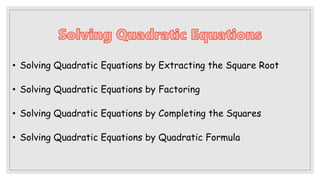
• Solving Quadratic Equations by Extracting the Square Root
• Solving Quadratic Equations by Factoring
• Solving Quadratic Equations by Completing the Squares
• Solving Quadratic Equations by Quadratic Formula
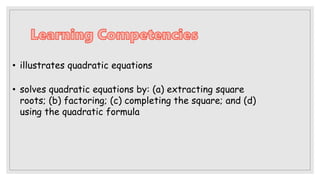
• illustrates quadratic equations
• solves quadratic equations by: (a) extracting square
roots; (b) factoring; (c) completing the square; and (d)
using the quadratic formula
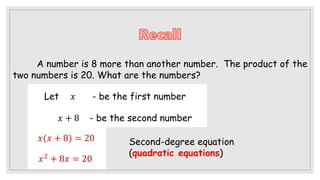
A number is 8 more than another number. The product of the
two numbers is 20. What are the numbers?
Second-degree equation
(quadratic equations)
Let 𝑥 - be the first number
𝑥 + 8 - be the second number
𝑥(𝑥 + 8) = 20
𝑥2 + 8𝑥 = 20
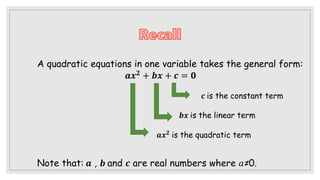
A quadratic equations in one variable takes the general form:
𝒂𝒙𝟐
+ 𝒃𝒙 + 𝒄 = 𝟎
𝒄 is the constant term
𝒃𝒙 is the linear term
𝒂𝒙𝟐 is the quadratic term
Note that: 𝒂 , 𝒃 and 𝒄 are real numbers where 𝑎≠0.
A quadratic equation can take any of these forms:
𝒂𝒙𝟐 = 𝒄
𝒂𝒙𝟐 + 𝒃𝒙 = 𝒄
𝒂𝒙𝟐 + 𝒃𝒙 + 𝒄 = 𝟎
Quadratic equation with no linear term form
Standard form
General form
The values 𝑥 of that make 𝑎𝑥2
+ 𝑏𝑥 + 𝑐 = 0 true are referred to as the
solutions or roots.
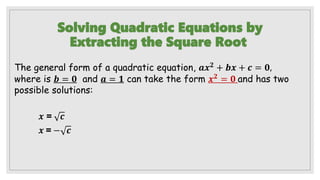
Solving Quadratic Equations by
Extracting the Square Root
The general form of a quadratic equation, 𝒂𝒙𝟐
+ 𝒃𝒙 + 𝒄 = 𝟎,
where is 𝒃 = 𝟎 and 𝒂 = 𝟏 can take the form 𝒙𝟐 = 𝟎 and has two
possible solutions:
𝒙 = 𝒄
𝒙 = − 𝒄
Solving Quadratic Equations by
Extracting the Square Root
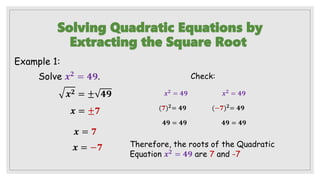
Example 1:
𝒙𝟐 = ± 𝟒𝟗
Solve 𝒙𝟐 = 𝟒𝟗.
𝒙 = ±𝟕
Therefore, the roots of the Quadratic
Equation 𝒙𝟐
= 𝟒𝟗 are 7 and -7
Check:
𝒙𝟐 = 𝟒𝟗
(−𝟕)𝟐
= 𝟒𝟗
𝟒𝟗 = 𝟒𝟗
(𝟕)𝟐
= 𝟒𝟗
𝟒𝟗 = 𝟒𝟗
𝒙𝟐 = 𝟒𝟗
𝒙 = 𝟕
𝒙 = −𝟕
Solving Quadratic Equations by
Extracting the Square Root
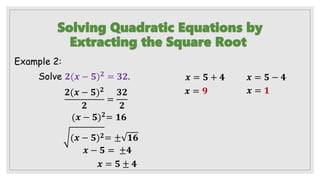
Example 2:
(𝒙 − 𝟓)𝟐= ± 𝟏𝟔
Solve 𝟐(𝒙 − 𝟓)𝟐 = 𝟑𝟐.
𝒙 = 𝟓 ± 𝟒
𝟐(𝒙 − 𝟓)𝟐
𝟐
=
𝟑𝟐
𝟐
(𝒙 − 𝟓)𝟐
= 𝟏𝟔
𝒙 = 𝟓 + 𝟒 𝒙 = 𝟓 − 𝟒
𝒙 = 𝟗 𝒙 = 𝟏
𝒙 − 𝟓 = ±𝟒
Solving Quadratic Equations by
Extracting the Square Root
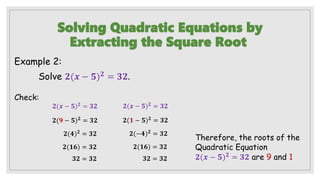
Example 2:
Solve 𝟐(𝒙 − 𝟓)𝟐 = 𝟑𝟐.
Therefore, the roots of the
Quadratic Equation
𝟐(𝒙 − 𝟓)𝟐
= 𝟑𝟐 are 9 and 1
Check:
𝟐(𝒙 − 𝟓)𝟐
= 𝟑𝟐
𝟐(𝟗 − 𝟓)𝟐 = 𝟑𝟐
𝟐(𝟒)𝟐 = 𝟑𝟐
𝟐(𝟏𝟔) = 𝟑𝟐
𝟑𝟐 = 𝟑𝟐
𝟐(𝒙 − 𝟓)𝟐 = 𝟑𝟐
𝟐(𝟏 − 𝟓)𝟐 = 𝟑𝟐
𝟐(−𝟒)𝟐
= 𝟑𝟐
𝟐(𝟏𝟔) = 𝟑𝟐
𝟑𝟐 = 𝟑𝟐
In solving quadratic equations by factoring, we apply the principle
of zero product to determine the solutions. In the principle of
zero product,
if𝒂𝒃 = 𝟎, then 𝒂 = 𝟎 or 𝒃 = 𝟎.
Example 1:
Solve the quadratic equation 𝟗𝒙𝟐
= 𝟐𝟓 by factoring.
Solution:
𝟗𝒙𝟐 = 𝟐𝟓
𝟗𝒙𝟐 − 𝟐𝟓 = 𝟎
(𝟑𝒙 + 𝟓)(𝟑𝒙 − 𝟓) = 𝟎
(𝟑𝒙 + 𝟓) = 𝟎 (𝟑𝒙 − 𝟓) = 𝟎
𝟑𝒙 = −𝟓
𝟑𝒙
𝟑
=
−𝟓
𝟑
𝟑𝒙 = 𝟓
𝒙 =
−𝟓
𝟑
𝟑𝒙
𝟑
=
𝟓
𝟑
𝒙 =
𝟓
𝟑
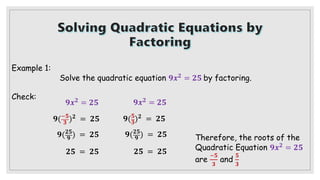
Example 1:
Solve the quadratic equation 𝟗𝒙𝟐
= 𝟐𝟓 by factoring.
Check:
𝟗𝒙𝟐 = 𝟐𝟓
𝟗(−𝟓
𝟑 )𝟐 = 𝟐𝟓
𝟗(𝟐𝟓
𝟗 ) = 𝟐𝟓
𝟐𝟓 = 𝟐𝟓
𝟗𝒙𝟐 = 𝟐𝟓
𝟗(𝟓
𝟑
)𝟐 = 𝟐𝟓
𝟗(𝟐𝟓
𝟗 ) = 𝟐𝟓
𝟐𝟓 = 𝟐𝟓
Therefore, the roots of the
Quadratic Equation 𝟗𝒙𝟐
= 𝟐𝟓
are
−𝟓
𝟑
and
𝟓
𝟑
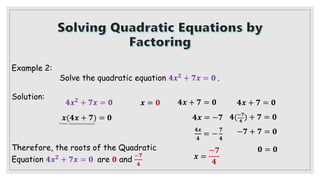
Example 2:
Solve the quadratic equation 𝟒𝒙𝟐
+ 𝟕𝒙 = 𝟎 .
Solution:
𝟒𝒙𝟐 + 𝟕𝒙 = 𝟎
𝒙(𝟒𝒙 + 𝟕) = 𝟎
𝒙 = 𝟎 𝟒𝒙 + 𝟕 = 𝟎
𝟒𝒙 = −𝟕
𝟒𝒙
𝟒
= −
𝟕
𝟒
𝒙 =
−𝟕
𝟒
𝟒𝒙 + 𝟕 = 𝟎
−𝟕 + 𝟕 = 𝟎
𝟎 = 𝟎
𝟒(−𝟕
𝟒
) + 𝟕 = 𝟎
Therefore, the roots of the Quadratic
Equation 𝟒𝒙𝟐 + 𝟕𝒙 = 𝟎 are 𝟎 and
−𝟕
𝟒
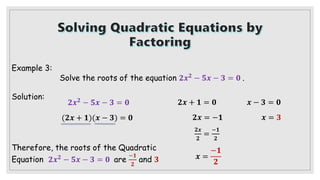
Example 3:
Solve the roots of the equation 𝟐𝒙𝟐
− 𝟓𝒙 − 𝟑 = 𝟎 .
Solution:
𝟐𝒙𝟐 − 𝟓𝒙 − 𝟑 = 𝟎
(𝟐𝒙 + 𝟏)(𝒙 − 𝟑) = 𝟎
𝟐𝒙 + 𝟏 = 𝟎
𝟐𝒙 = −𝟏
𝟐𝒙
𝟐
=
−𝟏
𝟐
𝒙 =
−𝟏
𝟐
Therefore, the roots of the Quadratic
Equation 𝟐𝒙𝟐 − 𝟓𝒙 − 𝟑 = 𝟎 are
−𝟏
𝟐
and 𝟑
𝒙 − 𝟑 = 𝟎
𝒙 = 𝟑
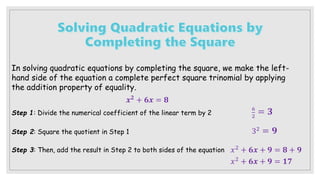
In solving quadratic equations by completing the square, we make the left-
hand side of the equation a complete perfect square trinomial by applying
the addition property of equality.
𝒙𝟐 + 𝟔𝒙 = 𝟖
Step 1: Divide the numerical coefficient of the linear term by 2
Step 2: Square the quotient in Step 1
Step 3: Then, add the result in Step 2 to both sides of the equation
6
2
= 𝟑
32 = 𝟗
𝑥2 + 𝟔𝒙 + 𝟗 = 𝟖 + 𝟗
𝑥2 + 𝟔𝒙 + 𝟗 = 𝟏𝟕
Example: 𝟐𝒙𝟐
− 𝟑𝒙 − 𝟗 = 𝟎
𝟐𝒙𝟐 − 𝟑𝒙 = 𝟗
𝟐
𝟐𝒙𝟐
− 𝟑
𝟐𝒙 = 𝟗
𝟐
𝒙𝟐 − 𝟑
𝟐𝒙 + 𝟗
𝟏𝟔 = 𝟗
𝟐+
𝟗
𝟏𝟔
(𝒙 − 𝟑
𝟒)𝟐= 𝟕𝟐+𝟗
𝟏𝟔
(𝒙 − 𝟑
𝟒)𝟐
= 𝟖𝟏
𝟏𝟔
(𝒙 − 𝟑
𝟒)𝟐= ±
𝟖𝟏
𝟏𝟔
𝒙 − 𝟑
𝟒 = ±
𝟗
𝟒
𝒙 = 𝟑
𝟒
±
𝟗
𝟒
Thus, the square roots of the
equation are 𝟑 or −
𝟑
𝟐
𝒙 = 𝟑
𝟒 −
𝟗
𝟒
𝒙 = 𝟑
𝟒 +
𝟗
𝟒
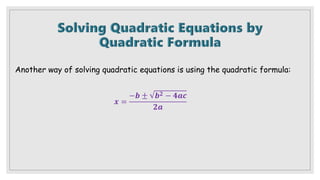
Another way of solving quadratic equations is using the quadratic formula:
𝒙 =
−𝒃 ± 𝒃𝟐 − 𝟒𝒂𝒄
𝟐𝒂
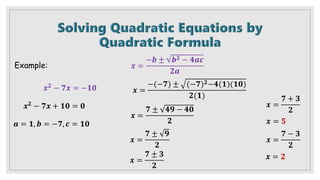
Example:
𝒙𝟐 − 𝟕𝒙 = −𝟏𝟎
𝒙𝟐 − 𝟕𝒙 + 𝟏𝟎 = 𝟎
𝒂 = 𝟏, 𝒃 = −𝟕, 𝒄 = 𝟏𝟎
𝒙 =
−𝒃 ± 𝒃𝟐 − 𝟒𝒂𝒄
𝟐𝒂
𝒙 =
−(−𝟕) ± (−𝟕)𝟐−𝟒(𝟏)(𝟏𝟎)
𝟐(𝟏)
𝒙 =
𝟕 ± 𝟒𝟗 − 𝟒𝟎
𝟐
𝒙 =
𝟕 ± 𝟗
𝟐
𝒙 =
𝟕 ± 𝟑
𝟐
𝒙 =
𝟕 + 𝟑
𝟐
𝒙 =
𝟕 − 𝟑
𝟐
𝒙 = 𝟐
𝒙 = 𝟓
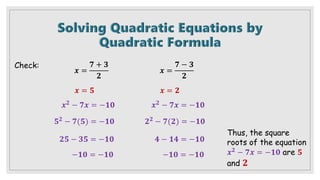
Check:
𝒙 =
𝟕 + 𝟑
𝟐
𝒙 =
𝟕 − 𝟑
𝟐
𝒙 = 𝟐
𝒙 = 𝟓
𝒙𝟐 − 𝟕𝒙 = −𝟏𝟎 𝒙𝟐 − 𝟕𝒙 = −𝟏𝟎
𝟓𝟐
− 𝟕(𝟓) = −𝟏𝟎
𝟐𝟓 − 𝟑𝟓 = −𝟏𝟎
−𝟏𝟎 = −𝟏𝟎
𝟐𝟐
− 𝟕(𝟐) = −𝟏𝟎
𝟒 − 𝟏𝟒 = −𝟏𝟎
−𝟏𝟎 = −𝟏𝟎
Thus, the square
roots of the equation
𝒙𝟐 − 𝟕𝒙 = −𝟏𝟎 are 𝟓
and 𝟐
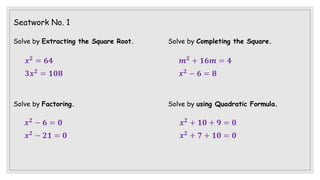
Seatwork No. 1
Solve by Extracting the Square Root.
Solve by Factoring.
Solve by Completing the Square.
Solve by using Quadratic Formula.
𝒙𝟐 = 𝟔𝟒
𝟑𝒙𝟐
= 𝟏𝟎𝟖
𝒙𝟐 − 𝟔 = 𝟎
𝒙𝟐 − 𝟐𝟏 = 𝟎
𝒎𝟐 + 𝟏𝟔𝒎 = 𝟒
𝒙𝟐
− 𝟔 = 𝟖
𝒙𝟐 + 𝟏𝟎 + 𝟗 = 𝟎
𝒙𝟐 + 𝟕 + 𝟏𝟎 = 𝟎

g_9 - L_1 Solving Quadratic Equations.pptx

  • 1.
  • 2.
    • Solving QuadraticEquations by Extracting the Square Root • Solving Quadratic Equations by Factoring • Solving Quadratic Equations by Completing the Squares • Solving Quadratic Equations by Quadratic Formula
  • 3.
    • illustrates quadraticequations • solves quadratic equations by: (a) extracting square roots; (b) factoring; (c) completing the square; and (d) using the quadratic formula
  • 4.
    A number is8 more than another number. The product of the two numbers is 20. What are the numbers? Second-degree equation (quadratic equations) Let 𝑥 - be the first number 𝑥 + 8 - be the second number 𝑥(𝑥 + 8) = 20 𝑥2 + 8𝑥 = 20
  • 5.
    A quadratic equationsin one variable takes the general form: 𝒂𝒙𝟐 + 𝒃𝒙 + 𝒄 = 𝟎 𝒄 is the constant term 𝒃𝒙 is the linear term 𝒂𝒙𝟐 is the quadratic term Note that: 𝒂 , 𝒃 and 𝒄 are real numbers where 𝑎≠0.
  • 6.
    A quadratic equationcan take any of these forms: 𝒂𝒙𝟐 = 𝒄 𝒂𝒙𝟐 + 𝒃𝒙 = 𝒄 𝒂𝒙𝟐 + 𝒃𝒙 + 𝒄 = 𝟎 Quadratic equation with no linear term form Standard form General form The values 𝑥 of that make 𝑎𝑥2 + 𝑏𝑥 + 𝑐 = 0 true are referred to as the solutions or roots.
  • 7.
    Solving Quadratic Equationsby Extracting the Square Root The general form of a quadratic equation, 𝒂𝒙𝟐 + 𝒃𝒙 + 𝒄 = 𝟎, where is 𝒃 = 𝟎 and 𝒂 = 𝟏 can take the form 𝒙𝟐 = 𝟎 and has two possible solutions: 𝒙 = 𝒄 𝒙 = − 𝒄
  • 8.
    Solving Quadratic Equationsby Extracting the Square Root Example 1: 𝒙𝟐 = ± 𝟒𝟗 Solve 𝒙𝟐 = 𝟒𝟗. 𝒙 = ±𝟕 Therefore, the roots of the Quadratic Equation 𝒙𝟐 = 𝟒𝟗 are 7 and -7 Check: 𝒙𝟐 = 𝟒𝟗 (−𝟕)𝟐 = 𝟒𝟗 𝟒𝟗 = 𝟒𝟗 (𝟕)𝟐 = 𝟒𝟗 𝟒𝟗 = 𝟒𝟗 𝒙𝟐 = 𝟒𝟗 𝒙 = 𝟕 𝒙 = −𝟕
  • 9.
    Solving Quadratic Equationsby Extracting the Square Root Example 2: (𝒙 − 𝟓)𝟐= ± 𝟏𝟔 Solve 𝟐(𝒙 − 𝟓)𝟐 = 𝟑𝟐. 𝒙 = 𝟓 ± 𝟒 𝟐(𝒙 − 𝟓)𝟐 𝟐 = 𝟑𝟐 𝟐 (𝒙 − 𝟓)𝟐 = 𝟏𝟔 𝒙 = 𝟓 + 𝟒 𝒙 = 𝟓 − 𝟒 𝒙 = 𝟗 𝒙 = 𝟏 𝒙 − 𝟓 = ±𝟒
  • 10.
    Solving Quadratic Equationsby Extracting the Square Root Example 2: Solve 𝟐(𝒙 − 𝟓)𝟐 = 𝟑𝟐. Therefore, the roots of the Quadratic Equation 𝟐(𝒙 − 𝟓)𝟐 = 𝟑𝟐 are 9 and 1 Check: 𝟐(𝒙 − 𝟓)𝟐 = 𝟑𝟐 𝟐(𝟗 − 𝟓)𝟐 = 𝟑𝟐 𝟐(𝟒)𝟐 = 𝟑𝟐 𝟐(𝟏𝟔) = 𝟑𝟐 𝟑𝟐 = 𝟑𝟐 𝟐(𝒙 − 𝟓)𝟐 = 𝟑𝟐 𝟐(𝟏 − 𝟓)𝟐 = 𝟑𝟐 𝟐(−𝟒)𝟐 = 𝟑𝟐 𝟐(𝟏𝟔) = 𝟑𝟐 𝟑𝟐 = 𝟑𝟐
  • 11.
    In solving quadraticequations by factoring, we apply the principle of zero product to determine the solutions. In the principle of zero product, if𝒂𝒃 = 𝟎, then 𝒂 = 𝟎 or 𝒃 = 𝟎.
  • 12.
    Example 1: Solve thequadratic equation 𝟗𝒙𝟐 = 𝟐𝟓 by factoring. Solution: 𝟗𝒙𝟐 = 𝟐𝟓 𝟗𝒙𝟐 − 𝟐𝟓 = 𝟎 (𝟑𝒙 + 𝟓)(𝟑𝒙 − 𝟓) = 𝟎 (𝟑𝒙 + 𝟓) = 𝟎 (𝟑𝒙 − 𝟓) = 𝟎 𝟑𝒙 = −𝟓 𝟑𝒙 𝟑 = −𝟓 𝟑 𝟑𝒙 = 𝟓 𝒙 = −𝟓 𝟑 𝟑𝒙 𝟑 = 𝟓 𝟑 𝒙 = 𝟓 𝟑
  • 13.
    Example 1: Solve thequadratic equation 𝟗𝒙𝟐 = 𝟐𝟓 by factoring. Check: 𝟗𝒙𝟐 = 𝟐𝟓 𝟗(−𝟓 𝟑 )𝟐 = 𝟐𝟓 𝟗(𝟐𝟓 𝟗 ) = 𝟐𝟓 𝟐𝟓 = 𝟐𝟓 𝟗𝒙𝟐 = 𝟐𝟓 𝟗(𝟓 𝟑 )𝟐 = 𝟐𝟓 𝟗(𝟐𝟓 𝟗 ) = 𝟐𝟓 𝟐𝟓 = 𝟐𝟓 Therefore, the roots of the Quadratic Equation 𝟗𝒙𝟐 = 𝟐𝟓 are −𝟓 𝟑 and 𝟓 𝟑
  • 14.
    Example 2: Solve thequadratic equation 𝟒𝒙𝟐 + 𝟕𝒙 = 𝟎 . Solution: 𝟒𝒙𝟐 + 𝟕𝒙 = 𝟎 𝒙(𝟒𝒙 + 𝟕) = 𝟎 𝒙 = 𝟎 𝟒𝒙 + 𝟕 = 𝟎 𝟒𝒙 = −𝟕 𝟒𝒙 𝟒 = − 𝟕 𝟒 𝒙 = −𝟕 𝟒 𝟒𝒙 + 𝟕 = 𝟎 −𝟕 + 𝟕 = 𝟎 𝟎 = 𝟎 𝟒(−𝟕 𝟒 ) + 𝟕 = 𝟎 Therefore, the roots of the Quadratic Equation 𝟒𝒙𝟐 + 𝟕𝒙 = 𝟎 are 𝟎 and −𝟕 𝟒
  • 15.
    Example 3: Solve theroots of the equation 𝟐𝒙𝟐 − 𝟓𝒙 − 𝟑 = 𝟎 . Solution: 𝟐𝒙𝟐 − 𝟓𝒙 − 𝟑 = 𝟎 (𝟐𝒙 + 𝟏)(𝒙 − 𝟑) = 𝟎 𝟐𝒙 + 𝟏 = 𝟎 𝟐𝒙 = −𝟏 𝟐𝒙 𝟐 = −𝟏 𝟐 𝒙 = −𝟏 𝟐 Therefore, the roots of the Quadratic Equation 𝟐𝒙𝟐 − 𝟓𝒙 − 𝟑 = 𝟎 are −𝟏 𝟐 and 𝟑 𝒙 − 𝟑 = 𝟎 𝒙 = 𝟑
  • 16.
    In solving quadraticequations by completing the square, we make the left- hand side of the equation a complete perfect square trinomial by applying the addition property of equality. 𝒙𝟐 + 𝟔𝒙 = 𝟖 Step 1: Divide the numerical coefficient of the linear term by 2 Step 2: Square the quotient in Step 1 Step 3: Then, add the result in Step 2 to both sides of the equation 6 2 = 𝟑 32 = 𝟗 𝑥2 + 𝟔𝒙 + 𝟗 = 𝟖 + 𝟗 𝑥2 + 𝟔𝒙 + 𝟗 = 𝟏𝟕
  • 17.
    Example: 𝟐𝒙𝟐 − 𝟑𝒙− 𝟗 = 𝟎 𝟐𝒙𝟐 − 𝟑𝒙 = 𝟗 𝟐 𝟐𝒙𝟐 − 𝟑 𝟐𝒙 = 𝟗 𝟐 𝒙𝟐 − 𝟑 𝟐𝒙 + 𝟗 𝟏𝟔 = 𝟗 𝟐+ 𝟗 𝟏𝟔 (𝒙 − 𝟑 𝟒)𝟐= 𝟕𝟐+𝟗 𝟏𝟔 (𝒙 − 𝟑 𝟒)𝟐 = 𝟖𝟏 𝟏𝟔 (𝒙 − 𝟑 𝟒)𝟐= ± 𝟖𝟏 𝟏𝟔 𝒙 − 𝟑 𝟒 = ± 𝟗 𝟒 𝒙 = 𝟑 𝟒 ± 𝟗 𝟒 Thus, the square roots of the equation are 𝟑 or − 𝟑 𝟐 𝒙 = 𝟑 𝟒 − 𝟗 𝟒 𝒙 = 𝟑 𝟒 + 𝟗 𝟒
  • 18.
    Another way ofsolving quadratic equations is using the quadratic formula: 𝒙 = −𝒃 ± 𝒃𝟐 − 𝟒𝒂𝒄 𝟐𝒂
  • 19.
    Example: 𝒙𝟐 − 𝟕𝒙= −𝟏𝟎 𝒙𝟐 − 𝟕𝒙 + 𝟏𝟎 = 𝟎 𝒂 = 𝟏, 𝒃 = −𝟕, 𝒄 = 𝟏𝟎 𝒙 = −𝒃 ± 𝒃𝟐 − 𝟒𝒂𝒄 𝟐𝒂 𝒙 = −(−𝟕) ± (−𝟕)𝟐−𝟒(𝟏)(𝟏𝟎) 𝟐(𝟏) 𝒙 = 𝟕 ± 𝟒𝟗 − 𝟒𝟎 𝟐 𝒙 = 𝟕 ± 𝟗 𝟐 𝒙 = 𝟕 ± 𝟑 𝟐 𝒙 = 𝟕 + 𝟑 𝟐 𝒙 = 𝟕 − 𝟑 𝟐 𝒙 = 𝟐 𝒙 = 𝟓
  • 20.
    Check: 𝒙 = 𝟕 +𝟑 𝟐 𝒙 = 𝟕 − 𝟑 𝟐 𝒙 = 𝟐 𝒙 = 𝟓 𝒙𝟐 − 𝟕𝒙 = −𝟏𝟎 𝒙𝟐 − 𝟕𝒙 = −𝟏𝟎 𝟓𝟐 − 𝟕(𝟓) = −𝟏𝟎 𝟐𝟓 − 𝟑𝟓 = −𝟏𝟎 −𝟏𝟎 = −𝟏𝟎 𝟐𝟐 − 𝟕(𝟐) = −𝟏𝟎 𝟒 − 𝟏𝟒 = −𝟏𝟎 −𝟏𝟎 = −𝟏𝟎 Thus, the square roots of the equation 𝒙𝟐 − 𝟕𝒙 = −𝟏𝟎 are 𝟓 and 𝟐
  • 21.
    Seatwork No. 1 Solveby Extracting the Square Root. Solve by Factoring. Solve by Completing the Square. Solve by using Quadratic Formula. 𝒙𝟐 = 𝟔𝟒 𝟑𝒙𝟐 = 𝟏𝟎𝟖 𝒙𝟐 − 𝟔 = 𝟎 𝒙𝟐 − 𝟐𝟏 = 𝟎 𝒎𝟐 + 𝟏𝟔𝒎 = 𝟒 𝒙𝟐 − 𝟔 = 𝟖 𝒙𝟐 + 𝟏𝟎 + 𝟗 = 𝟎 𝒙𝟐 + 𝟕 + 𝟏𝟎 = 𝟎