MATHEMATICS 9
LESSON 1
SOLVING
QUADRATIC
EQUATIONS
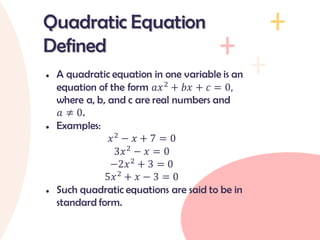
● A quadratic equation in one variable is an
equation of the form 𝑎𝑥2
+ 𝑏𝑥 + 𝑐 = 0,
where a, b, and c are real numbers and
𝑎 ≠ 0.
● Examples:
𝑥2
− 𝑥 + 7 = 0
3𝑥2
− 𝑥 = 0
−2𝑥2
+ 3 = 0
5𝑥2
+ 𝑥 − 3 = 0
● Such quadratic equations are said to be in
standard form.
Quadratic Equation
Defined
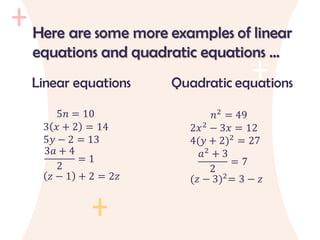
Linear equations
5𝑛 = 10
3 𝑥 + 2 = 14
5𝑦 − 2 = 13
3𝑎 + 4
2
= 1
𝑧 − 1 + 2 = 2𝑧
Quadratic equations
𝑛2
= 49
2𝑥2
− 3𝑥 = 12
4(𝑦 + 2)2
= 27
𝑎2
+ 3
2
= 7
(𝑧 − 3)2
= 3 − 𝑧
Here are some more examples of linear
equations and quadratic equations …
Solving Quadratic
Equations by Extracting
the Square Root
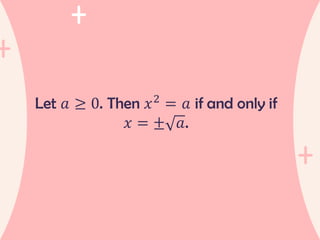
Let 𝑎 ≥ 0. Then 𝑥2
= 𝑎 if and only if
𝑥 = ± 𝑎.
The following quadratic
equations can be solved by
extracting the square roots.
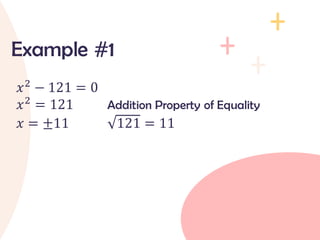
𝑥2
− 121 = 0
𝑥2
= 121 Addition Property of Equality
𝑥 = ±11 121 = 11
Example #1
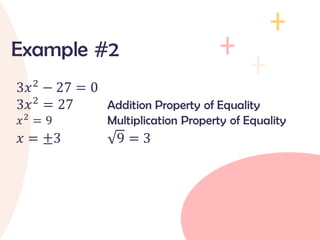
3𝑥2
− 27 = 0
3𝑥2
= 27 Addition Property of Equality
𝑥2
= 9 Multiplication Property of Equality
𝑥 = ±3 9 = 3
Example #2
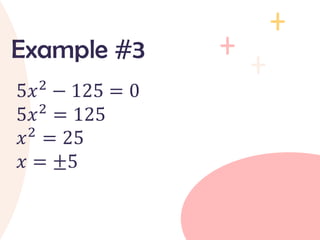
5𝑥2
− 125 = 0
5𝑥2
= 125
𝑥2
= 25
𝑥 = ±5
Example #3
𝑥2
= 15
𝑥 = ± 15
Example #4
Solving Quadratic
Equations by
Factoring
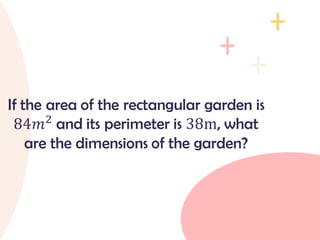
If the area of the rectangular garden is
84𝑚2
and its perimeter is 38m, what
are the dimensions of the garden?
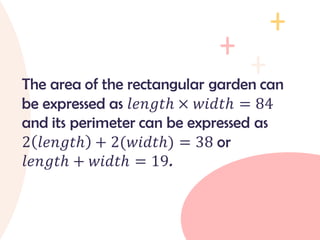
The area of the rectangular garden can
be expressed as 𝑙𝑒𝑛𝑔𝑡ℎ × 𝑤𝑖𝑑𝑡ℎ = 84
and its perimeter can be expressed as
2 𝑙𝑒𝑛𝑔𝑡ℎ + 2(𝑤𝑖𝑑𝑡ℎ) = 38 or
𝑙𝑒𝑛𝑔𝑡ℎ + 𝑤𝑖𝑑𝑡ℎ = 19.
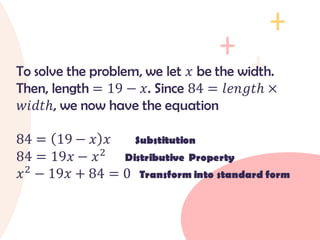
To solve the problem, we let 𝑥 be the width.
Then, length = 19 − 𝑥. Since 84 = 𝑙𝑒𝑛𝑔𝑡ℎ ×
𝑤𝑖𝑑𝑡ℎ, we now have the equation
84 = 19 − 𝑥 𝑥 Substitution
84 = 19𝑥 − 𝑥2
Distributive Property
𝑥2
− 19𝑥 + 84 = 0 Transform into standard form
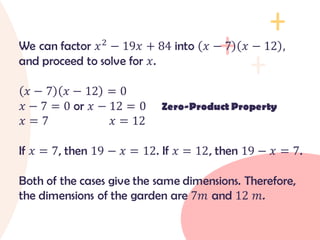
We can factor 𝑥2
− 19𝑥 + 84 into 𝑥 − 7 𝑥 − 12 ,
and proceed to solve for 𝑥.
𝑥 − 7 𝑥 − 12 = 0
𝑥 − 7 = 0 or 𝑥 − 12 = 0 Zero-Product Property
𝑥 = 7 𝑥 = 12
If 𝑥 = 7, then 19 − 𝑥 = 12. If 𝑥 = 12, then 19 − 𝑥 = 7.
Both of the cases give the same dimensions. Therefore,
the dimensions of the garden are 7𝑚 and 12 𝑚.
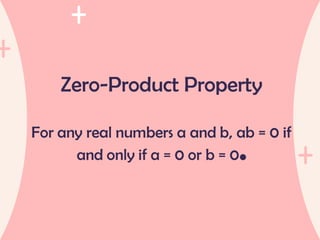
Zero-Product Property
For any real numbers a and b, ab = 0 if
and only if a = 0 or b = 0.
The following quadratic
equations can be solved by
factoring.
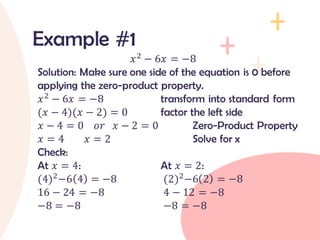
𝑥2
− 6𝑥 = −8
Solution: Make sure one side of the equation is 0 before
applying the zero-product property.
𝑥2
− 6𝑥 = −8 transform into standard form
(𝑥 − 4)(𝑥 − 2) = 0 factor the left side
𝑥 − 4 = 0 𝑜𝑟 𝑥 − 2 = 0 Zero-Product Property
𝑥 = 4 𝑥 = 2 Solve for x
Check:
At 𝑥 = 4: At 𝑥 = 2:
(4)2
−6 4 = −8 (2)2
−6 2 = −8
16 − 24 = −8 4 − 12 = −8
−8 = −8 −8 = −8
Example #1
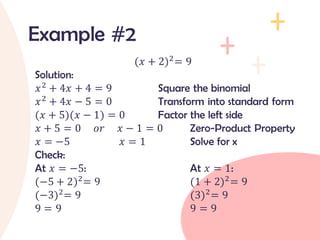
(𝑥 + 2)2= 9
Solution:
𝑥2
+ 4𝑥 + 4 = 9 Square the binomial
𝑥2 + 4𝑥 − 5 = 0 Transform into standard form
(𝑥 + 5)(𝑥 − 1) = 0 Factor the left side
𝑥 + 5 = 0 𝑜𝑟 𝑥 − 1 = 0 Zero-Product Property
𝑥 = −5 𝑥 = 1 Solve for x
Check:
At 𝑥 = −5: At 𝑥 = 1:
(−5 + 2)2= 9 (1 + 2)2= 9
(−3)2= 9 (3)2= 9
9 = 9 9 = 9
Example #2
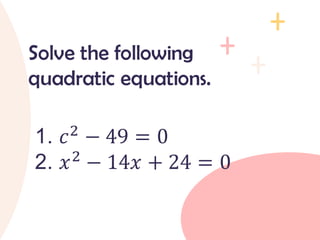
PRACTICE!
1. 𝑐2 − 49 = 0
2. 𝑥2 − 14𝑥 + 24 = 0
Solve the following
quadratic equations.
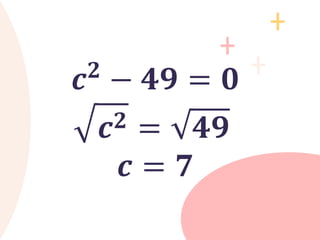
𝒄𝟐
− 𝟒𝟗 = 𝟎
𝒄𝟐 = 𝟒𝟗
𝒄 = 𝟕
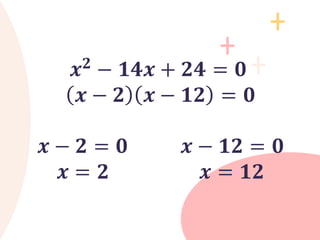
𝒙𝟐 − 𝟏𝟒𝒙 + 𝟐𝟒 = 𝟎
𝒙 − 𝟐 𝒙 − 𝟏𝟐 = 𝟎
𝒙 − 𝟐 = 𝟎 𝒙 − 𝟏𝟐 = 𝟎
𝒙 = 𝟐 𝒙 = 𝟏𝟐

Math-9-Lesson-dasaseaaeaeaWAawaAAAq1.pdf

  • 1.
  • 2.
  • 3.
    ● A quadraticequation in one variable is an equation of the form 𝑎𝑥2 + 𝑏𝑥 + 𝑐 = 0, where a, b, and c are real numbers and 𝑎 ≠ 0. ● Examples: 𝑥2 − 𝑥 + 7 = 0 3𝑥2 − 𝑥 = 0 −2𝑥2 + 3 = 0 5𝑥2 + 𝑥 − 3 = 0 ● Such quadratic equations are said to be in standard form. Quadratic Equation Defined
  • 4.
    Linear equations 5𝑛 =10 3 𝑥 + 2 = 14 5𝑦 − 2 = 13 3𝑎 + 4 2 = 1 𝑧 − 1 + 2 = 2𝑧 Quadratic equations 𝑛2 = 49 2𝑥2 − 3𝑥 = 12 4(𝑦 + 2)2 = 27 𝑎2 + 3 2 = 7 (𝑧 − 3)2 = 3 − 𝑧 Here are some more examples of linear equations and quadratic equations …
  • 5.
    Solving Quadratic Equations byExtracting the Square Root
  • 6.
    Let 𝑎 ≥0. Then 𝑥2 = 𝑎 if and only if 𝑥 = ± 𝑎.
  • 7.
    The following quadratic equationscan be solved by extracting the square roots.
  • 8.
    𝑥2 − 121 =0 𝑥2 = 121 Addition Property of Equality 𝑥 = ±11 121 = 11 Example #1
  • 9.
    3𝑥2 − 27 =0 3𝑥2 = 27 Addition Property of Equality 𝑥2 = 9 Multiplication Property of Equality 𝑥 = ±3 9 = 3 Example #2
  • 10.
    5𝑥2 − 125 =0 5𝑥2 = 125 𝑥2 = 25 𝑥 = ±5 Example #3
  • 11.
    𝑥2 = 15 𝑥 =± 15 Example #4
  • 12.
  • 13.
    If the areaof the rectangular garden is 84𝑚2 and its perimeter is 38m, what are the dimensions of the garden?
  • 14.
    The area ofthe rectangular garden can be expressed as 𝑙𝑒𝑛𝑔𝑡ℎ × 𝑤𝑖𝑑𝑡ℎ = 84 and its perimeter can be expressed as 2 𝑙𝑒𝑛𝑔𝑡ℎ + 2(𝑤𝑖𝑑𝑡ℎ) = 38 or 𝑙𝑒𝑛𝑔𝑡ℎ + 𝑤𝑖𝑑𝑡ℎ = 19.
  • 15.
    To solve theproblem, we let 𝑥 be the width. Then, length = 19 − 𝑥. Since 84 = 𝑙𝑒𝑛𝑔𝑡ℎ × 𝑤𝑖𝑑𝑡ℎ, we now have the equation 84 = 19 − 𝑥 𝑥 Substitution 84 = 19𝑥 − 𝑥2 Distributive Property 𝑥2 − 19𝑥 + 84 = 0 Transform into standard form
  • 16.
    We can factor𝑥2 − 19𝑥 + 84 into 𝑥 − 7 𝑥 − 12 , and proceed to solve for 𝑥. 𝑥 − 7 𝑥 − 12 = 0 𝑥 − 7 = 0 or 𝑥 − 12 = 0 Zero-Product Property 𝑥 = 7 𝑥 = 12 If 𝑥 = 7, then 19 − 𝑥 = 12. If 𝑥 = 12, then 19 − 𝑥 = 7. Both of the cases give the same dimensions. Therefore, the dimensions of the garden are 7𝑚 and 12 𝑚.
  • 17.
    Zero-Product Property For anyreal numbers a and b, ab = 0 if and only if a = 0 or b = 0.
  • 18.
    The following quadratic equationscan be solved by factoring.
  • 19.
    𝑥2 − 6𝑥 =−8 Solution: Make sure one side of the equation is 0 before applying the zero-product property. 𝑥2 − 6𝑥 = −8 transform into standard form (𝑥 − 4)(𝑥 − 2) = 0 factor the left side 𝑥 − 4 = 0 𝑜𝑟 𝑥 − 2 = 0 Zero-Product Property 𝑥 = 4 𝑥 = 2 Solve for x Check: At 𝑥 = 4: At 𝑥 = 2: (4)2 −6 4 = −8 (2)2 −6 2 = −8 16 − 24 = −8 4 − 12 = −8 −8 = −8 −8 = −8 Example #1
  • 20.
    (𝑥 + 2)2=9 Solution: 𝑥2 + 4𝑥 + 4 = 9 Square the binomial 𝑥2 + 4𝑥 − 5 = 0 Transform into standard form (𝑥 + 5)(𝑥 − 1) = 0 Factor the left side 𝑥 + 5 = 0 𝑜𝑟 𝑥 − 1 = 0 Zero-Product Property 𝑥 = −5 𝑥 = 1 Solve for x Check: At 𝑥 = −5: At 𝑥 = 1: (−5 + 2)2= 9 (1 + 2)2= 9 (−3)2= 9 (3)2= 9 9 = 9 9 = 9 Example #2
  • 21.
  • 22.
    1. 𝑐2 −49 = 0 2. 𝑥2 − 14𝑥 + 24 = 0 Solve the following quadratic equations.
  • 23.
    𝒄𝟐 − 𝟒𝟗 =𝟎 𝒄𝟐 = 𝟒𝟗 𝒄 = 𝟕
  • 24.
    𝒙𝟐 − 𝟏𝟒𝒙+ 𝟐𝟒 = 𝟎 𝒙 − 𝟐 𝒙 − 𝟏𝟐 = 𝟎 𝒙 − 𝟐 = 𝟎 𝒙 − 𝟏𝟐 = 𝟎 𝒙 = 𝟐 𝒙 = 𝟏𝟐