1, 2, 3,…
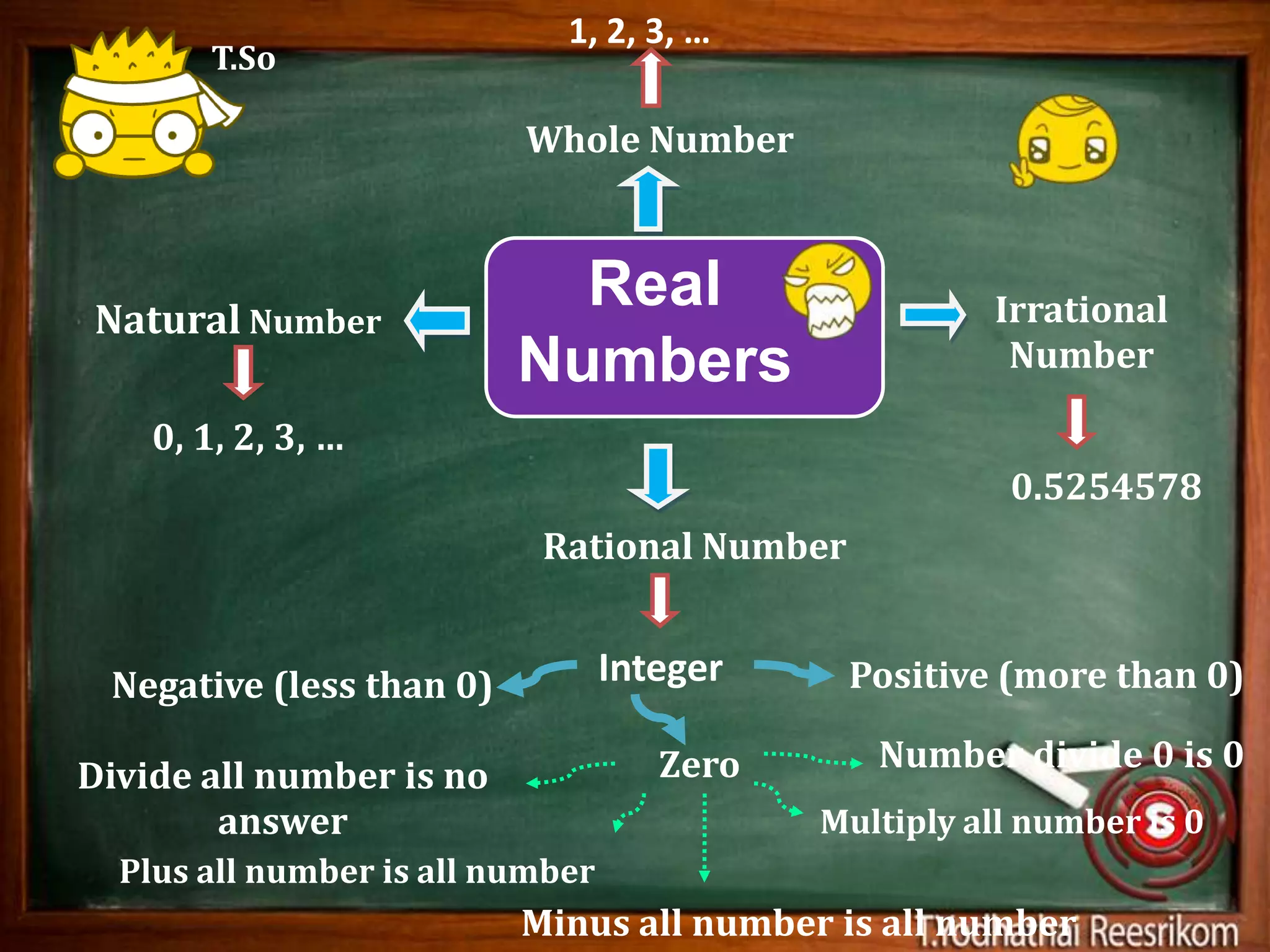
T.So
Whole Number
Natural Number
Real Irrational
Numbers Number
0, 1, 2, 3, …
0.5254578
Rational Number
Negative (less than 0) Integer Positive (more than 0)
Zero Number divide 0 is 0
Divide all number is no
answer Multiply all number is 0
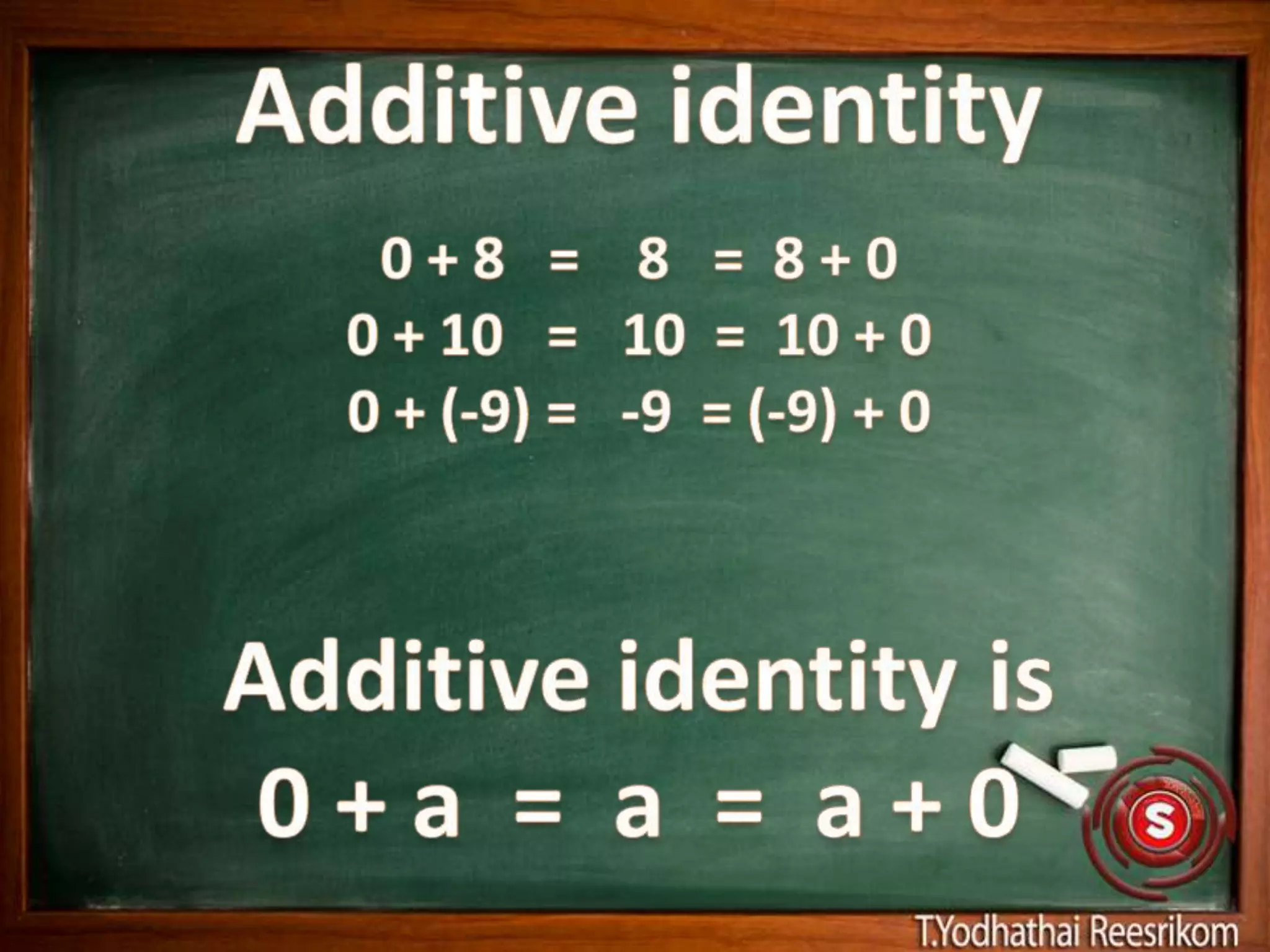
Plus all number is all number
Minus all number is all number
6.
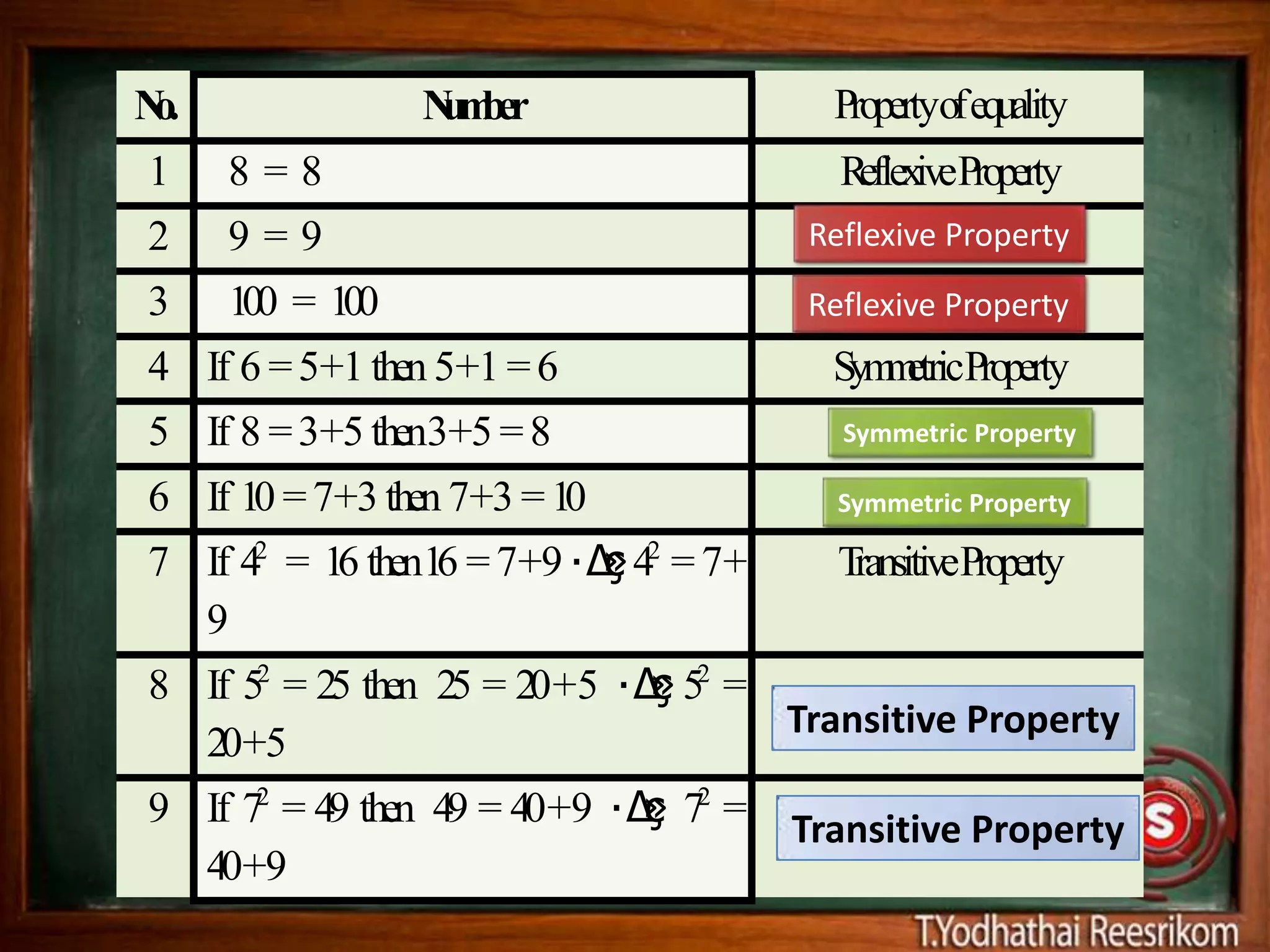
No. N ber
um Propertyof equality
1 8=8 ReflexiveProperty
2 9=9 Reflexive Property
3 100 = 100 Reflexive Property
4 If 6 = 5+1 then 5+1 = 6 Sym etricProperty
m
5 If 8 = 3+5 then3+5 = 8 Symmetric Property
6 If 10 = 7+3 then 7+3 = 10 Symmetric Property
7 If 42 = 16 then16 = 7+9 42 = 7+ TransitiveProperty
9
8 If 52 = 25 then 25 = 20 +5 52 =
Transitive Property
20+5
9 If 72 = 49 then 49 = 40+9 72 = Transitive Property
40+9
7.
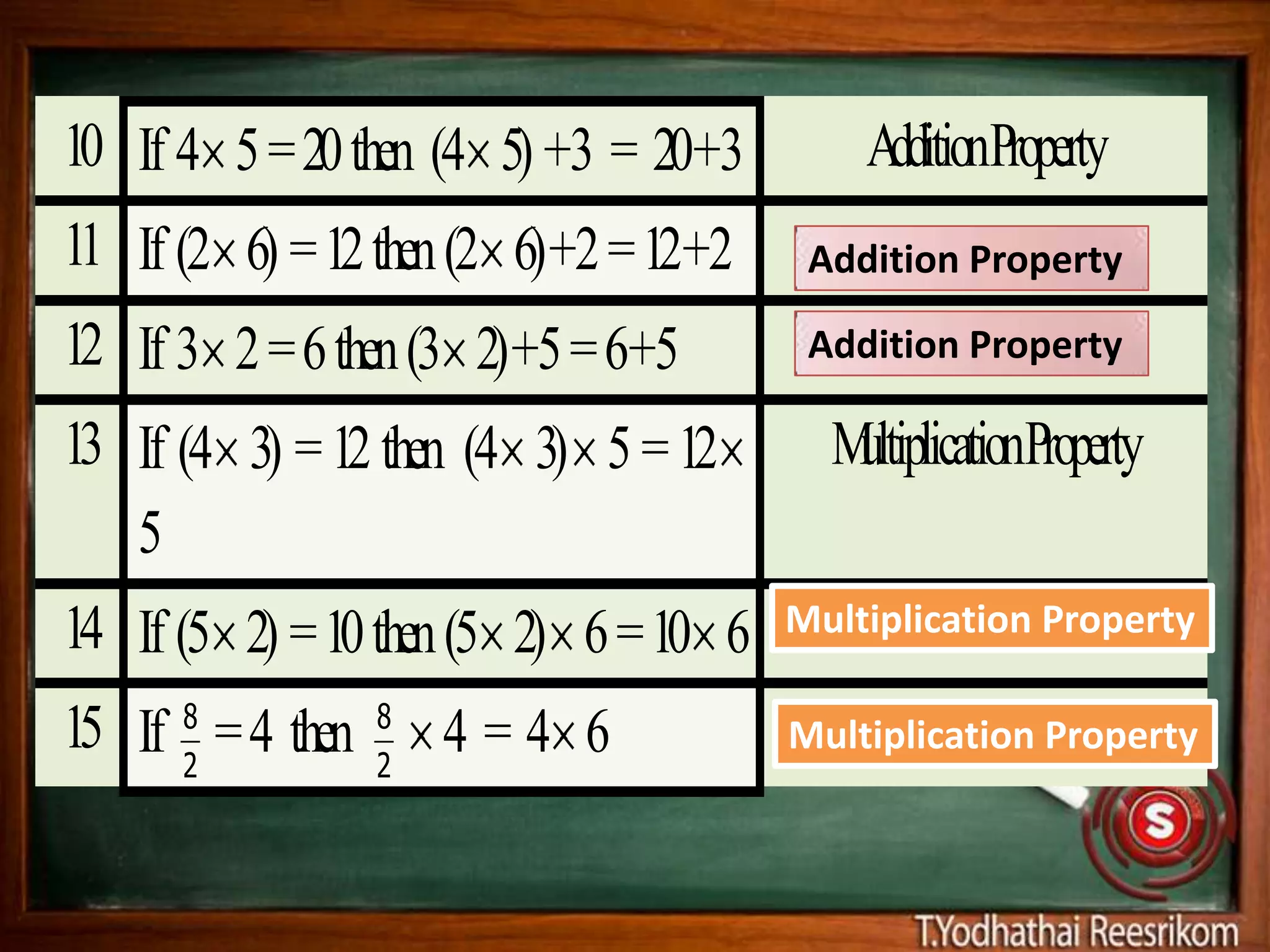
10 If 45 = 20 then (4 5) +3 = 20+3 AdditionProperty
11 If (2 6) = 12 then (2 6) +2 = 12+2 Addition Property
12 If 3 2 = 6 then (3 2) +5 = 6+5 Addition Property
13 If (4 3) = 12 then (4 3) 5 = 12 MultiplicationProperty
5
14 If (5 2) = 10 then (5 2) 6 = 10 6 Multiplication Property
8 8
15 If 2 = 4 then 2
4=4 6 Multiplication Property
8.
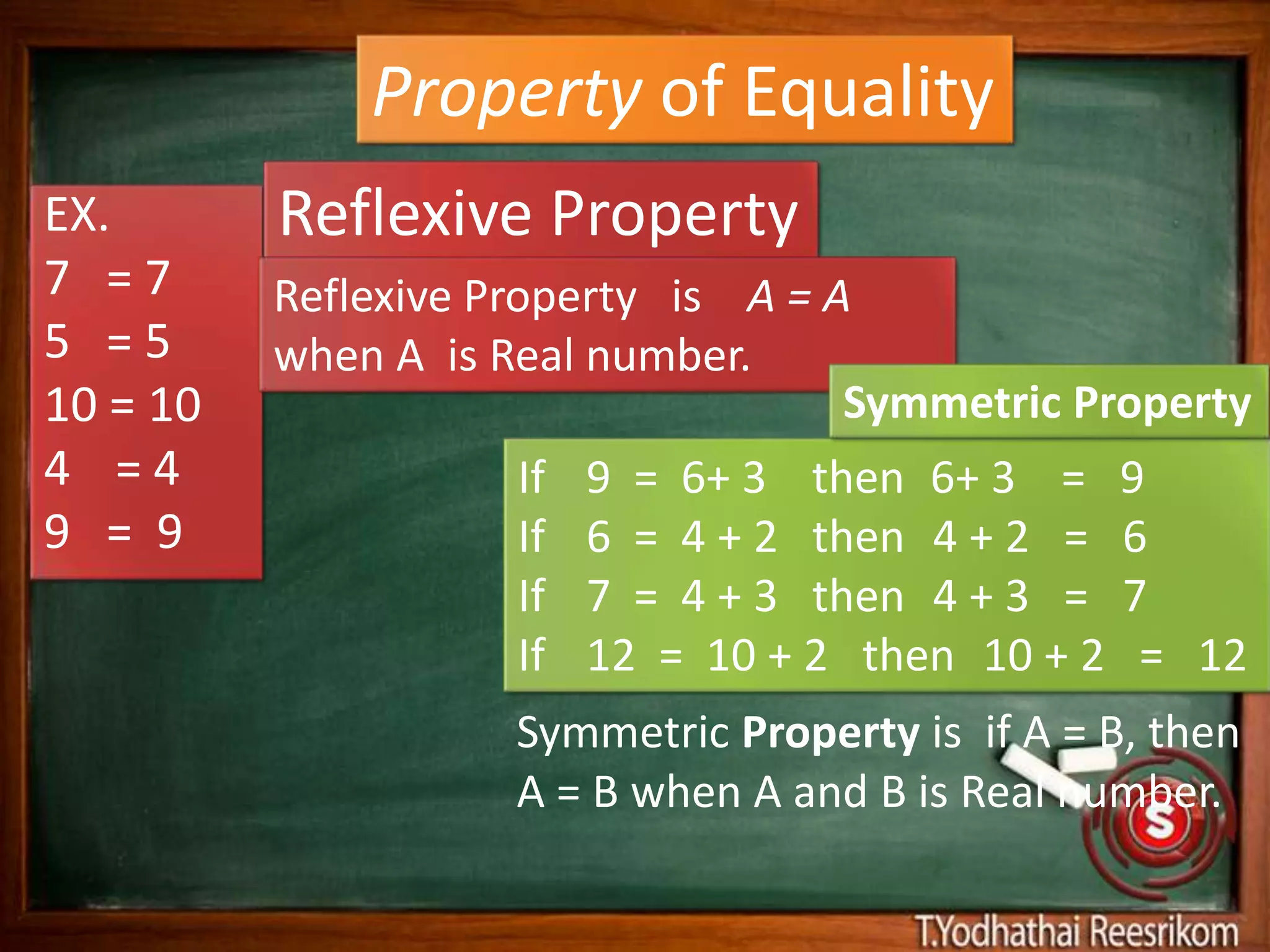
Property of Equality
EX. Reflexive Property
7 =7 Reflexive Property is A = A
5 =5 when A is Real number.
10 = 10 Symmetric Property
4 =4 If 9 = 6+ 3 then 6+ 3 = 9
9 = 9 If 6 = 4 + 2 then 4 + 2 = 6
If 7 = 4 + 3 then 4 + 3 = 7
If 12 = 10 + 2 then 10 + 2 = 12
Symmetric Property is if A = B, then
A = B when A and B is Real number.
9.
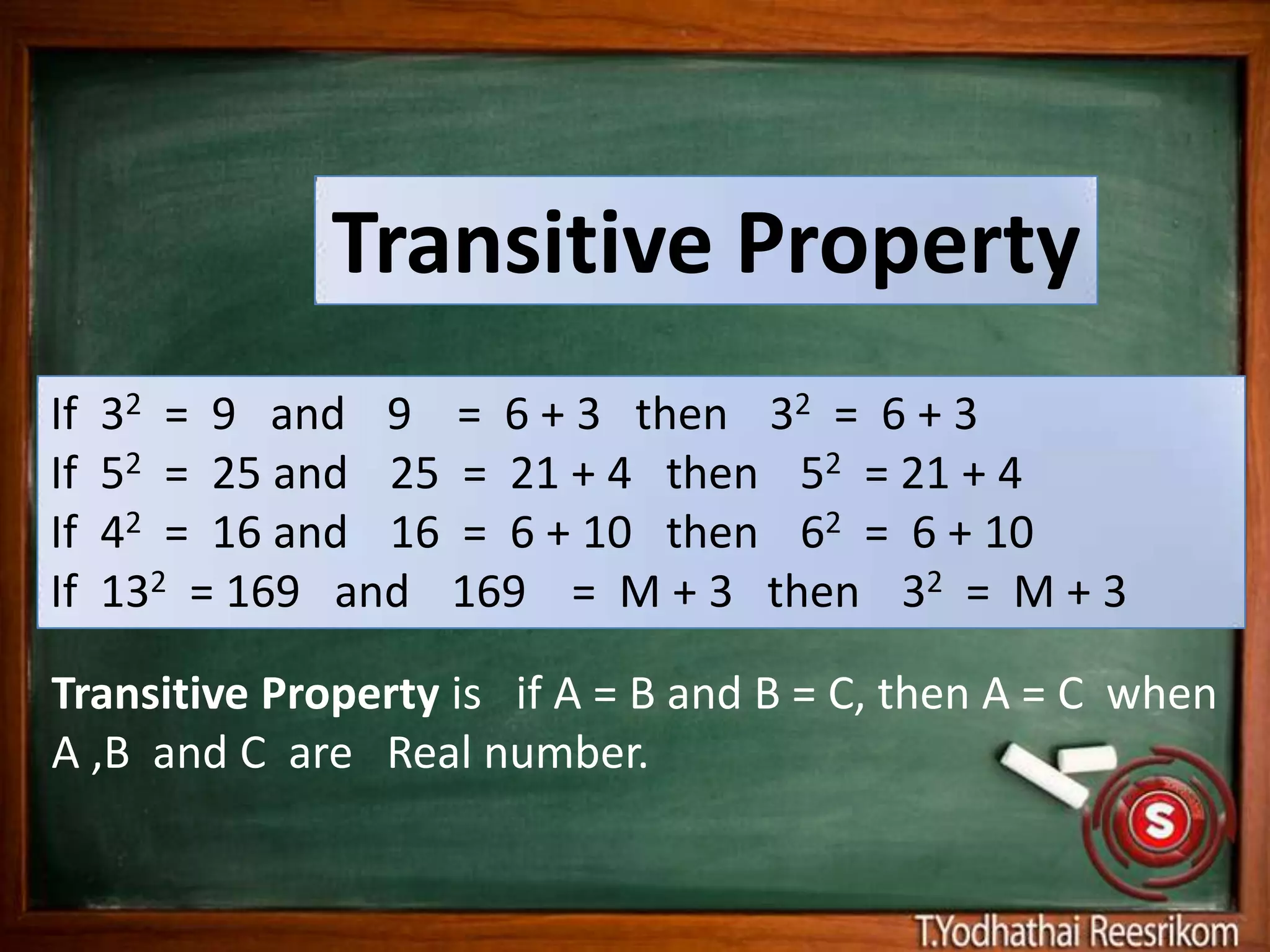
Transitive Property
If 32 = 9 and 9 = 6 + 3 then 32 = 6 + 3
If 52 = 25 and 25 = 21 + 4 then 52 = 21 + 4
If 42 = 16 and 16 = 6 + 10 then 62 = 6 + 10
If 132 = 169 and 169 = M + 3 then 32 = M + 3
Transitive Property is if A = B and B = C, then A = C when
A ,B and C are Real number.
10.
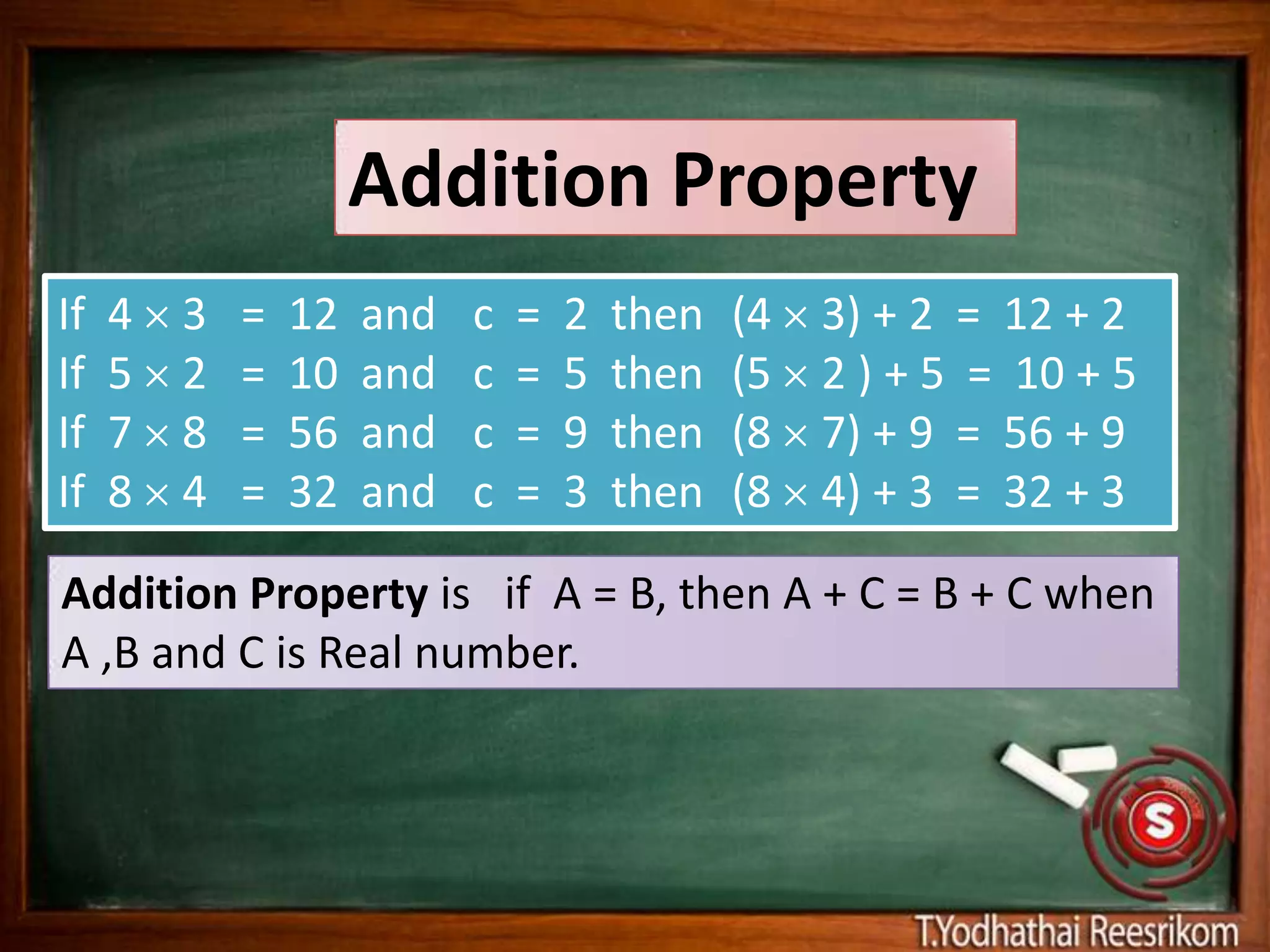
Addition Property
If 4 3 = 12 and c = 2 then (4 3) + 2 = 12 + 2
If 5 2 = 10 and c = 5 then (5 2 ) + 5 = 10 + 5
If 7 8 = 56 and c = 9 then (8 7) + 9 = 56 + 9
If 8 4 = 32 and c = 3 then (8 4) + 3 = 32 + 3
Addition Property is if A = B, then A + C = B + C when
A ,B and C is Real number.
11.
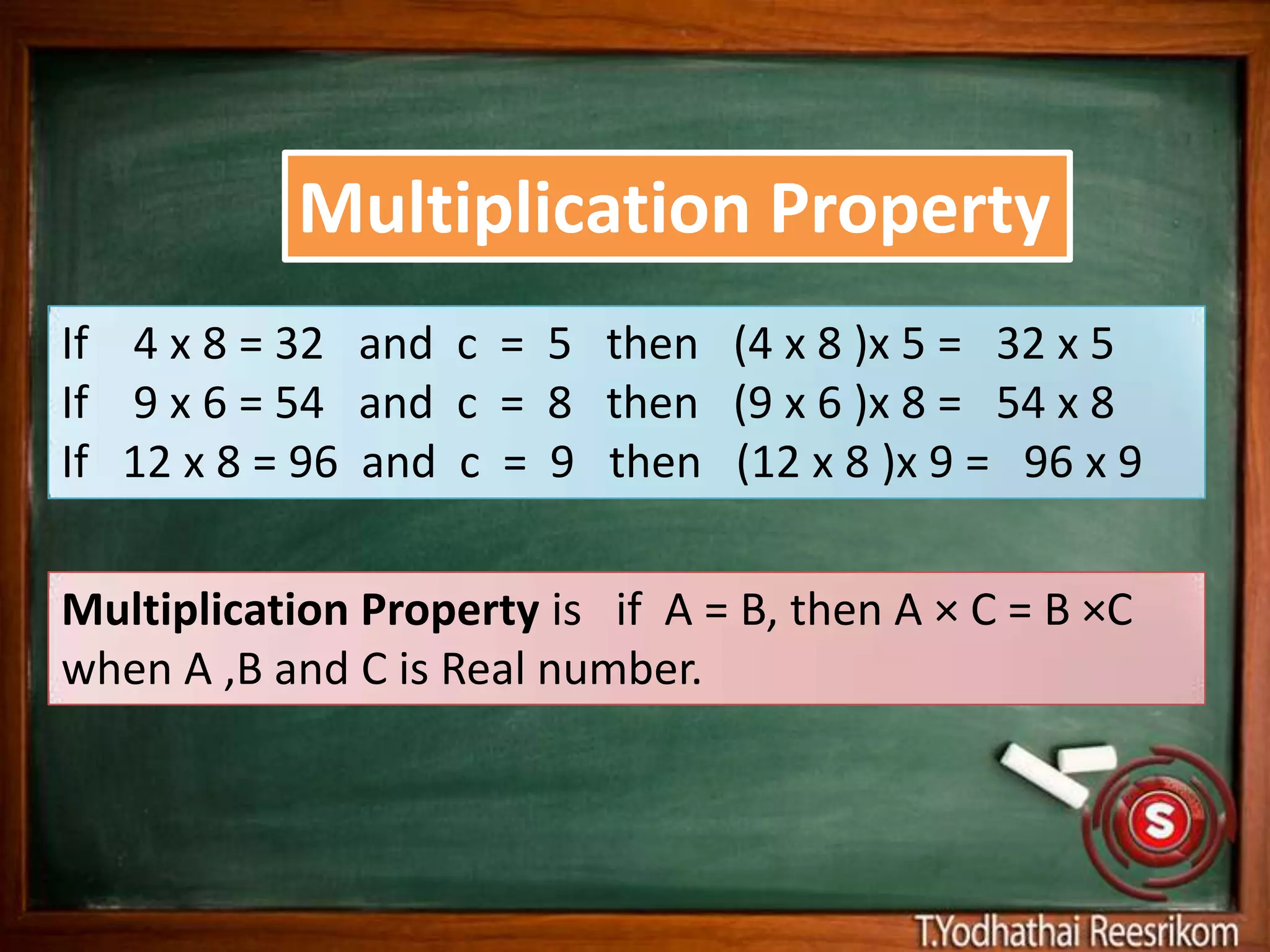
Multiplication Property
If 4x 8 = 32 and c = 5 then (4 x 8 )x 5 = 32 x 5
If 9 x 6 = 54 and c = 8 then (9 x 6 )x 8 = 54 x 8
If 12 x 8 = 96 and c = 9 then (12 x 8 )x 9 = 96 x 9
Multiplication Property is if A = B, then A × C = B ×C
when A ,B and C is Real number.
20.
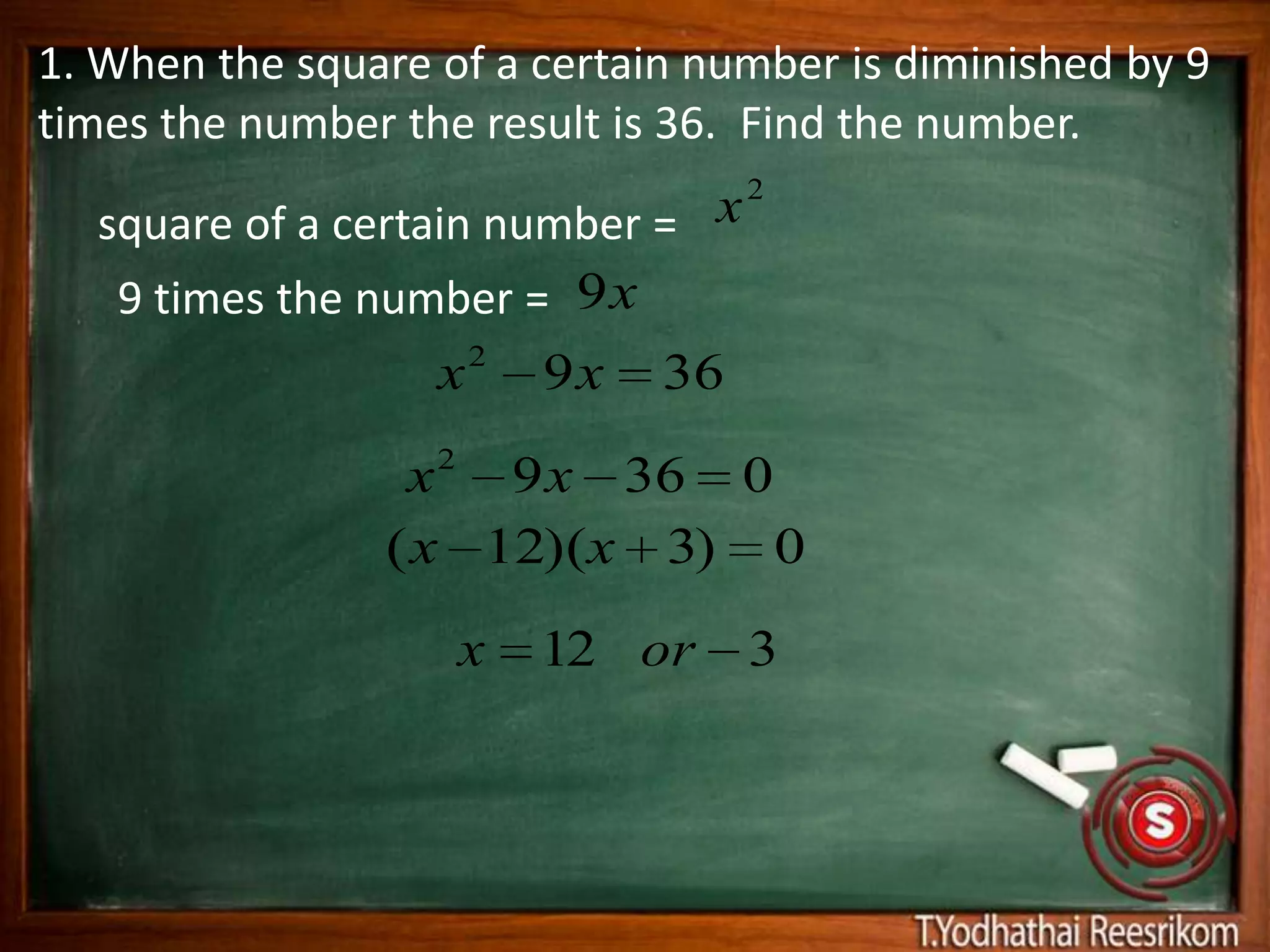
1. When thesquare of a certain number is diminished by 9
times the number the result is 36. Find the number.
square of a certain number = x2
9 times the number = 9 x
2
x 9 x 36
x 2 9 x 36 0
( x 12)(x 3) 0
x 12 or 3
21.
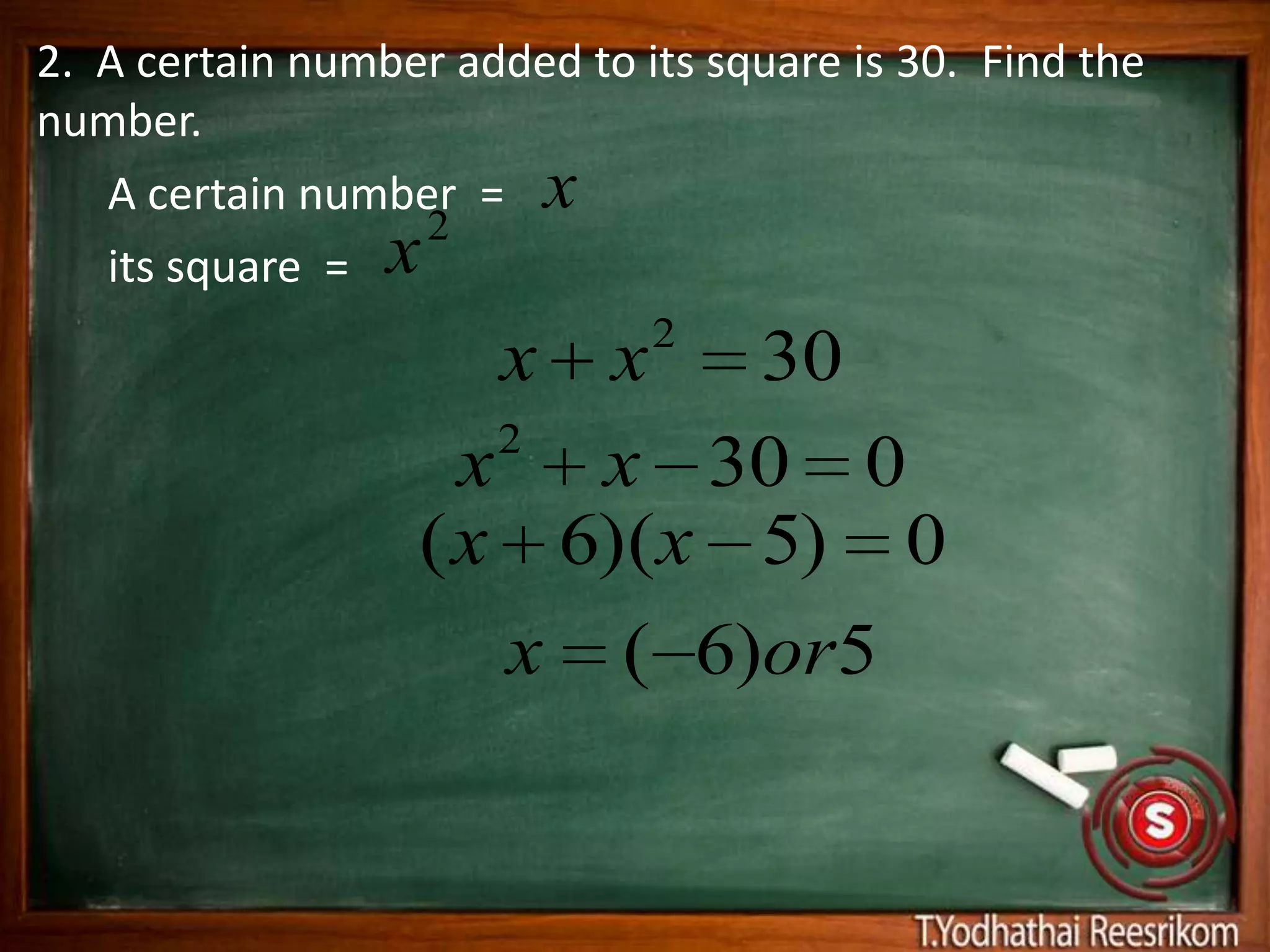
2. A certainnumber added to its square is 30. Find the
number.
A certain number = x
2
its square = x
2
x
x 30
2
x x 30 0
( x 6)(x 5) 0
x ( 6)or5
22.
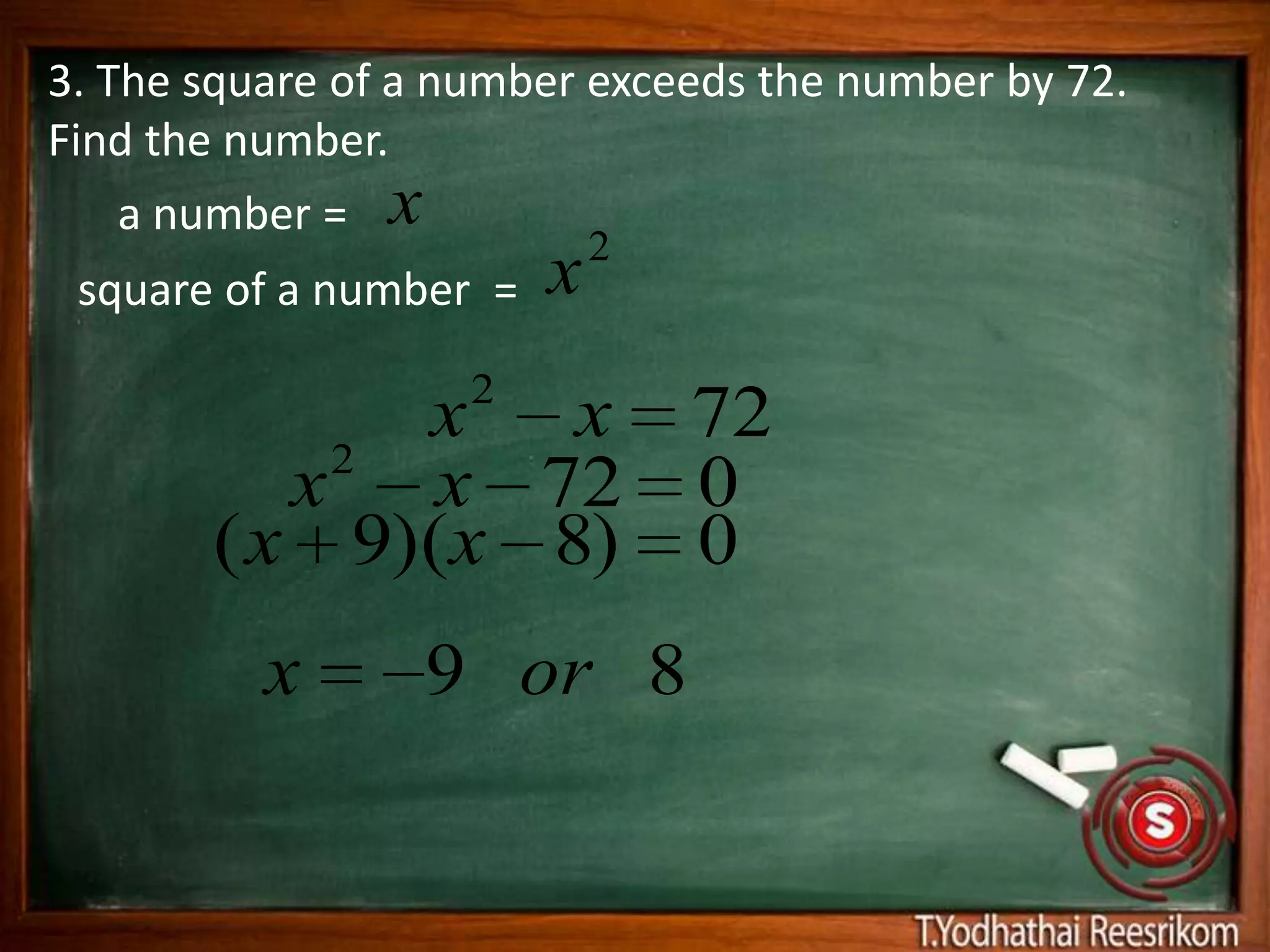
3. The squareof a number exceeds the number by 72.
Find the number.
a number = x
2
square of a number = x
2
2
x x 72
x x 72 0
( x 9)(x 8) 0
x 9 or 8
23.
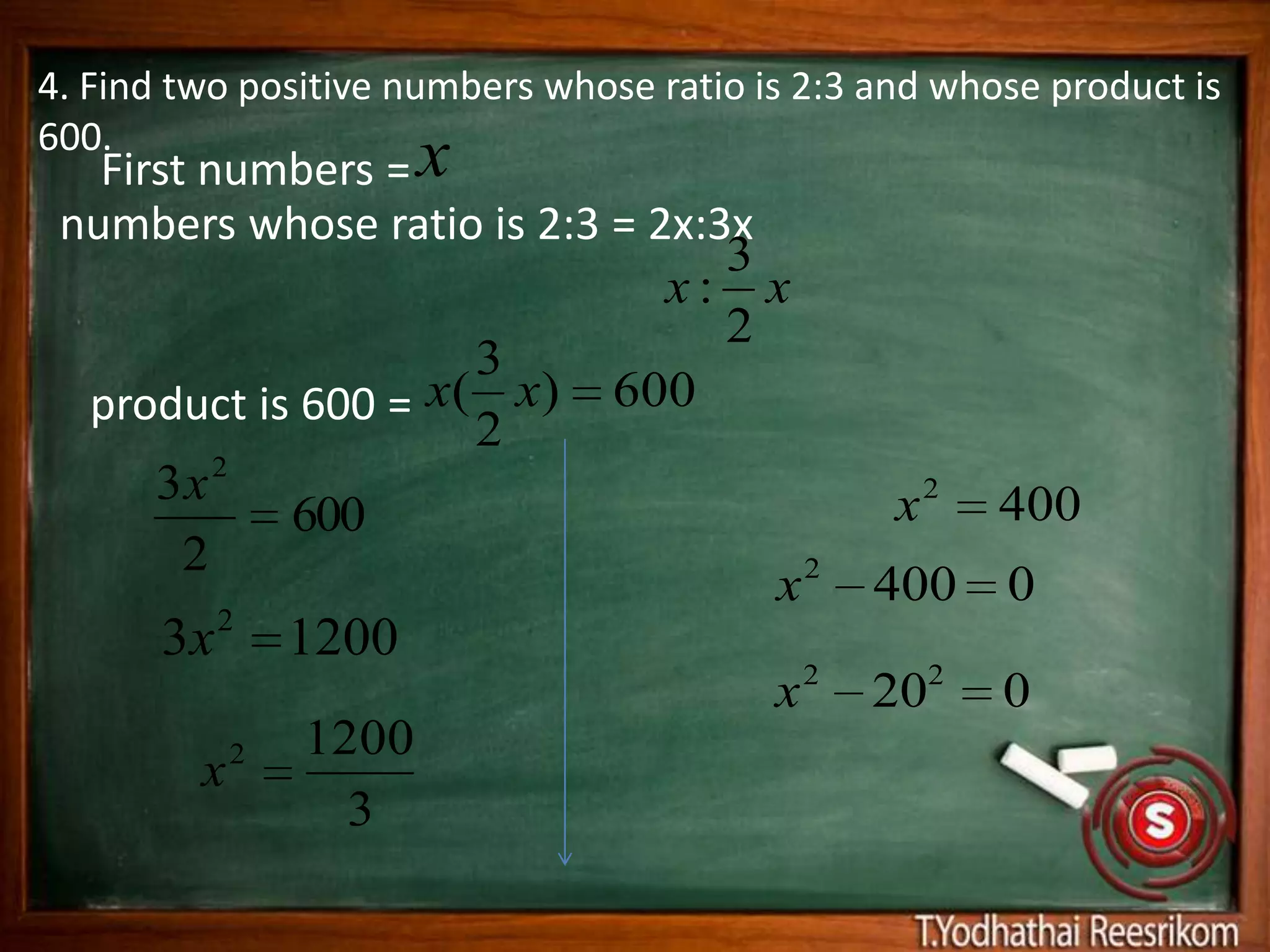
4. Find twopositive numbers whose ratio is 2:3 and whose product is
600.
First numbers = x
numbers whose ratio is 2:3 = 2x:3x
3
x: x
2
3
product is 600 = x( x) 600
2
3x 2 x2 400
600
2 2
x 400 0
3x 2 1200
x2 202 0
2 1200
x
3
24.
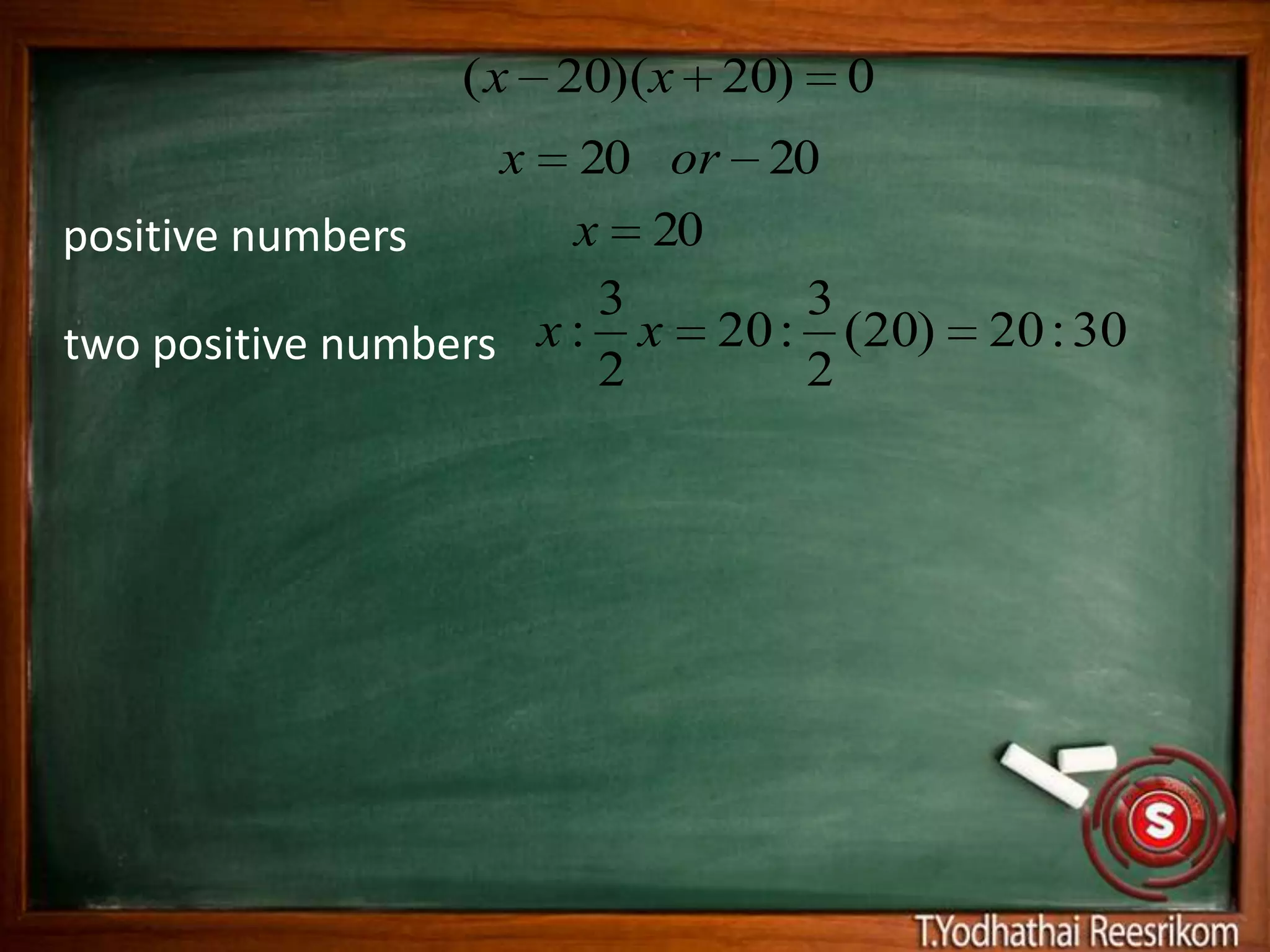
( x 20)(x20) 0
x 20 or 20
positive numbers x 20
3 3
two positive numbers x : x 20 : (20) 20 : 30
2 2
25.
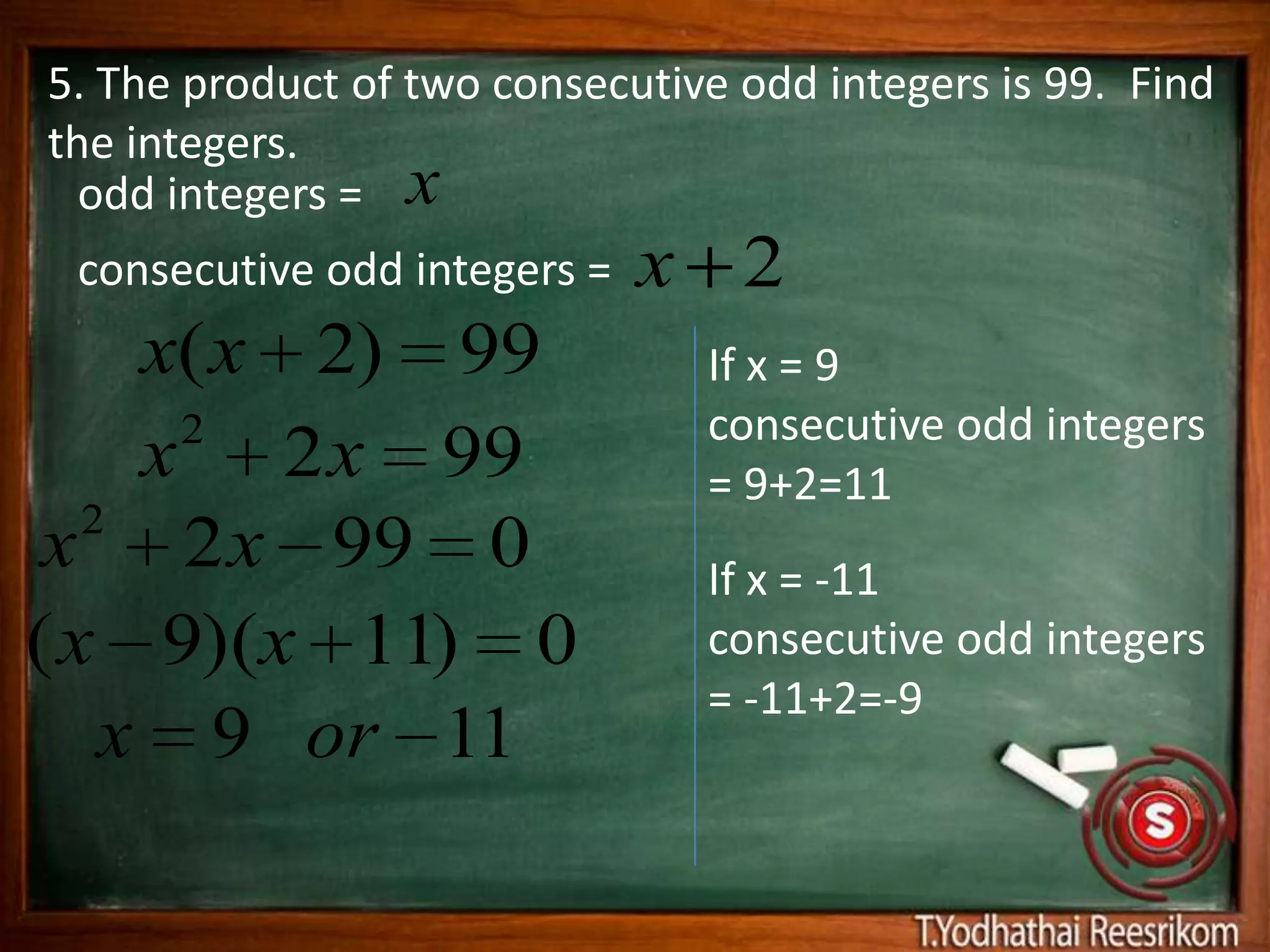
5. The productof two consecutive odd integers is 99. Find
the integers.
odd integers = x
consecutive odd integers = x 2
x(x 2) 99 If x = 9
2 consecutive odd integers
x 2 x 99 = 9+2=11
2
x 2 x 99 0 If x = -11
( x 9)(x 11) 0 consecutive odd integers
= -11+2=-9
x 9 or 11
26.
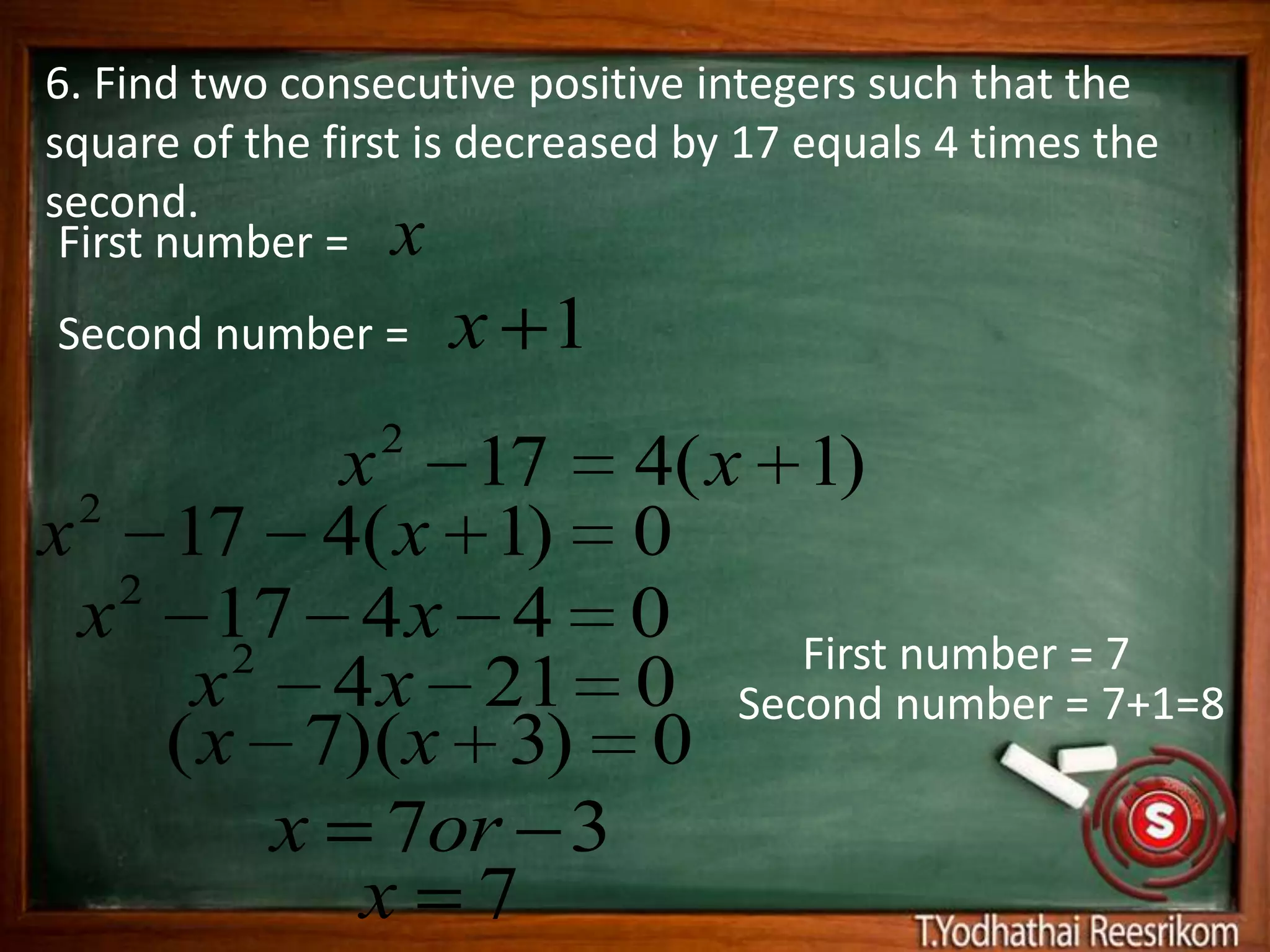
6. Find twoconsecutive positive integers such that the
square of the first is decreased by 17 equals 4 times the
second.
First number = x
Second number = x 1
2
x 17 4( x 1)
2
x 17 4( x 1) 0
2
x 17 4 x 4 0
2 First number = 7
x 4 x 21 0 Second number = 7+1=8
( x 7)(x 3) 0
x 7or 3
x 7
27.
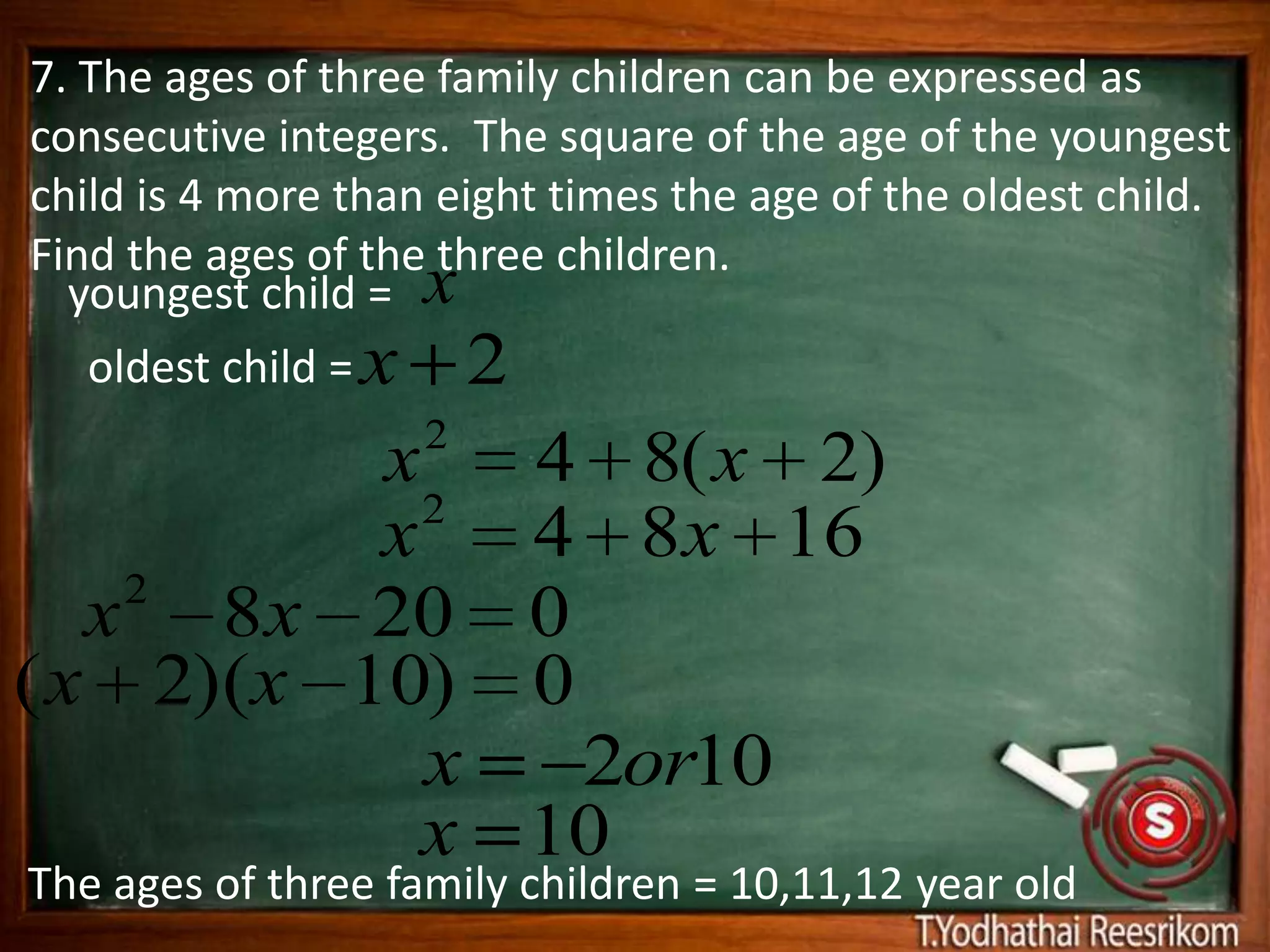
7. The agesof three family children can be expressed as
consecutive integers. The square of the age of the youngest
child is 4 more than eight times the age of the oldest child.
Find the ages of the three children.
youngest child = x
oldest child = x 2
2
x 4 8( x 2)
2
x 4 8 x 16
2
x 8 x 20 0
( x 2)(x 10) 0
x 2or10
x 10
The ages of three family children = 10,11,12 year old
28.
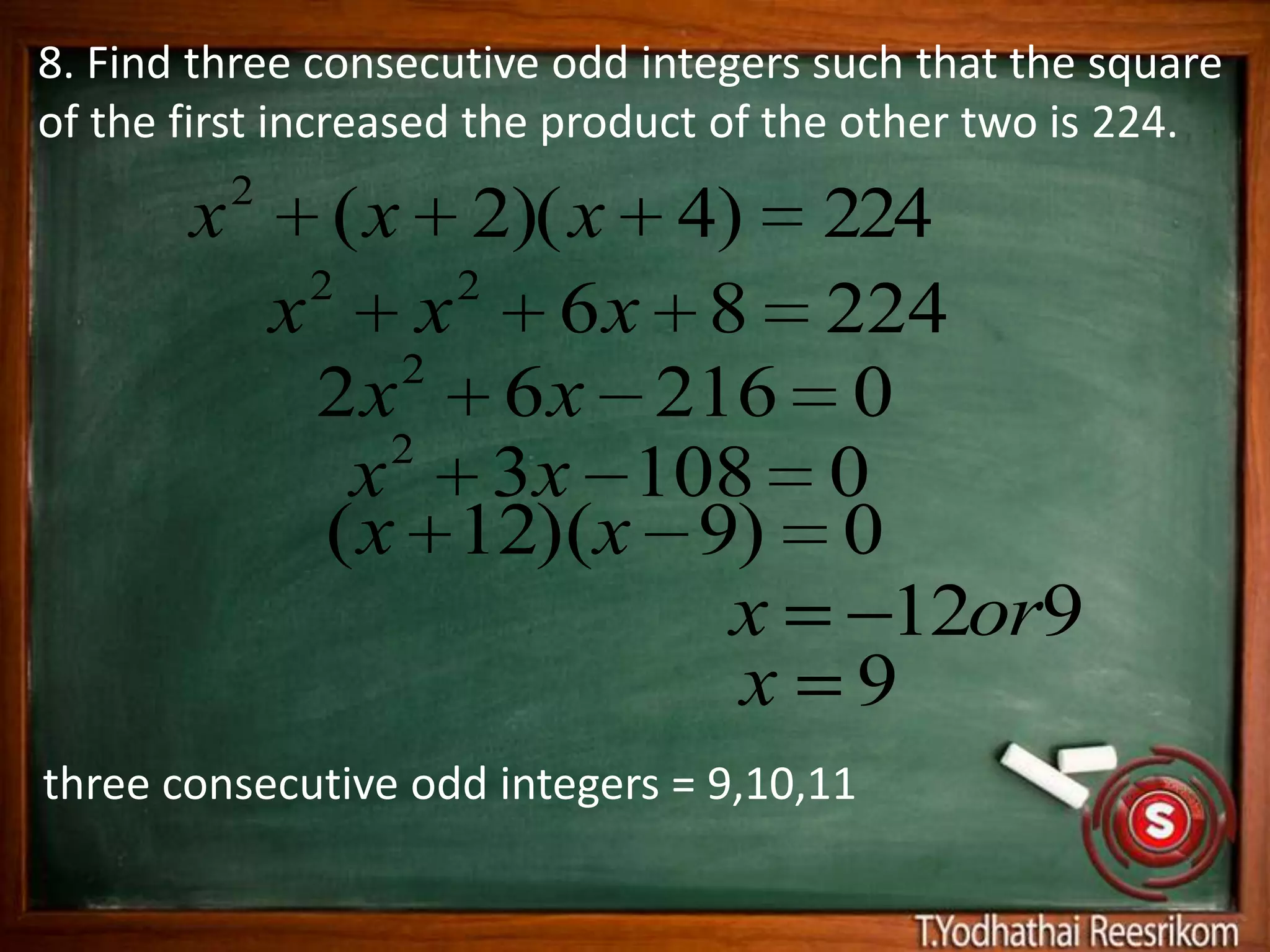
8. Find threeconsecutive odd integers such that the square
of the first increased the product of the other two is 224.
2
x ( x 2)( x 4) 224
2 2
x x 6x 8 224
2
2 x 6 x 216 0
2
x 3x 108 0
( x 12)(x 9) 0
x 12or9
x 9
three consecutive odd integers = 9,10,11
29.
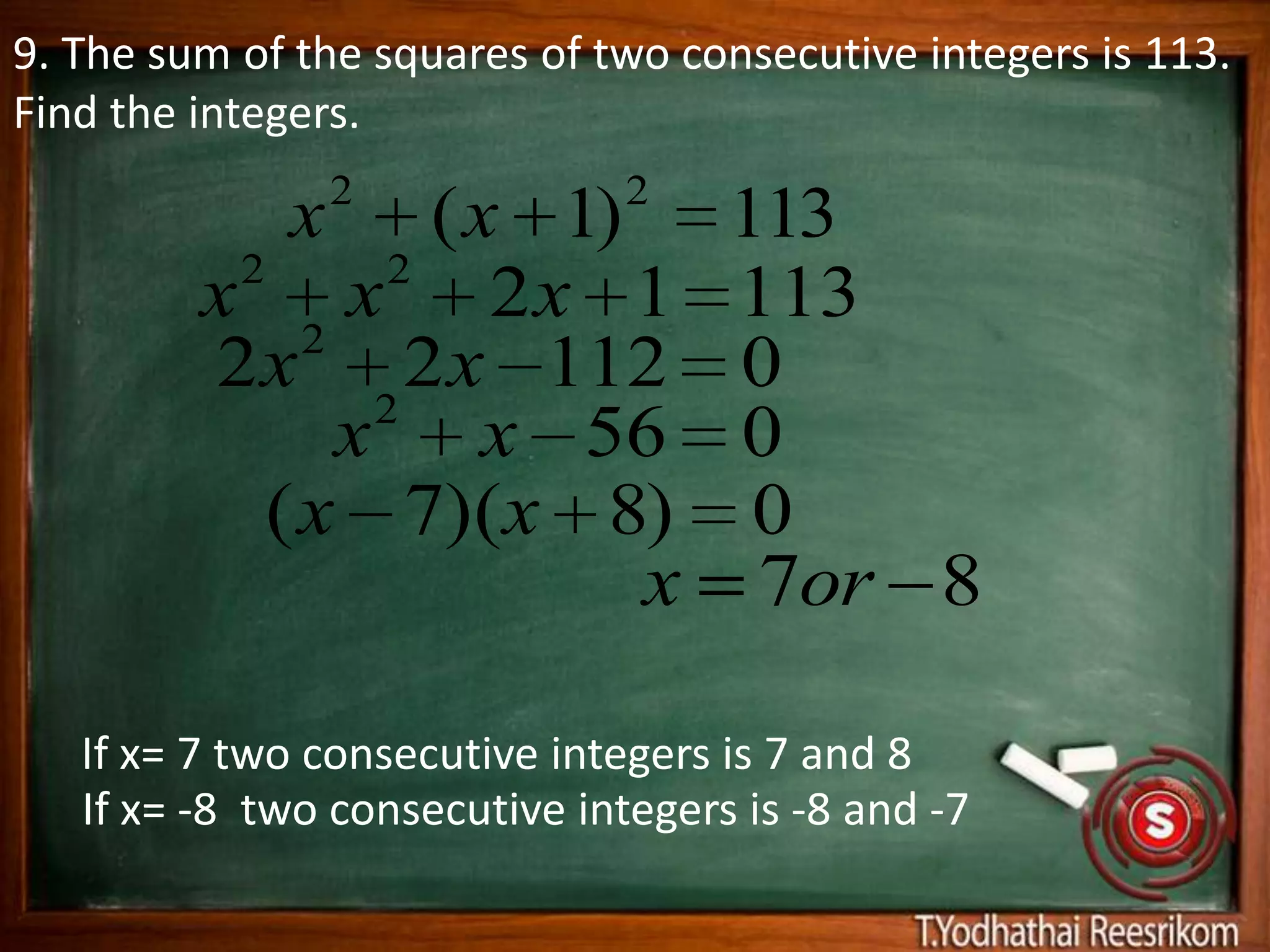
9. The sumof the squares of two consecutive integers is 113.
Find the integers.
2 2
x ( x 1) 113
2 2
x 2 x 2x 1 113
2 x 2 2 x 112 0
x x 56 0
( x 7)(x 8) 0
x 7or 8
If x= 7 two consecutive integers is 7 and 8
If x= -8 two consecutive integers is -8 and -7
30.
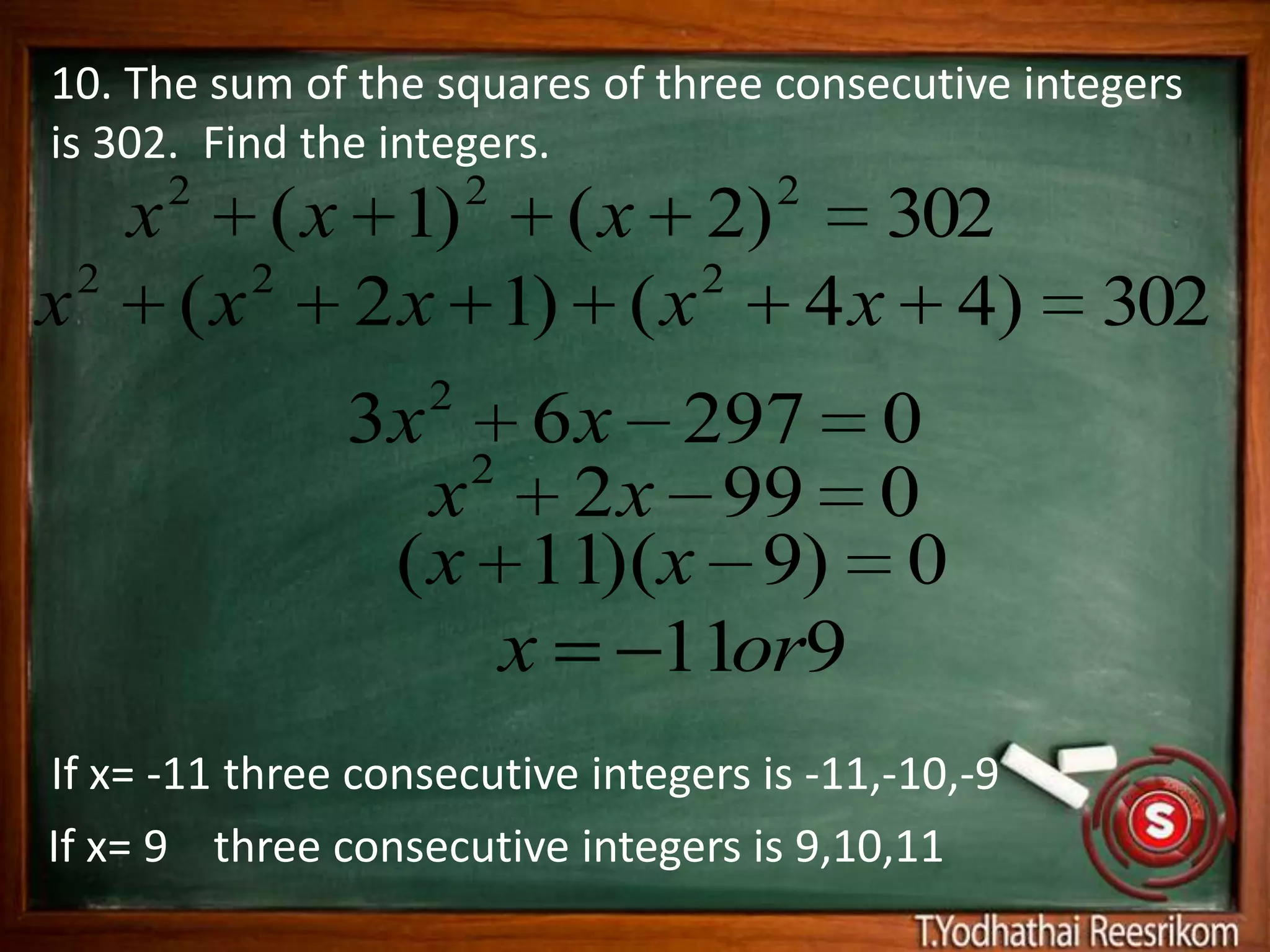
10. The sumof the squares of three consecutive integers
is 302. Find the integers.
2 2 2
x ( x 1) ( x 2) 302
2 2 2
x ( x 2 x 1) ( x 4 x 4) 302
2
3x 6 x 297 0
2
x 2 x 99 0
( x 11)(x 9) 0
x 11or9
If x= -11 three consecutive integers is -11,-10,-9
If x= 9 three consecutive integers is 9,10,11
31.
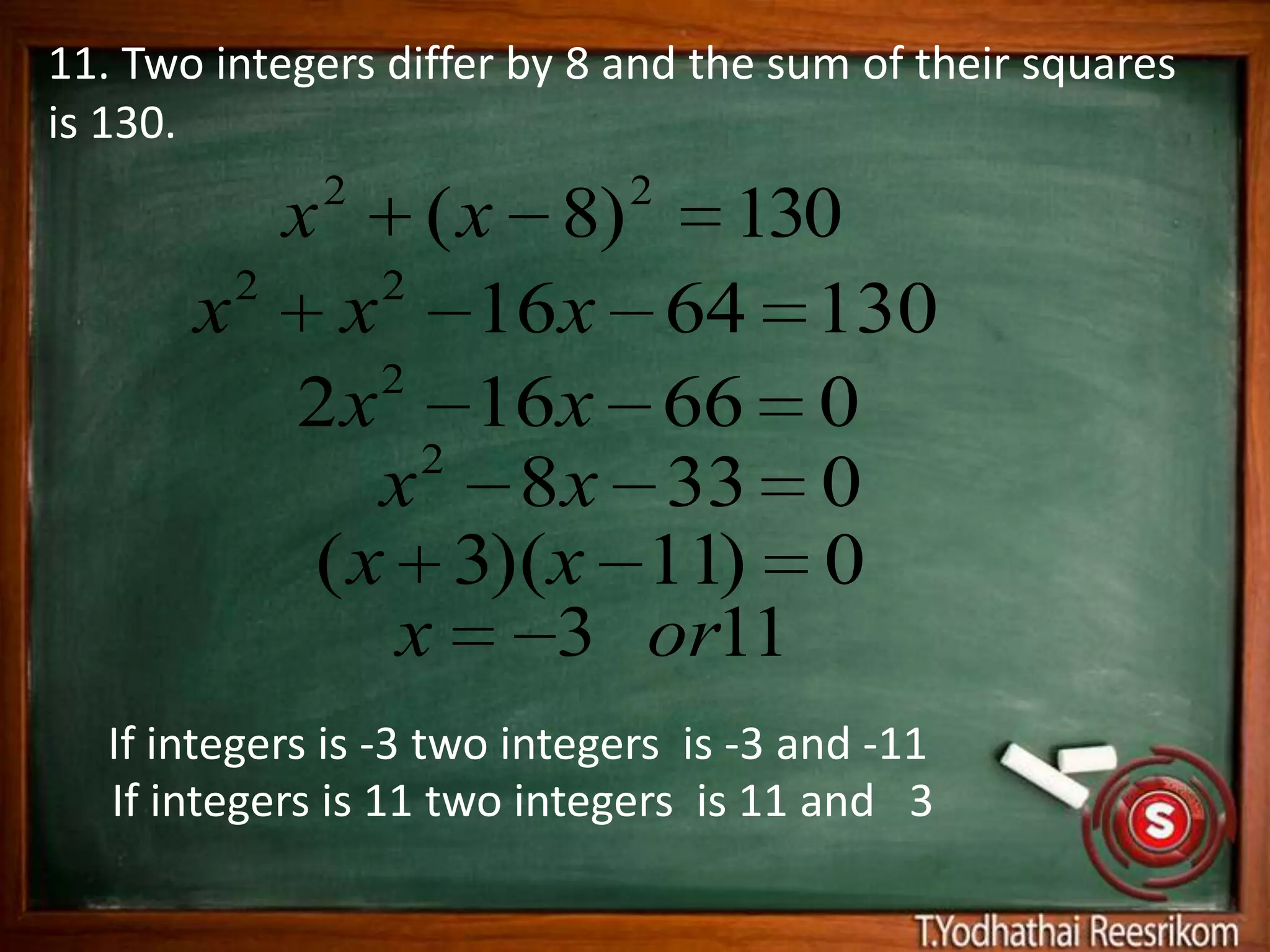
11. Two integersdiffer by 8 and the sum of their squares
is 130.
2 2
x ( x 8) 130
2 2
x x 16x 64 130
2
2 x 16x 66 0
2
x 8 x 33 0
( x 3)(x 11) 0
x 3 or11
If integers is -3 two integers is -3 and -11
If integers is 11 two integers is 11 and 3
32.
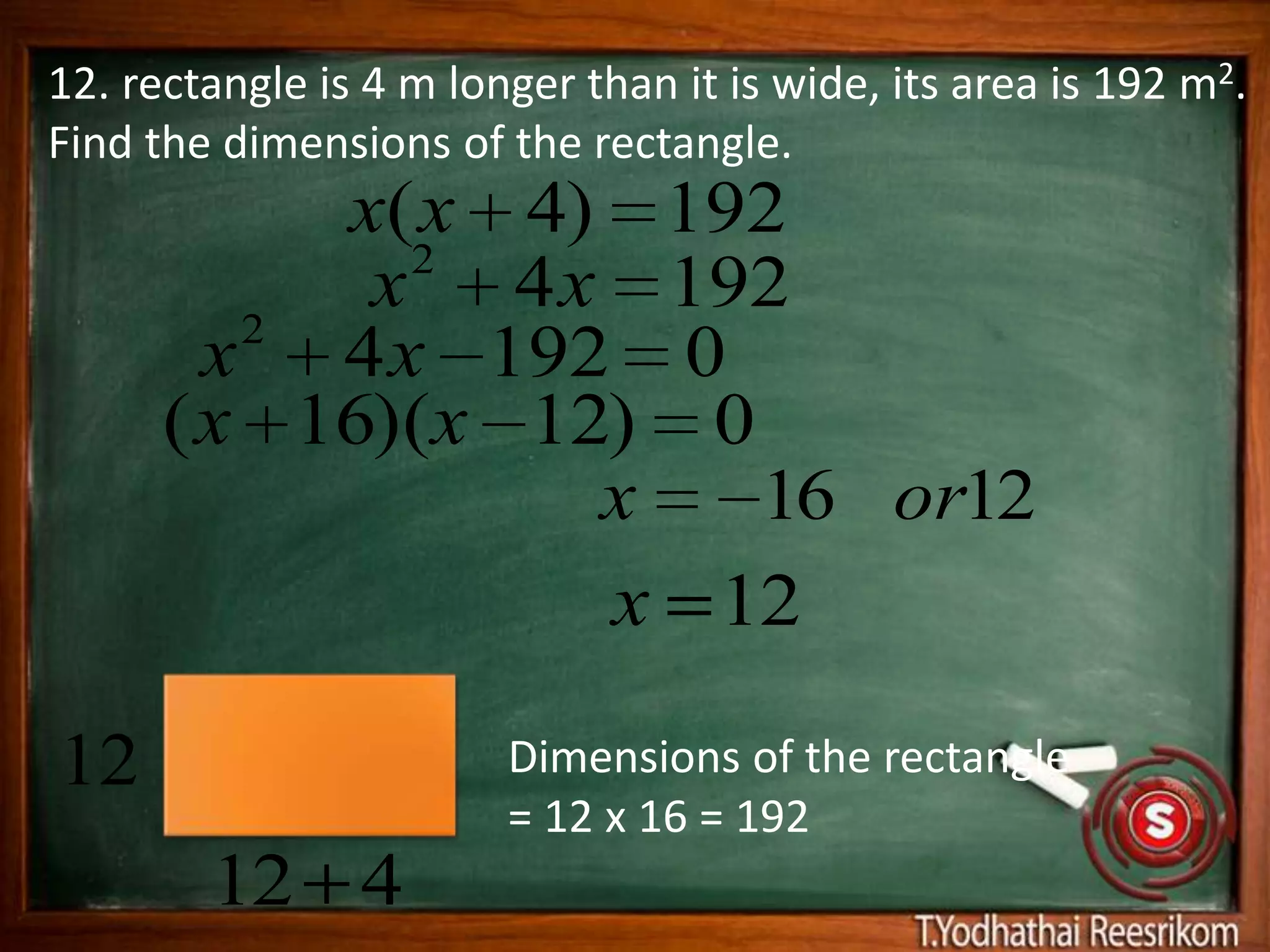
12. rectangle is4 m longer than it is wide, its area is 192 m2.
Find the dimensions of the rectangle.
x(x 4) 192
2
2
x 4 x 192
x 4 x 192 0
( x 16)(x 12) 0
x 16 or12
x 12
12 Dimensions of the rectangle
= 12 x 16 = 192
12 4