PYTHON IN CIVIL AND
ENVIRONMENTAL ENGINEERING
PAUL HOBSON
GEOSYNTEC CONSULTANTS
PDX PYTHON 2016-03-24
PYTHON IN CIVIL ENGINEERING
HEALTH AND SAFETY
▸ Nearest exit in case of emergency
▸ Ergonomics
▸ Right angles
▸ Head level
▸ Take breaks, look and move around
PYTHON IN CIVIL ENGINEERING
I’M AN ENGINEER (I STUDIED MUD)
▸ What is Civil Engineering?
▸ Structural
▸ Transportation
▸ Construction Management
▸ Geotechnical
▸ Environmental
▸ Water and Natural Resources
PYTHON IN CIVIL ENGINEERING
I’M AN ENGINEER (I STUDIED MUD)
▸ What is Civil Engineering?
▸ Structural
▸ Transportation
▸ Construction Management
▸ Geotechnical
▸ Environmental
▸ Water and Natural Resources
Thesis Title:
Rheologic and Flume Erosion
Characteristics of Georgia
Sediments at Bridge Piers
PYTHON IN CIVIL ENGINEERING
I’M AN ENGINEER (I STUDIED MUD)
▸ What is Civil Engineering?
▸ Structural
▸ Transportation
▸ Construction Management
▸ Geotechnical
▸ Environmental
▸ Water and Natural Resources
Thesis Title:
Rheologic and Flume Erosion
Characteristics of Georgia
Sediments at Bridge Piers
PYTHON IN CIVIL ENGINEERING
I WORK AS AN ENVIRONMENTAL CONSULTANT
▸ Help industry with compliance and remediation
▸ Litigation support for allocation of environmental
damages
▸ Grant-funded research with NCHRP, FHWA, WERF
PYTHON IN CIVIL ENGINEERING
I WORK AS AN ENVIRONMENTAL CONSULTANT
PYTHON IN CIVIL ENGINEERING
I WORK AS AN ENVIRONMENTAL CONSULTANT
▸ Build spatial databases of contaminant concentrations
PYTHON IN CIVIL ENGINEERING
I WORK AS AN ENVIRONMENTAL CONSULTANT
▸ Build spatial databases of contaminant concentrations
▸ Scrape the web (brute force) to meteorologic and
hydrologic data
PYTHON IN CIVIL ENGINEERING
I WORK AS AN ENVIRONMENTAL CONSULTANT
▸ Build spatial databases of contaminant concentrations
▸ Scrape the web (brute force) to meteorologic and
hydrologic data
▸ Statistical analysis of pollution mitigation and remediation
systems
PYTHON IN CIVIL ENGINEERING
I WORK AS AN ENVIRONMENTAL CONSULTANT
▸ Build spatial databases of contaminant concentrations
▸ Scrape the web (brute force) to meteorologic and
hydrologic data
▸ Statistical analysis of pollution mitigation and remediation
systems
▸ Build inputs for, run, and analyze output from vetted
numerical models
PYTHON IN CIVIL ENGINEERING
I WORK AS AN ENVIRONMENTAL CONSULTANT
▸ Build spatial databases of contaminant concentrations
▸ Scrape the web (brute force) to meteorologic and
hydrologic data
▸ Statistical analysis of pollution mitigation and remediation
systems
▸ Build inputs for, run, and analyze output from vetted
numerical models
▸ Build tools to help my colleagues do the same
PYTHON IN CIVIL ENGINEERING
SUMMARY FOR THE REST OF THE TALK
▸ My take on the general state of the practice in engineering
consulting
▸ Characteristic challenges of environmental consulting
▸ Tools I like to use
▸ Tools I have built over the course of my career
PYTHON IN CIVIL ENGINEERING
STATE OF THE PRACTICE - DATABASES
PYTHON IN CIVIL ENGINEERING
STATE OF THE PRACTICE - DATABASES
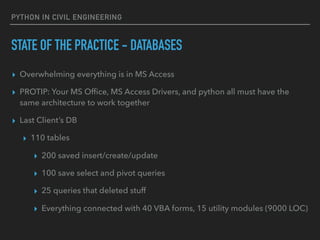
▸ Overwhelming everything is in MS Access
PYTHON IN CIVIL ENGINEERING
STATE OF THE PRACTICE - DATABASES
▸ Overwhelming everything is in MS Access
▸ PROTIP: Your MS Office, MS Access Drivers, and python all must have the
same architecture to work together
PYTHON IN CIVIL ENGINEERING
STATE OF THE PRACTICE - DATABASES
▸ Overwhelming everything is in MS Access
▸ PROTIP: Your MS Office, MS Access Drivers, and python all must have the
same architecture to work together
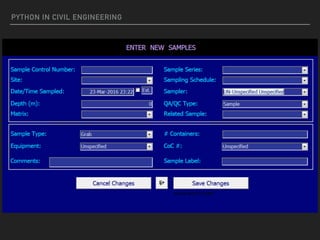
▸ Last Client’s DB
PYTHON IN CIVIL ENGINEERING
STATE OF THE PRACTICE - DATABASES
▸ Overwhelming everything is in MS Access
▸ PROTIP: Your MS Office, MS Access Drivers, and python all must have the
same architecture to work together
▸ Last Client’s DB
▸ 110 tables
PYTHON IN CIVIL ENGINEERING
STATE OF THE PRACTICE - DATABASES
▸ Overwhelming everything is in MS Access
▸ PROTIP: Your MS Office, MS Access Drivers, and python all must have the
same architecture to work together
▸ Last Client’s DB
▸ 110 tables
▸ 200 saved insert/create/update
PYTHON IN CIVIL ENGINEERING
STATE OF THE PRACTICE - DATABASES
▸ Overwhelming everything is in MS Access
▸ PROTIP: Your MS Office, MS Access Drivers, and python all must have the
same architecture to work together
▸ Last Client’s DB
▸ 110 tables
▸ 200 saved insert/create/update
▸ 100 save select and pivot queries
PYTHON IN CIVIL ENGINEERING
STATE OF THE PRACTICE - DATABASES
▸ Overwhelming everything is in MS Access
▸ PROTIP: Your MS Office, MS Access Drivers, and python all must have the
same architecture to work together
▸ Last Client’s DB
▸ 110 tables
▸ 200 saved insert/create/update
▸ 100 save select and pivot queries
▸ 25 queries that deleted stuff
PYTHON IN CIVIL ENGINEERING
STATE OF THE PRACTICE - DATABASES
▸ Overwhelming everything is in MS Access
▸ PROTIP: Your MS Office, MS Access Drivers, and python all must have the
same architecture to work together
▸ Last Client’s DB
▸ 110 tables
▸ 200 saved insert/create/update
▸ 100 save select and pivot queries
▸ 25 queries that deleted stuff
▸ Everything connected with 40 VBA forms, 15 utility modules (9000 LOC)
PYTHON IN CIVIL ENGINEERING
STATE OF THE PRACTICE - ANALYSIS
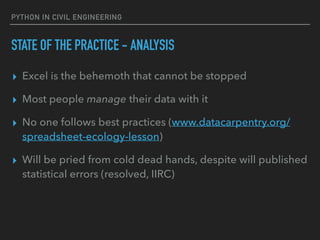
▸ Excel is the behemoth that cannot be stopped
▸ Most people manage their data with it
▸ No one follows best practices (www.datacarpentry.org/
spreadsheet-ecology-lesson)
▸ Will be pried from cold dead hands, despite will published
statistical errors (resolved, IIRC)
PYTHON IN CIVIL ENGINEERING
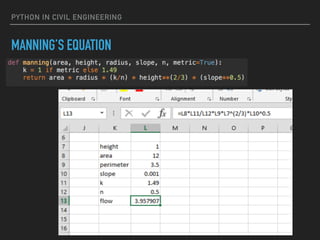
MANNING’S EQUATION
PYTHON IN CIVIL ENGINEERING
STATE OF THE PRACTICE - DOMAIN-SPECIFIC TOOLS
PYTHON IN CIVIL ENGINEERING
STATE OF THE PRACTICE - DOMAIN-SPECIFIC TOOLS
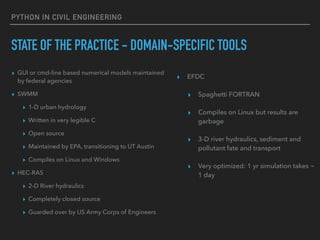
▸ GUI or cmd-line based numerical models maintained
by federal agencies
PYTHON IN CIVIL ENGINEERING
STATE OF THE PRACTICE - DOMAIN-SPECIFIC TOOLS
▸ GUI or cmd-line based numerical models maintained
by federal agencies
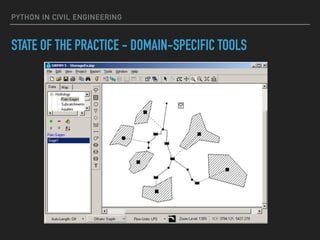
▸ SWMM
▸ 1-D urban hydrology
▸ Written in very legible C
▸ Open source
▸ Maintained by EPA, transitioning to UT Austin
▸ Compiles on Linux and Windows
PYTHON IN CIVIL ENGINEERING
STATE OF THE PRACTICE - DOMAIN-SPECIFIC TOOLS
▸ GUI or cmd-line based numerical models maintained
by federal agencies
▸ SWMM
▸ 1-D urban hydrology
▸ Written in very legible C
▸ Open source
▸ Maintained by EPA, transitioning to UT Austin
▸ Compiles on Linux and Windows
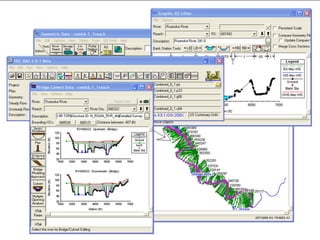
▸ HEC-RAS
▸ 2-D River hydraulics
▸ Completely closed source
▸ Guarded over by US Army Corps of Engineers
PYTHON IN CIVIL ENGINEERING
STATE OF THE PRACTICE - DOMAIN-SPECIFIC TOOLS
▸ GUI or cmd-line based numerical models maintained
by federal agencies
▸ SWMM
▸ 1-D urban hydrology
▸ Written in very legible C
▸ Open source
▸ Maintained by EPA, transitioning to UT Austin
▸ Compiles on Linux and Windows
▸ HEC-RAS
▸ 2-D River hydraulics
▸ Completely closed source
▸ Guarded over by US Army Corps of Engineers
▸ EFDC
PYTHON IN CIVIL ENGINEERING
STATE OF THE PRACTICE - DOMAIN-SPECIFIC TOOLS
▸ GUI or cmd-line based numerical models maintained
by federal agencies
▸ SWMM
▸ 1-D urban hydrology
▸ Written in very legible C
▸ Open source
▸ Maintained by EPA, transitioning to UT Austin
▸ Compiles on Linux and Windows
▸ HEC-RAS
▸ 2-D River hydraulics
▸ Completely closed source
▸ Guarded over by US Army Corps of Engineers
▸ EFDC
▸ Spaghetti FORTRAN
PYTHON IN CIVIL ENGINEERING
STATE OF THE PRACTICE - DOMAIN-SPECIFIC TOOLS
▸ GUI or cmd-line based numerical models maintained
by federal agencies
▸ SWMM
▸ 1-D urban hydrology
▸ Written in very legible C
▸ Open source
▸ Maintained by EPA, transitioning to UT Austin
▸ Compiles on Linux and Windows
▸ HEC-RAS
▸ 2-D River hydraulics
▸ Completely closed source
▸ Guarded over by US Army Corps of Engineers
▸ EFDC
▸ Spaghetti FORTRAN
▸ Compiles on Linux but results are
garbage
PYTHON IN CIVIL ENGINEERING
STATE OF THE PRACTICE - DOMAIN-SPECIFIC TOOLS
▸ GUI or cmd-line based numerical models maintained
by federal agencies
▸ SWMM
▸ 1-D urban hydrology
▸ Written in very legible C
▸ Open source
▸ Maintained by EPA, transitioning to UT Austin
▸ Compiles on Linux and Windows
▸ HEC-RAS
▸ 2-D River hydraulics
▸ Completely closed source
▸ Guarded over by US Army Corps of Engineers
▸ EFDC
▸ Spaghetti FORTRAN
▸ Compiles on Linux but results are
garbage
▸ 3-D river hydraulics, sediment and
pollutant fate and transport
PYTHON IN CIVIL ENGINEERING
STATE OF THE PRACTICE - DOMAIN-SPECIFIC TOOLS
▸ GUI or cmd-line based numerical models maintained
by federal agencies
▸ SWMM
▸ 1-D urban hydrology
▸ Written in very legible C
▸ Open source
▸ Maintained by EPA, transitioning to UT Austin
▸ Compiles on Linux and Windows
▸ HEC-RAS
▸ 2-D River hydraulics
▸ Completely closed source
▸ Guarded over by US Army Corps of Engineers
▸ EFDC
▸ Spaghetti FORTRAN
▸ Compiles on Linux but results are
garbage
▸ 3-D river hydraulics, sediment and
pollutant fate and transport
▸ Very optimized: 1 yr simulation takes ~
1 day
PYTHON IN CIVIL ENGINEERING
STATE OF THE PRACTICE - DOMAIN-SPECIFIC TOOLS
PYTHON IN CIVIL ENGINEERING
STATE OF THE PRACTICE - DOMAIN SPECIFIC TOOLS
▸ All (numerically) solve the St. Venant Equations
▸ Differential equations in time and space
▸ Very difficult to even work with symbolically
▸ Large code bases
▸ Represent a significant intellectual investment from civil/
environmental community
PYTHON IN CIVIL ENGINEERING
WHERE DOES PYTHON FIT IN ALL OF THIS?
▸ Scrape model inputs from web
▸ Hack input files for batch processing
▸ Move data around between formats
▸ General data and model results analysis
▸ (Rarely) Wrap C/Fortran libraries with ctypes/cython/
numpy
PYTHON IN CIVIL ENGINEERING
CIVIL/ENVIRONMENTAL CHALLENGES
▸ Arcane input file formats
▸ Left-censored (non-detect) data
▸ Non-parametric statistics
▸ Regression-on-order statistics
▸ Kaplan-Meier
▸ Project management inertia
▸ Disconnect between libraries and project needs
▸ ~5 coworkers (out of ~600) are comfortable with python
PYTHON IN CIVIL ENGINEERING
TOOLS I USE
▸ numpy/scipy
▸ Fast numeric arrays implemented in C
▸ Specialized scientific functions
▸ Matplotlib/seaborn: generic and statistical 2-D visualizations
▸ pandas/statsmodels: table-like data structures and statistical models
▸ Jupyter: interactive computing via notebooks
▸ conda: sane installation of python packages on Windows and other
operating systems
PYTHON IN CIVIL ENGINEERING
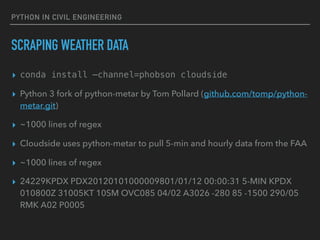
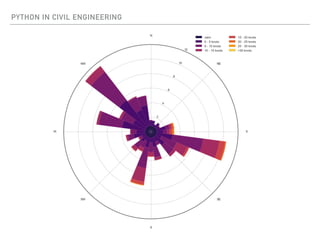
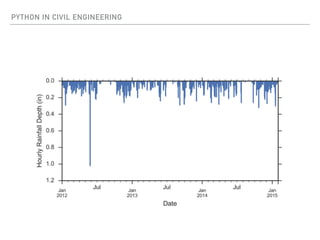
SCRAPING WEATHER DATA
▸ conda install —channel=phobson cloudside
▸ Python 3 fork of python-metar by Tom Pollard (github.com/tomp/python-
metar.git)
▸ ~1000 lines of regex
▸ Cloudside uses python-metar to pull 5-min and hourly data from the FAA
▸ ~1000 lines of regex
▸ 24229KPDX PDX20120101000009801/01/12 00:00:31 5-MIN KPDX
010800Z 31005KT 10SM OVC085 04/02 A3026 -280 85 -1500 290/05
RMK A02 P0005
PYTHON IN CIVIL ENGINEERING
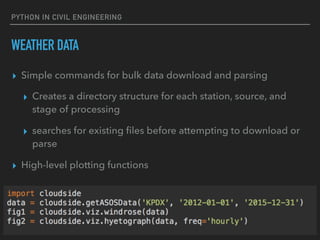
WEATHER DATA
▸ Simple commands for bulk data download and parsing
▸ Creates a directory structure for each station, source, and
stage of processing
▸ searches for existing files before attempting to download or
parse
▸ High-level plotting functions
PYTHON IN CIVIL ENGINEERING
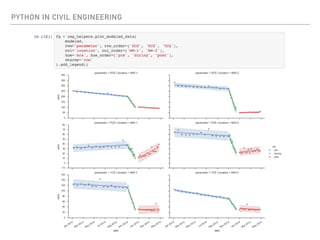
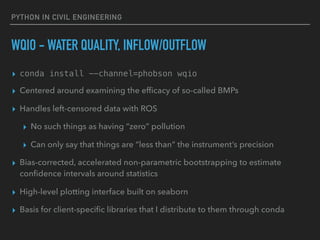
WQIO - WATER QUALITY, INFLOW/OUTFLOW
PYTHON IN CIVIL ENGINEERING
WQIO - WATER QUALITY, INFLOW/OUTFLOW
▸ conda install --channel=phobson wqio
PYTHON IN CIVIL ENGINEERING
WQIO - WATER QUALITY, INFLOW/OUTFLOW
▸ conda install --channel=phobson wqio
▸ Centered around examining the efficacy of so-called BMPs
PYTHON IN CIVIL ENGINEERING
WQIO - WATER QUALITY, INFLOW/OUTFLOW
▸ conda install --channel=phobson wqio
▸ Centered around examining the efficacy of so-called BMPs
▸ Handles left-censored data with ROS
▸ No such things as having “zero” pollution
▸ Can only say that things are “less than” the instrument’s precision
PYTHON IN CIVIL ENGINEERING
WQIO - WATER QUALITY, INFLOW/OUTFLOW
▸ conda install --channel=phobson wqio
▸ Centered around examining the efficacy of so-called BMPs
▸ Handles left-censored data with ROS
▸ No such things as having “zero” pollution
▸ Can only say that things are “less than” the instrument’s precision
▸ Bias-corrected, accelerated non-parametric bootstrapping to estimate
confidence intervals around statistics
PYTHON IN CIVIL ENGINEERING
WQIO - WATER QUALITY, INFLOW/OUTFLOW
▸ conda install --channel=phobson wqio
▸ Centered around examining the efficacy of so-called BMPs
▸ Handles left-censored data with ROS
▸ No such things as having “zero” pollution
▸ Can only say that things are “less than” the instrument’s precision
▸ Bias-corrected, accelerated non-parametric bootstrapping to estimate
confidence intervals around statistics
▸ High-level plotting interface built on seaborn
PYTHON IN CIVIL ENGINEERING
WQIO - WATER QUALITY, INFLOW/OUTFLOW
▸ conda install --channel=phobson wqio
▸ Centered around examining the efficacy of so-called BMPs
▸ Handles left-censored data with ROS
▸ No such things as having “zero” pollution
▸ Can only say that things are “less than” the instrument’s precision
▸ Bias-corrected, accelerated non-parametric bootstrapping to estimate
confidence intervals around statistics
▸ High-level plotting interface built on seaborn
▸ Basis for client-specific libraries that I distribute to them through conda
PYTHON IN CIVIL ENGINEERING
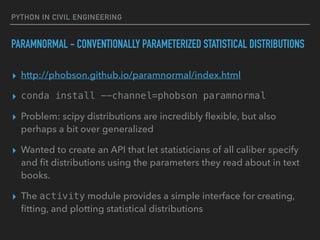
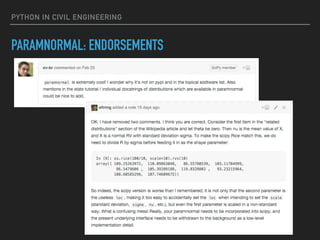
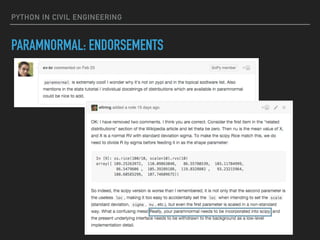
PARAMNORMAL - CONVENTIONALLY PARAMETERIZED STATISTICAL DISTRIBUTIONS
▸ http://phobson.github.io/paramnormal/index.html
▸ conda install --channel=phobson paramnormal
▸ Problem: scipy distributions are incredibly flexible, but also
perhaps a bit over generalized
▸ Wanted to create an API that let statisticians of all caliber specify
and fit distributions using the parameters they read about in text
books.
▸ The activity module provides a simple interface for creating,
fitting, and plotting statistical distributions
PYTHON IN CIVIL ENGINEERING
PARANORMAL: BRIEF EXAMPLES
▸ (super fast demo)
PYTHON IN CIVIL ENGINEERING
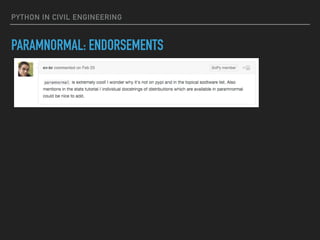
PARAMNORMAL: ENDORSEMENTS
PYTHON IN CIVIL ENGINEERING
PARAMNORMAL: ENDORSEMENTS
PYTHON IN CIVIL ENGINEERING
PARAMNORMAL: ENDORSEMENTS
PYTHON IN CIVIL ENGINEERING
MPL-PROBSCALE
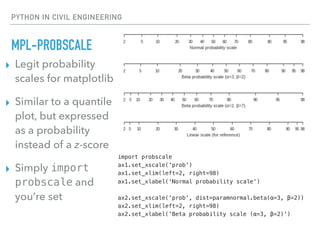
▸ Legit probability
scales for matplotlib
▸ Similar to a quantile
plot, but expressed
as a probability
instead of a z-score
▸ Simply import
probscale and
you’re set
import probscale
ax1.set_xscale('prob')
ax1.set_xlim(left=2, right=98)
ax1.set_xlabel('Normal probability scale')
ax2.set_xscale('prob', dist=paramnormal.beta(α=3, β=2))
ax2.set_xlim(left=2, right=98)
ax2.set_xlabel('Beta probability scale (α=3, β=2)')
PYTHON IN CIVIL ENGINEERING
MPL-PROBSCALE
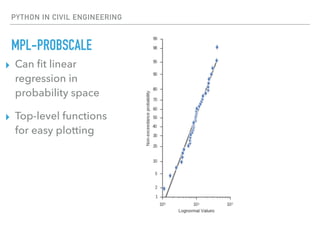
▸ Can fit linear
regression in
probability space
▸ Top-level functions
for easy plotting
PYTHON IN CIVIL ENGINEERING
GENERATING MODEL GRIDS
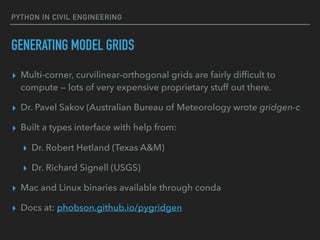
▸ Multi-corner, curvilinear-orthogonal grids are fairly difficult to
compute — lots of very expensive proprietary stuff out there.
▸ Dr. Pavel Sakov (Australian Bureau of Meteorology wrote gridgen-c
▸ Built a types interface with help from:
▸ Dr. Robert Hetland (Texas A&M)
▸ Dr. Richard Signell (USGS)
▸ Mac and Linux binaries available through conda
▸ Docs at: phobson.github.io/pygridgen
PYTHON IN CIVIL ENGINEERING
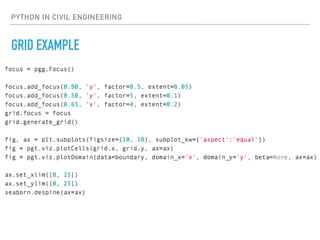
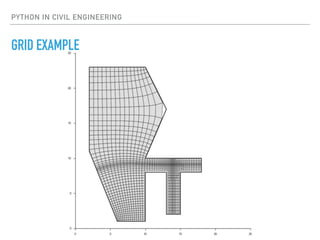
GRID EXAMPLE
PYTHON IN CIVIL ENGINEERING
GRID EXAMPLE
PYTHON IN CIVIL ENGINEERING
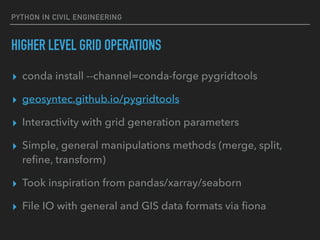
HIGHER LEVEL GRID OPERATIONS
▸ conda install --channel=conda-forge pygridtools
▸ geosyntec.github.io/pygridtools
▸ Interactivity with grid generation parameters
▸ Simple, general manipulations methods (merge, split,
refine, transform)
▸ Took inspiration from pandas/xarray/seaborn
▸ File IO with general and GIS data formats via fiona
PYTHON IN CIVIL ENGINEERING
GRID EXAMPLE - MANIPULATION
grid1, grid2, grid3 = make_test_grids()
fig = (
grid2.merge(grid3, how='vert', where='-', shift=2)
.merge(grid1, how='horiz', where='-', shift=11)
.refine(10, axis=1, n_points=4)
.refine(13, axis=0, n_points=2)
.transform(lambda x: x*5 + 2)
.update_cell_mask()
.plotCells(ax=ax, cell_kws=dict(facecolor=palette[2], alpha=0.75))
)
PYTHON IN CIVIL ENGINEERING
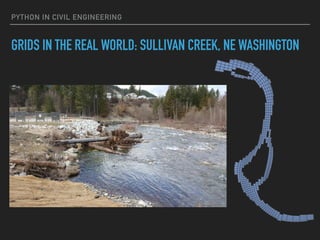
GRIDS IN THE REAL WORLD: SULLIVAN CREEK, NE WASHINGTON
PYTHON IN CIVIL ENGINEERING
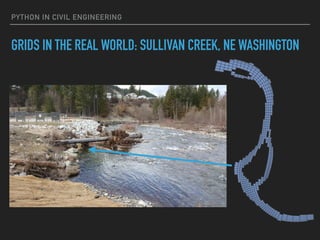
GRIDS IN THE REAL WORLD: SULLIVAN CREEK, NE WASHINGTON
PYTHON IN CIVIL ENGINEERING
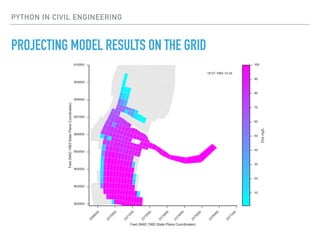
PROJECTING MODEL RESULTS ON THE GRID
PYTHON IN CIVIL ENGINEERING
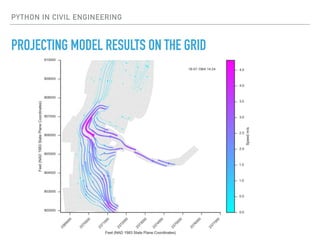
PROJECTING MODEL RESULTS ON THE GRID
PYTHON IN CIVIL ENGINEERING
RESOURCES FOR GETTING STARTED AS A MEAT-SPACE ENGINEER
▸ I was lucky enough to get started with numpy and matplotlib while:
▸ I was still very familiar with MATLAB
▸ Both projects were directly trying to take market share away
from MATLAB
▸ APIs and efforts have changed since then.
▸ More recently, a new employee started with MATLAB experience
from college. We gave them a copy of Python For Data Analysis by
Wes McKinney (author of pandas), and were pretty productive with
python in a couple of week.
PYTHON IN CIVIL ENGINEERING
LINK DUMP
▸ Me:
▸ https://twitter.com/pmhobson
▸ https://github.com/phobson
▸ My (documented) Projects
▸ http://geosyntec.github.io/pygridtools/
▸ http://phobson.github.io/paramnormal/
▸ http://phobson.github.io/mpl-probscale
▸ https://github.com/phobson/cloudside (docs forthcoming)
DEMOS
&
QUESTIONS.
Thank you

Python in Civil/Environmental Engineering

  • 1.
    PYTHON IN CIVILAND ENVIRONMENTAL ENGINEERING PAUL HOBSON GEOSYNTEC CONSULTANTS PDX PYTHON 2016-03-24
  • 2.
    PYTHON IN CIVILENGINEERING HEALTH AND SAFETY ▸ Nearest exit in case of emergency ▸ Ergonomics ▸ Right angles ▸ Head level ▸ Take breaks, look and move around
  • 3.
    PYTHON IN CIVILENGINEERING I’M AN ENGINEER (I STUDIED MUD) ▸ What is Civil Engineering? ▸ Structural ▸ Transportation ▸ Construction Management ▸ Geotechnical ▸ Environmental ▸ Water and Natural Resources
  • 4.
    PYTHON IN CIVILENGINEERING I’M AN ENGINEER (I STUDIED MUD) ▸ What is Civil Engineering? ▸ Structural ▸ Transportation ▸ Construction Management ▸ Geotechnical ▸ Environmental ▸ Water and Natural Resources Thesis Title: Rheologic and Flume Erosion Characteristics of Georgia Sediments at Bridge Piers
  • 5.
    PYTHON IN CIVILENGINEERING I’M AN ENGINEER (I STUDIED MUD) ▸ What is Civil Engineering? ▸ Structural ▸ Transportation ▸ Construction Management ▸ Geotechnical ▸ Environmental ▸ Water and Natural Resources Thesis Title: Rheologic and Flume Erosion Characteristics of Georgia Sediments at Bridge Piers
  • 6.
    PYTHON IN CIVILENGINEERING I WORK AS AN ENVIRONMENTAL CONSULTANT ▸ Help industry with compliance and remediation ▸ Litigation support for allocation of environmental damages ▸ Grant-funded research with NCHRP, FHWA, WERF
  • 7.
    PYTHON IN CIVILENGINEERING I WORK AS AN ENVIRONMENTAL CONSULTANT
  • 8.
    PYTHON IN CIVILENGINEERING I WORK AS AN ENVIRONMENTAL CONSULTANT ▸ Build spatial databases of contaminant concentrations
  • 9.
    PYTHON IN CIVILENGINEERING I WORK AS AN ENVIRONMENTAL CONSULTANT ▸ Build spatial databases of contaminant concentrations ▸ Scrape the web (brute force) to meteorologic and hydrologic data
  • 10.
    PYTHON IN CIVILENGINEERING I WORK AS AN ENVIRONMENTAL CONSULTANT ▸ Build spatial databases of contaminant concentrations ▸ Scrape the web (brute force) to meteorologic and hydrologic data ▸ Statistical analysis of pollution mitigation and remediation systems
  • 11.
    PYTHON IN CIVILENGINEERING I WORK AS AN ENVIRONMENTAL CONSULTANT ▸ Build spatial databases of contaminant concentrations ▸ Scrape the web (brute force) to meteorologic and hydrologic data ▸ Statistical analysis of pollution mitigation and remediation systems ▸ Build inputs for, run, and analyze output from vetted numerical models
  • 12.
    PYTHON IN CIVILENGINEERING I WORK AS AN ENVIRONMENTAL CONSULTANT ▸ Build spatial databases of contaminant concentrations ▸ Scrape the web (brute force) to meteorologic and hydrologic data ▸ Statistical analysis of pollution mitigation and remediation systems ▸ Build inputs for, run, and analyze output from vetted numerical models ▸ Build tools to help my colleagues do the same
  • 13.
    PYTHON IN CIVILENGINEERING SUMMARY FOR THE REST OF THE TALK ▸ My take on the general state of the practice in engineering consulting ▸ Characteristic challenges of environmental consulting ▸ Tools I like to use ▸ Tools I have built over the course of my career
  • 14.
    PYTHON IN CIVILENGINEERING STATE OF THE PRACTICE - DATABASES
  • 15.
    PYTHON IN CIVILENGINEERING STATE OF THE PRACTICE - DATABASES ▸ Overwhelming everything is in MS Access
  • 16.
    PYTHON IN CIVILENGINEERING STATE OF THE PRACTICE - DATABASES ▸ Overwhelming everything is in MS Access ▸ PROTIP: Your MS Office, MS Access Drivers, and python all must have the same architecture to work together
  • 17.
    PYTHON IN CIVILENGINEERING STATE OF THE PRACTICE - DATABASES ▸ Overwhelming everything is in MS Access ▸ PROTIP: Your MS Office, MS Access Drivers, and python all must have the same architecture to work together ▸ Last Client’s DB
  • 18.
    PYTHON IN CIVILENGINEERING STATE OF THE PRACTICE - DATABASES ▸ Overwhelming everything is in MS Access ▸ PROTIP: Your MS Office, MS Access Drivers, and python all must have the same architecture to work together ▸ Last Client’s DB ▸ 110 tables
  • 19.
    PYTHON IN CIVILENGINEERING STATE OF THE PRACTICE - DATABASES ▸ Overwhelming everything is in MS Access ▸ PROTIP: Your MS Office, MS Access Drivers, and python all must have the same architecture to work together ▸ Last Client’s DB ▸ 110 tables ▸ 200 saved insert/create/update
  • 20.
    PYTHON IN CIVILENGINEERING STATE OF THE PRACTICE - DATABASES ▸ Overwhelming everything is in MS Access ▸ PROTIP: Your MS Office, MS Access Drivers, and python all must have the same architecture to work together ▸ Last Client’s DB ▸ 110 tables ▸ 200 saved insert/create/update ▸ 100 save select and pivot queries
  • 21.
    PYTHON IN CIVILENGINEERING STATE OF THE PRACTICE - DATABASES ▸ Overwhelming everything is in MS Access ▸ PROTIP: Your MS Office, MS Access Drivers, and python all must have the same architecture to work together ▸ Last Client’s DB ▸ 110 tables ▸ 200 saved insert/create/update ▸ 100 save select and pivot queries ▸ 25 queries that deleted stuff
  • 22.
    PYTHON IN CIVILENGINEERING STATE OF THE PRACTICE - DATABASES ▸ Overwhelming everything is in MS Access ▸ PROTIP: Your MS Office, MS Access Drivers, and python all must have the same architecture to work together ▸ Last Client’s DB ▸ 110 tables ▸ 200 saved insert/create/update ▸ 100 save select and pivot queries ▸ 25 queries that deleted stuff ▸ Everything connected with 40 VBA forms, 15 utility modules (9000 LOC)
  • 23.
    PYTHON IN CIVILENGINEERING
  • 24.
    PYTHON IN CIVILENGINEERING STATE OF THE PRACTICE - ANALYSIS ▸ Excel is the behemoth that cannot be stopped ▸ Most people manage their data with it ▸ No one follows best practices (www.datacarpentry.org/ spreadsheet-ecology-lesson) ▸ Will be pried from cold dead hands, despite will published statistical errors (resolved, IIRC)
  • 25.
    PYTHON IN CIVILENGINEERING MANNING’S EQUATION
  • 26.
    PYTHON IN CIVILENGINEERING STATE OF THE PRACTICE - DOMAIN-SPECIFIC TOOLS
  • 27.
    PYTHON IN CIVILENGINEERING STATE OF THE PRACTICE - DOMAIN-SPECIFIC TOOLS ▸ GUI or cmd-line based numerical models maintained by federal agencies
  • 28.
    PYTHON IN CIVILENGINEERING STATE OF THE PRACTICE - DOMAIN-SPECIFIC TOOLS ▸ GUI or cmd-line based numerical models maintained by federal agencies ▸ SWMM ▸ 1-D urban hydrology ▸ Written in very legible C ▸ Open source ▸ Maintained by EPA, transitioning to UT Austin ▸ Compiles on Linux and Windows
  • 29.
    PYTHON IN CIVILENGINEERING STATE OF THE PRACTICE - DOMAIN-SPECIFIC TOOLS ▸ GUI or cmd-line based numerical models maintained by federal agencies ▸ SWMM ▸ 1-D urban hydrology ▸ Written in very legible C ▸ Open source ▸ Maintained by EPA, transitioning to UT Austin ▸ Compiles on Linux and Windows ▸ HEC-RAS ▸ 2-D River hydraulics ▸ Completely closed source ▸ Guarded over by US Army Corps of Engineers
  • 30.
    PYTHON IN CIVILENGINEERING STATE OF THE PRACTICE - DOMAIN-SPECIFIC TOOLS ▸ GUI or cmd-line based numerical models maintained by federal agencies ▸ SWMM ▸ 1-D urban hydrology ▸ Written in very legible C ▸ Open source ▸ Maintained by EPA, transitioning to UT Austin ▸ Compiles on Linux and Windows ▸ HEC-RAS ▸ 2-D River hydraulics ▸ Completely closed source ▸ Guarded over by US Army Corps of Engineers ▸ EFDC
  • 31.
    PYTHON IN CIVILENGINEERING STATE OF THE PRACTICE - DOMAIN-SPECIFIC TOOLS ▸ GUI or cmd-line based numerical models maintained by federal agencies ▸ SWMM ▸ 1-D urban hydrology ▸ Written in very legible C ▸ Open source ▸ Maintained by EPA, transitioning to UT Austin ▸ Compiles on Linux and Windows ▸ HEC-RAS ▸ 2-D River hydraulics ▸ Completely closed source ▸ Guarded over by US Army Corps of Engineers ▸ EFDC ▸ Spaghetti FORTRAN
  • 32.
    PYTHON IN CIVILENGINEERING STATE OF THE PRACTICE - DOMAIN-SPECIFIC TOOLS ▸ GUI or cmd-line based numerical models maintained by federal agencies ▸ SWMM ▸ 1-D urban hydrology ▸ Written in very legible C ▸ Open source ▸ Maintained by EPA, transitioning to UT Austin ▸ Compiles on Linux and Windows ▸ HEC-RAS ▸ 2-D River hydraulics ▸ Completely closed source ▸ Guarded over by US Army Corps of Engineers ▸ EFDC ▸ Spaghetti FORTRAN ▸ Compiles on Linux but results are garbage
  • 33.
    PYTHON IN CIVILENGINEERING STATE OF THE PRACTICE - DOMAIN-SPECIFIC TOOLS ▸ GUI or cmd-line based numerical models maintained by federal agencies ▸ SWMM ▸ 1-D urban hydrology ▸ Written in very legible C ▸ Open source ▸ Maintained by EPA, transitioning to UT Austin ▸ Compiles on Linux and Windows ▸ HEC-RAS ▸ 2-D River hydraulics ▸ Completely closed source ▸ Guarded over by US Army Corps of Engineers ▸ EFDC ▸ Spaghetti FORTRAN ▸ Compiles on Linux but results are garbage ▸ 3-D river hydraulics, sediment and pollutant fate and transport
  • 34.
    PYTHON IN CIVILENGINEERING STATE OF THE PRACTICE - DOMAIN-SPECIFIC TOOLS ▸ GUI or cmd-line based numerical models maintained by federal agencies ▸ SWMM ▸ 1-D urban hydrology ▸ Written in very legible C ▸ Open source ▸ Maintained by EPA, transitioning to UT Austin ▸ Compiles on Linux and Windows ▸ HEC-RAS ▸ 2-D River hydraulics ▸ Completely closed source ▸ Guarded over by US Army Corps of Engineers ▸ EFDC ▸ Spaghetti FORTRAN ▸ Compiles on Linux but results are garbage ▸ 3-D river hydraulics, sediment and pollutant fate and transport ▸ Very optimized: 1 yr simulation takes ~ 1 day
  • 35.
    PYTHON IN CIVILENGINEERING STATE OF THE PRACTICE - DOMAIN-SPECIFIC TOOLS
  • 36.
    PYTHON IN CIVILENGINEERING
  • 37.
    PYTHON IN CIVILENGINEERING STATE OF THE PRACTICE - DOMAIN SPECIFIC TOOLS ▸ All (numerically) solve the St. Venant Equations ▸ Differential equations in time and space ▸ Very difficult to even work with symbolically ▸ Large code bases ▸ Represent a significant intellectual investment from civil/ environmental community
  • 38.
    PYTHON IN CIVILENGINEERING WHERE DOES PYTHON FIT IN ALL OF THIS? ▸ Scrape model inputs from web ▸ Hack input files for batch processing ▸ Move data around between formats ▸ General data and model results analysis ▸ (Rarely) Wrap C/Fortran libraries with ctypes/cython/ numpy
  • 39.
    PYTHON IN CIVILENGINEERING CIVIL/ENVIRONMENTAL CHALLENGES ▸ Arcane input file formats ▸ Left-censored (non-detect) data ▸ Non-parametric statistics ▸ Regression-on-order statistics ▸ Kaplan-Meier ▸ Project management inertia ▸ Disconnect between libraries and project needs ▸ ~5 coworkers (out of ~600) are comfortable with python
  • 40.
    PYTHON IN CIVILENGINEERING TOOLS I USE ▸ numpy/scipy ▸ Fast numeric arrays implemented in C ▸ Specialized scientific functions ▸ Matplotlib/seaborn: generic and statistical 2-D visualizations ▸ pandas/statsmodels: table-like data structures and statistical models ▸ Jupyter: interactive computing via notebooks ▸ conda: sane installation of python packages on Windows and other operating systems
  • 41.
    PYTHON IN CIVILENGINEERING
  • 42.
    PYTHON IN CIVILENGINEERING SCRAPING WEATHER DATA ▸ conda install —channel=phobson cloudside ▸ Python 3 fork of python-metar by Tom Pollard (github.com/tomp/python- metar.git) ▸ ~1000 lines of regex ▸ Cloudside uses python-metar to pull 5-min and hourly data from the FAA ▸ ~1000 lines of regex ▸ 24229KPDX PDX20120101000009801/01/12 00:00:31 5-MIN KPDX 010800Z 31005KT 10SM OVC085 04/02 A3026 -280 85 -1500 290/05 RMK A02 P0005
  • 43.
    PYTHON IN CIVILENGINEERING WEATHER DATA ▸ Simple commands for bulk data download and parsing ▸ Creates a directory structure for each station, source, and stage of processing ▸ searches for existing files before attempting to download or parse ▸ High-level plotting functions
  • 44.
    PYTHON IN CIVILENGINEERING
  • 45.
    PYTHON IN CIVILENGINEERING
  • 46.
    PYTHON IN CIVILENGINEERING WQIO - WATER QUALITY, INFLOW/OUTFLOW
  • 47.
    PYTHON IN CIVILENGINEERING WQIO - WATER QUALITY, INFLOW/OUTFLOW ▸ conda install --channel=phobson wqio
  • 48.
    PYTHON IN CIVILENGINEERING WQIO - WATER QUALITY, INFLOW/OUTFLOW ▸ conda install --channel=phobson wqio ▸ Centered around examining the efficacy of so-called BMPs
  • 49.
    PYTHON IN CIVILENGINEERING WQIO - WATER QUALITY, INFLOW/OUTFLOW ▸ conda install --channel=phobson wqio ▸ Centered around examining the efficacy of so-called BMPs ▸ Handles left-censored data with ROS ▸ No such things as having “zero” pollution ▸ Can only say that things are “less than” the instrument’s precision
  • 50.
    PYTHON IN CIVILENGINEERING WQIO - WATER QUALITY, INFLOW/OUTFLOW ▸ conda install --channel=phobson wqio ▸ Centered around examining the efficacy of so-called BMPs ▸ Handles left-censored data with ROS ▸ No such things as having “zero” pollution ▸ Can only say that things are “less than” the instrument’s precision ▸ Bias-corrected, accelerated non-parametric bootstrapping to estimate confidence intervals around statistics
  • 51.
    PYTHON IN CIVILENGINEERING WQIO - WATER QUALITY, INFLOW/OUTFLOW ▸ conda install --channel=phobson wqio ▸ Centered around examining the efficacy of so-called BMPs ▸ Handles left-censored data with ROS ▸ No such things as having “zero” pollution ▸ Can only say that things are “less than” the instrument’s precision ▸ Bias-corrected, accelerated non-parametric bootstrapping to estimate confidence intervals around statistics ▸ High-level plotting interface built on seaborn
  • 52.
    PYTHON IN CIVILENGINEERING WQIO - WATER QUALITY, INFLOW/OUTFLOW ▸ conda install --channel=phobson wqio ▸ Centered around examining the efficacy of so-called BMPs ▸ Handles left-censored data with ROS ▸ No such things as having “zero” pollution ▸ Can only say that things are “less than” the instrument’s precision ▸ Bias-corrected, accelerated non-parametric bootstrapping to estimate confidence intervals around statistics ▸ High-level plotting interface built on seaborn ▸ Basis for client-specific libraries that I distribute to them through conda
  • 53.
    PYTHON IN CIVILENGINEERING PARAMNORMAL - CONVENTIONALLY PARAMETERIZED STATISTICAL DISTRIBUTIONS ▸ http://phobson.github.io/paramnormal/index.html ▸ conda install --channel=phobson paramnormal ▸ Problem: scipy distributions are incredibly flexible, but also perhaps a bit over generalized ▸ Wanted to create an API that let statisticians of all caliber specify and fit distributions using the parameters they read about in text books. ▸ The activity module provides a simple interface for creating, fitting, and plotting statistical distributions
  • 54.
    PYTHON IN CIVILENGINEERING PARANORMAL: BRIEF EXAMPLES ▸ (super fast demo)
  • 55.
    PYTHON IN CIVILENGINEERING PARAMNORMAL: ENDORSEMENTS
  • 56.
    PYTHON IN CIVILENGINEERING PARAMNORMAL: ENDORSEMENTS
  • 57.
    PYTHON IN CIVILENGINEERING PARAMNORMAL: ENDORSEMENTS
  • 58.
    PYTHON IN CIVILENGINEERING MPL-PROBSCALE ▸ Legit probability scales for matplotlib ▸ Similar to a quantile plot, but expressed as a probability instead of a z-score ▸ Simply import probscale and you’re set import probscale ax1.set_xscale('prob') ax1.set_xlim(left=2, right=98) ax1.set_xlabel('Normal probability scale') ax2.set_xscale('prob', dist=paramnormal.beta(α=3, β=2)) ax2.set_xlim(left=2, right=98) ax2.set_xlabel('Beta probability scale (α=3, β=2)')
  • 59.
    PYTHON IN CIVILENGINEERING MPL-PROBSCALE ▸ Can fit linear regression in probability space ▸ Top-level functions for easy plotting
  • 60.
    PYTHON IN CIVILENGINEERING GENERATING MODEL GRIDS ▸ Multi-corner, curvilinear-orthogonal grids are fairly difficult to compute — lots of very expensive proprietary stuff out there. ▸ Dr. Pavel Sakov (Australian Bureau of Meteorology wrote gridgen-c ▸ Built a types interface with help from: ▸ Dr. Robert Hetland (Texas A&M) ▸ Dr. Richard Signell (USGS) ▸ Mac and Linux binaries available through conda ▸ Docs at: phobson.github.io/pygridgen
  • 61.
    PYTHON IN CIVILENGINEERING GRID EXAMPLE
  • 62.
    PYTHON IN CIVILENGINEERING GRID EXAMPLE
  • 63.
    PYTHON IN CIVILENGINEERING HIGHER LEVEL GRID OPERATIONS ▸ conda install --channel=conda-forge pygridtools ▸ geosyntec.github.io/pygridtools ▸ Interactivity with grid generation parameters ▸ Simple, general manipulations methods (merge, split, refine, transform) ▸ Took inspiration from pandas/xarray/seaborn ▸ File IO with general and GIS data formats via fiona
  • 64.
    PYTHON IN CIVILENGINEERING GRID EXAMPLE - MANIPULATION grid1, grid2, grid3 = make_test_grids() fig = ( grid2.merge(grid3, how='vert', where='-', shift=2) .merge(grid1, how='horiz', where='-', shift=11) .refine(10, axis=1, n_points=4) .refine(13, axis=0, n_points=2) .transform(lambda x: x*5 + 2) .update_cell_mask() .plotCells(ax=ax, cell_kws=dict(facecolor=palette[2], alpha=0.75)) )
  • 65.
    PYTHON IN CIVILENGINEERING GRIDS IN THE REAL WORLD: SULLIVAN CREEK, NE WASHINGTON
  • 66.
    PYTHON IN CIVILENGINEERING GRIDS IN THE REAL WORLD: SULLIVAN CREEK, NE WASHINGTON
  • 67.
    PYTHON IN CIVILENGINEERING PROJECTING MODEL RESULTS ON THE GRID
  • 68.
    PYTHON IN CIVILENGINEERING PROJECTING MODEL RESULTS ON THE GRID
  • 69.
    PYTHON IN CIVILENGINEERING RESOURCES FOR GETTING STARTED AS A MEAT-SPACE ENGINEER ▸ I was lucky enough to get started with numpy and matplotlib while: ▸ I was still very familiar with MATLAB ▸ Both projects were directly trying to take market share away from MATLAB ▸ APIs and efforts have changed since then. ▸ More recently, a new employee started with MATLAB experience from college. We gave them a copy of Python For Data Analysis by Wes McKinney (author of pandas), and were pretty productive with python in a couple of week.
  • 70.
    PYTHON IN CIVILENGINEERING LINK DUMP ▸ Me: ▸ https://twitter.com/pmhobson ▸ https://github.com/phobson ▸ My (documented) Projects ▸ http://geosyntec.github.io/pygridtools/ ▸ http://phobson.github.io/paramnormal/ ▸ http://phobson.github.io/mpl-probscale ▸ https://github.com/phobson/cloudside (docs forthcoming)
  • 71.