Python Awareness for Exploration and
Production Students and Professionals
Yohanes Nuwara
Outline
• Why do we need to program and why Python?
• Python & oil and gas industries in-action
• Python as scientific programming language
• Open datasets and cloud computing with Python
• Python “lifehacks” you should know (for oil and gas)
• How to start learning and pitch ideas
• Demo, yeay!
Reasons why Engineers are not Starting?
• Engineers love working on spreadsheets – But, is it effective enough if we need to
automate?
• Engineers think programming is horrible (back in college when they learned C) –
But, do we want to learn if in fact programming is much simpler?
• Engineers depend on software – But, are you sure you know what’s behind the black
box?
• Engineers think that most problems are easy (1+1=2, so no need to code) – You
kidding! Engineering is not that simple.
• Engineers don’t need to be a programmer because there have been so many out
there – Nope! They don’t solve problems for you; they solve for themselves.
Why Python?
• Python is open-source
• Python is easy : It is built based on human language (feels like we’re “having
conversation” with the programs)
• Python is fast and efficient : The use of “list comprehension” instead of “for-loop”
makes consuming much less lines of codes
• Python is flexible : We can build and deploy programs almost anywhere (in local PC
systems and in the cloud)
• Python is abundant : 2 million ++ libraries and packages available to use
• Python is scientific : For scientific task, Python is as capable as scientific programming
languages like MATLAB, or even better.
The use of Python in Oil and Gas
Industries
• CGG GeoSoftware develops a Python
plugin that connects machine learning to
their interpretation software
• Schlumberger develops Python editor
that connects petrophysical calculation to
their Techlog software
• Equinor actively works on Python libraries
such as segyio for seismic data loader,
libecl for reservoir simulation data loader,
dlisio, etc.
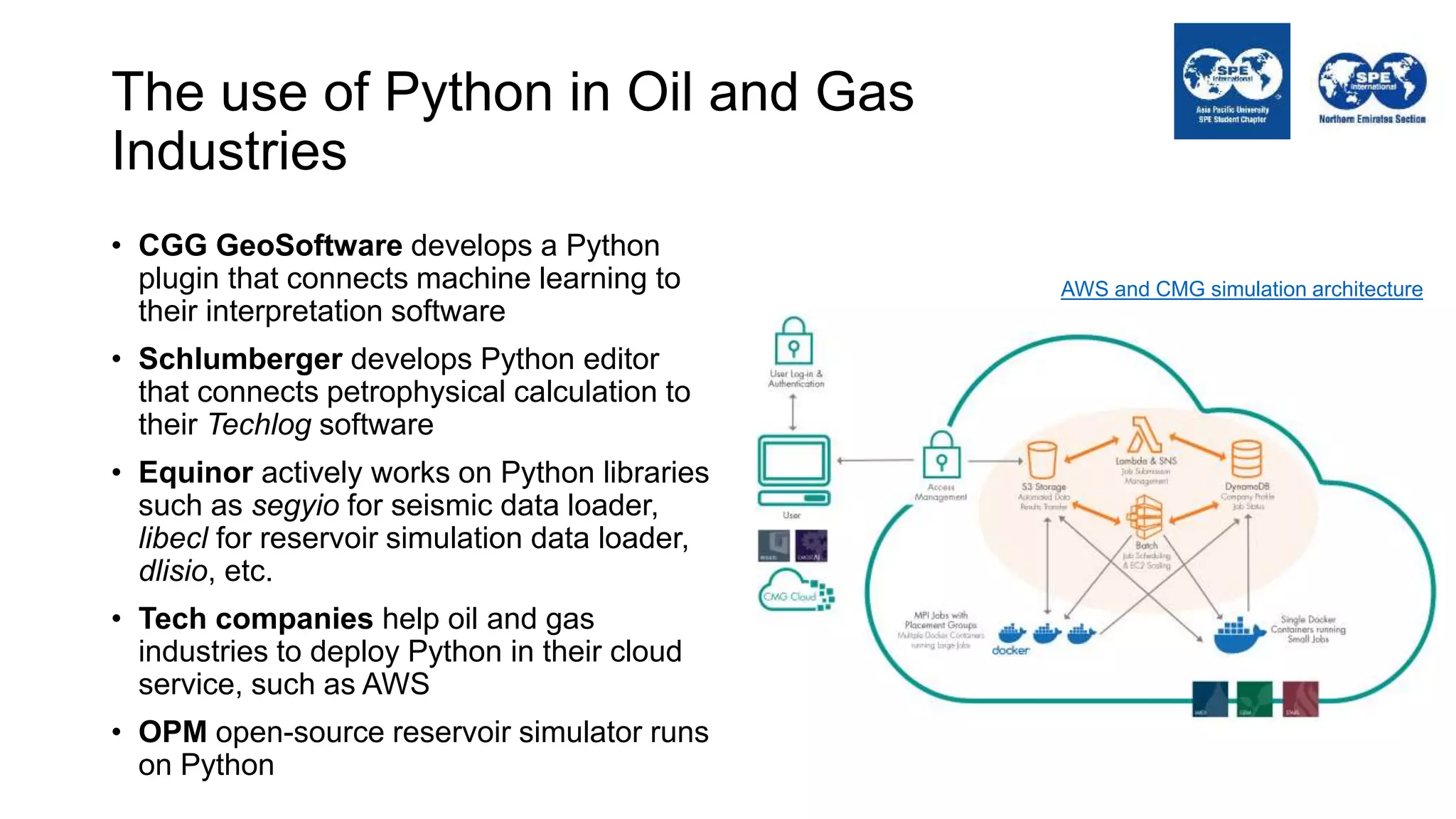
• Tech companies help oil and gas
industries to deploy Python in their cloud
service, such as AWS
• OPM open-source reservoir simulator runs
on Python
AWS and CMG simulation architecture
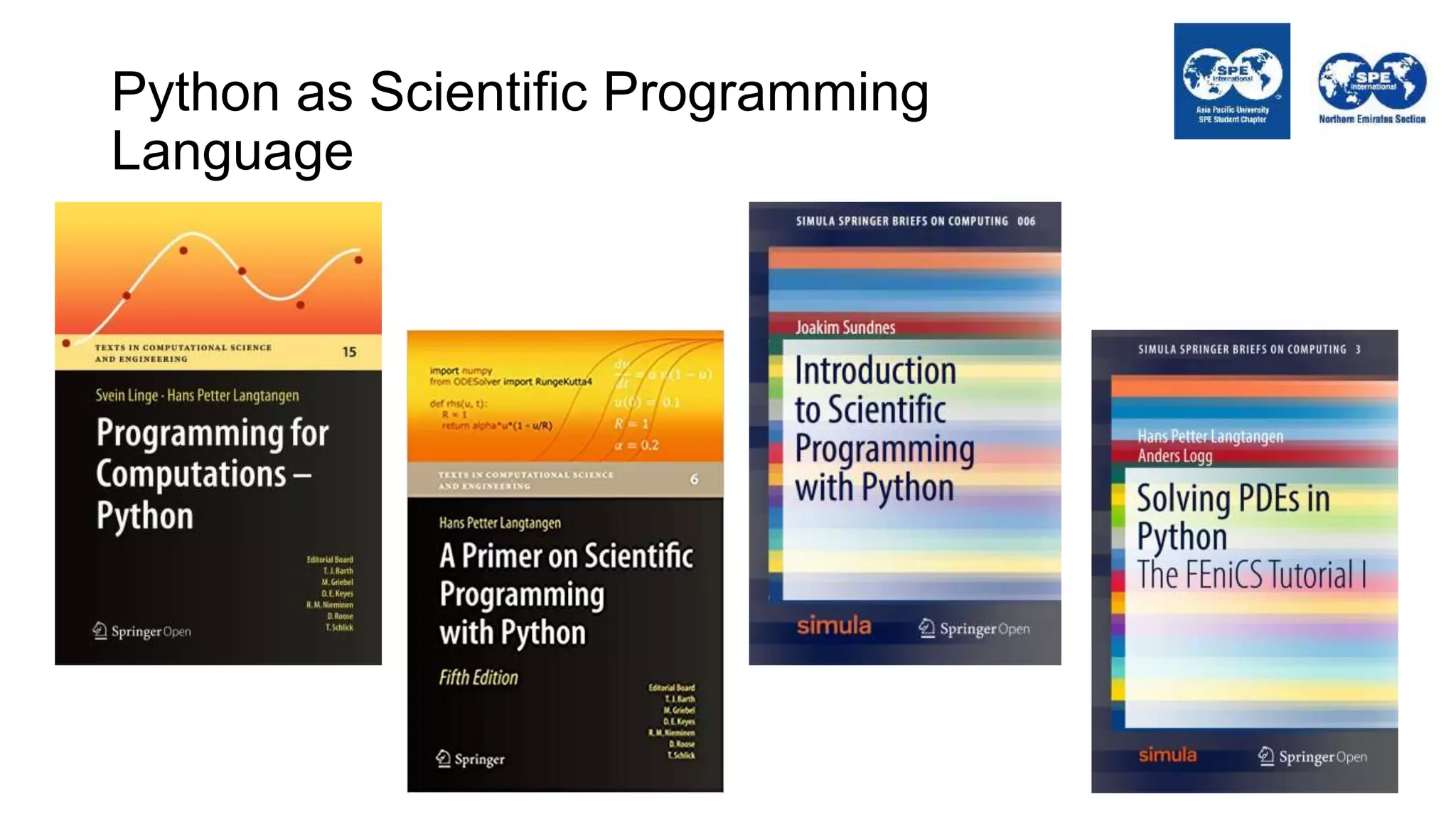
Python as Scientific Programming
Language
• Acoustic/elastic wave simulation based on various
methods (finite-difference, pseudo-spectral, spectral)
for computational seismology (Prof. Heiner Igel from
LMU in Germany)
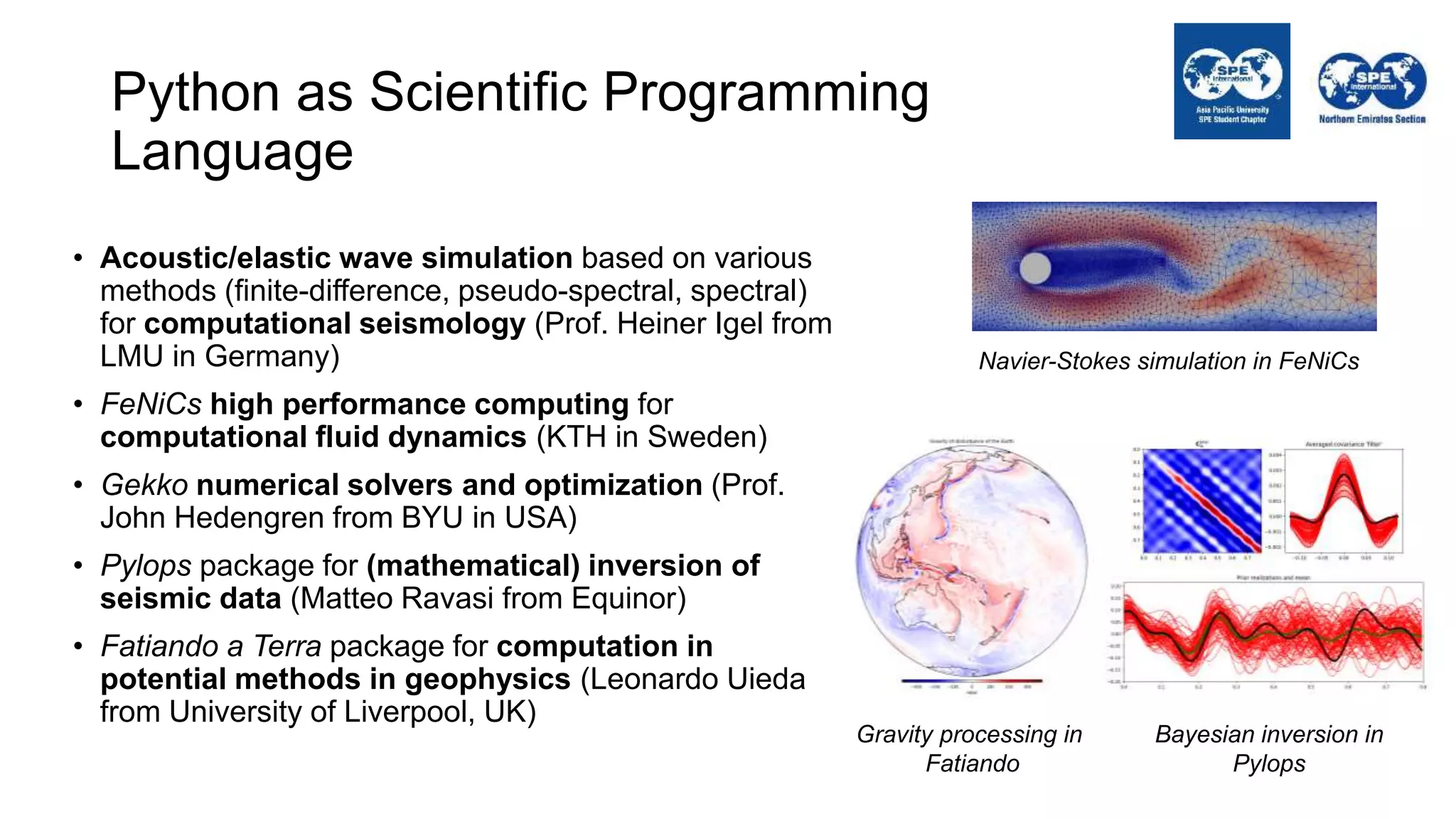
• FeNiCs high performance computing for
computational fluid dynamics (KTH in Sweden)
• Gekko numerical solvers and optimization (Prof.
John Hedengren from BYU in USA)
• Pylops package for (mathematical) inversion of
seismic data (Matteo Ravasi from Equinor)
• Fatiando a Terra package for computation in
potential methods in geophysics (Leonardo Uieda
from University of Liverpool, UK)
Navier-Stokes simulation in FeNiCs
Gravity processing in
Fatiando
Bayesian inversion in
Pylops
Python as Scientific Programming
Language
Python “lifehacks”
What things you need to master?
Numpy “lifehacks”
• Manipulating multidimensional arrays (transposing, etc) – seismic data is a “4D” data
consists of inlines, crosslines, time, and amplitude
• Data cleansing (search for NaNs, replace values) – data quality control (QC)
• Load and read files with text formats – parsing multiple files (e.g. ECLIPSE simulator
files)
• Operations in Numpy (matrix linear algebra, FFT, etc) – signal processing in
geophysics, inverse problems
• Generating random numbers – synthetic data generation when data is not available (!),
Monte Carlo simulation of a stochastic analysis in oil and gas
• Write files – output results from program to a file
Matplotlib “lifehacks”
• Creating subplots through automation – displaying multiple well logs and composites
(RHOB, NPHI, resistivity, GR, PEF, etc.) during formation eval
• Scatter plots – facies typing from petrophysical crossplots
• Logarithmic plots – semilog plot for well-test analysis
• Displaying histogram – evaluation of the statistical distribution of petrophysical variables
• Displaying boxplot – identifying outliers in well logs or production data
• Creating contour plots – spatial distribution of porosity, permeability, net pay, sand
thickness, etc.
• Displaying 3D plot – wellbore trajectory visualization
Pandas “lifehacks”
• Read spreadsheets
• Dataframe manipulation (slicing or creating subsets of dataframes, merging, etc)
• Datetime conversion (datetime format in Pandas is YYYY-MM-DD. If our input has
different format, we need to convert it)
• Summary statistics (knowing the mean, interquartiles, standard deviation, min, max)
• Data cleansing (searching for NaNs, removing unwanted rows or columns)
• Regex (string contains)
Scipy “lifehacks”
• Gridding data – gridding from a reservoir model (porosity, permeability, net pay in 2D/3D)
• Interpolate – mapping porosity, permeability, net pay using different methods (spline,
cubic, or kriging)
• Solve systems of equations and roots – solving PVT (e.g. Peng-Robinson cubic EOS)
• Using optimization methods – linear regression or curve fitting in well-test analysis,
Arps’ decline curve analysis
Open datasets and cloud computing
with Python
• Many available open datasets that you can access: SEG Wiki, Geothermal Data
Repository (GDR) OpenEi, KGS, MSEEL, and many more
• We have list down open datasets in: https://github.com/yohanesnuwara/open-geoscience-
repository
• Python allows interfacing with data stored in websites (cloud computing in Google Colab)
Starting Python
How to learn and pitch ideas? And a demo.
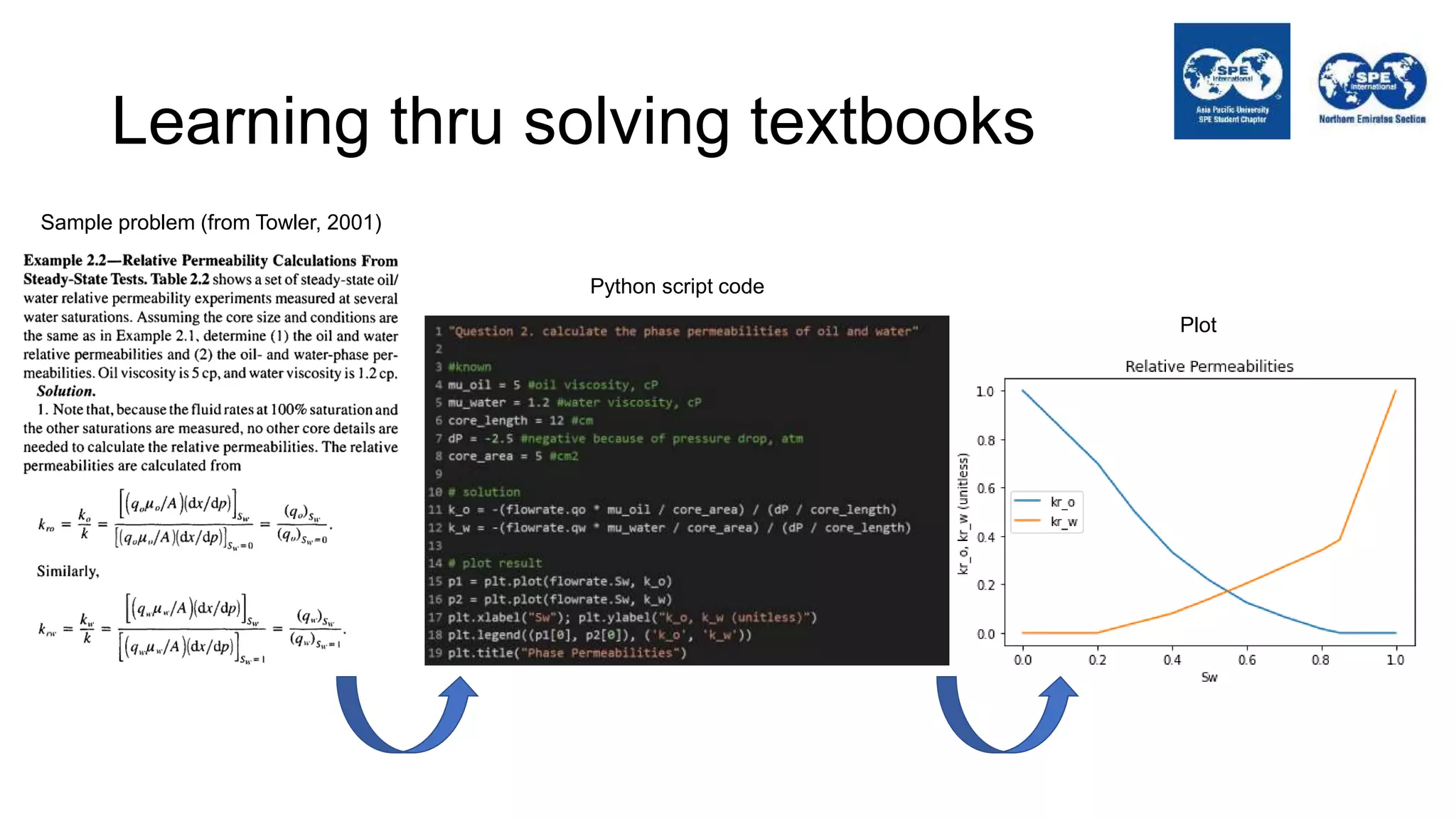
Learning thru solving textbooks
Sample problem (from Towler, 2001)
Plot
Python script code
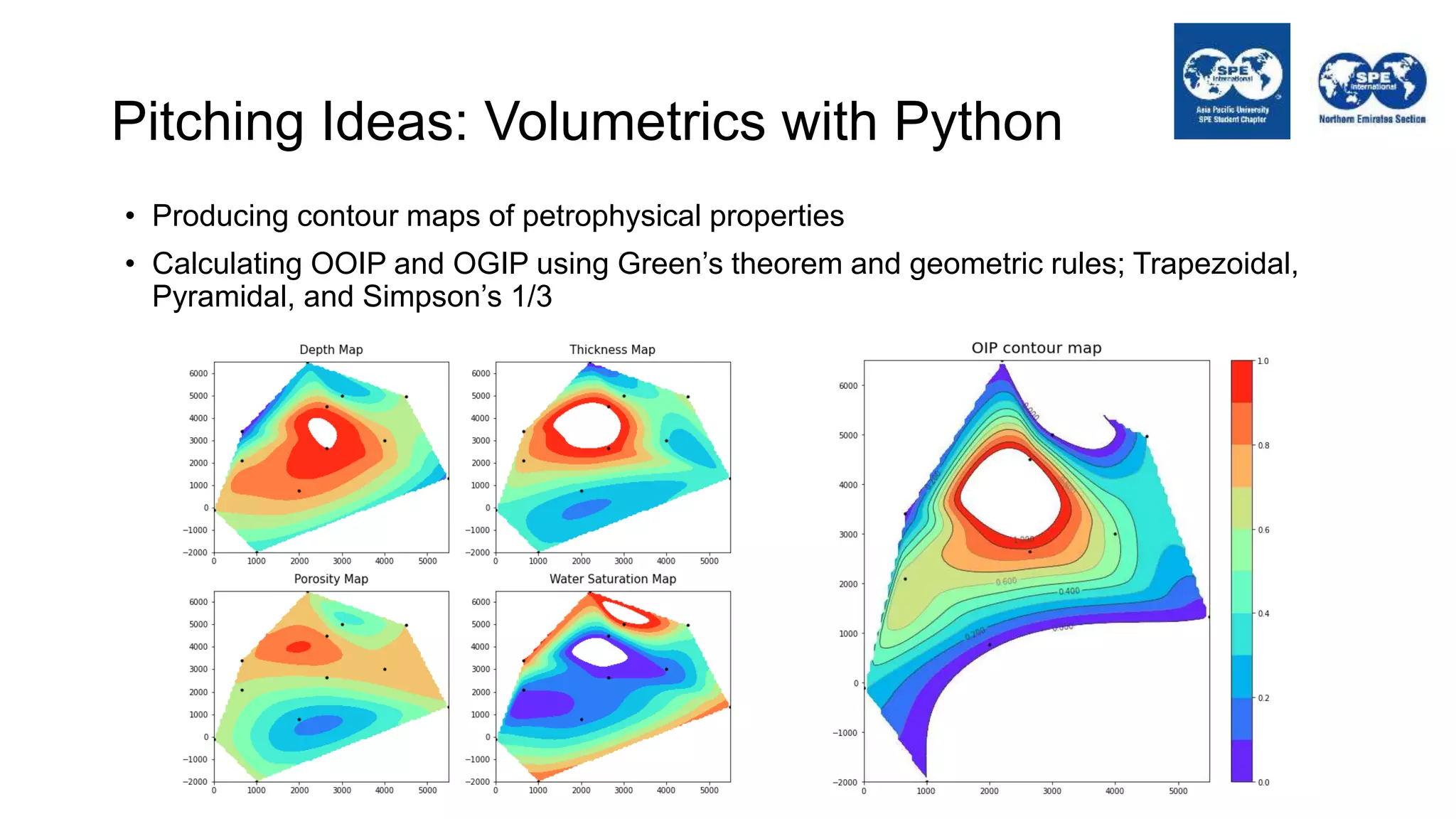
Pitching Ideas: Volumetrics with Python
• Producing contour maps of petrophysical properties
• Calculating OOIP and OGIP using Green’s theorem and geometric rules; Trapezoidal,
Pyramidal, and Simpson’s 1/3
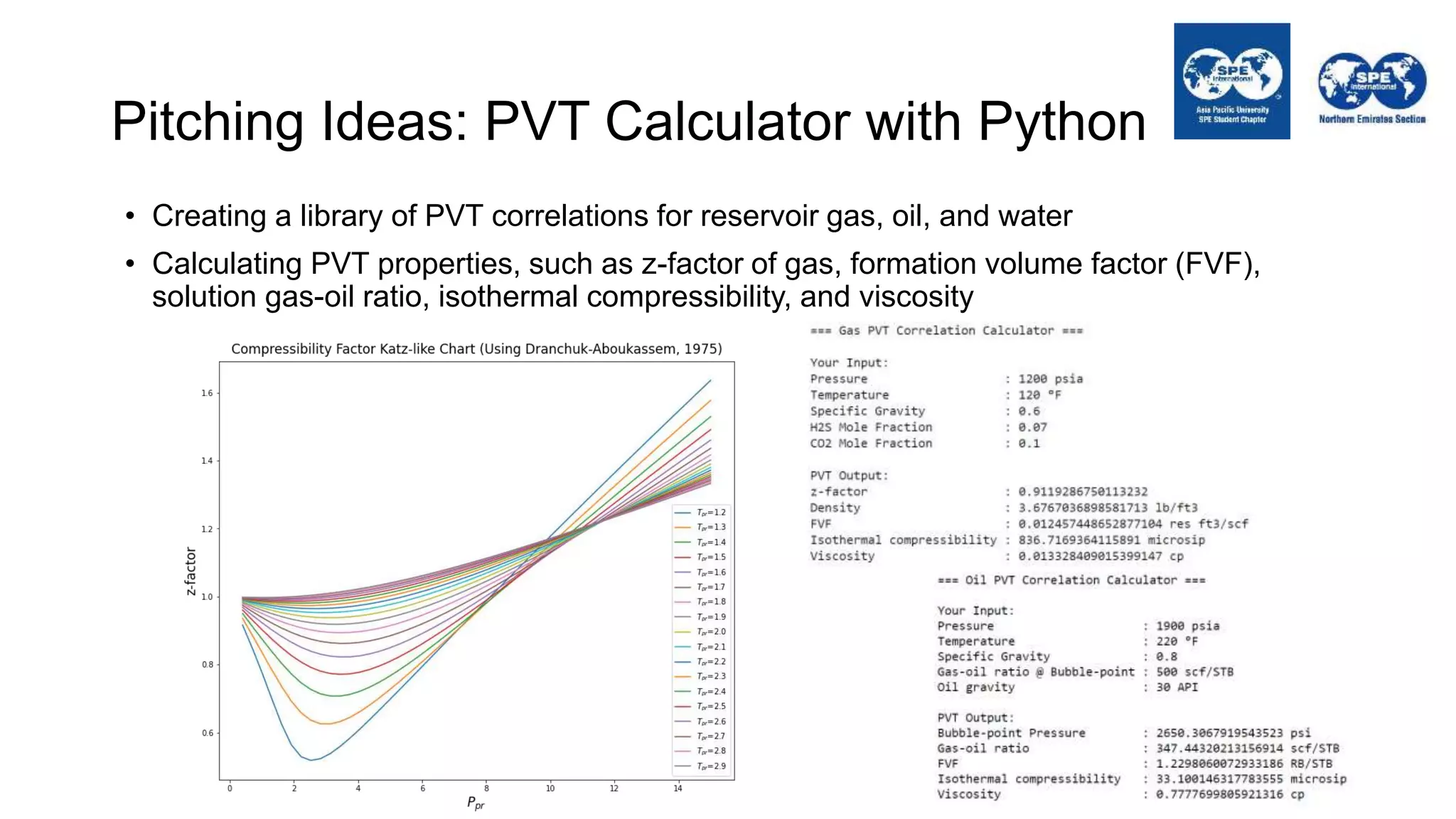
Pitching Ideas: PVT Calculator with Python
• Creating a library of PVT correlations for reservoir gas, oil, and water
• Calculating PVT properties, such as z-factor of gas, formation volume factor (FVF),
solution gas-oil ratio, isothermal compressibility, and viscosity
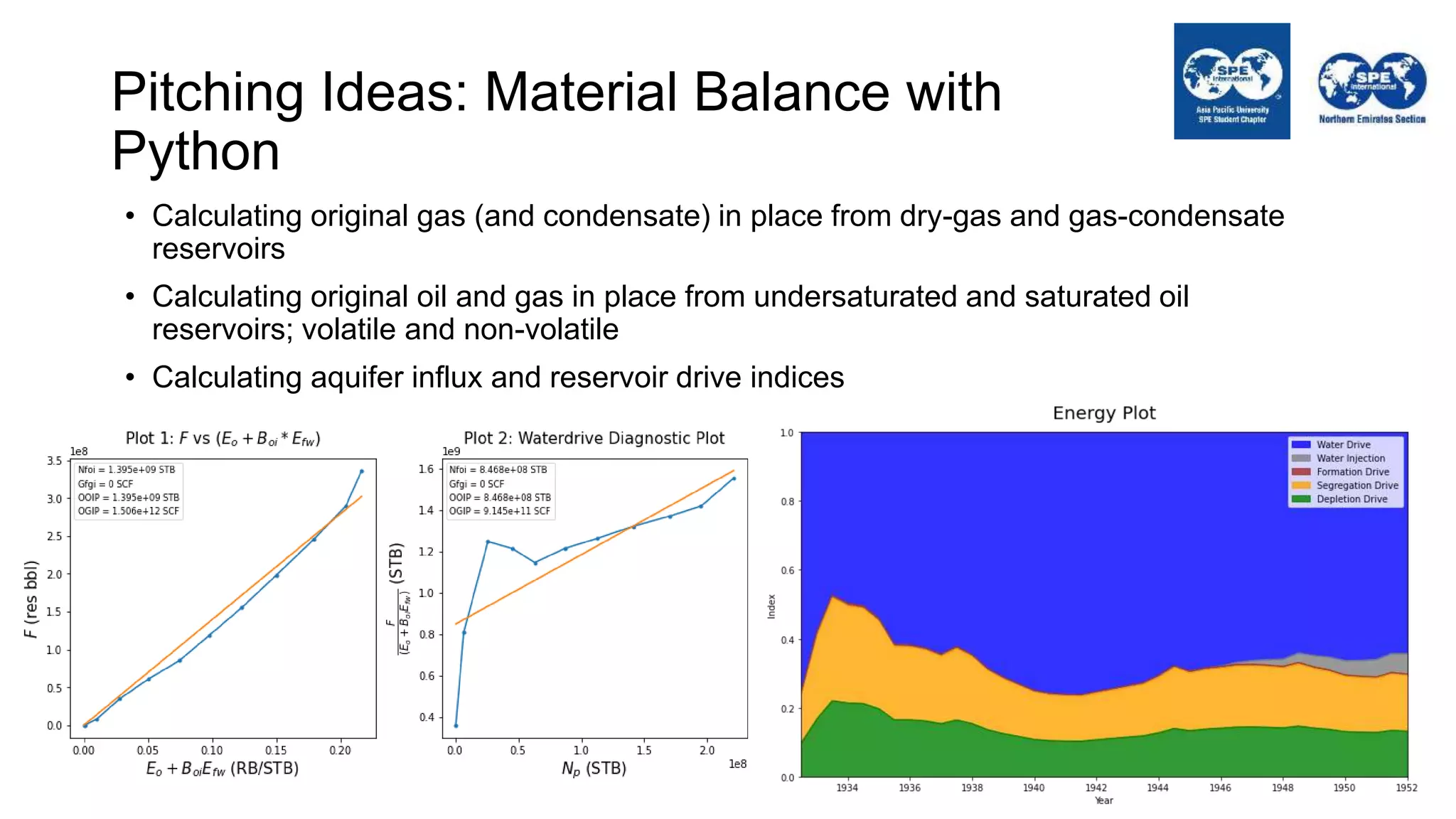
Pitching Ideas: Material Balance with
Python
• Calculating original gas (and condensate) in place from dry-gas and gas-condensate
reservoirs
• Calculating original oil and gas in place from undersaturated and saturated oil
reservoirs; volatile and non-volatile
• Calculating aquifer influx and reservoir drive indices
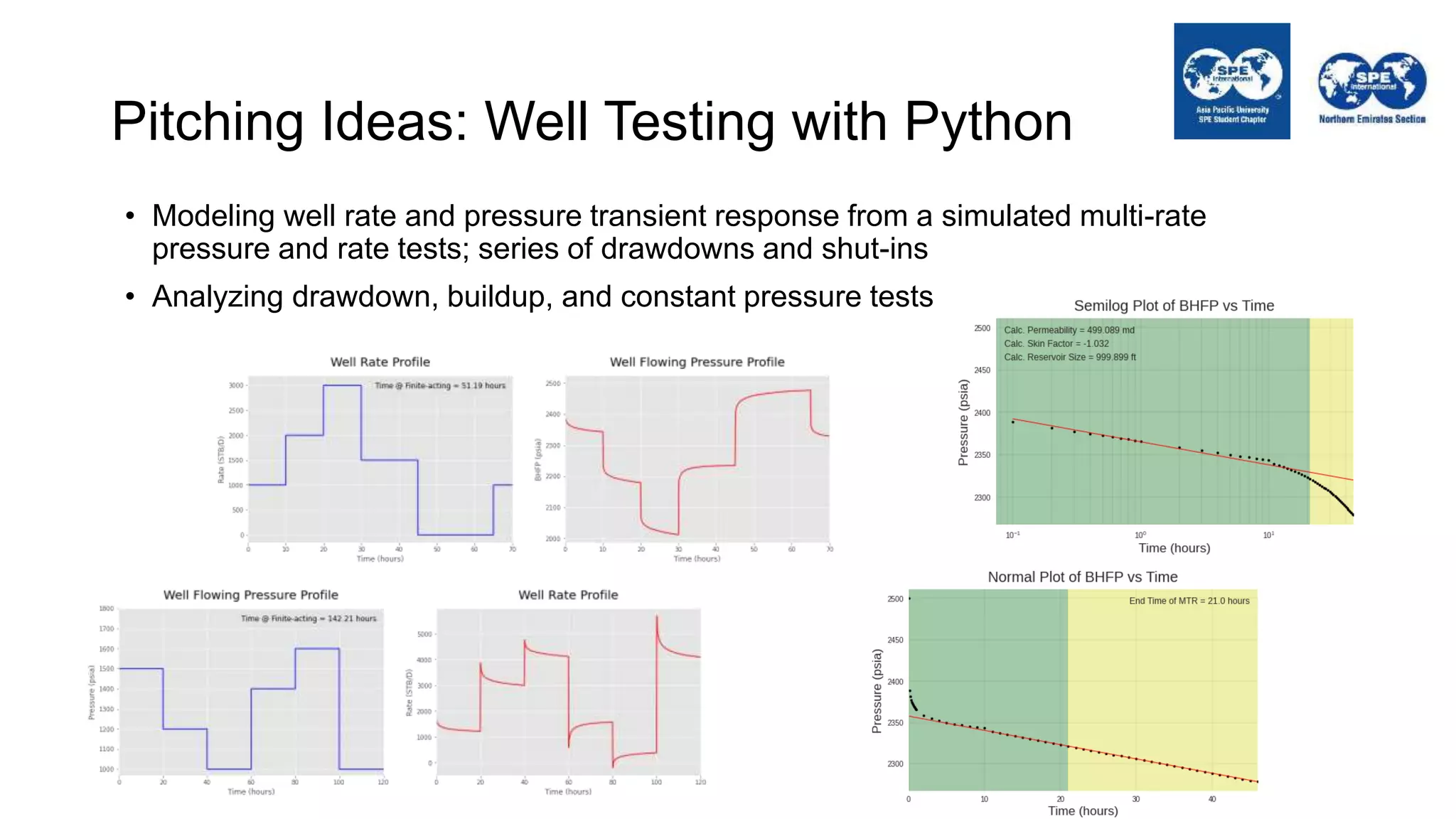
Pitching Ideas: Well Testing with Python
• Modeling well rate and pressure transient response from a simulated multi-rate
pressure and rate tests; series of drawdowns and shut-ins
• Analyzing drawdown, buildup, and constant pressure tests
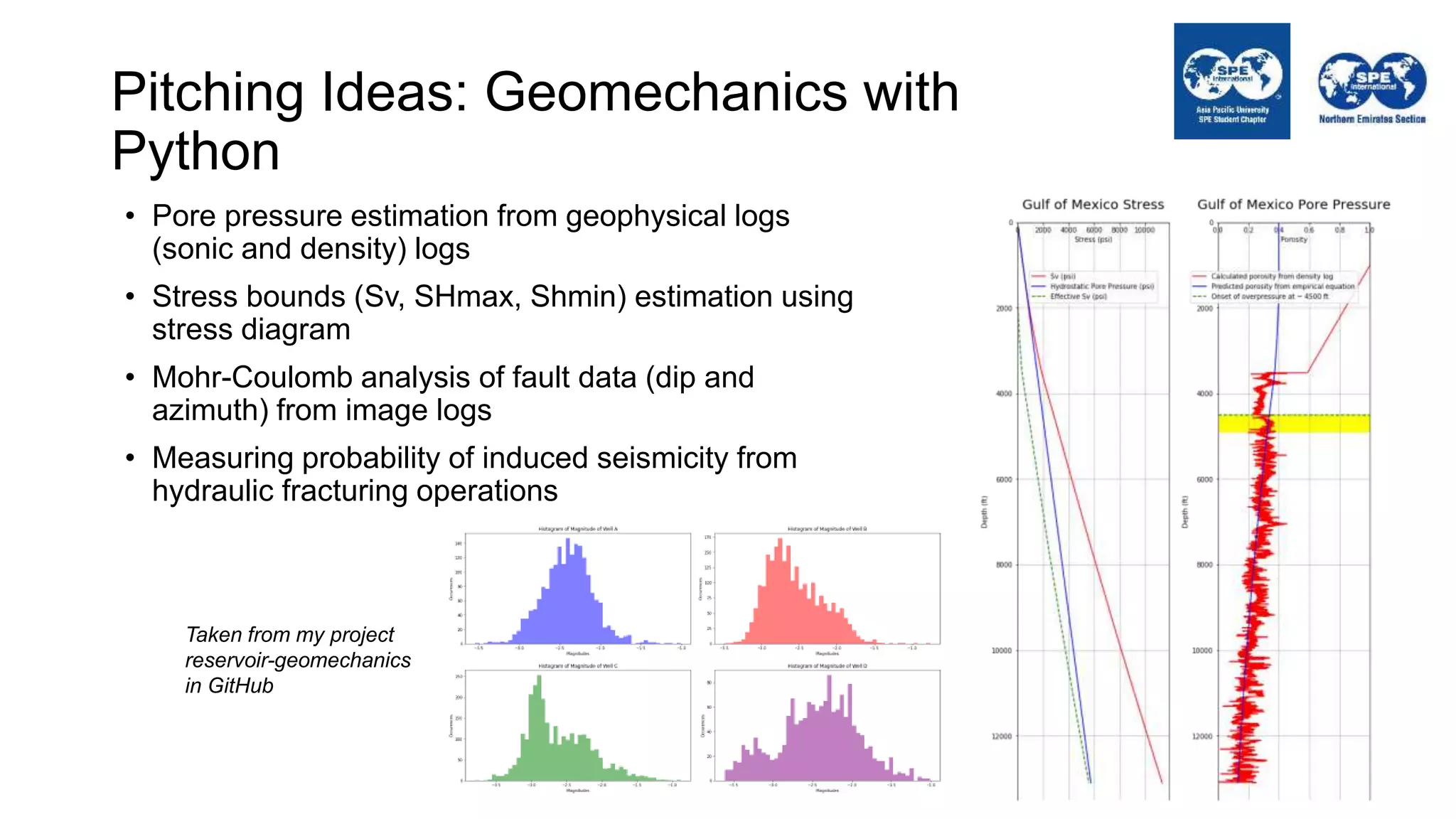
Pitching Ideas: Geomechanics with
Python
• Pore pressure estimation from geophysical logs
(sonic and density) logs
• Stress bounds (Sv, SHmax, Shmin) estimation using
stress diagram
• Mohr-Coulomb analysis of fault data (dip and
azimuth) from image logs
• Measuring probability of induced seismicity from
hydraulic fracturing operations
Taken from my project
reservoir-geomechanics
in GitHub
Pitching Ideas: Reservoir Simulation
with Python
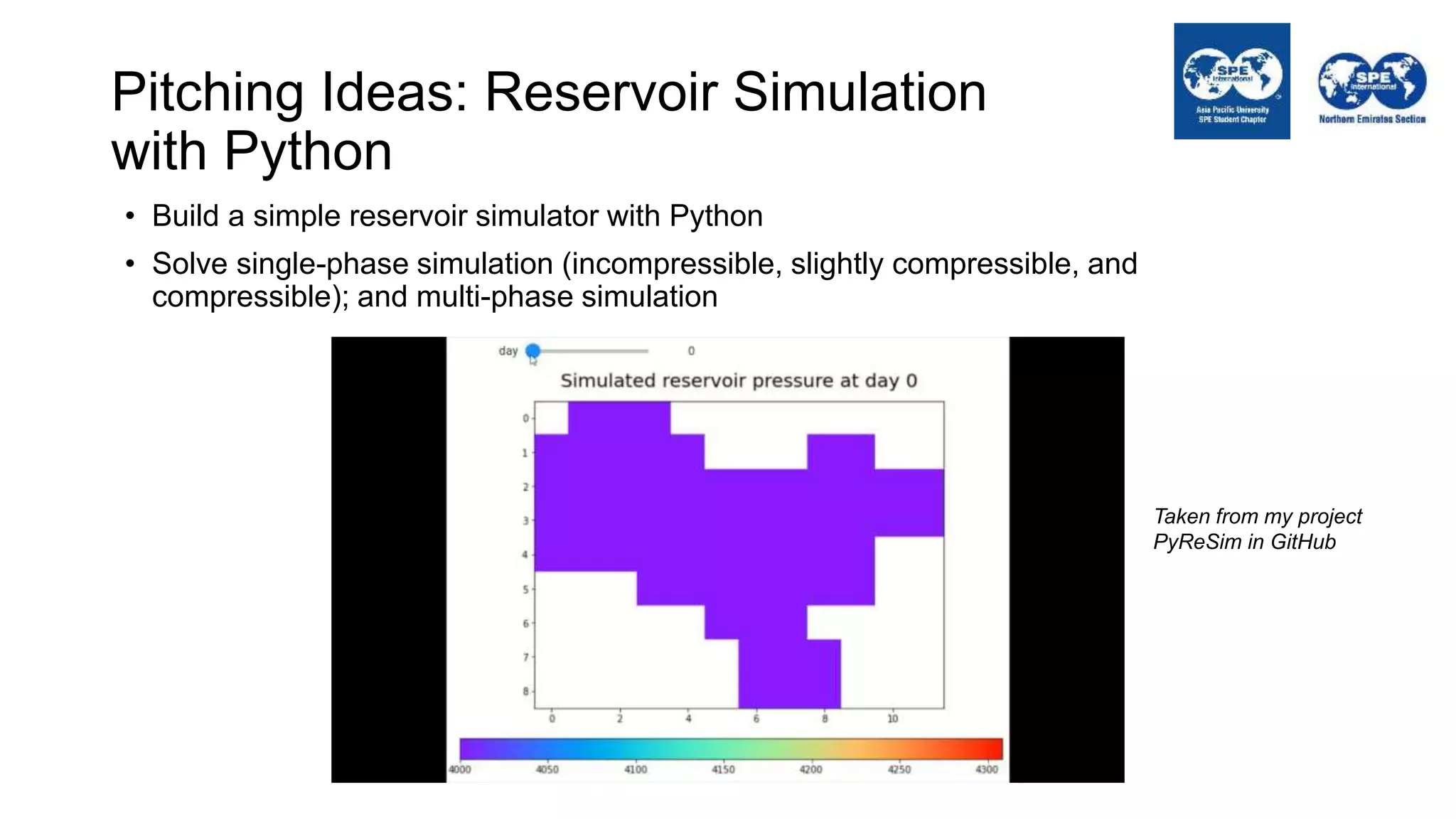
• Build a simple reservoir simulator with Python
• Solve single-phase simulation (incompressible, slightly compressible, and
compressible); and multi-phase simulation
Taken from my project
PyReSim in GitHub
Pitching Ideas: Formation Evaluation
with Python
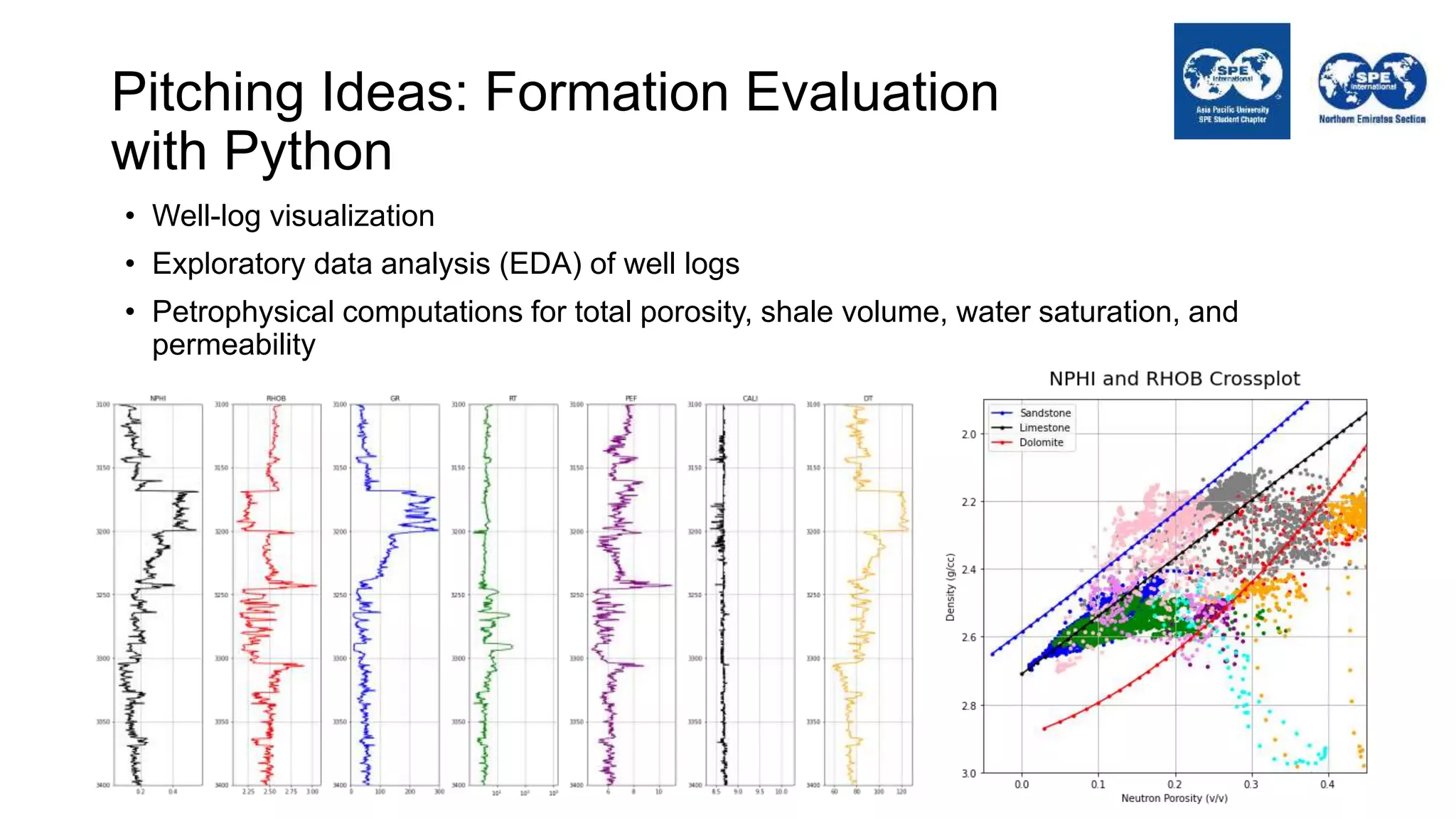
• Well-log visualization
• Exploratory data analysis (EDA) of well logs
• Petrophysical computations for total porosity, shale volume, water saturation, and
permeability
Pitching Ideas: Seismic Attribute
Computation
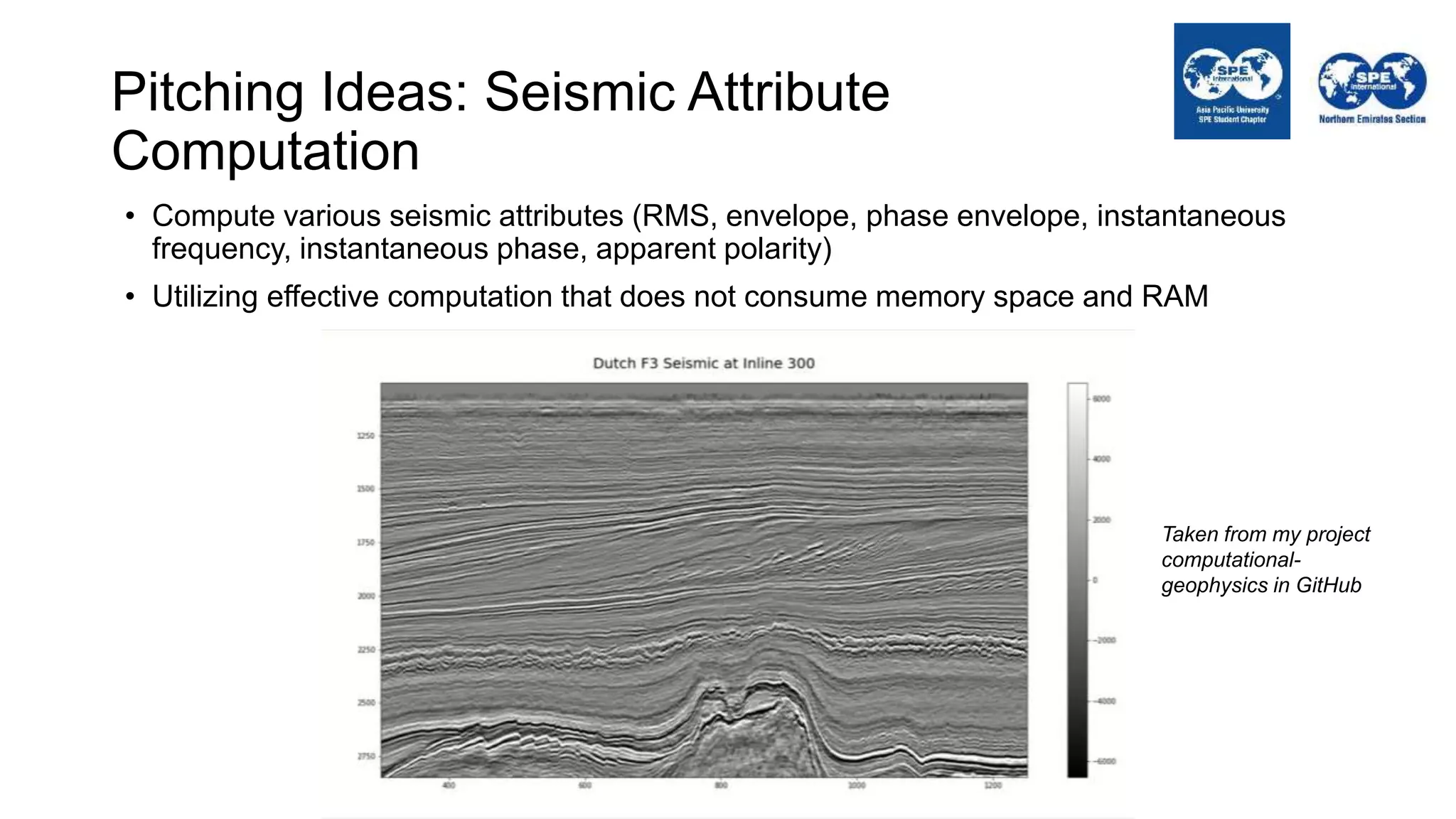
• Compute various seismic attributes (RMS, envelope, phase envelope, instantaneous
frequency, instantaneous phase, apparent polarity)
• Utilizing effective computation that does not consume memory space and RAM
Taken from my project
computational-
geophysics in GitHub
Demo
Starting Python in 1 hour. To access: bit.ly/demopython
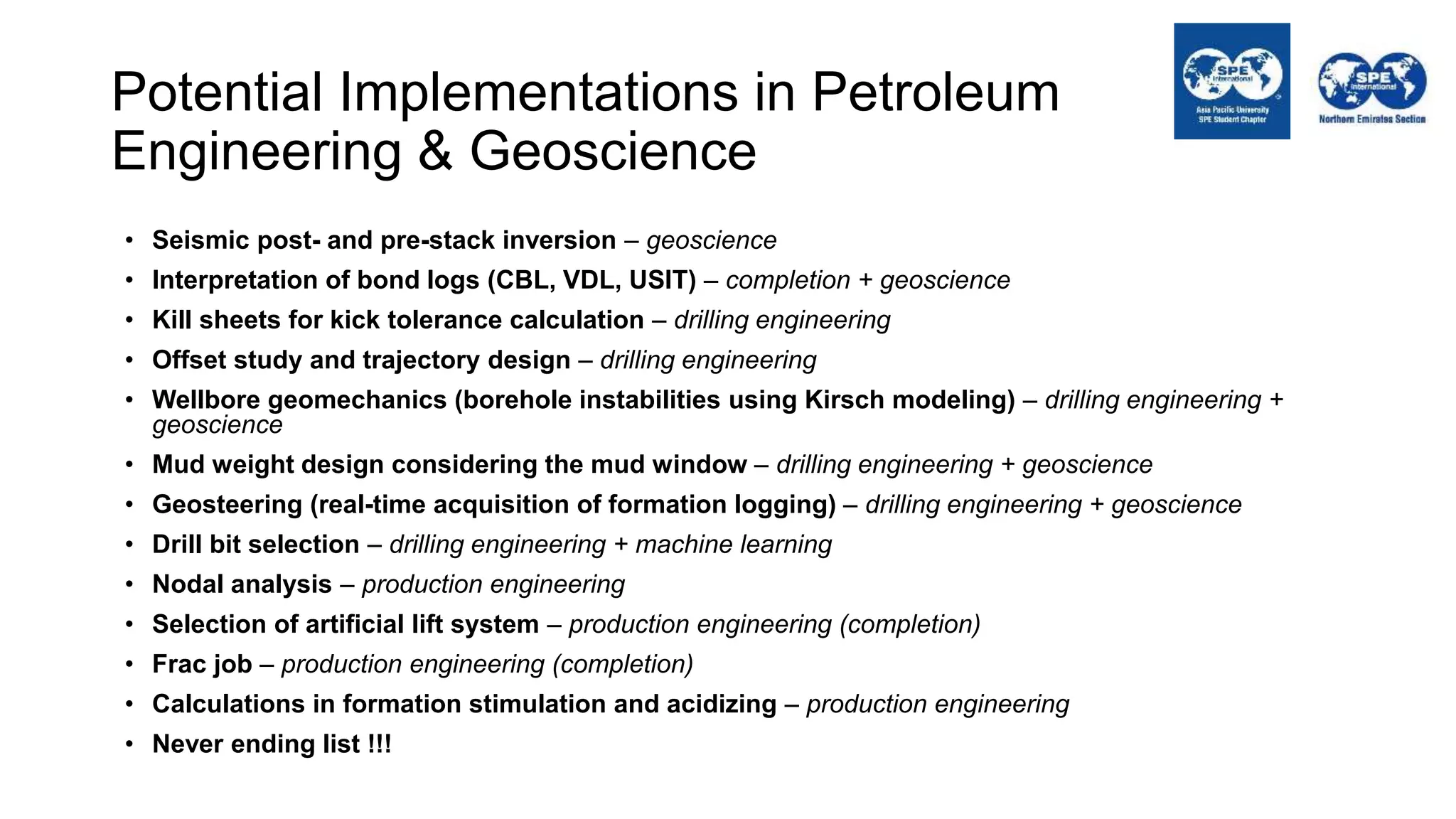
Potential Implementations in Petroleum
Engineering & Geoscience
• Seismic post- and pre-stack inversion – geoscience
• Interpretation of bond logs (CBL, VDL, USIT) – completion + geoscience
• Kill sheets for kick tolerance calculation – drilling engineering
• Offset study and trajectory design – drilling engineering
• Wellbore geomechanics (borehole instabilities using Kirsch modeling) – drilling engineering +
geoscience
• Mud weight design considering the mud window – drilling engineering + geoscience
• Geosteering (real-time acquisition of formation logging) – drilling engineering + geoscience
• Drill bit selection – drilling engineering + machine learning
• Nodal analysis – production engineering
• Selection of artificial lift system – production engineering (completion)
• Frac job – production engineering (completion)
• Calculations in formation stimulation and acidizing – production engineering
• Never ending list !!!
Thank You, it’s your turn now!
Want to discuss?
E-mail : ign.nuwara97@gmail.com
LinkedIn : https://www.linkedin.com/in/yohanesnuwara/

Python Awareness for Exploration and Production Students and Professionals

  • 1.
    Python Awareness forExploration and Production Students and Professionals Yohanes Nuwara
  • 2.
    Outline • Why dowe need to program and why Python? • Python & oil and gas industries in-action • Python as scientific programming language • Open datasets and cloud computing with Python • Python “lifehacks” you should know (for oil and gas) • How to start learning and pitch ideas • Demo, yeay!
  • 3.
    Reasons why Engineersare not Starting? • Engineers love working on spreadsheets – But, is it effective enough if we need to automate? • Engineers think programming is horrible (back in college when they learned C) – But, do we want to learn if in fact programming is much simpler? • Engineers depend on software – But, are you sure you know what’s behind the black box? • Engineers think that most problems are easy (1+1=2, so no need to code) – You kidding! Engineering is not that simple. • Engineers don’t need to be a programmer because there have been so many out there – Nope! They don’t solve problems for you; they solve for themselves.
  • 4.
    Why Python? • Pythonis open-source • Python is easy : It is built based on human language (feels like we’re “having conversation” with the programs) • Python is fast and efficient : The use of “list comprehension” instead of “for-loop” makes consuming much less lines of codes • Python is flexible : We can build and deploy programs almost anywhere (in local PC systems and in the cloud) • Python is abundant : 2 million ++ libraries and packages available to use • Python is scientific : For scientific task, Python is as capable as scientific programming languages like MATLAB, or even better.
  • 5.
    The use ofPython in Oil and Gas Industries • CGG GeoSoftware develops a Python plugin that connects machine learning to their interpretation software • Schlumberger develops Python editor that connects petrophysical calculation to their Techlog software • Equinor actively works on Python libraries such as segyio for seismic data loader, libecl for reservoir simulation data loader, dlisio, etc. • Tech companies help oil and gas industries to deploy Python in their cloud service, such as AWS • OPM open-source reservoir simulator runs on Python AWS and CMG simulation architecture
  • 6.
    Python as ScientificProgramming Language
  • 7.
    • Acoustic/elastic wavesimulation based on various methods (finite-difference, pseudo-spectral, spectral) for computational seismology (Prof. Heiner Igel from LMU in Germany) • FeNiCs high performance computing for computational fluid dynamics (KTH in Sweden) • Gekko numerical solvers and optimization (Prof. John Hedengren from BYU in USA) • Pylops package for (mathematical) inversion of seismic data (Matteo Ravasi from Equinor) • Fatiando a Terra package for computation in potential methods in geophysics (Leonardo Uieda from University of Liverpool, UK) Navier-Stokes simulation in FeNiCs Gravity processing in Fatiando Bayesian inversion in Pylops Python as Scientific Programming Language
  • 8.
  • 9.
    Numpy “lifehacks” • Manipulatingmultidimensional arrays (transposing, etc) – seismic data is a “4D” data consists of inlines, crosslines, time, and amplitude • Data cleansing (search for NaNs, replace values) – data quality control (QC) • Load and read files with text formats – parsing multiple files (e.g. ECLIPSE simulator files) • Operations in Numpy (matrix linear algebra, FFT, etc) – signal processing in geophysics, inverse problems • Generating random numbers – synthetic data generation when data is not available (!), Monte Carlo simulation of a stochastic analysis in oil and gas • Write files – output results from program to a file
  • 10.
    Matplotlib “lifehacks” • Creatingsubplots through automation – displaying multiple well logs and composites (RHOB, NPHI, resistivity, GR, PEF, etc.) during formation eval • Scatter plots – facies typing from petrophysical crossplots • Logarithmic plots – semilog plot for well-test analysis • Displaying histogram – evaluation of the statistical distribution of petrophysical variables • Displaying boxplot – identifying outliers in well logs or production data • Creating contour plots – spatial distribution of porosity, permeability, net pay, sand thickness, etc. • Displaying 3D plot – wellbore trajectory visualization
  • 11.
    Pandas “lifehacks” • Readspreadsheets • Dataframe manipulation (slicing or creating subsets of dataframes, merging, etc) • Datetime conversion (datetime format in Pandas is YYYY-MM-DD. If our input has different format, we need to convert it) • Summary statistics (knowing the mean, interquartiles, standard deviation, min, max) • Data cleansing (searching for NaNs, removing unwanted rows or columns) • Regex (string contains)
  • 12.
    Scipy “lifehacks” • Griddingdata – gridding from a reservoir model (porosity, permeability, net pay in 2D/3D) • Interpolate – mapping porosity, permeability, net pay using different methods (spline, cubic, or kriging) • Solve systems of equations and roots – solving PVT (e.g. Peng-Robinson cubic EOS) • Using optimization methods – linear regression or curve fitting in well-test analysis, Arps’ decline curve analysis
  • 13.
    Open datasets andcloud computing with Python • Many available open datasets that you can access: SEG Wiki, Geothermal Data Repository (GDR) OpenEi, KGS, MSEEL, and many more • We have list down open datasets in: https://github.com/yohanesnuwara/open-geoscience- repository • Python allows interfacing with data stored in websites (cloud computing in Google Colab)
  • 14.
    Starting Python How tolearn and pitch ideas? And a demo.
  • 15.
    Learning thru solvingtextbooks Sample problem (from Towler, 2001) Plot Python script code
  • 16.
    Pitching Ideas: Volumetricswith Python • Producing contour maps of petrophysical properties • Calculating OOIP and OGIP using Green’s theorem and geometric rules; Trapezoidal, Pyramidal, and Simpson’s 1/3
  • 17.
    Pitching Ideas: PVTCalculator with Python • Creating a library of PVT correlations for reservoir gas, oil, and water • Calculating PVT properties, such as z-factor of gas, formation volume factor (FVF), solution gas-oil ratio, isothermal compressibility, and viscosity
  • 18.
    Pitching Ideas: MaterialBalance with Python • Calculating original gas (and condensate) in place from dry-gas and gas-condensate reservoirs • Calculating original oil and gas in place from undersaturated and saturated oil reservoirs; volatile and non-volatile • Calculating aquifer influx and reservoir drive indices
  • 19.
    Pitching Ideas: WellTesting with Python • Modeling well rate and pressure transient response from a simulated multi-rate pressure and rate tests; series of drawdowns and shut-ins • Analyzing drawdown, buildup, and constant pressure tests
  • 20.
    Pitching Ideas: Geomechanicswith Python • Pore pressure estimation from geophysical logs (sonic and density) logs • Stress bounds (Sv, SHmax, Shmin) estimation using stress diagram • Mohr-Coulomb analysis of fault data (dip and azimuth) from image logs • Measuring probability of induced seismicity from hydraulic fracturing operations Taken from my project reservoir-geomechanics in GitHub
  • 21.
    Pitching Ideas: ReservoirSimulation with Python • Build a simple reservoir simulator with Python • Solve single-phase simulation (incompressible, slightly compressible, and compressible); and multi-phase simulation Taken from my project PyReSim in GitHub
  • 22.
    Pitching Ideas: FormationEvaluation with Python • Well-log visualization • Exploratory data analysis (EDA) of well logs • Petrophysical computations for total porosity, shale volume, water saturation, and permeability
  • 23.
    Pitching Ideas: SeismicAttribute Computation • Compute various seismic attributes (RMS, envelope, phase envelope, instantaneous frequency, instantaneous phase, apparent polarity) • Utilizing effective computation that does not consume memory space and RAM Taken from my project computational- geophysics in GitHub
  • 24.
    Demo Starting Python in1 hour. To access: bit.ly/demopython
  • 25.
    Potential Implementations inPetroleum Engineering & Geoscience • Seismic post- and pre-stack inversion – geoscience • Interpretation of bond logs (CBL, VDL, USIT) – completion + geoscience • Kill sheets for kick tolerance calculation – drilling engineering • Offset study and trajectory design – drilling engineering • Wellbore geomechanics (borehole instabilities using Kirsch modeling) – drilling engineering + geoscience • Mud weight design considering the mud window – drilling engineering + geoscience • Geosteering (real-time acquisition of formation logging) – drilling engineering + geoscience • Drill bit selection – drilling engineering + machine learning • Nodal analysis – production engineering • Selection of artificial lift system – production engineering (completion) • Frac job – production engineering (completion) • Calculations in formation stimulation and acidizing – production engineering • Never ending list !!!
  • 26.
    Thank You, it’syour turn now! Want to discuss? E-mail : ign.nuwara97@gmail.com LinkedIn : https://www.linkedin.com/in/yohanesnuwara/