PATEL INSTITUTE OF ENGINEERING & SCIENCE
BHOPAL (M.P.)-462021, INDIA
Department of Civil Engineering
Presented by:-Pratik R. Atwal Guide name:- Prof. Vinay kumar singh
Roll No. :- 0509CE14MT05 Department:- Civil Engineering
Topic
2
Analysis & Design of Pre-engineered
building using IS 800:2007 &
International standards
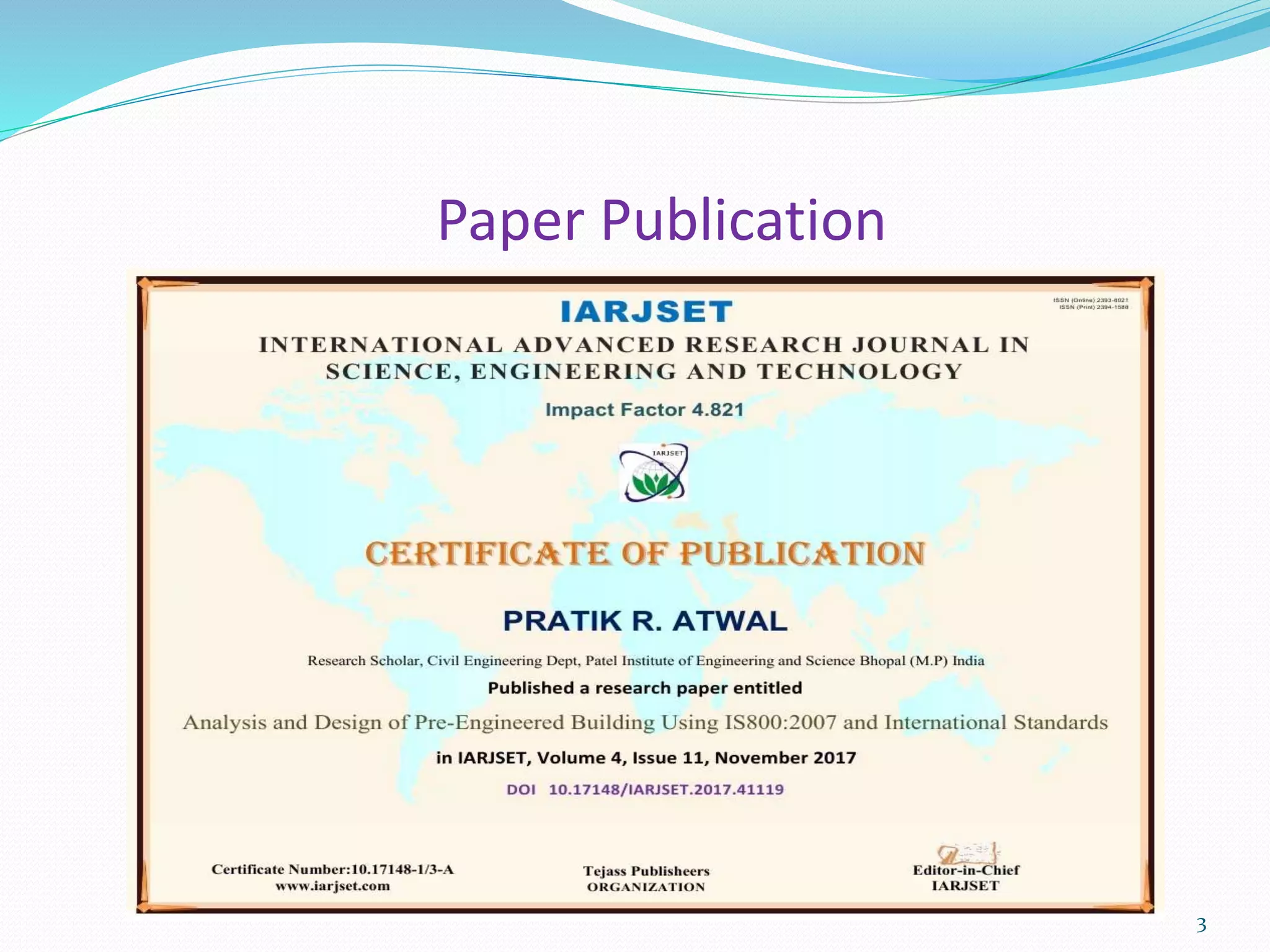
Paper Publication
3
INDEX
 Abstract
 Introduction
 Literature Review
 Objective
 Design Philosophy
 Market research
 Problem statement
 Results and discussion
 Future work
 References
4
ABSTRACT
Technological improvement over the year has contributed immensely to the
enhancement of quality of life through various new products and services. One such
revolution was the pre-engineered buildings (PEB). Pre-engineered buildings can
be adopted to suit a wide variety of structural applications; the greatest economy
will be realized when utilizing standard details in structural framework. In this
report, comparison is made between IS800:2007 & International standards. The
entire range of pre-engineered building is studied while doing this comparison. A
school building is designed using IS800:2007 & International standards by keeping
the loading parameters similar, all the loads are applied accordance with Indian
codes. An attempt is made to study the variation in tonnage as per IS800:2007 &
International standards & possible reasons for variation in respective results.
Analysis and design of these building frames was carried out using Staad-Pro
software & manually also.
5
The design codes are being updated and modified incorporating the results
from the various researches and developments being carried out at the
various R & D Centres in the country. Considering that the current practice
all over the world is based on Limit State Method (LSM) or Load and
Resistance Factor Design Method (LRFD), it was found essential during the
year 2002 – 2003 that the code of practice for use of steel in general
construction should be modified to LSM while maintaining Allowable
Stress Design as a transition alternative. The IS800:2007 was thus prepared
and published by the Bureau of Indian Standards (BIS) in 2008.
6
As per market study it observed that more than 70% pre-engineered
buildings are designed according to American codes. As per the design
result obtained during this dissertation work it is noted that the weight of
structure is reduced by 23.97% as compared to IS800:2007. Even though
most of the pre-engineered buildings are designed accordance to American
code it is noted that by using Euro-03 weight of structure is reduced by
27.2% and by using BS5950-2000 weight of structure is reduced by 9.04%
respectively as per obtained design results as compared to IS800:2007.
 Key Words:PEB, Analysis, Design, LSM, LRFD, AISC-10, IS 800:2007,
Euro-03, BS5950.
7
Introduction
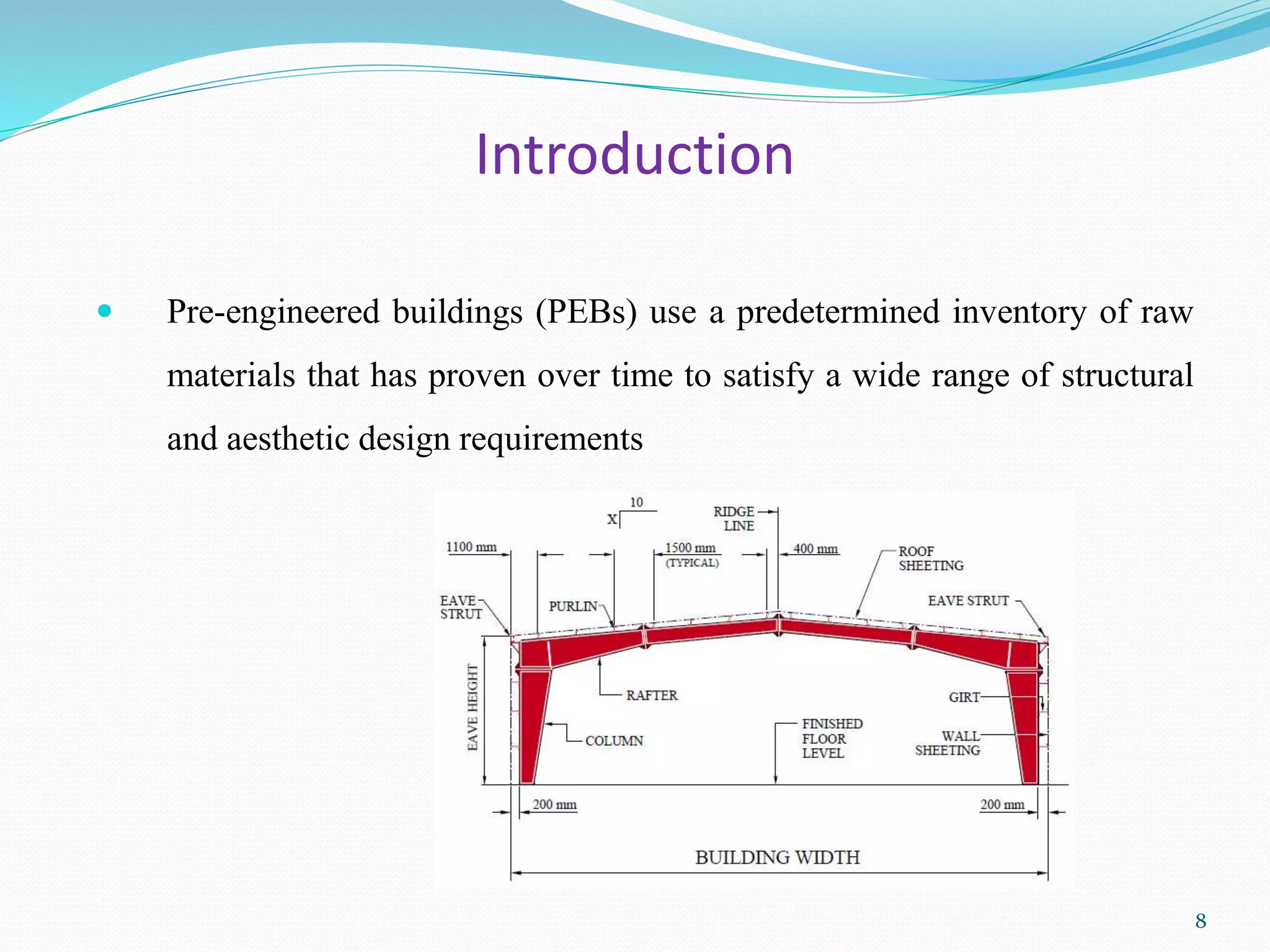
 Pre-engineered buildings (PEBs) use a predetermined inventory of raw
materials that has proven over time to satisfy a wide range of structural
and aesthetic design requirements
8
9
Introduction
o Flexibility in material choice allows PEBs to fulfil an lmost unlimited range of
building configurations, custom designs, requirements and applications.
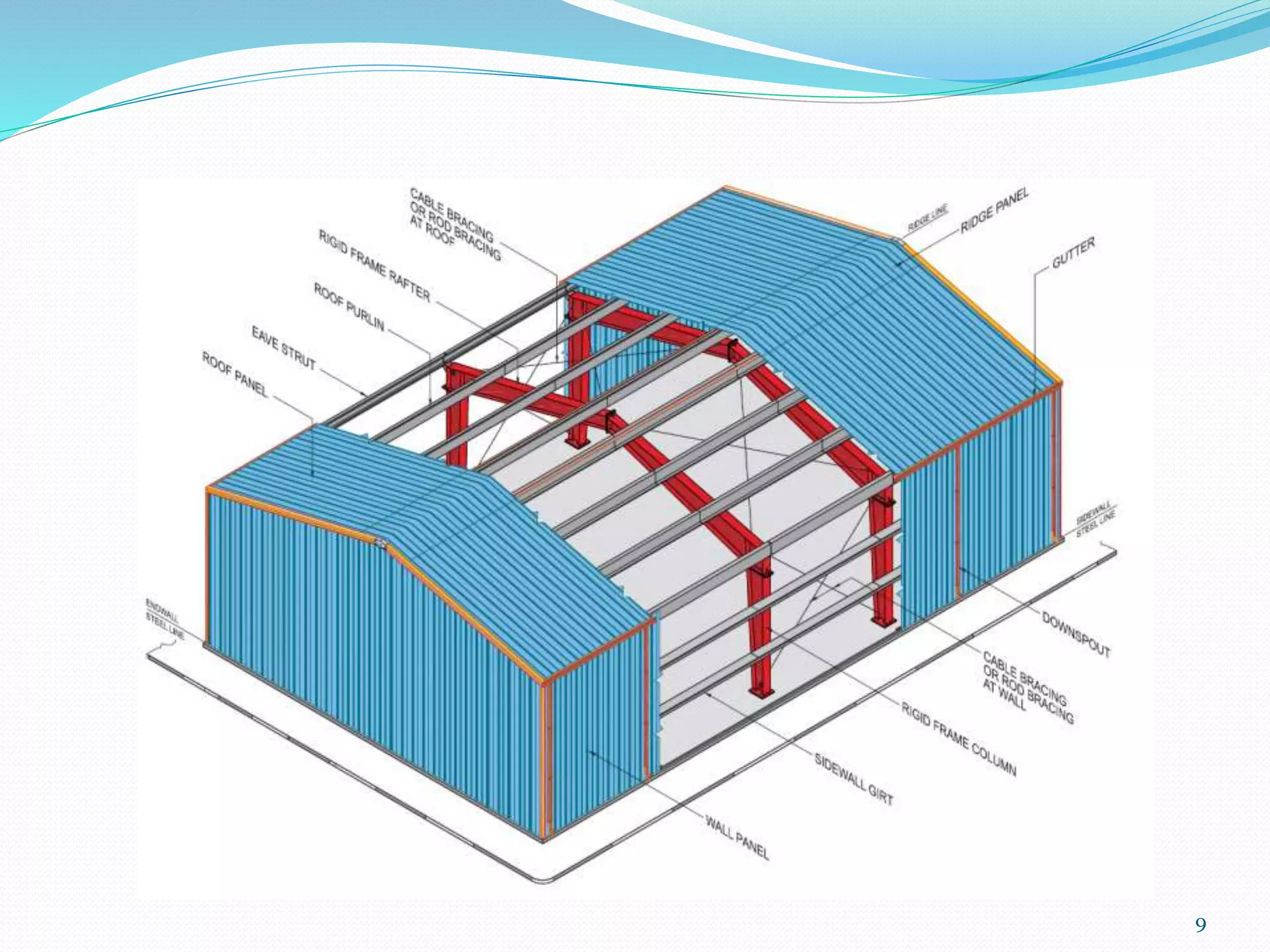
o The pre-engineered steel building is a building shell utilizing three distinct
product categories as:
1. Built-up “I” shaped primary structural framing members (columns and rafters)
2. Cold-formed “Z” and “C” shaped secondary structural members (roof purlin,
eave struts and wall grits)
3. Roll formed profiled sheeting (roof and wall panels)
10
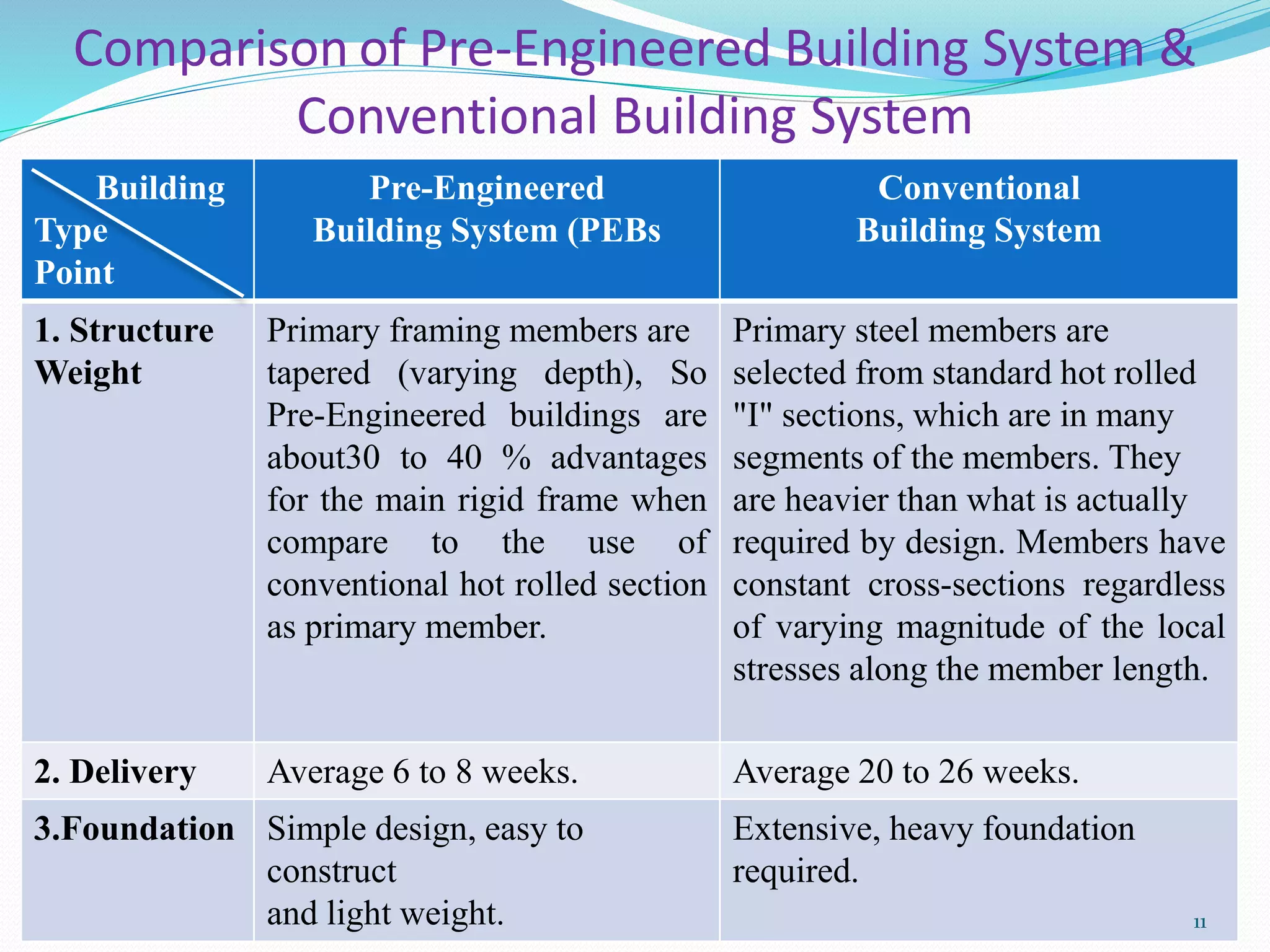
Comparison of Pre-Engineered Building System &
Conventional Building System
Building
Type
Point
Pre-Engineered
Building System (PEBs
Conventional
Building System
1. Structure
Weight
Primary framing members are
tapered (varying depth), So
Pre-Engineered buildings are
about30 to 40 % advantages
for the main rigid frame when
compare to the use of
conventional hot rolled section
as primary member.
Primary steel members are
selected from standard hot rolled
"I" sections, which are in many
segments of the members. They
are heavier than what is actually
required by design. Members have
constant cross-sections regardless
of varying magnitude of the local
stresses along the member length.
2. Delivery Average 6 to 8 weeks. Average 20 to 26 weeks.
3.Foundation Simple design, easy to
construct
and light weight.
Extensive, heavy foundation
required.
11
12
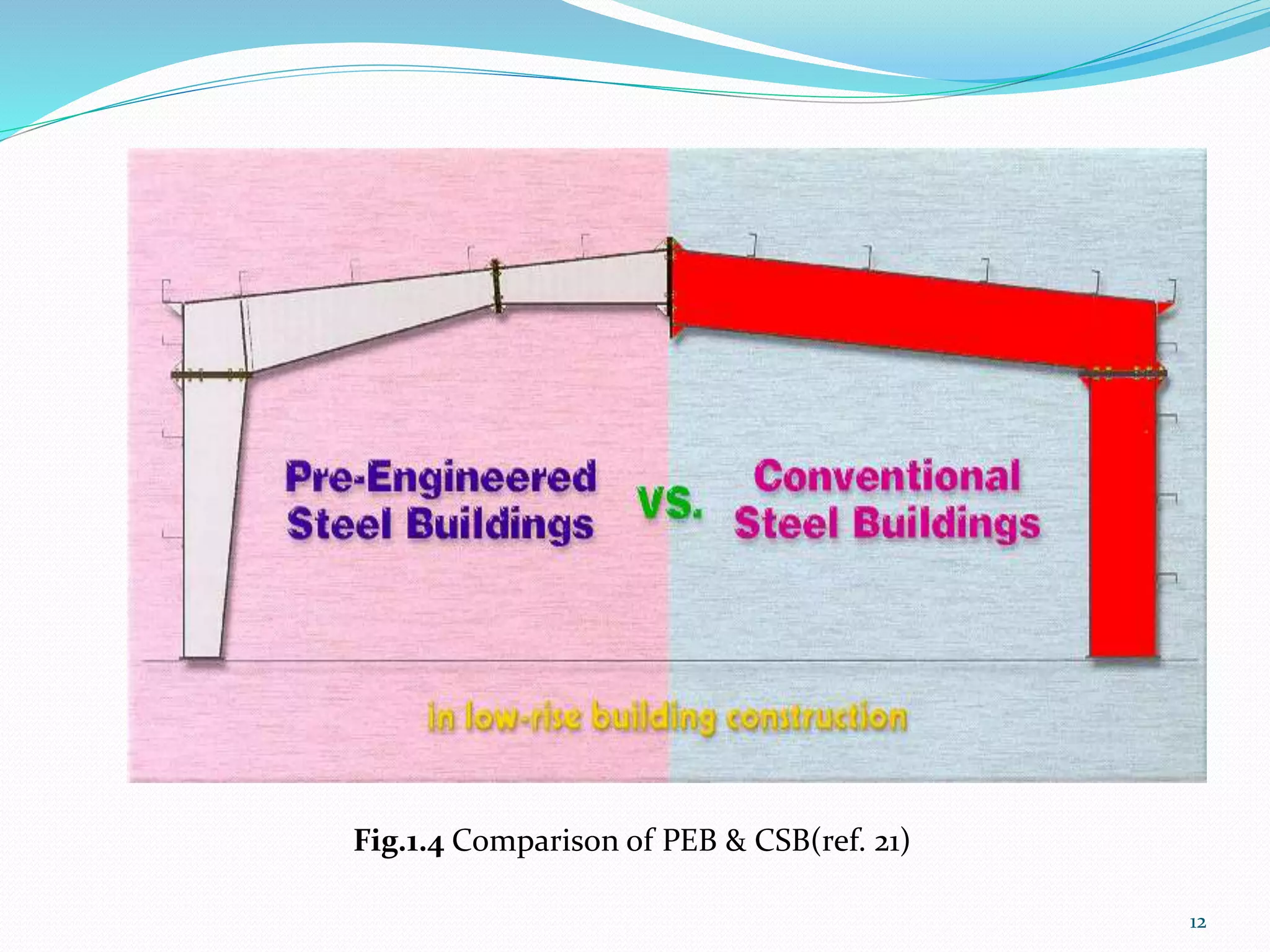
Fig.1.4 Comparison of PEB & CSB(ref. 21)
13
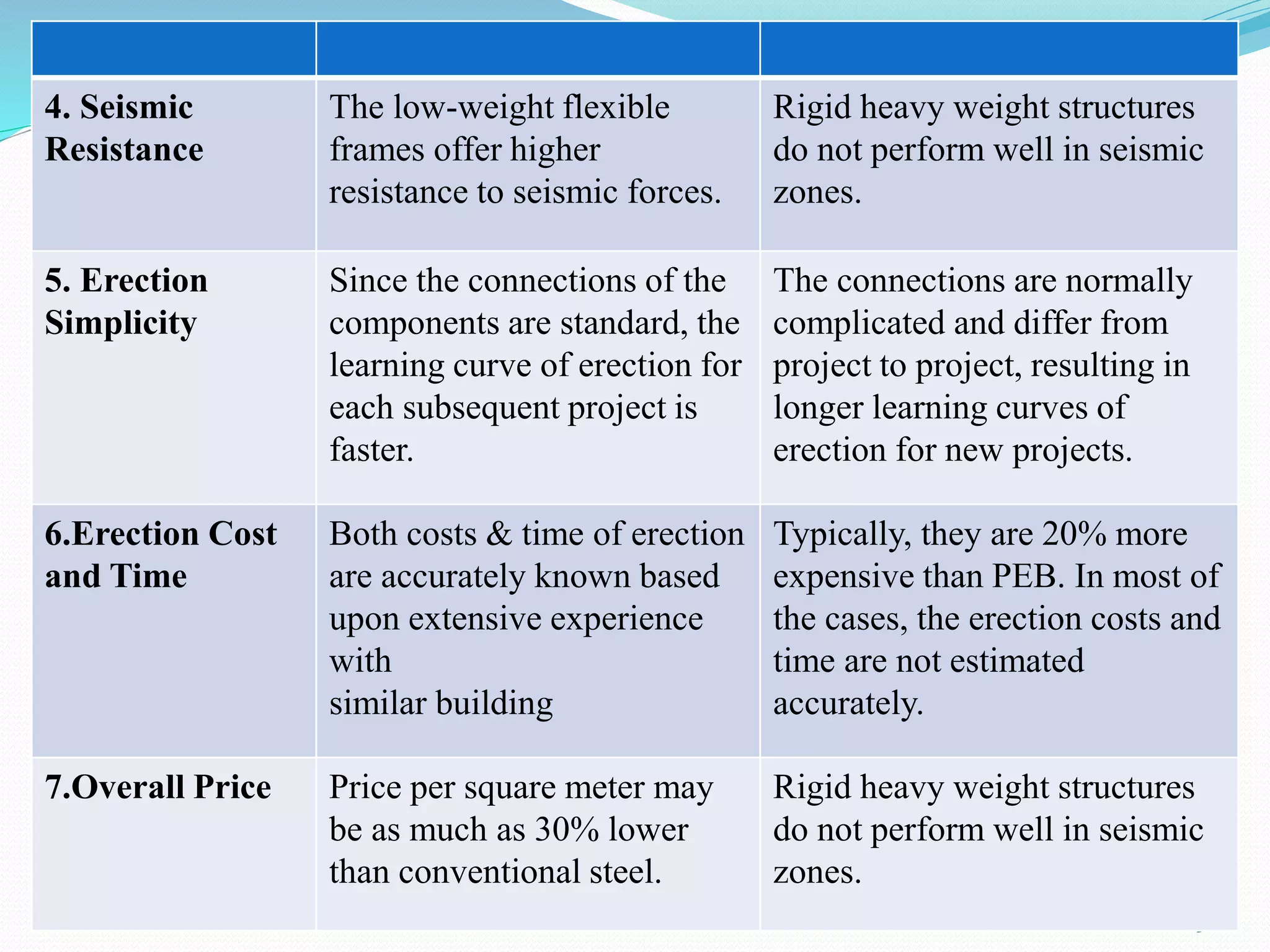
4. Seismic
Resistance
The low-weight flexible
frames offer higher
resistance to seismic forces.
Rigid heavy weight structures
do not perform well in seismic
zones.
5. Erection
Simplicity
Since the connections of the
components are standard, the
learning curve of erection for
each subsequent project is
faster.
The connections are normally
complicated and differ from
project to project, resulting in
longer learning curves of
erection for new projects.
6.Erection Cost
and Time
Both costs & time of erection
are accurately known based
upon extensive experience
with
similar building
Typically, they are 20% more
expensive than PEB. In most of
the cases, the erection costs and
time are not estimated
accurately.
7.Overall Price Price per square meter may
be as much as 30% lower
than conventional steel.
Rigid heavy weight structures
do not perform well in seismic
zones.
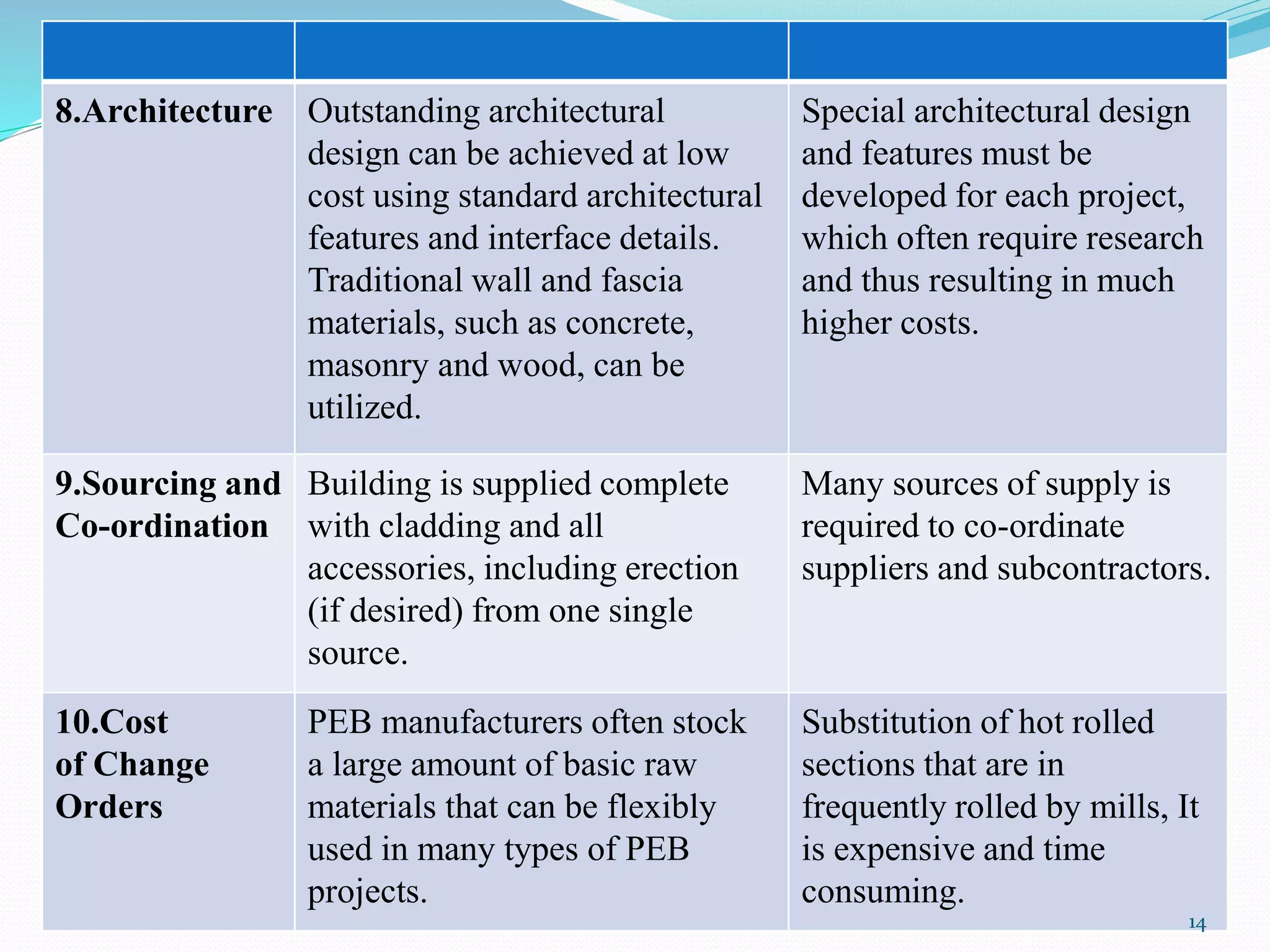
8.Architecture Outstanding architectural
design can be achieved at low
cost using standard architectural
features and interface details.
Traditional wall and fascia
materials, such as concrete,
masonry and wood, can be
utilized.
Special architectural design
and features must be
developed for each project,
which often require research
and thus resulting in much
higher costs.
9.Sourcing and
Co-ordination
Building is supplied complete
with cladding and all
accessories, including erection
(if desired) from one single
source.
Many sources of supply is
required to co-ordinate
suppliers and subcontractors.
10.Cost
of Change
Orders
PEB manufacturers often stock
a large amount of basic raw
materials that can be flexibly
used in many types of PEB
projects.
Substitution of hot rolled
sections that are in
frequently rolled by mills, It
is expensive and time
consuming.
14
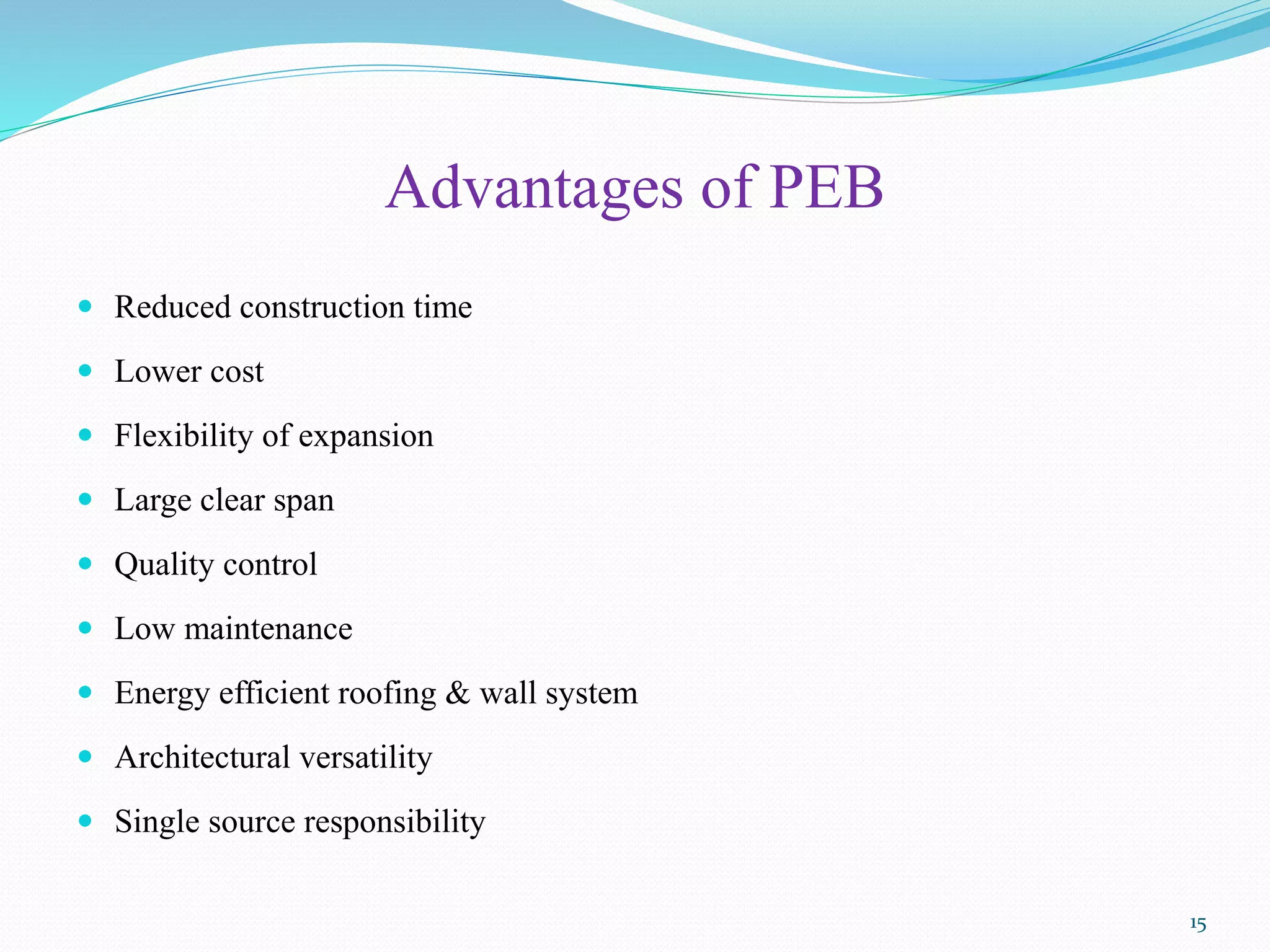
Advantages of PEB
 Reduced construction time
 Lower cost
 Flexibility of expansion
 Large clear span
 Quality control
 Low maintenance
 Energy efficient roofing & wall system
 Architectural versatility
 Single source responsibility
15
Literature Review
 Kumar et al [2014]
o Studied the Pre-Engineered Building (PEB) concept in the design of structures
which helped in optimizing design.
o The ability of PEB in the place of Conventional Steel Building (CSB) design
concept resulted in many advantages, including economy and easier fabrication.
o The economy of the structure is discussed in terms of its weight comparison,
between Indian codes (IS800-1984, IS800-2007) & American code (AISC-89)
& between Indian codes (IS800-1984, IS800-2007).
 Chavan et al [2014]
o Evaluated the economic significance of the Hollow Structural Sections (HSS) in
contrast with open sections.
o This study was carried out to determine the percentage economy achieved using
Hollow Structural Sections (HSS) so as to understand the importance of cost
effectiveness.
16
Literature Review
 Anbuchezian et al [2013]
o studied behaviour of cold formed sections.
o Cold formed steel purlins are the widely used structural elements in
India.
o Practically ‘Z’ sections are provided, where the span of the roof purlins is
sloped and the length of the span is maximum.
 Saleem [2013]
o Presented research work on, minimum weight buildings that are targeted
with simple fabrication process and easy erection to have maximum
structural efficiency.
o and to verify suitability and applicability of concept of PEB, a sample
steel building is first analyzed and designed by using conventional steel
hot rolled sections and then by using pre-engineered tapered and cold
formed sections.
17
Literature Review
 Satpute et al [2012]
o He has done the detailed analysis of Industrial building with Cold
formed concept is carried out.
o A comparative study has also been carried out between Hot Roll steel
Industrial building and Cold formed Industrial building and a conclusion
has been drawn.
o In Industrial building the material & cost of the building is minimized in
case of cold formed steel while in case of conventional building it was be
higher both in two cases. The saving in material and cost is about 25%.
18
Conclusion of Literature Review
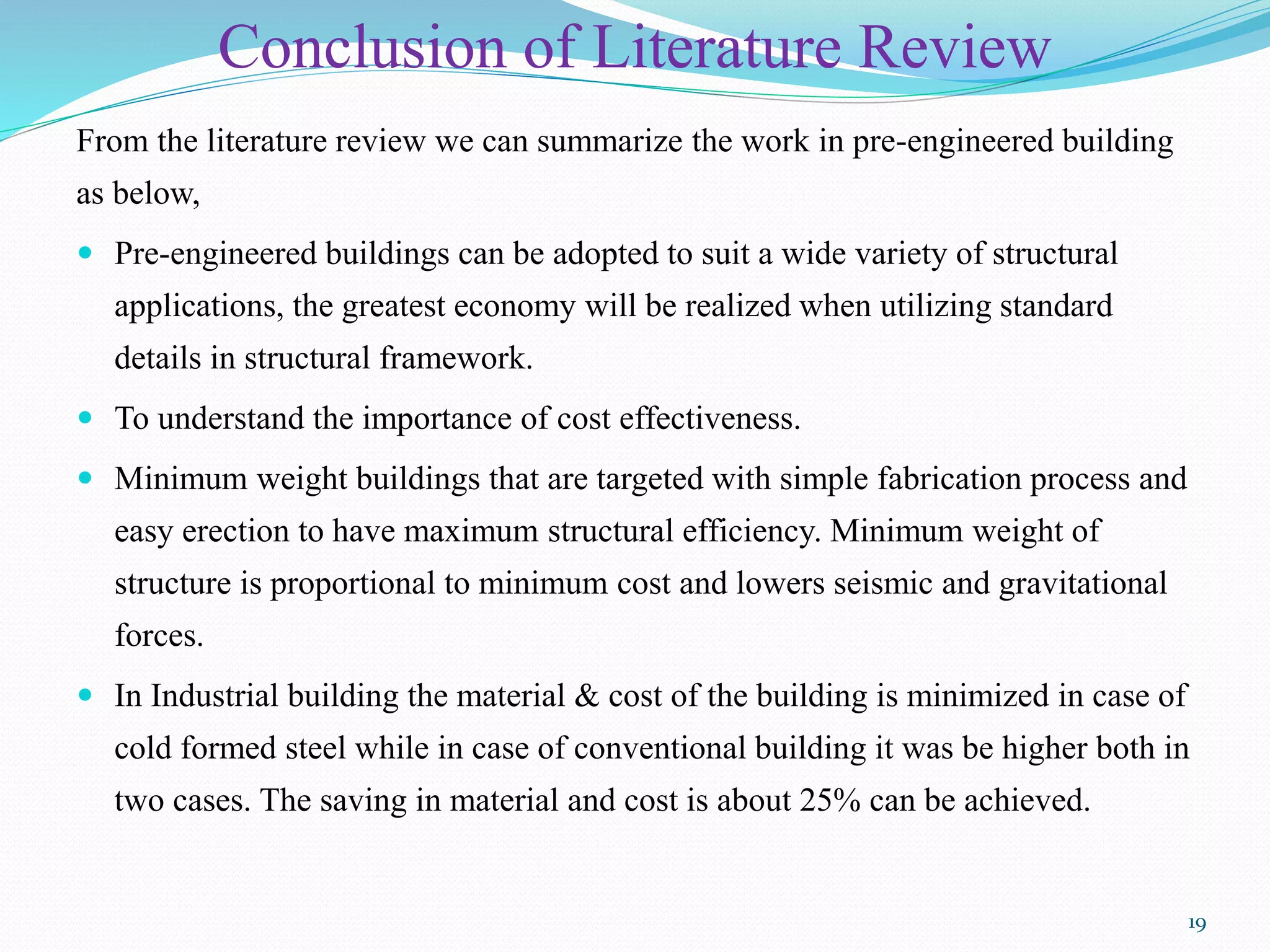
From the literature review we can summarize the work in pre-engineered building
as below,
 Pre-engineered buildings can be adopted to suit a wide variety of structural
applications, the greatest economy will be realized when utilizing standard
details in structural framework.
 To understand the importance of cost effectiveness.
 Minimum weight buildings that are targeted with simple fabrication process and
easy erection to have maximum structural efficiency. Minimum weight of
structure is proportional to minimum cost and lowers seismic and gravitational
forces.
 In Industrial building the material & cost of the building is minimized in case of
cold formed steel while in case of conventional building it was be higher both in
two cases. The saving in material and cost is about 25% can be achieved.
19
Conclusion of Literature Review
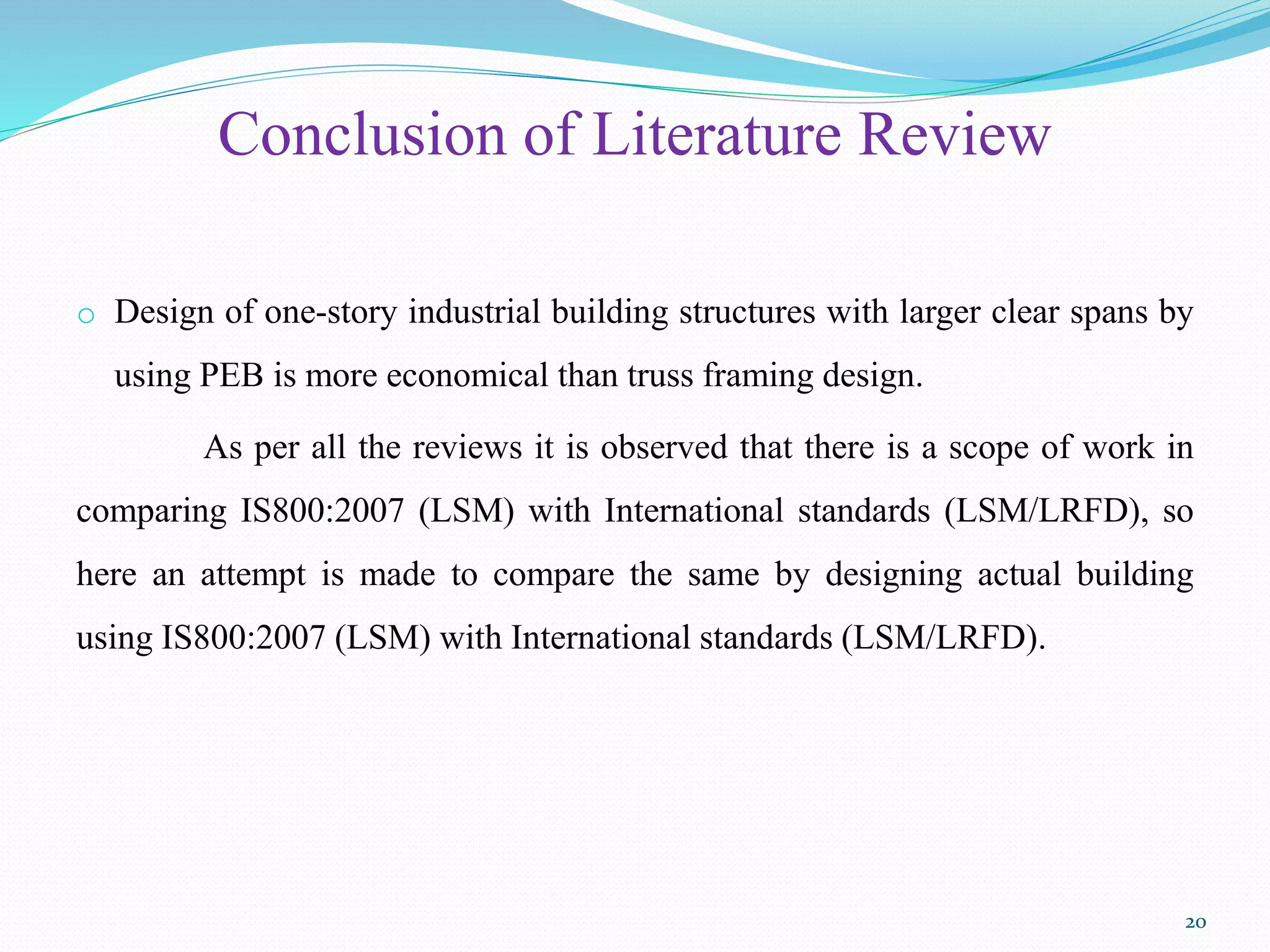
o Design of one-story industrial building structures with larger clear spans by
using PEB is more economical than truss framing design.
As per all the reviews it is observed that there is a scope of work in
comparing IS800:2007 (LSM) with International standards (LSM/LRFD), so
here an attempt is made to compare the same by designing actual building
using IS800:2007 (LSM) with International standards (LSM/LRFD).
20
Objective
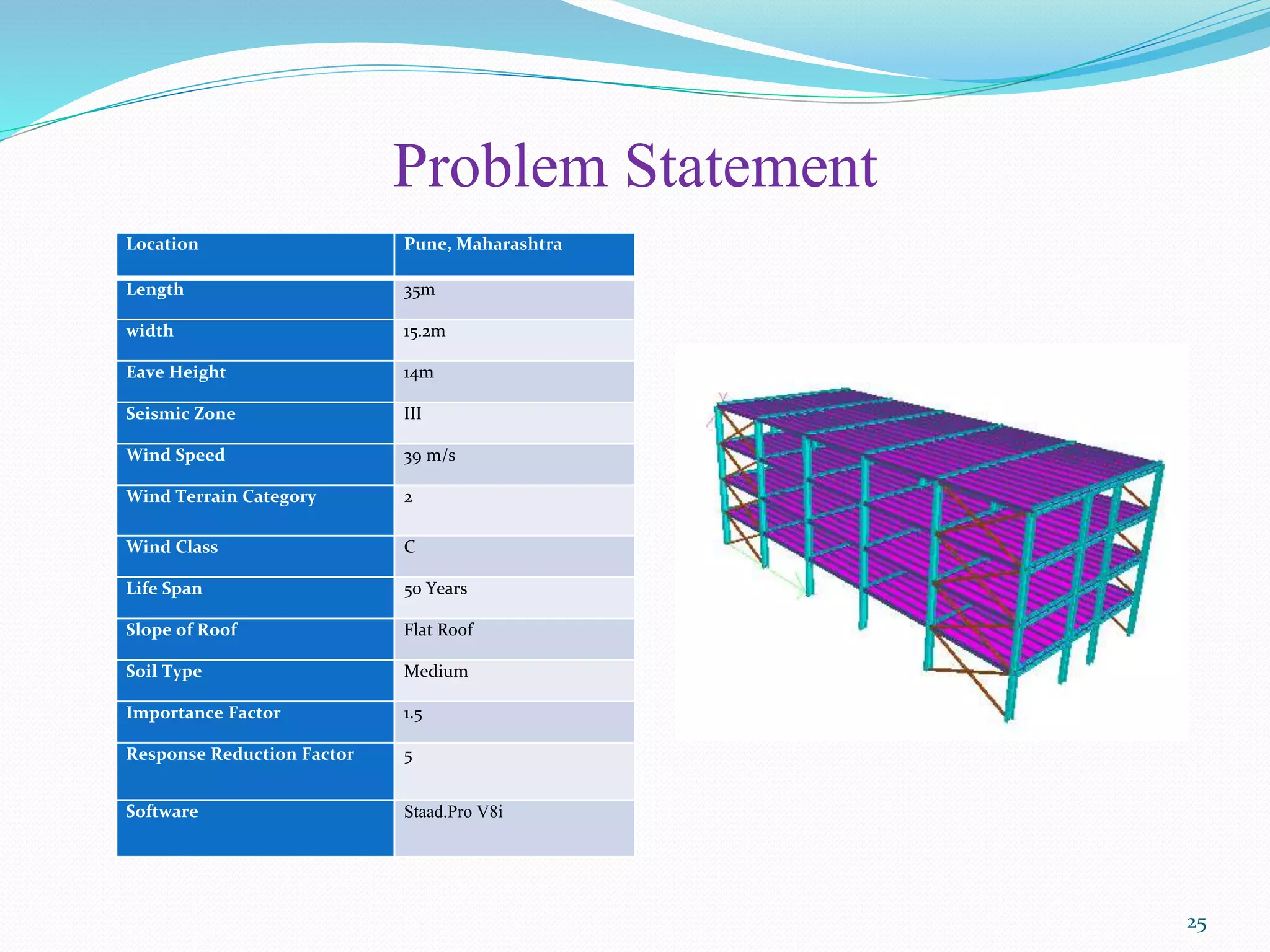
 Design of G+3 PEB structure for school building using IS800:2007 &
International standards
 Comparing design results of IS800:2007 with International standards
 Comparing % variation in tonnage of structure.
 Suggest most efficient method & design code for industrial building.
21
Design Philosophy
 Software is used for analysis.
 Max piece length
 Load application
 Dead load
 Live load
 Collateral load
 Wind load
 Seismic load
22
Design codes
 AISC: American institute of steel construction
 AISI: American iron & steel institute
 MBMA: Metal bldg. manufacturers association
 ASCE: American society of civil engineers
 UBC: Uniform building code
 BS5950: British Standard
 EURO-03: Euro code
 IS: Indian standards
23
Market research
 More than 70% building are designed AISC
 Load application code used is MBMA
 Serviceability criteria used as per IS800:2007 for IS800:1984
 Serviceability criteria used as per IS800:1984 for IS800:2007
 Chapter-12 ignored mostly from IS800:2007.
24
Problem Statement
Location Pune, Maharashtra
Length 35m
width 15.2m
Eave Height 14m
Seismic Zone III
Wind Speed 39 m/s
Wind Terrain Category 2
Wind Class C
Life Span 50 Years
Slope of Roof Flat Roof
Soil Type Medium
Importance Factor 1.5
Response Reduction Factor 5
Software Staad.Pro V8i
25
Load Combinations
Abbreviations:
DL= Dead Load LL= Live Load
WL= Wind Load EL= Earthquake Load
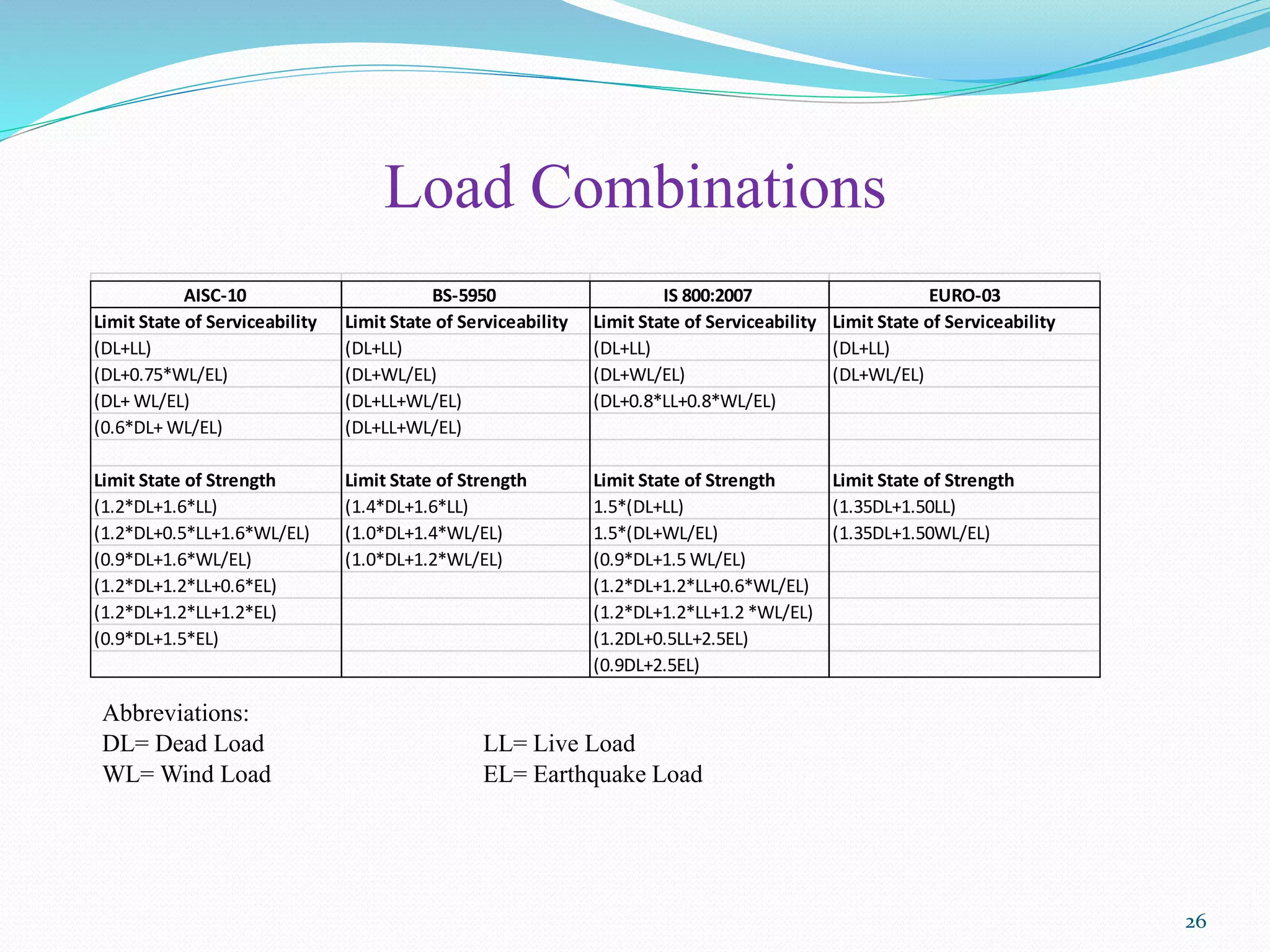
AISC-10 BS-5950 IS 800:2007 EURO-03
Limit State of Serviceability Limit State of Serviceability Limit State of Serviceability Limit State of Serviceability
(DL+LL) (DL+LL) (DL+LL) (DL+LL)
(DL+0.75*WL/EL) (DL+WL/EL) (DL+WL/EL) (DL+WL/EL)
(DL+ WL/EL) (DL+LL+WL/EL) (DL+0.8*LL+0.8*WL/EL)
(0.6*DL+ WL/EL) (DL+LL+WL/EL)
Limit State of Strength Limit State of Strength Limit State of Strength Limit State of Strength
(1.2*DL+1.6*LL) (1.4*DL+1.6*LL) 1.5*(DL+LL) (1.35DL+1.50LL)
(1.2*DL+0.5*LL+1.6*WL/EL) (1.0*DL+1.4*WL/EL) 1.5*(DL+WL/EL) (1.35DL+1.50WL/EL)
(0.9*DL+1.6*WL/EL) (1.0*DL+1.2*WL/EL) (0.9*DL+1.5 WL/EL)
(1.2*DL+1.2*LL+0.6*EL) (1.2*DL+1.2*LL+0.6*WL/EL)
(1.2*DL+1.2*LL+1.2*EL) (1.2*DL+1.2*LL+1.2 *WL/EL)
(0.9*DL+1.5*EL) (1.2DL+0.5LL+2.5EL)
(0.9DL+2.5EL)
26
Section Classification
27
Section Classification
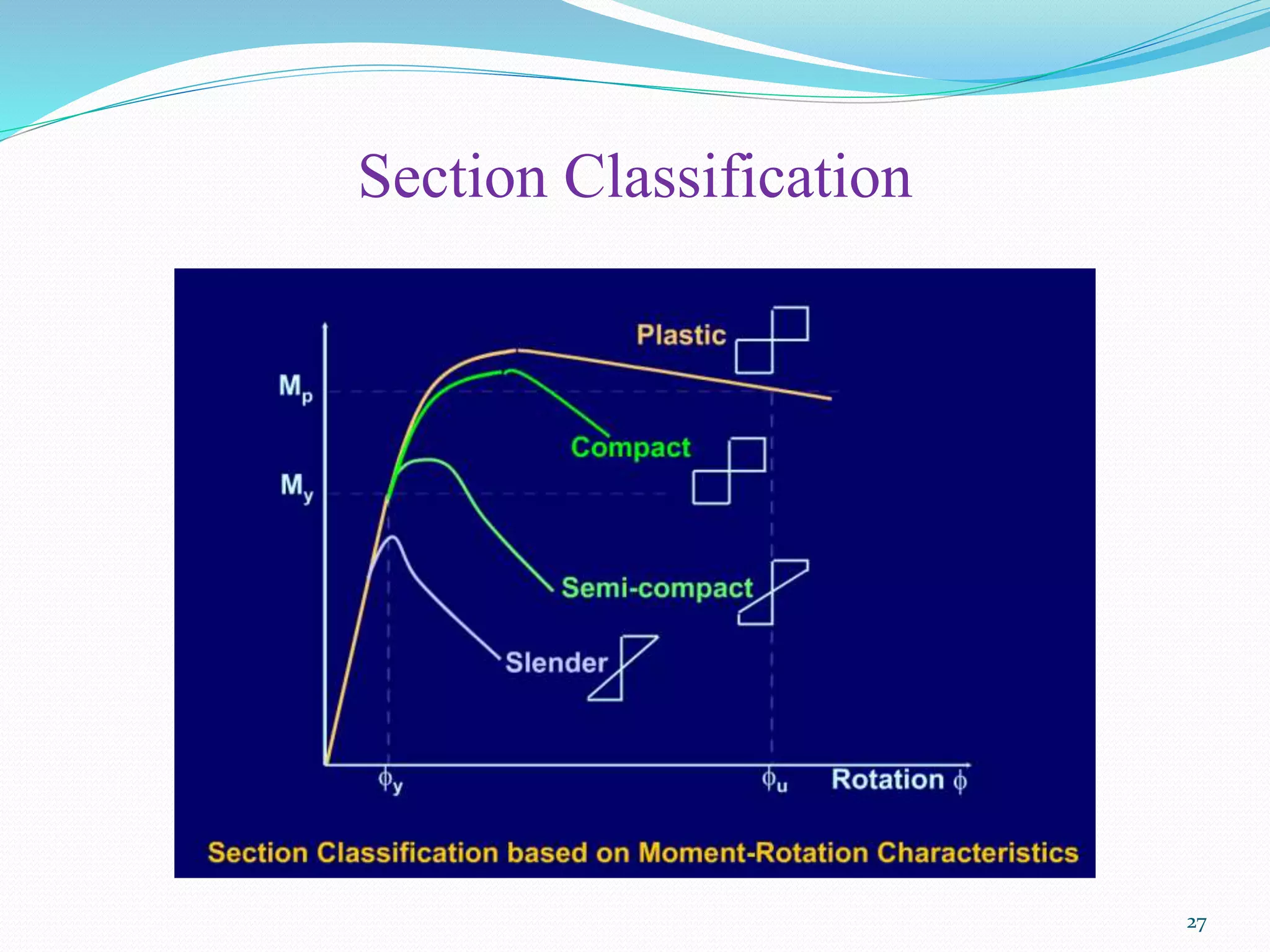
As per IS, Euro & BS
 Plastic
 Compact
 Semi-compact
 Slender (As per AISC)
 Seismically compact
 Compact
28
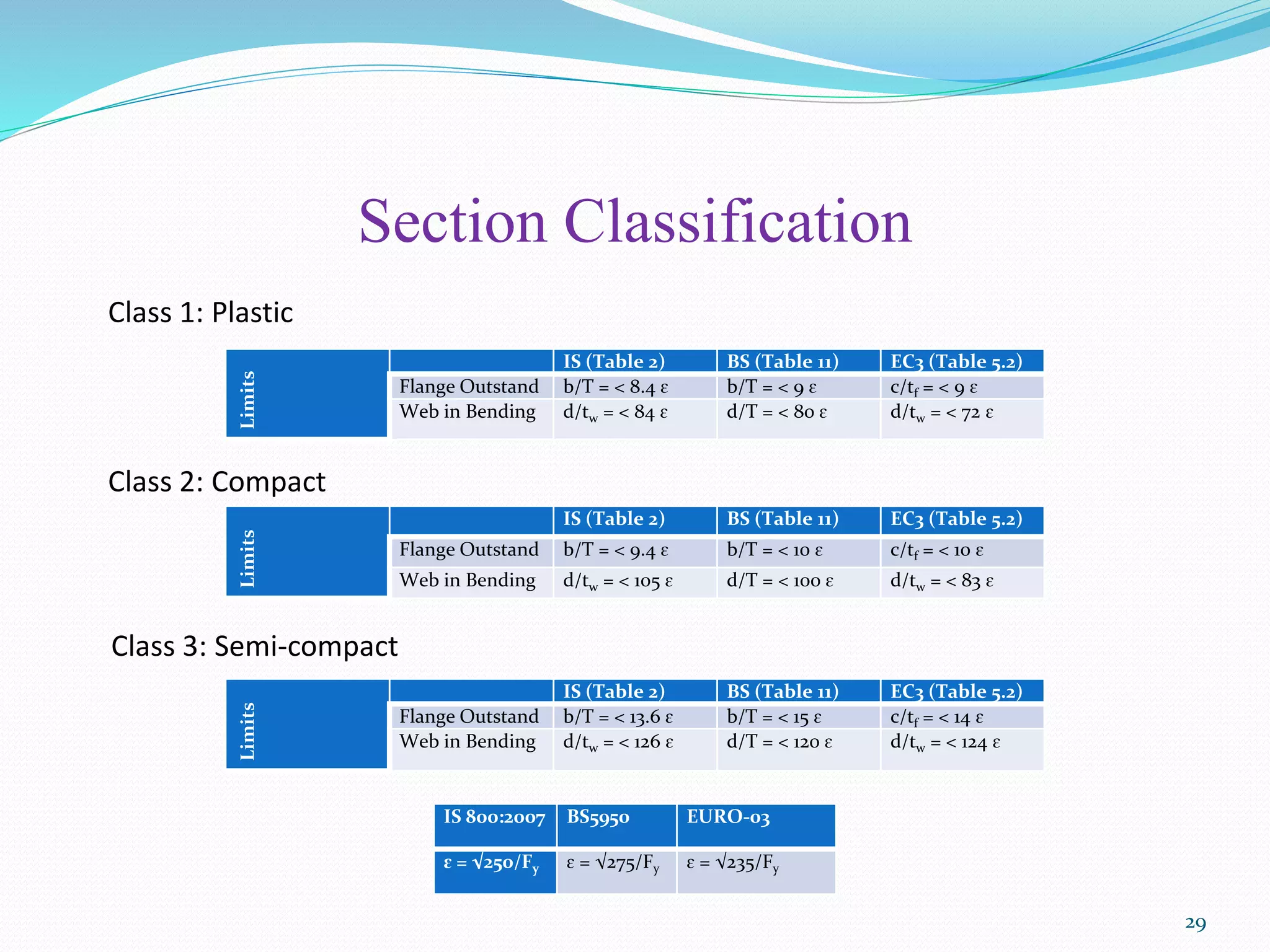
Section ClassificationLimits
IS (Table 2) BS (Table 11) EC3 (Table 5.2)
Flange Outstand b/T = < 8.4 ɛ b/T = < 9 ɛ c/tf = < 9 ɛ
Web in Bending d/tw = < 84 ɛ d/T = < 80 ɛ d/tw = < 72 ɛ
Class 1: Plastic
Class 2: Compact
Limits
IS (Table 2) BS (Table 11) EC3 (Table 5.2)
Flange Outstand b/T = < 9.4 ɛ b/T = < 10 ɛ c/tf = < 10 ɛ
Web in Bending d/tw = < 105 ɛ d/T = < 100 ɛ d/tw = < 83 ɛ
Class 3: Semi-compact
Limits
IS (Table 2) BS (Table 11) EC3 (Table 5.2)
Flange Outstand b/T = < 13.6 ɛ b/T = < 15 ɛ c/tf = < 14 ɛ
Web in Bending d/tw = < 126 ɛ d/T = < 120 ɛ d/tw = < 124 ɛ
IS 800:2007 BS5950 EURO-03
ɛ = √250/Fy ɛ = √275/Fy ɛ = √235/Fy
29
Section Classification
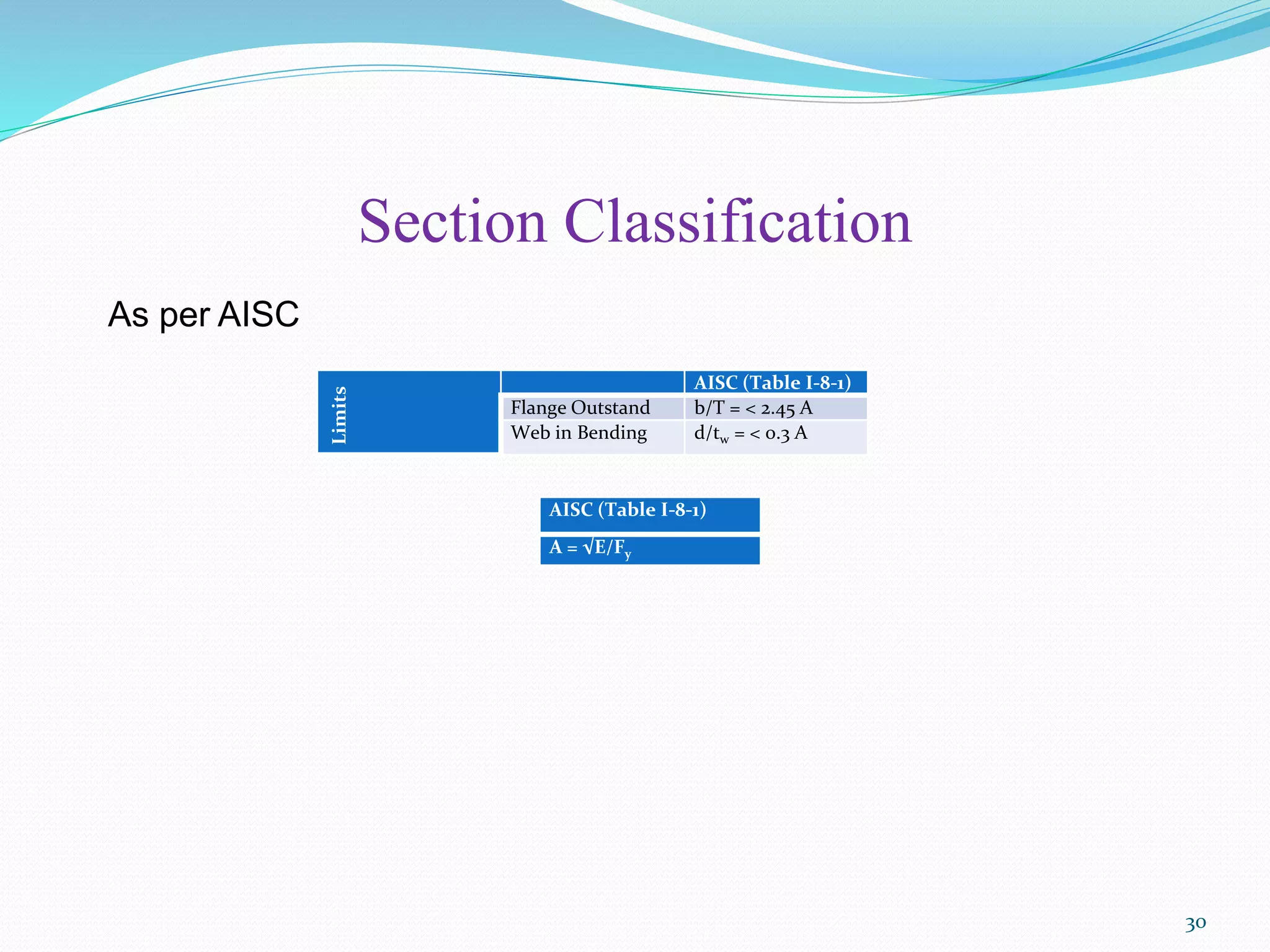
As per AISC
Limits
AISC (Table I-8-1)
Flange Outstand b/T = < 2.45 A
Web in Bending d/tw = < 0.3 A
AISC (Table I-8-1)
A = √E/Fy
30
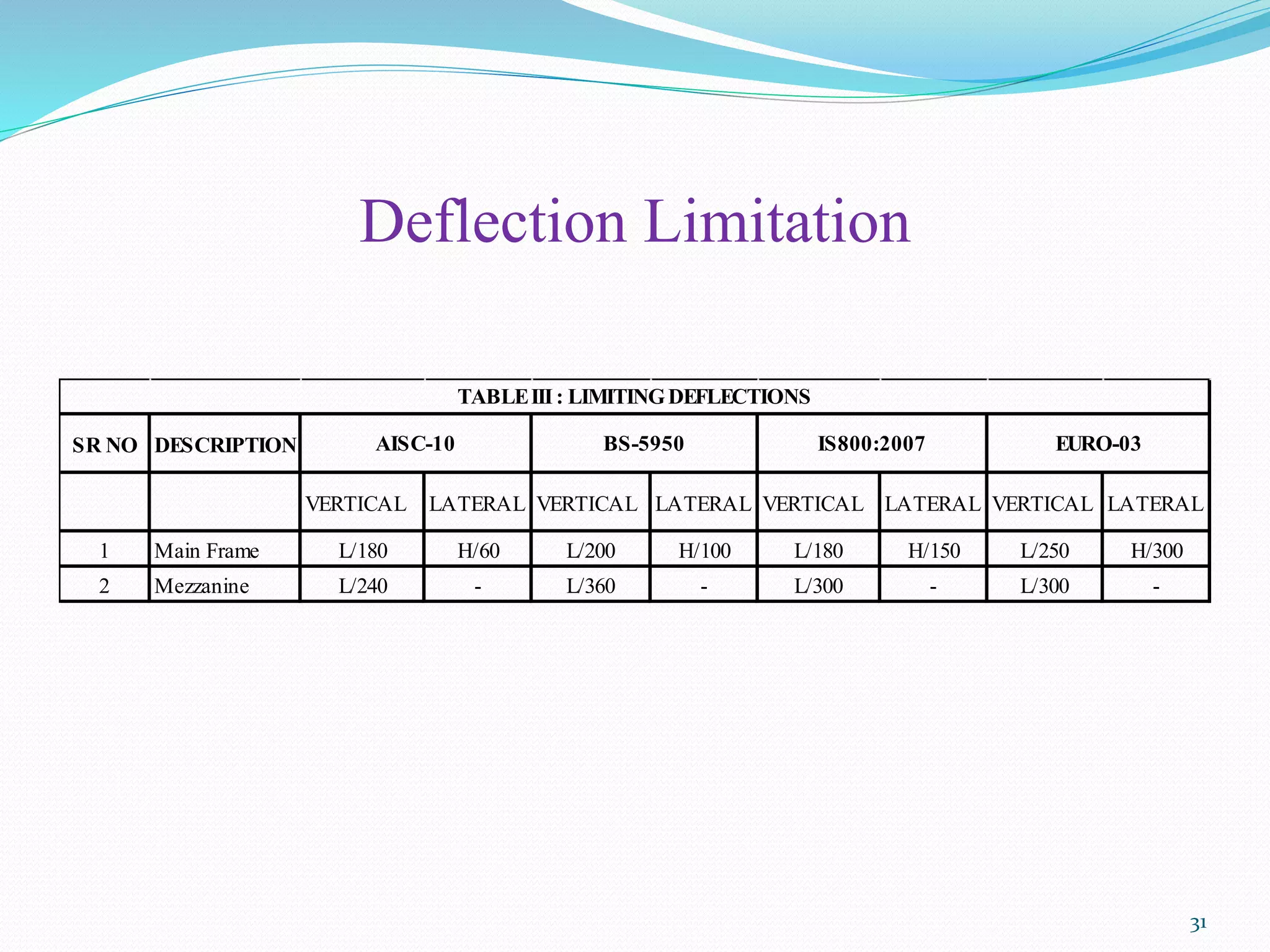
Deflection Limitation
SR NO DESCRIPTION
VERTICAL LATERAL VERTICAL LATERAL VERTICAL LATERAL VERTICAL LATERAL
1 Main Frame L/180 H/60 L/200 H/100 L/180 H/150 L/250 H/300
2 Mezzanine L/240 - L/360 - L/300 - L/300 -
TABLEIII: LIMITINGDEFLECTIONS
AISC-10 BS-5950 IS800:2007 EURO-03
31
Design Results
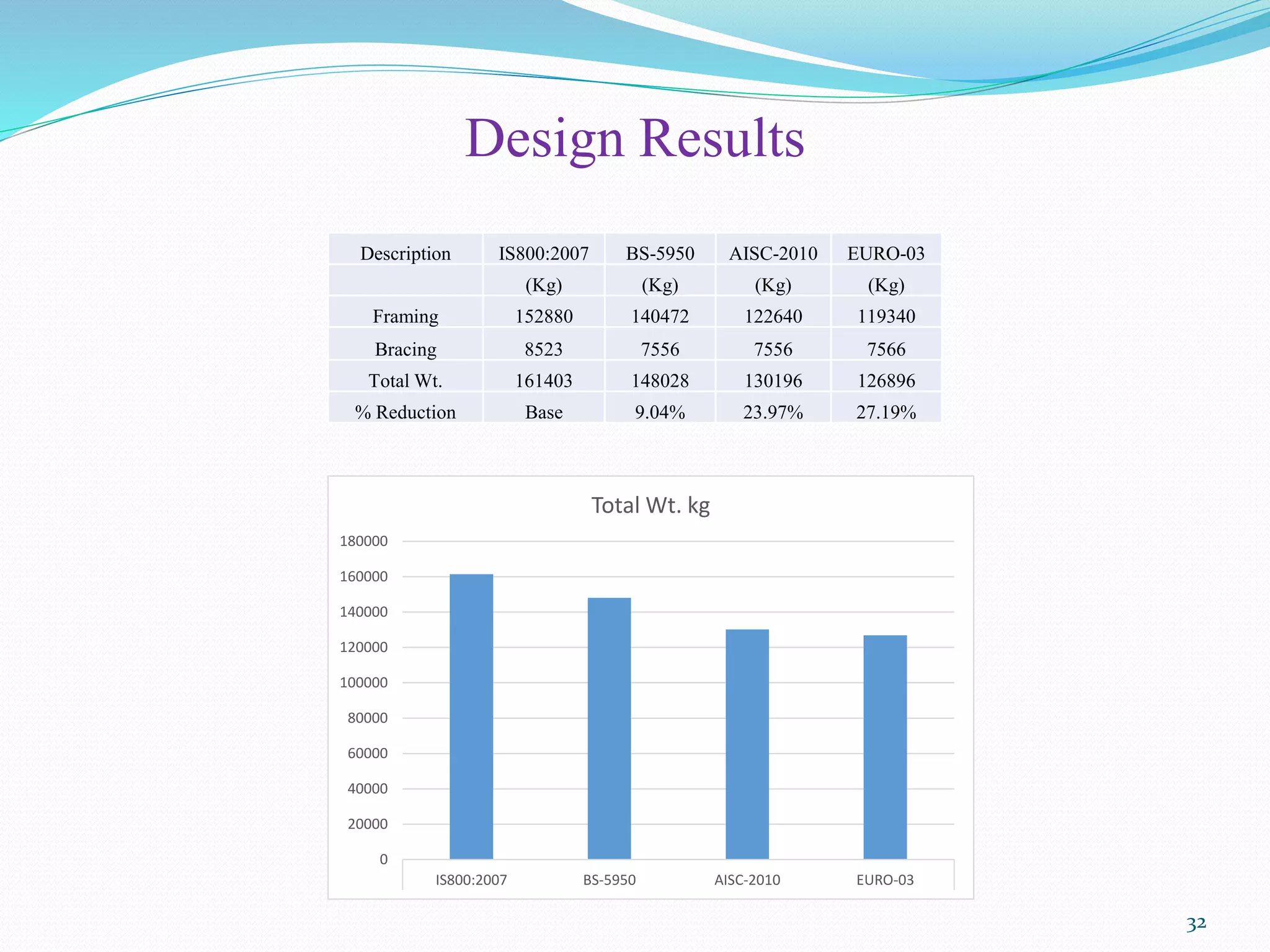
Description IS800:2007 BS-5950 AISC-2010 EURO-03
(Kg) (Kg) (Kg) (Kg)
Framing 152880 140472 122640 119340
Bracing 8523 7556 7556 7566
Total Wt. 161403 148028 130196 126896
% Reduction Base 9.04% 23.97% 27.19%
32
0
20000
40000
60000
80000
100000
120000
140000
160000
180000
IS800:2007 BS-5950 AISC-2010 EURO-03
Total Wt. kg
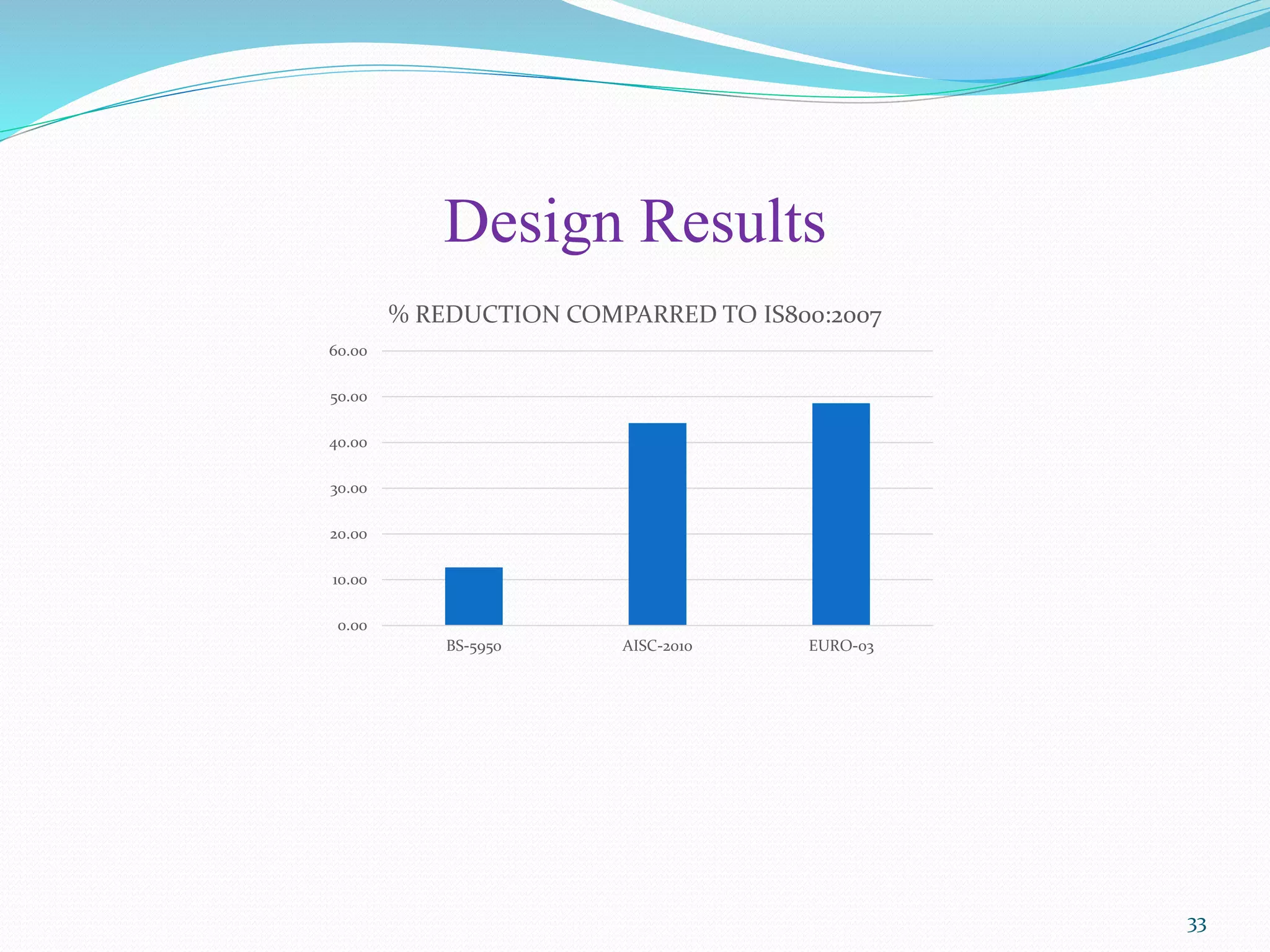
Design Results
0.00
10.00
20.00
30.00
40.00
50.00
60.00
BS-5950 AISC-2010 EURO-03
% REDUCTION COMPARRED TO IS800:2007
33
Results & Discussion
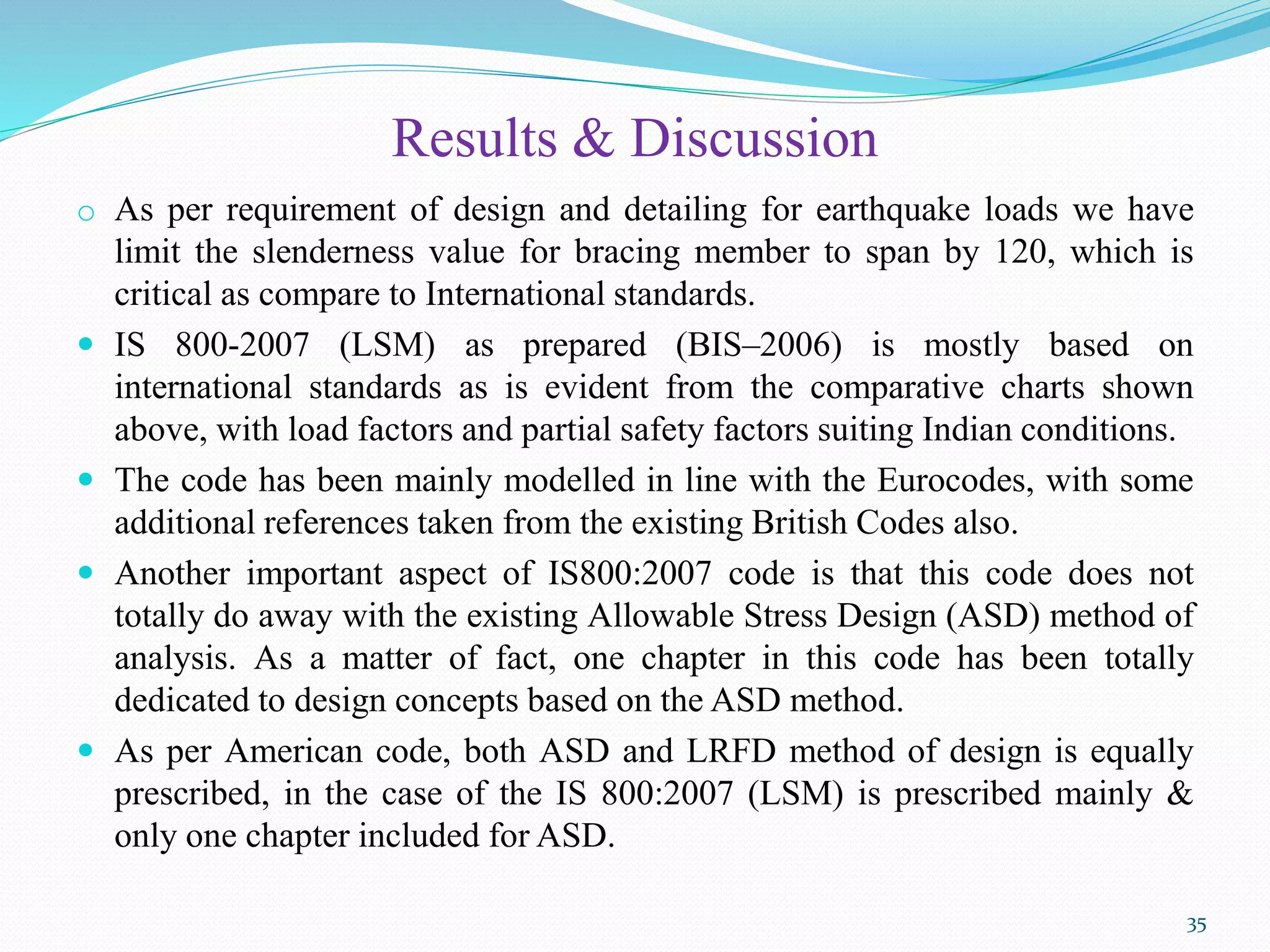
 “As per market study it observed that more than 70% pre-engineered
buildings are designed according to American codes. As per the design
result obtained during this dissertation work it is noted that the weight of
structure is reduced by 23.97% as compared to IS800:2007.
 Even though most of the pre-engineered buildings are designed accordance
to American code it is noted that by using Euro-03 weight of structure is
reduced by 27.2% and by using BS5950-2000 weight of structure is reduced
by 9.04% respectively as per obtained design results as compared to
IS800:2007.
 The reasons to increase in weight in IS800:2007 as compared other
international standards are as mentioned below.
o As per requirement of design and detailing for earthquake loads we have to
consider additional Load combinations as per limit state of strength. 34
Results & Discussion
o As per requirement of design and detailing for earthquake loads we have
limit the slenderness value for bracing member to span by 120, which is
critical as compare to International standards.
 IS 800-2007 (LSM) as prepared (BIS–2006) is mostly based on
international standards as is evident from the comparative charts shown
above, with load factors and partial safety factors suiting Indian conditions.
 The code has been mainly modelled in line with the Eurocodes, with some
additional references taken from the existing British Codes also.
 Another important aspect of IS800:2007 code is that this code does not
totally do away with the existing Allowable Stress Design (ASD) method of
analysis. As a matter of fact, one chapter in this code has been totally
dedicated to design concepts based on the ASD method.
 As per American code, both ASD and LRFD method of design is equally
prescribed, in the case of the IS 800:2007 (LSM) is prescribed mainly &
only one chapter included for ASD.
35
Future Work
 Design of connections using IS800:2007 & International standards.
 Comparison of connection weight as per IS800:2007 & International
standards.
 Designing conventional building using rolled steel section & comparing the
tonnage of conventional building with pre-engineered building.
 Cost comparison of conventional building with pre-engineered building
36
Reference
 Anderson J.P & Marc, “Guide for the Design & Construction of Pre-
engineered Building”, The Association for Iron & Steel Technology, 2003,
Technical Report 13.
 Anbuchezian A, Dr. Baskar. G, “Experimental Study on Cold Formed Steel
Purlin Section”, IRACST – Engineering Science and Technology: An
International Journal (ESTIJ), ISSN: 2250-3498, Vol.3, No.2, April 2013
 Bradley A.K, “Pre-Engineered Building”, JFE Civil Engineering &
Construction, Vol-2, 1970, pp. 25-46.
 Vaibhav B. Chavan, Vikas N. Nimbalkar, Abhishek P. Jaiswal, “Economic
Evaluation of Open and Hollow Structural Sections in Industrial Trusses”,
International Journal of Innovative Research in Science, Engineering and
Technology; Vol. 3, Issue 2, February 2014.
 Lipson S.L, “History of Pre-engineered Building”, JFE Civil Engineering &
Construction, Vol-1, 1962, pp. 9-25.
 Muhammad Umair Saleem, “Minimum Weight Design of Pre Engineered
Steel Structures using Built-up Sections and Cold Formed Sections”,
Advanced Material Research Vol 684 (2013) pp 125-129
37
Reference
 C.M. Meera, “Pre-Engineered Building Design of an Industrial Warehouse”,
International Journal of Engineering & Emerging Technologies, June 2013
Volume 5, issue 2, pp 75-82
 G. Sai Kiran, A. Kailasa Rao, R. Pradeep Kumar- “Comparison of Design
procedure for PEB”.
 Roshan Satpute & Dr. Valsson Varghese, “Building design using cold
formed steel sections”, International Refereed Journal of Engineering and
Science (IRJES) ISSN (Online) 2319-183X, (Print) 2319-1821 Volume 1,
Issue 2 (October 2012), PP.01-16
 Wei-Wen Yu, “Cold Form Steel Structure”, Mc-Graw Hill Book Company,
1973, pp. 25-46.
 Wen-bin Zhao, “Behaviour and Design of Cold-formed Steel Sections with
Hollow Flanges”, School of Civil Engineering, Queensland University of
Technology.
 IS: 875-1987 (Parts - I to V), Indian Code of Practice for evaluating loads
excepting earthquake load, BIS New Delhi.
38
Reference
 IS: 1893-2002, Criteria for the seismic design of structures subjected to
earthquake loads, BIS New Delhi.
 IS: 800-2007, Indian Code of Practice for general construction in steel, BIS
New Delhi.
 BS 5950-1:2000, Code of practice for design Rolled and welded sections.
 AISC-2010, Specifications for structural steel buildings, American Institute
of Steel Construction.
 EURO-03, Basis of structural design.
 AISC-341, Seismic provision of structural steel building.
 Manuals & books of pre-engineered building.
 IS: 1893-2002 Part-IV, Criteria for the seismic design of structures
subjected to earthquake loads, BIS New Delhi.
39
Thank you
40

Analysis and design of pre engineered building using is 800:2007 and International standards

  • 1.
    PATEL INSTITUTE OFENGINEERING & SCIENCE BHOPAL (M.P.)-462021, INDIA Department of Civil Engineering Presented by:-Pratik R. Atwal Guide name:- Prof. Vinay kumar singh Roll No. :- 0509CE14MT05 Department:- Civil Engineering
  • 2.
    Topic 2 Analysis & Designof Pre-engineered building using IS 800:2007 & International standards
  • 3.
  • 4.
    INDEX  Abstract  Introduction Literature Review  Objective  Design Philosophy  Market research  Problem statement  Results and discussion  Future work  References 4
  • 5.
    ABSTRACT Technological improvement overthe year has contributed immensely to the enhancement of quality of life through various new products and services. One such revolution was the pre-engineered buildings (PEB). Pre-engineered buildings can be adopted to suit a wide variety of structural applications; the greatest economy will be realized when utilizing standard details in structural framework. In this report, comparison is made between IS800:2007 & International standards. The entire range of pre-engineered building is studied while doing this comparison. A school building is designed using IS800:2007 & International standards by keeping the loading parameters similar, all the loads are applied accordance with Indian codes. An attempt is made to study the variation in tonnage as per IS800:2007 & International standards & possible reasons for variation in respective results. Analysis and design of these building frames was carried out using Staad-Pro software & manually also. 5
  • 6.
    The design codesare being updated and modified incorporating the results from the various researches and developments being carried out at the various R & D Centres in the country. Considering that the current practice all over the world is based on Limit State Method (LSM) or Load and Resistance Factor Design Method (LRFD), it was found essential during the year 2002 – 2003 that the code of practice for use of steel in general construction should be modified to LSM while maintaining Allowable Stress Design as a transition alternative. The IS800:2007 was thus prepared and published by the Bureau of Indian Standards (BIS) in 2008. 6
  • 7.
    As per marketstudy it observed that more than 70% pre-engineered buildings are designed according to American codes. As per the design result obtained during this dissertation work it is noted that the weight of structure is reduced by 23.97% as compared to IS800:2007. Even though most of the pre-engineered buildings are designed accordance to American code it is noted that by using Euro-03 weight of structure is reduced by 27.2% and by using BS5950-2000 weight of structure is reduced by 9.04% respectively as per obtained design results as compared to IS800:2007.  Key Words:PEB, Analysis, Design, LSM, LRFD, AISC-10, IS 800:2007, Euro-03, BS5950. 7
  • 8.
    Introduction  Pre-engineered buildings(PEBs) use a predetermined inventory of raw materials that has proven over time to satisfy a wide range of structural and aesthetic design requirements 8
  • 9.
  • 10.
    Introduction o Flexibility inmaterial choice allows PEBs to fulfil an lmost unlimited range of building configurations, custom designs, requirements and applications. o The pre-engineered steel building is a building shell utilizing three distinct product categories as: 1. Built-up “I” shaped primary structural framing members (columns and rafters) 2. Cold-formed “Z” and “C” shaped secondary structural members (roof purlin, eave struts and wall grits) 3. Roll formed profiled sheeting (roof and wall panels) 10
  • 11.
    Comparison of Pre-EngineeredBuilding System & Conventional Building System Building Type Point Pre-Engineered Building System (PEBs Conventional Building System 1. Structure Weight Primary framing members are tapered (varying depth), So Pre-Engineered buildings are about30 to 40 % advantages for the main rigid frame when compare to the use of conventional hot rolled section as primary member. Primary steel members are selected from standard hot rolled "I" sections, which are in many segments of the members. They are heavier than what is actually required by design. Members have constant cross-sections regardless of varying magnitude of the local stresses along the member length. 2. Delivery Average 6 to 8 weeks. Average 20 to 26 weeks. 3.Foundation Simple design, easy to construct and light weight. Extensive, heavy foundation required. 11
  • 12.
    12 Fig.1.4 Comparison ofPEB & CSB(ref. 21)
  • 13.
    13 4. Seismic Resistance The low-weightflexible frames offer higher resistance to seismic forces. Rigid heavy weight structures do not perform well in seismic zones. 5. Erection Simplicity Since the connections of the components are standard, the learning curve of erection for each subsequent project is faster. The connections are normally complicated and differ from project to project, resulting in longer learning curves of erection for new projects. 6.Erection Cost and Time Both costs & time of erection are accurately known based upon extensive experience with similar building Typically, they are 20% more expensive than PEB. In most of the cases, the erection costs and time are not estimated accurately. 7.Overall Price Price per square meter may be as much as 30% lower than conventional steel. Rigid heavy weight structures do not perform well in seismic zones.
  • 14.
    8.Architecture Outstanding architectural designcan be achieved at low cost using standard architectural features and interface details. Traditional wall and fascia materials, such as concrete, masonry and wood, can be utilized. Special architectural design and features must be developed for each project, which often require research and thus resulting in much higher costs. 9.Sourcing and Co-ordination Building is supplied complete with cladding and all accessories, including erection (if desired) from one single source. Many sources of supply is required to co-ordinate suppliers and subcontractors. 10.Cost of Change Orders PEB manufacturers often stock a large amount of basic raw materials that can be flexibly used in many types of PEB projects. Substitution of hot rolled sections that are in frequently rolled by mills, It is expensive and time consuming. 14
  • 15.
    Advantages of PEB Reduced construction time  Lower cost  Flexibility of expansion  Large clear span  Quality control  Low maintenance  Energy efficient roofing & wall system  Architectural versatility  Single source responsibility 15
  • 16.
    Literature Review  Kumaret al [2014] o Studied the Pre-Engineered Building (PEB) concept in the design of structures which helped in optimizing design. o The ability of PEB in the place of Conventional Steel Building (CSB) design concept resulted in many advantages, including economy and easier fabrication. o The economy of the structure is discussed in terms of its weight comparison, between Indian codes (IS800-1984, IS800-2007) & American code (AISC-89) & between Indian codes (IS800-1984, IS800-2007).  Chavan et al [2014] o Evaluated the economic significance of the Hollow Structural Sections (HSS) in contrast with open sections. o This study was carried out to determine the percentage economy achieved using Hollow Structural Sections (HSS) so as to understand the importance of cost effectiveness. 16
  • 17.
    Literature Review  Anbuchezianet al [2013] o studied behaviour of cold formed sections. o Cold formed steel purlins are the widely used structural elements in India. o Practically ‘Z’ sections are provided, where the span of the roof purlins is sloped and the length of the span is maximum.  Saleem [2013] o Presented research work on, minimum weight buildings that are targeted with simple fabrication process and easy erection to have maximum structural efficiency. o and to verify suitability and applicability of concept of PEB, a sample steel building is first analyzed and designed by using conventional steel hot rolled sections and then by using pre-engineered tapered and cold formed sections. 17
  • 18.
    Literature Review  Satputeet al [2012] o He has done the detailed analysis of Industrial building with Cold formed concept is carried out. o A comparative study has also been carried out between Hot Roll steel Industrial building and Cold formed Industrial building and a conclusion has been drawn. o In Industrial building the material & cost of the building is minimized in case of cold formed steel while in case of conventional building it was be higher both in two cases. The saving in material and cost is about 25%. 18
  • 19.
    Conclusion of LiteratureReview From the literature review we can summarize the work in pre-engineered building as below,  Pre-engineered buildings can be adopted to suit a wide variety of structural applications, the greatest economy will be realized when utilizing standard details in structural framework.  To understand the importance of cost effectiveness.  Minimum weight buildings that are targeted with simple fabrication process and easy erection to have maximum structural efficiency. Minimum weight of structure is proportional to minimum cost and lowers seismic and gravitational forces.  In Industrial building the material & cost of the building is minimized in case of cold formed steel while in case of conventional building it was be higher both in two cases. The saving in material and cost is about 25% can be achieved. 19
  • 20.
    Conclusion of LiteratureReview o Design of one-story industrial building structures with larger clear spans by using PEB is more economical than truss framing design. As per all the reviews it is observed that there is a scope of work in comparing IS800:2007 (LSM) with International standards (LSM/LRFD), so here an attempt is made to compare the same by designing actual building using IS800:2007 (LSM) with International standards (LSM/LRFD). 20
  • 21.
    Objective  Design ofG+3 PEB structure for school building using IS800:2007 & International standards  Comparing design results of IS800:2007 with International standards  Comparing % variation in tonnage of structure.  Suggest most efficient method & design code for industrial building. 21
  • 22.
    Design Philosophy  Softwareis used for analysis.  Max piece length  Load application  Dead load  Live load  Collateral load  Wind load  Seismic load 22
  • 23.
    Design codes  AISC:American institute of steel construction  AISI: American iron & steel institute  MBMA: Metal bldg. manufacturers association  ASCE: American society of civil engineers  UBC: Uniform building code  BS5950: British Standard  EURO-03: Euro code  IS: Indian standards 23
  • 24.
    Market research  Morethan 70% building are designed AISC  Load application code used is MBMA  Serviceability criteria used as per IS800:2007 for IS800:1984  Serviceability criteria used as per IS800:1984 for IS800:2007  Chapter-12 ignored mostly from IS800:2007. 24
  • 25.
    Problem Statement Location Pune,Maharashtra Length 35m width 15.2m Eave Height 14m Seismic Zone III Wind Speed 39 m/s Wind Terrain Category 2 Wind Class C Life Span 50 Years Slope of Roof Flat Roof Soil Type Medium Importance Factor 1.5 Response Reduction Factor 5 Software Staad.Pro V8i 25
  • 26.
    Load Combinations Abbreviations: DL= DeadLoad LL= Live Load WL= Wind Load EL= Earthquake Load AISC-10 BS-5950 IS 800:2007 EURO-03 Limit State of Serviceability Limit State of Serviceability Limit State of Serviceability Limit State of Serviceability (DL+LL) (DL+LL) (DL+LL) (DL+LL) (DL+0.75*WL/EL) (DL+WL/EL) (DL+WL/EL) (DL+WL/EL) (DL+ WL/EL) (DL+LL+WL/EL) (DL+0.8*LL+0.8*WL/EL) (0.6*DL+ WL/EL) (DL+LL+WL/EL) Limit State of Strength Limit State of Strength Limit State of Strength Limit State of Strength (1.2*DL+1.6*LL) (1.4*DL+1.6*LL) 1.5*(DL+LL) (1.35DL+1.50LL) (1.2*DL+0.5*LL+1.6*WL/EL) (1.0*DL+1.4*WL/EL) 1.5*(DL+WL/EL) (1.35DL+1.50WL/EL) (0.9*DL+1.6*WL/EL) (1.0*DL+1.2*WL/EL) (0.9*DL+1.5 WL/EL) (1.2*DL+1.2*LL+0.6*EL) (1.2*DL+1.2*LL+0.6*WL/EL) (1.2*DL+1.2*LL+1.2*EL) (1.2*DL+1.2*LL+1.2 *WL/EL) (0.9*DL+1.5*EL) (1.2DL+0.5LL+2.5EL) (0.9DL+2.5EL) 26
  • 27.
  • 28.
    Section Classification As perIS, Euro & BS  Plastic  Compact  Semi-compact  Slender (As per AISC)  Seismically compact  Compact 28
  • 29.
    Section ClassificationLimits IS (Table2) BS (Table 11) EC3 (Table 5.2) Flange Outstand b/T = < 8.4 ɛ b/T = < 9 ɛ c/tf = < 9 ɛ Web in Bending d/tw = < 84 ɛ d/T = < 80 ɛ d/tw = < 72 ɛ Class 1: Plastic Class 2: Compact Limits IS (Table 2) BS (Table 11) EC3 (Table 5.2) Flange Outstand b/T = < 9.4 ɛ b/T = < 10 ɛ c/tf = < 10 ɛ Web in Bending d/tw = < 105 ɛ d/T = < 100 ɛ d/tw = < 83 ɛ Class 3: Semi-compact Limits IS (Table 2) BS (Table 11) EC3 (Table 5.2) Flange Outstand b/T = < 13.6 ɛ b/T = < 15 ɛ c/tf = < 14 ɛ Web in Bending d/tw = < 126 ɛ d/T = < 120 ɛ d/tw = < 124 ɛ IS 800:2007 BS5950 EURO-03 ɛ = √250/Fy ɛ = √275/Fy ɛ = √235/Fy 29
  • 30.
    Section Classification As perAISC Limits AISC (Table I-8-1) Flange Outstand b/T = < 2.45 A Web in Bending d/tw = < 0.3 A AISC (Table I-8-1) A = √E/Fy 30
  • 31.
    Deflection Limitation SR NODESCRIPTION VERTICAL LATERAL VERTICAL LATERAL VERTICAL LATERAL VERTICAL LATERAL 1 Main Frame L/180 H/60 L/200 H/100 L/180 H/150 L/250 H/300 2 Mezzanine L/240 - L/360 - L/300 - L/300 - TABLEIII: LIMITINGDEFLECTIONS AISC-10 BS-5950 IS800:2007 EURO-03 31
  • 32.
    Design Results Description IS800:2007BS-5950 AISC-2010 EURO-03 (Kg) (Kg) (Kg) (Kg) Framing 152880 140472 122640 119340 Bracing 8523 7556 7556 7566 Total Wt. 161403 148028 130196 126896 % Reduction Base 9.04% 23.97% 27.19% 32 0 20000 40000 60000 80000 100000 120000 140000 160000 180000 IS800:2007 BS-5950 AISC-2010 EURO-03 Total Wt. kg
  • 33.
  • 34.
    Results & Discussion “As per market study it observed that more than 70% pre-engineered buildings are designed according to American codes. As per the design result obtained during this dissertation work it is noted that the weight of structure is reduced by 23.97% as compared to IS800:2007.  Even though most of the pre-engineered buildings are designed accordance to American code it is noted that by using Euro-03 weight of structure is reduced by 27.2% and by using BS5950-2000 weight of structure is reduced by 9.04% respectively as per obtained design results as compared to IS800:2007.  The reasons to increase in weight in IS800:2007 as compared other international standards are as mentioned below. o As per requirement of design and detailing for earthquake loads we have to consider additional Load combinations as per limit state of strength. 34
  • 35.
    Results & Discussion oAs per requirement of design and detailing for earthquake loads we have limit the slenderness value for bracing member to span by 120, which is critical as compare to International standards.  IS 800-2007 (LSM) as prepared (BIS–2006) is mostly based on international standards as is evident from the comparative charts shown above, with load factors and partial safety factors suiting Indian conditions.  The code has been mainly modelled in line with the Eurocodes, with some additional references taken from the existing British Codes also.  Another important aspect of IS800:2007 code is that this code does not totally do away with the existing Allowable Stress Design (ASD) method of analysis. As a matter of fact, one chapter in this code has been totally dedicated to design concepts based on the ASD method.  As per American code, both ASD and LRFD method of design is equally prescribed, in the case of the IS 800:2007 (LSM) is prescribed mainly & only one chapter included for ASD. 35
  • 36.
    Future Work  Designof connections using IS800:2007 & International standards.  Comparison of connection weight as per IS800:2007 & International standards.  Designing conventional building using rolled steel section & comparing the tonnage of conventional building with pre-engineered building.  Cost comparison of conventional building with pre-engineered building 36
  • 37.
    Reference  Anderson J.P& Marc, “Guide for the Design & Construction of Pre- engineered Building”, The Association for Iron & Steel Technology, 2003, Technical Report 13.  Anbuchezian A, Dr. Baskar. G, “Experimental Study on Cold Formed Steel Purlin Section”, IRACST – Engineering Science and Technology: An International Journal (ESTIJ), ISSN: 2250-3498, Vol.3, No.2, April 2013  Bradley A.K, “Pre-Engineered Building”, JFE Civil Engineering & Construction, Vol-2, 1970, pp. 25-46.  Vaibhav B. Chavan, Vikas N. Nimbalkar, Abhishek P. Jaiswal, “Economic Evaluation of Open and Hollow Structural Sections in Industrial Trusses”, International Journal of Innovative Research in Science, Engineering and Technology; Vol. 3, Issue 2, February 2014.  Lipson S.L, “History of Pre-engineered Building”, JFE Civil Engineering & Construction, Vol-1, 1962, pp. 9-25.  Muhammad Umair Saleem, “Minimum Weight Design of Pre Engineered Steel Structures using Built-up Sections and Cold Formed Sections”, Advanced Material Research Vol 684 (2013) pp 125-129 37
  • 38.
    Reference  C.M. Meera,“Pre-Engineered Building Design of an Industrial Warehouse”, International Journal of Engineering & Emerging Technologies, June 2013 Volume 5, issue 2, pp 75-82  G. Sai Kiran, A. Kailasa Rao, R. Pradeep Kumar- “Comparison of Design procedure for PEB”.  Roshan Satpute & Dr. Valsson Varghese, “Building design using cold formed steel sections”, International Refereed Journal of Engineering and Science (IRJES) ISSN (Online) 2319-183X, (Print) 2319-1821 Volume 1, Issue 2 (October 2012), PP.01-16  Wei-Wen Yu, “Cold Form Steel Structure”, Mc-Graw Hill Book Company, 1973, pp. 25-46.  Wen-bin Zhao, “Behaviour and Design of Cold-formed Steel Sections with Hollow Flanges”, School of Civil Engineering, Queensland University of Technology.  IS: 875-1987 (Parts - I to V), Indian Code of Practice for evaluating loads excepting earthquake load, BIS New Delhi. 38
  • 39.
    Reference  IS: 1893-2002,Criteria for the seismic design of structures subjected to earthquake loads, BIS New Delhi.  IS: 800-2007, Indian Code of Practice for general construction in steel, BIS New Delhi.  BS 5950-1:2000, Code of practice for design Rolled and welded sections.  AISC-2010, Specifications for structural steel buildings, American Institute of Steel Construction.  EURO-03, Basis of structural design.  AISC-341, Seismic provision of structural steel building.  Manuals & books of pre-engineered building.  IS: 1893-2002 Part-IV, Criteria for the seismic design of structures subjected to earthquake loads, BIS New Delhi. 39
  • 40.