Best Programming
Language for
Civil Engineers
Presented by Coding Alpha
bestcodinglanguage.com
Agenda
1. Introduction to Programming in Civil Engineering
2. Popular Programming Languages for Civil Engineers
3. Python for Civil Engineers
4. MATLAB for Civil Engineers
5. R for Civil Engineers
6. Case Studies and Real-World Examples
7. Frequently Asked Questions
8. Conclusion and Future Directions
bestcodinglanguage.com
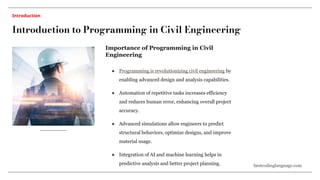
Importance of Programming in Civil
Engineering
● Programming is revolutionizing civil engineering by
enabling advanced design and analysis capabilities.
● Automation of repetitive tasks increases efficiency
and reduces human error, enhancing overall project
accuracy.
● Advanced simulations allow engineers to predict
structural behaviors, optimize designs, and improve
material usage.
● Integration of AI and machine learning helps in
predictive analysis and better project planning.
Introduction to Programming in Civil Engineering
Introduction
bestcodinglanguage.com
Popular Programming Languages for Civil Engineers
Overview
Widely used for data analysis, automation,
and creating simulations. Integrates with
tools like AutoCAD and GIS, and is known for
its ease of learning and extensive libraries.
Ideal for structural analysis, data
visualization, and simulations. Known for its
powerful numerical analysis capabilities,
though it can be expensive with a steep
learning curve.
Used for web development, interactive
visualizations, and project management tools.
Not suited for heavy computations but
excellent for creating interactive web
applications.
Python
MATLAB
JavaScript
High performance and control over resources
make it ideal for custom simulation software
and real-time processing. However, it has a
complex syntax and steep learning curve.
C/C++
Strong in statistical analysis and data
visualization. Commonly used for
environmental data analysis and statistical
modeling, but less versatile for general-
purpose tasks.
R
Essential for managing and querying large
datasets in databases. Used for handling
structured data efficiently, making it crucial
for project databases and data management.
SQL
bestcodinglanguage.com
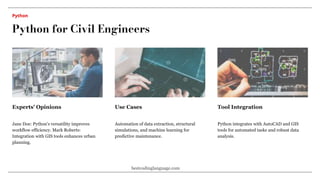
Python for Civil Engineers
Experts' Opinions Use Cases
Jane Doe: Python’s versatility improves
workflow efficiency. Mark Roberts:
Integration with GIS tools enhances urban
planning.
Automation of data extraction, structural
simulations, and machine learning for
predictive maintenance.
Tool Integration
Python integrates with AutoCAD and GIS
tools for automated tasks and robust data
analysis.
Python
bestcodinglanguage.com
MATLAB for Civil Engineers
Structural Analysis Simulations
MATLAB excels in simulating physical
systems and performing intricate structural
analysis, aiding in safer and more efficient
designs.
Engineers use MATLAB to simulate structural
behaviors under various load conditions,
helping improve design accuracy and safety.
Research Integration
Used extensively in research to model the
behavior of new materials under stress,
enhancing the development of innovative
solutions.
Applications
bestcodinglanguage.com
Statistical Modeling Engineers utilize R to create detailed statistical models for traffic
patterns, structural health monitoring, and environmental
assessments.
Experts' Opinions “R’s prowess in statistical analysis and data visualization makes it a
crucial tool for analyzing traffic patterns.” – Dr. Alice Green,
Transportation Engineer
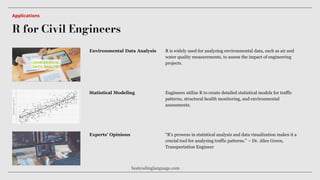
Environmental Data Analysis R is widely used for analyzing environmental data, such as air and
water quality measurements, to assess the impact of engineering
projects.
R for Civil Engineers
Applications
bestcodinglanguage.com
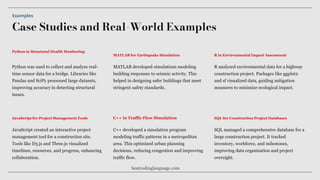
Case Studies and Real-World Examples
Examples
Python was used to collect and analyze real-
time sensor data for a bridge. Libraries like
Pandas and SciPy processed large datasets,
improving accuracy in detecting structural
issues.
MATLAB developed simulations modeling
building responses to seismic activity. This
helped in designing safer buildings that meet
stringent safety standards.
JavaScript created an interactive project
management tool for a construction site.
Tools like D3.js and Three.js visualized
timelines, resources, and progress, enhancing
collaboration.
Python in Structural Health Monitoring
MATLAB for Earthquake Simulation
JavaScript for Project Management Tools
C++ developed a simulation program
modeling traffic patterns in a metropolitan
area. This optimized urban planning
decisions, reducing congestion and improving
traffic flow.
C++ in Traffic Flow Simulation
R analyzed environmental data for a highway
construction project. Packages like ggplot2
and sf visualized data, guiding mitigation
measures to minimize ecological impact.
R in Environmental Impact Assessment
SQL managed a comprehensive database for a
large construction project. It tracked
inventory, workforce, and milestones,
improving data organization and project
oversight.
SQL for Construction Project Databases
bestcodinglanguage.com
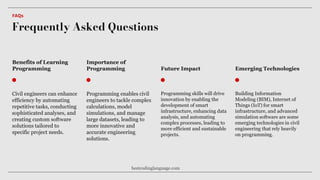
Benefits of Learning
Programming
Importance of
Programming Future Impact Emerging Technologies
Civil engineers can enhance
efficiency by automating
repetitive tasks, conducting
sophisticated analyses, and
creating custom software
solutions tailored to
specific project needs.
Programming enables civil
engineers to tackle complex
calculations, model
simulations, and manage
large datasets, leading to
more innovative and
accurate engineering
solutions.
Programming skills will drive
innovation by enabling the
development of smart
infrastructure, enhancing data
analysis, and automating
complex processes, leading to
more efficient and sustainable
projects.
Building Information
Modeling (BIM), Internet of
Things (IoT) for smart
infrastructure, and advanced
simulation software are some
emerging technologies in civil
engineering that rely heavily
on programming.
Frequently Asked Questions
FAQs
bestcodinglanguage.com
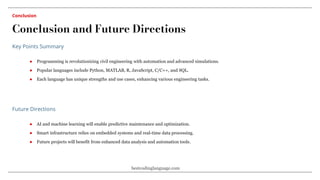
Key Points Summary
● Programming is revolutionizing civil engineering with automation and advanced simulations.
● Popular languages include Python, MATLAB, R, JavaScript, C/C++, and SQL.
● Each language has unique strengths and use cases, enhancing various engineering tasks.
Future Directions
● AI and machine learning will enable predictive maintenance and optimization.
● Smart infrastructure relies on embedded systems and real-time data processing.
● Future projects will benefit from enhanced data analysis and automation tools.
Conclusion and Future Directions
Conclusion
bestcodinglanguage.com
Visit Colding Alpha to Learn More
About the Topic!
Thank you.

Best Programming Language for Civil Engineers

  • 1.
    Best Programming Language for CivilEngineers Presented by Coding Alpha bestcodinglanguage.com
  • 2.
    Agenda 1. Introduction toProgramming in Civil Engineering 2. Popular Programming Languages for Civil Engineers 3. Python for Civil Engineers 4. MATLAB for Civil Engineers 5. R for Civil Engineers 6. Case Studies and Real-World Examples 7. Frequently Asked Questions 8. Conclusion and Future Directions bestcodinglanguage.com
  • 3.
    Importance of Programmingin Civil Engineering ● Programming is revolutionizing civil engineering by enabling advanced design and analysis capabilities. ● Automation of repetitive tasks increases efficiency and reduces human error, enhancing overall project accuracy. ● Advanced simulations allow engineers to predict structural behaviors, optimize designs, and improve material usage. ● Integration of AI and machine learning helps in predictive analysis and better project planning. Introduction to Programming in Civil Engineering Introduction bestcodinglanguage.com
  • 4.
    Popular Programming Languagesfor Civil Engineers Overview Widely used for data analysis, automation, and creating simulations. Integrates with tools like AutoCAD and GIS, and is known for its ease of learning and extensive libraries. Ideal for structural analysis, data visualization, and simulations. Known for its powerful numerical analysis capabilities, though it can be expensive with a steep learning curve. Used for web development, interactive visualizations, and project management tools. Not suited for heavy computations but excellent for creating interactive web applications. Python MATLAB JavaScript High performance and control over resources make it ideal for custom simulation software and real-time processing. However, it has a complex syntax and steep learning curve. C/C++ Strong in statistical analysis and data visualization. Commonly used for environmental data analysis and statistical modeling, but less versatile for general- purpose tasks. R Essential for managing and querying large datasets in databases. Used for handling structured data efficiently, making it crucial for project databases and data management. SQL bestcodinglanguage.com
  • 5.
    Python for CivilEngineers Experts' Opinions Use Cases Jane Doe: Python’s versatility improves workflow efficiency. Mark Roberts: Integration with GIS tools enhances urban planning. Automation of data extraction, structural simulations, and machine learning for predictive maintenance. Tool Integration Python integrates with AutoCAD and GIS tools for automated tasks and robust data analysis. Python bestcodinglanguage.com
  • 6.
    MATLAB for CivilEngineers Structural Analysis Simulations MATLAB excels in simulating physical systems and performing intricate structural analysis, aiding in safer and more efficient designs. Engineers use MATLAB to simulate structural behaviors under various load conditions, helping improve design accuracy and safety. Research Integration Used extensively in research to model the behavior of new materials under stress, enhancing the development of innovative solutions. Applications bestcodinglanguage.com
  • 7.
    Statistical Modeling Engineersutilize R to create detailed statistical models for traffic patterns, structural health monitoring, and environmental assessments. Experts' Opinions “R’s prowess in statistical analysis and data visualization makes it a crucial tool for analyzing traffic patterns.” – Dr. Alice Green, Transportation Engineer Environmental Data Analysis R is widely used for analyzing environmental data, such as air and water quality measurements, to assess the impact of engineering projects. R for Civil Engineers Applications bestcodinglanguage.com
  • 8.
    Case Studies andReal-World Examples Examples Python was used to collect and analyze real- time sensor data for a bridge. Libraries like Pandas and SciPy processed large datasets, improving accuracy in detecting structural issues. MATLAB developed simulations modeling building responses to seismic activity. This helped in designing safer buildings that meet stringent safety standards. JavaScript created an interactive project management tool for a construction site. Tools like D3.js and Three.js visualized timelines, resources, and progress, enhancing collaboration. Python in Structural Health Monitoring MATLAB for Earthquake Simulation JavaScript for Project Management Tools C++ developed a simulation program modeling traffic patterns in a metropolitan area. This optimized urban planning decisions, reducing congestion and improving traffic flow. C++ in Traffic Flow Simulation R analyzed environmental data for a highway construction project. Packages like ggplot2 and sf visualized data, guiding mitigation measures to minimize ecological impact. R in Environmental Impact Assessment SQL managed a comprehensive database for a large construction project. It tracked inventory, workforce, and milestones, improving data organization and project oversight. SQL for Construction Project Databases bestcodinglanguage.com
  • 9.
    Benefits of Learning Programming Importanceof Programming Future Impact Emerging Technologies Civil engineers can enhance efficiency by automating repetitive tasks, conducting sophisticated analyses, and creating custom software solutions tailored to specific project needs. Programming enables civil engineers to tackle complex calculations, model simulations, and manage large datasets, leading to more innovative and accurate engineering solutions. Programming skills will drive innovation by enabling the development of smart infrastructure, enhancing data analysis, and automating complex processes, leading to more efficient and sustainable projects. Building Information Modeling (BIM), Internet of Things (IoT) for smart infrastructure, and advanced simulation software are some emerging technologies in civil engineering that rely heavily on programming. Frequently Asked Questions FAQs bestcodinglanguage.com
  • 10.
    Key Points Summary ●Programming is revolutionizing civil engineering with automation and advanced simulations. ● Popular languages include Python, MATLAB, R, JavaScript, C/C++, and SQL. ● Each language has unique strengths and use cases, enhancing various engineering tasks. Future Directions ● AI and machine learning will enable predictive maintenance and optimization. ● Smart infrastructure relies on embedded systems and real-time data processing. ● Future projects will benefit from enhanced data analysis and automation tools. Conclusion and Future Directions Conclusion bestcodinglanguage.com
  • 11.
    Visit Colding Alphato Learn More About the Topic! Thank you.