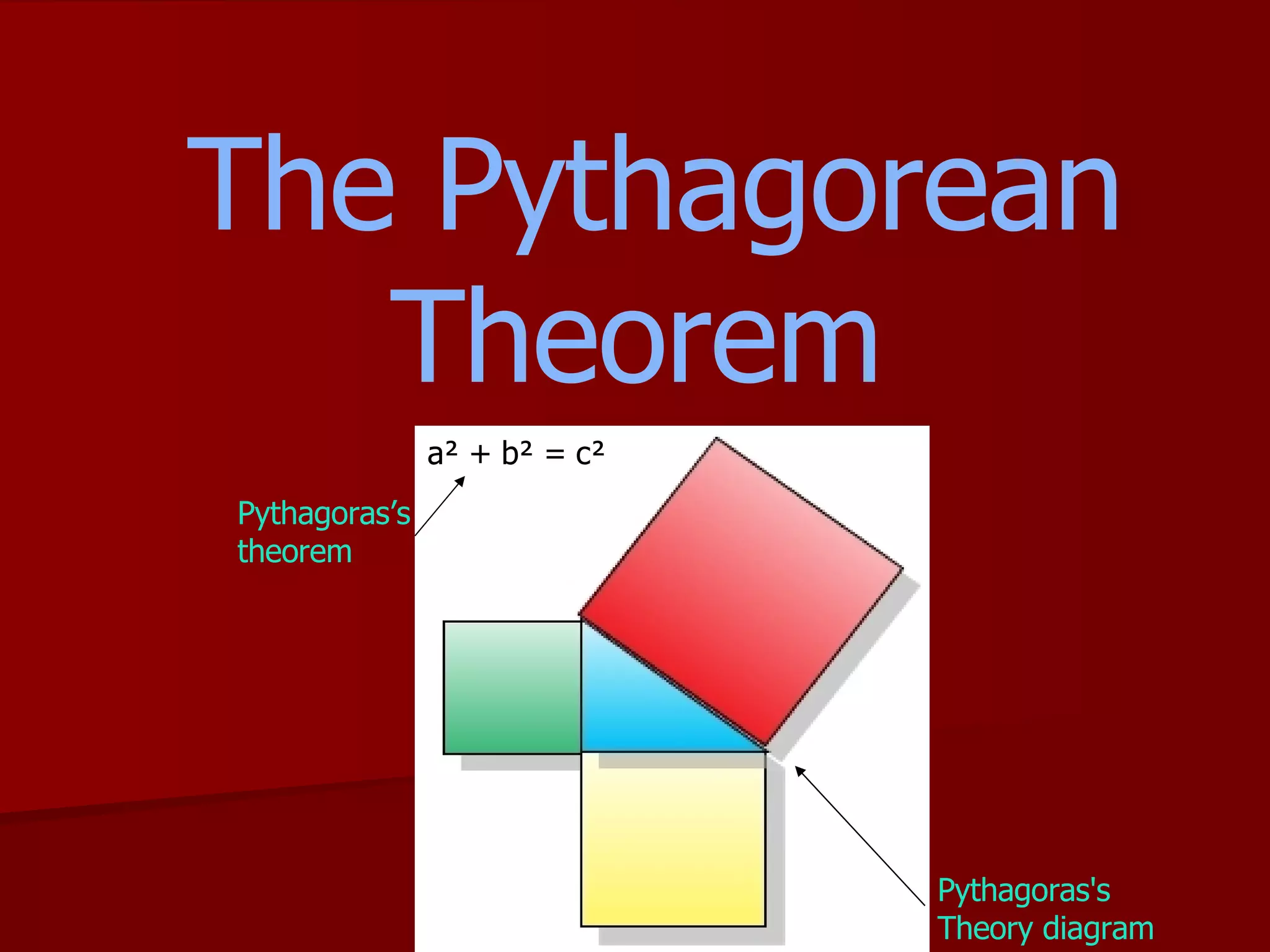
The Pythagorean Theorem  a² + b ² = c² Pythagoras's Theory diagram Pythagoras’s theorem
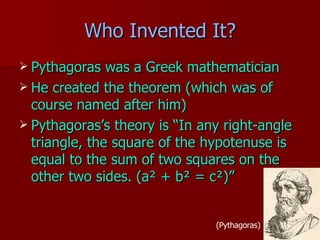
Who Invented It? Pythagoras was a Greek mathematician  He created the theorem (which was of course named after him) Pythagoras’s theory is “In any right-angle triangle, the square of the hypotenuse is equal to the sum of two squares on the other two sides. (a ² + b² = c²)” (Pythagoras)
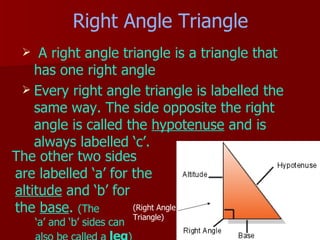
Right Angle Triangle A right angle triangle is a triangle that  has one right angle Every right angle triangle is labelled the same way. The side opposite the right angle is called the  hypotenuse  and is always labelled ‘c’.  (Right Angle Triangle) The other two sides are labelled ‘a’ for the  altitude  and ‘b’ for the  base .  (The  ‘a’ and ‘b’ sides can  also be called a  leg )
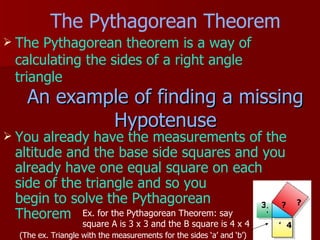
An example of finding a missing Hypotenuse The Pythagorean theorem is a way of calculating the sides of a right angle triangle 3 4 ? Ex. for the Pythagorean Theorem: say square A is 3 x 3 and the B square is 4 x 4   (The ex. Triangle with the measurements for the sides ‘a’ and ‘b’) The Pythagorean Theorem You already have the measurements of the altitude and the base side squares and you already have one equal square on each side of the triangle and so you  begin to solve the Pythagorean  Theorem  3 4 ?
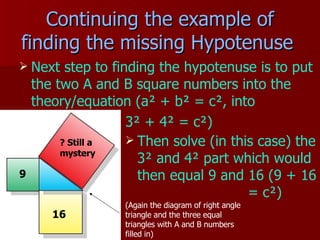
Continuing the example of finding the missing Hypotenuse   Next step to finding the hypotenuse is to put the two A and B square numbers into the theory/equation (a ² + b² = c², into  3² + 4² = c²) Then solve (in this case) the 3² and 4² part which would then equal 9 and 16 (9 + 16  = c²) 9 16 ? Still a mystery (Again the diagram of right angle triangle and the three equal triangles with A and B numbers filled in)
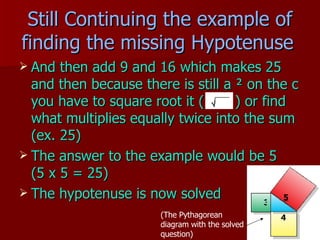
Still Continuing the example of finding the missing Hypotenuse   And then add 9 and 16 which makes 25 and then because there is still a ² on the c you have to square root it (  ) or find what multiplies equally twice into the sum (ex. 25)  The answer to the example would be 5  (5 x 5 = 25) The hypotenuse is now solved 5 3 4 (The Pythagorean diagram with the solved question)
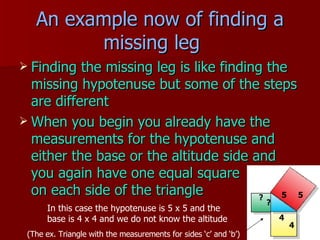
An example now of finding a missing leg   Finding the missing leg is like finding the missing hypotenuse but some of the steps are different When you begin you already have the measurements for the hypotenuse and either the base or the altitude side and you again have one equal square  on each side of the triangle 5 5 4 4 ? ? In this case the hypotenuse is 5 x 5 and the base is 4 x 4 and we do not know the altitude (The ex. Triangle with the measurements for sides ‘c’ and ‘b’)
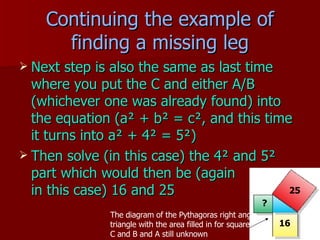
Continuing the example of finding a missing leg Next step is also the same as last time where you put the C and either A/B (whichever one was already found) into the equation (a ² + b² = c², and this time it turns into a² + 4² = 5²) Then solve (in this case) the 4² and 5² part which would then be (again  in this case) 16 and 25 25 16 ? The diagram of the Pythagoras right angle triangle with the area filled in for squares C and B and A still unknown
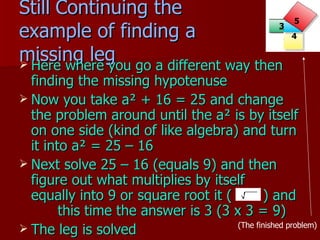
Still   Continuing the example of finding a missing leg Here where you go a different way then finding the missing hypotenuse Now you take a ² + 16 = 25 and change the problem around until the  a ² is by itself on one side (kind of like algebra) and turn it into  a ² = 25 – 16 Next solve 25 – 16 (equals 9) and then figure out what multiplies by itself  equally into 9 or square root it (  ) and  this time the answer is 3 (3 x 3 = 9) The leg is solved 3 4 5 (The finished problem)

The Pythagorean Theorem

  • 1.
    The Pythagorean Theorem a² + b ² = c² Pythagoras's Theory diagram Pythagoras’s theorem
  • 2.
    Who Invented It?Pythagoras was a Greek mathematician He created the theorem (which was of course named after him) Pythagoras’s theory is “In any right-angle triangle, the square of the hypotenuse is equal to the sum of two squares on the other two sides. (a ² + b² = c²)” (Pythagoras)
  • 3.
    Right Angle TriangleA right angle triangle is a triangle that has one right angle Every right angle triangle is labelled the same way. The side opposite the right angle is called the hypotenuse and is always labelled ‘c’. (Right Angle Triangle) The other two sides are labelled ‘a’ for the altitude and ‘b’ for the base . (The ‘a’ and ‘b’ sides can also be called a leg )
  • 4.
    An example offinding a missing Hypotenuse The Pythagorean theorem is a way of calculating the sides of a right angle triangle 3 4 ? Ex. for the Pythagorean Theorem: say square A is 3 x 3 and the B square is 4 x 4 (The ex. Triangle with the measurements for the sides ‘a’ and ‘b’) The Pythagorean Theorem You already have the measurements of the altitude and the base side squares and you already have one equal square on each side of the triangle and so you begin to solve the Pythagorean Theorem 3 4 ?
  • 5.
    Continuing the exampleof finding the missing Hypotenuse Next step to finding the hypotenuse is to put the two A and B square numbers into the theory/equation (a ² + b² = c², into 3² + 4² = c²) Then solve (in this case) the 3² and 4² part which would then equal 9 and 16 (9 + 16 = c²) 9 16 ? Still a mystery (Again the diagram of right angle triangle and the three equal triangles with A and B numbers filled in)
  • 6.
    Still Continuing theexample of finding the missing Hypotenuse And then add 9 and 16 which makes 25 and then because there is still a ² on the c you have to square root it ( ) or find what multiplies equally twice into the sum (ex. 25) The answer to the example would be 5 (5 x 5 = 25) The hypotenuse is now solved 5 3 4 (The Pythagorean diagram with the solved question)
  • 7.
    An example nowof finding a missing leg Finding the missing leg is like finding the missing hypotenuse but some of the steps are different When you begin you already have the measurements for the hypotenuse and either the base or the altitude side and you again have one equal square on each side of the triangle 5 5 4 4 ? ? In this case the hypotenuse is 5 x 5 and the base is 4 x 4 and we do not know the altitude (The ex. Triangle with the measurements for sides ‘c’ and ‘b’)
  • 8.
    Continuing the exampleof finding a missing leg Next step is also the same as last time where you put the C and either A/B (whichever one was already found) into the equation (a ² + b² = c², and this time it turns into a² + 4² = 5²) Then solve (in this case) the 4² and 5² part which would then be (again in this case) 16 and 25 25 16 ? The diagram of the Pythagoras right angle triangle with the area filled in for squares C and B and A still unknown
  • 9.
    Still Continuing the example of finding a missing leg Here where you go a different way then finding the missing hypotenuse Now you take a ² + 16 = 25 and change the problem around until the a ² is by itself on one side (kind of like algebra) and turn it into a ² = 25 – 16 Next solve 25 – 16 (equals 9) and then figure out what multiplies by itself equally into 9 or square root it ( ) and this time the answer is 3 (3 x 3 = 9) The leg is solved 3 4 5 (The finished problem)