Dimensionality Reduction
Fereshteh Sadeghi
CSEP 546
Motivation
• Clustering
• One way to summarize a complex real-valued data point with a single
categorical variable
• Dimensionality reduction
• Another way to simplify complex high-dimensional data
• Summarize data with a lower dimensional real valued vector
Motivation
• Clustering
• One way to summarize a complex real-valued data point with a single
categorical variable
• Dimensionality reduction
• Another way to simplify complex high-dimensional data
• Summarize data with a lower dimentional real valued vector
• Given data points in d dimensions
• Convert them to data points in r<d dimensions
• With minimal loss of information
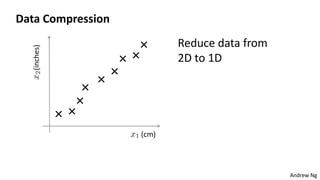
Data Compression
(inches)
(cm)
Reduce data from
2D to 1D
Andrew Ng
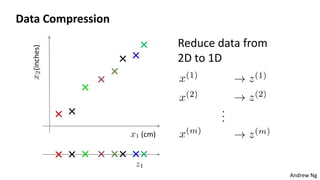
Data Compression
Reduce data from
2D to 1D
(inches)
(cm)
Andrew Ng
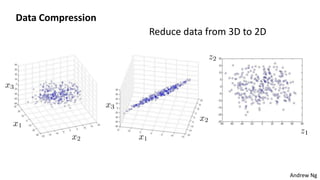
Data Compression
Reduce data from 3D to 2D
Andrew Ng
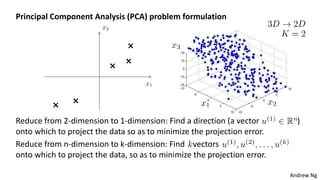
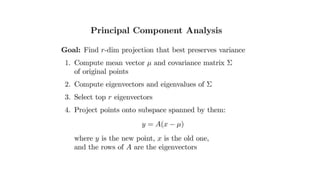
Principal Component Analysis (PCA) problem formulation
Reduce from 2-dimension to 1-dimension: Find a direction (a vector )
onto which to project the data so as to minimize the projection error.
Reduce from n-dimension to k-dimension: Find vectors
onto which to project the data, so as to minimize the projection error.
Andrew Ng
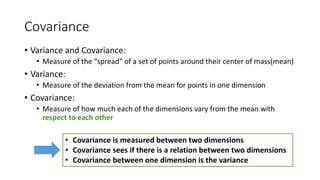
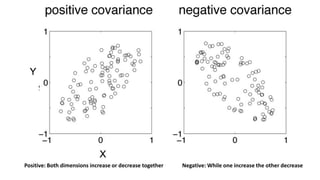
Covariance
• Variance and Covariance:
• Measure of the “spread” of a set of points around their center of mass(mean)
• Variance:
• Measure of the deviation from the mean for points in one dimension
• Covariance:
• Measure of how much each of the dimensions vary from the mean with
respect to each other
• Covariance is measured between two dimensions
• Covariance sees if there is a relation between two dimensions
• Covariance between one dimension is the variance
Positive: Both dimensions increase or decrease together Negative: While one increase the other decrease
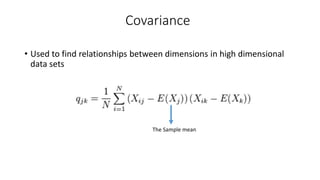
Covariance
• Used to find relationships between dimensions in high dimensional
data sets
The Sample mean
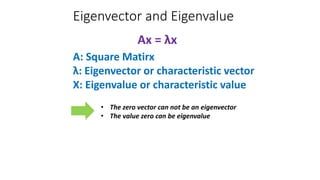
Eigenvector and Eigenvalue
Ax = λx
A: Square Matirx
λ: Eigenvector or characteristic vector
X: Eigenvalue or characteristic value
• The zero vector can not be an eigenvector
• The value zero can be eigenvalue
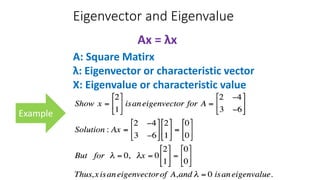
Eigenvector and Eigenvalue
Ax = λx
A: Square Matirx
λ: Eigenvector or characteristic vector
X: Eigenvalue or characteristic value
Example
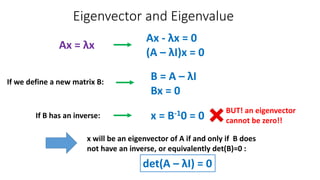
Eigenvector and Eigenvalue
Ax - λx = 0
(A – λI)x = 0
B = A – λI
Bx = 0
x = B-10 = 0
If we define a new matrix B:
If B has an inverse:
BUT! an eigenvector
cannot be zero!!
x will be an eigenvector of A if and only if B does
not have an inverse, or equivalently det(B)=0 :
det(A – λI) = 0
Ax = λx
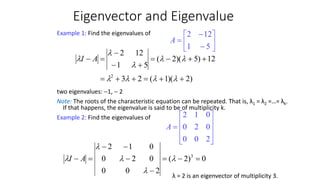
Example 1: Find the eigenvalues of
two eigenvalues: 1,  2
Note: The roots of the characteristic equation can be repeated. That is, λ1 = λ2 =…= λk.
If that happens, the eigenvalue is said to be of multiplicity k.
Example 2: Find the eigenvalues of
λ = 2 is an eigenvector of multiplicity 3.









5
1
12
2
A
)
2
)(
1
(
2
3
12
)
5
)(
2
(
5
1
12
2
2























 A
I











2
0
0
0
2
0
0
1
2
A
0
)
2
(
2
0
0
0
2
0
0
1
2
3








 



 A
I
Eigenvector and Eigenvalue
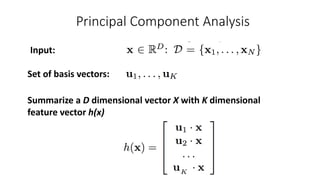
Principal Component Analysis
Input:
Summarize a D dimensional vector X with K dimensional
feature vector h(x)
Set of basis vectors:
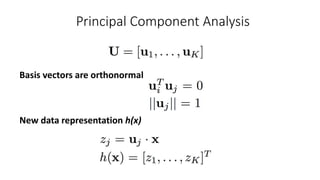
Principal Component Analysis
Basis vectors are orthonormal
New data representation h(x)
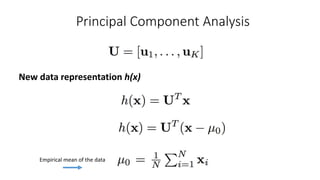
Principal Component Analysis
New data representation h(x)
Empirical mean of the data
• The top three principal components of SIFT descriptors from a set of images are computed
• Map these principal components to the principal components of the RGB space
• pixels with similar colors share similar structures
SIFT feature visualization
Original Image
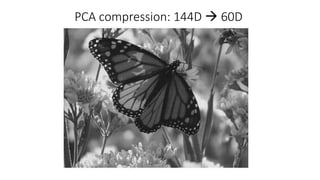
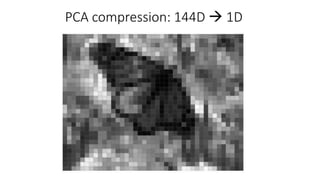
• Divide the original 372x492 image into patches:
• Each patch is an instance that contains 12x12 pixels on a grid
• View each as a 144-D vector
Application: Image compression
PCA compression: 144D  60D
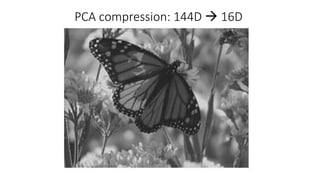
PCA compression: 144D  16D
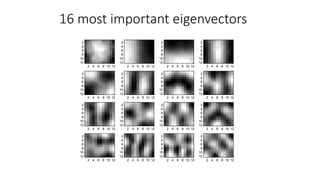
16 most important eigenvectors
2 4 6 8 10 12
2
4
6
8
10
12
2 4 6 8 10 12
2
4
6
8
10
12
2 4 6 8 10 12
2
4
6
8
10
12
2 4 6 8 10 12
2
4
6
8
10
12
2 4 6 8 10 12
2
4
6
8
10
12
2 4 6 8 10 12
2
4
6
8
10
12
2 4 6 8 10 12
2
4
6
8
10
12
2 4 6 8 10 12
2
4
6
8
10
12
2 4 6 8 10 12
2
4
6
8
10
12
2 4 6 8 10 12
2
4
6
8
10
12
2 4 6 8 10 12
2
4
6
8
10
12
2 4 6 8 10 12
2
4
6
8
10
12
2 4 6 8 10 12
2
4
6
8
10
12
2 4 6 8 10 12
2
4
6
8
10
12
2 4 6 8 10 12
2
4
6
8
10
12
2 4 6 8 10 12
2
4
6
8
10
12
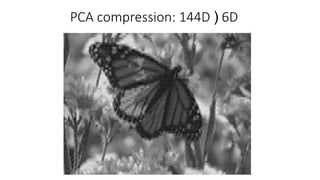
PCA compression: 144D ) 6D
2 4 6 8 10 12
2
4
6
8
10
12
2 4 6 8 10 12
2
4
6
8
10
12
2 4 6 8 10 12
2
4
6
8
10
12
2 4 6 8 10 12
2
4
6
8
10
12
2 4 6 8 10 12
2
4
6
8
10
12
2 4 6 8 10 12
2
4
6
8
10
12
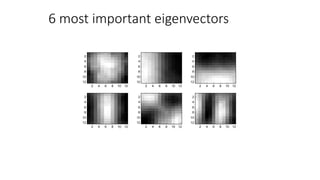
6 most important eigenvectors
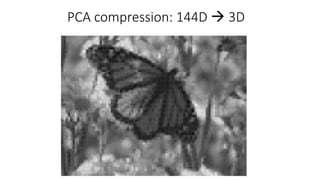
PCA compression: 144D  3D
2 4 6 8 10 12
2
4
6
8
10
12
2 4 6 8 10 12
2
4
6
8
10
12
2 4 6 8 10 12
2
4
6
8
10
12
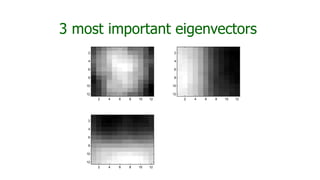
3 most important eigenvectors
PCA compression: 144D  1D
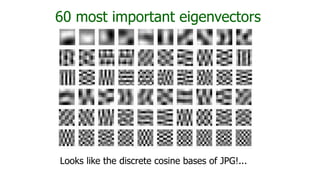
60 most important eigenvectors
Looks like the discrete cosine bases of JPG!...
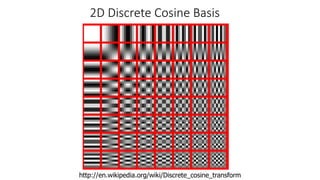
2D Discrete Cosine Basis
http://en.wikipedia.org/wiki/Discrete_cosine_transform
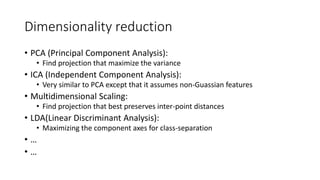
Dimensionality reduction
• PCA (Principal Component Analysis):
• Find projection that maximize the variance
• ICA (Independent Component Analysis):
• Very similar to PCA except that it assumes non-Guassian features
• Multidimensional Scaling:
• Find projection that best preserves inter-point distances
• LDA(Linear Discriminant Analysis):
• Maximizing the component axes for class-separation
• …
• …

principle component analysis pca - machine learning - unsupervised learning

  • 1.
  • 2.
    Motivation • Clustering • Oneway to summarize a complex real-valued data point with a single categorical variable • Dimensionality reduction • Another way to simplify complex high-dimensional data • Summarize data with a lower dimensional real valued vector
  • 3.
    Motivation • Clustering • Oneway to summarize a complex real-valued data point with a single categorical variable • Dimensionality reduction • Another way to simplify complex high-dimensional data • Summarize data with a lower dimentional real valued vector • Given data points in d dimensions • Convert them to data points in r<d dimensions • With minimal loss of information
  • 4.
  • 5.
    Data Compression Reduce datafrom 2D to 1D (inches) (cm) Andrew Ng
  • 6.
    Data Compression Reduce datafrom 3D to 2D Andrew Ng
  • 7.
    Principal Component Analysis(PCA) problem formulation Reduce from 2-dimension to 1-dimension: Find a direction (a vector ) onto which to project the data so as to minimize the projection error. Reduce from n-dimension to k-dimension: Find vectors onto which to project the data, so as to minimize the projection error. Andrew Ng
  • 9.
    Covariance • Variance andCovariance: • Measure of the “spread” of a set of points around their center of mass(mean) • Variance: • Measure of the deviation from the mean for points in one dimension • Covariance: • Measure of how much each of the dimensions vary from the mean with respect to each other • Covariance is measured between two dimensions • Covariance sees if there is a relation between two dimensions • Covariance between one dimension is the variance
  • 10.
    Positive: Both dimensionsincrease or decrease together Negative: While one increase the other decrease
  • 11.
    Covariance • Used tofind relationships between dimensions in high dimensional data sets The Sample mean
  • 12.
    Eigenvector and Eigenvalue Ax= λx A: Square Matirx λ: Eigenvector or characteristic vector X: Eigenvalue or characteristic value • The zero vector can not be an eigenvector • The value zero can be eigenvalue
  • 13.
    Eigenvector and Eigenvalue Ax= λx A: Square Matirx λ: Eigenvector or characteristic vector X: Eigenvalue or characteristic value Example
  • 14.
    Eigenvector and Eigenvalue Ax- λx = 0 (A – λI)x = 0 B = A – λI Bx = 0 x = B-10 = 0 If we define a new matrix B: If B has an inverse: BUT! an eigenvector cannot be zero!! x will be an eigenvector of A if and only if B does not have an inverse, or equivalently det(B)=0 : det(A – λI) = 0 Ax = λx
  • 15.
    Example 1: Findthe eigenvalues of two eigenvalues: 1,  2 Note: The roots of the characteristic equation can be repeated. That is, λ1 = λ2 =…= λk. If that happens, the eigenvalue is said to be of multiplicity k. Example 2: Find the eigenvalues of λ = 2 is an eigenvector of multiplicity 3.          5 1 12 2 A ) 2 )( 1 ( 2 3 12 ) 5 )( 2 ( 5 1 12 2 2                         A I            2 0 0 0 2 0 0 1 2 A 0 ) 2 ( 2 0 0 0 2 0 0 1 2 3               A I Eigenvector and Eigenvalue
  • 16.
    Principal Component Analysis Input: Summarizea D dimensional vector X with K dimensional feature vector h(x) Set of basis vectors:
  • 17.
    Principal Component Analysis Basisvectors are orthonormal New data representation h(x)
  • 18.
    Principal Component Analysis Newdata representation h(x) Empirical mean of the data
  • 23.
    • The topthree principal components of SIFT descriptors from a set of images are computed • Map these principal components to the principal components of the RGB space • pixels with similar colors share similar structures SIFT feature visualization
  • 24.
    Original Image • Dividethe original 372x492 image into patches: • Each patch is an instance that contains 12x12 pixels on a grid • View each as a 144-D vector Application: Image compression
  • 25.
  • 26.
  • 27.
    16 most importanteigenvectors 2 4 6 8 10 12 2 4 6 8 10 12 2 4 6 8 10 12 2 4 6 8 10 12 2 4 6 8 10 12 2 4 6 8 10 12 2 4 6 8 10 12 2 4 6 8 10 12 2 4 6 8 10 12 2 4 6 8 10 12 2 4 6 8 10 12 2 4 6 8 10 12 2 4 6 8 10 12 2 4 6 8 10 12 2 4 6 8 10 12 2 4 6 8 10 12 2 4 6 8 10 12 2 4 6 8 10 12 2 4 6 8 10 12 2 4 6 8 10 12 2 4 6 8 10 12 2 4 6 8 10 12 2 4 6 8 10 12 2 4 6 8 10 12 2 4 6 8 10 12 2 4 6 8 10 12 2 4 6 8 10 12 2 4 6 8 10 12 2 4 6 8 10 12 2 4 6 8 10 12 2 4 6 8 10 12 2 4 6 8 10 12
  • 28.
  • 29.
    2 4 68 10 12 2 4 6 8 10 12 2 4 6 8 10 12 2 4 6 8 10 12 2 4 6 8 10 12 2 4 6 8 10 12 2 4 6 8 10 12 2 4 6 8 10 12 2 4 6 8 10 12 2 4 6 8 10 12 2 4 6 8 10 12 2 4 6 8 10 12 6 most important eigenvectors
  • 30.
  • 31.
    2 4 68 10 12 2 4 6 8 10 12 2 4 6 8 10 12 2 4 6 8 10 12 2 4 6 8 10 12 2 4 6 8 10 12 3 most important eigenvectors
  • 32.
  • 33.
    60 most importanteigenvectors Looks like the discrete cosine bases of JPG!...
  • 34.
    2D Discrete CosineBasis http://en.wikipedia.org/wiki/Discrete_cosine_transform
  • 35.
    Dimensionality reduction • PCA(Principal Component Analysis): • Find projection that maximize the variance • ICA (Independent Component Analysis): • Very similar to PCA except that it assumes non-Guassian features • Multidimensional Scaling: • Find projection that best preserves inter-point distances • LDA(Linear Discriminant Analysis): • Maximizing the component axes for class-separation • … • …