
Resilient Priorirty Queue

                              Anirban Mitra

                          anmitra@cs.stonybrook.edu
                        Department of Computer Science
                            Stony Brook University


                             March 30, 2013


Anirban Mitra (SBU)           Resilient Priorirty Queue   March 30, 2013   1 / 25
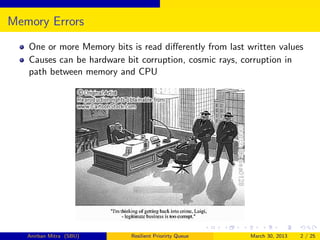
Memory Errors
   One or more Memory bits is read differently from last written values
   Causes can be hardware bit corruption, cosmic rays, corruption in
   path between memory and CPU


   Anirban Mitra (SBU)     Resilient Priorirty Queue     March 30, 2013   2 / 25
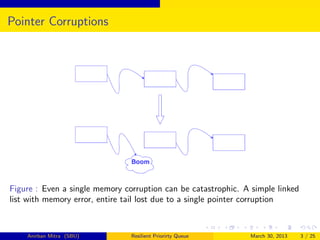
Pointer Corruptions


Figure : Even a single memory corruption can be catastrophic. A simple linked
list with memory error, entire tail lost due to a single pointer corruption


    Anirban Mitra (SBU)         Resilient Priorirty Queue       March 30, 2013   3 / 25
ECC
  Hardware ECC (Error Correcting Codes) chips can help
  But is expensive in terms of processing time and money
  Even ECC cannot correct every corruption


  Anirban Mitra (SBU)     Resilient Priorirty Queue    March 30, 2013   4 / 25
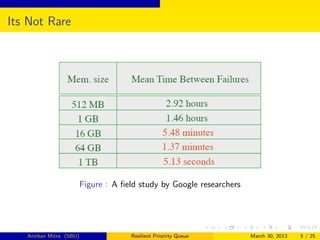
Its Not Rare


                         Figure : A field study by Google researchers


   Anirban Mitra (SBU)                Resilient Priorirty Queue        March 30, 2013   5 / 25
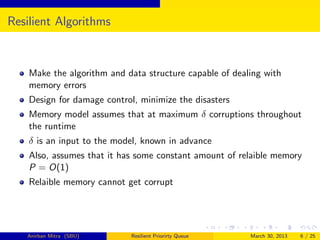
Resilient Algorithms


    Make the algorithm and data structure capable of dealing with
    memory errors
    Design for damage control, minimize the disasters
    Memory model assumes that at maximum δ corruptions throughout
    the runtime
    δ is an input to the model, known in advance
    Also, assumes that it has some constant amount of relaible memory
    P = O(1)
    Relaible memory cannot get corrupt


   Anirban Mitra (SBU)      Resilient Priorirty Queue    March 30, 2013   6 / 25
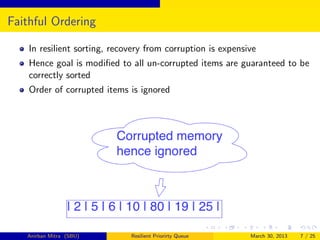
Faithful Ordering

    In resilient sorting, recovery from corruption is expensive
    Hence goal is modified to all un-corrupted items are guaranteed to be
    correctly sorted
    Order of corrupted items is ignored


   Anirban Mitra (SBU)        Resilient Priorirty Queue      March 30, 2013   7 / 25
Resilient Merging


   Anirban Mitra (SBU)   Resilient Priorirty Queue   March 30, 2013   8 / 25
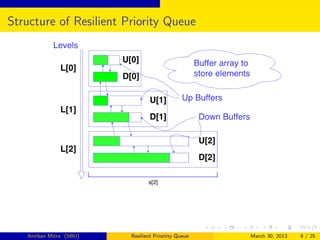
Structure of Resilient Priority Queue


   Anirban Mitra (SBU)   Resilient Priorirty Queue   March 30, 2013   9 / 25
Structure of Resilient Priority Queue


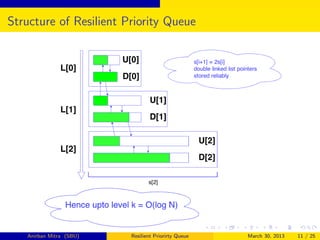
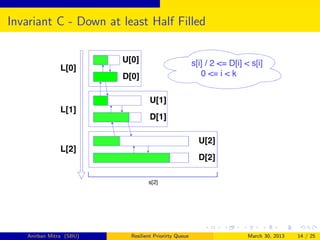
    Intuitively, elements in Up buffer are moving to upper layers
    Elements in Down buffer are moving to lower layers


   Anirban Mitra (SBU)       Resilient Priorirty Queue    March 30, 2013   10 / 25
Structure of Resilient Priority Queue


   Anirban Mitra (SBU)   Resilient Priorirty Queue   March 30, 2013   11 / 25
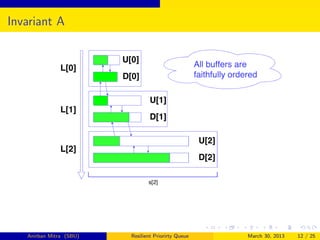
Invariant A


   Anirban Mitra (SBU)   Resilient Priorirty Queue   March 30, 2013   12 / 25
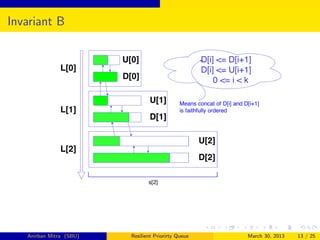
Invariant B


   Anirban Mitra (SBU)   Resilient Priorirty Queue   March 30, 2013   13 / 25
Invariant C - Down at least Half Filled


   Anirban Mitra (SBU)   Resilient Priorirty Queue   March 30, 2013   14 / 25
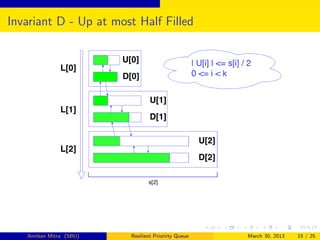
Invariant D - Up at most Half Filled


   Anirban Mitra (SBU)   Resilient Priorirty Queue   March 30, 2013   15 / 25
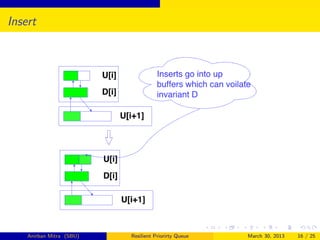
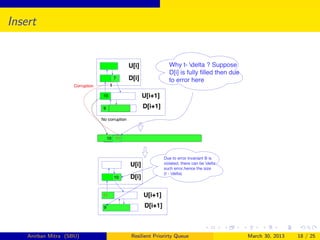
Insert


    Anirban Mitra (SBU)   Resilient Priorirty Queue   March 30, 2013   16 / 25
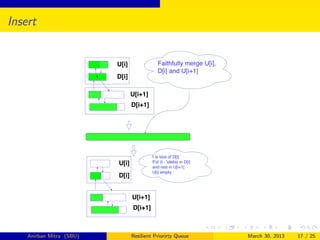
Insert


    Anirban Mitra (SBU)   Resilient Priorirty Queue   March 30, 2013   17 / 25
Insert


    Anirban Mitra (SBU)   Resilient Priorirty Queue   March 30, 2013   18 / 25
Push and Pull


   Push and Pull primitives used fro Insert and DeleteMin
   Push pushes elements to higher layers when Up at most half invariant
   is broken
   Similarly, Pull pulls elements from higher layer when Down at least
   half invariant is broken


   Anirban Mitra (SBU)      Resilient Priorirty Queue    March 30, 2013   19 / 25
Algorithm for Push

 1:   function Push(Ui )
 2:      di = |Di |
 3:      M = Ui ∪ Di ∪ Ui+1
 4:      Di = M[0..(di − δ)]
 5:      Ui = []
 6:      if i = k then
 7:           Uk+1 = []
 8:           Dk+1 = M[(di − δ)..]
 9:           k = k+1
10:      else
11:           Ui+1 = M[(di − δ)..]
12:      if Ui+1 > si+1 /2 then
13:           Push(Ui+1 )
14:      if Di < si /2 then
15:           Pull(Di )
      Anirban Mitra (SBU)      Resilient Priorirty Queue   March 30, 2013   20 / 25
Algorithm for Pull


 1:   function Pull(Di )
 2:      di = |Di |
 3:      di+1 = |Di+1 |
 4:      M = Ui ∪ Di ∪ Ui+1
 5:      Di = M[0..si ]
 6:      Di+1 = [si ..(di+1 + di − δ)]
 7:      Ui+1 = [di+1 + di − δ..]
 8:      if Ui+1 > si+1 /2 then
 9:          Push(Ui+1 )
10:      if Di+1 < si+1 /2 then
11:          Pull(Di+1 )


      Anirban Mitra (SBU)       Resilient Priorirty Queue   March 30, 2013   21 / 25
Insert


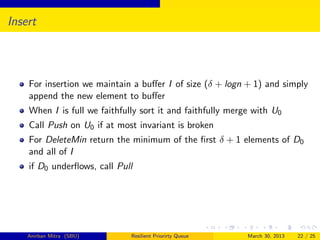
    For insertion we maintain a buffer I of size (δ + logn + 1) and simply
    append the new element to buffer
    When I is full we faithfully sort it and faithfully merge with U0
    Call Push on U0 if at most invariant is broken
    For DeleteMin return the minimum of the first δ + 1 elements of D0
    and all of I
    if D0 underflows, call Pull


    Anirban Mitra (SBU)       Resilient Priorirty Queue     March 30, 2013   22 / 25
Complexity


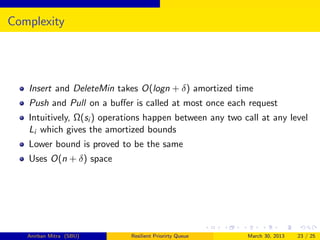
   Insert and DeleteMin takes O(logn + δ) amortized time
   Push and Pull on a buffer is called at most once each request
   Intuitively, Ω(si ) operations happen between any two call at any level
   Li which gives the amortized bounds
   Lower bound is proved to be the same
   Uses O(n + δ) space


   Anirban Mitra (SBU)       Resilient Priorirty Queue    March 30, 2013   23 / 25
Relation with Cache Oblivious


   This structure was inspired by cache oblivious priority queue by
   Bender et al in 2002
   There are several data structures which are adpated from their cache
   oblivious versions
   Even though resilient model does not have memory hierarchy
   One reason could be that cache oblivious structure use chunks of
   array to gain by locality and employs less pointers
   So they become amenable to be adapted to resilient version because
   then the small number of pointers can be stored in reliable memory
   Note that there is a tree based cache oblivious priority queue too


   Anirban Mitra (SBU)      Resilient Priorirty Queue     March 30, 2013   24 / 25
References


   L. Arge, M. A. Bender, E. D. Demaine, B. Holland-Minkley, and J. I.
   Munro. Cache-oblivious priority queue and graph algorithm
   applications. In Proc. of the 34th Annual ACM Symposium on
   Theory of Computing, pages 268-276, 2002.
   I. Finocchi, F. Grandoni, and G. F. Italiano. Optimal resilient
   sortingand searching in the presence of memory faults. In Proceedings
   of the 33rd International Colloquium on Automata, Languages and
   Programming, volume 4051 of Lecture Notes in Computer Science,
   pages 286-298. Springer, 2006
   A. G. Jorgensen. Data Structures: Sequence Problems, Range
   Queries and Fault Tolerance. PhD Dissertation, Aarhus University,
   Department of Computer Science, Denmatk, pages 79-87, 2010.


   Anirban Mitra (SBU)      Resilient Priorirty Queue   March 30, 2013   25 / 25

Resilient priority queue

  • 1.
    Resilient Priorirty Queue Anirban Mitra anmitra@cs.stonybrook.edu Department of Computer Science Stony Brook University March 30, 2013 Anirban Mitra (SBU) Resilient Priorirty Queue March 30, 2013 1 / 25
  • 2.
    Memory Errors One or more Memory bits is read differently from last written values Causes can be hardware bit corruption, cosmic rays, corruption in path between memory and CPU Anirban Mitra (SBU) Resilient Priorirty Queue March 30, 2013 2 / 25
  • 3.
    Pointer Corruptions Figure :Even a single memory corruption can be catastrophic. A simple linked list with memory error, entire tail lost due to a single pointer corruption Anirban Mitra (SBU) Resilient Priorirty Queue March 30, 2013 3 / 25
  • 4.
    ECC HardwareECC (Error Correcting Codes) chips can help But is expensive in terms of processing time and money Even ECC cannot correct every corruption Anirban Mitra (SBU) Resilient Priorirty Queue March 30, 2013 4 / 25
  • 5.
    Its Not Rare Figure : A field study by Google researchers Anirban Mitra (SBU) Resilient Priorirty Queue March 30, 2013 5 / 25
  • 6.
    Resilient Algorithms Make the algorithm and data structure capable of dealing with memory errors Design for damage control, minimize the disasters Memory model assumes that at maximum δ corruptions throughout the runtime δ is an input to the model, known in advance Also, assumes that it has some constant amount of relaible memory P = O(1) Relaible memory cannot get corrupt Anirban Mitra (SBU) Resilient Priorirty Queue March 30, 2013 6 / 25
  • 7.
    Faithful Ordering In resilient sorting, recovery from corruption is expensive Hence goal is modified to all un-corrupted items are guaranteed to be correctly sorted Order of corrupted items is ignored Anirban Mitra (SBU) Resilient Priorirty Queue March 30, 2013 7 / 25
  • 8.
    Resilient Merging Anirban Mitra (SBU) Resilient Priorirty Queue March 30, 2013 8 / 25
  • 9.
    Structure of ResilientPriority Queue Anirban Mitra (SBU) Resilient Priorirty Queue March 30, 2013 9 / 25
  • 10.
    Structure of ResilientPriority Queue Intuitively, elements in Up buffer are moving to upper layers Elements in Down buffer are moving to lower layers Anirban Mitra (SBU) Resilient Priorirty Queue March 30, 2013 10 / 25
  • 11.
    Structure of ResilientPriority Queue Anirban Mitra (SBU) Resilient Priorirty Queue March 30, 2013 11 / 25
  • 12.
    Invariant A Anirban Mitra (SBU) Resilient Priorirty Queue March 30, 2013 12 / 25
  • 13.
    Invariant B Anirban Mitra (SBU) Resilient Priorirty Queue March 30, 2013 13 / 25
  • 14.
    Invariant C -Down at least Half Filled Anirban Mitra (SBU) Resilient Priorirty Queue March 30, 2013 14 / 25
  • 15.
    Invariant D -Up at most Half Filled Anirban Mitra (SBU) Resilient Priorirty Queue March 30, 2013 15 / 25
  • 16.
    Insert Anirban Mitra (SBU) Resilient Priorirty Queue March 30, 2013 16 / 25
  • 17.
    Insert Anirban Mitra (SBU) Resilient Priorirty Queue March 30, 2013 17 / 25
  • 18.
    Insert Anirban Mitra (SBU) Resilient Priorirty Queue March 30, 2013 18 / 25
  • 19.
    Push and Pull Push and Pull primitives used fro Insert and DeleteMin Push pushes elements to higher layers when Up at most half invariant is broken Similarly, Pull pulls elements from higher layer when Down at least half invariant is broken Anirban Mitra (SBU) Resilient Priorirty Queue March 30, 2013 19 / 25
  • 20.
    Algorithm for Push 1: function Push(Ui ) 2: di = |Di | 3: M = Ui ∪ Di ∪ Ui+1 4: Di = M[0..(di − δ)] 5: Ui = [] 6: if i = k then 7: Uk+1 = [] 8: Dk+1 = M[(di − δ)..] 9: k = k+1 10: else 11: Ui+1 = M[(di − δ)..] 12: if Ui+1 > si+1 /2 then 13: Push(Ui+1 ) 14: if Di < si /2 then 15: Pull(Di ) Anirban Mitra (SBU) Resilient Priorirty Queue March 30, 2013 20 / 25
  • 21.
    Algorithm for Pull 1: function Pull(Di ) 2: di = |Di | 3: di+1 = |Di+1 | 4: M = Ui ∪ Di ∪ Ui+1 5: Di = M[0..si ] 6: Di+1 = [si ..(di+1 + di − δ)] 7: Ui+1 = [di+1 + di − δ..] 8: if Ui+1 > si+1 /2 then 9: Push(Ui+1 ) 10: if Di+1 < si+1 /2 then 11: Pull(Di+1 ) Anirban Mitra (SBU) Resilient Priorirty Queue March 30, 2013 21 / 25
  • 22.
    Insert For insertion we maintain a buffer I of size (δ + logn + 1) and simply append the new element to buffer When I is full we faithfully sort it and faithfully merge with U0 Call Push on U0 if at most invariant is broken For DeleteMin return the minimum of the first δ + 1 elements of D0 and all of I if D0 underflows, call Pull Anirban Mitra (SBU) Resilient Priorirty Queue March 30, 2013 22 / 25
  • 23.
    Complexity Insert and DeleteMin takes O(logn + δ) amortized time Push and Pull on a buffer is called at most once each request Intuitively, Ω(si ) operations happen between any two call at any level Li which gives the amortized bounds Lower bound is proved to be the same Uses O(n + δ) space Anirban Mitra (SBU) Resilient Priorirty Queue March 30, 2013 23 / 25
  • 24.
    Relation with CacheOblivious This structure was inspired by cache oblivious priority queue by Bender et al in 2002 There are several data structures which are adpated from their cache oblivious versions Even though resilient model does not have memory hierarchy One reason could be that cache oblivious structure use chunks of array to gain by locality and employs less pointers So they become amenable to be adapted to resilient version because then the small number of pointers can be stored in reliable memory Note that there is a tree based cache oblivious priority queue too Anirban Mitra (SBU) Resilient Priorirty Queue March 30, 2013 24 / 25
  • 25.
    References L. Arge, M. A. Bender, E. D. Demaine, B. Holland-Minkley, and J. I. Munro. Cache-oblivious priority queue and graph algorithm applications. In Proc. of the 34th Annual ACM Symposium on Theory of Computing, pages 268-276, 2002. I. Finocchi, F. Grandoni, and G. F. Italiano. Optimal resilient sortingand searching in the presence of memory faults. In Proceedings of the 33rd International Colloquium on Automata, Languages and Programming, volume 4051 of Lecture Notes in Computer Science, pages 286-298. Springer, 2006 A. G. Jorgensen. Data Structures: Sequence Problems, Range Queries and Fault Tolerance. PhD Dissertation, Aarhus University, Department of Computer Science, Denmatk, pages 79-87, 2010. Anirban Mitra (SBU) Resilient Priorirty Queue March 30, 2013 25 / 25