




Efficient Deep Learning
Amir Alush, PhD
DEEP Neural Networks on Edge Devices
● State-of-the-art in many AI applications
● High computational complexity
● Inference efficiency (not training)
● Edge not Cloud Not on a Pricey GPU
● Maintain accuracy, fast and slim
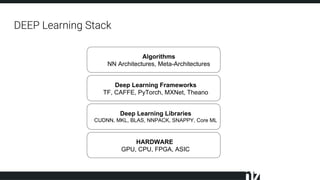
DEEP Learning Stack
HARDWARE
GPU, CPU, FPGA, ASIC
Deep Learning Libraries
CUDNN, MKL, BLAS, NNPACK, SNAPPY, Core ML
Deep Learning Frameworks
TF, CAFFE, PyTorch, MXNet, Theano
Algorithms
NN Architectures, Meta-Architectures
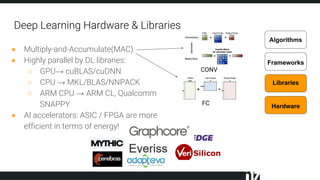
Deep Learning Hardware & Libraries
Hardware
Libraries
Frameworks
Algorithms
● Multiply-and-Accumulate(MAC)
● Highly parallel by DL libraries:
○ GPU→ cuBLAS/cuDNN
○ CPU → MKL/BLAS/NNPACK
○ ARM CPU → ARM CL, Qualcomm
SNAPPY
● AI accelerators: ASIC / FPGA are more
efficient in terms of energy!
CONV
FC
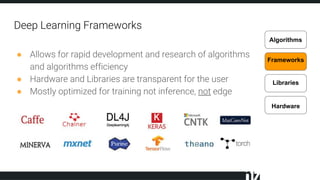
Deep Learning Frameworks
Hardware
Libraries
Frameworks
Algorithms
● Allows for rapid development and research of algorithms
and algorithms efficiency
● Hardware and Libraries are transparent for the user
● Mostly optimized for training not inference, not edge
Deep Learning Algorithms
Hardware
Libraries
Frameworks
Algorithms
Have a crucial role in efficiency since algorithms
define the model’s complexity and size
Evolution of CNN
Architectures
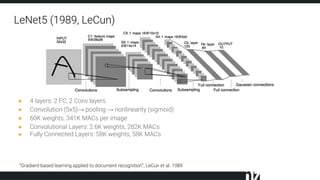
LeNet5 (1989, LeCun)
● 4 layers: 2 FC, 2 Conv layers.
● Convolution (5x5)→ pooling → nonlinearity (sigmoid)
● 60K weights, 341K MACs per image
● Convolutional Layers: 2.6K weights, 282K MACs
● Fully Connected Layers: 58K weights, 58K MACs
“Gradient-based learning applied to document recognition”, LeCun et al. 1989
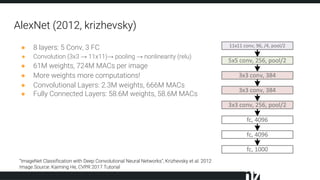
AlexNet (2012, krizhevsky)
● 8 layers: 5 Conv, 3 FC
● Convolution (3x3 → 11x11)→ pooling → nonlinearity (relu)
● 61M weights, 724M MACs per image
● More weights more computations!
● Convolutional Layers: 2.3M weights, 666M MACs
● Fully Connected Layers: 58.6M weights, 58.6M MACs
“ImageNet Classification with Deep Convolutional Neural Networks”, Krizhevsky et al. 2012
Image Source: Kaiming He, CVPR 2017 Tutorial
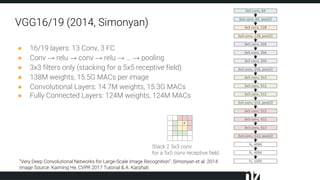
● 16/19 layers: 13 Conv, 3 FC
● Conv → relu → conv → relu → … → pooling
● 3x3 filters only (stacking for a 5x5 receptive field)
● 138M weights, 15.5G MACs per image
● Convolutional Layers: 14.7M weights, 15.3G MACs
● Fully Connected Layers: 124M weights, 124M MACs
VGG16/19 (2014, Simonyan)
Stack 2 3x3 conv
for a 5x5 conv receptive field.
“Very Deep Convolutional Networks for Large-Scale Image Recognition”, Simonyan et al. 2014
Image Source: Kaiming He, CVPR 2017 Tutorial & A. Karphati
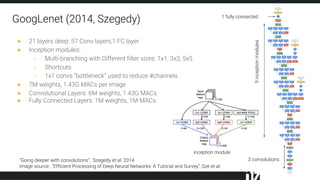
1 fully connected
GoogLenet (2014, Szegedy)
“Going deeper with convolutions”, Szegedy et al. 2014
Image source: .”Efficient Processing of Deep Neural Networks: A Tutorial and Survey”, Sze et al.
9inceptionmodules
inception module
3 convolutions
● 21 layers deep: 57 Conv layers,1 FC layer
● Inception modules:
○ Multi-branching with Different filter sizes: 1x1, 3x3, 5x5
○ Shortcuts
○ 1x1 convs “bottleneck” used to reduce #channels
● 7M weights, 1.43G MACs per image
● Convolutional Layers: 6M weights, 1.43G MACs
● Fully Connected Layers: 1M weights, 1M MACs
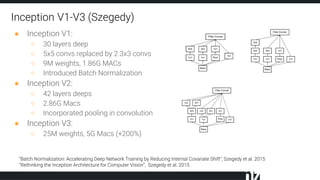
Inception V1-V3 (Szegedy)
● Inception V1:
○ 30 layers deep
○ 5x5 convs replaced by 2 3x3 convs
○ 9M weights, 1.86G MACs
○ Introduced Batch Normalization
● Inception V2:
○ 42 layers deeps
○ 2.86G Macs
○ Incorporated pooling in convolution
● Inception V3:
○ 25M weights, 5G Macs (+200%)
“Batch Normalization: Accelerating Deep Network Training by Reducing Internal Covariate Shift”, Szegedy et al. 2015
“Rethinking the Inception Architecture for Computer Vision”, Szegedy et al. 2015
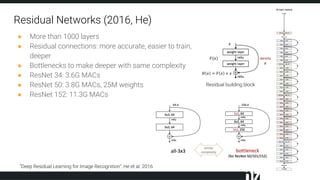
Residual Networks (2016, He)
“Deep Residual Learning for Image Recognition”, He et al. 2016
Residual building block
● More than 1000 layers
● Residual connections: more accurate, easier to train,
deeper
● Bottlenecks to make deeper with same complexity
● ResNet 34: 3.6G MACs
● ResNet 50: 3.8G MACs, 25M weights
● ResNet 152: 11.3G MACs
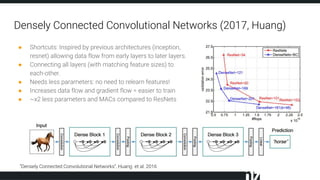
Densely Connected Convolutional Networks (2017, Huang)
● Shortcuts: Inspired by previous architectures (inception,
resnet) allowing data flow from early layers to later layers.
● Connecting all layers (with matching feature sizes) to
each-other.
● Needs less parameters: no need to relearn features!
● Increases data flow and gradient flow = easier to train
● ~x2 less parameters and MACs compared to ResNets
“Densely Connected Convolutional Networks”, Huang et al. 2016
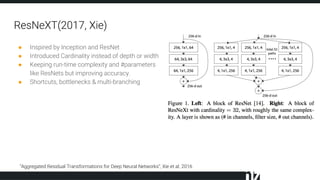
ResNeXT(2017, Xie)
● Inspired by Inception and ResNet
● Introduced Cardinality instead of depth or width
● Keeping run-time complexity and #parameters
like ResNets but improving accuracy.
● Shortcuts, bottlenecks & multi-branching
“Aggregated Residual Transformations for Deep Neural Networks”, Xie et al. 2016
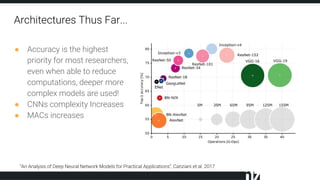
Architectures Thus Far...
● Accuracy is the highest
priority for most researchers,
even when able to reduce
computations, deeper more
complex models are used!
● CNNs complexity Increases
● MACs increases
“An Analysis of Deep Neural Network Models for Practical Applications”, Canziani et al. 2017
Fitting to Hardware
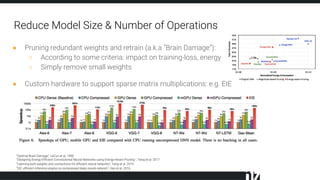
Reduce Model Size & Number of Operations
● Pruning redundant weights and retrain (a.k.a “Brain Damage”):
○ According to some criteria: impact on training-loss, energy
○ Simply remove small weights
● Custom hardware to support sparse matrix multiplications: e.g. EIE
”Optimal Brain Damage”, LeCun et al. 1990
“Designing Energy-Efficient Convolutional Neural Networks using Energy-Aware Pruning “, Yang et al. 2017
“Learning both weights and connections for efficient neural networks”, Yang et al. 2015
“EIE: efficient inference engine on compressed deep neural network”, Han et al. 2016
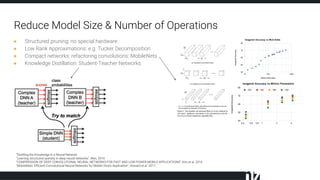
Reduce Model Size & Number of Operations
● Structured pruning: no special hardware
● Low Rank Approximations: e.g. Tucker Decomposition
● Compact networks: refactoring convolutions: MobileNets
● Knowledge Distillation: Student-Teacher Networks
“Distilling the Knowledge in a Neural Network
“Learning structured sparsity in deep neural networks“, Wen, 2016
“COMPRESSION OF DEEP CONVOLUTIONAL NEURAL NETWORKS FOR FAST AND LOW POWER MOBILE APPLICATIONS”, Kim et al. 2016
“MobileNets: Efficient Convolutional Neural Networks for Mobile Vision Application”, Howard et al. 2017
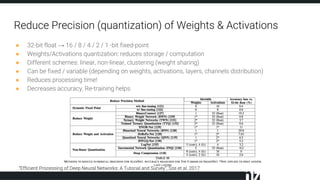
Reduce Precision (quantization) of Weights & Activations
● 32-bit float → 16 / 8 / 4 / 2 / 1 -bit fixed-point
● Weights/Activations quantization: reduces storage / computation
● Different schemes: linear, non-linear, clustering (weight sharing)
● Can be fixed / variable (depending on weights, activations, layers, channels distribution)
● Reduces processing time!
● Decreases accuracy, Re-training helps
”Efficient Processing of Deep Neural Networks: A Tutorial and Survey”, Sze et al. 2017
Brodmann17
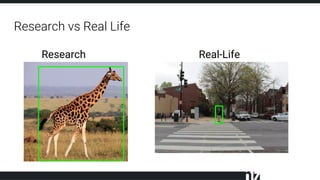
Research vs Real Life
Research Real-Life
Research vs Real Life
● Flickr/Google Images
● Large objects
● Center location
● Close classes distribution (1 of many)
● Balanced dataset (pos/neg)
● Unlimited Run-Time Resources
● In the wild
● small/medium/large objects
● All over
● Unconstrained (1 vs infinity)
● Highly UnBalanced
● Tight memory/storage/run-time
Research Real-Life
Real-life Applications On Edge Devices Checklist
1. Low memory footprint
2. High throughput
3. High Recall
4. FPR → 0
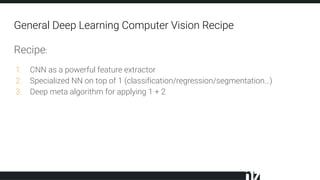
General Deep Learning Computer Vision Recipe
Recipe:
1. CNN as a powerful feature extractor
2. Specialized NN on top of 1 (classification/regression/segmentation…)
3. Deep meta algorithm for applying 1 + 2
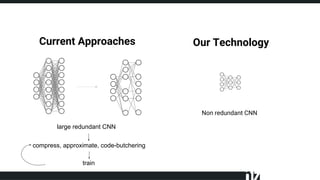
Current Approaches Our Technology
large redundant CNN
Non redundant CNN
compress, approximate, code-butchering
train
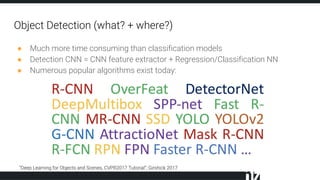
Object Detection (what? + where?)
● Much more time consuming than classification models
● Detection CNN = CNN feature extractor + Regression/Classification NN
● Numerous popular algorithms exist today:
”Deep Learning for Objects and Scenes, CVPR2017 Tutorial”, Girshick 2017
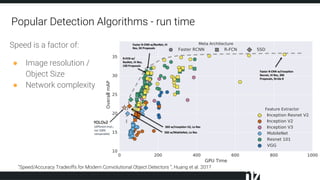
”Speed/Accuracy Tradeoffs for Modern Convolutional Object Detectors ”, Huang et al. 2017
Popular Detection Algorithms - run time
Speed is a factor of:
● Image resolution /
Object Size
● Network complexity
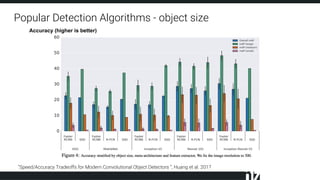
Popular Detection Algorithms - object size
”Speed/Accuracy Tradeoffs for Modern Convolutional Object Detectors ”, Huang et al. 2017
Accuracy (higher is better)
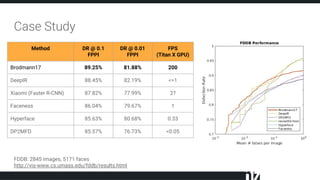
Case Study
Method DR @ 0.1
FPPI
DR @ 0.01
FPPI
FPS
(Titan X GPU)
Brodmann17 89.25% 81.88% 200
DeepIR 88.45% 82.19% <=1
Xiaomi (Faster R-CNN) 87.82% 77.99% 2?
Faceness 86.04% 79.67% 1
Hyperface 85.63% 80.68% 0.33
DP2MFD 85.57% 76.73% <0.05
FDDB: 2845 images, 5171 faces
http://vis-www.cs.umass.edu/fddb/results.html
Looking for brilliant
researchers
cv@brodmann17.com
Nir
Netanell
Ben
Ben
Yossi
Shai
30 FPS on 1xA72!

DLD meetup 2017, Efficient Deep Learning

  • 1.
  • 2.
    DEEP Neural Networkson Edge Devices ● State-of-the-art in many AI applications ● High computational complexity ● Inference efficiency (not training) ● Edge not Cloud Not on a Pricey GPU ● Maintain accuracy, fast and slim
  • 3.
    DEEP Learning Stack HARDWARE GPU,CPU, FPGA, ASIC Deep Learning Libraries CUDNN, MKL, BLAS, NNPACK, SNAPPY, Core ML Deep Learning Frameworks TF, CAFFE, PyTorch, MXNet, Theano Algorithms NN Architectures, Meta-Architectures
  • 4.
    Deep Learning Hardware& Libraries Hardware Libraries Frameworks Algorithms ● Multiply-and-Accumulate(MAC) ● Highly parallel by DL libraries: ○ GPU→ cuBLAS/cuDNN ○ CPU → MKL/BLAS/NNPACK ○ ARM CPU → ARM CL, Qualcomm SNAPPY ● AI accelerators: ASIC / FPGA are more efficient in terms of energy! CONV FC
  • 5.
    Deep Learning Frameworks Hardware Libraries Frameworks Algorithms ●Allows for rapid development and research of algorithms and algorithms efficiency ● Hardware and Libraries are transparent for the user ● Mostly optimized for training not inference, not edge
  • 6.
    Deep Learning Algorithms Hardware Libraries Frameworks Algorithms Havea crucial role in efficiency since algorithms define the model’s complexity and size
  • 7.
  • 8.
    LeNet5 (1989, LeCun) ●4 layers: 2 FC, 2 Conv layers. ● Convolution (5x5)→ pooling → nonlinearity (sigmoid) ● 60K weights, 341K MACs per image ● Convolutional Layers: 2.6K weights, 282K MACs ● Fully Connected Layers: 58K weights, 58K MACs “Gradient-based learning applied to document recognition”, LeCun et al. 1989
  • 9.
    AlexNet (2012, krizhevsky) ●8 layers: 5 Conv, 3 FC ● Convolution (3x3 → 11x11)→ pooling → nonlinearity (relu) ● 61M weights, 724M MACs per image ● More weights more computations! ● Convolutional Layers: 2.3M weights, 666M MACs ● Fully Connected Layers: 58.6M weights, 58.6M MACs “ImageNet Classification with Deep Convolutional Neural Networks”, Krizhevsky et al. 2012 Image Source: Kaiming He, CVPR 2017 Tutorial
  • 10.
    ● 16/19 layers:13 Conv, 3 FC ● Conv → relu → conv → relu → … → pooling ● 3x3 filters only (stacking for a 5x5 receptive field) ● 138M weights, 15.5G MACs per image ● Convolutional Layers: 14.7M weights, 15.3G MACs ● Fully Connected Layers: 124M weights, 124M MACs VGG16/19 (2014, Simonyan) Stack 2 3x3 conv for a 5x5 conv receptive field. “Very Deep Convolutional Networks for Large-Scale Image Recognition”, Simonyan et al. 2014 Image Source: Kaiming He, CVPR 2017 Tutorial & A. Karphati
  • 11.
    1 fully connected GoogLenet(2014, Szegedy) “Going deeper with convolutions”, Szegedy et al. 2014 Image source: .”Efficient Processing of Deep Neural Networks: A Tutorial and Survey”, Sze et al. 9inceptionmodules inception module 3 convolutions ● 21 layers deep: 57 Conv layers,1 FC layer ● Inception modules: ○ Multi-branching with Different filter sizes: 1x1, 3x3, 5x5 ○ Shortcuts ○ 1x1 convs “bottleneck” used to reduce #channels ● 7M weights, 1.43G MACs per image ● Convolutional Layers: 6M weights, 1.43G MACs ● Fully Connected Layers: 1M weights, 1M MACs
  • 12.
    Inception V1-V3 (Szegedy) ●Inception V1: ○ 30 layers deep ○ 5x5 convs replaced by 2 3x3 convs ○ 9M weights, 1.86G MACs ○ Introduced Batch Normalization ● Inception V2: ○ 42 layers deeps ○ 2.86G Macs ○ Incorporated pooling in convolution ● Inception V3: ○ 25M weights, 5G Macs (+200%) “Batch Normalization: Accelerating Deep Network Training by Reducing Internal Covariate Shift”, Szegedy et al. 2015 “Rethinking the Inception Architecture for Computer Vision”, Szegedy et al. 2015
  • 13.
    Residual Networks (2016,He) “Deep Residual Learning for Image Recognition”, He et al. 2016 Residual building block ● More than 1000 layers ● Residual connections: more accurate, easier to train, deeper ● Bottlenecks to make deeper with same complexity ● ResNet 34: 3.6G MACs ● ResNet 50: 3.8G MACs, 25M weights ● ResNet 152: 11.3G MACs
  • 14.
    Densely Connected ConvolutionalNetworks (2017, Huang) ● Shortcuts: Inspired by previous architectures (inception, resnet) allowing data flow from early layers to later layers. ● Connecting all layers (with matching feature sizes) to each-other. ● Needs less parameters: no need to relearn features! ● Increases data flow and gradient flow = easier to train ● ~x2 less parameters and MACs compared to ResNets “Densely Connected Convolutional Networks”, Huang et al. 2016
  • 15.
    ResNeXT(2017, Xie) ● Inspiredby Inception and ResNet ● Introduced Cardinality instead of depth or width ● Keeping run-time complexity and #parameters like ResNets but improving accuracy. ● Shortcuts, bottlenecks & multi-branching “Aggregated Residual Transformations for Deep Neural Networks”, Xie et al. 2016
  • 16.
    Architectures Thus Far... ●Accuracy is the highest priority for most researchers, even when able to reduce computations, deeper more complex models are used! ● CNNs complexity Increases ● MACs increases “An Analysis of Deep Neural Network Models for Practical Applications”, Canziani et al. 2017
  • 17.
  • 18.
    Reduce Model Size& Number of Operations ● Pruning redundant weights and retrain (a.k.a “Brain Damage”): ○ According to some criteria: impact on training-loss, energy ○ Simply remove small weights ● Custom hardware to support sparse matrix multiplications: e.g. EIE ”Optimal Brain Damage”, LeCun et al. 1990 “Designing Energy-Efficient Convolutional Neural Networks using Energy-Aware Pruning “, Yang et al. 2017 “Learning both weights and connections for efficient neural networks”, Yang et al. 2015 “EIE: efficient inference engine on compressed deep neural network”, Han et al. 2016
  • 19.
    Reduce Model Size& Number of Operations ● Structured pruning: no special hardware ● Low Rank Approximations: e.g. Tucker Decomposition ● Compact networks: refactoring convolutions: MobileNets ● Knowledge Distillation: Student-Teacher Networks “Distilling the Knowledge in a Neural Network “Learning structured sparsity in deep neural networks“, Wen, 2016 “COMPRESSION OF DEEP CONVOLUTIONAL NEURAL NETWORKS FOR FAST AND LOW POWER MOBILE APPLICATIONS”, Kim et al. 2016 “MobileNets: Efficient Convolutional Neural Networks for Mobile Vision Application”, Howard et al. 2017
  • 20.
    Reduce Precision (quantization)of Weights & Activations ● 32-bit float → 16 / 8 / 4 / 2 / 1 -bit fixed-point ● Weights/Activations quantization: reduces storage / computation ● Different schemes: linear, non-linear, clustering (weight sharing) ● Can be fixed / variable (depending on weights, activations, layers, channels distribution) ● Reduces processing time! ● Decreases accuracy, Re-training helps ”Efficient Processing of Deep Neural Networks: A Tutorial and Survey”, Sze et al. 2017
  • 21.
  • 22.
    Research vs RealLife Research Real-Life
  • 23.
    Research vs RealLife ● Flickr/Google Images ● Large objects ● Center location ● Close classes distribution (1 of many) ● Balanced dataset (pos/neg) ● Unlimited Run-Time Resources ● In the wild ● small/medium/large objects ● All over ● Unconstrained (1 vs infinity) ● Highly UnBalanced ● Tight memory/storage/run-time Research Real-Life
  • 24.
    Real-life Applications OnEdge Devices Checklist 1. Low memory footprint 2. High throughput 3. High Recall 4. FPR → 0
  • 25.
    General Deep LearningComputer Vision Recipe Recipe: 1. CNN as a powerful feature extractor 2. Specialized NN on top of 1 (classification/regression/segmentation…) 3. Deep meta algorithm for applying 1 + 2
  • 26.
    Current Approaches OurTechnology large redundant CNN Non redundant CNN compress, approximate, code-butchering train
  • 27.
    Object Detection (what?+ where?) ● Much more time consuming than classification models ● Detection CNN = CNN feature extractor + Regression/Classification NN ● Numerous popular algorithms exist today: ”Deep Learning for Objects and Scenes, CVPR2017 Tutorial”, Girshick 2017
  • 28.
    ”Speed/Accuracy Tradeoffs forModern Convolutional Object Detectors ”, Huang et al. 2017 Popular Detection Algorithms - run time Speed is a factor of: ● Image resolution / Object Size ● Network complexity
  • 29.
    Popular Detection Algorithms- object size ”Speed/Accuracy Tradeoffs for Modern Convolutional Object Detectors ”, Huang et al. 2017 Accuracy (higher is better)
  • 30.
    Case Study Method DR@ 0.1 FPPI DR @ 0.01 FPPI FPS (Titan X GPU) Brodmann17 89.25% 81.88% 200 DeepIR 88.45% 82.19% <=1 Xiaomi (Faster R-CNN) 87.82% 77.99% 2? Faceness 86.04% 79.67% 1 Hyperface 85.63% 80.68% 0.33 DP2MFD 85.57% 76.73% <0.05 FDDB: 2845 images, 5171 faces http://vis-www.cs.umass.edu/fddb/results.html
  • 31.