PHILIPPINE NORMAL UNIVERSITY
The National Center for Teacher Education
Technology and Livelihood Education Hub
South Luzon Campus
Lopez, Quezon
GED-ENG 01:
Purposive Communication
BTLE 2 - JHS
P
U
R
P
O
S
I
V
E
C
O
M
M
U
N
I
C
AT
I
O
N
Different
Types
of Speeches
P
U
R
P
O
S
I
V
E
C
O
M
M
U
N
I
C
AT
I
O
N
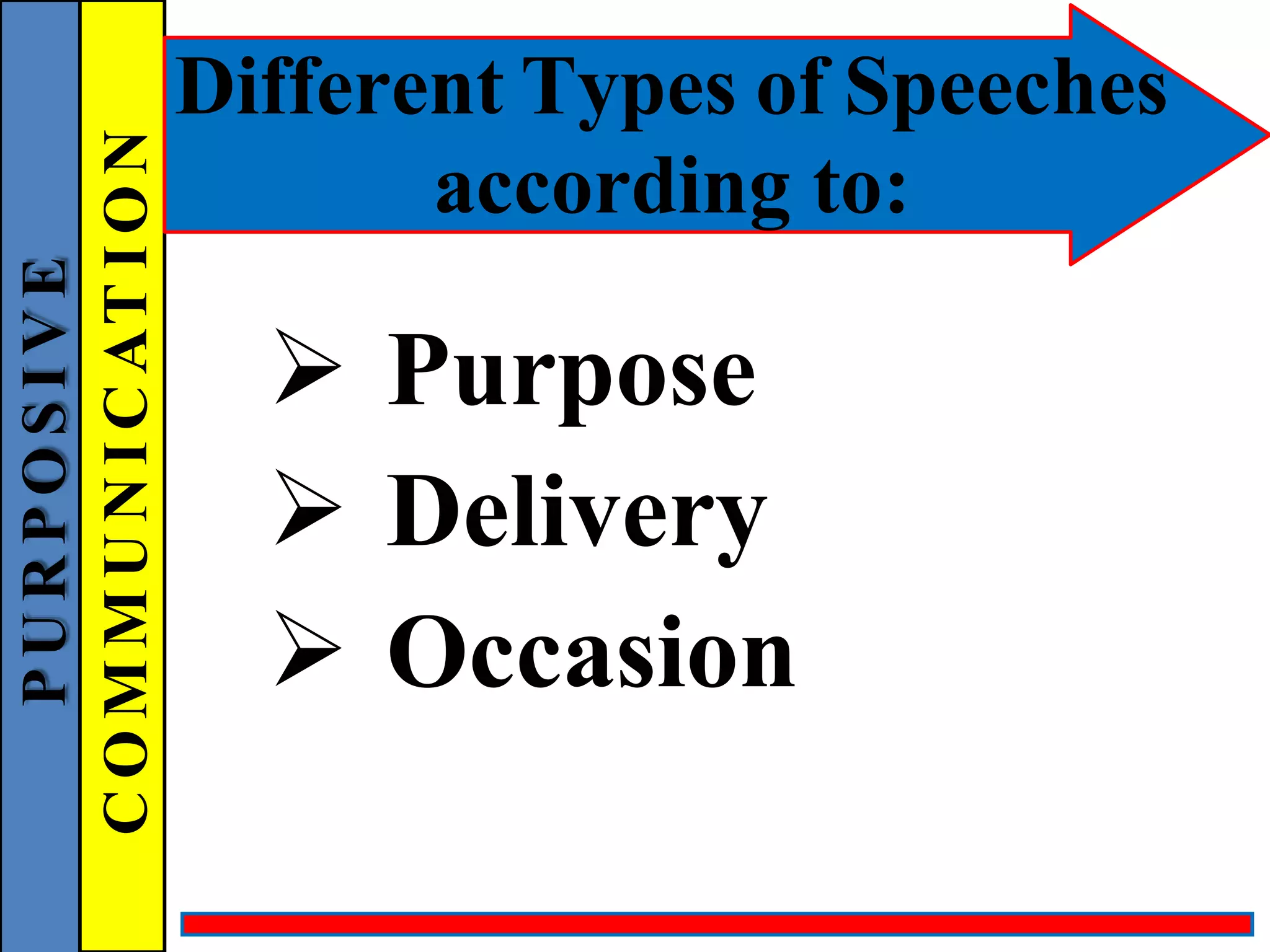
Different Types of Speeches
according to:
 Purpose
 Delivery
 Occasion
P
U
R
P
O
S
I
V
E
C
O
M
M
U
N
I
C
AT
I
O
N
Different Types
of Speeches
according to
PURPOSE
P
U
R
P
O
S
I
V
E
C
O
M
M
U
N
I
C
AT
I
O
N
Different Types of Speeches
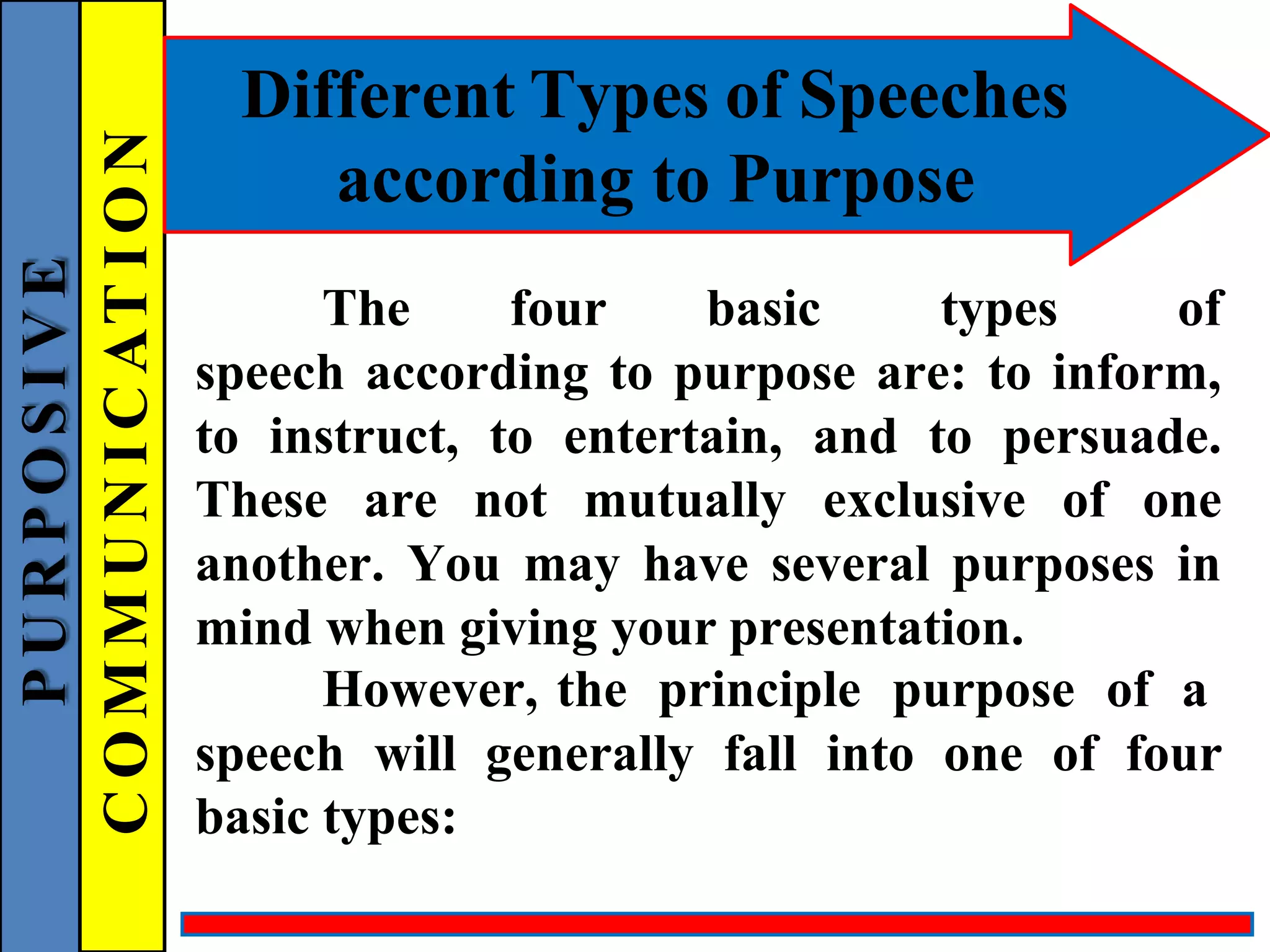
according to Purpose
The four basic types of
speech according to purpose are: to inform,
to instruct, to entertain, and to persuade.
These are not mutually exclusive of one
another. You may have several purposes in
mind when giving your presentation.
However, the principle purpose of a
speech will generally fall into one of four
basic types:
P
U
R
P
O
S
I
V
E
C
O
M
M
U
N
I
C
AT
I
O
N
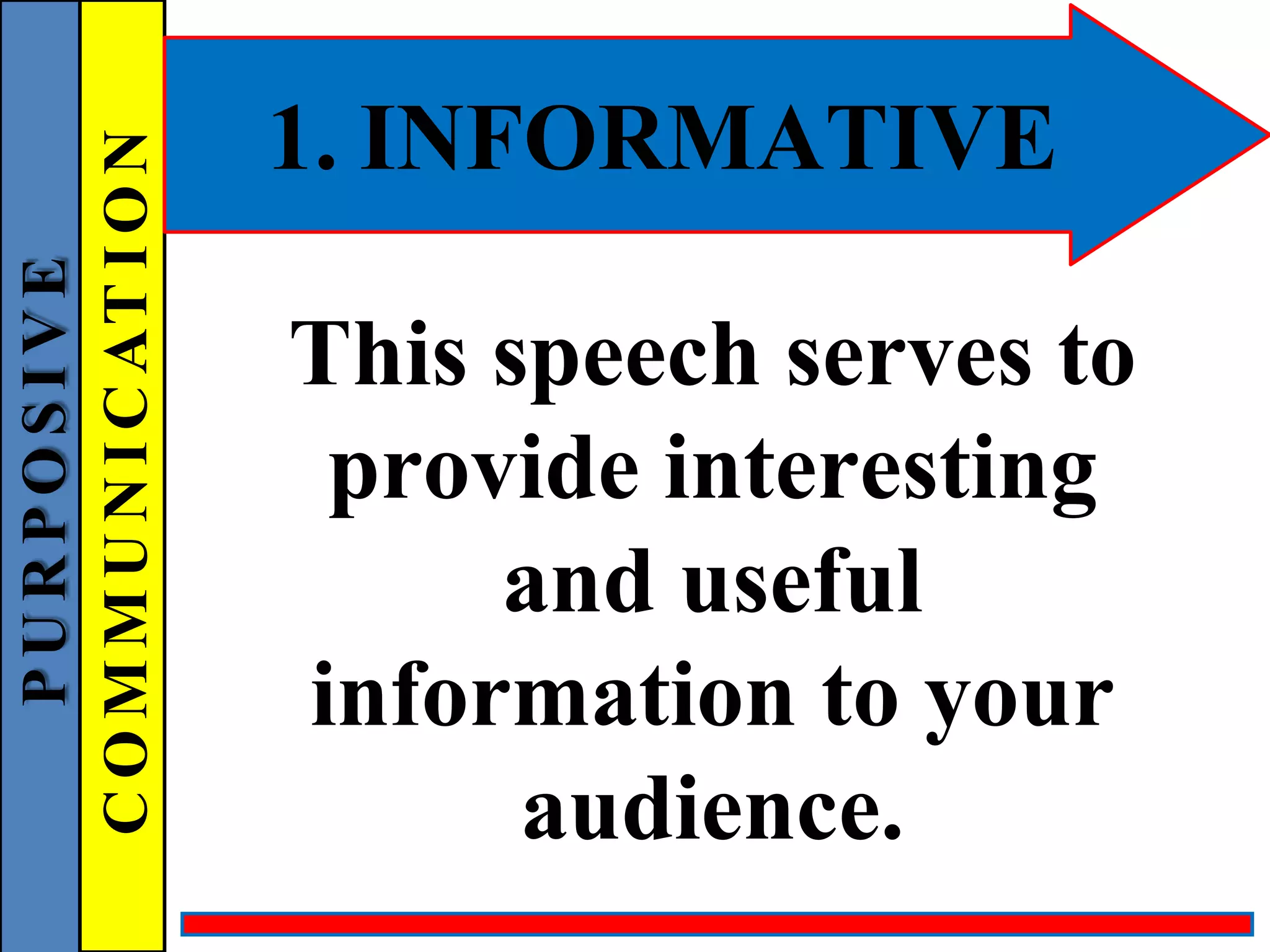
1. INFORMATIVE
This speech serves to
provide interesting
and useful
information to your
audience.
P
U
R
P
O
S
I
V
E
C
O
M
M
U
N
I
C
AT
I
O
N
1. INFORMATIVE
Example:
A teacher telling students
about earthquakes
 A student talking about her
research
P
U
R
P
O
S
I
V
E
C
O
M
M
U
N
I
C
AT
I
O
N
1. INFORMATIVE
Example:
A travelogue about the Tower
of London
A computer programmer
speaking about new software
P
U
R
P
O
S
I
V
E
C
O
M
M
U
N
I
C
AT
I
O
N
2. DEMONSTRATIVE
This has many similarities with
an informative speech. A
demonstrative speech also
teaches you something. The main
difference lies in including a
demonstration of how to do the
thing you’re teaching.
P
U
R
P
O
S
I
V
E
C
O
M
M
U
N
I
C
AT
I
O
N
2. DEMONSTRATIVE
Example:
How to start your own blog
How to bake a cake
How to write a speech
 How to… just about anything
P
U
R
P
O
S
I
V
E
C
O
M
M
U
N
I
C
AT
I
O
N
3. PERSUASIVE
A persuasive speech works to
convince people to change in
some way: they think, the
way they do something, or to
start doing something that
they are not currently doing.
P
U
R
P
O
S
I
V
E
C
O
M
M
U
N
I
C
AT
I
O
N
3. PERSUASIVE
Example:
Become an organ donor
Improve your health through
better eating
P
U
R
P
O
S
I
V
E
C
O
M
M
U
N
I
C
AT
I
O
N
3. PERSUASIVE
Example:
Television violence is
negatively influencing our
children
Become a volunteer and
change the world
P
U
R
P
O
S
I
V
E
C
O
M
M
U
N
I
C
AT
I
O
N
4. ENTERTAINING
The after-dinner speech is a
typical example of an
entertaining speech. The
speaker provides pleasure and
enjoyment that make the
audience laugh or identify with
anecdotal information.
P
U
R
P
O
S
I
V
E
C
O
M
M
U
N
I
C
AT
I
O
N
4. ENTERTAINING
Example:
Excuses for any occasion
Explaining cricket to an
American
Things you wouldn’t know
without the movies
P
U
R
P
O
S
I
V
E
C
O
M
M
U
N
I
C
AT
I
O
N
Effective preparation requires
identifying the purpose of
your speech. Once you’ve
identified your purpose, you
can move on to the objective
of your speech.
P
U
R
P
O
S
I
V
E
C
O
M
M
U
N
I
C
AT
I
O
N
Reference:
http://www.ismckenzie
.com/4-basic-types-of-
speeches/
P
U
R
P
O
S
I
V
E
C
O
M
M
U
N
I
C
AT
I
O
N
Different Types
of Speeches
according to
DELIVERY
P
U
R
P
O
S
I
V
E
C
O
M
M
U
N
I
C
AT
I
O
N
Different Types of Speeches
according to Delivery
The easiest approach to speech
delivery is not always the best.
Substantial work goes into the careful
preparation of an interesting and
ethical message, so it is understandable
that students may have the impulse to
avoid “messing it up” by simply
reading it word for word.
P
U
R
P
O
S
I
V
E
C
O
M
M
U
N
I
C
AT
I
O
N
1. IMPROMPTU
SPEAKING
It is the presentation of a
short message without advance
preparation. Impromptu
speeches often occur when
someone is asked to “say a few
words” or give a toast on a
special occasion.
P
U
R
P
O
S
I
V
E
C
O
M
M
U
N
I
C
AT
I
O
N
1. IMPROMPTU
SPEAKING
The advantage of this
kind of speaking is that it’s
spontaneous and responsive
in an animated group
context.
P
U
R
P
O
S
I
V
E
C
O
M
M
U
N
I
C
AT
I
O
N
1. IMPROMPTU
SPEAKING
The disadvantage is that the
speaker is given little or no time
to contemplate the central theme
of his or her message.
As a result, the message may
be disorganized and difficult for
listeners to follow.
P
U
R
P
O
S
I
V
E
C
O
M
M
U
N
I
C
AT
I
O
N
1. IMPROMPTU
SPEAKING
Impromptu speeches
are generally most
successful when they
are brief and focus on
a single point.
P
U
R
P
O
S
I
V
E
C
O
M
M
U
N
I
C
AT
I
O
N
2. EXTEMPORANEOUS
SPEAKING
Extemporaneous speaking is
the presentation of a carefully
planned and rehearsed speech,
spoken in a conversational
manner using brief notes.
P
U
R
P
O
S
I
V
E
C
O
M
M
U
N
I
C
AT
I
O
N
2. EXTEMPORANEOUS
SPEAKING
By using notes rather than a
full manuscript, the
extemporaneous speaker can
establish and maintain eye contact
with the audience and assess how
well they are understanding the
speech as it progresses.
P
U
R
P
O
S
I
V
E
C
O
M
M
U
N
I
C
AT
I
O
N
2. EXTEMPORANEOUS
SPEAKING
Speaking extemporaneously
has some advantages. It
promotes the likelihood that
you, the speaker, will be
perceived as knowledgeable and
credible.
P
U
R
P
O
S
I
V
E
C
O
M
M
U
N
I
C
AT
I
O
N
2. EXTEMPORANEOUS
SPEAKING
In addition, your
audience is likely to pay
better attention to the
message because it is
engaging both verbally and
nonverbally.
P
U
R
P
O
S
I
V
E
C
O
M
M
U
N
I
C
AT
I
O
N
2. EXTEMPORANEOUS
SPEAKING
The disadvantage of
extemporaneous speaking is that it
requires a great deal of preparation
for both the verbal and the
nonverbal components of the
speech. Adequate preparation
cannot be achieved the day before
you’re scheduled to speak.
P
U
R
P
O
S
I
V
E
C
O
M
M
U
N
I
C
AT
I
O
N
3. SPEAKING FROM A
MANUSCRIPT
Manuscript speaking is the
word-for-word iteration of a
written message. In a
manuscript speech, the speaker
maintains his or her attention
on the printed page except when
using visual aids.
P
U
R
P
O
S
I
V
E
C
O
M
M
U
N
I
C
AT
I
O
N
3. SPEAKING FROM A
MANUSCRIPT
The advantage to reading
from a manuscript is the exact
repetition of original words. As
we mentioned at the beginning
of this chapter, in some
circumstances this can be
extremely important.
P
U
R
P
O
S
I
V
E
C
O
M
M
U
N
I
C
AT
I
O
N
4. SPEAKING FROM
MEMORY
Memorized speaking is
the rote recitation of a
written message that the
speaker has committed to
memory.
P
U
R
P
O
S
I
V
E
C
O
M
M
U
N
I
C
AT
I
O
N
4. SPEAKING FROM
MEMORY
When it comes to
speeches, memorization can
be useful when the message
needs to be exact and the
speaker doesn’t want to be
confined by notes.
P
U
R
P
O
S
I
V
E
C
O
M
M
U
N
I
C
AT
I
O
N
4. SPEAKING FROM
MEMORY
The advantage to
memorization is that it
enables the speaker to
maintain eye contact with
the audience throughout
the speech.
P
U
R
P
O
S
I
V
E
C
O
M
M
U
N
I
C
AT
I
O
N
Reference:
http://2012books.lardbucket.
org/books/public-speaking-
practice-and-ethics/s17-01-
four-methods-of-delivery.html
P
U
R
P
O
S
I
V
E
C
O
M
M
U
N
I
C
AT
I
O
N
Different Types
of Speeches
according to
OCCASION
P
U
R
P
O
S
I
V
E
C
O
M
M
U
N
I
C
AT
I
O
N
CEREMONIAL
SPEAKING
Ceremonial speeches are
speeches given during a ceremony
or a ritual marked by observance of
formality or etiquette. These
ceremonies tend to be very special
for people, so it shouldn’t be
surprising that they are
opportunities for speech making.
P
U
R
P
O
S
I
V
E
C
O
M
M
U
N
I
C
AT
I
O
N
CEREMONIAL
SPEAKING
A. Speeches of Introduction
The first type of speech is
called the speech of introduction,
which is a mini speech given by
the host of a ceremony that
introduces another speaker and
his or her speech.
P
U
R
P
O
S
I
V
E
C
O
M
M
U
N
I
C
AT
I
O
N
CEREMONIAL
SPEAKING
A. Speeches of Introduction
Just like any other speech,
a speech of introduction should
be a complete speech and have
a clear introduction, body, and
conclusion—and you should do
it all in under two minutes.
P
U
R
P
O
S
I
V
E
C
O
M
M
U
N
I
C
AT
I
O
N
CEREMONIAL
SPEAKING
A. Speeches of Introduction
For an introduction, think
of a hook that will make your
audience interested in the
upcoming speaker.
P
U
R
P
O
S
I
V
E
C
O
M
M
U
N
I
C
AT
I
O
N
CEREMONIAL
SPEAKING
A. Speeches of Introduction
The body of your
introductory speech should be
devoted to telling the audience
about the speaker’s topic, why the
speaker is qualified, and why the
audience should listen.
P
U
R
P
O
S
I
V
E
C
O
M
M
U
N
I
C
AT
I
O
N
CEREMONIAL
SPEAKING
A. Speeches of Introduction
The final part of a good
introduction is the conclusion,
which is generally designed to
welcome the speaker to the
lectern.
P
U
R
P
O
S
I
V
E
C
O
M
M
U
N
I
C
AT
I
O
N
CEREMONIAL
SPEAKING
B. Speeches of Presentation
A speech of
presentation is a brief
speech given to accompany
a prize or honor.
P
U
R
P
O
S
I
V
E
C
O
M
M
U
N
I
C
AT
I
O
N
CEREMONIAL
SPEAKING
B. Speeches of Presentation
When preparing a speech
of presentation, it’s
always important to ask
how long the speech
should be.
P
U
R
P
O
S
I
V
E
C
O
M
M
U
N
I
C
AT
I
O
N
CEREMONIAL
SPEAKING
B. Speeches of Presentation
First, you should
explain what the award
or honor is and why the
presentation is important.
P
U
R
P
O
S
I
V
E
C
O
M
M
U
N
I
C
AT
I
O
N
CEREMONIAL
SPEAKING
B. Speeches of Presentation
Second, you can
explain what the recipient
has accomplished in order
for the award to be
bestowed.
P
U
R
P
O
S
I
V
E
C
O
M
M
U
N
I
C
AT
I
O
N
CEREMONIAL
SPEAKING
B. Speeches of Presentation
Did the person win a race?
Did the person write an important
piece of literature? Did the person
mediate conflict? Whatever the
recipient has done, you need to
clearly highlight his or her work.
P
U
R
P
O
S
I
V
E
C
O
M
M
U
N
I
C
AT
I
O
N
CEREMONIAL
SPEAKING
B. Speeches of Presentation
Lastly, if the race or
competition was conducted in a
public forum and numerous
people didn’t win, you may
want to recognize those people
for their efforts as well.
P
U
R
P
O
S
I
V
E
C
O
M
M
U
N
I
C
AT
I
O
N
CEREMONIAL
SPEAKING
C. Speeches of Dedication
A speech of dedication is
delivered when a new store
opens, a building is named after
someone, a plaque is placed on a
wall, a new library is completed,
and so on.
P
U
R
P
O
S
I
V
E
C
O
M
M
U
N
I
C
AT
I
O
N
CEREMONIAL
SPEAKING
C. Speeches of Dedication
These speeches are
designed to highlight the
importance of the project and
possibly those to whom the
project has been dedicated.
P
U
R
P
O
S
I
V
E
C
O
M
M
U
N
I
C
AT
I
O
N
CEREMONIAL
SPEAKING
D. Toasts
A toast is a speech
designed to congratulate,
appreciate, or remember.
P
U
R
P
O
S
I
V
E
C
O
M
M
U
N
I
C
AT
I
O
N
CEREMONIAL
SPEAKING
D. Toasts
First, toasts can be delivered
for the purpose of congratulating
someone for an honor, a new job, or
getting married. You can also toast
someone to show your appreciation
for something they’ve done.
P
U
R
P
O
S
I
V
E
C
O
M
M
U
N
I
C
AT
I
O
N
CEREMONIAL
SPEAKING
D. Toasts
Lastly, we toast
people to remember them
and what they have
accomplished.
P
U
R
P
O
S
I
V
E
C
O
M
M
U
N
I
C
AT
I
O
N
CEREMONIAL
SPEAKING
D. Toasts
When preparing a toast, the
first goal is always to keep your
remarks brief. Toasts are generally
given during the middle of some
kind of festivities (e.g., wedding,
retirement party, farewell party).
P
U
R
P
O
S
I
V
E
C
O
M
M
U
N
I
C
AT
I
O
N
CEREMONIAL
SPEAKING
D. Toasts
Second, the goal of a
toast is to focus attention
on the person or persons
being toasted—not on the
speaker
P
U
R
P
O
S
I
V
E
C
O
M
M
U
N
I
C
AT
I
O
N
CEREMONIAL
SPEAKING
E. Roasts
The roast speech is a very
interesting and peculiar speech
because it is designed to both
praise and good-naturedly
insult a person being honored.
P
U
R
P
O
S
I
V
E
C
O
M
M
U
N
I
C
AT
I
O
N
CEREMONIAL
SPEAKING
E. Roasts
Generally, roasts are
given at the conclusion of a
banquet in honor of
someone’s life achievements.
P
U
R
P
O
S
I
V
E
C
O
M
M
U
N
I
C
AT
I
O
N
CEREMONIAL
SPEAKING
E. Eulogies
A eulogy is a
speech given in
honor of someone
who has died.
P
U
R
P
O
S
I
V
E
C
O
M
M
U
N
I
C
AT
I
O
N
CEREMONIAL
SPEAKING
F. Speeches of Farewell
A speech of farewell allows
someone to say good-bye to one
part of his or her life as he or
she is moving on to the next
part of life.
P
U
R
P
O
S
I
V
E
C
O
M
M
U
N
I
C
AT
I
O
N
CEREMONIAL
SPEAKING
F. Speeches of Farewell
Maybe you’ve accepted a
new job and are leaving your
current job, or you’re
graduating from college and
entering the work force.
P
U
R
P
O
S
I
V
E
C
O
M
M
U
N
I
C
AT
I
O
N
INSPIRATIONAL
SPEAKING
The goal of
an inspirational speech is
to elicit or arouse an
emotional state within an
audience.
P
U
R
P
O
S
I
V
E
C
O
M
M
U
N
I
C
AT
I
O
N
INSPIRATIONAL
SPEAKING
A. Speeches to Ensure Goodwill
Goodwill is an
intangible asset that is made
up of the favor or reputation
of an individual or
organization.
P
U
R
P
O
S
I
V
E
C
O
M
M
U
N
I
C
AT
I
O
N
INSPIRATIONAL
SPEAKING
A. Speeches to Ensure Goodwill
Speeches of goodwill are
often given in an attempt to get
audience members to view the
person or organization more
favorably.
P
U
R
P
O
S
I
V
E
C
O
M
M
U
N
I
C
AT
I
O
N
INSPIRATIONAL
SPEAKING
A. Speeches to Ensure Goodwill
Although speeches of goodwill
are clearly persuasive, they try not to
be obvious about the persuasive
intent and are often delivered as
information-giving speeches that
focus on an individual or
organization’s positives attributes.
P
U
R
P
O
S
I
V
E
C
O
M
M
U
N
I
C
AT
I
O
N
INSPIRATIONAL
SPEAKING
A. Speeches to Ensure Goodwill
There are three basic
types of speeches of
goodwill: public relations,
justification, and apology.
P
U
R
P
O
S
I
V
E
C
O
M
M
U
N
I
C
AT
I
O
N
INSPIRATIONAL
SPEAKING
A. 1. Speeches for Public Relations
In a public relations
speech, the speaker is
speaking to enhance one’s
own image or the image of
his or her organization.
P
U
R
P
O
S
I
V
E
C
O
M
M
U
N
I
C
AT
I
O
N
INSPIRATIONAL
SPEAKING
A. 1. Speeches for Public Relations
You can almost think of
these speeches as cheerleading
speeches because the ultimate
goal is to get people to like the
speaker and what he or she
represents.
P
U
R
P
O
S
I
V
E
C
O
M
M
U
N
I
C
AT
I
O
N
INSPIRATIONAL
SPEAKING
A. 2. Speeches for Justification
The second common
speech of goodwill is the
speech of justification, which is
given when someone attempts
to defend why certain actions
were taken or will be taken.
P
U
R
P
O
S
I
V
E
C
O
M
M
U
N
I
C
AT
I
O
N
INSPIRATIONAL
SPEAKING
A. 2. Speeches for Justification
In these speeches, speakers
have already enacted (or
decided to enact) some kind of
behavior, and are now
attempting to justify why the
behavior is or was appropriate.
P
U
R
P
O
S
I
V
E
C
O
M
M
U
N
I
C
AT
I
O
N
INSPIRATIONAL
SPEAKING
A. 3. Speeches of Apology
These speeches have become
more and more commonplace.
Every time we turn around, a
politician, professional athlete,
musician, or actor/actress is doing
something reprehensible and getting
caught.
P
U
R
P
O
S
I
V
E
C
O
M
M
U
N
I
C
AT
I
O
N
INSPIRATIONAL
SPEAKING
A. 3. Speeches of Apology
In fact, the speech of
apology has quickly
become a fodder for
humor as well.
P
U
R
P
O
S
I
V
E
C
O
M
M
U
N
I
C
AT
I
O
N
INSPIRATIONAL
SPEAKING
B. Speeches for Commencements
The second type of
inspirational speech is the speech
of commencement, which is
designed to recognize and celebrate
the achievements of a graduating
class or other group of people.
P
U
R
P
O
S
I
V
E
C
O
M
M
U
N
I
C
AT
I
O
N
INSPIRATIONAL
SPEAKING
B. Speeches for Commencements
The most typical
form of commencement
speech happens when
someone graduates
from school.
P
U
R
P
O
S
I
V
E
C
O
M
M
U
N
I
C
AT
I
O
N
Reference:
http://2012books.lardbucket.org/
books/public-speaking-practice-
and-ethics/s21-02-special-
occasion-speeches.html
P
U
R
P
O
S
I
V
E
C
O
M
M
U
N
I
C
AT
I
O
N
Prepared by:
CERDON, Jayson R.
DAPOG, Jake J.
DE CASTRO, Juwan P.
P
U
R
P
O
S
I
V
E
C
O
M
M
U
N
I
C
AT
I
O
N

purposivecommunication-160716015902.docx

  • 1.
    PHILIPPINE NORMAL UNIVERSITY TheNational Center for Teacher Education Technology and Livelihood Education Hub South Luzon Campus Lopez, Quezon GED-ENG 01: Purposive Communication BTLE 2 - JHS P U R P O S I V E C O M M U N I C AT I O N
  • 2.
  • 3.
    Different Types ofSpeeches according to:  Purpose  Delivery  Occasion P U R P O S I V E C O M M U N I C AT I O N
  • 4.
    Different Types of Speeches accordingto PURPOSE P U R P O S I V E C O M M U N I C AT I O N
  • 5.
    Different Types ofSpeeches according to Purpose The four basic types of speech according to purpose are: to inform, to instruct, to entertain, and to persuade. These are not mutually exclusive of one another. You may have several purposes in mind when giving your presentation. However, the principle purpose of a speech will generally fall into one of four basic types: P U R P O S I V E C O M M U N I C AT I O N
  • 6.
    1. INFORMATIVE This speechserves to provide interesting and useful information to your audience. P U R P O S I V E C O M M U N I C AT I O N
  • 7.
    1. INFORMATIVE Example: A teachertelling students about earthquakes  A student talking about her research P U R P O S I V E C O M M U N I C AT I O N
  • 8.
    1. INFORMATIVE Example: A travelogueabout the Tower of London A computer programmer speaking about new software P U R P O S I V E C O M M U N I C AT I O N
  • 9.
    2. DEMONSTRATIVE This hasmany similarities with an informative speech. A demonstrative speech also teaches you something. The main difference lies in including a demonstration of how to do the thing you’re teaching. P U R P O S I V E C O M M U N I C AT I O N
  • 10.
    2. DEMONSTRATIVE Example: How tostart your own blog How to bake a cake How to write a speech  How to… just about anything P U R P O S I V E C O M M U N I C AT I O N
  • 11.
    3. PERSUASIVE A persuasivespeech works to convince people to change in some way: they think, the way they do something, or to start doing something that they are not currently doing. P U R P O S I V E C O M M U N I C AT I O N
  • 12.
    3. PERSUASIVE Example: Become anorgan donor Improve your health through better eating P U R P O S I V E C O M M U N I C AT I O N
  • 13.
    3. PERSUASIVE Example: Television violenceis negatively influencing our children Become a volunteer and change the world P U R P O S I V E C O M M U N I C AT I O N
  • 14.
    4. ENTERTAINING The after-dinnerspeech is a typical example of an entertaining speech. The speaker provides pleasure and enjoyment that make the audience laugh or identify with anecdotal information. P U R P O S I V E C O M M U N I C AT I O N
  • 15.
    4. ENTERTAINING Example: Excuses forany occasion Explaining cricket to an American Things you wouldn’t know without the movies P U R P O S I V E C O M M U N I C AT I O N
  • 16.
    Effective preparation requires identifyingthe purpose of your speech. Once you’ve identified your purpose, you can move on to the objective of your speech. P U R P O S I V E C O M M U N I C AT I O N
  • 17.
  • 18.
    Different Types of Speeches accordingto DELIVERY P U R P O S I V E C O M M U N I C AT I O N
  • 19.
    Different Types ofSpeeches according to Delivery The easiest approach to speech delivery is not always the best. Substantial work goes into the careful preparation of an interesting and ethical message, so it is understandable that students may have the impulse to avoid “messing it up” by simply reading it word for word. P U R P O S I V E C O M M U N I C AT I O N
  • 20.
    1. IMPROMPTU SPEAKING It isthe presentation of a short message without advance preparation. Impromptu speeches often occur when someone is asked to “say a few words” or give a toast on a special occasion. P U R P O S I V E C O M M U N I C AT I O N
  • 21.
    1. IMPROMPTU SPEAKING The advantageof this kind of speaking is that it’s spontaneous and responsive in an animated group context. P U R P O S I V E C O M M U N I C AT I O N
  • 22.
    1. IMPROMPTU SPEAKING The disadvantageis that the speaker is given little or no time to contemplate the central theme of his or her message. As a result, the message may be disorganized and difficult for listeners to follow. P U R P O S I V E C O M M U N I C AT I O N
  • 23.
    1. IMPROMPTU SPEAKING Impromptu speeches aregenerally most successful when they are brief and focus on a single point. P U R P O S I V E C O M M U N I C AT I O N
  • 24.
    2. EXTEMPORANEOUS SPEAKING Extemporaneous speakingis the presentation of a carefully planned and rehearsed speech, spoken in a conversational manner using brief notes. P U R P O S I V E C O M M U N I C AT I O N
  • 25.
    2. EXTEMPORANEOUS SPEAKING By usingnotes rather than a full manuscript, the extemporaneous speaker can establish and maintain eye contact with the audience and assess how well they are understanding the speech as it progresses. P U R P O S I V E C O M M U N I C AT I O N
  • 26.
    2. EXTEMPORANEOUS SPEAKING Speaking extemporaneously hassome advantages. It promotes the likelihood that you, the speaker, will be perceived as knowledgeable and credible. P U R P O S I V E C O M M U N I C AT I O N
  • 27.
    2. EXTEMPORANEOUS SPEAKING In addition,your audience is likely to pay better attention to the message because it is engaging both verbally and nonverbally. P U R P O S I V E C O M M U N I C AT I O N
  • 28.
    2. EXTEMPORANEOUS SPEAKING The disadvantageof extemporaneous speaking is that it requires a great deal of preparation for both the verbal and the nonverbal components of the speech. Adequate preparation cannot be achieved the day before you’re scheduled to speak. P U R P O S I V E C O M M U N I C AT I O N
  • 29.
    3. SPEAKING FROMA MANUSCRIPT Manuscript speaking is the word-for-word iteration of a written message. In a manuscript speech, the speaker maintains his or her attention on the printed page except when using visual aids. P U R P O S I V E C O M M U N I C AT I O N
  • 30.
    3. SPEAKING FROMA MANUSCRIPT The advantage to reading from a manuscript is the exact repetition of original words. As we mentioned at the beginning of this chapter, in some circumstances this can be extremely important. P U R P O S I V E C O M M U N I C AT I O N
  • 31.
    4. SPEAKING FROM MEMORY Memorizedspeaking is the rote recitation of a written message that the speaker has committed to memory. P U R P O S I V E C O M M U N I C AT I O N
  • 32.
    4. SPEAKING FROM MEMORY Whenit comes to speeches, memorization can be useful when the message needs to be exact and the speaker doesn’t want to be confined by notes. P U R P O S I V E C O M M U N I C AT I O N
  • 33.
    4. SPEAKING FROM MEMORY Theadvantage to memorization is that it enables the speaker to maintain eye contact with the audience throughout the speech. P U R P O S I V E C O M M U N I C AT I O N
  • 34.
  • 35.
    Different Types of Speeches accordingto OCCASION P U R P O S I V E C O M M U N I C AT I O N
  • 36.
    CEREMONIAL SPEAKING Ceremonial speeches are speechesgiven during a ceremony or a ritual marked by observance of formality or etiquette. These ceremonies tend to be very special for people, so it shouldn’t be surprising that they are opportunities for speech making. P U R P O S I V E C O M M U N I C AT I O N
  • 37.
    CEREMONIAL SPEAKING A. Speeches ofIntroduction The first type of speech is called the speech of introduction, which is a mini speech given by the host of a ceremony that introduces another speaker and his or her speech. P U R P O S I V E C O M M U N I C AT I O N
  • 38.
    CEREMONIAL SPEAKING A. Speeches ofIntroduction Just like any other speech, a speech of introduction should be a complete speech and have a clear introduction, body, and conclusion—and you should do it all in under two minutes. P U R P O S I V E C O M M U N I C AT I O N
  • 39.
    CEREMONIAL SPEAKING A. Speeches ofIntroduction For an introduction, think of a hook that will make your audience interested in the upcoming speaker. P U R P O S I V E C O M M U N I C AT I O N
  • 40.
    CEREMONIAL SPEAKING A. Speeches ofIntroduction The body of your introductory speech should be devoted to telling the audience about the speaker’s topic, why the speaker is qualified, and why the audience should listen. P U R P O S I V E C O M M U N I C AT I O N
  • 41.
    CEREMONIAL SPEAKING A. Speeches ofIntroduction The final part of a good introduction is the conclusion, which is generally designed to welcome the speaker to the lectern. P U R P O S I V E C O M M U N I C AT I O N
  • 42.
    CEREMONIAL SPEAKING B. Speeches ofPresentation A speech of presentation is a brief speech given to accompany a prize or honor. P U R P O S I V E C O M M U N I C AT I O N
  • 43.
    CEREMONIAL SPEAKING B. Speeches ofPresentation When preparing a speech of presentation, it’s always important to ask how long the speech should be. P U R P O S I V E C O M M U N I C AT I O N
  • 44.
    CEREMONIAL SPEAKING B. Speeches ofPresentation First, you should explain what the award or honor is and why the presentation is important. P U R P O S I V E C O M M U N I C AT I O N
  • 45.
    CEREMONIAL SPEAKING B. Speeches ofPresentation Second, you can explain what the recipient has accomplished in order for the award to be bestowed. P U R P O S I V E C O M M U N I C AT I O N
  • 46.
    CEREMONIAL SPEAKING B. Speeches ofPresentation Did the person win a race? Did the person write an important piece of literature? Did the person mediate conflict? Whatever the recipient has done, you need to clearly highlight his or her work. P U R P O S I V E C O M M U N I C AT I O N
  • 47.
    CEREMONIAL SPEAKING B. Speeches ofPresentation Lastly, if the race or competition was conducted in a public forum and numerous people didn’t win, you may want to recognize those people for their efforts as well. P U R P O S I V E C O M M U N I C AT I O N
  • 48.
    CEREMONIAL SPEAKING C. Speeches ofDedication A speech of dedication is delivered when a new store opens, a building is named after someone, a plaque is placed on a wall, a new library is completed, and so on. P U R P O S I V E C O M M U N I C AT I O N
  • 49.
    CEREMONIAL SPEAKING C. Speeches ofDedication These speeches are designed to highlight the importance of the project and possibly those to whom the project has been dedicated. P U R P O S I V E C O M M U N I C AT I O N
  • 50.
    CEREMONIAL SPEAKING D. Toasts A toastis a speech designed to congratulate, appreciate, or remember. P U R P O S I V E C O M M U N I C AT I O N
  • 51.
    CEREMONIAL SPEAKING D. Toasts First, toastscan be delivered for the purpose of congratulating someone for an honor, a new job, or getting married. You can also toast someone to show your appreciation for something they’ve done. P U R P O S I V E C O M M U N I C AT I O N
  • 52.
    CEREMONIAL SPEAKING D. Toasts Lastly, wetoast people to remember them and what they have accomplished. P U R P O S I V E C O M M U N I C AT I O N
  • 53.
    CEREMONIAL SPEAKING D. Toasts When preparinga toast, the first goal is always to keep your remarks brief. Toasts are generally given during the middle of some kind of festivities (e.g., wedding, retirement party, farewell party). P U R P O S I V E C O M M U N I C AT I O N
  • 54.
    CEREMONIAL SPEAKING D. Toasts Second, thegoal of a toast is to focus attention on the person or persons being toasted—not on the speaker P U R P O S I V E C O M M U N I C AT I O N
  • 55.
    CEREMONIAL SPEAKING E. Roasts The roastspeech is a very interesting and peculiar speech because it is designed to both praise and good-naturedly insult a person being honored. P U R P O S I V E C O M M U N I C AT I O N
  • 56.
    CEREMONIAL SPEAKING E. Roasts Generally, roastsare given at the conclusion of a banquet in honor of someone’s life achievements. P U R P O S I V E C O M M U N I C AT I O N
  • 57.
    CEREMONIAL SPEAKING E. Eulogies A eulogyis a speech given in honor of someone who has died. P U R P O S I V E C O M M U N I C AT I O N
  • 58.
    CEREMONIAL SPEAKING F. Speeches ofFarewell A speech of farewell allows someone to say good-bye to one part of his or her life as he or she is moving on to the next part of life. P U R P O S I V E C O M M U N I C AT I O N
  • 59.
    CEREMONIAL SPEAKING F. Speeches ofFarewell Maybe you’ve accepted a new job and are leaving your current job, or you’re graduating from college and entering the work force. P U R P O S I V E C O M M U N I C AT I O N
  • 60.
    INSPIRATIONAL SPEAKING The goal of aninspirational speech is to elicit or arouse an emotional state within an audience. P U R P O S I V E C O M M U N I C AT I O N
  • 61.
    INSPIRATIONAL SPEAKING A. Speeches toEnsure Goodwill Goodwill is an intangible asset that is made up of the favor or reputation of an individual or organization. P U R P O S I V E C O M M U N I C AT I O N
  • 62.
    INSPIRATIONAL SPEAKING A. Speeches toEnsure Goodwill Speeches of goodwill are often given in an attempt to get audience members to view the person or organization more favorably. P U R P O S I V E C O M M U N I C AT I O N
  • 63.
    INSPIRATIONAL SPEAKING A. Speeches toEnsure Goodwill Although speeches of goodwill are clearly persuasive, they try not to be obvious about the persuasive intent and are often delivered as information-giving speeches that focus on an individual or organization’s positives attributes. P U R P O S I V E C O M M U N I C AT I O N
  • 64.
    INSPIRATIONAL SPEAKING A. Speeches toEnsure Goodwill There are three basic types of speeches of goodwill: public relations, justification, and apology. P U R P O S I V E C O M M U N I C AT I O N
  • 65.
    INSPIRATIONAL SPEAKING A. 1. Speechesfor Public Relations In a public relations speech, the speaker is speaking to enhance one’s own image or the image of his or her organization. P U R P O S I V E C O M M U N I C AT I O N
  • 66.
    INSPIRATIONAL SPEAKING A. 1. Speechesfor Public Relations You can almost think of these speeches as cheerleading speeches because the ultimate goal is to get people to like the speaker and what he or she represents. P U R P O S I V E C O M M U N I C AT I O N
  • 67.
    INSPIRATIONAL SPEAKING A. 2. Speechesfor Justification The second common speech of goodwill is the speech of justification, which is given when someone attempts to defend why certain actions were taken or will be taken. P U R P O S I V E C O M M U N I C AT I O N
  • 68.
    INSPIRATIONAL SPEAKING A. 2. Speechesfor Justification In these speeches, speakers have already enacted (or decided to enact) some kind of behavior, and are now attempting to justify why the behavior is or was appropriate. P U R P O S I V E C O M M U N I C AT I O N
  • 69.
    INSPIRATIONAL SPEAKING A. 3. Speechesof Apology These speeches have become more and more commonplace. Every time we turn around, a politician, professional athlete, musician, or actor/actress is doing something reprehensible and getting caught. P U R P O S I V E C O M M U N I C AT I O N
  • 70.
    INSPIRATIONAL SPEAKING A. 3. Speechesof Apology In fact, the speech of apology has quickly become a fodder for humor as well. P U R P O S I V E C O M M U N I C AT I O N
  • 71.
    INSPIRATIONAL SPEAKING B. Speeches forCommencements The second type of inspirational speech is the speech of commencement, which is designed to recognize and celebrate the achievements of a graduating class or other group of people. P U R P O S I V E C O M M U N I C AT I O N
  • 72.
    INSPIRATIONAL SPEAKING B. Speeches forCommencements The most typical form of commencement speech happens when someone graduates from school. P U R P O S I V E C O M M U N I C AT I O N
  • 73.
  • 74.
    Prepared by: CERDON, JaysonR. DAPOG, Jake J. DE CASTRO, Juwan P. P U R P O S I V E C O M M U N I C AT I O N