K.Darshana Viduranga
Why do we need punctuation?
 Punctuation allows the authors writing to be easy to
read and understandable for the reader.
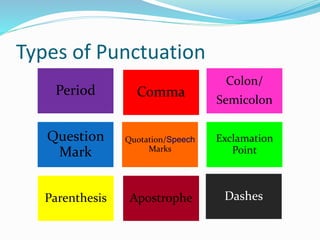
Types of Punctuation
Period Comma
Colon/
Semicolon
Question
Mark
Quotation/Speech
Marks
Exclamation
Point
Parenthesis Apostrophe Dashes
Period
 Rule: Use at the end of a complete sentence.
 Example: I went to the store for groceries.
 Rule: Use at the end of an indirect question.
 Example: He asked where the milk was.
Comma
 Rule: Use a comma to separate words or items in a list.
 Example: She has two dogs, three cats, one bird, and five fish
in her house.
 Rule: Use a comma to separate a city from its state.
 Example: I am from East Lansing, Michigan.
 Rule: Use a comma to separate the day of the month from
the year.
 Example: He was born on August 4th, 1990.
 Rule: Use a comma to separate two adjectives (describing
words) when the word and can be inserted between them.
 Example: She was a young, beautiful dog. ,
Question Mark
 Rule: Use a question mark only after a direct question.
 Example: Will you come over after school?
Exclamation Point
 Rule: Use the exclamation point to show emphasis or
excitement.
 Summer is in three months!
Ellipses(…)
 An ellipsis (plural: ellipses) is a punctuation mark
consisting of three dots.
 Rule 1. Many writers use an ellipsis whether the omission
occurs at the beginning of a sentence, in the middle of a
sentence, or between sentences. /Writers also use ellipses
to indicate a pause or wavering in an otherwise
straightforward sentence.
 Full quotation: "Today, after hours of careful thought, we
vetoed the bill.“
 With ellipsis: "Today…we vetoed the bill."
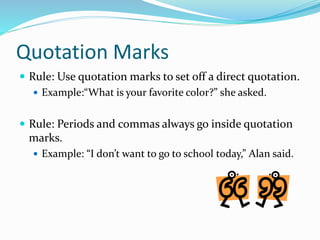
Quotation Marks
 Rule: Use quotation marks to set off a direct quotation.
 Example:“What is your favorite color?” she asked.
 Rule: Periods and commas always go inside quotation
marks.
 Example: “I don’t want to go to school today,” Alan said.
Colon
 Rule: Use the colon after a complete sentence to
introduce a list of items.
 Example: On my trip I will bring: clothes, a pillow, a
sleeping bag, a toothbrush, and my teddy bear.
 Rule: Use the colon after the greeting of the person’s
name in a business letter.
 Example: Dear Mr. Smith:
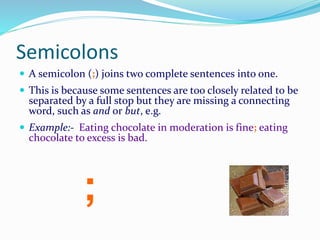
Semicolons
 A semicolon (;) joins two complete sentences into one.
 This is because some sentences are too closely related to be
separated by a full stop but they are missing a connecting
word, such as and or but, e.g.
 Example:- Eating chocolate in moderation is fine; eating
chocolate to excess is bad.
;
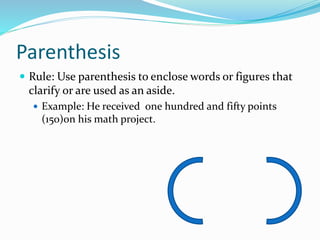
Parenthesis
 Rule: Use parenthesis to enclose words or figures that
clarify or are used as an aside.
 Example: He received one hundred and fifty points
(150)on his math project.
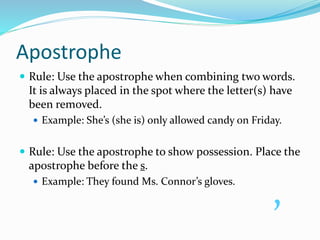
Apostrophe
 Rule: Use the apostrophe when combining two words.
It is always placed in the spot where the letter(s) have
been removed.
 Example: She’s (she is) only allowed candy on Friday.
 Rule: Use the apostrophe to show possession. Place the
apostrophe before the s.
 Example: They found Ms. Connor’s gloves.
’
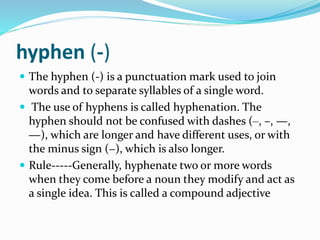
hyphen (‐)
 The hyphen (‐) is a punctuation mark used to join
words and to separate syllables of a single word.
 The use of hyphens is called hyphenation. The
hyphen should not be confused with dashes (‒, –, —,
―), which are longer and have different uses, or with
the minus sign (−), which is also longer.
 Rule-----Generally, hyphenate two or more words
when they come before a noun they modify and act as
a single idea. This is called a compound adjective
References
 Pictures on Slides: 6,7,8 Clipart
 Information on Slides: 6,7,8,9,10,11,12
http://www.grammarbook.com/english_rules.asp

Punctuationpowerpoint 100302004113-phpapp02

  • 1.
  • 2.
    Why do weneed punctuation?  Punctuation allows the authors writing to be easy to read and understandable for the reader.
  • 3.
    Types of Punctuation PeriodComma Colon/ Semicolon Question Mark Quotation/Speech Marks Exclamation Point Parenthesis Apostrophe Dashes
  • 4.
    Period  Rule: Useat the end of a complete sentence.  Example: I went to the store for groceries.  Rule: Use at the end of an indirect question.  Example: He asked where the milk was.
  • 5.
    Comma  Rule: Usea comma to separate words or items in a list.  Example: She has two dogs, three cats, one bird, and five fish in her house.  Rule: Use a comma to separate a city from its state.  Example: I am from East Lansing, Michigan.  Rule: Use a comma to separate the day of the month from the year.  Example: He was born on August 4th, 1990.  Rule: Use a comma to separate two adjectives (describing words) when the word and can be inserted between them.  Example: She was a young, beautiful dog. ,
  • 6.
    Question Mark  Rule:Use a question mark only after a direct question.  Example: Will you come over after school?
  • 7.
    Exclamation Point  Rule:Use the exclamation point to show emphasis or excitement.  Summer is in three months!
  • 8.
    Ellipses(…)  An ellipsis(plural: ellipses) is a punctuation mark consisting of three dots.  Rule 1. Many writers use an ellipsis whether the omission occurs at the beginning of a sentence, in the middle of a sentence, or between sentences. /Writers also use ellipses to indicate a pause or wavering in an otherwise straightforward sentence.  Full quotation: "Today, after hours of careful thought, we vetoed the bill.“  With ellipsis: "Today…we vetoed the bill."
  • 9.
    Quotation Marks  Rule:Use quotation marks to set off a direct quotation.  Example:“What is your favorite color?” she asked.  Rule: Periods and commas always go inside quotation marks.  Example: “I don’t want to go to school today,” Alan said.
  • 10.
    Colon  Rule: Usethe colon after a complete sentence to introduce a list of items.  Example: On my trip I will bring: clothes, a pillow, a sleeping bag, a toothbrush, and my teddy bear.  Rule: Use the colon after the greeting of the person’s name in a business letter.  Example: Dear Mr. Smith:
  • 11.
    Semicolons  A semicolon(;) joins two complete sentences into one.  This is because some sentences are too closely related to be separated by a full stop but they are missing a connecting word, such as and or but, e.g.  Example:- Eating chocolate in moderation is fine; eating chocolate to excess is bad. ;
  • 12.
    Parenthesis  Rule: Useparenthesis to enclose words or figures that clarify or are used as an aside.  Example: He received one hundred and fifty points (150)on his math project.
  • 13.
    Apostrophe  Rule: Usethe apostrophe when combining two words. It is always placed in the spot where the letter(s) have been removed.  Example: She’s (she is) only allowed candy on Friday.  Rule: Use the apostrophe to show possession. Place the apostrophe before the s.  Example: They found Ms. Connor’s gloves. ’
  • 14.
    hyphen (‐)  Thehyphen (‐) is a punctuation mark used to join words and to separate syllables of a single word.  The use of hyphens is called hyphenation. The hyphen should not be confused with dashes (‒, –, —, ―), which are longer and have different uses, or with the minus sign (−), which is also longer.  Rule-----Generally, hyphenate two or more words when they come before a noun they modify and act as a single idea. This is called a compound adjective
  • 15.
    References  Pictures onSlides: 6,7,8 Clipart  Information on Slides: 6,7,8,9,10,11,12 http://www.grammarbook.com/english_rules.asp