Origin
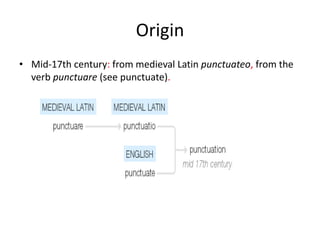
• Mid-17th century: from medieval Latin punctuateo, from the
verb punctuare (see punctuate).
Punctuation is used to create sense, clarity and
stress in sentences. You use punctuation marks to
structure and organize your writing.
Importance
• Important aspects
• Feature of writing
• Change tone of speaking
• An error
EXAMPLE
Take the sentence A woman without her man is nothing. Now see
the difference punctuation makes:
A woman, without her man, is nothing.
A woman: without her, man is nothing.
See how punctuation has made the same sentence mean two
exactly opposite things?
It’s very important to know all the punctuation marks, their
meanings, and when to use them in order to produce a good piece
of writing – and more importantly, to convey the correct message.
Period or Full stop .
Definition
The marks used to clarify meaning by
indicating separation of words into
sentences and clauses and phrases.
Periods/full stops are
Used for
• in names (examples:
J.F. Kennedy, Robert E. Lee)
• abbreviations that need no
explanation (example: e.g., i.e.)
• Contraction (example: Dr.,
Ltd.)
• Abbreviations end in lower
case/small letters (example:
Dec. for December)
Not used for
• Abbreviations in upper
case/capital letters (examples:
UNESCO, CNN)
• Abbreviations of countries
(examples: USA, UK)
• Abbreviations of compass
directions (examples: NW, SSE)
• Metric abbreviations
(examples: kg, cm)
Comma ,
A punctuation mark (,) indicating a pause
between parts of a sentence or separating
items in a list.
Use of ,
• Words
• Muneeba, Awais, Qadeer, Uzma, Ali, Anas, Essa etc.
• Phrases
• The novel is available in print, on audio tape, and on video
cassette.
• Clauses
• The lawyer argued that the weather was bad, that the car had
bad brakes, and that the other driver was speeding.
????????
Origin
• In A History of Writing (2003), Steven Roger Fischer notes that
the question mark "first appeared around the eighth or ninth
century in Latin manuscripts, but did not appear in English until
1587 with the publication of Sir Philip Sidney's Arcadia."
Question mark is a punctuation mark that indicates an interrogative
clause, or phrase in many languages. The question mark is not used
for indirect questions.
Use of ?
Use for
• What is your name?
• Do you speak Italian?
• You're Spanish, aren't you?
Not use for
• He asked me what my name
was.
• She asked if I was Spanish.
• Ask them where they are
going.
Question marks can sometimes appear
within sentences
• "Why is she here?" asked Henry.
The colon ( : )
ARE USED IN SENTENCES TO INTRODUCE THAT SOMETHING
FOLLOWS LIKE A QUOTATION, EXAMPLE OR A LIST.
A colon is used to explain or start an enumeration.
Colons :
Uses
• There are two choices at this time: run away
or fight.
• We knew who would win the game: the Eagles
• He wanted to see three cities in Italy: Rome,
Florence and Venice
• Remember: Two can play at that game.
• She kept repeating: “I really want that car!”
Sami colon ;
• Separates major element of sentence.
• between two closely related independent
clauses
Uses
• The new material contains a semicolon; it has
orders to call me if anybody gives it any
trouble.
• I like your brother; he's a good friend.
The exclamation point !
A punctuation mark ! used to show a
forceful way of speaking or a strong
feeling+
• Help! Help!
• That's unbelievable!
• Get out!
• Look out!
You can also use exclamation marks to mark a
phrase as humorous, ironic or sarcastic.
What a lovely day! (when it obviously is not a
lovely day)
That was clever! (when someone has done
something stupid)
EXAMPLES
Apostrophe ’
Use the apostrophe to show
possession. To show possession with a
singular noun, add an apostrophe plus
the letter s.
EXAMPLES
• It's a nice day outside. (contraction)
• The cat is dirty. Its fur is matted. (possession)
• You're not supposed to be here. (contraction)
• This is your book. (possession)
Hyphen & Dashes -
• Hyphens (-) are used to connect two or more
words (and numbers) into a single concept,
especially for building adjectives.
Example
• There are fewer Italian-American communities these
days.
• The family’s money-saving measures have been helping
them to build their savings.
• She has stopped buying 2-liter bottles and has started
buying 0.5-liter bottles, instead.
Some married women use hyphens to combine their
maiden name with their spouse’s name:
• I had a conversation with Mrs. Skinner-Kcrycek this
morning.
Brackets & Parentheses ()
Use parentheses to enclose
information that clarifies or is used as
an aside.
EXAMPLES
• He finally answered (after taking five minutes
to think) that he did not understand the
question.
• The government's education report (April
2005) shows that the level of literacy is rising
in nearly all areas.
• I visited Kathmandu (which was full of
tourists) on my way to the Himalayas for a
trekking expedition.

punctuation

  • 2.
    Origin • Mid-17th century:from medieval Latin punctuateo, from the verb punctuare (see punctuate).
  • 3.
    Punctuation is usedto create sense, clarity and stress in sentences. You use punctuation marks to structure and organize your writing.
  • 4.
    Importance • Important aspects •Feature of writing • Change tone of speaking • An error
  • 5.
    EXAMPLE Take the sentenceA woman without her man is nothing. Now see the difference punctuation makes: A woman, without her man, is nothing. A woman: without her, man is nothing. See how punctuation has made the same sentence mean two exactly opposite things? It’s very important to know all the punctuation marks, their meanings, and when to use them in order to produce a good piece of writing – and more importantly, to convey the correct message.
  • 6.
  • 7.
    Definition The marks usedto clarify meaning by indicating separation of words into sentences and clauses and phrases.
  • 8.
    Periods/full stops are Usedfor • in names (examples: J.F. Kennedy, Robert E. Lee) • abbreviations that need no explanation (example: e.g., i.e.) • Contraction (example: Dr., Ltd.) • Abbreviations end in lower case/small letters (example: Dec. for December) Not used for • Abbreviations in upper case/capital letters (examples: UNESCO, CNN) • Abbreviations of countries (examples: USA, UK) • Abbreviations of compass directions (examples: NW, SSE) • Metric abbreviations (examples: kg, cm)
  • 9.
  • 11.
    A punctuation mark(,) indicating a pause between parts of a sentence or separating items in a list.
  • 12.
    Use of , •Words • Muneeba, Awais, Qadeer, Uzma, Ali, Anas, Essa etc. • Phrases • The novel is available in print, on audio tape, and on video cassette. • Clauses • The lawyer argued that the weather was bad, that the car had bad brakes, and that the other driver was speeding.
  • 13.
  • 14.
    Origin • In AHistory of Writing (2003), Steven Roger Fischer notes that the question mark "first appeared around the eighth or ninth century in Latin manuscripts, but did not appear in English until 1587 with the publication of Sir Philip Sidney's Arcadia."
  • 15.
    Question mark isa punctuation mark that indicates an interrogative clause, or phrase in many languages. The question mark is not used for indirect questions.
  • 16.
    Use of ? Usefor • What is your name? • Do you speak Italian? • You're Spanish, aren't you? Not use for • He asked me what my name was. • She asked if I was Spanish. • Ask them where they are going.
  • 17.
    Question marks cansometimes appear within sentences • "Why is she here?" asked Henry.
  • 18.
  • 19.
    ARE USED INSENTENCES TO INTRODUCE THAT SOMETHING FOLLOWS LIKE A QUOTATION, EXAMPLE OR A LIST. A colon is used to explain or start an enumeration. Colons :
  • 20.
    Uses • There aretwo choices at this time: run away or fight. • We knew who would win the game: the Eagles • He wanted to see three cities in Italy: Rome, Florence and Venice • Remember: Two can play at that game. • She kept repeating: “I really want that car!”
  • 21.
  • 22.
    • Separates majorelement of sentence. • between two closely related independent clauses
  • 23.
    Uses • The newmaterial contains a semicolon; it has orders to call me if anybody gives it any trouble. • I like your brother; he's a good friend.
  • 24.
  • 25.
    A punctuation mark! used to show a forceful way of speaking or a strong feeling+
  • 26.
    • Help! Help! •That's unbelievable! • Get out! • Look out! You can also use exclamation marks to mark a phrase as humorous, ironic or sarcastic. What a lovely day! (when it obviously is not a lovely day) That was clever! (when someone has done something stupid) EXAMPLES
  • 27.
  • 28.
    Use the apostropheto show possession. To show possession with a singular noun, add an apostrophe plus the letter s.
  • 30.
    EXAMPLES • It's anice day outside. (contraction) • The cat is dirty. Its fur is matted. (possession) • You're not supposed to be here. (contraction) • This is your book. (possession)
  • 31.
  • 32.
    • Hyphens (-)are used to connect two or more words (and numbers) into a single concept, especially for building adjectives.
  • 33.
    Example • There arefewer Italian-American communities these days. • The family’s money-saving measures have been helping them to build their savings. • She has stopped buying 2-liter bottles and has started buying 0.5-liter bottles, instead. Some married women use hyphens to combine their maiden name with their spouse’s name: • I had a conversation with Mrs. Skinner-Kcrycek this morning.
  • 34.
  • 35.
    Use parentheses toenclose information that clarifies or is used as an aside.
  • 36.
    EXAMPLES • He finallyanswered (after taking five minutes to think) that he did not understand the question. • The government's education report (April 2005) shows that the level of literacy is rising in nearly all areas. • I visited Kathmandu (which was full of tourists) on my way to the Himalayas for a trekking expedition.