AMITY UNIVERSITY
TASHKENT
Prepared by
Parveen Kumar
Department of International Foundation Studies
Amity University Tashkent
pkumar@amity.uz
Course Title: Intensive English Through Practice-I
Course Code: IFS 106
Topic: Module 2
Listening
• Listening for Main Ideas
• Difference between Active & Selective Listening
• Understanding Vocabulary
• Note Taking
• Listening for Reasons
2
“Paying Thoughtful Attention to What we Hear”
Listening is often described as a skill that can be imparted,
earned and enhanced as well. Informally, practitioners divide
listening into Attentive, Reflective, Pretended, Selective,
Appreciative, Informative, Critical, Empathetic, Precision,
Discriminative and Comprehensive etc. Listening creates a
meaningful discourse.
LISTENING
The FIRST SKILL for HUMAN BEINGS
Parveen Kumar - - - pkumar@amity.uz
3
LISTENING
The FIRST SKILL for HUMAN BEINGS
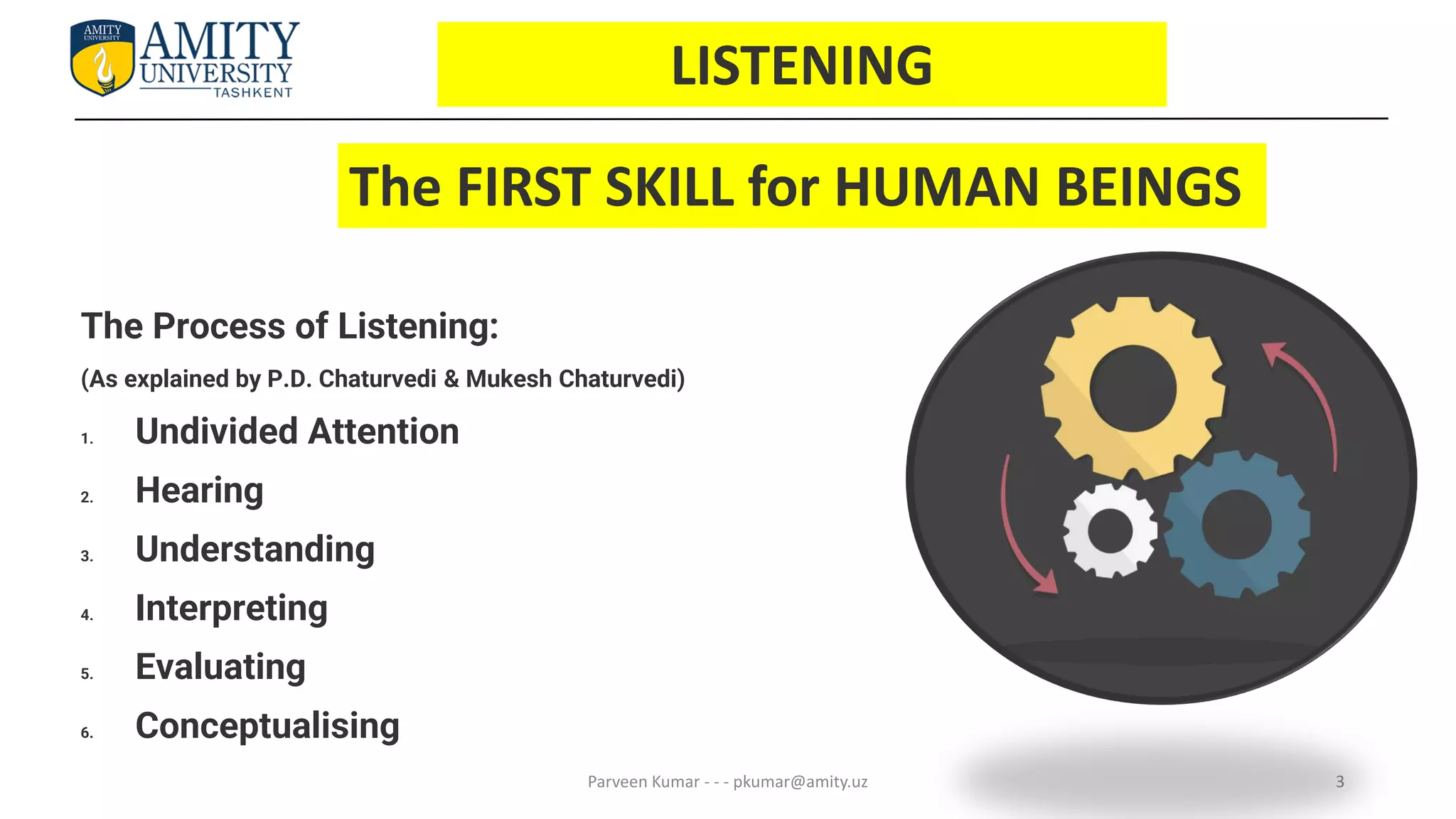
The Process of Listening:
(As explained by P.D. Chaturvedi & Mukesh Chaturvedi)
1. Undivided Attention
2. Hearing
3. Understanding
4. Interpreting
5. Evaluating
6. Conceptualising
Parveen Kumar - - - pkumar@amity.uz
4
•Preparing to listen
•Identifying main ideas
•Identifying supporting
detail/examples
•Using background knowledge to aid
comprehension
•Taking notes from
lectures/presentations
•Predicting
•Identifying specific information
•Understanding instructions and
explanations
•Guessing the meaning of unknown
words/phrases
•Recognizing words/phrases in
connected speech
•Interpreting
•Understanding evaluative language
•Understanding attitudes
•Understanding opinion
SUB-SKILLS OF LISTENING
Parveen Kumar - - - pkumar@amity.uz
5
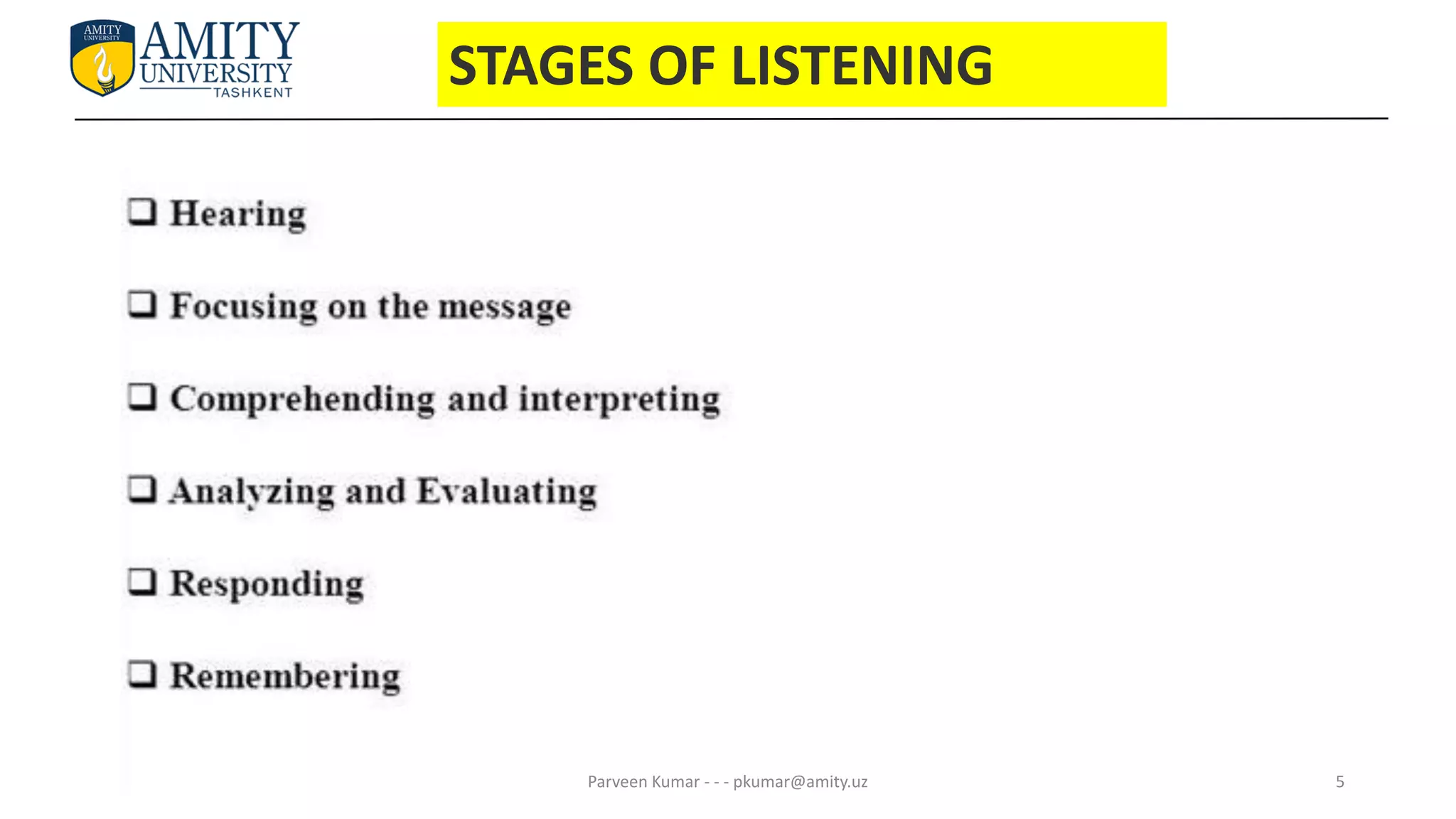
STAGES OF LISTENING
Parveen Kumar - - - pkumar@amity.uz
6
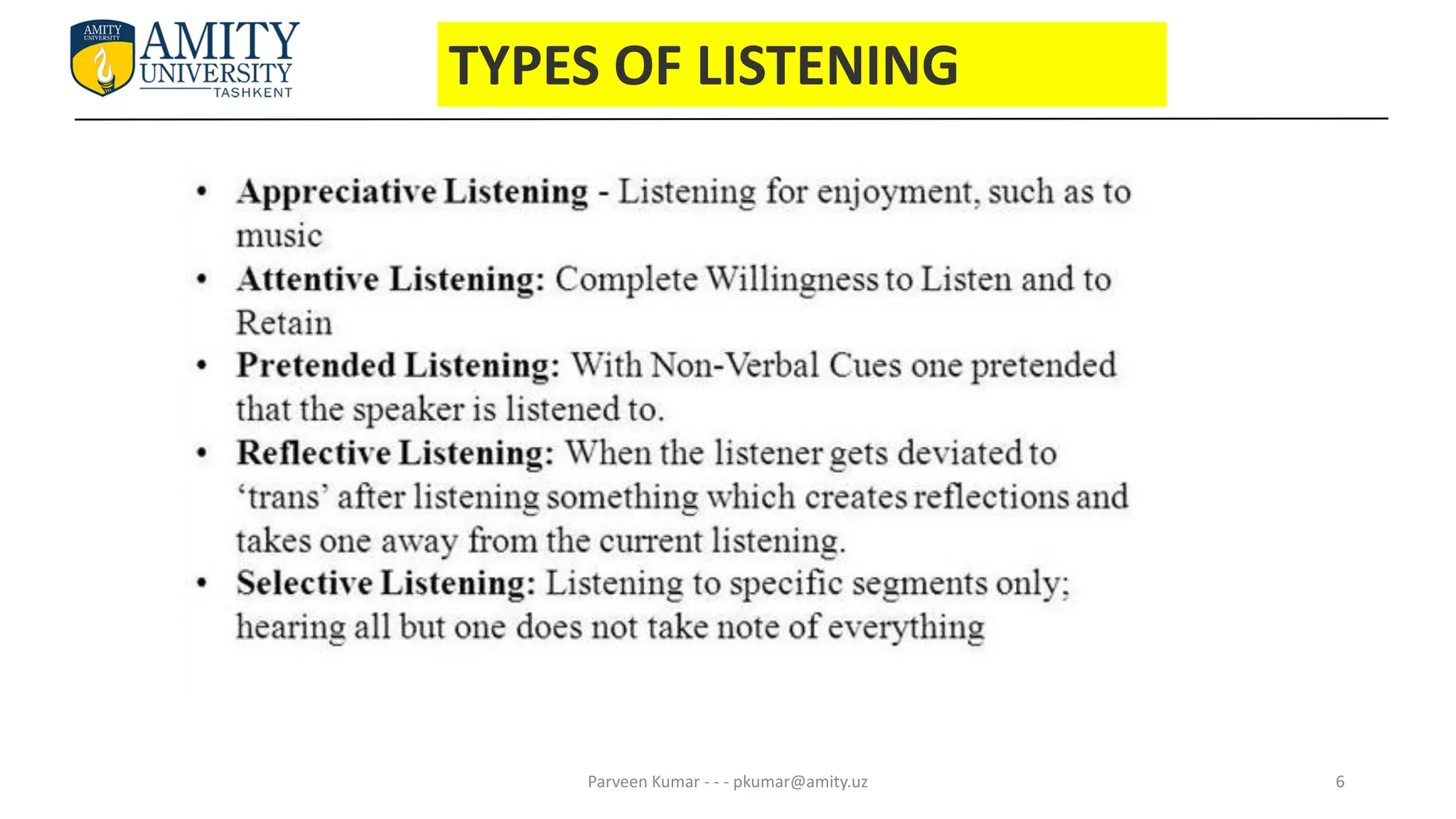
TYPES OF LISTENING
Parveen Kumar - - - pkumar@amity.uz
7
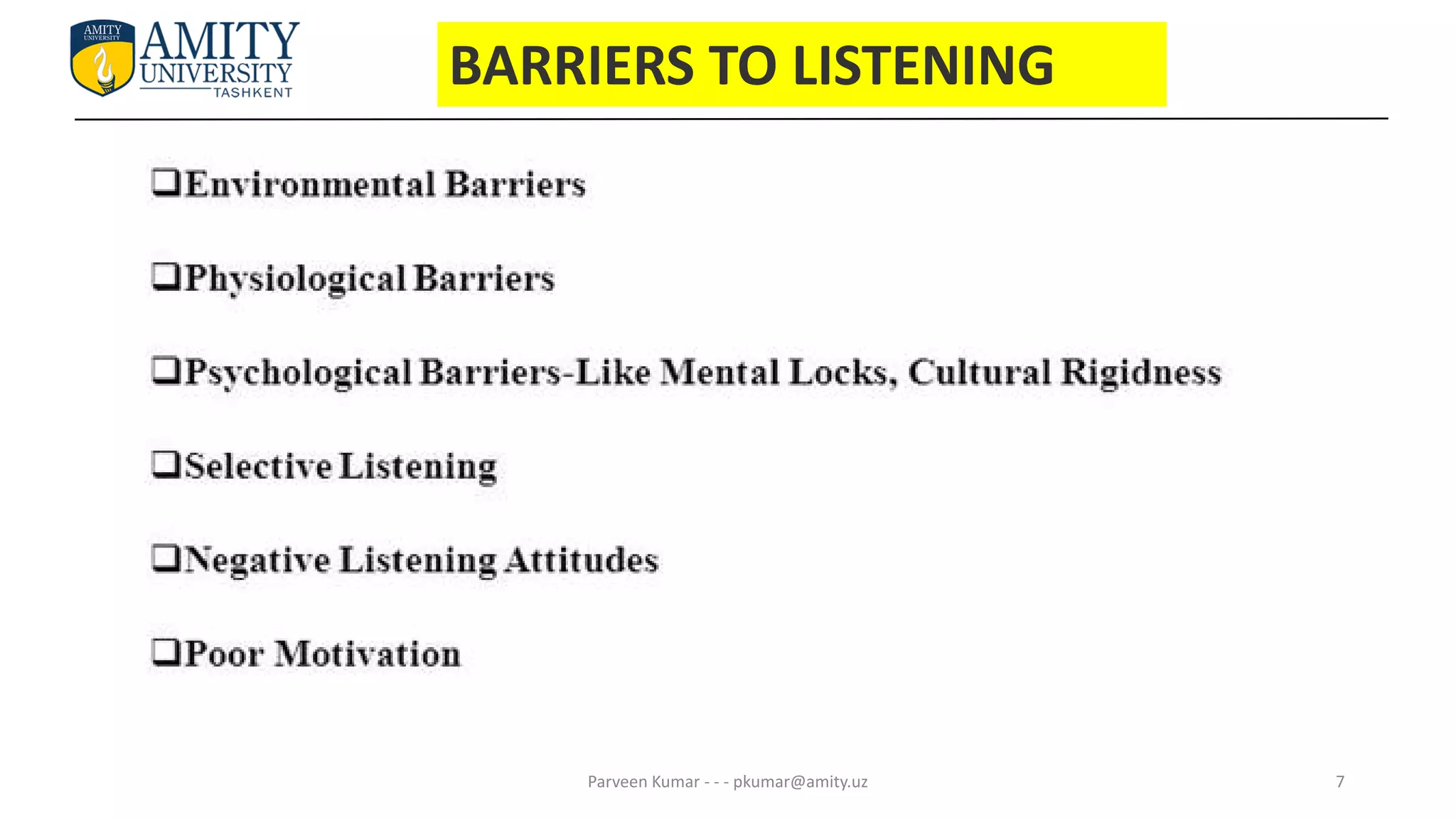
BARRIERS TO LISTENING
Parveen Kumar - - - pkumar@amity.uz
8
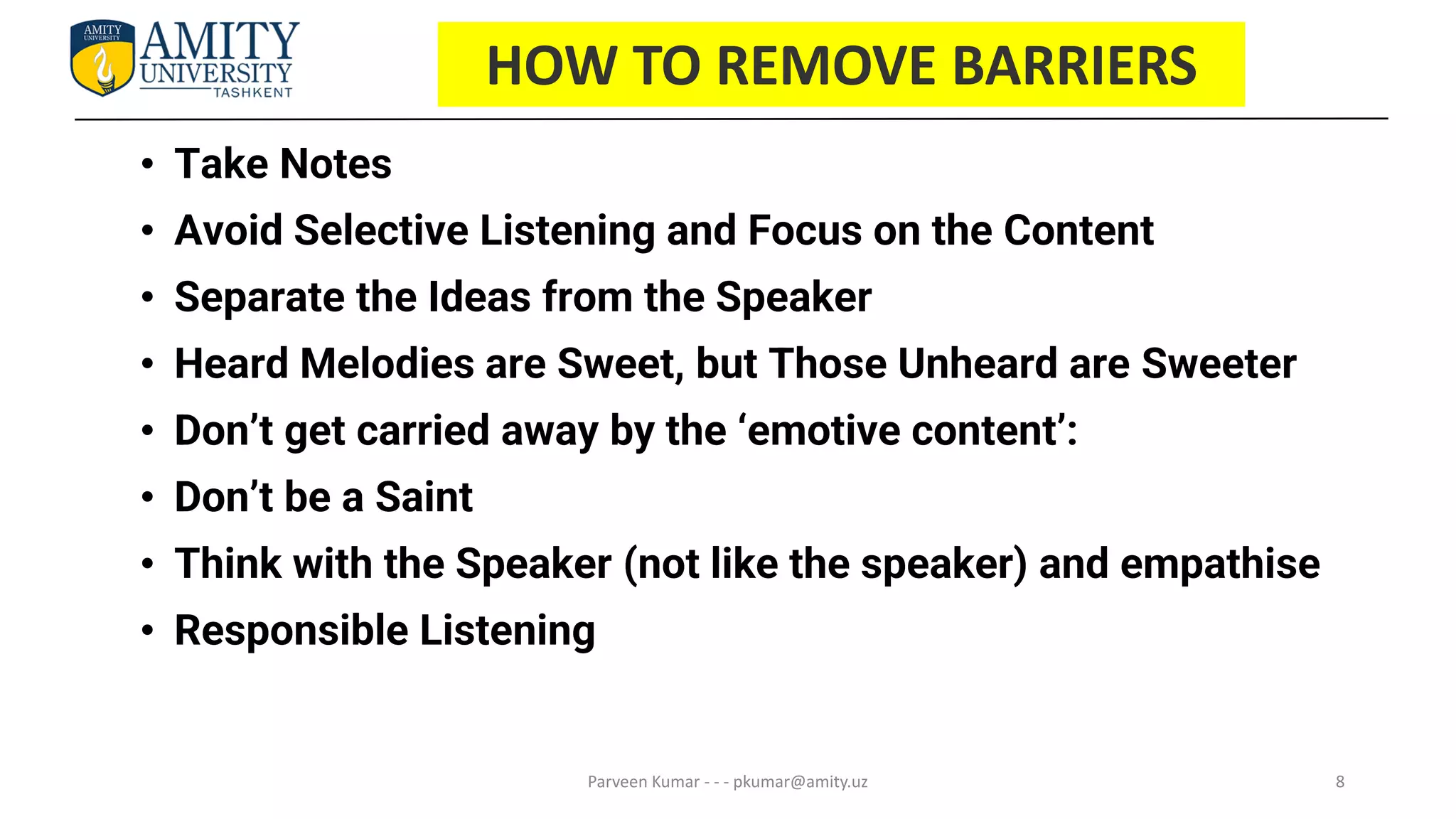
HOW TO REMOVE BARRIERS
• Take Notes
• Avoid Selective Listening and Focus on the Content
• Separate the Ideas from the Speaker
• Heard Melodies are Sweet, but Those Unheard are Sweeter
• Don’t get carried away by the ‘emotive content’:
• Don’t be a Saint
• Think with the Speaker (not like the speaker) and empathise
• Responsible Listening
Parveen Kumar - - - pkumar@amity.uz
9
Difference between Active & Selective Listening
Active Listening
Parveen Kumar - - - pkumar@amity.uz
Selective Listening
02
Effective
Listening
Learning
Material
Appreciation
for Speaker
03
01
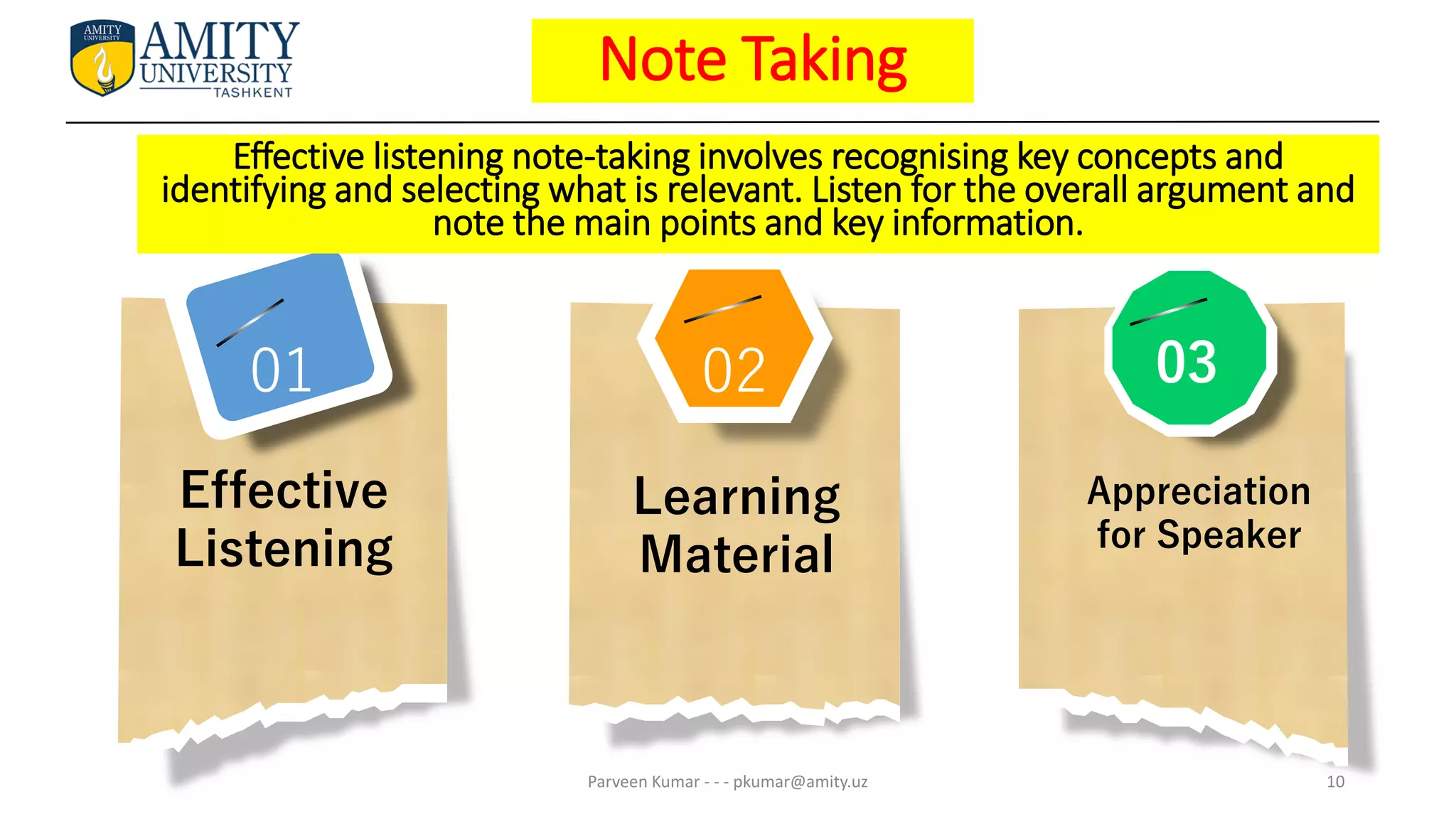
Note Taking
Parveen Kumar - - - pkumar@amity.uz 10
Effective listening note-taking involves recognising key concepts and
identifying and selecting what is relevant. Listen for the overall argument and
note the main points and key information.
11
Parveen Kumar - - - pkumar@amity.uz
https://www.student.unsw.edu.au/note-taking-skills
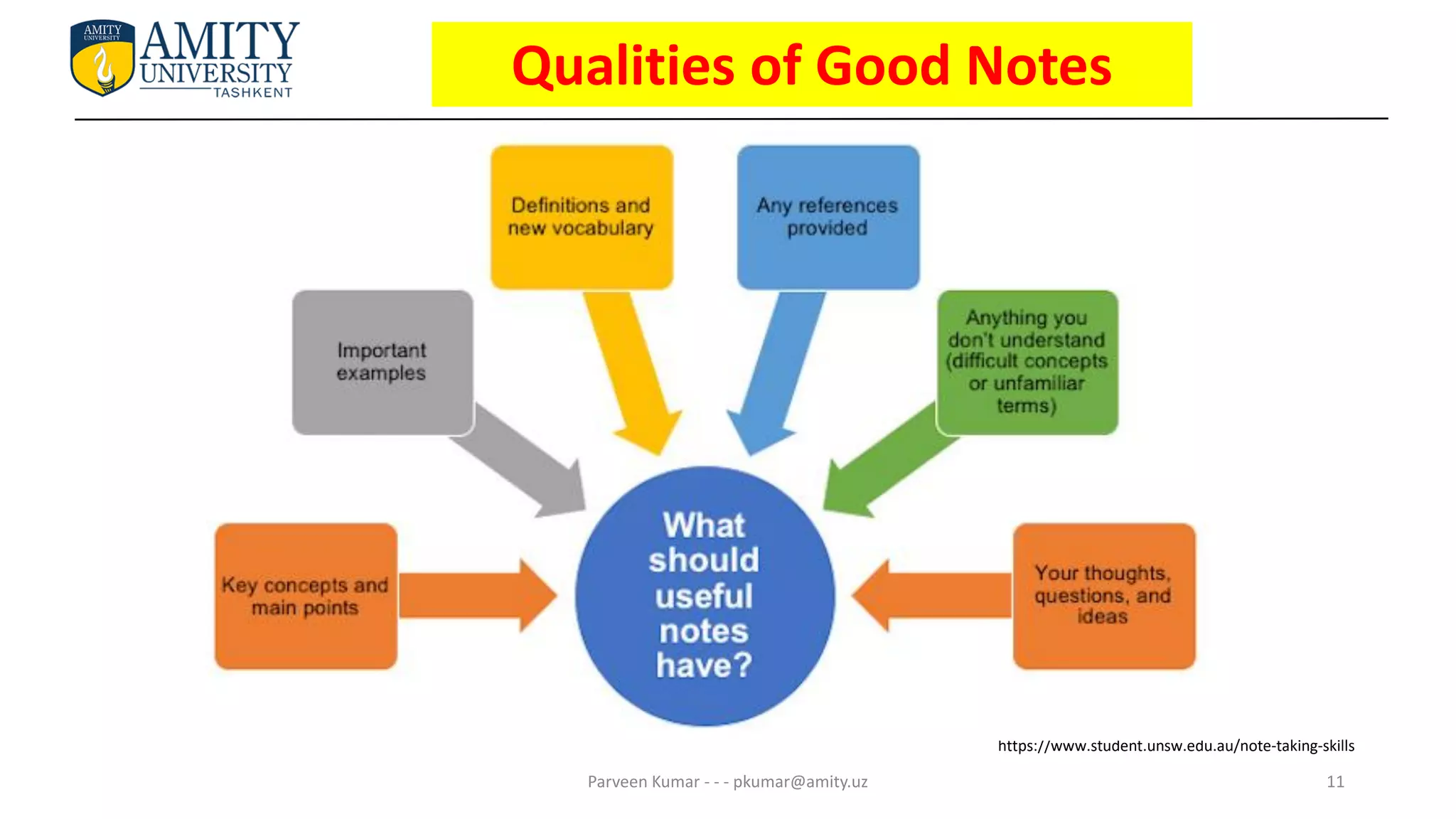
Qualities of Good Notes
12
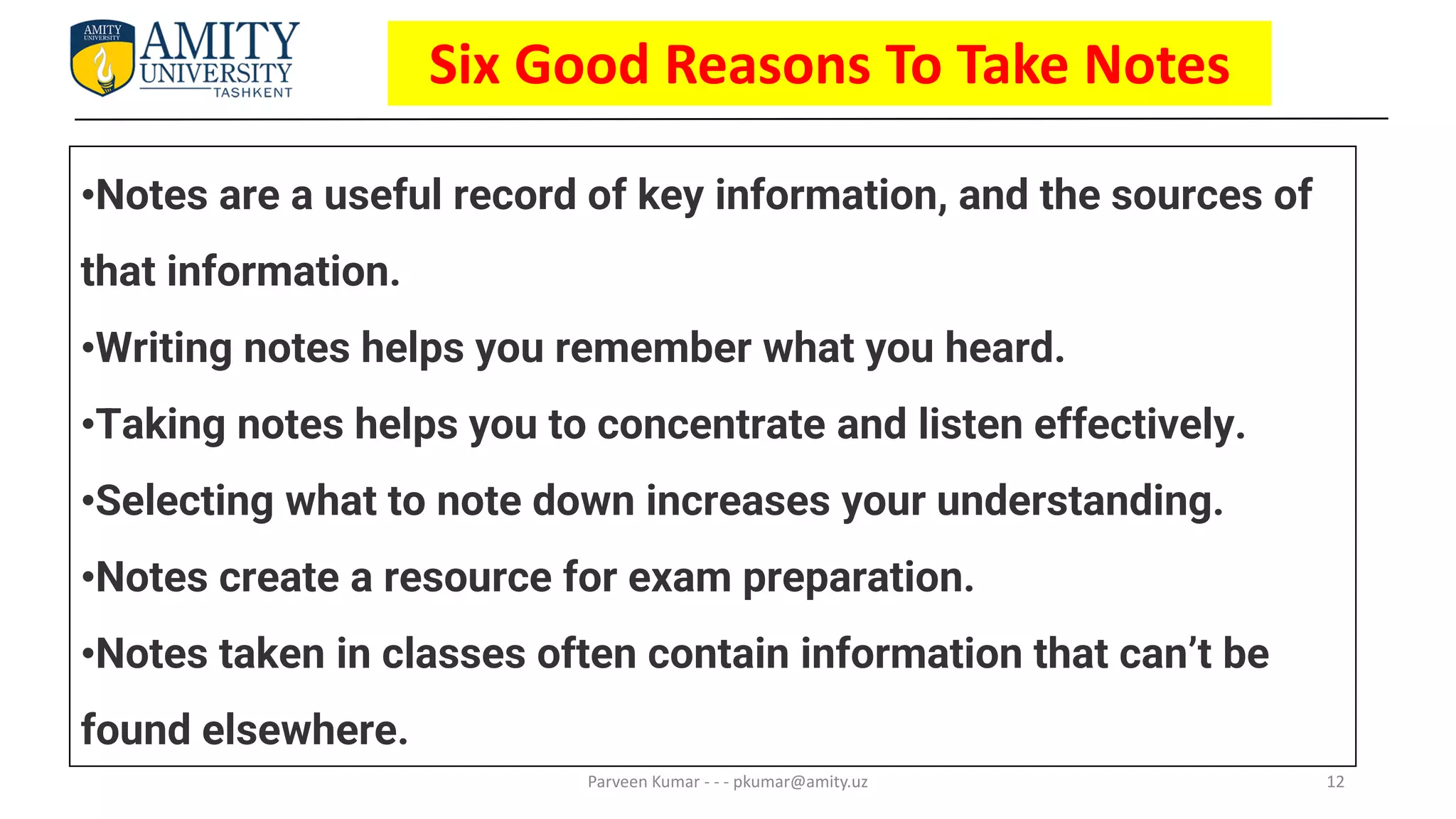
Six Good Reasons To Take Notes
Parveen Kumar - - - pkumar@amity.uz
•Notes are a useful record of key information, and the sources of
that information.
•Writing notes helps you remember what you heard.
•Taking notes helps you to concentrate and listen effectively.
•Selecting what to note down increases your understanding.
•Notes create a resource for exam preparation.
•Notes taken in classes often contain information that can’t be
found elsewhere.
13
Strategies for Effective Note-Taking
Parveen Kumar - - - pkumar@amity.uz
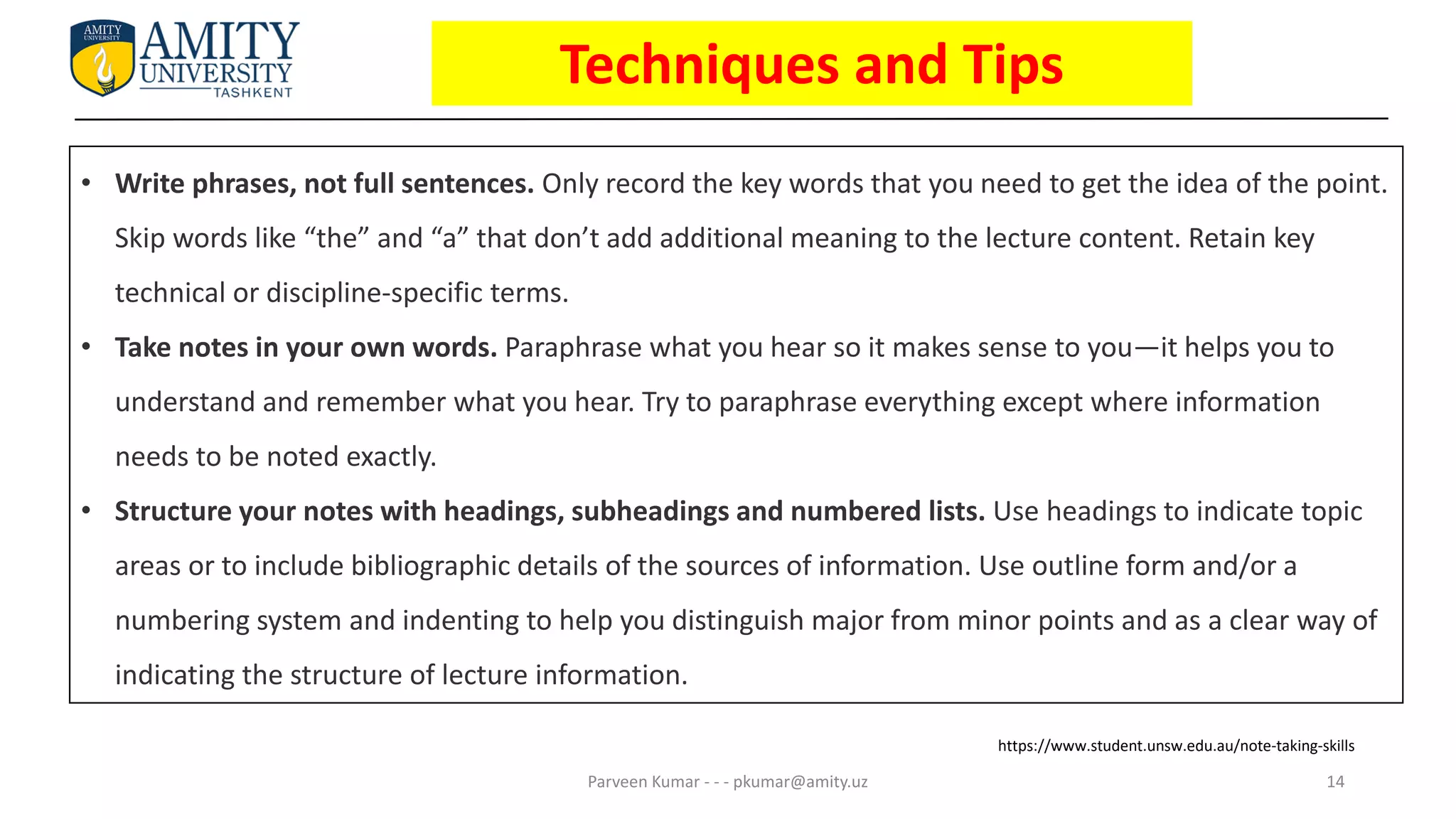
✓ Concentrate and pay attention
✓ Don’t try to write down everything being said
✓ Use concept maps and diagrams
https://www.student.unsw.edu.au/note-taking-skills
14
Parveen Kumar - - - pkumar@amity.uz
• Write phrases, not full sentences. Only record the key words that you need to get the idea of the point.
Skip words like “the” and “a” that don’t add additional meaning to the lecture content. Retain key
technical or discipline-specific terms.
• Take notes in your own words. Paraphrase what you hear so it makes sense to you—it helps you to
understand and remember what you hear. Try to paraphrase everything except where information
needs to be noted exactly.
• Structure your notes with headings, subheadings and numbered lists. Use headings to indicate topic
areas or to include bibliographic details of the sources of information. Use outline form and/or a
numbering system and indenting to help you distinguish major from minor points and as a clear way of
indicating the structure of lecture information.
https://www.student.unsw.edu.au/note-taking-skills
Techniques and Tips
15
Parveen Kumar - - - pkumar@amity.uz
• Code your notes—use colour and symbols to mark structure and emphasis.
• Use colour to highlight major sections, main points and diagrams. You can also use different colours to
classify and link concepts or information by topic. However, don’t focus too much on colour coding
when you’re in the lecture. It requires time and concentration, so it’s more useful to do most of the
highlighting and underlining when you’re revising your notes later.
• Underline, circle, star, etc. to identify key information, examples, definitions, or other important
materials. Devise your own marking code to indicate each type.
• If you miss something, write key words, skip a few spaces, and get the information later. Leave a space
on the page for your own notes and comments.
https://www.student.unsw.edu.au/note-taking-skills
Techniques and Tips
16
Parveen Kumar - - - pkumar@amity.uz
https://www.student.unsw.edu.au/note-taking-skills
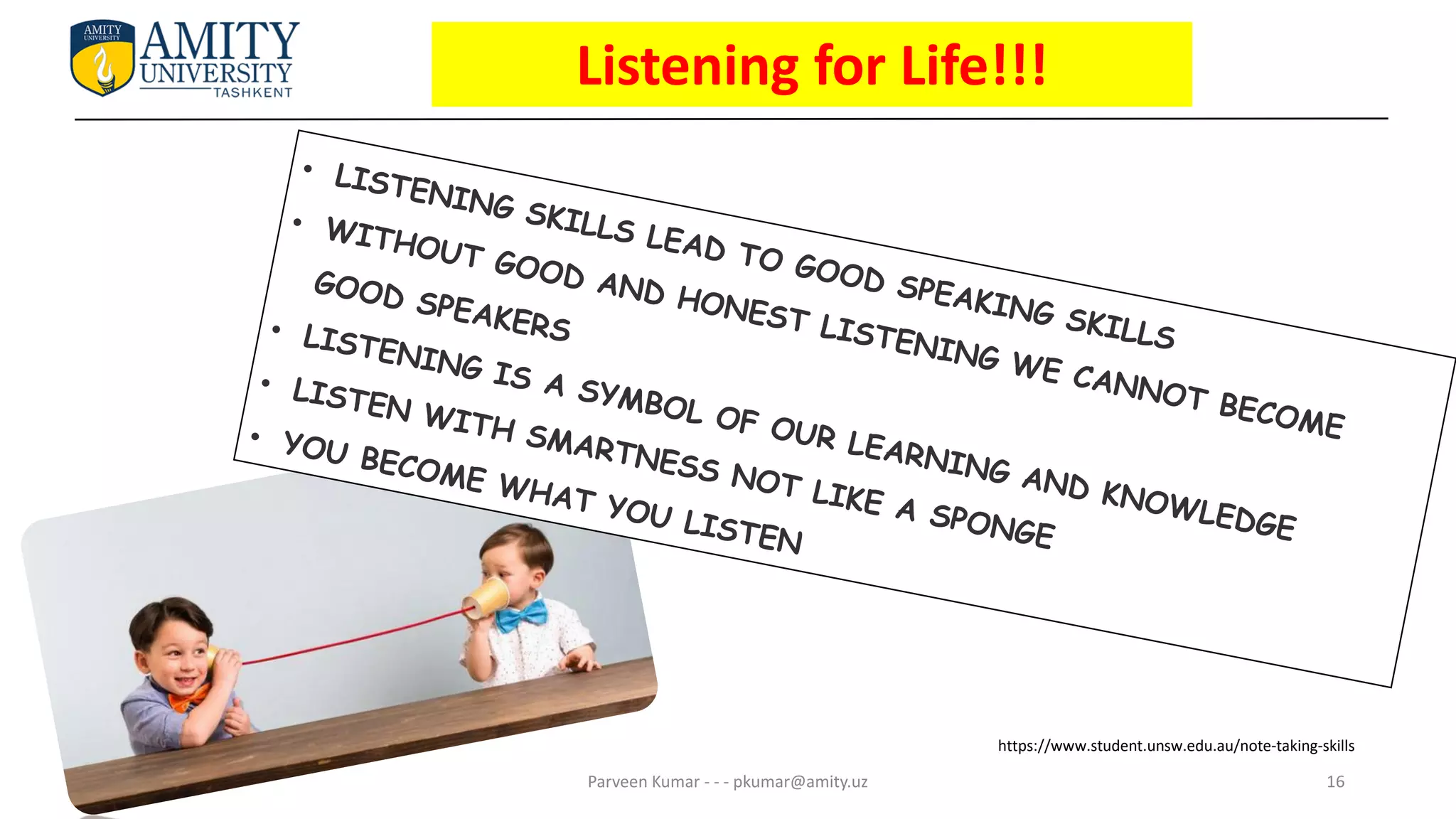
Listening for Life!!!

Listening Skills and Note Making - IFS English

  • 1.
    AMITY UNIVERSITY TASHKENT Prepared by ParveenKumar Department of International Foundation Studies Amity University Tashkent pkumar@amity.uz Course Title: Intensive English Through Practice-I Course Code: IFS 106 Topic: Module 2 Listening • Listening for Main Ideas • Difference between Active & Selective Listening • Understanding Vocabulary • Note Taking • Listening for Reasons
  • 2.
    2 “Paying Thoughtful Attentionto What we Hear” Listening is often described as a skill that can be imparted, earned and enhanced as well. Informally, practitioners divide listening into Attentive, Reflective, Pretended, Selective, Appreciative, Informative, Critical, Empathetic, Precision, Discriminative and Comprehensive etc. Listening creates a meaningful discourse. LISTENING The FIRST SKILL for HUMAN BEINGS Parveen Kumar - - - pkumar@amity.uz
  • 3.
    3 LISTENING The FIRST SKILLfor HUMAN BEINGS The Process of Listening: (As explained by P.D. Chaturvedi & Mukesh Chaturvedi) 1. Undivided Attention 2. Hearing 3. Understanding 4. Interpreting 5. Evaluating 6. Conceptualising Parveen Kumar - - - pkumar@amity.uz
  • 4.
    4 •Preparing to listen •Identifyingmain ideas •Identifying supporting detail/examples •Using background knowledge to aid comprehension •Taking notes from lectures/presentations •Predicting •Identifying specific information •Understanding instructions and explanations •Guessing the meaning of unknown words/phrases •Recognizing words/phrases in connected speech •Interpreting •Understanding evaluative language •Understanding attitudes •Understanding opinion SUB-SKILLS OF LISTENING Parveen Kumar - - - pkumar@amity.uz
  • 5.
    5 STAGES OF LISTENING ParveenKumar - - - pkumar@amity.uz
  • 6.
    6 TYPES OF LISTENING ParveenKumar - - - pkumar@amity.uz
  • 7.
    7 BARRIERS TO LISTENING ParveenKumar - - - pkumar@amity.uz
  • 8.
    8 HOW TO REMOVEBARRIERS • Take Notes • Avoid Selective Listening and Focus on the Content • Separate the Ideas from the Speaker • Heard Melodies are Sweet, but Those Unheard are Sweeter • Don’t get carried away by the ‘emotive content’: • Don’t be a Saint • Think with the Speaker (not like the speaker) and empathise • Responsible Listening Parveen Kumar - - - pkumar@amity.uz
  • 9.
    9 Difference between Active& Selective Listening Active Listening Parveen Kumar - - - pkumar@amity.uz Selective Listening
  • 10.
    02 Effective Listening Learning Material Appreciation for Speaker 03 01 Note Taking ParveenKumar - - - pkumar@amity.uz 10 Effective listening note-taking involves recognising key concepts and identifying and selecting what is relevant. Listen for the overall argument and note the main points and key information.
  • 11.
    11 Parveen Kumar -- - pkumar@amity.uz https://www.student.unsw.edu.au/note-taking-skills Qualities of Good Notes
  • 12.
    12 Six Good ReasonsTo Take Notes Parveen Kumar - - - pkumar@amity.uz •Notes are a useful record of key information, and the sources of that information. •Writing notes helps you remember what you heard. •Taking notes helps you to concentrate and listen effectively. •Selecting what to note down increases your understanding. •Notes create a resource for exam preparation. •Notes taken in classes often contain information that can’t be found elsewhere.
  • 13.
    13 Strategies for EffectiveNote-Taking Parveen Kumar - - - pkumar@amity.uz ✓ Concentrate and pay attention ✓ Don’t try to write down everything being said ✓ Use concept maps and diagrams https://www.student.unsw.edu.au/note-taking-skills
  • 14.
    14 Parveen Kumar -- - pkumar@amity.uz • Write phrases, not full sentences. Only record the key words that you need to get the idea of the point. Skip words like “the” and “a” that don’t add additional meaning to the lecture content. Retain key technical or discipline-specific terms. • Take notes in your own words. Paraphrase what you hear so it makes sense to you—it helps you to understand and remember what you hear. Try to paraphrase everything except where information needs to be noted exactly. • Structure your notes with headings, subheadings and numbered lists. Use headings to indicate topic areas or to include bibliographic details of the sources of information. Use outline form and/or a numbering system and indenting to help you distinguish major from minor points and as a clear way of indicating the structure of lecture information. https://www.student.unsw.edu.au/note-taking-skills Techniques and Tips
  • 15.
    15 Parveen Kumar -- - pkumar@amity.uz • Code your notes—use colour and symbols to mark structure and emphasis. • Use colour to highlight major sections, main points and diagrams. You can also use different colours to classify and link concepts or information by topic. However, don’t focus too much on colour coding when you’re in the lecture. It requires time and concentration, so it’s more useful to do most of the highlighting and underlining when you’re revising your notes later. • Underline, circle, star, etc. to identify key information, examples, definitions, or other important materials. Devise your own marking code to indicate each type. • If you miss something, write key words, skip a few spaces, and get the information later. Leave a space on the page for your own notes and comments. https://www.student.unsw.edu.au/note-taking-skills Techniques and Tips
  • 16.
    16 Parveen Kumar -- - pkumar@amity.uz https://www.student.unsw.edu.au/note-taking-skills Listening for Life!!!