Public–Private Partnership and Education Ghaus,
Ghulam
1 | P a g e
Submitted by
Ghulam Ghaus
M.Ed. (B) 2015-16
Submitted to
Dr Latha Rammohan
Dept. Educational Studies
Jamia Millia Islamia
26th
March 2016
2nd
Semester
Paper-IX
PUBLIC–PRIVATE PARTNERSHIP &
EDUCATION
Public–Private Partnership and Education Ghaus,
Ghulam
2 | P a g e
Declaration
All the content in this paper is taken from different
sources that are mentioned under the heading references. I
just taken all information and arranged them in such a way
that will be useful for the reader to understand Public
Private Partnership & Education.
Ghulam Ghaus
Public–Private Partnership and Education Ghaus,
Ghulam
3 | P a g e
Public–Private Partnership and Education
Outline
Introduction
 Concept of 3P
 Educational Objectives of 3P
 Models of 3P
3P and Education
Conclusion
Introduction
Now days the term of public–private partnership is not only used very frankly
but also it has influenced on various aspects of our life. Education, health and some
other important sectors are very much attached to 3P. In education, it deals not only
with the infrastructure, but also with management, curriculumframing, book writing,
staff monitoring and quality education etc. in the same way it covers building,
facilities,doctors etc. in hospital. In this paper I will describe what PPP is, and how it
influenced education.
Concept
Differentscholars and policy makers have defined 3P in different ways but the
outcome is same the collaboration of public and private to improve the system,
[whatever it be].
"PPP is a contract that a government makes with a private service provider to
acquire a specifiedservice of a defined quantity and quality at an agreed price for a
specified period" (Taylor 2003).
"PPPs are collaborations between public and private sectors with a focus on
system efficiency, innovation and accountability. In education, they bring together
the scale of the government system with the innovation of the private sector to
improve the quality of the system as a whole."
[Public-Private Partnerships in School Education: Learning and Insights for India]
A public–private partnership (PPP or 3P or P3) is a government service or
private business venture that is funded and operated through a partnership of
government and one or more private sector companies. PPP involves a contract
Public–Private Partnership and Education Ghaus,
Ghulam
4 | P a g e
between a public sector authority and a private party, in which the private party
provides a public service or project and assumes substantial financial, technical and
operational risk in the project.
Public-Private Partnerships can introduce innovation and investment into
India’s government school system, which urgently needs to improve the quality of
education. Lessons, from existing models in India and international efforts at
collaboration between the private and public sector, show that PPPs have an
important role in improving the system.
Opportunity for/Objective of 3P in School Education
Here are some opportunities of 3P which are educational objectives also. Well-
designed PPPs can create models of innovation for the school system in India.
Various governments at the central, state and local level are exploring and
implementing PPPs in education. Three primary reasons that governments are
exploring these partnerships include:
 Increasing access to school
India has a high dropout rate from primary to secondary school, with the
national Gross Enrolment Ratio (GER) falling from 118 in primary school1 to 34 in
senior secondary school.2 As access at the elementary level has become nearly
universal, the focus in the education system is now shifting towards increasing the
quality of outcomes. PPPs can extend the reach of the government system to
provide children access to schools.
India’s education policy since independence has been largely input-driven,
with a focus on improving access and ensuring equity. The creation of the central
government’s flagship programme for elementaryeducation, Sarva Shiksha Abhiyan
(SSA), in 2003 and the enactment of the Right of Children to Free and Compulsory
Education Act, 2009 (RTE) gave a big boost to enrolment rates for children aged 6
through 14. Due to this focus, India today has nearly achieved its goal of universal
access to elementary education.
The gross enrolment ratio (GER) in primary education rose from 90 in 2003-
043 to 106 in 2012-13.4 The 2013 Annual Status of Education Report (ASER) findings
show that enrolmentamong children aged 6 to 14 is very high, with more than 96%
of rural children enrolled in school.
Access to secondary education is a cause for concern as enrolment is low and
increasingat a very slow rate. The GER in secondaryand senior secondary education
Public–Private Partnership and Education Ghaus,
Ghulam
5 | P a g e
respectively was at 66 and 39 in 2012-13.6 It is up from 53 and 29, respectively in
2006-07.
 Using underutilized school infrastructure
Across India, major metropolitan areas such as Mumbai, Chennai, Pune and
Ahmedabad have experienced up to 25% decline in enrolment in government
schools over the past 10 years and simultaneously their education budgets have
almost doubled. These trends have resulted in a hollowing out of government
schools. By getting private operators to manage high quality schools in these empty
buildings, governments can effectively utilize existing infrastructure.
 Improving the quality of education
The government school system urgently needs improvement. Through PPPs,
private operators can introduce innovative pedagogical and school management
techniques to create models of excellence within the government system.
Experience, in other countries, shows that introducing new standards of excellence
creates a higher level of discussion around education quality.
Educational outcomes in India are dismally low both in absolute terms as well
as relative to other countries. The 2013 ASER results show that nationally, 53% of
students enrolled in Class 5 are unable to read a Class 2 text. In numeracy, 74% of
students enrolled in Class 5 could not complete a Class 3 division problem.
The relatively well-performing states of Himachal Pradesh and Tamil Nadu
ranked at the bottom globally in the 2009 Programme for International Student
Assessment (PISA) test conducted by the Organisation for Economic Co-operation
and Development (OECD). This assessment measures the quantitative and critical
reasoningcompetencies of 15-year-oldstudents across the world.12 The two Indian
states were placed ahead of only Kyrgyzstan among the 74 participating regions,
both in the reading and the Maths assessment.
In light of these quality indicators, the focus of education policy is shifting
towards improving learning. The Twelfth Five-Year Plan states, “Improving learning
outcomes is crucial for inclusive growth and, therefore, a major focus of the Twelfth
Plan will be on measuring and improving learning outcomes for all children, with a
clear recognition that increasing inputs (number of schools, classrooms, teachers
and so on) will by themselves not be enough to ensure quality education for all
children."
 Other opportunities are;
 Lift the quality of education
 Increase choice for low-Income parents
Public–Private Partnership and Education Ghaus,
Ghulam
6 | P a g e
 Strengthen accountability in the government system
Models of 3P
Different models of PPP funding are characterized by which partner is
responsible for owning and maintaining assets at different stages of the project.
Examples of PPP models include:
Design-Build (DB): The private-sector partner designs and builds the
infrastructure to meet the public- sector partner's specifications, often for a fixed
price. The private-sector partner assumes all risk. Operation & Maintenance Contract
(O & M): The private-sector partner, under contract, operates a publicly- owned
asset for a specific periodof time. The public partner retains ownershipof the assets.
Design-Build-Finance-Operate (DBFO): The private-sector partner designs,
finances and constructs a new infrastructure component and operates/maintains it
under a long- term lease. The private-sector partner transfers the infrastructure
component to the public-sector partner when the lease is up.
Build-Own-Operate(BOO): The private-sector partner finances, builds, owns
and operates the infrastructure componentin perpetuity. The public-sector partner's
constraints are stated in the original agreement and through on-going regulatory
authority.
Build-Own-Operate-Transfer (BOOT): The private-sector partner is granted
authorizationto finance, design, build and operate an infrastructure component(and
to charge user fees) for a specific period of time, after which ownershipis transferred
back to the public-sector partner.
Buy-Build-Operate (BBO): This publicly-owned asset is legally transferred to
a private-sector partner for a designated period of time.
Build-lease-operate-transfer (BLOT): The private-sector partner designs,
finances and builds a facility on leased public land. The private- sector partner
operates the facilityfor the duration of the landlease. When the lease expires, assets
are transferred to the public-sector partner.
3P in Education
Public–Private Partnership and Education Ghaus,
Ghulam
7 | P a g e
The main rationale for developing public-private partnerships (PPPs) in
education is to maximize the potential for expanding equitable access to schooling
and for improvingeducation outcomes, especiallyfor marginalizedgroups. Different
types of contracts can help to meet these two objectives in different socioeconomic
and political contexts. Contracting is the process whereby a government procures
education or education-related services of a defined quantity and quality at an
agreed price from a specific provider. The agreement between the funder and the
service provider is recorded in a contract and is valid for a specified period of time
(Taylor 2003; Wang 2000).
The World Development Report 2004 (World Bank 2003a) concluded that
services can be provided to poor people most successfully when citizens, service
providers, and governments are accountable to each other.
Many forms of contractingare currentlyused in education aroundthe world. A
range of different services can be procuredfrom the private sector governments buy
the services involved in producing education (inputs), such as teacher training,
management, curriculum design, or the use of a school facility from private
organizations governments contract with private organizations to provide the
process of education, for example, by managing and operating public schools.
Here I will discuss in brief each type of education service: (i) management
services, (ii) professional services, (iii)support services, (iv)operational services,
(v)education services,(vi)facilityavailability, and (vii)facilityavailability and education
services combined.
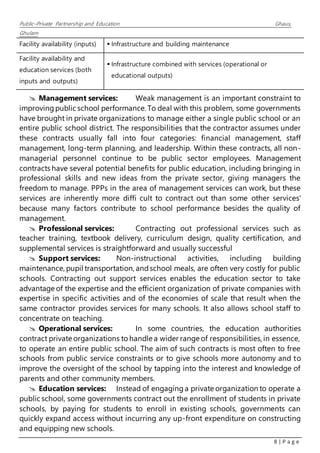
Types of contracts in education
What governments
contract for
What governments buy
Management, professional,
support
services (input)
 School management (financial and human resources
management)
 Support services (meals and transportation)
 Professional services (teacher training, curriculum design,
textbook delivery, quality assurance, and supplemental services)
Operational services
(process)
 The education of students, financial and human resources
management, professional services, and building maintenance
Education services
(outputs)
 Student places in private schools (by contracting with schools
to enroll specific students)
Public–Private Partnership and Education Ghaus,
Ghulam
8 | P a g e
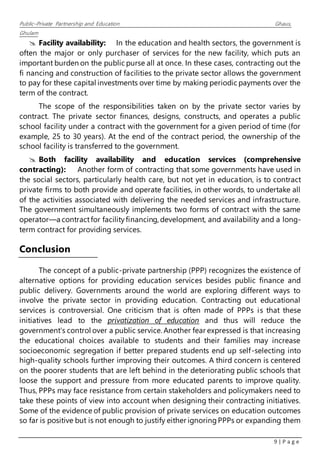
Facility availability (inputs)  Infrastructure and building maintenance
Facility availability and
education services (both
inputs and outputs)
 Infrastructure combined with services (operational or
educational outputs)
 Management services: Weak management is an important constraint to
improvingpublic school performance. To deal with this problem, some governments
have brought in private organizations to manage either a single public school or an
entire public school district. The responsibilities that the contractor assumes under
these contracts usually fall into four categories: financial management, staff
management, long-term planning, and leadership. Within these contracts, all non-
managerial personnel continue to be public sector employees. Management
contracts have several potential benefits for public education, including bringing in
professional skills and new ideas from the private sector, giving managers the
freedom to manage. PPPs in the area of management services can work, but these
services are inherently more diffi cult to contract out than some other services'
because many factors contribute to school performance besides the quality of
management.
 Professional services: Contracting out professional services such as
teacher training, textbook delivery, curriculum design, quality certification, and
supplemental services is straightforward and usually successful
 Support services: Non-instructional activities, including building
maintenance, pupil transportation, andschool meals, are often very costly for public
schools. Contracting out support services enables the education sector to take
advantage of the expertise and the efficient organization of private companies with
expertise in specific activities and of the economies of scale that result when the
same contractor provides services for many schools. It also allows school staff to
concentrate on teaching.
 Operational services: In some countries, the education authorities
contract private organizations to handle a wider range of responsibilities,in essence,
to operate an entire public school. The aim of such contracts is most often to free
schools from public service constraints or to give schools more autonomy and to
improve the oversight of the school by tapping into the interest and knowledge of
parents and other community members.
 Education services: Instead of engaginga private organization to operate a
public school, some governments contract out the enrollment of students in private
schools, by paying for students to enroll in existing schools, governments can
quickly expand access without incurring any up-front expenditure on constructing
and equipping new schools.
Public–Private Partnership and Education Ghaus,
Ghulam
9 | P a g e
 Facility availability: In the education and health sectors, the government is
often the major or only purchaser of services for the new facility, which puts an
important burden on the public purse all at once. In these cases, contracting out the
fi nancing and construction of facilities to the private sector allows the government
to pay for these capital investments over time by making periodic payments over the
term of the contract.
The scope of the responsibilities taken on by the private sector varies by
contract. The private sector finances, designs, constructs, and operates a public
school facility under a contract with the government for a given period of time (for
example, 25 to 30 years). At the end of the contract period, the ownership of the
school facility is transferred to the government.
 Both facility availability and education services (comprehensive
contracting): Another form of contracting that some governments have used in
the social sectors, particularly health care, but not yet in education, is to contract
private firms to both provide and operate facilities, in other words, to undertake all
of the activities associated with delivering the needed services and infrastructure.
The government simultaneously implements two forms of contract with the same
operator—a contractfor facilityfinancing, development, and availability and a long-
term contract for providing services.
Conclusion
The concept of a public-private partnership (PPP) recognizes the existence of
alternative options for providing education services besides public finance and
public delivery. Governments around the world are exploring different ways to
involve the private sector in providing education. Contracting out educational
services is controversial. One criticism that is often made of PPPs is that these
initiatives lead to the privatization of education and thus will reduce the
government's control over a public service. Another fear expressed is that increasing
the educational choices available to students and their families may increase
socioeconomic segregation if better prepared students end up self-selecting into
high-quality schools further improving their outcomes. A third concern is centered
on the poorer students that are left behind in the deteriorating public schools that
loose the support and pressure from more educated parents to improve quality.
Thus, PPPs may face resistance from certain stakeholders and policymakers need to
take these points of view into account when designing their contracting initiatives.
Some of the evidence of public provision of private services on education outcomes
so far is positive but is not enough to justify either ignoringPPPs or expanding them
Public–Private Partnership and Education Ghaus,
Ghulam
10 | P a g e
on a large scale. The small numbers of studies that have been carried out so far
suggest that contracting out to the private sector can have several benefits,
including greater efficiency, increased choice, and wider access to education,
particularly for those households who have been poorly served by traditional
methods of providing education.
References
 the international bank for reconstruction and development/the world bank e-library/ the role
and impact of public-private partnerships in education
 Central Square Foundation: Public Private Partnerships In School Education Learning And
Insights For India Working Paper March 2014
 Report Of The Committee On Revisiting And Revitalising Public Private Partnership Model Of
Infrastructure [November, 2015]

Public Private Partnership and Education

  • 1.
    Public–Private Partnership andEducation Ghaus, Ghulam 1 | P a g e Submitted by Ghulam Ghaus M.Ed. (B) 2015-16 Submitted to Dr Latha Rammohan Dept. Educational Studies Jamia Millia Islamia 26th March 2016 2nd Semester Paper-IX PUBLIC–PRIVATE PARTNERSHIP & EDUCATION
  • 2.
    Public–Private Partnership andEducation Ghaus, Ghulam 2 | P a g e Declaration All the content in this paper is taken from different sources that are mentioned under the heading references. I just taken all information and arranged them in such a way that will be useful for the reader to understand Public Private Partnership & Education. Ghulam Ghaus
  • 3.
    Public–Private Partnership andEducation Ghaus, Ghulam 3 | P a g e Public–Private Partnership and Education Outline Introduction  Concept of 3P  Educational Objectives of 3P  Models of 3P 3P and Education Conclusion Introduction Now days the term of public–private partnership is not only used very frankly but also it has influenced on various aspects of our life. Education, health and some other important sectors are very much attached to 3P. In education, it deals not only with the infrastructure, but also with management, curriculumframing, book writing, staff monitoring and quality education etc. in the same way it covers building, facilities,doctors etc. in hospital. In this paper I will describe what PPP is, and how it influenced education. Concept Differentscholars and policy makers have defined 3P in different ways but the outcome is same the collaboration of public and private to improve the system, [whatever it be]. "PPP is a contract that a government makes with a private service provider to acquire a specifiedservice of a defined quantity and quality at an agreed price for a specified period" (Taylor 2003). "PPPs are collaborations between public and private sectors with a focus on system efficiency, innovation and accountability. In education, they bring together the scale of the government system with the innovation of the private sector to improve the quality of the system as a whole." [Public-Private Partnerships in School Education: Learning and Insights for India] A public–private partnership (PPP or 3P or P3) is a government service or private business venture that is funded and operated through a partnership of government and one or more private sector companies. PPP involves a contract
  • 4.
    Public–Private Partnership andEducation Ghaus, Ghulam 4 | P a g e between a public sector authority and a private party, in which the private party provides a public service or project and assumes substantial financial, technical and operational risk in the project. Public-Private Partnerships can introduce innovation and investment into India’s government school system, which urgently needs to improve the quality of education. Lessons, from existing models in India and international efforts at collaboration between the private and public sector, show that PPPs have an important role in improving the system. Opportunity for/Objective of 3P in School Education Here are some opportunities of 3P which are educational objectives also. Well- designed PPPs can create models of innovation for the school system in India. Various governments at the central, state and local level are exploring and implementing PPPs in education. Three primary reasons that governments are exploring these partnerships include:  Increasing access to school India has a high dropout rate from primary to secondary school, with the national Gross Enrolment Ratio (GER) falling from 118 in primary school1 to 34 in senior secondary school.2 As access at the elementary level has become nearly universal, the focus in the education system is now shifting towards increasing the quality of outcomes. PPPs can extend the reach of the government system to provide children access to schools. India’s education policy since independence has been largely input-driven, with a focus on improving access and ensuring equity. The creation of the central government’s flagship programme for elementaryeducation, Sarva Shiksha Abhiyan (SSA), in 2003 and the enactment of the Right of Children to Free and Compulsory Education Act, 2009 (RTE) gave a big boost to enrolment rates for children aged 6 through 14. Due to this focus, India today has nearly achieved its goal of universal access to elementary education. The gross enrolment ratio (GER) in primary education rose from 90 in 2003- 043 to 106 in 2012-13.4 The 2013 Annual Status of Education Report (ASER) findings show that enrolmentamong children aged 6 to 14 is very high, with more than 96% of rural children enrolled in school. Access to secondary education is a cause for concern as enrolment is low and increasingat a very slow rate. The GER in secondaryand senior secondary education
  • 5.
    Public–Private Partnership andEducation Ghaus, Ghulam 5 | P a g e respectively was at 66 and 39 in 2012-13.6 It is up from 53 and 29, respectively in 2006-07.  Using underutilized school infrastructure Across India, major metropolitan areas such as Mumbai, Chennai, Pune and Ahmedabad have experienced up to 25% decline in enrolment in government schools over the past 10 years and simultaneously their education budgets have almost doubled. These trends have resulted in a hollowing out of government schools. By getting private operators to manage high quality schools in these empty buildings, governments can effectively utilize existing infrastructure.  Improving the quality of education The government school system urgently needs improvement. Through PPPs, private operators can introduce innovative pedagogical and school management techniques to create models of excellence within the government system. Experience, in other countries, shows that introducing new standards of excellence creates a higher level of discussion around education quality. Educational outcomes in India are dismally low both in absolute terms as well as relative to other countries. The 2013 ASER results show that nationally, 53% of students enrolled in Class 5 are unable to read a Class 2 text. In numeracy, 74% of students enrolled in Class 5 could not complete a Class 3 division problem. The relatively well-performing states of Himachal Pradesh and Tamil Nadu ranked at the bottom globally in the 2009 Programme for International Student Assessment (PISA) test conducted by the Organisation for Economic Co-operation and Development (OECD). This assessment measures the quantitative and critical reasoningcompetencies of 15-year-oldstudents across the world.12 The two Indian states were placed ahead of only Kyrgyzstan among the 74 participating regions, both in the reading and the Maths assessment. In light of these quality indicators, the focus of education policy is shifting towards improving learning. The Twelfth Five-Year Plan states, “Improving learning outcomes is crucial for inclusive growth and, therefore, a major focus of the Twelfth Plan will be on measuring and improving learning outcomes for all children, with a clear recognition that increasing inputs (number of schools, classrooms, teachers and so on) will by themselves not be enough to ensure quality education for all children."  Other opportunities are;  Lift the quality of education  Increase choice for low-Income parents
  • 6.
    Public–Private Partnership andEducation Ghaus, Ghulam 6 | P a g e  Strengthen accountability in the government system Models of 3P Different models of PPP funding are characterized by which partner is responsible for owning and maintaining assets at different stages of the project. Examples of PPP models include: Design-Build (DB): The private-sector partner designs and builds the infrastructure to meet the public- sector partner's specifications, often for a fixed price. The private-sector partner assumes all risk. Operation & Maintenance Contract (O & M): The private-sector partner, under contract, operates a publicly- owned asset for a specific periodof time. The public partner retains ownershipof the assets. Design-Build-Finance-Operate (DBFO): The private-sector partner designs, finances and constructs a new infrastructure component and operates/maintains it under a long- term lease. The private-sector partner transfers the infrastructure component to the public-sector partner when the lease is up. Build-Own-Operate(BOO): The private-sector partner finances, builds, owns and operates the infrastructure componentin perpetuity. The public-sector partner's constraints are stated in the original agreement and through on-going regulatory authority. Build-Own-Operate-Transfer (BOOT): The private-sector partner is granted authorizationto finance, design, build and operate an infrastructure component(and to charge user fees) for a specific period of time, after which ownershipis transferred back to the public-sector partner. Buy-Build-Operate (BBO): This publicly-owned asset is legally transferred to a private-sector partner for a designated period of time. Build-lease-operate-transfer (BLOT): The private-sector partner designs, finances and builds a facility on leased public land. The private- sector partner operates the facilityfor the duration of the landlease. When the lease expires, assets are transferred to the public-sector partner. 3P in Education
  • 7.
    Public–Private Partnership andEducation Ghaus, Ghulam 7 | P a g e The main rationale for developing public-private partnerships (PPPs) in education is to maximize the potential for expanding equitable access to schooling and for improvingeducation outcomes, especiallyfor marginalizedgroups. Different types of contracts can help to meet these two objectives in different socioeconomic and political contexts. Contracting is the process whereby a government procures education or education-related services of a defined quantity and quality at an agreed price from a specific provider. The agreement between the funder and the service provider is recorded in a contract and is valid for a specified period of time (Taylor 2003; Wang 2000). The World Development Report 2004 (World Bank 2003a) concluded that services can be provided to poor people most successfully when citizens, service providers, and governments are accountable to each other. Many forms of contractingare currentlyused in education aroundthe world. A range of different services can be procuredfrom the private sector governments buy the services involved in producing education (inputs), such as teacher training, management, curriculum design, or the use of a school facility from private organizations governments contract with private organizations to provide the process of education, for example, by managing and operating public schools. Here I will discuss in brief each type of education service: (i) management services, (ii) professional services, (iii)support services, (iv)operational services, (v)education services,(vi)facilityavailability, and (vii)facilityavailability and education services combined. Types of contracts in education What governments contract for What governments buy Management, professional, support services (input)  School management (financial and human resources management)  Support services (meals and transportation)  Professional services (teacher training, curriculum design, textbook delivery, quality assurance, and supplemental services) Operational services (process)  The education of students, financial and human resources management, professional services, and building maintenance Education services (outputs)  Student places in private schools (by contracting with schools to enroll specific students)
  • 8.
    Public–Private Partnership andEducation Ghaus, Ghulam 8 | P a g e Facility availability (inputs)  Infrastructure and building maintenance Facility availability and education services (both inputs and outputs)  Infrastructure combined with services (operational or educational outputs)  Management services: Weak management is an important constraint to improvingpublic school performance. To deal with this problem, some governments have brought in private organizations to manage either a single public school or an entire public school district. The responsibilities that the contractor assumes under these contracts usually fall into four categories: financial management, staff management, long-term planning, and leadership. Within these contracts, all non- managerial personnel continue to be public sector employees. Management contracts have several potential benefits for public education, including bringing in professional skills and new ideas from the private sector, giving managers the freedom to manage. PPPs in the area of management services can work, but these services are inherently more diffi cult to contract out than some other services' because many factors contribute to school performance besides the quality of management.  Professional services: Contracting out professional services such as teacher training, textbook delivery, curriculum design, quality certification, and supplemental services is straightforward and usually successful  Support services: Non-instructional activities, including building maintenance, pupil transportation, andschool meals, are often very costly for public schools. Contracting out support services enables the education sector to take advantage of the expertise and the efficient organization of private companies with expertise in specific activities and of the economies of scale that result when the same contractor provides services for many schools. It also allows school staff to concentrate on teaching.  Operational services: In some countries, the education authorities contract private organizations to handle a wider range of responsibilities,in essence, to operate an entire public school. The aim of such contracts is most often to free schools from public service constraints or to give schools more autonomy and to improve the oversight of the school by tapping into the interest and knowledge of parents and other community members.  Education services: Instead of engaginga private organization to operate a public school, some governments contract out the enrollment of students in private schools, by paying for students to enroll in existing schools, governments can quickly expand access without incurring any up-front expenditure on constructing and equipping new schools.
  • 9.
    Public–Private Partnership andEducation Ghaus, Ghulam 9 | P a g e  Facility availability: In the education and health sectors, the government is often the major or only purchaser of services for the new facility, which puts an important burden on the public purse all at once. In these cases, contracting out the fi nancing and construction of facilities to the private sector allows the government to pay for these capital investments over time by making periodic payments over the term of the contract. The scope of the responsibilities taken on by the private sector varies by contract. The private sector finances, designs, constructs, and operates a public school facility under a contract with the government for a given period of time (for example, 25 to 30 years). At the end of the contract period, the ownership of the school facility is transferred to the government.  Both facility availability and education services (comprehensive contracting): Another form of contracting that some governments have used in the social sectors, particularly health care, but not yet in education, is to contract private firms to both provide and operate facilities, in other words, to undertake all of the activities associated with delivering the needed services and infrastructure. The government simultaneously implements two forms of contract with the same operator—a contractfor facilityfinancing, development, and availability and a long- term contract for providing services. Conclusion The concept of a public-private partnership (PPP) recognizes the existence of alternative options for providing education services besides public finance and public delivery. Governments around the world are exploring different ways to involve the private sector in providing education. Contracting out educational services is controversial. One criticism that is often made of PPPs is that these initiatives lead to the privatization of education and thus will reduce the government's control over a public service. Another fear expressed is that increasing the educational choices available to students and their families may increase socioeconomic segregation if better prepared students end up self-selecting into high-quality schools further improving their outcomes. A third concern is centered on the poorer students that are left behind in the deteriorating public schools that loose the support and pressure from more educated parents to improve quality. Thus, PPPs may face resistance from certain stakeholders and policymakers need to take these points of view into account when designing their contracting initiatives. Some of the evidence of public provision of private services on education outcomes so far is positive but is not enough to justify either ignoringPPPs or expanding them
  • 10.
    Public–Private Partnership andEducation Ghaus, Ghulam 10 | P a g e on a large scale. The small numbers of studies that have been carried out so far suggest that contracting out to the private sector can have several benefits, including greater efficiency, increased choice, and wider access to education, particularly for those households who have been poorly served by traditional methods of providing education. References  the international bank for reconstruction and development/the world bank e-library/ the role and impact of public-private partnerships in education  Central Square Foundation: Public Private Partnerships In School Education Learning And Insights For India Working Paper March 2014  Report Of The Committee On Revisiting And Revitalising Public Private Partnership Model Of Infrastructure [November, 2015]