Problems In ImplementingProblems In Implementing
Education Policies In PakistanEducation Policies In Pakistan
Nighat Shaheen
(M.Phil. 1st
)
DEPARTMENT OF EDUCATION
HAZARA UNIVERSITY MANSEHRA
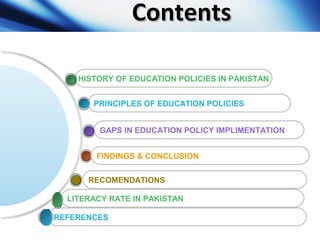
ContentsContents
GAPS IN EDUCATION POLICY IMPLIMENTATION
PRINCIPLES OF EDUCATION POLICIES
HISTORY OF EDUCATION POLICIES IN PAKISTAN
RECOMENDATIONS
FINDINGS & CONCLUSION
LITERACY RATE IN PAKISTAN
REFERENCES
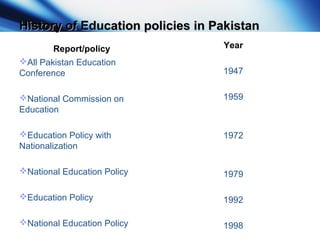
History of Education policies in PakistanHistory of Education policies in Pakistan
Report/policy
All Pakistan Education
Conference
National Commission on
Education
Education Policy with
Nationalization
National Education Policy
Education Policy
National Education Policy
Year
1947
1959
1972
1979
1992
1998
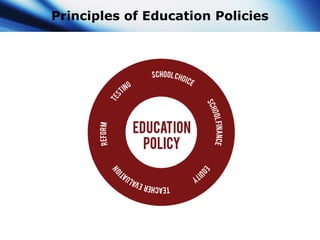
Principles of Education Policies
Gaps in education policy implementation
1. Poor communication system
 Policy implementation is a dynamic process. Education
policies in Pakistan are plagued by poor communication,
less support from the stakeholders, less ownership of the
policy by the stakeholders, lack of commitment on the
part of the implementers, no collaboration and
cooperation, less accurate and consistent approach
towards the completion of the policy goals. Therefore,
according to inadequate information creates distances
between the policy implementers and the beneficiaries
and ultimately causes serious obstacles to policy
implementation.
2. Weak administration
 Government of Pakistan (1979) says that for proper implementation
of policies effective implementation agencies are important. ©
Centre for Promoting Ideas, USA www.ijhssnet.com 243 Various
initiatives for policy implementation failed due to weak administrative
machinery at the grassroots level. The agencies at this level did not
own the policies (UNESCO & Government of Pakistan, 2003). The
poor management capacity of the directorates of education at policy
formulation levels, school heads at implementation level is one of
the many factors which also responsible for this mess. Government
of Pakistan (1998) considers weak and defective implementation
mechanism, inadequate personnel, poor training, low political
commitment and absence of incentives as reasons for the failures of
educational policy implementation in Pakistan.
3 Poor policy evaluation mechanisms
 It is a fact that precise, accurate and clear policy directives produce
creativity and adaptability which helps in the effective
implementation as well. On the other hand, less precise directive
does not leave room for the policy implementers to use their
discretion and flexibility which is normally needed for better policy
implementation. It must also be ensured that a not just information
rather a highly relevant and adequate information is provided on the
implementation process.
4 Financial gaps and irregularities
 UNESCO report (2005) has found that inadequate financial
resources for education in Pakistan have hindered the policy
implementation. Financial resource in any system plays the role of a
life blood. Without enough monitory support no system can work
effectively. No matter, how clearly and accurately the
implementation orders are transmitted, if the resources both
financial and material are less, the implementation will result in
problems. Therefore, according to World Bank Report (2000)
resource availability must be ensured by the implementers and the
policy makers before developing a policy. The resources include
adequate number of staff, enough financial support, quality and
trained staff. Therefore, it is necessary that equipments and
buildings must be provided for better policy implementation. Without
sufficient resources like these, required services will not reach the
beneficiaries directly.
5 Attitudes and dispositions of public servants
 Attitude and disposition is one of the key factors that affect
implementation process. It has been explored that bureaucratic
underpinnings have placed more pressures on the teachers’
community in Pakistan. This trend has given rise to feelings of
alienation among the teachers. This attitude and disposition of the
supervisors has promoted sense of discrimination among the
teachers. This leads to demonization of the supervisors and de-
motivation of the teachers. In education system, use of powers,
direct of staff, developing relationship and keeping expectation
depends to a large extent on the disposition of the implementers
toward the policies.
6. Inefficient bureaucratic structure
 Unless and until there is an efficient bureaucratic structure along
strong professional knowledge, the problem of implementation will
remain unresolved despite of having clear communication,
resources and positive disposition. Organization where there is
fragmentation hinders effective coordination which is necessary for
policy implementation because it may result in wastage of
resources, block the pace of smooth change and in overlooking of
some of the important actions necessary for policy implementation.
7. Failure of decentralization measures
 Zaki (1992) has found that in Pakistan devolution of responsibilities
in any system is not always accompanied by devolution of authority
which has created many complications in the discharge of the
services. Education is not exception to this. Naseem (1990) further
elaborates that decentralization provides better opportunities for the
beneficiaries at the grass root level. They will reap the fruits of the
policy easily without any bureaucratic or other hurdles. However, in
Pakistan there are discrepancies in the assigning of responsibilities
to the people as to how to act and use the given powers. There is no
proper direction which leads to role confusion less and effective
contributions.
8. Lack of political will
Political will of the local implementers play
a pivotal role in effective implementation
process. In Pakistan, due to none or less
participation of local implementer such as
school principals, teachers and students,
ownership factor of the policy becomes
weak. Jatoi (1995) believes that success
of implementation of a policy depends
largely on the political will of the policy
makers and policy implementers alike.
9. Leadership vacuum
 For any successful implementation of policies, visionary leadership,
strategic planning, strong will, trained teachers, community support,
and availability of resources, students and teachers motivation play
the role of cementing forces (Channo, 2003). For this purpose Zaidi
(2005) suggest empowerment of local stakeholders, planning
strategically, resource mobilization, resource utilization, political will,
monitoring and evaluation of the education system are essential
steps for successful implementation.
10. Deeply entrenched corruption
 Riaz (1998) writes that for successful implementation of any policy,
it is essential that the stakeholder are ready to sacrifice their
personal interest on the interest of the system and for the general
welfare of all irrespective of nay personal whim or vested interests.
This type of attitude develops an environment of trust and
transparency. However, education system in Pakistan has been
made hostage to evils for many years after its inception. This trend
of corruption has played with the foundations of the overall system.
Findings and Conclusions
 Policy strategies are essential for successful implementation of a
policy. These strategies help in setting forth mechanisms to achieve
the prescribed objectives. This study aimed at exploring the hurdles
in the way of successful policy implementation in Pakistan and
suggesting solutions in the light of literature review. The vast
analysis of the data showed that there is lack of direction,
consistency, poor institution-community relationship, corruption, lack
of visionary leadership at lower level and commitment on the part of
policy formulators and implementers with regard to policy
implementation in education. The analysis also showed that there is
no follow up, accountability for authority and supervisors, lack of
system of training for policy formulators and implementers.
Recommendations
• All stakeholders such as teachers, principals, and researchers may
be involved or informed on policy formulation and implementation. In
this way the gap of understanding would be resolved.
• Strong coordination between the schools and the inspectorate may
help in bridging the gulf of mistrust and alienation.
• Accountability system may be strengthened to decrease corruption.
• In order to overcome financial constraints, practical measures may
be taken for effective planning and utilization of available resources
both human and material.
• Through strong accountability, the prevalence of corruption,
nepotism and favoritism could be controlled.
• The people involved in the process of formulation, implementation
and evaluation of policies can be trained to enhance their theoretical
knowledge in skills in better administration, management and
coordination.
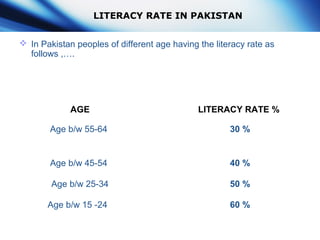
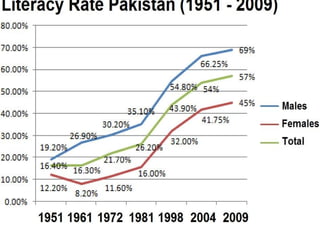
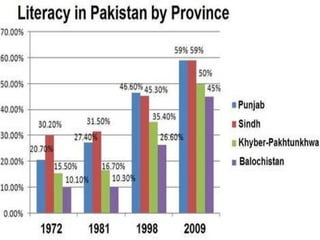
LITERACY RATE IN PAKISTAN
 In Pakistan peoples of different age having the literacy rate as
follows ,….
AGE LITERACY RATE %
Age b/w 55-64 30 %
Age b/w 45-54 40 %
Age b/w 25-34 50 %
Age b/w 15 -24 60 %
References
• Government of Pakistan (2010). Economic Survey of Pakistan (2008-2009). Finance division:
Islamabad.
• Government of Pakistan (2009). National Education Policy 2009. Ministry of Education:
Islamabad.
• Government of Pakistan (1998). National Education Policy 1998-2010, Ministry of Education:
Islamabad.
• Government of Pakistan (1979). National Education Policy and implementation program.
Islamabad: Ministry of Education.
• Bank. (2000). World Development Report 2000/2001. New York: Oxford University Press.
• Channo, S. K. (1990). Review of Educational Policies. NIPA, Karachi. P p. 6, 14, 26-28
• Jatoi, H. (1995). Brief Review of Educational Polices and Five Year Development Plans 1947-92
(unpublished). AEPM, Islmabad. P.6-7
• Naseem,J. Q. (1990), Problem of Education in Pakistan, Karachi: Royal Book Company
• UNESCO (2000). Summary of Global Monitoring Report. France : UNESCO
• UNESCO & Government of Pakistan (2003). Seminar on Capacity building to enable
implementation of education devolution reforms at local levels. Islamabad. AEPM
• Riaz R. (1998) Introduction to Education. Lahore: Urdu Bazaar, Ehtasham Publishers.
Any QuestionAny Question
Problems in implementing education policies in pakistan

Problems in implementing education policies in pakistan

  • 2.
    Problems In ImplementingProblemsIn Implementing Education Policies In PakistanEducation Policies In Pakistan Nighat Shaheen (M.Phil. 1st ) DEPARTMENT OF EDUCATION HAZARA UNIVERSITY MANSEHRA
  • 3.
    ContentsContents GAPS IN EDUCATIONPOLICY IMPLIMENTATION PRINCIPLES OF EDUCATION POLICIES HISTORY OF EDUCATION POLICIES IN PAKISTAN RECOMENDATIONS FINDINGS & CONCLUSION LITERACY RATE IN PAKISTAN REFERENCES
  • 4.
    History of Educationpolicies in PakistanHistory of Education policies in Pakistan Report/policy All Pakistan Education Conference National Commission on Education Education Policy with Nationalization National Education Policy Education Policy National Education Policy Year 1947 1959 1972 1979 1992 1998
  • 5.
  • 6.
    Gaps in educationpolicy implementation
  • 7.
    1. Poor communicationsystem  Policy implementation is a dynamic process. Education policies in Pakistan are plagued by poor communication, less support from the stakeholders, less ownership of the policy by the stakeholders, lack of commitment on the part of the implementers, no collaboration and cooperation, less accurate and consistent approach towards the completion of the policy goals. Therefore, according to inadequate information creates distances between the policy implementers and the beneficiaries and ultimately causes serious obstacles to policy implementation.
  • 8.
    2. Weak administration Government of Pakistan (1979) says that for proper implementation of policies effective implementation agencies are important. © Centre for Promoting Ideas, USA www.ijhssnet.com 243 Various initiatives for policy implementation failed due to weak administrative machinery at the grassroots level. The agencies at this level did not own the policies (UNESCO & Government of Pakistan, 2003). The poor management capacity of the directorates of education at policy formulation levels, school heads at implementation level is one of the many factors which also responsible for this mess. Government of Pakistan (1998) considers weak and defective implementation mechanism, inadequate personnel, poor training, low political commitment and absence of incentives as reasons for the failures of educational policy implementation in Pakistan.
  • 9.
    3 Poor policyevaluation mechanisms  It is a fact that precise, accurate and clear policy directives produce creativity and adaptability which helps in the effective implementation as well. On the other hand, less precise directive does not leave room for the policy implementers to use their discretion and flexibility which is normally needed for better policy implementation. It must also be ensured that a not just information rather a highly relevant and adequate information is provided on the implementation process.
  • 10.
    4 Financial gapsand irregularities  UNESCO report (2005) has found that inadequate financial resources for education in Pakistan have hindered the policy implementation. Financial resource in any system plays the role of a life blood. Without enough monitory support no system can work effectively. No matter, how clearly and accurately the implementation orders are transmitted, if the resources both financial and material are less, the implementation will result in problems. Therefore, according to World Bank Report (2000) resource availability must be ensured by the implementers and the policy makers before developing a policy. The resources include adequate number of staff, enough financial support, quality and trained staff. Therefore, it is necessary that equipments and buildings must be provided for better policy implementation. Without sufficient resources like these, required services will not reach the beneficiaries directly.
  • 11.
    5 Attitudes anddispositions of public servants  Attitude and disposition is one of the key factors that affect implementation process. It has been explored that bureaucratic underpinnings have placed more pressures on the teachers’ community in Pakistan. This trend has given rise to feelings of alienation among the teachers. This attitude and disposition of the supervisors has promoted sense of discrimination among the teachers. This leads to demonization of the supervisors and de- motivation of the teachers. In education system, use of powers, direct of staff, developing relationship and keeping expectation depends to a large extent on the disposition of the implementers toward the policies.
  • 12.
    6. Inefficient bureaucraticstructure  Unless and until there is an efficient bureaucratic structure along strong professional knowledge, the problem of implementation will remain unresolved despite of having clear communication, resources and positive disposition. Organization where there is fragmentation hinders effective coordination which is necessary for policy implementation because it may result in wastage of resources, block the pace of smooth change and in overlooking of some of the important actions necessary for policy implementation.
  • 13.
    7. Failure ofdecentralization measures  Zaki (1992) has found that in Pakistan devolution of responsibilities in any system is not always accompanied by devolution of authority which has created many complications in the discharge of the services. Education is not exception to this. Naseem (1990) further elaborates that decentralization provides better opportunities for the beneficiaries at the grass root level. They will reap the fruits of the policy easily without any bureaucratic or other hurdles. However, in Pakistan there are discrepancies in the assigning of responsibilities to the people as to how to act and use the given powers. There is no proper direction which leads to role confusion less and effective contributions.
  • 14.
    8. Lack ofpolitical will Political will of the local implementers play a pivotal role in effective implementation process. In Pakistan, due to none or less participation of local implementer such as school principals, teachers and students, ownership factor of the policy becomes weak. Jatoi (1995) believes that success of implementation of a policy depends largely on the political will of the policy makers and policy implementers alike.
  • 15.
    9. Leadership vacuum For any successful implementation of policies, visionary leadership, strategic planning, strong will, trained teachers, community support, and availability of resources, students and teachers motivation play the role of cementing forces (Channo, 2003). For this purpose Zaidi (2005) suggest empowerment of local stakeholders, planning strategically, resource mobilization, resource utilization, political will, monitoring and evaluation of the education system are essential steps for successful implementation.
  • 16.
    10. Deeply entrenchedcorruption  Riaz (1998) writes that for successful implementation of any policy, it is essential that the stakeholder are ready to sacrifice their personal interest on the interest of the system and for the general welfare of all irrespective of nay personal whim or vested interests. This type of attitude develops an environment of trust and transparency. However, education system in Pakistan has been made hostage to evils for many years after its inception. This trend of corruption has played with the foundations of the overall system.
  • 17.
    Findings and Conclusions Policy strategies are essential for successful implementation of a policy. These strategies help in setting forth mechanisms to achieve the prescribed objectives. This study aimed at exploring the hurdles in the way of successful policy implementation in Pakistan and suggesting solutions in the light of literature review. The vast analysis of the data showed that there is lack of direction, consistency, poor institution-community relationship, corruption, lack of visionary leadership at lower level and commitment on the part of policy formulators and implementers with regard to policy implementation in education. The analysis also showed that there is no follow up, accountability for authority and supervisors, lack of system of training for policy formulators and implementers.
  • 18.
    Recommendations • All stakeholderssuch as teachers, principals, and researchers may be involved or informed on policy formulation and implementation. In this way the gap of understanding would be resolved. • Strong coordination between the schools and the inspectorate may help in bridging the gulf of mistrust and alienation. • Accountability system may be strengthened to decrease corruption. • In order to overcome financial constraints, practical measures may be taken for effective planning and utilization of available resources both human and material. • Through strong accountability, the prevalence of corruption, nepotism and favoritism could be controlled. • The people involved in the process of formulation, implementation and evaluation of policies can be trained to enhance their theoretical knowledge in skills in better administration, management and coordination.
  • 19.
    LITERACY RATE INPAKISTAN  In Pakistan peoples of different age having the literacy rate as follows ,…. AGE LITERACY RATE % Age b/w 55-64 30 % Age b/w 45-54 40 % Age b/w 25-34 50 % Age b/w 15 -24 60 %
  • 24.
    References • Government ofPakistan (2010). Economic Survey of Pakistan (2008-2009). Finance division: Islamabad. • Government of Pakistan (2009). National Education Policy 2009. Ministry of Education: Islamabad. • Government of Pakistan (1998). National Education Policy 1998-2010, Ministry of Education: Islamabad. • Government of Pakistan (1979). National Education Policy and implementation program. Islamabad: Ministry of Education. • Bank. (2000). World Development Report 2000/2001. New York: Oxford University Press. • Channo, S. K. (1990). Review of Educational Policies. NIPA, Karachi. P p. 6, 14, 26-28 • Jatoi, H. (1995). Brief Review of Educational Polices and Five Year Development Plans 1947-92 (unpublished). AEPM, Islmabad. P.6-7 • Naseem,J. Q. (1990), Problem of Education in Pakistan, Karachi: Royal Book Company • UNESCO (2000). Summary of Global Monitoring Report. France : UNESCO • UNESCO & Government of Pakistan (2003). Seminar on Capacity building to enable implementation of education devolution reforms at local levels. Islamabad. AEPM • Riaz R. (1998) Introduction to Education. Lahore: Urdu Bazaar, Ehtasham Publishers.
  • 25.