Course: Development Education II
Presentation By: Ibrash Pasha- MA Education
Planning & Management- EPM
 Objectives
1. Highlight the Economic considerations in
Educational Planning
2. Describe relevance b/w Edu. and Econ. Dev
3. Explain the concept of Dev. Planning.
4. Evaluate the efficiency of an educational
plan on basis of Econ. Dev
 Edu. planner must have some knowledge of
economics, b/c in Edu. Planning they get
information from economists, which are
relevant to education.
 They must understand what the economists
are doing like;
◦ Describing and analyzing economy. (economy,
production, consumption, investment, exports,
employment, manpower, income )
◦ Planning the social and economic development.
◦ Checking that every thing is done effectively.
 Economic Context of education, education as
investment; like in most of Asian countries;
◦ The people are poor
◦ Majority of population are doing farming
◦ Majority of people are illiterate.
 To develop the country, its necessary to
◦ Make agriculture more modern
◦ Industrialization
 For the above both, need trained human
resource, engineers, skilled force
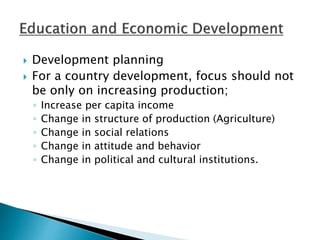
 Development planning
 For a country development, focus should not
be only on increasing production;
◦ Increase per capita income
◦ Change in structure of production (Agriculture)
◦ Change in social relations
◦ Change in attitude and behavior
◦ Change in political and cultural institutions.
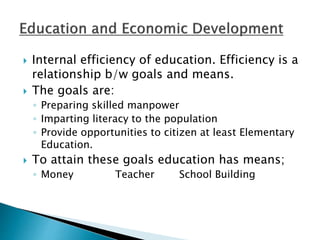
 Internal efficiency of education. Efficiency is a
relationship b/w goals and means.
 The goals are:
◦ Preparing skilled manpower
◦ Imparting literacy to the population
◦ Provide opportunities to citizen at least Elementary
Education.
 To attain these goals education has means;
◦ Money Teacher School Building
1.Skilled Manpower 2. Literate Population, 3. Equal
Educational opportunities
S/Building
Money
Teacher
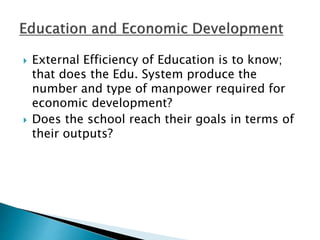
 External Efficiency of Education is to know;
that does the Edu. System produce the
number and type of manpower required for
economic development?
 Does the school reach their goals in terms of
their outputs?
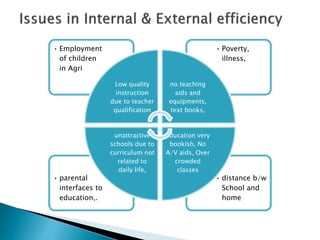
• distance b/w
School and
home
• parental
interfaces to
education,.
• Poverty,
illness,
• Employment
of children
in Agri
Low quality
instruction
due to teacher
qualification
no teaching
aids and
equipments,
text books,
education very
bookish, No
A/V aids, Over
crowded
classes
unattractive
schools due to
curriculum not
related to
daily life,
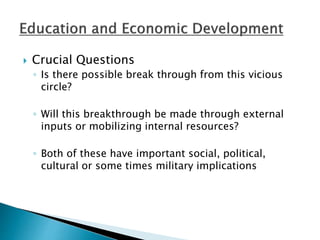
 Crucial Questions
◦ Is there possible break through from this vicious
circle?
◦ Will this breakthrough be made through external
inputs or mobilizing internal resources?
◦ Both of these have important social, political,
cultural or some times military implications
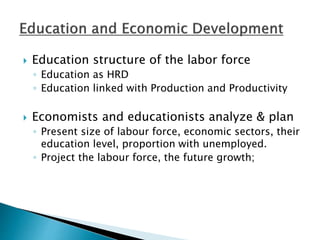
 Education structure of the labor force
◦ Education as HRD
◦ Education linked with Production and Productivity
 Economists and educationists analyze & plan
◦ Present size of labour force, economic sectors, their
education level, proportion with unemployed.
◦ Project the labour force, the future growth;
 External Resources/ Inputs
◦ Economic
◦ Financial
◦ Transfer of technology related to education
 Internal Resources/ Inputs
◦ In Human Resource, political, economic, social etc
Thanks

Education and Economic Development

  • 1.
    Course: Development EducationII Presentation By: Ibrash Pasha- MA Education Planning & Management- EPM
  • 2.
     Objectives 1. Highlightthe Economic considerations in Educational Planning 2. Describe relevance b/w Edu. and Econ. Dev 3. Explain the concept of Dev. Planning. 4. Evaluate the efficiency of an educational plan on basis of Econ. Dev
  • 3.
     Edu. plannermust have some knowledge of economics, b/c in Edu. Planning they get information from economists, which are relevant to education.  They must understand what the economists are doing like; ◦ Describing and analyzing economy. (economy, production, consumption, investment, exports, employment, manpower, income ) ◦ Planning the social and economic development. ◦ Checking that every thing is done effectively.
  • 4.
     Economic Contextof education, education as investment; like in most of Asian countries; ◦ The people are poor ◦ Majority of population are doing farming ◦ Majority of people are illiterate.  To develop the country, its necessary to ◦ Make agriculture more modern ◦ Industrialization  For the above both, need trained human resource, engineers, skilled force
  • 5.
     Development planning For a country development, focus should not be only on increasing production; ◦ Increase per capita income ◦ Change in structure of production (Agriculture) ◦ Change in social relations ◦ Change in attitude and behavior ◦ Change in political and cultural institutions.
  • 6.
     Internal efficiencyof education. Efficiency is a relationship b/w goals and means.  The goals are: ◦ Preparing skilled manpower ◦ Imparting literacy to the population ◦ Provide opportunities to citizen at least Elementary Education.  To attain these goals education has means; ◦ Money Teacher School Building
  • 7.
    1.Skilled Manpower 2.Literate Population, 3. Equal Educational opportunities S/Building Money Teacher
  • 8.
     External Efficiencyof Education is to know; that does the Edu. System produce the number and type of manpower required for economic development?  Does the school reach their goals in terms of their outputs?
  • 9.
    • distance b/w Schooland home • parental interfaces to education,. • Poverty, illness, • Employment of children in Agri Low quality instruction due to teacher qualification no teaching aids and equipments, text books, education very bookish, No A/V aids, Over crowded classes unattractive schools due to curriculum not related to daily life,
  • 10.
     Crucial Questions ◦Is there possible break through from this vicious circle? ◦ Will this breakthrough be made through external inputs or mobilizing internal resources? ◦ Both of these have important social, political, cultural or some times military implications
  • 11.
     Education structureof the labor force ◦ Education as HRD ◦ Education linked with Production and Productivity  Economists and educationists analyze & plan ◦ Present size of labour force, economic sectors, their education level, proportion with unemployed. ◦ Project the labour force, the future growth;
  • 12.
     External Resources/Inputs ◦ Economic ◦ Financial ◦ Transfer of technology related to education  Internal Resources/ Inputs ◦ In Human Resource, political, economic, social etc
  • 13.