





CUSTOMER
CENTRICITY
THE AGE OF THE CUSTOMER……
WHAT IS CUSTOMER CENTRICITY?
• Customer centricity is a mind-set that companies need to
adopt throughout the entire organization—not just marketing—
to thrive in the digital world.
• Smart customers are customers that leverage digital devices to
access information, anywhere and anytime. What that means is
the power in the relationship between companies and
customers is in the process of shifting.
STATISTICAL DATA ON CUSTOMER
CENTRICITY
1. PROFITABILITY
Customer-centric companies are
60% more profitable compared to
companies that are not focused on
the customer.
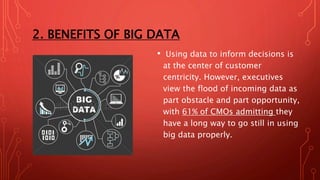
2. BENEFITS OF BIG DATA
• Using data to inform decisions is
at the center of customer
centricity. However, executives
view the flood of incoming data as
part obstacle and part opportunity,
with 61% of CMOs admitting they
have a long way to go still in using
big data properly.
3. OWNERSHIP OF CUSTOMER
• A lack of clear ownership of the customer also is holding
companies back from a true customer focus. This lack of
centralized customer ownership has resulted in a scenario where
48% of marketers are only moderately confident in the ability of
their organizations’ core touch points to reach and engage with
the customer.
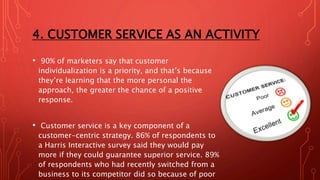
4. CUSTOMER SERVICE AS AN ACTIVITY
• 90% of marketers say that customer
individualization is a priority, and that’s because
they’re learning that the more personal the
approach, the greater the chance of a positive
response.
• Customer service is a key component of a
customer-centric strategy. 86% of respondents to
a Harris Interactive survey said they would pay
more if they could guarantee superior service. 89%
of respondents who had recently switched from a
business to its competitor did so because of poor
5. INFLUENCE ON FINANCIAL INSTITUTION
• Banks and other
financial institutions
have significantly
increased their customer
focus recently,
increasing the number of
customer-centric jobs by
52% in the last year.
6. CUSTOMER TO SET THEIR OWN
PREFERENCES
• Enterprise brands, like multichannel retailers, are asking their
customers to set their own preferences: Brands today are 62%
more likely to give their subscribers the ability to set their own
preferences for branded communications than they were in
2013. Further, they are 89% more likely to allow them to select
the type of messages that they receive and 48% more likely to
give options for how often subscribers want to receive those
communications.
7. ROLE OF DATA RECOGNITION
• Marketers recognize data's role in customer centricity and are
taking action to improve their data hygiene: Marketers are 53%
more likely to execute data hygiene techniques than they were
in 2013. Retailers are 13% less likely to undertake some form of
data-hygiene process than nonretailers. However, when they do
prioritize data hygiene, retailers are 38% more likely to use a
data-hygiene provider than nonretail brands.
8. ORGANISATIONS INVOLVEMENT
• 63% percent of CEOs see
rallying their organizations
around the customer as one
of the top three investment
priorities this year.
• 9 out of 10 U.S. CEOs say
they are strengthening their
customer and client
engagement programs this
year.
9. ASPIRATIONAL GOAL VS REALITY
• For most marketers, customer centricity is an
aspirational goal but not yet a reality. Here's why: 70%
have suboptimal or no ability to integrate customer
data between online and offline sources; 80% don’t
apply customer value scores; and, 74% can’t recognize
customers in real time.
• According to consumers, customer service agents fail
to answer their questions 50% of the time.
• It takes 12 positive experiences with a brand to make
up for one unresolved negative experience.
10. AT B2B LEVEL
• 45% of B2B marketers feel their levels of customer centricity are
good, if not high. And 45% believe their customers would say that
customer-centricity levels are good to high.
• Creating a happy customer is not a marketing-only endeavor—
customer service, product development, R&D teams, operations,
and IT all play a role. However, just 12% of B2B marketers said that
functional teams were strongly aligned around a holistic customer
experience strategy.
-THANKYOU

Customer centricity

  • 1.
  • 2.
    WHAT IS CUSTOMERCENTRICITY? • Customer centricity is a mind-set that companies need to adopt throughout the entire organization—not just marketing— to thrive in the digital world. • Smart customers are customers that leverage digital devices to access information, anywhere and anytime. What that means is the power in the relationship between companies and customers is in the process of shifting.
  • 3.
    STATISTICAL DATA ONCUSTOMER CENTRICITY
  • 4.
    1. PROFITABILITY Customer-centric companiesare 60% more profitable compared to companies that are not focused on the customer.
  • 5.
    2. BENEFITS OFBIG DATA • Using data to inform decisions is at the center of customer centricity. However, executives view the flood of incoming data as part obstacle and part opportunity, with 61% of CMOs admitting they have a long way to go still in using big data properly.
  • 6.
    3. OWNERSHIP OFCUSTOMER • A lack of clear ownership of the customer also is holding companies back from a true customer focus. This lack of centralized customer ownership has resulted in a scenario where 48% of marketers are only moderately confident in the ability of their organizations’ core touch points to reach and engage with the customer.
  • 7.
    4. CUSTOMER SERVICEAS AN ACTIVITY • 90% of marketers say that customer individualization is a priority, and that’s because they’re learning that the more personal the approach, the greater the chance of a positive response. • Customer service is a key component of a customer-centric strategy. 86% of respondents to a Harris Interactive survey said they would pay more if they could guarantee superior service. 89% of respondents who had recently switched from a business to its competitor did so because of poor
  • 8.
    5. INFLUENCE ONFINANCIAL INSTITUTION • Banks and other financial institutions have significantly increased their customer focus recently, increasing the number of customer-centric jobs by 52% in the last year.
  • 9.
    6. CUSTOMER TOSET THEIR OWN PREFERENCES • Enterprise brands, like multichannel retailers, are asking their customers to set their own preferences: Brands today are 62% more likely to give their subscribers the ability to set their own preferences for branded communications than they were in 2013. Further, they are 89% more likely to allow them to select the type of messages that they receive and 48% more likely to give options for how often subscribers want to receive those communications.
  • 10.
    7. ROLE OFDATA RECOGNITION • Marketers recognize data's role in customer centricity and are taking action to improve their data hygiene: Marketers are 53% more likely to execute data hygiene techniques than they were in 2013. Retailers are 13% less likely to undertake some form of data-hygiene process than nonretailers. However, when they do prioritize data hygiene, retailers are 38% more likely to use a data-hygiene provider than nonretail brands.
  • 11.
    8. ORGANISATIONS INVOLVEMENT •63% percent of CEOs see rallying their organizations around the customer as one of the top three investment priorities this year. • 9 out of 10 U.S. CEOs say they are strengthening their customer and client engagement programs this year.
  • 12.
    9. ASPIRATIONAL GOALVS REALITY • For most marketers, customer centricity is an aspirational goal but not yet a reality. Here's why: 70% have suboptimal or no ability to integrate customer data between online and offline sources; 80% don’t apply customer value scores; and, 74% can’t recognize customers in real time. • According to consumers, customer service agents fail to answer their questions 50% of the time. • It takes 12 positive experiences with a brand to make up for one unresolved negative experience.
  • 13.
    10. AT B2BLEVEL • 45% of B2B marketers feel their levels of customer centricity are good, if not high. And 45% believe their customers would say that customer-centricity levels are good to high. • Creating a happy customer is not a marketing-only endeavor— customer service, product development, R&D teams, operations, and IT all play a role. However, just 12% of B2B marketers said that functional teams were strongly aligned around a holistic customer experience strategy.
  • 14.