


6-10-03 1
Event Solutions International
Organizational
Development
Presented by:
First Light LLC – jgillis767@aol.com
6-10-03 2
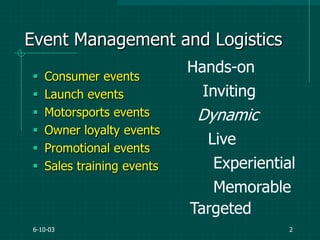
Event Management and Logistics
 Consumer events
 Launch events
 Motorsports events
 Owner loyalty events
 Promotional events
 Sales training events
Hands-on
Inviting
Live
Memorable
Dynamic
Experiential
Targeted
6-10-03 3
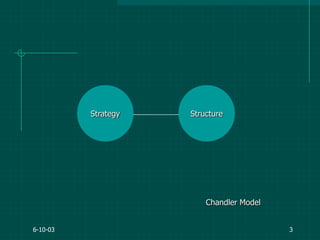
Strategy Structure
Chandler Model
6-10-03 4
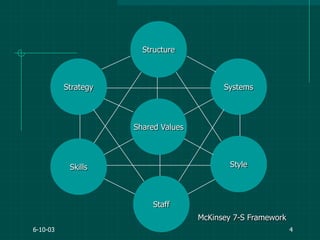
Shared Values
Strategy
Structure
Systems
Style
Staff
Skills
McKinsey 7-S Framework
6-10-03 5
Principles
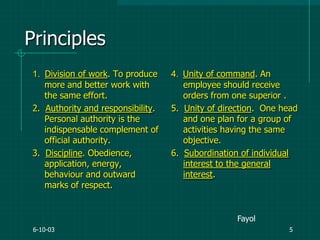
1. Division of work. To produce
more and better work with
the same effort.
2. Authority and responsibility.
Personal authority is the
indispensable complement of
official authority.
3. Discipline. Obedience,
application, energy,
behaviour and outward
marks of respect.
4. Unity of command. An
employee should receive
orders from one superior .
5. Unity of direction. One head
and one plan for a group of
activities having the same
objective.
6. Subordination of individual
interest to the general
interest.
Fayol
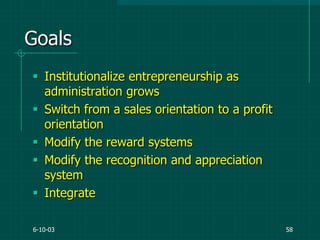
6-10-03 6
Principles
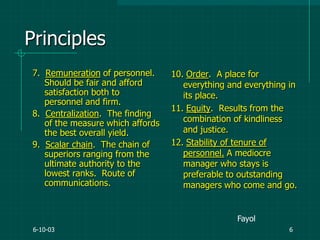
7. Remuneration of personnel.
Should be fair and afford
satisfaction both to
personnel and firm.
8. Centralization. The finding
of the measure which affords
the best overall yield.
9. Scalar chain. The chain of
superiors ranging from the
ultimate authority to the
lowest ranks. Route of
communications.
10. Order. A place for
everything and everything in
its place.
11. Equity. Results from the
combination of kindliness
and justice.
12. Stability of tenure of
personnel. A mediocre
manager who stays is
preferable to outstanding
managers who come and go.
Fayol
6-10-03 7
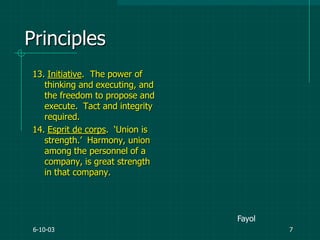
13. Initiative. The power of
thinking and executing, and
the freedom to propose and
execute. Tact and integrity
required.
14. Esprit de corps. „Union is
strength.‟ Harmony, union
among the personnel of a
company, is great strength
in that company.
Principles
Fayol
6-10-03 8
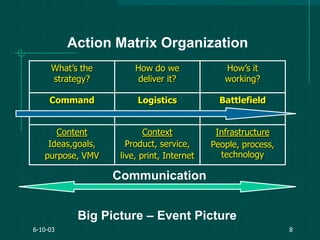
Infrastructure
People, process,
technology
Context
Product, service,
live, print, Internet
Content
Ideas,goals,
purpose, VMV
How‟s it
working?
How do we
deliver it?
What‟s the
strategy?
BattlefieldLogisticsCommand
Action Matrix Organization
Communication
Big Picture – Event Picture
6-10-03 9
Battlefield Infrastructure
 People
• Yours, mine and ours
 Process
• People, budgets and schedules
• Macro and micro
 Technology
• Operational
• Deliverable
6-10-03 10
ESI INFRASTRUCTURE
PEOPLE
6-10-03 11
Lesson 1
 Being responsible sometimes means pissing
people off.
Colin Powell
6-10-03 12
Lesson 2
 The day soldiers stop bringing you their
problems is the day you have stopped leading
them. They have either lost confidence that
you can help them or concluded that you do
not care. Either case is a failure of
leadership.
Colin Powell
6-10-03 13
People
 What do you want me to do?
 Why is it important?
 How do I do it?
 What‟s in it for me?
 How do I know when I‟ve done it right?
6-10-03 14
People
 What would you like me to keep doing?
 What would you like me to do more of?
 What would you like me to do less of?
 What would you like me to stop doing?
 What would you like me to start doing?
Mordecai Magencey
6-10-03 15
Lesson 3
 Organization doesn‟t really accomplish
anything. Plans don‟t accomplish anything
either. Theories of management don‟t much
matter. Endeavors succeed or fail because of
the people involved. Only by attracting the
best people will you accomplish great deeds.
Colin Powell
6-10-03 16
Lesson 4
 Powell‟s rules for picking people: Look for
intelligence and judgment, and most
critically, a capacity to anticipate, to see
around corners. Also look for
loyalty, integrity, a high energy drive, a
balanced ego, and the drive to get things
done.
Colin Powell
6-10-03 17
Lesson 5
 Have fun in your command. Don‟t always run
at a breakneck pace. Take leave when
you‟ve earned it: spend time with your
families.
 Corollary: surround yourself with people who
take their work seriously, but not themselves
– those who work hard and play hard.
Colin Powell
6-10-03 18
People
Questions? Comments?
6-10-03 19
ESI INFRASTRUCTURE
PROCESS
6-10-03 20
Lesson 6
 Never neglect details. When everyone‟s mind
is dulled or distracted the leader must be
doubly vigilant.
Colin Powell
6-10-03 21
Lesson 7
 You don‟t know what you can get away with
until you try.
Colin Powell
6-10-03 22
Lesson 8
 Keep looking below surface appearances.
Don‟t shrink from doing so (just) because you
might not like what you find.
Colin Powell
6-10-03 23
Lesson 9
 Perpetual optimism is a force multiplier.
Colin Powell
6-10-03 24
Lesson 10
 Great leaders are almost always great
simplifiers, who can cut through argument,
debate and doubt, to offer a solution
everybody can understand.
Colin Powell
6-10-03 25
Lesson 11
 Part I:
• Use the formula P = 40 to 70, in which P stands
for the probability of success and the numbers
indicate the percentage of information acquired.
 Part II:
• Once the information is in the 40 to 70 range, go
with your gut.
Colin Powell
6-10-03 26
Lesson 12
 The commander in the field is always right
and the rear echelon is wrong, unless proved
otherwise.
Colin Powell
6-10-03 27
Process
 Business happens horizontally.
 Input – Process – Output
 The problems and solutions usually occur at
the interfaces, connections and handoffs.
 Systems thinking.
 A way of doing business.
6-10-03 28
ISO
 “Say what you do and do what you say.”
 Make the process explicit.
• ISO elements
• System Level Procedures (SLPs)
• Work Instructions
 Process Owners.
• Accountability and responsibility
• Review, monitor, measure, improve
 Management Responsibility.
6-10-03 29
Process
 Quality System
 Corrective and Preventive Action
 Continuous Improvement
 Radical Improvement
 Customer Satisfaction
6-10-03 30
Process
Questions? Comments?
6-10-03 31
ESI INFRASTRUCTURE
TECHNOLOGY
6-10-03 32
Lesson 13
 Don‟t be buffaloed by experts and elites.
Experts often possess more data than
judgment. Elites can become so inbred that
they produce hemophiliacs who bleed to
death as soon as they are nicked by the real
world.
Colin Powell
6-10-03 33
Lesson 14
 Fit no stereotypes. Don‟t chase the latest
management fads. The situation dictates
which approach best accomplishes the team‟s
mission.
Colin Powell
6-10-03 34
Lesson 15
 Don‟t be afraid to challenge the pros, even in
their own backyard.
Colin Powell
6-10-03 35
Questions
 The role of technology in the future of ESI?
 The cost of technology in the infrastructure of
ESI?
 The role of technology in long-term
efficiency?
 The role of technology in integration?
6-10-03 36
Technology
Questions? Comments?
6-10-03 37
Management
 SOMMD
 Sets objectives
 Organizes
 Motivates and communicates
 Measures
 Develops people
Peter Ferdinand Drucker
6-10-03 38
Respect & Professionalism
 “If Judge MacMahon had been asked what he was
training Paul Crotty, Ken Caruso, Jim Duff, David
Denton, or Rudy Giuliani or any of his clerks to be, he
would have said it was to be a fine trial lawyer.
Being able to communicate, being able to explain,
being able to simplify. He expected a lot from
lawyers because he saw them as professionals, from
whom one should expect the highest standards…the
high standards he set were born out of respect.”
Rudolf W. Giuliani
6-10-03 39
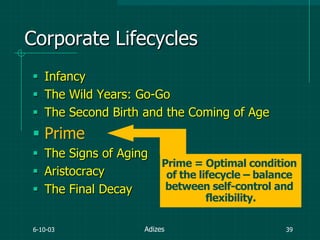
Corporate Lifecycles
 Infancy
 The Wild Years: Go-Go
 The Second Birth and the Coming of Age
 Prime
 The Signs of Aging
 Aristocracy
 The Final Decay
Adizes
Prime = Optimal condition
of the lifecycle – balance
between self-control and
flexibility.
6-10-03 40
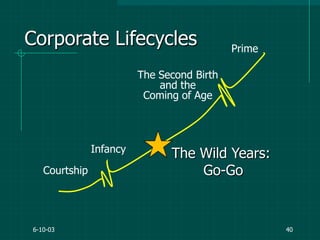
Courtship
The Wild Years:
Go-Go
Infancy
Prime
Corporate Lifecycles
The Second Birth
and the
Coming of Age
6-10-03 41
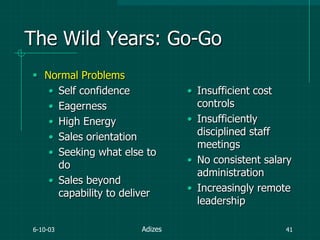
The Wild Years: Go-Go
 Normal Problems
• Self confidence
• Eagerness
• High Energy
• Sales orientation
• Seeking what else to
do
• Sales beyond
capability to deliver
• Insufficient cost
controls
• Insufficiently
disciplined staff
meetings
• No consistent salary
administration
• Increasingly remote
leadership
Adizes
6-10-03 42
The Wild Years: Go-Go
 Normal Problems
• Leadership‟s inflated
expectations
• Unclear
communication
• Hope for miracles
• Unclear
responsibilities
• Company subject to
criticism
• Internal
disintegration
• Cracking
infrastructure
• Workable people-
centric org structure
• Everything is a
priority?
• Founder
indispensable
Adizes
6-10-03 43
The Wild Years: Go-Go
 Abnormal Problems
• Arrogance
• Lack of Focus
• Energy too thinly
spread
• Sales and premature
profit orientation
• No boundaries on
what to do
• Selling despite
inability to deliver
quality
• No cost controls
• No staff meetings
• Overpaid employees
• Leadership‟s
paranoia
Adizes
6-10-03 44
The Wild Years: Go-Go
 Abnormal Problems
• No communication
• Reliance on miracles
• Lack of
accountability
• Diminishing mutual
trust and respect
• Collapsing
infrastructure
• Unworkable people-
centric organizational
structure
• Everything is a
priority!
Adizes
6-10-03 45
Institutionalizing Leadership
 It is the difficult process of transferring the
integration function that retards companies‟ abilities
to institutionalize entrepreneurial functions.
 For a company to preserve its hard-won gains, it
must make the change from management-by-
intuition and management-by-the-seat-of the pants –
Go-Go management – to a more professional
process.
Adizes
6-10-03 46
Guns or Butter
 The sooner the Go – Go realizes the necessity for
setting priorities, the faster it will focus and become
more efficient. The organization must learn that
resources are limited and that the law of opportunity-
costs prevails. Doing one thing means that one
cannot do something else – and the cost of doing
one thing is the price of not doing another.
Adizes
6-10-03 47
Goals
 Teamwork
 Build integration to reduce the need for
administrative systems
 Purpose
 Focus
 Get over the “We‟re too busy to get
organized.”
 Grow up
6-10-03 48
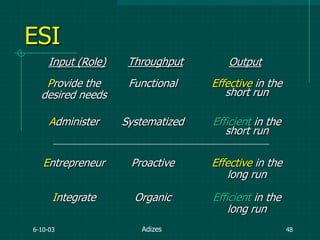
ESI
Efficient in the
short run
SystematizedAdminister
Effective in the
short run
FunctionalProvide the
desired needs
Input (Role) Throughput Output
Effective in the
long run
Efficient in the
long run
Proactive
Organic
Entrepreneur
Integrate
Adizes
6-10-03 49
Entrepreneuring
 “We cannot afford the luxury of waiting to
see the future before we decide what to do in
the present.” Adizes
 “Imagination is more important than
knowledge.” Einstein
 Creativity and risk taking.
 Planning.
Adizes
6-10-03 50
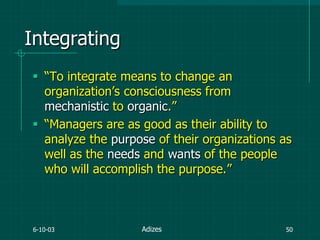
Integrating
 “To integrate means to change an
organization‟s consciousness from
mechanistic to organic.”
 “Managers are as good as their ability to
analyze the purpose of their organizations as
well as the needs and wants of the people
who will accomplish the purpose.”
Adizes
6-10-03 51
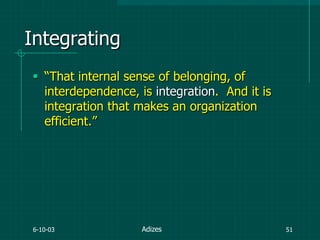
Integrating
 “That internal sense of belonging, of
interdependence, is integration. And it is
integration that makes an organization
efficient.”
Adizes
6-10-03 52
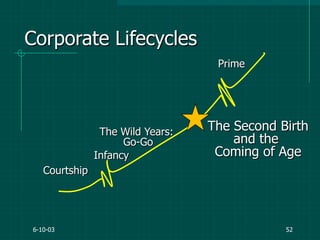
Courtship
The Wild Years:
Go-Go
Infancy
Prime
Corporate Lifecycles
The Second Birth
and the
Coming of Age
6-10-03 53
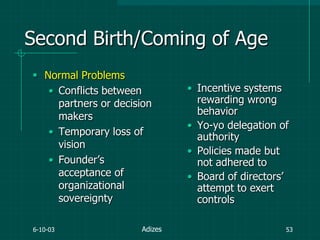
Second Birth/Coming of Age
 Normal Problems
• Conflicts between
partners or decision
makers
• Temporary loss of
vision
• Founder‟s
acceptance of
organizational
sovereignty
• Incentive systems
rewarding wrong
behavior
• Yo-yo delegation of
authority
• Policies made but
not adhered to
• Board of directors‟
attempt to exert
controls
Adizes
6-10-03 54
Second Birth/Coming of Age
 Normal Problems
• Love – hate
relationship between
the organization and
its entrepreneurial
leadership
• Difficulty changing
leadership style
• Entrepreneurial role
monopolized and
personalized
• Lack of controls
• Lack of
accountability
• Low morale
• Lack of profit-sharing
scheme
• Rising profits, flat
sales
Adizes
6-10-03 55
Second Birth/Coming of Age
 Abnormal Problems
• Return to Go-Go and
the founder‟s trap
• Inconsistent goals
• Organizational
paralysis during
endless power shifts
• Rapid decline in
mutual trust and
respect
• Excessive internal
politics
• Unchanging
dysfunctional
leadership style
• Entrepreneur‟s
refusal to delegate
the role to a
depersonalized role
Adizes
6-10-03 56
Second Birth/Coming of Age
 Abnormal Problems
• Divide-and-rule
management
• Imposition of
excessive and
expensive controls
• Profit responsibility
delegated without
capability to manage
it
• Excessive salaries to
retain employees
• Rising profits, falling
sales
Adizes
6-10-03 57
Integration and Administration
 An organization can achieve a timely move to
the coming of age cycle if management
consciously determines that the company is
doing well and that now is the time to turn
inward and organize.
 Extra rules and controls are necessary only
for those who lack a system of values to
support them.
Adizes
6-10-03 58
Goals
 Institutionalize entrepreneurship as
administration grows
 Switch from a sales orientation to a profit
orientation
 Modify the reward systems
 Modify the recognition and appreciation
system
 Integrate
6-10-03 59
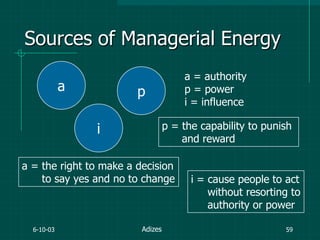
Sources of Managerial Energy
a
i
p
a = authority
p = power
i = influence
a = the right to make a decision
to say yes and no to change i = cause people to act
without resorting to
authority or power
p = the capability to punish
and reward
Adizes
6-10-03 60
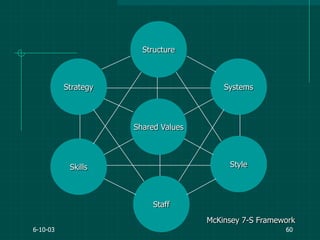
Shared Values
Strategy
Structure
Systems
Style
Staff
Skills
McKinsey 7-S Framework
6-10-03 61
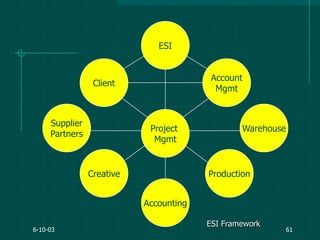
ProductionCreative
Project
Mgmt
Client
Account
Mgmt
Accounting
Supplier
Partners
Warehouse
ESI
ESI Framework
6-10-03 62
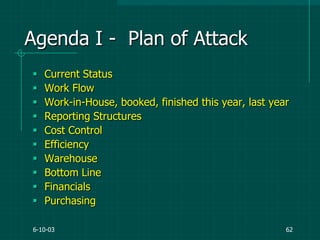
Agenda I - Plan of Attack
 Current Status
 Work Flow
 Work-in-House, booked, finished this year, last year
 Reporting Structures
 Cost Control
 Efficiency
 Warehouse
 Bottom Line
 Financials
 Purchasing
6-10-03 63
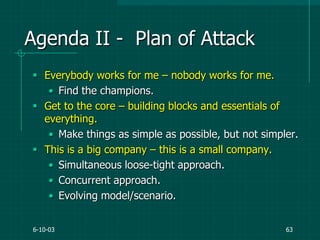
Agenda II - Plan of Attack
 Everybody works for me – nobody works for me.
• Find the champions.
 Get to the core – building blocks and essentials of
everything.
• Make things as simple as possible, but not simpler.
 This is a big company – this is a small company.
• Simultaneous loose-tight approach.
• Concurrent approach.
• Evolving model/scenario.
6-10-03 64
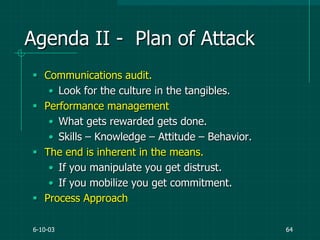
Agenda II - Plan of Attack
 Communications audit.
• Look for the culture in the tangibles.
 Performance management
• What gets rewarded gets done.
• Skills – Knowledge – Attitude – Behavior.
 The end is inherent in the means.
• If you manipulate you get distrust.
• If you mobilize you get commitment.
 Process Approach
6-10-03 65
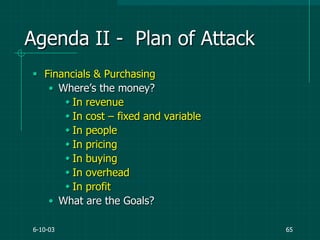
Agenda II - Plan of Attack
 Financials & Purchasing
• Where‟s the money?
 In revenue
 In cost – fixed and variable
 In people
 In pricing
 In buying
 In overhead
 In profit
• What are the Goals?
6-10-03 66
Laws
 All living systems seek to be effective and efficient in
the short and long run…
 …using their fixed amount of energy in the most
efficient way possible.
 The pattern is the lifecycle.
 The more integration a system has, the shorter the
route to prime.
 As long as there is change, there will be problems.
 All problems are created by disintegration.
Adizes
6-10-03 67
Laws
 Disintegration occurs because the subsystems that
comprise any system do not change all at the same
time.
 The role of the leaders is to lead change, integrate to
solve the problems created by change, and prepare
the system for the next cycle.
 Integration predicts development, and lack of it
predicts decay.
Adizes
6-10-03 68
“Leadership is the art of accomplishing
more than the science of management
says is possible.”
General Colin Powell
Chairman (Ret), Joint Chiefs of Staff
Secretary of State
United States of America
6-10-03 69
Lesson 16
 Command is lonely.
Colin Powell
6-10-03 70
Event Solutions International
ESI
Presented by:
First Light LLC – jgillis767@aol.com
6-10-03
Veritas
First Light LLC
John Gillis
jgillis767@aol.com
248-770-0485
6-10-03 71

Organizational development esi_08292013

  • 1.
    6-10-03 1 Event SolutionsInternational Organizational Development Presented by: First Light LLC – jgillis767@aol.com
  • 2.
    6-10-03 2 Event Managementand Logistics  Consumer events  Launch events  Motorsports events  Owner loyalty events  Promotional events  Sales training events Hands-on Inviting Live Memorable Dynamic Experiential Targeted
  • 3.
  • 4.
  • 5.
    6-10-03 5 Principles 1. Divisionof work. To produce more and better work with the same effort. 2. Authority and responsibility. Personal authority is the indispensable complement of official authority. 3. Discipline. Obedience, application, energy, behaviour and outward marks of respect. 4. Unity of command. An employee should receive orders from one superior . 5. Unity of direction. One head and one plan for a group of activities having the same objective. 6. Subordination of individual interest to the general interest. Fayol
  • 6.
    6-10-03 6 Principles 7. Remunerationof personnel. Should be fair and afford satisfaction both to personnel and firm. 8. Centralization. The finding of the measure which affords the best overall yield. 9. Scalar chain. The chain of superiors ranging from the ultimate authority to the lowest ranks. Route of communications. 10. Order. A place for everything and everything in its place. 11. Equity. Results from the combination of kindliness and justice. 12. Stability of tenure of personnel. A mediocre manager who stays is preferable to outstanding managers who come and go. Fayol
  • 7.
    6-10-03 7 13. Initiative.The power of thinking and executing, and the freedom to propose and execute. Tact and integrity required. 14. Esprit de corps. „Union is strength.‟ Harmony, union among the personnel of a company, is great strength in that company. Principles Fayol
  • 8.
    6-10-03 8 Infrastructure People, process, technology Context Product,service, live, print, Internet Content Ideas,goals, purpose, VMV How‟s it working? How do we deliver it? What‟s the strategy? BattlefieldLogisticsCommand Action Matrix Organization Communication Big Picture – Event Picture
  • 9.
    6-10-03 9 Battlefield Infrastructure People • Yours, mine and ours  Process • People, budgets and schedules • Macro and micro  Technology • Operational • Deliverable
  • 10.
  • 11.
    6-10-03 11 Lesson 1 Being responsible sometimes means pissing people off. Colin Powell
  • 12.
    6-10-03 12 Lesson 2 The day soldiers stop bringing you their problems is the day you have stopped leading them. They have either lost confidence that you can help them or concluded that you do not care. Either case is a failure of leadership. Colin Powell
  • 13.
    6-10-03 13 People  Whatdo you want me to do?  Why is it important?  How do I do it?  What‟s in it for me?  How do I know when I‟ve done it right?
  • 14.
    6-10-03 14 People  Whatwould you like me to keep doing?  What would you like me to do more of?  What would you like me to do less of?  What would you like me to stop doing?  What would you like me to start doing? Mordecai Magencey
  • 15.
    6-10-03 15 Lesson 3 Organization doesn‟t really accomplish anything. Plans don‟t accomplish anything either. Theories of management don‟t much matter. Endeavors succeed or fail because of the people involved. Only by attracting the best people will you accomplish great deeds. Colin Powell
  • 16.
    6-10-03 16 Lesson 4 Powell‟s rules for picking people: Look for intelligence and judgment, and most critically, a capacity to anticipate, to see around corners. Also look for loyalty, integrity, a high energy drive, a balanced ego, and the drive to get things done. Colin Powell
  • 17.
    6-10-03 17 Lesson 5 Have fun in your command. Don‟t always run at a breakneck pace. Take leave when you‟ve earned it: spend time with your families.  Corollary: surround yourself with people who take their work seriously, but not themselves – those who work hard and play hard. Colin Powell
  • 18.
  • 19.
  • 20.
    6-10-03 20 Lesson 6 Never neglect details. When everyone‟s mind is dulled or distracted the leader must be doubly vigilant. Colin Powell
  • 21.
    6-10-03 21 Lesson 7 You don‟t know what you can get away with until you try. Colin Powell
  • 22.
    6-10-03 22 Lesson 8 Keep looking below surface appearances. Don‟t shrink from doing so (just) because you might not like what you find. Colin Powell
  • 23.
    6-10-03 23 Lesson 9 Perpetual optimism is a force multiplier. Colin Powell
  • 24.
    6-10-03 24 Lesson 10 Great leaders are almost always great simplifiers, who can cut through argument, debate and doubt, to offer a solution everybody can understand. Colin Powell
  • 25.
    6-10-03 25 Lesson 11 Part I: • Use the formula P = 40 to 70, in which P stands for the probability of success and the numbers indicate the percentage of information acquired.  Part II: • Once the information is in the 40 to 70 range, go with your gut. Colin Powell
  • 26.
    6-10-03 26 Lesson 12 The commander in the field is always right and the rear echelon is wrong, unless proved otherwise. Colin Powell
  • 27.
    6-10-03 27 Process  Businesshappens horizontally.  Input – Process – Output  The problems and solutions usually occur at the interfaces, connections and handoffs.  Systems thinking.  A way of doing business.
  • 28.
    6-10-03 28 ISO  “Saywhat you do and do what you say.”  Make the process explicit. • ISO elements • System Level Procedures (SLPs) • Work Instructions  Process Owners. • Accountability and responsibility • Review, monitor, measure, improve  Management Responsibility.
  • 29.
    6-10-03 29 Process  QualitySystem  Corrective and Preventive Action  Continuous Improvement  Radical Improvement  Customer Satisfaction
  • 30.
  • 31.
  • 32.
    6-10-03 32 Lesson 13 Don‟t be buffaloed by experts and elites. Experts often possess more data than judgment. Elites can become so inbred that they produce hemophiliacs who bleed to death as soon as they are nicked by the real world. Colin Powell
  • 33.
    6-10-03 33 Lesson 14 Fit no stereotypes. Don‟t chase the latest management fads. The situation dictates which approach best accomplishes the team‟s mission. Colin Powell
  • 34.
    6-10-03 34 Lesson 15 Don‟t be afraid to challenge the pros, even in their own backyard. Colin Powell
  • 35.
    6-10-03 35 Questions  Therole of technology in the future of ESI?  The cost of technology in the infrastructure of ESI?  The role of technology in long-term efficiency?  The role of technology in integration?
  • 36.
  • 37.
    6-10-03 37 Management  SOMMD Sets objectives  Organizes  Motivates and communicates  Measures  Develops people Peter Ferdinand Drucker
  • 38.
    6-10-03 38 Respect &Professionalism  “If Judge MacMahon had been asked what he was training Paul Crotty, Ken Caruso, Jim Duff, David Denton, or Rudy Giuliani or any of his clerks to be, he would have said it was to be a fine trial lawyer. Being able to communicate, being able to explain, being able to simplify. He expected a lot from lawyers because he saw them as professionals, from whom one should expect the highest standards…the high standards he set were born out of respect.” Rudolf W. Giuliani
  • 39.
    6-10-03 39 Corporate Lifecycles Infancy  The Wild Years: Go-Go  The Second Birth and the Coming of Age  Prime  The Signs of Aging  Aristocracy  The Final Decay Adizes Prime = Optimal condition of the lifecycle – balance between self-control and flexibility.
  • 40.
    6-10-03 40 Courtship The WildYears: Go-Go Infancy Prime Corporate Lifecycles The Second Birth and the Coming of Age
  • 41.
    6-10-03 41 The WildYears: Go-Go  Normal Problems • Self confidence • Eagerness • High Energy • Sales orientation • Seeking what else to do • Sales beyond capability to deliver • Insufficient cost controls • Insufficiently disciplined staff meetings • No consistent salary administration • Increasingly remote leadership Adizes
  • 42.
    6-10-03 42 The WildYears: Go-Go  Normal Problems • Leadership‟s inflated expectations • Unclear communication • Hope for miracles • Unclear responsibilities • Company subject to criticism • Internal disintegration • Cracking infrastructure • Workable people- centric org structure • Everything is a priority? • Founder indispensable Adizes
  • 43.
    6-10-03 43 The WildYears: Go-Go  Abnormal Problems • Arrogance • Lack of Focus • Energy too thinly spread • Sales and premature profit orientation • No boundaries on what to do • Selling despite inability to deliver quality • No cost controls • No staff meetings • Overpaid employees • Leadership‟s paranoia Adizes
  • 44.
    6-10-03 44 The WildYears: Go-Go  Abnormal Problems • No communication • Reliance on miracles • Lack of accountability • Diminishing mutual trust and respect • Collapsing infrastructure • Unworkable people- centric organizational structure • Everything is a priority! Adizes
  • 45.
    6-10-03 45 Institutionalizing Leadership It is the difficult process of transferring the integration function that retards companies‟ abilities to institutionalize entrepreneurial functions.  For a company to preserve its hard-won gains, it must make the change from management-by- intuition and management-by-the-seat-of the pants – Go-Go management – to a more professional process. Adizes
  • 46.
    6-10-03 46 Guns orButter  The sooner the Go – Go realizes the necessity for setting priorities, the faster it will focus and become more efficient. The organization must learn that resources are limited and that the law of opportunity- costs prevails. Doing one thing means that one cannot do something else – and the cost of doing one thing is the price of not doing another. Adizes
  • 47.
    6-10-03 47 Goals  Teamwork Build integration to reduce the need for administrative systems  Purpose  Focus  Get over the “We‟re too busy to get organized.”  Grow up
  • 48.
    6-10-03 48 ESI Efficient inthe short run SystematizedAdminister Effective in the short run FunctionalProvide the desired needs Input (Role) Throughput Output Effective in the long run Efficient in the long run Proactive Organic Entrepreneur Integrate Adizes
  • 49.
    6-10-03 49 Entrepreneuring  “Wecannot afford the luxury of waiting to see the future before we decide what to do in the present.” Adizes  “Imagination is more important than knowledge.” Einstein  Creativity and risk taking.  Planning. Adizes
  • 50.
    6-10-03 50 Integrating  “Tointegrate means to change an organization‟s consciousness from mechanistic to organic.”  “Managers are as good as their ability to analyze the purpose of their organizations as well as the needs and wants of the people who will accomplish the purpose.” Adizes
  • 51.
    6-10-03 51 Integrating  “Thatinternal sense of belonging, of interdependence, is integration. And it is integration that makes an organization efficient.” Adizes
  • 52.
    6-10-03 52 Courtship The WildYears: Go-Go Infancy Prime Corporate Lifecycles The Second Birth and the Coming of Age
  • 53.
    6-10-03 53 Second Birth/Comingof Age  Normal Problems • Conflicts between partners or decision makers • Temporary loss of vision • Founder‟s acceptance of organizational sovereignty • Incentive systems rewarding wrong behavior • Yo-yo delegation of authority • Policies made but not adhered to • Board of directors‟ attempt to exert controls Adizes
  • 54.
    6-10-03 54 Second Birth/Comingof Age  Normal Problems • Love – hate relationship between the organization and its entrepreneurial leadership • Difficulty changing leadership style • Entrepreneurial role monopolized and personalized • Lack of controls • Lack of accountability • Low morale • Lack of profit-sharing scheme • Rising profits, flat sales Adizes
  • 55.
    6-10-03 55 Second Birth/Comingof Age  Abnormal Problems • Return to Go-Go and the founder‟s trap • Inconsistent goals • Organizational paralysis during endless power shifts • Rapid decline in mutual trust and respect • Excessive internal politics • Unchanging dysfunctional leadership style • Entrepreneur‟s refusal to delegate the role to a depersonalized role Adizes
  • 56.
    6-10-03 56 Second Birth/Comingof Age  Abnormal Problems • Divide-and-rule management • Imposition of excessive and expensive controls • Profit responsibility delegated without capability to manage it • Excessive salaries to retain employees • Rising profits, falling sales Adizes
  • 57.
    6-10-03 57 Integration andAdministration  An organization can achieve a timely move to the coming of age cycle if management consciously determines that the company is doing well and that now is the time to turn inward and organize.  Extra rules and controls are necessary only for those who lack a system of values to support them. Adizes
  • 58.
    6-10-03 58 Goals  Institutionalizeentrepreneurship as administration grows  Switch from a sales orientation to a profit orientation  Modify the reward systems  Modify the recognition and appreciation system  Integrate
  • 59.
    6-10-03 59 Sources ofManagerial Energy a i p a = authority p = power i = influence a = the right to make a decision to say yes and no to change i = cause people to act without resorting to authority or power p = the capability to punish and reward Adizes
  • 60.
  • 61.
  • 62.
    6-10-03 62 Agenda I- Plan of Attack  Current Status  Work Flow  Work-in-House, booked, finished this year, last year  Reporting Structures  Cost Control  Efficiency  Warehouse  Bottom Line  Financials  Purchasing
  • 63.
    6-10-03 63 Agenda II- Plan of Attack  Everybody works for me – nobody works for me. • Find the champions.  Get to the core – building blocks and essentials of everything. • Make things as simple as possible, but not simpler.  This is a big company – this is a small company. • Simultaneous loose-tight approach. • Concurrent approach. • Evolving model/scenario.
  • 64.
    6-10-03 64 Agenda II- Plan of Attack  Communications audit. • Look for the culture in the tangibles.  Performance management • What gets rewarded gets done. • Skills – Knowledge – Attitude – Behavior.  The end is inherent in the means. • If you manipulate you get distrust. • If you mobilize you get commitment.  Process Approach
  • 65.
    6-10-03 65 Agenda II- Plan of Attack  Financials & Purchasing • Where‟s the money?  In revenue  In cost – fixed and variable  In people  In pricing  In buying  In overhead  In profit • What are the Goals?
  • 66.
    6-10-03 66 Laws  Allliving systems seek to be effective and efficient in the short and long run…  …using their fixed amount of energy in the most efficient way possible.  The pattern is the lifecycle.  The more integration a system has, the shorter the route to prime.  As long as there is change, there will be problems.  All problems are created by disintegration. Adizes
  • 67.
    6-10-03 67 Laws  Disintegrationoccurs because the subsystems that comprise any system do not change all at the same time.  The role of the leaders is to lead change, integrate to solve the problems created by change, and prepare the system for the next cycle.  Integration predicts development, and lack of it predicts decay. Adizes
  • 68.
    6-10-03 68 “Leadership isthe art of accomplishing more than the science of management says is possible.” General Colin Powell Chairman (Ret), Joint Chiefs of Staff Secretary of State United States of America
  • 69.
    6-10-03 69 Lesson 16 Command is lonely. Colin Powell
  • 70.
    6-10-03 70 Event SolutionsInternational ESI Presented by: First Light LLC – jgillis767@aol.com
  • 71.
    6-10-03 Veritas First Light LLC JohnGillis jgillis767@aol.com 248-770-0485 6-10-03 71