PUBLIC
RELATIONS
MANAGEMENT
CRISIS COMMUNICATION MANAGEMENT AND
COMMUNICATION BARRIERS
Table of Contents
1. Introduction
2. Crisis definition
3. Characteristics of crisis
4. Types of crises
5. Crisis Cycle
6. Communication barriers
7. The role of manager in crisis
5/2/2021
ftgacademy1234@gmail.com
2
5/2/2021
ftgacademy1234@gmail.com
3
A CRISIS
• A crisis is any event that leads to unstable and dangerous situation affecting an
individual, group, community and the whole society.
• A balanced, timely public relation response in crisis minimizes the chances of
misinformation, misinterpretation of the facts and damage to corporate reputation.
• An organization can be faced with a predictable crisis such as strike or an
unpredictable crisis such as an industrial accident, explosion or crash.
CHARACTERISTICS OF CRISIS
 A crisis threatens the future existence of an organization
 A crisis develops at an ever increasing rate of destruction
 A crisis creates havoc with the financial reserves of a company
 A crisis has to be brought under control as soon as possible
5/2/2021
ftgacademy1234@gmail.com
4
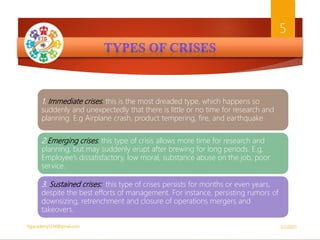
1. Immediate crises: this is the most dreaded type, which happens so
suddenly and unexpectedly that there is little or no time for research and
planning. E.g Airplane crash, product tempering, fire, and earthquake
2.Emerging crises: this type of crisis allows more time for research and
planning, but may suddenly erupt after brewing for long periods. E.g,
Employee’s dissatisfactory, low moral, substance abuse on the job, poor
service.
3. Sustained crises: this type of crises persists for months or even years,
despite the best efforts of management. For instance, persisting rumors of
downsizing, retrenchment and closure of operations mergers and
takeovers.
5/2/2021
ftgacademy1234@gmail.com
5
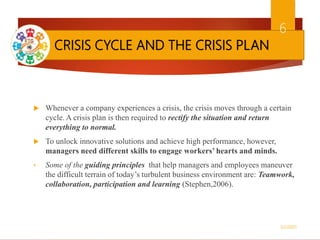
CRISIS CYCLE AND THE CRISIS PLAN
 Whenever a company experiences a crisis, the crisis moves through a certain
cycle. A crisis plan is then required to rectify the situation and return
everything to normal.
 To unlock innovative solutions and achieve high performance, however,
managers need different skills to engage workers’ hearts and minds.
• Some of the guiding principles that help managers and employees maneuver
the difficult terrain of today’s turbulent business environment are: Teamwork,
collaboration, participation and learning (Stephen,2006).
5/2/2021
6
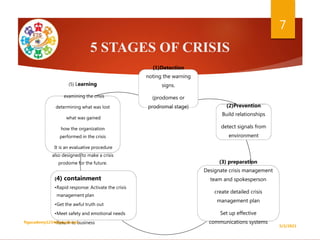
5 STAGES OF CRISIS
(1)Detection
noting the warning
signs.
(prodomes or
prodromal stage) (2)Prevention
Build relationships
detect signals from
environment
(3) preparation
Designate crisis management
team and spokesperson
create detailed crisis
management plan
Set up effective
communications systems
(4) containment
•Rapid response: Activate the crisis
management plan
•Get the awful truth out
•Meet safety and emotional needs
•Return to business
(5) Learning
examining the crisis
determining what was lost
what was gained
how the organization
performed in the crisis
It is an evaluative procedure
also designed to make a crisis
prodome for the future.
5/2/2021
ftgacademy1234@gmail.com
7
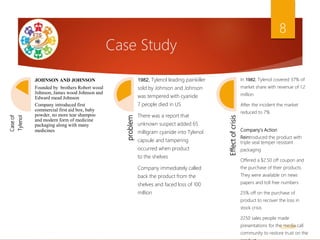
Case
of
Tylenol
JOHNSON AND JOHNSON
Founded by brothers Robert wood
Johnson, James wood Johnson and
Edward mead Johnson
Company introduced first
commercial first aid box, baby
powder, no more tear shampoo
and modern form of medicine
packaging along with many
medicines problem
1982, Tylenol leading painkiller
sold by Johnson and Johnson
was tempered with cyanide
7 people died in US
There was a report that
unknown suspect added 65
milligram cyanide into Tylenol
capsule and tampering
occurred when product
to the shelves
Company immediately called
back the product from the
shelves and faced loss of 100
million
Effect
of
crisis
In 1982, Tylenol covered 37% of
market share with revenue of 1.2
million
After the incident the market
reduced to 7%
Company's Action
Reintroduced the product with
triple seal temper resistant
packaging
Offered a $2.50 off coupon and
the purchase of their products.
They were available on news
papers and toll free numbers
25% off on the purchase of
product to recover the loss in
stock crisis
2250 sales people made
presentations for the media call
community to restore trust on the
Case Study
5/2/2021
8
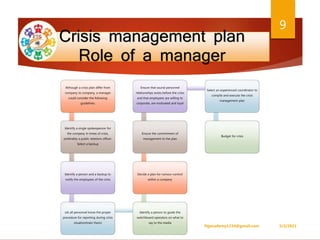
Crisis management plan
Role of a manager
Although a crisis plan differ from
company to company, a manager
could consider the following
guidelines:
Identify a single spokesperson for
the company in times of crisis,
preferably a public relations officer.
Select a backup
Identify a person and a backup to
notify the employees of the crisis
Let all personnel know the proper
procedure for reporting during crisis
situation(train them)
Identify a person to guide the
switchboard operators on what to
say to the media
Decide a plan for rumour-control
within a company
Ensure the commitment of
management to the plan
Ensure that sound personnel
relationships exists before the crisis
and that employees are willing to
corporate, are motivated and loyal
Select an experienced coordinator to
compile and execute the crisis
management plan
Budget for crisis
5/2/2021
ftgacademy1234@gmail.com
9
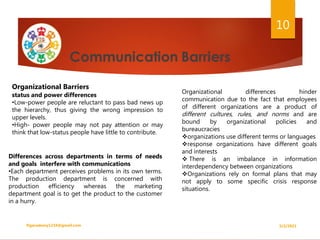
Organizational Barriers
status and power differences
•Low-power people are reluctant to pass bad news up
the hierarchy, thus giving the wrong impression to
upper levels.
•High- power people may not pay attention or may
think that low-status people have little to contribute.
Organizational differences hinder
communication due to the fact that employees
of different organizations are a product of
different cultures, rules, and norms and are
bound by organizational policies and
bureaucracies
organizations use different terms or languages
response organizations have different goals
and interests
 There is an imbalance in information
interdependency between organizations
Organizations rely on formal plans that may
not apply to some specific crisis response
situations.
Differences across departments in terms of needs
and goals interfere with communications
•Each department perceives problems in its own terms.
The production department is concerned with
production efficiency whereas the marketing
department goal is to get the product to the customer
in a hurry.
5/2/2021
ftgacademy1234@gmail.com
10
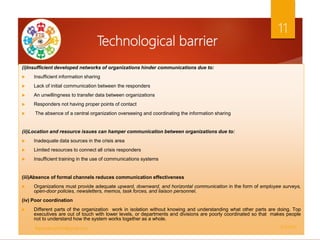
Technological barrier
(i)Insufficient developed networks of organizations hinder communications due to:
 Insufficient information sharing
 Lack of initial communication between the responders
 An unwillingness to transfer data between organizations
 Responders not having proper points of contact
 The absence of a central organization overseeing and coordinating the information sharing
(ii)Location and resource issues can hamper communication between organizations due to:
 Inadequate data sources in the crisis area
 Limited resources to connect all crisis responders
 Insufficient training in the use of communications systems
(iii)Absence of formal channels reduces communication effectiveness
 Organizations must provide adequate upward, downward, and horizontal communication in the form of employee surveys,
open-door policies, newsletters, memos, task forces, and liaison personnel.
(iv) Poor coordination
 Different parts of the organization work in isolation without knowing and understanding what other parts are doing. Top
executives are out of touch with lower levels, or departments and divisions are poorly coordinated so that makes people
not to understand how the system works together as a whole.
5/2/2021
ftgacademy1234@gmail.com
11
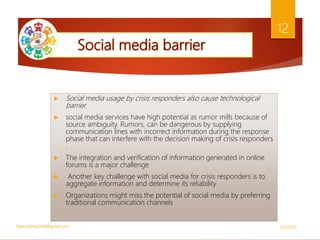
 Social media usage by crisis responders also cause technological
barrier.
 social media services have high potential as rumor mills because of
source ambiguity. Rumors, can be dangerous by supplying
communication lines with incorrect information during the response
phase that can interfere with the decision making of crisis responders
.
 The integration and verification of information generated in online
forums is a major challenge
 Another key challenge with social media for crisis responders is to
aggregate information and determine its reliability
 Organizations might miss the potential of social media by preferring
traditional communication channels
5/2/2021
ftgacademy1234@gmail.com
12
RECAP
 To cope with natural or man-made crises, it is crucial to distribute relevant
information and expertise in a timely manner to all crisis response
organizations; fire and rescue services, medical assistance, government
agencies, public organizations, police to save lives and minimize damage.
Under such stressful and highly dynamic situations, effective
communication can literally be a matter of life and death.
 A manager needs to have practiced Principles of management in order to
help current and future managers find innovative solutions to the
problems that plague today’s organizations, whether they are everyday
challenges or once in-a-lifetime crises.
 Even if all preventive measures have been taken, there is still the potential
for crisis. Companies must therefore plan to handle a crisis in the most
effective way possible to minimize the impact of the disaster, contain the
negative consequences and revert to “business as usual” as soon as
possible.
5/2/2021
ftgacademy1234@gmail.com
13
REFERENCES
 Stephen, P.R (2006). Managing today! New Jersey: SanDiego State University,
Prentice Hall
 Richard, L.D (2009). Principles of Management. India Edition: Cengage Learning
5/2/2021
ftgacademy1234@gmail.com
14
Email: ftgacademy1234@gmail.com
Facebook: https://www.facebook.com/FTG-Academy-
107915397682120/?modal=admin_todo_tour
Instagram: ftgacademy
LinkedIn: FTG Academy
5/2/2021
ftgacademy1234@gmail.com
15

Public relations management

  • 1.
  • 2.
    Table of Contents 1.Introduction 2. Crisis definition 3. Characteristics of crisis 4. Types of crises 5. Crisis Cycle 6. Communication barriers 7. The role of manager in crisis 5/2/2021 ftgacademy1234@gmail.com 2
  • 3.
  • 4.
    A CRISIS • Acrisis is any event that leads to unstable and dangerous situation affecting an individual, group, community and the whole society. • A balanced, timely public relation response in crisis minimizes the chances of misinformation, misinterpretation of the facts and damage to corporate reputation. • An organization can be faced with a predictable crisis such as strike or an unpredictable crisis such as an industrial accident, explosion or crash. CHARACTERISTICS OF CRISIS  A crisis threatens the future existence of an organization  A crisis develops at an ever increasing rate of destruction  A crisis creates havoc with the financial reserves of a company  A crisis has to be brought under control as soon as possible 5/2/2021 ftgacademy1234@gmail.com 4
  • 5.
    1. Immediate crises:this is the most dreaded type, which happens so suddenly and unexpectedly that there is little or no time for research and planning. E.g Airplane crash, product tempering, fire, and earthquake 2.Emerging crises: this type of crisis allows more time for research and planning, but may suddenly erupt after brewing for long periods. E.g, Employee’s dissatisfactory, low moral, substance abuse on the job, poor service. 3. Sustained crises: this type of crises persists for months or even years, despite the best efforts of management. For instance, persisting rumors of downsizing, retrenchment and closure of operations mergers and takeovers. 5/2/2021 ftgacademy1234@gmail.com 5
  • 6.
    CRISIS CYCLE ANDTHE CRISIS PLAN  Whenever a company experiences a crisis, the crisis moves through a certain cycle. A crisis plan is then required to rectify the situation and return everything to normal.  To unlock innovative solutions and achieve high performance, however, managers need different skills to engage workers’ hearts and minds. • Some of the guiding principles that help managers and employees maneuver the difficult terrain of today’s turbulent business environment are: Teamwork, collaboration, participation and learning (Stephen,2006). 5/2/2021 6
  • 7.
    5 STAGES OFCRISIS (1)Detection noting the warning signs. (prodomes or prodromal stage) (2)Prevention Build relationships detect signals from environment (3) preparation Designate crisis management team and spokesperson create detailed crisis management plan Set up effective communications systems (4) containment •Rapid response: Activate the crisis management plan •Get the awful truth out •Meet safety and emotional needs •Return to business (5) Learning examining the crisis determining what was lost what was gained how the organization performed in the crisis It is an evaluative procedure also designed to make a crisis prodome for the future. 5/2/2021 ftgacademy1234@gmail.com 7
  • 8.
    Case of Tylenol JOHNSON AND JOHNSON Foundedby brothers Robert wood Johnson, James wood Johnson and Edward mead Johnson Company introduced first commercial first aid box, baby powder, no more tear shampoo and modern form of medicine packaging along with many medicines problem 1982, Tylenol leading painkiller sold by Johnson and Johnson was tempered with cyanide 7 people died in US There was a report that unknown suspect added 65 milligram cyanide into Tylenol capsule and tampering occurred when product to the shelves Company immediately called back the product from the shelves and faced loss of 100 million Effect of crisis In 1982, Tylenol covered 37% of market share with revenue of 1.2 million After the incident the market reduced to 7% Company's Action Reintroduced the product with triple seal temper resistant packaging Offered a $2.50 off coupon and the purchase of their products. They were available on news papers and toll free numbers 25% off on the purchase of product to recover the loss in stock crisis 2250 sales people made presentations for the media call community to restore trust on the Case Study 5/2/2021 8
  • 9.
    Crisis management plan Roleof a manager Although a crisis plan differ from company to company, a manager could consider the following guidelines: Identify a single spokesperson for the company in times of crisis, preferably a public relations officer. Select a backup Identify a person and a backup to notify the employees of the crisis Let all personnel know the proper procedure for reporting during crisis situation(train them) Identify a person to guide the switchboard operators on what to say to the media Decide a plan for rumour-control within a company Ensure the commitment of management to the plan Ensure that sound personnel relationships exists before the crisis and that employees are willing to corporate, are motivated and loyal Select an experienced coordinator to compile and execute the crisis management plan Budget for crisis 5/2/2021 ftgacademy1234@gmail.com 9
  • 10.
    Organizational Barriers status andpower differences •Low-power people are reluctant to pass bad news up the hierarchy, thus giving the wrong impression to upper levels. •High- power people may not pay attention or may think that low-status people have little to contribute. Organizational differences hinder communication due to the fact that employees of different organizations are a product of different cultures, rules, and norms and are bound by organizational policies and bureaucracies organizations use different terms or languages response organizations have different goals and interests  There is an imbalance in information interdependency between organizations Organizations rely on formal plans that may not apply to some specific crisis response situations. Differences across departments in terms of needs and goals interfere with communications •Each department perceives problems in its own terms. The production department is concerned with production efficiency whereas the marketing department goal is to get the product to the customer in a hurry. 5/2/2021 ftgacademy1234@gmail.com 10
  • 11.
    Technological barrier (i)Insufficient developednetworks of organizations hinder communications due to:  Insufficient information sharing  Lack of initial communication between the responders  An unwillingness to transfer data between organizations  Responders not having proper points of contact  The absence of a central organization overseeing and coordinating the information sharing (ii)Location and resource issues can hamper communication between organizations due to:  Inadequate data sources in the crisis area  Limited resources to connect all crisis responders  Insufficient training in the use of communications systems (iii)Absence of formal channels reduces communication effectiveness  Organizations must provide adequate upward, downward, and horizontal communication in the form of employee surveys, open-door policies, newsletters, memos, task forces, and liaison personnel. (iv) Poor coordination  Different parts of the organization work in isolation without knowing and understanding what other parts are doing. Top executives are out of touch with lower levels, or departments and divisions are poorly coordinated so that makes people not to understand how the system works together as a whole. 5/2/2021 ftgacademy1234@gmail.com 11
  • 12.
     Social mediausage by crisis responders also cause technological barrier.  social media services have high potential as rumor mills because of source ambiguity. Rumors, can be dangerous by supplying communication lines with incorrect information during the response phase that can interfere with the decision making of crisis responders .  The integration and verification of information generated in online forums is a major challenge  Another key challenge with social media for crisis responders is to aggregate information and determine its reliability  Organizations might miss the potential of social media by preferring traditional communication channels 5/2/2021 ftgacademy1234@gmail.com 12
  • 13.
    RECAP  To copewith natural or man-made crises, it is crucial to distribute relevant information and expertise in a timely manner to all crisis response organizations; fire and rescue services, medical assistance, government agencies, public organizations, police to save lives and minimize damage. Under such stressful and highly dynamic situations, effective communication can literally be a matter of life and death.  A manager needs to have practiced Principles of management in order to help current and future managers find innovative solutions to the problems that plague today’s organizations, whether they are everyday challenges or once in-a-lifetime crises.  Even if all preventive measures have been taken, there is still the potential for crisis. Companies must therefore plan to handle a crisis in the most effective way possible to minimize the impact of the disaster, contain the negative consequences and revert to “business as usual” as soon as possible. 5/2/2021 ftgacademy1234@gmail.com 13
  • 14.
    REFERENCES  Stephen, P.R(2006). Managing today! New Jersey: SanDiego State University, Prentice Hall  Richard, L.D (2009). Principles of Management. India Edition: Cengage Learning 5/2/2021 ftgacademy1234@gmail.com 14
  • 15.